US5334917A - System and method for optimally driving a DC motor - Google Patents

System and method for optimally driving a DC motor Download PDF

Info

Publication number
US5334917A
US5334917A US07/937,995 US93799592A US5334917A US 5334917 A US5334917 A US 5334917A US 93799592 A US93799592 A US 93799592A US 5334917 A US5334917 A US 5334917A
Authority
US
United States
Prior art keywords
sub
signal
time
register
bemf
Prior art date
Legal status (The legal status is an assumption and is not a legal conclusion. Google has not performed a legal analysis and makes no representation as to the accuracy of the status listed.)
Expired - Fee Related
Application number
US07/937,995
Inventor
Bjorn Lind
Current Assignee (The listed assignees may be inaccurate. Google has not performed a legal analysis and makes no representation or warranty as to the accuracy of the list.)
Oerlikon Textile GmbH and Co KG
Original Assignee
W Schlafhorst AG and Co
Priority date (The priority date is an assumption and is not a legal conclusion. Google has not performed a legal analysis and makes no representation as to the accuracy of the date listed.)
Filing date
Publication date
Priority to SE9002420A priority Critical patent/SE9002420L/en
Priority to EP91850188A priority patent/EP0466673A1/en
Priority to JP3197179A priority patent/JPH05176587A/en
Application filed by W Schlafhorst AG and Co filed Critical W Schlafhorst AG and Co
Priority to US07/937,995 priority patent/US5334917A/en
Assigned to AB SKF reassignment AB SKF ASSIGNMENT OF ASSIGNORS INTEREST. Assignors: LIND, BJORN
Assigned to W. SCHLAFHORST AG & CO reassignment W. SCHLAFHORST AG & CO ASSIGNMENT OF ASSIGNORS INTEREST (SEE DOCUMENT FOR DETAILS). Assignors: AB SKF
Application granted granted Critical
Publication of US5334917A publication Critical patent/US5334917A/en
Anticipated expiration legal-status Critical
Expired - Fee Related legal-status Critical Current

Links

Images

Classifications

    • HELECTRICITY
    • H02GENERATION; CONVERSION OR DISTRIBUTION OF ELECTRIC POWER
    • H02PCONTROL OR REGULATION OF ELECTRIC MOTORS, ELECTRIC GENERATORS OR DYNAMO-ELECTRIC CONVERTERS; CONTROLLING TRANSFORMERS, REACTORS OR CHOKE COILS
    • H02P6/00Arrangements for controlling synchronous motors or other dynamo-electric motors using electronic commutation dependent on the rotor position; Electronic commutators therefor
    • H02P6/14Electronic commutators
    • H02P6/15Controlling commutation time

Definitions

  • the present invention refers to an inverter for brushless DC-operated electrical motors.
  • the invention refers to a method to control the commutation of a DC-motor comprising an inverter and a multiple phase synchronous motor with a permanent magnet rotor, and provided with a rotor position detection means in order to generate a rotation dependent position signal or signals.
  • a brushless or commutator free DC- motor generally comprises a permanent magnet synchronous motor which is fed by an inverter controlled by magnetic or optical sensors arranged at the motor shaft, said sensors provide a pattern of output signals corresponding to the rotor position of said motor. The output signals are then processed in logic circuits and control the output bridge of the inverter.
  • a synchronous motor with a feeding equipment of the type is normally self-commutating, that is, it operates basically in the same way as a DC -motor with mechanical commutation.
  • the waveform of the output voltage from the inverter should be adapted as well as possible to the waveform of the back- EMF generated by the motor, which normally is sinusoidal.
  • the losses in this can be kept low, but consideration must also be taken to influence of harmonics in the stator winding which are generated as a result of the square wave of the inverter and which harmonics do not contribute to the torque of the synchronous motor.
  • a second object of the invention is to provide a method to optimize the inverter drive system for a self-commutating DC supplied permanent magnet synchronous motor dynamically with respect to efficiency at the present velocity and load condition, maximum acceleration and motor vibrations.
  • FIG. 1 shows a block diagram in principle over a first embodiment of a motor system comprising an inverter according to the invention
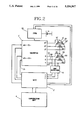
  • FIG. 2 shows a block diagram in principle over a second embodiment of a motor system comprising a modified inverter according to the invention in which the fifth harmonic has been eliminated;
  • FIG. 3 shows a block diagram of a motor control unit included in the first and second embodiments of the motor drive system according to the invention
  • FIG. 4a shows a simplified diagram for the inverter included in the motor system according to the first embodiment of the invention.
  • FIG. 4b shows a vector diagram for the inverter included in the motor system according to the invention.
  • FIG. 5a-e shows timing diagrams for the inverter included in the motor system according to the invention
  • FIG. 6 shows position signals and output signals from the motor control unit in a 6-pulse system
  • FIG. 7 shows position signals and output signals from the motor control unit in a 12-pulse system
  • FIG. 8a shows common commutating positions in a 6-pulse system without optimization which is used with the drive system according to the invention
  • FIG. 8b shows a timing diagram for modification of the commutation positions in a 6-pulse system for optimization according to the invention
  • FIG. 9 shows a block diagram of the commutation control unit which performs modification of the commutation positions for optimization according to the invention.
  • FIG. 10 shows a timing diagram of the result of an optimization according to the invention.
  • a three phase inverter l with its outputs R,S and T is connected to respective stator windings 31, 32 and 33 via the lines 51, 52 and 53 where each winding comprises one phase of a preferably permanently magnetized synchronous motor 3 the permanent magnet rotor of which can comprise 2 poles.
  • the inverter 1 comprises 6 valves which are controlled from the inputs A+-C- which in their turn are connected to corresponding outputs of the control unit 2.
  • On The inputs r,s and t of the control unit 2 are supplied rotor position signals from the back-EMF detector 5 which detects zero passages on the supply lines 51, 52 and 53 .
  • the resulting signal pattern from the bask- EMF and corresponding control signals is shown in FIG. 6.
  • the inverter is supplied from a battery 11 via a control unit 10 which operates with pulse width modulation (PWM) from the control unit 2.
  • PWM pulse width modulation
  • the function of the control unit 2 is supervised by the supervising unit 4 comprising a ⁇ -processor.
  • the control signal SSD (SET SPEED) gives the pulse width modulation a certain ratio corresponding to a certain effective voltage supplied to the inverter 1.
  • the rotational speed of the motor is directly proportional to the supply voltage of the inverter.
  • the control signals (DATA IN) comprise commands for rotational direction, braking, normal operation and impulse start.
  • FIG. 2 a 12-pulse application of the motor system according to the present invention is shown, which gives an elimination of the fifth harmonic.
  • the three phase inverter 1' comprises 12 valves which are controlled from the inputs A1+-C1-och A2+-C2- which in turn are connected to corresponding outputs of the control unit 2'.
  • the inverter from its outputs R,S,T and R',S',T' feeds respective sets of stator windings 31,32,33 and 31', 32', 33', in the permanent magnet synchronous motor 3'.
  • the position signals from the back-EMF detector 5 and resulting operating signals are illustrated in FIG. 7.
  • the operating voltages RST and R',S',T' are 60 degrees displaced with respect to each other and in the resulting stator flow influence of the fifth and seventh harmonics is eliminated with corresponding raise in the efficiency, see further in the specification page 7, eq. 1-4.
  • the motor system according to FIG. 2 for the rest has a function similar to that accounted for i connection to FIG. 1.
  • FIG. 3 a block diagram over the motor control unit 2 is shown, which contains a commutation control unit (CCU) comprising detecting means for rotational direction and velocity as well as means for detecting and controlling the commutating angles.
  • CCU commutation control unit
  • the current can be detected in the current detector 97 and a suitable current be set on the current limiter 98 from the supervising unit 4 by means of the signal CVSI (CURRENT VOLTAGE SOURCE INVERTER).
  • the circuit REG gives pulse width controlled pulses corresponding to the control signal SET SPEED.
  • FIG. 4a With reference to FIG. 4a is shown a basic circuit diagram over the inverter 1, which consists of a three phase bridge with the controllable valves A+, A-, B+, B-, C+, C- which can be constituted by a MOS-transistor with an integrated back diode D .
  • the outputs R, S and T from the three phase bridge are connected respectively to each phase of a synchronous motor with a permanent magnet rotor whereby the phases 31,32,33 with identical, impedances are connected in Y - configuration in order to clearly illustrate the function of the inverter.
  • the three phase bridge is connected to the symmetrical supply voltages +U d /2 and -U d /2.
  • FIG. 5a Through digital signal processing in the commutation control unit a set of signals is crested which can be seen in FIG. 5a for generation of the potential wave forms on the alternating current outputs R,S,T according to FIG. 5b. From this can be seen, that these wave forms are three square wave voltages with the amplitude U d /Z and 120° phase shift.
  • the square wave voltages consist of odd harmonics with the mean square values
  • V R , V s and V T are the three phase potentials and i R , i S and i T are the corresponding currents through the same impedances Z which connect the AC-terminals to the (real or imaginary) neutral point of the three phase system, the potential of the neutral point can be calculated from
  • the potential wave form of the neutral is a third of the sum of the three phase potential wave forms. It is a square wave, see FIG. 5c with an amplitude of T/3 * 1/2 U d , and a fundamental frequency which is three times the frequency of the inverter. Therefore it only contains harmonics with the harmonic sequence which are multiples of 3, and the harmonics have the same amplitude and phase as corresponding harmonics of the phase potentials.
  • phase voltages u R , u S , and u T are the difference between the potentials of R, S, and T and the potential of the neutral point.
  • the result is that voltages will contain the same harmonic components as the square waves, which blocks multiples of harmonics of three since these will be eliminated.
  • the phase to phase voltages are semi square voltages with conduction intervals of 120° and with the same harmonics as the phase voltages, see FIG. 5e.
  • FIG. 4b In order to further illustrate the operating principle of the inverter 1 a vector diagram is shown in FIG. 4b for the fundamental components of the phase voltages u R , u s , and u T and the main voltages u R-S , u S-T and u T-R .
  • a starting sequence for the motor 3 is described in the following.
  • the back- EMF is equal to zero on the supply lines.
  • a first current pulse is given to the rotor via the supervising unit 4 and an activation signal to the DATA IN input of the commutation control unit.
  • a stator winding e.g. 31 receives a current pulse which gives rise to an arbitrary magnetic field, whereby if no back-EMF is detected, a second current pulse is supplied through e.g. 32 which produces a magnetic field the direction of which does not coincide with the first.
  • One of the main functions of the control unit 2 is to make possible an optimization of performance by minimizing power dissipation from the motor at high speed operation of the motor.
  • this optimization is performed by displacing the commutating or the firing points and detecting changes in the input current. Because of unsymmetries in the stator iron, the stator windings and the permanent magnetized rotor the back-EMF or position sensors do not give quite optimal commutating information for all 60 degrees commutating intervals.
  • the displacement of the commutating points is carried out in the commutation control unit 90 which will be described in detail below.
  • the Commutation Control Unit 90 forms a part of the Motor Control Unit 2 (MCU).
  • the prime function of the CCU is to control the commutation to give optimum performance of the high speed motor driving system.
  • Input signals are rotor position signals created by sensors or by back-EMF detectors.
  • the electronic commutation control is monitored by a supervisory unit, e.g. a micro-processor, with input data from the CCU.
  • Output data is used to change commutation transition points for different commutation types.
  • Output data is also used to control motor action e.g. start, brake and rotation direction.
  • the pulse detector 101 creates two signals from the position signals (POS1, POS2, POS3). Each transition of position signals are detected and summarized to a LOAD-signal, which is used to transport data through the CCU-structure. The other signal, POSITION -- RESET, is created from the POS1 signal each period at the positive transition. These two signals consists of pulses, which are one clock period long.
  • the system clock 100 of a frequency of e.g. 10 MHz is used to synchronize the data flow in the CCU. It is also used to measure the time interval between position signal transitions. A lower clock frequency can be selected, to avoid time measurement overflow at low rotation speeds.
  • the input memory 112 and the output memory 113 are memories which store data that is exchanged between the supervising unit and the motor control unit.
  • the time counter 108 is reset for each LOAD-pulse.
  • the encountered value is stored in the time register 109 at the same time.
  • the time counter value is an integer, proportional to the distance between two position signal transitions. This value is used in the calculation of commutation position, relative to position signal transitions.
  • the position counter 102 holds information of which interval in the cycle is measured. There are 6 intervals for each cycle or revolution of the rotor in this embodiment of the invention.
  • the position counter is set to zero by the POSITION -- RESET signal.
  • the position value is used to control the multiplication algorithm, to allocate counters, to create phase signals and to control back-EMF gaps to phase signals.
  • Each position has a specific control decoding scheme for 6 or 12-pulse drive systems and for the selected commutation type.
  • the time register 109 is used to hold data for the multiplication algorithm in each interval. This time value is also transferred to an output memory accessible from the supervisory unit. The sum of six consecutive values comprise a value proportional to the rotor speed, RPM.
  • the position registers 103A, 103B,103C hold the position address for each step in the data processing. It is used to decode the function for each interval in the pipe-lined design structure.
  • the multiplier unit 111 multiplies the time register value with a binary constant, stored in an input memory 112.
  • the constant has a practical range from 0.0000 to 1.9999, i.e to decrease or increase the time value.
  • the calculated value is stored in a signal register 114A or back-emf register 114 B, to be used when the next interval begins. During one interval several multiplications can be performed, to implement the algorithm for a specific commutation. Time considerations for an example shows the following
  • the algorithm for each interval depends on the type of commutation that is selected.
  • the state machine 110 has a program which can control multiplication for 12 counters in each interval. The result is stored in a register for each counter.
  • the state machine 110 fetches constants from the input memory 112. It also stores the time register value in the output memory 113.
  • the SIGNAL -- REG's 1 and 2 respectively BEMF -- REG's 3 and 4 are used alternately.
  • counters are in use as other 4 are loaded with new values.
  • the back-EMF counter can be used alternately for 6 and 12-pulse drive systems.
  • the control register 124 is loaded directly from the supervisory unit 4. This register contains signals to control the following functions
  • commutation phase (e.g. 0, +/-60 degrees) related to position signals
  • Each counter has a register that is loaded by the state machine program. These registers hold data until the next interval starts. These registers could be omitted if the value is loaded into the counters. The counters are then enabled, when the next interval starts.
  • the counter allocator 115A, 115B has a decoding scheme corresponding to each interval, defined by POSITION value to load the correct counter with a new value when the LOAD pulse comes. Some counters, initiated from the previous interval, can still be active.
  • Counters 116A and 116B are down counters and when they reach zero value, a pulse is generated. This pulse performs a set or reset function on signal flip-flops. The same clock is used for counting down the modified value as measuring the time interval. The count down value represents the time at which a phase signal transition should occur.
  • the signal flip-flop (FF) allocator 117A and 117B has a decoding scheme corresponding to each interval, defined by the POSITION value to control the set or reset of a phase signal. By means of the down counter pulse is switched to the correct phase signal FF in the defined interval.
  • a signal flip-flop 118A and 118B is allocated for each signal. These flip-flops are set or reset by a pulse from some of the down counters.
  • the rotation direction switch 120 is controlled by signals from the control register 124.
  • the direction is controlled by switching phase signal order.
  • An optional drive mode, defined by the control register, is available by switching the position signals directly to the out going phase signals after logical modification for desired commutation type. This mode thus disconnects the phase signals generated by the described data processing steps.
  • the back-emf signal is allocated to the correct phase signal as defined by the POSITION value.
  • the back-EMF signal can be disconnected by a signal from the control register 124.
  • the back-EMF signal is applied to an AND-gate 121A, 121B and 121C to the appropriate phase signal.
  • phase drive control logic 123A, 123B and 123C performs control actions initiated by the supervisory unit 4 or from protective measurement units not shown.
  • Actions from the supervisory unit are defined by CONTROL -- REGISTER signals.
  • Brake is performed by short circuit of phase windings.
  • Free-wheel is performed when phase signals are inactive.
  • the motor control unit 122 can receive a signal from a protective measurement unit outside the CCU. This signal inactivates phase signal drive.
  • the protective signal can e.g. be generated when the motor current exceeds a specific limit value.
  • the signal CLOCK -- EX is the system clock signal, shown as an example, which time period is to small to be shown on the time scale used.
  • the signal CLOCK -- EX is the system clock signal, shown as an example, which time period is to small to be shown on the time scale used.
  • the system clock signal shown as an example, which time period is to small to be shown on the time scale used.
  • two load pulses about 100 ⁇ s there are 1000 actual clock periods, 0,1 ⁇ s.
  • POS1, POS2, POS3 are position signals from sensors or back-EMF detector 5.
  • LOAD is the sum of POS-signal transition pulses.
  • POS -- RESET is the signal pulse for one revolution of the rotor.
  • BACK -- EMF is the gap where the back-EMF position signal can be detected.
  • A+,A-,B+,B-,C+,C- are phase signals to the inverter power transistor bridge.
  • the timing diagram shows the signals that can be modified by the algorithm. These signal transition areas are shown, as an example, with a pattern in the diagram. The modification of each signal is performed with a start reference at the LOAD signal pulse. Both positive and negative transitions can be altered. The change is calculated by the general formula
  • this contains CLOCK -- EX, system clock with not accurate time scale; POS1, POS2, POS3 position signals as above; LOAD, sum signal pulses of position signals; A+,A-,B+,B-,C+,C- are phase signals to the inverter power transistor bridge; BACK -- EMF, signal gap to create back-EMF sensor signals; SET and RESET signals for each phase and back-emf signals.
  • the signals are a result from the time calculation according to the formula defined above.
  • FIG. 10 is shown as an example the result of an optimization in which symmetric phase signals are obtained from asymmetric position signals from either sensors or the EMF-detector.
  • the set and reset signals for each phase signal are generated by logic circuits, initiated by time pulse calculation.
  • a measured previous interval is multiplied by a constant, which modifies a specific signal transition. All measured intervals for a revolution are repeated, or slightly changed because of speed variation.
  • Algorithms for power minimization can be used with commutation position control as described above, as a control variable. The operation is the following:

Landscapes

  • Engineering & Computer Science (AREA)
  • Power Engineering (AREA)
  • Control Of Motors That Do Not Use Commutators (AREA)

Abstract

Method and a device in a drive system for a DC-motor including an inverter and a multiple phase synchronous motor with a permanent magnet rotor, and provided with a rotor position detection means in order to generate a rotation dependent logical position signal or signals. An optimization is carried out, which is based on the rotation dependent logical signals (POS1, POS2, POS3) from said rotor position detection means whereby the commutation points each are displaced such, that at said optimization minimum input current is detected to eliminate poor operation caused by unsymmetries in the motor iron or windings as well as unsymmetries of the rotor magnet and thereby optimize motor performance with respect to e.g. efficiency at present velocity and load, maximum acceleration and motor vibrations.

Description

This is a continuation-in-part of application Ser. No. 07/720892, filed Jun. 25, 1991 now abandoned.
The present invention refers to an inverter for brushless DC-operated electrical motors. In particular the invention refers to a method to control the commutation of a DC-motor comprising an inverter and a multiple phase synchronous motor with a permanent magnet rotor, and provided with a rotor position detection means in order to generate a rotation dependent position signal or signals.
BACKGROUND OF THE INVENTION
A brushless or commutator free DC- motor generally comprises a permanent magnet synchronous motor which is fed by an inverter controlled by magnetic or optical sensors arranged at the motor shaft, said sensors provide a pattern of output signals corresponding to the rotor position of said motor. The output signals are then processed in logic circuits and control the output bridge of the inverter. A synchronous motor with a feeding equipment of the type is normally self-commutating, that is, it operates basically in the same way as a DC -motor with mechanical commutation.
In conventional DC brushless motors designed for rotational speeds up to 10,000 rpm switching losses in the motor windings and slight unsymmetries in the commutation detection circuits ( which could be of type optic, magnetic or Back-EMF) normally do not cause any problems. However in a high speed motor a slight unsymmetry or displacement of the commutation points may cause very high losses e.g. in the magnitude of the rated power and might damage the motor. The design of the inverter has to be such that the majority of heat losses are dissipated in the inverter and not in the stator coils and core which are very sensitive to heating.
Thus the reference commutation points which have been obtained either by external shaft position encoders or internally by Back-EMF detection have to be displaced
a) individual angles with respect to unsymmetries of the rotor and stator and
b) all with the same amount of angle when e.g. the armature reaction has to be compensated for.
Various motor speeds as well as different motor species give different sets of commutation time points.
In order to keep the losses of the synchronous motor as small as possible, the waveform of the output voltage from the inverter should be adapted as well as possible to the waveform of the back- EMF generated by the motor, which normally is sinusoidal. By using switching technique in the inverter, the losses in this can be kept low, but consideration must also be taken to influence of harmonics in the stator winding which are generated as a result of the square wave of the inverter and which harmonics do not contribute to the torque of the synchronous motor.
When inverting at high operating frequencies corresponding to high rotational speeds (100,000 r.p.m) of the motor in question it is essential to keep the number of switchings per electric feeding period as low as possible in order to avoid substantial losses in the inverter. At high r.p.m. it is also important that the switching is performed in such a way that the output power per volume unit will be as large as possible. The difference between the calculated mechanical setting of the magnetic sensors (e.g. Hall sensors) or optical sensors and the actual setting which is influenced by unsymmetries of the rotor, the stator windings and stator iron is critical with respect to the efficiency of the motor especially at high rotor speeds. This increases the costs of production of such a motor since measures have to be taken for a final adjustment of the sensors. In certain cases also separate commutating magnets are used in order to avoid influence from the stator field, which involves an additional material and assembly cost in addition to the costs of a device for final adjustment and the sensors per se.
THE OBJECTS 0F THE INVENTION AND ESSENTIAL FEATURES
It is a first object of the invention to provide an inverter for a brushless motor drive system in which the number of switchings per electric current supply period is reduced to a minimum.
A second object of the invention is to provide a method to optimize the inverter drive system for a self-commutating DC supplied permanent magnet synchronous motor dynamically with respect to efficiency at the present velocity and load condition, maximum acceleration and motor vibrations.
The above objects are achieved according to the present invention by providing a three phase inverter with voltage stiff output and 180° commutation angle for the commutation signals, and by the commutation points based on the rotation dependent logical signals from said rotor position detection means each being displaced by a commutation control unit individually such, that an optimization can be carried out to eliminate poor operation caused by unsymmetries in the motor iron or the windings as well as unsymmetries of the rotor magnet and a method for driving the DC-motor comprises
a) performing optimization based upon the logical position signals from the position detecting mechanism whereby the commutation points derived from said position signals are each individually displaced by a commutation control unit according to a certain scheme;
b) detecting the input current level when controlling the commutation for minimum power dissipation in the permanent magnet motor to optimize motor performance by reducing motor vibrations, maximizing motor acceleration, and providing efficient operation at given velocity and load.
With reference to the accompanying drawing in the following preferred embodiments of the present invention are described.
IN THE DRAWING
FIG. 1 shows a block diagram in principle over a first embodiment of a motor system comprising an inverter according to the invention;
FIG. 2 shows a block diagram in principle over a second embodiment of a motor system comprising a modified inverter according to the invention in which the fifth harmonic has been eliminated;
FIG. 3 shows a block diagram of a motor control unit included in the first and second embodiments of the motor drive system according to the invention;
FIG. 4a shows a simplified diagram for the inverter included in the motor system according to the first embodiment of the invention.
FIG. 4b shows a vector diagram for the inverter included in the motor system according to the invention;
FIG. 5a-e shows timing diagrams for the inverter included in the motor system according to the invention;
FIG. 6 shows position signals and output signals from the motor control unit in a 6-pulse system;
FIG. 7 shows position signals and output signals from the motor control unit in a 12-pulse system;
FIG. 8a shows common commutating positions in a 6-pulse system without optimization which is used with the drive system according to the invention;
FIG. 8b shows a timing diagram for modification of the commutation positions in a 6-pulse system for optimization according to the invention;
FIG. 9 shows a block diagram of the commutation control unit which performs modification of the commutation positions for optimization according to the invention;
FIG. 10 shows a timing diagram of the result of an optimization according to the invention.
A three phase inverter l with its outputs R,S and T is connected to respective stator windings 31, 32 and 33 via the lines 51, 52 and 53 where each winding comprises one phase of a preferably permanently magnetized synchronous motor 3 the permanent magnet rotor of which can comprise 2 poles.
The inverter 1 comprises 6 valves which are controlled from the inputs A+-C- which in their turn are connected to corresponding outputs of the control unit 2. On The inputs r,s and t of the control unit 2 are supplied rotor position signals from the back-EMF detector 5 which detects zero passages on the supply lines 51, 52 and 53 . The resulting signal pattern from the bask- EMF and corresponding control signals is shown in FIG. 6. The inverter is supplied from a battery 11 via a control unit 10 which operates with pulse width modulation (PWM) from the control unit 2. The function of the control unit 2 is supervised by the supervising unit 4 comprising a μ-processor.
From the interface of the control unit 2 (see FIG. 3) versus the supervising unit 4 there are information signals about current limiting CLT (CURRENT LIMIT), present rotational speed and rotor position including direction of rotation (DATA OUT ).
The control signal SSD (SET SPEED) gives the pulse width modulation a certain ratio corresponding to a certain effective voltage supplied to the inverter 1. The rotational speed of the motor is directly proportional to the supply voltage of the inverter.
The control signals (DATA IN) comprise commands for rotational direction, braking, normal operation and impulse start.
With reference to FIG. 2 a 12-pulse application of the motor system according to the present invention is shown, which gives an elimination of the fifth harmonic.
The three phase inverter 1' comprises 12 valves which are controlled from the inputs A1+-C1-och A2+-C2- which in turn are connected to corresponding outputs of the control unit 2'. The inverter from its outputs R,S,T and R',S',T' feeds respective sets of stator windings 31,32,33 and 31', 32', 33', in the permanent magnet synchronous motor 3'. The position signals from the back-EMF detector 5 and resulting operating signals are illustrated in FIG. 7.
The operating voltages RST and R',S',T' are 60 degrees displaced with respect to each other and in the resulting stator flow influence of the fifth and seventh harmonics is eliminated with corresponding raise in the efficiency, see further in the specification page 7, eq. 1-4. The motor system according to FIG. 2 for the rest has a function similar to that accounted for i connection to FIG. 1.
With reference to FIG. 3 a block diagram over the motor control unit 2 is shown, which contains a commutation control unit (CCU) comprising detecting means for rotational direction and velocity as well as means for detecting and controlling the commutating angles. In order to make measuring of the power supplied to the system possible the current can be detected in the current detector 97 and a suitable current be set on the current limiter 98 from the supervising unit 4 by means of the signal CVSI (CURRENT VOLTAGE SOURCE INVERTER). The circuit REG gives pulse width controlled pulses corresponding to the control signal SET SPEED.
With reference to FIG. 4a is shown a basic circuit diagram over the inverter 1, which consists of a three phase bridge with the controllable valves A+, A-, B+, B-, C+, C- which can be constituted by a MOS-transistor with an integrated back diode D . The outputs R, S and T from the three phase bridge are connected respectively to each phase of a synchronous motor with a permanent magnet rotor whereby the phases 31,32,33 with identical, impedances are connected in Y - configuration in order to clearly illustrate the function of the inverter. The three phase bridge is connected to the symmetrical supply voltages +Ud /2 and -Ud /2.
With reference to FIG. 4 and FIG. 5 the operating principle for the inverter 1 will be described.
On the inputs 10-14 of the inverter 1 signals from the commutation control unit 90 are received in response to detected voltage levels on the supply lines of the permanent magnet motor 3.
Through digital signal processing in the commutation control unit a set of signals is crested which can be seen in FIG. 5a for generation of the potential wave forms on the alternating current outputs R,S,T according to FIG. 5b. From this can be seen, that these wave forms are three square wave voltages with the amplitude Ud /Z and 120° phase shift. The square wave voltages consist of odd harmonics with the mean square values
U.sub.(1) =0.9 U.sub.d /2=0.45 U.sub.d                     (1)
U.sub.(3) =1/2U.sub.(1)                                    (2)
U.sub.(5) =1/5 U.sub.(1)                                   (3)
U.sub.(7) =1/7 U.sub.(1)                                   (4)
and so on. If VR, Vs and VT are the three phase potentials and iR, iS and iT are the corresponding currents through the same impedances Z which connect the AC-terminals to the (real or imaginary) neutral point of the three phase system, the potential of the neutral point can be calculated from
v.sub.R -v.sub.O =Z i.sub.R (=u.sub.R)                     (5)
v.sub.S -v.sub.O =Z i.sub.S (=u.sub.S)                     (6)
v.sub.T -v.sub.O =Z i.sub.T (=u.sub.T)                     (7)
The three equations are added. Since the sum of currents is zero, the following is valid
v.sub.R +v.sub.S +v.sub.T -3v.sub.O =Z(i.sub.R +i.sub.S +i.sub.T)=0(8)
or
v.sub.O =(V.sub.R +v.sub.S +v.sub.T)/3
The potential wave form of the neutral is a third of the sum of the three phase potential wave forms. It is a square wave, see FIG. 5c with an amplitude of T/3 * 1/2 Ud, and a fundamental frequency which is three times the frequency of the inverter. Therefore it only contains harmonics with the harmonic sequence which are multiples of 3, and the harmonics have the same amplitude and phase as corresponding harmonics of the phase potentials.
The phase voltages uR, uS, and uT, see FIG. 5d, is the difference between the potentials of R, S, and T and the potential of the neutral point. Of what has been said about the harmonic content of the neutral point, the result is that voltages will contain the same harmonic components as the square waves, which blocks multiples of harmonics of three since these will be eliminated.
The phase to phase voltages or main voltages uR-9, uS-T, and uT-R can either be calculated as the difference between corresponding phase voltages, e.g. uR-S =uR -US, or as the difference between corresponding square wave potentials. The phase to phase voltages are semi square voltages with conduction intervals of 120° and with the same harmonics as the phase voltages, see FIG. 5e.
In order to further illustrate the operating principle of the inverter 1 a vector diagram is shown in FIG. 4b for the fundamental components of the phase voltages uR, us, and uT and the main voltages uR-S, uS-T and uT-R.
With reference to the block diagram in FIG. 3 a starting sequence for the motor 3 is described in the following. At zero frequency, that is at idle rotor the back- EMF is equal to zero on the supply lines. According to the invention a first current pulse is given to the rotor via the supervising unit 4 and an activation signal to the DATA IN input of the commutation control unit. As a result of this a stator winding e.g. 31 receives a current pulse which gives rise to an arbitrary magnetic field, whereby if no back-EMF is detected, a second current pulse is supplied through e.g. 32 which produces a magnetic field the direction of which does not coincide with the first. If a back-EMF, that is rotation, thereby is detected in the speed detector of the CCU, which also implies that the direction can be detected in the direction detector of the CCU third current pulse is supplied which produces a magnetic flow which maintains the produced rotation direction (ACTUAL DIRECTION) if this direction is the desired or shifts said direction so that further detected back- EMF on the supply lines gives a set of control signals on the timing logic 93 to obtain the intended rotational speed (SET SPEED).
One of the main functions of the control unit 2 is to make possible an optimization of performance by minimizing power dissipation from the motor at high speed operation of the motor.
According to the invention this optimization is performed by displacing the commutating or the firing points and detecting changes in the input current. Because of unsymmetries in the stator iron, the stator windings and the permanent magnetized rotor the back-EMF or position sensors do not give quite optimal commutating information for all 60 degrees commutating intervals. The displacement of the commutating points is carried out in the commutation control unit 90 which will be described in detail below.
With reference to FIG. 3 the Commutation Control Unit 90 (CCU) forms a part of the Motor Control Unit 2 (MCU). The prime function of the CCU is to control the commutation to give optimum performance of the high speed motor driving system. Input signals are rotor position signals created by sensors or by back-EMF detectors. The electronic commutation control is monitored by a supervisory unit, e.g. a micro-processor, with input data from the CCU. Output data is used to change commutation transition points for different commutation types. Output data is also used to control motor action e.g. start, brake and rotation direction.
The pulse detector 101 creates two signals from the position signals (POS1, POS2, POS3). Each transition of position signals are detected and summarized to a LOAD-signal, which is used to transport data through the CCU-structure. The other signal, POSITION-- RESET, is created from the POS1 signal each period at the positive transition. These two signals consists of pulses, which are one clock period long.
The system clock 100 of a frequency of e.g. 10 MHz is used to synchronize the data flow in the CCU. It is also used to measure the time interval between position signal transitions. A lower clock frequency can be selected, to avoid time measurement overflow at low rotation speeds.
The input memory 112 and the output memory 113 are memories which store data that is exchanged between the supervising unit and the motor control unit.
The time counter 108 is reset for each LOAD-pulse. The encountered value is stored in the time register 109 at the same time. The time counter value is an integer, proportional to the distance between two position signal transitions. This value is used in the calculation of commutation position, relative to position signal transitions.
The position counter 102 holds information of which interval in the cycle is measured. There are 6 intervals for each cycle or revolution of the rotor in this embodiment of the invention. The position counter is set to zero by the POSITION-- RESET signal. The position value is used to control the multiplication algorithm, to allocate counters, to create phase signals and to control back-EMF gaps to phase signals. Each position has a specific control decoding scheme for 6 or 12-pulse drive systems and for the selected commutation type.
The time register 109 is used to hold data for the multiplication algorithm in each interval. This time value is also transferred to an output memory accessible from the supervisory unit. The sum of six consecutive values comprise a value proportional to the rotor speed, RPM.
The position registers 103A, 103B,103C, hold the position address for each step in the data processing. It is used to decode the function for each interval in the pipe-lined design structure.
The multiplier unit 111 multiplies the time register value with a binary constant, stored in an input memory 112. The constant has a practical range from 0.0000 to 1.9999, i.e to decrease or increase the time value. The calculated value is stored in a signal register 114A or back-emf register 114 B, to be used when the next interval begins. During one interval several multiplications can be performed, to implement the algorithm for a specific commutation. Time considerations for an example shows the following
Rotation speed 100,000 rpm
Cycle time 600 us
Interval time (6 intervals) 100 us
Clock speed 10 MHZ gives 100/0.1 =1000 instructions
The algorithm for each interval, defined by the POSITION value, depends on the type of commutation that is selected. The state machine 110 has a program which can control multiplication for 12 counters in each interval. The result is stored in a register for each counter. The state machine 110 fetches constants from the input memory 112. It also stores the time register value in the output memory 113.
Below is given an example of a program for a 6-pulse drive system according to an embodiment of the invention
______________________________________                                    
POSITION 0:                                                               
SIGNAL.sub.-- REG1 := TIME.sub.-- REGISTER *                              
SIGNAL.sub.-- CONSTANT.sub.-- 1;                                          
SIGNAL.sub.-- REG2 := TIME.sub.-- REGISTER *                              
SIGNAL.sub.-- CONSTANT.sub.-- 1;                                          
BEMF.sub.-- REG1 := TIME.sub.-- REGISTER *                                
BEMF.sub.-- CONSTANT.sub.-- 1;                                            
BEMF.sub.-- REG2 := TIME.sub.-- REGISTER *                                
BEMF.sub.-- CONSTANT.sub.-- 2;                                            
OUT.sub.-- PUT.sub.-- MEMORY[0] := TIME.sub.-- REGISTER ;                 
POSITION 1:                                                               
SIGNAL.sub.-- REG3 := TIME.sub.-- REGISTER *                              
SIGNAL.sub.-- CONSTANT.sub.-- 3;                                          
SIGNAL.sub.-- REG4 := TIME.sub.-- REGISTER *                              
SIGNAL.sub.-- CONSTANT.sub.-- 4;                                          
BEMF.sub.-- REG3 := TIME.sub.-- REGISTER *                                
BEMF.sub.-- CONSTANT.sub.-- 3;                                            
BEMF.sub.-- REG4 := TIME.sub.-- REGISTER *                                
BEMF.sub.-- CONSTANT.sub.-- 4;                                            
OUT.sub.-- PUT.sub.-- MEMORY[1] := TIME.sub.-- REGISTER ;                 
POSITION 2:                                                               
SIGNAL.sub.-- REG1 := TIME.sub.-- REGISTER *                              
SIGNAL.sub. -- CONSTANT.sub.-- 5;                                         
SIGNAL.sub.-- REG2 := TIME.sub.-- REGISTER *                              
SIGNAL.sub.-- CONSTANT.sub.-- 6;                                          
BEMF.sub.-- REG1 := TIME.sub.-- REGISTER *                                
BEMF.sub.-- CONSTANT.sub.-- 5;                                            
BEMF.sub.-- REG2 := TIME.sub.-- REGISTER *                                
BEMF.sub.-- CONSTANT.sub.-- 6;                                            
OUT.sub.-- PUT.sub.-- MEMORY[2] := TIME.sub.-- REGISTER ;                 
POSITION 3:                                                               
SIGNAL.sub.-- REG3 := TIME.sub.-- REGISTER *                              
SIGNAL.sub.-- CONSTANT.sub.-- 7;                                          
SIGNAL.sub.-- REG4 := TIME.sub.-- REGISTER *                              
SIGNAL.sub.-- CONSTANT.sub.-- 8;                                          
BEMF.sub.-- REG3 := TIME.sub.-- REGISTER *                                
BEMF.sub.-- CONSTANT.sub.-- 7;                                            
BEMF.sub.-- REG4 := TIME.sub.-- REGISTER *                                
BEMF.sub.-- CONSTANT.sub.-- 8;                                            
OUT.sub.-- PUT.sub.-- MEMORY[3] := TIME.sub.-- REGISTER ;                 
POSITION 4:                                                               
SIGNAL.sub.-- REG1 := TIME.sub.-- REGISTER *                              
SIGNAL.sub.-- CONSTANT.sub.-- 9;                                          
SIGNAL.sub.-- REG2 := TIME.sub.-- REGISTER *                              
SIGNAL.sub. -- CONSTANT.sub.-- 10;                                        
BEMF.sub.-- REG1 := TIME.sub.-- REGISTER *                                
BEMF.sub.-- CONSTANT.sub.-- 9;                                            
BEMF.sub.-- REG2 := TIME.sub.-- REGISTER *                                
BEMF.sub.-- CONSTANT.sub.-- 10;                                           
OUT.sub.-- PUT.sub.-- MEMORY[4] := TIME.sub.-- REGISTER ;                 
POSITION 5:                                                               
SIGNAL.sub.-- REG3 := TIME.sub.-- REGISTER *                              
SIGNAL.sub.-- CONSTANT.sub.-- 11;                                         
SIGNAL.sub.-- REG4 := TIME.sub.-- REGISTER *                              
SIGNAL.sub.-- CONSTANT.sub.-- 12;                                         
BEMF.sub.-- REG3 := TIME.sub.-- REGISTER *                                
BEMF.sub.-- CONSTANT.sub.-- 11;                                           
BEMF.sub.-- REG4 := TIME.sub.-- REGISTER *                                
BEMF.sub.-- CONSTANT.sub.-- 12;                                           
OUT.sub.-- PUT.sub.-- MEMORY[5] := TIME.sub.-- REGISTER                   
______________________________________                                    
The SIGNAL-- REG's 1 and 2 respectively BEMF-- REG's 3 and 4 are used alternately. In a 12-pulse drive system 4 counters are in use as other 4 are loaded with new values. The back-EMF counter can be used alternately for 6 and 12-pulse drive systems. Some algorithms can use fewer counters,
The control register 124 is loaded directly from the supervisory unit 4. This register contains signals to control the following functions
Brake
Free-wheel operation
Direction control of rotor
Drive mode with commutation position regulation
Drive mode with direct position signal control
Commutation types
6- or 12 pulse
commutation phase (e.g. 0, +/-60 degrees) related to position signals
commutation modes, i.e how commutation is performed
Back-EMF signal disconnection
Phase signal polarity
Impulse start mode
Clock frequency selection
Each counter has a register that is loaded by the state machine program. These registers hold data until the next interval starts. These registers could be omitted if the value is loaded into the counters. The counters are then enabled, when the next interval starts.
The counter allocator 115A, 115B has a decoding scheme corresponding to each interval, defined by POSITION value to load the correct counter with a new value when the LOAD pulse comes. Some counters, initiated from the previous interval, can still be active.
Counters 116A and 116B are down counters and when they reach zero value, a pulse is generated. This pulse performs a set or reset function on signal flip-flops. The same clock is used for counting down the modified value as measuring the time interval. The count down value represents the time at which a phase signal transition should occur.
There are four counters allocated for back-emf signal generation. These counters are configured as two pairs which are alternately used to create a back-EMF gap at the desired point in the commutation cycle.
The signal flip-flop (FF) allocator 117A and 117B has a decoding scheme corresponding to each interval, defined by the POSITION value to control the set or reset of a phase signal. By means of the down counter pulse is switched to the correct phase signal FF in the defined interval.
A signal flip- flop 118A and 118B is allocated for each signal. These flip-flops are set or reset by a pulse from some of the down counters.
The rotation direction switch 120 is controlled by signals from the control register 124. The direction is controlled by switching phase signal order. An optional drive mode, defined by the control register, is available by switching the position signals directly to the out going phase signals after logical modification for desired commutation type. This mode thus disconnects the phase signals generated by the described data processing steps.
The back-emf signal, the logical sum from BEFF1 and BEFF2, is allocated to the correct phase signal as defined by the POSITION value. The back-EMF signal can be disconnected by a signal from the control register 124.
The back-EMF signal is applied to an AND-gate 121A, 121B and 121C to the appropriate phase signal.
The phase drive control logic 123A, 123B and 123C performs control actions initiated by the supervisory unit 4 or from protective measurement units not shown.
Actions from the supervisory unit, are defined by CONTROL-- REGISTER signals.
Brake is performed by short circuit of phase windings.
Free-wheel is performed when phase signals are inactive.
Phase signal polarity.
Start pulses on selected phases to start motor.
The motor control unit 122 can receive a signal from a protective measurement unit outside the CCU. This signal inactivates phase signal drive. The protective signal can e.g. be generated when the motor current exceeds a specific limit value.
With reference to the timing diagram FIG.10, the signal CLOCK-- EX is the system clock signal, shown as an example, which time period is to small to be shown on the time scale used. During two load pulses, about 100 μs there are 1000 actual clock periods, 0,1 μs.
POS1, POS2, POS3 are position signals from sensors or back-EMF detector 5. LOAD is the sum of POS-signal transition pulses. POS-- RESET is the signal pulse for one revolution of the rotor. BACK-- EMF is the gap where the back-EMF position signal can be detected. A+,A-,B+,B-,C+,C- are phase signals to the inverter power transistor bridge.
The timing diagram shows the signals that can be modified by the algorithm. These signal transition areas are shown, as an example, with a pattern in the diagram. The modification of each signal is performed with a start reference at the LOAD signal pulse. Both positive and negative transitions can be altered. The change is calculated by the general formula
t.sub.p(x+2) =N.sub.x.k.sub.p(x+2).T.sub.2                 (9)
p=the signal identity e.g. A+,A- NX =the number of system clock periods between load pulses for the interval numbered x kp(X+2) =the multiplication factor for the p-signal in the (x+2) interval TZ =time period for the p-signal in the (x+2) interval The calculation is performed in the (x+1) interval
With reference to the timing diagram FIG. 11 this contains CLOCK-- EX, system clock with not accurate time scale; POS1, POS2, POS3 position signals as above; LOAD, sum signal pulses of position signals; A+,A-,B+,B-,C+,C- are phase signals to the inverter power transistor bridge; BACK-- EMF, signal gap to create back-EMF sensor signals; SET and RESET signals for each phase and back-emf signals. The signals are a result from the time calculation according to the formula defined above.
In the timing diagram FIG. 10 is shown as an example the result of an optimization in which symmetric phase signals are obtained from asymmetric position signals from either sensors or the EMF-detector. The set and reset signals for each phase signal, are generated by logic circuits, initiated by time pulse calculation. A measured previous interval is multiplied by a constant, which modifies a specific signal transition. All measured intervals for a revolution are repeated, or slightly changed because of speed variation. Algorithms for power minimization can be used with commutation position control as described above, as a control variable. The operation is the following:
At the time point 100:
No transition of POS1 signal is occurring at 100, The (A+) signal is set high end the (C+) signal is set low at this point.
At the time point 200:
No transition of POS3 signal is occurring at 200 The (B-) signal is set low and the (C-) signal is set high.
At the time point 300:
No transition of POS2 signal is occurring at 300. The (A+) signal is set low and the (B+) signal is set high.
At the time point 400:
No transition of POS1 signal is occurring at 400, The (A-) signal is set high and the (C-) signal is set low.
At the time point 500:
No transition of POS3 signal is occurring at 500. The (B+) signal is set low and the (C+) signal is set high.
At the time point 600 or O (one period):
No transition of POS2 signal is occurring at 600 or 0. The (A-) Signal is set low and the (B-) signal is set high,

Claims (3)

I claim:
1. A method for driving a DC-motor comprising a permanent magnet rotor, an inverter and a position detection mechanism capable of generating rotation dependent logical position signals, the method comprising the steps of:
a) performing optimization based upon the logical position signals from the position detecting mechanism whereby the commutation points derived from said position signals are each individually displaced by a commutation control unit according to a certain scheme;
b) detecting the input current level when controlling the commutation for minimum power dissipation in the permanent magnet motor to optimize motor performance by reducing motor vibrations, maximizing motor acceleration, and providing efficient operation at given velocity and load;
c) applying a digital technique to displace the commutation points individually to a given angle based upon the logical signals, the technique comprising the steps of:
1)supplying the logical position signals to a pulse detector which creates a first LOAD-signal at each transition of said position signal detected, and a second signal POSITION-- RESET from one of said position signals each first and second signals consist of pulses one clock period long;
2) resetting a time counter for each LOAD-pulse;
3) storing the encountered value in a time register the time counter value being an integer proportional to the distance between two position signal transitions;
4) using said value in the calculation of commutation position, relative to position signal transitions;
5) transferring said value in a time register holding data for a multiplication algorithm;
6) storing signal constants in an input memory;
7) carrying out the following multiplication program:
______________________________________                                    
POSITION 0:                                                               
SIGNAL.sub.-- REG1 := TIME.sub.-- REGISTER *                              
SIGNAL.sub.-- CONSTANT.sub.-- 1;                                          
SIGNAL.sub.-- REG2 := TIME.sub.-- REGISTER *                              
SIGNAL.sub.-- CONSTANT.sub.-- 2;                                          
BEMF.sub.-- REG1 := TIME.sub.-- REGISTER *                                
BEMF.sub.-- CONSTANT.sub.-- 1;                                            
BEMF.sub.-- REG2 := TIME.sub.-- REGISTER *                                
BEMF.sub.-- CONSTANT.sub.-- 2;                                            
OUT.sub.-- PUT.sub.-- MEMORY[0] := TIME.sub.-- REGISTER ;                 
POSITION 1:                                                               
SIGNAL.sub.-- REG3 := TIME.sub.-- REGISTER *                              
SIGNAL.sub.-- CONSTANT.sub.-- 3;                                          
SIGNAL.sub.-- REG4 := TIME.sub.-- REGISTER *                              
SIGNAL.sub.-- CONSTANT.sub.-- 4;                                          
BEMF.sub.-- REG3 := TIME.sub.-- REGISTER *                                
BEMF.sub.-- CONSTANT.sub.-- 3;                                            
BEMF.sub.-- REG4 := TIME.sub.-- REGISTER *                                
BEMF.sub.-- CONSTANT.sub.-- 4;                                            
OUT.sub.-- PUT.sub.-- MEMORY[1] := TIME.sub.-- REGISTER ;                 
POSITION 2:                                                               
SIGNAL.sub.-- REG1 := TIME.sub.-- REGISTER *                              
SIGNAL.sub. -- CONSTANT.sub.-- 5;                                         
SIGNAL.sub.-- REG2 := TIME.sub.-- REGISTER *                              
SIGNAL.sub.-- CONSTANT.sub.-- 6;                                          
BEMF.sub.-- REG1 := TIME.sub.-- REGISTER *                                
BEMF.sub.-- CONSTANT.sub.-- 5;                                            
BEMF.sub.-- REG2 := TIME.sub.-- REGISTER *                                
BEMF.sub.-- CONSTANT.sub.-- 6;                                            
OUT.sub.-- PUT.sub.-- MEMORY[2] := TIME.sub.-- REGISTER ;                 
POSITION 3:                                                               
SIGNAL.sub.-- REG3 := TIME.sub.-- REGISTER *                              
SIGNAL.sub.-- CONSTANT.sub.-- 7;                                          
SIGNAL.sub.-- REG4 := TIME.sub.-- REGISTER *                              
SIGNAL.sub.-- CONSTANT.sub.-- 8;                                          
BEMF.sub.-- REG3 := TIME.sub.-- REGISTER *                                
BEMF.sub.-- CONSTANT.sub.-- 7;                                            
BEMF.sub.-- REG4 := TIME.sub.-- REGISTER *                                
BEMF.sub.-- CONSTANT.sub.-- 8;                                            
OUT.sub.-- PUT.sub.-- MEMORY[3] := TIME.sub.-- REGISTER ;                 
POSITION 4:                                                               
SIGNAL.sub.-- REG1 := TIME.sub.-- REGISTER *                              
SIGNAL.sub.-- CONSTANT.sub.-- 9;                                          
SIGNAL.sub.-- REG2 := TIME.sub.-- REGISTER *                              
SIGNAL.sub. -- CONSTANT.sub.-- 10;                                        
BEMF.sub.-- REG1 := TIME.sub.-- REGISTER *                                
BEMF.sub.-- CONSTANT.sub.-- 9;                                            
BEMF.sub.-- REG2 := TIME.sub.-- REGISTER *                                
BEMF.sub.-- CONSTANT.sub.-- 10;                                           
OUT.sub.-- PUT.sub.-- MEMORY[4] := TIME.sub.-- REGISTER ;                 
POSITION 5:                                                               
SIGNAL.sub.-- REG3 := TIME.sub.-- REGISTER *                              
SIGNAL.sub.-- CONSTANT.sub.-- 11;                                         
SIGNAL.sub.-- REG4 := TIME.sub.-- REGISTER *                              
SIGNAL.sub.-- CONSTANT.sub.-- 12;                                         
BEMF.sub.-- REG3 := TIME.sub.-- REGISTER *                                
BEMF.sub.-- CONSTANT.sub.-- 11;                                           
BEMF.sub.-- REG3 := TIME.sub.-- REGISTER *                                
BEMF.sub.-- CONSTANT.sub.-- 12;                                           
OUT.sub.-- PUT.sub.-- MEMORY[5] := TIME.sub.-- REGISTER                   
______________________________________                                    
8) loading signal down counters and bemf down counters with an allocated new value when receiving the LOAD-pulse;
9) counting down said down counters and at zero value a pulse is generated respectively;
10) said pulse sets or resets signal and bemf flip-flops whereby respective count down value represents the time at which a phase signal transition should occur.
2. The method according to claim 1 wherein rotor is started rotating by the steps of:
a) applying a short first current pulse in the stator winding for generating an arbitrary magnetic field
b) if no rotor rotation is detected, applying a second current pulse for generating a magnetic field which does not coincide with the direction of the first generated magnetic field;
c) if rotor rotation is detected, applying a third current pulse for maintaining the rotation if the rotation is in an intended direction; and
d) shifting the rotation direction such that further detected rotation signals may directly and indirectly control the drive system in order to reach an intended rotation speed.
3. A motor drive system for driving a DC motor, the motor comprising stator windings, a permanent magnet rotor, and an inverter, the drive system comprising:
a) stator means of the motor comprising two sets of phase windings driven by the inverter, the inverter emitting first, second, and third phase voltage square waves with a 180° commutating angle and a phase displacement of 60° between the first and second sets of voltage waves in order to suppress the fifth and seventh harmonics in the stator of the motor;
b) control unit means to control the inverter the output of the inverter comprising three phase square waves with a 180° commutating angle which drive the motor;
c) supervise unit means for monitoring the inverter;
d) voltage source means for supplying a pulse width modulated constant voltage, connected to the motor;
e) inverter means for inverting current, the inverter means being supplied from the voltage source means;
f) back-EMF detection circuit means for detecting a back-EMF voltage induced by the rotor in the stator windings during a time given by the control unit means in response to output signals from the back-EMF detection circuit means the back-EMF detect circuit means connected between the voltage source means and the control unit means;
g) detection means for detecting the speed and position of the rotor in order to emit information signals to the supervise unit means at a start of the rotor rotation in response to a start impulse and a direction command sent from the supervising unit to a timing logic in the commutation control unit; and
h) commutation control unit means for displacing the commutation times, the commutation control unit comprising a time counter means which counts clock pulses from a reference oscillator between time intervals obtained from a pulse detect circuit means, the time intervals corresponding to successive zero crossings detected by the back-EMF detect circuit means, whereby after a multiplication with a signal constant in an input memory the result is counted down with the clock frequency reference oscillator means in a down counter means, the down counter means giving modified time for activation of flip-flop means for creation of modified control signals.
US07/937,995 1990-07-12 1992-08-28 System and method for optimally driving a DC motor Expired - Fee Related US5334917A (en)

Priority Applications (4)

Application Number Priority Date Filing Date Title
SE9002420A SE9002420L (en) 1990-07-12 1990-07-12 CONVERTER 3
EP91850188A EP0466673A1 (en) 1990-07-12 1991-07-11 Inverter
JP3197179A JPH05176587A (en) 1990-07-12 1991-07-11 Motor driving method and system
US07/937,995 US5334917A (en) 1990-07-12 1992-08-28 System and method for optimally driving a DC motor

Applications Claiming Priority (3)

Application Number Priority Date Filing Date Title
SE9002420A SE9002420L (en) 1990-07-12 1990-07-12 CONVERTER 3
US72089291A 1991-06-25 1991-06-25
US07/937,995 US5334917A (en) 1990-07-12 1992-08-28 System and method for optimally driving a DC motor

Related Parent Applications (1)

Application Number Title Priority Date Filing Date
US72089291A Continuation-In-Part 1990-07-12 1991-06-25

Publications (1)

Publication Number Publication Date
US5334917A true US5334917A (en) 1994-08-02

Family

ID=26660816

Family Applications (1)

Application Number Title Priority Date Filing Date
US07/937,995 Expired - Fee Related US5334917A (en) 1990-07-12 1992-08-28 System and method for optimally driving a DC motor

Country Status (4)

Country Link
US (1) US5334917A (en)
EP (1) EP0466673A1 (en)
JP (1) JPH05176587A (en)
SE (1) SE9002420L (en)

Cited By (39)

* Cited by examiner, † Cited by third party
Publication number Priority date Publication date Assignee Title
US5426354A (en) * 1994-11-15 1995-06-20 Synektron Corporation Vector control for brushless DC motor
US5569995A (en) * 1993-08-10 1996-10-29 Toyota Jidosha Kabushiki Kaisha Method and apparatus for driving and controlling synchronous motor using permanent magnets as its field system
US5637976A (en) * 1995-09-29 1997-06-10 Allen-Bradley Company, Inc. Method and apparatus for RMS current measurement in induction motors without a current transformer
US5642009A (en) * 1992-09-02 1997-06-24 Electric Power Research Institute, Inc. Quasi square-wave back-EMF permanent magnet AC machines with five or more phases
US5675464A (en) * 1996-05-02 1997-10-07 Siemens Electric Limited Stall or reduced-speed protection system for electric motor
US5677607A (en) * 1994-12-16 1997-10-14 Aisin Seiki Kabushiki Kaisha Energization control system for a switched reluctance motor
US5742139A (en) * 1996-07-26 1998-04-21 Dana Corporation Method and apparatus for reducing noise in a variable reluctance motor
US5744921A (en) 1996-05-02 1998-04-28 Siemens Electric Limited Control circuit for five-phase brushless DC motor
US5777448A (en) * 1993-03-31 1998-07-07 Kabushiki Kaisha Toshiba Circuit for controlling brushless DC motor
US5886489A (en) * 1996-12-04 1999-03-23 International Business Machines Corporation Apparatus and method for reducing spindle power and acoustic noise in a disk drive
US5905347A (en) * 1993-07-16 1999-05-18 Dell Usa, L.P. System and method for controlling a computer drive motor
US5949204A (en) * 1997-08-18 1999-09-07 Alliedsignal Inc. Method and apparatus for driving a brushless DC motor without rotor position sensors
US6023136A (en) * 1997-11-28 2000-02-08 Motorola, Inc. Adaptive motor control circuit and method
WO2000021189A1 (en) * 1998-10-05 2000-04-13 Papst-Motoren Gmbh & Co. Kg Electronically commutated motor
US6107772A (en) * 1997-09-26 2000-08-22 Dana Corporation Sensorless switched reluctance motor control
US6161656A (en) * 1999-02-01 2000-12-19 Otis Elevator Company Speed and direction indicator for elevator systems
US6316895B1 (en) * 1999-09-01 2001-11-13 Ramachandran Ramarathnam Multi-speed motor controller
US6577088B2 (en) 2001-02-09 2003-06-10 Seagate Technology Llc Closed loop spindle motor acceleration control in a disc drive
US6577085B2 (en) 1998-02-11 2003-06-10 Stmicroelectronics S.A. Control of a brushless motor
US20030128009A1 (en) * 2001-12-27 2003-07-10 Hitachi, Ltd. Motor control apparatus and method
US6646406B1 (en) * 1999-08-17 2003-11-11 Black & Decker Inc. Electrical machines
US6664749B2 (en) 2001-04-06 2003-12-16 Seagate Technology Llc Spindle motor initialization after a control processor reset condition in a disc drive
US6707269B2 (en) 2001-09-11 2004-03-16 Seagate Technology Llc Motor control circuit with adaptive dynamic range selection
US6710567B2 (en) 2000-11-27 2004-03-23 Seagate Technology Llc Velocity dependent reference profile for spindle motor acceleration control
US6744587B2 (en) 2001-06-29 2004-06-01 Seagate Technology Llc Motor control circuit with adaptive controller path selection for different load conditions
US20040228051A1 (en) * 2003-05-13 2004-11-18 Siemens Vdo Automotive Inc. System and method for speed control and stall protection combination for electric motors such as in engine cooling applications
US20040245950A1 (en) * 2003-06-06 2004-12-09 Ang June Christian Electrical phase compensation in BEMF spindle motor control
US20050057656A1 (en) * 2003-09-12 2005-03-17 Logitech Europe S.A. Pan and tilt camera
US20050099148A1 (en) * 2002-08-09 2005-05-12 Dulaney James W. Motor acceleration using continuous sequence of current limit values
US20060075448A1 (en) * 2004-10-01 2006-04-06 Logitech Europe S.A. Mechanical pan, tilt and zoom in a webcam
US20060097681A1 (en) * 2003-06-06 2006-05-11 Seagate Technology Llc Electrical phase compensation in BEMF spindle motor control
US20070069669A1 (en) * 2005-09-29 2007-03-29 Mackay David K System and method for starting and operating a motor
US7404073B2 (en) 2003-06-26 2008-07-22 Seagate Technology Llc Transitioning from startup code to application code during initialization of a processor based device
US20080211440A1 (en) * 2007-03-02 2008-09-04 International Rectifier Corporation Measurement of speed and direction of coasting permanent magnet synchronous motor
US20090009113A1 (en) * 2007-06-15 2009-01-08 Fernando Rodriguez Digital control of motor drives
US20090128071A1 (en) * 2007-11-16 2009-05-21 Brown Robert G Extrapolation of Back EMF Signals in Brushless DC Motors
US20100301785A1 (en) * 2009-05-29 2010-12-02 Gm Global Technology Operations, Inc. Method and Apparatus for Electromagnetically Braking a Motor
CN102227871A (en) * 2008-10-23 2011-10-26 核心微电子德累斯顿股份公司 Method for operating electric motor
CN110995072A (en) * 2019-12-19 2020-04-10 华中科技大学 Motor rotor position estimation method

Families Citing this family (5)

* Cited by examiner, † Cited by third party
Publication number Priority date Publication date Assignee Title
US5845045A (en) * 1993-11-28 1998-12-01 Papst-Motoren Gmbh & Co. Kg Method and apparatus for DC motor speed control
US6255789B1 (en) * 1999-02-04 2001-07-03 Matsushita Electric Industrial Co., Ltd. Motor
FR2852464B1 (en) * 2003-03-12 2007-03-16 Skf Ab SWITCHING DEVICE, BEARING BEARING, AND ELECTRIC MOTOR USING SUCH A DEVICE
DE10322463A1 (en) * 2003-05-16 2004-12-16 Ksb Aktiengesellschaft Canned motor pump with a permanent magnet synchronous motor
US7053583B1 (en) * 2005-04-06 2006-05-30 Delphi Technologies, Inc. Brushless DC motor control

Citations (19)

* Cited by examiner, † Cited by third party
Publication number Priority date Publication date Assignee Title
US3611085A (en) * 1970-11-05 1971-10-05 Gen Electric Preventing torque pulsation in inverter-fed polyphase
EP0071941A1 (en) * 1981-08-03 1983-02-16 Hitachi, Ltd. Apparatus for driving a polyphase brushless motor with a suppressed torque ripple
DE3209394A1 (en) * 1982-03-15 1983-09-22 Georg Schick Dental GmbH, 7957 Schemmerhofen DC motor without a commutator
EP0121144A1 (en) * 1983-03-09 1984-10-10 Matsushita Electric Industrial Co., Ltd. Rotation control apparatus for an electronic commutator motor
US4495450A (en) * 1982-12-29 1985-01-22 Sanyo Electric Co., Ltd. Control device for brushless motor
JPS61170291A (en) * 1985-01-22 1986-07-31 Shinano Denki Kk Brushless motor
US4641066A (en) * 1984-10-04 1987-02-03 Nippondenso Co., Ltd. Control apparatus for brushless motor
JPS6244093A (en) * 1985-08-21 1987-02-26 Toyota Motor Corp Brushless motor
US4678973A (en) * 1986-10-07 1987-07-07 General Motors Corporation Sensorless starting control for a brushless DC motor
US4712050A (en) * 1986-03-17 1987-12-08 Hitachi, Ltd. Control system for brushless DC motor
EP0251785A2 (en) * 1986-07-01 1988-01-07 Conner Peripherals, Inc. Electric motor control method and apparatus
JPS6311085A (en) * 1986-06-30 1988-01-18 Aichi Electric Co Ltd Method and apparatus for driving monophase brushless motor
US4743815A (en) * 1987-09-01 1988-05-10 Emerson Electric Co. Brushless permanent magnet motor system
EP0316077A1 (en) * 1987-10-31 1989-05-17 Sony Corporation Brushless motors
EP0363169A2 (en) * 1988-10-07 1990-04-11 Matsushita Electric Industrial Co., Ltd. System for driving a brushless motor
US4928043A (en) * 1988-11-14 1990-05-22 Synektron Corporation Back EMF sampling circuit for phase locked loop motor control
WO1990015473A1 (en) * 1989-06-01 1990-12-13 Papst-Motoren Gmbh & Co. Kg Motor or position transducer
US4983894A (en) * 1989-02-01 1991-01-08 Matsushita Electric Industrial Co., Ltd. Brushless motor driving system
US5017845A (en) * 1990-10-05 1991-05-21 Sgs-Thomson Microelectronics, Inc. Brushless direct current motor starting and operating apparatus and method

Patent Citations (20)

* Cited by examiner, † Cited by third party
Publication number Priority date Publication date Assignee Title
US3611085A (en) * 1970-11-05 1971-10-05 Gen Electric Preventing torque pulsation in inverter-fed polyphase
EP0071941A1 (en) * 1981-08-03 1983-02-16 Hitachi, Ltd. Apparatus for driving a polyphase brushless motor with a suppressed torque ripple
DE3209394A1 (en) * 1982-03-15 1983-09-22 Georg Schick Dental GmbH, 7957 Schemmerhofen DC motor without a commutator
US4495450A (en) * 1982-12-29 1985-01-22 Sanyo Electric Co., Ltd. Control device for brushless motor
EP0121144A1 (en) * 1983-03-09 1984-10-10 Matsushita Electric Industrial Co., Ltd. Rotation control apparatus for an electronic commutator motor
US4641066A (en) * 1984-10-04 1987-02-03 Nippondenso Co., Ltd. Control apparatus for brushless motor
JPS61170291A (en) * 1985-01-22 1986-07-31 Shinano Denki Kk Brushless motor
JPS6244093A (en) * 1985-08-21 1987-02-26 Toyota Motor Corp Brushless motor
US4712050A (en) * 1986-03-17 1987-12-08 Hitachi, Ltd. Control system for brushless DC motor
JPS6311085A (en) * 1986-06-30 1988-01-18 Aichi Electric Co Ltd Method and apparatus for driving monophase brushless motor
EP0251785A2 (en) * 1986-07-01 1988-01-07 Conner Peripherals, Inc. Electric motor control method and apparatus
US4678973A (en) * 1986-10-07 1987-07-07 General Motors Corporation Sensorless starting control for a brushless DC motor
US4743815A (en) * 1987-09-01 1988-05-10 Emerson Electric Co. Brushless permanent magnet motor system
EP0316077A1 (en) * 1987-10-31 1989-05-17 Sony Corporation Brushless motors
US4874993A (en) * 1987-10-31 1989-10-17 Sony Corporation Sensorless brushless motor
EP0363169A2 (en) * 1988-10-07 1990-04-11 Matsushita Electric Industrial Co., Ltd. System for driving a brushless motor
US4928043A (en) * 1988-11-14 1990-05-22 Synektron Corporation Back EMF sampling circuit for phase locked loop motor control
US4983894A (en) * 1989-02-01 1991-01-08 Matsushita Electric Industrial Co., Ltd. Brushless motor driving system
WO1990015473A1 (en) * 1989-06-01 1990-12-13 Papst-Motoren Gmbh & Co. Kg Motor or position transducer
US5017845A (en) * 1990-10-05 1991-05-21 Sgs-Thomson Microelectronics, Inc. Brushless direct current motor starting and operating apparatus and method

Non-Patent Citations (2)

* Cited by examiner, † Cited by third party
Title
Perret et al., "Minimization of torque ripple in brushless DC motor drivers", Oct. 11, 1985, IEEE-IAS Annual Meeting, p. 790.
Perret et al., Minimization of torque ripple in brushless DC motor drivers , Oct. 11, 1985, IEEE IAS Annual Meeting, p. 790. *

Cited By (57)

* Cited by examiner, † Cited by third party
Publication number Priority date Publication date Assignee Title
US5642009A (en) * 1992-09-02 1997-06-24 Electric Power Research Institute, Inc. Quasi square-wave back-EMF permanent magnet AC machines with five or more phases
US5777448A (en) * 1993-03-31 1998-07-07 Kabushiki Kaisha Toshiba Circuit for controlling brushless DC motor
US5905347A (en) * 1993-07-16 1999-05-18 Dell Usa, L.P. System and method for controlling a computer drive motor
US5569995A (en) * 1993-08-10 1996-10-29 Toyota Jidosha Kabushiki Kaisha Method and apparatus for driving and controlling synchronous motor using permanent magnets as its field system
US5426354A (en) * 1994-11-15 1995-06-20 Synektron Corporation Vector control for brushless DC motor
US5677607A (en) * 1994-12-16 1997-10-14 Aisin Seiki Kabushiki Kaisha Energization control system for a switched reluctance motor
US5637976A (en) * 1995-09-29 1997-06-10 Allen-Bradley Company, Inc. Method and apparatus for RMS current measurement in induction motors without a current transformer
US5675464A (en) * 1996-05-02 1997-10-07 Siemens Electric Limited Stall or reduced-speed protection system for electric motor
US5744921A (en) 1996-05-02 1998-04-28 Siemens Electric Limited Control circuit for five-phase brushless DC motor
US5742139A (en) * 1996-07-26 1998-04-21 Dana Corporation Method and apparatus for reducing noise in a variable reluctance motor
US6049181A (en) * 1996-07-26 2000-04-11 Dana Corporation Method and apparatus for reducing noise in a variable reluctance motor
US5886489A (en) * 1996-12-04 1999-03-23 International Business Machines Corporation Apparatus and method for reducing spindle power and acoustic noise in a disk drive
US5949204A (en) * 1997-08-18 1999-09-07 Alliedsignal Inc. Method and apparatus for driving a brushless DC motor without rotor position sensors
US6107772A (en) * 1997-09-26 2000-08-22 Dana Corporation Sensorless switched reluctance motor control
US6023136A (en) * 1997-11-28 2000-02-08 Motorola, Inc. Adaptive motor control circuit and method
US6577085B2 (en) 1998-02-11 2003-06-10 Stmicroelectronics S.A. Control of a brushless motor
WO2000021189A1 (en) * 1998-10-05 2000-04-13 Papst-Motoren Gmbh & Co. Kg Electronically commutated motor
US7230400B1 (en) 1998-10-05 2007-06-12 Ebm-Papst St. Georgen Gmbh & Co. Kg Electronically commutated motor
US6161656A (en) * 1999-02-01 2000-12-19 Otis Elevator Company Speed and direction indicator for elevator systems
US6788020B1 (en) * 1999-08-17 2004-09-07 Black & Decker, Inc. Electrical machines
US6850029B1 (en) * 1999-08-17 2005-02-01 Black & Decker, Inc. Electrical machines
US6646406B1 (en) * 1999-08-17 2003-11-11 Black & Decker Inc. Electrical machines
US6316895B1 (en) * 1999-09-01 2001-11-13 Ramachandran Ramarathnam Multi-speed motor controller
US6710567B2 (en) 2000-11-27 2004-03-23 Seagate Technology Llc Velocity dependent reference profile for spindle motor acceleration control
US6577088B2 (en) 2001-02-09 2003-06-10 Seagate Technology Llc Closed loop spindle motor acceleration control in a disc drive
US6664749B2 (en) 2001-04-06 2003-12-16 Seagate Technology Llc Spindle motor initialization after a control processor reset condition in a disc drive
US6744587B2 (en) 2001-06-29 2004-06-01 Seagate Technology Llc Motor control circuit with adaptive controller path selection for different load conditions
US6707269B2 (en) 2001-09-11 2004-03-16 Seagate Technology Llc Motor control circuit with adaptive dynamic range selection
US6771039B2 (en) * 2001-12-27 2004-08-03 Hitachi, Ltd. Motor control apparatus and method
US20030128009A1 (en) * 2001-12-27 2003-07-10 Hitachi, Ltd. Motor control apparatus and method
US20050099148A1 (en) * 2002-08-09 2005-05-12 Dulaney James W. Motor acceleration using continuous sequence of current limit values
US7012391B2 (en) 2002-08-09 2006-03-14 Seagate Technology Llc Motor acceleration using continuous sequence of current limit values
US20040228051A1 (en) * 2003-05-13 2004-11-18 Siemens Vdo Automotive Inc. System and method for speed control and stall protection combination for electric motors such as in engine cooling applications
US7486489B2 (en) * 2003-05-13 2009-02-03 Siemens Canada Limited System and method for speed control and stall protection combination for electric motors such as in engine cooling applications
US20060097681A1 (en) * 2003-06-06 2006-05-11 Seagate Technology Llc Electrical phase compensation in BEMF spindle motor control
US7170249B2 (en) * 2003-06-06 2007-01-30 Seagate Technology Llc Electrical phase compensation in BEMF spindle motor control
US20040245950A1 (en) * 2003-06-06 2004-12-09 Ang June Christian Electrical phase compensation in BEMF spindle motor control
USRE43863E1 (en) * 2003-06-26 2012-12-11 Seagate Technology Llc Transitioning from startup code to application code during initialization of a processor based device
US7404073B2 (en) 2003-06-26 2008-07-22 Seagate Technology Llc Transitioning from startup code to application code during initialization of a processor based device
US8228377B2 (en) * 2003-09-12 2012-07-24 Logitech Europe S.A. Pan and tilt camera
US20050057656A1 (en) * 2003-09-12 2005-03-17 Logitech Europe S.A. Pan and tilt camera
US20060075448A1 (en) * 2004-10-01 2006-04-06 Logitech Europe S.A. Mechanical pan, tilt and zoom in a webcam
US7917935B2 (en) 2004-10-01 2011-03-29 Logitech Europe S.A. Mechanical pan, tilt and zoom in a webcam
US20070069669A1 (en) * 2005-09-29 2007-03-29 Mackay David K System and method for starting and operating a motor
US7592761B2 (en) * 2005-09-29 2009-09-22 Agile Systems Inc. System and method for starting and operating a motor
US20080211440A1 (en) * 2007-03-02 2008-09-04 International Rectifier Corporation Measurement of speed and direction of coasting permanent magnet synchronous motor
US7965053B2 (en) * 2007-03-02 2011-06-21 International Rectifier Corporation Measurement of speed and direction of coasting permanent magnet synchronous motor
US20090009113A1 (en) * 2007-06-15 2009-01-08 Fernando Rodriguez Digital control of motor drives
US7960931B2 (en) 2007-06-15 2011-06-14 Illinois Institute Of Technology Digital control of motor drives
US7692395B2 (en) * 2007-11-16 2010-04-06 The Bergquist Torrington Company Extrapolation of back EMF signals in brushless DC motors
US20090128071A1 (en) * 2007-11-16 2009-05-21 Brown Robert G Extrapolation of Back EMF Signals in Brushless DC Motors
CN102227871A (en) * 2008-10-23 2011-10-26 核心微电子德累斯顿股份公司 Method for operating electric motor
US20120086376A1 (en) * 2008-10-23 2012-04-12 Hella Kgaa Hueck & Co. Electric motor operation apparatus and method
US8810180B2 (en) * 2008-10-23 2014-08-19 Zentrum Mikroelektronik Dresden Ag Electric motor operation apparatus and method
US8067909B2 (en) * 2009-05-29 2011-11-29 GM Global Technology Operations LLC Method and apparatus for electromagnetically braking a motor
US20100301785A1 (en) * 2009-05-29 2010-12-02 Gm Global Technology Operations, Inc. Method and Apparatus for Electromagnetically Braking a Motor
CN110995072A (en) * 2019-12-19 2020-04-10 华中科技大学 Motor rotor position estimation method

Also Published As

Publication number Publication date
JPH05176587A (en) 1993-07-13
EP0466673A1 (en) 1992-01-15
SE9002420D0 (en) 1990-07-12
SE9002420L (en) 1992-01-13

Similar Documents

Publication Publication Date Title
US5334917A (en) System and method for optimally driving a DC motor
EP0820657B1 (en) Switch mode sine wave driver for polyphase brushless permanent magnet motor
US5872435A (en) Electrical drive arrangement
CA1292504C (en) Sensorless brushless motor
CN100399682C (en) a two-phase motor
KR930022699A (en) Non-commutator DC Motor
JP3325997B2 (en) Motor control device and control method
US5894210A (en) Control of a switched reluctance machine
JP3894566B2 (en) Method and apparatus for maximizing the maximum speed of a brushless DC motor
US5739663A (en) Phase energization controller and method for controlling switched reluctance machines using simple angular position sensors with improved angle interpolation
JPH0634621B2 (en) Electric rotating machine
AU2024309896A1 (en) Driving method, apparatus and circuit for brushless motor, and device
AU2024309608A1 (en) Driving circuit for brushless electric motor, control method and apparatus therefor, and device
US7002311B2 (en) Motor speed sensor advancement emulation and compensation
KR102449033B1 (en) How to control a synchronous double stator electromechanical
CN106169892A (en) System and method for operating a Hall sensor
KR101686352B1 (en) Method For Designing The Controller Of Lead Angle
JP2897210B2 (en) Sensorless drive for brushless motor
AU2024310063A1 (en) Driving method and apparatus for brushless electric motor, and device
EP0466672A1 (en) Inverter
CN106452214B (en) Phase change control method, change controller and the DC brushless motor of DC brushless motor
JPS62163591A (en) Controller for brushless motor
Makiela Sensorless control of high-speed PM BLDC motor
JP6402276B1 (en) Electric field position detection method
RU1812599C (en) Brushless motor

Legal Events

Date Code Title Description
AS Assignment

Owner name: AB SKF, SWEDEN

Free format text: ASSIGNMENT OF ASSIGNORS INTEREST.;ASSIGNOR:LIND, BJORN;REEL/FRAME:006317/0486

Effective date: 19920828

AS Assignment

Owner name: W. SCHLAFHORST AG & CO, GERMANY

Free format text: ASSIGNMENT OF ASSIGNORS INTEREST;ASSIGNOR:AB SKF;REEL/FRAME:006887/0797

Effective date: 19940119

FEPP Fee payment procedure

Free format text: PAYOR NUMBER ASSIGNED (ORIGINAL EVENT CODE: ASPN); ENTITY STATUS OF PATENT OWNER: LARGE ENTITY

FEPP Fee payment procedure

Free format text: PAYER NUMBER DE-ASSIGNED (ORIGINAL EVENT CODE: RMPN); ENTITY STATUS OF PATENT OWNER: LARGE ENTITY

Free format text: PAYOR NUMBER ASSIGNED (ORIGINAL EVENT CODE: ASPN); ENTITY STATUS OF PATENT OWNER: LARGE ENTITY

FPAY Fee payment

Year of fee payment: 4

REMI Maintenance fee reminder mailed
FPAY Fee payment

Year of fee payment: 8

SULP Surcharge for late payment

Year of fee payment: 7

REMI Maintenance fee reminder mailed
LAPS Lapse for failure to pay maintenance fees
STCH Information on status: patent discontinuation

Free format text: PATENT EXPIRED DUE TO NONPAYMENT OF MAINTENANCE FEES UNDER 37 CFR 1.362

FP Lapsed due to failure to pay maintenance fee

Effective date: 20060802