US5314939A - Amorphous copolymers for photorefractive compounds used in optical signal processing - Google Patents
Amorphous copolymers for photorefractive compounds used in optical signal processing Download PDFInfo
- Publication number
- US5314939A US5314939A US07/937,719 US93771992A US5314939A US 5314939 A US5314939 A US 5314939A US 93771992 A US93771992 A US 93771992A US 5314939 A US5314939 A US 5314939A
- Authority
- US
- United States
- Prior art keywords
- photorefractive
- electron
- group
- signal processing
- optical signal
- Prior art date
- Legal status (The legal status is an assumption and is not a legal conclusion. Google has not performed a legal analysis and makes no representation as to the accuracy of the status listed.)
- Expired - Fee Related
Links
- 229920001577 copolymer Polymers 0.000 title claims abstract description 25
- 230000003287 optical effect Effects 0.000 title claims abstract description 13
- 150000001875 compounds Chemical class 0.000 title claims description 7
- 238000012545 processing Methods 0.000 title abstract description 5
- 239000000203 mixture Substances 0.000 claims description 10
- VHQGURIJMFPBKS-UHFFFAOYSA-N 2,4,7-trinitrofluoren-9-one Chemical group [O-][N+](=O)C1=CC([N+]([O-])=O)=C2C3=CC=C([N+](=O)[O-])C=C3C(=O)C2=C1 VHQGURIJMFPBKS-UHFFFAOYSA-N 0.000 claims description 3
- 239000000126 substance Substances 0.000 claims description 2
- 150000002894 organic compounds Chemical class 0.000 claims 1
- 239000000463 material Substances 0.000 abstract description 12
- 150000003384 small molecules Chemical class 0.000 abstract description 2
- 101100386054 Saccharomyces cerevisiae (strain ATCC 204508 / S288c) CYS3 gene Proteins 0.000 abstract 1
- 101150035983 str1 gene Proteins 0.000 abstract 1
- ZMXDDKWLCZADIW-UHFFFAOYSA-N N,N-Dimethylformamide Chemical compound CN(C)C=O ZMXDDKWLCZADIW-UHFFFAOYSA-N 0.000 description 9
- LFQSCWFLJHTTHZ-UHFFFAOYSA-N Ethanol Chemical compound CCO LFQSCWFLJHTTHZ-UHFFFAOYSA-N 0.000 description 8
- 230000015572 biosynthetic process Effects 0.000 description 7
- 238000006243 chemical reaction Methods 0.000 description 7
- 238000003786 synthesis reaction Methods 0.000 description 7
- OZAIFHULBGXAKX-UHFFFAOYSA-N 2-(2-cyanopropan-2-yldiazenyl)-2-methylpropanenitrile Chemical compound N#CC(C)(C)N=NC(C)(C)C#N OZAIFHULBGXAKX-UHFFFAOYSA-N 0.000 description 6
- UJOBWOGCFQCDNV-UHFFFAOYSA-N 9H-carbazole Chemical compound C1=CC=C2C3=CC=CC=C3NC2=C1 UJOBWOGCFQCDNV-UHFFFAOYSA-N 0.000 description 6
- VLKZOEOYAKHREP-UHFFFAOYSA-N n-Hexane Chemical compound CCCCCC VLKZOEOYAKHREP-UHFFFAOYSA-N 0.000 description 6
- YPOZWWWFVVCVSV-UHFFFAOYSA-N 2-(9h-carbazol-1-yl)ethyl 2-methylprop-2-enoate Chemical compound N1C2=CC=CC=C2C2=C1C(CCOC(=O)C(=C)C)=CC=C2 YPOZWWWFVVCVSV-UHFFFAOYSA-N 0.000 description 4
- QIGBRXMKCJKVMJ-UHFFFAOYSA-N Hydroquinone Chemical compound OC1=CC=C(O)C=C1 QIGBRXMKCJKVMJ-UHFFFAOYSA-N 0.000 description 4
- 239000003086 colorant Substances 0.000 description 4
- 238000010586 diagram Methods 0.000 description 4
- 239000000178 monomer Substances 0.000 description 4
- LQNUZADURLCDLV-UHFFFAOYSA-N nitrobenzene Chemical compound [O-][N+](=O)C1=CC=CC=C1 LQNUZADURLCDLV-UHFFFAOYSA-N 0.000 description 4
- ZXBSSAFKXWFUMF-UHFFFAOYSA-N 1,2,3-trinitrofluoren-9-one Chemical compound C12=CC=CC=C2C(=O)C2=C1C=C([N+](=O)[O-])C([N+]([O-])=O)=C2[N+]([O-])=O ZXBSSAFKXWFUMF-UHFFFAOYSA-N 0.000 description 3
- GVWLMVQPGGLQJK-UHFFFAOYSA-N 1-(2-bromoethyl)-9h-carbazole Chemical compound C12=CC=CC=C2NC2=C1C=CC=C2CCBr GVWLMVQPGGLQJK-UHFFFAOYSA-N 0.000 description 3
- HEMHJVSKTPXQMS-UHFFFAOYSA-M Sodium hydroxide Chemical compound [OH-].[Na+] HEMHJVSKTPXQMS-UHFFFAOYSA-M 0.000 description 3
- YXFVVABEGXRONW-UHFFFAOYSA-N Toluene Chemical compound CC1=CC=CC=C1 YXFVVABEGXRONW-UHFFFAOYSA-N 0.000 description 3
- 239000013078 crystal Substances 0.000 description 3
- 239000011521 glass Substances 0.000 description 3
- 229910010272 inorganic material Inorganic materials 0.000 description 3
- 229920003227 poly(N-vinyl carbazole) Polymers 0.000 description 3
- 229920000642 polymer Polymers 0.000 description 3
- -1 polymers Chemical class 0.000 description 3
- XLYOFNOQVPJJNP-UHFFFAOYSA-N water Substances O XLYOFNOQVPJJNP-UHFFFAOYSA-N 0.000 description 3
- UBOXGVDOUJQMTN-UHFFFAOYSA-N 1,1,2-trichloroethane Chemical compound ClCC(Cl)Cl UBOXGVDOUJQMTN-UHFFFAOYSA-N 0.000 description 2
- HEDRZPFGACZZDS-UHFFFAOYSA-N Chloroform Chemical compound ClC(Cl)Cl HEDRZPFGACZZDS-UHFFFAOYSA-N 0.000 description 2
- DZBUGLKDJFMEHC-UHFFFAOYSA-N acridine Chemical compound C1=CC=CC2=CC3=CC=CC=C3N=C21 DZBUGLKDJFMEHC-UHFFFAOYSA-N 0.000 description 2
- 229920006125 amorphous polymer Polymers 0.000 description 2
- 239000003708 ampul Substances 0.000 description 2
- HTZCNXWZYVXIMZ-UHFFFAOYSA-M benzyl(triethyl)azanium;chloride Chemical compound [Cl-].CC[N+](CC)(CC)CC1=CC=CC=C1 HTZCNXWZYVXIMZ-UHFFFAOYSA-M 0.000 description 2
- 238000011161 development Methods 0.000 description 2
- 230000000694 effects Effects 0.000 description 2
- 239000010408 film Substances 0.000 description 2
- 238000001914 filtration Methods 0.000 description 2
- 238000005286 illumination Methods 0.000 description 2
- 150000002484 inorganic compounds Chemical class 0.000 description 2
- RLQOUIUVEQXDPW-UHFFFAOYSA-M lithium;2-methylprop-2-enoate Chemical compound [Li+].CC(=C)C([O-])=O RLQOUIUVEQXDPW-UHFFFAOYSA-M 0.000 description 2
- 238000002844 melting Methods 0.000 description 2
- 230000008018 melting Effects 0.000 description 2
- 230000015654 memory Effects 0.000 description 2
- 238000000034 method Methods 0.000 description 2
- 239000002244 precipitate Substances 0.000 description 2
- 239000000047 product Substances 0.000 description 2
- BBEAQIROQSPTKN-UHFFFAOYSA-N pyrene Chemical compound C1=CC=C2C=CC3=CC=CC4=CC=C1C2=C43 BBEAQIROQSPTKN-UHFFFAOYSA-N 0.000 description 2
- 230000035945 sensitivity Effects 0.000 description 2
- 238000000870 ultraviolet spectroscopy Methods 0.000 description 2
- PAAZPARNPHGIKF-UHFFFAOYSA-N 1,2-dibromoethane Chemical compound BrCCBr PAAZPARNPHGIKF-UHFFFAOYSA-N 0.000 description 1
- WFQDTOYDVUWQMS-UHFFFAOYSA-N 1-fluoro-4-nitrobenzene Chemical compound [O-][N+](=O)C1=CC=C(F)C=C1 WFQDTOYDVUWQMS-UHFFFAOYSA-N 0.000 description 1
- SNCMCDMEYCLVBO-UHFFFAOYSA-N 3-aminopropyl 2-methylprop-2-enoate Chemical compound CC(=C)C(=O)OCCCN SNCMCDMEYCLVBO-UHFFFAOYSA-N 0.000 description 1
- 229920013683 Celanese Polymers 0.000 description 1
- 229910001218 Gallium arsenide Inorganic materials 0.000 description 1
- 229910003327 LiNbO3 Inorganic materials 0.000 description 1
- 101150108015 STR6 gene Proteins 0.000 description 1
- XUIMIQQOPSSXEZ-UHFFFAOYSA-N Silicon Chemical compound [Si] XUIMIQQOPSSXEZ-UHFFFAOYSA-N 0.000 description 1
- 238000013019 agitation Methods 0.000 description 1
- 230000003321 amplification Effects 0.000 description 1
- 150000001454 anthracenes Chemical class 0.000 description 1
- 150000004982 aromatic amines Chemical group 0.000 description 1
- 125000003118 aryl group Chemical group 0.000 description 1
- 229910002113 barium titanate Inorganic materials 0.000 description 1
- 229910052797 bismuth Inorganic materials 0.000 description 1
- JCXGWMGPZLAOME-UHFFFAOYSA-N bismuth atom Chemical compound [Bi] JCXGWMGPZLAOME-UHFFFAOYSA-N 0.000 description 1
- JSILWGOAJSWOGY-UHFFFAOYSA-N bismuth;oxosilicon Chemical compound [Bi].[Si]=O JSILWGOAJSWOGY-UHFFFAOYSA-N 0.000 description 1
- 239000000969 carrier Substances 0.000 description 1
- 238000004587 chromatography analysis Methods 0.000 description 1
- 238000007334 copolymerization reaction Methods 0.000 description 1
- 230000005684 electric field Effects 0.000 description 1
- 238000002474 experimental method Methods 0.000 description 1
- 239000000706 filtrate Substances 0.000 description 1
- GVEPBJHOBDJJJI-UHFFFAOYSA-N fluoranthrene Natural products C1=CC(C2=CC=CC=C22)=C3C2=CC=CC3=C1 GVEPBJHOBDJJJI-UHFFFAOYSA-N 0.000 description 1
- 230000004907 flux Effects 0.000 description 1
- YBMRDBCBODYGJE-UHFFFAOYSA-N germanium oxide Inorganic materials O=[Ge]=O YBMRDBCBODYGJE-UHFFFAOYSA-N 0.000 description 1
- 239000010931 gold Substances 0.000 description 1
- 229910052737 gold Inorganic materials 0.000 description 1
- APFVFJFRJDLVQX-UHFFFAOYSA-N indium atom Chemical compound [In] APFVFJFRJDLVQX-UHFFFAOYSA-N 0.000 description 1
- 229910003437 indium oxide Inorganic materials 0.000 description 1
- 239000011147 inorganic material Substances 0.000 description 1
- 238000005305 interferometry Methods 0.000 description 1
- 239000007788 liquid Substances 0.000 description 1
- GQYHUHYESMUTHG-UHFFFAOYSA-N lithium niobate Chemical compound [Li+].[O-][Nb](=O)=O GQYHUHYESMUTHG-UHFFFAOYSA-N 0.000 description 1
- 229910052751 metal Inorganic materials 0.000 description 1
- 239000002184 metal Substances 0.000 description 1
- 230000005012 migration Effects 0.000 description 1
- 238000013508 migration Methods 0.000 description 1
- 125000006501 nitrophenyl group Chemical group 0.000 description 1
- 238000003199 nucleic acid amplification method Methods 0.000 description 1
- 239000011368 organic material Substances 0.000 description 1
- PVADDRMAFCOOPC-UHFFFAOYSA-N oxogermanium Chemical compound [Ge]=O PVADDRMAFCOOPC-UHFFFAOYSA-N 0.000 description 1
- 125000001997 phenyl group Chemical group [H]C1=C([H])C([H])=C(*)C([H])=C1[H] 0.000 description 1
- 229920000548 poly(silane) polymer Polymers 0.000 description 1
- 229920001197 polyacetylene Polymers 0.000 description 1
- 239000002861 polymer material Substances 0.000 description 1
- 238000006116 polymerization reaction Methods 0.000 description 1
- 239000000843 powder Substances 0.000 description 1
- 238000010526 radical polymerization reaction Methods 0.000 description 1
- 239000012429 reaction media Substances 0.000 description 1
- 239000011541 reaction mixture Substances 0.000 description 1
- 230000004044 response Effects 0.000 description 1
- 239000010703 silicon Substances 0.000 description 1
- 229910052814 silicon oxide Inorganic materials 0.000 description 1
- 239000007787 solid Substances 0.000 description 1
- 239000002904 solvent Substances 0.000 description 1
- 239000007858 starting material Substances 0.000 description 1
- 239000010409 thin film Substances 0.000 description 1
- 229910001887 tin oxide Inorganic materials 0.000 description 1
- QHGNHLZPVBIIPX-UHFFFAOYSA-N tin(ii) oxide Chemical class [Sn]=O QHGNHLZPVBIIPX-UHFFFAOYSA-N 0.000 description 1
- 230000007704 transition Effects 0.000 description 1
Images


Classifications
-
- G—PHYSICS
- G02—OPTICS
- G02F—OPTICAL DEVICES OR ARRANGEMENTS FOR THE CONTROL OF LIGHT BY MODIFICATION OF THE OPTICAL PROPERTIES OF THE MEDIA OF THE ELEMENTS INVOLVED THEREIN; NON-LINEAR OPTICS; FREQUENCY-CHANGING OF LIGHT; OPTICAL LOGIC ELEMENTS; OPTICAL ANALOGUE/DIGITAL CONVERTERS
- G02F1/00—Devices or arrangements for the control of the intensity, colour, phase, polarisation or direction of light arriving from an independent light source, e.g. switching, gating or modulating; Non-linear optics
- G02F1/35—Non-linear optics
- G02F1/355—Non-linear optics characterised by the materials used
- G02F1/361—Organic materials
- G02F1/3615—Organic materials containing polymers
- G02F1/3617—Organic materials containing polymers having the non-linear optical group in a side chain
Definitions
- the invention consists of copolymers associated with certain small molecules which form photorefractive compounds usable in optical signal processing. More specifically, it concerns new families of amorphous polymers whose lateral chains contain chromophoric groups capable of generating non-linear optical effects and electron-donor groups which, associated with electron-accepter groups, give the material its photoconductive properties.
- a material is said to be "photorefractive" when illumination generates remanent variations in the refractive index.
- variations in the refractive index occur in the dark, isolating section while this variation tends towards zero in conductive illuminated zones where charge migration cancels out the voltage.
- the illumination stops the material returns to the initial situation except close to the boundary: the dielectric on the illuminated side of the boundary is depleted in photon-carriers which have migrated a certain distance and become trapped in the dark area.
- the space charges created form a local field which results in a local variation in the refractive index. This variation remains throughout the period required for dielectric relaxation of the material (several months in the case of compounds such as lithium niobate).
- optical calculation for association memories, elementary logic components, reconfigurable interconnections.
- photorefractive materials are inorganic compounds such as:
- ferroelectric crystals for example LiNbO 3 , BaTiO 3
- sillenites such as bismuth and silicon or germanium oxide crystals (Bi 12 SiO 20 or B 12 GeO 20 )
- III-V compounds GaAs doped with Cr, InP doped with Fe.
- organic materials particularly polymers
- PVK polyvinylcarbazole
- TNF 2, 4, 7 trinitro-9-fluorenone
- this invention proposes a series of amorphous copolymers with properties which are advantageous both in non-linear optics and in photoconductivity and can be used to produce organic photorefractive materials for optical applications, particularly optical signal processing.
- These amorphous copolymers with lateral chains comprise:
- these copolymers comply with the following chemical formula: ##STR4## where: X is H, CH 3 , Cl or F
- Y is H, CH 3 , Cl or F
- the electron-donor group D being: --O--, --S--, ##STR5## or --COO--
- the electron-accepter group A e being: --CN, --NO 2 ##STR6## representing a system rich in ⁇ -conjugated electrons: ##STR7##
- This invention is also a photorefractive mixture obtained by introducing a small electron-accepter molecule into a copolymer complying with the invention; this molecule may be 2, 4, 7 trinitro-9-fluorenone.
- the invention includes the use of this organic mixture in any device which uses the photorefractive effect.
- FIG. 1 showing a family of copolymers complying with the invention
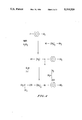
- FIG. 2 showing a reaction diagram of the synthesis of the colorant monomer in one example of a copolymer complying with the invention
- FIG. 3 showing a reaction diagram of the synthesis of the monomer with an electron-donor group in an example of a copolymer complying with the invention.
- copolymers complying with the invention are preferably produced by radical polymerization using azobisisobutyronitrile (AIBN) as a starter and dimethylformamide as a solvent at 60° C. for twenty four hours.
- AIBN azobisisobutyronitrile
- the copolymer is precipitated in ethanol.
- the colorant content is determined by visible UV spectrometry.
- a precise example of the synthesis of a copolymer complying with the invention and its non-linear optical and photoconductive properties are given below:
- 74 ml of 50% sodium hydroxide solution is prepared in a 500 ml receptacle.
- 83 ml of 1,2 dibromoethane (0.96 moles), 10 g of carbazole (0.06 moles) and 1.72 g of benzyltriethylammonium chloride are added.
- the mixture is heated to 70° C. for 10 hours with strong agitation.
- the contents are poured from the first receptacle into a second receptacle containing a mixture of water and hexane.
- the raw product precipitates and is separated by filtration.
- the solid obtained is placed in chloroform and agitated. After filtration through sintered glass, the filtrate recovered is evaporated then recrystallized in ethanol.
- the melting point of the small beige needles obtained is 140° C.
- the reaction yield is 35%.
- N bromoethyl carbazole (0.018 moles) is placed in a 50 ml receptacle and 25 ml of hexamethylphosphortriamide (HMPA) is added. The mixture is agitated until the N bromoethyl carbazole is completely dissolved. The next step is to add 3.35 g of lithium methacrylate (0.036 moles) and 0.2 g of hydroquinone to avoid polymerization. The mixture is then agitated for 24 hours at 40° C. When poured into water, the reaction mixture gives a white precipitate which is filtered out through sintered glass and then washed with water and hexane to remove excess lithium methacrylate, HMPA and hydroquinone.
- HMPA hexamethylphosphortriamide
- the copolymer vitreous transition temperature is 136.5° C.
- this copolymer When dissolved in 1,1,2 trichloroethane, this copolymer allows thin films to be produced easily.
- the copolymer film is dried under vacuum at 120° C. and oriented by a steady electric field. This field is created by ionizing the air feed from a metal tip at very high voltage (4 kV) using the corona method.
- the polymer doubles the frequency of a YAG laser operating at 1.06 ⁇ m.
- the d 33 factor measured is 3 pm v -1 (identical to that obtained with BSO (bismuth silicon oxide)).
- This copolymer doped with 20% TNF, and placed between glass coated with ITO (a mixture of indium and tin oxides) and a chrome-gold electrode has photoconductive properties.
- W -1 is approximately 0.5 10 -10 ⁇ -1 cm W -1 for a 514 nm incident wavelength. This ⁇ coefficient is approximately 10 -9 ⁇ -1 cm. W -1 for polysilanes and approximately 10 -7 ⁇ -1 cm. W -1 for the BSO photorefractive crystal.
- electroactive and photoconductive copolymers can be optimized by carefully selecting the chromophoric and photoconductive groups, their relative proportions and, above all, by using these materials at the wavelength for which they were optimized.
Landscapes
- Physics & Mathematics (AREA)
- Nonlinear Science (AREA)
- General Physics & Mathematics (AREA)
- Optics & Photonics (AREA)
- Addition Polymer Or Copolymer, Post-Treatments, Or Chemical Modifications (AREA)
Abstract
The invention is a series of amorphous copolymers which, used in association with a small molecule, provide photorefractive materials that can be used in optical signal processing. These copolymers contain an active non-linear optical group and a group which contributes to their photoconductivity. ##STR1## where: X is H, CH3, Cl or F
Y is H, CH3, Cl or F
2≦n≦4
2≦m≦4
The electron-donor group D being: --O--, --S--, ##STR2## or --COO-- The electron-accepter group Ae being: --CN, --NO2, ##STR3##
Description
This is a division, of application Ser. No. 07/734,673, filed on Jul. 23, 1991, now U.S. Pat. No. 5,198,514.
1. Field of the invention
The invention consists of copolymers associated with certain small molecules which form photorefractive compounds usable in optical signal processing. More specifically, it concerns new families of amorphous polymers whose lateral chains contain chromophoric groups capable of generating non-linear optical effects and electron-donor groups which, associated with electron-accepter groups, give the material its photoconductive properties.
A material is said to be "photorefractive" when illumination generates remanent variations in the refractive index. When an electric potential is applied to these materials and they are exposed to incident distributed luminosity, variations in the refractive index occur in the dark, isolating section while this variation tends towards zero in conductive illuminated zones where charge migration cancels out the voltage. When the illumination stops, the material returns to the initial situation except close to the boundary: the dielectric on the illuminated side of the boundary is depleted in photon-carriers which have migrated a certain distance and become trapped in the dark area. At the boundary, the space charges created form a local field which results in a local variation in the refractive index. This variation remains throughout the period required for dielectric relaxation of the material (several months in the case of compounds such as lithium niobate).
2. Description of the prior art
The photorefractive effect therefore records a spatial variation and is used in applications such as:
the recording of volumetric holographic networks
experiments in dynamic interferometry
image processing
the deflection of laser beams
optical amplification
auto-resonant cavities
optical calculation (for association memories, elementary logic components, reconfigurable interconnections).
At present, most photorefractive materials are inorganic compounds such as:
ferroelectric crystals, for example LiNbO3, BaTiO3
sillenites such as bismuth and silicon or germanium oxide crystals (Bi12 SiO20 or B12 GeO20)
III-V compounds (GaAs doped with Cr, InP doped with Fe).
However, these materials present certain disadvantages which impede further development: the compounds which offer the best performance are not available as large monocrystals and they are still very expensive. In addition, at present, none of these materials offer the qualities required, which are very fast response, high sensitivity and large memory capability.
In parallel with the development of these inorganic photorefractive compounds, organic materials, particularly polymers, have been found to possess promising properties:
for non-linear optical applications. Since the beginning of the 1980s, work on amorphous polymers doped with highly hyperpolarizable molecules and then amorphous copolymers in which the chromophoric molecules are directly bonded have shown that the electrooptical properties that could be obtained were comparable with those of inorganic compounds (U.S. Pat. Nos. 4,828,865 and 4,808,332, taken out by HOECHST CELANESE, the applicant's European patents EP 88 0579 and EP 89 11327).
in photoconductive applications. These polymers can possess conjugated multiple bonds as in polyacetylenes and trans polyphenylacetylenes. They can include aromatic groups consisting of several benzene cores, either in the structure or in the lateral chains, for example derivatives of anthracene, pyrene or acridine. They can also possess aromatic amine functions like, for example, polyvinylcarbazole (PVK). PVK doped with 2, 4, 7 trinitro-9-fluorenone (TNF) is commercially available and has practical applications in the reproduction of documents (Xerography). These polymer materials are also generally easy to work and can be used to produce large surfaces at far less cost than inorganic materials.
Consequently, this invention proposes a series of amorphous copolymers with properties which are advantageous both in non-linear optics and in photoconductivity and can be used to produce organic photorefractive materials for optical applications, particularly optical signal processing. These amorphous copolymers with lateral chains comprise:
a group with a high β hyperpolarizability value to generate strong non-linear optical effects, molecular engineering making it possible to adjust this hyperpolarizability and the transparency of the material to suit the wavelength used
an electron-donor group which, in conjunction with a small electron-accepter molecule, makes the copolymer photoconductive.
Preferably, these copolymers comply with the following chemical formula: ##STR4## where: X is H, CH3, Cl or F
Y is H, CH3, Cl or F
2≦n≦4
2≦m≦4
The electron-donor group D being: --O--, --S--, ##STR5## or --COO-- The electron-accepter group Ae being: --CN, --NO2 ##STR6## representing a system rich in π-conjugated electrons: ##STR7##
This invention is also a photorefractive mixture obtained by introducing a small electron-accepter molecule into a copolymer complying with the invention; this molecule may be 2, 4, 7 trinitro-9-fluorenone.
Finally, the invention includes the use of this organic mixture in any device which uses the photorefractive effect.
The invention will be better understood, and other advantages will become clear, upon reading the following description, which is not exhaustive, and by studying the appended figures including:
FIG. 1, showing a family of copolymers complying with the invention,
FIG. 2, showing a reaction diagram of the synthesis of the colorant monomer in one example of a copolymer complying with the invention,
FIG. 3, showing a reaction diagram of the synthesis of the monomer with an electron-donor group in an example of a copolymer complying with the invention.
In general, copolymers complying with the invention are preferably produced by radical polymerization using azobisisobutyronitrile (AIBN) as a starter and dimethylformamide as a solvent at 60° C. for twenty four hours. The copolymer is precipitated in ethanol.
The colorant content is determined by visible UV spectrometry. A precise example of the synthesis of a copolymer complying with the invention and its non-linear optical and photoconductive properties are given below:
synthesis of poly [N (methacryloyloxyethyl) carbazole co 4 (N methacryloyloxypropylamino) nitrobenzene)]. ##STR8##
1) The colorant monomer 4'(N-methacryloyloxypropylamino) nitrobenzene is synthesized from 4 fluoronitrobenzene in 2 stages as represented by the reaction diagram in FIG. 2. The experimental details are described in patent 89 11327 deposited by the applicant.
2) The monomer N methacryloyloxyethyl carbazole is synthesized from carbazole in 2 stages as represented in the reaction diagram in FIG. 3:
1st stage: synthesis of N (2 bromoethyl) carbazole.
74 ml of 50% sodium hydroxide solution is prepared in a 500 ml receptacle. 83 ml of 1,2 dibromoethane (0.96 moles), 10 g of carbazole (0.06 moles) and 1.72 g of benzyltriethylammonium chloride are added. The mixture is heated to 70° C. for 10 hours with strong agitation. The contents are poured from the first receptacle into a second receptacle containing a mixture of water and hexane. The raw product precipitates and is separated by filtration. To eliminate any carbazole which has not taken part in the reaction, the solid obtained is placed in chloroform and agitated. After filtration through sintered glass, the filtrate recovered is evaporated then recrystallized in ethanol. The melting point of the small beige needles obtained is 140° C. The reaction yield is 35%.
2nd stage: synthesis of N (methacryloyloxyethyl) carbazole.
5 g of N bromoethyl carbazole (0.018 moles) is placed in a 50 ml receptacle and 25 ml of hexamethylphosphortriamide (HMPA) is added. The mixture is agitated until the N bromoethyl carbazole is completely dissolved. The next step is to add 3.35 g of lithium methacrylate (0.036 moles) and 0.2 g of hydroquinone to avoid polymerization. The mixture is then agitated for 24 hours at 40° C. When poured into water, the reaction mixture gives a white precipitate which is filtered out through sintered glass and then washed with water and hexane to remove excess lithium methacrylate, HMPA and hydroquinone.
This gives a white powder which is purified by chromatography using toluene as the eluant. It is then recrystallized in ethanol. The reaction yield is 45% and the product obtained has a melting point of 84° C.
3) Copolymer synthesis
3.14 mg of AIBN, 1.41 g (5.05 moles) of N methacryloyloxyethyl carbazole, 0.608 g (2.30 moles) of 4 (N methacryloyloxypropylamine) nitrophenyl and 20 ml of dimethylformamide (DMF) are placed in a previously-sealed ampoule. This reaction medium is frozen in liquid air then placed under vacuum. It is allowed to return to ambient temperature and the above operation is repeated twice. Finally, the ampoule is sealed under vacuum and heated to 60° C. for 24 hours. The copolymer is precipitated in ethanol. The copolymerization yield is 61.5%. The colorant content is determined by visible UV spectrometry: x=0.237.
The copolymer vitreous transition temperature is 136.5° C.
When dissolved in 1,1,2 trichloroethane, this copolymer allows thin films to be produced easily.
The copolymer film is dried under vacuum at 120° C. and oriented by a steady electric field. This field is created by ionizing the air feed from a metal tip at very high voltage (4 kV) using the corona method.
Polarized in this way, the polymer doubles the frequency of a YAG laser operating at 1.06 μm. The d33 factor measured is 3 pm v-1 (identical to that obtained with BSO (bismuth silicon oxide)).
This same copolymer, when doped with 20% TNF, gives a film which, after orientation by the corona method (V=4 kV), doubles the frequency of a YAG laser (λ=1.06 μm) with d33 =4 pm V-1.
This copolymer, doped with 20% TNF, and placed between glass coated with ITO (a mixture of indium and tin oxides) and a chrome-gold electrode has photoconductive properties.
In fact, the β sensitivity, defined by the following equation:
σ=σ.sub.o +βI
where
σ=conductivity when illuminated
σo =conductivity in the dark
I=intensity of the luminous flux
is approximately 0.5 10-10 Ω-1 cm W-1 for a 514 nm incident wavelength. This β coefficient is approximately 10-9 Ω-1 cm. W-1 for polysilanes and approximately 10-7 Ω-1 cm. W-1 for the BSO photorefractive crystal.
These electroactive and photoconductive copolymers can be optimized by carefully selecting the chromophoric and photoconductive groups, their relative proportions and, above all, by using these materials at the wavelength for which they were optimized.
Claims (3)
1. A photorefractive mixture of organic compounds consisting of an amorphous copolymer for photorefractive compounds having the following chemical formula: ##STR9## where: X=H, CH3, Cl or F
Y=H, CH3, Cl or F
≦ n≦4
2≦m≦4
D is an electron donor group being --O--, --S--, ##STR10## where 0≦p≦3, or --COO-- Ae is an electron-acceptor group being --CN, --NO2, ##STR11## ##STR12## is a system rich in π conjugated electrons: ##STR13## and a small electron-acceptor molecule C, the molar ratio of electron donor groups D to small electron-acceptor molecules C being between 0 and 1.
2. The photorefractive mixture described in claim 1 in which the small electron-acceptor molecule is 2,4,7 trinitro-9-fluorenone.
3. An optical device which uses the photorefractive mixture described in claim 1 or claim 2.
Priority Applications (1)
| Application Number | Priority Date | Filing Date | Title |
|---|---|---|---|
| US07/937,719 US5314939A (en) | 1990-07-31 | 1992-10-06 | Amorphous copolymers for photorefractive compounds used in optical signal processing |
Applications Claiming Priority (4)
| Application Number | Priority Date | Filing Date | Title |
|---|---|---|---|
| FR9009740A FR2665452B1 (en) | 1990-07-31 | 1990-07-31 | AMORPHOUS COPOLYMERS FOR PHOTOREFRACTIVE COMPOUNDS USED IN THE PROCESSING OF THE OPTICAL SIGNAL. |
| FR9009740 | 1990-07-31 | ||
| US07/734,673 US5198514A (en) | 1990-07-31 | 1991-07-23 | Amorphous copolymers for photorefractive compounds used in optical signal processing |
| US07/937,719 US5314939A (en) | 1990-07-31 | 1992-10-06 | Amorphous copolymers for photorefractive compounds used in optical signal processing |
Related Parent Applications (1)
| Application Number | Title | Priority Date | Filing Date |
|---|---|---|---|
| US07/734,673 Division US5198514A (en) | 1990-07-31 | 1991-07-23 | Amorphous copolymers for photorefractive compounds used in optical signal processing |
Publications (1)
| Publication Number | Publication Date |
|---|---|
| US5314939A true US5314939A (en) | 1994-05-24 |
Family
ID=9399257
Family Applications (2)
| Application Number | Title | Priority Date | Filing Date |
|---|---|---|---|
| US07/734,673 Expired - Fee Related US5198514A (en) | 1990-07-31 | 1991-07-23 | Amorphous copolymers for photorefractive compounds used in optical signal processing |
| US07/937,719 Expired - Fee Related US5314939A (en) | 1990-07-31 | 1992-10-06 | Amorphous copolymers for photorefractive compounds used in optical signal processing |
Family Applications Before (1)
| Application Number | Title | Priority Date | Filing Date |
|---|---|---|---|
| US07/734,673 Expired - Fee Related US5198514A (en) | 1990-07-31 | 1991-07-23 | Amorphous copolymers for photorefractive compounds used in optical signal processing |
Country Status (3)
| Country | Link |
|---|---|
| US (2) | US5198514A (en) |
| EP (1) | EP0469941A1 (en) |
| FR (1) | FR2665452B1 (en) |
Cited By (6)
| Publication number | Priority date | Publication date | Assignee | Title |
|---|---|---|---|---|
| US20070148696A1 (en) * | 2004-02-12 | 2007-06-28 | Celine Fiorini-Debuisschert | Highly-selective tandem chemical sensor and detection method using same |
| US20080039603A1 (en) * | 2006-07-25 | 2008-02-14 | Nitto Denko Corporation | Non-linear optical device with long grating persistency |
| WO2008013775A3 (en) * | 2006-07-25 | 2008-04-03 | Nitto Denko Corp | Non-linear optical device sensitive to green laser |
| US20090197186A1 (en) * | 2008-02-05 | 2009-08-06 | Nitto Denko Corporation | Optical devices responsive to blue laser and method of modulating light |
| US20100096603A1 (en) * | 2008-10-20 | 2010-04-22 | Nitto Denko Corporation | Optical devices responsive to near infrared laser and methods of modulating light |
| US20100099789A1 (en) * | 2008-10-20 | 2010-04-22 | Nitto Denko Corporation | Method for modulating light of photorefractive composition |
Families Citing this family (6)
| Publication number | Priority date | Publication date | Assignee | Title |
|---|---|---|---|---|
| US5064264A (en) * | 1990-10-26 | 1991-11-12 | International Business Machines Corporation | Photorefractive materials |
| DE69218288T2 (en) * | 1991-05-23 | 1997-06-26 | Matsushita Electric Ind Co Ltd | Holographic recording material, device for recording a hologram, method for its production and recording method |
| FR2690453B1 (en) * | 1992-04-25 | 1995-11-03 | Sandoz Sa | NOVEL POLYMERIC COMPOUNDS HAVING NONLINEAR OPTICAL PROPERTIES. |
| US5361148A (en) * | 1993-01-21 | 1994-11-01 | International Business Machines Corporation | Apparatus for photorefractive two beam coupling |
| FR2703690B1 (en) * | 1993-04-06 | 1995-05-12 | Thomson Csf | Electrooptical material based on liquid crystal dispersed in a polymer, process for production by chemical modification of the interface and device based on this material. |
| KR101545365B1 (en) * | 2007-10-30 | 2015-08-18 | 쓰리엠 이노베이티브 프로퍼티즈 컴파니 | High refractive index adhesives |
Citations (7)
| Publication number | Priority date | Publication date | Assignee | Title |
|---|---|---|---|---|
| EP0090282B1 (en) * | 1982-03-27 | 1986-02-05 | BASF Aktiengesellschaft | Polymers having mesogen groups and colouring matter in the side chain |
| EP0240276A2 (en) * | 1986-03-31 | 1987-10-07 | EASTMAN KODAK COMPANY (a New Jersey corporation) | Photocrosslinkable polymers |
| EP0244288A1 (en) * | 1986-04-15 | 1987-11-04 | Thomson-Csf | Mesomorphic polymeric material for use in non-linear optics |
| EP0260687A2 (en) * | 1986-09-19 | 1988-03-23 | BASF Aktiengesellschaft | Liquid-crystalline copolymers |
| US4867538A (en) * | 1987-03-20 | 1989-09-19 | Hoechst Celanese Corp. | Organic nonlinear optical media |
| US4898691A (en) * | 1988-05-16 | 1990-02-06 | Hoechst Celanese Corporation | Organic nonlinear optical media |
| US5185102A (en) * | 1989-06-08 | 1993-02-09 | Minnesota Mining And Manufacturing Company | Polymeric charge transfer complexes for nonlinear optical applications |
-
1990
- 1990-07-31 FR FR9009740A patent/FR2665452B1/en not_active Expired - Lifetime
-
1991
- 1991-07-04 EP EP91401847A patent/EP0469941A1/en not_active Withdrawn
- 1991-07-23 US US07/734,673 patent/US5198514A/en not_active Expired - Fee Related
-
1992
- 1992-10-06 US US07/937,719 patent/US5314939A/en not_active Expired - Fee Related
Patent Citations (7)
| Publication number | Priority date | Publication date | Assignee | Title |
|---|---|---|---|---|
| EP0090282B1 (en) * | 1982-03-27 | 1986-02-05 | BASF Aktiengesellschaft | Polymers having mesogen groups and colouring matter in the side chain |
| EP0240276A2 (en) * | 1986-03-31 | 1987-10-07 | EASTMAN KODAK COMPANY (a New Jersey corporation) | Photocrosslinkable polymers |
| EP0244288A1 (en) * | 1986-04-15 | 1987-11-04 | Thomson-Csf | Mesomorphic polymeric material for use in non-linear optics |
| EP0260687A2 (en) * | 1986-09-19 | 1988-03-23 | BASF Aktiengesellschaft | Liquid-crystalline copolymers |
| US4867538A (en) * | 1987-03-20 | 1989-09-19 | Hoechst Celanese Corp. | Organic nonlinear optical media |
| US4898691A (en) * | 1988-05-16 | 1990-02-06 | Hoechst Celanese Corporation | Organic nonlinear optical media |
| US5185102A (en) * | 1989-06-08 | 1993-02-09 | Minnesota Mining And Manufacturing Company | Polymeric charge transfer complexes for nonlinear optical applications |
Non-Patent Citations (10)
| Title |
|---|
| D. DC. Bradley et al., (1991) Phys. Rev. Lett. 67 (18), 2589 (Oct. 28 1991) "Comment on observation . . .". |
| D. DC. Bradley et al., (1991) Phys. Rev. Lett. 67 (18), 2589 (Oct. 28 1991) Comment on observation . . . . * |
| R. P. Feynman et al., Feynman Lectures on Physics, vol. 1 33 3 33 6 Addison Wesley, Reading MA, 1963. * |
| R. P. Feynman et al., Feynman Lectures on Physics, vol. 1 33-3-33-6 Addison-Wesley, Reading MA, 1963. |
| S. Ducharme et al. (1991) Phys. Rev. Lett. 67 (18) 2590 (Oct. 28, 1991) Reply to Comment . * |
| S. Ducharme et al. (1991) Phys. Rev. Lett. 67 (18) 2590 (Oct. 28, 1991)"Reply to Comment". |
| S. Ducharme et al., (1991) Phys. Rev. Lett. 66 (14), 1846 1849 (Apr. 8, 1991) Observation of the Photo refractive Effect in a Polymer . * |
| S. Ducharme et al., (1991) Phys. Rev. Lett. 66 (14), 1846-1849 (Apr. 8, 1991) "Observation of the Photo refractive Effect in a Polymer". |
| Williams, D. J. (1984) Angew. Chem. Int. Ed. Engl. 23, 690 703, Organic Polymeric and Non Polymeric Materials with large Optical Nonlinearities . * |
| Williams, D. J. (1984) Angew. Chem. Int. Ed. Engl. 23, 690-703, "Organic Polymeric and Non-Polymeric Materials with large Optical Nonlinearities". |
Cited By (10)
| Publication number | Priority date | Publication date | Assignee | Title |
|---|---|---|---|---|
| US20070148696A1 (en) * | 2004-02-12 | 2007-06-28 | Celine Fiorini-Debuisschert | Highly-selective tandem chemical sensor and detection method using same |
| US20080039603A1 (en) * | 2006-07-25 | 2008-02-14 | Nitto Denko Corporation | Non-linear optical device with long grating persistency |
| WO2008013774A3 (en) * | 2006-07-25 | 2008-03-27 | Nitto Denko Corp | Non-linear optical device with long grating persistency |
| WO2008013775A3 (en) * | 2006-07-25 | 2008-04-03 | Nitto Denko Corp | Non-linear optical device sensitive to green laser |
| US20090052009A1 (en) * | 2006-07-25 | 2009-02-26 | Nitto Denko Corporation | Non-linear optical device sensitive to green laser |
| US7736548B2 (en) | 2006-07-25 | 2010-06-15 | Nitto Denko Corporation | Non-linear optical device with long grating persistency |
| US7985356B2 (en) | 2006-07-25 | 2011-07-26 | Nitto Denko Corporation | Non-linear optical device sensitive to green laser |
| US20090197186A1 (en) * | 2008-02-05 | 2009-08-06 | Nitto Denko Corporation | Optical devices responsive to blue laser and method of modulating light |
| US20100096603A1 (en) * | 2008-10-20 | 2010-04-22 | Nitto Denko Corporation | Optical devices responsive to near infrared laser and methods of modulating light |
| US20100099789A1 (en) * | 2008-10-20 | 2010-04-22 | Nitto Denko Corporation | Method for modulating light of photorefractive composition |
Also Published As
| Publication number | Publication date |
|---|---|
| EP0469941A1 (en) | 1992-02-05 |
| US5198514A (en) | 1993-03-30 |
| FR2665452B1 (en) | 1992-10-09 |
| FR2665452A1 (en) | 1992-02-07 |
Similar Documents
| Publication | Publication Date | Title |
|---|---|---|
| US5198514A (en) | Amorphous copolymers for photorefractive compounds used in optical signal processing | |
| Zhang et al. | Carbazole photorefractive materials | |
| US5326661A (en) | Photorefractive polymers containing discrete photoconductive and electrooptical units | |
| Silence et al. | C60 sensitization of a photorefractive polymer | |
| US4769448A (en) | Electrically conductive liquid crystalline substance and polymer | |
| EP2434340B1 (en) | Systems and methods for improving the performance of a photorefractive device | |
| US3932025A (en) | Imaging system | |
| US4900127A (en) | Optical article containing a linear polymer exhibiting a high level of second order polymerization susceptibility | |
| JPH08339001A (en) | Polyquinoline-based nonlinear optical material | |
| US4999139A (en) | Organic nonlinear optical material and nonlinear optical device | |
| Amano et al. | Second‐order nonlinearity of a novel diazo‐dye‐attached polymer | |
| US7736548B2 (en) | Non-linear optical device with long grating persistency | |
| Meerholz | Amorphous plastics pave the way to widespread holographic applications | |
| US5475213A (en) | Optical information processing element and a light-to-light converting device | |
| JPH10333195A (en) | Photorefractive material composition | |
| EP0630954B1 (en) | Low-molecular-weight and polymeric liquid cristalline benztriazoles and their use | |
| EP0313477A2 (en) | An optical article containing a linear polymer exhibiting a high level of second order polarization susceptibility | |
| JPH07318992A (en) | Photorefractive polymer | |
| Silence et al. | Nonlinear optical properties of photorefractive polymers | |
| WO2012112876A1 (en) | Photorefractive devices having sol-gel buffer layers and methods of manufacturing | |
| US5410630A (en) | Optical article containing a polymer exhibiting a high level of second order polarization susceptibility | |
| Aoyama et al. | Photoconductive and electro-optic responses in multifunctional carbazole polymers | |
| US5264512A (en) | Amorphous copolymers, transparent in the visible range, for non-linear optical applications | |
| Maertens et al. | Synthesis and electrooptic properties of a new chromophore dispersed or grafted in a carbazolyl methacrylate matrix | |
| Zhang et al. | Molecular design of carbazole polymers for photorefractive applications |
Legal Events
| Date | Code | Title | Description |
|---|---|---|---|
| LAPS | Lapse for failure to pay maintenance fees | ||
| FP | Lapsed due to failure to pay maintenance fee |
Effective date: 19980524 |
|
| STCH | Information on status: patent discontinuation |
Free format text: PATENT EXPIRED DUE TO NONPAYMENT OF MAINTENANCE FEES UNDER 37 CFR 1.362 |