US5291156A - Method and apparatus for imparting positive phase slope to a narrowband signal - Google Patents

Method and apparatus for imparting positive phase slope to a narrowband signal Download PDF

Info

Publication number
US5291156A
US5291156A US08/015,732 US1573293A US5291156A US 5291156 A US5291156 A US 5291156A US 1573293 A US1573293 A US 1573293A US 5291156 A US5291156 A US 5291156A
Authority
US
United States
Prior art keywords
signal
amplitude
gain control
path
control block
Prior art date
Legal status (The legal status is an assumption and is not a legal conclusion. Google has not performed a legal analysis and makes no representation as to the accuracy of the status listed.)
Expired - Lifetime
Application number
US08/015,732
Inventor
Bernard J. Arntz
Current Assignee (The listed assignees may be inaccurate. Google has not performed a legal analysis and makes no representation or warranty as to the accuracy of the list.)
Nokia Bell Labs USA
AT&T Corp
Original Assignee
AT&T Bell Laboratories Inc
Priority date (The priority date is an assumption and is not a legal conclusion. Google has not performed a legal analysis and makes no representation as to the accuracy of the date listed.)
Filing date
Publication date
Application filed by AT&T Bell Laboratories Inc filed Critical AT&T Bell Laboratories Inc
Priority to US08/015,732 priority Critical patent/US5291156A/en
Assigned to AMERICAN TELEPHONE AND TELEGRAPH COMPANY reassignment AMERICAN TELEPHONE AND TELEGRAPH COMPANY ASSIGNMENT OF ASSIGNORS INTEREST. Assignors: ARNTZ, BERNARD J.
Priority to CA002109997A priority patent/CA2109997C/en
Priority to EP94300791A priority patent/EP0611099A1/en
Priority to JP6036400A priority patent/JPH06252679A/en
Application granted granted Critical
Publication of US5291156A publication Critical patent/US5291156A/en
Anticipated expiration legal-status Critical
Expired - Lifetime legal-status Critical Current

Links

Images

Classifications

    • HELECTRICITY
    • H03ELECTRONIC CIRCUITRY
    • H03HIMPEDANCE NETWORKS, e.g. RESONANT CIRCUITS; RESONATORS
    • H03H7/00Multiple-port networks comprising only passive electrical elements as network components
    • H03H7/18Networks for phase shifting

Definitions

  • the present invention relates to electric circuit design in general, and more particularly, to methods and apparatus which expedite a narrowband signal.
  • a narrowband electric signal In electronic circuits it is often advantageous to temporally delay a narrowband electric signal. Such a delay can be realized by increasing the physical path traversed by the signal, thereby altering the phases of the various frequency components in an amount proportional to their frequency. In some applications, however, it is advantageous to expedite a narrowband signal (i.e., make the signal appear to have propagated a shorter distance than it actually did).
  • the present invention provides a mechanism for expediting a narrowband signal by imparting a positive phase slope to the signal, in contrast to a delay element which imparts a negative phase slope to a signal. Furthermore, embodiments of the present invention are capable of expediting the signal by an adjustable length of time while avoiding the need for mechanical apparatus or the interchange of cables. Embodiments of the present invention are particularly advantageous when processing high-frequency signals because the embodiments do not necessitate a polarity inverter.
  • the first signal path advantageously comprises a gain control block.
  • the second signal path advantageously comprises a second gain control block and a fixed delay element which is not found in the first signal path.
  • the input signal comprises a sinusoidal component at a frequency, ⁇ 0 radians per second
  • the fixed delay element be fabricated so that the second signal path is substantially close to ##EQU1## seconds longer than the first signal path, where N is a positive odd integer.
  • the length of time by which the input signal is expedited can be adjusted by varying N and the gain of the respective gain control blocks.
  • FIG. 1 shows a block diagram of an illustrative embodiment of the present invention.
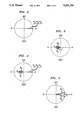
  • FIG. 2 depicts, using vectors, the phase relationship of three illustrative sinusoidal components of a narrowband signal at the input to the illustrative embodiment in FIG. 1.
  • FIG. 3 depicts, using vectors, the phase relationship of the three sinusoidal components of FIG. 2 as they appear on lead 115 in FIG. 1.
  • FIG. 4 depicts, using vectors, superpositioning of the phase relationship of the three sinusoidal components of FIG. 2 as they appear on leads 105 and 115 in FIG. 1.
  • FIG. 5 depicts, using vectors, the phase relationship of the same three sinusoidal components of FIG. 2 as they appear on lead 119 in FIG. 1.
  • FIG. 6 depicts, using vectors, the trigonometry associated with analytically summing two vectors.
  • FIG. 7 shows a block diagram of an illustrative embodiment of the present invention which can adjust the amount of time by which the input signal is expedited.
  • FIG. 8 depicts the phase response of the illustrative embodiment shown in FIG. 1.
  • the first has a fixed phase slope and the second has an electronically adjustable phase slope.
  • FIG. 1 depicts a block diagram of an illustrative embodiment of the present invention which receives a narrowband input signal and imparts to it a positive phase slope.
  • the negative group delay, d is fixed according to criteria described below.
  • the illustrative embodiment advantageously comprises signal divider 103, delay element 109, attenuator 113 and summing amplifier 117.
  • Signal divider 103 advantageously receives on lead 101 a narrowband input signal having an root-mean-squared amplitude (hereinafter "amplitude") of magnitude one and phase defined as zero radians.
  • FIG. 2 depicts, using vectors, the phase and amplitude of three illustrative sinusoidal components of the signal on lead 101.
  • Signal divider 103 creates a first signal on lead 105 and a second signal on lead 107 based on the amplitude of the input signal such that both the first signal and the second signal are analog representations of the input signal.
  • first signal and the second signal be given an equal amplitude by signal divider 103
  • attenuator 113 can subsumed by a signal divider which can adjust the proportionate amplitude of the first signal and second signal.
  • signal divider 103 create the first signal and the second signal at equal phase (i.e., 0°) although it will be clear to those skilled in the art how to make and use embodiments of the present invention which do not (e.g., using 90° hybrid 3 dB couplers). It will be clear to those skilled in the art that signal divider 103 may be fabricated in many ways using commercially available components (e.g., a resistive power divider, a Wilkinson power divider, a hybrid coupler, etc.). See E. J. Wilkinson, "An N Way Hybrid Power Divider," IRE Trans., MTT-8, 116-118 (January 1960); and J.
  • signal divider 103 divides the input signal on lead 101 into a first signal on lead 105 and a second signal on lead 107--both of which are equal in amplitude and equal in phase.
  • Delay element 109 is advantageously a length of conducting material (e.g., coaxial cable, a section of strip line, a microstrip, etc., or a lumped delay line) which causes the signal path of the second signal to be longer than the signal path taken by the first signal.
  • the input signal comprises a sinusoidal component at a frequency, ⁇ 0 radians per second
  • delay element 109 be fabricated so that the second signal path is substantially close to ##EQU2## seconds longer that the first signal path, where N is a positive odd integer, preferably one.
  • delay element 103 imparts a phase shift of nominally-pi radians to the second signal at the frequency ⁇ 0 .
  • delay element 103 imparts a negative phase slope of ##EQU3## radians per radians per second to the other frequency components such that the higher frequency components experience a greater phase shift.
  • delay element 109 receives the second signal from lead 107 and outputs the delayed second signal on lead 111. It will be clear to those skilled in the art that embodiments where attenuator 113 comes before delay element 109 in the second signal path is an equivalent circuit.
  • Attenuator 113 is preferably a passive device which receives the second signal from lead 111 and attenuates the signal without affecting the phase of the signal. It will be clear to those skilled in the art that attenuator 113 can be fabricated in many ways using commercially available components.
  • the "gain" associated with attenuator 113 is denoted G 1 and is defined to be fixed within the range 0 ⁇ G 1 ⁇ 1. When G 1 equals 0.5, FIG. 3 depicts, using vectors, the three sinusoidal components associated with the second signal on lead 115.
  • Summing amplifier 117 advantageously receives the first signal from lead 105 and the second signal from lead 115 and forms an output signal on lead 119 which is based on the unweighted sum of the amplitudes of the first signal and the second signal. While it is preferred that summing amplifier 117 combine the amplitude of the respective signals equally, it will be clear to those skilled in the art how to make and use embodiments of the present invention in which the amplitude associated with one of the signals is disproportionately added and attenuator 113 is omitted.
  • FIG. 4 depicts, using vectors, the three sinusoidal components of the first signal on lead 105 and the three sinusoidal components of the second signal on lead 115 to be added by summing amplifier 117. Three illustrative sinusoidal components of the output signal on lead 119 are shown in FIG. 5. Note that the magnitude of components ⁇ H and ⁇ L are greater than that of ⁇ 0 .
  • summing amplifier 117 combine the amplitude to the first signal and the second signal at equal phase (i.e., 0°) although it will be clear to those skilled in the art how to make and use embodiments of the present invention which do not. It will be clear to those skilled in the art that summing amplifier 117 can be fabricated in many ways using commercially available components (e.g., a Wilkinson power divider, a hybrid coupler, etc.).
  • the group delay, d through the illustrative embodiment is equal to: ##EQU4##
  • the negative polarity of the value of d indicates that the signal is expedited rather than delayed. It will be clear to those skilled in the art how to make and use embodiments of the invention for other values of G 1 .
  • FIG. 7 depicts a block diagram of an illustrative embodiment of the present invention which receives a narrowband input signal and imparts to it a positive phase slope, thereby appearing to temporally expedite the signal.
  • the illustrative embodiment is particularly advantageous when processing high-frequency signals because it does not use a polarity inverter.
  • the illustrative embodiment is characterized by a frequency response curve with upward-facing cusps.
  • FIG. 7 depicts a block diagram of an illustrative embodiment of the present invention in which the apparent time saved, d 0 , advantageously can be adjusted at will, electronically, and without physically changing the length of the signal path which the input signal traverses.
  • the illustrative embodiment advantageously comprises signal divider 707, gain control block 717, delay element 719, gain control block 725, signal combiner 729 and delay controller 705.
  • Signal divider 707 advantageously receives on lead 703 a narrowband input signal having an root-mean-squared amplitude (hereinafter "amplitude") and phase defined as zero radians.
  • Signal divider 707 creates a first signal on lead 713 and a second signal on lead 715 based on the amplitude of the input signal such that both the first signal and the second signal are analog representations of the input signal. While it is preferred that the first signal and the second signal be given an equal amplitude by signal divider 707, it will be clear to those skilled in the art how to make and use embodiments of the present invention in which the first signal and second signal are not created with equal amplitudes. Furthermore, it will be clear to those skilled in the art that either or both of gain control block 717 and gain control block 725 can subsumed by a signal divider which can adjust the proportionate amplitude of the first signal and second signal.
  • signal divider 707 create the first signal and the second signal at equal phase (i.e., 0°) although it will be clear to those skilled in the art how to make and use embodiments of the present invention which do not (e.g., using 90° hybrid 3 dB couplers). It will be clear to those skilled in the art that signal divider 707 may be fabricated in many ways using commercially available components (e.g., a Wilkinson power divider, a hybrid coupler, etc.). See E. J. Wilkinson, "An N Way Hybrid Power Divider," IRE Trans., MTT-8, 116-118 (January 1960); and J. Lange, "Integrated Stripline Quadrature Hybrid,” MTT-17, No.
  • signal divider 707 divides the input signal on lead 703 into a first signal on lead 713 and a second signal on lead 715--both of which are equal in amplitude and equal in phase.
  • Gain control block 717 and gain control block 725 are preferably identical and are non-reflective (i.e., matched impedance on both ports on all settings) and advantageously amplify (i.e., positive gain), attenuate (i.e., negative gain) or pass through (i.e., zero gain) a signal placed on their respective input. It is preferred that the phase response of gain control block 717 and gain control block 725 be equal although it will be clear to those skilled in the art how to make and use embodiments of the present invention in which they are not. It is preferred that the respective gain of each of gain control block 717 and gain control block 725 be continuously variable in response to a gain control signal.
  • each of gain control block 717 and gain control block 725 can be fabricated in many ways using commercially available components (e.g., a voltage controlled amplifier, a voltage controlled attenuator, a current controlled amplifier, a current controlled attenuator, etc.). See R. Waugh, "A Low Cost Surface Mount PIN Diode Attenuator," Microwave journal, 280-284 (May 1992).
  • gain control block 717 comprises a voltage controlled attenuator which receives the first signal on lead 713 and outputs the first signal on lead 721 in response to the first gain control signal on lead 711.
  • gain control block 725 comprises a voltage controlled attenuator which receives the second signal on lead 723 and outputs second signal on lead 727 in response to the second gain control signal on lead 709.
  • the "gain" associated with gain control block 717 is denoted G 1 and operates linearly over a range defined to be 0 ⁇ G 1 ⁇ 1.
  • Delay element 719 is advantageously a length of conducting material (e.g., coaxial cable, a section of strip line, a microstrip, etc., or a lumped delay line) which causes the signal path of the second signal to be longer than the signal path taken by the first signal.
  • the input signal comprises a sinusoidal component at a frequency, ⁇ 0 radians per second
  • delay element 719 be fabricated so that the second signal path is substantially close to ##EQU5## seconds longer that the first signal path, where N is a positive odd integer.
  • delay element 719 receives the second signal from lead 715 and outputs the delayed second signal on lead 723. It will be clear to those skilled in the art that embodiments where gain control block 725 comes before delay element 719 in the second signal path is an equivalent circuit.
  • Signal combiner 729 advantageously receives the first signal from gain control block 117 on lead 121 and the second signal from gain control block 725 on lead 127 and forms an output signal on lead 131 which is based on the unweighted sum of the amplitudes of the first signal and the second signal. While it is preferred that signal combiner 729 combine the amplitude of the respective signals equally, it will be clear to those skilled in the art how to make and use embodiments of the presents invention in which the amplitude associated with one of the signals is disproportionately added. Furthermore, it will be clear to those skilled in the art that either or both of gain control block 717 and gain control block 725 can subsumed by a signal combiner which can vary the weighting with which the first signal and the second signal are added.
  • signal combiner 729 combine the amplitude to the first signal and the second signal at opposite phase (i.e., ⁇ radians) although it will be clear to those skilled in the art how to make and use embodiments of the present invention which do not. It will be clear to those skilled in the art that signal combiner 729 can be fabricated in many ways using commercially available components (e.g., a Wilkinson power divider, a hybrid coupler, etc.).
  • the operation of the illustrative embodiment depicted in FIG. 7 can be represented as follows.
  • the group delay, d through the illustrative embodiment is defined as: ##EQU6## where ##EQU7## is the first derivative of the phase of the output signal on lead 731 with respect to the frequency of the signal. Phase lag is defined as a negative number.
  • the first signal on lead 721 is: ##EQU8## where V in is the input signal on lead 703.
  • the second signal on lead 727 is: ##EQU9## where N is a positive odd integer and ##EQU10## is the length of delay element 719 in seconds.
  • Equation (8) For analytically add the vectors representing the signals, it can be seen that for a given frequency: ##EQU11## For narrowband operation, the value of ⁇ 2 is close to ⁇ . Therefore, the approximations sin ⁇ , cos ⁇ -1, and arctan ⁇ are used. Therefore, Equation (4) becomes: ##EQU12## Combining equations 2a, 3a, 3b and 5 yields: ##EQU13## Simplifying equation (6) yields: ##EQU14## Referring back to Equation (1) the delay through the illustrative embodiment is: ##EQU15## which is a function of the relative gain of the gain control block 717 and gain control block 725. It will be clear to those skilled in the art how to make and use embodiments of the invention using appropriate values as shown in Equation (8).
  • FIG. 8 depicts a typical phase response curve associated the illustrative embodiment of the present invention depicted in FIG. 7.

Landscapes

  • Waveguide Switches, Polarizers, And Phase Shifters (AREA)
  • Stabilization Of Oscillater, Synchronisation, Frequency Synthesizers (AREA)
  • Networks Using Active Elements (AREA)

Abstract

A method and apparatus for imparting a positive phase slope (i.e., a negative group delay) to a narrowband signals is disclosed which adjusts the phases of the various frequency components of a signal in a manner opposite to that of a delay line. The invention also permits the amount of phase slope to be adjusted, electronically, without the need for electro-mechanical apparatus or the interchange of cables. Furthermore, embodiments of the present invention are advantageous in that at the center of the operating band they maintain the phase of the delayed signal. These results are obtained in an illustrative embodiment of the present invention which divides the signal to be delayed into two signals which traverse different signal paths and are recombined in a signal combiner. The first signal path advantageously comprises a gain control block. The second signal path advantageously comprises a second gain control block and a fixed line delay which is not found in the first signal path. The amount of phase slope imparted to the signal can be adjusted by varying the gain (or attenuation) of the respective gain control blocks.

Description

FIELD OF THE INVENTION
The present invention relates to electric circuit design in general, and more particularly, to methods and apparatus which expedite a narrowband signal.
BACKGROUND OF THE INVENTION
In electronic circuits it is often advantageous to temporally delay a narrowband electric signal. Such a delay can be realized by increasing the physical path traversed by the signal, thereby altering the phases of the various frequency components in an amount proportional to their frequency. In some applications, however, it is advantageous to expedite a narrowband signal (i.e., make the signal appear to have propagated a shorter distance than it actually did).
SUMMARY OF THE INVENTION
The present invention provides a mechanism for expediting a narrowband signal by imparting a positive phase slope to the signal, in contrast to a delay element which imparts a negative phase slope to a signal. Furthermore, embodiments of the present invention are capable of expediting the signal by an adjustable length of time while avoiding the need for mechanical apparatus or the interchange of cables. Embodiments of the present invention are particularly advantageous when processing high-frequency signals because the embodiments do not necessitate a polarity inverter.
These results are obtained in an illustrative embodiment of the present invention which divides an input signal to be delayed into two signals, each of which traverse different signal paths and are recombined in a signal combiner. The first signal path advantageously comprises a gain control block. The second signal path advantageously comprises a second gain control block and a fixed delay element which is not found in the first signal path. Where the input signal comprises a sinusoidal component at a frequency, ω0 radians per second, it is preferred that the fixed delay element be fabricated so that the second signal path is substantially close to ##EQU1## seconds longer than the first signal path, where N is a positive odd integer. The length of time by which the input signal is expedited can be adjusted by varying N and the gain of the respective gain control blocks.
BRIEF DESCRIPTION OF THE DRAWING
FIG. 1 shows a block diagram of an illustrative embodiment of the present invention.
FIG. 2 depicts, using vectors, the phase relationship of three illustrative sinusoidal components of a narrowband signal at the input to the illustrative embodiment in FIG. 1.
FIG. 3 depicts, using vectors, the phase relationship of the three sinusoidal components of FIG. 2 as they appear on lead 115 in FIG. 1.
FIG. 4 depicts, using vectors, superpositioning of the phase relationship of the three sinusoidal components of FIG. 2 as they appear on leads 105 and 115 in FIG. 1.
FIG. 5 depicts, using vectors, the phase relationship of the same three sinusoidal components of FIG. 2 as they appear on lead 119 in FIG. 1.
FIG. 6 depicts, using vectors, the trigonometry associated with analytically summing two vectors.
FIG. 7 shows a block diagram of an illustrative embodiment of the present invention which can adjust the amount of time by which the input signal is expedited.
FIG. 8 depicts the phase response of the illustrative embodiment shown in FIG. 1.
DETAILED DESCRIPTION
Two embodiments of the present invention are described below. The first has a fixed phase slope and the second has an electronically adjustable phase slope.
I. An Embodiment with a Fixed Phase Slope
FIG. 1 depicts a block diagram of an illustrative embodiment of the present invention which receives a narrowband input signal and imparts to it a positive phase slope. In the illustrative embodiment of FIG. 1 the negative group delay, d, is fixed according to criteria described below. The illustrative embodiment advantageously comprises signal divider 103, delay element 109, attenuator 113 and summing amplifier 117.
Signal divider 103 advantageously receives on lead 101 a narrowband input signal having an root-mean-squared amplitude (hereinafter "amplitude") of magnitude one and phase defined as zero radians. FIG. 2 depicts, using vectors, the phase and amplitude of three illustrative sinusoidal components of the signal on lead 101. Signal divider 103 creates a first signal on lead 105 and a second signal on lead 107 based on the amplitude of the input signal such that both the first signal and the second signal are analog representations of the input signal. While it is preferred that the first signal and the second signal be given an equal amplitude by signal divider 103, it will be clear to those skilled in the art how to make and use embodiments of the present invention in which the first signal and second signal are not created with equal amplitudes. Furthermore, it will be clear to those skilled in the art that attenuator 113 can subsumed by a signal divider which can adjust the proportionate amplitude of the first signal and second signal.
It is preferred that signal divider 103 create the first signal and the second signal at equal phase (i.e., 0°) although it will be clear to those skilled in the art how to make and use embodiments of the present invention which do not (e.g., using 90° hybrid 3 dB couplers). It will be clear to those skilled in the art that signal divider 103 may be fabricated in many ways using commercially available components (e.g., a resistive power divider, a Wilkinson power divider, a hybrid coupler, etc.). See E. J. Wilkinson, "An N Way Hybrid Power Divider," IRE Trans., MTT-8, 116-118 (January 1960); and J. Lange, "Integrated Stripline Quadrature Hybrid," MTT-17, No. 12, 7150-7151 (December 1969). In the illustrative embodiment depicted in FIG. 1, signal divider 103 divides the input signal on lead 101 into a first signal on lead 105 and a second signal on lead 107--both of which are equal in amplitude and equal in phase.
Delay element 109 is advantageously a length of conducting material (e.g., coaxial cable, a section of strip line, a microstrip, etc., or a lumped delay line) which causes the signal path of the second signal to be longer than the signal path taken by the first signal. Where the input signal comprises a sinusoidal component at a frequency, ω0 radians per second, it is preferred that delay element 109 be fabricated so that the second signal path is substantially close to ##EQU2## seconds longer that the first signal path, where N is a positive odd integer, preferably one. It should be noted that delay element 103 imparts a phase shift of nominally-pi radians to the second signal at the frequency ω0. In addition, delay element 103 imparts a negative phase slope of ##EQU3## radians per radians per second to the other frequency components such that the higher frequency components experience a greater phase shift.
In the illustrative embodiment depicted in FIG. 1 delay element 109 receives the second signal from lead 107 and outputs the delayed second signal on lead 111. It will be clear to those skilled in the art that embodiments where attenuator 113 comes before delay element 109 in the second signal path is an equivalent circuit.
Attenuator 113 is preferably a passive device which receives the second signal from lead 111 and attenuates the signal without affecting the phase of the signal. It will be clear to those skilled in the art that attenuator 113 can be fabricated in many ways using commercially available components. The "gain" associated with attenuator 113 is denoted G1 and is defined to be fixed within the range 0≦G1 ≦1. When G1 equals 0.5, FIG. 3 depicts, using vectors, the three sinusoidal components associated with the second signal on lead 115.
Summing amplifier 117 advantageously receives the first signal from lead 105 and the second signal from lead 115 and forms an output signal on lead 119 which is based on the unweighted sum of the amplitudes of the first signal and the second signal. While it is preferred that summing amplifier 117 combine the amplitude of the respective signals equally, it will be clear to those skilled in the art how to make and use embodiments of the present invention in which the amplitude associated with one of the signals is disproportionately added and attenuator 113 is omitted. FIG. 4 depicts, using vectors, the three sinusoidal components of the first signal on lead 105 and the three sinusoidal components of the second signal on lead 115 to be added by summing amplifier 117. Three illustrative sinusoidal components of the output signal on lead 119 are shown in FIG. 5. Note that the magnitude of components ωH and ωL are greater than that of ω0.
It is preferred that summing amplifier 117 combine the amplitude to the first signal and the second signal at equal phase (i.e., 0°) although it will be clear to those skilled in the art how to make and use embodiments of the present invention which do not. It will be clear to those skilled in the art that summing amplifier 117 can be fabricated in many ways using commercially available components (e.g., a Wilkinson power divider, a hybrid coupler, etc.).
When the input signal is a narrowband signal, the group delay, d, through the illustrative embodiment is equal to: ##EQU4## The negative polarity of the value of d indicates that the signal is expedited rather than delayed. It will be clear to those skilled in the art how to make and use embodiments of the invention for other values of G1.
II. An Embodiment with an Adjustable Phase Slope
FIG. 7 depicts a block diagram of an illustrative embodiment of the present invention which receives a narrowband input signal and imparts to it a positive phase slope, thereby appearing to temporally expedite the signal. The illustrative embodiment is particularly advantageous when processing high-frequency signals because it does not use a polarity inverter. Furthermore, the illustrative embodiment is characterized by a frequency response curve with upward-facing cusps.
FIG. 7 depicts a block diagram of an illustrative embodiment of the present invention in which the apparent time saved, d0, advantageously can be adjusted at will, electronically, and without physically changing the length of the signal path which the input signal traverses. The illustrative embodiment advantageously comprises signal divider 707, gain control block 717, delay element 719, gain control block 725, signal combiner 729 and delay controller 705.
Signal divider 707 advantageously receives on lead 703 a narrowband input signal having an root-mean-squared amplitude (hereinafter "amplitude") and phase defined as zero radians. Signal divider 707 creates a first signal on lead 713 and a second signal on lead 715 based on the amplitude of the input signal such that both the first signal and the second signal are analog representations of the input signal. While it is preferred that the first signal and the second signal be given an equal amplitude by signal divider 707, it will be clear to those skilled in the art how to make and use embodiments of the present invention in which the first signal and second signal are not created with equal amplitudes. Furthermore, it will be clear to those skilled in the art that either or both of gain control block 717 and gain control block 725 can subsumed by a signal divider which can adjust the proportionate amplitude of the first signal and second signal.
It is preferred that signal divider 707 create the first signal and the second signal at equal phase (i.e., 0°) although it will be clear to those skilled in the art how to make and use embodiments of the present invention which do not (e.g., using 90° hybrid 3 dB couplers). It will be clear to those skilled in the art that signal divider 707 may be fabricated in many ways using commercially available components (e.g., a Wilkinson power divider, a hybrid coupler, etc.). See E. J. Wilkinson, "An N Way Hybrid Power Divider," IRE Trans., MTT-8, 116-118 (January 1960); and J. Lange, "Integrated Stripline Quadrature Hybrid," MTT-17, No. 12, 7150-7151 (December 1969). In the illustrative embodiment depicted in FIG. 7, signal divider 707 divides the input signal on lead 703 into a first signal on lead 713 and a second signal on lead 715--both of which are equal in amplitude and equal in phase.
Gain control block 717 and gain control block 725 are preferably identical and are non-reflective (i.e., matched impedance on both ports on all settings) and advantageously amplify (i.e., positive gain), attenuate (i.e., negative gain) or pass through (i.e., zero gain) a signal placed on their respective input. It is preferred that the phase response of gain control block 717 and gain control block 725 be equal although it will be clear to those skilled in the art how to make and use embodiments of the present invention in which they are not. It is preferred that the respective gain of each of gain control block 717 and gain control block 725 be continuously variable in response to a gain control signal. It will be clear to those skilled in the art that each of gain control block 717 and gain control block 725 can be fabricated in many ways using commercially available components (e.g., a voltage controlled amplifier, a voltage controlled attenuator, a current controlled amplifier, a current controlled attenuator, etc.). See R. Waugh, "A Low Cost Surface Mount PIN Diode Attenuator," Microwave journal, 280-284 (May 1992).
In the illustrative embodiment depicted in FIG. 7, gain control block 717 comprises a voltage controlled attenuator which receives the first signal on lead 713 and outputs the first signal on lead 721 in response to the first gain control signal on lead 711. Analogously, gain control block 725 comprises a voltage controlled attenuator which receives the second signal on lead 723 and outputs second signal on lead 727 in response to the second gain control signal on lead 709. The "gain" associated with gain control block 717 is denoted G1 and operates linearly over a range defined to be 0≦G1 ≦1. Analogously, the "gain" associated with gain control block 725 is denoted G2 and also operates linearly over a range defined to be 0≦G2 ≦1. It is preferred that at all times G1 +G2 =1.
It will be clear to those skilled in the art how to make and use embodiments of the present invention which exclude either gain control block 717 or gain control block 725. It will also be clear to those skilled in the art how to make and use embodiments of the present invention by moving either gain control block 717 or gain control block 725 past signal combiner 729 so that the input to the displaced gain control block is taken from lead 731.
Delay element 719 is advantageously a length of conducting material (e.g., coaxial cable, a section of strip line, a microstrip, etc., or a lumped delay line) which causes the signal path of the second signal to be longer than the signal path taken by the first signal. Where the input signal comprises a sinusoidal component at a frequency, ω0 radians per second, it is preferred that delay element 719 be fabricated so that the second signal path is substantially close to ##EQU5## seconds longer that the first signal path, where N is a positive odd integer.
In the illustrative embodiment depicted in FIG. 7 delay element 719 receives the second signal from lead 715 and outputs the delayed second signal on lead 723. It will be clear to those skilled in the art that embodiments where gain control block 725 comes before delay element 719 in the second signal path is an equivalent circuit.
Signal combiner 729 advantageously receives the first signal from gain control block 117 on lead 121 and the second signal from gain control block 725 on lead 127 and forms an output signal on lead 131 which is based on the unweighted sum of the amplitudes of the first signal and the second signal. While it is preferred that signal combiner 729 combine the amplitude of the respective signals equally, it will be clear to those skilled in the art how to make and use embodiments of the presents invention in which the amplitude associated with one of the signals is disproportionately added. Furthermore, it will be clear to those skilled in the art that either or both of gain control block 717 and gain control block 725 can subsumed by a signal combiner which can vary the weighting with which the first signal and the second signal are added.
It is preferred that signal combiner 729 combine the amplitude to the first signal and the second signal at opposite phase (i.e., π radians) although it will be clear to those skilled in the art how to make and use embodiments of the present invention which do not. It will be clear to those skilled in the art that signal combiner 729 can be fabricated in many ways using commercially available components (e.g., a Wilkinson power divider, a hybrid coupler, etc.).
The operation of the illustrative embodiment depicted in FIG. 7 can be represented as follows. When the input signal is a narrowband signal, the group delay, d, through the illustrative embodiment is defined as: ##EQU6## where ##EQU7## is the first derivative of the phase of the output signal on lead 731 with respect to the frequency of the signal. Phase lag is defined as a negative number. In terms of vectors, the first signal on lead 721 is: ##EQU8## where Vin is the input signal on lead 703. The second signal on lead 727 is: ##EQU9## where N is a positive odd integer and ##EQU10## is the length of delay element 719 in seconds. Using trigonometry as shown in FIG. 6 to analytically add the vectors representing the signals, it can be seen that for a given frequency: ##EQU11## For narrowband operation, the value of α2 is close to π. Therefore, the approximations sin α≈α, cos α≈-1, and arctan α≈α are used. Therefore, Equation (4) becomes: ##EQU12## Combining equations 2a, 3a, 3b and 5 yields: ##EQU13## Simplifying equation (6) yields: ##EQU14## Referring back to Equation (1) the delay through the illustrative embodiment is: ##EQU15## which is a function of the relative gain of the gain control block 717 and gain control block 725. It will be clear to those skilled in the art how to make and use embodiments of the invention using appropriate values as shown in Equation (8). FIG. 8 depicts a typical phase response curve associated the illustrative embodiment of the present invention depicted in FIG. 7.

Claims (5)

I claim:
1. An apparatus for processing an input signal comprising an input amplitude and a sinusoidal component at ω0 radians per second, said apparatus comprising:
a signal divider for creating a first signal, comprising a first amplitude, based on said input signal and for inputting said first signal onto a first signal path, and for creating a second signal, comprising a second amplitude, based on said input signal and for inputting said second signal onto a second signal path, wherein said first signal and said second signal are each analog representations of said input signal;
a signal combiner for receiving said first signal from said first signal path, and for receiving said second signal from said second signal path, and for creating an output signal, comprising an output amplitude, based on the sum of said first signal and said second signal;
a delay element in said second signal path for making said second signal path substantially close to ##EQU16## seconds longer than said first signal path, where N is a positive odd integer; and
attenuator means in said second signal path for attenuating said second signal relative to said first signal.
2. The apparatus of claim 1 wherein said output amplitude is substantially equal to said input amplitude.
3. The apparatus of claim 1 wherein said signal divider comprises a hybrid coupler.
4. An apparatus for processing an input signal comprising an input amplitude and a sinusoidal component at ω0 radians per second, said apparatus comprising:
a signal divider for creating a first signal, comprising a first amplitude, based on said input signal and for inputting said first signal onto a first signal path, and for creating a second signal, comprising a second amplitude, based on said input signal and for inputting said second signal onto a second signal path, wherein said first signal and said second signal are each analog representations of said input signal;
a signal combiner for receiving said first signal from said first signal path, and for receiving said second signal from said second signal path, and for creating an output signal, comprising an output amplitude, based on the sum of said first signal and said second signal;
a first gain control block in said first signal path for modifying said amplitude of said first signal;
a delay element in said second signal path for making said second signal path substantially close to ##EQU17## seconds longer than said first signal path, where N is a positive odd integer; and
a second gain control block in said second signal path for modifying said second amplitude of second signal.
5. The apparatus of claim 4 wherein said signal divider comprises a hybrid coupler, said first gain control block comprises a voltage controlled attenuator, and said second gain control block comprises a voltage controlled attenuator.
US08/015,732 1993-02-10 1993-02-10 Method and apparatus for imparting positive phase slope to a narrowband signal Expired - Lifetime US5291156A (en)

Priority Applications (4)

Application Number Priority Date Filing Date Title
US08/015,732 US5291156A (en) 1993-02-10 1993-02-10 Method and apparatus for imparting positive phase slope to a narrowband signal
CA002109997A CA2109997C (en) 1993-02-10 1993-11-25 Method and apparatus for imparting positive phase slope to a narrowband signal
EP94300791A EP0611099A1 (en) 1993-02-10 1994-02-02 A method and apparatus for imparting positive phase slope to a narrowband signal
JP6036400A JPH06252679A (en) 1993-02-10 1994-02-10 Method and apparatus for giving positive phase ramp to narrow-band signal

Applications Claiming Priority (1)

Application Number Priority Date Filing Date Title
US08/015,732 US5291156A (en) 1993-02-10 1993-02-10 Method and apparatus for imparting positive phase slope to a narrowband signal

Publications (1)

Publication Number Publication Date
US5291156A true US5291156A (en) 1994-03-01

Family

ID=21773270

Family Applications (1)

Application Number Title Priority Date Filing Date
US08/015,732 Expired - Lifetime US5291156A (en) 1993-02-10 1993-02-10 Method and apparatus for imparting positive phase slope to a narrowband signal

Country Status (4)

Country Link
US (1) US5291156A (en)
EP (1) EP0611099A1 (en)
JP (1) JPH06252679A (en)
CA (1) CA2109997C (en)

Cited By (4)

* Cited by examiner, † Cited by third party
Publication number Priority date Publication date Assignee Title
US5694396A (en) * 1994-09-30 1997-12-02 Lucent Technologies Inc. Method and apparatus for processing multicarrier signals
US20040199487A1 (en) * 2001-07-25 2004-10-07 Eio Andrew John Data storage and retrieval systems
WO2008112602A3 (en) * 2007-03-09 2008-11-27 Chris Hymel Application of signal advance amplification to analog waveform or signal detection, acquisition and processing
US20110148588A1 (en) * 2009-12-21 2011-06-23 Comm. A L'ener. Atom. Et Aux Energies Alt. Device for the secure contactless data exchange between a reader and a card

Citations (2)

* Cited by examiner, † Cited by third party
Publication number Priority date Publication date Assignee Title
US4354168A (en) * 1980-09-04 1982-10-12 Itek Corporation Delay line canceler
US4491808A (en) * 1981-11-05 1985-01-01 Mitsubishi Denki Kabushiki Kaisha Equalizer circuit for use in communication unit

Family Cites Families (2)

* Cited by examiner, † Cited by third party
Publication number Priority date Publication date Assignee Title
GB1060992A (en) * 1964-02-18 1967-03-08 North Atlantic Industries Improved phase slope compensator
US4581595A (en) * 1984-05-30 1986-04-08 Rockwell International Corporation Phase shift network with minimum amplitude ripple

Patent Citations (2)

* Cited by examiner, † Cited by third party
Publication number Priority date Publication date Assignee Title
US4354168A (en) * 1980-09-04 1982-10-12 Itek Corporation Delay line canceler
US4491808A (en) * 1981-11-05 1985-01-01 Mitsubishi Denki Kabushiki Kaisha Equalizer circuit for use in communication unit

Cited By (9)

* Cited by examiner, † Cited by third party
Publication number Priority date Publication date Assignee Title
US5694396A (en) * 1994-09-30 1997-12-02 Lucent Technologies Inc. Method and apparatus for processing multicarrier signals
US20040199487A1 (en) * 2001-07-25 2004-10-07 Eio Andrew John Data storage and retrieval systems
WO2008112602A3 (en) * 2007-03-09 2008-11-27 Chris Hymel Application of signal advance amplification to analog waveform or signal detection, acquisition and processing
US20110184650A1 (en) * 2007-03-09 2011-07-28 Hymel Chris M Utility and method for the application of signal advance amplification to analog waveform or signal detection, acquisition and processing
EP2137817A4 (en) * 2007-03-09 2012-02-22 Chris Hymel APPLYING SIGNAL GAIN GAIN TO ANALOG CURVES OR SIGNAL DETECTION, CAPTURE AND PROCESSING
CN101730974B (en) * 2007-03-09 2012-10-03 克里斯·海梅尔 Application method and device of signal amplification in analog waveform or signal detection, acquisition and processing
US8452544B2 (en) * 2007-03-09 2013-05-28 Chris M. Hymel Utility and method for the application of signal advance amplification to analog waveform or signal detection, acquisition and processing
US20110148588A1 (en) * 2009-12-21 2011-06-23 Comm. A L'ener. Atom. Et Aux Energies Alt. Device for the secure contactless data exchange between a reader and a card
US8773241B2 (en) * 2009-12-21 2014-07-08 Commissariat à l'énergie atomique et aux énergies alternatives Device for the secure contactless data exchange between a reader and a card

Also Published As

Publication number Publication date
JPH06252679A (en) 1994-09-09
EP0611099A1 (en) 1994-08-17
CA2109997A1 (en) 1994-08-11
CA2109997C (en) 1997-04-22

Similar Documents

Publication Publication Date Title
KR100315569B1 (en) Low Distortion Feedforward Amplifier
US5317288A (en) Continuously variable electronically controlled phase shift circuit
US4549152A (en) Broadband adjustable phase modulation circuit
US5355103A (en) Fast settling, wide dynamic range vector modulator
US6335665B1 (en) Adjustable phase and delay shift element
EP0475408B1 (en) Magnetostatic wave s/n enhancer and receiving apparatus of fm or pm signal using the same
US5291156A (en) Method and apparatus for imparting positive phase slope to a narrowband signal
JPS61161001A (en) Variable attenuator
US5426433A (en) Coherent RF pulse multiplier
JPS5963810A (en) Method and device for attenuating high power high speed step
US5311155A (en) Method and apparatus for imparting a linear frequency response to a signal
US6459345B1 (en) Programmable saw filter including unidirectional transducers
US2879484A (en) Branching filter
JPH0470203A (en) Feed forward amplifier
US4348642A (en) Feedforward wideband amplifier
US4207547A (en) Reflection mode notch filter
US5585769A (en) Passive temperature variable phase-shifter
US4798987A (en) Surface acoustic wave generator
JPH0537318A (en) High frequency switch
US3381246A (en) Distributed transducer ultrasonic delay line and coupling apparatus
JP3348270B2 (en) Phase adjustment device
US3487337A (en) Distributed constant transversal equalizer
US4757516A (en) Transversal equalizer
Males-Ilic et al. Design of low intermodulation amplifiers for wireless multichannel applications
JPS61198801A (en) Microwave variable attenuator

Legal Events

Date Code Title Description
AS Assignment

Owner name: AMERICAN TELEPHONE AND TELEGRAPH COMPANY, NEW YORK

Free format text: ASSIGNMENT OF ASSIGNORS INTEREST.;ASSIGNOR:ARNTZ, BERNARD J.;REEL/FRAME:006428/0552

Effective date: 19930210

STCF Information on status: patent grant

Free format text: PATENTED CASE

FEPP Fee payment procedure

Free format text: PAYOR NUMBER ASSIGNED (ORIGINAL EVENT CODE: ASPN); ENTITY STATUS OF PATENT OWNER: LARGE ENTITY

FPAY Fee payment

Year of fee payment: 4

FEPP Fee payment procedure

Free format text: PAYOR NUMBER ASSIGNED (ORIGINAL EVENT CODE: ASPN); ENTITY STATUS OF PATENT OWNER: LARGE ENTITY

Free format text: PAYER NUMBER DE-ASSIGNED (ORIGINAL EVENT CODE: RMPN); ENTITY STATUS OF PATENT OWNER: LARGE ENTITY

FPAY Fee payment

Year of fee payment: 8

FPAY Fee payment

Year of fee payment: 12