US528224A - Half to orlando brown - Google Patents
Half to orlando brown Download PDFInfo
- Publication number
- US528224A US528224A US528224DA US528224A US 528224 A US528224 A US 528224A US 528224D A US528224D A US 528224DA US 528224 A US528224 A US 528224A
- Authority
- US
- United States
- Prior art keywords
- car
- track
- cable
- block
- point
- Prior art date
- Legal status (The legal status is an assumption and is not a legal conclusion. Google has not performed a legal analysis and makes no representation as to the accuracy of the status listed.)
- Expired - Lifetime
Links
- 230000001174 ascending effect Effects 0.000 description 4
- 238000010276 construction Methods 0.000 description 2
- 230000005484 gravity Effects 0.000 description 1
- 230000007246 mechanism Effects 0.000 description 1
Images

Classifications
-
- A—HUMAN NECESSITIES
- A63—SPORTS; GAMES; AMUSEMENTS
- A63G—MERRY-GO-ROUNDS; SWINGS; ROCKING-HORSES; CHUTES; SWITCHBACKS; SIMILAR DEVICES FOR PUBLIC AMUSEMENT
- A63G7/00—Up-and-down hill tracks; Switchbacks
Definitions
- My invention relates especially to a roller toboggan slide of that class wherein the cars are carried to an elevation by an endless chain or cable and running on the track by gravlty.
- the particular object of my invention is to 0 so arrange a continuous track in curves or oval that at certain points there shall appear to be two tracks in parallelism upon which succeeding cars may race.
- the tracks are supported on a trestle work 5 of any suitable construction, and continuous from a point on the supporting platform, A, which is arranged at the bottom of the trestle.
- the shaft, b is journaled at this point, and carries two pulleys, cl, f.
- a pulley At the opposite 0 end of the frame or trestle and atthe top thereof a pulley, It, is mounted and is connected by the endless belt or cable, m, with the pulley, d.
- the first track starts from the platform, A, and ascends at a pitch of about 4 5 forty-five degrees to the top of the trestle.
- a car is carried up said track by means of a clutch hereinafter described, which takes on the cable, m.
- the cars are started on the outer track, B, consecutively and the parts are so arranged or timed that when the first car arrives at the point, p, and is carried by the cable, 25, to the pulley, g, a succeeding car will have arrived at the highest point of the track at the pulley, It, so that said first car and. succeeding car running respectively on the parallel tracks indicated by guide arrows 2 and. 3, will race side by side, their speed varying according to the load on the car somewhat.
- the car is shown in the bottom plan view in Fig. 3.
- This car may be of any suitable 5 construction fitted to run in the tracks, B.
- the cable, m is continuously moving in the direction indicated by the arrow in Fig. 3, and the car is secured thereto by a clutch mech anism which comprises an arm, H, pivoted at, [O0 15, to the bottom of the car.
- Acoiled spring, 16 tends to throw its free end in the direction of travel of the car.
- a head-block, 17, is fastened to the car bottom and isgrooved on its 4 face to receive the cable, m.
- a wedge-block, 18, is pivoted to the free end of the arm, H.
- said wedge-block binds it against the head-block and the car is carried along by the cable in a manner which will be readily understood without a more explicit description.
- Both the head-block and wedge-block may have supply grooves, so that if thecable fails to take in one groove it will engage in another.
- Acurved track for a toboggan car inclining downwardly for a determined distance, then ascending to the beginning of said incline; thence running approximately in parallelism in the same plane with said inclined portion, substantially as and for the purpose described.
- the cable in combination with the car and the clutch thereon comprising a spring-pulled pivoted arm; the Wedge-block pivoted in said arm and the head-block rigidly secured to said car and registering with said wedge block.
- a cable grip for toboggan cars comprising a spring pulled pivoted lever, H; the grooved wedge-block, 18, loosely pivoted in the free end of said lever, and the rigid grooved head-block, 17, all being arranged to operate substantially as set forth.
Landscapes
- Enzymes And Modification Thereof (AREA)
Description
(No Model.) 2 Sheets-Sheet 1.
G N GRANT ROLLER TOBOGGAN.
No.' 528,224. Patented Oct. 30, 1894.
WITN E5525.
6 e 8 h m e e h S 2 N M M G A R GT m N C ,224. Patented Oct. 30, 1894.
' Fig-J [NVENTDH- (No Model UNIT-ED STATES PATENT Grates.
CHARLES N. GRANT, OF HAVER H ILL, MASSACHUSETTS, ASSIGNOR OF ONE- HALF TO ORLANDO BROWN, OF SAME PLACE...
ROLLER-TOBOGGAN.
SPECIFICATION forming part of Letters Patent No. 528,224, dated October 30, 1894. Application filed January 6, 1894- Serial No. 1389, (N model.)
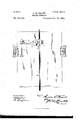
and useful Improvements in Roller-Toboggans, of which the following is a description sufficiently full, clear, and exact to enable any person skilled in the art or science to which said invention appertains to make and I0 use the same, reference being had to the ac companying drawings, forming partof this specification, in Which Figure l is a side elevation of my improved roller-toboggan slide; Fig. 2, a top plan view I5 of the same; andFig. 3 is a bottom plan View of the car.
Like letters and numerals of reference indicate corresponding parts in the different figures of the drawings.
My invention relates especially to a roller toboggan slide of that class wherein the cars are carried to an elevation by an endless chain or cable and running on the track by gravlty.
The nature and operation of the improvement will be readily understood by all conversant with such matters from the following explanation:
The particular object of my invention is to 0 so arrange a continuous track in curves or oval that at certain points there shall appear to be two tracks in parallelism upon which succeeding cars may race.
The tracks are supported on a trestle work 5 of any suitable construction, and continuous from a point on the supporting platform, A, which is arranged at the bottom of the trestle. The shaft, b, is journaled at this point, and carries two pulleys, cl, f. At the opposite 0 end of the frame or trestle and atthe top thereof a pulley, It, is mounted and is connected by the endless belt or cable, m, with the pulley, d. The first track starts from the platform, A, and ascends at a pitch of about 4 5 forty-five degrees to the top of the trestle. A car is carried up said track by means of a clutch hereinafter described, which takes on the cable, m. As soon as the car reaches the highest point of the track, B, or at the pulley, k, the clutch is released and the track commences to incline downwardly the car traveling thereon by gravity. Said track winds in an oval following the course of arrow 2 as indicated in the plan in Fig. 2. The descent is constant until the track reaches a point, p, which is a determinednumber of feet below the highest point of said track at the pulley,
7c. At said point, p, the track again ascends until on a level at the highest point, the carbeing carried up by a cable, t, which connects the pulleys, f, There are now apparently two tracks in parallelism indicated by arrow, 2 and arrow3 in Fig. 2. Said portion marked arrow 3 continues on a downward incline in parallelism with arrow Zuntil it descends sufficiently low to permit it to pass under the cable, 25, of the track as indicated by arrow 4. From this point the descent continues, the course being in an oval (see arrow 5) and preferably extending around the whole length of the trestle until it returns to the platform, A. (See guide arrows 6 and 7.)
The cars are started on the outer track, B, consecutively and the parts are so arranged or timed that when the first car arrives at the point, p, and is carried by the cable, 25, to the pulley, g, a succeeding car will have arrived at the highest point of the track at the pulley, It, so that said first car and. succeeding car running respectively on the parallel tracks indicated by guide arrows 2 and. 3, will race side by side, their speed varying according to the load on the car somewhat.
This racing continues until said first car has reached the point arrow 4, when it is shunted under the higher portion of the track into that part marked arrow 5 as above described. Meanwhile, for example, the second car of the series and the fifth will have met at the highest part of the track and start racing. this arrangement the interest in the ride is greatly increased and the danger of collision between the cars substantially obviated.
The car is shown in the bottom plan view in Fig. 3. This car may be of any suitable 5 construction fitted to run in the tracks, B. The cable, m, is continuously moving in the direction indicated by the arrow in Fig. 3, and the car is secured thereto by a clutch mech anism which comprises an arm, H, pivoted at, [O0 15, to the bottom of the car. Acoiled spring, 16, tends to throw its free end in the direction of travel of the car. A head-block, 17, is fastened to the car bottom and isgrooved on its 4 face to receive the cable, m.
A wedge-block, 18, is pivoted to the free end of the arm, H. When the cable is in groove of .the head-block engaged by the wedgeblock, said wedge-block binds it against the head-block and the car is carried along by the cable in a manner which will be readily understood without a more explicit description.
Both the head-block and wedge-block may have supply grooves, so that if thecable fails to take in one groove it will engage in another.
After the track ceases to run in parallelism, it will be understood that it may be 2 coursed around the trestle as many times as desired before returning to the starting point.
Having thus explained my invention, what 2. Acurved track for a toboggan car inclining downwardly for a determined distance, then ascending to the beginning of said incline; thence running approximately in parallelism in the same plane with said inclined portion, substantially as and for the purpose described.
3. In a track for toboggan cars an ascending portion and devices for carrying the car thereon; said track descending in a curve from the summit of the ascending portion a determined distance; then again ascending into the plane of said summit, and continuing in parallelism with said descending portion, to the beginning of said second ascent; then continuing to descend to the point of starting.
4. In a roller toboggan car, the cable in combination with the car and the clutch thereon comprising a spring-pulled pivoted arm; the Wedge-block pivoted in said arm and the head-block rigidly secured to said car and registering with said wedge block.
5. A cable grip for toboggan carscomprising a spring pulled pivoted lever, H; the grooved wedge-block, 18, loosely pivoted in the free end of said lever, and the rigid grooved head-block, 17, all being arranged to operate substantially as set forth.
- CHARLES N. GRANT. Witnesses:
K. DURFEE, O. M. SHAW.
Publications (1)
| Publication Number | Publication Date |
|---|---|
| US528224A true US528224A (en) | 1894-10-30 |
Family
ID=2597012
Family Applications (1)
| Application Number | Title | Priority Date | Filing Date |
|---|---|---|---|
| US528224D Expired - Lifetime US528224A (en) | Half to orlando brown |
Country Status (1)
| Country | Link |
|---|---|
| US (1) | US528224A (en) |
-
0
- US US528224D patent/US528224A/en not_active Expired - Lifetime
Similar Documents
| Publication | Publication Date | Title |
|---|---|---|
| US719751A (en) | Spiral elevator. | |
| US474657A (en) | Passenger-railway system | |
| US973079A (en) | Conveyer. | |
| US374442A (en) | Peters | |
| US1040125A (en) | Loop-the-loop pleasure-railway. | |
| US548973A (en) | Cable-hoist | |
| US452791A (en) | Power and gravity railway | |
| US468553A (en) | Sliding hill or chute for carriages | |
| US1195927A (en) | mccloy | |
| US283831A (en) | thiyee | |
| US71921A (en) | Improved aerial carriage and way | |
| US812996A (en) | Giant swing. | |
| US1167170A (en) | Amusement device. | |
| US1148901A (en) | Moving stairway or conveyer. | |
| US1130556A (en) | Moving stairway. | |
| US369335A (en) | Endless-railway system | |
| US430587A (en) | Chusetts | |
| US667201A (en) | Flight conveyer. | |
| US635454A (en) | Elevator. | |
| US662906A (en) | Portable derrick. | |
| US779568A (en) | Roundabout. | |
| US379116A (en) | Frederic leininger | |
| US1014856A (en) | Elevator. | |
| US896430A (en) | Amusement apparatus of the gravity-railway type. | |
| US450658A (en) | Pleasure-railway |