US5257281A - Induction heating apparatus and method - Google Patents

Induction heating apparatus and method Download PDF

Info

Publication number
US5257281A
US5257281A US07/473,000 US47300090A US5257281A US 5257281 A US5257281 A US 5257281A US 47300090 A US47300090 A US 47300090A US 5257281 A US5257281 A US 5257281A
Authority
US
United States
Prior art keywords
shell
crucible
vessel
induction heating
induction
Prior art date
Legal status (The legal status is an assumption and is not a legal conclusion. Google has not performed a legal analysis and makes no representation as to the accuracy of the status listed.)
Expired - Lifetime
Application number
US07/473,000
Inventor
Nicolas P. Cignetti
Richard U. Swaney
John H. Mortimer
Current Assignee (The listed assignees may be inaccurate. Google has not performed a legal analysis and makes no representation or warranty as to the accuracy of the list.)
Inductotherm Corp
Original Assignee
Inductotherm Corp
Priority date (The priority date is an assumption and is not a legal conclusion. Google has not performed a legal analysis and makes no representation as to the accuracy of the date listed.)
Filing date
Publication date
Application filed by Inductotherm Corp filed Critical Inductotherm Corp
Priority to US07/473,000 priority Critical patent/US5257281A/en
Assigned to INDUCTOTHERM CORP. reassignment INDUCTOTHERM CORP. ASSIGNMENT OF ASSIGNORS INTEREST. Assignors: CIGNETTI, NICOLAS P., SWANEY, RICHARD U., MORTIMER, JOHN H.
Priority to US07/532,010 priority patent/US5272720A/en
Priority to CA002023285A priority patent/CA2023285C/en
Priority to EP19900310029 priority patent/EP0439900A3/en
Priority to KR1019900020796A priority patent/KR930011375B1/en
Priority to JP3022649A priority patent/JP2731787B2/en
Priority to US08/019,921 priority patent/US5425048A/en
Priority to US08/107,427 priority patent/US5416794A/en
Publication of US5257281A publication Critical patent/US5257281A/en
Application granted granted Critical
Priority to US08/384,080 priority patent/US5550353A/en
Priority to US08/525,322 priority patent/US5844213A/en
Anticipated expiration legal-status Critical
Expired - Lifetime legal-status Critical Current

Links

Images

Classifications

    • HELECTRICITY
    • H05ELECTRIC TECHNIQUES NOT OTHERWISE PROVIDED FOR
    • H05BELECTRIC HEATING; ELECTRIC LIGHT SOURCES NOT OTHERWISE PROVIDED FOR; CIRCUIT ARRANGEMENTS FOR ELECTRIC LIGHT SOURCES, IN GENERAL
    • H05B6/00Heating by electric, magnetic or electromagnetic fields
    • H05B6/02Induction heating
    • H05B6/16Furnaces having endless cores
    • H05B6/20Furnaces having endless cores having melting channel only
    • HELECTRICITY
    • H05ELECTRIC TECHNIQUES NOT OTHERWISE PROVIDED FOR
    • H05BELECTRIC HEATING; ELECTRIC LIGHT SOURCES NOT OTHERWISE PROVIDED FOR; CIRCUIT ARRANGEMENTS FOR ELECTRIC LIGHT SOURCES, IN GENERAL
    • H05B6/00Heating by electric, magnetic or electromagnetic fields
    • H05B6/02Induction heating
    • H05B6/22Furnaces without an endless core
    • H05B6/24Crucible furnaces
    • HELECTRICITY
    • H05ELECTRIC TECHNIQUES NOT OTHERWISE PROVIDED FOR
    • H05BELECTRIC HEATING; ELECTRIC LIGHT SOURCES NOT OTHERWISE PROVIDED FOR; CIRCUIT ARRANGEMENTS FOR ELECTRIC LIGHT SOURCES, IN GENERAL
    • H05B6/00Heating by electric, magnetic or electromagnetic fields
    • H05B6/02Induction heating
    • H05B6/36Coil arrangements

Definitions

  • This invention relates in its broadest aspects to structure and method for rendering a metallic object substantially transparent to an applied alternating magnetic field.
  • the invention finds particular utility with respect to metal-reinforced heating vessels for coreless induction furnaces, although the invention is not so limited.
  • Coreless induction furnaces for melting or otherwise heating metal by inducing eddy currents to flow within the metal are well known.
  • heating is used broadly to encompass not only raising the temperature of a material without causing the material to change state, but also melting, wherein the temperature of a material is raised sufficiently to cause it to change state.
  • metal to be heated is contained in a vessel, usually but not always a crucible.
  • Eddy currents are electromagnetically induced in the metal by an induction coil surrounding the vessel. The eddy currents cause power to be dissipated in the metal, thereby increasing its temperature. In effect, the metal serves as its own heat source.
  • the eddy currents are induced in the metal when alternating current is passed through the induction coil to generate an alternating magnetic field, or induction field.
  • an induction furnace may be used for either heating or physically agitating ("stirring") a quantity of molten metal, and sometimes both.
  • the heating vessel must meet certain stringent physical standards. It must have a sufficiently high melting point so that it will not be melted by the heat of the metal, it must have a high strength to hold the weight of the metal, and it must not interfere with the passage of magnetic flux from the induction coil through and around the metal. Very often, these requirements of high melting point, strength, and lack of interference with the applied magnetic induction field are at cross-purposes from a design standpoint.
  • the present invention optimizes the competing design criteria, enables induction heating vessels to be made larger and stronger than previous designs, and offers dramatic improvements in efficiency.
  • the present invention is particularly-well suited for removable heating vessels for coreless induction furnaces.
  • Removable crucible induction furnaces have been known since at least the early part of this century. See, e.g., Helberger U.S. Pat. No. 1,023,309, which discloses a ceramic refractory crucible which is partially sintered in place and which is pushed out of the induction coil by a hydraulic ram.
  • the utility of a crucible such as that disclosed by Helberger is limited by the use of ceramic alone for the crucible.
  • Ceramic as is well known, is brittle and subject to stress cracking. Breakage of the ceramic crucible could lead to "run out" of molten metal from the crucible, posing a severe safety hazard to operating personnel and to equipment, as well as leading to loss of the metal charge. Thus, ceramic crucibles tend to be relatively small and limited to small quantities of metal.
  • One way of strengthening a ceramic crucible is to surround it by a continuous metallic jacket, or shell.
  • Metals are generally less brittle and have higher yield strengths than ceramics.
  • the shell material is typically steel.
  • steel and many other useful metals are either electrically conductive, magnetic, or greatly weakened when heated, steel-jacketed ceramic crucibles do not offer much of an improvement over ceramic crucibles alone since the magnetic field generated by the induction coil will heat the shell as well as the molten metal in the crucible, thus rendering the vessel either useless or unsafe.
  • Kennedy U.S. Pat. No. 3,314,670 describes a vessel having a one-piece, electrically continuous outer shell of austenitic stainless steel with a refractory lining. The steel must be specially selected to have very specific electrical and magnetic properties.
  • the Kennedy vessel is capable of use only within a frequency range of 0.1 Hz to 60 hz (column 2, line 59). Further, the Kennedy vessel is limited to stirring, and the Kennedy patent states that stirring may take place effectively only within a narrow range of parameters, taking into account the competing requirements of temperature range, stirring forces, strength, and economics. Kennedy thus recognizes that his vessel is not usable for induction melting.
  • a metal-jacketed induction heating vessel that overcomes the drawbacks of the prior art.
  • the present invention provides such a vessel by providing a method by which a metallic shell can be rendered substantially transparent to an applied induction field and by which eddy currents induced in the shell are greatly reduced, thus reducing heating in the shell.
  • a metal-jacketed induction heating vessel employing the principles of the present invention does not rely on exotic materials, nor is it limited to only inductive stirring of molten metals.
  • a metal-jacketed induction heating vessel according to the present invention is, in contrast to prior vessels, able to handle large quantities of metal, with excellent yield strengths at operating temperatures.
  • a vessel according to the present invention allows most of the electromagnetic field developed by the induction coil to couple with the metal to be melted, with only a small amount coupling to the metal jacket. This also is a substantial improvement over prior metal-jacketed crucibles, in which a great deal of energy was lost in coupling between the induction coil and the metal jacket itself.
  • the present invention is not limited to ceramic-lined vessels for coreless induction furnaces.
  • the present invention includes metal-jacketed induction heating vessels which have an inductively heatable susceptor, such as a graphite susceptor, in which non-conductive materials may be heated indirectly by inductively heating the susceptor.
  • the present invention is directed to a method of rendering a metallic object substantially transparent to an applied alternating magnetic field, and comprises providing the object with discrete physically integral but electrically isolated regions for limiting the flow of electromagnetically induced electric currents in the object at locations to be rendered transparent.
  • the invention is directed to a method of mechanically reinforcing an induction heating vessel.
  • the method comprises providing the vessel with a metallic shell which is substantially continuous and which substantially conforms to the shape of the vessel, and providing the shell with discrete physically integral but electrically isolated regions at preselected locations in the shell, whereby the shell is rendered substantially transparent to the induction field at the preselected locations.
  • the invention is broadly directed to a metallic shell for an induction heating vessel.
  • the shell is substantially continuous and substantially conforms to the shape of the vessel.
  • the shell has means integral with it for limiting the flow of induced electric current in it and is substantially transparent to an applied induction field.
  • the invention is also directed to an induction heating vessel which comprises means for holding material to be heated, a substantially continuous metallic shell surrounding and generally conforming to the holding means, the shell having means integral with it for limiting the flow of induced electric currents in the shell.
  • the invention further comprises an induction heating apparatus comprising means for holding material to be heated, induction coil means surrounding the holding means, and metallic shell means between the holding means and the coil means for mechanically reinforcing the holding means.
  • the shell has integral current limiting means for limiting electric currents induced in the shell means by the coil means and for causing the shell means to be substantially transparent to the electromagnetic induction field.
  • the present invention is directed to an induction melting vessel comprising a refractory crucible having an open top end and a closed bottom end, with a substantially continuous side wall between the top and bottom ends.
  • a substantially continuous metallic shell is provided surrounding and generally conforming to the side wall, and extending for at least a majority of the height of the side wall from the bottom end to the top end.
  • the shell thus has a bottom end corresponding to the bottom end of the crucible and a top end corresponding to the top end of the crucible.
  • a portion of the shell adjacent its top end and a portion of the shell adjacent its bottom end each have discrete physically integral but electrically isolated regions therein for limiting the flow of electric current in the shell.
  • the regions are defined by a plurality of slits through the shell which extend from the top and bottom ends of the shell toward the respective opposite ends.
  • the slits are of a length not exceeding half the distance to the respective opposite end.
  • the regions are defined by a plurality of electrically isolated laminations arranged generally perpendicularly to the shell side wall.
  • the laminations may be either in the form of a physically continuous closed path, or arranged in discrete groups.
  • the present invention When used in the context of induction heating, the present invention enables highly efficient coupling of the field developed by the induction coil with the material to be heated (e.g., a metal charge or a graphite susceptor) and minimizes heating of the shell, which in turn allows the use of commercially available engineering metals for the shell and provides the benefits of a metal-jacketed crucible without the drawbacks.
  • the material to be heated e.g., a metal charge or a graphite susceptor
  • FIG. 1 is a longitudinal sectional view of an induction heating vessel according the present invention.
  • FIG. 2 is an isometric view of the vessel of FIG. 1.
  • FIG. 3 is an exploded view of the vessel of FIG. 2.
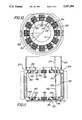
  • FIG. 4 is a transverse sectional view of the vessel of FIG. 2, taken along the lines 4--4 in FIG. 2.
  • FIG. 5 is an enlarged view of a portion of FIG. 4, showing the interconnection of the various parts of the vessel shell.
  • FIGS. 6 and 7 illustrate the flow of induced eddy currents in a metal object without and with the features of the invention, respectively.
  • FIG. 8 is an isometric view of an alternate embodiment of an induction heating vessel according to the present invention.
  • FIG. 9 is a longitudinal sectional view of the vessel of FIG. 8.
  • FIG. 10 is a top plan view of a variation of the alternate embodiment shown in FIGS. 8 and 9.
  • FIG. 11 is a partial sectional view of the vessel of FIG. 10, taken along the lines 11--11 in FIG. 10.
  • FIG. 12 is a sectional view of a variation of the vessel in FIGS. 10 and 11.
  • FIG. 13 is a sectional view illustrating the vessel of the invention used with a multi-layer induction coil.
  • FIGS. 1 through 4 there is shown in FIGS. 1 through 4 one embodiment of an induction heating vessel according to the present invention.
  • the entire vessel is indicated by reference numeral 10.
  • Vessel 10 comprises a crucible 12, which may be a refractory ceramic or an electrically conductive electromagnetic susceptor, such as graphite.
  • Crucible 12 has an open top end 14 and a closed bottom end 16 and, in known manner, contains a charge 18 of metal being melted.
  • crucible 12 and, consequently, vessel 10 are substantially cylindrical in shape.
  • the present invention will be described with reference to a substantially cylindrical crucible, it should be understood that the precise shape of the crucible is not crucial to the present invention.
  • the vessel may be rectangular, or in the shape of an oblate spheroid, for example, without departing from the scope of the invention.
  • crucible 12 is illustrated having a closed bottom end, the crucible may have an open bottom, and can be any suitable means for holding material to be inductively heated.
  • crucible 12 could just as easily be a casting ladle, launder, runner, sprue or the like.
  • Crucible 12 also has a side wall 20 between the top and bottom ends 14 and 16, respectively, of crucible 12. Surrounding and generally conforming to crucible side wall 20 is a metallic shell designated generally by reference numeral 22. (It will be noted that, except for FIG. 1, crucible 12 has been omitted in order to more clearly show the structure of shell 22.)
  • Shell 22 is preferably, but not necessarily, fitted with a pair of diametrically opposite lugs 24 adjacent the top end of crucible 12. Lugs 24 permit vessel 10 to be lowered into or lifted out of the interior of induction coil 26.
  • Induction coil 26 is a conventional induction coil through which an alternating current flows which, in known manner, generates an alternating magnetic field, or induction field. The induction field, in turn, couples with the metal 18 and heats it. As those skilled in the art will recognize, the flux lines of the induction field from coil 26 will enter and leave crucible 12 adjacent the top and bottom ends of shell 22.
  • Shell 22 comprises, at a minimum, a substantially continuous side wall 28 which is preferably a single sheet of a metallic material, such as steel, that wraps around and substantially conforms to crucible 12.
  • Shell side wall 28 is wrapped around crucible 12 and surrounds substantially the entire circumference of crucible 12, with the exception of a small gap 30 between ends 32 and 34 of side wall 28.
  • Gap 30 provides an electrical discontinuity between ends 32 and 34, which serves to limit induced eddy currents in shell side wall 28.
  • Ends 32 and 34 are held in place by retaining plates 36 and 38 which, as more clearly shown in FIG. 5, are electrically insulated from side wall 28 by non-conductive strips 40.
  • Strips 40 also cooperate with corresponding strips 42 and 44 on the inside surface of ends 32 and 34, respectively, of shell 28. Strips 40, 42 and 40, 44 cooperate, when plates 36 and 38 are bolted together, to give side wall 28 added strength and prevent it from "unwrapping" from crucible 12. Retaining plates 36 and 38 are secured by a plurality of fasteners such as nut and bolt arrangement 47, 49. It should be noted that, in order to maintain electrical isolation between ends 32 and 34 of side wall 28, insulating strips and insulating washers 46, 48, 50 and 52 are used wherever metal parts of the shell might come into contact. Thus, as can be seen in FIG. 5, while the shell is physically continuous there is no electrically conductive path between ends 32 and 34 of side wall 28.
  • collar assembly 54 comprises two separate halves 56, 58 which are essentially identical and which are bolted together along their edges to form a single unit.
  • each collar half is provided with flanges 60 and 62 by which halves 56, 58 may be bolted or riveted together, in known manner.
  • collar halves 56, 58 be insulated from one another.
  • an insulating strip is placed between flanges 60 and 62 before halves 56 and 58 are joined together.
  • Collar assembly 54 is provided with a plurality of circular openings 64 along one edge which mate with corresponding circular openings 66 along one edge of shell side wall 28 so that collar 54 may be joined to shell 28, such as by bolts or rivets 68. Again, although not shown in the drawings, it is preferable that collar assembly 54 be electrically insulated from shell side wall 28. For that purpose, a strip or band of insulating material may be placed between collar assembly 54 and shell side wall 28.
  • Shell 22 also preferably includes a bottom, designated generally by reference numeral 70.
  • bottom 70 comprises two halves 72 and 74.
  • Each half is substantially identical to the other and comprises a support plate 76 and a side edge 78 generally perpendicular to plate 76.
  • Each half also comprises a diametric flange 80 which enables it to be joined to its opposite half.
  • a plurality of openings 82 is provided in flange 80 so that halves 72, 74 may be joined together, such as by bolts or rivets.
  • Halves 72 and 74 are preferably electrically insulated from one another.
  • an insulating strip is placed between the flanges 80 of halves 72 and 74 before they are joined together.
  • the bottom 70 is joined to the bottom edge of shell 28 by means of openings 84 and 86 provided adjacent the bottom end of shell side wall 28 and in the side edges 78 of bottom halves 72 and 74, respectively.
  • Bottom 70 is joined to the bottom edge of side wall 28 by fasteners such as bolts or rivets 88.
  • an insulating band is placed between bottom 70 and the bottom end of shell side wall 28, so that the bottom 70 is electrically insulated from shell 22.
  • the gap formed by flanges 80 of bottom halves 72 and 74 and one of the gaps formed by flanges 60 and 62 of collar halves 56 and 58 are co-linear with gap 30 in shell 22.
  • the fasteners used to connect the various parts of shell 22 together are preferably, although not necessarily, electrically insulated by insulating strips and washers, as required, so that the individual parts of shell 22 are electrically isolated from the other parts of shell 22.
  • electrically isolating the various parts of shell 22 from one another By electrically isolating the various parts of shell 22 from one another, induced eddy currents in shell 22 are minimized.
  • Induced eddy currents in shell 22 are primarily minimized by a plurality of discrete physically integral but electrically isolated regions in shell 22. These regions serve to break up and limit the flow of eddy currents induced in the shell by induction coil 26.
  • the regions are defined by a plurality of slits 90 which extend through shell side wall 28 from the top end and the bottom end and extend toward the respective opposite ends of side wall 28. Opposed slits in the top and bottom ends may lie along the same longitudinal line along side wall 28, or may be offset with respect to each other.
  • each slit does not exceed fifty percent of the distance to the opposite end of shell side wall 28 and, preferably, the slits are of such length that the total length of corresponding pairs of opposed slits at the top and bottom edges of shell 28 does not exceed twenty percent of the height of side wall 28.
  • the slits need not be very wide, as long as there is no electrical path across the slits.
  • the slits may remain unfilled so that each slit comprises an air gap, or the slits may be filled with an insulating cement for added shell strength.
  • Collar assembly 54 is likewise provided with a plurality of slits in its bottom edge. These slits are preferably, although not necessarily, in alignment with slits 90 in the top edge of shell side wall 28. Likewise, the side edges 78 of bottom 70 are provided with a plurality of slits 91 which are preferably, but not necessarily, in alignment with slits 90 in the bottom edge of shell side wall 28. Halves 72 and 74 of bottom 70 are also provided with radially inward slits 92, which are preferably, but need not be, in alignment with the slits in side edge 78. Preferably, although not necessarily, slits 92 are alternately longer and shorter, to better minimize induced eddy currents in bottom 70. Preferably, the maximum length of slits 92 is not greater than forty percent of the radius of bottom 70.
  • FIGS. 6 and 7 The way in which the discrete regions serve to break up and limit the eddy currents is shown schematically in FIGS. 6 and 7.
  • FIG. 6 illustrates the flow pattern of the eddy currents induced shell by the induction coil in a shell with insulating gap 30 but no slits.
  • the direction of these currents alternates at the same frequency as the alternating current source used to excite coil 26, and the direction shown in the figures is that at a given instant of time.
  • the shell is shown "unwrapped," with ends 32 and 34 separated and he shell laid in a plane. The shell is illustrated in this manner to facilitate the explanation of the behavior of the eddy currents, but that behavior is the same whether the shell is laid flat or curved into a cylinder.
  • Eddy currents originate in the top and bottom halves of the shell and move in a circular path toward or away from the center of the shell.
  • the present invention achieves large reductions in current by creating electrically isolated regions in the shell 28. In the embodiment already described, these regions are defined by the insulating gap 30 and slits 90 in the top and bottom ends of shell 28.
  • the shell according to this embodiment is shown, laid flat, in FIG. 7.
  • the slots define electrically isolated regions along the top and bottom ends of shell 28 which break up induced eddy currents. In the shell of FIG. 7, instead of one large eddy current flowing in each half of the shell (as in FIG.
  • Insulating gap 30 and slits 90 are only one way of defining electrically isolated regions in shell 22.
  • physically contiguous but electrically insulated laminated strips may also be used.
  • An embodiment of the invention using laminated strips is shown in FIGS. 8 and 9.
  • a vessel 102 comprises a crucible (not shown) surrounded by a substantially uniform cylindrical metallic shell 104 having an open top end 106 and an open bottom end 108.
  • a cover 107 shown in phantom, may be inserted through the top end 106, so as to close off the top of the crucible holding molten metal.
  • Bottom end 108 may either be left open or may be closed by a suitable bottom support, such as bottom 70 shown in FIG. 2.
  • a bottom is preferably electrically isolated from shell 104. Portions of shell 104 adjacent top end 106 and bottom end 108 are interrupted by laminated rings 110.
  • the rings 110 are made up of thin strips 112 of metal. The strips are electrically insulated from one another by a thin layer of insulating material 114.
  • the insulating material 114 may be any suitable insulating material.
  • the strips 112 and insulating layers 114 are laminated together by a suitable adhesive to form a physically continuous closed path of a plurality of electrically isolated regions.
  • the laminated rings 110 are integrally joined to of shell 104, such as by welds 118. Similar to the slits 90 in the first embodiment, the strips 112 in rings 110 break up eddy currents in the shell 104.
  • the electrically isolated regions are substantially transparent to he flux lines from a typical induction coil.
  • FIG. 9 which illustrates vessel 102 in place within an induction coil 122
  • the flux lines 120 from a typical induction coil 122 enter and leave vessel 102 near the top and bottom.
  • FIGS. 10 and 11 A variation of the embodiment of the vessel illustrated in FIGS. 8 and 9 is shown in FIGS. 10 and 11.
  • the vessel is designated generally by reference numeral 124 and comprises a substantially continuous shell 126, a collar assembly 128 and a bottom 130.
  • shell 126 has a gap 132 between is ends.
  • gap 134 defined by halves o collar assembly 128 and a gap 136 defined by halves of bottom 130.
  • gaps 132, 134 and 136 are all co-linear.
  • FIGS. 10 and 11 is, in effect, a combination of features of the embodiments illustrated in FIGS. 1 through 4 and FIGS. 8 and 9.
  • the electrically isolated regions are defined by a combination of laminated strips and slits.
  • shell 126 comprises a plurality of slits 138 in the top and bottom edges of shell 126.
  • the slits thus define electrically isolated regions 140 along the top and bottom ends of shell 126.
  • additional electrically isolated regions are defined by laminated blocks 142 and 144 arranged circumferentially around the top and bottom ends, respectively, of shell 126.
  • Each laminated block is made of a plurality of thin strips 146 of metal.
  • the strips are electrically insulated from one another by a layer of insulating material 148, which may be any suitable insulating material.
  • the strips 146 and insulating layers 148 are laminated together by a suitable adhesive to form a physically continuous block of a plurality of electrically isolated regions.
  • the laminated blocks 142 and 144 are inserted in corresponding openings provided in shell 126 and are insulated from shell 126 by insulating strips 150. Blocks 142 and 144 may be either welded in place or secured in place by a suitable adhesive.
  • Blocks 142 and 144 may extend radially inward and radially outward of vessel 124 to any desired extent.
  • blocks 142 may extend radially outwardly so as to overlap induction coil 152 or, if desired, may extend to a lesser degree to be inboard of coil 152, as illustrated by phantom line 154.
  • blocks 144 around the bottom end of shell 126 are limited in their radially outward extent in order to provide clearance with coil 152, so that vessel 124 may be lifted out of coil 152.
  • Blocks 144 are also preferably, although not necessarily, provided with an angled face 156, which is preferably at an angle of 45° to the side wall of shell 126. This enables flux lines from the applied induction field from coil 15 to be directed toward the geometric center of vessel 124 to facilitate heating or stirring.
  • strips 146 of laminated blocks 142 and 144 are perpendicular to the side wall of shell 126.
  • strips 146 need not be disposed vertically, as illustrated in FIG. 11. Instead, the strips 146 may be horizontal or at oblique angles.
  • blocks 142 and 144 need not be substantially rectangular in cross section. Blocks may be of any other shape, including a cylindrical roll of metal strip wound in a coil in the manner of "jelly roll".
  • blocks 142 may extend, if desired, radially outward so as to be inboard of coil 152, as shown by phantom line 154 in FIG. 11.
  • FIG. 12 shows a vessel 124 in which blocks 154 are inboard of coil 152.
  • Shunts 158 are preferably made of a plurality of thin strips of metal, in the manner of laminated blocks 142 and 144. Shunts 158 may surround the entire circumference of coil 152, or may be arranged in groups, coextensive with blocks 142 and 144.
  • Shunts 158 comprise an upright portion 160 and top and bottom horizontal portions 162, 164, respectively.
  • the length of upright portion 160 is approximately equal to the axial length of coil 152.
  • top horizontal and bottom horizontal portions 160, 164 are located opposite blocks 142 and 144, respectively.
  • Shunts 158 serve to direct the flux lines of the induction field generated by induction coil 152, so that the flux lines on the exterior of coil 152 are constrained to travel through upright portions 160 and be directed through blocks 142 and 144.
  • Shunts 158 thus minimize stray flux and concentrate the majority of the flux lines of the induction field at the locations of blocks 142 and 144. In that way, the majority of the flux lines pass through blocks 142 and 144 to the interior of the vessel 124 without coupling substantially to shell 126.
  • shunts 158 are formed of a plurality of thin laminations, as are blocks 142 and 144, very little of the induction field is lost in coupling with the shunts. Thus, shunts 158 enhance the coupling efficiency between coil 152 and vessel 124.
  • shunts 158 can be sized to accommodate a multi-layer coil 166, which comprises a plurality of concentric, radially-spaced windings, in known manner. Top and bottom horizontal portions 162 and 164 may be made shorter or longer, as desired, to accommodate any number of radially-spaced coil windings.
  • the use of shunts 158 is not limited to embodiments of the vessel which employ laminated blocks 142 and 144, but is usable also with embodiments of the vessel which employ only slits 90.
  • shunts 158 may be used with embodiments of the vessel which employ laminated rings, as shown in FIG. 8.
  • the metal-jacketed vessel of the present invention offers all of the advantages of a steel-jacketed crucible, which can be realized over a wide range of temperatures and even at temperatures at which superheating of the molten metal charge occurs. Because the structure of the shell is so effective in minimizing induced eddy currents, little power is dissipated in the shell, allowing the shell to remain at temperatures significantly lower than the contents of the crucible during heating and melting.
  • the invention thus offers a number of advantages: vessel capacity can be greatly increased; danger of "run out” is minimized; the metal shell retains its structural strength over an extremely wide temperature range; the shell remains cool relative to the contents of the crucible, which, in turn, minimizes operator discomfort and danger of injury from burns caused by hot metal.
  • the metal-jacketed vessel of the present invention also makes it possible to carry out metallurgical and other material treating processes on a vastly-improved economic scale. Likewise, processes not previously possible can be achieved with the vessel of the present invention.
  • the present invention makes it possible, for the first time, to carry out unique metallurgical processes because constant temperature, non-stratified compositions and conditions have been achieved by non-violent turbulence of the contained charge. Other processes achieve these conditions only under extreme turbulence caused by injected gases, and as a consequence require very large freeboard around the vessel and sophisticated safety controls, and suffer extreme container erosion and corrosion.
  • the present invention makes possible the benefits of these known metallurgical reactions without these costly and expansive conditions at rates equal to or faster than achieved in the gas blown processes.
  • This non-violent mixing allows for the use of hitherto unusable continuous temperature, pressure, and compositional sensors. The violence of the turbulence damages the sensors or renders them unreliable in the aforementioned known gas blown process.
  • the new vessel thus makes the process controllable by accurate sensor output data to known controllers and computer networks.
  • the vessel of the present invention retains high structural strength, it is readily transportable from one location to another. This makes it possible to conveniently transport the vessel and its contents among various stations for melting, holding and treating. By using a number of vessels, it is possible to carry out a melting operation at one location while simultaneously carrying out a treating operation on an already-molten charge at a treating location.
  • an individual vessel is placed at a charging location, where it is charged with metal or other material to be treated.
  • the vessel is charged with metal.
  • the vessel is transported to a melting station which, preferably, has a high power (such as, for example, 3000 kW) melting coil.
  • the metal is able to be melted quickly.
  • the vessel is transported to a treating station, at which is located a low power (such as, for example, 500 kW) induction coil with a power output sufficient to keep the already-molten metal in the liquid state.
  • elements such as carbon and silicon can be added to the melt, or the melt can be treated with any number of commonly-used gases such as argon, oxygen, carbon dioxide and nitrogen, for treating and/or refining.
  • gases such as argon, oxygen, carbon dioxide and nitrogen
  • the vessel of the present invention can be easily and safely moved from location to location, all of the preceding steps can be carried out simultaneously. Thus, while one vessel is at the treating station, another can be at the melting station, and another at the charging station, while a vessel containing already-treated metal is at a casting station.
  • the vessel of the present invention makes it possible to greatly increase equipment usage, minimize equipment "dead time,” and speed up throughput.
  • the present invention also makes it possible to treat materials in a transportable controlled environment.
  • materials such as carbon/carbon and composite ceramics
  • This process conventionally starts with a cold chamber, into which a graphite susceptor containing a charge of material is placed.
  • the chamber must be sealed and the atmosphere evacuated, and the charge in the susceptor brought up to treatment temperature by the induction coil.
  • the material can be subjected to treatment gases or a vacuum, as desired.
  • the charge must be permitted to cool before the susceptor can be removed from the chamber.
  • the conventional process is quite time consuming and could take 24 hours from start to finish.
  • the vessel of the present invention it is possible to seal the vessel itself, so that the vessel in effect becomes the environmental chamber. This permits treating in a controlled environment to be carried out using a conventional induction coil and does not require a separate environmental chamber.
  • the vessel of the present invention can be fitted in any convenient manner with an appropriate cover and fittings for sealing and evacuating the interior of the vessel after it is charged and for admitting treating gases.
  • the sealed vessel can then be placed in a conventional induction coil for heating.
  • this process permits great savings in cost and improvements in throughput. While one vessel is being charged, another can be heated, while a third can be unloaded. In addition, it is no longer necessary to wait for an environmental chamber to heat up and cool down before the vessel can be moved. Instead, the vessel can simply be placed in an induction coil and, after treatment is completed, be removed immediately and allowed to cool. As soon as one vessel is removed from the coil, another vessel, already charged, can be placed in the coil. Thus, significant improvements in throughput and equipment utilization can be realized.

Landscapes

  • Physics & Mathematics (AREA)
  • Electromagnetism (AREA)
  • General Induction Heating (AREA)
  • Crucibles And Fluidized-Bed Furnaces (AREA)

Abstract

An induction melting vessel comprising a refractory crucible having an opened top end and closed bottom end, with a substantially continuous side wall. A substantially continuous metallic shell surrounds and generally conforms to the side wall and extends for at least a majority of the height of the side wall from the bottom end to the top end. The shell has a bottom end corresponding to the bottom end of the crucible and a top end corresponding to the top end of the crucible. A portion the shell adjacent the top end thereof and a portion of the shell adjacent the bottom end thereof have discrete physically integral but electrically isolated regions therein for limiting the flow of electric current in the shell. In one embodiment of the invention, the regions are defined by a plurality of slits through the shell and extending from the top and bottom ends thereof toward the respective opposite ends. The slits have a length not exceeding have the distance to the respective opposite end. In an alternate embodiment of the invention, the regions are defined by a plurality of electrically isolated laminations arranged generally perpendicularly to the shell side wall.

Description

FIELD OF THE INVENTION
This invention relates in its broadest aspects to structure and method for rendering a metallic object substantially transparent to an applied alternating magnetic field. The invention finds particular utility with respect to metal-reinforced heating vessels for coreless induction furnaces, although the invention is not so limited.
BACKGROUND OF THE INVENTION
Coreless induction furnaces for melting or otherwise heating metal by inducing eddy currents to flow within the metal are well known. (As used in this disclosure, the term "heating" is used broadly to encompass not only raising the temperature of a material without causing the material to change state, but also melting, wherein the temperature of a material is raised sufficiently to cause it to change state.) Typically, metal to be heated is contained in a vessel, usually but not always a crucible. Eddy currents are electromagnetically induced in the metal by an induction coil surrounding the vessel. The eddy currents cause power to be dissipated in the metal, thereby increasing its temperature. In effect, the metal serves as its own heat source. The eddy currents are induced in the metal when alternating current is passed through the induction coil to generate an alternating magnetic field, or induction field. Depending upon the frequency of the alternating current in the induction coil, and on other design considerations, an induction furnace may be used for either heating or physically agitating ("stirring") a quantity of molten metal, and sometimes both.
The heating vessel must meet certain stringent physical standards. It must have a sufficiently high melting point so that it will not be melted by the heat of the metal, it must have a high strength to hold the weight of the metal, and it must not interfere with the passage of magnetic flux from the induction coil through and around the metal. Very often, these requirements of high melting point, strength, and lack of interference with the applied magnetic induction field are at cross-purposes from a design standpoint.
The present invention optimizes the competing design criteria, enables induction heating vessels to be made larger and stronger than previous designs, and offers dramatic improvements in efficiency. The present invention is particularly-well suited for removable heating vessels for coreless induction furnaces. Removable crucible induction furnaces have been known since at least the early part of this century. See, e.g., Helberger U.S. Pat. No. 1,023,309, which discloses a ceramic refractory crucible which is partially sintered in place and which is pushed out of the induction coil by a hydraulic ram. In practical terms, however, the utility of a crucible such as that disclosed by Helberger is limited by the use of ceramic alone for the crucible. Ceramic, as is well known, is brittle and subject to stress cracking. Breakage of the ceramic crucible could lead to "run out" of molten metal from the crucible, posing a severe safety hazard to operating personnel and to equipment, as well as leading to loss of the metal charge. Thus, ceramic crucibles tend to be relatively small and limited to small quantities of metal.
One way of strengthening a ceramic crucible is to surround it by a continuous metallic jacket, or shell. Metals are generally less brittle and have higher yield strengths than ceramics. The shell material is typically steel. However, since steel and many other useful metals are either electrically conductive, magnetic, or greatly weakened when heated, steel-jacketed ceramic crucibles do not offer much of an improvement over ceramic crucibles alone since the magnetic field generated by the induction coil will heat the shell as well as the molten metal in the crucible, thus rendering the vessel either useless or unsafe.
Where metal-jacketed ceramic crucibles have been used in induction furnaces, their use has generally been restricted to induction stirring, not induction heating. For example, Kennedy U.S. Pat. No. 3,314,670 describes a vessel having a one-piece, electrically continuous outer shell of austenitic stainless steel with a refractory lining. The steel must be specially selected to have very specific electrical and magnetic properties. The Kennedy vessel is capable of use only within a frequency range of 0.1 Hz to 60 hz (column 2, line 59). Further, the Kennedy vessel is limited to stirring, and the Kennedy patent states that stirring may take place effectively only within a narrow range of parameters, taking into account the competing requirements of temperature range, stirring forces, strength, and economics. Kennedy thus recognizes that his vessel is not usable for induction melting.
Other attempts at developing usable metal-jacketed ceramic crucibles involve the selection of exotic materials. For example, Willay U.S. Pat. No. 4,446,563 discloses a composite vessel with an inner container made of vitreous carbon and an outer container made of platinum. Clearly, however, such exotic designs are extremely impractical and are not cost effective for most applications.
There thus exists a definite need for a metal-jacketed induction heating vessel that overcomes the drawbacks of the prior art. The present invention provides such a vessel by providing a method by which a metallic shell can be rendered substantially transparent to an applied induction field and by which eddy currents induced in the shell are greatly reduced, thus reducing heating in the shell. A metal-jacketed induction heating vessel employing the principles of the present invention does not rely on exotic materials, nor is it limited to only inductive stirring of molten metals. A metal-jacketed induction heating vessel according to the present invention is, in contrast to prior vessels, able to handle large quantities of metal, with excellent yield strengths at operating temperatures. At the same time, a vessel according to the present invention allows most of the electromagnetic field developed by the induction coil to couple with the metal to be melted, with only a small amount coupling to the metal jacket. This also is a substantial improvement over prior metal-jacketed crucibles, in which a great deal of energy was lost in coupling between the induction coil and the metal jacket itself.
Moreover, the present invention is not limited to ceramic-lined vessels for coreless induction furnaces. The present invention includes metal-jacketed induction heating vessels which have an inductively heatable susceptor, such as a graphite susceptor, in which non-conductive materials may be heated indirectly by inductively heating the susceptor.
These and other advantages of the present invention will become apparent from the following description.
SUMMARY OF THE INVENTION
In its broad aspect, the present invention is directed to a method of rendering a metallic object substantially transparent to an applied alternating magnetic field, and comprises providing the object with discrete physically integral but electrically isolated regions for limiting the flow of electromagnetically induced electric currents in the object at locations to be rendered transparent.
In a somewhat narrower aspect, the invention is directed to a method of mechanically reinforcing an induction heating vessel. In this aspect of the invention, the method comprises providing the vessel with a metallic shell which is substantially continuous and which substantially conforms to the shape of the vessel, and providing the shell with discrete physically integral but electrically isolated regions at preselected locations in the shell, whereby the shell is rendered substantially transparent to the induction field at the preselected locations.
In its structural aspects, the invention is broadly directed to a metallic shell for an induction heating vessel. The shell is substantially continuous and substantially conforms to the shape of the vessel. The shell has means integral with it for limiting the flow of induced electric current in it and is substantially transparent to an applied induction field.
The invention is also directed to an induction heating vessel which comprises means for holding material to be heated, a substantially continuous metallic shell surrounding and generally conforming to the holding means, the shell having means integral with it for limiting the flow of induced electric currents in the shell.
The invention further comprises an induction heating apparatus comprising means for holding material to be heated, induction coil means surrounding the holding means, and metallic shell means between the holding means and the coil means for mechanically reinforcing the holding means. The shell has integral current limiting means for limiting electric currents induced in the shell means by the coil means and for causing the shell means to be substantially transparent to the electromagnetic induction field.
In one of its structural aspects, the present invention is directed to an induction melting vessel comprising a refractory crucible having an open top end and a closed bottom end, with a substantially continuous side wall between the top and bottom ends. A substantially continuous metallic shell is provided surrounding and generally conforming to the side wall, and extending for at least a majority of the height of the side wall from the bottom end to the top end. The shell thus has a bottom end corresponding to the bottom end of the crucible and a top end corresponding to the top end of the crucible. A portion of the shell adjacent its top end and a portion of the shell adjacent its bottom end each have discrete physically integral but electrically isolated regions therein for limiting the flow of electric current in the shell.
In one embodiment, the regions are defined by a plurality of slits through the shell which extend from the top and bottom ends of the shell toward the respective opposite ends. The slits are of a length not exceeding half the distance to the respective opposite end.
In an alternate embodiment, the regions are defined by a plurality of electrically isolated laminations arranged generally perpendicularly to the shell side wall. The laminations may be either in the form of a physically continuous closed path, or arranged in discrete groups.
When used in the context of induction heating, the present invention enables highly efficient coupling of the field developed by the induction coil with the material to be heated (e.g., a metal charge or a graphite susceptor) and minimizes heating of the shell, which in turn allows the use of commercially available engineering metals for the shell and provides the benefits of a metal-jacketed crucible without the drawbacks.
Of course, although the invention is described in relation to induction heating, it should be understood that the present invention is applicable wherever it is desired to render a metallic object substantially transparent to an applied magnetic field.
BRIEF DESCRIPTION OF THE DRAWINGS
For the purpose of illustrating the invention, there is shown in the drawings a form which is presently preferred; it being understood, however, that this invention is not limited to the precise arrangements and instrumentalities shown.
FIG. 1 is a longitudinal sectional view of an induction heating vessel according the present invention.
FIG. 2 is an isometric view of the vessel of FIG. 1.
FIG. 3 is an exploded view of the vessel of FIG. 2.
FIG. 4 is a transverse sectional view of the vessel of FIG. 2, taken along the lines 4--4 in FIG. 2.
FIG. 5 is an enlarged view of a portion of FIG. 4, showing the interconnection of the various parts of the vessel shell.
FIGS. 6 and 7 illustrate the flow of induced eddy currents in a metal object without and with the features of the invention, respectively.
FIG. 8 is an isometric view of an alternate embodiment of an induction heating vessel according to the present invention.
FIG. 9 is a longitudinal sectional view of the vessel of FIG. 8.
FIG. 10 is a top plan view of a variation of the alternate embodiment shown in FIGS. 8 and 9.
FIG. 11 is a partial sectional view of the vessel of FIG. 10, taken along the lines 11--11 in FIG. 10.
FIG. 12 is a sectional view of a variation of the vessel in FIGS. 10 and 11.
FIG. 13 is a sectional view illustrating the vessel of the invention used with a multi-layer induction coil.
DESCRIPTION OF THE INVENTION
Referring now to the drawings, wherein like numerals indicate like elements, there is shown in FIGS. 1 through 4 one embodiment of an induction heating vessel according to the present invention. (While the invention is described and illustrated using an induction heating vessel, it should be remembered that the invention is not so limited.) The entire vessel is indicated by reference numeral 10. Vessel 10 comprises a crucible 12, which may be a refractory ceramic or an electrically conductive electromagnetic susceptor, such as graphite. Crucible 12 has an open top end 14 and a closed bottom end 16 and, in known manner, contains a charge 18 of metal being melted. As shown in the drawings, crucible 12 and, consequently, vessel 10, are substantially cylindrical in shape. Although the present invention will be described with reference to a substantially cylindrical crucible, it should be understood that the precise shape of the crucible is not crucial to the present invention. Thus, although it is generally easier to manufacture a cylindrical vessel, the vessel may be rectangular, or in the shape of an oblate spheroid, for example, without departing from the scope of the invention. Likewise, although crucible 12 is illustrated having a closed bottom end, the crucible may have an open bottom, and can be any suitable means for holding material to be inductively heated. Thus, without departing from the scope of the invention, crucible 12 could just as easily be a casting ladle, launder, runner, sprue or the like.
Crucible 12 also has a side wall 20 between the top and bottom ends 14 and 16, respectively, of crucible 12. Surrounding and generally conforming to crucible side wall 20 is a metallic shell designated generally by reference numeral 22. (It will be noted that, except for FIG. 1, crucible 12 has been omitted in order to more clearly show the structure of shell 22.) Shell 22 is preferably, but not necessarily, fitted with a pair of diametrically opposite lugs 24 adjacent the top end of crucible 12. Lugs 24 permit vessel 10 to be lowered into or lifted out of the interior of induction coil 26. Induction coil 26 is a conventional induction coil through which an alternating current flows which, in known manner, generates an alternating magnetic field, or induction field. The induction field, in turn, couples with the metal 18 and heats it. As those skilled in the art will recognize, the flux lines of the induction field from coil 26 will enter and leave crucible 12 adjacent the top and bottom ends of shell 22.
The structure of shell 22 according to a first embodiment of the invention is best illustrated in FIGS. 2 through 4. Shell 22 comprises, at a minimum, a substantially continuous side wall 28 which is preferably a single sheet of a metallic material, such as steel, that wraps around and substantially conforms to crucible 12. Shell side wall 28 is wrapped around crucible 12 and surrounds substantially the entire circumference of crucible 12, with the exception of a small gap 30 between ends 32 and 34 of side wall 28. Gap 30 provides an electrical discontinuity between ends 32 and 34, which serves to limit induced eddy currents in shell side wall 28. Ends 32 and 34 are held in place by retaining plates 36 and 38 which, as more clearly shown in FIG. 5, are electrically insulated from side wall 28 by non-conductive strips 40. Strips 40 also cooperate with corresponding strips 42 and 44 on the inside surface of ends 32 and 34, respectively, of shell 28. Strips 40, 42 and 40, 44 cooperate, when plates 36 and 38 are bolted together, to give side wall 28 added strength and prevent it from "unwrapping" from crucible 12. Retaining plates 36 and 38 are secured by a plurality of fasteners such as nut and bolt arrangement 47, 49. It should be noted that, in order to maintain electrical isolation between ends 32 and 34 of side wall 28, insulating strips and insulating washers 46, 48, 50 and 52 are used wherever metal parts of the shell might come into contact. Thus, as can be seen in FIG. 5, while the shell is physically continuous there is no electrically conductive path between ends 32 and 34 of side wall 28.
Side wall 28 may also be fitted with a collar assembly, generally designated by numeral 54. Preferably, although not necessarily, collar assembly 54 comprises two separate halves 56, 58 which are essentially identical and which are bolted together along their edges to form a single unit. For this purpose, each collar half is provided with flanges 60 and 62 by which halves 56, 58 may be bolted or riveted together, in known manner. Although not illustrated in the drawings, it is preferable that collar halves 56, 58 be insulated from one another. For that purpose, an insulating strip is placed between flanges 60 and 62 before halves 56 and 58 are joined together.
Collar assembly 54 is provided with a plurality of circular openings 64 along one edge which mate with corresponding circular openings 66 along one edge of shell side wall 28 so that collar 54 may be joined to shell 28, such as by bolts or rivets 68. Again, although not shown in the drawings, it is preferable that collar assembly 54 be electrically insulated from shell side wall 28. For that purpose, a strip or band of insulating material may be placed between collar assembly 54 and shell side wall 28.
Shell 22 also preferably includes a bottom, designated generally by reference numeral 70. Preferably, bottom 70 comprises two halves 72 and 74. Each half is substantially identical to the other and comprises a support plate 76 and a side edge 78 generally perpendicular to plate 76. Each half also comprises a diametric flange 80 which enables it to be joined to its opposite half. For that purpose, a plurality of openings 82 is provided in flange 80 so that halves 72, 74 may be joined together, such as by bolts or rivets. Halves 72 and 74 are preferably electrically insulated from one another. For that purpose, an insulating strip is placed between the flanges 80 of halves 72 and 74 before they are joined together. The bottom 70 is joined to the bottom edge of shell 28 by means of openings 84 and 86 provided adjacent the bottom end of shell side wall 28 and in the side edges 78 of bottom halves 72 and 74, respectively. Bottom 70 is joined to the bottom edge of side wall 28 by fasteners such as bolts or rivets 88. Preferably, an insulating band is placed between bottom 70 and the bottom end of shell side wall 28, so that the bottom 70 is electrically insulated from shell 22.
Preferably, although by no means necessarily, the gap formed by flanges 80 of bottom halves 72 and 74 and one of the gaps formed by flanges 60 and 62 of collar halves 56 and 58 are co-linear with gap 30 in shell 22.
As suggested by FIG. 5, the fasteners used to connect the various parts of shell 22 together are preferably, although not necessarily, electrically insulated by insulating strips and washers, as required, so that the individual parts of shell 22 are electrically isolated from the other parts of shell 22. By electrically isolating the various parts of shell 22 from one another, induced eddy currents in shell 22 are minimized.
Induced eddy currents in shell 22 are primarily minimized by a plurality of discrete physically integral but electrically isolated regions in shell 22. These regions serve to break up and limit the flow of eddy currents induced in the shell by induction coil 26. In the embodiment of the invention illustrated in FIGS. 1 through 4, the regions are defined by a plurality of slits 90 which extend through shell side wall 28 from the top end and the bottom end and extend toward the respective opposite ends of side wall 28. Opposed slits in the top and bottom ends may lie along the same longitudinal line along side wall 28, or may be offset with respect to each other. The length of each slit does not exceed fifty percent of the distance to the opposite end of shell side wall 28 and, preferably, the slits are of such length that the total length of corresponding pairs of opposed slits at the top and bottom edges of shell 28 does not exceed twenty percent of the height of side wall 28. The slits need not be very wide, as long as there is no electrical path across the slits. The slits may remain unfilled so that each slit comprises an air gap, or the slits may be filled with an insulating cement for added shell strength.
Collar assembly 54 is likewise provided with a plurality of slits in its bottom edge. These slits are preferably, although not necessarily, in alignment with slits 90 in the top edge of shell side wall 28. Likewise, the side edges 78 of bottom 70 are provided with a plurality of slits 91 which are preferably, but not necessarily, in alignment with slits 90 in the bottom edge of shell side wall 28. Halves 72 and 74 of bottom 70 are also provided with radially inward slits 92, which are preferably, but need not be, in alignment with the slits in side edge 78. Preferably, although not necessarily, slits 92 are alternately longer and shorter, to better minimize induced eddy currents in bottom 70. Preferably, the maximum length of slits 92 is not greater than forty percent of the radius of bottom 70.
The way in which the discrete regions serve to break up and limit the eddy currents is shown schematically in FIGS. 6 and 7.
FIG. 6 illustrates the flow pattern of the eddy currents induced shell by the induction coil in a shell with insulating gap 30 but no slits. Of course, the direction of these currents alternates at the same frequency as the alternating current source used to excite coil 26, and the direction shown in the figures is that at a given instant of time. In FIGS. 6 and 7, the shell is shown "unwrapped," with ends 32 and 34 separated and he shell laid in a plane. The shell is illustrated in this manner to facilitate the explanation of the behavior of the eddy currents, but that behavior is the same whether the shell is laid flat or curved into a cylinder. Eddy currents originate in the top and bottom halves of the shell and move in a circular path toward or away from the center of the shell. Current flow at a particular instant of time is represented by arrows 94 and 96. As the currents reach the center of the shell, defined in FIG. 6 by an imaginary meridian M, both currents flow in the same direction, as shown by the heads of arrows 94 and 96. Thus, there is no cancellation effect between the voltage gradients due to the upper and lower current systems along the meridian M, and the flow of current in the center section of the shell causes the center of the shell to become extremely hot. As those skilled in the art are aware, eddy currents in the shell cause power to be dissipated in the shell, in accordance with the well-known formula P=I2 R, where R represents the electrical resistance of the shell. Moreover, since power is proportional to the square of the current in the shell, small currents can produce large amounts of dissipated power. The dissipated power generates heat, and causes the shell to reach extremely hot temperatures which, in turn, reduces the mechanical integrity of the vessel.
Since the power varies as the square of current, it follows that, by making small reductions in the current, power dissipation can greatly be reduced, resulting in much lower temperatures in the shell. The present invention achieves large reductions in current by creating electrically isolated regions in the shell 28. In the embodiment already described, these regions are defined by the insulating gap 30 and slits 90 in the top and bottom ends of shell 28. The shell according to this embodiment is shown, laid flat, in FIG. 7. The slots, define electrically isolated regions along the top and bottom ends of shell 28 which break up induced eddy currents. In the shell of FIG. 7, instead of one large eddy current flowing in each half of the shell (as in FIG. 6), there will be induced a much smaller current (represented by arrows 98 in FIG. 7) in the electrically continuous portion of shell 28 (i.e., the portion without slits) and a plurality of very small currents (represented by arrows 100) in the portion of shell 28 which contains the slits 90. As shown in FIG. 7, an eddy current 100 induced in one of the electrically isolated regions defined by slits 90 in shell 28 is restricted to the portion of the shell located between adjacent slits. This results in small eddy currents in the top and bottom halves of shell 28. Furthermore, induced voltage gradients will tend to drive eddy currents 100 in a direction opposite to the eddy currents 98 which flow in the electrically continuous portion of shell 28. Thus, eddy currents 100 partially cancel currents 98. The end result is a dramatic reduction in the amount of induced current which flows in the shell and a concomitant reduction, according to the law of inverse squares, in the power dissipated rom the shell.
Insulating gap 30 and slits 90 are only one way of defining electrically isolated regions in shell 22. For example, physically contiguous but electrically insulated laminated strips may also be used. An embodiment of the invention using laminated strips is shown in FIGS. 8 and 9. In this embodiment, a vessel 102 comprises a crucible (not shown) surrounded by a substantially uniform cylindrical metallic shell 104 having an open top end 106 and an open bottom end 108. If desired, a cover 107, shown in phantom, may be inserted through the top end 106, so as to close off the top of the crucible holding molten metal. Bottom end 108 may either be left open or may be closed by a suitable bottom support, such as bottom 70 shown in FIG. 2. If a bottom is used, it is preferably electrically isolated from shell 104. Portions of shell 104 adjacent top end 106 and bottom end 108 are interrupted by laminated rings 110. The rings 110 are made up of thin strips 112 of metal. The strips are electrically insulated from one another by a thin layer of insulating material 114. The insulating material 114 may be any suitable insulating material. The strips 112 and insulating layers 114 are laminated together by a suitable adhesive to form a physically continuous closed path of a plurality of electrically isolated regions. The laminated rings 110 are integrally joined to of shell 104, such as by welds 118. Similar to the slits 90 in the first embodiment, the strips 112 in rings 110 break up eddy currents in the shell 104.
In either embodiment of the invention, the electrically isolated regions (defined by either the slots or the laminated rings) are substantially transparent to he flux lines from a typical induction coil. As shown in FIG. 9, which illustrates vessel 102 in place within an induction coil 122, the flux lines 120 from a typical induction coil 122 (shown in phantom) enter and leave vessel 102 near the top and bottom. By locating the electrically isolated regions where the flux lines enter and leave vessel 102, significant improvements in furnace efficiency may be realized.
A variation of the embodiment of the vessel illustrated in FIGS. 8 and 9 is shown in FIGS. 10 and 11. In FIGS. 10 and 11, the vessel is designated generally by reference numeral 124 and comprises a substantially continuous shell 126, a collar assembly 128 and a bottom 130. As with shell 22, shell 126 has a gap 132 between is ends. Likewise, there is a gap 134 defined by halves o collar assembly 128 and a gap 136 defined by halves of bottom 130. Preferably, although not necessarily, gaps 132, 134 and 136 are all co-linear.
The variation illustrated in FIGS. 10 and 11 is, in effect, a combination of features of the embodiments illustrated in FIGS. 1 through 4 and FIGS. 8 and 9. In the variation shown in FIGS. 10 and 11, the electrically isolated regions are defined by a combination of laminated strips and slits. Thus, as in the embodiment illustrated in FIGS. 1-4, shell 126 comprises a plurality of slits 138 in the top and bottom edges of shell 126. The slits thus define electrically isolated regions 140 along the top and bottom ends of shell 126. In addition to the slits, additional electrically isolated regions are defined by laminated blocks 142 and 144 arranged circumferentially around the top and bottom ends, respectively, of shell 126. Each laminated block, like the laminated rings 110 illustrated in FIGS. 8 and 9, is made of a plurality of thin strips 146 of metal. The strips are electrically insulated from one another by a layer of insulating material 148, which may be any suitable insulating material. The strips 146 and insulating layers 148 are laminated together by a suitable adhesive to form a physically continuous block of a plurality of electrically isolated regions. The laminated blocks 142 and 144 are inserted in corresponding openings provided in shell 126 and are insulated from shell 126 by insulating strips 150. Blocks 142 and 144 may be either welded in place or secured in place by a suitable adhesive.
Blocks 142 and 144 may extend radially inward and radially outward of vessel 124 to any desired extent. Thus, blocks 142 may extend radially outwardly so as to overlap induction coil 152 or, if desired, may extend to a lesser degree to be inboard of coil 152, as illustrated by phantom line 154. Preferably, blocks 144 around the bottom end of shell 126 are limited in their radially outward extent in order to provide clearance with coil 152, so that vessel 124 may be lifted out of coil 152. Blocks 144 are also preferably, although not necessarily, provided with an angled face 156, which is preferably at an angle of 45° to the side wall of shell 126. This enables flux lines from the applied induction field from coil 15 to be directed toward the geometric center of vessel 124 to facilitate heating or stirring.
As with the strips in the embodiment illustrated in FIGS. 8 and 9, strips 146 of laminated blocks 142 and 144 are perpendicular to the side wall of shell 126. However, strips 146 need not be disposed vertically, as illustrated in FIG. 11. Instead, the strips 146 may be horizontal or at oblique angles. Moreover, blocks 142 and 144 need not be substantially rectangular in cross section. Blocks may be of any other shape, including a cylindrical roll of metal strip wound in a coil in the manner of "jelly roll".
As noted above, blocks 142 may extend, if desired, radially outward so as to be inboard of coil 152, as shown by phantom line 154 in FIG. 11. FIG. 12 shows a vessel 124 in which blocks 154 are inboard of coil 152. Surrounding the circumference of coil 152 are a plurality of shunts 158. Shunts 158 are preferably made of a plurality of thin strips of metal, in the manner of laminated blocks 142 and 144. Shunts 158 may surround the entire circumference of coil 152, or may be arranged in groups, coextensive with blocks 142 and 144.
Shunts 158 comprise an upright portion 160 and top and bottom horizontal portions 162, 164, respectively. The length of upright portion 160 is approximately equal to the axial length of coil 152. Thus, top horizontal and bottom horizontal portions 160, 164 are located opposite blocks 142 and 144, respectively. Shunts 158 serve to direct the flux lines of the induction field generated by induction coil 152, so that the flux lines on the exterior of coil 152 are constrained to travel through upright portions 160 and be directed through blocks 142 and 144. Shunts 158 thus minimize stray flux and concentrate the majority of the flux lines of the induction field at the locations of blocks 142 and 144. In that way, the majority of the flux lines pass through blocks 142 and 144 to the interior of the vessel 124 without coupling substantially to shell 126. Moreover, since shunts 158 are formed of a plurality of thin laminations, as are blocks 142 and 144, very little of the induction field is lost in coupling with the shunts. Thus, shunts 158 enhance the coupling efficiency between coil 152 and vessel 124.
As illustrated in FIG. 13, shunts 158 can be sized to accommodate a multi-layer coil 166, which comprises a plurality of concentric, radially-spaced windings, in known manner. Top and bottom horizontal portions 162 and 164 may be made shorter or longer, as desired, to accommodate any number of radially-spaced coil windings. Furthermore, as illustrated in FIG. 13, the use of shunts 158 is not limited to embodiments of the vessel which employ laminated blocks 142 and 144, but is usable also with embodiments of the vessel which employ only slits 90. Likewise, shunts 158 may be used with embodiments of the vessel which employ laminated rings, as shown in FIG. 8.
It will be appreciated that the metal-jacketed vessel of the present invention offers all of the advantages of a steel-jacketed crucible, which can be realized over a wide range of temperatures and even at temperatures at which superheating of the molten metal charge occurs. Because the structure of the shell is so effective in minimizing induced eddy currents, little power is dissipated in the shell, allowing the shell to remain at temperatures significantly lower than the contents of the crucible during heating and melting. The invention thus offers a number of advantages: vessel capacity can be greatly increased; danger of "run out" is minimized; the metal shell retains its structural strength over an extremely wide temperature range; the shell remains cool relative to the contents of the crucible, which, in turn, minimizes operator discomfort and danger of injury from burns caused by hot metal.
The metal-jacketed vessel of the present invention also makes it possible to carry out metallurgical and other material treating processes on a vastly-improved economic scale. Likewise, processes not previously possible can be achieved with the vessel of the present invention.
The present invention makes it possible, for the first time, to carry out unique metallurgical processes because constant temperature, non-stratified compositions and conditions have been achieved by non-violent turbulence of the contained charge. Other processes achieve these conditions only under extreme turbulence caused by injected gases, and as a consequence require very large freeboard around the vessel and sophisticated safety controls, and suffer extreme container erosion and corrosion. The present invention makes possible the benefits of these known metallurgical reactions without these costly and expansive conditions at rates equal to or faster than achieved in the gas blown processes. This non-violent mixing allows for the use of hitherto unusable continuous temperature, pressure, and compositional sensors. The violence of the turbulence damages the sensors or renders them unreliable in the aforementioned known gas blown process. The new vessel thus makes the process controllable by accurate sensor output data to known controllers and computer networks.
It is also possible to carry out metallurgical treatment processes with virtually 100% efficiency in terms of use of equipment. Because the vessel of the present invention retains high structural strength, it is readily transportable from one location to another. This makes it possible to conveniently transport the vessel and its contents among various stations for melting, holding and treating. By using a number of vessels, it is possible to carry out a melting operation at one location while simultaneously carrying out a treating operation on an already-molten charge at a treating location.
Thus, it is now possible to treat a number of metal charges in sequence on an "assembly line" basis. For example, an individual vessel is placed at a charging location, where it is charged with metal or other material to be treated. In the context of this example, it will be assumed that the vessel is charged with metal. From the charging station, the vessel is transported to a melting station which, preferably, has a high power (such as, for example, 3000 kW) melting coil. At this station, the metal is able to be melted quickly. From there, the vessel is transported to a treating station, at which is located a low power (such as, for example, 500 kW) induction coil with a power output sufficient to keep the already-molten metal in the liquid state. At the treating station, elements such as carbon and silicon can be added to the melt, or the melt can be treated with any number of commonly-used gases such as argon, oxygen, carbon dioxide and nitrogen, for treating and/or refining. From the treating station, the vessel is then taken to a location for further processing, such as casting.
Because the vessel of the present invention can be easily and safely moved from location to location, all of the preceding steps can be carried out simultaneously. Thus, while one vessel is at the treating station, another can be at the melting station, and another at the charging station, while a vessel containing already-treated metal is at a casting station. The vessel of the present invention makes it possible to greatly increase equipment usage, minimize equipment "dead time," and speed up throughput.
The present invention also makes it possible to treat materials in a transportable controlled environment. For example, in manufacturing certain types of composite materials such as carbon/carbon and composite ceramics, it is usual to place a graphite crucible, or susceptor, within an induction coil located inside a sealed environmental chamber. This process conventionally starts with a cold chamber, into which a graphite susceptor containing a charge of material is placed. After the charged susceptor is placed in the coil within the chamber, the chamber must be sealed and the atmosphere evacuated, and the charge in the susceptor brought up to treatment temperature by the induction coil. Once at treatment temperature, the material can be subjected to treatment gases or a vacuum, as desired. After treatment is complete, the charge must be permitted to cool before the susceptor can be removed from the chamber.
The conventional process is quite time consuming and could take 24 hours from start to finish. However, with the vessel of the present invention, it is possible to seal the vessel itself, so that the vessel in effect becomes the environmental chamber. This permits treating in a controlled environment to be carried out using a conventional induction coil and does not require a separate environmental chamber. Thus, the vessel of the present invention can be fitted in any convenient manner with an appropriate cover and fittings for sealing and evacuating the interior of the vessel after it is charged and for admitting treating gases. The sealed vessel can then be placed in a conventional induction coil for heating.
As with the process described previously, this process permits great savings in cost and improvements in throughput. While one vessel is being charged, another can be heated, while a third can be unloaded. In addition, it is no longer necessary to wait for an environmental chamber to heat up and cool down before the vessel can be moved. Instead, the vessel can simply be placed in an induction coil and, after treatment is completed, be removed immediately and allowed to cool. As soon as one vessel is removed from the coil, another vessel, already charged, can be placed in the coil. Thus, significant improvements in throughput and equipment utilization can be realized.
The present invention may be embodied in other specific forms without departing from the spirit or essential attributes thereof and, accordingly, reference should be made to the appended claims, rather than to the foregoing specification, as indicating the scope of the invention.

Claims (38)

We claim:
1. Induction heating vessel for use in induction heating apparatus including an induction coil surrounding at least a portion of said vessel, said vessel comprising holding means for holding material to be heated and a substantially continuous metallic shell surrounding and generally conforming to said holding means, said shell comprising a metallic wall disposed between said holding means and said induction coil for mechanically reinforcing the holding means, said shell having means integral therewith for limiting flow of induced electric currents in the shell.
2. Induction heating vessel according to claim 1, wherein the holding means comprises a refractory material.
3. Induction heating vessel according to claim 2, where the refractory material is a ceramic.
4. Induction heating vessel according to claim 1, wherein the holding means comprises electrically conductive material in which non-conductive materials are heated indirectly by inductively heating the electrically conductive material of the holding means.
5. Induction heating vessel according to claim 1, wherein said holding means comprises a closed chamber.
6. A metallic shell for an induction heating vessel for use in induction heating apparatus having holding means with a predetermined shape for holding material to be inductively heated and induction coil means for generating electromagnetic energy, said shell being substantially continuous and substantially conforming to the shape of said holding means and having means integral therewith for limiting flow of induced electric current therein, said shell comprising a metallic wall disposed between said holding means and said coil means for mechanically reinforcing the holding means, said shell being substantially transparent to an applied induction field.
7. Induction heating apparatus comprising means for holding material to be heated, induction coil means surrounding the holding means for generating en electromagnetic induction field, and a substantially continuous metallic shell means comprises a metallic wall disposed between the holding means and the coil means for mechanically reinforcing the holding means, the shell means having integral current limiting means for limiting electric currents induced in the shell by the coil means and for causing the shell means to be substantially transparent to the electromagnetic induction field.
8. Induction heating apparatus as in claim 7, wherein said holding means has a top, a bottom, an open end and a closed end.
9. Induction heating apparatus as in claim 8, wherein the open end is at the top.
10. Induction heating vessel according to claim 7, wherein said holding means comprises a closed chamber.
11. Induction heating apparatus as in claim 7, further comprising a plurality of laminated shunt means substantially surrounding the induction coil means for directing a major portion of the electromagnetic induction field through said current limiting means to the holding means.
12. Induction heating apparatus as in claim 11, wherein said shunt means include portions substantially in alignment with said current limiting means.
13. Induction heating apparatus as in claim 11, wherein said induction coil means comprises a multi-layer coil.
14. Induction heating apparatus as in claim 7, wherein the current limiting means are defined by a plurality of slits through said metallic shell means.
15. Induction heating apparatus as in claim 7, wherein the current limiting means are defined by a plurality of electrically isolated laminations arranged generally perpendicular to the metallic shell means.
16. Induction heating apparatus comprising:
a crucible having an open top end and a closed bottom end, with a substantially continuous side wall having a defined height between the top and bottom ends;
an induction coil surrounding the crucible for generating an electromagnetic induction field; and
a substantially continuous metallic shell comprising a substantially metallic wall disposed between the coil and the crucible for mechanically reinforcing the crucible, said shell surrounding and generally conforming to the crucible side wall and extending for at least a majority of the defined height of the crucible side wall from the bottom end to the top end, the shell having a bottom end corresponding to the bottom end of the crucible and a top end corresponding to the top end of the crucible, a portion of the shell adjacent the top end thereof and a portion of the shell adjacent the bottom end thereof having discrete physically integral and electrically isolated regions therein for limiting flow of induced electric current in the shell.
17. Induction heating apparatus as in claim 16, further comprising a plurality of laminated shunt means substantially surrounding the induction coil, the shunt means including portions substantially in alignment with said electrically isolated regions in said shell.
18. Induction heating apparatus according to claim 16, further comprising means for closing the top end of the crucible.
19. Method of mechanically reinforcing holding means of an induction heating vessel of predetermined shape with a substantially continuous metallic object and rendering said metallic object substantially transparent to an applied alternating magnetic field, comprising:
(a) providing the vessel with a metallic shell for mechanically reinforcing the holding means, said shell being substantially continuous and substantially conforming to the shape of the vessel,
(b) locating said shell between said vessel and induction coil means for generating an induction field,
(c) providing the shell with discrete physically integral and electrically isolated regions at preselected locations in the shell, whereby the shell is rendered substantially transparent to an induction field at said preselected locations.
20. Induction heating vessel for use in induction heating apparatus including an induction coil surrounding at least a portion of said vessel, said vessel comprising:
a refractory crucible having an open top end and a closed bottom end, with a substantially continuous side wall having a defined height between the top and bottom ends;
a substantially continuous metallic shell surrounding and generally conforming to the continuous side wall and extending for at least a majority of the defined height of the side wall from the bottom end to the top end, said shall comprising a metallic wall disposed between said crucible and said induction coil for mechanically reinforcing said crucible, the shell having a bottom end corresponding to the bottom end of the crucible and a top end corresponding to the top end of the crucible, said bottom and top ends of the crucible and the shell being respectively located opposite each other by a defined distance;
a portion of the shell adjacent the top end thereof and a portion of the shell adjacent the bottom end thereof having discrete physically integral and electrically isolated regions therein for limiting flow of induced current in the shell.
21. Induction heating vessel as in claim 20, wherein the regions are defined by a plurality of electrically isolated laminations arranged generally perpendicularly to a side wall of said shell.
22. Induction heating vessel according to claim 20, further comprising means for closing the top end of the crucible.
23. Induction heating vessel as in claim 21, wherein the laminations are arranged in the form of a closed path around the side wall of the shell.
24. Induction heating vessel as in claim 21, wherein the laminations are arranged in a plurality of discrete groups at spaced locations around the periphery of the shell side wall.
25. Induction heating vessel for use in induction heating apparatus including an induction coil surrounding at least a portion of said vessel, said vessel comprising:
a refractory crucible having an open top end and a closed bottom end, with a substantially continuous side wall having a defined height between the top and bottom ends;
a substantially continuous metallic shell surrounding and generally conforming to the continuous side wall and extending for at least a majority of the defined height of the side wall from the bottom end to the top end, said shell comprising a metallic wall disposed between said crucible and said coil for mechanically reinforcing said crucible, the shell having a bottom end corresponding to the bottom end of the crucible and a top end corresponding to the top end of the crucible, said bottom and top ends being respectively located opposite each other by a defined distance;
a portion of the shell adjacent the top end thereof and a portion of the shell adjacent the bottom end thereof having discrete physically integral and electrically isolated regions therein for limiting flow of induced electric current in the shell, wherein the isolated regions of the shell are defined by a plurality of slits through the shell and extending from the top and bottom ends thereof so that the slits extending from the bottom of the shell extend toward the top end of the shell and the slits extending from the top of the shell extend toward the bottom end of the shell, the slits having a total length not exceeding half the defined distance between the respective opposite ends of the shell.
26. Induction heating vessel as in claim 25, wherein the total length of the slits at the top and bottom ends does not exceed twenty percent of the defined distance of the side wall of the shell.
27. An induction vessel for melting a metal charge, said vessel being for use in induction heating apparatus including an induction coil surrounding at least a portion of said vessel, said vessel comprising:
a substantially cylindrical refractory crucible having an open top end, a closed bottom end, and a substantially continuous side wall, said crucible being hollow to receive a metal charge to be melted;
a substantially continuous metallic shell having two edges, a top end, and a bottom end, and conforming to the surface of said crucible side walls, the edges of said shell connected to and electrically insulated from each other at a line along the side wall of said crucible, said shell comprising a metallic wall between said crucible and said coil for mechanically reinforcing said crucible:
electrically insulating means connecting said edges of said shell and forming a substantially physically continuous and electrically insulated tube;
a circular metal bottom corresponding to the bottom end of said crucible, said bottom being connected by electrically insulating means to said shell, said shell and said bottom forming a closed vessel; and
current reducing means integrally located on a portion of said shell adjacent the top end and the bottom end of said shell to reduce flow of induced electrical currents in the shell.
28. Induction vessel according to claim 27, further comprising means for closing the top end of the crucible.
29. A vessel according to claim 27, further comprising lifting means in a portion of said shell adjacent o open top end of said shell to permit said vessel to be lifted.
30. A vessel according to claim 27, wherein said current reducing means are defined by a plurality of slits through said shell and extending from the top and bottom ends thereof so that the slits extending from the bottom of the shell extend toward the top end of the shell and the slits extending from the top of the shell extend toward the bottom end of the shell, said slits not exceeding half the distance to the respective top and bottom ends.
31. A vessel according to claim 27, wherein said current reducing means are defined by a plurality of electrically isolated laminations arranged generally perpendicularly to a side wall of said shell.
32. An induction vessel for melting a metal charge, said vessel being for use in induction heating apparatus including an induction coil surrounding at least a portion of said vessel, said vessel comprising:
a substantially cylindrical refractory crucible having a predetermined shape and an open top end, a closed bottom end, and a substantially continuous side wall, said crucible being hollow to receive a metal charge to be melted;
a substantially continuous metallic shell having two edges and conforming to the shape of said crucible side wall, the edges of said shell connected to an electrically insulated from each other at a line along the side wall of said crucible, said shell comprising a metallic wall between said crucible and said coil for mechanically reinforcing said crucible:
electrically insulating means connecting the edges of said shell and forming a substantially physically continuous and electrically insulated tube;
a circular metal bottom corresponding to the bottom end of said crucible, said bottom having a defined center, a defined radius and a circumference, said bottom being connected by electrically insulating means to said shell, said shell and said circular metal bottom forming a closed vessel wherein said circular metal bottom includes a plurality of slits therethrough each having a defined length and extending from the circumference of the bottom toward the center thereof, the length of said slits not exceeding forth percent of the radius of said circular metal bottom; and
current reducing means integrally located on a portion of said shell adjacent the open top end and the closed bottom end of said shell to reduce flow of induced electrical currents in the shell.
33. An induction vessel for melting a metallic charge, said vessel being for use in induction heating apparatus including an induction coil surrounding at least a portion of said vessel, said vessel comprising:
a refractory crucible having outer surfaces, an open top end, a closed bottom end and a substantially continuous side wall, said crucible being hollow to receive a metal charge;
a substantially uniform and continuous thin metallic shell having an open top end and closed bottom end and conforming to the outer surfaces of said crucible, said shell comprising a metallic wall between said crucible and said coil for mechanically reinforcing said crucible, said continuous metallic shell having a side wall;
lifting means on a portion of said shell adjacent the open top end of said shell; and
discrete physically integral and electrically isolated regions located on a portion of said shell adjacent the open top end and closed bottom end of said shell for reducing flow of electric currents in said shell.
34. A vessel according to claim 33, wherein said discrete integral and electrically isolated regions are defined by a plurality of vertical silts through said shell and extending from the top and bottom ends thereof so that the slits extending from the bottom of the shell extend toward the top end of the shell and the slits extending from the top of the shell extend toward the bottom end of the shell, said slits not exceeding half the distance between the respective top and bottom opposite ends of the shell.
35. A vessel according to claim 33, wherein said discrete integral and electrically isolated regions are defined by a plurality of electrically isolated laminations arranged generally perpendicularly to said side wall of said shell.
36. Induction heating vessel according to claim 33, wherein said holding means has, a top, a bottom, an open end and a closed end.
37. Induction heating vessel according to claim 36, wherein said open end is at the top.
38. Induction vessel according to claim 33, further comprising means for closing the top end of the crucible.
US07/473,000 1990-01-31 1990-01-31 Induction heating apparatus and method Expired - Lifetime US5257281A (en)

Priority Applications (10)

Application Number Priority Date Filing Date Title
US07/473,000 US5257281A (en) 1990-01-31 1990-01-31 Induction heating apparatus and method
US07/532,010 US5272720A (en) 1990-01-31 1990-06-01 Induction heating apparatus and method
CA002023285A CA2023285C (en) 1990-01-31 1990-08-15 Induction heating apparatus and method
EP19900310029 EP0439900A3 (en) 1990-01-31 1990-09-13 Induction heating apparatus and method
KR1019900020796A KR930011375B1 (en) 1990-01-31 1990-12-17 Induction heating vessel and metal melting method using the heating vessel
JP3022649A JP2731787B2 (en) 1990-01-31 1991-01-24 Induction heating apparatus and method
US08/019,921 US5425048A (en) 1990-01-31 1993-02-19 Heating apparatus for induction ladle and vacuum furnaces
US08/107,427 US5416794A (en) 1990-01-31 1993-08-16 Induction furnace havng a modular induction coil assembly
US08/384,080 US5550353A (en) 1990-01-31 1995-02-06 Induction heating coil assembly for prevent of circulating current in induction heating lines for continuous-cast products
US08/525,322 US5844213A (en) 1990-01-31 1995-09-08 Induction heating coil assembly for prevention of circulating currents in induction heating lines for continuous-cast products

Applications Claiming Priority (1)

Application Number Priority Date Filing Date Title
US07/473,000 US5257281A (en) 1990-01-31 1990-01-31 Induction heating apparatus and method

Related Child Applications (1)

Application Number Title Priority Date Filing Date
US07/532,010 Continuation-In-Part US5272720A (en) 1990-01-31 1990-06-01 Induction heating apparatus and method

Publications (1)

Publication Number Publication Date
US5257281A true US5257281A (en) 1993-10-26

Family

ID=23877768

Family Applications (1)

Application Number Title Priority Date Filing Date
US07/473,000 Expired - Lifetime US5257281A (en) 1990-01-31 1990-01-31 Induction heating apparatus and method

Country Status (1)

Country Link
US (1) US5257281A (en)

Cited By (12)

* Cited by examiner, † Cited by third party
Publication number Priority date Publication date Assignee Title
US5416794A (en) * 1990-01-31 1995-05-16 Inductotherm Corp. Induction furnace havng a modular induction coil assembly
US5425048A (en) * 1990-01-31 1995-06-13 Inductotherm Corp. Heating apparatus for induction ladle and vacuum furnaces
US5550353A (en) * 1990-01-31 1996-08-27 Inductotherm Corp. Induction heating coil assembly for prevent of circulating current in induction heating lines for continuous-cast products
EP0801516A1 (en) * 1996-04-08 1997-10-15 Inductotherm Corp. Induction heating and melting apparatus with superconductive coil and removable crucible
US5844213A (en) * 1990-01-31 1998-12-01 Inductotherm Corp. Induction heating coil assembly for prevention of circulating currents in induction heating lines for continuous-cast products
US5953363A (en) * 1997-03-10 1999-09-14 Ajax Magnethermic Corporation Bushing for minimizing power losses in a channel inductor
US6214286B1 (en) 1997-12-01 2001-04-10 Howmet Research Corporation Hybrid induction skull melting
US20050175064A1 (en) * 2004-01-16 2005-08-11 Keough Graham A. Cold crucible induction furnace
FR2871984A1 (en) * 2004-06-18 2005-12-23 Electricite De France Basin e.g. chemical reactor, heating and cooling device for e.g. chemical industry, has cooling system with casing that allows circulation of coolant between itself and basin`s space and is transparent to medium frequency magnetic field
US20070181567A1 (en) * 2006-01-09 2007-08-09 Jean Lovens Electromagnetically shielded induction heating apparatus
US20090184109A1 (en) * 2008-01-22 2009-07-23 Tokyo Electron Limited Processing apparatus and process method
US20120138599A1 (en) * 2010-07-20 2012-06-07 Mitsui Engineering & Shipbuilding Co., Ltd. Semiconductor substrate heat treatment apparatus

Citations (25)

* Cited by examiner, † Cited by third party
Publication number Priority date Publication date Assignee Title
US1023309A (en) * 1911-08-11 1912-04-16 Hugo Helberger Electrical resistance furnace.
US1682388A (en) * 1928-08-28 Induction furnace
US1684800A (en) * 1925-12-24 1928-09-18 Maximoff Juvenal Centrifugal liquid crucible
US1743956A (en) * 1927-06-02 1930-01-14 Acieries De Gennevilliers Soc Induction furnace
US1795842A (en) * 1929-01-08 1931-03-10 Westinghouse Electric & Mfg Co Induction furnace
US1879360A (en) * 1928-07-24 1932-09-27 Ajax Electrothermic Corp Electric induction furnace
US2946834A (en) * 1955-11-25 1960-07-26 Junker Otto Method and apparatus for electric induction furnace melting
US2969411A (en) * 1957-09-04 1961-01-24 Wild Barfield Electr Furnaces Induction heated furnaces
DE1208451B (en) * 1961-05-17 1966-01-05 Bbc Brown Boveri & Cie Device for signaling emerging crucible breakthroughs in induction furnaces
US3314670A (en) * 1963-11-15 1967-04-18 Inductotherm Corp Molten metal stirring apparatus
US3320348A (en) * 1964-08-07 1967-05-16 V & V Companies Inc Induction melting furnace
US3461215A (en) * 1966-04-05 1969-08-12 Commissariat Energie Atomique Electric induction furnace
US3700779A (en) * 1970-07-30 1972-10-24 Est Aciers Fins Method of treatment of liquid steel under vacuum
US3704336A (en) * 1971-04-01 1972-11-28 Ajax Magnethermic Corp Support means for induction coil
US3709678A (en) * 1969-03-13 1973-01-09 J Gallay Process for the preparation of metals or alloys
EP0020215A1 (en) * 1979-05-23 1980-12-10 INSTITUT DE RECHERCHES DE LA SIDERURGIE FRANCAISE (IRSID) France Induction reheating furnace with travelling field
EP0056915A1 (en) * 1980-12-23 1982-08-04 Societe D'applications De La Physique Moderne Et De L'electronique Saphymo-Stel Arrangement for direct induction melting in a cooled vessel with supplementary electromagnetic confinement of the contents
US4351058A (en) * 1979-02-22 1982-09-21 Rudolf Florian Induction crucible furnace and method for its preparation
US4386255A (en) * 1979-12-17 1983-05-31 Rca Corporation Susceptor for rotary disc reactor
US4410796A (en) * 1981-11-19 1983-10-18 Ultra Carbon Corporation Segmented heater assembly
US4411412A (en) * 1980-11-21 1983-10-25 Institut De Recherches De La Siderurgie Francaise Metallurgical container for the inductive treatment of metal
US4446563A (en) * 1980-06-12 1984-05-01 Institut De Recherches De La Siderurgie Francaise Composite crucible
US4583230A (en) * 1983-09-09 1986-04-15 Nippon Steel Corporation Apparatus for induction heating of molten metal
US4618964A (en) * 1984-02-06 1986-10-21 Asea Ab Ladle or tundish
EP0311506A1 (en) * 1987-10-06 1989-04-12 Commissariat A L'energie Atomique Crucible for an induction furnace

Patent Citations (28)

* Cited by examiner, † Cited by third party
Publication number Priority date Publication date Assignee Title
US1682388A (en) * 1928-08-28 Induction furnace
US1023309A (en) * 1911-08-11 1912-04-16 Hugo Helberger Electrical resistance furnace.
US1684800A (en) * 1925-12-24 1928-09-18 Maximoff Juvenal Centrifugal liquid crucible
US1743956A (en) * 1927-06-02 1930-01-14 Acieries De Gennevilliers Soc Induction furnace
US1879360A (en) * 1928-07-24 1932-09-27 Ajax Electrothermic Corp Electric induction furnace
US1795842A (en) * 1929-01-08 1931-03-10 Westinghouse Electric & Mfg Co Induction furnace
US2946834A (en) * 1955-11-25 1960-07-26 Junker Otto Method and apparatus for electric induction furnace melting
US2969411A (en) * 1957-09-04 1961-01-24 Wild Barfield Electr Furnaces Induction heated furnaces
DE1208451B (en) * 1961-05-17 1966-01-05 Bbc Brown Boveri & Cie Device for signaling emerging crucible breakthroughs in induction furnaces
US3314670A (en) * 1963-11-15 1967-04-18 Inductotherm Corp Molten metal stirring apparatus
US3320348A (en) * 1964-08-07 1967-05-16 V & V Companies Inc Induction melting furnace
US3461215A (en) * 1966-04-05 1969-08-12 Commissariat Energie Atomique Electric induction furnace
US3709678A (en) * 1969-03-13 1973-01-09 J Gallay Process for the preparation of metals or alloys
US3700779A (en) * 1970-07-30 1972-10-24 Est Aciers Fins Method of treatment of liquid steel under vacuum
US3704336A (en) * 1971-04-01 1972-11-28 Ajax Magnethermic Corp Support means for induction coil
US4351058A (en) * 1979-02-22 1982-09-21 Rudolf Florian Induction crucible furnace and method for its preparation
EP0020215A1 (en) * 1979-05-23 1980-12-10 INSTITUT DE RECHERCHES DE LA SIDERURGIE FRANCAISE (IRSID) France Induction reheating furnace with travelling field
US4339625A (en) * 1979-05-23 1982-07-13 Institut De Recherches De La Siderurgie Francaise (Irsid) Electric induction furnace with electrically discontinued cooling screen
US4386255A (en) * 1979-12-17 1983-05-31 Rca Corporation Susceptor for rotary disc reactor
US4446563A (en) * 1980-06-12 1984-05-01 Institut De Recherches De La Siderurgie Francaise Composite crucible
US4411412A (en) * 1980-11-21 1983-10-25 Institut De Recherches De La Siderurgie Francaise Metallurgical container for the inductive treatment of metal
EP0056915A1 (en) * 1980-12-23 1982-08-04 Societe D'applications De La Physique Moderne Et De L'electronique Saphymo-Stel Arrangement for direct induction melting in a cooled vessel with supplementary electromagnetic confinement of the contents
US4432093A (en) * 1980-12-23 1984-02-14 SAPHYMO-STEL-Ste. d'Applications de la Physique Moderne et de l'Electronique Melting device by direct induction in a cold cage with supplementary electromagnetic confinement of the load
US4410796A (en) * 1981-11-19 1983-10-18 Ultra Carbon Corporation Segmented heater assembly
US4583230A (en) * 1983-09-09 1986-04-15 Nippon Steel Corporation Apparatus for induction heating of molten metal
US4618964A (en) * 1984-02-06 1986-10-21 Asea Ab Ladle or tundish
EP0311506A1 (en) * 1987-10-06 1989-04-12 Commissariat A L'energie Atomique Crucible for an induction furnace
US4873698A (en) * 1987-10-06 1989-10-10 Commissariat A L'energie Atomique Induction furnace crucible

Non-Patent Citations (2)

* Cited by examiner, † Cited by third party
Title
Asea Calidus Brochure. *
Detem Plant and Process Description. *

Cited By (17)

* Cited by examiner, † Cited by third party
Publication number Priority date Publication date Assignee Title
US5416794A (en) * 1990-01-31 1995-05-16 Inductotherm Corp. Induction furnace havng a modular induction coil assembly
US5425048A (en) * 1990-01-31 1995-06-13 Inductotherm Corp. Heating apparatus for induction ladle and vacuum furnaces
US5550353A (en) * 1990-01-31 1996-08-27 Inductotherm Corp. Induction heating coil assembly for prevent of circulating current in induction heating lines for continuous-cast products
US5844213A (en) * 1990-01-31 1998-12-01 Inductotherm Corp. Induction heating coil assembly for prevention of circulating currents in induction heating lines for continuous-cast products
EP0801516A1 (en) * 1996-04-08 1997-10-15 Inductotherm Corp. Induction heating and melting apparatus with superconductive coil and removable crucible
US5781581A (en) * 1996-04-08 1998-07-14 Inductotherm Industries, Inc. Induction heating and melting apparatus with superconductive coil and removable crucible
US5953363A (en) * 1997-03-10 1999-09-14 Ajax Magnethermic Corporation Bushing for minimizing power losses in a channel inductor
US6214286B1 (en) 1997-12-01 2001-04-10 Howmet Research Corporation Hybrid induction skull melting
US20050175064A1 (en) * 2004-01-16 2005-08-11 Keough Graham A. Cold crucible induction furnace
EP1716376A4 (en) * 2004-01-16 2008-02-27 Consarc Corp Cold crucible induction furnace
US7796674B2 (en) 2004-01-16 2010-09-14 Consarc Corporation Cold crucible induction furnace
FR2871984A1 (en) * 2004-06-18 2005-12-23 Electricite De France Basin e.g. chemical reactor, heating and cooling device for e.g. chemical industry, has cooling system with casing that allows circulation of coolant between itself and basin`s space and is transparent to medium frequency magnetic field
US20070181567A1 (en) * 2006-01-09 2007-08-09 Jean Lovens Electromagnetically shielded induction heating apparatus
WO2007081918A3 (en) * 2006-01-09 2008-08-21 Inductotherm Corp Electromagnetically shielded induction heating apparatus
RU2403687C2 (en) * 2006-01-09 2010-11-10 Индактотерм Корп. Electro-magnetically protected induction heater
US20090184109A1 (en) * 2008-01-22 2009-07-23 Tokyo Electron Limited Processing apparatus and process method
US20120138599A1 (en) * 2010-07-20 2012-06-07 Mitsui Engineering & Shipbuilding Co., Ltd. Semiconductor substrate heat treatment apparatus

Similar Documents

Publication Publication Date Title
US5272720A (en) Induction heating apparatus and method
US5257281A (en) Induction heating apparatus and method
US7388896B2 (en) Induction melter apparatus
CA2105246C (en) Heating apparatus for induction ladle and vacuum furnace
US5781581A (en) Induction heating and melting apparatus with superconductive coil and removable crucible
CA1240727A (en) High frequency induction melting furnace and process for the production of ceramic materials using this furnace
JPH0380578B2 (en)
US3235243A (en) Apparatus for producing ultraclean alloy steels
US5902509A (en) Method and apparatus for inductively heating a refractory shaped member
JPH09122901A (en) Method and device to induction-heat fire resistant molded part
US3412195A (en) Intermediate furnace barrier
WO1995020684A1 (en) Hot coating by induction levitation
US20080123715A1 (en) Silicon Refining Installation
JP2001516282A (en) Method, apparatus and refractory nozzle for injecting and / or casting liquid metal
US3239204A (en) Vacuum degassing apparatus
KR930004477B1 (en) Apparatus and method for induction melting of metal
US5275229A (en) Magnetic suspension melting apparatus
US2997512A (en) Coreless electric induction furnace
US3107268A (en) Melting furnace
EP0657236B1 (en) Molten metal pouring pot with induction heater
US4276082A (en) Process for the heating and/or melting of metals and an induction furnace to carry out the process
US3347538A (en) Apparatus for the vacuum degassing of molten metal
US3914527A (en) Lining for zinc pot induction heater
JP3122321B2 (en) Continuous casting equipment and melting furnace by induction heating with magnetic flux interruption device
AU725323B2 (en) Method and apparatus for inductively heating a refractory shaped member

Legal Events

Date Code Title Description
AS Assignment

Owner name: INDUCTOTHERM CORP., NEW JERSEY

Free format text: ASSIGNMENT OF ASSIGNORS INTEREST.;ASSIGNORS:CIGNETTI, NICOLAS P.;SWANEY, RICHARD U.;MORTIMER, JOHN H.;REEL/FRAME:005248/0872;SIGNING DATES FROM 19900223 TO 19900226

FEPP Fee payment procedure

Free format text: PAYOR NUMBER ASSIGNED (ORIGINAL EVENT CODE: ASPN); ENTITY STATUS OF PATENT OWNER: LARGE ENTITY

FPAY Fee payment

Year of fee payment: 4

REMI Maintenance fee reminder mailed
REIN Reinstatement after maintenance fee payment confirmed
FP Lapsed due to failure to pay maintenance fee

Effective date: 20011026

FEPP Fee payment procedure

Free format text: PETITION RELATED TO MAINTENANCE FEES FILED (ORIGINAL EVENT CODE: PMFP); ENTITY STATUS OF PATENT OWNER: LARGE ENTITY

FEPP Fee payment procedure

Free format text: PETITION RELATED TO MAINTENANCE FEES GRANTED (ORIGINAL EVENT CODE: PMFG); ENTITY STATUS OF PATENT OWNER: LARGE ENTITY

FPAY Fee payment

Year of fee payment: 8

Year of fee payment: 12

PRDP Patent reinstated due to the acceptance of a late maintenance fee

Effective date: 20050914

STCF Information on status: patent grant

Free format text: PATENTED CASE