US521705A - Georges dement - Google Patents
Georges dement Download PDFInfo
- Publication number
- US521705A US521705A US521705DA US521705A US 521705 A US521705 A US 521705A US 521705D A US521705D A US 521705DA US 521705 A US521705 A US 521705A
- Authority
- US
- United States
- Prior art keywords
- disk
- images
- georges
- band
- dement
- Prior art date
- Legal status (The legal status is an assumption and is not a legal conclusion. Google has not performed a legal analysis and makes no representation as to the accuracy of the status listed.)
- Expired - Lifetime
Links
- 206010012289 Dementia Diseases 0.000 title 1
- 238000000034 method Methods 0.000 description 3
- 238000010276 construction Methods 0.000 description 1
- 230000003467 diminishing effect Effects 0.000 description 1
- 230000007704 transition Effects 0.000 description 1
Images

Classifications
-
- G—PHYSICS
- G03—PHOTOGRAPHY; CINEMATOGRAPHY; ANALOGOUS TECHNIQUES USING WAVES OTHER THAN OPTICAL WAVES; ELECTROGRAPHY; HOLOGRAPHY
- G03F—PHOTOMECHANICAL PRODUCTION OF TEXTURED OR PATTERNED SURFACES, e.g. FOR PRINTING, FOR PROCESSING OF SEMICONDUCTOR DEVICES; MATERIALS THEREFOR; ORIGINALS THEREFOR; APPARATUS SPECIALLY ADAPTED THEREFOR
- G03F7/00—Photomechanical, e.g. photolithographic, production of textured or patterned surfaces, e.g. printing surfaces; Materials therefor, e.g. comprising photoresists; Apparatus specially adapted therefor
- G03F7/70—Microphotolithographic exposure; Apparatus therefor
- G03F7/70216—Mask projection systems
- G03F7/70283—Mask effects on the imaging process
- G03F7/70291—Addressable masks, e.g. spatial light modulators [SLMs], digital micro-mirror devices [DMDs] or liquid crystal display [LCD] patterning devices
-
- G—PHYSICS
- G03—PHOTOGRAPHY; CINEMATOGRAPHY; ANALOGOUS TECHNIQUES USING WAVES OTHER THAN OPTICAL WAVES; ELECTROGRAPHY; HOLOGRAPHY
- G03B—APPARATUS OR ARRANGEMENTS FOR TAKING PHOTOGRAPHS OR FOR PROJECTING OR VIEWING THEM; APPARATUS OR ARRANGEMENTS EMPLOYING ANALOGOUS TECHNIQUES USING WAVES OTHER THAN OPTICAL WAVES; ACCESSORIES THEREFOR
- G03B27/00—Photographic printing apparatus
- G03B27/72—Controlling or varying light intensity, spectral composition, or exposure time in photographic printing apparatus
- G03B27/73—Controlling exposure by variation of spectral composition, e.g. multicolor printers
- G03B27/735—Controlling exposure by variation of spectral composition, e.g. multicolor printers in dependence upon automatic analysis of the original
Definitions
- the apparatus called the phonoscope reproduces, as is known, the illusion of movements of speech and of physiognomy, either by direct vision, or by projection by means of light against a screen.
- This apparatus is designed to afford successive observations of diiferent'photographic images, taken at very short intervals, of a person in the act of speaking; the observation being made as much as possible, in the same total time as that which has served for the taking of the photographic proofs.
- the positive images are generally arranged on the circumference of a disk which is moved with a rotary motion so calculated that these images may be successively perceived by the observer or projected on a screen at each passage before the objective, by an opening made in an illuminating disk turning at high speed.
- the position for each successive picture must be calculated and laid out on the disk image-holders, so that all occupy relatively to each other, such positions that during the rotation of the disk picture-holder, they register exactly for the eye of the observer, and give the illusion of a living face or figure.
- I thus obtain a series of negatives which I cut so as to separate them one from another, then I fix them separately by any means on the circumference of a disk serving as a support, usually on an opaque disk pierced with openings, one against each of the openings formed near the exterior circumference of the opaque disk taking care to arrange them in the order following that in which they were obtained during the sitting.
- This operation necessitates evidently a very long and very minute marking, but once ended, I have a negative which serves for taking as many positive prints as may be required, without the need of determining for each one of these positives the bench-marks or indications that have been necessary heretofore.
- the support for the series of' negatives may be in the form of a strip or band.
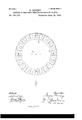
- FIG. 1 being a plan view showing the disposition of the negative images upon a disk-shaped holder
- Fig. 2 showing in elevation the arrangement of an exhibition apparatus in which the images are produced upon a band wound spirally upon a drum.
- FIG. 1 A represents a disk-shaped holder of ordinary construction, having near the periphery a'series of oblong apertures a.
- the rectangular figures a in dotted lines, show the disposition of the negative images, which has been. determined as above explained, the whole constituting what may be termed a phonoscopic negative plate, from which any desired number of positives may be readily produced by ordinary photographic processes. If the period of movement of the face or other object extends over a period of time too large to admit of exhibition upon a disk of moderate diameter, I substitute for the disk A, a strip or band upon which the successive negative images separated from one another, as already described, are placed in their proper positions, determined in the same manner as when a disk-shaped support is used. This band then constitutes the negative plate, from which any number of positives can be taken in the ordinary way.
- Such positive is represented by the letter I) in Fig. 2, wound spirally upon a drum B, which serves as its support during the exhibition.
- the drum B is adapted to be moved by a feed-screw O lengthwise of its shaft D, the pitch of the feed-screw being such that, at each revolution, the drum moves lengthwise a distance equal to the width of band I).
- E represents a disk having a slot 6, for purposes of observation, disk E being on a shaft F, rotated at a high speed by means of gearingf, g, h.
- I claim as my invention The process herein described of producing exhibition plates for phonoscopes by first preparing upon a band or film a series of negative images representing consecutively the transitions of movement of an animated ob ject; secondly, severing the strip or film to separate the different images; thirdly, fixing the separated negative images in proper order and position upon a support or holder, and finally obtaining positives by photography, substantially as described.
Landscapes
- Physics & Mathematics (AREA)
- General Physics & Mathematics (AREA)
- Spectroscopy & Molecular Physics (AREA)
- Silver Salt Photography Or Processing Solution Therefor (AREA)
Description
(No Model.) 2 Sheets -Sheet 1.
G. DEMBNY. PROCESS OF PRODUCING POSITIVE PHONOSGOPIG PLATES.
Patented June 19, 1894.
jzye/zfar.
(No Model.) 2 Sheets-Sheet 2.
G. DEMENY. PROCESS OF PRODUCING POSITIVE PHONOSGOPIG PLATES.
Patented June 19, 1894.
UNITED STATES PATENT OFFICE.
GEORGES DEMENY, OF PARIS, FRANCE.
PROCESS OF PRODUCING POSITIVE PHONOSCO PIC PLATES.
SPECIFICATION forming part of Letters Patent No. 521,705, dated June 19, 1894.
Application filed July 18, 1893. Serial No. 480,370- (N0 Specimens-l To all whom it may concern.-
Be it known that I, GEORGES DEMENY, of Paris, France, have invented certain new and useful Improvements in Processes of Producin g Exhibition-Plates for Phouoscopes, which is fully described in the following specification.
The apparatus called the phonoscope reproduces, as is known, the illusion of movements of speech and of physiognomy, either by direct vision, or by projection by means of light against a screen. This apparatus is designed to afford successive observations of diiferent'photographic images, taken at very short intervals, of a person in the act of speaking; the observation being made as much as possible, in the same total time as that which has served for the taking of the photographic proofs.
In order that phonoscopes may be employed for direct observation or for projection, the positive images are generally arranged on the circumference of a disk which is moved with a rotary motion so calculated that these images may be successively perceived by the observer or projected on a screen at each passage before the objective, by an opening made in an illuminating disk turning at high speed. The position for each successive picture must be calculated and laid out on the disk image-holders, so that all occupy relatively to each other, such positions that during the rotation of the disk picture-holder, they register exactly for the eye of the observer, and give the illusion of a living face or figure. This measuring and calculation for the successive images, which is very tedious and very minute, increases greatly the cost of the apparatus and constitutes a serious obstacle to the industrial development of which the apparatus is susceptible. It is with the object of surmounting this obstacle by diminishing the cost of these positive disk picture holders, that I have contrived to prepare them in the following way: The different negatives of the animated faces are obtained on a band of sensitive film which unrolls in photochronographic apparatus. I develop the negatives thus obtained by submitting them to the manipulations practiced daily in photography. I thus obtain a series of negatives which I cut so as to separate them one from another, then I fix them separately by any means on the circumference of a disk serving as a support, usually on an opaque disk pierced with openings, one against each of the openings formed near the exterior circumference of the opaque disk taking care to arrange them in the order following that in which they were obtained during the sitting. This operation necessitates evidently a very long and very minute marking, but once ended, I have a negative which serves for taking as many positive prints as may be required, without the need of determining for each one of these positives the bench-marks or indications that have been necessary heretofore.
In certain cases as more particularly explained hereinafter, the support for the series of' negatives may be in the form of a strip or band.
The accompanying drawings will serve to illustrate the manner of carrying out my invention, Figure 1 being a plan view showing the disposition of the negative images upon a disk-shaped holder, and Fig. 2 showing in elevation the arrangement of an exhibition apparatus in which the images are produced upon a band wound spirally upon a drum.
In Fig. 1, A represents a disk-shaped holder of ordinary construction, having near the periphery a'series of oblong apertures a. The rectangular figures a in dotted lines, show the disposition of the negative images, which has been. determined as above explained, the whole constituting what may be termed a phonoscopic negative plate, from which any desired number of positives may be readily produced by ordinary photographic processes. If the period of movement of the face or other object extends over a period of time too large to admit of exhibition upon a disk of moderate diameter, I substitute for the disk A, a strip or band upon which the successive negative images separated from one another, as already described, are placed in their proper positions, determined in the same manner as when a disk-shaped support is used. This band then constitutes the negative plate, from which any number of positives can be taken in the ordinary way. Such positive is represented by the letter I) in Fig. 2, wound spirally upon a drum B, which serves as its support during the exhibition.
The apparatus must be so constructed that the successive images will register accurately with an opening through which the observer looks. In the apparatus shown the drum B is adapted to be moved by a feed-screw O lengthwise of its shaft D, the pitch of the feed-screw being such that, at each revolution, the drum moves lengthwise a distance equal to the width of band I). E represents a disk having a slot 6, for purposes of observation, disk E being on a shaft F, rotated at a high speed by means of gearingf, g, h. The eye of the observer being in a fixed position, he sees a dift'erent image each time the slot 6 crosses his line of vision; and it will be readily understood that to secure exact correspondence between the moving observationslot and the successive images with which it must register accurately, requires a very careful calculation and disposition of the positive images upon the band I). By my invention,
however, these dispositions are determined once for all, and by placing the negative images in the determined positions upon the used will apply to a disk,band or other form in which the exhibition devices are made.
I claim as my invention The process herein described of producing exhibition plates for phonoscopes by first preparing upon a band or film a series of negative images representing consecutively the transitions of movement of an animated ob ject; secondly, severing the strip or film to separate the different images; thirdly, fixing the separated negative images in proper order and position upon a support or holder, and finally obtaining positives by photography, substantially as described.
In testimony whereof I have signed this specification in the presence of two subscribing witnesses.
GEORGES DEMENY.
Witnesses:
ROBT. M. Hoorna, JOSEPH LACOSTE.
Publications (1)
| Publication Number | Publication Date |
|---|---|
| US521705A true US521705A (en) | 1894-06-19 |
Family
ID=2590501
Family Applications (1)
| Application Number | Title | Priority Date | Filing Date |
|---|---|---|---|
| US521705D Expired - Lifetime US521705A (en) | Georges dement |
Country Status (1)
| Country | Link |
|---|---|
| US (1) | US521705A (en) |
-
0
- US US521705D patent/US521705A/en not_active Expired - Lifetime
Similar Documents
| Publication | Publication Date | Title |
|---|---|---|
| US5704061A (en) | Method and apparatus for creating cylindrical three dimensional picture | |
| US3178720A (en) | Three dimensional unaided viewing method and apparatus | |
| US1247682A (en) | Light-control mechanism for cinematographic and like apparatus. | |
| US540545A (en) | Best available corn | |
| US1782860A (en) | Apparatus for making exposures of the path or route of flying machines or the like | |
| US521705A (en) | Georges dement | |
| US3324760A (en) | Three dimensional unaided viewing apparatus | |
| US2288079A (en) | Motion picture apparatus | |
| US2012995A (en) | Stereoscopic motion picture | |
| US2045129A (en) | Printing | |
| US721954A (en) | Apparatus for taking pictures and viewing or reproducing animated scenes therefrom. | |
| US3218114A (en) | Cinematographic method and apparatus | |
| US2382617A (en) | Method of photographically recording the order of passage of moving objects | |
| US1311008A (en) | Stereoscopic motion-picture camera | |
| US958367A (en) | Motion-picture film. | |
| US2492520A (en) | Bonnet | |
| US946339A (en) | Panoramic stereoscope and stereograph. | |
| US875333A (en) | Moving-picture film. | |
| US1631450A (en) | Art of and means for metrical optic and acoustic recording and reproduction | |
| US532327A (en) | Diaphragm for photographic lens-tubes | |
| US1289849A (en) | Method of teaching and illustrating. | |
| US2117428A (en) | Photographic camera | |
| US620357A (en) | pbestwich | |
| US557246A (en) | George frederick wynne | |
| US1705760A (en) | Stereoscopic color cinematographic apparatus |