US5205974A - Process for the preparation of continuous objects of plastics - Google Patents
Process for the preparation of continuous objects of plastics Download PDFInfo
- Publication number
- US5205974A US5205974A US07/794,973 US79497391A US5205974A US 5205974 A US5205974 A US 5205974A US 79497391 A US79497391 A US 79497391A US 5205974 A US5205974 A US 5205974A
- Authority
- US
- United States
- Prior art keywords
- rate
- stretching
- temperature
- plastic
- polyethylene
- Prior art date
- Legal status (The legal status is an assumption and is not a legal conclusion. Google has not performed a legal analysis and makes no representation as to the accuracy of the status listed.)
- Expired - Lifetime
Links
- 238000000034 method Methods 0.000 title claims abstract description 19
- 229920003023 plastic Polymers 0.000 title claims description 15
- 239000004033 plastic Substances 0.000 title claims description 15
- 238000004519 manufacturing process Methods 0.000 claims abstract description 8
- 238000002844 melting Methods 0.000 claims abstract description 8
- 230000008018 melting Effects 0.000 claims abstract description 8
- 239000004698 Polyethylene Substances 0.000 claims description 18
- -1 polyethylene Polymers 0.000 claims description 16
- 229920000573 polyethylene Polymers 0.000 claims description 16
- 238000001816 cooling Methods 0.000 claims description 12
- 239000000155 melt Substances 0.000 claims description 11
- 235000015231 kebab Nutrition 0.000 claims description 10
- 101100453790 Drosophila melanogaster Kebab gene Proteins 0.000 claims description 9
- 238000001125 extrusion Methods 0.000 abstract description 8
- 229920000785 ultra high molecular weight polyethylene Polymers 0.000 abstract 1
- 229920000642 polymer Polymers 0.000 description 8
- 238000012360 testing method Methods 0.000 description 6
- 238000010438 heat treatment Methods 0.000 description 5
- 229920001577 copolymer Polymers 0.000 description 3
- 229920000098 polyolefin Polymers 0.000 description 3
- 239000013078 crystal Substances 0.000 description 2
- 238000012545 processing Methods 0.000 description 2
- VGGSQFUCUMXWEO-UHFFFAOYSA-N Ethene Chemical compound C=C VGGSQFUCUMXWEO-UHFFFAOYSA-N 0.000 description 1
- 239000005977 Ethylene Substances 0.000 description 1
- 208000012868 Overgrowth Diseases 0.000 description 1
- 238000013459 approach Methods 0.000 description 1
- 125000004432 carbon atom Chemical group C* 0.000 description 1
- 238000000748 compression moulding Methods 0.000 description 1
- 238000011161 development Methods 0.000 description 1
- 230000018109 developmental process Effects 0.000 description 1
- 238000009826 distribution Methods 0.000 description 1
- 238000001493 electron microscopy Methods 0.000 description 1
- 229920001519 homopolymer Polymers 0.000 description 1
- 239000007788 liquid Substances 0.000 description 1
- 239000012803 melt mixture Substances 0.000 description 1
- 239000003348 petrochemical agent Substances 0.000 description 1
- 239000000843 powder Substances 0.000 description 1
- 239000007787 solid Substances 0.000 description 1
- 238000001228 spectrum Methods 0.000 description 1
- XLYOFNOQVPJJNP-UHFFFAOYSA-N water Substances O XLYOFNOQVPJJNP-UHFFFAOYSA-N 0.000 description 1
Images
Classifications
-
- C—CHEMISTRY; METALLURGY
- C08—ORGANIC MACROMOLECULAR COMPOUNDS; THEIR PREPARATION OR CHEMICAL WORKING-UP; COMPOSITIONS BASED THEREON
- C08J—WORKING-UP; GENERAL PROCESSES OF COMPOUNDING; AFTER-TREATMENT NOT COVERED BY SUBCLASSES C08B, C08C, C08F, C08G or C08H
- C08J5/00—Manufacture of articles or shaped materials containing macromolecular substances
- C08J5/18—Manufacture of films or sheets
-
- B—PERFORMING OPERATIONS; TRANSPORTING
- B29—WORKING OF PLASTICS; WORKING OF SUBSTANCES IN A PLASTIC STATE IN GENERAL
- B29C—SHAPING OR JOINING OF PLASTICS; SHAPING OF MATERIAL IN A PLASTIC STATE, NOT OTHERWISE PROVIDED FOR; AFTER-TREATMENT OF THE SHAPED PRODUCTS, e.g. REPAIRING
- B29C55/00—Shaping by stretching, e.g. drawing through a die; Apparatus therefor
- B29C55/005—Shaping by stretching, e.g. drawing through a die; Apparatus therefor characterised by the choice of materials
-
- D—TEXTILES; PAPER
- D01—NATURAL OR MAN-MADE THREADS OR FIBRES; SPINNING
- D01F—CHEMICAL FEATURES IN THE MANUFACTURE OF ARTIFICIAL FILAMENTS, THREADS, FIBRES, BRISTLES OR RIBBONS; APPARATUS SPECIALLY ADAPTED FOR THE MANUFACTURE OF CARBON FILAMENTS
- D01F6/00—Monocomponent artificial filaments or the like of synthetic polymers; Manufacture thereof
- D01F6/02—Monocomponent artificial filaments or the like of synthetic polymers; Manufacture thereof from homopolymers obtained by reactions only involving carbon-to-carbon unsaturated bonds
- D01F6/04—Monocomponent artificial filaments or the like of synthetic polymers; Manufacture thereof from homopolymers obtained by reactions only involving carbon-to-carbon unsaturated bonds from polyolefins
-
- B—PERFORMING OPERATIONS; TRANSPORTING
- B29—WORKING OF PLASTICS; WORKING OF SUBSTANCES IN A PLASTIC STATE IN GENERAL
- B29K—INDEXING SCHEME ASSOCIATED WITH SUBCLASSES B29B, B29C OR B29D, RELATING TO MOULDING MATERIALS OR TO MATERIALS FOR MOULDS, REINFORCEMENTS, FILLERS OR PREFORMED PARTS, e.g. INSERTS
- B29K2023/00—Use of polyalkenes or derivatives thereof as moulding material
- B29K2023/04—Polymers of ethylene
- B29K2023/06—PE, i.e. polyethylene
-
- C—CHEMISTRY; METALLURGY
- C08—ORGANIC MACROMOLECULAR COMPOUNDS; THEIR PREPARATION OR CHEMICAL WORKING-UP; COMPOSITIONS BASED THEREON
- C08J—WORKING-UP; GENERAL PROCESSES OF COMPOUNDING; AFTER-TREATMENT NOT COVERED BY SUBCLASSES C08B, C08C, C08F, C08G or C08H
- C08J2323/00—Characterised by the use of homopolymers or copolymers of unsaturated aliphatic hydrocarbons having only one carbon-to-carbon double bond; Derivatives of such polymers
- C08J2323/02—Characterised by the use of homopolymers or copolymers of unsaturated aliphatic hydrocarbons having only one carbon-to-carbon double bond; Derivatives of such polymers not modified by chemical after treatment
- C08J2323/04—Homopolymers or copolymers of ethene
Definitions
- the invention relates to a process for the manufacture of continuous objects of plastic that have a shish kebab morphology.
- This morphology in the object is obtained by extrusion of a polyolefin with a weight average molecular weight (M w ) of 3 ⁇ 10 5 -10 6 g/mol, applying in the die channel a temperature which is a few degrees Celsius higher than the temperature at which the polyolefin melt solidifies spontaneously.
- M w weight average molecular weight
- Drawbacks of the known process are that it is extremely difficult to maintain the temperature in the die channel within the required limits and that the rate of production with which continuous objects can be manufactured in practice is rather low. Also, the process is less suitable for the manufacture of films.
- the object of the invention is to provide a process for the manufacture of continuous objects that does not show the said drawbacks and which moreover is suitable for the manufacture of tapes and films.
- a plastic with a relatively high weight average molecular weight (M w ) for that particular type of plastic, is converted in the melt to a continuous article, in that this article is stretched at a temperature lying between the melting temperature of the non-orientated plastic (T m ) and a certain higher temperature (Tc), in that the rate of stretching lies between, on the one hand, a lower rate (Ve), but which is higher than the rate of relaxation of the chain molecules under the prevailing conditions, and on the other a higher rate, but which is not so high that the melt begins to show elastic behaviour under the prevailing conditions, and in that the stretched article, while stressed, is rapidly cooled to a continuous object.
- M w weight average molecular weight
- the plate-shaped crystals also termed ⁇ lamellae ⁇ , surround the core and are angularly disposed relative to the core.
- the cores are parallel and so close to each other that the lamellae of the one core overlap with those of the other.
- the shish kebabs that can be formed from a melt of non-orientated molecular chains during the stretching process in the melt disappear if the temperature (Tc) of the melt becomes too high.
- This temperature has to be established for each polymer, using the melting curve of the shaped article as known from EP-A-151343.
- a structure examination by electron microscopy with the use of replicas is also a suitable method.
- the stretching temperature should not exceed the temperature Tc thus found.
- the stretching rate also requires special attention.
- the stretching rate is understood here the stretching ratio (lambda) divided by the number of seconds needed to achieve that stretching.
- lambda is understood here the ratio L ##EQU1## where Lo is the initial length and L the length after stretching.
- the stretching rate must not be too high either, because otherwise the melt reacts elastically and breaks. This stretching rate can thus also be easily determined empirically.
- the weight average molecular weight Mw should be chosen between appropriate limits in order to achieve higher-than-normal E moduli and tensile strengths. If the Mw is too low, no shish kebab morphology at all forms in the melt or a shish kebab morphology in which the ratio between shish and kebab is too low or in which the cores are too far apart, so that the lamellae do not overlap each other. If by contrast the Mw is too high, problems will arise during processing, for instance with an extruder. Here too the person skilled in the art will use an empiric approach.
- the shish kebab morphology obtained in the stretched article is frozen in stressed condition and the article is formed as film or filament with a high E modulus and high tensile strength.
- the invention is applicable in particular for (co)polyolefins, by which are understood here one or more homopolymers, copolymers or melt mixtures of two or more (co)polymers.
- the plastic preferably consists of a polyethylene with an Mw between 400,000 and 1,500,000 g/mol, in particular between 500,000 and 1,200,000 g/mol, more in particular between 800,000 and 1,000,000 g/mol.
- polyethylene in this content includes copolymers of ethylene with at most 5 wt. % of an alkene-1 with 3 or more carbon atoms.
- the stretching temperatures are preferably between 130° and 160° C., in particular between 140° and 160° C. For other polymers these limits can be different.
- the stretching rates are preferably between 0.1 and 10 sec -1 , more in particular between 0.5 and 5 sec -1 .
- the invention also relates to a device for the implementation of the invention, comprising an extrusion machine and a downstream stretching device consisting of at least a feed roll and a haul-off roll, with a heating oven in between.
- the device is characterized in that between the extrusion machine and the feed roll a cooling device is placed for cooling of the extrudate to a temperature between the extrusion temperature and the melting temperature of the plastic, in that one or more feed rolls are also heating rolls and in that means are provided for rapid cooling of the stretched object between the heating oven and the haul-off roll.
- a device so designed better permits control of the temperature of the extrudate during the stretching.
- the stretching process can now be carried out temperature independent of the extrusion process.
- the cooling device can be operated with liquid or gas.
- a specimen with a thickness of 0.5 mm was made by compression moulding for 15 minutes at a temperature of 145° C. followed by rapid cooling in cold water. From the specimens test pieces were cut which were maximally stretched at a stretching rate of 5 sec. -1 above the melting temperature and subsequently cooled in stressed condition.
- the tensile moduli were measured in an Instron stretching device on test specimens with a length of 10 cm at a rate of 1 mm/min.
- the cross-section surface areas were calculated from the weight of the test specimens, on the basis of a polyethylene density of 0.97.
- Table 2 shows the stretching temperature, the stretching ratio and the measured strength properties for each of the polyethylene of Table 1.
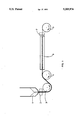
- FIG. 1 is a schematic representation of a device according to the invention, with which the process according to the invention can be carried out.
- the extrudate in the form of a filament, tape or film is supplied to the cooling device 2, in which the extrudate is cooled to below its melting point.
- the cooling roll From the cooling roll the cooled extrudate, still non-orientated, is supplied to a feed roll section, of which for instance only feed roll 4 is also a heating roll, and heated to 5° to 10° C. below the melting point of the plastic and is subsequently drawn through the oven 6 by means of the haul-off roll 5.
- the oven heats the extrudate to a temperature between 130° and 160° C. Because the haul-off roll 5 has a higher circumferential speed than the roll 4, stretching takes place in the oven.
- the rolls 3 and 4 have the same circumferential speed.
- the cooling device 2 and the heated feed roll 4 allow of better temperature control in the oven of the extrudate to be stretched.
- Between the heating oven 6 and the haul-off roll 5, 7 is a schematic indication of means for rapid cooling in stressed condition of the stretched object.
Landscapes
- Chemical & Material Sciences (AREA)
- Engineering & Computer Science (AREA)
- Manufacturing & Machinery (AREA)
- Chemical Kinetics & Catalysis (AREA)
- Materials Engineering (AREA)
- Textile Engineering (AREA)
- General Chemical & Material Sciences (AREA)
- Health & Medical Sciences (AREA)
- Medicinal Chemistry (AREA)
- Polymers & Plastics (AREA)
- Organic Chemistry (AREA)
- Mechanical Engineering (AREA)
- Shaping By String And By Release Of Stress In Plastics And The Like (AREA)
Abstract
Description
              TABLE 1
______________________________________
          Mw       Mn
Polyethylene
          g/mol    g/mol   Mw/Mn  Producer
______________________________________
Rigidex 006-60
            130,000
                    19,200 5.9    BP Chemic. Ltd.
Rigidex     350,000
                    24,400 14.3   BP Chemic. Ltd.
HO-2054P
PE `R`      411,000
                    73,500 5.6    BP Chemic. Ltd.
Hizex 145   950,000
                   121,300 8.9    Mitsui
Hizex 240M
          1,974,000
                   226,000 8.74   Mitsui
                                  Petrochemicals
______________________________________
              TABLE 2
______________________________________
            Melt
            temp. at Stretch- Axial   Axial
            stretch- ing      E-modulus
                                      strength
Polyethylene
            ing, °C.
                     ratio    GPa     GPa
______________________________________
Rigidex 006-60
            130-131  ×50-60
                               2      0.2
Rigidex HO-2054P
            135      ×20-35
                              40-60   0.4
Rigidex HO-2054P
            140      ×60
                               8-10   0.2
PE `R`      142      ×60-80
                              15-20   0.5
Hizex 145   145      ×60-80
                              60-80   0.7-1.5
Hizex 240M  158      ×17-20
                              10-15   0.35
______________________________________
Claims (8)
Priority Applications (1)
| Application Number | Priority Date | Filing Date | Title |
|---|---|---|---|
| US07/794,973 US5205974A (en) | 1988-06-03 | 1991-11-20 | Process for the preparation of continuous objects of plastics |
Applications Claiming Priority (4)
| Application Number | Priority Date | Filing Date | Title |
|---|---|---|---|
| NL8801426 | 1988-06-03 | ||
| NL8801426A NL8801426A (en) | 1988-06-03 | 1988-06-03 | METHOD AND APPARATUS FOR MANUFACTURING ENDLESS ARTICLES |
| US07/360,838 US5080849A (en) | 1988-06-03 | 1989-06-02 | Process for the preparation of continuous objects of plastic |
| US07/794,973 US5205974A (en) | 1988-06-03 | 1991-11-20 | Process for the preparation of continuous objects of plastics |
Related Parent Applications (1)
| Application Number | Title | Priority Date | Filing Date |
|---|---|---|---|
| US07/360,838 Division US5080849A (en) | 1988-06-03 | 1989-06-02 | Process for the preparation of continuous objects of plastic |
Publications (1)
| Publication Number | Publication Date |
|---|---|
| US5205974A true US5205974A (en) | 1993-04-27 |
Family
ID=27352207
Family Applications (1)
| Application Number | Title | Priority Date | Filing Date |
|---|---|---|---|
| US07/794,973 Expired - Lifetime US5205974A (en) | 1988-06-03 | 1991-11-20 | Process for the preparation of continuous objects of plastics |
Country Status (1)
| Country | Link |
|---|---|
| US (1) | US5205974A (en) |
Cited By (12)
| Publication number | Priority date | Publication date | Assignee | Title |
|---|---|---|---|---|
| US5372756A (en) * | 1990-04-11 | 1994-12-13 | Oyama; Nobuo | Method of forming striated light diffuser |
| US5749214A (en) * | 1996-10-04 | 1998-05-12 | Cook; Roger B. | Braided or twisted line |
| EP0938082A3 (en) * | 1998-02-21 | 2000-01-12 | Taiyo Yuden Co., Ltd. | Optical disc |
| US6083443A (en) * | 1996-05-31 | 2000-07-04 | Bruckner Mashcinenbau Gmbh | Method of manufacturing filler-containing polymer film suitable for printing on |
| US6391411B1 (en) | 1999-06-03 | 2002-05-21 | Printpack Illinois, Inc. | Machine direction oriented high molecular weight, high density polyethylene films with enhanced water vapor transmission properties |
| CN101580984B (en) * | 2008-05-12 | 2011-01-12 | 中国水产科学研究院东海水产研究所 | Method for processing high-performance polyethylene twisting threads for waving netting or binding a steel rope |
| CN101666014B (en) * | 2008-09-01 | 2011-02-09 | 中国水产科学研究院东海水产研究所 | Method for manufacturing anti-turning high-strength net mesh for aquaculture net cages and catching and fishing tools |
| CN101624787B (en) * | 2008-07-07 | 2011-08-10 | 中国水产科学研究院东海水产研究所 | Method for manufacturing net cage or different medium-sized fiber mixing steel cable for set fishing gear |
| CN101851799B (en) * | 2009-03-31 | 2011-10-26 | 中国水产科学研究院东海水产研究所 | Method for processing modified polypropylene bristle filaments for net mesh |
| CN101624788B (en) * | 2008-07-07 | 2011-11-02 | 中国水产科学研究院东海水产研究所 | Method for processing cultivation net cage or passive small-sized high-performance head rope for fishing gear |
| WO2018091966A1 (en) * | 2016-11-17 | 2018-05-24 | The Hong Kong University Of Science And Technology | Nanoporous ultra-high molecular weight polyethylene membrane |
| US11389772B2 (en) | 2017-12-18 | 2022-07-19 | The Hong Kong University Of Science And Technology | Method for synthesis of flexible multifunctional high-voidage ultrathin PE membranes |
Citations (2)
| Publication number | Priority date | Publication date | Assignee | Title |
|---|---|---|---|---|
| US4948545A (en) * | 1983-12-10 | 1990-08-14 | Stamicarbon B.V. | Extrusion process for preparing orientated polyolefins |
| EP1513343A1 (en) * | 2002-06-07 | 2005-03-09 | Sony Corporation | Video tape recorder and recording method |
-
1991
- 1991-11-20 US US07/794,973 patent/US5205974A/en not_active Expired - Lifetime
Patent Citations (2)
| Publication number | Priority date | Publication date | Assignee | Title |
|---|---|---|---|---|
| US4948545A (en) * | 1983-12-10 | 1990-08-14 | Stamicarbon B.V. | Extrusion process for preparing orientated polyolefins |
| EP1513343A1 (en) * | 2002-06-07 | 2005-03-09 | Sony Corporation | Video tape recorder and recording method |
Non-Patent Citations (2)
| Title |
|---|
| Abhiraman, A. S. "Shish Kebab and High-Performance Morphologies", Journal of Applied Polymer Science, vol. 23, No. 8 (1979), pp. 2419-2424. |
| Abhiraman, A. S. Shish Kebab and High Performance Morphologies , Journal of Applied Polymer Science, vol. 23, No. 8 (1979), pp. 2419 2424. * |
Cited By (13)
| Publication number | Priority date | Publication date | Assignee | Title |
|---|---|---|---|---|
| US5372756A (en) * | 1990-04-11 | 1994-12-13 | Oyama; Nobuo | Method of forming striated light diffuser |
| US6083443A (en) * | 1996-05-31 | 2000-07-04 | Bruckner Mashcinenbau Gmbh | Method of manufacturing filler-containing polymer film suitable for printing on |
| US5749214A (en) * | 1996-10-04 | 1998-05-12 | Cook; Roger B. | Braided or twisted line |
| EP0938082A3 (en) * | 1998-02-21 | 2000-01-12 | Taiyo Yuden Co., Ltd. | Optical disc |
| US6391411B1 (en) | 1999-06-03 | 2002-05-21 | Printpack Illinois, Inc. | Machine direction oriented high molecular weight, high density polyethylene films with enhanced water vapor transmission properties |
| CN101580984B (en) * | 2008-05-12 | 2011-01-12 | 中国水产科学研究院东海水产研究所 | Method for processing high-performance polyethylene twisting threads for waving netting or binding a steel rope |
| CN101624788B (en) * | 2008-07-07 | 2011-11-02 | 中国水产科学研究院东海水产研究所 | Method for processing cultivation net cage or passive small-sized high-performance head rope for fishing gear |
| CN101624787B (en) * | 2008-07-07 | 2011-08-10 | 中国水产科学研究院东海水产研究所 | Method for manufacturing net cage or different medium-sized fiber mixing steel cable for set fishing gear |
| CN101666014B (en) * | 2008-09-01 | 2011-02-09 | 中国水产科学研究院东海水产研究所 | Method for manufacturing anti-turning high-strength net mesh for aquaculture net cages and catching and fishing tools |
| CN101851799B (en) * | 2009-03-31 | 2011-10-26 | 中国水产科学研究院东海水产研究所 | Method for processing modified polypropylene bristle filaments for net mesh |
| WO2018091966A1 (en) * | 2016-11-17 | 2018-05-24 | The Hong Kong University Of Science And Technology | Nanoporous ultra-high molecular weight polyethylene membrane |
| US12206064B2 (en) | 2016-11-17 | 2025-01-21 | The Hong Kong University Of Science And Technology | Nanoporous ultra-high molecular weight polyethylene membrane |
| US11389772B2 (en) | 2017-12-18 | 2022-07-19 | The Hong Kong University Of Science And Technology | Method for synthesis of flexible multifunctional high-voidage ultrathin PE membranes |
Similar Documents
| Publication | Publication Date | Title |
|---|---|---|
| US3801692A (en) | Production of novel open-celled microporous film | |
| US3679538A (en) | Novel open-celled microporous film | |
| US5205974A (en) | Process for the preparation of continuous objects of plastics | |
| CA2465289C (en) | Process for fabricating polypropylene sheet | |
| EP0301625B1 (en) | Process for the production of thin stretched films from polyolefins of ultrahigh molecular weight | |
| US3920785A (en) | Process for increasing the porosity of opencelled microporous film | |
| Bashir et al. | Melt drawing as a route to high performance polyethylene | |
| KR910009691B1 (en) | The preparation of ultra stretchable polymer material | |
| EP0048227B1 (en) | Stretched thermoplastic material based on polyethylene and a process for its production | |
| JP4724365B2 (en) | Method for producing molded article of ultra high molecular weight polyethylene | |
| GB2164897A (en) | Process for preparing polyethylene films having a high tensile strength and a high modulus | |
| US5080849A (en) | Process for the preparation of continuous objects of plastic | |
| EP0192303B1 (en) | Process for prepapring polyolefin gel articles, as well as for preparing herefrom articles having a high tensile strength and modulus | |
| US5006296A (en) | Process for the preparation of fibers of stereoregular polystyrene | |
| JPS61215715A (en) | Polyarylene thioether fiber of high performance and production thereof | |
| JPS59215826A (en) | Manufacture of super high molecular weight polyethylene film | |
| JPS6312767B2 (en) | ||
| JP2000313751A (en) | High strength high molecular weight polyolefin film excellent in transparency and method for producing the same | |
| US4919875A (en) | Oriented polymeric tape preparation | |
| JP4345901B2 (en) | High molecular weight polyolefin transparent film having high elongation and method for producing the same | |
| JPS63252719A (en) | Orientated object of polyacetal and its manufacture | |
| JPS60239516A (en) | Undrawn material of polyoxymethylene | |
| HK1068846B (en) | Process for fabricating polypropylene sheet |
Legal Events
| Date | Code | Title | Description |
|---|---|---|---|
| STCF | Information on status: patent grant |
Free format text: PATENTED CASE |
|
| AS | Assignment |
Owner name: DSM N.V., NETHERLANDS Free format text: ASSIGNMENT OF ASSIGNORS INTEREST;ASSIGNOR:STAMICARBON B.V.;REEL/FRAME:007000/0747 Effective date: 19931209 |
|
| FEPP | Fee payment procedure |
Free format text: PAYOR NUMBER ASSIGNED (ORIGINAL EVENT CODE: ASPN); ENTITY STATUS OF PATENT OWNER: LARGE ENTITY |
|
| FPAY | Fee payment |
Year of fee payment: 4 |
|
| FEPP | Fee payment procedure |
Free format text: PAYER NUMBER DE-ASSIGNED (ORIGINAL EVENT CODE: RMPN); ENTITY STATUS OF PATENT OWNER: LARGE ENTITY Free format text: PAYOR NUMBER ASSIGNED (ORIGINAL EVENT CODE: ASPN); ENTITY STATUS OF PATENT OWNER: LARGE ENTITY |
|
| FPAY | Fee payment |
Year of fee payment: 8 |
|
| AS | Assignment |
Owner name: DSM IP ASSETS B.V., NETHERLANDS Free format text: ASSIGNMENT OF ASSIGNORS INTEREST;ASSIGNOR:DSM N.V.;REEL/FRAME:014863/0133 Effective date: 20031208 |
|
| FPAY | Fee payment |
Year of fee payment: 12 |