US5120978A - Method and apparatus for scattered light measurements - Google Patents

Method and apparatus for scattered light measurements Download PDF

Info

Publication number
US5120978A
US5120978A US07/583,862 US58386290A US5120978A US 5120978 A US5120978 A US 5120978A US 58386290 A US58386290 A US 58386290A US 5120978 A US5120978 A US 5120978A
Authority
US
United States
Prior art keywords
laser beam
specimen
scattered light
scattered
cross
Prior art date
Legal status (The legal status is an assumption and is not a legal conclusion. Google has not performed a legal analysis and makes no representation as to the accuracy of the status listed.)
Expired - Lifetime
Application number
US07/583,862
Inventor
Tomoyoshi Yamashita
Yasuteru Tahara
Current Assignee (The listed assignees may be inaccurate. Google has not performed a legal analysis and makes no representation or warranty as to the accuracy of the list.)
Mitsubishi Chemical Corp
Original Assignee
Mitsubishi Rayon Co Ltd
Priority date (The priority date is an assumption and is not a legal conclusion. Google has not performed a legal analysis and makes no representation as to the accuracy of the date listed.)
Filing date
Publication date
Application filed by Mitsubishi Rayon Co Ltd filed Critical Mitsubishi Rayon Co Ltd
Assigned to MITSUBISHI RAYON CO., LTD. reassignment MITSUBISHI RAYON CO., LTD. ASSIGNMENT OF ASSIGNORS INTEREST. Assignors: KAMADA, KENSUKE, TAHARA, YASUTERU, YAMASHITA, TOMOYOSHI
Application granted granted Critical
Publication of US5120978A publication Critical patent/US5120978A/en
Anticipated expiration legal-status Critical
Expired - Lifetime legal-status Critical Current

Links

Images

Classifications

    • GPHYSICS
    • G01MEASURING; TESTING
    • G01JMEASUREMENT OF INTENSITY, VELOCITY, SPECTRAL CONTENT, POLARISATION, PHASE OR PULSE CHARACTERISTICS OF INFRARED, VISIBLE OR ULTRAVIOLET LIGHT; COLORIMETRY; RADIATION PYROMETRY
    • G01J3/00Spectrometry; Spectrophotometry; Monochromators; Measuring colours
    • GPHYSICS
    • G01MEASURING; TESTING
    • G01NINVESTIGATING OR ANALYSING MATERIALS BY DETERMINING THEIR CHEMICAL OR PHYSICAL PROPERTIES
    • G01N21/00Investigating or analysing materials by the use of optical means, i.e. using sub-millimetre waves, infrared, visible or ultraviolet light
    • G01N21/17Systems in which incident light is modified in accordance with the properties of the material investigated
    • G01N21/47Scattering, i.e. diffuse reflection
    • GPHYSICS
    • G01MEASURING; TESTING
    • G01NINVESTIGATING OR ANALYSING MATERIALS BY DETERMINING THEIR CHEMICAL OR PHYSICAL PROPERTIES
    • G01N21/00Investigating or analysing materials by the use of optical means, i.e. using sub-millimetre waves, infrared, visible or ultraviolet light
    • G01N21/17Systems in which incident light is modified in accordance with the properties of the material investigated
    • G01N21/47Scattering, i.e. diffuse reflection
    • G01N2021/4704Angular selective
    • G01N2021/4711Multiangle measurement

Definitions

  • the present invention relates to a method for scattered light measurements and an apparatus applicable thereto whereby a laser light is irradiated onto a transparent solid specimen to perform characteristic measurements by measuring the scattered lights being scattered from the specimen.
  • a glass which is below the transition point (Tg) is also included in the transparent solid specimens.
  • PMMA polymethyl methacrylate
  • FIG. 10 An apparatus for measuring scattered lights of polymethyl methacrylate (PMMA) which is a typical transparent material for optic fibers and lenses (Otsuka et al [Papers on High Polymer]p. 266, No. 4, Volume 42 (1985)) shown in FIG. 10, for example, as an apparatus for the scattered light measurements to obtain scattered light data by measuring scattered lights being scattered from a specimen when a laser light is irradiated onto a transparent specimen available in various forms, such as gas, liquid, solution, and solid.
  • the measuring method applicable to this apparatus is dependent on angles at intervals of several degrees (Otsuka et al [Preparatory Papers B for the Textile Society Symposium]B-p. 36, Jun. 1988, Textile Society).
  • the Rayleigh scattering intensity (R) obtainable by the density fluctuations of the specimen is evaluated by the mean scattered light level in the wide angle region and its smooth distributive state, and in addition, from the profile in the lower angle region, the relative length which reflects the fine structure of the specimen is evaluated using the Debye plots.
  • the Rayleigh scattering intensities (R) obtainable by the density fluctuations of a transparent material and the relative length reflecting the fine structure thereof can be evaluated by the conventional apparatus and method.
  • the object of the present invention is to provide a method and an apparatus for scattered light measurements whereby a new knowledge and information of the structures of transparent materials can be acquired to evaluate the optical characteristics of the materials, making it possible to develop new highly capable optical materials.
  • the inventors and others carried out various researches and developments.
  • the optical purity is increased by removing impurities, such as dust and others, in an optical material to a certain extent, the angular distribution of scattered light intensities of the material represents a smooth curve, and when such smooth curve is not obtained, the results are neglected as simple non-reproducible noises that may have been caused by the insufficient accuracy of the apparatus in use.
  • the "scattering volume V" and the “broadening of the light receiving angle ⁇ " in the case of the observation at an angle of substantially 90° to the incident direction are defined as follows with reference to FIG. 3: ##EQU1##
  • the laser beam 31 is being passed through a specimen (not shown), and the lights scattered from that position are passed through the first pin hole 32 and second pin hole 33 to reach the light receiving device 34.
  • the cross-sectional diameter of the laser beam 31 is r 0
  • the diameters of the first pin hole 32 and second pin hole 33 are r 1 and r 2 respectively
  • the distance between the central axis of the laser beam and the first pin hole is l 1
  • the distance between the first pin hole and second pin hole is l 2 .
  • the angle of receiving light is substantially 90°.
  • the scattering volume V is shown with slashes.
  • the aforementioned measuring condition should be such that the scattering volume is 1 mm 3 ⁇ V>0, preferably 10 -1 mm 3 ⁇ V>0, still more preferably 10 -2 mm 3 ⁇ V>0, or most preferably 10 -3 mm 3 ⁇ V>0. If the condition exceeds the above-mentioned uppermost limit, information from the minute local part of the structure becomes so much that only averaged scattering profile is obtained. As the V value becomes smaller, the optical quantity is reduced. However, this reduction can be compensated with a prolonged measuring time. It is desirable to define a specific set value for the scattering volume in consideration of the properties of a specimen, the broadening of the light receiving angle ⁇ , and others.
  • the broadening of the light receiving angle should desirably be the narrowest possible; it should be, for example, 0.5 deg ⁇ >0, still more preferably 0.1 deg ⁇ >0, or most preferably 0.05 deg ⁇ >0. This is because of the fact that if the angular broadening exceeds the above-mentioned uppermost limit, the resolution is lowered to make it impossible to obtain high-precision scattering profiles. As the value becomes smaller, the quantity of the scattered light is reduced. However, this reduction can be compensated with a prolonged measuring time. It is desirable to define a specific set value for the broadening of the light receiving angle in consideration of the properties of a specimen, the scattering volume V, and others.
  • these measuring conditions must be defined so as to obtain the sudden and minute changes in the scattering intensities (the spiky scattering phenomena) caused by the minute ununiformity in the structures of transparent noncrystalline specimens.
  • the measuring resolution is increased so as to represent a state closest to the ideal scattering profile.
  • both ⁇ and V are so defined that they are made the smallest possible to acquire information about scattering conditions having the following characteristics caused by the local structures of transparent noncrystalline specimens:
  • the background scatterings and the laser speckles i.e., providing statistics of intensity histogram in accordance with the speckle theory
  • the scattering profiles show high reproducivities.
  • the scattering profiles are caused by the interior structures of the transparent noncrystalline specimens.
  • optical impurities dust, catalyst, heterogeneous structures
  • the critical value of the light scattering loss characteristic to a specimen can be estimated.
  • a high-precision scattered light measuring method characterized in that:
  • the cross section of the laser beam is adjusted, and the laser beam is irradiated into a specimen fixed relatively to the laser beam to cause scattered lights to be scattered from the specimen;
  • the cross section for observing the scattered light is adjusted to measure the angular distribution of the scattered lights by scanning relatively with the specimen as the center thereof;
  • the optical characteristics of the transparent materials are evaluated.
  • a high-precision scattered light measuring method for evaluating the optical characteristics of transparent materials in the above-mentioned first aspect, wherein the measuring conditions are defined to provide a given scattering volume and a given broadening of light receiving angle by adjusting the cross sections of said incident laser beam and scattered light.
  • a high-precision scattered light measuring method for evaluating the optical characteristics of transparent materials having the scattered light measuring method wherein:
  • the cross section of the laser beam is adjusted, and the laser beam is irradiated into a specimen fixed relatively to the laser beam to cause scattered lights to be scattered from the specimen;
  • the cross section for observing the scattered light is adjusted to increase the resolution accuracy for the observation, and the angular distribution of the scattered lights is measured by scanning relatively to the center of the laser beam in a specimen; characterized in that:
  • the measuring conditions are defined to provide the scattering volume of 1 mm 3 or less (V: in the case of observation at an angle of substantially 90° to the incident direction) and the broadening of the light receiving angle ( ⁇ ) of 0.5 deg or less by adjusting the cross sections of the incident laser beam and scattered light.
  • a high-precision scattered light measuring apparatus for evaluating the optical characteristics of transparent materials comprising a laser light source irradiating a laser beam into a specimen, a specimen supporting member fixing the specimen relatively to the laser beam, a scattered light measuring member for measuring the angular distribution of the scattered light by scanning relatively with the specimen as its center, and beam adjusters for adjusting the cross section of the incident laser beam and the cross section for observing the scattered light; characterized in that:
  • the beam adjusters comprise an incident laser beam adjuster provided in the optical path of the laser beam to adjust the cross section thereof, and a scattered light adjuster provided in the optical path between the specimen and the scattered light measuring member to adjust the cross section for observing scattered light;
  • the beam adjusters define the measuring conditions to provide the scattering volume of 1 mm 3 or less (V: in the case of observation at an angle of substantially 90° to the incident direction) and the broadening of the light receiving angle of 0.5 deg or less ( ⁇ ).
  • FIG. 1 is a schematic view showing an example of a light scattering apparatus according to the present invention
  • FIG. 2 is a block diagram showing a light scattering apparatus according to the present invention.
  • FIG. 3 is a typical representation illustrating the scattering volume V and the broadening of the light receiving angle ⁇ ;
  • FIGS. 4(a)-(d) are views showing scattered profiles of spiky scattering variations resulting from changes in the V and ⁇ ;
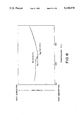
  • FIG. 5 is a view showing the scattering profile of the pure benzene
  • FIG. 6 is a view showing the spiky scattering profile of PMMA
  • FIG. 7 is a view showing the spiky scattering profile of PMMA resulting from the temperature changes
  • FIG. 8 is a view showing the resultant profile of DSC measurement of PMMA
  • FIG. 9 is a graphic representation showing the variations of the standard deviation of the averaged scattering intensities and the spiky scatterings in accordance with the PMMA temperature changes.
  • FIG. 10 is a schematic view showing a conventional apparatus for scattered light measurements.
  • FIG. 2 A block diagram representation of an example of the apparatus used for a scattered light measuring method according to the present invention is shown in FIG. 2, and the optical system for the apparatus is shown in FIG. 1.
  • the apparatus comprises an Ar ion-laser light source 1 (manufactured by NEC) irradiating into a specimen 2 an Ar laser beam 4 having wavelength of 488 nm, a specimen stand 3 (a device holding a specimen) on which the specimen 2 is mounted in such a manner that the specimen 2 is fixed relatively to the laser beam 4, a scattered light measuring device 5 to measure the angular distribution of the scattered lights, an incident laser beam adjuster 6 which is provided in the optical path of the laser beam 4 to adjust the cross section of the laser beam, and a scattered light beam adjuster 7 which is provided in the optical path between the specimen 2 and the scattered light measuring device 5 to adjust the cross section for observing the scattered light.
  • an Ar ion-laser light source 1 manufactured by NEC
  • a specimen stand 3 a device holding a specimen
  • the apparatus comprises an Ar ion-laser light source 1 (manufactured by NEC) irradiating into a specimen 2 an Ar laser beam 4 having wavelength of 488 n
  • the incident laser beam adjuster 6 comprises two condenser lenses 10 and 11, and a polarizer 12 to narrow down the laser light from the lighting source 1 to a thin parallel laser light with a cross-sectional diameter of approximately 10-1,000 ⁇ m ⁇ , preferably 50-700 ⁇ m ⁇ , or still more preferably 200 ⁇ m ⁇ or less.
  • the scattered light beam adjuster 7 comprises two pin holes 13 and 14 (the diameter is 0.6 mm ⁇ and the distance between the pin holes, 128 mm, for example), a condenser lens 15 and horizontal and vertical polarizing plates 16 in order to adjust the scattered light to have a given cross section for observing scattered light.
  • an incident terminal of an optical fiber 17 is arranged, and the scattered light measuring device 5 is mounted on the irradiation terminal thereof, i.e., the other end of this optical fiber 17, to scan rotatably around the laser beam in the specimen as its center.
  • the scattered light measuring device 5 of this embodiment comprises a photomultiplier (its applied voltage--1,150 V) to measure a luminous energy by increasing S/N ratio using a photoelectric computation made by a photon-counter with a built-in level sampling discriminator (manufactured by Hamamatsu Photonics Co., Ltd.) and a digital lock-in method by using an up-down counting system synchronized with a light chopper 22.
  • a photomultiplier its applied voltage--1,150 V
  • a built-in level sampling discriminator manufactured by Hamamatsu Photonics Co., Ltd.
  • the specimen 2 is mounted on the specimen stand 3 (a device holding the specimen) and is fixed relatively to the laser beam 4.
  • the scattered light beam adjuster 7 is mounted by magnet on an arm 20 (in a place 400 mm away from the center, for example), which is arranged on the outer circumference of a rotary stage rotating with the central axis of the specimen (making right angles to the laser beam) as its center.
  • optical shielding 21 each for the entire optical path in the light receiving section and the light source to shield each of them from the external light.
  • a DD servo motor 22 (manufactured by Yokogawa Precision Co., Ltd.) is installed in the rotary stage to allow the scattered light measuring member to scan rotatably around the specimen as its center.
  • This servo motor is capable of performing a high-precision rotational positioning with its built-in optical encoder generating 1,024,000 pulses per revolution to achieve the repeatability of ⁇ 2 sec (1/800 deg) or more and the positioning precision of 30 sec (1/120 deg).
  • a proximity switch 23 (manufactured by Tateishi Electric Mfg. Co., Ltd.) is employed as a positioning sensor for determining the home position for the motor. With the output signals from this sensor and the encoder, a highly precise positioning of the home position can be performed by an external control.
  • measuring conditions are adjusted to provide a scattering volume (V) of 1 mm 3 or less and/or the broadening of the light receiving angle ( ⁇ ) of 0.5 deg or less in the case of the observation at an angle of substantially 90° to the incident direction.
  • a scattered light measuring method according to the present invention will subsequently be described in detail using the apparatus of this embodiment.
  • the specimen must first be prepared.
  • the specimen can be, for example, a transparent noncrystalline material, such as inorganic glass and polymethylmethacrylate (PMMA), a transparent crystalline material such as crystal, and a translucent material.
  • PMMA polymethylmethacrylate
  • any specimens can be used irrespective of its contours and the states thereof, such as solid, liquid, or gas.
  • the specimen can be cylindrical, conic, cylindrical rod, filamentary, spherical, drum-shape, spindle-shape, etc., and its contour is so selected that the radially scattered light from a micro scattering volume in the center of the specimen always crosses vertically from the lateral face of the specimen.
  • a pre-processing so as to eliminate any possible effects caused by the condition of its lateral face by, for example, immersing it in a matching oil having the same refractive index as the specimen or by coating such matching oil on the surface of the specimen.
  • the specimen thus prepared is mounted on the specimen stand.
  • the matching oil silicone oil, dibutyl phthalate and others are applicable.
  • the cross section of a laser beam is adjusted and polarized in the incident laser beam adjuster 6 provided in the optical path from the laser light source, and the laser beam thus adjusted and polarized is irradiated into the specimen fixed relatively to the laser beam.
  • the scattered light is being scattered beginning with the condition that the scattering volume of the specimen is 1 mm 3 or less when it is observed at an angle of substantially 90° to the incident direction.
  • the cross section for observing the scattered light is adjusted, and angular distribution of the scattered lights is measured by allowing the scattered light measuring member to rotatably scan relatively with the specimen as its center.
  • This measurement is taken by measuring the scattering intensities Vv and Hv when each of them is scattered with the respective vertical and horizontal polarizing elements.
  • the optical quantity is measured by the photo-electronic computation.
  • the count time is approximately 2 seconds at a point, for example, and it can arbitrarily selected for changes in accordance with the other conditions.
  • the measuring condition is established to be the scattering volume of 1 mm 3 or less (V: in the case of the observation at an angle of substantially 90° to the incident direction) and/or the broadening of the light receiving angle ( ⁇ ) of 0.5 deg or less.
  • a cylindrical rod type specimen of 18 mm ⁇ diameter and approximately 20 mm ⁇ long taken from a preform fused quartz for an optical fiber was immersed in a matching oil comprising silicone oil.
  • This fused quartz specimen was precisely measured by use of the high resolution scattered light measuring apparatus shown in FIGS. 1 and 2.
  • the distance l 1 between the central axis of the laser beam and the first pin hole was 74 mm and the distance l 2 between the first pin hole and the second pin hole was 128 mm.
  • the diameters of the two pin holes were both adjusted to be 600 ⁇ m to 1,000 ⁇ m, and the diameter of the laser beam was modified to be approximately 150 ⁇ m to 600 ⁇ m using the two condenser lenses in the light source so as to adjust the optical cross sections of the incident laser beam and scattered light.
  • the scattering profile was recorded under the measuring conditions stated below:
  • the amplitudes of the spiky scattering profiles become greater as the resolution becomes higher in the order of d, c, b, and a, and it is obvious that the means scattering profile has changed into the scattering profile resulting from the interior structures which are extremely minute and local.
  • a transparent noncrystalline material was evaluated by the scattered light measuring method according to the present invention in relation to the amorphous structure (ununiform structure) of PMMA.
  • a PMMA rod was fixed in a sample cell with a heater, and its temperature was gradually raised under control by a temperature controller from 30° C., 70° C., 90° C., 110° C., and 130° C. Then it was lowered likewise. The scattered light was measured in a completely stable thermal condition when the thermal equilibrium was reached at each of these temperatures. The results are shown in FIG. 7.
  • FIG. 9 Based on the above-mentioned data, a graph is shown in FIG. 9 where the sample temperatures (T) are given in the abscissa, the averaged intensities, in the ordinate on the left-hand side, and the standard deviations (averaged intensity of spiky scattering amplitudes), in the ordinate on the right-hand side.
  • the spiky scattering phenomena obtainable by this measuring method of the present invention reflect the ununiform structures of the transparent amorphous body, and by evaluating the phenomena, it is possible to evaluate the characteristics, features and natures of transparent noncrystalline materials.
  • the method and apparatus according to the present invention can produce the effects as follows:
  • the ununiformity in the interior structures of transparent noncrystalline materials can be evaluated as verified in the examples set forth above.
  • the spiky scattering profile becomes acuter as the ununiformity is more prominent.
  • a uniform profile is obtained as the structure becomes more uniform.
  • the spiky scattering data obtained by the measurement according to the present invention can be analyzed to evaluate the ununiform structures of transparent noncrystalline materials theoretically.
  • optical materials such as highly capable optical fibers, and optical lenses, can be developed.

Landscapes

  • Physics & Mathematics (AREA)
  • General Physics & Mathematics (AREA)
  • General Health & Medical Sciences (AREA)
  • Chemical & Material Sciences (AREA)
  • Analytical Chemistry (AREA)
  • Biochemistry (AREA)
  • Life Sciences & Earth Sciences (AREA)
  • Health & Medical Sciences (AREA)
  • Immunology (AREA)
  • Pathology (AREA)
  • Spectroscopy & Molecular Physics (AREA)
  • Investigating Or Analysing Materials By Optical Means (AREA)
  • Investigating Materials By The Use Of Optical Means Adapted For Particular Applications (AREA)

Abstract

A method and an apparatus for high-precision scattered light measurements characterized in that:
in the optical path of a laser beam from the laser light source, the cross section of the laser beam is adjusted, and the laser beam is irradiated into a specimen fixed relatively to the laser beam to cause scattered lights to be scattered from the specimen;
the angular distribution of the scattered lights is measured by adjusting the cross section for observing the scattered light in the optical path of the scattered light and scanning relatively with the specimen as its center; and by obtaining rapid and minute changes in the scattering intensities against minute changes in the scattering angles caused by the minute ununiformity in the structure of the specimen, the optical characteristics of transparent materials are evaluated.

Description

BACKGROUND OF THE INVENTION
1. Technical Field
The present invention relates to a method for scattered light measurements and an apparatus applicable thereto whereby a laser light is irradiated onto a transparent solid specimen to perform characteristic measurements by measuring the scattered lights being scattered from the specimen. Here a glass which is below the transition point (Tg) is also included in the transparent solid specimens.
2. Background Art
There is available an apparatus for measuring scattered lights of polymethyl methacrylate (PMMA) which is a typical transparent material for optic fibers and lenses (Otsuka et al [Papers on High Polymer]p. 266, No. 4, Volume 42 (1985)) shown in FIG. 10, for example, as an apparatus for the scattered light measurements to obtain scattered light data by measuring scattered lights being scattered from a specimen when a laser light is irradiated onto a transparent specimen available in various forms, such as gas, liquid, solution, and solid. The measuring method applicable to this apparatus is dependent on angles at intervals of several degrees (Otsuka et al [Preparatory Papers B for the Textile Society Symposium]B-p. 36, Jun. 1988, Textile Society).
From the scattered light profiles obtained using the above-mentioned apparatus, the Rayleigh scattering intensity (R) obtainable by the density fluctuations of the specimen is evaluated by the mean scattered light level in the wide angle region and its smooth distributive state, and in addition, from the profile in the lower angle region, the relative length which reflects the fine structure of the specimen is evaluated using the Debye plots.
[PROBLEMS TO BE SOLVED BY THE INVENTION]
As set forth above, the Rayleigh scattering intensities (R) obtainable by the density fluctuations of a transparent material and the relative length reflecting the fine structure thereof can be evaluated by the conventional apparatus and method. However, it is still difficult to measure the optical characteristics of transparent materials more precisely in order to evaluate the transparent optical materials from the new point of view.
SUMMARY OF THE INVENTION
The object of the present invention is to provide a method and an apparatus for scattered light measurements whereby a new knowledge and information of the structures of transparent materials can be acquired to evaluate the optical characteristics of the materials, making it possible to develop new highly capable optical materials.
[MEANS TO SOLVE THE PROBLEMS]
In order to achieve the above-mentioned object, the inventors and others carried out various researches and developments. Conventionally, it has been considered that if the optical purity is increased by removing impurities, such as dust and others, in an optical material to a certain extent, the angular distribution of scattered light intensities of the material represents a smooth curve, and when such smooth curve is not obtained, the results are neglected as simple non-reproducible noises that may have been caused by the insufficient accuracy of the apparatus in use. However, the inventors have come to know that even among those unsmooth curves of angular distributions (spiky representations of angular distribution curves), which have very good reproductivities under the high-precision light scattering measurements, there should be some which suggest new optical characteristics not known to public conventionally.
As a result of the further researches and developments, the inventors have discovered that if a scattering volume (V) and the broadening of the light receiving angle (Δθ) are made the smallest possible for observation using a coherent laser light so as to investigate the ideal scattering profiles, it becomes possible to obtain a spiky scattered light distribution where the scattered lights from the minute region interfere with each other, and that the amplitude and the state of distribution show a close relationship with the ununiformity in the noncrystalline structures. Hence the present invention is completed.
In this specification, the "scattering volume V" and the "broadening of the light receiving angle Δθ" in the case of the observation at an angle of substantially 90° to the incident direction are defined as follows with reference to FIG. 3: ##EQU1##
In the above equations and FIG. 3, the laser beam 31 is being passed through a specimen (not shown), and the lights scattered from that position are passed through the first pin hole 32 and second pin hole 33 to reach the light receiving device 34. The cross-sectional diameter of the laser beam 31 is r0, the diameters of the first pin hole 32 and second pin hole 33 are r1 and r2 respectively, the distance between the central axis of the laser beam and the first pin hole is l1, and the distance between the first pin hole and second pin hole is l2. In this case, the angle of receiving light is substantially 90°. The scattering volume V is shown with slashes.
In the above case, if the sizes of the first and second pin holes are equal, i.e., if the expression r1 =r2 =r is established, the definitions are particularly r2 =r is established, the definitions are particularly made in accordance with the following equation: ##EQU2##
According to the present invention, the aforementioned measuring condition should be such that the scattering volume is 1 mm3 ≧V>0, preferably 10-1 mm3 ≧V>0, still more preferably 10-2 mm3 ≧V>0, or most preferably 10-3 mm3 ≧V>0. If the condition exceeds the above-mentioned uppermost limit, information from the minute local part of the structure becomes so much that only averaged scattering profile is obtained. As the V value becomes smaller, the optical quantity is reduced. However, this reduction can be compensated with a prolonged measuring time. It is desirable to define a specific set value for the scattering volume in consideration of the properties of a specimen, the broadening of the light receiving angle Δθ, and others.
The broadening of the light receiving angle should desirably be the narrowest possible; it should be, for example, 0.5 deg≧Δθ>0, still more preferably 0.1 deg ≧Δθ>0, or most preferably 0.05 deg ≧Δθ>0. This is because of the fact that if the angular broadening exceeds the above-mentioned uppermost limit, the resolution is lowered to make it impossible to obtain high-precision scattering profiles. As the value becomes smaller, the quantity of the scattered light is reduced. However, this reduction can be compensated with a prolonged measuring time. It is desirable to define a specific set value for the broadening of the light receiving angle in consideration of the properties of a specimen, the scattering volume V, and others.
In any event, these measuring conditions must be defined so as to obtain the sudden and minute changes in the scattering intensities (the spiky scattering phenomena) caused by the minute ununiformity in the structures of transparent noncrystalline specimens.
[FUNCTION]
With the constituents set forth above, the present invention functions as follows:
Usually, in the case of observing a scattering phenomenon, taking that the measurement of the scattering light at an angle θ is meant to measure the data of the scattered light for θ±Δ.Here the ±Δ,i.e., the broadening of the light receiving angle defined in the previous description, results from an optical solid angle ω and corresponds to an optical resolution.
Hence if the broadening of the light receiving angle can be made the smallest possible (Δθ→0), the measuring resolution is increased so as to represent a state closest to the ideal scattering profile.
However, even when the resolution is increased by making the Δθ smaller to a certain extent, the ideal speckle width, not things observed practically, becomes narrower accordingly if the scattering volume V is great. This results in a lower resolution after all against the observation angle of Δθ.
According to the present invention, both Δθ and V are so defined that they are made the smallest possible to acquire information about scattering conditions having the following characteristics caused by the local structures of transparent noncrystalline specimens:
There are minute and sudden changes in scattering intensities (laser speckles) against minute changes in the scattering angles.
There are observed fluctuations of long cycles in the scattering profiles.
There are various other representations of different kinds of periodicities.
Normally, the background scatterings and the laser speckles (i.e., providing statistics of intensity histogram in accordance with the speckle theory) are separated.
The scattering profiles show high reproducivities.
The scattering profiles are caused by the interior structures of the transparent noncrystalline specimens.
From the above scattering profiles, the following information about the interior structures of the transparent noncrystalline specimens can be acquired:
1 The existence of optical impurities (dust, catalyst, heterogeneous structures) remaining in the specimen are determined qualitatively, and with other means, it can be measured quantitatively.
2 The ununiformity by the region of micron or submicron order of an important optical transparent non-crystalline material is qualitatively analyzed for its quantitative evaluation.
3 The critical value of the light scattering loss characteristic to a specimen can be estimated.
4 In the substantial fluctuations of a transparent material, the contributions of the dynamic fluctuations φdyn (equilibrium) and the static fluctuations φqst non-equilibrium) are separated and defined respectively.
5 The isothermal compressibility of a material accompanying the dynamic fluctuation φdyn can be evaluated without any contacting.
According to a first aspect of the present invention, there is provided a high-precision scattered light measuring method characterized in that:
in the optical path of a laser beam from the laser light source, the cross section of the laser beam is adjusted, and the laser beam is irradiated into a specimen fixed relatively to the laser beam to cause scattered lights to be scattered from the specimen;
in the optical path of the scattered light, the cross section for observing the scattered light is adjusted to measure the angular distribution of the scattered lights by scanning relatively with the specimen as the center thereof; and
by obtaining the rapid and minute changes in the scattered intensities of the scattering angle caused by minute ununiformity in the structure of the transparent specimen, the optical characteristics of the transparent materials are evaluated.
Also, according to a second aspect of the present invention, there is provided a high-precision scattered light measuring method for evaluating the optical characteristics of transparent materials in the above-mentioned first aspect, wherein the measuring conditions are defined to provide a given scattering volume and a given broadening of light receiving angle by adjusting the cross sections of said incident laser beam and scattered light.
Furthermore, according to a third aspect of the present invention, there is provided a high-precision scattered light measuring method for evaluating the optical characteristics of transparent materials having the scattered light measuring method wherein:
in the optical path of a laser beam from the laser light source, the cross section of the laser beam is adjusted, and the laser beam is irradiated into a specimen fixed relatively to the laser beam to cause scattered lights to be scattered from the specimen; and
in the optical path of the scattered light, the cross section for observing the scattered light is adjusted to increase the resolution accuracy for the observation, and the angular distribution of the scattered lights is measured by scanning relatively to the center of the laser beam in a specimen; characterized in that:
the measuring conditions are defined to provide the scattering volume of 1 mm3 or less (V: in the case of observation at an angle of substantially 90° to the incident direction) and the broadening of the light receiving angle (Δθ) of 0.5 deg or less by adjusting the cross sections of the incident laser beam and scattered light.
Furthermore, according to a fourth aspect of the present invention, there is provided a high-precision scattered light measuring apparatus for evaluating the optical characteristics of transparent materials comprising a laser light source irradiating a laser beam into a specimen, a specimen supporting member fixing the specimen relatively to the laser beam, a scattered light measuring member for measuring the angular distribution of the scattered light by scanning relatively with the specimen as its center, and beam adjusters for adjusting the cross section of the incident laser beam and the cross section for observing the scattered light; characterized in that:
the beam adjusters comprise an incident laser beam adjuster provided in the optical path of the laser beam to adjust the cross section thereof, and a scattered light adjuster provided in the optical path between the specimen and the scattered light measuring member to adjust the cross section for observing scattered light; and
the beam adjusters define the measuring conditions to provide the scattering volume of 1 mm3 or less (V: in the case of observation at an angle of substantially 90° to the incident direction) and the broadening of the light receiving angle of 0.5 deg or less (Δθ).
BRIEF DESCRIPTION OF THE DRAWINGS
FIG. 1 is a schematic view showing an example of a light scattering apparatus according to the present invention;
FIG. 2 is a block diagram showing a light scattering apparatus according to the present invention;
FIG. 3 is a typical representation illustrating the scattering volume V and the broadening of the light receiving angle Δθ;
FIGS. 4(a)-(d) are views showing scattered profiles of spiky scattering variations resulting from changes in the V and Δθ;
FIG. 5 is a view showing the scattering profile of the pure benzene;
FIG. 6 is a view showing the spiky scattering profile of PMMA;
FIG. 7 is a view showing the spiky scattering profile of PMMA resulting from the temperature changes;
FIG. 8 is a view showing the resultant profile of DSC measurement of PMMA;
FIG. 9 is a graphic representation showing the variations of the standard deviation of the averaged scattering intensities and the spiky scatterings in accordance with the PMMA temperature changes; and
FIG. 10 is a schematic view showing a conventional apparatus for scattered light measurements.
DETAILED DESCRIPTION OF THE PREFERRED EMBODIMENT
Although the present invention will subsequently be described in detail with reference to the preferred embodiment thereof, it is to be understood that the present invention is not limited to the example stated below unless it departs from the purport of the present invention.
A block diagram representation of an example of the apparatus used for a scattered light measuring method according to the present invention is shown in FIG. 2, and the optical system for the apparatus is shown in FIG. 1.
In this example, the apparatus comprises an Ar ion-laser light source 1 (manufactured by NEC) irradiating into a specimen 2 an Ar laser beam 4 having wavelength of 488 nm, a specimen stand 3 (a device holding a specimen) on which the specimen 2 is mounted in such a manner that the specimen 2 is fixed relatively to the laser beam 4, a scattered light measuring device 5 to measure the angular distribution of the scattered lights, an incident laser beam adjuster 6 which is provided in the optical path of the laser beam 4 to adjust the cross section of the laser beam, and a scattered light beam adjuster 7 which is provided in the optical path between the specimen 2 and the scattered light measuring device 5 to adjust the cross section for observing the scattered light.
In this embodiment, the incident laser beam adjuster 6 comprises two condenser lenses 10 and 11, and a polarizer 12 to narrow down the laser light from the lighting source 1 to a thin parallel laser light with a cross-sectional diameter of approximately 10-1,000 μmφ, preferably 50-700 μmφ, or still more preferably 200 μmφ or less.
The scattered light beam adjuster 7 comprises two pin holes 13 and 14 (the diameter is 0.6 mmφ and the distance between the pin holes, 128 mm, for example), a condenser lens 15 and horizontal and vertical polarizing plates 16 in order to adjust the scattered light to have a given cross section for observing scattered light.
In the down stream of the light passing through the polarizing plate 16, an incident terminal of an optical fiber 17 is arranged, and the scattered light measuring device 5 is mounted on the irradiation terminal thereof, i.e., the other end of this optical fiber 17, to scan rotatably around the laser beam in the specimen as its center.
The scattered light measuring device 5 of this embodiment comprises a photomultiplier (its applied voltage--1,150 V) to measure a luminous energy by increasing S/N ratio using a photoelectric computation made by a photon-counter with a built-in level sampling discriminator (manufactured by Hamamatsu Photonics Co., Ltd.) and a digital lock-in method by using an up-down counting system synchronized with a light chopper 22.
The specimen 2 is mounted on the specimen stand 3 (a device holding the specimen) and is fixed relatively to the laser beam 4.
The scattered light beam adjuster 7 is mounted by magnet on an arm 20 (in a place 400 mm away from the center, for example), which is arranged on the outer circumference of a rotary stage rotating with the central axis of the specimen (making right angles to the laser beam) as its center.
For the apparatus according to this embodiment, there are provided optical shielding 21, each for the entire optical path in the light receiving section and the light source to shield each of them from the external light.
A DD servo motor 22 (manufactured by Yokogawa Precision Co., Ltd.) is installed in the rotary stage to allow the scattered light measuring member to scan rotatably around the specimen as its center. This servo motor is capable of performing a high-precision rotational positioning with its built-in optical encoder generating 1,024,000 pulses per revolution to achieve the repeatability of ±2 sec (1/800 deg) or more and the positioning precision of 30 sec (1/120 deg).
In order to set up a rotational coordinate, a proximity switch 23 (manufactured by Tateishi Electric Mfg. Co., Ltd.) is employed as a positioning sensor for determining the home position for the motor. With the output signals from this sensor and the encoder, a highly precise positioning of the home position can be performed by an external control.
In the beam adjuster of the apparatus abovementioned, measuring conditions are adjusted to provide a scattering volume (V) of 1 mm3 or less and/or the broadening of the light receiving angle (Δθ) of 0.5 deg or less in the case of the observation at an angle of substantially 90° to the incident direction.
APPLICATION EXAMPLE
A scattered light measuring method according to the present invention will subsequently be described in detail using the apparatus of this embodiment.
A specimen must first be prepared. The specimen can be, for example, a transparent noncrystalline material, such as inorganic glass and polymethylmethacrylate (PMMA), a transparent crystalline material such as crystal, and a translucent material.
Provided that the scattered light measurement is applicable, any specimens can be used irrespective of its contours and the states thereof, such as solid, liquid, or gas. As a specific contour, the specimen can be cylindrical, conic, cylindrical rod, filamentary, spherical, drum-shape, spindle-shape, etc., and its contour is so selected that the radially scattered light from a micro scattering volume in the center of the specimen always crosses vertically from the lateral face of the specimen.
In preparing a specimen, it is desirable to carry out a pre-processing so as to eliminate any possible effects caused by the condition of its lateral face by, for example, immersing it in a matching oil having the same refractive index as the specimen or by coating such matching oil on the surface of the specimen. The specimen thus prepared is mounted on the specimen stand. As to the matching oil, silicone oil, dibutyl phthalate and others are applicable.
The cross section of a laser beam is adjusted and polarized in the incident laser beam adjuster 6 provided in the optical path from the laser light source, and the laser beam thus adjusted and polarized is irradiated into the specimen fixed relatively to the laser beam.
By this incidence, the scattered light is being scattered beginning with the condition that the scattering volume of the specimen is 1 mm3 or less when it is observed at an angle of substantially 90° to the incident direction.
In the optical path of the scattered light, the cross section for observing the scattered light is adjusted, and angular distribution of the scattered lights is measured by allowing the scattered light measuring member to rotatably scan relatively with the specimen as its center.
This measurement is taken by measuring the scattering intensities Vv and Hv when each of them is scattered with the respective vertical and horizontal polarizing elements. By use of the photon-counter 24, the optical quantity is measured by the photo-electronic computation. The count time is approximately 2 seconds at a point, for example, and it can arbitrarily selected for changes in accordance with the other conditions.
In the above example, with the adjustments of the cross sections of the incident laser beam and scattered light, the measuring condition is established to be the scattering volume of 1 mm3 or less (V: in the case of the observation at an angle of substantially 90° to the incident direction) and/or the broadening of the light receiving angle (Δθ) of 0.5 deg or less.
It is to be understood that the present invention is not limited to the example set forth above, and various changes and modifications are possible without departing from the purport thereof.
An example of a high-precision scattered light measuring method will subsequently be described with reference to the application of the apparatus according to the above-mentioned embodiment.
EXPERIMENTAL EXAMPLE 1
A cylindrical rod type specimen of 18 mmφ diameter and approximately 20 mmφ long taken from a preform fused quartz for an optical fiber was immersed in a matching oil comprising silicone oil.
This fused quartz specimen was precisely measured by use of the high resolution scattered light measuring apparatus shown in FIGS. 1 and 2.
In this respect, the distance l1 between the central axis of the laser beam and the first pin hole was 74 mm and the distance l2 between the first pin hole and the second pin hole was 128 mm.
By the beam adjuster, the diameters of the two pin holes were both adjusted to be 600 μm to 1,000 μm, and the diameter of the laser beam was modified to be approximately 150 μm to 600 μm using the two condenser lenses in the light source so as to adjust the optical cross sections of the incident laser beam and scattered light. As a result, the scattering profile was recorded under the measuring conditions stated below:
______________________________________                                    
Measuring Conditions                                                      
Test Nos.                                                                 
______________________________________                                    
          Pin Hole diameters                                              
                        Laser beam diameters                              
______________________________________                                    
a           600 μm   150 μm                                         
b         1,000 μm   150 μm                                         
c           600 μm   600 μm                                         
d         1,000 μm   600 μm                                         
______________________________________                                    
          V (× 10.sup.-2 mm.sup.3)                                  
                        Δθ (deg)                              
______________________________________                                    
a          2.28         0.268                                             
b          3.81         0.417                                             
c         36.60         0.268                                             
d         61.00         0.447                                             
______________________________________                                    
The results of the test Nos. a, b, c, and d are respectively shown in FIGS. 4(i a), (b), (c), and (d).
As shown in FIG. 4, the amplitudes of the spiky scattering profiles become greater as the resolution becomes higher in the order of d, c, b, and a, and it is obvious that the means scattering profile has changed into the scattering profile resulting from the interior structures which are extremely minute and local.
EXPERIMENTAL EXAMPLE 2
In order to verify the above-mentioned experimental example 1, a pure benzene solution, which was considered to be in a sufficiently uniform and non-structural state due to the time averaging by molecular movement, was applied to observing the scattered light profiles in the same way as in the above example under the measuring conditions stated below:
______________________________________                                    
Measuring Conditions                                                      
Pin hole diameter                                                         
               Laser beam diameter                                        
______________________________________                                    
600 μm      150 μm                                                  
V (× 10.sup.-2 mm.sup.3)                                            
               Δθ (deg)                                       
2.28           0.268                                                      
______________________________________                                    
The results are shown in FIG. 5. As obviously noticeable from that figure, the spiky scattering phenomena resulting from the ununiformity in the interior structure are not observed. Only extremely minute fluctuations are observed because of the simple noises generated by the detector in use.
EXPERIMENTAL EXAMPLE 3
A scattered light profile was observed using a high purity polymethyl methacrylate (PMMA manufactured by Mitsubishi Rayon Co., Ltd.) which was employed as a core material for a plastic optical fiber. The observation was made in the same way as in the previous example under the measuring conditions stated below:
______________________________________                                    
Measuring Conditions                                                      
Pin hole diameter                                                         
               Laser beam diameter                                        
______________________________________                                    
600 μm      150 μm                                                  
V (× 10.sup.-2 mm.sup.3)                                            
               Δθ (deg)                                       
2.28           0.268                                                      
______________________________________                                    
The results are shown in FIG. 6. As obviously noticeable from that figure, the spiky scattering phenomena caused by the ununiformity in the interior structure are observed. The reproducibility thereof is significantly high.
EVALUATION EXAMPLES
A transparent noncrystalline material was evaluated by the scattered light measuring method according to the present invention in relation to the amorphous structure (ununiform structure) of PMMA.
A PMMA rod was fixed in a sample cell with a heater, and its temperature was gradually raised under control by a temperature controller from 30° C., 70° C., 90° C., 110° C., and 130° C. Then it was lowered likewise. The scattered light was measured in a completely stable thermal condition when the thermal equilibrium was reached at each of these temperatures. The results are shown in FIG. 7.
Furthermore, a DSC measurement was carried out for this specimen. The results are shown in FIG. 8.
As obviously noticeable from the temperature changes in the scattering profile shown in FIG. 7, there is almost no change in the amplitudes of the scattered light up to 90° C. From 110° C., a tendency of reduction is slightly observed. Then at 130° C., it is rapidly reduced and the spiky scattering phenomenon suddenly disappears.
In the process of temperature drop, the spiky scattering phenomenon again appears in the vicinity of 110° C. and the same type of scattering is observed as in the process of temperature rise. In this respect, the profiles observed were not exactly the same before and after being heated.
From the result of the DSC measurement shown in FIG. 8, it is obvious that the glass transition point (Tg) of PMMA is in the vicinity of 112.5° C., and that the spiky scattering disappears or appears reversibly with this glass transition point (Tg) as its boundary.
Based on the above-mentioned data, a graph is shown in FIG. 9 where the sample temperatures (T) are given in the abscissa, the averaged intensities, in the ordinate on the left-hand side, and the standard deviations (averaged intensity of spiky scattering amplitudes), in the ordinate on the right-hand side.
In FIG. 9, the scattering intensities become greater in the temperature region of T≧Tg and the amplitudes become smaller. In the temperature region of T<Tg, there are not much changes observed against the respective temperatures.
This is considered attributable to the sudden reduction of the spiky scattering amplitudes in the temperature region of T≧Tg where the intensity becomes greater due to the increasingly promoted micro Brownian motion of polymer as the temperature increases, and the amorphous structures are observed to be in a uniform state more averaged timewise due to a sufficiently increased movability of the polymer with the temperature rise as compared with the observed time Δt. In the temperature region of T<Tg, the structure is almost in the frozen state and there are almost no changes in the averaged scattering intensities and scattering amplitudes. It is conceivable that ununiform structures in the amorphous polymer remaining in the frozen state are reflected for some reason as spiky scattering phenomena.
From the evaluation examples set forth above, it is verified that there is a close relationship between the structural phase transition before and after the glass transition point (Tg) of the PMMA which is a transparent noncrystalline material and the reversible disappearance and appearance of the spiky scatterings, so that the phase transition can be observed by the scattered light measuring method according to the present invention.
In other words, furthermore, the spiky scattering phenomena obtainable by this measuring method of the present invention reflect the ununiform structures of the transparent amorphous body, and by evaluating the phenomena, it is possible to evaluate the characteristics, features and natures of transparent noncrystalline materials.
[EFFECT OF THE INVENTION]
As verified by the above-mentioned samples, the method and apparatus according to the present invention can produce the effects as follows:
(1) By observing the spiky scattering profiles, the ununiformity in the interior structures of transparent noncrystalline materials can be evaluated as verified in the examples set forth above. In other words, the spiky scattering profile becomes acuter as the ununiformity is more prominent. A uniform profile is obtained as the structure becomes more uniform.
(2) With the scattering theory, the spiky scattering data obtained by the measurement according to the present invention can be analyzed to evaluate the ununiform structures of transparent noncrystalline materials theoretically.
Therefore, by measuring the above-mentioned spiky scattering phenomena, the new knowledge and view which have never been available conventionally can be acquired regarding the structures of transparent noncrystalline materials, and using the evaluating means of the present invention, optical materials, such as highly capable optical fibers, and optical lenses, can be developed.

Claims (5)

What is claimed is:
1. A high-precision scattered light measuring method for evaluating the optical characteristics of transparent materials comprising
in the optical path of a laser beam from the laser light source, the cross section of the laser beam is adjusted, and the laser beam is irradiated into a specimen fixed relatively to the laser beam so as to cause scattered lights to be scattered from the specimen;
in the optical path of the scattered light, the cross section for observing the scattered light is adjusted to measure the angular distribution of the scattered lights by scanning relatively with the specimen as the center thereof, the measuring conditions are defined to provide a given scattering volume and a given broadening of light receiving angle by adjusting the cross sections of said incident laser beam and scattered light
by obtaining the rapid and minute changes in the scattering intensities of the scattering angle caused by the minute ununiformity in the structure of a transparent specimen.
2. A high-precision scattered light measuring method for evaluating the optical characteristics of transparent materials having the scattered light measuring method comprising:
in the optical path of a laser beam from the laser light source, the cross section of the laser beam is adjusted, and laser beam is irradiated into a specimen fixed relatively to the laser beam to cause scattered lights to be scattered from the specimen; and
in the optical path of the scattered light, the cross section for observing the scattered light is adjusted to increase the resolution accuracy for the observation, and the angular distribution of the scattered lights is measured by scanning relatively to the center of the laser beam in a specimen;
the measuring conditions are defined to provide the scattering volume of 1 mm3 or less and the broadening of the light receiving angle (Δθ) of 0.5 deg or less by adjusting the cross sections of the incident laser beam and scattered light.
3. A high-precision scattered light measuring apparatus for evaluating the optical characteristics of transparent materials comprising a laser light source irradiating a laser beam into a specimen, a specimen supporting member fixing the specimen relatively to the laser beam, a scattered light measuring member for measuring the angular distribution of the scattered lights by scanning relatively with the specimen as its center, and beam adjusters for adjusting the cross section of the incident laser beam and the cross section for observing the scattered light comprising:
the beam adjusters comprise an incident laser beam adjuster provided in the optical path of the laser beam to adjust the cross section of the laser beam, and a scattered light adjuster provided in the optical path between the specimen and the scattered light measuring member to adjust the cross section for observing scattered light; and
the beam adjusters define the measuring conditions to provide the scattering volume of 1 mm3 or less and the broadening of light receiving angle 0.5 deg or less (Δθ).
4. A high-precision scattered light measuring method for evaluating the optical characteristics of transparent materials having the scattered light measuring method comprising:
in the optical path of a laser beam from the laser light source, the cross section of the laser beam is adjusted, and laser beam is irradiated into a specimen fixed relatively to the laser beam to cause scattered lights to be scattered from the specimen; and
in the optical path of the scattered light, the cross section for observing the scattered light is adjusted to increase the resolution accuracy for the observation, and the angular distribution of the scattered lights is measured by scanning relatively to the center of the laser beam in a specimen;
the measuring conditions are defined to provide the scattering volume of 1 mm3 or less or the broadening of the light receiving angle (Δθ) by 0.5 deg or less by adjusting the cross sections of the incident laser beam and scattered light.
5. A high-precision scattered light measuring apparatus for evaluating the optical characteristics of transparent materials comprising a laser light source irradiating a laser beam into a specimen, a specimen supporting member fixing the specimen relatively to the laser beam, a scattered light measuring member for measuring the angular distribution of the scattered lights by scanning relatively with the specimen as its center, and beam adjusters for adjusting the cross section of the incident laser beam and the cross section for observing the scattered light, comprising:
the beam adjusters comprise an incident laser beam adjuster provided in the optical path of the laser beam to adjust the cross section of the laser beam, and a scattered light adjuster provided in the optical path between the specimen and the scattered light measuring member to adjust the cross section for observing scattered light; and
the beam adjusters define the measuring conditions to provide the scattering volume of 1 mm3 or less or the broadening of light receiving angle of 0.5 deg or less (Δθ).
US07/583,862 1989-09-20 1990-09-17 Method and apparatus for scattered light measurements Expired - Lifetime US5120978A (en)

Applications Claiming Priority (2)

Application Number Priority Date Filing Date Title
JP1-244778 1989-09-20
JP1244778A JPH03107745A (en) 1989-09-20 1989-09-20 Light scattering measurement method and device

Publications (1)

Publication Number Publication Date
US5120978A true US5120978A (en) 1992-06-09

Family

ID=17123782

Family Applications (1)

Application Number Title Priority Date Filing Date
US07/583,862 Expired - Lifetime US5120978A (en) 1989-09-20 1990-09-17 Method and apparatus for scattered light measurements

Country Status (7)

Country Link
US (1) US5120978A (en)
EP (1) EP0418874B1 (en)
JP (1) JPH03107745A (en)
KR (1) KR910006698A (en)
AU (1) AU638276B2 (en)
CA (1) CA2025606A1 (en)
DE (1) DE69029351D1 (en)

Cited By (6)

* Cited by examiner, † Cited by third party
Publication number Priority date Publication date Assignee Title
US6118532A (en) * 1997-03-28 2000-09-12 Alv-Laser Vertriebsgesellschaft Mbh Instrument for determining static and/or dynamic light scattering
US20090070068A1 (en) * 2007-08-31 2009-03-12 Kohei Aso Surface profile measuring apparatus
CN101482504B (en) * 2009-02-10 2011-03-23 中国人民解放军63983部队 Method for detecting material laser space scattering characteristics
US20130321798A1 (en) * 2010-11-01 2013-12-05 Hitachi High-Technologies Corporation Defect inspection method, low light detecting method and low light detector
US20180238793A1 (en) * 2015-11-09 2018-08-23 Olympus Corporation Light-attenuation-ratio measurement method and light-intensity measurement system
WO2025087171A1 (en) * 2023-10-23 2025-05-01 丹东百特仪器有限公司 Multifunctional dynamic light scattering detection apparatus based on micro sample cell

Families Citing this family (8)

* Cited by examiner, † Cited by third party
Publication number Priority date Publication date Assignee Title
RU2183828C1 (en) * 2000-12-25 2002-06-20 Томский политехнический университет Procedure determining indicatrix of diffusion of small angle
US7173704B2 (en) * 2003-02-26 2007-02-06 Hamamatsu Photonics K.K. Measuring device for immunochromatography test piece and light source device
JP2007298282A (en) * 2006-04-27 2007-11-15 Sumika Chemical Analysis Service Ltd Evaluation method of material by thermooptical analyzing method
DE102009043001A1 (en) * 2009-09-25 2011-04-14 Schott Ag Method for the determination of defects in an electromagnetic wave transparent material, in particular for optical purposes, an apparatus here and the use of these materials
JP2012251875A (en) * 2011-06-03 2012-12-20 Utsunomiya Univ Light intensity measuring device
JP5882864B2 (en) * 2012-09-13 2016-03-09 スガ試験機株式会社 Diffusion haze value measuring method and measuring apparatus
RU2612199C1 (en) * 2015-12-01 2017-03-03 Федеральное государственное бюджетное образовательное учреждение высшего профессионального образования "Национальный исследовательский Томский государственный университет" (ТГУ) Device for small-angle scattering indicatrix measurement
JP2016048263A (en) * 2015-12-22 2016-04-07 国立大学法人宇都宮大学 Light intensity measuring device

Citations (4)

* Cited by examiner, † Cited by third party
Publication number Priority date Publication date Assignee Title
US4896961A (en) * 1984-12-26 1990-01-30 Canon Kabushiki Kaisha Particle analyzing apparatus
US4975237A (en) * 1987-03-12 1990-12-04 The Secretary Of State For Defence In Her Britannic Majesty's Government Of The United Kingdom Of Great Britain And Northern Ireland Dynamic light scattering apparatus
US4990795A (en) * 1988-07-30 1991-02-05 Horiba, Ltd. Particle counter with photointensity compensation
US5017008A (en) * 1988-03-24 1991-05-21 Kowa Company Ltd. Particle measuring apparatus

Family Cites Families (5)

* Cited by examiner, † Cited by third party
Publication number Priority date Publication date Assignee Title
US4344709A (en) * 1980-05-08 1982-08-17 Scm Corporation Method and apparatus for photogoniometric analysis of surfaces
JPS57175957A (en) * 1981-04-24 1982-10-29 Chugai Pharmaceut Co Ltd Measuring method and device for antigen- antibody reaction
GB2141553B (en) * 1983-06-14 1987-06-03 Standard Telephones Cables Ltd Scatter cells for photo sensors
AU608887B2 (en) * 1987-06-29 1991-04-18 Coulter Electronics of New England Inc. System for measuring the size distribution of particles dispersed in a fluid
US5028139A (en) * 1987-07-16 1991-07-02 Miles Inc. Readhead for reflectance measurement of distant samples

Patent Citations (4)

* Cited by examiner, † Cited by third party
Publication number Priority date Publication date Assignee Title
US4896961A (en) * 1984-12-26 1990-01-30 Canon Kabushiki Kaisha Particle analyzing apparatus
US4975237A (en) * 1987-03-12 1990-12-04 The Secretary Of State For Defence In Her Britannic Majesty's Government Of The United Kingdom Of Great Britain And Northern Ireland Dynamic light scattering apparatus
US5017008A (en) * 1988-03-24 1991-05-21 Kowa Company Ltd. Particle measuring apparatus
US4990795A (en) * 1988-07-30 1991-02-05 Horiba, Ltd. Particle counter with photointensity compensation

Cited By (9)

* Cited by examiner, † Cited by third party
Publication number Priority date Publication date Assignee Title
US6118532A (en) * 1997-03-28 2000-09-12 Alv-Laser Vertriebsgesellschaft Mbh Instrument for determining static and/or dynamic light scattering
US20090070068A1 (en) * 2007-08-31 2009-03-12 Kohei Aso Surface profile measuring apparatus
US8085409B2 (en) * 2007-08-31 2011-12-27 Konica Minolta Sensing, Inc. Surface profile measuring apparatus
CN101482504B (en) * 2009-02-10 2011-03-23 中国人民解放军63983部队 Method for detecting material laser space scattering characteristics
US20130321798A1 (en) * 2010-11-01 2013-12-05 Hitachi High-Technologies Corporation Defect inspection method, low light detecting method and low light detector
US9588054B2 (en) * 2010-11-01 2017-03-07 Hitachi High-Technologies Corporation Defect inspection method, low light detecting method and low light detector
US10261026B2 (en) 2010-11-01 2019-04-16 Hitachi High-Technologies Corporation Defect inspection method, low light detecting method, and low light detector
US20180238793A1 (en) * 2015-11-09 2018-08-23 Olympus Corporation Light-attenuation-ratio measurement method and light-intensity measurement system
WO2025087171A1 (en) * 2023-10-23 2025-05-01 丹东百特仪器有限公司 Multifunctional dynamic light scattering detection apparatus based on micro sample cell

Also Published As

Publication number Publication date
KR910006698A (en) 1991-04-29
CA2025606A1 (en) 1991-03-21
EP0418874A2 (en) 1991-03-27
JPH03107745A (en) 1991-05-08
EP0418874B1 (en) 1996-12-11
AU638276B2 (en) 1993-06-24
AU6264690A (en) 1991-03-28
EP0418874A3 (en) 1992-02-26
DE69029351D1 (en) 1997-01-23

Similar Documents

Publication Publication Date Title
US5120978A (en) Method and apparatus for scattered light measurements
EP0602145B1 (en) Measurement method and apparatus
KR100326302B1 (en) Apparatus and method for measuring residual stress and photoelastic effect of optical fiber
US4067651A (en) Method for measuring the parameters of optical fibers
Eickhoff et al. Measuring method for the refractive index profile of optical glass fibres
KR100203345B1 (en) Simultaneous multiple angle/multiple wavelength ellipsometer and method
Faust The determination of the refractive indices of inhomogeneous solids by interference microscopy
Huijts et al. The relation between molecular orientation and birefringence in PET and PEN fibres
CN108332857B (en) Device and method for measuring light polarization in nano optical fiber
Ilev Fiber-optic autocollimation refractometer
CA2019782C (en) Measuring a gap between a tube and a float
WO2022203007A1 (en) Dispersion stability evaluation method, and dispersion stability comparison method
US7212280B1 (en) Device for measuring the dimension and controlling of defects in optical fibres during production
Mortimer et al. A device for on-line measurement of fiber birefringence
Leiner et al. Real‐time phase microscopy using a phase‐lock interferometer
JP2588965B2 (en) Electric field measurement probe
Brophy et al. Formation and measurement of tapers in optical fibers
KR100279017B1 (en) Apparatus for measuring stress in a thin film and method of manufacturing a probe used therefor
WO2020101555A1 (en) Method and apparatus for temperature measurement in optical fiber fusion splicing
RU2733391C1 (en) Method of measuring refractive indices of optical materials in solid state or in form of melt
DE10238078C1 (en) Method and arrangement for spatially and angle-resolved reflection measurement
Askins et al. Technique for controlling the internal rotation of principal axes in the fabrication of birefringent fibers
Braiman et al. Evanescent-wave IR spectroscopy of single-bilayer membranes coated on chalcogenide fibers: sensitivity improvements using a diamond rod coupler between fiber and source
JP2003222589A (en) Dual-wavelength surface plasmon resonance spectroscopic device
JP2814255B2 (en) How to measure the refractive index distribution

Legal Events

Date Code Title Description
AS Assignment

Owner name: MITSUBISHI RAYON CO., LTD., JAPAN

Free format text: ASSIGNMENT OF ASSIGNORS INTEREST.;ASSIGNORS:YAMASHITA, TOMOYOSHI;TAHARA, YASUTERU;KAMADA, KENSUKE;REEL/FRAME:005462/0847

Effective date: 19900907

STCF Information on status: patent grant

Free format text: PATENTED CASE

FEPP Fee payment procedure

Free format text: PAYOR NUMBER ASSIGNED (ORIGINAL EVENT CODE: ASPN); ENTITY STATUS OF PATENT OWNER: LARGE ENTITY

FPAY Fee payment

Year of fee payment: 4

FPAY Fee payment

Year of fee payment: 8

FPAY Fee payment

Year of fee payment: 12