US5107583A - Method for the manufacture of tubular elements - Google Patents
Method for the manufacture of tubular elements Download PDFInfo
- Publication number
- US5107583A US5107583A US07/697,393 US69739391A US5107583A US 5107583 A US5107583 A US 5107583A US 69739391 A US69739391 A US 69739391A US 5107583 A US5107583 A US 5107583A
- Authority
- US
- United States
- Prior art keywords
- tool
- parts
- filler
- core
- seam
- Prior art date
- Legal status (The legal status is an assumption and is not a legal conclusion. Google has not performed a legal analysis and makes no representation as to the accuracy of the status listed.)
- Expired - Fee Related
Links
- 238000000034 method Methods 0.000 title claims abstract description 32
- 238000004519 manufacturing process Methods 0.000 title abstract description 15
- 239000000945 filler Substances 0.000 claims abstract description 11
- 238000003825 pressing Methods 0.000 claims abstract 6
- 238000005304 joining Methods 0.000 claims abstract 4
- 238000005187 foaming Methods 0.000 claims abstract 2
- 230000001681 protective effect Effects 0.000 claims description 3
- 239000003518 caustics Substances 0.000 claims 1
- 238000007493 shaping process Methods 0.000 claims 1
- 238000007711 solidification Methods 0.000 claims 1
- 230000008023 solidification Effects 0.000 claims 1
- 239000000126 substance Substances 0.000 claims 1
- 239000000463 material Substances 0.000 abstract description 5
- 238000007789 sealing Methods 0.000 abstract description 4
- 238000005452 bending Methods 0.000 abstract 1
- 239000006260 foam Substances 0.000 description 4
- XAGFODPZIPBFFR-UHFFFAOYSA-N aluminium Chemical compound [Al] XAGFODPZIPBFFR-UHFFFAOYSA-N 0.000 description 3
- 229910052782 aluminium Inorganic materials 0.000 description 3
- 239000004411 aluminium Substances 0.000 description 3
- 238000010297 mechanical methods and process Methods 0.000 description 2
- 239000002253 acid Substances 0.000 description 1
- 238000004026 adhesive bonding Methods 0.000 description 1
- 239000002313 adhesive film Substances 0.000 description 1
- 239000004020 conductor Substances 0.000 description 1
- 238000007796 conventional method Methods 0.000 description 1
- 238000001125 extrusion Methods 0.000 description 1
- 230000005226 mechanical processes and functions Effects 0.000 description 1
- 238000003801 milling Methods 0.000 description 1
- 238000012986 modification Methods 0.000 description 1
- 230000004048 modification Effects 0.000 description 1
- 230000002028 premature Effects 0.000 description 1
- 238000004826 seaming Methods 0.000 description 1
- 239000002904 solvent Substances 0.000 description 1
- 238000003466 welding Methods 0.000 description 1
Images



Classifications
-
- H—ELECTRICITY
- H01—ELECTRIC ELEMENTS
- H01P—WAVEGUIDES; RESONATORS, LINES, OR OTHER DEVICES OF THE WAVEGUIDE TYPE
- H01P11/00—Apparatus or processes specially adapted for manufacturing waveguides or resonators, lines, or other devices of the waveguide type
- H01P11/001—Manufacturing waveguides or transmission lines of the waveguide type
- H01P11/002—Manufacturing hollow waveguides
-
- Y—GENERAL TAGGING OF NEW TECHNOLOGICAL DEVELOPMENTS; GENERAL TAGGING OF CROSS-SECTIONAL TECHNOLOGIES SPANNING OVER SEVERAL SECTIONS OF THE IPC; TECHNICAL SUBJECTS COVERED BY FORMER USPC CROSS-REFERENCE ART COLLECTIONS [XRACs] AND DIGESTS
- Y10—TECHNICAL SUBJECTS COVERED BY FORMER USPC
- Y10T—TECHNICAL SUBJECTS COVERED BY FORMER US CLASSIFICATION
- Y10T29/00—Metal working
- Y10T29/49—Method of mechanical manufacture
- Y10T29/49002—Electrical device making
- Y10T29/49016—Antenna or wave energy "plumbing" making
-
- Y—GENERAL TAGGING OF NEW TECHNOLOGICAL DEVELOPMENTS; GENERAL TAGGING OF CROSS-SECTIONAL TECHNOLOGIES SPANNING OVER SEVERAL SECTIONS OF THE IPC; TECHNICAL SUBJECTS COVERED BY FORMER USPC CROSS-REFERENCE ART COLLECTIONS [XRACs] AND DIGESTS
- Y10—TECHNICAL SUBJECTS COVERED BY FORMER USPC
- Y10T—TECHNICAL SUBJECTS COVERED BY FORMER US CLASSIFICATION
- Y10T29/00—Metal working
- Y10T29/49—Method of mechanical manufacture
- Y10T29/4981—Utilizing transitory attached element or associated separate material
- Y10T29/49812—Temporary protective coating, impregnation, or cast layer
Definitions
- the present invention relates to a method for the manufacture of two-part, thin-walled tubular elements, particularly waveguides, to close tolerances.
- tubular elements such as waveguides.
- An example of one such method is aluminium extrusion.
- This method enables tubular elements to be produced with sufficient accuracy and at relatively low cost, provided that the wall thicknesses of said elements are greater than 1 mm.
- the drawback with this known method is that the element produced is relatively heavy. Because of the nature of the process involved, a reduction in wall thickness, and therewith a reduction in weight, will result in a pronounced increase in the number of elements that must be scrapped because the tolerances no longer can be maintained within set limits. Furthermore, it is not possible to subsequently work such elements without subjecting them to significant deformation, which also increases the percentage of scrapped elements.
- the object of the present invention is to provide a method for manufacturing tubular elements with great accuracy. This object is achieved by using an expanding filler as a working component in combination with an outer counter-pressure means to dimension and fixate component parts and to function as a support for continued working of the element.
- the inventive method affords the advantage of providing an element with satisfactory tolerances and of low weight at defensibly low production costs.
- the element can also be subsequently worked without risk of harmful deformation.
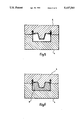
- FIGS. 1-9 illustrate schematically the various procedural steps of a method for manufacturing tubular elements to close tolerances in accordance with the invention.
- Waveguides are preferably made of aluminium, although they can also be made of other electrically conductive materials, preferably of low specific weight.
- Other types of tubular elements may, of course, be made from other types of material, such as different types of plastic materials.
- FIG. 1 illustrates the first step in the manufacture of a waveguide comprising a bottom part 1 and a top part 2 made from thin aluminium sheet and bent or pressed to a given shape with a wall thickness of 0.3-0.6 mm, for instance. This results in high-precision components.
- the top part is also provided with shoulders-like projections 3, which enable the parts to be mutually joined together.
- the pre-shaped bottom part 1 is then placed in a bottom tool-half 4 which has precise internal dimensions, FIG. 2.
- FIG. 3 illustrates the step of applying a protective film 5 onto the bottom part 1, either by gluing or by using a self-adhesive film, so as to protect the join between said parts and to prevent the ingress of filler. This is particularly important in the case of waveguides, since it is necessary to ensure good electrical contact between the waveguide parts.
- the top part 2 is then pressed down against the bottom part 1.
- the now formed waveguide has a smaller vertical extension or height than the ultimate finished element.
- FIG. 4 illustrates the next step of manufacture, in which an upper tool-half 6 is pressed down over the bottom element part 2 until coming into abutment with the bottom tool-half 4.
- the upper tool-half 6, similar to the tool-half 4, is configured with accurate internal dimensions and is also provided with means 7 which squeeze together the joint-forming shoulders 3 so as to form a lightly squeezed sealing connection between the element parts 1 and 2.
- the two tool-halves 4 and 6 are screwed together to the position illustrated in FIG. 5.
- FIG. 5 also illustrates the sealing connection and the manner in which the protective film 5 covers the joint region between the parts 1 and 2.
- the upper part 2 is fitted in the tool-half 6 such as to present a clearance therewith, i.e. the height of the formed element is smaller than the internal dimensions of the tool.
- a filler 8 for instance polyurethene
- a filler 8 is introduced into the tool 4, 6 between the element-parts 1 and 2, FIG. 6, and foamed therein.
- This causes the bottom part 1 and the top part 2 of the element to be pressed against their respective tool-halves 4 and 6 and to be shaped so as to provide an integrated element of precise dimensions.
- the foam is then allowed to solidfy. It is important that the tool is not opened prematurely during this manufacturing stage, since premature opening of the tool would cause the pressure exerted by the expanding foam to bulge-out the walls of the waveguide and therewith destroy the element. Thus, it is imperative that the tool is not opened and the waveguide removed before the foam has propertly solidified to form a core.
- the removed waveguide is now finally effectively sealed along the lightly squeezed connection 3 by some appropriate method, such as spot welding, seaming or like techniques, to form a secure join, as illustrated schematically in FIG. 7.
- some appropriate method such as spot welding, seaming or like techniques, to form a secure join, as illustrated schematically in FIG. 7.
- the expanded foam core within the waveguide ensures that the waveguide will retain its shape during this working process, with only local deformation.
- FIG. 8 illustrates a method by means of which holes can be formed in the waveguide with the expanded core still present therein.
- the holes can be made with the aid of any appropriate conventional method, such as boring, milling or the like without risk of deformation, since the core forms a support for the material being worked during the hole-forming process.
- the last stage of manufacture involves removing the core, so that the finished element, shown in FIG. 9, can be used for the purpose intended.
- the method used to remove the core depends on the material from which the core is made.
- the method used will preferably be a non-mechanical method, so as not to influence the waveguide mechanically, for instance a method in which the core is dissolved with the aid of a solvent, acid or the like, and therewith readily removed. It is also conceivable, however, to press the core mechanically from the waveguide in its axial direction, if this can be effected without requiring the application of excessive force that is liable to act negatively on the waveguide.
- the described method enables a tubular element to be produced to close tolerances in a simple and reliable fashion and with high repeatability.
- the foamed core ensures that the element will not be subjected to deformation during mechanical process, such as hole-forming processes or the like.
Landscapes
- Engineering & Computer Science (AREA)
- Manufacturing & Machinery (AREA)
- Pressure Welding/Diffusion-Bonding (AREA)
- Extrusion Moulding Of Plastics Or The Like (AREA)
Abstract
The present invention relates to a method of manufacturing a two-part, thin-walled tubular element, particularly waveguides, to close tolerances. The inventive method comprises the steps of bending or pressing thin material in a manner to produce the parts (1, 2) of said element, wherein at least one of the parts (2) is provided with a shoulder-like projection (3) for joining said parts together; inserting the first part (1) into a first tool-half (4) which functions as a counter-pressure means and which has accurately determined internal dimensions; pressing the second part (2) together with the first part (1), wherein the formed element has a smaller vertical extension than the finished element; pressing a second tool-half (6) over the second part (2) and into abutment with the first tool-half (4), this second tool-half (6) functioning as a counter-pressure device and having accurately determined internal dimensions, wherein at least one of the tool-halves (6) is provided with means (7) which is operative in squeezing the join-forming surfaces of the element parts together into a lightly squeezed sealing connection; by introducing a foaming filler (8) into the assembled tool (4, 6) and between the element part (1, 2) and permitting the filler to expand so as to press the element parts outwardly against respective accurately-dimensioned tool-halves 4, 6); permitting the filler (8) to solidify to a core so that the element can be removed from the tool; sealing the lightly squeezed connection (3) to form a secure joint; and removing the foamed core from the finished tubular element.
Description
The present invention relates to a method for the manufacture of two-part, thin-walled tubular elements, particularly waveguides, to close tolerances.
Various methods are known for the manufacture of tubular elements, such as waveguides. An example of one such method is aluminium extrusion. This method enables tubular elements to be produced with sufficient accuracy and at relatively low cost, provided that the wall thicknesses of said elements are greater than 1 mm. The drawback with this known method, however, is that the element produced is relatively heavy. Because of the nature of the process involved, a reduction in wall thickness, and therewith a reduction in weight, will result in a pronounced increase in the number of elements that must be scrapped because the tolerances no longer can be maintained within set limits. Furthermore, it is not possible to subsequently work such elements without subjecting them to significant deformation, which also increases the percentage of scrapped elements.
The object of the present invention is to provide a method for manufacturing tubular elements with great accuracy. This object is achieved by using an expanding filler as a working component in combination with an outer counter-pressure means to dimension and fixate component parts and to function as a support for continued working of the element.
The inventive method affords the advantage of providing an element with satisfactory tolerances and of low weight at defensibly low production costs. The element can also be subsequently worked without risk of harmful deformation.
Other objects of the invention and advantages afforded thereby will be evident from the following detailed description, which is made with reference to a preferred exemplifying embodiment thereof and with reference to the accompanying drawings.
FIGS. 1-9 illustrate schematically the various procedural steps of a method for manufacturing tubular elements to close tolerances in accordance with the invention.
There will now be described a method for manufacturing a two-part tubular, thin-walled element. The description is directed to the manufacture of a ridge waveguide, although it will be understood that other types of tubular elements with other cross-sectional shapes, such as rectangular for instance, can be manufactured in accordance with the inventive method. Waveguides are preferably made of aluminium, although they can also be made of other electrically conductive materials, preferably of low specific weight. Other types of tubular elements may, of course, be made from other types of material, such as different types of plastic materials.
FIG. 1 illustrates the first step in the manufacture of a waveguide comprising a bottom part 1 and a top part 2 made from thin aluminium sheet and bent or pressed to a given shape with a wall thickness of 0.3-0.6 mm, for instance. This results in high-precision components. The top part is also provided with shoulders-like projections 3, which enable the parts to be mutually joined together. The pre-shaped bottom part 1 is then placed in a bottom tool-half 4 which has precise internal dimensions, FIG. 2. FIG. 3 illustrates the step of applying a protective film 5 onto the bottom part 1, either by gluing or by using a self-adhesive film, so as to protect the join between said parts and to prevent the ingress of filler. This is particularly important in the case of waveguides, since it is necessary to ensure good electrical contact between the waveguide parts. The top part 2 is then pressed down against the bottom part 1. The now formed waveguide has a smaller vertical extension or height than the ultimate finished element.
FIG. 4 illustrates the next step of manufacture, in which an upper tool-half 6 is pressed down over the bottom element part 2 until coming into abutment with the bottom tool-half 4. The upper tool-half 6, similar to the tool-half 4, is configured with accurate internal dimensions and is also provided with means 7 which squeeze together the joint-forming shoulders 3 so as to form a lightly squeezed sealing connection between the element parts 1 and 2. In this stage of the manufacturing process, the two tool- halves 4 and 6 are screwed together to the position illustrated in FIG. 5. FIG. 5 also illustrates the sealing connection and the manner in which the protective film 5 covers the joint region between the parts 1 and 2. As will also be seen from the Figure, the upper part 2 is fitted in the tool-half 6 such as to present a clearance therewith, i.e. the height of the formed element is smaller than the internal dimensions of the tool.
In the next step of the manufacturing process, a filler 8, for instance polyurethene, is introduced into the tool 4, 6 between the element- parts 1 and 2, FIG. 6, and foamed therein. This causes the bottom part 1 and the top part 2 of the element to be pressed against their respective tool- halves 4 and 6 and to be shaped so as to provide an integrated element of precise dimensions. The foam is then allowed to solidfy. It is important that the tool is not opened prematurely during this manufacturing stage, since premature opening of the tool would cause the pressure exerted by the expanding foam to bulge-out the walls of the waveguide and therewith destroy the element. Thus, it is imperative that the tool is not opened and the waveguide removed before the foam has propertly solidified to form a core. The removed waveguide is now finally effectively sealed along the lightly squeezed connection 3 by some appropriate method, such as spot welding, seaming or like techniques, to form a secure join, as illustrated schematically in FIG. 7. The expanded foam core within the waveguide ensures that the waveguide will retain its shape during this working process, with only local deformation.
FIG. 8 illustrates a method by means of which holes can be formed in the waveguide with the expanded core still present therein. The holes can be made with the aid of any appropriate conventional method, such as boring, milling or the like without risk of deformation, since the core forms a support for the material being worked during the hole-forming process. The last stage of manufacture involves removing the core, so that the finished element, shown in FIG. 9, can be used for the purpose intended. The method used to remove the core depends on the material from which the core is made. The method used will preferably be a non-mechanical method, so as not to influence the waveguide mechanically, for instance a method in which the core is dissolved with the aid of a solvent, acid or the like, and therewith readily removed. It is also conceivable, however, to press the core mechanically from the waveguide in its axial direction, if this can be effected without requiring the application of excessive force that is liable to act negatively on the waveguide.
The described method enables a tubular element to be produced to close tolerances in a simple and reliable fashion and with high repeatability. The foamed core ensures that the element will not be subjected to deformation during mechanical process, such as hole-forming processes or the like.
It will be understood that the invention is not restricted to the aforedescribed and illustrated embodiment thereof and that modifications can be made within the scope of the following claims.
Claims (9)
1. A method of accurately forming a tubular member having an inner surface and an outer surface by joining and shaping a first elongated deformable part and a second elongated deformable part, comprising the steps of:
inserting said first part in a first tool half of specified dimensions that surrounds an outer surface of said first part;
lightly press-fitting said second part together with said first part such that edges of said first part extend within corresponding seam-forming channels of said second part;
pressing over said second part a second tool half of specified dimensions that surrounds an outer surface of said second part such that said first and second tool halves abut and said seam-forming channels are lightly squeezed;
introducing a tumescent foaming filler into a hollow formed by inner surfaces of said first and second parts;
allowing said filler to expand, pressing said first and second parts against said first and second tool halves;
allowing said filler to solidify, forming a removable core;
securely joining said first and second parts along said seam-forming channels; and
removing said core.
2. The method of claim 1 wherein said step of securely joining comprises applying at least one of heat and pressure to said seam-forming channels sufficient to fuse said first and second parts.
3. The method of claim 2 wherein said seam-forming channels are spot welded.
4. The method of claim 2 wherein said seam-forming channels are swaged.
5. A method according to claim 1, comprising the further step of applying a protective film to one of the parts prior to pressing said parts together, in order to protect the joint area from the ingress of filler.
6. A method according to claim 1, comprising the further step of forming at least one hole in the tubular member prior to removing the foamed core.
7. A method according to claim 1, comprising the further step of screwing the tool halves together prior to expansion and solidification of the filler.
8. A method according to claim 1, wherein said removing step includes dissolving the foamed core with the aid of a caustic substance, to facilitate removal of said core.
9. A method according to claim 1, wherein said removing step comprises removing the foamed core by pushing said core axially from said tubular member.
Applications Claiming Priority (2)
| Application Number | Priority Date | Filing Date | Title |
|---|---|---|---|
| SE9002016A SE466372B (en) | 1990-06-06 | 1990-06-06 | PROCEDURES FOR MANUFACTURING PIPE FORMED ELEMENTS |
| SE9002016 | 1990-06-06 |
Publications (1)
| Publication Number | Publication Date |
|---|---|
| US5107583A true US5107583A (en) | 1992-04-28 |
Family
ID=20379690
Family Applications (1)
| Application Number | Title | Priority Date | Filing Date |
|---|---|---|---|
| US07/697,393 Expired - Fee Related US5107583A (en) | 1990-06-06 | 1991-05-09 | Method for the manufacture of tubular elements |
Country Status (4)
| Country | Link |
|---|---|
| US (1) | US5107583A (en) |
| EP (1) | EP0461094B1 (en) |
| DE (1) | DE69104908T2 (en) |
| SE (1) | SE466372B (en) |
Cited By (2)
| Publication number | Priority date | Publication date | Assignee | Title |
|---|---|---|---|---|
| US6626726B2 (en) * | 2000-01-24 | 2003-09-30 | Samsung Sdi Co., Ltd. | Method for fabricating cathode structure for cathode ray tube |
| US20100146728A1 (en) * | 2001-12-06 | 2010-06-17 | Sharabura Scott D | Windshield wiper having reduced friction characteristics |
Families Citing this family (1)
| Publication number | Priority date | Publication date | Assignee | Title |
|---|---|---|---|---|
| GB202005060D0 (en) * | 2020-04-06 | 2020-05-20 | Global Skyware Ltd | Method of formation of a waveguide filter for data receiving and/or transmitting apparatus |
Citations (4)
| Publication number | Priority date | Publication date | Assignee | Title |
|---|---|---|---|---|
| US3314130A (en) * | 1964-03-23 | 1967-04-18 | William R Sheridan | Method of making hollow electronic components |
| US3686590A (en) * | 1971-06-24 | 1972-08-22 | Rca Corp | Sheet metal waveguide constructed of a pair of interlocking sheet metal channels |
| US3955274A (en) * | 1972-08-25 | 1976-05-11 | Hitachi Electronics, Ltd. | Method of manufacturing a low energy-loss waveguide circuit element |
| US4885839A (en) * | 1985-05-30 | 1989-12-12 | General Signal Corporation | Process of fabricating a waveguide |
-
1990
- 1990-06-06 SE SE9002016A patent/SE466372B/en not_active IP Right Cessation
-
1991
- 1991-04-18 EP EP91850099A patent/EP0461094B1/en not_active Expired - Lifetime
- 1991-04-18 DE DE69104908T patent/DE69104908T2/en not_active Expired - Fee Related
- 1991-05-09 US US07/697,393 patent/US5107583A/en not_active Expired - Fee Related
Patent Citations (4)
| Publication number | Priority date | Publication date | Assignee | Title |
|---|---|---|---|---|
| US3314130A (en) * | 1964-03-23 | 1967-04-18 | William R Sheridan | Method of making hollow electronic components |
| US3686590A (en) * | 1971-06-24 | 1972-08-22 | Rca Corp | Sheet metal waveguide constructed of a pair of interlocking sheet metal channels |
| US3955274A (en) * | 1972-08-25 | 1976-05-11 | Hitachi Electronics, Ltd. | Method of manufacturing a low energy-loss waveguide circuit element |
| US4885839A (en) * | 1985-05-30 | 1989-12-12 | General Signal Corporation | Process of fabricating a waveguide |
Cited By (2)
| Publication number | Priority date | Publication date | Assignee | Title |
|---|---|---|---|---|
| US6626726B2 (en) * | 2000-01-24 | 2003-09-30 | Samsung Sdi Co., Ltd. | Method for fabricating cathode structure for cathode ray tube |
| US20100146728A1 (en) * | 2001-12-06 | 2010-06-17 | Sharabura Scott D | Windshield wiper having reduced friction characteristics |
Also Published As
| Publication number | Publication date |
|---|---|
| SE466372B (en) | 1992-02-03 |
| SE9002016L (en) | 1991-12-07 |
| EP0461094A1 (en) | 1991-12-11 |
| EP0461094B1 (en) | 1994-11-02 |
| SE9002016D0 (en) | 1990-06-06 |
| DE69104908D1 (en) | 1994-12-08 |
| DE69104908T2 (en) | 1995-03-09 |
Similar Documents
| Publication | Publication Date | Title |
|---|---|---|
| JPS5950226A (en) | Slide bearing | |
| MXPA02008003A (en) | Tubular assembly having hydroformed interconnecting member and method for making same. | |
| EP0786294B1 (en) | Joint structure for metal plates | |
| US5107583A (en) | Method for the manufacture of tubular elements | |
| JPH07117134A (en) | Method and device for crimping plastic member | |
| CN101663156A (en) | Method of fastening first and second thermoplastic parts, and two-part assembly | |
| US2755368A (en) | Welding method | |
| US4747199A (en) | Method of securing mating parts together | |
| JP2561546B2 (en) | Method for producing box-shaped molded article composed of composite of plastic and metal foil | |
| JP3242355B2 (en) | Fastening method and fastening structure | |
| JPS5928825Y2 (en) | Structure of heat caulked joints of plastic parts | |
| JP3452757B2 (en) | Press mold | |
| RU2086333C1 (en) | Method of making laminate sheet blank for drawing | |
| RU2062912C1 (en) | Threaded insert for setting in dummy hole of three- layered structure | |
| JPH08112675A (en) | Formed shape of connecting hollow pipe for projection welding | |
| JP3187103B2 (en) | Fastening method and fastening structure | |
| JPH1034230A (en) | Manufacturing method of steel column | |
| JPS6257414B2 (en) | ||
| JP2019214127A (en) | Exterior coating resin molding method of electronic part module | |
| JPH066310B2 (en) | Baking-molded product manufacturing method | |
| JP2000042641A (en) | Embossing structure for positioning and mold for processing embossing structure for positioning | |
| KR100196986B1 (en) | Joint structure between metal plates | |
| JP2949999B2 (en) | Press bending method for composite parts | |
| KR0177627B1 (en) | Method for door panel of a vehicle | |
| DE19616062A1 (en) | Laser welding together a set of zinc@-coated steel plates |
Legal Events
| Date | Code | Title | Description |
|---|---|---|---|
| AS | Assignment |
Owner name: TELEFONAKTIEBOLAGET L M ERICSSON A CORPORATION Free format text: ASSIGNMENT OF ASSIGNORS INTEREST.;ASSIGNOR:GUSTAFSSON, PETER O.;REEL/FRAME:005706/0221 Effective date: 19910418 |
|
| FEPP | Fee payment procedure |
Free format text: PAYOR NUMBER ASSIGNED (ORIGINAL EVENT CODE: ASPN); ENTITY STATUS OF PATENT OWNER: LARGE ENTITY |
|
| FPAY | Fee payment |
Year of fee payment: 4 |
|
| REMI | Maintenance fee reminder mailed | ||
| LAPS | Lapse for failure to pay maintenance fees | ||
| FP | Lapsed due to failure to pay maintenance fee |
Effective date: 20000428 |
|
| STCH | Information on status: patent discontinuation |
Free format text: PATENT EXPIRED DUE TO NONPAYMENT OF MAINTENANCE FEES UNDER 37 CFR 1.362 |