US5070709A - Striping system for circular knitting machine - Google Patents
Striping system for circular knitting machine Download PDFInfo
- Publication number
- US5070709A US5070709A US07/614,024 US61402490A US5070709A US 5070709 A US5070709 A US 5070709A US 61402490 A US61402490 A US 61402490A US 5070709 A US5070709 A US 5070709A
- Authority
- US
- United States
- Prior art keywords
- yarnguide
- yarn
- rod
- lever
- slide
- Prior art date
- Legal status (The legal status is an assumption and is not a legal conclusion. Google has not performed a legal analysis and makes no representation as to the accuracy of the status listed.)
- Expired - Fee Related
Links
- 238000009940 knitting Methods 0.000 title claims description 7
- 230000007246 mechanism Effects 0.000 claims description 29
- 230000000994 depressogenic effect Effects 0.000 claims description 7
- 239000011435 rock Substances 0.000 claims description 5
- 230000000717 retained effect Effects 0.000 claims description 3
- 230000001105 regulatory effect Effects 0.000 claims description 2
- 230000005540 biological transmission Effects 0.000 description 1
- 230000015556 catabolic process Effects 0.000 description 1
- 239000004744 fabric Substances 0.000 description 1
Images



Classifications
-
- D—TEXTILES; PAPER
- D04—BRAIDING; LACE-MAKING; KNITTING; TRIMMINGS; NON-WOVEN FABRICS
- D04B—KNITTING
- D04B15/00—Details of, or auxiliary devices incorporated in, weft knitting machines, restricted to machines of this kind
- D04B15/38—Devices for supplying, feeding, or guiding threads to needles
- D04B15/54—Thread guides
- D04B15/58—Thread guides for circular knitting machines; Thread-changing devices
- D04B15/60—Thread guides for circular knitting machines; Thread-changing devices with thread-clamping or -severing devices
Definitions
- the invention relates to a striping system for a circular knitting machine, the machine comprising an axis of rotation, a needle cylinder provided with needles adapted to receive knitting yarn, cam sections for regulating the movement of said needles, a support for said cam sections, stripers and a common yarnguide from which the yarn may run to the needle.
- stripers are used allowing the pattern it is desired to knit to be programmed without taking the pattern that was being knitted into account. This leads to the frequent error of programming the coming into operation of a moving yarnguide rod which was already in operation.
- the conventional systems require the striper to be subjected to three selections: one for the yarnguide which has to come into operation; another for freeing the incoming yarn and a third one for cutting the outgoing yarn. All this creates a complex situation.
- each rod being provided with a yarn notch, each rod being capable of pivoting between a first position away from said axis of rotation and a second position towards said axis of rotation;
- a support member associated with each yarnguide rod and fixedly attached to a gripper member for retaining the yarn and with a shears member for cutting said yarn, said support member being provided with first means to be pushed downwardly and second means to be pushed upwardly, and being adapted to slide along the rod between a first lower position in which the gripper member retains the yarn and a second upper position in which the gripper member does not retain the yarn, said shears member being adapted to cut the yarn on moving from said second to said first position;
- each yarnguide rod provided with a lower contour in which there is provided a recess for guiding the yarn between the infeed yarnguide and the common yarnguide;
- a moving cam adapted to pick up the yarn retained in a yarnguide rod when the latter is in said second position thereof, such that the yarn slides along said lower contour to reach said recess, to be inserted in the common yarnguide and to be captured by the needle;
- a pivoting mechanism for pivoting each yarnguide rod comprising a last rocking lever having an end;
- said selection device comprises:
- a slide member for each pivoting mechanism which is adapted to slide between a retracted position and an extended position, which is housed in a slot and is provided with: a tail portion capable of being depressed into the slot against the urging of a second spring; a rear engagement surface; an upper engagement surface; a front engagement surface; an upper butt and a recess in which there is inserted said end of said last rocking lever with a clearance therebetween, such that a sliding movement of the slide member from said retracted position of a magnitude greater than said clearance, causes said last rocking lever to rock and the actuation of said pivoting mechanism;
- a single selection box which, for each slide member, comprises a selector adapted to occupy a retracted inoperative position or an extended operative position in which it engages said upper butt, causing the slide member to slide over a first distance of a magnitude of the order of said clearance;
- said closing mechanism is provided with a first rocking arm pivotably connected to a closing lever which, on the one hand, is adapted to slide between a first retracted position to which it is urged by a third spring and a second, extended position and, on the other hand it is also adapted to pivot between an inoperative position, to which it is urged by a fourth spring, and an operative position to which it is led by the pivoting of any yarnguide rod to the second position thereof towards said axis of rotation, said closing lever having a terminal edge which, when the closing lever has been pivoted to the operative position thereof and is slid towards the extended position thereof, engages said first means of said support member, leading it to a first lower position thereof.
- the invention also contemplates that said opening mechanism be provided with a second rocking arm pivotably attached to an opening lever which is adapted to slide between a low position to which it is urged by a fifth spring and a high position, said opening lever having an inner operative edge which, when the lever slides from said low position to said high position, is adapted to engage said second means of said support member, when the yarnguide rod corresponding to the support member is in the second position thereof towards the axis of rotation.
- FIG. 1 is an elevation view of the system of the invention, mounted on a circular knitting machine shown in part.
- FIG. 2 is a side elevation view, on a larger scale, of a yarnguide rod attached to a corresponding lever.
- FIG. 3 is a front view of the lower end of the yarnguide rod, the shears member being illustrated in part and the gripper member having been deleted for greater clarity.
- FIG. 4 is a partial elevation view of the striper, without a frame cover, showing a yarnguide rod pivoted to the first position thereof away from the axis of rotation; the remaining yarnguide rods have been omitted for clarity, although at least one of them is in a second position thereof towards the axis of rotation, in view of the position of the closing lever.
- FIG. 5 is a similar view to the previous one, with the yarnguide rod pivoted to the second position thereof towards the axis of rotation.
- FIG. 7 is a similar view to the previous one, showing a further position of the slide member.
- FIG. 8 is an elevation view of the top portion of the striper associated with the selection box and other system parts, the rigid front cover of the frame being shown partly cut away.
- FIG. 9 is a part elevation view of the striper, showing a yarnguide rod in the first pivoting position thereof and with the support member in the second upper position thereof and another yarnguide rod in the second pivoting position thereof and with the support member in the first lower position thereof; only one last rocking lever has been shown.
- FIG. 10 is a similar view to the previous one, with the lower and upper positions of the support members being reversed.
- FIG. 11 is an elevation view of the lower portion of the striper in an operative stage thereof; the guide plate has been drawn in phantom lines for clarity.
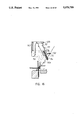
- FIG. 11(a) is a perspective view showing the parts of the striping mechanism 2 shown in FIG. 11, with the needle cylinder and common yarnguide removed for clarity.
- FIG. 12 is a cross section view on the line XII--XII of FIG. 11, limited to the moving cam.
- FIGS. 13 to 15 are similar views to FIG. 11, showing other operative stages of the striper.
- FIG. 16 is a plan view of the radial and axial cams operating on the striper.
- striper 2 is mounted on a circular knitting machine. A large part of the members forming the yarn changeover system are contained in the striper 2 and detailed reference will be made to said members hereinafter.
- the needle cylinder 4 is illustrated at the bottom of the Figure and is seen to be provided with grooves housing needles 6 and other items, a description of which is not necessary for an understanding of the invention.
- Sinkers 8 cooperate with said needles and the cam sections 10 and cams 12, for the needles.
- the cam sections 14 and cams 16 for the sinkers 8 are also shown.
- the cam sections 14 are supported on a support 18, mounted in turn on brackets 20.
- the cam sections 10 are held by a support 22, serving as a base for columns 24 which in turn support the said brackets 20.
- the columns 24 support a ring 26 to which the stripers 2 are attached by bolts 28, taking advantage of an appropriate configuration of the ring 26 and the stripers.
- a rotating ring 30 driven by the kinematic chain (not illustrated) of the machine for rotation around an axis of rotation (not shown either and which would be situated to the left of FIG. 1), at the same speed as the needle cylinder 4.
- a selection box 32 (FIG. 8), to be referred to hereinafter, is mounted on the ring 30.
- the ring 30 also supports a first radial cam 34 and a second radial cam 36, as well as three axial cams 38, 40 and 42.
- the second radial cam 36 is supported by an intermediate support ring 37.
- radial is used to designate the cams whose operative surface is arcuate and is held generally parallel to the machine axis of rotation.
- axial cams are those whose operative surface is the lower surface of the cam and which, therefore, is oriented generally normal to said axis of rotation, although such surface may be curved.
- the ring 30 draws along a support arm 44 for holding a support 46 on which a moving cam 48 is mounted in association with the needle removal area of the striping machines.
- the purpose of the moving cam is to take the yarn offered by the stripers to be changed and place it within a common yarnguide 52 to be captured by the needles 6.
- Each striper 2 is provided preferably with two parallel rigid covers 54 (of which only the front one is seen in FIG. 1). A plurality of shafts for the elements of the different mechanisms are located between the covers. Attached to the striper are guide plates 56 having a lower contour 58 wherein there is located a recess 60 for guiding the yarn extending between the needle and the infeed yarnguides 62.
- Yarnguide rods 64 are very important for the system.
- Each yarnguide rod 64 (FIGS. 2 and 3) is provided with a generally hook shaped notch 66 and the rods are pivotable between a first position 64a away from the axis of rotation of the machine and a position 64b towards said axis (FIG. 1), there being a first spring 68 (FIGS. 4 and 5) urging the corresponding rod 64 to said first position.
- Each rod 64 is located between two guide plates 56.
- Each yarnguide rod 64 is associated with a support member 70 which, in turn is attached to a gripper member 72 for retaining the yarn and a shears member 74 for cutting the yarn.
- the attachment may be effected, for example, by tabs 76 on each of said members extending through a window 78 of the support member 70.
- the support member 70 together with the members 72 and 74, is adapted to slide along the rod (to which it is snugly mounted) between a first lower position (70a in FIG. 4) and a second upper position (70b in FIG. 5). In said first position the gripper member 72 retains the yarn against the rod body 64 and in the second upper position the yarn is freed from the gripper member.
- the notch 66 is provided with an edge 80 which, together with the lower edge 82 of the shears member cut the yarn when the support member 70, together with the shears member 74 moves from said second position to said first position.
- Each support member 70 is provided with first means for being pushed downwards towards said first position and second means for being pushed upwardly towards said second position.
- these first and second means may be formed by respective fins 84 and 86 respectively having an upper transverse surface 88 and a lower transverse surface 90.
- Each yarnguide rod 64 is attached to a lever 92 pivotably connected to another lever 94 and the latter in turn is attached to a last rocking lever 96 which has an end 98.
- each slide member 100 is connected to a pivoting mechanism for the yarnguide rods 64, it should be said here that the slide member is provided with a recess 106 in which said end 98 is inserted with a clearance therebetween.
- any sliding movement of the slide member of a magnitude inferior to that of the clearance does not cause the slide member 100 to engage said end 98 and, therefore, the last lever 96 does not rock.
- the last lever 96 When said sliding movement is greater than said clearance, the last lever 96 is caused to rock, thereby moving the lever 94 and, therewith, the lever 92.
- the last named is connected to the corresponding yarnguide rod 64, whereby a sliding movement of the slide member 100 from the retracted position thereof to the extended position thereof causes the yarnguide rod 64 to pivot from the first position 70a to the second position 70b thereof.
- an opposite sliding movement of the slide member 100 causes the rod 64 to pivot in the opposite direction, i.e. from the second position 70b to the first position 70a thereof.
- FIGS. 4 and 5 For greater clarity, reference has been made in FIGS. 4 and 5 only to the items involved in the rod pivoting mechanism.
- the slide member 100 is seen (FIGS. 6, 7 and 8) to have furthermore a tail portion 108 capable of being depressed to the bottom 104 of the slot 102, against the force of the second spring 107.
- a rear engagement surface 110 there is a rear engagement surface 110, an upper engagement surface 112 and a front engagement surface 114.
- each slide member 100 is provided with an upper butt 116; the position of the upper butt 116 of a slide member 100 is advanced or in arrears relative to the upper butts of the possibly contiguous slide members, so that each upper butt 116 associates itself with each of the selectors 118 of the selected box 32, such that the respective butts 116 of the different slide members are mutually offset.
- a single selection box 32 provided with as many selectors 118 as there are butts 116, i.e. as slide members 100 and the selectors are correspondingly offset with the butts 116.
- Said selectors 118 may be in an inoperative retracted position or an operative extended position. They are provided with a sloping surface 120 which engages the corresponding butt 116, when the selector is in the operative position and, with little effort, the butt 116 may be caused to advance over a first distance (portion between initial position 110 and retracted position 110a in FIG. 6), equivalent to the clearance between the end 98 and recess 106.
- the continued forward movement of the selector 118 places the butt 116 in front of the head 122 of the selector, whereby it is led to its inoperative position, in which it remains or not, depending on whether programmable magnetic elements are excited or not.
- the corresponding selector 118 moves to the operative position thereof and engages the upper butt 116 of the slide member 100.
- the slide member 100 moves away from the initial position thereof and slides over the said first distance and thus the upper engagement surface 112 is taken out of the reach of the first axial cam 38. Consequently, the tail portion 108 is not depressed in the slot, whereby the rear surface (in position 110a) is engaged by the first radial cam 34 and the slide member is pushed towards its extended position, whereby the recess 106 thereof engages the end 98 of the last rocking lever 96, the levers 92 and 94 are moved and the yarnguide rod 64 pivots. Thereafter, the second radial cam 36 engages the front engagement surface 114 and returns the slide member 100 to its initial position in which the rear surface is in position 110 of FIG. 6.
- the system is also provided with a closing mechanism to take said support member 70 to the said first lower position.
- Said closing mechanism comprises a first rocking arm 124 pivotably connected to a closing lever 126.
- the lever 126 may move in two ways: in the first place, it is adapted to slide from a first retracted position, shown in FIG. 10, to a second extended position shown in FIG. 9.
- a third spring 146 engages the arm 124 and urges the closing lever to the first retracted position.
- the closing lever 126 may pivot between an operative position and a not shown inoperative position.
- a fourth spring 130 urges the lever to the said inoperative position, in which on sliding it does not engage the support member 70.
- This situation is illustrated in FIG. 15, where the lower end of the lever 126 is seen to be orientated in a plane not containing the fin of the support member 70.
- the lever 126 is moved to the operative position when any yarnguide rod is pivoted to its second position towards the axis of rotation. This movement is caused by the neb 131 of the lever 94.
- the yarnguide rods 64 are in the first position thereof away from the axis (FIG. 4), the corresponding neb 131 is separated from a swinging arm 133.
- the closing lever 126 has an edge 134 which, when the lever 126 is in the said operative position and is slid towards its second extended position, engages said first means, i.e. the upper transverse surface 88, of the support member 70.
- said support member is moved to the lower position thereof (FIG. 9) whereby, obviously, the gripper member and the shears member are also lowered; the former retains any yarn on the rod 64 and the latter cuts it, as stated hereinbefore.
- the closing lever 126 is moved from the first retracted position to the second extended position by a first pusher 136 which, in turn, is moved by the second axial cam 40.
- the lever 140 may move between a high position (FIG. 9) and a low position (FIG. 10) to which it is urged by a fifth spring 128 engaging the second rocking arm 138.
- 50(a) designates the yarn being introduced, which is being offered to the needles 6.
- the support members 70(a) (corresponding to the yarn 50(a)) has been displaced towards the center of the machine (to the left in the figure). In this position, it still holds the yarn 50(a) gripped, since the gripper 72(a) is in the low position.
- the moving cam has placed the yarn 50(a) in the path of the needles and the needle shown is taking it. Thereafter, the cam synchronism operates and the opening lever 140 (FIG. 9) drives the support member upwards, thereby releasing the yarn 50(a).
- the incoming yarn 50(a) and the outgoing yarn 50(b) are knit simultaneously by a small number of needles (approximately from six to ten). Thereafter, the closing lever 126 acts on the support member 70(b), whereby the gripper 72(b) is lowered from the position shown, cutting the outgoing yarn 50(b) and leaving it gripped.
- the support member 70(a) then rocks towards the right of the figure keeping the corresponding gripper 72(a) open and this will not close again until a further change takes place.
- the support members 70(c) and 70(d) are closed, keeping the yarns not taking part in the change gripped.
- the sliding of the opening lever 140 is controlled by a second pusher 148 engaged by the third axial cam.
- the yarnguide rod 64 containing the yarn 50a to be knitted is pivoted to the second position thereof towards the axis of rotation (FIG. 11).
- the moving cam 48 continues drawing the yarn until it is inserted in the common yarnguide 52, being extended between the latter and the infeed yarnguide 62, whereby the yarn has been removed from the yarnguide rod 64.
- This position it lies within the range of movement of the head of the needles 6, whereby the latter capture the yarn 50a and start to knit it with the yarn 50b which was already being knitted.
- the yarns 50a and 50b are partly superimposed in FIG. 13.
- the opening mechanism operates, whereby the gripper member 72 is raised and the end of yarn 50a is released.
- the closing mechanism of the yarnguide rod 64 feeding yarn 50b operates.
- the shears member 74 cuts the yarn 50b (whereupon it ceases to be knitted) and grips it, leaving it ready for a new change.
- the yarnguide 64 which had fed yarn 50a returns to the position away from the axis of rotation, but in the open position.
- the opening and closing movements occur always, but they are effective only if a yarnguide rod 64 has pivoted previously towards its position towards the axis of rotation.
- FIG. 16 shows the axial and radial cams and a selector box 32, which facilitates an understanding of the operation of the system.
- the selection box 32 receives commands from a controller (not shown) programmed in dependence on the number of yarn changes required to knit the desired garment and said commands arrive synchronously with the machine rotation in the space of time comprised between two consecutive stripers.
- a conventional synchroniser not shown, reports the relative position of the box 32 to the stripers to the controller.
- the operations of offering up the incoming yarn 50a, picking up of said yarn by the moving cam 48, removal of the outgoing yarn 50b and the cutting and retaining of the yarn 50b are carried out in a period of time approximately the same as that occupied by half a machine rotation. This relatively long period of time allows the movements of the different parts of the striper 2 to be effected smoothly.
- the recess 60 of the guide plate 56 is positioned such that it guides the yarn without needing the aid of the yarnguide rod 64. This is particularly inportant when effecting a pattern change, since it is normal in pattern changes to program the pattern change without considering the pattern already being knitted, whereby it is possible to program the operation of a yarnguide rod 64 already in operation.
Landscapes
- Engineering & Computer Science (AREA)
- Textile Engineering (AREA)
- Knitting Machines (AREA)
Abstract
The striper of the system is provided with yarnguide rods which are pivotable to a position conducive to delivery of yarn to the needle. The rod to be pivoted is selected by a selector which imposes a small movement on a slide member and this small movement causes the slide member to be moved by a first radial cam such that its movement causes pivoting of the rod. Independently of said pivoting, a closing lever and an opening lever respectively adapted to retain and cut the yarn or release it are always moved. The movement of said levers, is only effective when at least one yarnguide rod has pivoted. There is a striper for each cam section and all of them are controlled by a single selection box containing the selectors.
Description
This is a continuation of copending application Ser. No. 07/279,070 filed on 12/2/88, now abandoned.
1. Field of the Invention
The invention relates to a striping system for a circular knitting machine, the machine comprising an axis of rotation, a needle cylinder provided with needles adapted to receive knitting yarn, cam sections for regulating the movement of said needles, a support for said cam sections, stripers and a common yarnguide from which the yarn may run to the needle.
2. Description of the Related Art
In known systems, stripers are used allowing the pattern it is desired to knit to be programmed without taking the pattern that was being knitted into account. This leads to the frequent error of programming the coming into operation of a moving yarnguide rod which was already in operation.
This error causes serious problems in the conventional stripers, since the movement of the moving yarnguide rod readily drags the yarn that was being knitted out of the correct place, thus causing the needles to miss it.
Furthermore, in the usual systems there is an extraordinarily short period of time in which to give the necessary commands to the striper and for the latter to execute them. This factor, on the one hand, limits the possibilities of the striper and, on the other hand, subjects the striper components to very heavy mechanical stresses which are obviously required to operate at the required speed. Thus, the risk of breakdown is high.
It should also be noted that the conventional systems require the striper to be subjected to three selections: one for the yarnguide which has to come into operation; another for freeing the incoming yarn and a third one for cutting the outgoing yarn. All this creates a complex situation.
It is an object of the invention to provide a reliable, safe system in which the aforementioned drawbacks are overcome.
The above object is achieved by a system of the type described hereinbefore and which comprises:
at least two yarnguide rods, each being provided with a yarn notch, each rod being capable of pivoting between a first position away from said axis of rotation and a second position towards said axis of rotation;
a first spring for each yarnguide rod urging it to said first position;
a support member associated with each yarnguide rod and fixedly attached to a gripper member for retaining the yarn and with a shears member for cutting said yarn, said support member being provided with first means to be pushed downwardly and second means to be pushed upwardly, and being adapted to slide along the rod between a first lower position in which the gripper member retains the yarn and a second upper position in which the gripper member does not retain the yarn, said shears member being adapted to cut the yarn on moving from said second to said first position;
a guide plate for each yarnguide rod, provided with a lower contour in which there is provided a recess for guiding the yarn between the infeed yarnguide and the common yarnguide;
a moving cam, adapted to pick up the yarn retained in a yarnguide rod when the latter is in said second position thereof, such that the yarn slides along said lower contour to reach said recess, to be inserted in the common yarnguide and to be captured by the needle;
a pivoting mechanism for pivoting each yarnguide rod comprising a last rocking lever having an end;
a selection device for actuating the pivoting mechanisms;
a closing mechanism to lead said support member to said first lower position; and
an opening mechanism to lead said support member to said second upper position.
According to a further feature of the invention, said selection device comprises:
a slide member for each pivoting mechanism, which is adapted to slide between a retracted position and an extended position, which is housed in a slot and is provided with: a tail portion capable of being depressed into the slot against the urging of a second spring; a rear engagement surface; an upper engagement surface; a front engagement surface; an upper butt and a recess in which there is inserted said end of said last rocking lever with a clearance therebetween, such that a sliding movement of the slide member from said retracted position of a magnitude greater than said clearance, causes said last rocking lever to rock and the actuation of said pivoting mechanism;
a single selection box which, for each slide member, comprises a selector adapted to occupy a retracted inoperative position or an extended operative position in which it engages said upper butt, causing the slide member to slide over a first distance of a magnitude of the order of said clearance;
a first axial cam engaging said upper engagement surfaces of said slide members, causing the depression of said tail portion when the slide members have not moved over said first distance;
a first radial cam engaging said rear engagement surfaces when said tail portions have not been depressed; and
a second radial cam engaging said front engagement surfaces to return the slide members to said retracted position.
In one development of the invention said closing mechanism is provided with a first rocking arm pivotably connected to a closing lever which, on the one hand, is adapted to slide between a first retracted position to which it is urged by a third spring and a second, extended position and, on the other hand it is also adapted to pivot between an inoperative position, to which it is urged by a fourth spring, and an operative position to which it is led by the pivoting of any yarnguide rod to the second position thereof towards said axis of rotation, said closing lever having a terminal edge which, when the closing lever has been pivoted to the operative position thereof and is slid towards the extended position thereof, engages said first means of said support member, leading it to a first lower position thereof.
The invention also contemplates that said opening mechanism be provided with a second rocking arm pivotably attached to an opening lever which is adapted to slide between a low position to which it is urged by a fifth spring and a high position, said opening lever having an inner operative edge which, when the lever slides from said low position to said high position, is adapted to engage said second means of said support member, when the yarnguide rod corresponding to the support member is in the second position thereof towards the axis of rotation.
Further advantages and features of the invention will be appreciated in the following description in which, without any limiting intention, there is described a preferred embodiment of the invention, with reference to the accompanying drawings. In the drawings:
FIG. 1 is an elevation view of the system of the invention, mounted on a circular knitting machine shown in part.
FIG. 2 is a side elevation view, on a larger scale, of a yarnguide rod attached to a corresponding lever.
FIG. 3 is a front view of the lower end of the yarnguide rod, the shears member being illustrated in part and the gripper member having been deleted for greater clarity.
FIG. 4 is a partial elevation view of the striper, without a frame cover, showing a yarnguide rod pivoted to the first position thereof away from the axis of rotation; the remaining yarnguide rods have been omitted for clarity, although at least one of them is in a second position thereof towards the axis of rotation, in view of the position of the closing lever.
FIG. 5 is a similar view to the previous one, with the yarnguide rod pivoted to the second position thereof towards the axis of rotation.
FIG. 6 is a schematic view of the slide member, associated with the last rocking lever of the pivoting mechanism.
FIG. 7 is a similar view to the previous one, showing a further position of the slide member.
FIG. 8 is an elevation view of the top portion of the striper associated with the selection box and other system parts, the rigid front cover of the frame being shown partly cut away.
FIG. 9 is a part elevation view of the striper, showing a yarnguide rod in the first pivoting position thereof and with the support member in the second upper position thereof and another yarnguide rod in the second pivoting position thereof and with the support member in the first lower position thereof; only one last rocking lever has been shown.
FIG. 10 is a similar view to the previous one, with the lower and upper positions of the support members being reversed.
FIG. 11 is an elevation view of the lower portion of the striper in an operative stage thereof; the guide plate has been drawn in phantom lines for clarity.
FIG. 11(a) is a perspective view showing the parts of the striping mechanism 2 shown in FIG. 11, with the needle cylinder and common yarnguide removed for clarity.
FIG. 12 is a cross section view on the line XII--XII of FIG. 11, limited to the moving cam.
FIGS. 13 to 15 are similar views to FIG. 11, showing other operative stages of the striper.
FIG. 16 is a plan view of the radial and axial cams operating on the striper.
In the general view of FIG. 1, striper 2 is mounted on a circular knitting machine. A large part of the members forming the yarn changeover system are contained in the striper 2 and detailed reference will be made to said members hereinafter.
The needle cylinder 4 is illustrated at the bottom of the Figure and is seen to be provided with grooves housing needles 6 and other items, a description of which is not necessary for an understanding of the invention. Sinkers 8 cooperate with said needles and the cam sections 10 and cams 12, for the needles. The cam sections 14 and cams 16 for the sinkers 8 are also shown.
The cam sections 14 are supported on a support 18, mounted in turn on brackets 20. The cam sections 10 are held by a support 22, serving as a base for columns 24 which in turn support the said brackets 20.
At the upper end thereof, the columns 24 support a ring 26 to which the stripers 2 are attached by bolts 28, taking advantage of an appropriate configuration of the ring 26 and the stripers. On the ring 26 there is mounted a rotating ring 30 driven by the kinematic chain (not illustrated) of the machine for rotation around an axis of rotation (not shown either and which would be situated to the left of FIG. 1), at the same speed as the needle cylinder 4.
A selection box 32 (FIG. 8), to be referred to hereinafter, is mounted on the ring 30. The ring 30 also supports a first radial cam 34 and a second radial cam 36, as well as three axial cams 38, 40 and 42. The second radial cam 36 is supported by an intermediate support ring 37.
Herein the term "radial" is used to designate the cams whose operative surface is arcuate and is held generally parallel to the machine axis of rotation. Likewise, the axial cams are those whose operative surface is the lower surface of the cam and which, therefore, is oriented generally normal to said axis of rotation, although such surface may be curved.
The ring 30 draws along a support arm 44 for holding a support 46 on which a moving cam 48 is mounted in association with the needle removal area of the striping machines. The purpose of the moving cam, as discussed herein after, is to take the yarn offered by the stripers to be changed and place it within a common yarnguide 52 to be captured by the needles 6.
Each striper 2 is provided preferably with two parallel rigid covers 54 (of which only the front one is seen in FIG. 1). A plurality of shafts for the elements of the different mechanisms are located between the covers. Attached to the striper are guide plates 56 having a lower contour 58 wherein there is located a recess 60 for guiding the yarn extending between the needle and the infeed yarnguides 62.
Each yarnguide rod 64 is associated with a support member 70 which, in turn is attached to a gripper member 72 for retaining the yarn and a shears member 74 for cutting the yarn. The attachment may be effected, for example, by tabs 76 on each of said members extending through a window 78 of the support member 70.
The support member 70, together with the members 72 and 74, is adapted to slide along the rod (to which it is snugly mounted) between a first lower position (70a in FIG. 4) and a second upper position (70b in FIG. 5). In said first position the gripper member 72 retains the yarn against the rod body 64 and in the second upper position the yarn is freed from the gripper member.
The notch 66 is provided with an edge 80 which, together with the lower edge 82 of the shears member cut the yarn when the support member 70, together with the shears member 74 moves from said second position to said first position.
Each support member 70 is provided with first means for being pushed downwards towards said first position and second means for being pushed upwardly towards said second position. In a simple embodiment, these first and second means may be formed by respective fins 84 and 86 respectively having an upper transverse surface 88 and a lower transverse surface 90.
Each yarnguide rod 64 is attached to a lever 92 pivotably connected to another lever 94 and the latter in turn is attached to a last rocking lever 96 which has an end 98.
At the top of the striper 2 there is a slide member 100 for each yarnguide rod 64. Each slide member 100 is housed in a slot 102 with a space normally existing between the slide member 100 and the bottom 104 of the slot, due to the existence of the pushbutton 105 and the spring 107. Preferably, there is another button and another spring (not shown) which engage the lower front portion of the slide member, whereby the slide member is adaptably moveable relative to the selector and the cams to be described hereinafter. The slide member 100 is adapted to slide between a retracted position (FIG. 4) and an extended position (FIG. 5). Later on, a third or initial position is described.
To the extent that each slide member 100 is connected to a pivoting mechanism for the yarnguide rods 64, it should be said here that the slide member is provided with a recess 106 in which said end 98 is inserted with a clearance therebetween. As a result of said clearance, any sliding movement of the slide member of a magnitude inferior to that of the clearance does not cause the slide member 100 to engage said end 98 and, therefore, the last lever 96 does not rock.
When said sliding movement is greater than said clearance, the last lever 96 is caused to rock, thereby moving the lever 94 and, therewith, the lever 92. The last named is connected to the corresponding yarnguide rod 64, whereby a sliding movement of the slide member 100 from the retracted position thereof to the extended position thereof causes the yarnguide rod 64 to pivot from the first position 70a to the second position 70b thereof. Obviously, an opposite sliding movement of the slide member 100 causes the rod 64 to pivot in the opposite direction, i.e. from the second position 70b to the first position 70a thereof.
For greater clarity, reference has been made in FIGS. 4 and 5 only to the items involved in the rod pivoting mechanism.
The slide member 100 is seen (FIGS. 6, 7 and 8) to have furthermore a tail portion 108 capable of being depressed to the bottom 104 of the slot 102, against the force of the second spring 107. Likewise, there is a rear engagement surface 110, an upper engagement surface 112 and a front engagement surface 114. Furthermore, each slide member 100 is provided with an upper butt 116; the position of the upper butt 116 of a slide member 100 is advanced or in arrears relative to the upper butts of the possibly contiguous slide members, so that each upper butt 116 associates itself with each of the selectors 118 of the selected box 32, such that the respective butts 116 of the different slide members are mutually offset.
There is, furthermore, a single selection box 32 provided with as many selectors 118 as there are butts 116, i.e. as slide members 100 and the selectors are correspondingly offset with the butts 116.
Said selectors 118, as has already been disclosed in other patents and patent applications of the applicant, may be in an inoperative retracted position or an operative extended position. They are provided with a sloping surface 120 which engages the corresponding butt 116, when the selector is in the operative position and, with little effort, the butt 116 may be caused to advance over a first distance (portion between initial position 110 and retracted position 110a in FIG. 6), equivalent to the clearance between the end 98 and recess 106. The continued forward movement of the selector 118 places the butt 116 in front of the head 122 of the selector, whereby it is led to its inoperative position, in which it remains or not, depending on whether programmable magnetic elements are excited or not.
In accordance with the foregoing, the selection of the pivoting movement of the yarnguide rods 64 is easy to understand.
When selection occurs, i.e. when a yarnguide rod has to pivot, the corresponding selector 118 moves to the operative position thereof and engages the upper butt 116 of the slide member 100. Thereupon, the slide member 100 moves away from the initial position thereof and slides over the said first distance and thus the upper engagement surface 112 is taken out of the reach of the first axial cam 38. Consequently, the tail portion 108 is not depressed in the slot, whereby the rear surface (in position 110a) is engaged by the first radial cam 34 and the slide member is pushed towards its extended position, whereby the recess 106 thereof engages the end 98 of the last rocking lever 96, the levers 92 and 94 are moved and the yarnguide rod 64 pivots. Thereafter, the second radial cam 36 engages the front engagement surface 114 and returns the slide member 100 to its initial position in which the rear surface is in position 110 of FIG. 6.
When no selection occurs, i.e. a yarnguide rod 64 is not to pivot, the corresponding selector 118 remains in the inoperative position thereof. Consequently, the upper engagement surface 112 (FIG. 7) is not taken out of the reach of the first axial cam 38, whereby this pushes the slide member 100 and the tail portion 108 is depressed in the slot 102. In this case, it is the rear engagement surface 110 which is taken out of the reach of the first radial cam 34, thus the slide member does not slide and the corresponding yarnguide rod does not pivot. After the engagement with the first radial cam 38 is terminated, the second spring 107 returns the slide member to its initial retracted position and thus it is ready for selection or otherwise on a future occasion.
The system is also provided with a closing mechanism to take said support member 70 to the said first lower position.
Said closing mechanism comprises a first rocking arm 124 pivotably connected to a closing lever 126. The lever 126 may move in two ways: in the first place, it is adapted to slide from a first retracted position, shown in FIG. 10, to a second extended position shown in FIG. 9. A third spring 146 engages the arm 124 and urges the closing lever to the first retracted position.
Secondly, the closing lever 126 may pivot between an operative position and a not shown inoperative position. A fourth spring 130 urges the lever to the said inoperative position, in which on sliding it does not engage the support member 70. This situation is illustrated in FIG. 15, where the lower end of the lever 126 is seen to be orientated in a plane not containing the fin of the support member 70. The lever 126 is moved to the operative position when any yarnguide rod is pivoted to its second position towards the axis of rotation. This movement is caused by the neb 131 of the lever 94. When the yarnguide rods 64 are in the first position thereof away from the axis (FIG. 4), the corresponding neb 131 is separated from a swinging arm 133. On the contrary, when one of the rods 64 is in the first position thereof towards to the axis (FIGS. 9 and 10), the corresponding neb 131 of lever 94 engages the swinging arm 133 which, in turn, pushes the closing lever 126 to the operative position thereof.
The closing lever 126 has an edge 134 which, when the lever 126 is in the said operative position and is slid towards its second extended position, engages said first means, i.e. the upper transverse surface 88, of the support member 70. Thus said support member is moved to the lower position thereof (FIG. 9) whereby, obviously, the gripper member and the shears member are also lowered; the former retains any yarn on the rod 64 and the latter cuts it, as stated hereinbefore. The closing lever 126 is moved from the first retracted position to the second extended position by a first pusher 136 which, in turn, is moved by the second axial cam 40.
An opening mechanism is now described. This is provided with a second rocking arm 138 also pivotably connected to an opening lever 140 having a window 142 with an active inner edge 144.
The lever 140 may move between a high position (FIG. 9) and a low position (FIG. 10) to which it is urged by a fifth spring 128 engaging the second rocking arm 138.
When a yarnguide rod 64 is towards the axis of rotation, the sliding of the opening lever 140 to its high position causes the active inner edge 144 to engage the lower transverse surface 90 of the fin 86, whereby the support member 70 rises, together with a gripper member 72, which thus releases any retained yarn.
In FIG. 11(a), 50(a) designates the yarn being introduced, which is being offered to the needles 6. The support members 70(a) (corresponding to the yarn 50(a)) has been displaced towards the center of the machine (to the left in the figure). In this position, it still holds the yarn 50(a) gripped, since the gripper 72(a) is in the low position. The moving cam has placed the yarn 50(a) in the path of the needles and the needle shown is taking it. Thereafter, the cam synchronism operates and the opening lever 140 (FIG. 9) drives the support member upwards, thereby releasing the yarn 50(a). Therefore, the incoming yarn 50(a) and the outgoing yarn 50(b) are knit simultaneously by a small number of needles (approximately from six to ten). Thereafter, the closing lever 126 acts on the support member 70(b), whereby the gripper 72(b) is lowered from the position shown, cutting the outgoing yarn 50(b) and leaving it gripped. The support member 70(a) then rocks towards the right of the figure keeping the corresponding gripper 72(a) open and this will not close again until a further change takes place. The support members 70(c) and 70(d) are closed, keeping the yarns not taking part in the change gripped.
The sliding of the opening lever 140 is controlled by a second pusher 148 engaged by the third axial cam.
With regard to the delivery of the yarn 50, the operation is as follows. The yarnguide rod 64 containing the yarn 50a to be knitted is pivoted to the second position thereof towards the axis of rotation (FIG. 11). Thus the yarn 50a is placed within the reach of the moving cam 48 and the yarn 50a slides over the contour 150 of the cam 48 and from there to the lower contour 58 of the corresponding guide plate 56 until it is inserted in the recess 60. The moving cam 48 continues drawing the yarn until it is inserted in the common yarnguide 52, being extended between the latter and the infeed yarnguide 62, whereby the yarn has been removed from the yarnguide rod 64. In this position it lies within the range of movement of the head of the needles 6, whereby the latter capture the yarn 50a and start to knit it with the yarn 50b which was already being knitted. The yarns 50a and 50b are partly superimposed in FIG. 13.
Thereafter (FIG. 13) the opening mechanism operates, whereby the gripper member 72 is raised and the end of yarn 50a is released. Subsequently (FIG. 14), the closing mechanism of the yarnguide rod 64 feeding yarn 50b operates. On closing, the shears member 74 cuts the yarn 50b (whereupon it ceases to be knitted) and grips it, leaving it ready for a new change. Finally (FIG. 15), the yarnguide 64 which had fed yarn 50a returns to the position away from the axis of rotation, but in the open position.
The opening and closing movements occur always, but they are effective only if a yarnguide rod 64 has pivoted previously towards its position towards the axis of rotation.
As stated above, FIG. 16 shows the axial and radial cams and a selector box 32, which facilitates an understanding of the operation of the system.
It should be observed that with a single control (selection box 32) mounted on the rotating ring 30 containing the said axial and radial cams, the simultaneous engagement with several stripers and with the moving cam 48 is achieved. The box 32 operates, or may operate, once each machine rotation on each striper 2, there being normally 48 stripers of four yarns each.
The selection box 32 receives commands from a controller (not shown) programmed in dependence on the number of yarn changes required to knit the desired garment and said commands arrive synchronously with the machine rotation in the space of time comprised between two consecutive stripers. A conventional synchroniser, not shown, reports the relative position of the box 32 to the stripers to the controller. Although the transmission of commands and programming of the selection box is effected in a period of time substantially shorter that the time available between two consecutive stripers, the mechanical movements ending in the yarn changeover take much longer.
The operations of offering up the incoming yarn 50a, picking up of said yarn by the moving cam 48, removal of the outgoing yarn 50b and the cutting and retaining of the yarn 50b are carried out in a period of time approximately the same as that occupied by half a machine rotation. This relatively long period of time allows the movements of the different parts of the striper 2 to be effected smoothly.
Therefore, assuming a machine having 48 stripers, 24 of them are carrying out the yarn changeover operations almost simultaneously (with a slight phase offset). This peculiarity makes the delivery, gripping and cutting of the yarn extremely reliable, at the same time as it places less mechanical stress on the machine.
The recess 60 of the guide plate 56 is positioned such that it guides the yarn without needing the aid of the yarnguide rod 64. This is particularly inportant when effecting a pattern change, since it is normal in pattern changes to program the pattern change without considering the pattern already being knitted, whereby it is possible to program the operation of a yarnguide rod 64 already in operation.
With the system of the invention, such programming errors do not affect either the pattern it is desired to knit or produce faults in the fabric, since the pivoting of the yarnguide rod takes place without affecting the yarn feed.
2 striping mechanism
4 needle cylinder
6 needle
8 sinker
10 cam sections
12 cams
14 cam sections
16 cams
18 support
20 brackets
22 support
24 columns
26 ring
28 bolts
30 rotating ring
32 selector box
34 first radial cam
36 second radial cam
37 intermediate support ring
38 first axial cam
40 second axial cam
42 third axial cam
44 support arm
46 support
48 moving cam
50 yarn
52 common yarnguide
54 rigid covers
56 guide plates
58 inner contour
60 recess
62 infeed yarnguide
64 yarnguide rods
66 notch
68 first spring
70 support member
72 gripper
74 shears
76 tabs
78 window
80 notch edge
82 shears edge
84 fin
86 fin
88 upper transverse surface
90 lower transverse surface
92 lever
94 lever
96 last rocking lever
98 end
100 slide member
102 slot
104 bottom
105 push bottom
106 recess
107 second spring
108 tail portion
110 rear engagement surface
112 upper engagement surface
114 front engagement surface
116 upper butt
118 selectors
120 sloping surface
122 selector head
124 first rocking arm
126 closing lever
128 third spring
130 fourth spring
131 neb
133 swinging arm
134 edge
136 first pusher
138 second rocking arm
140 opening lever
142 window
144 inner active edge
146 fifth spring
148 second pusher
150 contour
Claims (6)
1. In a circular knitting machine comprising an axis of rotation, a needle cylinder provided with needles adapted to receive knitting yarn, cam sections for regulating the movement of said needles, a support for said cam sections, stripers and a common yarnguide from which the yarn may run to the needle, a striping system comprising at least two yarnguide rods, each being provided with a yarn notch, each rod being capable of pivoting between a first position away from said axis of rotation and a second position towards said axis of rotation;
a first spring for each yarnguide rod urging it to said first position;
a support member associated with each yarnguide rod and fixedly attached to a gripper member for retaining the yarn and with a shears member for cutting said yarn, said support member being provided with first means to be pushed downwardly and second means to be pushed upwardly, and being adapted to slide along the rod between a first lower position in which the gripper member retains the yarn and a second upper position in which the gripper member does not retain the yarn, said shears member being adapted to cut the yarn on moving from said second to said first position;
a guide plate for each yarnguide rod, provided with a lower contour in which there is provided a recess for guiding the yarn between the infeed yarnguide and the common yarnguide;
a moving cam, adapted to pick up the yarn retained in a yarnguide rod when the latter is in said second position thereof, such that the yarn slides along said lower contour to reach said recess, be inserted in the common yarnguide and be captured by the needle;
a pivoting mechanism for pivoting each yarnguide rod comprising a last rocking lever having an end;
a selection device for actuating the pivoting mechanisms;
a closing mechanism to lead said support member to said first lower position; and
an opening mechanism to lead said support member to said second upper position.
2. The system of claim 1, said selection device comprising:
a slide member for each pivoting mechanism, which is adapted to slide between a retracted position and an extended position, which is housed in a slot and is provided with: a tail portion capable of being depressed into the slot against the urging of a second spring; a rear engagement surface; an upper engagement surface; a front engagement surface; an upper butt and a recess in which there is inserted said end of said last rocking lever with a clearance therebetween, such that a sliding movement of the slide member from said retracted position of a magnitude greater than said clearance, causes said last rocking lever to rock and the actuation of said pivoting mechanism;
a single selection box which, for each slide member, comprises a selector adapted to occupy a retracted inoperative position or an extended operative position in which it engages said upper butt, causing the slide member to slide over a first distance of a magnitude of the order of said clearance;
a first axial cam engaging said upper engagement surfaces of said slide members, causing the depression of said tail portion when the slide members have not moved over said first distance;
a first radial cam engaging said rear engagement surfaces when said tail portions have not been depressed; and
a second radial cam engaging said front engagement surfaces to return the slide members to said retracted position.
3. The system of claim 1, wherein said closing mechanism is provided with a first rocking arm pivotably connected to a closing lever which, on the one hand, is adapted to slide between a first retracted position to which it is urged by a third spring and a second, extended position and, on the other hand it is also adapted to pivot between an inoperative position, to which it is urged by a fourth spring, and an operative position to which it is led by the pivoting of any yarnguide rod to the second position thereof towards said axis of rotation, said closing lever having a terminal edge which, when the closing lever has been pivoted to the operative position thereof and is slid towards the extended position thereof, engages said first means of said support member, leading it to the first lower position thereof.
4. The system of claim 3, wherein said first rocking arm of said closing mechanism is engaged by a first pusher which in turn is engaged by a second axial cam, whereby the said closing lever is slid to the extended position thereof.
5. The system of claim 1, wherein said opening mechanism be provided with a second rocking arm pivotably attached to an opening lever which is adapted to slide between a low position to which it is urged by a fifth spring and a high position, said opening lever having an inner operative edge which, when the lever slides from said low position to said high position, is adapted to engage said second means of said support member, when the yarnguide rod corresponding to the support member is in the second position thereof towards the axis of rotation.
6. The system of claim 5, wherein said second rocking arm of said opening mechanism is engaged by a second pusher which in turn is engaged by a third axial cam, whereby said opening lever is slid to the high position thereof.
Applications Claiming Priority (2)
| Application Number | Priority Date | Filing Date | Title |
|---|---|---|---|
| ES8703484A ES2006232A6 (en) | 1987-12-04 | 1987-12-04 | Striping system for a circular knitting machine. |
| ES8703484 | 1987-12-04 |
Related Parent Applications (1)
| Application Number | Title | Priority Date | Filing Date |
|---|---|---|---|
| US07279070 Continuation | 1988-12-02 |
Publications (1)
| Publication Number | Publication Date |
|---|---|
| US5070709A true US5070709A (en) | 1991-12-10 |
Family
ID=8253576
Family Applications (1)
| Application Number | Title | Priority Date | Filing Date |
|---|---|---|---|
| US07/614,024 Expired - Fee Related US5070709A (en) | 1987-12-04 | 1990-11-16 | Striping system for circular knitting machine |
Country Status (4)
| Country | Link |
|---|---|
| US (1) | US5070709A (en) |
| EP (1) | EP0319444A3 (en) |
| JP (1) | JPH01207447A (en) |
| ES (1) | ES2006232A6 (en) |
Cited By (26)
| Publication number | Priority date | Publication date | Assignee | Title |
|---|---|---|---|---|
| US5218845A (en) * | 1992-12-07 | 1993-06-15 | Wang Ping S | Circular knitting machine striper control system |
| US5251463A (en) * | 1991-09-19 | 1993-10-12 | Lonati S.R.L. | Thread guide structure for circular knitting machine, in particular for line-forming units in double-cylinder machines for manufacturing socks and stockings |
| US5826446A (en) * | 1995-03-31 | 1998-10-27 | Spira Patententwiklungs-Und Beteiligungsgesellschaft Mbh | Circular knitting machine having drive system for yarn feed device |
| US6058742A (en) * | 1997-10-07 | 2000-05-09 | Jumberca, S.A. | Circular knitting machine for knitted fabrics |
| US6189345B1 (en) * | 1999-06-11 | 2001-02-20 | Sangiacomo S.P.A. | Yarn-locking/cutting device for circular stocking knitting and knitting machines |
| SG82541A1 (en) * | 1995-03-31 | 2001-08-21 | Sipra Patent Beteiligung | A knitting machine and a yarn changer |
| US6295845B1 (en) * | 2000-03-17 | 2001-10-02 | Matec S.P.A. | Thread dispensing device for dispensing thread at a feed of a circular knitting machine |
| US6655176B1 (en) * | 2002-06-27 | 2003-12-02 | Pai Lung Machinery Mill Co., Ltd. | Striping apparatus for circular knitting machines |
| US6810696B1 (en) * | 2003-04-30 | 2004-11-02 | Riccardo Lonati | Method for trimming loose threads on circular knitting machines |
| US20050066692A1 (en) * | 2001-12-21 | 2005-03-31 | Francesco Lonati | Thread gripping device, particularly for gripping elastic threads having a small cross-section, in circular knitting machines for hosiery or the like |
| US20050076681A1 (en) * | 2001-12-21 | 2005-04-14 | Francesco Lonati | Thread gripping device in circular knitting machines for hosiery or the like |
| KR100520046B1 (en) * | 2002-07-03 | 2005-10-10 | 파이 룽 머시너리 밀 코포레이션 리미티드 | Discoloration apparatus for circular knitting machines |
| US20060010928A1 (en) * | 2004-06-30 | 2006-01-19 | Dietmar Traenkle | Knitting machine with at least one striping attachment |
| US7036343B1 (en) | 2005-11-07 | 2006-05-02 | Pai Lung Machinery Co., Ltd. | Striping apparatus of a circular knitting machine |
| US7055348B1 (en) * | 2005-11-09 | 2006-06-06 | Pai Lung Machinery Mill Co., Ltd. | High speed color altering head for single-face circular knitting machines |
| US20100000262A1 (en) * | 2006-09-29 | 2010-01-07 | Ettore Lonati | Yarn feeding device for knitting machines, particularly for circular knitting machines |
| US7690224B1 (en) * | 2008-12-29 | 2010-04-06 | Pai Lung Machinery Mill Co., Ltd. | Yarn changing set for color altering heads |
| US7845196B1 (en) * | 2010-04-07 | 2010-12-07 | Pai Lung Machinery Mill Co., Ltd. | Circular knitting machine having integrated multiple yarn changing apparatus |
| US20110056247A1 (en) * | 2009-09-08 | 2011-03-10 | Dietmar Traenkle | Method and knitting machine for the production of knitted goods with horizontal stripe patterns |
| CN104233611A (en) * | 2013-06-21 | 2014-12-24 | 山德霓股份公司 | Device for feeding thread to needles of a knitting machine |
| US9441317B1 (en) | 2015-06-04 | 2016-09-13 | Pai Lung Machinery Mill Co., Ltd. | Yarn clipping and cutting structure for striping apparatus of circular knitting machine |
| EP3103905A1 (en) | 2015-06-11 | 2016-12-14 | Pai Lung Machinery Mill Co., Ltd. | Yarn clipping and cutting structure for a striping apparatus of a circular knitting machine |
| US20170362751A1 (en) * | 2014-12-19 | 2017-12-21 | Lava Bvba | Double jersey knitted fabric with yarn selection |
| US11332857B2 (en) * | 2016-06-15 | 2022-05-17 | Sipra Patententwicklungs- Und Beteiligungsgesellschaft Mbh | Circular knitting machine |
| USD957476S1 (en) * | 2019-06-18 | 2022-07-12 | Santoni S.P.A. | Textile machine |
| USD961628S1 (en) * | 2019-06-18 | 2022-08-23 | Santoni S.P.A. | Textile machine |
Families Citing this family (10)
| Publication number | Priority date | Publication date | Assignee | Title |
|---|---|---|---|---|
| JP3667485B2 (en) * | 1997-02-19 | 2005-07-06 | 株式会社福原精機製作所 | Yarn supply switching method in circular knitting machine |
| ES2168881B1 (en) * | 1998-11-06 | 2003-04-01 | Jumberca Sa | SYSTEM OF CANCELLATION OF LISTS FOR CIRCULAR MACHINE CONFECCIONADORA DE GENERO DE PUNTO. |
| ES2184636B1 (en) * | 2001-09-05 | 2004-01-01 | Quantum Knitting Technologies | MECHANISM TO CLEAR THE THREAD IN A LISTING MACHINE |
| ES2187368B1 (en) * | 2001-09-05 | 2004-09-16 | Quantum Knitting Technologies, S.A. | THREAD CUTTING MECHANISM IN A LISTING MACHINE. |
| KR100461529B1 (en) * | 2002-07-08 | 2004-12-17 | 쌍용기계공업주식회사 | Electronic automatic striping unit of jacquard circular knitting machine |
| CN100547138C (en) * | 2005-10-31 | 2009-10-07 | 佰龙机械厂股份有限公司 | Color changing device of circular knitting machine |
| ATE483050T1 (en) * | 2005-11-04 | 2010-10-15 | Pai Lung Machinery Mill Co Ltd | RING APPARATUS FOR A CIRCULAR KNITTING MACHINE |
| JP2007270365A (en) * | 2006-03-30 | 2007-10-18 | Matsuzaki Matorikusu Techno:Kk | Yarn feeding device of knitting machine |
| DE102009018942A1 (en) | 2009-04-29 | 2010-11-11 | Sipra Patententwicklungs- Und Beteiligungsgesellschaft Mbh | Mattress cover and method of making a cover fabric therefor |
| CN105019126B (en) * | 2015-07-28 | 2016-10-05 | 张家港润山针织机械有限公司 | Yarn changing device locking device |
Citations (2)
| Publication number | Priority date | Publication date | Assignee | Title |
|---|---|---|---|---|
| DE2805779A1 (en) * | 1977-02-11 | 1978-08-17 | Camber Int Uk Ltd | YARN CHANGER FOR A YARN CONSUMING MACHINE |
| US4656842A (en) * | 1985-03-02 | 1987-04-14 | Precision Fukuhara Works, Ltd. | Yarn feeding and changing apparatus for circular knitting machine |
Family Cites Families (3)
| Publication number | Priority date | Publication date | Assignee | Title |
|---|---|---|---|---|
| FR2343846A1 (en) * | 1976-03-08 | 1977-10-07 | Asa Sa | Circular knitter yarn cutter-clamp - including a fixed blade with each yarn change unit and a moving blade acting successively on fixed blades |
| DE3325102C2 (en) * | 1983-07-12 | 1986-01-02 | SIPRA Patententwicklungs- und Beteiligungsgesellschaft mbH, 7470 Albstadt | Thread changing device for knitting machines |
| IT1202725B (en) * | 1987-03-31 | 1989-02-09 | Orizio Paolo Spa | WIRE SELECTION AND CONTROL DEVICE IN KNITTING MACHINES |
-
1987
- 1987-12-04 ES ES8703484A patent/ES2006232A6/en not_active Expired
-
1988
- 1988-12-02 EP EP19880500119 patent/EP0319444A3/en not_active Withdrawn
- 1988-12-05 JP JP63306179A patent/JPH01207447A/en active Pending
-
1990
- 1990-11-16 US US07/614,024 patent/US5070709A/en not_active Expired - Fee Related
Patent Citations (2)
| Publication number | Priority date | Publication date | Assignee | Title |
|---|---|---|---|---|
| DE2805779A1 (en) * | 1977-02-11 | 1978-08-17 | Camber Int Uk Ltd | YARN CHANGER FOR A YARN CONSUMING MACHINE |
| US4656842A (en) * | 1985-03-02 | 1987-04-14 | Precision Fukuhara Works, Ltd. | Yarn feeding and changing apparatus for circular knitting machine |
Cited By (38)
| Publication number | Priority date | Publication date | Assignee | Title |
|---|---|---|---|---|
| US5251463A (en) * | 1991-09-19 | 1993-10-12 | Lonati S.R.L. | Thread guide structure for circular knitting machine, in particular for line-forming units in double-cylinder machines for manufacturing socks and stockings |
| US5218845A (en) * | 1992-12-07 | 1993-06-15 | Wang Ping S | Circular knitting machine striper control system |
| US5826446A (en) * | 1995-03-31 | 1998-10-27 | Spira Patententwiklungs-Und Beteiligungsgesellschaft Mbh | Circular knitting machine having drive system for yarn feed device |
| US6000245A (en) * | 1995-03-31 | 1999-12-14 | Sipra Patententwicklugs-Und Beteiligungsgesellschaft | Circular knitting machine with a yarn changer |
| SG82541A1 (en) * | 1995-03-31 | 2001-08-21 | Sipra Patent Beteiligung | A knitting machine and a yarn changer |
| US6058742A (en) * | 1997-10-07 | 2000-05-09 | Jumberca, S.A. | Circular knitting machine for knitted fabrics |
| ES2153261A1 (en) * | 1997-10-07 | 2001-02-16 | Jumberca Sa | Circular knitting machine for knitted fabrics |
| US6189345B1 (en) * | 1999-06-11 | 2001-02-20 | Sangiacomo S.P.A. | Yarn-locking/cutting device for circular stocking knitting and knitting machines |
| US6295845B1 (en) * | 2000-03-17 | 2001-10-02 | Matec S.P.A. | Thread dispensing device for dispensing thread at a feed of a circular knitting machine |
| US20050066692A1 (en) * | 2001-12-21 | 2005-03-31 | Francesco Lonati | Thread gripping device, particularly for gripping elastic threads having a small cross-section, in circular knitting machines for hosiery or the like |
| US20050076681A1 (en) * | 2001-12-21 | 2005-04-14 | Francesco Lonati | Thread gripping device in circular knitting machines for hosiery or the like |
| US6920768B2 (en) * | 2001-12-21 | 2005-07-26 | Santoni S.P.A. | Thread gripping device in circular knitting machines for hosiery or the like |
| US7032414B2 (en) * | 2001-12-21 | 2006-04-25 | Santoni S.P.A. | Thread gripping device, particularly for gripping elastic threads having a small cross-section, in circular knitting machines for hosiery or the like |
| US6655176B1 (en) * | 2002-06-27 | 2003-12-02 | Pai Lung Machinery Mill Co., Ltd. | Striping apparatus for circular knitting machines |
| KR100520046B1 (en) * | 2002-07-03 | 2005-10-10 | 파이 룽 머시너리 밀 코포레이션 리미티드 | Discoloration apparatus for circular knitting machines |
| US6810696B1 (en) * | 2003-04-30 | 2004-11-02 | Riccardo Lonati | Method for trimming loose threads on circular knitting machines |
| US20040216495A1 (en) * | 2003-04-30 | 2004-11-04 | Riccardo Lonati | Method for trimming loose threads on circular knitting machines |
| US20060010928A1 (en) * | 2004-06-30 | 2006-01-19 | Dietmar Traenkle | Knitting machine with at least one striping attachment |
| US7073355B2 (en) * | 2004-06-30 | 2006-07-11 | Sipra Patententwicklungs Und Beteiligungsgesellschaft Mbh | Knitting machine with at least one striping attachment |
| US7036343B1 (en) | 2005-11-07 | 2006-05-02 | Pai Lung Machinery Co., Ltd. | Striping apparatus of a circular knitting machine |
| US7055348B1 (en) * | 2005-11-09 | 2006-06-06 | Pai Lung Machinery Mill Co., Ltd. | High speed color altering head for single-face circular knitting machines |
| US20100000262A1 (en) * | 2006-09-29 | 2010-01-07 | Ettore Lonati | Yarn feeding device for knitting machines, particularly for circular knitting machines |
| US7861559B2 (en) * | 2006-09-29 | 2011-01-04 | Santoni S.P.A. | Yarn feeding device for knitting machines, particularly for circular knitting machines |
| US7690224B1 (en) * | 2008-12-29 | 2010-04-06 | Pai Lung Machinery Mill Co., Ltd. | Yarn changing set for color altering heads |
| US20110056247A1 (en) * | 2009-09-08 | 2011-03-10 | Dietmar Traenkle | Method and knitting machine for the production of knitted goods with horizontal stripe patterns |
| US8196438B2 (en) * | 2009-09-08 | 2012-06-12 | Sipra Patententwicklungs- Und Beteiligungsgesellschaft Mbh | Method and knitting machine for the production of knitted goods with horizontal stripe patterns |
| US7845196B1 (en) * | 2010-04-07 | 2010-12-07 | Pai Lung Machinery Mill Co., Ltd. | Circular knitting machine having integrated multiple yarn changing apparatus |
| US20160130735A1 (en) * | 2013-06-21 | 2016-05-12 | Santoni S.P.A. | Device for feeding thread to needles of a knitting machine |
| CN104233611A (en) * | 2013-06-21 | 2014-12-24 | 山德霓股份公司 | Device for feeding thread to needles of a knitting machine |
| CN104233611B (en) * | 2013-06-21 | 2016-09-07 | 山德霓股份公司 | For providing the device of line to the pin of knitting machine |
| US10472749B2 (en) * | 2013-06-21 | 2019-11-12 | Santoni S.P.A. | Device for feeding thread to needles of a knitting machine |
| US20170362751A1 (en) * | 2014-12-19 | 2017-12-21 | Lava Bvba | Double jersey knitted fabric with yarn selection |
| US10662558B2 (en) * | 2014-12-19 | 2020-05-26 | Lava Bvba | Double jersey knitted fabric with yarn selection |
| US9441317B1 (en) | 2015-06-04 | 2016-09-13 | Pai Lung Machinery Mill Co., Ltd. | Yarn clipping and cutting structure for striping apparatus of circular knitting machine |
| EP3103905A1 (en) | 2015-06-11 | 2016-12-14 | Pai Lung Machinery Mill Co., Ltd. | Yarn clipping and cutting structure for a striping apparatus of a circular knitting machine |
| US11332857B2 (en) * | 2016-06-15 | 2022-05-17 | Sipra Patententwicklungs- Und Beteiligungsgesellschaft Mbh | Circular knitting machine |
| USD957476S1 (en) * | 2019-06-18 | 2022-07-12 | Santoni S.P.A. | Textile machine |
| USD961628S1 (en) * | 2019-06-18 | 2022-08-23 | Santoni S.P.A. | Textile machine |
Also Published As
| Publication number | Publication date |
|---|---|
| ES2006232A6 (en) | 1989-04-16 |
| JPH01207447A (en) | 1989-08-21 |
| EP0319444A2 (en) | 1989-06-07 |
| EP0319444A3 (en) | 1991-12-18 |
Similar Documents
| Publication | Publication Date | Title |
|---|---|---|
| US5070709A (en) | Striping system for circular knitting machine | |
| US6000245A (en) | Circular knitting machine with a yarn changer | |
| US4385507A (en) | Yarn feeding and changing apparatus for circular knitting machines | |
| JP2005042260A (en) | Feed yarn changeover apparatus for circular knitting machine and changeover method | |
| EP0407196B1 (en) | Yarn changing apparatus for circular knitting machine | |
| US7073355B2 (en) | Knitting machine with at least one striping attachment | |
| US4934161A (en) | Mechanism for adjusting the stitch density in circular knitting machines | |
| US2146647A (en) | Circular knitting machine | |
| EP0863239B1 (en) | Yarn feeding and changing mechanism for a circular knitting machine | |
| KR101470668B1 (en) | Striped pattern knitting apparatus and method thereof in a yarn breaker | |
| US2940285A (en) | Yarn feeding and changing mechanism for circular knitting machines | |
| CN100422417C (en) | Yarn feeding mechanism for knitting machine | |
| US3097512A (en) | mover | |
| CS231976B2 (en) | Two-cylinder knitting machine | |
| EP0055545B1 (en) | Stitch transfer device for a knitting machine | |
| US2310070A (en) | Knitting machine and method | |
| US4502299A (en) | Yarn feeder mechanisms and double cylinder knitting machines having such mechanisms | |
| US4364246A (en) | Knitting machine | |
| JPH0121988Y2 (en) | ||
| US3608335A (en) | Device for automatic narrowing on both needle-beds of flat knitting machines | |
| GB2058152A (en) | Yarn feeder mechanisms and double cylinder knitting machines having such mechanisms | |
| US2720092A (en) | Knitting machines | |
| US2276214A (en) | Yarn binder for knitting machines | |
| WO1996030575A1 (en) | Cam system for a circular knitting machine | |
| GB2099464A (en) | Yarn gripping and cutting device for use on a circular knitting machine, in particular of the cylinder and dial type |
Legal Events
| Date | Code | Title | Description |
|---|---|---|---|
| FEPP | Fee payment procedure |
Free format text: PAYOR NUMBER ASSIGNED (ORIGINAL EVENT CODE: ASPN); ENTITY STATUS OF PATENT OWNER: LARGE ENTITY |
|
| REMI | Maintenance fee reminder mailed | ||
| LAPS | Lapse for failure to pay maintenance fees | ||
| FP | Lapsed due to failure to pay maintenance fee |
Effective date: 19951213 |
|
| STCH | Information on status: patent discontinuation |
Free format text: PATENT EXPIRED DUE TO NONPAYMENT OF MAINTENANCE FEES UNDER 37 CFR 1.362 |