US5059561A - UV attenuated colored glasses - Google Patents
UV attenuated colored glasses Download PDFInfo
- Publication number
- US5059561A US5059561A US07/494,337 US49433790A US5059561A US 5059561 A US5059561 A US 5059561A US 49433790 A US49433790 A US 49433790A US 5059561 A US5059561 A US 5059561A
- Authority
- US
- United States
- Prior art keywords
- sub
- glass
- lens
- amount
- zno
- Prior art date
- Legal status (The legal status is an assumption and is not a legal conclusion. Google has not performed a legal analysis and makes no representation as to the accuracy of the status listed.)
- Expired - Fee Related
Links
Images
Classifications
-
- C—CHEMISTRY; METALLURGY
- C03—GLASS; MINERAL OR SLAG WOOL
- C03C—CHEMICAL COMPOSITION OF GLASSES, GLAZES OR VITREOUS ENAMELS; SURFACE TREATMENT OF GLASS; SURFACE TREATMENT OF FIBRES OR FILAMENTS MADE FROM GLASS, MINERALS OR SLAGS; JOINING GLASS TO GLASS OR OTHER MATERIALS
- C03C3/00—Glass compositions
- C03C3/04—Glass compositions containing silica
- C03C3/076—Glass compositions containing silica with 40% to 90% silica, by weight
- C03C3/089—Glass compositions containing silica with 40% to 90% silica, by weight containing boron
-
- C—CHEMISTRY; METALLURGY
- C03—GLASS; MINERAL OR SLAG WOOL
- C03C—CHEMICAL COMPOSITION OF GLASSES, GLAZES OR VITREOUS ENAMELS; SURFACE TREATMENT OF GLASS; SURFACE TREATMENT OF FIBRES OR FILAMENTS MADE FROM GLASS, MINERALS OR SLAGS; JOINING GLASS TO GLASS OR OTHER MATERIALS
- C03C14/00—Glass compositions containing a non-glass component, e.g. compositions containing fibres, filaments, whiskers, platelets, or the like, dispersed in a glass matrix
- C03C14/006—Glass compositions containing a non-glass component, e.g. compositions containing fibres, filaments, whiskers, platelets, or the like, dispersed in a glass matrix the non-glass component being in the form of microcrystallites, e.g. of optically or electrically active material
-
- C—CHEMISTRY; METALLURGY
- C03—GLASS; MINERAL OR SLAG WOOL
- C03C—CHEMICAL COMPOSITION OF GLASSES, GLAZES OR VITREOUS ENAMELS; SURFACE TREATMENT OF GLASS; SURFACE TREATMENT OF FIBRES OR FILAMENTS MADE FROM GLASS, MINERALS OR SLAGS; JOINING GLASS TO GLASS OR OTHER MATERIALS
- C03C4/00—Compositions for glass with special properties
- C03C4/08—Compositions for glass with special properties for glass selectively absorbing radiation of specified wave lengths
- C03C4/085—Compositions for glass with special properties for glass selectively absorbing radiation of specified wave lengths for ultraviolet absorbing glass
-
- G—PHYSICS
- G02—OPTICS
- G02B—OPTICAL ELEMENTS, SYSTEMS OR APPARATUS
- G02B5/00—Optical elements other than lenses
- G02B5/20—Filters
- G02B5/22—Absorbing filters
- G02B5/23—Photochromic filters
-
- C—CHEMISTRY; METALLURGY
- C03—GLASS; MINERAL OR SLAG WOOL
- C03C—CHEMICAL COMPOSITION OF GLASSES, GLAZES OR VITREOUS ENAMELS; SURFACE TREATMENT OF GLASS; SURFACE TREATMENT OF FIBRES OR FILAMENTS MADE FROM GLASS, MINERALS OR SLAGS; JOINING GLASS TO GLASS OR OTHER MATERIALS
- C03C2214/00—Nature of the non-vitreous component
- C03C2214/16—Microcrystallites, e.g. of optically or electrically active material
Definitions
- Glasses have sharp cut-on points at wavelengths in the vicinity of the border of the UV and visible ranges are known. They are used primarily as cut-off filter glasses.
- One technique for achieving this effect is the introduction into the glass of chromophoric colorants (i.e., chromophores) such as cadmium sulfide, cadmium selenide and cadmium telluride. See, e.g., W. Vogel, Chemistry of Glass, 163-173, American Ceramic Society, 1985.)
- the glasses become colored by "striking" of the base melts, e.g., by heat treatment at temperatures in the range of 550°-850° C. for times on the order of 30 min. up to 24 hrs.
- This heat treatment causes the formation of microcrystals which achieve the UV and/or short wavelength visible radiation cutoff and, hence, the color.
- a nucleation step before striking ensures uniform formation of crystallites and increases chances of reproducibility when the striking is performed in a continuous manner.
- the cut-on wavelength can be varied by varying the heating conditions. See German Patent 1,596,981 and U.S. Pat. Nos. 3,773,530 and 4,106,946, which also exemplify the wide range of base glasses which are suitable.
- struck glasses have been utilized for special uses such as traffic signal lenses for the German patent, optical filters, and shooter's (e.g., hunter's) eyeglass lenses, e.g., for S-7083 of Schott Glass Technologies Inc., Duryea, Pa. 18642, where the colors and transmittances producible in such glasses are appropriate.
- traffic signal lenses for the German patent
- optical filters e.g., optical filters
- shooter's e.g., hunter's
- eyeglass lenses e.g., for S-7083 of Schott Glass Technologies Inc., Duryea, Pa. 18642, where the colors and transmittances producible in such glasses are appropriate.
- sunglasses where these "struck" glasses have been inapplicable.
- FIGS. 1-4 are graphs showing transmission spectrums for glasses of the invention.
- This invention provides a new method and corresponding glass composition which produce struck glasses suitable for uses such as in sunglass lenses.
- the invention involves the employment of relatively less severe striking conditions (partial striking) than conventionally employed.
- the base glasses of this invention remain substantially noncolored by the chromaphore content and exposure to striking conditions.
- the color desired in the glasses of this invention is provided by additions of ions commonly added to glasses for purposes of coloring them, e.g., due to absorption effects of ions such as nickel, cobalt, vanadium, chromium, copper, neodymium, erbium, samarium, other rare earths, other transition metals, etc.
- the glasses of this invention have the benefits of both UV attenuation due to the striking phenomenon in conjunction with the chromaphore content and also of the desirable colors provided by the classic coloring ions. Heretofore, these two "coloring" phenomena have not been used in conjunction.
- This invention relates to a method of achieving a UV-region transmission cut-on spectrum of about 0% T at a wavelength of 400-450 nm and about 50% T at 420-465 nm in a struck cadmium-chalcogenide chromaphore containing glass and of achieving a desired color of said glass, comprising incorporating in said glass a photopic colorant which imparts the desired color and partially striking said glass under conditions effective to produce essentially no color or only light coloring due to said chromophor in a different glass having the same composition except lacking said photopic colorant.
- It also relates to a glass having a color imparted primarily by a photopic colorant, yet containing a cadmium chalcogenide chromophoric colorant consisting essentially of, in wt %.,
- SiO 2 as at least one network former
- the glass of the invention has a composition comprising, in wt %,
- a preferred composition is in wt %
- a particularly preferred composition is in wt %
- the partial striking permits achievement of relatively low wavelength cut-ons (e.g., in the range of 400-450 nm for 0% T (transmittance) and 420-465 nm for 50% T).
- Such properties can be achieved in accordance with this invention, e.g., utilizing the partial striking conditions of 615°-650° C. for times of 30-150 minutes.
- Preferred temperatures and times typically are: 615°-625° C. for 60-120 minutes.
- Precise time/temperature combinations appropriate for a given glass to achieve the desired wavelength cut-on properties are routinely determinable in a given case in dependence on glass composition (and sulfur retention) and physical dimensions of the glass blank to be struck (usually a 65-71 mm diameter ⁇ 3.0-3.4 mm thick pressing with a +6/-6 diopter curve for glass lenses).
- generally useful combinations include 615°-650° C. for 30 to 150 minutes for achievement of a cut-on wavelength of 425-430 nm (50% T) and 400-410 nm (0% T) for borosilicate base glasses.
- One advantage of this invention's milder conditions is the avoidance of the need heretofore to employ a represser to achieve adequate striking.
- a represser takes a supplied gob of glass and remolds it into another configuration needed for a given application. The striking of a standard colloidally colored glass occurs during the remolding with the represser.
- the struck “base” glasses will be only lightly colored, e.g., generally having only a pale yellow hue. This can be determined by a yellowness index (YI) measurement.
- YI yellowness index
- a partially struck glass with a 50% T cut-on of 427 nm has a YI of 18.3, while a partially struck glass with a 50% T cut-on of 439 nm has a YI of 25.3 showing it is substantially more yellow than the 427 nm sample. Both are acceptable per this invention.
- Colorless ophthalmic glasses such as Schott's S-1 and S-3 have YI measurements between 3.0 and 5.0.
- the partially struck glasses of this invention can be doped with suitable photopic colorants in order to achieve desired colors, e.g., for sunglass lenses and other purposes, especially where UV attenuation is desirable, e.g., in tinted lenses (which have a higher transmittance than sunglass lenses).
- desired colors e.g., for sunglass lenses and other purposes, especially where UV attenuation is desirable, e.g., in tinted lenses (which have a higher transmittance than sunglass lenses).
- This color selectability is a very desirable attribute from a commercial standpoint.
- Suitable photopic colorants include those mentioned above, especially NiO, CoO, V 2 O 5 , Cr 2 O 3 , Nd 2 O 3 , Er 2 O 3 , Sm 2 O 3 and CuO.
- Fe 2 O 3 is generally undesirable since it will compete with the Cd and Zn for sulfur. (See below.) This forms FeS (a differently colored chromophore). Therefore, the preferred photopic colorants are compounds that do not interfere with the formation of the chromophoric active component, especially CdS and/or ZnS.
- the amount of the colorant(s) is non-critical, and will be determined by the desired hue and intensity of color and the overall transmission in the visible range which is desired in the glass. Typically, the amount of colorant will be in the following ranges:
- each colorant when included will be approximately 0.01% for NiO, 0.0005% for CoO, 0.10% for V 2 O 5 , 0.10% for Cr 2 O 3 , 0.06% for CuO and 0.50% for the rare earths, lower and higher amounts also being suitable.
- the integrated percent of visible light transmitted (photopic transmission) typically is 12-40%, preferably 12-30%, at 2 mm thickness for sunglass lenses, for example. Amounts of other colorants can be chosen routinely using conventional considerations.
- Base glass compositions i.e., compositions without a colorant which can be partially struck to achieve the desired properties of this invention include those having SiO 2 as a (or the) network former, and especially include the following borosilicate glasses:
- a borosilicate glass matrix is not necessary to make these yellow-colorless strikeable glasses. Also useful will be conventional silicate, aluminosilicate, and phospho-alumino-silicate compositions well known in the literature. Where included, typical amounts of Al 2 O 3 will be 0-3 wt % and of P 2 O 5 will be 0-4 wt. %. However, a borosilicate matrix melts and processes at lower temperatures and possesses acceptable chemical durability and hence is preferred. These lower temperatures again aid in the retention of S in the melt (see below) to ensure that proper striking will occur in the final product. Additions of Al 2 O 3 increase melt temperatures and the viscosity of the glass thereby creating sulfur retention problems.
- R 2 O Na+K+Li
- R 2 O Na+K+Li
- Rubidium and cesium are less preferred due to expense. If amounts of the alkali metal oxides (collectively and individually) greater than those recited above are employed, in general, devitrification stability decreases. If the amount of sodium oxide is lowered, insufficient chemstrengthenability (discussed below) is achieved. If amounts of potassium oxide greater than those mentioned are included, chemstrengthenability is also adversely affected. If the amount of lithium is increased, unacceptable turbidity occurs.
- Alkaline earth oxides (RO (sum)) are generally included in amounts of 0-20 wt. %.
- the alkaline earth oxides play their usual role in silica-containing glasses, e.g., they increase durability. If the amounts are too high, however, there will be adverse influences on the chemstrengthenability of the glass caused by interference effects during the chemstrengthening process. For example, depth of layer (D.O.L. ( ⁇ m)) and/or M.O.R. (modulus of rupture (nm/cm)) worsens.
- Calcium is the preferred alkaline earth oxide. Barium, strontium and/or magnesium can be used in addition to or as a replacement for some or all of the calcium. However, each causes different phenomena in the melting and/or striking of the glass.
- barium If too much barium is included, there is an adverse effect on striking. Absorption peaks occur in the vicinity of the cut-on wavelength. These aborbances are believed to be due to BaS or BaSO 4 . The latter postulated species are supported by the observed better retention of sulfur in barium-containing glasses. Thus, the amounts of barium, as stated above, represent a balance between the adverse effects of the absorption peaks and the beneficial impact on sulfur retention. With enhanced sulfur retention, the amounts of other sulfur-contributing components can be reduced, thereby alleviating sulfur bubble formation during melting. In addition, it should also beneficially impact the interrelationship among molten glass, sulfur and platinum which also produces bubbles primarily during refining of the glass.
- Suitable chromophoric colorants include CdS, CdSe, and CdTe in amounts of 0.05-4.5 wt. %.
- CdS When CdS is used, ZnS is greatly preferred in addition to help retain S in the melt.
- the S is covalently bonded to the Zn.
- ZnS can be used in amounts of 0-4.5 wt. %.
- a particularly preferred set of contents is:
- Amounts of CdS and ZnS less than what is listed will typically produce glass that will insufficiently strike to the desired wavelength. Amounts larger than the listed ranges produce problems during the manufacturing of the glass, e.g., large amounts of retained S give rise to bubble formation in the molten glass. These become very hard if not impossible to refine out of the glass. Also, some colorants added may form an undesirable product such as CoS which is not very soluble in the glass matrix; and, on occasion, will form a black glass. Some of the other chromophoric colorants when used in too large amounts (CdS, CdSe, CdTe) are extremely harsh on platinum. They alloy quite readily under the proper conditions and cause brittleness and failure of the Pt after extended exposure.
- the amount of retained S in the melt preferably falls between 280 and 400 ppm S. Inclusion of appropriate amounts of ZnO and ZnS ensures this retention and allows the glass to strike to the desired wavelength. For CdTe and CdSe, harsher striking conditions are generally required.
- Suitable amounts of zinc oxide are 0.5-30 wt. %, preferably 0.5-10 wt. %.
- Zinc oxide is a component especially useful when cadmium sulfide is a chromophore since it significantly aids in retention of S in the glass melt.
- S is important to form the CdS crystallite during striking.
- CdS cannot be added alone in the finally desired amounts due to sulfur loss during melting.
- ZnS alleviates this problem due to the enhanced sulfur retention caused by the covalent bonding of sulfur to zinc.
- sulfur content can increase to such an extent that excess sulfur is retained thereby causing sulfur bubbles and increased difficulties during refining.
- TiO 2 can also be included in the glasses, e.g., up to 1 wt. %. Such inclusions enhance glass durability and can also be used to increase the index of refraction. However, the primary advantage of small TiO 2 inclusions is their usefulness as nucleating agents for the growth of cadmium sulfide crystals during heat treatment. The preferred amount of TiO 2 when included is 0.3-0.6 wt. %.
- the glasses of this invention can be prepared using conventional considerations. Thus, they can be melted in ceramic crucibles, most preferably in continuous melting environments. The melting atmosphere should be neutral to slightly reducing to avoid oxidizing S, Se and/or Te to the volatile SO 2 , SeO 2 and/or TeO 2 . According to W. A. Weyl, Colored Glasses, p. 270, Society Glass Technologists (1978), in order to minimize S, Se, and/or Te volatilization, extremely hydrated batch materials are to be avoided as steam release facilitates volatilization. The conventional arsenic and antimony refining agents are generally not preferred since they inhibit glass striking. Furthermore, raw materials known to contain adverse impurities, e.g., iron, lead, etc., should be avoided in order to avoid difficulties in achieving proper transmission and cut-on features.
- adverse impurities e.g., iron, lead, etc.
- the glass of this invention can be provided in any desirable shape using conventional molding procedures well known in the glass industry.
- at least one polished surface of a glass component of this invention is typically strengthened.
- Chemstrengthening is greatly preferred since conventional air hardening, normally performed above the T g of the glass, would affect the final cut-on of the glass.
- Chemstrengthening is typically achieved by exchanging smaller alkali metal ions (e.g., sodium) before larger ions (e.g., potassium). For these purposes, it is especially preferred that the amount of sodium be at least 7 wt. %.
- Conventional exchange solutions can be used, e.g., a crown-bath solution containing, e.g., 99.5% KNO 3 and 0.5% silicic acid at a temperature in the range of about 480°-550° C. for an exchange time of, e.g., 16 hours or more generally 8-24 hours.
- a preferred exchange temperature will be approximately 30° lower than the transformation temperature of the glass.
- Determination of optimum chemstrengthening layer thicknesses can be effected routinely. Typically, acceptable thicknesses of a chemstrengthened layer will be above 30 ⁇ m, preferably above 50 ⁇ m. However, narrower and larger thicknesses are fully included. Typical surface compression values achievable will be 2700-3000 nm/cm (birefringence).
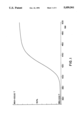
- FIG. 1 shows the transmission spectrum of a typical glass, unstruck.
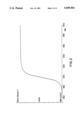
- FIG. 2 shows the same spectrum for the same glass when struck at 800° C. for 30 minutes.
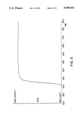
- FIG. 3 shows the transmission spectrum for the same glass, partially struck, i.e., at 625° C. for 1 hour.
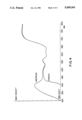
- FIG. 4 gives the spectrum for another glass of this invention, both unstruck and struck (625° C. for 1 hour).
Landscapes
- Chemical & Material Sciences (AREA)
- Engineering & Computer Science (AREA)
- Materials Engineering (AREA)
- Chemical Kinetics & Catalysis (AREA)
- General Chemical & Material Sciences (AREA)
- Geochemistry & Mineralogy (AREA)
- Life Sciences & Earth Sciences (AREA)
- Organic Chemistry (AREA)
- Physics & Mathematics (AREA)
- Crystallography & Structural Chemistry (AREA)
- Ceramic Engineering (AREA)
- Dispersion Chemistry (AREA)
- General Physics & Mathematics (AREA)
- Optics & Photonics (AREA)
- Glass Compositions (AREA)
Abstract
Glasses containing chromophores are partially struck to produce no coloring or only light coloring due to the chromophore. The glasses are colored as desired by contents of colorant ions.
Description
Glasses have sharp cut-on points at wavelengths in the vicinity of the border of the UV and visible ranges are known. They are used primarily as cut-off filter glasses. One technique for achieving this effect is the introduction into the glass of chromophoric colorants (i.e., chromophores) such as cadmium sulfide, cadmium selenide and cadmium telluride. See, e.g., W. Vogel, Chemistry of Glass, 163-173, American Ceramic Society, 1985.) The glasses become colored by "striking" of the base melts, e.g., by heat treatment at temperatures in the range of 550°-850° C. for times on the order of 30 min. up to 24 hrs. This heat treatment causes the formation of microcrystals which achieve the UV and/or short wavelength visible radiation cutoff and, hence, the color. A nucleation step before striking ensures uniform formation of crystallites and increases chances of reproducibility when the striking is performed in a continuous manner.
The cut-on wavelength can be varied by varying the heating conditions. See German Patent 1,596,981 and U.S. Pat. Nos. 3,773,530 and 4,106,946, which also exemplify the wide range of base glasses which are suitable.
Such struck glasses have been utilized for special uses such as traffic signal lenses for the German patent, optical filters, and shooter's (e.g., hunter's) eyeglass lenses, e.g., for S-7083 of Schott Glass Technologies Inc., Duryea, Pa. 18642, where the colors and transmittances producible in such glasses are appropriate. However, there are other important uses such as sunglasses, where these "struck" glasses have been inapplicable.
FIGS. 1-4 are graphs showing transmission spectrums for glasses of the invention.
This invention provides a new method and corresponding glass composition which produce struck glasses suitable for uses such as in sunglass lenses. The invention involves the employment of relatively less severe striking conditions (partial striking) than conventionally employed. As a result, instead of being colored as occurs with the prior art use of striking, the base glasses of this invention remain substantially noncolored by the chromaphore content and exposure to striking conditions. The color desired in the glasses of this invention is provided by additions of ions commonly added to glasses for purposes of coloring them, e.g., due to absorption effects of ions such as nickel, cobalt, vanadium, chromium, copper, neodymium, erbium, samarium, other rare earths, other transition metals, etc. (Hereinafter, these colorants are referred to as "photopic" colorants.) As a result, the glasses of this invention have the benefits of both UV attenuation due to the striking phenomenon in conjunction with the chromaphore content and also of the desirable colors provided by the classic coloring ions. Heretofore, these two "coloring" phenomena have not been used in conjunction.
This invention relates to a method of achieving a UV-region transmission cut-on spectrum of about 0% T at a wavelength of 400-450 nm and about 50% T at 420-465 nm in a struck cadmium-chalcogenide chromaphore containing glass and of achieving a desired color of said glass, comprising incorporating in said glass a photopic colorant which imparts the desired color and partially striking said glass under conditions effective to produce essentially no color or only light coloring due to said chromophor in a different glass having the same composition except lacking said photopic colorant.
It also relates to a glass having a color imparted primarily by a photopic colorant, yet containing a cadmium chalcogenide chromophoric colorant consisting essentially of, in wt %.,
______________________________________
SiO.sub.2           45-76
B.sub.2 O.sub.3      0-10
ΣR.sub.2 O (R.sub.2 = alkali metal)
                     5-30
ΣRO (R = Ca, Ba, Sr, Mg)
                     0-20
TiO.sub.2           0-1
ZnO                 0.5-30
ΣCdS, CdSe, CdTe
                    0.05-4.5
ZnS                   0-4.0
______________________________________
and a coloring effective amount (based on the total of the above components) of at least one of the following colorants in the following wt % ranges:
______________________________________
NiO                     0-1.0;
CoO                     0-1.0;
V.sub.2 O.sub.5         0-3.0;
Cr.sub.2 O.sub.3        0-1.0;
CuO                     0-4.0;
ΣNd.sub.2 O.sub.3, Er.sub.2 O.sub.3, Sm.sub.2 O.sub.3
                        0-10.
______________________________________
It further relates to a colored sunglass lens having attenuated UV transmission comprising colored glass containing
SiO2 as at least one network former;
an amount of a cadmium chalcogenide chromaphore sufficient that when said glass is struck, the UV-region transmission cut-on wavelength of said glass is shifted, said glass having been struck under temperature conditions and for a time sufficient to achieve about 0% T at 400-450 nm and about 50% T at 420-465 nm; and
a coloring effective amount of a photopic colorant.
Preferably, the glass of the invention has a composition comprising, in wt %,
______________________________________
SiO.sub.2          45-76
B.sub.2 O.sub.3     0-10
ΣR.sub.2 O (R.sub.2 = alkali metal)
                    5-30
ΣRO (R = Ca, Ba, Sr, Mg)
                    0-20
TiO.sub.2          0-1
ZnO                0.5-30
ΣCdS, CdSe, CdTe
                     0.05-4.0 and
ZnS                   0--3.5.
______________________________________
A preferred composition is in wt %
______________________________________
SiO.sub.2         45-76
B.sub.2 O.sub.3    0-10
K.sub.2 O         3.0-5.5
Na.sub.2 O         6.0-14.0
Li.sub.2 O        0-3
CaO               5-9
BaO               0-9
SrO               0-7
MgO               0-3
ΣCa, Ba, Sr, Mg (RO)
                   5-20
TiO.sub.2         0-1
ZnO               0.5-30
CdS               0.05-2.0
ZnS               0.1-3.5
CdSe                0-1.5
CdTe                0-0.5
______________________________________
Ba, Sr and/or Mg being present in addition to or as a replacement of said CaO amount,
and a coloring effective amount (based on the total of the above components) of at least one of the following colorants in the following wt % ranges:
______________________________________
NiO                    0-1.0
CoO                    0-1.0
V.sub.2 O.sub.5        0-3.0
Cr.sub.2 O.sub.3       0-1.0
CuO                    0-4.0 and
ΣNd.sub.2 O.sub.3, Er.sub.2 O.sub.3, Sm.sub.2 O.sub.3
                       0-10.
______________________________________
A particularly preferred composition is in wt %
______________________________________
       SiO.sub.2
             60-73
       B.sub.2 O.sub.3
             4-7
       K.sub.2 O
             3.5-5
       Na.sub.2 O
               12-14.0
       CaO   5-9
       ZnO    0.5-10.0
       CdS   0.1-1.5
       ZnS   0.1-3.0
       CdSe    0-1.0
       CdTe    0-0.5
______________________________________
all other components recited in the "preferred" composition above being essentially absent,
and a coloring effective amount (based on the total of the above components) of at least one of the following colorants in the following wt % ranges:
______________________________________
NiO                0.1-0.3
CoO                0.02-0.05
V.sub.2 O.sub.5    1.5-3.0
Cr.sub.2 O.sub.3     0-0.5
CuO                  0-2.0
ΣNd.sub.2 O.sub.3, Er.sub.2 O.sub.3, Sm.sub.2 O.sub.3
                     5-10.
______________________________________
In other preferred aspects, there are contained 2-4 wt. % of BaO and 3-9 wt. % of CaO; 0.5-10 wt. % of ZnO; and essentially no TiO2.
The partial striking permits achievement of relatively low wavelength cut-ons (e.g., in the range of 400-450 nm for 0% T (transmittance) and 420-465 nm for 50% T). Such properties can be achieved in accordance with this invention, e.g., utilizing the partial striking conditions of 615°-650° C. for times of 30-150 minutes. Preferred temperatures and times typically are: 615°-625° C. for 60-120 minutes. Precise time/temperature combinations appropriate for a given glass to achieve the desired wavelength cut-on properties are routinely determinable in a given case in dependence on glass composition (and sulfur retention) and physical dimensions of the glass blank to be struck (usually a 65-71 mm diameter×3.0-3.4 mm thick pressing with a +6/-6 diopter curve for glass lenses). For example, generally useful combinations include 615°-650° C. for 30 to 150 minutes for achievement of a cut-on wavelength of 425-430 nm (50% T) and 400-410 nm (0% T) for borosilicate base glasses. One advantage of this invention's milder conditions is the avoidance of the need heretofore to employ a represser to achieve adequate striking. A represser takes a supplied gob of glass and remolds it into another configuration needed for a given application. The striking of a standard colloidally colored glass occurs during the remolding with the represser.
In view of these low cutoff wavelengths, as mentioned, the struck "base" glasses will be only lightly colored, e.g., generally having only a pale yellow hue. This can be determined by a yellowness index (YI) measurement. For example, a partially struck glass with a 50% T cut-on of 427 nm has a YI of 18.3, while a partially struck glass with a 50% T cut-on of 439 nm has a YI of 25.3 showing it is substantially more yellow than the 427 nm sample. Both are acceptable per this invention. Colorless ophthalmic glasses such as Schott's S-1 and S-3 have YI measurements between 3.0 and 5.0. As a result of the pale, colorless hue, the partially struck glasses of this invention can be doped with suitable photopic colorants in order to achieve desired colors, e.g., for sunglass lenses and other purposes, especially where UV attenuation is desirable, e.g., in tinted lenses (which have a higher transmittance than sunglass lenses). This color selectability is a very desirable attribute from a commercial standpoint.
Suitable photopic colorants include those mentioned above, especially NiO, CoO, V2 O5, Cr2 O3, Nd2 O3, Er2 O3, Sm2 O3 and CuO. Fe2 O3 is generally undesirable since it will compete with the Cd and Zn for sulfur. (See below.) This forms FeS (a differently colored chromophore). Therefore, the preferred photopic colorants are compounds that do not interfere with the formation of the chromophoric active component, especially CdS and/or ZnS. The amount of the colorant(s) is non-critical, and will be determined by the desired hue and intensity of color and the overall transmission in the visible range which is desired in the glass. Typically, the amount of colorant will be in the following ranges:
______________________________________
               General  Preferred
               Wt. % Input
                        Wt. % Input
______________________________________
NiO (sl purple-yellow)*
                 0-1.0      0-0.3
CoO (blue)       0-1.0       0-0.05
V.sub.2 O.sub.5 (intense green)
                 0-3.0      0-1.5
Cr.sub.2 O.sub.3 (lime green)
                 0-1.0      0-0.5
CuO (blue-blue green)
                 0-4.0      0-2.0
Nd.sub.2 O.sub.3 (purple), Er.sub.2 O.sub.3
                  0-10.0    0-5.0
(pink), Sm.sub.2 O.sub.3 (yellow)
______________________________________
 *colors are nominal only
These are based on total glass weight, not including the photopic colorant. Mixtures can be used, the total amount being chosen to provide the color hue and intensity and total transmittance desired. Typically, the minimum input amount (wt %) of each colorant when included will be approximately 0.01% for NiO, 0.0005% for CoO, 0.10% for V2 O5, 0.10% for Cr2 O3, 0.06% for CuO and 0.50% for the rare earths, lower and higher amounts also being suitable. The integrated percent of visible light transmitted (photopic transmission) typically is 12-40%, preferably 12-30%, at 2 mm thickness for sunglass lenses, for example. Amounts of other colorants can be chosen routinely using conventional considerations.
Base glass compositions (i.e., compositions without a colorant) which can be partially struck to achieve the desired properties of this invention include those having SiO2 as a (or the) network former, and especially include the following borosilicate glasses:
______________________________________
          General  Preferred
          Wt. % Input
                   Wt. % Input
______________________________________
SiO.sub.2   45-76      60-73
B.sub.2 O.sub.3
             0-10      4-7
______________________________________
A borosilicate glass matrix is not necessary to make these yellow-colorless strikeable glasses. Also useful will be conventional silicate, aluminosilicate, and phospho-alumino-silicate compositions well known in the literature. Where included, typical amounts of Al2 O3 will be 0-3 wt % and of P2 O5 will be 0-4 wt. %. However, a borosilicate matrix melts and processes at lower temperatures and possesses acceptable chemical durability and hence is preferred. These lower temperatures again aid in the retention of S in the melt (see below) to ensure that proper striking will occur in the final product. Additions of Al2 O3 increase melt temperatures and the viscosity of the glass thereby creating sulfur retention problems.
Alkali metal oxides: R2 O (Na+K+Li) are generally contained in 5-30 wt. %:
______________________________________
           General
                  Preferred
           wt. %  when included
______________________________________
K.sub.2 O    3.0-5.5  3.5-5.0
Na.sub.2 O    6.0-14.0
                      12-14
Li.sub.2 O     0-3.0    0-2.0
______________________________________
Rubidium and cesium are less preferred due to expense. If amounts of the alkali metal oxides (collectively and individually) greater than those recited above are employed, in general, devitrification stability decreases. If the amount of sodium oxide is lowered, insufficient chemstrengthenability (discussed below) is achieved. If amounts of potassium oxide greater than those mentioned are included, chemstrengthenability is also adversely affected. If the amount of lithium is increased, unacceptable turbidity occurs.
Alkaline earth oxides (RO (sum)) are generally included in amounts of 0-20 wt. %.
______________________________________
General          Preferred
wt. %            when included
______________________________________
CaO     5-9          6-8
BaO     0-9          2-9 (4-9, most preferred)
SrO     0-7          3-5
MgO     0-3          1-3
______________________________________
The alkaline earth oxides play their usual role in silica-containing glasses, e.g., they increase durability. If the amounts are too high, however, there will be adverse influences on the chemstrengthenability of the glass caused by interference effects during the chemstrengthening process. For example, depth of layer (D.O.L. (μm)) and/or M.O.R. (modulus of rupture (nm/cm)) worsens. Calcium is the preferred alkaline earth oxide. Barium, strontium and/or magnesium can be used in addition to or as a replacement for some or all of the calcium. However, each causes different phenomena in the melting and/or striking of the glass.
If too much barium is included, there is an adverse effect on striking. Absorption peaks occur in the vicinity of the cut-on wavelength. These aborbances are believed to be due to BaS or BaSO4. The latter postulated species are supported by the observed better retention of sulfur in barium-containing glasses. Thus, the amounts of barium, as stated above, represent a balance between the adverse effects of the absorption peaks and the beneficial impact on sulfur retention. With enhanced sulfur retention, the amounts of other sulfur-contributing components can be reduced, thereby alleviating sulfur bubble formation during melting. In addition, it should also beneficially impact the interrelationship among molten glass, sulfur and platinum which also produces bubbles primarily during refining of the glass.
When magnesium is included, there is a slight increase in glass viscosity, causing increased refining difficulties. Strontium additions do not have deleterious impact on viscosity but also do not enhance sulfur retention properties.
Suitable chromophoric colorants include CdS, CdSe, and CdTe in amounts of 0.05-4.5 wt. %. When CdS is used, ZnS is greatly preferred in addition to help retain S in the melt. The S is covalently bonded to the Zn. In general ZnS can be used in amounts of 0-4.5 wt. %. A particularly preferred set of contents is:
______________________________________
            General
                   Preferred
______________________________________
CdS           0.05-1.0 0.1-0.6
ZnS             0-4.0  0.1-0.5
CdSe            0-1.0  0.1-0.5
CdTe            0-2.5  0.1-0.4
______________________________________
Amounts of CdS and ZnS less than what is listed will typically produce glass that will insufficiently strike to the desired wavelength. Amounts larger than the listed ranges produce problems during the manufacturing of the glass, e.g., large amounts of retained S give rise to bubble formation in the molten glass. These become very hard if not impossible to refine out of the glass. Also, some colorants added may form an undesirable product such as CoS which is not very soluble in the glass matrix; and, on occasion, will form a black glass. Some of the other chromophoric colorants when used in too large amounts (CdS, CdSe, CdTe) are extremely harsh on platinum. They alloy quite readily under the proper conditions and cause brittleness and failure of the Pt after extended exposure. The amount of retained S in the melt preferably falls between 280 and 400 ppm S. Inclusion of appropriate amounts of ZnO and ZnS ensures this retention and allows the glass to strike to the desired wavelength. For CdTe and CdSe, harsher striking conditions are generally required.
Suitable amounts of zinc oxide are 0.5-30 wt. %, preferably 0.5-10 wt. %. Zinc oxide is a component especially useful when cadmium sulfide is a chromophore since it significantly aids in retention of S in the glass melt. Of course, S is important to form the CdS crystallite during striking. CdS cannot be added alone in the finally desired amounts due to sulfur loss during melting. The addition of ZnS alleviates this problem due to the enhanced sulfur retention caused by the covalent bonding of sulfur to zinc. However, if too much zinc sulfide is added, sulfur content can increase to such an extent that excess sulfur is retained thereby causing sulfur bubbles and increased difficulties during refining. In addition, as mentioned above, there is an electrochemical reaction which occurs between sulfur and platinum which can present a significant processing problem when platinum is utilized in the melting and/or refining system. The results of such a reaction again are increased bubble content and refining difficulties. By using zinc oxide in addition to zinc sulfide, the advantages of the zinc sulfur bond can be achieved without unacceptably high sulfur inclusion defects. Consequently, zinc oxide is a particularly preferred ingredient.
TiO2 can also be included in the glasses, e.g., up to 1 wt. %. Such inclusions enhance glass durability and can also be used to increase the index of refraction. However, the primary advantage of small TiO2 inclusions is their usefulness as nucleating agents for the growth of cadmium sulfide crystals during heat treatment. The preferred amount of TiO2 when included is 0.3-0.6 wt. %.
The glasses of this invention can be prepared using conventional considerations. Thus, they can be melted in ceramic crucibles, most preferably in continuous melting environments. The melting atmosphere should be neutral to slightly reducing to avoid oxidizing S, Se and/or Te to the volatile SO2, SeO2 and/or TeO2. According to W. A. Weyl, Colored Glasses, p. 270, Society Glass Technologists (1978), in order to minimize S, Se, and/or Te volatilization, extremely hydrated batch materials are to be avoided as steam release facilitates volatilization. The conventional arsenic and antimony refining agents are generally not preferred since they inhibit glass striking. Furthermore, raw materials known to contain adverse impurities, e.g., iron, lead, etc., should be avoided in order to avoid difficulties in achieving proper transmission and cut-on features.
The glass of this invention can be provided in any desirable shape using conventional molding procedures well known in the glass industry. When ophthalmic applications are desired, at least one polished surface of a glass component of this invention is typically strengthened. Chemstrengthening is greatly preferred since conventional air hardening, normally performed above the Tg of the glass, would affect the final cut-on of the glass. Chemstrengthening, of course, is typically achieved by exchanging smaller alkali metal ions (e.g., sodium) before larger ions (e.g., potassium). For these purposes, it is especially preferred that the amount of sodium be at least 7 wt. %. Conventional exchange solutions can be used, e.g., a crown-bath solution containing, e.g., 99.5% KNO3 and 0.5% silicic acid at a temperature in the range of about 480°-550° C. for an exchange time of, e.g., 16 hours or more generally 8-24 hours. Typically, a preferred exchange temperature will be approximately 30° lower than the transformation temperature of the glass. Determination of optimum chemstrengthening layer thicknesses can be effected routinely. Typically, acceptable thicknesses of a chemstrengthened layer will be above 30 μm, preferably above 50 μm. However, narrower and larger thicknesses are fully included. Typical surface compression values achievable will be 2700-3000 nm/cm (birefringence).
Without further elaboration, it is believed that one skilled in the art can, using the preceding description, utilize the present invention to its fullest extent. The following preferred specific embodiments are, therefore, to be construed as merely illustrative, and not limitative of the remainder of the disclosure in any way whatsoever.
In the foregoing and in the following examples, all temperatures are set forth uncorrected in degrees Celsius and unless otherwise indicated, all parts and percentages are by weight.
The entire disclosures of all applications, patents and publications, if any, cited above and below, and of corresponding application(s), are hereby incorporated by reference.
Glass compositions shown in the table were melted at approximately 1300° C. FIG. 1 shows the transmission spectrum of a typical glass, unstruck. FIG. 2 shows the same spectrum for the same glass when struck at 800° C. for 30 minutes. FIG. 3 shows the transmission spectrum for the same glass, partially struck, i.e., at 625° C. for 1 hour. FIG. 4 gives the spectrum for another glass of this invention, both unstruck and struck (625° C. for 1 hour).
__________________________________________________________________________
Weight Percent
     1   2    3   4    5   6    7   8
__________________________________________________________________________
SiO.sub.2
     68.80
         68.80
              68.80
                  68.80
                       68.80
                           68.80
                                68.80
                                    68.80
B.sub.2 O.sub.3*
     5.50
         5.50 5.50
                  5.50 5.50
                           5.50 5.50
                                    5.50
Na.sub.2 O
     13.20
         13.20
              13.20
                  13.20
                       13.20
                           13.20
                                13.20
                                    13.20
K.sub.2 O
     4.30
         4.30 4.30
                  4.30 4.30
                           4.30 4.30
                                    4.30
Li.sub.2 O
     --  --   --  --   --  --   --  --
CaO  4.85
         4.85 4.85
                  4.85 4.85
                           4.85 4.85
                                    4.85
ZnO  0.82
         0.82 0.82
                  0.82 0.82
                           0.82 0.85
                                    1.0
CoO   0.029
          0.036
              --  --   --  --   --   0.029
NiO   0.170
          0.250
              --  --   --  --    0.176
                                    --
CdS  0.40
         0.40 0.40
                  0.40 0.40
                           0.40 0.40
                                    0.40
ZnS  0.11
         0.11 0.11
                  0.12 0.12
                           0.12 0.11
                                    0.11
V.sub.2 O.sub.5   2.50 2.50
                           2.50
Nd.sub.2 O.sub.3       5.00
                           10.00
BaO  2.00
         2.00 2.00
                  2.00 2.00
                           2.00 2.00
                                    2.00
MgO
CdTe
Na.sub.2 SeO.sub.3
__________________________________________________________________________
Weight Percent
     9   10  11  12  13  14  15  16  17
__________________________________________________________________________
SiO.sub.2
     61.79
         65.28
             67.17
                 70.54
                     69.86
                         69.52
                             71.63
                                 70.38
                                     68.80
B.sub.2 O.sub.3*
     4.94
         5.22
             5.37
                 5.64
                     5.58
                         5.56
                             5.73
                                 5.63
                                     5.50
Na.sub.2 O
     11.86
         12.52
             12.89
                 13.54
                     13.40
                         13.33
                             6.87
                                 10.13
                                     13.20
LiO.sub.2
     --  --  --  --  --  --  3.31
                                 1.63
                                     --
K.sub.2 O
     3.86
         4.07
             4.19
                 4.40
                     4.36
                         4.33
                             4.47
                                 4.39
                                     4.30
CaO  --  3.25
             5.01
                 --  3.48
                         5.19
                             7.13
                                 7.01
                                     4.85
ZnO  0.73
         0.77
             0.80
                 0.84
                     0.83
                         0.82
                             0.85
                                 0.83
                                     0.82
CoO
NiO
CdS  0.40
         0.40
             0.40
                 0.40
                     0.40
                         0.40
                             0.40
                                 0.40
                                     --
ZnS  0.11
         0.11
             0.11
                 0.11
                     0.11
                         0.11
                             0.11
                                 0.11
                                     --
V.sub.2 O.sub.5
Nd.sub.2 O.sub.3
BaO  16.83
         8.88
             4.57
                 --  --  --  --  --  2.00
MgO  --  --  --  5.05
                     2.50
                         1.24
                             --  --  --
CdTe --  --  --  --  --  --  --  --  0.50
Na.sub.2 SeO.sub.3
     --  --  --  --  --  --  --  --  0.30
__________________________________________________________________________
 *anhydrous
The preceding examples can be repeated with similar success by substituting the generically or specifically described reactants and/or operating conditions of this invention.
From the foregoing description, one skilled in the art can easily ascertain the essential characteristics of this invention, and without departing from the spirit and scope thereof, can make various changes and modifications of the invention to adapt it to various usages and conditions.
Claims (19)
1. A colored lens having attenuated UV transmission comprising colored glass containing:
SiO2 as at least one network former;
a coloring-effective amount of a photopic colorant; and
an amount of a cadmium chalcogenide chromophore sufficient that when said glass is struck, the UV-region transmission cut-on wavelength of said glass is shifted;
said glass having been struck under temperature conditions and for a time sufficient to achieve about 0% T at 400-450 nm and about 50% T at 420-465 nm and to produce essentially no color or only light coloring due to said chromophore in a different glass having the same composition except lacking said photopic colorant;
said lens being a sunglass lens.
2. The lens of claim 1 having at least one surface which has been chemstrengthened.
3. The sunglass combination comprising a sunglass frame and a sunglass lens of claim 2.
4. The lens of claim 1 in which said glass has a composition consisting essentially of, in weight %,
______________________________________
SiO.sub.2           45-76
B.sub.2 O.sub.3      0-10
ΣR.sub.2 O (R.sub.2 = alkali metal)
                     5-30
ΣRO (R = Ca, Ba, Sr, Mg)
                     0-20
TiO.sub.2           0-1
ZnO                 0.5-30
ΣCdS, CdSe, CdTe
                    0.05-4.5
ZnS                   0-4.0
______________________________________
and an amount of a photopic colorant sufficient to provide a desired color in said lens.
5. The lens of claim 1 having the following composition, in wt. %:
______________________________________
SiO.sub.2         45-76
B.sub.2 O.sub.3    0-10
K.sub.2 O         3.0-5.5
Na.sub.2 O         6.0-14.0
Li.sub.2 O        0-3
CaO               5-9
BaO               0-9
SrO               0-7
MgO               0-3
ΣCa, Ba, Sr, Mg (RO)
                   5-20
TiO.sub.2         0-1
ZnO               0.5-30
CdS               0.05-2.0
ZnS                 0-3.5
CdSe                0-1.5
CdTe                0-0.5
______________________________________
Ba, Sr and/or Mg being present in addition to or as a replacement of said CaO amount;
and a coloring effective amount (based on the total of the above components) of at least one of the following colorants in the following wt % ranges:
______________________________________
NiO                    0-1.0
CoO                    0-1.0
V.sub.2 O.sub.5        0-3.0
Cr.sub.2 O.sub.3       0-1.0
CuO                    0-4.0 and
ΣNd.sub.2 O.sub.3, Er.sub.2 O.sub.3, Sm.sub.2 O.sub.3
                       0-10.
______________________________________
6. The lens of claim 5 having the following composition, in wt. %:
______________________________________
       SiO.sub.2
             60-73
       B.sub.2 O.sub.3
             4-7
       K.sub.2 O
             3.5-5
       Na.sub.2 O
               12-14.0
       CaO   5-9
       ZnO    0.5-10.0
       Cds   0.1-1.5
       ZnS     0-3.0
       CdSe    0-1.0
       CdTe    0-0.5
______________________________________
all other components recited in claim 5 being essentially absent,
and a coloring effective amount (based on the total of the above components) of at least one of the following colorants in the following wt % ranges:
______________________________________
NiO                0.1-0.3
CoO                0.02-0.05
V.sub.2 O.sub.5    1.5-3.0
Cr.sub.2 O.sub.3     0-0.5
CuO                  0-2.0
ΣNd.sub.2 O.sub.3, Er.sub.2 O.sub.3, Sm.sub.2 O.sub.3
                     5-10.
______________________________________
7. The lens of claim 5 containing 2-4 wt. % of BaO and 3-9 wt. % of CaO.
8. The lens of claim 4, wherein the amount of ZnO is 0.5-10 wt. %.
9. The lens of claim 7, wherein the amount of ZnO is 0.5-10 wt. %.
10. The lens of claim 5, wherein the amount of TiO2 is essentially zero.
11. A method of achieving a UV-region transmission cut-on spectrum of about 0% T at a wavelength of 400-450 nm and about 50% T at 420-465 nm in a struck cadmium-chalcogenide chromophore-containing glass and of achieving a desired color of said glass, comprising incorporating in said glass a photopic colorant which imparts the desired color and partially striking said glass under conditions effective to produce essentially no color or only light coloring due to said chromophore in a different glass having the same composition except lacking said photopic colorant.
12. A glass having a color imparted primarily by a photopic colorant, yet containing a cadmium chalcogenide chromophoric colorant, consisting essentially of, in wt. %,
______________________________________
SiO.sub.2           45-76
B.sub.2 O.sub.3      0-10
ΣR.sub.2 O (R.sub.2 = alkali metal)
                     5-30
ΣRO (R = Ca, Ba, Sr, Mg)
                     0-20
TiO.sub.2           0-1
ZnO                 0.5-30
ΣCdS, CdSe, CdTe
                    0.05-4.5
ZnS                   0-4.0
______________________________________
and a coloring effective amount (based on the total of the above components) of at least one of the following colorants in the following wt % ranges:
______________________________________
NiO                    0-1.0
CoO                    0-1.0
V.sub.2 O.sub.5        0-3.0
Cr.sub.2 O.sub.3       0-1.0
CuO                    0-4.0 and
ΣNd.sub.2 O.sub.3, Er.sub.2 O.sub.3, Sm.sub.2 O.sub.3
                       0-10.
______________________________________
13. The glass of claim 12 having at least one surface which is chemstrengthened.
14. The glass of claim 12 having the following composition, in wt. %:
______________________________________
SiO.sub.2         45-76
B.sub.2 O.sub.3    0-10
K.sub.2 O         3.0-5.5
Na.sub.2 O         6.0-14.0
Li.sub.2 O        0-3
CaO               5-9
BaO               0-9
SrO               0-7
MgO               0-3
ΣCa, Ba, Sr, Mg (RO)
                   5-20
TiO.sub.2         0-1
ZnO               0.5-30
CdS               0.05-2.0
ZnS                 0-3.5
CdSe                0-1.5
CdTe                0-0.5
______________________________________
Ba, Sr and/or Mg being present in addition to or as a replacement of said CaO amount:
and a coloring effective amount (based on the total of the above components) of at least one of the following colorants in the following wt % ranges:
______________________________________
NiO                    0-1.0
CoO                    0-1.0
V.sub.2 O.sub.5        0-3.0
Cr.sub.2 O.sub.3       0-1.0
CuO                    0-4.0 and
ΣNd.sub.2 O.sub.3, Er.sub.2 O.sub.3, Sm.sub.2 O.sub.3
                       0-10.
______________________________________
15. The glass of claim 14, having the following composition, in wt. %:
______________________________________
       SiO.sub.2
             60-73
       B.sub.2 O.sub.3
             4-7
       K.sub.2 O
             3.5-5
       Na.sub.2 O
               12-14.0
       CaO   5-9
       ZnO    0.5-10.0
       CdS   0.1-1.5
       ZnS   0.1-3.0
       CdSe    0-1.0
       CdTe    0-0.5
______________________________________
all other components recited in claim 14 being essentially absent,
and a coloring effective amount (based on the total of the above components) of at least one of the following colorants in the following wt % ranges:
______________________________________
NiO                0.1-0.3
CoO                0.02-0.05
V.sub.2 O.sub.5    1.5-3.0
Cr.sub.2 O.sub.3     0-0.5
CuO                  0-2.0
ΣNd.sub.2 O.sub.3, Er.sub.2 O.sub.3, Sm.sub.2 O.sub.3
                     5-10.
______________________________________
16. The glass of claim 14, containing 2-4 wt. % of BaO and 3-9 wt. % of CaO.
17. The glass of claim 12, wherein the amount of ZnO is 0.5-10 wt. %.
18. The glass of claim 16, wherein the amount of ZnO is 0.5-10 wt. %.
19. The glass of claim 14, wherein the amount of TiO2 is essentially zero.
Priority Applications (1)
| Application Number | Priority Date | Filing Date | Title |
|---|---|---|---|
| US07/494,337 US5059561A (en) | 1990-03-16 | 1990-03-16 | UV attenuated colored glasses |
Applications Claiming Priority (1)
| Application Number | Priority Date | Filing Date | Title |
|---|---|---|---|
| US07/494,337 US5059561A (en) | 1990-03-16 | 1990-03-16 | UV attenuated colored glasses |
Publications (1)
| Publication Number | Publication Date |
|---|---|
| US5059561A true US5059561A (en) | 1991-10-22 |
Family
ID=23964066
Family Applications (1)
| Application Number | Title | Priority Date | Filing Date |
|---|---|---|---|
| US07/494,337 Expired - Fee Related US5059561A (en) | 1990-03-16 | 1990-03-16 | UV attenuated colored glasses |
Country Status (1)
| Country | Link |
|---|---|
| US (1) | US5059561A (en) |
Cited By (21)
| Publication number | Priority date | Publication date | Assignee | Title |
|---|---|---|---|---|
| GB2325927A (en) * | 1997-06-07 | 1998-12-09 | Pilkington Plc | Grey and bronze glass compositions for absorbing uv |
| US6096432A (en) * | 1994-05-17 | 2000-08-01 | Asahi Chemical Company, Limited | Glazing layer-forming composition for hot-coating of furnace refractories and method of forming glazing layer |
| US6469443B1 (en) | 2001-03-20 | 2002-10-22 | Federal-Mogul World-Wide, Inc. | Cadmium-free amber automotive lamp |
| WO2003031360A1 (en) * | 2001-10-09 | 2003-04-17 | Corning Incorporated | Infrared, glass polarizer and method |
| US20030153451A1 (en) * | 2001-08-22 | 2003-08-14 | Rolf Clasen | Optical colored glass, it's use, and an optical long-pass cutoff filter |
| US6806216B2 (en) * | 1999-12-04 | 2004-10-19 | Schott Glas | Zinc-containing optical glass materials |
| US20070032368A1 (en) * | 2005-08-04 | 2007-02-08 | Guardian Industries Corp. | Glass composition for improved refining and method |
| CN100465234C (en) * | 2006-04-11 | 2009-03-04 | 山东省淄博市博山长虹陶瓷装饰材料厂 | Lead-free low-cadmium stripping quantity selenium-cadmium dye, preparing method and using method thereof |
| US20100067101A1 (en) * | 2007-03-29 | 2010-03-18 | Isuzu Glass Co., Ltd. | Method for production of distributed refractive index-type optical element having ultraviolet ray-absorbing ability |
| WO2012142185A3 (en) * | 2011-04-15 | 2013-01-24 | Applied Botanics, Inc. Dba Method Seven | Optical glass filter for producing balanced white light from a high pressure sodium lamp source |
| US20140117240A1 (en) * | 2012-11-01 | 2014-05-01 | Owens-Brockway Glass Container Inc. | Inspectable Black Glass Containers |
| RU2614791C1 (en) * | 2016-03-15 | 2017-03-29 | Юлия Алексеевна Щепочкина | Glass |
| RU2616019C1 (en) * | 2016-03-15 | 2017-04-12 | Юлия Алексеевна Щепочкина | Glass |
| RU2636838C1 (en) * | 2016-10-31 | 2017-11-28 | Юлия Алексеевна Щепочкина | Glass |
| RU2642585C1 (en) * | 2017-03-06 | 2018-01-25 | Юлия Алексеевна Щепочкина | Glass |
| DE102017127579B3 (en) | 2017-11-22 | 2019-02-07 | Schott Ag | Substrate for an optical filter and optical filter |
| US10222524B2 (en) | 2015-10-13 | 2019-03-05 | Vision Ease, Lp | Optical filter with selective transmittance and reflectance |
| US10317701B2 (en) | 2015-03-18 | 2019-06-11 | Vision Ease, Lp | Crazing resistant coating and method thereof |
| US10845505B2 (en) | 2015-03-09 | 2020-11-24 | Vision Ease, Lp | Anti-static, anti-reflective coating |
| US10866434B2 (en) | 2015-09-29 | 2020-12-15 | Vision Ease, Lp | UV and high energy visible absorbing ophthalmic lenses |
| US11630328B1 (en) * | 2022-01-26 | 2023-04-18 | Tara L. Jennis | Sunglasses with clear bifocals |
Citations (6)
| Publication number | Priority date | Publication date | Assignee | Title |
|---|---|---|---|---|
| DE1596981A1 (en) * | 1966-05-16 | 1970-07-30 | Saale Glas Gmbh | Steep edge bezel |
| US3773530A (en) * | 1971-11-08 | 1973-11-20 | Corning Glass Works | Glasses containing cadmium sulfide as a colorant |
| US4012131A (en) * | 1975-08-20 | 1977-03-15 | American Optical Corporation | High strength ophthalmic lens |
| US4106946A (en) * | 1976-05-15 | 1978-08-15 | Jenaer Glaswerk Schott & Gen. | Steep absorption edge filter glass |
| US4521524A (en) * | 1981-09-21 | 1985-06-04 | Hoya Corporation | Contrast enhancement filter for color CRT display devices |
| US4757034A (en) * | 1986-07-11 | 1988-07-12 | Corning Glass Works | Lightly tinted glasses of variable transmission |
-
1990
- 1990-03-16 US US07/494,337 patent/US5059561A/en not_active Expired - Fee Related
Patent Citations (6)
| Publication number | Priority date | Publication date | Assignee | Title |
|---|---|---|---|---|
| DE1596981A1 (en) * | 1966-05-16 | 1970-07-30 | Saale Glas Gmbh | Steep edge bezel |
| US3773530A (en) * | 1971-11-08 | 1973-11-20 | Corning Glass Works | Glasses containing cadmium sulfide as a colorant |
| US4012131A (en) * | 1975-08-20 | 1977-03-15 | American Optical Corporation | High strength ophthalmic lens |
| US4106946A (en) * | 1976-05-15 | 1978-08-15 | Jenaer Glaswerk Schott & Gen. | Steep absorption edge filter glass |
| US4521524A (en) * | 1981-09-21 | 1985-06-04 | Hoya Corporation | Contrast enhancement filter for color CRT display devices |
| US4757034A (en) * | 1986-07-11 | 1988-07-12 | Corning Glass Works | Lightly tinted glasses of variable transmission |
Non-Patent Citations (4)
| Title |
|---|
| J. S. Stroud, "The Strengthening of Some Commercial Ophthalmic and Filter Glasses by Ion Exchange," Glass Technology, vol. 29, No. 3, Jun. 1988, pp. 108-114. |
| J. S. Stroud, The Strengthening of Some Commercial Ophthalmic and Filter Glasses by Ion Exchange, Glass Technology, vol. 29, No. 3, Jun. 1988, pp. 108 114. * |
| W. Vogel, Chemistry of Glass, 163 173. * |
| W. Vogel, Chemistry of Glass, 163-173. |
Cited By (35)
| Publication number | Priority date | Publication date | Assignee | Title |
|---|---|---|---|---|
| US6096432A (en) * | 1994-05-17 | 2000-08-01 | Asahi Chemical Company, Limited | Glazing layer-forming composition for hot-coating of furnace refractories and method of forming glazing layer |
| GB2325927A (en) * | 1997-06-07 | 1998-12-09 | Pilkington Plc | Grey and bronze glass compositions for absorbing uv |
| US6806216B2 (en) * | 1999-12-04 | 2004-10-19 | Schott Glas | Zinc-containing optical glass materials |
| US6469443B1 (en) | 2001-03-20 | 2002-10-22 | Federal-Mogul World-Wide, Inc. | Cadmium-free amber automotive lamp |
| US7144834B2 (en) * | 2001-08-22 | 2006-12-05 | Schott Ag | Optical colored glass, its use, and an optical long-pass cutoff filter |
| US20030153451A1 (en) * | 2001-08-22 | 2003-08-14 | Rolf Clasen | Optical colored glass, it's use, and an optical long-pass cutoff filter |
| US20060270544A1 (en) * | 2001-08-22 | 2006-11-30 | Schott Ag | Optical colored glass, its use, and an optical long-pass cutoff filter |
| US6606885B2 (en) * | 2001-10-09 | 2003-08-19 | Corning Incorporated | Infrared, glass polarizer and method |
| WO2003031360A1 (en) * | 2001-10-09 | 2003-04-17 | Corning Incorporated | Infrared, glass polarizer and method |
| CN100363287C (en) * | 2001-10-09 | 2008-01-23 | 康宁股份有限公司 | Glass infrared polarizer and manufacturing method thereof |
| US20070032368A1 (en) * | 2005-08-04 | 2007-02-08 | Guardian Industries Corp. | Glass composition for improved refining and method |
| US7772144B2 (en) * | 2005-08-04 | 2010-08-10 | Guardian Industries Corp. | Glass composition for improved refining and method |
| CN100465234C (en) * | 2006-04-11 | 2009-03-04 | 山东省淄博市博山长虹陶瓷装饰材料厂 | Lead-free low-cadmium stripping quantity selenium-cadmium dye, preparing method and using method thereof |
| US20100067101A1 (en) * | 2007-03-29 | 2010-03-18 | Isuzu Glass Co., Ltd. | Method for production of distributed refractive index-type optical element having ultraviolet ray-absorbing ability |
| EP2128104A4 (en) * | 2007-03-29 | 2010-04-21 | Isuzu Glass Co Ltd | METHOD FOR MANUFACTURING A DISTRIBUTED REFRACTIVE INDEX TYPE OPTICAL ELEMENT HAVING ABSORB ABILITY TO ABSORB ULTRAVIOLET RADIATION |
| WO2012142185A3 (en) * | 2011-04-15 | 2013-01-24 | Applied Botanics, Inc. Dba Method Seven | Optical glass filter for producing balanced white light from a high pressure sodium lamp source |
| US20140117240A1 (en) * | 2012-11-01 | 2014-05-01 | Owens-Brockway Glass Container Inc. | Inspectable Black Glass Containers |
| US10018575B2 (en) | 2012-11-01 | 2018-07-10 | Owens-Brockway Glass Container Inc. | Inspectable black glass containers |
| US9296641B2 (en) * | 2012-11-01 | 2016-03-29 | Owens-Brockway Glass Container Inc. | Inspectable black glass containers |
| US10845505B2 (en) | 2015-03-09 | 2020-11-24 | Vision Ease, Lp | Anti-static, anti-reflective coating |
| US11112620B2 (en) | 2015-03-18 | 2021-09-07 | Vision Ease, Lp | Crazing resistant coating and method thereof |
| US10317701B2 (en) | 2015-03-18 | 2019-06-11 | Vision Ease, Lp | Crazing resistant coating and method thereof |
| US12326619B2 (en) | 2015-09-29 | 2025-06-10 | Hoya Optical Labs Of America, Inc. | UV and high energy visible absorbing ophthalmic lenses |
| US11442293B2 (en) | 2015-09-29 | 2022-09-13 | Hoya Optical Labs Of America, Inc. | UV and high energy visible absorbing ophthalmic lenses |
| US12007629B2 (en) | 2015-09-29 | 2024-06-11 | Hoya Optical Labs Of America, Inc. | UV and high energy visible absorbing ophthalmic lenses |
| US10866434B2 (en) | 2015-09-29 | 2020-12-15 | Vision Ease, Lp | UV and high energy visible absorbing ophthalmic lenses |
| US10222524B2 (en) | 2015-10-13 | 2019-03-05 | Vision Ease, Lp | Optical filter with selective transmittance and reflectance |
| US10732334B2 (en) | 2015-10-13 | 2020-08-04 | Vision Ease, Lp | Optical filter with selective transmittance and reflectance |
| RU2616019C1 (en) * | 2016-03-15 | 2017-04-12 | Юлия Алексеевна Щепочкина | Glass |
| RU2614791C1 (en) * | 2016-03-15 | 2017-03-29 | Юлия Алексеевна Щепочкина | Glass |
| RU2636838C1 (en) * | 2016-10-31 | 2017-11-28 | Юлия Алексеевна Щепочкина | Glass |
| RU2642585C1 (en) * | 2017-03-06 | 2018-01-25 | Юлия Алексеевна Щепочкина | Glass |
| CN109809689A (en) * | 2017-11-22 | 2019-05-28 | 肖特股份有限公司 | Substrate and optical filter for optical filter |
| DE102017127579B3 (en) | 2017-11-22 | 2019-02-07 | Schott Ag | Substrate for an optical filter and optical filter |
| US11630328B1 (en) * | 2022-01-26 | 2023-04-18 | Tara L. Jennis | Sunglasses with clear bifocals |
Similar Documents
| Publication | Publication Date | Title |
|---|---|---|
| US4565791A (en) | Glasses for ophthalmic applications | |
| US4891336A (en) | High index photochromic glasses | |
| US5434111A (en) | Lead- and barium-free crystal glass having high optical transmission | |
| US4562161A (en) | Optical and ophthalmic glass with refractive indices greater than or equal to 1.56, Abbe numbers greater than or equal to 40 and densities less than or equal to 2.70 g/cm3 | |
| US4374931A (en) | Photochromic glass suitable for ophthalmic applications | |
| US4980318A (en) | High refractive index photochromic glasses | |
| US5023209A (en) | Fast fading, high refractive index photochromic glass | |
| US4106946A (en) | Steep absorption edge filter glass | |
| KR100752904B1 (en) | Borosilicate glass with high content of silver | |
| US5403789A (en) | Ultraviolet absorbing, fixed tint brown sunglass | |
| JPS6411581B2 (en) | ||
| US5426077A (en) | High index brown photochromic glasses | |
| JPS6411582B2 (en) | ||
| US6162749A (en) | Photochromic glasses | |
| JPS6339531B2 (en) | ||
| US5750448A (en) | Copper(II) oxide-containing aluminophosphate glasses | |
| US3998647A (en) | Reversible light-sensitive glass | |
| CA1270689A (en) | Fast fading photochromic glass | |
| US3833511A (en) | Photochromic glass and process for producing the same | |
| JPS6356182B2 (en) | ||
| US5405811A (en) | Ultraviolet absorbing, fixed tint green sunglass | |
| JPS60145930A (en) | Glass filter and production thereof | |
| US2278501A (en) | Glass composition and product thereof | |
| EP0869925B1 (en) | Brown glass which absorbs ultraviolet radiation | |
| US3548060A (en) | Phototropic glass and method |
Legal Events
| Date | Code | Title | Description |
|---|---|---|---|
| AS | Assignment |
Owner name: SCHOTT GLASS TECHNOLOGIES, INC., 400 YORK AVENUE, Free format text: ASSIGNMENT OF ASSIGNORS INTEREST.;ASSIGNORS:CIOLEK, SALLY;KRASHKEVICH, DAVID;REEL/FRAME:005259/0083 Effective date: 19900314 |
|
| FPAY | Fee payment |
Year of fee payment: 4 |
|
| REMI | Maintenance fee reminder mailed | ||
| FPAY | Fee payment |
Year of fee payment: 8 |
|
| LAPS | Lapse for failure to pay maintenance fees | ||
| STCH | Information on status: patent discontinuation |
Free format text: PATENT EXPIRED DUE TO NONPAYMENT OF MAINTENANCE FEES UNDER 37 CFR 1.362 |
|
| FP | Lapsed due to failure to pay maintenance fee |
Effective date: 20031022 |