US5022973A - Method of electrostatically enhanced solvent extraction and apparatus therefor - Google Patents

Method of electrostatically enhanced solvent extraction and apparatus therefor Download PDF

Info

Publication number
US5022973A
US5022973A US07/386,117 US38611789A US5022973A US 5022973 A US5022973 A US 5022973A US 38611789 A US38611789 A US 38611789A US 5022973 A US5022973 A US 5022973A
Authority
US
United States
Prior art keywords
column
dispersed phase
receptacle
phase
space
Prior art date
Legal status (The legal status is an assumption and is not a legal conclusion. Google has not performed a legal analysis and makes no representation as to the accuracy of the status listed.)
Expired - Fee Related
Application number
US07/386,117
Inventor
John D. Thornton
Current Assignee (The listed assignees may be inaccurate. Google has not performed a legal analysis and makes no representation or warranty as to the accuracy of the list.)
UK Atomic Energy Authority
Original Assignee
UK Atomic Energy Authority
Priority date (The priority date is an assumption and is not a legal conclusion. Google has not performed a legal analysis and makes no representation as to the accuracy of the date listed.)
Filing date
Publication date
Application filed by UK Atomic Energy Authority filed Critical UK Atomic Energy Authority
Assigned to UNITED KINGDOM ATOMIC ENERGY AUTHORITY reassignment UNITED KINGDOM ATOMIC ENERGY AUTHORITY ASSIGNMENT OF ASSIGNORS INTEREST. Assignors: THORNTON, JOHN D.
Application granted granted Critical
Publication of US5022973A publication Critical patent/US5022973A/en
Anticipated expiration legal-status Critical
Expired - Fee Related legal-status Critical Current

Links

Images

Classifications

    • BPERFORMING OPERATIONS; TRANSPORTING
    • B01PHYSICAL OR CHEMICAL PROCESSES OR APPARATUS IN GENERAL
    • B01DSEPARATION
    • B01D11/00Solvent extraction
    • B01D11/04Solvent extraction of solutions which are liquid
    • B01D11/0419Solvent extraction of solutions which are liquid in combination with an electric or magnetic field or with vibrations

Definitions

  • This invention relates to enhanced solvent extraction, and in particular to a method and an apparatus for electrostatically enhanced solvent extraction.
  • UK Patent 1205562 envisaged a column comprising a number of stacked sieve plates and a bank of nozzles which are in communication with an inlet for the dispersed phase.
  • the nozzles are arranged to discharge longitudinally along the column, and when a potential is applied to the nozzles, charged droplets of the dispersed phase are discharged longitudinally towards the plates.
  • This arrangement works well on the small scale but becomes progressively less efficient with scale-up due to the fact that the inner nozzles in the bank tend to be shielded electrostatically by the outer ones and therefore carry a smaller charge.
  • only the outer nozzles produce the very small droplets required whilst the inner nozzles give rise to larger droplets having a lower specific area for mass transfer.
  • the larger droplets are not so highly charged, they are incapable of being accelerated to high velocities and so the advantage of low contact times is lost.
  • a method of electrostatically enhanced solvent extraction in which a dispersed phase interacts with a continuous liquid phase flowing through a column in counter-current relationship, wherein the improvement comprises locating interacting means in the column so as to catch the dispersed phase flowing in the column and so as to define a space at a side of the interacting means between the side and the side of the column and through which space the continuous phase flows, and providing an electric field to cause the discharge of charged droplets of the dispersed phase sideways from the interacting means through the space toward the side of the column.
  • the invention provides apparatus for electrostatically enhanced solvent extraction comprising a column in which a continuous phase is arranged to flow therethrough in counter-current relationship with a dispersed phase, wherein the improvement comprises, means for catching a dispersed phase flowing through the column and for interacting the dispersed phase with the continuous phase, the interacting means being located in the column to define a space at a side thereof between the side and the side of the column and through which space the continuous phase is arranged to flow, and means for providing an electric field to cause the discharge of charged droplets of the dispersed phase sideways from the interacting means through the space toward the side of the column.
  • the invention provides apparatus for electrostatically enhanced solvent extraction, the apparatus comprising a column for the counter-current flow of a continuous phase and a dispersed phase therethrough, one or a plurality of inlets for the introduction of the dispersed phase into the column to contact the continuous phase, at least one receptacle at an intermediate location in the column for catching the dispersed phase flowing through the column, the receptacle having side walls, an open top, and a closed base, the receptacle being located to define a space at the side thereof between the side of the receptacle and the column and through which space the continuous phase is arranged to flow, the receptacle having a plurality of discharge ports extending through the side walls and arranged to discharge the dispersed phase through the side walls and through the space toward the side of the column, and means for applying an electric potential to the receptacle to cause the discharge of charged droplets of the dispersed phase through the discharge ports.
  • the cell comprises a column with the discharge ports being arranged to discharge droplets towards the side of the column.
  • the flow of the continuous phase is biased away from the centre of the column so as to enhance the interaction of the continuous phase with the charged droplets.
  • the electric field strength applied to the receptacle is at least 1.5 kV/cm.
  • a collector is disposed below the receptacle, the collector having radially disposed riser ports for the upward flow of the continuous phase therethrough, and a central outlet for the downward flow of dispersed phase therethrough.
  • the collector has a side wall that extends to at least the same height as the discharge ports in the cell, and the electric potential is applied between the discharge ports and the side wall.
  • the base of the collector is of frusto-conical form to bias the flow of the dispersed phase towards the central outlet, and bias the flow of the continuous phase towards the ports.
  • a plurality of receptacles and collectors are located in series in the cell, and alternate receptacles may be oppositely charged.
  • the collectors may be at earth potential.
  • Use of the invention overcomes the aforementioned problem by arranging nozzles in such a manner that no matter how many nozzles are employed, electrostatic shielding is avoided and all the nozzles can carry the same charge.
  • This arrangement enables large diameter electrostatic solvent extraction columns to be envisaged and so opens the way to the exploitation of electrostatically enhanced solvent extraction on an industrial scale.
  • FIG. 1 shows a diagrammatic medial sectional view of part of an electrostatically enhanced solvent extraction column
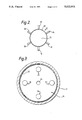
  • FIG. 2 shows to an enlarged scale a view in the direction of arrow A of FIG. 1;
  • FIG. 3 shows a view in the direction of arrow B of FIG. 1,
  • FIG. 4 shows to a reduced scale a line diagram of an electrostatically enhanced solvent extraction column.
  • a heavier phase usually aqueous
  • a funnel-shaped collector 14 In a typical operation, the receptacle 12 is charged to a high potential by means of a DC generator (not shown) and the collector 14 is at earth potential.
  • the receptacle 12 dimensions are not critical but the receptacle 12 is made as small as possible in order to reduce the static hold-up of dispersed phase in the column 10. To this end, the underside 16 of the receptacle 12 may be inwardly dished as shown in order to reduce static hold-up still further.
  • the receptacle 12 has an outer wall 13 supplied with six symmetrically disposed discharge ports in the form of nozzles 18 mounted as close to the bottom of the receptacle 12 as practicable.
  • the receptacle 12 is supported in the column by means of one or more rods of non-conducting material (not shown) and is electrically insulated from all other components of the column 10.
  • the collector 14 is similarly supported unless the column 10 is operated with the collector 14 at earth potential.
  • the collector 14 has a vertical cylindrical wall 20 and a conical base 22 with a central outlet 24 through which the dispersed phase passes to the next receptacle 12 below.
  • the base 22 has four symmetrically disposed radially displaced riser ports 26 through which the (lighter) continuous phase passes upwards through the column 10, the riser ports 26 having conical caps 28 defining gaps 29 in order to inhibit dispersed phase passing downwards through the riser ports 26 and thereby bypassing the receptacle 12 beneath.
  • the diameter of the collector wall 20 is made such that it fits snugly within the column 10.
  • the column 10 may be constructed by stacking a series arrangement of receptacles 12 and collectors 14.
  • receptacles 12 identified as (1), (3) and (5) are positively charged whilst receptacles 12 (2), (4) and (6) are negatively charged with respect to earth potential.
  • All the collectors 14 identified as (1)-(6) are earthed. This arrangement has the advantage that since all the collectors 14 are earthed they need not be electrically insulated from the column 10. Furthermore the heavy phase leaving the bottom of the column 10 is electrically neutral. It is however possible to operate with alternative circuits and, as an example, all receptacles 12 may be positively charged whilst all collectors 14 are negatively charged.
  • the conducting heavy phase (usually aqueous in practice) is fed to the top of the column 10 and enters receptacle 12 (1).
  • the heavy phase flows through the charged nozzles 18 and issues as a charged spray of very small droplets of heavy phase. These droplets are attracted to the earthed collector 14 where they coalesce on the wall 20 and then flow by gravity down through the outlet 24 to the next receptacle 12 below where the entire process is repeated.
  • the heavy coalesced phase leaves the collector 14 (6) and forms an interface 32 at the bottom of the column 10 from where it is withdrawn.
  • the heavy coalesced phase could, in principle, be withdrawn directly from collector 14 (6) but by allowing it to flow to the bottom of the column 10 a small volume of column 10 is created for the introduction and distribution of the light continuous phase. The latter then rises up the column 10, passing through the riser ports 26 in each collector 14 on the way, and is withdrawn at the top of the column 10.
  • the more important mode of transfer is that involving the droplet spray since in this case not only are the droplets oscillating because of the electrical charge that they carry but their interfacial area is also very high.
  • the characteristics of the droplets, including their mean size, is controlled not by the nozzle 18 diameter but by the voltage applied to the nozzles 18.
  • the important parameter is the electrical field strength between the tip of each nozzle 18 and the wall 20 of the collector 14.
  • the distance between the tip of each nozzle 18 and the wall 20 is denoted by L. If V volts are applied to the nozzles 18, the field strength E is given by V/L. When E is less than 1 kV/cm, droplets form separately at the nozzles 18 although they are smaller than would be the case if no field were applied. When E is equal to 1.5 kV/cm or greater, myriads of very small droplets issue from the nozzles 18 and it is in this "spray" regime that the column 10 should operate.
  • the invention is thus very economical in terms of energy utilisation. It should also be noted that the droplet size is independent of the nozzle 18 diameter in the spray regime. This is an important feature when extraction of liquors containing suspended solids is contemplated, such as biological broths which may contain cell fragments or other lysis products. In such situations, the nozzle 18 diameter may be made sufficiently large to avoid blocking without impairing the very small droplet size range needed to maintain a high interfacial area of contact. In principle the invention may be used in co-current as well as in counter-current flows through a solvent extraction column.
  • the number of nozzles 18 may be selected to provide a required discharge of charged droplets towards the wall 20. There may be fewer or more than the six shown in FIG. 2. Although the nozzles 18 have been shown as aligned normal to the longitudinal axis of the column 10, if desired the nozzles 18 may be aligned at alternative angles.
  • the number of riser ports 26 is selected to provide the required flow of the continuous phase, and may be fewer or more than the four shown in FIG. 3.

Landscapes

  • Chemical & Material Sciences (AREA)
  • Chemical Kinetics & Catalysis (AREA)
  • Extraction Or Liquid Replacement (AREA)
  • Physical Or Chemical Processes And Apparatus (AREA)

Abstract

A solvent extraction column in which a disperse phase in the form of electrostatically charged droplets contacts a fluid continuous phase. The disperse phase is received in a number of trays having radial nozzles, so that the disperse phase is discharged from the nozzles as charged droplets transverse to the general direction of flow in the column when an electric potential is applied between the trays and the column.

Description

This invention relates to enhanced solvent extraction, and in particular to a method and an apparatus for electrostatically enhanced solvent extraction.
In known electrostatic solvent extraction cells, relatively high extraction rates can be obtained if the dispersed phase is charged electrically by passing it through charged nozzles, and then subsequently accelerating the charged dispersed phase droplets in an electrical field. This procedure not only gives rise to very small drops (and hence a large interfacial area for mass transfer) but also involves very short contact times by virtue of the high drop velocity. The process is thus ideally suited to the extraction of labile and unstable materials, frequently of biological origin.
UK Patent 1205562 envisaged a column comprising a number of stacked sieve plates and a bank of nozzles which are in communication with an inlet for the dispersed phase. The nozzles are arranged to discharge longitudinally along the column, and when a potential is applied to the nozzles, charged droplets of the dispersed phase are discharged longitudinally towards the plates. This arrangement works well on the small scale but becomes progressively less efficient with scale-up due to the fact that the inner nozzles in the bank tend to be shielded electrostatically by the outer ones and therefore carry a smaller charge. As a consequence, only the outer nozzles produce the very small droplets required whilst the inner nozzles give rise to larger droplets having a lower specific area for mass transfer. Furthermore, since the larger droplets are not so highly charged, they are incapable of being accelerated to high velocities and so the advantage of low contact times is lost.
According to one aspect of the present invention, there is provided a method of electrostatically enhanced solvent extraction in which a dispersed phase interacts with a continuous liquid phase flowing through a column in counter-current relationship, wherein the improvement comprises locating interacting means in the column so as to catch the dispersed phase flowing in the column and so as to define a space at a side of the interacting means between the side and the side of the column and through which space the continuous phase flows, and providing an electric field to cause the discharge of charged droplets of the dispersed phase sideways from the interacting means through the space toward the side of the column.
According to another aspect, the invention provides apparatus for electrostatically enhanced solvent extraction comprising a column in which a continuous phase is arranged to flow therethrough in counter-current relationship with a dispersed phase, wherein the improvement comprises, means for catching a dispersed phase flowing through the column and for interacting the dispersed phase with the continuous phase, the interacting means being located in the column to define a space at a side thereof between the side and the side of the column and through which space the continuous phase is arranged to flow, and means for providing an electric field to cause the discharge of charged droplets of the dispersed phase sideways from the interacting means through the space toward the side of the column.
In a further aspect, the invention provides apparatus for electrostatically enhanced solvent extraction, the apparatus comprising a column for the counter-current flow of a continuous phase and a dispersed phase therethrough, one or a plurality of inlets for the introduction of the dispersed phase into the column to contact the continuous phase, at least one receptacle at an intermediate location in the column for catching the dispersed phase flowing through the column, the receptacle having side walls, an open top, and a closed base, the receptacle being located to define a space at the side thereof between the side of the receptacle and the column and through which space the continuous phase is arranged to flow, the receptacle having a plurality of discharge ports extending through the side walls and arranged to discharge the dispersed phase through the side walls and through the space toward the side of the column, and means for applying an electric potential to the receptacle to cause the discharge of charged droplets of the dispersed phase through the discharge ports.
Preferably, the cell comprises a column with the discharge ports being arranged to discharge droplets towards the side of the column.
Desirably, the flow of the continuous phase is biased away from the centre of the column so as to enhance the interaction of the continuous phase with the charged droplets.
Advantageously, the electric field strength applied to the receptacle is at least 1.5 kV/cm. Preferably a collector is disposed below the receptacle, the collector having radially disposed riser ports for the upward flow of the continuous phase therethrough, and a central outlet for the downward flow of dispersed phase therethrough. Conveniently the collector has a side wall that extends to at least the same height as the discharge ports in the cell, and the electric potential is applied between the discharge ports and the side wall.
Advantageously, the base of the collector is of frusto-conical form to bias the flow of the dispersed phase towards the central outlet, and bias the flow of the continuous phase towards the ports.
Preferably, a plurality of receptacles and collectors are located in series in the cell, and alternate receptacles may be oppositely charged. Conveniently, the collectors may be at earth potential.
Use of the invention overcomes the aforementioned problem by arranging nozzles in such a manner that no matter how many nozzles are employed, electrostatic shielding is avoided and all the nozzles can carry the same charge. This arrangement enables large diameter electrostatic solvent extraction columns to be envisaged and so opens the way to the exploitation of electrostatically enhanced solvent extraction on an industrial scale.
The invention will now be further described by way of example only with reference to the accompanying drawings, in which:
FIG. 1 shows a diagrammatic medial sectional view of part of an electrostatically enhanced solvent extraction column;
FIG. 2 shows to an enlarged scale a view in the direction of arrow A of FIG. 1;
FIG. 3 shows a view in the direction of arrow B of FIG. 1, and
FIG. 4 shows to a reduced scale a line diagram of an electrostatically enhanced solvent extraction column.
Referring now to FIG. 1 and FIG. 2, part of a solvent extraction column 10 of hollow cylindrical form is shown, and it is assumed that a heavier phase (usually aqueous) is dispersed and therefore moves down the column 10. In the column 10 a shallow receptacle 12 is surrounded by a funnel-shaped collector 14. In a typical operation, the receptacle 12 is charged to a high potential by means of a DC generator (not shown) and the collector 14 is at earth potential.
The receptacle 12 dimensions are not critical but the receptacle 12 is made as small as possible in order to reduce the static hold-up of dispersed phase in the column 10. To this end, the underside 16 of the receptacle 12 may be inwardly dished as shown in order to reduce static hold-up still further. The receptacle 12 has an outer wall 13 supplied with six symmetrically disposed discharge ports in the form of nozzles 18 mounted as close to the bottom of the receptacle 12 as practicable.
The receptacle 12 is supported in the column by means of one or more rods of non-conducting material (not shown) and is electrically insulated from all other components of the column 10. The collector 14 is similarly supported unless the column 10 is operated with the collector 14 at earth potential.
Referring now to FIG. 1 and FIG. 3, the collector 14 has a vertical cylindrical wall 20 and a conical base 22 with a central outlet 24 through which the dispersed phase passes to the next receptacle 12 below. The base 22 has four symmetrically disposed radially displaced riser ports 26 through which the (lighter) continuous phase passes upwards through the column 10, the riser ports 26 having conical caps 28 defining gaps 29 in order to inhibit dispersed phase passing downwards through the riser ports 26 and thereby bypassing the receptacle 12 beneath. The diameter of the collector wall 20 is made such that it fits snugly within the column 10.
As shown in FIG. 4, the column 10 may be constructed by stacking a series arrangement of receptacles 12 and collectors 14.
In one method of operation receptacles 12 identified as (1), (3) and (5) are positively charged whilst receptacles 12 (2), (4) and (6) are negatively charged with respect to earth potential. All the collectors 14 identified as (1)-(6) are earthed. This arrangement has the advantage that since all the collectors 14 are earthed they need not be electrically insulated from the column 10. Furthermore the heavy phase leaving the bottom of the column 10 is electrically neutral. It is however possible to operate with alternative circuits and, as an example, all receptacles 12 may be positively charged whilst all collectors 14 are negatively charged.
In FIG. 4, the conducting heavy phase (usually aqueous in practice) is fed to the top of the column 10 and enters receptacle 12 (1). The heavy phase flows through the charged nozzles 18 and issues as a charged spray of very small droplets of heavy phase. These droplets are attracted to the earthed collector 14 where they coalesce on the wall 20 and then flow by gravity down through the outlet 24 to the next receptacle 12 below where the entire process is repeated. Finally, the heavy coalesced phase leaves the collector 14 (6) and forms an interface 32 at the bottom of the column 10 from where it is withdrawn. The heavy coalesced phase could, in principle, be withdrawn directly from collector 14 (6) but by allowing it to flow to the bottom of the column 10 a small volume of column 10 is created for the introduction and distribution of the light continuous phase. The latter then rises up the column 10, passing through the riser ports 26 in each collector 14 on the way, and is withdrawn at the top of the column 10.
Contact between the two phases is effected in two different ways. Thus the rising continuous phase encounters the fine spray of dispersed phase droplets leaving each nozzle 18 and at the same time contacts the falling film of dispersed phase on the wall 20 of each collector 14. The overall mechanism of mass transfer is therefore a combination of cross-flow and countercurrent transfer.
By far the more important mode of transfer is that involving the droplet spray since in this case not only are the droplets oscillating because of the electrical charge that they carry but their interfacial area is also very high. The characteristics of the droplets, including their mean size, is controlled not by the nozzle 18 diameter but by the voltage applied to the nozzles 18. The important parameter is the electrical field strength between the tip of each nozzle 18 and the wall 20 of the collector 14.
Referring again to FIG. 1, the distance between the tip of each nozzle 18 and the wall 20 is denoted by L. If V volts are applied to the nozzles 18, the field strength E is given by V/L. When E is less than 1 kV/cm, droplets form separately at the nozzles 18 although they are smaller than would be the case if no field were applied. When E is equal to 1.5 kV/cm or greater, myriads of very small droplets issue from the nozzles 18 and it is in this "spray" regime that the column 10 should operate.
Although relatively high DC voltages may be called for, the current required is very small and only a few watts would be consumed by each receptacle 12. The invention is thus very economical in terms of energy utilisation. It should also be noted that the droplet size is independent of the nozzle 18 diameter in the spray regime. This is an important feature when extraction of liquors containing suspended solids is contemplated, such as biological broths which may contain cell fragments or other lysis products. In such situations, the nozzle 18 diameter may be made sufficiently large to avoid blocking without impairing the very small droplet size range needed to maintain a high interfacial area of contact. In principle the invention may be used in co-current as well as in counter-current flows through a solvent extraction column.
The number of nozzles 18 may be selected to provide a required discharge of charged droplets towards the wall 20. There may be fewer or more than the six shown in FIG. 2. Although the nozzles 18 have been shown as aligned normal to the longitudinal axis of the column 10, if desired the nozzles 18 may be aligned at alternative angles. The number of riser ports 26 is selected to provide the required flow of the continuous phase, and may be fewer or more than the four shown in FIG. 3.
The use of a relatively high wall 20 for the collector 14 has advantages, but if necessary the electric field could be applied between the nozzles 18 and the column 10.

Claims (17)

I claim:
1. A method of electrostatically enhanced solvent extraction in which a dispersed phase interacts with a continuous liquid phase flowing through a column in counter-current relationship, wherein the improvement comprises, locating interacting means in the column so as to catch the dispersed phase flowing in the column and so as to define a space at a side of the interacting means between the side and the side of the column and through which space the continuous phase flows, and providing an electric field to cause the discharge of charged droplets of the dispersed phase sideways from the interacting means through the space toward the side of the column.
2. A method as claimed in claim 1, wherein the dispersed phase passes through a plurality of said interacting means and electric fields.
3. A method as claimed in claim 2, wherein alternate said electric fields are of opposite polarity.
4. A method as claimed in claim 2, wherein all said electric fields are of the same polarity.
5. A method as claimed in claim 1, wherein the droplets are discharged in a direction substantially normal to the general direction of flow of the dispersed phase.
6. A method as claimed in claim 1, wherein the electric field is at least 1.5 kv/cm.
7. Apparatus for electrostatically enhanced solvent extraction comprising a column in which a continuous phase is arranged to flow therethrough in counter-current relationship with a dispersed phase, wherein the improvement comprises, means for catching a dispersed phase flowing through the column and for interacting the dispersed phase with the continuous phase, the interacting means being located in the column to define a space at a side thereof between the side and the side of the column and through which space the continuous phase is arranged to flow, and means for providing an electric field to cause the discharge of charged droplets of the dispersed phase sideways from the interacting means through the space towards the side of the column.
8. Apparatus for electrostatically enhanced solvent extraction, the apparatus comprising a column for the counter-current flow of a continuous phase and a dispersed phase therethrough, one or a plurality of inlets for the introduction of the dispersed phase into the column to contact the continuous phase, at least one receptacle at an intermediate location in the column for catching the dispersed phase flowing through the column, the receptacle having side walls, an open top, and a closed base, the receptacle being located to define a space at the side thereof between the side of the receptacle and the column and through which space the continuous phase is arranged to flow, the receptacle having a plurality of discharge ports extending through the side walls and arranged to discharge the dispersed phase through the side walls and through the space towards the side of the column, and means for applying an electric potential to the receptacle to cause the discharge of charged droplets of the dispersed phase through the discharge ports.
9. Apparatus as claimed in claim 8 wherein the space defined is substantially annular.
10. Apparatus as claimed in claim 8, wherein the base of the receptacle is inwardly dished.
11. Apparatus as claimed in claim 8, wherein a collector is disposed below the receptacle, the collector having radially disposed riser ports for the upward flow of the continuous phase therethrough, and a central outlet for the downward flow of dispersed phase therethrough.
12. Apparatus as claimed in claim 11, wherein the collector has a side wall that extends to at least the same height in the column as the discharge ports, and the electric potential is between the discharge ports and the side wall.
13. Apparatus as claimed in claim 11, wherein the base of the collector is of frusto-conical form to bias the flow of the dispersed phase towards the central outlet, and bias the flow of the continuous phase towards the ports.
14. Apparatus as claimed in claim 11, wherein a plurality of receptacles and collectors are located in series in the cell.
15. Apparatus as claimed in claim 14, wherein the electrical potential means is arranged to apply opposite polarity electric potentials to alternate receptacles.
16. Apparatus as claimed in claim 14, wherein the electrical potential means is arranged to apply the same polarity electric potential to all the receptacles.
17. Apparatus as claimed in claim 8, wherein the electric potential means is adapted to apply at least 1.5 kv/cm.
US07/386,117 1988-08-15 1989-07-28 Method of electrostatically enhanced solvent extraction and apparatus therefor Expired - Fee Related US5022973A (en)

Applications Claiming Priority (2)

Application Number Priority Date Filing Date Title
GB888819378A GB8819378D0 (en) 1988-08-15 1988-08-15 Enhanced solvent extraction
GB8819378 1988-08-15

Publications (1)

Publication Number Publication Date
US5022973A true US5022973A (en) 1991-06-11

Family

ID=10642156

Family Applications (1)

Application Number Title Priority Date Filing Date
US07/386,117 Expired - Fee Related US5022973A (en) 1988-08-15 1989-07-28 Method of electrostatically enhanced solvent extraction and apparatus therefor

Country Status (6)

Country Link
US (1) US5022973A (en)
EP (1) EP0356030B1 (en)
JP (1) JPH02164403A (en)
CN (1) CN1040511A (en)
DE (1) DE68909864T2 (en)
GB (1) GB8819378D0 (en)

Cited By (1)

* Cited by examiner, † Cited by third party
Publication number Priority date Publication date Assignee Title
US5421972A (en) * 1992-10-19 1995-06-06 National Tank Company & Catalytic Distillation Technologies Process and apparatus for removing soluble contaminants from hydrocarbon streams

Families Citing this family (3)

* Cited by examiner, † Cited by third party
Publication number Priority date Publication date Assignee Title
DE102014105149B4 (en) * 2014-04-11 2018-01-25 Netzsch-Feinmahltechnik Gmbh Shaft bushing
CN104225955B (en) * 2014-09-01 2016-06-22 宁波海越新材料有限公司 Carbon four separating methanol technique after ether
US12364934B2 (en) 2022-03-17 2025-07-22 BG Braingate Technology GmbH Device and method for the extraction of one or more components, in particular cannabinoids such as tetrahydrocannabinol from a mixture of substances

Citations (9)

* Cited by examiner, † Cited by third party
Publication number Priority date Publication date Assignee Title
DE858691C (en) * 1951-02-20 1952-12-08 Metallgesellschaft Ag Electrostatic precipitators, in particular for separating emulsions
US2794711A (en) * 1955-11-17 1957-06-04 Exxon Research Engineering Co Liquid-liquid countercurrent contacting device
US3488159A (en) * 1969-05-06 1970-01-06 Atomic Energy Commission Jet-pulsed liquid-liquid extraction column
GB1205562A (en) * 1966-06-29 1970-09-16 Nat Res Dev Liquid/fluid extraction process
US4204934A (en) * 1978-04-03 1980-05-27 Combustion Engineering, Inc. Process for application of electrostatic fields to mixing and separating fluids
US4237028A (en) * 1977-09-08 1980-12-02 National Research Development Corporation Apparatus for producing emulsions
EP0020049A1 (en) * 1979-05-22 1980-12-10 Secretary of State for Industry in Her Britannic Majesty's Gov. of the United Kingdom of Great Britain and Northern Ireland Apparatus and method for the electrostatic dispersion of liquids
EP0057324A1 (en) * 1981-01-30 1982-08-11 Imperial Chemical Industries Plc Process of spraying emulsions and apparatus thereof
US4702815A (en) * 1986-05-05 1987-10-27 National Tank Company Distributed charge composition electrodes and desalting system

Patent Citations (9)

* Cited by examiner, † Cited by third party
Publication number Priority date Publication date Assignee Title
DE858691C (en) * 1951-02-20 1952-12-08 Metallgesellschaft Ag Electrostatic precipitators, in particular for separating emulsions
US2794711A (en) * 1955-11-17 1957-06-04 Exxon Research Engineering Co Liquid-liquid countercurrent contacting device
GB1205562A (en) * 1966-06-29 1970-09-16 Nat Res Dev Liquid/fluid extraction process
US3488159A (en) * 1969-05-06 1970-01-06 Atomic Energy Commission Jet-pulsed liquid-liquid extraction column
US4237028A (en) * 1977-09-08 1980-12-02 National Research Development Corporation Apparatus for producing emulsions
US4204934A (en) * 1978-04-03 1980-05-27 Combustion Engineering, Inc. Process for application of electrostatic fields to mixing and separating fluids
EP0020049A1 (en) * 1979-05-22 1980-12-10 Secretary of State for Industry in Her Britannic Majesty's Gov. of the United Kingdom of Great Britain and Northern Ireland Apparatus and method for the electrostatic dispersion of liquids
EP0057324A1 (en) * 1981-01-30 1982-08-11 Imperial Chemical Industries Plc Process of spraying emulsions and apparatus thereof
US4702815A (en) * 1986-05-05 1987-10-27 National Tank Company Distributed charge composition electrodes and desalting system

Non-Patent Citations (2)

* Cited by examiner, † Cited by third party
Title
J. D. Thornton, "Electrically Enhanced Liquid-Liquid Extraction", Birmingham University Chemical Engineer; vol. 27, No. 1, Spring, 1976, pp. 6--13.
J. D. Thornton, Electrically Enhanced Liquid Liquid Extraction , Birmingham University Chemical Engineer; vol. 27, No. 1, Spring, 1976, pp. 6 13. *

Cited By (1)

* Cited by examiner, † Cited by third party
Publication number Priority date Publication date Assignee Title
US5421972A (en) * 1992-10-19 1995-06-06 National Tank Company & Catalytic Distillation Technologies Process and apparatus for removing soluble contaminants from hydrocarbon streams

Also Published As

Publication number Publication date
GB8819378D0 (en) 1988-09-14
EP0356030A2 (en) 1990-02-28
JPH02164403A (en) 1990-06-25
EP0356030A3 (en) 1990-09-05
DE68909864T2 (en) 1994-04-28
EP0356030B1 (en) 1993-10-13
DE68909864D1 (en) 1993-11-18
CN1040511A (en) 1990-03-21

Similar Documents

Publication Publication Date Title
US5262027A (en) Method of using an electric field controlled emulsion phase contactor
KR890002142B1 (en) Apparatus for separating oilfieid emulsions
US4941959A (en) Electric field-driven, magnetically-stabilized ferro-emulsion phase contactor
US4767515A (en) Surface area generation and droplet size control in solvent extraction systems utilizing high intensity electric fields
US4193774A (en) Electrostatic aerosol scrubber and method of operation
Ptasinski et al. Electric field driven separations: phenomena and applications
US3412002A (en) Apparatus and method for electrophoretic breaking of emulsions
JPS6260927B2 (en)
US4196168A (en) Sloped tray arrangement for polymerization reactor
US11299682B2 (en) Systems and methods for crude oil desalting and dehydration in a single vessel
US3527617A (en) Electrolytic cyclone separator and cell
US3915858A (en) Device for the separation of two liquids
EP1476236A1 (en) Apparatus and method for treating a fluid
US5022973A (en) Method of electrostatically enhanced solvent extraction and apparatus therefor
US3218781A (en) Electrostatic apparatus for removal of dust particles from a gas stream
US3401795A (en) Fluidized bed and electrostatic field type separator
JPH01159068A (en) Apparatus for insulating spray liquid source from high voltage of electrostatic spray apparatus in use of conductive spray liquid
US4581119A (en) Apparatus for separating a dispersed liquid phase from a continuous liquid phase by electrostatic coalescence
JP2012507598A (en) Removal of glycerin from biodiesel using an electrostatic process
US4588563A (en) Cascade sieve tray for extraction and deasphalting
US4541724A (en) Apparatus for counter-current contact of fluids
US5421972A (en) Process and apparatus for removing soluble contaminants from hydrocarbon streams
EP0159909B1 (en) Charging a dispersed phase-laden fluid
US4624764A (en) Separation of dispersed phase from continuous fluid phase
US3205160A (en) Electric treater for dispersions

Legal Events

Date Code Title Description
AS Assignment

Owner name: UNITED KINGDOM ATOMIC ENERGY AUTHORITY, 11 CHARLES

Free format text: ASSIGNMENT OF ASSIGNORS INTEREST.;ASSIGNOR:THORNTON, JOHN D.;REEL/FRAME:005104/0491

Effective date: 19890718

Owner name: UNITED KINGDOM ATOMIC ENERGY AUTHORITY,UNITED KING

Free format text: ASSIGNMENT OF ASSIGNORS INTEREST;ASSIGNOR:THORNTON, JOHN D.;REEL/FRAME:005104/0491

Effective date: 19890718

FEPP Fee payment procedure

Free format text: PAYOR NUMBER ASSIGNED (ORIGINAL EVENT CODE: ASPN); ENTITY STATUS OF PATENT OWNER: LARGE ENTITY

REMI Maintenance fee reminder mailed
LAPS Lapse for failure to pay maintenance fees
FP Lapsed due to failure to pay maintenance fee

Effective date: 19950614

STCH Information on status: patent discontinuation

Free format text: PATENT EXPIRED DUE TO NONPAYMENT OF MAINTENANCE FEES UNDER 37 CFR 1.362