US5022266A - Passive acoustics process to monitor fluidized bed flow - Google Patents
Passive acoustics process to monitor fluidized bed flow Download PDFInfo
- Publication number
- US5022266A US5022266A US07/318,102 US31810289A US5022266A US 5022266 A US5022266 A US 5022266A US 31810289 A US31810289 A US 31810289A US 5022266 A US5022266 A US 5022266A
- Authority
- US
- United States
- Prior art keywords
- flow
- power spectrum
- bed
- positions
- wall
- Prior art date
- Legal status (The legal status is an assumption and is not a legal conclusion. Google has not performed a legal analysis and makes no representation as to the accuracy of the status listed.)
- Expired - Lifetime
Links
Images


Classifications
-
- B—PERFORMING OPERATIONS; TRANSPORTING
- B01—PHYSICAL OR CHEMICAL PROCESSES OR APPARATUS IN GENERAL
- B01J—CHEMICAL OR PHYSICAL PROCESSES, e.g. CATALYSIS OR COLLOID CHEMISTRY; THEIR RELEVANT APPARATUS
- B01J8/00—Chemical or physical processes in general, conducted in the presence of fluids and solid particles; Apparatus for such processes
- B01J8/18—Chemical or physical processes in general, conducted in the presence of fluids and solid particles; Apparatus for such processes with fluidised particles
- B01J8/1809—Controlling processes
-
- G—PHYSICS
- G01—MEASURING; TESTING
- G01N—INVESTIGATING OR ANALYSING MATERIALS BY DETERMINING THEIR CHEMICAL OR PHYSICAL PROPERTIES
- G01N29/00—Investigating or analysing materials by the use of ultrasonic, sonic or infrasonic waves; Visualisation of the interior of objects by transmitting ultrasonic or sonic waves through the object
- G01N29/14—Investigating or analysing materials by the use of ultrasonic, sonic or infrasonic waves; Visualisation of the interior of objects by transmitting ultrasonic or sonic waves through the object using acoustic emission techniques
-
- B—PERFORMING OPERATIONS; TRANSPORTING
- B01—PHYSICAL OR CHEMICAL PROCESSES OR APPARATUS IN GENERAL
- B01J—CHEMICAL OR PHYSICAL PROCESSES, e.g. CATALYSIS OR COLLOID CHEMISTRY; THEIR RELEVANT APPARATUS
- B01J2208/00—Processes carried out in the presence of solid particles; Reactors therefor
- B01J2208/00008—Controlling the process
- B01J2208/00017—Controlling the temperature
- B01J2208/00026—Controlling or regulating the heat exchange system
- B01J2208/00035—Controlling or regulating the heat exchange system involving measured parameters
-
- G—PHYSICS
- G01—MEASURING; TESTING
- G01N—INVESTIGATING OR ANALYSING MATERIALS BY DETERMINING THEIR CHEMICAL OR PHYSICAL PROPERTIES
- G01N2291/00—Indexing codes associated with group G01N29/00
- G01N2291/02—Indexing codes associated with the analysed material
- G01N2291/024—Mixtures
- G01N2291/02408—Solids in gases, e.g. particle suspensions
-
- G—PHYSICS
- G01—MEASURING; TESTING
- G01N—INVESTIGATING OR ANALYSING MATERIALS BY DETERMINING THEIR CHEMICAL OR PHYSICAL PROPERTIES
- G01N2291/00—Indexing codes associated with group G01N29/00
- G01N2291/02—Indexing codes associated with the analysed material
- G01N2291/024—Mixtures
- G01N2291/02416—Solids in liquids
-
- G—PHYSICS
- G01—MEASURING; TESTING
- G01N—INVESTIGATING OR ANALYSING MATERIALS BY DETERMINING THEIR CHEMICAL OR PHYSICAL PROPERTIES
- G01N2291/00—Indexing codes associated with group G01N29/00
- G01N2291/02—Indexing codes associated with the analysed material
- G01N2291/028—Material parameters
- G01N2291/02818—Density, viscosity
-
- G—PHYSICS
- G01—MEASURING; TESTING
- G01N—INVESTIGATING OR ANALYSING MATERIALS BY DETERMINING THEIR CHEMICAL OR PHYSICAL PROPERTIES
- G01N2291/00—Indexing codes associated with group G01N29/00
- G01N2291/02—Indexing codes associated with the analysed material
- G01N2291/028—Material parameters
- G01N2291/02836—Flow rate, liquid level
-
- G—PHYSICS
- G01—MEASURING; TESTING
- G01N—INVESTIGATING OR ANALYSING MATERIALS BY DETERMINING THEIR CHEMICAL OR PHYSICAL PROPERTIES
- G01N2291/00—Indexing codes associated with group G01N29/00
- G01N2291/04—Wave modes and trajectories
- G01N2291/042—Wave modes
- G01N2291/0421—Longitudinal waves
Definitions
- a fluidized bed is a suspension of solid particles in a stream of gas or liquid of sufficient velocity to support the particle by flow forces against the downward force of gravity
- Fluidized beds are critical components of important petrochemical processing units such as the catalytic cracking ("cat-cracking") of petroleum on catalytic particles to produce lighter and more valuable products as well as thermal cracking of heavy feeds on coke particles ("fluid bed cokers” or “flexi-cokers”) to again produce lighter and more valuable feeds
- cat-cracking the regenerator where coke is burned off the catalyst to produce "fresh catalyst” contains a fluidized bed
- the particles in the fluidized bed within the regenerator are approximately 60 micron diameter pellets of a zeolite.
- fluidized beds can be found in the heater, reactor and in the case of flexi-coking, the gasifier.
- the particles in this case are approximately 100 to 150 micron particles of coke.
- fluidized beds containing small solids suspended in a gas include advanced coal combustion units where small particles of coal are suspended and burned to produce heat with minimum pollution and maximum efficiency.
- Yet another example is found in separation processes in the chemical industry where a fine suspension of particles is suspended in a flowing liquid.
- fluidized beds are used in many large scale processes where it is desired to maximize the interaction between the surface of a particle and a surrounding gas or liquid.
- Fluidized beds can contain volume mass densities for the case of fluid bed cokers and regenerators of the order of 40 pounds per cubic foot and particle velocities of several feet per second. Fluidized beds of the order of 10 to 50 feet in diameter are found in coking and cat cracking. With bed heights of the order of 10 to 60 feet the contained fluids range from less than a hundred to more than a thousand tons of particles.
- Geldart Wood (Wiley 1986) is a review of the technology.
- the material within the fluidized bed is at an elevated temperature
- the vessel will often be lined by several inches of refractory. Direct access to the contained particles is thus very difficult. This difficulty is compounded when heavy petroleum feed is being injected into the fluidized bed as in the case of cokers and cat-crackers. Under these circumstances the interior of the fluidized bed can foul any window or probe if special precautions are not taken.
- Monitoring the flow condition in the fluidized bed is usually limited to static pressure measurements and inferred flow data derived from such measurements.
- Special precautions to avoid fouling include use of an inert gas to maintain openings in such static pressure measurements and eliminating the pressure drop of the inert gas through a "pressure bridge". While pressure measurements can suggest flow maldistribution within the vessel containing the fluidized bed, they rarely (if at all) pinpoint the region of flow maldistribution.
- Flow maldistribution within a fluidized bed can arise from a variety of causes.
- the bed is "slumped" in one region of the reactor, greatly reducing the efficiency of the chemical process going on within the fluidized bed.
- fluidization gas can be channeled to the other side of the reactor, leading to regions of flow turbulence.
- excessive attrition of the particles within the fluidized bed can occur leading to an excessive number of fines emitted into the gaseous product of the reactor or into the atmosphere.
- Another example is where a critical element of the flow distribution within a fluidized bed is damaged.
- flow within the bed is dominated by gas and particle flow through a grid forming the bottom of the dense phase of the bed.
- holes in the grid can become blocked, leading to regions of bed slump.
- Other possibilities include damage to the support structure of the grid due to the large forces exerted by gas pressure across the blocked grid. Under these circumstances a large quantity of a chemically reacting gas may bubble through the bed destroying the uniformity of the process and leading to serious problems in the temperature distribution across the fluidized bed.
- One example is the use of gamma rays or neutrons to determine the mass density of particles within the vessel. This technique can only be used if the walls and/or diameter of the vessel are less than a critical value since the technique is based on deriving the density from absorption. Too large a vessel diameter, or too thick a wall drops the detected signal below the level of background noise and the mass density cannot be determined.
- Non-intrusive probes that can be used to monitor the flow state of experimental fluidized beds would also be of great value in complementing visual, radiographic and radioactive tracer studies of flow in order to improve or modify existing designs, or for pilot plant studies
- a current review of a wide variety of electrical, optical, thermal and mechanical technology for studying the hydrodynamics of experimental gas-solid fluidized beds is contained in a recent review by N. P. Cheremisonoff (Ind Eng. Chem Process Dev. 25, 329-351 (1986)).
- the r®view presents techniques that are "best suited for laboratory-scale systems, [although]adaption to industrial pilot facilities and/or commercial units is possible in some cases".
- examination of the presented techniques suggest they suffer from the usual disadvantages of being intrusive, easily contaminated by the process or as in the case of so many of the radioactive techniques severely restricted by environmental or safety considerations.
- the present invention is a method for the non-intrusive determination of flow anisotropy through the cross-section of a two phase fluid bed in a structure for processing material (hereinafter referred to as a "reactor").
- the method includes the steps of measuring reactor wall vibrations of the reactor and then determining the power spectrum as a function of frequency.
- the wall vibrations are taken at several (first) positions circumferentially about the reactor and the area of the power spectrum under a resonance peak is determined for each of the positions. Then a change in the area of the power spectrum is correlated with a change in flow distribution.
- the method may be extended to determine flow anisotropy in the vertical direction by performing the additional steps of measuring reactor wall vibrations of the reactor and then determining the power spectrum as a function of frequency, the wall vibrations taken at several second positions circumferentially about the reactor, the second positions spaced vertically from the first positions about the reactor, determining the area of the power spectrum under a resonance peak for each of the second positions, and comparing a change in the area of the power spectrum between adjacent first positions with the change between the area of the power spectrum between corresponding second positions and correlating difference between the changes in the area of the power spectrum with a change in bed density.
- the non-intrusive method tolerates the presence of internal refractory in the vessel containing the fluidized bed and can operate over wide extremes of temperature. It can be clearly distinguished from all active acoustic techniques and has a wider breadth of applications.
- the process can be described as a "passive" process since the desired information is obtained from processing vibrational or solid borne sound produced by the process itself.
- FIG. 1 shows a schematic of a fluidized bed in a reactor indicating dense and dilute phase region of bed.
- FIG. 2A shows a schematic of fluid bed reactor indicating location of accelerometers in horizontal plane to measure flow maldistribution within the fluidized bed.
- FIG. 2B shows a schematic of fluid bed reactor indicating location of accelerometers along the vertical to measure flow maldistribution within the fluidized bed.
- FIGS. 3A, 3B and 3C show a schematic illustration of some flow maldistributions compared to normal flow that can occur in fluidized beds: FIG. 3A shows incomplete fluidization in one region of the bed (bed "slump"), FIG. 3B shows normal bubbling in the fluidized bed, and FIG. 3C shows excessive turbulence in the bed arising from poor gas distribution.
- FIG. 4 shows a schematic of the nodes and antinodes of acceleration of a compressional mode wave resonance on a refractory lined wall as well as the coupling between the accelerometer and charge amplifier and the subsequent coupling between the charge amplifier and a signal processor.
- FIGS. 5A, 5B, and 5C illustrate the conversion of a time varying acceleration to a power spectrum:
- FIG. 5(A) shows the signal produced by accelerometer as a function of time
- FIG. 5(B) shows the square of the signal produced by the accelerometer as a function of time and the relationship between the mean square acceleration and the area under the power spectrum
- FIG 5(C) shows the power spectrum as a function of frequency.
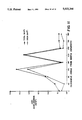
- FIG. 6 shows a typical power spectrum from a refractory lined wall and illustrates the location of peak frequency and peak area.
- FIG. 7 shows the comparison between the response of the wall to hammer excitation and the response of the wall to particle excitation.
- FIG. 8 shows the logarithm of magnitude of the RMS acceleration within the wall resonance on a regenerator as a function of direction about the unit under three different states of flow within the fluidized bed.
- FIG. 9 shows a polar plot of the area of the wall resonance (m/s 2 ) of a coker, under conditions when flow through the sheds was blocked.
- FIG. 10 shows a polar plot of the total RMS acceleration (m/s 2 ) over a 25.6 kHz bandwidth for the same locations shown in FIG. 9.
- FIG. 11 shows the comparison of the area of the power spectrum over the wall resonance and that over a 25.6 kHz band for the measurements shown in FIGS. 9 and 10.
- the present invention is a passive acoustic process to monitor flow distribution in a reactor.
- the process is intended to permit operation of the reactor under conditions that increase yield as well as to identify regions where mechanical lead to flow maldistribution within the bed for subsequent correction.
- FIG. 1 shows a schematic diagram of a fluidized bed showing the dense and dilute phases separated by the splash zone.
- FIGS. 3A, 3B and 3C show a schematic of the various flow states within a fluidized bed.
- FIG. 3A shows incomplete fluidization in one region of the bed (bed "slump")
- FIG. 3B shows normal bubbling in the fluidized bed
- FIG. 3C shows excessive turbulence in the bed arising from poor gas distribution.
- Flow is indicated by the vertical arrows.
- the accelerometers 2 are placed circumferentially and vertically around the reactor vessel as shown in FIG. 2.
- the normal momentum flux of particles to the wall flows through the cross section bounded by that circumference is monitored by the method of the present invention.
- the electrical signal from the accelerometers, proportional to the wall's normal acceleration, is amplified and transmitted either by cable or optical link to a control room, FIG. 4.
- the power spectrum is determined as indicated in FIG. 6. The area under the peak may then be determined and is related to flow anisotropy through the bed of the reactor.
- FIG. 4 shows a schematic diagram of how the measurement of wall acceleration is made.
- a magnetically (or otherwise) attached accelerometer such as a B and K 4384
- This charge is converted by a charge amplifier (such as a B and K 2635) to a voltage output which is again proportional to the normal acceleration of the wall.
- This voltage is processed by a signal processor (B and K 2032 or equivalent) to produce the power spectrum of the acceleration.
- the power spectrum of the acceleration of the wall exhibits a peak located at a frequency corresponding to the wall resonance. Both the frequency of this peak and its area can be determined by a suitable computer algorithm.
- FIG. 5A, 5B and 5C exhibit the relationship between the acceleration and its square as a function of time and as a function of frequency.
- the Power Spectrum for a stationary random function of time displays the mean square acceleration as a function of frequency.
- the area under the Power Spectrum is one half of the mean square acceleration, ⁇ A 2 (T)>.
- FIG. 6 shows a typical power spectrum obtained from an accelerometer placed on a refractory lined wall on a fluid bed regenerator. The frequency and area of the wall resonance is indicated.
- FIG. 4 also illustrates the placement of the accelerometer on the wall of the vessel containing the dense bed, and the spatial variation of the acceleration normal to the wall at the fundamental mode of wall vibration.
- the fundamental mode has a node in the center and an antinode at the two boundaries.
- the frequency of the wall resonance is then simply given by the average compressional sound velocity of the wall divided by twice the thickness of the wall.
- FIG. 4 also illustrates excitation of the wall resonance, namely the impact of the particles to the fluid bed which produces a steady state wall resonance peak in the power spectrum of the accelerometer output.
- FIG. 7 shows how the wall resonance can be explicitly identified by comparison between the response of the wall to hammer excitation and the response of the wall to particle excitation.
- the present invention is a method to monitor flow anisotropy of a two phase fluidized bed by determining the power spectrum of the wall vibrations. Although the method does not depend on any theory, the method may be made plausible by relating the power spectrum to the characteristics of the particles within the unit.
- the use of the area of the localized wall resonance can be used to obtain direct information on the flow immediately adjacent to the wall. It can be shown that the area of the wall resonance, A, is given by
- Eq. (1) the area of the wall resonance A is defined in units of RMS acceleration and is easily obtained by integrating through the wall resonance as displayed in a power spectrum as shown in FIG. 4.
- the quantity K 1 is of the order of 10 to 15 for walls with steel of the order of 0.6 "and refractory of the order of 5".
- the quantity K 1 can be independently determined by hammer excitation or if relative measurements are made, preserved as a constant in the application of Eq. (1).
- the other quantities in Eq. (1) are:
- p B volume density of particles in units of number per cm 3
- M average mass of a particle in units of grams
- V o normal velocity of particles at wall in units of feet per second
- Eq. (1) is derived by considering the impact of solid particles within the two phase medium as the equivalent of a random impact of many hammers. It is the vibrational equivalent to the electrical phenomena of "shot noise”.
- Eq. (1) relates an easily measured quantity, A, to properties of the hydrodynamic state of the two phase fluid adjacent to the wall
- A coupled to the flow state of the two phase fluid within the fluidized bed or transfer line can be used to monitor the flow state in terms of changes in the quantity p B , M and V o .
- Large changes in M are unexpected for many petrochemical processes and a major use of the invention is to monitor p B and V o at various locations in the bed, and through these measurements get information on flow or turbulence within the bed.
- the variation of A from accelerometer to accelerometer supplies information on bed anisotropy such as bed turbulence due to improper distribution of fluidization gas, or regions of bed "slump" through the circumferential variation of [p B (1/CM 3 )V o 3 -(FT/SEC)].
- An important feature of this invention is the ability to place an accelerometer on the steel shell of a refractory lined vessel or pipe and distinguish the wall resonance from other noise peaks and resonances. Distinguishing the wall resonance can be accomplished easily if it is the dominant peak, it falls at the frequency expected from prior knowledge of the thickness of the wall or by the use of hammer excitation. Once the wall resonance is identified in the power spectrum, its area determines the quantity A and can be used, as above to determine certain features of the state of the two phase fluid within the vessel or pipe.
- the constant K 1 can be determined by hammer measurements and the theory.
- locations are marked on the vessel containing the fluidized bed: circumferentially at a constant level from the grid of the bed.
- One or more such horizontal sections are located in the dense phase of the bed below the "bed level”.
- Accelerometers are placed in contact with the locations and mounted either magnetically or bolted to permanent tabs.
- the output of the accelerometer is led to a charge amplifier or other suitable impedance converting and amplifying device.
- the output of the charge amplifier is the input to either a portable signal processor on the platform, or to a recording system and then to a signal processor.
- the area of the wall resonance, A is obtained and its variation with angle at one or more vertical heights above the grid of the fluidized bed.
- FIG. 8 we see the results of a series of circumferential measurements on a fluidized bed regenerator of catalytic cracking unit.
- the regenerator includes a grid bonded to walls of the regenerator.
- the measurements of the area of the wall resonance, A are shown on a polar plot at various times over a period of one year.
- the radius of the polar plot is taken proportional to the logarithm of the quantity A.
- FIG. 8 is easily interpreted in terms of turbulence due to:
- the passive acoustic information was used to pinpoint the location of large gas influx into the bed (see FIG. 2) for correction by torch oil combustion in an interim stage and repair of the mechanical defect during shutdown.
- the large variation in A for the data at time 1 between the northeast and southwest quadrants (a factor of 20) is consistent with Eq. (3) and the large value of V o in a region of turbulence due to excessive gas flow.
- Example shows blocked flow in a fluid bed coker.
- Flow was blocked and information was needed on the region of flow blockage, so that steam lances could be directed to the region in order to clear the obstruction by pulverization.
- FIG. 10 shows a polar plot of the total RMS acceleration (m,s 2 ) over a 25.6 kHz bandwidth for the same locations shown in FIG. 8. This data illustrates the point that under the circumstances when the wall resonance is the dominant contributor to the power spectrum, it is not necessary to use its area to pinpoint the region of low particle activity.
- FIG. 11 shows the comparison of the area of the power spectrum over the wall resonance and that over a 25.6 kHz band for the measurements shown in FIG. 8 and 9.
- the method may be extended to determine flow anisotropy in the vertical direction by determining the power spectrum as a function of frequency for another set of wall vibrations taken at positions circumferentially about the reactor but spaced vertically from the first positions (see FIG. 3).
- the area of the power spectrum under a resonance peak for each of the second measurements is determined.
- the area of the power spectrum between adjacent first measurements is compared with the change between the area of the power spectrum between corresponding adjacent second positions.
- the differences between the changes in the area of the power spectrum correspond to a change in bed density. This follows because the area of the power spectrum, A, depends on both density and velocity. This change in density also indicates bed flow anisotropy.
Landscapes
- Chemical & Material Sciences (AREA)
- Physics & Mathematics (AREA)
- Life Sciences & Earth Sciences (AREA)
- Analytical Chemistry (AREA)
- Chemical Kinetics & Catalysis (AREA)
- Combustion & Propulsion (AREA)
- Acoustics & Sound (AREA)
- Health & Medical Sciences (AREA)
- Engineering & Computer Science (AREA)
- Organic Chemistry (AREA)
- Biochemistry (AREA)
- General Health & Medical Sciences (AREA)
- General Physics & Mathematics (AREA)
- Immunology (AREA)
- Pathology (AREA)
- Devices And Processes Conducted In The Presence Of Fluids And Solid Particles (AREA)
- Monitoring And Testing Of Nuclear Reactors (AREA)
- Investigating Or Analyzing Materials By The Use Of Ultrasonic Waves (AREA)
Abstract
Description
A(M/S.sup.2)=K.sub.1 [p.sub.B (1/CM.sup.3)M.sup.2 (GM) V.sub.o.sup.3 (FT/SEC)].sup.1/2 (1)
p.sub.M =p.sub.B M (2)
A(M/S.sup.2)=K.sub.2 {d(u)}.sup.3/2 [p.sub.M (#/FT.sup.3)].sup.1/2 V.sub.o (FT/SEC).sup.3/2 (3)
Claims (5)
Priority Applications (7)
| Application Number | Priority Date | Filing Date | Title |
|---|---|---|---|
| US07/318,102 US5022266A (en) | 1989-03-02 | 1989-03-02 | Passive acoustics process to monitor fluidized bed flow |
| CA002010453A CA2010453C (en) | 1989-03-02 | 1990-02-20 | Passive acoustics process to monitor fluidized bed flow |
| ES90302219T ES2047256T3 (en) | 1989-03-02 | 1990-03-01 | PASSIVE ACOUSTIC PROCEDURE TO MONITOR FLOW IN A FLUIDIFIED BED. |
| DE69005155T DE69005155T2 (en) | 1989-03-02 | 1990-03-01 | Passive acoustic method for monitoring the flow of a fluidized bed. |
| EP90302219A EP0385789B1 (en) | 1989-03-02 | 1990-03-01 | Passive acoustics process for monitoring fluidized bed flow |
| AU50590/90A AU618662B2 (en) | 1989-03-02 | 1990-03-01 | Passive acoustics process to monitor fluidized bed flow |
| JP2051617A JP2927864B2 (en) | 1989-03-02 | 1990-03-02 | Method for non-invasively measuring flow anisotropy through a two-phase fluidized bed in a structure |
Applications Claiming Priority (1)
| Application Number | Priority Date | Filing Date | Title |
|---|---|---|---|
| US07/318,102 US5022266A (en) | 1989-03-02 | 1989-03-02 | Passive acoustics process to monitor fluidized bed flow |
Publications (1)
| Publication Number | Publication Date |
|---|---|
| US5022266A true US5022266A (en) | 1991-06-11 |
Family
ID=23236661
Family Applications (1)
| Application Number | Title | Priority Date | Filing Date |
|---|---|---|---|
| US07/318,102 Expired - Lifetime US5022266A (en) | 1989-03-02 | 1989-03-02 | Passive acoustics process to monitor fluidized bed flow |
Country Status (7)
| Country | Link |
|---|---|
| US (1) | US5022266A (en) |
| EP (1) | EP0385789B1 (en) |
| JP (1) | JP2927864B2 (en) |
| AU (1) | AU618662B2 (en) |
| CA (1) | CA2010453C (en) |
| DE (1) | DE69005155T2 (en) |
| ES (1) | ES2047256T3 (en) |
Cited By (46)
| Publication number | Priority date | Publication date | Assignee | Title |
|---|---|---|---|---|
| US5551297A (en) * | 1992-12-04 | 1996-09-03 | Sumitomo Chemical Company, Limited | Pipe clogging detecting device |
| US5633462A (en) * | 1994-07-19 | 1997-05-27 | Apa Systems | Method and apparatus for detecting the condition of the flow of liquid metal in and from a teeming vessel |
| EP0781596A2 (en) | 1995-12-22 | 1997-07-02 | Exxon Research And Engineering Company | Passive acoustics process to monitor feed injection lines of a catalytic cracker |
| US5675071A (en) * | 1995-12-22 | 1997-10-07 | Exxon Research & Engineering Company | Passive acoustics process to monitor transfer lines of a reactor |
| US5974887A (en) * | 1997-09-26 | 1999-11-02 | Exxon Research And Engineering Co. | Method for determining operating status of liquid phase gas-phase interaction columns |
| US6460412B1 (en) | 2000-10-27 | 2002-10-08 | Union Carbide Chemicals & Plastics Technology Corporation | Detection of dynamic fluidized bed level in a fluidized bed polymerization reactor using ultrasonic waves or microwaves |
| US20020189358A1 (en) * | 2001-03-08 | 2002-12-19 | Novozymes A/S | Method of analyzing granular composition by acoustic emission |
| US6539805B2 (en) | 1994-07-19 | 2003-04-01 | Vesuvius Crucible Company | Liquid metal flow condition detection |
| US20040154913A1 (en) * | 2001-03-12 | 2004-08-12 | Lah Ruben F. | Valve system and method for unheading a coke drum |
| US20060225514A1 (en) * | 2005-04-07 | 2006-10-12 | Advanced Flow Technologies Inc. | System, method and apparatus for acoustic fluid flow measurement |
| US20070038393A1 (en) * | 2005-08-12 | 2007-02-15 | Frederic Borah | Vibration monitoring |
| US20070215518A1 (en) * | 2004-04-22 | 2007-09-20 | Lah Ruben F | Systems and Methods for Remotely Determining and Changing Cutting Modes During Decoking |
| US20080000298A1 (en) * | 2006-02-28 | 2008-01-03 | Frederic Borah | Vibration Monitoring System |
| CN100406885C (en) * | 2001-03-08 | 2008-07-30 | 诺和酶股份有限公司 | Method for analyzing particle compositions by acoustic emission |
| US7530574B2 (en) | 2003-04-11 | 2009-05-12 | Curtiss-Wright Flow Control Corporation | Dynamic flange seal and sealing system |
| US20090145460A1 (en) * | 2004-04-22 | 2009-06-11 | Lah Ruben F | Remotely Controlled Decoking Tool Used in Coke Cutting Operations |
| US20090183980A1 (en) * | 2008-01-23 | 2009-07-23 | Lah Ruben F | Coke Drum Skirt |
| US20090282910A1 (en) * | 2008-05-13 | 2009-11-19 | Limin Song | Method for measuring reactor bed level from active acoustic measurement and analysis |
| US20100252409A1 (en) * | 2009-02-11 | 2010-10-07 | Lah Ruben F | Center Feed System |
| US20110083747A1 (en) * | 2009-03-23 | 2011-04-14 | Christopher Orino | Non-Rising Electric Actuated Valve Operator |
| US7931044B2 (en) | 2006-03-09 | 2011-04-26 | Curtiss-Wright Flow Control Corporation | Valve body and condensate holding tank flushing systems and methods |
| US8123197B2 (en) | 2001-03-12 | 2012-02-28 | Curtiss-Wright Flow Control Corporation | Ethylene production isolation valve systems |
| US8440057B2 (en) | 2008-01-23 | 2013-05-14 | Curtiss-Wright Flow Control Corporation | Linked coke drum support |
| US8459608B2 (en) | 2009-07-31 | 2013-06-11 | Curtiss-Wright Flow Control Corporation | Seat and valve systems for use in delayed coker system |
| US8679298B2 (en) | 2004-04-22 | 2014-03-25 | Curtiss-Wright Flow Control Corporation | Remotely controlled decoking tool used in coke cutting operations |
| US8702911B2 (en) | 2003-02-21 | 2014-04-22 | Curtiss-Wright Flow Control Corporation | Center feed system |
| US10239034B2 (en) | 2009-02-06 | 2019-03-26 | Marathon Petroleum Company Lp | FCC cyclone using acoustic detectors |
| US11802257B2 (en) | 2022-01-31 | 2023-10-31 | Marathon Petroleum Company Lp | Systems and methods for reducing rendered fats pour point |
| US11860069B2 (en) | 2021-02-25 | 2024-01-02 | Marathon Petroleum Company Lp | Methods and assemblies for determining and using standardized spectral responses for calibration of spectroscopic analyzers |
| US11891581B2 (en) | 2017-09-29 | 2024-02-06 | Marathon Petroleum Company Lp | Tower bottoms coke catching device |
| US11898109B2 (en) | 2021-02-25 | 2024-02-13 | Marathon Petroleum Company Lp | Assemblies and methods for enhancing control of hydrotreating and fluid catalytic cracking (FCC) processes using spectroscopic analyzers |
| US11905468B2 (en) | 2021-02-25 | 2024-02-20 | Marathon Petroleum Company Lp | Assemblies and methods for enhancing control of fluid catalytic cracking (FCC) processes using spectroscopic analyzers |
| US11905479B2 (en) | 2020-02-19 | 2024-02-20 | Marathon Petroleum Company Lp | Low sulfur fuel oil blends for stability enhancement and associated methods |
| US11970664B2 (en) | 2021-10-10 | 2024-04-30 | Marathon Petroleum Company Lp | Methods and systems for enhancing processing of hydrocarbons in a fluid catalytic cracking unit using a renewable additive |
| US11975316B2 (en) | 2019-05-09 | 2024-05-07 | Marathon Petroleum Company Lp | Methods and reforming systems for re-dispersing platinum on reforming catalyst |
| US12000720B2 (en) | 2018-09-10 | 2024-06-04 | Marathon Petroleum Company Lp | Product inventory monitoring |
| US12031094B2 (en) | 2021-02-25 | 2024-07-09 | Marathon Petroleum Company Lp | Assemblies and methods for enhancing fluid catalytic cracking (FCC) processes during the FCC process using spectroscopic analyzers |
| US12031676B2 (en) | 2019-03-25 | 2024-07-09 | Marathon Petroleum Company Lp | Insulation securement system and associated methods |
| US12306076B2 (en) | 2023-05-12 | 2025-05-20 | Marathon Petroleum Company Lp | Systems, apparatuses, and methods for sample cylinder inspection, pressurization, and sample disposal |
| US12311305B2 (en) | 2022-12-08 | 2025-05-27 | Marathon Petroleum Company Lp | Removable flue gas strainer and associated methods |
| US12345416B2 (en) | 2019-05-30 | 2025-07-01 | Marathon Petroleum Company Lp | Methods and systems for minimizing NOx and CO emissions in natural draft heaters |
| US12415962B2 (en) | 2023-11-10 | 2025-09-16 | Marathon Petroleum Company Lp | Systems and methods for producing aviation fuel |
| US12473500B2 (en) | 2021-02-25 | 2025-11-18 | Marathon Petroleum Company Lp | Assemblies and methods for enhancing control of fluid catalytic cracking (FCC) processes using spectroscopic analyzers |
| US12517106B2 (en) | 2021-02-25 | 2026-01-06 | Marathon Petroleum Company Lp | Methods and assemblies for enhancing control of refining processes using spectroscopic analyzers |
| US12533615B2 (en) | 2023-06-02 | 2026-01-27 | Marathon Petroleum Company Lp | Methods and systems for reducing contaminants in a feed stream |
| US12599848B2 (en) | 2024-06-03 | 2026-04-14 | Marathon Petroleum Company Lp | Systems, analyzers, controllers, and associated methods to enhance fluid separation for distillation operations |
Families Citing this family (7)
| Publication number | Priority date | Publication date | Assignee | Title |
|---|---|---|---|---|
| US5625150A (en) * | 1994-08-18 | 1997-04-29 | General Electric Company | Integrated acoustic leak detection sensor subsystem |
| US6020304A (en) * | 1996-04-01 | 2000-02-01 | The Procter & Gamble Company | Fabric softener compositions |
| US5767406A (en) * | 1996-09-30 | 1998-06-16 | Ford Motor Company | Method to specify random vibration tests for product durability validation |
| DE19744990C1 (en) * | 1997-10-13 | 1999-03-04 | Siemens Ag | Filter functionality monitoring unit |
| DE102010052344A1 (en) * | 2010-11-25 | 2012-05-31 | Bma Braunschweigische Maschinenbauanstalt Ag | Fluidized bed apparatus and method for operating a fluidized bed apparatus |
| CN111468043B (en) * | 2020-03-13 | 2022-04-08 | 宁波巨化化工科技有限公司 | Fixed bed reactor with bed temperature uniformly distributed |
| US11656203B2 (en) * | 2020-12-10 | 2023-05-23 | Batfer Investment S.A. | Apparatus and method for determining solids level in a sand separator |
Citations (4)
| Publication number | Priority date | Publication date | Assignee | Title |
|---|---|---|---|---|
| US3012848A (en) * | 1958-11-12 | 1961-12-12 | Jr Ralph P Levey | Method for sensing degree of fluidization in a fluidized bed |
| US3553636A (en) * | 1969-01-27 | 1971-01-05 | Bindicator Co | Noncontact ultrasonic interface viscosity and percent solid detecting device |
| US4357603A (en) * | 1980-11-24 | 1982-11-02 | The United States Of America As Represented By The Depart Of Energy | Method and apparatus for acoustically monitoring the flow of suspended solid particulate matter |
| US4824016A (en) * | 1987-12-10 | 1989-04-25 | Exxon Research And Engineering Company | Acoustic monitoring of two phase feed nozzles |
Family Cites Families (2)
| Publication number | Priority date | Publication date | Assignee | Title |
|---|---|---|---|---|
| GB2071513B (en) * | 1980-03-11 | 1983-06-08 | Coal Industry Patents Ltd | Fluidised bed system |
| US4877488A (en) * | 1986-10-30 | 1989-10-31 | Exxon Research And Engineering Company | Passive acoustic power spectra to monitor and control processing |
-
1989
- 1989-03-02 US US07/318,102 patent/US5022266A/en not_active Expired - Lifetime
-
1990
- 1990-02-20 CA CA002010453A patent/CA2010453C/en not_active Expired - Fee Related
- 1990-03-01 DE DE69005155T patent/DE69005155T2/en not_active Expired - Fee Related
- 1990-03-01 AU AU50590/90A patent/AU618662B2/en not_active Ceased
- 1990-03-01 ES ES90302219T patent/ES2047256T3/en not_active Expired - Lifetime
- 1990-03-01 EP EP90302219A patent/EP0385789B1/en not_active Expired - Lifetime
- 1990-03-02 JP JP2051617A patent/JP2927864B2/en not_active Expired - Fee Related
Patent Citations (4)
| Publication number | Priority date | Publication date | Assignee | Title |
|---|---|---|---|---|
| US3012848A (en) * | 1958-11-12 | 1961-12-12 | Jr Ralph P Levey | Method for sensing degree of fluidization in a fluidized bed |
| US3553636A (en) * | 1969-01-27 | 1971-01-05 | Bindicator Co | Noncontact ultrasonic interface viscosity and percent solid detecting device |
| US4357603A (en) * | 1980-11-24 | 1982-11-02 | The United States Of America As Represented By The Depart Of Energy | Method and apparatus for acoustically monitoring the flow of suspended solid particulate matter |
| US4824016A (en) * | 1987-12-10 | 1989-04-25 | Exxon Research And Engineering Company | Acoustic monitoring of two phase feed nozzles |
Cited By (71)
| Publication number | Priority date | Publication date | Assignee | Title |
|---|---|---|---|---|
| US5551297A (en) * | 1992-12-04 | 1996-09-03 | Sumitomo Chemical Company, Limited | Pipe clogging detecting device |
| US6539805B2 (en) | 1994-07-19 | 2003-04-01 | Vesuvius Crucible Company | Liquid metal flow condition detection |
| US5633462A (en) * | 1994-07-19 | 1997-05-27 | Apa Systems | Method and apparatus for detecting the condition of the flow of liquid metal in and from a teeming vessel |
| EP0781596A2 (en) | 1995-12-22 | 1997-07-02 | Exxon Research And Engineering Company | Passive acoustics process to monitor feed injection lines of a catalytic cracker |
| US5652145A (en) * | 1995-12-22 | 1997-07-29 | Exxon Research And Engineering Company | Passive acoustics process to monitor feed injection lines of a catalytic cracker (law077) |
| US5675071A (en) * | 1995-12-22 | 1997-10-07 | Exxon Research & Engineering Company | Passive acoustics process to monitor transfer lines of a reactor |
| EP0781596A3 (en) * | 1995-12-22 | 1998-05-13 | Exxon Research And Engineering Company | Passive acoustics process to monitor feed injection lines of a catalytic cracker |
| EP0781597A3 (en) * | 1995-12-22 | 1998-05-13 | Exxon Research And Engineering Company | Passive acoustics process to monitor transfer lines of a reactor |
| AU706734B2 (en) * | 1995-12-22 | 1999-06-24 | Exxon Research And Engineering Company | Passive acoustics process to monitor feed injection lines of a catalytic cracker |
| US5974887A (en) * | 1997-09-26 | 1999-11-02 | Exxon Research And Engineering Co. | Method for determining operating status of liquid phase gas-phase interaction columns |
| US6460412B1 (en) | 2000-10-27 | 2002-10-08 | Union Carbide Chemicals & Plastics Technology Corporation | Detection of dynamic fluidized bed level in a fluidized bed polymerization reactor using ultrasonic waves or microwaves |
| CN100406885C (en) * | 2001-03-08 | 2008-07-30 | 诺和酶股份有限公司 | Method for analyzing particle compositions by acoustic emission |
| US7114392B2 (en) * | 2001-03-08 | 2006-10-03 | Novozymes A/S | Method of analyzing granular composition by acoustic emission |
| US20020189358A1 (en) * | 2001-03-08 | 2002-12-19 | Novozymes A/S | Method of analyzing granular composition by acoustic emission |
| US8512525B2 (en) | 2001-03-12 | 2013-08-20 | Curtiss-Wright Flow Control Corporation | Valve system and method for unheading a coke drum |
| US8123197B2 (en) | 2001-03-12 | 2012-02-28 | Curtiss-Wright Flow Control Corporation | Ethylene production isolation valve systems |
| US20040154913A1 (en) * | 2001-03-12 | 2004-08-12 | Lah Ruben F. | Valve system and method for unheading a coke drum |
| US8702911B2 (en) | 2003-02-21 | 2014-04-22 | Curtiss-Wright Flow Control Corporation | Center feed system |
| US7530574B2 (en) | 2003-04-11 | 2009-05-12 | Curtiss-Wright Flow Control Corporation | Dynamic flange seal and sealing system |
| US8679298B2 (en) | 2004-04-22 | 2014-03-25 | Curtiss-Wright Flow Control Corporation | Remotely controlled decoking tool used in coke cutting operations |
| US20090145460A1 (en) * | 2004-04-22 | 2009-06-11 | Lah Ruben F | Remotely Controlled Decoking Tool Used in Coke Cutting Operations |
| US8197644B2 (en) | 2004-04-22 | 2012-06-12 | Curtiss-Wright Flow Control Corporation | Remotely controlled decoking tool used in coke cutting operations |
| US7820014B2 (en) | 2004-04-22 | 2010-10-26 | Lah Ruben F | Systems and methods for remotely determining and changing cutting modes during decoking |
| US20070215518A1 (en) * | 2004-04-22 | 2007-09-20 | Lah Ruben F | Systems and Methods for Remotely Determining and Changing Cutting Modes During Decoking |
| US7562584B2 (en) | 2005-04-07 | 2009-07-21 | Advanced Flow Technologies Inc. | System, method and apparatus for acoustic fluid flow measurement |
| US20060225514A1 (en) * | 2005-04-07 | 2006-10-12 | Advanced Flow Technologies Inc. | System, method and apparatus for acoustic fluid flow measurement |
| US20070038393A1 (en) * | 2005-08-12 | 2007-02-15 | Frederic Borah | Vibration monitoring |
| US7819009B2 (en) | 2006-02-28 | 2010-10-26 | Frederic Borah | Vibration Monitoring System |
| US20080000298A1 (en) * | 2006-02-28 | 2008-01-03 | Frederic Borah | Vibration Monitoring System |
| US7931044B2 (en) | 2006-03-09 | 2011-04-26 | Curtiss-Wright Flow Control Corporation | Valve body and condensate holding tank flushing systems and methods |
| US7871500B2 (en) | 2008-01-23 | 2011-01-18 | Curtiss-Wright Flow Control Corporation | Coke drum skirt |
| US20090183980A1 (en) * | 2008-01-23 | 2009-07-23 | Lah Ruben F | Coke Drum Skirt |
| US8440057B2 (en) | 2008-01-23 | 2013-05-14 | Curtiss-Wright Flow Control Corporation | Linked coke drum support |
| US8850881B2 (en) * | 2008-05-13 | 2014-10-07 | Exxonmobil Research & Engineering Company | Method for measuring reactor bed level from active acoustic measurement and analysis |
| US20090282910A1 (en) * | 2008-05-13 | 2009-11-19 | Limin Song | Method for measuring reactor bed level from active acoustic measurement and analysis |
| US10239034B2 (en) | 2009-02-06 | 2019-03-26 | Marathon Petroleum Company Lp | FCC cyclone using acoustic detectors |
| US8545680B2 (en) | 2009-02-11 | 2013-10-01 | Curtiss-Wright Flow Control Corporation | Center feed system |
| US20100252409A1 (en) * | 2009-02-11 | 2010-10-07 | Lah Ruben F | Center Feed System |
| US8851451B2 (en) | 2009-03-23 | 2014-10-07 | Curtiss-Wright Flow Control Corporation | Non-rising electric actuated valve operator |
| US20110083747A1 (en) * | 2009-03-23 | 2011-04-14 | Christopher Orino | Non-Rising Electric Actuated Valve Operator |
| US8459608B2 (en) | 2009-07-31 | 2013-06-11 | Curtiss-Wright Flow Control Corporation | Seat and valve systems for use in delayed coker system |
| US11891581B2 (en) | 2017-09-29 | 2024-02-06 | Marathon Petroleum Company Lp | Tower bottoms coke catching device |
| US12000720B2 (en) | 2018-09-10 | 2024-06-04 | Marathon Petroleum Company Lp | Product inventory monitoring |
| US12031676B2 (en) | 2019-03-25 | 2024-07-09 | Marathon Petroleum Company Lp | Insulation securement system and associated methods |
| US11975316B2 (en) | 2019-05-09 | 2024-05-07 | Marathon Petroleum Company Lp | Methods and reforming systems for re-dispersing platinum on reforming catalyst |
| US12345416B2 (en) | 2019-05-30 | 2025-07-01 | Marathon Petroleum Company Lp | Methods and systems for minimizing NOx and CO emissions in natural draft heaters |
| US12421467B2 (en) | 2020-02-19 | 2025-09-23 | Marathon Petroleum Company Lp | Low sulfur fuel oil blends for stability enhancement and associated methods |
| US11905479B2 (en) | 2020-02-19 | 2024-02-20 | Marathon Petroleum Company Lp | Low sulfur fuel oil blends for stability enhancement and associated methods |
| US12448578B2 (en) | 2020-02-19 | 2025-10-21 | Marathon Petroleum Company Lp | Low sulfur fuel oil blends for paraffinic resid stability and associated methods |
| US11920096B2 (en) | 2020-02-19 | 2024-03-05 | Marathon Petroleum Company Lp | Low sulfur fuel oil blends for paraffinic resid stability and associated methods |
| US11898109B2 (en) | 2021-02-25 | 2024-02-13 | Marathon Petroleum Company Lp | Assemblies and methods for enhancing control of hydrotreating and fluid catalytic cracking (FCC) processes using spectroscopic analyzers |
| US12461022B2 (en) | 2021-02-25 | 2025-11-04 | Marathon Petroleum Company Lp | Methods and assemblies for determining and using standardized spectral responses for calibration of spectroscopic analyzers |
| US11921035B2 (en) | 2021-02-25 | 2024-03-05 | Marathon Petroleum Company Lp | Methods and assemblies for determining and using standardized spectral responses for calibration of spectroscopic analyzers |
| US11906423B2 (en) | 2021-02-25 | 2024-02-20 | Marathon Petroleum Company Lp | Methods, assemblies, and controllers for determining and using standardized spectral responses for calibration of spectroscopic analyzers |
| US12031094B2 (en) | 2021-02-25 | 2024-07-09 | Marathon Petroleum Company Lp | Assemblies and methods for enhancing fluid catalytic cracking (FCC) processes during the FCC process using spectroscopic analyzers |
| US11905468B2 (en) | 2021-02-25 | 2024-02-20 | Marathon Petroleum Company Lp | Assemblies and methods for enhancing control of fluid catalytic cracking (FCC) processes using spectroscopic analyzers |
| US12163878B2 (en) | 2021-02-25 | 2024-12-10 | Marathon Petroleum Company Lp | Methods and assemblies for determining and using standardized spectral responses for calibration of spectroscopic analyzers |
| US12221583B2 (en) | 2021-02-25 | 2025-02-11 | Marathon Petroleum Company Lp | Assemblies and methods for enhancing control of hydrotreating and fluid catalytic cracking (FCC) processes using spectroscopic analyzers |
| US12517106B2 (en) | 2021-02-25 | 2026-01-06 | Marathon Petroleum Company Lp | Methods and assemblies for enhancing control of refining processes using spectroscopic analyzers |
| US12473500B2 (en) | 2021-02-25 | 2025-11-18 | Marathon Petroleum Company Lp | Assemblies and methods for enhancing control of fluid catalytic cracking (FCC) processes using spectroscopic analyzers |
| US11860069B2 (en) | 2021-02-25 | 2024-01-02 | Marathon Petroleum Company Lp | Methods and assemblies for determining and using standardized spectral responses for calibration of spectroscopic analyzers |
| US11885739B2 (en) | 2021-02-25 | 2024-01-30 | Marathon Petroleum Company Lp | Methods and assemblies for determining and using standardized spectral responses for calibration of spectroscopic analyzers |
| US12338396B2 (en) | 2021-10-10 | 2025-06-24 | Marathon Petroleum Company Lp | Methods and systems for enhancing processing of hydrocarbons in a fluid catalytic cracking unit using a renewable additive |
| US11970664B2 (en) | 2021-10-10 | 2024-04-30 | Marathon Petroleum Company Lp | Methods and systems for enhancing processing of hydrocarbons in a fluid catalytic cracking unit using a renewable additive |
| US11802257B2 (en) | 2022-01-31 | 2023-10-31 | Marathon Petroleum Company Lp | Systems and methods for reducing rendered fats pour point |
| US12297403B2 (en) | 2022-01-31 | 2025-05-13 | Marathon Petroleum Company Lp | Systems and methods for reducing rendered fats pour point |
| US12311305B2 (en) | 2022-12-08 | 2025-05-27 | Marathon Petroleum Company Lp | Removable flue gas strainer and associated methods |
| US12306076B2 (en) | 2023-05-12 | 2025-05-20 | Marathon Petroleum Company Lp | Systems, apparatuses, and methods for sample cylinder inspection, pressurization, and sample disposal |
| US12533615B2 (en) | 2023-06-02 | 2026-01-27 | Marathon Petroleum Company Lp | Methods and systems for reducing contaminants in a feed stream |
| US12415962B2 (en) | 2023-11-10 | 2025-09-16 | Marathon Petroleum Company Lp | Systems and methods for producing aviation fuel |
| US12599848B2 (en) | 2024-06-03 | 2026-04-14 | Marathon Petroleum Company Lp | Systems, analyzers, controllers, and associated methods to enhance fluid separation for distillation operations |
Also Published As
| Publication number | Publication date |
|---|---|
| DE69005155T2 (en) | 1994-05-19 |
| CA2010453C (en) | 2000-04-04 |
| EP0385789A2 (en) | 1990-09-05 |
| ES2047256T3 (en) | 1994-02-16 |
| EP0385789B1 (en) | 1993-12-15 |
| CA2010453A1 (en) | 1990-09-02 |
| JP2927864B2 (en) | 1999-07-28 |
| DE69005155D1 (en) | 1994-01-27 |
| JPH02278159A (en) | 1990-11-14 |
| AU5059090A (en) | 1990-09-06 |
| AU618662B2 (en) | 1992-01-02 |
| EP0385789A3 (en) | 1991-01-02 |
Similar Documents
| Publication | Publication Date | Title |
|---|---|---|
| US5022266A (en) | Passive acoustics process to monitor fluidized bed flow | |
| US4993264A (en) | Passive acoustics process to monitor fluidized bed level | |
| EP0781597B1 (en) | Passive acoustics process to monitor transfer lines of a reactor | |
| JP2960111B2 (en) | Passive acoustic system for monitoring fluidized bed systems | |
| EP0266192B1 (en) | Passive acoustic power spectra to monitor and control processing | |
| AU616771B2 (en) | Passive acoustic power spectra to monitor and control processing | |
| JPH11166855A (en) | Method for determining the operating state of a liquid-gas interaction column | |
| Saxena et al. | Pressure fluctuations in a gas fluidized bed and fluidization quality | |
| Ellis | Experimental investigation of fluidized bed systems | |
| Saxena et al. | Fluidization characteristics of gas-fluidized beds: Air and glass beads system | |
| Zhou | Circulating fluidized bed hydrodynamics in a riser of square cross-section | |
| Greene et al. | Acoustic leak detection/location system for sodium heated steam generators | |
| Bansal | Heat transfer studies from single cylinder and tube bundle in fluidized bed | |
| Castro et al. | Onset of nucleate boiling and onset of fully developed subcooled boiling using pressure transducers signals spectral analysis | |
| Chung | Leakage-flow induced vibrations of a chimney structure suspended in a liquid flow | |
| Romberg et al. | Application of vibration signals to the identification of hydrodynamic instabilities in a heated channel | |
| Kono et al. | Kinetic behavior of solid particles in fluidized beds: Annual report | |
| Cocco et al. | AN ACOUSTIC METHOD FOR THE MEASUREMENT OF MINIMUM FLUIDIZATION AND BUBBLING PROPERTIES OF GROUP A SOLIDS | |
| Bauerle | Technique for detecting liquid metal leaks | |
| Pence et al. | Overall and average local heat transfer from a horizontal cylinder in a gas-fluidized bed with an opposing oscillatory flow | |
| Henager | Design criteria for phase II dummy hydraulic core for containment systems experiment reactor simulator | |
| Managan et al. | Instrumentation for advanced processes for coal utilization |
Legal Events
| Date | Code | Title | Description |
|---|---|---|---|
| AS | Assignment |
Owner name: EXXON RESEARCH AND ENGINEERING COMPANY, A CORP. OF Free format text: ASSIGNMENT OF ASSIGNORS INTEREST.;ASSIGNOR:BAKER, CHARLES L. JR.;REEL/FRAME:005370/0331 Effective date: 19890327 Owner name: EXXON RESEARCH AND ENGINEERING COMPANY, A CORP. OF Free format text: ASSIGNMENT OF ASSIGNORS INTEREST.;ASSIGNOR:ELZINGA, EUGENE R. JR.;REEL/FRAME:005370/0329 Effective date: 19890426 Owner name: EXXON RESEARCH AND ENGINEERING COMPANY, A CORP. OF Free format text: ASSIGNMENT OF ASSIGNORS INTEREST.;ASSIGNOR:CODY, GEORGE D.;REEL/FRAME:005370/0327 Effective date: 19890323 |
|
| STCF | Information on status: patent grant |
Free format text: PATENTED CASE |
|
| FEPP | Fee payment procedure |
Free format text: PAYOR NUMBER ASSIGNED (ORIGINAL EVENT CODE: ASPN); ENTITY STATUS OF PATENT OWNER: LARGE ENTITY |
|
| FPAY | Fee payment |
Year of fee payment: 4 |
|
| FPAY | Fee payment |
Year of fee payment: 8 |
|
| FPAY | Fee payment |
Year of fee payment: 12 |