US4979935A - Method of photodynamic therapy employing electron trapping material - Google Patents
Method of photodynamic therapy employing electron trapping material Download PDFInfo
- Publication number
- US4979935A US4979935A US07/313,053 US31305389A US4979935A US 4979935 A US4979935 A US 4979935A US 31305389 A US31305389 A US 31305389A US 4979935 A US4979935 A US 4979935A
- Authority
- US
- United States
- Prior art keywords
- light
- photodynamic therapy
- recited
- patient
- electron trapping
- Prior art date
- Legal status (The legal status is an assumption and is not a legal conclusion. Google has not performed a legal analysis and makes no representation as to the accuracy of the status listed.)
- Expired - Lifetime
Links
- 239000000463 material Substances 0.000 title claims abstract description 93
- 238000010893 electron trap Methods 0.000 title claims abstract description 59
- 238000000034 method Methods 0.000 title claims abstract description 36
- 238000002428 photodynamic therapy Methods 0.000 title claims abstract description 33
- OAICVXFJPJFONN-UHFFFAOYSA-N Phosphorus Chemical compound [P] OAICVXFJPJFONN-UHFFFAOYSA-N 0.000 claims abstract description 27
- 230000005516 deep trap Effects 0.000 claims abstract description 24
- 239000007788 liquid Substances 0.000 claims abstract description 12
- 230000000717 retained effect Effects 0.000 claims abstract description 9
- 230000000638 stimulation Effects 0.000 claims abstract description 8
- 230000003287 optical effect Effects 0.000 claims description 15
- 239000002245 particle Substances 0.000 claims description 15
- ZEGFMFQPWDMMEP-UHFFFAOYSA-N strontium;sulfide Chemical compound [S-2].[Sr+2] ZEGFMFQPWDMMEP-UHFFFAOYSA-N 0.000 claims description 12
- 239000002019 doping agent Substances 0.000 claims description 10
- KZUNJOHGWZRPMI-UHFFFAOYSA-N samarium atom Chemical compound [Sm] KZUNJOHGWZRPMI-UHFFFAOYSA-N 0.000 claims description 9
- 229910052772 Samarium Inorganic materials 0.000 claims description 8
- AEBZCFFCDTZXHP-UHFFFAOYSA-N europium(3+);oxygen(2-) Chemical compound [O-2].[O-2].[O-2].[Eu+3].[Eu+3] AEBZCFFCDTZXHP-UHFFFAOYSA-N 0.000 claims description 8
- 239000013307 optical fiber Substances 0.000 claims description 7
- MYMOFIZGZYHOMD-UHFFFAOYSA-N Dioxygen Chemical compound O=O MYMOFIZGZYHOMD-UHFFFAOYSA-N 0.000 claims description 5
- 230000003213 activating effect Effects 0.000 claims description 5
- JGIATAMCQXIDNZ-UHFFFAOYSA-N calcium sulfide Chemical compound [Ca]=S JGIATAMCQXIDNZ-UHFFFAOYSA-N 0.000 claims description 5
- 150000001785 cerium compounds Chemical class 0.000 claims description 4
- MRELNEQAGSRDBK-UHFFFAOYSA-N lanthanum(3+);oxygen(2-) Chemical compound [O-2].[O-2].[O-2].[La+3].[La+3] MRELNEQAGSRDBK-UHFFFAOYSA-N 0.000 claims description 4
- 238000004519 manufacturing process Methods 0.000 claims description 4
- UJKPHYRXOLRVJJ-MLSVHJFASA-N CC(O)C1=C(C)/C2=C/C3=N/C(=C\C4=C(CCC(O)=O)C(C)=C(N4)/C=C4\N=C(\C=C\1/N\2)C(C)=C4C(C)O)/C(CCC(O)=O)=C3C Chemical class CC(O)C1=C(C)/C2=C/C3=N/C(=C\C4=C(CCC(O)=O)C(C)=C(N4)/C=C4\N=C(\C=C\1/N\2)C(C)=C4C(C)O)/C(CCC(O)=O)=C3C UJKPHYRXOLRVJJ-MLSVHJFASA-N 0.000 claims description 3
- 229940015493 dihematoporphyrin ether Drugs 0.000 claims description 3
- 150000002148 esters Chemical class 0.000 claims description 3
- 150000002178 europium compounds Chemical class 0.000 claims description 3
- 239000011248 coating agent Substances 0.000 claims description 2
- 238000000576 coating method Methods 0.000 claims description 2
- 230000005855 radiation Effects 0.000 claims description 2
- 230000003247 decreasing effect Effects 0.000 claims 1
- 239000011236 particulate material Substances 0.000 claims 1
- 238000002560 therapeutic procedure Methods 0.000 claims 1
- 239000000843 powder Substances 0.000 abstract description 7
- 238000011282 treatment Methods 0.000 abstract description 5
- 210000000056 organ Anatomy 0.000 abstract description 4
- 230000007423 decrease Effects 0.000 abstract description 2
- 206010058467 Lung neoplasm malignant Diseases 0.000 abstract 1
- 239000002801 charged material Substances 0.000 abstract 1
- 201000005202 lung cancer Diseases 0.000 abstract 1
- 208000020816 lung neoplasm Diseases 0.000 abstract 1
- 239000000203 mixture Substances 0.000 description 18
- TZCXTZWJZNENPQ-UHFFFAOYSA-L barium sulfate Chemical compound [Ba+2].[O-]S([O-])(=O)=O TZCXTZWJZNENPQ-UHFFFAOYSA-L 0.000 description 14
- PQXKHYXIUOZZFA-UHFFFAOYSA-M lithium fluoride Chemical compound [Li+].[F-] PQXKHYXIUOZZFA-UHFFFAOYSA-M 0.000 description 14
- 206010028980 Neoplasm Diseases 0.000 description 11
- 201000011510 cancer Diseases 0.000 description 7
- XKRFYHLGVUSROY-UHFFFAOYSA-N Argon Chemical compound [Ar] XKRFYHLGVUSROY-UHFFFAOYSA-N 0.000 description 6
- 229910001940 europium oxide Inorganic materials 0.000 description 6
- 229910052784 alkaline earth metal Inorganic materials 0.000 description 5
- -1 alkaline earth metal sulfides Chemical class 0.000 description 5
- 230000008569 process Effects 0.000 description 5
- IJGRMHOSHXDMSA-UHFFFAOYSA-N Atomic nitrogen Chemical compound N#N IJGRMHOSHXDMSA-UHFFFAOYSA-N 0.000 description 4
- 238000004891 communication Methods 0.000 description 4
- 238000001228 spectrum Methods 0.000 description 4
- 229910052693 Europium Inorganic materials 0.000 description 3
- 229910052786 argon Inorganic materials 0.000 description 3
- 239000012298 atmosphere Substances 0.000 description 3
- QVGXLLKOCUKJST-UHFFFAOYSA-N atomic oxygen Chemical compound [O] QVGXLLKOCUKJST-UHFFFAOYSA-N 0.000 description 3
- 239000013078 crystal Substances 0.000 description 3
- OGPBJKLSAFTDLK-UHFFFAOYSA-N europium atom Chemical compound [Eu] OGPBJKLSAFTDLK-UHFFFAOYSA-N 0.000 description 3
- 238000010438 heat treatment Methods 0.000 description 3
- 238000005286 illumination Methods 0.000 description 3
- 230000003211 malignant effect Effects 0.000 description 3
- 229910044991 metal oxide Inorganic materials 0.000 description 3
- 150000004706 metal oxides Chemical class 0.000 description 3
- 150000002902 organometallic compounds Chemical class 0.000 description 3
- 239000001301 oxygen Substances 0.000 description 3
- 229910052760 oxygen Inorganic materials 0.000 description 3
- NKBSIBTVPNHSIK-UHFFFAOYSA-N 2,3-dichloro-6,7-dimethylquinoxaline Chemical compound ClC1=C(Cl)N=C2C=C(C)C(C)=CC2=N1 NKBSIBTVPNHSIK-UHFFFAOYSA-N 0.000 description 2
- OKTJSMMVPCPJKN-UHFFFAOYSA-N Carbon Chemical compound [C] OKTJSMMVPCPJKN-UHFFFAOYSA-N 0.000 description 2
- VYPSYNLAJGMNEJ-UHFFFAOYSA-N Silicium dioxide Chemical compound O=[Si]=O VYPSYNLAJGMNEJ-UHFFFAOYSA-N 0.000 description 2
- GWEVSGVZZGPLCZ-UHFFFAOYSA-N Titan oxide Chemical compound O=[Ti]=O GWEVSGVZZGPLCZ-UHFFFAOYSA-N 0.000 description 2
- MMXSKTNPRXHINM-UHFFFAOYSA-N cerium(3+);trisulfide Chemical compound [S-2].[S-2].[S-2].[Ce+3].[Ce+3] MMXSKTNPRXHINM-UHFFFAOYSA-N 0.000 description 2
- NNMXSTWQJRPBJZ-UHFFFAOYSA-K europium(iii) chloride Chemical compound Cl[Eu](Cl)Cl NNMXSTWQJRPBJZ-UHFFFAOYSA-K 0.000 description 2
- 229910002804 graphite Inorganic materials 0.000 description 2
- 239000010439 graphite Substances 0.000 description 2
- 230000005283 ground state Effects 0.000 description 2
- BDAGIHXWWSANSR-NJFSPNSNSA-N hydroxyformaldehyde Chemical compound O[14CH]=O BDAGIHXWWSANSR-NJFSPNSNSA-N 0.000 description 2
- 230000006872 improvement Effects 0.000 description 2
- 229910052757 nitrogen Inorganic materials 0.000 description 2
- 238000005424 photoluminescence Methods 0.000 description 2
- 239000012254 powdered material Substances 0.000 description 2
- 230000004044 response Effects 0.000 description 2
- 150000003839 salts Chemical class 0.000 description 2
- KZUNJOHGWZRPMI-IGMARMGPSA-N samarium-150 Chemical group [150Sm] KZUNJOHGWZRPMI-IGMARMGPSA-N 0.000 description 2
- 230000035945 sensitivity Effects 0.000 description 2
- 229910000018 strontium carbonate Inorganic materials 0.000 description 2
- 150000004763 sulfides Chemical class 0.000 description 2
- HPNURIVGONRLQI-UHFFFAOYSA-K trifluoroeuropium Chemical compound F[Eu](F)F HPNURIVGONRLQI-UHFFFAOYSA-K 0.000 description 2
- 241000283690 Bos taurus Species 0.000 description 1
- 102000001554 Hemoglobins Human genes 0.000 description 1
- 108010054147 Hemoglobins Proteins 0.000 description 1
- 229910019704 Nb2O Inorganic materials 0.000 description 1
- 229910004446 Ta2 O5 Inorganic materials 0.000 description 1
- 238000013019 agitation Methods 0.000 description 1
- 230000008901 benefit Effects 0.000 description 1
- 239000011230 binding agent Substances 0.000 description 1
- 230000001413 cellular effect Effects 0.000 description 1
- 229910000420 cerium oxide Inorganic materials 0.000 description 1
- VYLVYHXQOHJDJL-UHFFFAOYSA-K cerium trichloride Chemical compound Cl[Ce](Cl)Cl VYLVYHXQOHJDJL-UHFFFAOYSA-K 0.000 description 1
- QCCDYNYSHILRDG-UHFFFAOYSA-K cerium(3+);trifluoride Chemical compound [F-].[F-].[F-].[Ce+3] QCCDYNYSHILRDG-UHFFFAOYSA-K 0.000 description 1
- 230000008859 change Effects 0.000 description 1
- 238000006243 chemical reaction Methods 0.000 description 1
- 239000003795 chemical substances by application Substances 0.000 description 1
- 238000005229 chemical vapour deposition Methods 0.000 description 1
- 239000005081 chemiluminescent agent Substances 0.000 description 1
- 229910052681 coesite Inorganic materials 0.000 description 1
- 150000001875 compounds Chemical class 0.000 description 1
- 238000001816 cooling Methods 0.000 description 1
- 230000008878 coupling Effects 0.000 description 1
- 238000010168 coupling process Methods 0.000 description 1
- 238000005859 coupling reaction Methods 0.000 description 1
- 229910052906 cristobalite Inorganic materials 0.000 description 1
- 230000001419 dependent effect Effects 0.000 description 1
- 238000000151 deposition Methods 0.000 description 1
- 230000008021 deposition Effects 0.000 description 1
- 238000011161 development Methods 0.000 description 1
- 238000007599 discharging Methods 0.000 description 1
- 230000005611 electricity Effects 0.000 description 1
- 238000000295 emission spectrum Methods 0.000 description 1
- 238000005538 encapsulation Methods 0.000 description 1
- 210000003238 esophagus Anatomy 0.000 description 1
- 230000005284 excitation Effects 0.000 description 1
- 239000000835 fiber Substances 0.000 description 1
- 230000037406 food intake Effects 0.000 description 1
- 210000001035 gastrointestinal tract Anatomy 0.000 description 1
- 239000012535 impurity Substances 0.000 description 1
- 230000000977 initiatory effect Effects 0.000 description 1
- 238000002347 injection Methods 0.000 description 1
- 239000007924 injection Substances 0.000 description 1
- 239000006194 liquid suspension Substances 0.000 description 1
- 238000004020 luminiscence type Methods 0.000 description 1
- 210000004072 lung Anatomy 0.000 description 1
- 230000007246 mechanism Effects 0.000 description 1
- 230000004048 modification Effects 0.000 description 1
- 238000012986 modification Methods 0.000 description 1
- 239000012299 nitrogen atmosphere Substances 0.000 description 1
- 125000002524 organometallic group Chemical group 0.000 description 1
- BMMGVYCKOGBVEV-UHFFFAOYSA-N oxo(oxoceriooxy)cerium Chemical compound [Ce]=O.O=[Ce]=O BMMGVYCKOGBVEV-UHFFFAOYSA-N 0.000 description 1
- 150000002926 oxygen Chemical class 0.000 description 1
- 230000035515 penetration Effects 0.000 description 1
- 150000002978 peroxides Chemical class 0.000 description 1
- 238000005215 recombination Methods 0.000 description 1
- 230000006798 recombination Effects 0.000 description 1
- 230000008439 repair process Effects 0.000 description 1
- 229910001954 samarium oxide Inorganic materials 0.000 description 1
- 229940075630 samarium oxide Drugs 0.000 description 1
- 238000004062 sedimentation Methods 0.000 description 1
- 239000000377 silicon dioxide Substances 0.000 description 1
- 239000007787 solid Substances 0.000 description 1
- 230000002269 spontaneous effect Effects 0.000 description 1
- 239000007921 spray Substances 0.000 description 1
- 238000004544 sputter deposition Methods 0.000 description 1
- 238000010561 standard procedure Methods 0.000 description 1
- 230000004936 stimulating effect Effects 0.000 description 1
- 229910052682 stishovite Inorganic materials 0.000 description 1
- 210000002784 stomach Anatomy 0.000 description 1
- 229910052712 strontium Inorganic materials 0.000 description 1
- CIOAGBVUUVVLOB-UHFFFAOYSA-N strontium atom Chemical compound [Sr] CIOAGBVUUVVLOB-UHFFFAOYSA-N 0.000 description 1
- 239000000126 substance Substances 0.000 description 1
- 238000006467 substitution reaction Methods 0.000 description 1
- 238000011277 treatment modality Methods 0.000 description 1
- 229910052905 tridymite Inorganic materials 0.000 description 1
- 238000007738 vacuum evaporation Methods 0.000 description 1
Images


Classifications
-
- A—HUMAN NECESSITIES
- A61—MEDICAL OR VETERINARY SCIENCE; HYGIENE
- A61N—ELECTROTHERAPY; MAGNETOTHERAPY; RADIATION THERAPY; ULTRASOUND THERAPY
- A61N5/00—Radiation therapy
- A61N5/06—Radiation therapy using light
- A61N5/0613—Apparatus adapted for a specific treatment
- A61N5/062—Photodynamic therapy, i.e. excitation of an agent
-
- A—HUMAN NECESSITIES
- A61—MEDICAL OR VETERINARY SCIENCE; HYGIENE
- A61N—ELECTROTHERAPY; MAGNETOTHERAPY; RADIATION THERAPY; ULTRASOUND THERAPY
- A61N5/00—Radiation therapy
- A61N5/06—Radiation therapy using light
- A61N5/0601—Apparatus for use inside the body
Definitions
- Photodynamic therapy is a cancer treatment modality in which cancer cells are destroyed through the energy represented by light photons.
- a light sensitive antibody made from cattle hemoglobin called hematoporphyrin derivative (HpD), or a further purified mixture of HpD known as dihematoporphyrin ether/ester (DHE)
- HpD hematoporphyrin derivative
- DHE dihematoporphyrin ether/ester
- the antibody is purged from normal tissues during a latent period of 48-72 hours, but remains preferentially concentrated within malignant tissue.
- the activated oxygen (known as singlet oxygen) is a highly reactive species which lethally damages cellular components - in this case, the surrounding malignant tissue
- PDT is typically performed by using an argon laser to pump a dye laser, which in turn is tuned to produce light having the desired wavelength of 630 nm. This results in bulky equipment and large electric power requirements.
- the 630 nm activating light is ordinarily delivered through an optical fiber to a diffuser at the tumor tissue
- the use of an optical fiber during PDT is undesirably intrusive.
- the effectiveness of PDT using an optical fiber is reduced when cancer cells are distributed over large organ surfaces or when the cancer cells are located in crevasses. In such cases, cancer cells cannot be fully illuminated even when a diffuser is employed.
- the present invention is directed to a method of photodynamic therapy employing an electron trapping material as the light source.
- the electron trapping material is adapted to release light at a wavelength which will activate a light sensitive antibody retained within cancerous tissue.
- the invention is directed to a method of photodynamic therapy including the steps of: (1) introducing an antibody into a patient's body which will be retained by cancerous tissue; (2) charging electron trapping material with light to raise electrons in the material from a ground state to a trapping energy level; (3) introducing the charged electron trapping material into a patient's body; and (4) activating the light sensitive antibody contained in cancerous tissue within the patient's body with light emitted from the electron trapping material when trapped electrons in the material fall from the trapping level back to the ground state.
- the electron trapping material may be either a phosphor in which the raised electrons are held in deep traps until released by optical stimulation, or a phosphor with shallow traps which begins to emit light immediately after charging.
- the electron trapping material is ground into a fine powder, and the particles are microencapsulated with an inert and transparent coating. Microencapsulation ensures that the electron trapping material will remain inert as it circulates through the patient's body.
- the electron trapping material is applied as a sheet to the patient's skin in the vicinity of cancerous tissue.
- the material charges up by exposure to ambient or artificial light, and emits light into the skin to activate the light sensitive antibody retained by the cancerous tissue.
- a deep trap or shallow trap phosphor can be employed in this embodiment of the invention.
- the effectiveness of photodynamic therapy resulting from the method of the present invention can be indirectly determined by measuring the amount of light of this wavelength emitted at the site of the cancerous tumor.
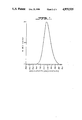
- FIG. 1 shows the spectrum of light output by the deep trap phosphor which may be used in the present invention
- FIG. 2 shows the infrared interrogation response of the deep trap phosphor which may be used in the present invention
- FIG. 3 shows the relative performance of the mixed base deep trap phosphor which may be used in the present invention.
- FIG. 4 shows the spectrum of light output by the shallow trap phosphor which may be used in the present invention.
- Luminescence refers to the ability of certain solids (and liquids) to emit light when driven by an external energy source.
- the driving energy source is light
- the proper term is photoluminescence.
- numerous materials will emit light when driven by short wavelengths, such as ultraviolet.
- there is yet another interesting class of materials which, upon excitation by illumination, can store electrons in "traps" for various lengths of time.
- the invention is made possible by the development of the above-noted electron trapping (ET) materials by the assignee of the present application.
- E electron trapping
- certain deep trap and shallow trap materials have been developed which emit the proper wavelength, 630 nm, to activate the cancer destroying HpD and DHE antibodies.
- the deep trap ET material used in the present invention is described and claimed in U.S. Pat. No. 4,806,772, the disclosure of which is here incorporated by reference.
- the deep trap ET material comprises a base material, a first dopant, and a second dopant.
- the base material may be selected from the group of alkaline earth metal sulfides such as strontium sulfide.
- the first dopant is samarium and the second dopant is selected from the group of europium oxide, europium fluoride, europium chloride, and europium sulfide.
- Barium sulfate is preferably added to improve light output and a fusible salt such as lithium fluoride is useful in certain embodiments.
- An exemplary composition for the deep trap ET material is as follows:
- the mixture is placed into a graphite crucible within a furnace flushed with a dry nitrogen atmosphere (derived from a liquid source) or other dry inert atmosphere such as argon, and heated to between 1150° C. and 1300° C. (preferably 1200° C) for 30 minutes to one hour such that a fused mass is formed.
- a dry nitrogen atmosphere derived from a liquid source
- other dry inert atmosphere such as argon
- the fused mass is ground using standard techniques into a fine powder having a particulate size of 1 to 100 microns.
- the powdered material is heated to about 300° C. to 700° C. (preferably 600° C.) in the graphite crucible within the nitrogen or other inert atmosphere furnace.
- This second heating is below the fusing temperature of the material (about 700° C.) and is maintained for 10 to 60 minutes (preferably 30 minutes). This second heating step removes internal stresses and repairs damage done to the crystalline surfaces during the grinding step.
- the strontium sulfide serves as a base material, whereas the lithium fluoride operates to provide the fusibility characteristics.
- the base material might be used as the base material.
- the barium sulfate in the above mixture is used to improve the brightness of output light from the material.
- the barium sulfate is not absolutely essential, but will greatly improve the optical characteristics of the material.
- the samarium and europium oxide in the above mixture are used for establishing the communication band and the electron trapping level.
- the europium oxide may be between 300 and 800 parts per million with 400 and 600 parts per million being preferred and 550 parts per million being the optimal value.
- Europium fluoride, europium chloride, or europium sulfide could be used in lieu of europium oxide.
- the mixture resulting from the above process provides a depth for electron traps of 1.2 electron volts below the communication band and has an output spectrum as shown in FIG. 1, which illustrates that the center frequency of the output has a wavelength of approximately 630 nanometers corresponding to orange light.
- the infrared interrogation response of the mixture is shown in FIG. 2.
- the present invention can also be used with a deep trap ET material having a base material comprised of a mixture of two alkaline earth metal sulfides, such as a mixture of strontium sulfide and calcium sulfide.
- This mixed base deep trap phosphor is described and claimed in U.S. Pat. No. 4,842,960, the disclosure of which is herein incorporated by reference.
- a third dopant selected from the group of cerium oxide, cerium fluoride, cerium chloride and cerium sulfide can also be added to provide a 10 percent improvement in performance over materials with only the other two dopants.
- An exemplary mixture of a deep trap ET material with a mixed base is as follows:
- FIG. 3 shows the relative performance of the optical material as a function of strontium and calcium sulfide ratios. At 100 percent strontium sulfide, the intensity is approximately 70 percent of peak intensity which is experienced with the ratio of the above example.
- the two sulfides apparently form a new crystal (ternary compound).
- This basic change in the base crystal significantly improves the performance of the optical material. This improvement is apparent when the samarium/europium impurity pair is used without a cerium compound.
- the introduction of a cerium compound further enhances the efficiency.
- the dopants are used for establishing the communication band and the electron trapping level.
- the samarium could alternatively be between 50 parts per million and 500 parts per million, depending on the specific application.
- the europium and cerium compound concentrations may be between 100 and 1000 parts per million with 200 and 600 parts per million being preferred and 500 parts per million being the optimal value.
- the process for making the material is the same as that described for the first example, and yields a substance with electron trap depths of about 1.2 electron volts below the communication band and an output spectrum as shown in FIG. 1 with a center frequency of approximately 630 nanometers corresponding to an orange light.
- the shallow trap ET material used in the present invention is described and claimed in U.S. Pat. No. 4,755,324, issued July 5, 1988, the disclosure of which is herein incorporated by reference.
- the shallow trap ET material comprises a base material selected from the group of alkaline earth metal sulfides, preferably strontium sulfide, two dopants, preferably lanthanum oxide and europium trioxide, and fusible salt such as lithium fluoride.
- the material provides electron trapping with trap depths less than 0.150 eV and more than 0.020 eV.
- the components are combined and the mixture is heated to about 1,000° C. in a furnace in an atmosphere of dry nitrogen to form a fused mass.
- the fused mass is ground to a fine powder having particle size in the order of 50 microns or less.
- the powdered material After grinding, the powdered material is heated at about 600° C. and below fusing temperature for 30 minutes.
- the resultant material has the emission spectrum of FIG. 4.
- afterglow of the material is temperature dependent, and the afterglow intensity decreases approximately inversely with time as a function of 1/time.
- the above-described deep trap and shallow trap ET materials emit a spectrally narrow bandwidth of light around 630 nm, which surrounds the critical wavelength necessary to inactivate the HpD and DHE antibodies. Since the electron trapping materials appear in the form of a fine powder when made in accordance with the above-described processes, they can be introduced as a light source into the body in numerous ways. In essence then, it becomes possible to drink, inhale, or circulate in cavities of the body an orange light. Thus, the present invention for the first time provides the critical wavelength through internal illumination.
- the literature speaks about PDT treatments of patients with promising results involving cancerous tumors at various locations. If the ET particles are suspended in liquid, the esophagus, the stomach and the gastrointestinal tract in general could be illuminated internally.
- the liquid could also be pumped or circulated through the patient's body as a light "conveyor belt", transporting light from outside the body to the treatment area within, and then being circulated outside again to be recharged with light and sent back into the body.
- the lung of a patient could be illuminated by inhalation of a fine ET powder, a process that could continue for a relatively long time without discomfort.
- Other organs of the body could be reached in analogous ways, depending upon the location and type of tissue surrounding the cancer--the common denominator of all these methods, however, is the use of the electron trapping material as the vehicle to illuminate an antibody that has been retained at the treatment site.
- the ET particles are charged up with ambient light before intake. Once the material is inside, the patient is exposed to infrared light, such as from an infrared lamp The infrared stimulation releases the trapped electrons, resulting in the desired emission of 630 nm light. Since the deep trap ET material holds its charge for up to a week, and since only a portion of the electrons are released from their traps upon infrared stimulation, multiple treatments are possible after each intake of ET material. Obviously, if the material is circulated through an organ or crevice of the body, an unlimited amount of light can be delivered internally.
- a shallow trap material If a shallow trap material is employed, it is charged up with light immediately before intake and phosphorescence occurs inside the patient's body with a time decay approximately following a 1/t function.
- the size of the ET particles depends upon the particular method of intake. If the material is inhaled, it must be ground into a fine powder. If it is suspended in liquid for ingestion, injection or circulation, the optimum particle diameter is between 10-20 microns. A small particle size can more easily penetrate the interstices of cancerous tissue, but the intensity of emitted light from the ET material falls off when the particles are smaller than 10 microns in diameter.
- the electron trapping particles used in the present invention are chemically stable crystallites. Nevertheless, it is desirable to microencapsulate the individual particles to ensure inertness within the body.
- Preferred materials for microencapsulation are organometallic compounds because they produce materials which are very inert and very transparent and which readily coat the particulate photoluminescent materials described above.
- Certain organometallic compounds contain a metal oxide and an organic molecule. When the organometallic compound is heated to temperatures of about 400°-500° C., the organic molecule disintegrates leaving only the metal oxide.
- Preferred inert and transparent metal oxides available in an organometallic form are SiO 2 , Ta 2 O 5 , Nb 2O 5 , and TiO 2 . The particles (or crystallites) of electron trapping material are easily coated with such oxides. Besides inertness, encapsulation reduces surface recombination (a loss mechanism) and improves optical coupling. Microencapsulation may be accomplished by techniques which are known per se, e.g., spray techniques, direct oxide deposition, vacuum evaporation, chemical vapor deposition, and sputtering.
- the optimum size of the microencapsulated particles is a function of the sedimentation rate of the microencapsulated particles in liquid suspension, the light emission characteristics of the electron trapping material, and the ability of the microencapsulated particles to penetrate the interstices of cancerous tissue.
- a preferred diameter is 50 microns.
- the electron trapping material can also be applied as a sheet to the patient's skin in the vicinity of cancerous tissue.
- the material charges up by exposure to ambient or artificial light and emits light of the desired 630 nm wavelength into the patient's skin to activate the light sensitive antibody retained by the tumor.
- the electron trapping material is encapsulated in an autoclavable clear binder and bonded to the tip of an optical fiber.
- the optical fiber is then placed adjacent the cancerous tissue, and infrared stimulating light (such as from a laser diode) is sent through the fiber to release 630 nm illumination from the ET material.
- the effectiveness of photodynamic therapy resulting from the method of the present invention can be indirectly quantified by measuring the amount of light of this wavelength emitted at the site of the cancerous tissue.
- Such light can be detected by a photomultiplier specially adapted for infrared sensitivity ("an infrared photomultiplier"), such as described in U.S. Patent Application Ser. No. , filed on even date herewith, now allowed assigned to the present assignee.
- an infrared photomultiplier is an ordinary photomultiplier tube fitted with a special upconverting faceplate which converts incoming infrared light (to which the photomultiplier tube is relatively insensitive) into visible light (to which photomultiplier tube is highly sensitive).
- a long wavelength filter is employed to prevent external visible light (in this case the orange light emitted during PDT) from reaching the photomultiplier.
- the infrared photomultiplier is sensitive only to infrared light.
- the upconverting faceplate is comprised of a deep trap ET material doped with a europium compound similar to that described above in the first example.
- the barium sulfate is exchanged for strontium carbonate, and the mixture is fused at 1300° C., rather than 1200° C.
- a deep trap ET similar to that described and claimed in U.S. Pat. No. 4,879,186, can be used for the upconverting faceplate.
- This material is also europium doped, but has a calcium sulfide base, rather than a strontium sulfide base. This substitution of base material results in a shift of IR sensitivity to longer wavelengths (peaking at about 1150 nm and having about 50 percent output at the desirable wavelength of 1270 nm).
- the barium sulfate in the material is exchanged for strontium carbonate, and the mixture is fused at 1300° C., rather than 1100° C.
- the method of the present invention provides an internal light source which:
Landscapes
- Health & Medical Sciences (AREA)
- Engineering & Computer Science (AREA)
- Biomedical Technology (AREA)
- Life Sciences & Earth Sciences (AREA)
- Pathology (AREA)
- Radiology & Medical Imaging (AREA)
- Nuclear Medicine, Radiotherapy & Molecular Imaging (AREA)
- Animal Behavior & Ethology (AREA)
- General Health & Medical Sciences (AREA)
- Public Health (AREA)
- Veterinary Medicine (AREA)
- Biophysics (AREA)
- Radiation-Therapy Devices (AREA)
Abstract
Description
______________________________________ Strontiumsulfide 100 parts Barium sulfate 5.5 parts Lithium fluoride 5.5 parts Samarium 150 parts per million Europium oxide 550 parts per million ______________________________________
______________________________________
Strontium sulfide 69     parts
Calcium sulfide   25     parts
Samarium          150    parts per million
Europium oxide    500    parts per million
Cerium sulfide    500    parts per million
Lithium fluoride  5.7    parts
______________________________________
Claims (18)
Priority Applications (1)
| Application Number | Priority Date | Filing Date | Title |
|---|---|---|---|
| US07/313,053 US4979935A (en) | 1989-02-21 | 1989-02-21 | Method of photodynamic therapy employing electron trapping material |
Applications Claiming Priority (1)
| Application Number | Priority Date | Filing Date | Title |
|---|---|---|---|
| US07/313,053 US4979935A (en) | 1989-02-21 | 1989-02-21 | Method of photodynamic therapy employing electron trapping material |
Publications (1)
| Publication Number | Publication Date |
|---|---|
| US4979935A true US4979935A (en) | 1990-12-25 |
Family
ID=23214178
Family Applications (1)
| Application Number | Title | Priority Date | Filing Date |
|---|---|---|---|
| US07/313,053 Expired - Lifetime US4979935A (en) | 1989-02-21 | 1989-02-21 | Method of photodynamic therapy employing electron trapping material |
Country Status (1)
| Country | Link |
|---|---|
| US (1) | US4979935A (en) |
Cited By (19)
| Publication number | Priority date | Publication date | Assignee | Title |
|---|---|---|---|---|
| WO1998004183A3 (en) * | 1996-07-25 | 1998-03-26 | Light Medicine Inc | Photodynamic therapy with light emitting particles |
| ES2181586A1 (en) * | 2001-05-03 | 2003-02-16 | Cobo Alfonso Blanco | Pharmaceutical for carcinogenic tumor treatment consists of a mixture of strontium sulfate barium nitrate cordierite and e.g. glycerine |
| US20060200116A1 (en) * | 2005-03-04 | 2006-09-07 | Searete Llc, A Limited Liability Corporation Of The State Of Delaware | Method and system for temporary hair removal |
| US20080039827A1 (en) * | 2005-06-02 | 2008-02-14 | Searete Llc | Photopatterning of skin |
| US20080248001A1 (en) * | 2007-04-08 | 2008-10-09 | Immunolight | Methods and systems for treating cell proliferation disorders |
| US20090104212A1 (en) * | 2007-08-06 | 2009-04-23 | Immunolight | Methods and systems for treating cell proliferation disorders using two-photon simultaneous absorption |
| US20100003316A1 (en) * | 2007-08-06 | 2010-01-07 | Duke University | Methods and systems for treating cell proliferation disorders using plasmonics enhanced photospectral therapy (pepst) and exciton-plasmon enhanced phototherapy (epep) |
| US20100016783A1 (en) * | 2008-04-04 | 2010-01-21 | Duke University | Non-invasive systems and methods for in-situ photobiomodulation |
| WO2010123993A1 (en) | 2009-04-21 | 2010-10-28 | Tuan Vo-Dinh | Non-invasive energy upconversion methods and systems for in-situ photobiomodulation |
| US20120259152A1 (en) * | 2011-04-08 | 2012-10-11 | Gerrans Lawrence J | Treatment of hypoxic tumors with localized oxygenation |
| US8529560B2 (en) | 2005-03-04 | 2013-09-10 | The Invention Science Fund I, Llc | Hair treatment system |
| US8540701B2 (en) | 2005-03-04 | 2013-09-24 | The Invention Science Fund I, Llc | Hair treatment system |
| US8562657B2 (en) | 2005-03-04 | 2013-10-22 | The Invention Science Fund I, Llc | Photopatterning of skin |
| US9055958B2 (en) | 2005-06-29 | 2015-06-16 | The Invention Science Fund I, Llc | Hair modification using converging light |
| WO2015112850A2 (en) | 2014-01-23 | 2015-07-30 | Wenle Xia | Use of psoralen derivatives and combination therapy for treatment of cell proliferation disorders |
| WO2015195896A1 (en) | 2014-06-19 | 2015-12-23 | Immunolight, Llc | Methods and systems for treating cell proliferation disorders with psoralen derivatives |
| WO2016115225A1 (en) | 2015-01-14 | 2016-07-21 | Immunolight, Llc. | Non-invasive systems and methods for treatment of a host carrying a virus with photoactivatable drugs |
| US9993661B2 (en) | 2008-04-04 | 2018-06-12 | Immunolight, Llc. | Modulating a biological activity of a target structure by energy generation in-situ within a medium |
| US10029115B2 (en) | 2011-04-08 | 2018-07-24 | Sanovas Intellectual Property, Llc | Photodynamic therapy for tumors with localized delivery |
Citations (10)
| Publication number | Priority date | Publication date | Assignee | Title |
|---|---|---|---|---|
| US4674480A (en) * | 1984-05-25 | 1987-06-23 | Lemelson Jerome H | Drug compositions and methods of applying same |
| US4755324A (en) * | 1985-11-15 | 1988-07-05 | Quantex Corporation | Thermoluminescent material |
| US4772681A (en) * | 1986-01-17 | 1988-09-20 | Hamari Chemicals, Ltd. | Porphyrin derivatives |
| US4783529A (en) * | 1985-12-03 | 1988-11-08 | Research Corporation Technologies | Rapid synthesis of radiolabeled porphyrin complexes for medical application |
| US4806772A (en) * | 1985-10-10 | 1989-02-21 | Quantex Corporation | Infrared sensing device outputting orange light and a process for making the same |
| US4842960A (en) * | 1985-10-10 | 1989-06-27 | Quantex Corporation | High efficiency photoluminescent material for optical upconversion |
| US4866168A (en) * | 1982-09-27 | 1989-09-12 | Health Research, Inc. | Hematoporphyrin derivatives and process of preparing |
| US4877872A (en) * | 1986-06-24 | 1989-10-31 | The University Of Toledo | Production and use of dimers of hematoporophyrin, purpurins, chlorines and purpurin- and chlorin-complexes |
| US4879186A (en) * | 1985-10-10 | 1989-11-07 | Quantex Corporation | Photoluminescent materials for outputting reddish-orange light and a process for making the same |
| US4883790A (en) * | 1987-01-20 | 1989-11-28 | University Of British Columbia | Wavelength-specific cytotoxic agents |
-
1989
- 1989-02-21 US US07/313,053 patent/US4979935A/en not_active Expired - Lifetime
Patent Citations (10)
| Publication number | Priority date | Publication date | Assignee | Title |
|---|---|---|---|---|
| US4866168A (en) * | 1982-09-27 | 1989-09-12 | Health Research, Inc. | Hematoporphyrin derivatives and process of preparing |
| US4674480A (en) * | 1984-05-25 | 1987-06-23 | Lemelson Jerome H | Drug compositions and methods of applying same |
| US4806772A (en) * | 1985-10-10 | 1989-02-21 | Quantex Corporation | Infrared sensing device outputting orange light and a process for making the same |
| US4842960A (en) * | 1985-10-10 | 1989-06-27 | Quantex Corporation | High efficiency photoluminescent material for optical upconversion |
| US4879186A (en) * | 1985-10-10 | 1989-11-07 | Quantex Corporation | Photoluminescent materials for outputting reddish-orange light and a process for making the same |
| US4755324A (en) * | 1985-11-15 | 1988-07-05 | Quantex Corporation | Thermoluminescent material |
| US4783529A (en) * | 1985-12-03 | 1988-11-08 | Research Corporation Technologies | Rapid synthesis of radiolabeled porphyrin complexes for medical application |
| US4772681A (en) * | 1986-01-17 | 1988-09-20 | Hamari Chemicals, Ltd. | Porphyrin derivatives |
| US4877872A (en) * | 1986-06-24 | 1989-10-31 | The University Of Toledo | Production and use of dimers of hematoporophyrin, purpurins, chlorines and purpurin- and chlorin-complexes |
| US4883790A (en) * | 1987-01-20 | 1989-11-28 | University Of British Columbia | Wavelength-specific cytotoxic agents |
Non-Patent Citations (4)
| Title |
|---|
| Mew et al., "Photoimmunotherapy: Treatment of Animal Tumors with Tumor Specific Monoclonal Antibody-Hematoporphyrin Conjugates", Journal of Immunology, vol. 130, No. 3, Mar. 1983, pp. 1473-1477. |
| Mew et al., Photoimmunotherapy: Treatment of Animal Tumors with Tumor Specific Monoclonal Antibody Hematoporphyrin Conjugates , Journal of Immunology, vol. 130, No. 3, Mar. 1983, pp. 1473 1477. * |
| Weishaupt et al., "Identification of Singlet Oxgyen as the Cytotoxic Agent in Photo-Inactivation of a Murine Tumor", Cancer Research, vol. 36, pp. 2326-2329, Jul. 1976. |
| Weishaupt et al., Identification of Singlet Oxgyen as the Cytotoxic Agent in Photo Inactivation of a Murine Tumor , Cancer Research, vol. 36, pp. 2326 2329, Jul. 1976. * |
Cited By (34)
| Publication number | Priority date | Publication date | Assignee | Title |
|---|---|---|---|---|
| WO1998004183A3 (en) * | 1996-07-25 | 1998-03-26 | Light Medicine Inc | Photodynamic therapy with light emitting particles |
| ES2181586A1 (en) * | 2001-05-03 | 2003-02-16 | Cobo Alfonso Blanco | Pharmaceutical for carcinogenic tumor treatment consists of a mixture of strontium sulfate barium nitrate cordierite and e.g. glycerine |
| ES2181586B1 (en) * | 2001-05-03 | 2004-06-16 | Alfonso Blanco Cobo | PHARMACEUTICAL PRODUCT FOR THE TREATMENT OF CANCERIGENE TUMORS. |
| US8529560B2 (en) | 2005-03-04 | 2013-09-10 | The Invention Science Fund I, Llc | Hair treatment system |
| US20060200116A1 (en) * | 2005-03-04 | 2006-09-07 | Searete Llc, A Limited Liability Corporation Of The State Of Delaware | Method and system for temporary hair removal |
| US8679101B2 (en) | 2005-03-04 | 2014-03-25 | The Invention Science Fund I, Llc | Method and system for temporary hair removal |
| US8562657B2 (en) | 2005-03-04 | 2013-10-22 | The Invention Science Fund I, Llc | Photopatterning of skin |
| US8540701B2 (en) | 2005-03-04 | 2013-09-24 | The Invention Science Fund I, Llc | Hair treatment system |
| US20080039827A1 (en) * | 2005-06-02 | 2008-02-14 | Searete Llc | Photopatterning of skin |
| US9055958B2 (en) | 2005-06-29 | 2015-06-16 | The Invention Science Fund I, Llc | Hair modification using converging light |
| US9358292B2 (en) | 2007-04-08 | 2016-06-07 | Immunolight, Llc | Methods and systems for treating cell proliferation disorders |
| US9352040B2 (en) | 2007-04-08 | 2016-05-31 | Immunolight, Llc. | Methods and systems for treating cell proliferation disorders |
| US9682146B2 (en) | 2007-04-08 | 2017-06-20 | Immunolight, Llc. | Methods and systems for treating cell proliferation related disorders |
| EP3299031A1 (en) | 2007-04-08 | 2018-03-28 | Immunolight, LLC | Methods and systems for treating cell proliferation disorders |
| WO2008124681A2 (en) | 2007-04-08 | 2008-10-16 | Immunolight, Llc | Methods and systems for treating cell proliferation disorders |
| US20080248001A1 (en) * | 2007-04-08 | 2008-10-09 | Immunolight | Methods and systems for treating cell proliferation disorders |
| US8951561B2 (en) | 2007-08-06 | 2015-02-10 | Duke University | Methods and systems for treating cell proliferation disorders using plasmonics enhanced photospectral therapy (PEPST) and exciton-plasmon enhanced phototherapy (EPEP) |
| US20090104212A1 (en) * | 2007-08-06 | 2009-04-23 | Immunolight | Methods and systems for treating cell proliferation disorders using two-photon simultaneous absorption |
| US20100003316A1 (en) * | 2007-08-06 | 2010-01-07 | Duke University | Methods and systems for treating cell proliferation disorders using plasmonics enhanced photospectral therapy (pepst) and exciton-plasmon enhanced phototherapy (epep) |
| US9662388B2 (en) | 2007-08-06 | 2017-05-30 | Duke University | Methods and systems for treating cell proliferation disorders using plasmonics enhanced photospectral therapy (PEPST) and exciton-plasmon enhanced phototherapy (EPEP) |
| US9439897B2 (en) | 2007-11-06 | 2016-09-13 | Immunolight, Llc | Use of psoralen derivatives and combination therapy for treatment of cell proliferation disorders |
| US10391330B2 (en) | 2007-11-06 | 2019-08-27 | Immunolight, Llc | Non-invasive systems and methods for in-situ photobiomodulation |
| US20100016783A1 (en) * | 2008-04-04 | 2010-01-21 | Duke University | Non-invasive systems and methods for in-situ photobiomodulation |
| EP3300744A1 (en) | 2008-04-04 | 2018-04-04 | Immunolight, Llc. | Non-invasive systems and methods for in-situ photobiomodulation |
| US9993661B2 (en) | 2008-04-04 | 2018-06-12 | Immunolight, Llc. | Modulating a biological activity of a target structure by energy generation in-situ within a medium |
| US10272262B2 (en) | 2008-04-04 | 2019-04-30 | Immunolight, Llc. | Method for modulating a biological activity of a target structure by energy generation in-situ within a medium |
| WO2010123993A1 (en) | 2009-04-21 | 2010-10-28 | Tuan Vo-Dinh | Non-invasive energy upconversion methods and systems for in-situ photobiomodulation |
| US20120259152A1 (en) * | 2011-04-08 | 2012-10-11 | Gerrans Lawrence J | Treatment of hypoxic tumors with localized oxygenation |
| US9694075B2 (en) * | 2011-04-08 | 2017-07-04 | Sanovas, Inc. | Treatment of hypoxic tumors with localized oxygenation |
| US10029115B2 (en) | 2011-04-08 | 2018-07-24 | Sanovas Intellectual Property, Llc | Photodynamic therapy for tumors with localized delivery |
| WO2015112850A2 (en) | 2014-01-23 | 2015-07-30 | Wenle Xia | Use of psoralen derivatives and combination therapy for treatment of cell proliferation disorders |
| WO2015195896A1 (en) | 2014-06-19 | 2015-12-23 | Immunolight, Llc | Methods and systems for treating cell proliferation disorders with psoralen derivatives |
| EP3838904A1 (en) | 2014-06-19 | 2021-06-23 | Immunolight, LLC | Methods and systems for treating cell proliferation disorders with psoralen derivatives |
| WO2016115225A1 (en) | 2015-01-14 | 2016-07-21 | Immunolight, Llc. | Non-invasive systems and methods for treatment of a host carrying a virus with photoactivatable drugs |
Similar Documents
| Publication | Publication Date | Title |
|---|---|---|
| Chen | Nanoparticle self-lighting photodynamic therapy for cancer treatment | |
| CN113767160B (en) | Energy-enhancing structures for energy emitters and collectors | |
| Liang et al. | Controlling persistent luminescence in nanocrystalline phosphors | |
| Poelman et al. | Persistent phosphors for the future: Fit for the right application | |
| JP3541041B2 (en) | All-optical high-speed reading fiber-coupled thermoluminescence dosimeter system | |
| US5997842A (en) | Radionuclide excited phosphorescent material for administering PDT | |
| Fan et al. | Enhanced afterglow performance of persistent luminescence implants for efficient repeatable photodynamic therapy | |
| Maldiney et al. | Controlling electron trap depth to enhance optical properties of persistent luminescence nanoparticles for in vivo imaging | |
| Singh | Red and near infrared persistent luminescence nano-probes for bioimaging and targeting applications | |
| Wang et al. | Recent progress in biomedical applications of persistent luminescence nanoparticles | |
| Chen et al. | Using nanoparticles to enable simultaneous radiation and photodynamic therapies for cancer treatment | |
| Wang et al. | A red-light-chargeable near infrared MgGeO 3: Mn 2+, Yb 3+ persistent phosphor for bioimaging and optical information storage applications | |
| Li et al. | Near-infrared light activated persistent luminescence nanoparticles via upconversion | |
| US20110238001A1 (en) | Nanoparticle based photodynamic therapy and methods of making and using same | |
| KR20130048243A (en) | Nanocrystals in devices | |
| KR102204359B1 (en) | Core/multi-shell upconversion fluoride nanophosphor showing luminescence under various excitation wavelengths and methods of forming the same | |
| US4806772A (en) | Infrared sensing device outputting orange light and a process for making the same | |
| US4839092A (en) | Photoluminescent materials for outputting orange light | |
| Yao et al. | X-ray excited luminescent nanoparticles for deep photodynamic therapy | |
| Wei et al. | X-ray/γ-ray/ultrasound-activated persistent luminescence phosphors for deep tissue bioimaging and therapy | |
| Viana et al. | NIR-persistent luminescence nanoparticles for bioimaging, principle and perspectives | |
| Gee | Recent trends concerning upconversion nanoparticles and near-IR emissive lanthanide materials in the context of forensic applications | |
| CN103194228A (en) | Long-lasting phosphorescent material with optical excitation characteristic for biological imaging and preparation method and application thereof | |
| Maldiney et al. | Trap depth optimization to improve optical properties of diopside-based nanophosphors for medical imaging | |
| US11504437B2 (en) | Multifunctional fluorescent and MRI-active nanostructure |
Legal Events
| Date | Code | Title | Description |
|---|---|---|---|
| AS | Assignment |
Owner name: QUANTEX CORPORATION, MARYLAND Free format text: ASSIGNMENT OF ASSIGNORS INTEREST.;ASSIGNOR:LINDMAYER, JOSEPH;REEL/FRAME:005047/0190 Effective date: 19890126 |
|
| FEPP | Fee payment procedure |
Free format text: PAYOR NUMBER ASSIGNED (ORIGINAL EVENT CODE: ASPN); ENTITY STATUS OF PATENT OWNER: SMALL ENTITY |
|
| FPAY | Fee payment |
Year of fee payment: 4 |
|
| AS | Assignment |
Owner name: GIMMEL, GERALD K., PERSONAL REPRESENTATIVE OF THE Free format text: ASSIGNMENT OF ASSIGNORS INTEREST;ASSIGNOR:QUANTEX CORPORATION;REEL/FRAME:008861/0211 Effective date: 19971212 |
|
| AS | Assignment |
Owner name: RADIOLOGICAL IMAGE SCIENCES, INC., MARYLAND Free format text: ASSIGNMENT OF ASSIGNORS INTEREST;ASSIGNOR:ESTATE OF LINDMAYER, JOSEPH GIMMEL, GERALD K., PERSONAL REP.;REEL/FRAME:009097/0560 Effective date: 19980326 |
|
| REMI | Maintenance fee reminder mailed | ||
| FPAY | Fee payment |
Year of fee payment: 8 |
|
| SULP | Surcharge for late payment | ||
| AS | Assignment |
Owner name: MONTANA INVESTMENTS, INC., MARYLAND Free format text: SECURITY INTEREST;ASSIGNORS:INSTITUTE FOR RADIOLOGICAL IMAGE SCIENCES, INC.;PHOSPHOROUS PLATE TECHNOLOGY, INC.;REEL/FRAME:011314/0154 Effective date: 20001025 |
|
| REMI | Maintenance fee reminder mailed | ||
| FEPP | Fee payment procedure |
Free format text: PETITION RELATED TO MAINTENANCE FEES FILED (ORIGINAL EVENT CODE: PMFP); ENTITY STATUS OF PATENT OWNER: SMALL ENTITY |
|
| FEPP | Fee payment procedure |
Free format text: PETITION RELATED TO MAINTENANCE FEES GRANTED (ORIGINAL EVENT CODE: PMFG); ENTITY STATUS OF PATENT OWNER: SMALL ENTITY |
|
| REIN | Reinstatement after maintenance fee payment confirmed | ||
| FPAY | Fee payment |
Year of fee payment: 12 |
|
| SULP | Surcharge for late payment | ||
| FP | Lapsed due to failure to pay maintenance fee |
Effective date: 20021225 |
|
| PRDP | Patent reinstated due to the acceptance of a late maintenance fee |
Effective date: 20030408 |
|
| STCF | Information on status: patent grant |
Free format text: PATENTED CASE |
|
| AS | Assignment |
Owner name: INSTITUTE FOR RADIOLOGICAL IMAGES SCIENCES, INC., Free format text: TERMINATION OF COLLATERAL ASSIGNMENT;ASSIGNOR:REDWOOD CAPITAL PARTNERS, LLC, SUCCESSOR-IN-INTEREST TO MONTANA INVESTMENTS, INC.;REEL/FRAME:018433/0252 Effective date: 20060822 |