US4974209A - Interactive smoothing system - Google Patents
Interactive smoothing system Download PDFInfo
- Publication number
- US4974209A US4974209A US07/497,802 US49780290A US4974209A US 4974209 A US4974209 A US 4974209A US 49780290 A US49780290 A US 49780290A US 4974209 A US4974209 A US 4974209A
- Authority
- US
- United States
- Prior art keywords
- point
- array
- data points
- data
- sample
- Prior art date
- Legal status (The legal status is an assumption and is not a legal conclusion. Google has not performed a legal analysis and makes no representation as to the accuracy of the status listed.)
- Expired - Fee Related
Links
- 238000009499 grossing Methods 0.000 title claims abstract description 42
- 230000002452 interceptive effect Effects 0.000 title description 7
- 238000000034 method Methods 0.000 claims abstract description 14
- 238000001228 spectrum Methods 0.000 claims description 23
- 230000003595 spectral effect Effects 0.000 abstract 1
- 230000009467 reduction Effects 0.000 description 7
- 238000004364 calculation method Methods 0.000 description 6
- 230000000994 depressogenic effect Effects 0.000 description 6
- 230000000881 depressing effect Effects 0.000 description 5
- 230000000593 degrading effect Effects 0.000 description 3
- NJPPVKZQTLUDBO-UHFFFAOYSA-N novaluron Chemical compound C1=C(Cl)C(OC(F)(F)C(OC(F)(F)F)F)=CC=C1NC(=O)NC(=O)C1=C(F)C=CC=C1F NJPPVKZQTLUDBO-UHFFFAOYSA-N 0.000 description 3
- 230000004044 response Effects 0.000 description 3
- 238000010521 absorption reaction Methods 0.000 description 2
- 230000000712 assembly Effects 0.000 description 2
- 238000000429 assembly Methods 0.000 description 2
- 125000000524 functional group Chemical group 0.000 description 2
- 101100204393 Arabidopsis thaliana SUMO2 gene Proteins 0.000 description 1
- 238000005773 Enders reaction Methods 0.000 description 1
- 101100311460 Schizosaccharomyces pombe (strain 972 / ATCC 24843) sum2 gene Proteins 0.000 description 1
- 229910002056 binary alloy Inorganic materials 0.000 description 1
- 238000006243 chemical reaction Methods 0.000 description 1
- 238000004891 communication Methods 0.000 description 1
- 230000003247 decreasing effect Effects 0.000 description 1
- 238000010586 diagram Methods 0.000 description 1
- 230000000694 effects Effects 0.000 description 1
- 230000006872 improvement Effects 0.000 description 1
- 230000004048 modification Effects 0.000 description 1
- 238000012986 modification Methods 0.000 description 1
- 230000005855 radiation Effects 0.000 description 1
- 230000035484 reaction time Effects 0.000 description 1
- 239000007858 starting material Substances 0.000 description 1
- 230000000007 visual effect Effects 0.000 description 1
Images

Classifications
-
- G—PHYSICS
- G01—MEASURING; TESTING
- G01J—MEASUREMENT OF INTENSITY, VELOCITY, SPECTRAL CONTENT, POLARISATION, PHASE OR PULSE CHARACTERISTICS OF INFRARED, VISIBLE OR ULTRAVIOLET LIGHT; COLORIMETRY; RADIATION PYROMETRY
- G01J3/00—Spectrometry; Spectrophotometry; Monochromators; Measuring colours
- G01J3/02—Details
-
- G—PHYSICS
- G01—MEASURING; TESTING
- G01J—MEASUREMENT OF INTENSITY, VELOCITY, SPECTRAL CONTENT, POLARISATION, PHASE OR PULSE CHARACTERISTICS OF INFRARED, VISIBLE OR ULTRAVIOLET LIGHT; COLORIMETRY; RADIATION PYROMETRY
- G01J3/00—Spectrometry; Spectrophotometry; Monochromators; Measuring colours
- G01J3/02—Details
- G01J3/027—Control of working procedures of a spectrometer; Failure detection; Bandwidth calculation
-
- G—PHYSICS
- G01—MEASURING; TESTING
- G01J—MEASUREMENT OF INTENSITY, VELOCITY, SPECTRAL CONTENT, POLARISATION, PHASE OR PULSE CHARACTERISTICS OF INFRARED, VISIBLE OR ULTRAVIOLET LIGHT; COLORIMETRY; RADIATION PYROMETRY
- G01J3/00—Spectrometry; Spectrophotometry; Monochromators; Measuring colours
- G01J3/28—Investigating the spectrum
Definitions
- This invention is directed to smoothing systems and, more particularly, to an interactive smoothing system for use on digital spectrum data from an analytical instrument. It is particularly adapted, among other possible uses, for use with an infrared spectrophotometer.
- this invention provides, in an analytical instrument including a spectrophophotometer, detector and a data station, a new and improved smoothing system, which includes: a FROM register for storing an array of data points to be smoothed, a modified triangular finite impulse response filter for smoothing the points from the FROM register, a TO buffer for storing the data points subsequent to being smoothed, a keyboard assembly for providing operator control of the degree of smoothing by the filter, and an interactive display unit for displaying the array of data points.
- the degree of smoothing by said triangular finite impulse response filter is controlled by a continuously variable strength parameter, and the central weight of the triangle filter is equal to the integer part of the strength plus one, and the triangle sits on a platform of height determined by the fractional part of the strength.
- the central weight of the triangle is depressed by a preselected amount, preferably 0.40625.
- the algorithm in order to reduce the number of multiplications and to reduce the computing time, is implemented in three parts using successive differences.
- the first part is the triangular filter calculation which is based on the difference between the current filter value and the previous value. The difference between this difference and the previous difference reduces to a simple three term expression.
- the second part is a running average of the pedestal or platform height.
- the third part is the depression of the weight of the central point. The smoothed point will equal the first part plus the second part minus the third part divided by the sum of the weights.
- a subroutine is provided for computing an effective increase ratio in best line width for a smooth ratio of a specified strength, which equals the sum of the weights squared, divided by the sum of the squares of the weights.
- Another subroutine is provided for determining the smoothing strength required to obtain the aforementioned smooth ratio using successive approximation calculations.
- a routine for providing operator control of the degree of smoothing by the filter which includes provision for continuously incrementing or decrementing the degree of smoothing.
- Another routine provides means for selectively increasing or decreasing the size of the incrementing or decrementing increments.
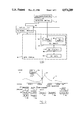
- FIG. 1 is a block diagram of an analytical instrument having an interactive smoothing system according to the invention.
- FIG. 2 is a keyboard assembly and display unit
- FIG. 3 is a flow chart of a method of identifying components in a sample in accordance with the present invention.
- the analytical instrument of the present invention may be considered as composed of a spectrophotometer 10, FIG. 1, with detector means 12, a data station indicated generally at 14, a visual display unit 16 and a keyboard module 18.
- the spectrophotometer 10 may be of any suitable type such as, for example, model 1600, as manufactured by The Perkin-Elmer Corporation. Communication between the operator and the data station 14 is accomplished via the keyboard 18.
- This keyboard in addition to the standard terminal format, contains a number of special function keys, which allow the operator to select specific tasks from one of the application programs by depressing the appropriate key on the keyboard.
- the video screen 16 is used to display commands entered into the system by way of the keyboard 18, to show status and properties of data collected and to view spectra. The screen can be used to view a spectrum directly during a scan and to view the spectrum which results after each step of data processing.
- the purpose of the smooth command is to achieve the greatest reduction in noise without degrading the resolution of the data spectrum 19.
- the display unit appears as illustrated in FIG. 2.
- the spectrum storage register is specified at 20, and the smoothing band width is indicated at 22.
- the upper limit of the smoothing band width is determined as follows: the cursor button 24 is depressed, whereby the vertical graphics cursor appears in the display. Then, the operator moves the cursor to the narrowest significant band in the spectrum or to a very narrow band. Then, the operator expands the spectrum horizontally with the " ⁇ " key 26 until the narrow band is clearly displayed. Next, the cursor is moved to the point on the left side of the band 28 where the band is approximately half its full height, as illustrated in FIG. 2.
- the wavenumber at this point is recorded, as shown in the cursor display 24, FIG. 2. This step is repeated for the right side of the band as viewed in FIG. 2. Again, record is made of the wavenumber of the point where the band is at half its full height. The difference in the value of the two wavenumbers obtained is the band width at half height. The smoothing width should not exceed this value.
- the smoothing width can be specified in either of the following ways. However, it should in general be kept below the value determined above.
- the number pad can be used to type in a width, or zero if desired, and the "Enter" key 30 is depressed.
- the display updates to show the effect of the smooth selected, or to show the unsmoothed spectrum 19 if zero was entered. If desired, a different bandwidth number can be entered, or the width can be modified interactively, by using the soft keys. That is, by depressing the "more” key 32, the field width is incremented. At the same time, the display interactively, or continuously, updates to show the spectrum 19 smoothed according to each new width. In a similar manner, by depressing the "less” key 34, the field width is decremented.
- the display interactively, or continuously, updates to show the spectrum smoothed according to each new width.
- the increments and decrements subsequently produced by the "more” and “less” soft keys 32, 34 become larger
- by depressing the "slower” key 38 the increments and decrements subsequently produced by the "more” and “less” soft keys become smaller.
- the "execute” key 40 is depressed and the system executes the smooth command using the specified smoothing width.
- the entire spectrum in the storage register currently selected by the "REGISTER” key 20 is smoothed, and the smoothed spectrum is displayed over the range currently selected.
- This smooth routine in the data station 14, FIG. 1 smooths a specified number of data points of the input data array and delivers the result to the output array.
- the degree of smoothing is controlled by the operator. As indicated hereinbefore, the operator can select any reasonable bandwidth desired. Typically, 500 points of data, for example, stored in a "FROM" register 42, FIG. 1, are removed in the DOSMOOTH routine 44 and smoothed with the strength specified and then the results are put into a "TO" buffer 46.
- the program used is a modified triangular finite impulse response filter. In the program, the degree of smoothing is controlled by the strength parameter; increasing the strength means more smoothing. As a very rough approximation the bandwidth is reduced to 1/(1+strength) of its original value. However, since this relationship is far from linear, it is merely an approximation. More accurate conversion between the bandwidth and the strength will be discussed hereinafter.
- the central weight of the triangle is equal to the integer part of the expression (strength +1). However, the triangle sits up on a platform of height determined by the fractional part of the strength, and in addition, the central weight is depressed by 0.40625.
- the exact value of the central weight depression is not critical and has been chosen because it is convenient in a binary system and multiplying by this factor can be achieved easily by shift and add.
- the weights are:
- D' would equal the sum of these products divided by the sum of the weights, as follows: ##EQU1## For a second example, assume a strength of 3.2, then the weights are:
- E' would equal the sum of these products divided by the sum of the weights, as follows: ##EQU2##
- the difference between the current filter value and the previous value for a strength of 2 can be expressed:
- n the filter central weight or half-length
- n the filter central weight or half-length
- i index of the central weight or half-length
- subroutines SMSTRENGTH 48 and SMRATIO 50 are corollaries to the routine DOSMOOTH. It is noted that the user thinks in terms of the smoothing bandwidth 22, as discussed hereinbefore. However, the program operates in unitless terms. Therefore, it is necessary to translate or convert the bandwidth to a unitless term.
- the term smoothing ratio is a unitless term that is directly related to the bandwidth. Hereinbefore, it was indicated that the bandwidth or smoothing ratio was approximately equal to 1/(1+strength). In using SMSTRENGTH and SMRATIO, this relationship is developed very accurately.
- the program for computing the SMRATIO is illustrated, as follows:
- the problem with the SMRATIO formula is that it derives the width from the strength when what is actually needed is the strength from the width.
- the SMSTRENGTH subroutine is used to determine the smoothing strength needed to achieve the specified target smoothing ratio. This requires the solution of a quartic equation, and instead Newton's method of successive approximation is used here.
- the initial bracketing guesses for the strength are set at the integer values above and below the target result, since at these points the slop is discontinuous.
- the successive approximations then remain within this interval. That is, successive iterations are performed until the strength corresponding to the target smoothing ratio is determined. This smoothing strength is then used in the basic DOSMOOTH routine.
- the program for computing the SMSTRENGTH is illustrated, as follows:
- FIG. 3 is a flow chart showing a summary of a method of identifying components in a sample in accordance with one form of the present invention.
- the method includes spectrally analyzing a sample 52, FIG. 3, in the spectrophotometer 10, FIG. 1, and detecting sample data points 54, FIG. 3, in a detector 12, FIG. 1, outputted from the spectrophotometer.
- the next steps in the method comprise storing an array of data points 56, FIG. 3, in a data station 14, FIG. 1, entering a preselected bandwidth value into the data station, 58, FIG. 3; and converting the bandwidth value to a strength parameter.
- the method includes the steps of modifying each data point by a formula SUM2'+RA+CPR divided by (n+1) 2 +f *(2n+3)-0.40625 to form an array of smoothed data points 62, FIG. 3, and then outputting the array of smoothed data points to identify the components of the sample 64, FIG. 3.
- the present invention does indeed provide a new and improved interactive smoothing system which produces substantial reduction in noise without degrading the resolution and which permits interactive smoothing with a computer of modest processing power.
Landscapes
- Physics & Mathematics (AREA)
- Spectroscopy & Molecular Physics (AREA)
- General Physics & Mathematics (AREA)
- Complex Calculations (AREA)
Abstract
Description
______________________________________
A       B     C         D   E       F   G
______________________________________
point A would be multiplied by 0.1
point B would be multiplied by 1.1
point C would be multiplied by 2.1
point D would be multiplied by 2.69375
point E would be multiplied by 2.1
point F would be multiplied by 1.1
point G would be multiplied by 0.1
______________________________________
______________________________________
A      B     C       D   E      F   G     H   I
______________________________________
point A would be multiplied by 0.2
point B would be multiplied by 1.2
point C would be multiplied by 2.2
point D would be multiplied by 3.2
point E would be multiplied by 3.79375
point F would be multiplied by 3.2
point G would be multiplied by 2.2
point H would be multiplied by 1.2
point I would be multiplied by 0.2
______________________________________
______________________________________
                1       2      3    2     1
       1        2       3      2    1
       -1       -1      -1     1    1     1
-1     -1       -1      1      1    1
1      0        0       -2     0    0     1
______________________________________
Central Point Reduction=CPR=0.40625* x.sub.[i]
______________________________________
***** included files  *****
*     none
***** imported functions
                      *****
globl    a.ldtl         * integer fix
globl    fprecip        * floating point reciprocal
***** stack variable equates
                      *****
*
fraction = 8
shifts = 10
***** subroutine dosmooth
                      *****
*
.text
.even
.globl   .sub.-- dosmooth
.sub.-- dosmooth:
*
*save registers
movem.1  d3-d5/a3-a6,-(a7)
* reserve space for variables
sub .w   #12,a7
* get parameters
movem.1  44(a7),d1/d2/d7/a2/a3
* fix strength with 16 bits of fraction
add.1    #0x01000000,d1 *times 65536
jsr      a.ldtl
move.1   d0,d3
clr.w    d3
swap     d3
*save the fraction
move.w   d0,fraction(a7)
*compute n+1
addq.w   #1,d3
*compute 2n+3
move.w   d3,d4
add.w    d4,d4
addq.w   #1,d4
*compute (n+1).2
move.w   d3,d5
mulu     d3,d5
* compute sum of coefficients (n+1)'2 + fraction*(2n+3)
-0.40625
mulu     d4,d0
swap     d5
add.1    d5,d0
swap     d5
sub.1    #0x6800,d0
* left justify, counting shifts
    moveq    #15,d1
i1: add.1    d0,d0
    dbmi     d1,i1
    move.w   d1,shifts(a7)
* compute reciprocal weight
jsr      fprecip
move.1   d0,a6
* initialise array end-pointers
move.1   a2,a4
move.1   a4,a5
subq.1   #1,d7
asl.1    #2,d7
add.1    d7,a5
* initialise centre triangle pointer
move.1   a2,a1
asl.1    #2,d3
sub.1    d3,a1
* initialise trailing edge pointer
move.1   a1,a0
sub.1    d3,a0
* get absolute value of first input point, noting sign
move.1   (a2),d0
smi      d2
bpl.s    i2
neg.1    d0
i2:
* . . . and split it ready for multiply
move.w   d0,d1
swap     d0
* initialise running sum = (2n+3) * from[0]
move.w   d4,d7
mulu     d0,d4
mulu     d1,d7
swap     d4
move.w   d4,d6
clr.w    d4,
add.1    d4,d7
addx.w   d4,d6
* initialise triangle sum = (n+1)'2 * from[0]
move.w   d5,d3
mulu     d0,d3
mulu     d1,d5
swap     d3
move.w   d3,d4
clr.w    d3
add.1    d3,d5
addx.w   d3,d4
* restore signs
tst.b    d2
bpl.s    i3
neg.1    d7
negx.w   d6
neg.1    d5
negx.w   d4
i3:
* initialise intermediate sum
moveq    #0,d2
moveq    #0.d3
*
*
*
*
***   smooth loop     ***
loop:
*
* subtract trailing edge from running sum
    cmp.1    a4,a0          * check lower array bound
    bcc.s    11
    addq.1   #4,a0
    move.1   (a4),d1        * substitute first data point
    bra.s    12
11: move.1   (a0)+,d1
12: smi      d0             * sign extend
    ext.w    d0
    sub.1    d1,d7
    subx.w   d0,d6
* add trailing edge of triangle
add.1    d1,d3
addx.w   d0,d2
* subtract 2* previous midpoint of triangle
    cmp.1    a4,a1
    bcc.s    13
    addq.1   #4,a1
    bra.s    14
13: move.1   (a1)+,d1
    smi      d0
    ext.w    d0
14: sub.1    d1,d3
    subx.w   d0,d2
    sub.1    d1,d3
    subx.w   d0,d2
* add leading edge of triangle
    cmp.1    a2,a5          * check upper array bound
    bcc.s    15
    move.1   (a5),d1        * substitute last point
    bra.s    16
15: move.1   (a2)+,d1
16: smi      d0
    ext.w    d0
    add.1    d1,d3
    addx.w   d0,d2
* add leading edge to running sum
    cmp.1    a2,a5
    bcs.s    17
    move.1   (a2),d1
    smi      d0
    ext.w    d0
17: add.1    d1,d7
    addx.w   d0,d6
* add intermediate triangle sum to final triangle sum
add.1    d3,d5
addx.w   d2,d4
*
** short-circuit loop, if centre of filter lies before array
cmp.1    a4,a1
bcs.s    loop
*
* save intermediate sums
movem.1  d2/d3,(a7)
swap     d4
* take absolute value of running sum, noting sign
move.1   d7,d1
move.w   d6,d0
smi      d4
bpl.s    18
neg.1    d1
negx.w   d0
18:
* multiply by fraction
move.w   fraction(a7),d3
move.w   d1,d2
swap     d1
mulu     d3,d0
mulu     d3,d1
mulu     d3,d2
move.w   d0,d2
clr.w    d0
swap     d0             * note top of d0 is 0
swap     d2
add.1    d2,d1
clr.w    d2
addx.w   d2,d0
* restore sign
tst.b    d4
bpl.s    19
neg.1    d1
negx.w   d0
19:
* add triangle sum
swap     d4             * restore temporarily
add.1    d5,d1
addx.w   d4,d0
swap     d4
* multiply by 2
add.1    d1,d1
addx.w   d0,d0
* subtract 0.8125 * central point
move.1   (a1),d3
move.1   d3,d2
asr.1    #3,d2
sub.1    d2,d3
asr.1    #1,d2
sub.1    d2,d3
smi      d2
ext.w    d2
sub.1    d3,d1
subx.w   d2,d0
* take absolute value, noting sign
smi      d4
bpl.s    110
neg.1    d1
negx.w   d0
110:
* shift right, retaining 32 bits
move.w   shifts(a7),d3
ror.1    d3,d0          * note top word was 0
lsr.1    d3,d1
add.1    d1,d0
* scale
move.1   a6,d3          * get multiplier
move.w   d0,d2
swap     d0
move.w   d0,d1
mulu     d3,d1
swap     d3
mulu     d3,d0
mulu     d3,d2
add.1    d2,d1
clr.w    d1
addx.w   d1,d1
swap     d1
add.1    d1,d0
* restore sign
tst.b    d4
bpl.s    111
neg.1    d0
111:
* output result
move.1   d0,(a3)+
*
* restore sums
swap     d4
movem.1  (a7),d2/d3
*
*** loop ends
cmp.1    a5,a1
bcs      loop
*
*
* restore registers and return
add.w    #12,a7
movem.1  (a7)+,d3-d5/a3-a6
rts
______________________________________
______________________________________
/***** subroutine smratio *****/
DOUBLE  smratio(strength)
DOUBLE  strength;
LONG    n;      /* integer part of strength */
LONG    n1;     /* n + 1 */
DOUBLE  f;      /* fractional part of strength */
DOUBLE  wsq     /* sum of squares of weights */
DOUBLE  sqw;    /* square of sum of weights */
/* split strength into integer and fraction */
n = strength;
f = strength - n;
n1 = n + 1;
/* compute sum of squares of weights */
wsq = strength + (1.0 - DEPRESS);
wsq *= wsq;
wsq += (n * n1 * (n + n1)/3) + f * strength * (n1 + n1);
/* compute square of sum of weights */
sqw = f * (n1 + n1 + 1) - DEPRESS + (n1 * n1);
sqw *= sqw;
/* return ratio */
return(sqw/wsq);
)
______________________________________
______________________________________
/***** subroutine smstrength *****/
DOUBLE  smstrength(target)
DOUBLE  target;
COUNT   iter;    /* number of iterations */
LONG    n;       /* integer part of strength */
DOUBLE  x;       /* general strength trial value */
DOUBLE  x1;      /* first strength trial value */
DOUBLE  x2;      /* second strength trial value */
DOUBLE  y;       /* general smoothing ration */
DOUBLE  y1;      /* first ratio */
DOUBLE  y2;      /* second ratio */
DOUBLE  error;   /* error in strength */
DOUBLE  temp;    /* temporary value */
/* initialise */
    iter = 0;
    n = target/1.5;
    x1 = n;
    y1 = smratio(x1);
    if (y1 >= target
(
    y2 = y1;
    x2 = x1;
    x1 = n - 1;
    y1 = smratio(x1);
)
else
(
    x2 = n + 1;
    y2 = smratio(x2);
)
error = y2 - target;
/* iteration loop */
while (error > LIMIT) && (iter < MAXITER))
(
/* interpolate new quess */
temp = error/(y2 - y1);
x = x2 - (x2 -  x1) * temp;
y = smratio(x);
/* if quess is nearer to y2, extrapolate new x 1,y1 */
if (temp < 0.5)
(
temp = x2 - (x2 - x) * error/(y2 - y);
if (temp > x 1
(
x1 = temp;
y1 = smratio(x1);
)
)
/* move x2,y2 */
y2 = y;
x2 = x;
/* compute new error */
error = y2 - target;
itertt;
)
/* return the result */
return(x2);
)
______________________________________
Claims (7)
Priority Applications (1)
| Application Number | Priority Date | Filing Date | Title |
|---|---|---|---|
| US07/497,802 US4974209A (en) | 1988-09-02 | 1990-03-21 | Interactive smoothing system |
Applications Claiming Priority (2)
| Application Number | Priority Date | Filing Date | Title |
|---|---|---|---|
| US24077388A | 1988-09-02 | 1988-09-02 | |
| US07/497,802 US4974209A (en) | 1988-09-02 | 1990-03-21 | Interactive smoothing system |
Related Parent Applications (1)
| Application Number | Title | Priority Date | Filing Date |
|---|---|---|---|
| US24077388A Continuation | 1988-09-02 | 1988-09-02 |
Publications (1)
| Publication Number | Publication Date |
|---|---|
| US4974209A true US4974209A (en) | 1990-11-27 |
Family
ID=26933691
Family Applications (1)
| Application Number | Title | Priority Date | Filing Date |
|---|---|---|---|
| US07/497,802 Expired - Fee Related US4974209A (en) | 1988-09-02 | 1990-03-21 | Interactive smoothing system |
Country Status (1)
| Country | Link |
|---|---|
| US (1) | US4974209A (en) |
Cited By (13)
| Publication number | Priority date | Publication date | Assignee | Title |
|---|---|---|---|---|
| EP0543160A1 (en) * | 1991-11-06 | 1993-05-26 | Hewlett-Packard Company | Optical spectrum analyzer |
| US5291426A (en) * | 1991-02-27 | 1994-03-01 | The Perkin-Elmer Corporation | Method of correcting spectral data for background |
| US5351198A (en) * | 1991-02-15 | 1994-09-27 | Horiba, Ltd. | Quantitative analytical method and apparatus for determining a plurality of ingredients with spectrometric analysis |
| US5430786A (en) * | 1992-12-04 | 1995-07-04 | Kabushiki Kaisha Toshiba | Element analyzing method |
| US5442676A (en) * | 1992-12-21 | 1995-08-15 | U.S. Philips Corporation | Method of determining a given characteristic of a material sample |
| US5545895A (en) * | 1995-03-20 | 1996-08-13 | The Dow Chemical Company | Method of standardizing data obtained through mass spectrometry |
| US5631845A (en) * | 1995-10-10 | 1997-05-20 | Ford Motor Company | Method and system for controlling phosphate bath constituents |
| US5710713A (en) * | 1995-03-20 | 1998-01-20 | The Dow Chemical Company | Method of creating standardized spectral libraries for enhanced library searching |
| WO1999001750A1 (en) * | 1997-07-02 | 1999-01-14 | Spectra Code, Inc. | Raman system for rapid sample identification |
| US6160902A (en) * | 1997-10-10 | 2000-12-12 | Case Corporation | Method for monitoring nitrogen status using a multi-spectral imaging system |
| US6178253B1 (en) | 1997-10-10 | 2001-01-23 | Case Corporation | Method of determining and treating the health of a crop |
| US6529615B2 (en) | 1997-10-10 | 2003-03-04 | Case Corporation | Method of determining and treating the health of a crop |
| CN115390750A (en) * | 2022-08-08 | 2022-11-25 | 北京航空航天大学 | Array MEMSMIMU data compression real-time storage method based on low storage capacity and calculated amount |
Citations (5)
| Publication number | Priority date | Publication date | Assignee | Title |
|---|---|---|---|---|
| US4238830A (en) * | 1979-08-01 | 1980-12-09 | The Perkin-Elmer Corporation | Curvature correction |
| US4692883A (en) * | 1985-02-21 | 1987-09-08 | The Perkin-Elmer Corporation | Automatic digital wavelength calibration system for a spectrophotometer |
| US4710024A (en) * | 1985-07-02 | 1987-12-01 | Shimadzu Corporation | Spectrophotometer |
| US4726679A (en) * | 1986-03-03 | 1988-02-23 | The Perkin-Elmer Corporation | Flame atomic absorption spectrophtometer including apparatus and method for logarithmic conversion |
| US4807148A (en) * | 1987-05-29 | 1989-02-21 | Hewlett-Packard Company | Deconvolving chromatographic peaks |
-
1990
- 1990-03-21 US US07/497,802 patent/US4974209A/en not_active Expired - Fee Related
Patent Citations (5)
| Publication number | Priority date | Publication date | Assignee | Title |
|---|---|---|---|---|
| US4238830A (en) * | 1979-08-01 | 1980-12-09 | The Perkin-Elmer Corporation | Curvature correction |
| US4692883A (en) * | 1985-02-21 | 1987-09-08 | The Perkin-Elmer Corporation | Automatic digital wavelength calibration system for a spectrophotometer |
| US4710024A (en) * | 1985-07-02 | 1987-12-01 | Shimadzu Corporation | Spectrophotometer |
| US4726679A (en) * | 1986-03-03 | 1988-02-23 | The Perkin-Elmer Corporation | Flame atomic absorption spectrophtometer including apparatus and method for logarithmic conversion |
| US4807148A (en) * | 1987-05-29 | 1989-02-21 | Hewlett-Packard Company | Deconvolving chromatographic peaks |
Non-Patent Citations (2)
| Title |
|---|
| Bromba et al, "Digital Filter for Computationally Efficient Smoothing of Noisy Spectra", Analytical Chemistry, vol. 55, No. 8, Jul. 1983, pp. 1299 and 1302. |
| Bromba et al, Digital Filter for Computationally Efficient Smoothing of Noisy Spectra , Analytical Chemistry, vol. 55, No. 8, Jul. 1983, pp. 1299 and 1302. * |
Cited By (16)
| Publication number | Priority date | Publication date | Assignee | Title |
|---|---|---|---|---|
| US5351198A (en) * | 1991-02-15 | 1994-09-27 | Horiba, Ltd. | Quantitative analytical method and apparatus for determining a plurality of ingredients with spectrometric analysis |
| US5291426A (en) * | 1991-02-27 | 1994-03-01 | The Perkin-Elmer Corporation | Method of correcting spectral data for background |
| EP0543160A1 (en) * | 1991-11-06 | 1993-05-26 | Hewlett-Packard Company | Optical spectrum analyzer |
| EP0647837A1 (en) * | 1991-11-06 | 1995-04-12 | Hewlett-Packard Company | Optical spectrum analyzer having adjustable sensitivity |
| US5430786A (en) * | 1992-12-04 | 1995-07-04 | Kabushiki Kaisha Toshiba | Element analyzing method |
| US5442676A (en) * | 1992-12-21 | 1995-08-15 | U.S. Philips Corporation | Method of determining a given characteristic of a material sample |
| US5710713A (en) * | 1995-03-20 | 1998-01-20 | The Dow Chemical Company | Method of creating standardized spectral libraries for enhanced library searching |
| US5545895A (en) * | 1995-03-20 | 1996-08-13 | The Dow Chemical Company | Method of standardizing data obtained through mass spectrometry |
| US5631845A (en) * | 1995-10-10 | 1997-05-20 | Ford Motor Company | Method and system for controlling phosphate bath constituents |
| WO1999001750A1 (en) * | 1997-07-02 | 1999-01-14 | Spectra Code, Inc. | Raman system for rapid sample identification |
| US6310686B1 (en) | 1997-07-02 | 2001-10-30 | Spectracode, Inc. | Raman probe with spatial filter and semi-confocal lens |
| US6483581B1 (en) | 1997-07-02 | 2002-11-19 | Spectra Code, Inc. | Raman system for rapid sample indentification |
| US6160902A (en) * | 1997-10-10 | 2000-12-12 | Case Corporation | Method for monitoring nitrogen status using a multi-spectral imaging system |
| US6178253B1 (en) | 1997-10-10 | 2001-01-23 | Case Corporation | Method of determining and treating the health of a crop |
| US6529615B2 (en) | 1997-10-10 | 2003-03-04 | Case Corporation | Method of determining and treating the health of a crop |
| CN115390750A (en) * | 2022-08-08 | 2022-11-25 | 北京航空航天大学 | Array MEMSMIMU data compression real-time storage method based on low storage capacity and calculated amount |
Similar Documents
| Publication | Publication Date | Title |
|---|---|---|
| US4974209A (en) | Interactive smoothing system | |
| US5023804A (en) | Method and apparatus for comparing spectra | |
| US7801386B2 (en) | Method for bilateral filtering of digital images | |
| US7835586B2 (en) | Method for filtering images with bilateral filters | |
| EP1203349B1 (en) | Graphical objects with minimum and preferred sizes | |
| US20050071401A1 (en) | Method and system for approximating sine and cosine functions | |
| US20200293857A1 (en) | Cnn processing device, cnn processing method, and program | |
| JP2003036273A (en) | Image retrieval device, image retrieval method, and program for retrieving image | |
| US4839844A (en) | Orthogonal transformer and apparatus operational thereby | |
| WO2007066445A1 (en) | Singular value decomposition device and singular value decomposition method | |
| Mukai | Optimal extraction of cross-dispersed spectra | |
| US6223197B1 (en) | Constant multiplier, method and device for automatically providing constant multiplier and storage medium storing constant multiplier automatic providing program | |
| CN117541899A (en) | Multisource remote sensing image fusion method, device, equipment and storage medium | |
| US6882449B2 (en) | Space varying gamut mapping | |
| US5748195A (en) | Method and means for evaluating a tetrahedral linear interpolation function | |
| US6304888B1 (en) | High speed numerical integration method and system | |
| EP0416311A2 (en) | Multidimensional array processor and array processing method | |
| KR100340035B1 (en) | Image similarity weight adjustment apparatus and method, and content-based image search system and method using same | |
| US7421139B2 (en) | Reducing errors in performance sensitive transformations | |
| Karjalainen et al. | Data analysis for hyphenated techniques | |
| US7489826B2 (en) | Compensating for errors in performance sensitive transformations | |
| Muti et al. | Multidimensional signal processing using lower-rank tensor approximation | |
| Gander et al. | Smoothing filters | |
| Barros et al. | Segmented principal component transform–principal component analysis | |
| US7107304B2 (en) | Single-channel convolution in a vector processing computer system |
Legal Events
| Date | Code | Title | Description |
|---|---|---|---|
| AS | Assignment |
Owner name: PERKIN-ELMER CORPORATION, THE, A CORP. OF NY, CONN Free format text: ASSIGNMENT OF ASSIGNORS INTEREST.;ASSIGNOR:HOULT, ROBERT A.;REEL/FRAME:005365/0798 Effective date: 19900628 |
|
| FEPP | Fee payment procedure |
Free format text: PAYOR NUMBER ASSIGNED (ORIGINAL EVENT CODE: ASPN); ENTITY STATUS OF PATENT OWNER: LARGE ENTITY |
|
| FPAY | Fee payment |
Year of fee payment: 4 |
|
| FPAY | Fee payment |
Year of fee payment: 8 |
|
| REMI | Maintenance fee reminder mailed | ||
| LAPS | Lapse for failure to pay maintenance fees | ||
| STCH | Information on status: patent discontinuation |
Free format text: PATENT EXPIRED DUE TO NONPAYMENT OF MAINTENANCE FEES UNDER 37 CFR 1.362 |
|
| FP | Lapsed due to failure to pay maintenance fee |
Effective date: 20021127 |