US4963628A - Compositions of polybenzimidazoles and polyarylates - Google Patents
Compositions of polybenzimidazoles and polyarylates Download PDFInfo
- Publication number
- US4963628A US4963628A US07/089,650 US8965087A US4963628A US 4963628 A US4963628 A US 4963628A US 8965087 A US8965087 A US 8965087A US 4963628 A US4963628 A US 4963628A
- Authority
- US
- United States
- Prior art keywords
- weight
- parts
- polyarylate
- composition
- polybenzimidazole
- Prior art date
- Legal status (The legal status is an assumption and is not a legal conclusion. Google has not performed a legal analysis and makes no representation as to the accuracy of the status listed.)
- Expired - Lifetime
Links
- 239000000203 mixture Substances 0.000 title claims abstract description 149
- 229920002480 polybenzimidazole Polymers 0.000 title claims abstract description 146
- 229920001230 polyarylate Polymers 0.000 title claims abstract description 145
- 239000004693 Polybenzimidazole Substances 0.000 claims abstract description 123
- 125000003118 aryl group Chemical group 0.000 claims abstract description 69
- 239000002904 solvent Substances 0.000 claims abstract description 43
- 239000000835 fiber Substances 0.000 claims abstract description 19
- QQVIHTHCMHWDBS-UHFFFAOYSA-N isophthalic acid Chemical compound OC(=O)C1=CC=CC(C(O)=O)=C1 QQVIHTHCMHWDBS-UHFFFAOYSA-N 0.000 claims description 18
- KKEYFWRCBNTPAC-UHFFFAOYSA-N Terephthalic acid Chemical compound OC(=O)C1=CC=C(C(O)=O)C=C1 KKEYFWRCBNTPAC-UHFFFAOYSA-N 0.000 claims description 17
- 125000004432 carbon atom Chemical group C* 0.000 claims description 9
- 125000001931 aliphatic group Chemical group 0.000 claims description 6
- IISBACLAFKSPIT-UHFFFAOYSA-N bisphenol A Chemical group C=1C=C(O)C=CC=1C(C)(C)C1=CC=C(O)C=C1 IISBACLAFKSPIT-UHFFFAOYSA-N 0.000 claims description 6
- 125000005498 phthalate group Chemical group 0.000 claims description 4
- QAOWNCQODCNURD-UHFFFAOYSA-N Sulfuric acid Chemical compound OS(O)(=O)=O QAOWNCQODCNURD-UHFFFAOYSA-N 0.000 abstract description 21
- 230000000704 physical effect Effects 0.000 abstract description 10
- 239000002253 acid Substances 0.000 abstract description 5
- 229920000058 polyacrylate Polymers 0.000 abstract 1
- SECXISVLQFMRJM-UHFFFAOYSA-N N-Methylpyrrolidone Chemical compound CN1CCCC1=O SECXISVLQFMRJM-UHFFFAOYSA-N 0.000 description 50
- 239000010408 film Substances 0.000 description 41
- 229920000642 polymer Polymers 0.000 description 35
- 239000000243 solution Substances 0.000 description 23
- 238000000034 method Methods 0.000 description 15
- OKKJLVBELUTLKV-UHFFFAOYSA-N Methanol Chemical compound OC OKKJLVBELUTLKV-UHFFFAOYSA-N 0.000 description 12
- 239000007787 solid Substances 0.000 description 12
- ZMXDDKWLCZADIW-UHFFFAOYSA-N N,N-Dimethylformamide Chemical compound CN(C)C=O ZMXDDKWLCZADIW-UHFFFAOYSA-N 0.000 description 11
- YMWUJEATGCHHMB-UHFFFAOYSA-N Dichloromethane Chemical compound ClCCl YMWUJEATGCHHMB-UHFFFAOYSA-N 0.000 description 9
- 229910052739 hydrogen Inorganic materials 0.000 description 9
- 239000001257 hydrogen Substances 0.000 description 9
- FXHOOIRPVKKKFG-UHFFFAOYSA-N N,N-Dimethylacetamide Chemical compound CN(C)C(C)=O FXHOOIRPVKKKFG-UHFFFAOYSA-N 0.000 description 8
- -1 aromatic dicarboxylic acids Chemical class 0.000 description 8
- 125000002915 carbonyl group Chemical group [*:2]C([*:1])=O 0.000 description 8
- 229920000728 polyester Polymers 0.000 description 8
- 230000008569 process Effects 0.000 description 8
- 238000000227 grinding Methods 0.000 description 7
- 238000002156 mixing Methods 0.000 description 7
- 238000011282 treatment Methods 0.000 description 7
- HYZJCKYKOHLVJF-UHFFFAOYSA-N 1H-benzimidazole Chemical compound C1=CC=C2NC=NC2=C1 HYZJCKYKOHLVJF-UHFFFAOYSA-N 0.000 description 6
- 229920013683 Celanese Polymers 0.000 description 6
- 238000005033 Fourier transform infrared spectroscopy Methods 0.000 description 6
- RAXXELZNTBOGNW-UHFFFAOYSA-N imidazole Natural products C1=CNC=N1 RAXXELZNTBOGNW-UHFFFAOYSA-N 0.000 description 6
- KWGKDLIKAYFUFQ-UHFFFAOYSA-M lithium chloride Chemical compound [Li+].[Cl-] KWGKDLIKAYFUFQ-UHFFFAOYSA-M 0.000 description 6
- 239000000047 product Substances 0.000 description 6
- 239000000126 substance Substances 0.000 description 6
- 238000004458 analytical method Methods 0.000 description 5
- 230000009477 glass transition Effects 0.000 description 5
- 238000010438 heat treatment Methods 0.000 description 5
- 230000000007 visual effect Effects 0.000 description 5
- IAZDPXIOMUYVGZ-UHFFFAOYSA-N Dimethylsulphoxide Chemical compound CS(C)=O IAZDPXIOMUYVGZ-UHFFFAOYSA-N 0.000 description 4
- 239000003795 chemical substances by application Substances 0.000 description 4
- 238000001035 drying Methods 0.000 description 4
- 238000009998 heat setting Methods 0.000 description 4
- 230000002195 synergetic effect Effects 0.000 description 4
- XLYOFNOQVPJJNP-UHFFFAOYSA-N water Substances O XLYOFNOQVPJJNP-UHFFFAOYSA-N 0.000 description 4
- QPFMBZIOSGYJDE-UHFFFAOYSA-N 1,1,2,2-tetrachloroethane Chemical compound ClC(Cl)C(Cl)Cl QPFMBZIOSGYJDE-UHFFFAOYSA-N 0.000 description 3
- LYCAIKOWRPUZTN-UHFFFAOYSA-N Ethylene glycol Chemical compound OCCO LYCAIKOWRPUZTN-UHFFFAOYSA-N 0.000 description 3
- VEXZGXHMUGYJMC-UHFFFAOYSA-N Hydrochloric acid Chemical compound Cl VEXZGXHMUGYJMC-UHFFFAOYSA-N 0.000 description 3
- 150000008280 chlorinated hydrocarbons Chemical class 0.000 description 3
- 238000000576 coating method Methods 0.000 description 3
- 239000011521 glass Substances 0.000 description 3
- 230000006872 improvement Effects 0.000 description 3
- 239000011159 matrix material Substances 0.000 description 3
- 238000005191 phase separation Methods 0.000 description 3
- 239000004033 plastic Substances 0.000 description 3
- 229920003023 plastic Polymers 0.000 description 3
- 238000006277 sulfonation reaction Methods 0.000 description 3
- VPWNQTHUCYMVMZ-UHFFFAOYSA-N 4,4'-sulfonyldiphenol Chemical class C1=CC(O)=CC=C1S(=O)(=O)C1=CC=C(O)C=C1 VPWNQTHUCYMVMZ-UHFFFAOYSA-N 0.000 description 2
- FJKROLUGYXJWQN-UHFFFAOYSA-N 4-hydroxybenzoic acid Chemical compound OC(=O)C1=CC=C(O)C=C1 FJKROLUGYXJWQN-UHFFFAOYSA-N 0.000 description 2
- HEDRZPFGACZZDS-UHFFFAOYSA-N Chloroform Chemical compound ClC(Cl)Cl HEDRZPFGACZZDS-UHFFFAOYSA-N 0.000 description 2
- RTZKZFJDLAIYFH-UHFFFAOYSA-N Diethyl ether Chemical compound CCOCC RTZKZFJDLAIYFH-UHFFFAOYSA-N 0.000 description 2
- UFHFLCQGNIYNRP-UHFFFAOYSA-N Hydrogen Chemical compound [H][H] UFHFLCQGNIYNRP-UHFFFAOYSA-N 0.000 description 2
- QIGBRXMKCJKVMJ-UHFFFAOYSA-N Hydroquinone Chemical compound OC1=CC=C(O)C=C1 QIGBRXMKCJKVMJ-UHFFFAOYSA-N 0.000 description 2
- 238000002441 X-ray diffraction Methods 0.000 description 2
- 238000002835 absorbance Methods 0.000 description 2
- 150000007513 acids Chemical class 0.000 description 2
- 159000000032 aromatic acids Chemical class 0.000 description 2
- 229910052799 carbon Inorganic materials 0.000 description 2
- 238000005266 casting Methods 0.000 description 2
- YCIMNLLNPGFGHC-UHFFFAOYSA-N catechol Chemical compound OC1=CC=CC=C1O YCIMNLLNPGFGHC-UHFFFAOYSA-N 0.000 description 2
- 239000006184 cosolvent Substances 0.000 description 2
- 230000007423 decrease Effects 0.000 description 2
- 230000003247 decreasing effect Effects 0.000 description 2
- 238000011161 development Methods 0.000 description 2
- 230000018109 developmental process Effects 0.000 description 2
- USIUVYZYUHIAEV-UHFFFAOYSA-N diphenyl ether Chemical compound C=1C=CC=CC=1OC1=CC=CC=C1 USIUVYZYUHIAEV-UHFFFAOYSA-N 0.000 description 2
- 238000007598 dipping method Methods 0.000 description 2
- 230000002708 enhancing effect Effects 0.000 description 2
- 230000007613 environmental effect Effects 0.000 description 2
- 229920001519 homopolymer Polymers 0.000 description 2
- 230000003301 hydrolyzing effect Effects 0.000 description 2
- 150000007522 mineralic acids Chemical class 0.000 description 2
- PCILLCXFKWDRMK-UHFFFAOYSA-N naphthalene-1,4-diol Chemical compound C1=CC=C2C(O)=CC=C(O)C2=C1 PCILLCXFKWDRMK-UHFFFAOYSA-N 0.000 description 2
- 239000002798 polar solvent Substances 0.000 description 2
- 239000002244 precipitate Substances 0.000 description 2
- 238000002360 preparation method Methods 0.000 description 2
- 239000013557 residual solvent Substances 0.000 description 2
- GHMLBKRAJCXXBS-UHFFFAOYSA-N resorcinol Chemical compound OC1=CC=CC(O)=C1 GHMLBKRAJCXXBS-UHFFFAOYSA-N 0.000 description 2
- 238000003756 stirring Methods 0.000 description 2
- AKEJUJNQAAGONA-UHFFFAOYSA-N sulfur trioxide Chemical compound O=S(=O)=O AKEJUJNQAAGONA-UHFFFAOYSA-N 0.000 description 2
- 238000002411 thermogravimetry Methods 0.000 description 2
- 238000001757 thermogravimetry curve Methods 0.000 description 2
- QPFMBZIOSGYJDE-ZDOIIHCHSA-N 1,1,2,2-tetrachloroethane Chemical group Cl[13CH](Cl)[13CH](Cl)Cl QPFMBZIOSGYJDE-ZDOIIHCHSA-N 0.000 description 1
- JHJUYGMZIWDHMO-UHFFFAOYSA-N 2,6-dibromo-4-(3,5-dibromo-4-hydroxyphenyl)sulfonylphenol Chemical compound C1=C(Br)C(O)=C(Br)C=C1S(=O)(=O)C1=CC(Br)=C(O)C(Br)=C1 JHJUYGMZIWDHMO-UHFFFAOYSA-N 0.000 description 1
- LBLYYCQCTBFVLH-UHFFFAOYSA-N 2-Methylbenzenesulfonic acid Chemical compound CC1=CC=CC=C1S(O)(=O)=O LBLYYCQCTBFVLH-UHFFFAOYSA-N 0.000 description 1
- DNUYOWCKBJFOGS-UHFFFAOYSA-N 2-[[10-(2,2-dicarboxyethyl)anthracen-9-yl]methyl]propanedioic acid Chemical compound C1=CC=C2C(CC(C(=O)O)C(O)=O)=C(C=CC=C3)C3=C(CC(C(O)=O)C(O)=O)C2=C1 DNUYOWCKBJFOGS-UHFFFAOYSA-N 0.000 description 1
- VWGKEVWFBOUAND-UHFFFAOYSA-N 4,4'-thiodiphenol Chemical compound C1=CC(O)=CC=C1SC1=CC=C(O)C=C1 VWGKEVWFBOUAND-UHFFFAOYSA-N 0.000 description 1
- NZGQHKSLKRFZFL-UHFFFAOYSA-N 4-(4-hydroxyphenoxy)phenol Chemical compound C1=CC(O)=CC=C1OC1=CC=C(O)C=C1 NZGQHKSLKRFZFL-UHFFFAOYSA-N 0.000 description 1
- VTDMBRAUHKUOON-UHFFFAOYSA-N 4-[(4-carboxyphenyl)methyl]benzoic acid Chemical compound C1=CC(C(=O)O)=CC=C1CC1=CC=C(C(O)=O)C=C1 VTDMBRAUHKUOON-UHFFFAOYSA-N 0.000 description 1
- RBWZNZOIVJUVRB-UHFFFAOYSA-N 4-[3-(4-hydroxyphenyl)-3-bicyclo[2.2.1]heptanyl]phenol Chemical compound C1=CC(O)=CC=C1C1(C=2C=CC(O)=CC=2)C(C2)CCC2C1 RBWZNZOIVJUVRB-UHFFFAOYSA-N 0.000 description 1
- 229940090248 4-hydroxybenzoic acid Drugs 0.000 description 1
- 229930185605 Bisphenol Natural products 0.000 description 1
- LFQSCWFLJHTTHZ-UHFFFAOYSA-N Ethanol Chemical compound CCO LFQSCWFLJHTTHZ-UHFFFAOYSA-N 0.000 description 1
- 229910003556 H2 SO4 Inorganic materials 0.000 description 1
- 239000004642 Polyimide Substances 0.000 description 1
- 101150108015 STR6 gene Proteins 0.000 description 1
- 101100386054 Saccharomyces cerevisiae (strain ATCC 204508 / S288c) CYS3 gene Proteins 0.000 description 1
- UCKMPCXJQFINFW-UHFFFAOYSA-N Sulphide Chemical compound [S-2] UCKMPCXJQFINFW-UHFFFAOYSA-N 0.000 description 1
- KYPYTERUKNKOLP-UHFFFAOYSA-N Tetrachlorobisphenol A Chemical compound C=1C(Cl)=C(O)C(Cl)=CC=1C(C)(C)C1=CC(Cl)=C(O)C(Cl)=C1 KYPYTERUKNKOLP-UHFFFAOYSA-N 0.000 description 1
- 238000010306 acid treatment Methods 0.000 description 1
- 230000032683 aging Effects 0.000 description 1
- 238000012443 analytical study Methods 0.000 description 1
- 230000002528 anti-freeze Effects 0.000 description 1
- 238000013459 approach Methods 0.000 description 1
- 239000012298 atmosphere Substances 0.000 description 1
- 230000009286 beneficial effect Effects 0.000 description 1
- 230000015572 biosynthetic process Effects 0.000 description 1
- VCCBEIPGXKNHFW-UHFFFAOYSA-N biphenyl-4,4'-diol Chemical group C1=CC(O)=CC=C1C1=CC=C(O)C=C1 VCCBEIPGXKNHFW-UHFFFAOYSA-N 0.000 description 1
- 125000003178 carboxy group Chemical group [H]OC(*)=O 0.000 description 1
- 230000015556 catabolic process Effects 0.000 description 1
- 238000006243 chemical reaction Methods 0.000 description 1
- 230000006835 compression Effects 0.000 description 1
- 238000000748 compression moulding Methods 0.000 description 1
- 239000007859 condensation product Substances 0.000 description 1
- 239000000470 constituent Substances 0.000 description 1
- 238000001816 cooling Methods 0.000 description 1
- 229920001577 copolymer Polymers 0.000 description 1
- 230000002950 deficient Effects 0.000 description 1
- 238000006731 degradation reaction Methods 0.000 description 1
- 150000001991 dicarboxylic acids Chemical class 0.000 description 1
- 150000002009 diols Chemical class 0.000 description 1
- 238000004090 dissolution Methods 0.000 description 1
- 230000000694 effects Effects 0.000 description 1
- 229920001971 elastomer Polymers 0.000 description 1
- 229920006351 engineering plastic Polymers 0.000 description 1
- 229920003247 engineering thermoplastic Polymers 0.000 description 1
- 150000002148 esters Chemical class 0.000 description 1
- 125000000816 ethylene group Chemical group [H]C([H])([*:1])C([H])([H])[*:2] 0.000 description 1
- 238000002474 experimental method Methods 0.000 description 1
- 239000004744 fabric Substances 0.000 description 1
- 239000000706 filtrate Substances 0.000 description 1
- 239000012530 fluid Substances 0.000 description 1
- 239000011491 glass wool Substances 0.000 description 1
- 238000002173 high-resolution transmission electron microscopy Methods 0.000 description 1
- 125000002887 hydroxy group Chemical group [H]O* 0.000 description 1
- 150000005165 hydroxybenzoic acids Chemical class 0.000 description 1
- 238000001746 injection moulding Methods 0.000 description 1
- 238000004519 manufacturing process Methods 0.000 description 1
- 239000000463 material Substances 0.000 description 1
- 238000005259 measurement Methods 0.000 description 1
- IJFXRHURBJZNAO-UHFFFAOYSA-N meta--hydroxybenzoic acid Natural products OC(=O)C1=CC=CC(O)=C1 IJFXRHURBJZNAO-UHFFFAOYSA-N 0.000 description 1
- 238000000386 microscopy Methods 0.000 description 1
- 230000004001 molecular interaction Effects 0.000 description 1
- 238000000465 moulding Methods 0.000 description 1
- ABMFBCRYHDZLRD-UHFFFAOYSA-N naphthalene-1,4-dicarboxylic acid Chemical compound C1=CC=C2C(C(=O)O)=CC=C(C(O)=O)C2=C1 ABMFBCRYHDZLRD-UHFFFAOYSA-N 0.000 description 1
- DFFZOPXDTCDZDP-UHFFFAOYSA-N naphthalene-1,5-dicarboxylic acid Chemical compound C1=CC=C2C(C(=O)O)=CC=CC2=C1C(O)=O DFFZOPXDTCDZDP-UHFFFAOYSA-N 0.000 description 1
- PSZYNBSKGUBXEH-UHFFFAOYSA-N naphthalene-1-sulfonic acid Chemical compound C1=CC=C2C(S(=O)(=O)O)=CC=CC2=C1 PSZYNBSKGUBXEH-UHFFFAOYSA-N 0.000 description 1
- RXOHFPCZGPKIRD-UHFFFAOYSA-N naphthalene-2,6-dicarboxylic acid Chemical compound C1=C(C(O)=O)C=CC2=CC(C(=O)O)=CC=C21 RXOHFPCZGPKIRD-UHFFFAOYSA-N 0.000 description 1
- MNZMMCVIXORAQL-UHFFFAOYSA-N naphthalene-2,6-diol Chemical compound C1=C(O)C=CC2=CC(O)=CC=C21 MNZMMCVIXORAQL-UHFFFAOYSA-N 0.000 description 1
- WPUMVKJOWWJPRK-UHFFFAOYSA-N naphthalene-2,7-dicarboxylic acid Chemical compound C1=CC(C(O)=O)=CC2=CC(C(=O)O)=CC=C21 WPUMVKJOWWJPRK-UHFFFAOYSA-N 0.000 description 1
- 239000012299 nitrogen atmosphere Substances 0.000 description 1
- 230000001590 oxidative effect Effects 0.000 description 1
- 239000003973 paint Substances 0.000 description 1
- 238000002135 phase contrast microscopy Methods 0.000 description 1
- 229920001721 polyimide Polymers 0.000 description 1
- 229920002959 polymer blend Polymers 0.000 description 1
- 238000012545 processing Methods 0.000 description 1
- 238000010992 reflux Methods 0.000 description 1
- 238000011160 research Methods 0.000 description 1
- 230000000717 retained effect Effects 0.000 description 1
- 238000012552 review Methods 0.000 description 1
- 150000003839 salts Chemical class 0.000 description 1
- 239000007858 starting material Substances 0.000 description 1
- 101150035983 str1 gene Proteins 0.000 description 1
- 150000003457 sulfones Chemical class 0.000 description 1
- 230000008961 swelling Effects 0.000 description 1
- 238000012360 testing method Methods 0.000 description 1
- 239000004753 textile Substances 0.000 description 1
- 238000002076 thermal analysis method Methods 0.000 description 1
- 238000009757 thermoplastic moulding Methods 0.000 description 1
- 239000010409 thin film Substances 0.000 description 1
- 238000005406 washing Methods 0.000 description 1
- 238000005303 weighing Methods 0.000 description 1
- 230000004580 weight loss Effects 0.000 description 1
Images




Classifications
-
- C—CHEMISTRY; METALLURGY
- C08—ORGANIC MACROMOLECULAR COMPOUNDS; THEIR PREPARATION OR CHEMICAL WORKING-UP; COMPOSITIONS BASED THEREON
- C08L—COMPOSITIONS OF MACROMOLECULAR COMPOUNDS
- C08L67/00—Compositions of polyesters obtained by reactions forming a carboxylic ester link in the main chain; Compositions of derivatives of such polymers
- C08L67/02—Polyesters derived from dicarboxylic acids and dihydroxy compounds
- C08L67/03—Polyesters derived from dicarboxylic acids and dihydroxy compounds the dicarboxylic acids and dihydroxy compounds having the carboxyl- and the hydroxy groups directly linked to aromatic rings
-
- C—CHEMISTRY; METALLURGY
- C08—ORGANIC MACROMOLECULAR COMPOUNDS; THEIR PREPARATION OR CHEMICAL WORKING-UP; COMPOSITIONS BASED THEREON
- C08L—COMPOSITIONS OF MACROMOLECULAR COMPOUNDS
- C08L79/00—Compositions of macromolecular compounds obtained by reactions forming in the main chain of the macromolecule a linkage containing nitrogen with or without oxygen or carbon only, not provided for in groups C08L61/00 - C08L77/00
- C08L79/04—Polycondensates having nitrogen-containing heterocyclic rings in the main chain; Polyhydrazides; Polyamide acids or similar polyimide precursors
Definitions
- This invention is concerned with a novel composition comprising a polyarylate and an aromatic polybenzimidazole.
- the novel compositions are suitable for the formation of coatings, fibers, films, thermoplastic molding compositions, and the like.
- High temperature aromatic polyesters are the condensation product of aromatic dicarboxylic acids and aromatic diols and are characterized as generally having high glass transition temperatures and high heat distortion temperatures.
- aromatic acids which may be utilized to provide aromatic polyesters typically are dicarboxylic acids in which each carboxy group is attached to a carbon atom in an isolated or fused aromatic ring.
- aromatic acids include terephthalic acid, isophthalic acid, diphenyl-4,4'-dicarboxylic acid, naphthalene-2,6-dicarboxylic acid, naphthalene-2,7-dicarboxylic acid, naphthalene-1,4-dicarboxylic acid, naphthalene-1,5-dicarboxylic acid, diphenylether,4,4'-dicarboxylic aid, diphenyl-sulfone-4,4'-dicarboxylic acid, diphenylmethane-4,4'-dicarboxylic acid and diphenoxyethane-4,4'-dicarboxylic acid, as well as the ester forming derivatives thereof.
- aromatic diols which may be used to produce the aromatic polyesters typically are diols in which the hydroxy group is attached to a carbon atom in an isolated or fused aromatic ring.
- aromatic diols include hydroquinone, resorcinol, 1,4-naphthalenediol, catechol, 4,4'-isopropylidenediphenol (also known as bisphenol A) or its structure analogs, 4,4'-sulfonyldiphenol, 4,4'-thiodiphenol, 4,4'-oxydiphenol, 4,4'-dihydroxybiphenyl, 4,4'-sulfonylbis(2,6-dibromophenol), 4,4'-(2-norbornylidene)diphenol, 2,6-naphthalenediol, 4,4'-isopropylidenebis (2,6-dichlorophenol).
- aromatic diols include hydroquinone, resorcinol, 1,4-naphthalenediol, catechol, 4,4'-isopropylidenediphenol (also known as bisphenol A) or its structure analogs, 4,4'-sulfonyldiphenol, 4,4'
- aromatic polyesters may also have incorporated therein aromatic hydroxy acids such as p-hydroxybenzoic acid, m-hydroxybenzoic acid and the various naphthalenehydroxy-carboxylic acids.
- the polyarylates are a series of engineering thermoplastics.
- One class of polyarylates is available from Celanese Corporation under the tradename of Durel and from Union Carbide Corporation under the tradename of Ardel. Information about the Durel and Ardel polyarylates are available in brochures from the respective manufacturers.
- They For relatively inexpensive polymers, they have reasonable physical properties (e.g., thermal resistance, impact strength, etc.) and good processability. They have generally good resistance to chemicals with the exception of chlorinated solvents, ethylene glycol antifreeze, brake fluid, and N,N-dimethylformamide, and inorganic acids (e.g., HCl), among others.
- the utility of the polyarylates is severely limited in the aerospace industry, where resistance to paint strippers such as methylene chloride is required. The poor hydrolytic stability also limits its use in specific applications.
- Aromatic polybenzimidazoles are characterized by a high degree of thermal and chemical stability. They may be shaped to form fibers, films, and other articles of wide utility which show resistance to degradation by heat, hydrolytic media and oxidizing media. However, many of the polybenzimidazoles are not easily thermally processable at desirably low enough temperatures and pressures.
- Aromatic polybenzimidazole available from Celanese Corporation has the following unit formula: ##STR1## The PBI has excellent heat and chemical resistance. Unfortunately, the aromatic polybenzimidazoles have relatively high moisture regain, which, although desirable for textile fibers, is undesirable for engineering plastics. In addition, they are rather expensive polymers.
- compositions of the present invention are miscible and also surprising that there are synergistic ameliorative effects of one polymer on the other's weak properties, as detailed below.
- the invention comprises a novel composition comprising from about 5 parts by weight to about 95 parts by weight of a polyarylate and from about 95 parts by weight to about 5 parts by weight of an aromatic polybenzimidazole. Most preferably, the composition comprises at least about 10 to 30 parts by weight of an aromatic polybenzimidazole or a polyarylate.
- the miscible compositions of the invention may be prepared by a process which comprises dissolving an aromatic polybenzimidazole and a polyarylate in a mutual solvent in relative weight proportions to each other of from about 5 to about 95 of the aromatic polybenzimidazole to about 95 to about 5 of the polyarylate and then using the solution to form products (e.g., films or fibers) or adding the solution to a non-solvent to precipitate the novel composition and subsequently drying the composition.
- compositions particularly in the form of films, fibers or fibrets, may be post-treated with heat or sulfuric acid in order to minimize their shrinkage when subsequently subjected to heat and in order to increase their stabilities to solvents and acid.
- compositions of this invention have unexpected properties and benefits.
- the compositions are useful under severe environmental conditions.
- the compositions have good thermal resistance, solvent resistance, improved physical properties and good price/performance characteristics.
- aromatic polybenzimidazoles generally have high thermal stability and good solvent resistance, they are expensive polymers with high moisture regain.
- Polyarylates generally have relatively low glass transition temperatures and lack resistance to certain solvents, but they are tractable polymers and are much less expensive than aromatic polybenzimidazoles.
- compositions of aromatic polybenzimidazoles and polyarylates which are less expensive than aromatic polybenzimidazoles and which have higher thermal stability and better solvent resistance than polyarylates with better price/performance characteristics.
- FIG. 1 shows that Fourier Transform IR analyses confirmed intermolecular hydrogen bonding of a polybenzimidazole/polyarylate (PBI/PA) blend. Due to the hydrogen bonding, the carbonyl group of the PA shifted from 1741 to 1730 cm -1 .
- PBI/PA polybenzimidazole/polyarylate
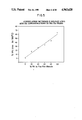
- FIG. 2 shows that the tenacity of several PBI/PA films exceeds the tenacity predicted by the rule of mixtures.
- FIG. 3 shows that the modulus of PBI/PA films exceeds the modulus predicted by the rule of mixtures.
- FIG. 4A shows the Thermal Gravimetric Analysis curves of several PBI/PA films and FIG. 4B shows the Isothermal Thermal Gravimetric Analysis curves of several PBI/PA films.
- FIG. 5 shows that the thermal stability (at 550° C.) of the blend increases as the relative PBI concentration increases.
- FIG. 6 shows that the hydrophilicity (or residual N-methylpyrrolidinone) of the blend follows the rule of mixtures.
- FIG. 7 shows the thermal shrinkage curves for post-treated PBI/PA (80/20) films using a Thermal Mechanical Analyzer. The films had been post-treated with sulfuric acid or with heat.
- FIG. 8 shows the Fourier Transform IR sulfonation absorbance bands of a sulfuric acid post-treated PBI/PA blend.
- FIG. 9 shows the Fourier Transform IR absorbance of a control and a thermally post-treated PBI/PA blend.
- the polyarylate used in the invention has the following unit formula: ##STR2## wherein Ar 1 and Ar 2 represent divalent aromatic moieties or mixtures thereof; wherein Y represents a divalent aliphatic moiety containing up to 6 carbon atoms, or mixtures thereof; wherein Z represents a divalent aliphatic moiety containing up to 6 carbon atoms, or mixtures thereof; and wherein a has a value of greater than 0.5 to 1, b has 0 or a value less than 0.5, and c has a value of 0 or a value less than 0.5, the sum of a, b and c being equal to 1.
- polyarylates which may be used in the compositions of this invention
- preferred polyarylates which may be used in the compositions and processes of this invention have repeating units of the following formula ##STR3## wherein R in the bisphenol moiety represents --C(CH 3 ) 2 -- or --SO 2 -- or --O--.
- the phthalate moiety may be from isophthalic acid, terephthalic acid or a mixture of the two at any ratio (i.e., ranging from 99% isophthalic acid and 1% terephthalic acid to 1% isophthalic acid and 99% terephthalic acid.
- Durel® is an amorphous homopolymer with a weight average molecular weight of about 20,000 to 200,000. Different polyarylates may be blended in the compositions of the invention.
- the polyarylates are soluble in halogenated or polar solvents.
- both the Durel® and Ardel® polyarylates dissolved readily in methylene chloride, chloroform, N-methylpyrrolidinone, N,N-dimethylformamide and N,N-dimethylacetamide.
- heating at 100° C. for 1/2 hour was required for dissolving concentrated polyarylate ( ⁇ 10%) in N-methylpyrrolidinone in order to obtain a clear solution.
- aromatic polybenzimidazole described in the prior art
- the preferred aromatic polybenzimidazoles employed as starting materials to prepare the novel compositions of the present invention are those having the repeating unit formula: ##STR4## wherein >Ar 3 ⁇ represents a tetravalent aromatic moiety having the formula ##STR5## Wherein R 2 is --O--, --SO 2 --, or --CH2-- x and x is a positive integer; and --Ar 4 -- represents a divalent aromatic moiety having the formula ##STR6## wherein R 4 is --O--, --CH2-- x or --Si(CH 3 ) 2 --O--Si(CH 3 ) 2 and x is a positive integer.
- Examples of the more preferred aromatic polybenzimidazoles which may be used in the compositions of the present invention include:
- Aromatic polybenzimidazoles of this type are commercially available from Celanese Corporation. These polybenzimidazoles are preferred components of the compositions because they are relatively more thermally stable and more soluble in N,N-dimethylacetamide than other polybenzimidazoles. This desirable combination of thermal stability and solubility makes them relatively processable. In addition, they have higher molecular weights than other polybenzimidazoles.
- novel compositions comprise from about 5 parts by weight to about 95 parts by weight of a polyarylate and from about 95 parts by weight to about 5 parts by weight of an aromatic polybenzimidazole.
- the more preferred compositions are those which are comprised of about 20 to about 50% of either the aromatic polybenzimidazole or the polyarylate.
- composition of the invention is mostly comprised of aromatic polybenzimidazole, it is preferred that the minor amount of polyarylate in the composition be sufficient to make the aromatic polybenzimidazole more tractable and processable and also less susceptible to moisture. It is thought that the minor amount of the polyarylate accomplishes the amelioration of the processability of the aromatic polybenzimidazole by interacting with and/or plasticizing the aromatic polybenzimidazole. More preferably, the compositions are comprised of from about 50 parts by weight to about 95 parts by weight of an aromatic polybenzimidazole and from about 50 parts by weight to about 5 parts by weight of a polyarylate. Most preferably, the composition comprises at least about 10 parts by weight of a polyarylate.
- a composition of the invention is mostly comprised of polyarylate, it is preferred that the minor amount of aromatic polybenzimidazole in the composition be sufficient to render the polyarylate less sensitive to solvents, particularly chlorinated hydrocarbons.
- the aromatic polybenzimidazole is present in an amount sufficient to result in a composition with greatly reduced solubility and low swelling, i.e., minimal weight loss in the composition of the invention when it is immersed in a chlorinated hydrocarbon for a period of time which would ordinarily result in the dissolving of a similar object made from the polyarylate itself.
- the compositions are comprised of from about 60 parts by weight to about 95 parts by weight of a polyarylate and from about 40 parts by weight to about 5 parts by weight of an aromatic polybenzimidazole.
- the composition should contain at least about 20 to about 30 parts by weight of a polybenzimidazole in order to impart to the polyarylate component greatly enhanced solvent-resistance in chlorinated solvents.
- aromatic polybenzimidazole in the composition substantially increases the thermal stability and physical properties of the composition, giving excellent price-performance results.
- aromatic polybenzimidazoles are on the order of twenty times the price of polyarylates.
- Polyarylates are commercially successful because of their generally good combination of properties, with the exception, of course, of poor resistance to chlorinated solvents in some applications. Those properties can be substantially improved in accordance with this invention by incorporating a minor amount of a relatively more expensive aromatic polybenzimidazole in a miscible blend with the polyarylate. It appears that all the beneficial properties of the polyarylates may be retained and solvent resistance, thermal and physical properties may be improved at a moderate additional cost. It is surprising that a minor amount of the polybenzimidazole can ameliorate the relatively weak properties of the polyarylate, i.e., poor resistance to chlorinated solvents and low thermal stability and physical properties (tenacity and modulus). At the same time, the less expensive polyarylate decreases the cost of the composition substantially below the cost of the polybenzimidazole.
- the aromatic polybenzimidazoles and polyarylates may be first dissolved in a mutual solvent, e.g., N,N-dimethylformamide (DMF), N,N-dimethylacetamide (DMAc), dimethylsulfoxide (DMSO), or N-methylpyrrolidinone (NMP) or concentrated H 2 SO 4 , so that each polymer is present in the resulting solution at the desired concentration up to the total polymer concentration of, e.g., from about 1% to about 25% on a weight/volume basis, preferably from about 15 to 20%. It is preferred that the total concentration of the two polymers in the solution be such that the viscosity of the solution is acceptable for subsequent processing.
- the two polymers may be simultaneously dissolved in the solvent, or each polymer may be separately dissolved in separate volumes of solvent and desired portions of the resulting solutions can be mixed together to form a solution of the two polymers.
- the solution may be added to a non-solvent such as an alcohol containing from 1 to 4 carbon atoms, e.g., methanol, to precipitate a novel composition of this invention with the desired concentration of component polymers.
- a non-solvent such as an alcohol containing from 1 to 4 carbon atoms, e.g., methanol
- the precipitated composition is washed with, e.g., methanol or water, to remove residual solvent if it is present and then, e.g., vacuum-dried at moderate temperatures.
- the solvent should be evaporated at low relative humidity, e.g., in a dry nitrogen atmosphere, and moderate temperatures, e.g., at about ⁇ 140° C.
- the remaining solvent may be removed by washing the film or fibers with hot water. Whether the solution of the composition is cast, extruded or precipitated, moisture should be initially excluded until most of the solvent is removed.
- compositions of the invention are miscible, or compatible.
- Several criteria indicate blend compatibility or miscibility. They are:
- FIG. 1 shows the Fourier Transform IR observed intermolecular Hydrogen bonding of a PBI/PA blend. Due to the Hydrogen bonding, the carbonyl group of the PA shifted from 1741 to 1730 cm -1 . Therefore, the hydrogen bonding between the imidazole hydrogen of the PBI and the carbonyl group of the PA is confirmed.
- FIG. 2 shows that the tenacity of several PBI/PA films exceeds the rule of mixtures values, which indicates the surprising synergistic effect obtained by blending PBI and PA.
- FIG. 3 shows that the modulus of PBI/PA films exceeds the modulus predicted by the rule of mixtures, which further indicates the surprising synergistic effect obtained by blending PBI and PA.
- FIG. 4A shows the results of Thermal Gravimetric Analysis of PBI/PA films, indicating the significant thermal property improvement for PA obtained by blending it with PBI.
- FIG. 4B shows how PBI increases the thermal properties of PA in an isothermal condition.
- FIG. 5 shows that the thermal stability (at 550° C.) of the blend increases proportionately as the relative PBI concentration increases.
- PBI is hydrophilic and has a high moisture and solvent regain. After blending with PA, the hydrophilicity of the PBI dramatically decreased.
- FIG. 6 indicates that the hydrophilicity (or residual NMP) of the blend follows ⁇ he rule of mixtures.
- Another process for preparing moldable compositions comprises grinding together an aromatic polybenzimidazole and a polyarylate in relative weight proportions to each other of from about 5 to about 95 of the aromatic polybenzimidazole to about 95 to about 5 of the polyarylate until the diameters of the solid particulates reach 100 um or less.
- a solid PBI/PA (70/30) blend may be prepared by mechanically grinding a mixture of PBI and PA polymers.
- a freeze mill device may be used for grinding, and the grinding process continued until the diameters of the solid particulates reach 37 um or less (which can take about 40 minutes).
- Those fine solid blends have a uniform visual appearance and are compressively moldable ( ⁇ 5000 psi, 30 minutes at 410° C.).
- the molded product has a dark color, is rigid and exhibits good physical integrity.
- compositions of the invention are miscible in all proportions and are useful as such, useful phase-separated systems may be formed, for example, by changing parameters, such as moisture content during solvent removal.
- the composition and properties of phase-separated systems can be controlled and varied according to the specific properties required, using pressure, temperature, time at the phase-separation conditions, initial composition as variables, etc. Obviously, innumerable combinations of these parameters can be employed to produce a wide assortment of potentially useful phase-separated systems.
- Phase-separated systems have property synergisms when used at a temperature above the glass transition temperature of the aromatic polyarylate component of the composition. It is possible to obtain phase-separated compositions where the matrix polymer is either the aromatic polybenzimidazole or the polyarylate and the dispersed phase is the other polymer. This depends on which polymer is the preponderant component and/or the technique employed to cause the phase separation. If the aromatic polybenzimidazole is the matrix polymer of the phase-separated composition, the polyarylate is the dispersed phase and the composition is used above the glass transition of the polyarylate, then the composition is an impact-resistant plastic. If, however, the aromatic polyarylate is the matrix polymer of the phase-separated composition, the aromatic polybenzimidazole is the dispersed phase and the composition is used above the glass transition of the aromatic polyarylate, then the composition is a reinforced rubber.
- compositions may be post-treated with heat or sulfuric acid in order to minimize their shrinkage when subsequently subjected to heat and in order to increase their resistance to solvents, such as DMAc and NMP, and acids, such as concentrated inorganic acids, such as hydrochloric acid.
- solvents such as DMAc and NMP
- acids such as concentrated inorganic acids, such as hydrochloric acid.
- the compositions are no longer soluble in the solvents used to initially form the blends of the constituent polymers, e.g., DMAc or NMP.
- Heating in air or in an inert atmosphere at a temperature of from about 200° to about 500° C. for a period of time of from about 1 to about 30 minutes may be employed.
- the time-temperature relationship to obtain the required results can be determined empirically.
- heating at a temperature of from about 350° to about 400° C. may be used.
- the product may be posttreated by treating with a sulfonating agent followed by heat setting at temperature of from about 200° to about 500° C. for a period of time sufficient to minimize its shrinkage when subsequently subjected to heat and to increase its resistance to solvents and acids.
- a solution of from 1 to about 15% sulfonating agent followed by heat setting at temperature of from about 200° to about 500° C. may be used.
- the sulfonating agent may be sulfuric acid, sulfur trioxide, toluene sulfonic acid or naphthalene sulfonic acid.
- post-treatment is accomplished by dipping the product in 5% sulfuric acid followed by heat setting at a temperature of from about 350° to about 400° C. for a period of time sufficient to minimize its shrinkage when subsequently subjected to heat and to increase its resistance to solvents and acid.
- the preferred aromatic polybenzimidazole polymer is used, namely, poly-2,2'-(m-phenylene)-5,5'-bibenzimidazole.
- Celanese polybenzimidazole having an inherent viscosity of 0.4 (6 gm) or greater was mixed with 50 mls of N-methylpyrrolidinone at 180° C. for 120 minutes. Then the resulting mixture was filtered through glass wool. The filtrate containing about 12% polybenzimidazole was used as a solvent to dissolve 1.5 gm of Union Carbide's Ardel® polyarylate (120° C., 30 minutes). The solution contained about 12% polybenzimidazole and 3% polyarylate (PA) in N-methylpyrrolidinone (NMP). The solution was kept at 80° C. overnight. The solution (A) was found clear (no precipitate). The solids content of the solution was about 15%. A clear yellow film was cast from solution A on a glass plate. The casting was repeated. Visual and microscopic observation indicated that the thin film was clear.
- Dissolution techniques were developed to assess the compatibility and processability of blends containing polybenzimidazole and polyarylate.
- dopes containing high levels ( ⁇ 20%, wt./vol.%) of solids with the following polybenzimidazole/polyarylate compositions ratios were prepared: 100/0, 80/20, 60/40, 20/80 and 0/100. These dopes were homogeneous and had no insolubles. Also, the stability of these dopes increased with the increase of the relative concentration of polyarylate. Clear films were successfully cast by using the above polybenzimidazole/polyarylate blends. FT-IR analyses suggested that there is a molecular synergism (i.e., intermolecular H-bonding) between polyarylate and polybenzimidazole.
- Table 1 describes the development of a cosolvent for preparing stable and processable dopes containing PBI and PA.
- Table 2 shows the results of the compatibility studies of the PBI/PA blends.
- Table 3 describes the physical property improvements obtained by blending PBI with PA.
- Table 4 indicates that the stability to solvents (e.g., methylene chloride or tetrachloroethane) of PA is dramatically improved by blending it with PBI.
- solvents e.g., methylene chloride or tetrachloroethane
- the miscibility of PBI and PA was further investigated by using phase contrast microscopy and transmission electron microscopy.
- the morphology of cast films of the 80/20 and 60/40 PBI/PA blends as well as their cross-sections were evaluated using these microscopy techniques. Both techniques indicated no evidence of phase separation in those blends.
- the results further confirmed that the compatibility of PBI and PA existed on a molecular scale.
- the compatibility of films of PBI and PA blends was confirmed by X-Ray Diffraction Analysis.
- the PBI/PA film blends Based on the relative PBI concentration, the PBI/PA film blends exhibited excellent or improved resistance towards chlorinated hydrocarbons, but they are still soluble in polar solvents, such as NMP and DMAc. Those film samples also shrunk at an elevated temperature (e.g., >200° C.). Two post-treatment methods, thermal or sulfonation agent treatments, were developed for enhancing the solvent (NMP) stability and thermal shrinkage properties of the compatible PBI/PA blends. Initial results on an 80/20:PBI/PA film indicated the sample treated with either method (e.g., thermal treating at 380° C. for 20 minutes or 5% sulfuric acid dipping followed with 6 minutes 380° C.
- FTIR Fourier Transform Infrared
- NMP dopes containing 80/20 and 50/50 PBI/PA polymers were added to a non-solvent (e.g., methanol) with constant stirring in order to precipitate the component polymers.
- a non-solvent e.g., methanol
- the precipitated composition was washed several times with aqueous methanol to remove residual solvent if it was present and then vacuum dried at 120° C. for 24 hours. After drying, the solid polymer blends were compressively moldable ( ⁇ 5000 psi, 20 minutes at 350° C.) and homogeneous molded products could be obtained.
- a solid PBI/PA (70/30) blend was prepared by mechanically grinding a mixture of PBI and PA polymers. A freeze mill device was used for grinding and the grinding process continued until the diameters of the solid particulates reached 37 um or less (took about 40 minutes). The fine solid blend had a uniform visual appearance and were compressively moldable ( ⁇ 5000 psi, 30 minutes at 410° C.). The molded product had a dark color, was rigid and exhibited good physical integrity.
Landscapes
- Chemical & Material Sciences (AREA)
- Health & Medical Sciences (AREA)
- Chemical Kinetics & Catalysis (AREA)
- Medicinal Chemistry (AREA)
- Polymers & Plastics (AREA)
- Organic Chemistry (AREA)
- Compositions Of Macromolecular Compounds (AREA)
- Manufacture Of Macromolecular Shaped Articles (AREA)
Abstract
Description
              TABLE 1
______________________________________
Cosolvent (NMP) Development
           PBI/PA Ratio (wt./wt.)
           100/0
                80/20  60/40   40/60
                                    20/80
                                         0/100
______________________________________
Dope homogeneity
             Yes    Yes    Yes   Yes  Yes  Yes
Dope Stability
             1      1      3     5    7    >14
(days)
______________________________________
 Note:
 (1) PBI (asspun fiber) having <1 PPM residual LiCl and <0.3% residual DMA
 was used for preparing all dopes.
 (2) The solids content of all dopes was 20% (wt %) and no LiCl was added.
 (3) All dopes were prepared by heating the polymer in NMP at 100°
 C. for two hours.
 (4) PA is Union Carbide Ardel ® (D100).
 (5) Dope homogeneity and stability were based on visual measurements of
 the haze level and insolubles.
              TABLE 2
______________________________________
Compatibility Studies of the PBI/PA Blends
PBI/PA ratio
         100/0   80/20   60/40 40/60 20/80 0/100
______________________________________
Cast film
         Clear   Clear   Clear Clear Clear Clear
H-bonding
         No      Yes     Yes   NM    NM    No
______________________________________
 Note:
 (1) 2 mil films were prepared by drying the wet film (cast on a glass
 plate) in a laboratory vacuum oven at 140° C. for 20 minutes.
 (2) Intermolecular hydrogenbonding of the blend samples was determined by
 using IR. The carbonyl band of PA showed downfield shifting (i.e. from
 1741 to 1730 cm.sup.-1) caused by bonding to the imidazole hydrogen of
 PBI. "NM" means not measurable because the carbonyl background of PA is
 too high to show any imidazoleinduced shifting.
              TABLE 3
______________________________________
Tenacity and Modulus of PBI/PA Films
PBI/PA (wt./wt.)
              Tenacity (K)
                         Modulus (KK)
______________________________________
100/0         8.1        0.26
80/20         9.4        0.26
60/40         11.2       0.27
20/80         8.7        0.22
0/100         4.1        0.17
______________________________________
 Note:
 1. PA (Ardel ® D100)
 2. PBI (As spun fiber)
 3. All data are the average of three individual analyses.
 4 Tenacity (K); K = 10.sup.3 PSI. Modulus (KK); KK = 10.sup.6 PSI.
TABLE 4 ______________________________________ Improved Solvent Stability of PBI/PA Films PBI/PA ratio 100/0 80/20 60/40 40/60 20/80 0/100 ______________________________________ CH.sub.2 Cl.sub.2 I I I I FI S (25° C., 30 min) TCE (100° C.I I I I FI S 10 min.) Film High High High Good Fair No Integrity ______________________________________ Note: 1. I--insoluble; S--Soluble; FI--Fairly insoluble 2. TCE is 1,1,2,2tetrachloroethane
              TABLE 5
______________________________________
Post-Treatment of PBI/PA (80/20) Films
         Thermal Shrinkage
                         NMP Solubility
Treatment
         (40 to 480° C. in air)
                         (100° C., 30 minutes)
______________________________________
Control  6.2%            Soluble
Sulfuric Acid
         4.7%            Insoluble
treated
Thermally
         0.2%            Insoluble
treated
______________________________________
 Note: Control samples were washed with hot water (80° C.) for 12
 hours in order to remove residual NMP.
Claims (18)
Priority Applications (1)
| Application Number | Priority Date | Filing Date | Title |
|---|---|---|---|
| US07/089,650 US4963628A (en) | 1987-08-26 | 1987-08-26 | Compositions of polybenzimidazoles and polyarylates |
Applications Claiming Priority (1)
| Application Number | Priority Date | Filing Date | Title |
|---|---|---|---|
| US07/089,650 US4963628A (en) | 1987-08-26 | 1987-08-26 | Compositions of polybenzimidazoles and polyarylates |
Publications (1)
| Publication Number | Publication Date |
|---|---|
| US4963628A true US4963628A (en) | 1990-10-16 |
Family
ID=22218833
Family Applications (1)
| Application Number | Title | Priority Date | Filing Date |
|---|---|---|---|
| US07/089,650 Expired - Lifetime US4963628A (en) | 1987-08-26 | 1987-08-26 | Compositions of polybenzimidazoles and polyarylates |
Country Status (1)
| Country | Link |
|---|---|
| US (1) | US4963628A (en) |
Cited By (3)
| Publication number | Priority date | Publication date | Assignee | Title |
|---|---|---|---|---|
| US5139863A (en) * | 1989-04-13 | 1992-08-18 | Hoechst Celanese Corporation | Molded polybenzimidazole/polyaryleneketone articles and method of manufacture |
| US20110129601A1 (en) * | 2009-12-01 | 2011-06-02 | Moore John C | Polybenzimidazole/polyacrylate mixtures |
| CN104389045A (en) * | 2014-11-04 | 2015-03-04 | 黑龙江聚翔科技开发有限公司 | Preparation method of thermotropic liquid crystal polyarylester fiber |
Citations (2)
| Publication number | Priority date | Publication date | Assignee | Title |
|---|---|---|---|---|
| US4113683A (en) * | 1977-01-17 | 1978-09-12 | Celanese Corporation | Production of high temperature resistant polymer compositions capable of forming superior fiber reinforced composite articles |
| JPS62146944A (en) * | 1985-12-20 | 1987-06-30 | Taiho Kogyo Co Ltd | Sliding material |
-
1987
- 1987-08-26 US US07/089,650 patent/US4963628A/en not_active Expired - Lifetime
Patent Citations (2)
| Publication number | Priority date | Publication date | Assignee | Title |
|---|---|---|---|---|
| US4113683A (en) * | 1977-01-17 | 1978-09-12 | Celanese Corporation | Production of high temperature resistant polymer compositions capable of forming superior fiber reinforced composite articles |
| JPS62146944A (en) * | 1985-12-20 | 1987-06-30 | Taiho Kogyo Co Ltd | Sliding material |
Cited By (5)
| Publication number | Priority date | Publication date | Assignee | Title |
|---|---|---|---|---|
| US5139863A (en) * | 1989-04-13 | 1992-08-18 | Hoechst Celanese Corporation | Molded polybenzimidazole/polyaryleneketone articles and method of manufacture |
| US20110129601A1 (en) * | 2009-12-01 | 2011-06-02 | Moore John C | Polybenzimidazole/polyacrylate mixtures |
| US9018308B2 (en) | 2009-12-01 | 2015-04-28 | Pbi Performance Products, Inc. | Polybenzimidazole/polyacrylate mixtures |
| WO2012074745A3 (en) * | 2010-12-01 | 2012-10-04 | Pbi Performance Products, Inc. | Polybenzimidazole/polyacrylate mixtures |
| CN104389045A (en) * | 2014-11-04 | 2015-03-04 | 黑龙江聚翔科技开发有限公司 | Preparation method of thermotropic liquid crystal polyarylester fiber |
Similar Documents
| Publication | Publication Date | Title |
|---|---|---|
| Chung | A critical review of polybenzimidazoles: historical development and future R&D | |
| CA1142685A (en) | Aromatic copolyester | |
| US4842740A (en) | Membranes prepared from blend of polybenzimidazole with polyarylates | |
| US5137985A (en) | Miscible blends of polybenzimidazoles and polyamide-imides having fluorine-containing linking groups and process for preparation of the blends | |
| EP1141059A1 (en) | Highly branched block copolymers | |
| US4973629A (en) | Compositions of aromatic polybenzimidazoles and aromatic polyimides | |
| US4113683A (en) | Production of high temperature resistant polymer compositions capable of forming superior fiber reinforced composite articles | |
| US4973630A (en) | Compositions of aromatic polybenzimidazoles and aromatic polyetherimides | |
| US4963628A (en) | Compositions of polybenzimidazoles and polyarylates | |
| IL104198A (en) | Process for spinning from solution of polyamide-imides (spi) based on tolylene or meta-phenylene diisocyanates and fibres thus obtained | |
| CA1256637A (en) | Branched copolyetherketones | |
| EP0242949B1 (en) | Compositions of aromatic polybenzimidazoles and aromatic polyimides or aromatic polyetherimides | |
| Chung et al. | Film and membrane properties of polybenzimidazole (PBI) and polyarylate alloys | |
| US5290884A (en) | Blends of polybenzimidazoles and aromatic polyamides, aromatic polyamide-hydrazides or aromatic polyamides containing heterocyclic linkages | |
| US4963434A (en) | Composites of aromatic polybenzimidazoles and polyarylates | |
| Kong et al. | Miscibility and crystallization behaviour of poly (ether ether ketone)/polyimide blends | |
| US4419308A (en) | Process for producing porous, film-like or fibrous structure of aromatic polyester | |
| EP0465251A1 (en) | Compositions of aromatic polybenzidmidazoles and polysulfones and fibers therefrom | |
| US5086120A (en) | Ionically blended molecular composites | |
| JP2884665B2 (en) | Aromatic polycarbonate / aromatic polyamide block copolymer composition | |
| US4398021A (en) | Solvent resistant, thermoplastic aromatic poly(imidesulfone) and process for preparing same | |
| EP0091669B1 (en) | Process for producing porous, film-like or fibrous structure of aromatic polyester | |
| US5208298A (en) | Stable solution of polybenzimidazole and polysulfons blends | |
| US6025439A (en) | Processing of thermoplastic rigid-rod molecular composites | |
| US5264504A (en) | Graft copolymers of articulated rod-like polymers |
Legal Events
| Date | Code | Title | Description |
|---|---|---|---|
| AS | Assignment |
Owner name: HOECHST CELANESE CORPORATION, 86 MORRIS AVENUE, SU Free format text: ASSIGNMENT OF ASSIGNORS INTEREST.;ASSIGNORS:CHEN, PAUL N. SR.;CHUNG, TAI-SHUNG;HARGET, PAUL J.;REEL/FRAME:004788/0196 Effective date: 19870820 Owner name: HOECHST CELANESE CORPORATION, 86 MORRIS AVENUE, SU Free format text: ASSIGNMENT OF ASSIGNORS INTEREST;ASSIGNORS:CHEN, PAUL N. SR.;CHUNG, TAI-SHUNG;HARGET, PAUL J.;REEL/FRAME:004788/0196 Effective date: 19870820 |
|
| STCF | Information on status: patent grant |
Free format text: PATENTED CASE |
|
| FEPP | Fee payment procedure |
Free format text: PAYOR NUMBER ASSIGNED (ORIGINAL EVENT CODE: ASPN); ENTITY STATUS OF PATENT OWNER: LARGE ENTITY |
|
| FEPP | Fee payment procedure |
Free format text: PAYER NUMBER DE-ASSIGNED (ORIGINAL EVENT CODE: RMPN); ENTITY STATUS OF PATENT OWNER: LARGE ENTITY Free format text: PAYOR NUMBER ASSIGNED (ORIGINAL EVENT CODE: ASPN); ENTITY STATUS OF PATENT OWNER: LARGE ENTITY |
|
| FPAY | Fee payment |
Year of fee payment: 4 |
|
| FPAY | Fee payment |
Year of fee payment: 8 |
|
| AS | Assignment |
Owner name: HOECHST AKTIENGESELLSCHAFT, GERMANY Free format text: ASSIGNMENT OF ASSIGNORS INTEREST;ASSIGNOR:HOECHST CELANESE CORPORATION;REEL/FRAME:009534/0147 Effective date: 19971230 |
|
| FPAY | Fee payment |
Year of fee payment: 12 |
|
| AS | Assignment |
Owner name: CELANESE VENTURES GMBH, GERMANY Free format text: ASSIGNMENT OF ASSIGNORS INTEREST;ASSIGNOR:AVENTIS PHARMA DEUTSCHLAND GMBH;REEL/FRAME:017223/0711 Effective date: 20050831 Owner name: PEMEAS GMBH, GERMANY Free format text: ASSIGNMENT OF ASSIGNORS INTEREST;ASSIGNOR:CLEANESE VENTURES GMBH;REEL/FRAME:017230/0181 Effective date: 20051008 Owner name: AVENTIS PHARMA DEUTSCHLAND, GERMANY Free format text: ASSIGNMENT OF ASSIGNORS INTEREST;ASSIGNOR:HOECHST AG;REEL/FRAME:017223/0694 Effective date: 20050809 |
|
| AS | Assignment |
Owner name: AVENTIS PHARMA DEUTSCHLAND, GERMANY Free format text: ASSIGNMENT OF ASSIGNORS INTEREST;ASSIGNOR:HOECHST AG;REEL/FRAME:017240/0846 Effective date: 20050809 |
|
| AS | Assignment |
Owner name: CELANESE VENTURES GMBH, GERMANY Free format text: ASSIGNMENT OF ASSIGNORS INTEREST;ASSIGNOR:AVENTIS PHARMA DEUTSCHLAND;REEL/FRAME:017275/0116 Effective date: 20050831 Owner name: PEMEAS GMBH, GERMANY Free format text: ASSIGNMENT OF ASSIGNORS INTEREST;ASSIGNOR:CELANESE VENTURES GMBH;REEL/FRAME:017325/0323 Effective date: 20050810 |