US4949629A - Cooking a food product in a process vapor at progressively varying rates - Google Patents

Cooking a food product in a process vapor at progressively varying rates Download PDF

Info

Publication number
US4949629A
US4949629A US07/107,774 US10777487A US4949629A US 4949629 A US4949629 A US 4949629A US 10777487 A US10777487 A US 10777487A US 4949629 A US4949629 A US 4949629A
Authority
US
United States
Prior art keywords
cooking
process vapor
oven
conveyor
food products
Prior art date
Legal status (The legal status is an assumption and is not a legal conclusion. Google has not performed a legal analysis and makes no representation as to the accuracy of the status listed.)
Expired - Fee Related
Application number
US07/107,774
Inventor
Steven G. Leary
Clark K. Benson
Andrew A. Caridis
Daniel E. Brown
Current Assignee (The listed assignees may be inaccurate. Google has not performed a legal analysis and makes no representation or warranty as to the accuracy of the list.)
Heat and Control Inc
Original Assignee
Heat and Control Inc
Priority date (The priority date is an assumption and is not a legal conclusion. Google has not performed a legal analysis and makes no representation as to the accuracy of the date listed.)
Filing date
Publication date
Application filed by Heat and Control Inc filed Critical Heat and Control Inc
Priority to US07/107,774 priority Critical patent/US4949629A/en
Priority to AU23626/88A priority patent/AU611720B2/en
Priority to EP88309559A priority patent/EP0312335B1/en
Priority to CA000579859A priority patent/CA1319302C/en
Priority to DE8888309559T priority patent/DE3880420T2/en
Priority to DK571788A priority patent/DK571788A/en
Priority to JP63258322A priority patent/JPH0738775B2/en
Assigned to HEAT AND CONTROL, INC., A CORP. OF CA reassignment HEAT AND CONTROL, INC., A CORP. OF CA ASSIGNMENT OF ASSIGNORS INTEREST. Assignors: BENSON, CLARK K., BROWN, DANIEL E., CARIDIS, ANDREW A., LEARY, STEVEN G.
Application granted granted Critical
Publication of US4949629A publication Critical patent/US4949629A/en
Priority to US07/708,000 priority patent/US5075120A/en
Assigned to WELLS FARGO BANK, NATIONAL ASSOCIATION reassignment WELLS FARGO BANK, NATIONAL ASSOCIATION SECURITY INTEREST (SEE DOCUMENT FOR DETAILS). Assignors: HEAT CONTROL, INC.
Anticipated expiration legal-status Critical
Expired - Fee Related legal-status Critical Current

Links

Images

Classifications

    • AHUMAN NECESSITIES
    • A21BAKING; EDIBLE DOUGHS
    • A21BBAKERS' OVENS; MACHINES OR EQUIPMENT FOR BAKING
    • A21B1/00Bakers' ovens
    • A21B1/42Bakers' ovens characterised by the baking surfaces moving during the baking
    • A21B1/48Bakers' ovens characterised by the baking surfaces moving during the baking with surfaces in the form of an endless band
    • AHUMAN NECESSITIES
    • A21BAKING; EDIBLE DOUGHS
    • A21BBAKERS' OVENS; MACHINES OR EQUIPMENT FOR BAKING
    • A21B1/00Bakers' ovens
    • A21B1/02Bakers' ovens characterised by the heating arrangements
    • A21B1/24Ovens heated by media flowing therethrough
    • AHUMAN NECESSITIES
    • A21BAKING; EDIBLE DOUGHS
    • A21BBAKERS' OVENS; MACHINES OR EQUIPMENT FOR BAKING
    • A21B3/00Parts or accessories of ovens
    • A21B3/04Air-treatment devices for ovens, e.g. regulating humidity

Definitions

  • This invention relates to cooking food products, and particularly to cooking in a steam-laden process cooking vapor applied in a plurality of cooking zones such that the heat transfer to the food products may be progressive and at varying rates permitting surface browning.
  • Some food products could be fully cooked and provide an excellent product yield when cooked according to the principles of the above patents.
  • certain of those products do not have the appearance of being braised or brown as is commonly seen with products cooked on a flat grill, roasting oven, frying pan or wok.
  • the invention resides in an oven including an elongated housing having product inlet and outlet openings and a conveyor for carrying the products through these openings.
  • the housing is divided internally by a horizontal baffle into an upper heating chamber and lower cooking chamber; is further divided internally by a generally vertical baffle into a first and second cooking zone.
  • the first cooking zone is equipped to provide a steam enriched process cooking vapor for treating food products and for circulating the process vapor between the heating and cooking chambers thereof along a path substantially parallel to the direction of the conveyor movement.
  • the second cooking zone is equipped to provide a steam-laden process vapor circulating between the heating and cooking chambers thereof which and in the cooking chamber is circulated substantially laterally of the direction of conveyor movement so as to envelope the product on the belt in a turbulent flow of the cooking process vapor.
  • Control means are provided to regulate the temperature and moisture content of the process vapor in the second zone independently of the temperature and moisture content of the process vapor circulated in the first zone.
  • the invention resides also in a process of cooking food products in an oven including an elongated housing having an inlet for food products to be cooked in the oven and an outlet for emitting food products from the oven including passing food products into the housing upon a conveyor of generally permeable construction and applying a cooking process vapor to the food products in a first cooking zone with the cooking process vapor being circulated parallel to the path of conveyor movement.
  • a general object of the invention is to provide an oven for cooking food products in a plurality of cooking zones, each separately controllable as to the temperature, moisture content and velocity of the process vapor circulating therein.
  • Another object of the invention is to provide an improved oven for cooking food in a steam-laden process vapor having a very high rate of heat transfer in one portion of the oven as compared to the rate of heat transfer in another portion of the oven.
  • Another object of the invention is to provide a process which is highly energy efficient for both cooking and browning food products in a process vapor at progressively varying rates of heat transfer to the food product.
  • Another object is to provide an apparatus which is adapted to the cooking and browning of a variety of product shapes including patties, links and chicken parts/pieces and to afford browning to both the top and bottom surfaces of such products substantilly simultaneously.
  • Another object of the invention is to provide an oven wherein a cooking process vapor is generated and circulated to envelope the products to be cooked in turbulent flow for greatly enhanced heat transfer.
  • a further object is to provide an oven of the type described which may be easily cleaned on the interior surfaces so that the by-products of the cooking process may be removed more easily than was practical in prior art air impingement ovens.
  • a still further object is to provide an oven of the type described which is highly energy efficient, permitting operation at lower temperatures or shorter cooking times than prior art ovens of comparable size.
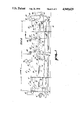
  • FIG. 1 of the drawings is a side elevational view, partially broken away, of an apparatus made in accordance with the principles of the present invention for performing the process of the present invention
  • FIG. 2 is an enlarged sectional view in the direction of the arrows 2-2 of FIG. 1;
  • FIG. 3 is a further enlarged fragmentary sectional view in the direction of the arrows 3-3 in FIG. 2;
  • FIG. 4 is a diagrammatic view of the flow patterns of the cooking process vapor circulated in zone II of the present invention.
  • FIG. 5 is a schematic diagram of the control system applicable to the present invention.
  • the oven 10 of the present invention is illustrated in the drawings, and referring particularly to FIG. 1, comprises in general a first oven section 11 and a second oven section 12 which serve to define cooking zone I and cooking zone II, respectively, for the cooking process of the present invention.
  • the oven 10 is supported upon a framework 13 and an endless conveyor 14 is provided to convey food products from an inlet opening 16 through the oven 10 and exiting the oven at an outlet opening 17.
  • an endless conveyor 14 is provided to convey food products from an inlet opening 16 through the oven 10 and exiting the oven at an outlet opening 17.
  • the direction of movement on the top run of the endless conveyor 14 is from the left to the right as indicated by the arrows 18.
  • a generally horizontal baffle 21 divides the oven 10 into an upper heating compartment 22 and a lower cooking compartment 23, the top run of the endless conveyor 14 extending through the lower cooking compartment for conveying and supporting the food to be cooked.
  • a vertically arranged baffle 24 generally divides the oven into the first 11 and second 12 oven sections and a gap 26 in the baffle is sized to permit food to be carried from the first to the second section.
  • the vertical baffle 24 may be equipped adjacent gap 26 with a moveable member or flap 27 to afford partial closure of the gap and serves to maintain a separation and distinction between the cooking process vapor operative in zone I from the cooking process vapor operative within zone II, which will be described more fully below.
  • the first oven section 11 comprises an elongate housing or shell 31 which is divisible along a horizontal plane defined generally by the horizontal baffle 21 and the housing 31 is generally arranged in accordance with the disclosure of U.S. Pat. No. 3,947,241 in that an upper shell portion may be raised from the lower shell portion to expose the interior of the oven for cleaning and servicing.
  • a water seal (not shown) acts between the upper and lower shell portions as an explosion release and for retaining the process vapor within the oven, confining the cooking gasses against escape into the surrounding plant.
  • a heat source 32 is arranged on the housing 31 to provide for the heating of the cooking process vapor in the upper heating compartment 22.
  • the heating unit 32 may comprise a gas burner assembly for discharging a jet of flame and combustion gasses into the heating chamber.
  • a heating unit comprised of electrically actuated heating element or heating elements energized by steam or heat transfer fluids may be arranged in the upper heating compartment 22 for heating and reheating the cooking process vapor as it is circulated by a tangential fan 33.
  • the fan 33 rotates in the direction of the arrows 34 (counterclockwise as viewed in FIG. 1) to circulate a cooking process vapor in the direction of the arrows 36 in a path generally parallel to the movement of food on the conveyor 14, as indicated by the arrow 18.
  • the first oven section 11 at the end proximate the vertical baffle 24 is equipped with turning vanes or baffles 37 serve to direct the cooking process vapor through the open wire mesh conveyor belt 14 into the upper heating compartment 22 where the process vapor is reheated by the heat source 32.
  • the arrow 38 indicates the recirculation pattern of the cooking process vapor from the lower cooking compartment into the upper heating compartment. It has been found that an inconsequential amount of the process vapor from zone I is entrained into the process vapor of zone II through the gap 26 in the vertical baffle 24. The amount of process vapor passing into zone II has had no material effect on the process carried out therein.
  • a steam supply manifold 39 is arranged to distribute from a steam supply (not shown) a flow of steam into the cooking process vapor.
  • the rate that steam is supplied is controlled by a system employing dry bulb and wet bulb thermocouples disposed in the oven as generally disclosed in U.S. Pat. No. 3,947,241.
  • a wet bulb thermocouple (not shown) is arranged within the cone 41 for monitoring the moisture content of the cooking process vapor.
  • means are provided to cause a draft to be created adjacent to the oven inlet 16 and includes a stack 42 provided with an exhaust fan (not shown).
  • the lower of the portion of the stack overlies the conveyor belt and when the fan is operative, ambient air is swept up the stack 42 and a small component of the process vapor is also entrained therein all to ensure that the process vapor will maintain an established level of moisture without accumulation of air from the plant.
  • a similar stack 42 is arranged at the outlet opening 17.
  • the second oven section 12 which encloses cooking zone II is equipped with a generally horizontal baffle 46 which serves to divide the second oven section into an upper heating compartment 47 and a lower cooking compartment 48.
  • the second oven section 12 includes an upper shell portion 49 which contains the upper heating compartment 47 and a lower shell portion 51 which contains the lower cooking compartment, as shown in FIG. 2.
  • a portion of the vertical sidewall of the upper shell 49 extends into a water trough 52 provided by the lower shell so as to establish a water seal, as mentioned above, between the two shell portions, 49 and 51.
  • the upper shell portion 49 maybe elevated with respect to the lower shell portion 51 to afford an opportunity for inspection and cleaning of the second oven section and the arrangement for achieving this is well known in the field and consequently is not disclosed herein.
  • the endless conveyor 14 extends through the lower cooking compartment 48 of the second oven section 12 and is supported therein by tubular members 53 mounted on a support frame 54 which extends to the lower wall 56 of the lower shell 51.
  • This arrangement is conventional and is also found in the first oven section 11.
  • the bottom portions of the lower cooking compartment is of double wall construction thus providing a channel for cooling liquid for maintaining the bottom of the oven at a relatively low temperature for the collection of drippings from the belt, preventing their burn-on to the metal surfaces.
  • the upper heating compartment 47 is equipped with a heat source 32, FIG. 1, which may be constructed and arranged similar if not identical to the heat source for the first oven section. In each case, however, the gas burner or electrical or other heating means are independently controlled so that the heating of the first zone is independent of the heating of the second zone.
  • a plurality of plenums 61 extending from the upper heating compartment 47 to the lower cooking compartment 48 serves for delivery of cooking process vapor into the cooking compartment 48.
  • the plenums 61 are disposed in spaced-apart pairs, one on each side of the conveyor 14; thus a set of plenums would comprise two which straddle the conveyor belt 14. It is desirable to provide an oven section with several sets or pairs of plenums arranged in tandem along the conveyor 14 so that the flow of cooking process vapor may be regulated over discrete lengths of the conveyor path thus providing a large measure of control over the rate of heat transfer of the process vapor to the product 62.
  • Two set or pairs are indicated in the drawings, but this number is only for the purpose of illustration and sets of plenums and associated nozzles, motors, etc. may be 3, 4, 5, etc. in number of sets as the application should require.
  • each plenum 61 in its upper portion has the shape of a scroll or spiral which serves as the outer shell for a tangential fan 63, the intake 64 of which is open to the upper heaing compartment 47, clearly shown in FIG. 2.
  • the rotors of the fan 63 are fixedly secured to a shaft 66 which extend laterally of the oven 10, the shaft 66 being suitably mounted in bearing supports 67 arranged on the upper shell 49 of the second oven section 12.
  • the fan 63 is driven by a variable speed controlled electric or hydraulic motor 68 through a drive connection comprising a pair of drive belts 69 operatively reaved over the pulleys 71 mounted on the motor drive shaft and the fan shaft 66.
  • the motor 68 rotates in the direction causing flow of the squirrel cage fan 63 to propell the cooking process vapor in the direction of the arrows 72 into the inlet of the fan, as shown in FIG. 2, urging the cooking vapor downwardly in the plenums 61 in the direction of the arrows 73 as shown in FIGS. 3 and 4.
  • a plurality of nozzles 76 are arranged in the lower portion of the plenum 61 in arrays such that on one side of the conveyor belt the array of nozzles projects laterally therefrom in a plane above the belt and from the opposite side of the belt an array of nozzles projects laterally of the belt in a plane generally below the belt, as shown in FIGS. 2 and 3. More specifically, the plenums 61 shown at the left hand portion of FIG. 2 presents an array of nozzles 76 for issuing the process vapor above the conveyor and product supported thereon. The plenum 61 on the right hand portion of FIG.
  • the flow of cooking process vapor in zone II as indicated by the arrows 77 may be in the range of from 3,000 to 4,500 feet per minute.
  • the flow of cooking vapor in zone I as indicated by the arrow 38 is generally on the order of 700 feet per minute.
  • the net effect of the increased circulation speed in zone II has been found to be a reduction in cooking time, an increase in browning of the food product on all sides by reason of the turbulent circulation above and below the product, the use of lower cooking temperatures and a resulting savings in fuel costs.
  • the array of nozzles 76 on the plenum shown at the left hand portion therein are disposed above the conveyor 14 and phantom circle lines indicate the array of nozzles disposed on the opposite side of the oven.
  • the right hand portion of FIG. 3 shows a plenum 61 disposed downstream of the last-mentioned plenum and with the array of nozzles 76 positioned to project cooking process vapor below the product. Phantom circle lines thereabove indicate the position of the nozzles in the plenum 61 on the opposite side of the belt.
  • the rotational speeds in the fans 63 may be on the order of 2100 rpm and the fans in each of the plenum pairs may be driven either at the same speed or at different speeds to achieve particular processing objectives.
  • the power of the fans is such as to cause a substantial draft of the process vapor which produces a flow in the second oven section, zone II, as indicated by the flow arrows 81.
  • the turbulent flow as indicated by the arrows 77 is transformed by the draft of the fans into a general mass flow in the direction of the arrows 81 for recirculating the cooking process vapor in the second zone from the lower cooking compartment 48 to the upper heating compartment 47 where the cooking process vapor is reheated.
  • a steam supply manifold 39, FIG. 2 is disposed in the second oven section and is coupled to a a wet bulb motorized modulating steam valve coupled to thermocouple unit (not shown) which functions as disclosed in U.S. Pat. No. 3,947,241.
  • the wet bulb thermocouple is positioned within the cone 41 as indicated at FIG. 11 in that patent.
  • the oven 10 is provided in zone II with means for sweeping liquids from the surface of the food products. More specifically, the liquid sweeping means 86 comprises a steam supply tube extending laterally across and above the conveyor 14 so as to overlie the products passing below the tube.
  • the tube is coupled to a suitable supply of process vapor or steam (not shown) and nozzles 87 are formed in the tube to project blasts of steam in the direction shown generally by the arrows 88 for sweeping liquid from the surface of the product 62.
  • the nozzles 87 may comprise a narrow slit arranged longitudinally of the tubular member 86 so that the steam meay issue therefrom in a narrow sheet or curtain for removing liquid all across the belt, thereby permitting the top surface of the product to receive heat more readily from the cooking process vapor and to achieve a browned appearance.
  • zone II controls are arranged in a circuit for controlling the speeds of the motors 68 and thus the volume of process vapor circulated by the fans 63.
  • a programmable controller 91 is coupled to a process time indicator 92 for controlling the speed of the conveyor 14 through the conveyor speed control 93, FIG. 1.
  • the oven temperature in zone I is sensed by a dry bulb thermocouple 94 disposed in the path of the process cooking vapor, the thermocouple providing a signal to the progrmmable controller 91 for operation of the heat source 32, for example a modulating burner motor 96.
  • zone I The moisture content in zone I is sensed by a wet bulb thermocouple 97 positioned in the cone 41 and provides a signal to the programmable controller 91 for actuating a motorized steam valve 98 for supplying steam through the steam supply manifold 39 into zone I to maintain a selected moisture content in the process vapor circulating therein.
  • Zone II of the oven is also equipped with a dry bulb thermocouple 99 giving an input to the dry bulb controller 91 which in turn provides an output to the heat source 32 for actuating the burner motor 101, FIG. 1.
  • a wet bulb thermocouple 102 positioned in the cone 41 of Zone II provides an input to the programmable controller 91 for actuation of a motorized steam 103 so as to achieve and maintain the desired moisture content of the cooking process atmosphere in zone II through supplying steam therein through the steam manifold 39, FIG. 2.
  • Each of the fan motors 68 is equipped with a speed indicator 104 furnishing an input to the programmable controller 91 with respect to the set fan speed.
  • the motors for each of the fans is also provided with a fan motor variable speed controller 106 for controlling the flow rate of the process vapor through the plenums 91 and nozzles 76 for establishing turbulent flow above and below the conveyor belt 14.
  • the speed of the fans associated with each plenum pair may be identical or different.
  • the fans in plenum pair A would operate at a slower speed than the fans in plenum pair B which would turn slower than the fans in plenum pair C which in turn would be operated slower than the fans in plenum pair D.
  • the flow through the plenums arranged downstream would be from slow to fast and the heat transfer would also be from slow to fast.
  • Another program would be to arrange the fan speeds from fast to slow; still another arrangement would be slow to fast to slow to achieve a particularly desired product conditioning.

Landscapes

  • Life Sciences & Earth Sciences (AREA)
  • Engineering & Computer Science (AREA)
  • Food Science & Technology (AREA)
  • Commercial Cooking Devices (AREA)
  • Baking, Grill, Roasting (AREA)
  • General Preparation And Processing Of Foods (AREA)

Abstract

An oven and method for cooking solid foods. The oven comprises an elongated housing divided into tandem cooking zones each with separate cooking and heating chambers. Food products are carried on a vapor pervious conveyor through the cooking chambers as a distinct cooking process vapor is recirculated in each zone at different rates between the heating and cooking chambers. In one zone, the process vapor is circulated generally laterally of the conveyor over the food in a turbulent mode and then recirculated for reheating in a path parallel to the conveyor.

Description

This invention relates to cooking food products, and particularly to cooking in a steam-laden process cooking vapor applied in a plurality of cooking zones such that the heat transfer to the food products may be progressive and at varying rates permitting surface browning.
Co-inventors Andrew A. Caridis and Clark K. Benson were granted two patents which disclose a novel apparatus and process for heating and cooking foods in a closed treatment chamber, U.S. Pat. Nos. 3,947,241 granted Mar. 30, 1976 and 4,167,585 granted Sept. 11, 1979. Within the treatment chamber disclosed in those patents a moving stream of process vapor was generated and steam or water vapor was injected into the process vapor which was heated and the temperature and moisture content were controlled to pre-selected values. Food products such as chicken parts, sometimes breaded, and meat patties were placed on a wire mesh conveyor belt extending through the treatment chamber and moved therethrough in their original positions while being cooked in the surrounding and circulating cooking process vapor. Those inventions were quite successful and have been adopted by the food processing industry.
Some food products, especially meat products such as sausage, meat patties, uncoated chicken parts, could be fully cooked and provide an excellent product yield when cooked according to the principles of the above patents. However, certain of those products do not have the appearance of being braised or brown as is commonly seen with products cooked on a flat grill, roasting oven, frying pan or wok. There is a popular demand for food products with a braised or browned appearance as contrasted to a pallid appearance, although the latter can be disguised in meat products with a coating such as gravy. It is possible to obtain a browned appearance on some meat products, such as sausages, by introducing sugar into the product formulation to achieve the browned effect. It is also possible to cook a product at a relatively high temperature, for example 450°-600°, to achieve a browned appearance. However, adding sugar to a product formulation increases the cost and cooking the product at a high temperature reduces product yield. These expedients to achieve a browned appearance can be improved upon.
In our co-pending patent application Ser. No. 897,085, filed Aug. 18, 1986, and entitled Browning a Food Product in a Moving, Steam-Laden Process Vapor, we disclosed browning meat products for example, using an infrared heat source after sweeping liquids from the surface of the products with a blast of steam. Thus the product surface was exposed to the IR heat source free from the shield that juices, fats and the like would otherwise provide.
In our work we have come to recognize that it is advantageous in cooking a food product, particularly a meat product, to treat the product progressively during processing to cause heat transfer to the product at controlled varying rates, if possible. There is a recognizable improvement in the appearance of the product and a better yield when this goal is achieved. This is in contrast to applying heat to food products at a relatively constant rate over the entire cooking process. In such a case the major process controls are only cook time, temperature, and moisture content in the process vapor. A change in any of these causes an effect throughout the whole oven.
The beneficial effect of high velocity air impingment on heat transfer to a food product has been known for some time and ovens operating in accordance with such principles are in use today. However, a known shortcoming of these ovens is the difficulty of cleaning, which is highly desirable at the end of the daily production runs. Another undesirable condition is the drying effect on the product if moisture content of the process vapor is low.
In summary, the invention resides in an oven including an elongated housing having product inlet and outlet openings and a conveyor for carrying the products through these openings. The housing is divided internally by a horizontal baffle into an upper heating chamber and lower cooking chamber; is further divided internally by a generally vertical baffle into a first and second cooking zone. The first cooking zone is equipped to provide a steam enriched process cooking vapor for treating food products and for circulating the process vapor between the heating and cooking chambers thereof along a path substantially parallel to the direction of the conveyor movement.
The second cooking zone is equipped to provide a steam-laden process vapor circulating between the heating and cooking chambers thereof which and in the cooking chamber is circulated substantially laterally of the direction of conveyor movement so as to envelope the product on the belt in a turbulent flow of the cooking process vapor. Control means are provided to regulate the temperature and moisture content of the process vapor in the second zone independently of the temperature and moisture content of the process vapor circulated in the first zone.
The invention resides also in a process of cooking food products in an oven including an elongated housing having an inlet for food products to be cooked in the oven and an outlet for emitting food products from the oven including passing food products into the housing upon a conveyor of generally permeable construction and applying a cooking process vapor to the food products in a first cooking zone with the cooking process vapor being circulated parallel to the path of conveyor movement. Moving the food product from said first cooking zone to a second cooking zone and applying therein a cooking process vapor to the food product in a direction generally laterally of the path of conveyor movement in a higher veocity turbulent action and then moving the cooking process vapor in said second cooking zone in a direction parallel to the path of conveyor movement and reheating the cooking process vapor in said second zone separately from reheating the cooking process vapor in said first cooking zone.
A general object of the invention is to provide an oven for cooking food products in a plurality of cooking zones, each separately controllable as to the temperature, moisture content and velocity of the process vapor circulating therein.
Another object of the invention is to provide an improved oven for cooking food in a steam-laden process vapor having a very high rate of heat transfer in one portion of the oven as compared to the rate of heat transfer in another portion of the oven.
Another object of the invention is to provide a process which is highly energy efficient for both cooking and browning food products in a process vapor at progressively varying rates of heat transfer to the food product.
Another object is to provide an apparatus which is adapted to the cooking and browning of a variety of product shapes including patties, links and chicken parts/pieces and to afford browning to both the top and bottom surfaces of such products substantilly simultaneously.
Another object of the invention is to provide an oven wherein a cooking process vapor is generated and circulated to envelope the products to be cooked in turbulent flow for greatly enhanced heat transfer.
A further object is to provide an oven of the type described which may be easily cleaned on the interior surfaces so that the by-products of the cooking process may be removed more easily than was practical in prior art air impingement ovens.
A still further object is to provide an oven of the type described which is highly energy efficient, permitting operation at lower temperatures or shorter cooking times than prior art ovens of comparable size.
Further objects and advantages of the invention will become apparent from the accompanying drawings taken in connection with a detailed description of a preferred embodiment of the invention.
FIG. 1 of the drawings is a side elevational view, partially broken away, of an apparatus made in accordance with the principles of the present invention for performing the process of the present invention;
FIG. 2 is an enlarged sectional view in the direction of the arrows 2-2 of FIG. 1;
FIG. 3 is a further enlarged fragmentary sectional view in the direction of the arrows 3-3 in FIG. 2;
FIG. 4 is a diagrammatic view of the flow patterns of the cooking process vapor circulated in zone II of the present invention;
FIG. 5 is a schematic diagram of the control system applicable to the present invention.
The oven 10 of the present invention is illustrated in the drawings, and referring particularly to FIG. 1, comprises in general a first oven section 11 and a second oven section 12 which serve to define cooking zone I and cooking zone II, respectively, for the cooking process of the present invention. The oven 10 is supported upon a framework 13 and an endless conveyor 14 is provided to convey food products from an inlet opening 16 through the oven 10 and exiting the oven at an outlet opening 17. Thus the direction of movement on the top run of the endless conveyor 14 is from the left to the right as indicated by the arrows 18.
A generally horizontal baffle 21 divides the oven 10 into an upper heating compartment 22 and a lower cooking compartment 23, the top run of the endless conveyor 14 extending through the lower cooking compartment for conveying and supporting the food to be cooked. A vertically arranged baffle 24 generally divides the oven into the first 11 and second 12 oven sections and a gap 26 in the baffle is sized to permit food to be carried from the first to the second section. The vertical baffle 24 may be equipped adjacent gap 26 with a moveable member or flap 27 to afford partial closure of the gap and serves to maintain a separation and distinction between the cooking process vapor operative in zone I from the cooking process vapor operative within zone II, which will be described more fully below.
Still referring to FIG. 1, the first oven section 11 comprises an elongate housing or shell 31 which is divisible along a horizontal plane defined generally by the horizontal baffle 21 and the housing 31 is generally arranged in accordance with the disclosure of U.S. Pat. No. 3,947,241 in that an upper shell portion may be raised from the lower shell portion to expose the interior of the oven for cleaning and servicing. A water seal (not shown) acts between the upper and lower shell portions as an explosion release and for retaining the process vapor within the oven, confining the cooking gasses against escape into the surrounding plant. A heat source 32 is arranged on the housing 31 to provide for the heating of the cooking process vapor in the upper heating compartment 22. The heating unit 32 may comprise a gas burner assembly for discharging a jet of flame and combustion gasses into the heating chamber. Alternatively, a heating unit comprised of electrically actuated heating element or heating elements energized by steam or heat transfer fluids may be arranged in the upper heating compartment 22 for heating and reheating the cooking process vapor as it is circulated by a tangential fan 33. The fan 33 rotates in the direction of the arrows 34 (counterclockwise as viewed in FIG. 1) to circulate a cooking process vapor in the direction of the arrows 36 in a path generally parallel to the movement of food on the conveyor 14, as indicated by the arrow 18. The first oven section 11 at the end proximate the vertical baffle 24 is equipped with turning vanes or baffles 37 serve to direct the cooking process vapor through the open wire mesh conveyor belt 14 into the upper heating compartment 22 where the process vapor is reheated by the heat source 32. The arrow 38 indicates the recirculation pattern of the cooking process vapor from the lower cooking compartment into the upper heating compartment. It has been found that an inconsequential amount of the process vapor from zone I is entrained into the process vapor of zone II through the gap 26 in the vertical baffle 24. The amount of process vapor passing into zone II has had no material effect on the process carried out therein.
Provision is made in zone I of the oven 10 for infusion of steam into the cooking process vapor and to that end a steam supply manifold 39 is arranged to distribute from a steam supply (not shown) a flow of steam into the cooking process vapor. The rate that steam is supplied is controlled by a system employing dry bulb and wet bulb thermocouples disposed in the oven as generally disclosed in U.S. Pat. No. 3,947,241. A wet bulb thermocouple (not shown) is arranged within the cone 41 for monitoring the moisture content of the cooking process vapor.
To maintain the moisture content of the cooking process vapor at a selected value it is necessary to prevent contamination of the vapor by entraining air such as through the inlet to the oven 16.
To this end means are provided to cause a draft to be created adjacent to the oven inlet 16 and includes a stack 42 provided with an exhaust fan (not shown). The lower of the portion of the stack overlies the conveyor belt and when the fan is operative, ambient air is swept up the stack 42 and a small component of the process vapor is also entrained therein all to ensure that the process vapor will maintain an established level of moisture without accumulation of air from the plant. A similar stack 42 is arranged at the outlet opening 17.
Referring now to FIGS. 1, 2 and 3, the second oven section 12 which encloses cooking zone II is equipped with a generally horizontal baffle 46 which serves to divide the second oven section into an upper heating compartment 47 and a lower cooking compartment 48. The second oven section 12 includes an upper shell portion 49 which contains the upper heating compartment 47 and a lower shell portion 51 which contains the lower cooking compartment, as shown in FIG. 2. A portion of the vertical sidewall of the upper shell 49 extends into a water trough 52 provided by the lower shell so as to establish a water seal, as mentioned above, between the two shell portions, 49 and 51. It will be understood that the upper shell portion 49 maybe elevated with respect to the lower shell portion 51 to afford an opportunity for inspection and cleaning of the second oven section and the arrangement for achieving this is well known in the field and consequently is not disclosed herein.
The endless conveyor 14 extends through the lower cooking compartment 48 of the second oven section 12 and is supported therein by tubular members 53 mounted on a support frame 54 which extends to the lower wall 56 of the lower shell 51. This arrangement is conventional and is also found in the first oven section 11. Similarly, the bottom portions of the lower cooking compartment is of double wall construction thus providing a channel for cooling liquid for maintaining the bottom of the oven at a relatively low temperature for the collection of drippings from the belt, preventing their burn-on to the metal surfaces.
The upper heating compartment 47 is equipped with a heat source 32, FIG. 1, which may be constructed and arranged similar if not identical to the heat source for the first oven section. In each case, however, the gas burner or electrical or other heating means are independently controlled so that the heating of the first zone is independent of the heating of the second zone.
Referring now to FIGS. 2 and 3, a plurality of plenums 61 extending from the upper heating compartment 47 to the lower cooking compartment 48 serves for delivery of cooking process vapor into the cooking compartment 48. The plenums 61 are disposed in spaced-apart pairs, one on each side of the conveyor 14; thus a set of plenums would comprise two which straddle the conveyor belt 14. It is desirable to provide an oven section with several sets or pairs of plenums arranged in tandem along the conveyor 14 so that the flow of cooking process vapor may be regulated over discrete lengths of the conveyor path thus providing a large measure of control over the rate of heat transfer of the process vapor to the product 62. Two set or pairs are indicated in the drawings, but this number is only for the purpose of illustration and sets of plenums and associated nozzles, motors, etc. may be 3, 4, 5, etc. in number of sets as the application should require.
Referring particularly to FIGS. 2 and 3, each plenum 61 in its upper portion has the shape of a scroll or spiral which serves as the outer shell for a tangential fan 63, the intake 64 of which is open to the upper heaing compartment 47, clearly shown in FIG. 2. The rotors of the fan 63 are fixedly secured to a shaft 66 which extend laterally of the oven 10, the shaft 66 being suitably mounted in bearing supports 67 arranged on the upper shell 49 of the second oven section 12. The fan 63 is driven by a variable speed controlled electric or hydraulic motor 68 through a drive connection comprising a pair of drive belts 69 operatively reaved over the pulleys 71 mounted on the motor drive shaft and the fan shaft 66. The motor 68 rotates in the direction causing flow of the squirrel cage fan 63 to propell the cooking process vapor in the direction of the arrows 72 into the inlet of the fan, as shown in FIG. 2, urging the cooking vapor downwardly in the plenums 61 in the direction of the arrows 73 as shown in FIGS. 3 and 4.
So as to envelop the product 62 in a turbulent flow of the process cooking vapor through the pervious conveyor belt, a plurality of nozzles 76 are arranged in the lower portion of the plenum 61 in arrays such that on one side of the conveyor belt the array of nozzles projects laterally therefrom in a plane above the belt and from the opposite side of the belt an array of nozzles projects laterally of the belt in a plane generally below the belt, as shown in FIGS. 2 and 3. More specifically, the plenums 61 shown at the left hand portion of FIG. 2 presents an array of nozzles 76 for issuing the process vapor above the conveyor and product supported thereon. The plenum 61 on the right hand portion of FIG. 2 presents an array of nozzles 76 for projecting a flow of cooking process vapor laterally of and below the conveyor 14 and the products supported thereon. The process vapor issues from the nozzle in the direction of the arrows 77 to envelope the product both above and below the conveyor thereby greatly increasing the rate of heat transfer from the cooking process vapor to the product.
More specifically, the flow of cooking process vapor in zone II as indicated by the arrows 77 may be in the range of from 3,000 to 4,500 feet per minute. The flow of cooking vapor in zone I as indicated by the arrow 38 is generally on the order of 700 feet per minute. The net effect of the increased circulation speed in zone II has been found to be a reduction in cooking time, an increase in browning of the food product on all sides by reason of the turbulent circulation above and below the product, the use of lower cooking temperatures and a resulting savings in fuel costs.
As shown in FIG. 3, the array of nozzles 76 on the plenum shown at the left hand portion therein are disposed above the conveyor 14 and phantom circle lines indicate the array of nozzles disposed on the opposite side of the oven. The right hand portion of FIG. 3 shows a plenum 61 disposed downstream of the last-mentioned plenum and with the array of nozzles 76 positioned to project cooking process vapor below the product. Phantom circle lines thereabove indicate the position of the nozzles in the plenum 61 on the opposite side of the belt.
The rotational speeds in the fans 63 may be on the order of 2100 rpm and the fans in each of the plenum pairs may be driven either at the same speed or at different speeds to achieve particular processing objectives. The power of the fans is such as to cause a substantial draft of the process vapor which produces a flow in the second oven section, zone II, as indicated by the flow arrows 81. Thus, the turbulent flow as indicated by the arrows 77 is transformed by the draft of the fans into a general mass flow in the direction of the arrows 81 for recirculating the cooking process vapor in the second zone from the lower cooking compartment 48 to the upper heating compartment 47 where the cooking process vapor is reheated.
A steam supply manifold 39, FIG. 2, is disposed in the second oven section and is coupled to a a wet bulb motorized modulating steam valve coupled to thermocouple unit (not shown) which functions as disclosed in U.S. Pat. No. 3,947,241. The wet bulb thermocouple is positioned within the cone 41 as indicated at FIG. 11 in that patent.
During an oven cooking process, even in the presence of a cooking atmosphere saturated with steam, it has been found that fats and juices exude onto the surfaces of the food products. Certain of these liquids drip from the product into the bottom of the oven while other portions of the liquid remain on the surface of the product and inhibit the desired surface browning which gives a desired visual appeal to the product. To ensure that liquids are removed from the surface of the products, the oven 10 is provided in zone II with means for sweeping liquids from the surface of the food products. More specifically, the liquid sweeping means 86 comprises a steam supply tube extending laterally across and above the conveyor 14 so as to overlie the products passing below the tube. The tube is coupled to a suitable supply of process vapor or steam (not shown) and nozzles 87 are formed in the tube to project blasts of steam in the direction shown generally by the arrows 88 for sweeping liquid from the surface of the product 62. Alternatively, the nozzles 87 may comprise a narrow slit arranged longitudinally of the tubular member 86 so that the steam meay issue therefrom in a narrow sheet or curtain for removing liquid all across the belt, thereby permitting the top surface of the product to receive heat more readily from the cooking process vapor and to achieve a browned appearance.
The operation of the oven 10 is controlled as to processing time, oven temperatures and oven moisture content. Further, in zone II controls are arranged in a circuit for controlling the speeds of the motors 68 and thus the volume of process vapor circulated by the fans 63.
Referring particularly to FIG. 5, a programmable controller 91 is coupled to a process time indicator 92 for controlling the speed of the conveyor 14 through the conveyor speed control 93, FIG. 1. The oven temperature in zone I is sensed by a dry bulb thermocouple 94 disposed in the path of the process cooking vapor, the thermocouple providing a signal to the progrmmable controller 91 for operation of the heat source 32, for example a modulating burner motor 96. The moisture content in zone I is sensed by a wet bulb thermocouple 97 positioned in the cone 41 and provides a signal to the programmable controller 91 for actuating a motorized steam valve 98 for supplying steam through the steam supply manifold 39 into zone I to maintain a selected moisture content in the process vapor circulating therein.
Zone II of the oven is also equipped with a dry bulb thermocouple 99 giving an input to the dry bulb controller 91 which in turn provides an output to the heat source 32 for actuating the burner motor 101, FIG. 1. A wet bulb thermocouple 102 positioned in the cone 41 of Zone II provides an input to the programmable controller 91 for actuation of a motorized steam 103 so as to achieve and maintain the desired moisture content of the cooking process atmosphere in zone II through supplying steam therein through the steam manifold 39, FIG. 2.
Each of the fan motors 68 is equipped with a speed indicator 104 furnishing an input to the programmable controller 91 with respect to the set fan speed. The motors for each of the fans is also provided with a fan motor variable speed controller 106 for controlling the flow rate of the process vapor through the plenums 91 and nozzles 76 for establishing turbulent flow above and below the conveyor belt 14.
It is understood that where a series of plenum pairs are provided in zone II of an oven, for example, four pairs, that the speed of the fans associated with each plenum pair may be identical or different. For example, the fans in plenum pair A would operate at a slower speed than the fans in plenum pair B which would turn slower than the fans in plenum pair C which in turn would be operated slower than the fans in plenum pair D. Thus the flow through the plenums arranged downstream would be from slow to fast and the heat transfer would also be from slow to fast. Another program would be to arrange the fan speeds from fast to slow; still another arrangement would be slow to fast to slow to achieve a particularly desired product conditioning.
It appears that many variations are possible in the process described here and in use of the exemplary apparatus disclosed. Accordingly, it should be understood that the disclosures here are intended to be purely illustrative and not in any sense limiting.
Claims (11)

What is claimed is:
1. An oven for cooking food products comprising an elongated housing having an inlet for food products to be cooked in the oven and an outlet for emitting cooked food products from the oven, conveyor means of generally permeable construction serving to convey food products through such inlet and outlet,
said housing being divided internally by a generally horizontal baffle into an upper heating chamber and a lower cooking chamber, said housing being further divided internally by a generally vertical baffle into a first and second cooking zone,
means in said first cooking zone serving to provide a steam laden process vapor for treating food products and including means for circulating said process vapor between said heating and cooking chambers along a path substantially parallel to the direction of conveyor movement,
means in said second cooking zone serving to provide a steam laden process vapor circulating between said heat and cooking chambers (in a path which in said heating chamber is generally parallel to the direction of conveyor movement),
means communicating with the heating chamber in said second cooking zone serving to divert (divide) the circulating process vapor and to direct its flow so as to emit the process vapor generally horizontally into (in) the cooking chamber from a location alongside the conveyor means (is circulated) in a path substantially lateral(ly) to the direction of conveyor movement and lateral to the product carrying surface of the conveyor means,
control means serving to permit control of the temperature and moisture content of the process vapor circulating in the second zone independently of the temperature and moisture content of the process vapor circulating in the first zone.
2. The apparatus of claim 1 and further including means in the second zone cooking chamber serving to remove liquid deposits such as juices from the surface of the food products by projecting steam upon the food products moving towards the oven outlet.
3. The apparatus of claim 1 wherein the means serving to divert (divide) the circulating process vapor includes a plurality of plenums extending between the upper heating chamber and the lower cooking chamber (therein) and being arranged for discharging the process vapor into the cooking chamber along the sides of said conveyor means,
fans means co-acting with said plenums serving to circulate the cooking process vapor between said heating and cooking chambers,
said plenums each being in communication with (having) an array of nozzles arranged (disposed) to cause (permit) the cooking process vapor to discharge into the cooking chamber towards the sides of the conveyor means (circulate) generally laterally of the path of conveyor travel, said nozzles projecting generally laterally of the product carrying surface of the conveyor means,
at least one of said nozzle arrays being arranged to discharge the process vapor (disposed) below the general plane of said conveyor means and at least one other of said nozzle arrays being arranged to discharge the process vapor (disposed) above the general plane of said conveyor means.
4. The oven in accordance with claim 3 wherein said fan means is arranged so that the fan intake is exposed to receive the cooking process vapor in the heating chamber and to exhaust the cooking process vapor into the cooking chamber through said nozzle arrays.
5. In an oven for cooking food products the combination comprising an elongated housing having an inlet for food products to be cooked in the oven and an outlet for emitting cooked food products from the oven, conveyor means of generally permeable construction serving to convey food products through such oven inlet and outlet, said housing being divided internally by a generally horizontal baffle so as to provide an upper heating chamber and a lower cooking chamber,
a plurality of plenums serving to conduct a process vapor (extending) between the upper heating chamber and the lower cooking chamber and (in said housing) including discharge portions of said plenums disposed adjacent to the sides of said conveyor means,
fan means co-acting with said plenums serving to circulate (a) the cooking process vapor between said heating and cooking chambers,
said discharge portions of said plenums each having an array of nozzles disposed to permit the cooking process vapor to discharge from the plenum adjacent to the side margins of said conveyor means (circulate) in the cooking chamber generally laterally of the path of conveyor travel,
said nozzles projecting generally laterally towards the side portions of the product carrying surface of said conveyor means,
at least one of said nozzle arrays being disposed below the general plane of said conveyor means and at least one of said nozzle arrays being disposed above the general plane of said conveyor means,
whereby the process vapor exiting the nozzles along the sides of (above and below) the conveyor means in opposing directions creates a turbulent condition through the permeable conveyor serving to promote rapid heat transfer to the food products supported thereon,
heating means for heating the cooking process vapor in said heating chamber, and means for emitting steam into said cooking process vapor, said fan means co-acting with said horizontal baffle and said plenums so as to circulate the process vapor from the cooking chamber to the heating chamber where the cooking medium is reheatable for reuse in the cooking chamber.
6. The oven in accordance with claim 5 wherein said fan means are arranged to supply a draft of process vapor to a pair of horizontally spaced apart plenums (spaced) arranged laterally of said conveyor means, the nozzle array in the plenum on one side of said conveyor means being vertically offset with respect to the nozzle array in the plenum on the opposite side of said conveyor means (from the nozzles in the other plenum in said pair).
7. The oven in accordance with claim 5 wherein said fan means is arranged so that the fan intake is exposed to receive the cooking process vapor in the heating chamber and to exhaust the cooking process vapor into the cooking chamber.
8. The oven in accordance with claim 6 wherein a plurality of plenum pairs are provided along said conveyor means,
each plenum pair being operatively coupled with such fans means serving to circulate the cooking process vapor from the heating chamber to the cooking chamber, and control means serving to permit regulation of said fan means for delivery of the cooking process vapor to one of said plenum pairs at a (greater) rate greater than that being delivered to another of said plenum pairs,
whereby the rate of heat transfer to said food product may be varied as such food products are conveyed past the discharge portions of said plenum pairs by said conveyor means.
9. The oven in accordance with claim 8 and further including means serving to remove liquid deposits such as fats or juices from the surface of food products, said means including means to supply a blast of steam towards the surface of the food product including steam conduit means arranged above said conveyor means, said steam conduit means having elongated slit nozzle means serving to project steam upon food products upon the conveyor moving towards the oven outlet.
10. A convection oven in accordance with claim 5 wherein the nozzle array in the plenum on one side of said conveyor means is longitudinally offset with respect to the nozzle array on the other side of said conveyor means.
11. A convection oven in accordance with claim 5 wherein the nozzle array associated with a plenum on one side of said conveyor means is longitudinally offset from the nozzle array associated with the plenum on the opposite side of said conveyor means.
US07/107,774 1987-10-13 1987-10-13 Cooking a food product in a process vapor at progressively varying rates Expired - Fee Related US4949629A (en)

Priority Applications (8)

Application Number Priority Date Filing Date Title
US07/107,774 US4949629A (en) 1987-10-13 1987-10-13 Cooking a food product in a process vapor at progressively varying rates
AU23626/88A AU611720B2 (en) 1987-10-13 1988-10-11 An oven for cooking food products
CA000579859A CA1319302C (en) 1987-10-13 1988-10-12 Cooking a food product in a process vapor at progressively varying rates
DE8888309559T DE3880420T2 (en) 1987-10-13 1988-10-12 COOKING A FOOD IN A STEAM PROCESS BY INCREASINGLY VARIABLE TREATMENT STAGES.
EP88309559A EP0312335B1 (en) 1987-10-13 1988-10-12 Cooking a food product in a process vapor at progressively varying rates
DK571788A DK571788A (en) 1987-10-13 1988-10-13 PREPARATION OF A FOOD PRODUCT IN A PROCESSIVE VAPE AT PROGRESSIVE VARIABLE SPEEDS
JP63258322A JPH0738775B2 (en) 1987-10-13 1988-10-13 Cooking food products in process steam at progressively variable rates
US07/708,000 US5075120A (en) 1987-10-13 1991-05-23 Method of cooking a food product in a process vapor at progressively varying rates

Applications Claiming Priority (1)

Application Number Priority Date Filing Date Title
US07/107,774 US4949629A (en) 1987-10-13 1987-10-13 Cooking a food product in a process vapor at progressively varying rates

Related Child Applications (1)

Application Number Title Priority Date Filing Date
US55095690A Continuation-In-Part 1987-10-13 1990-07-31

Publications (1)

Publication Number Publication Date
US4949629A true US4949629A (en) 1990-08-21

Family

ID=22318404

Family Applications (1)

Application Number Title Priority Date Filing Date
US07/107,774 Expired - Fee Related US4949629A (en) 1987-10-13 1987-10-13 Cooking a food product in a process vapor at progressively varying rates

Country Status (7)

Country Link
US (1) US4949629A (en)
EP (1) EP0312335B1 (en)
JP (1) JPH0738775B2 (en)
AU (1) AU611720B2 (en)
CA (1) CA1319302C (en)
DE (1) DE3880420T2 (en)
DK (1) DK571788A (en)

Cited By (47)

* Cited by examiner, † Cited by third party
Publication number Priority date Publication date Assignee Title
US5048719A (en) * 1988-05-10 1991-09-17 Nestec S.A. Apparatus for storing, heating and dispensing portioned food items
US5133249A (en) * 1991-12-20 1992-07-28 Lyco Manufacturing, Inc. Steam and air injection blancher
US5189948A (en) * 1991-02-05 1993-03-02 Beltec International Low temperature spiral conduction vapor cooker and process
US5322007A (en) * 1991-08-15 1994-06-21 Heat And Control, Inc. Compact, high-capacity oven
US5664482A (en) * 1996-09-13 1997-09-09 Beltec International Hydrostatically-sealed atmospheric spiral spray cooker
US5686004A (en) * 1996-04-29 1997-11-11 Schneider; Russell C. Pizza oven with conveyor
US6068874A (en) * 1993-02-16 2000-05-30 Dehydration Technologies, Inc. Process of dehydrating biological products
US6268012B1 (en) 1996-06-07 2001-07-31 Dtl S.A. Dried product and a drying process
US20040159245A1 (en) * 2003-02-17 2004-08-19 Laitram, L.L.C. Steam shrimp cooker
US20040211765A1 (en) * 2002-07-05 2004-10-28 Mcfadden David H. Multi rack speed cooking oven
US20060163238A1 (en) * 2005-01-26 2006-07-27 Miller R C Modular cooking oven and related methods
US20070137633A1 (en) * 2004-03-05 2007-06-21 Mcfadden David Conveyor oven
USRE39828E1 (en) 1995-06-26 2007-09-11 Miller R Craig Convection/impingement oven for continuously cooking food
US20070298148A1 (en) * 2004-11-08 2007-12-27 Stork Titan B.V. Treatment Device and Method for Treating Food Products With Conditioned Air
USRE40232E1 (en) 1999-10-14 2008-04-08 Lyco Manufacturing, Inc. Method for processing food product
US20080099008A1 (en) * 2002-07-05 2008-05-01 Bolton David A Re-Circulating Oven With Gas Clean-Up
US20080105136A1 (en) * 2003-07-07 2008-05-08 Turbochef Technologies, Inc. Griddle
US20080105133A1 (en) * 2003-07-07 2008-05-08 Turbochef Technologies, Inc. Speed cooking oven with improved radiant mode
US20080105135A1 (en) * 2003-07-07 2008-05-08 Mcfadden David H Speed cooking oven with sloped oven floor and reversing gas flow
US20080105249A1 (en) * 2003-07-07 2008-05-08 Turbochef Technologies, Inc. Speed cooking oven with radiant mode
US20080182214A1 (en) * 2006-10-19 2008-07-31 Wayne/Scott Fetzer Company Modulated power burner system and method
US20080206420A1 (en) * 2002-07-05 2008-08-28 Mcfadden David H Air Fryer
US20080296284A1 (en) * 2003-07-07 2008-12-04 Turbochef Technologies, Inc. Combination speed cooking oven
US20100159099A1 (en) * 2008-12-22 2010-06-24 Laitram, L.L.C. Method and apparatus for steam-cooking
US20110084056A1 (en) * 2008-04-18 2011-04-14 Hendrikus Antonius Jacobus Kuenen Oven and process to control the air-flow and air-leakages between two chambers
US8658953B2 (en) 2003-07-07 2014-02-25 Turbochef Technologies, Inc. Antenna cover for microwave ovens
US9295281B2 (en) 2012-06-06 2016-03-29 Momentum Machines Company System and method for dispensing toppings
US9295282B2 (en) 2012-06-06 2016-03-29 Momentum Machines Company System and method for dispensing toppings
US9326544B2 (en) 2012-06-06 2016-05-03 Momentum Machines Company System and method for dispensing toppings
US9386799B2 (en) 2012-06-06 2016-07-12 Momentum Machines Company System and method for dispensing toppings
WO2017147473A1 (en) * 2016-02-26 2017-08-31 Provisur Technologies, Inc. Cooking devices and methods of using the same
US10068273B2 (en) 2013-03-13 2018-09-04 Creator, Inc. Method for delivering a custom sandwich to a patron
CN110275555A (en) * 2019-07-15 2019-09-24 深圳市深思泰电子科技有限公司 For Solid fuel barbecue furnace accurate temperature control system
US10448650B2 (en) 2016-05-05 2019-10-22 Provisur Technologies, Inc. Spiral cooking devices and methods of using the same
CN110856620A (en) * 2018-08-22 2020-03-03 松下知识产权经营株式会社 heating cooker
EP1842009B1 (en) * 2005-01-26 2020-04-15 Enersyst Development Center, LLC Conveyorized impingement oven
US10905150B2 (en) 2012-06-06 2021-02-02 Creator, Inc. System for dispensing toppings
US11023949B2 (en) 2013-03-13 2021-06-01 Creator, Inc. Method for delivering a custom sandwich to a patron
WO2021202850A1 (en) * 2020-04-02 2021-10-07 Automation Tech, LLC Modular cooking appliance having a hot air oven
US11185105B2 (en) 2018-06-20 2021-11-30 Creator, Inc. System and method for dispensing toppings
US11739942B2 (en) 2020-04-02 2023-08-29 Automation Tech, LLC Modular cooking appliance having a hot air oven with a built-in magnetron and a double duty heater
US11737467B2 (en) 2020-04-02 2023-08-29 Automation Tech, LLC Method for cooking in a modular cooking appliance
US12063732B2 (en) 2020-04-02 2024-08-13 Automation Tech, LLC Modular cooking appliance having an auto-loading microwave oven
US12178357B2 (en) 2020-04-02 2024-12-31 Automation Tech, LLC Modular cooking appliance
US12239255B2 (en) 2020-04-02 2025-03-04 Automation Tech, LLC Modular cooking appliance
US12287098B2 (en) 2020-04-02 2025-04-29 Automation Tech, LLC Modular cooking appliance having a grease shield
US12480662B2 (en) 2020-04-02 2025-11-25 Automation Tech, LLC Modular cooking appliance having a user interface

Families Citing this family (4)

* Cited by examiner, † Cited by third party
Publication number Priority date Publication date Assignee Title
IT1270063B (en) * 1994-07-04 1997-04-28 Rossi & Catelli Spa AUTOCLAVE FOR THE CONTINUOUS COOKING AND STERILIZATION OF FOOD PRODUCTS IN GENERAL
IT1270062B (en) * 1994-07-04 1997-04-28 Rossi & Catelli Spa PLANT FOR INDUSTRIAL SCALE PRODUCTION OF COOKED FOOD, LONG STORAGE READY TO CONSUME
NL1028252C2 (en) 2005-02-11 2006-08-14 Cfs Bakel Bv Method for treating food products, as well as line oven therefor.
WO2017053866A1 (en) * 2015-09-23 2017-03-30 John Bean Technologies Corporation Impingement oven

Citations (10)

* Cited by examiner, † Cited by third party
Publication number Priority date Publication date Assignee Title
US4154861A (en) * 1976-05-19 1979-05-15 Smith Donald P Heat treatment of food products
US4167585A (en) * 1976-03-01 1979-09-11 Heat And Control, Inc. Method for heating and cooking foods in a closed treatment chamber by maintaining the temperature and moisture content
GB2045593A (en) * 1979-04-07 1980-11-05 Simon Vicars Ltd Bakers oven
DE3248581A1 (en) * 1982-12-30 1984-07-05 Pondeljak, geb. Filipovic, Margita, 51415 Lovran Method for preserving, in particular for removing moisture from foodstuffs and semi-luxury food items such as juices, and a device for carrying out this method
US4473593A (en) * 1982-03-15 1984-09-25 Proctor & Schwartz Process for preparing quick-cooking food products
WO1985005546A1 (en) * 1984-05-31 1985-12-19 Robert Bruce Forney Continuous feed oven
US4563945A (en) * 1984-11-13 1986-01-14 Stein Associates, Inc. Heat shield-steam distributor for cooking oven
US4569658A (en) * 1983-09-13 1986-02-11 Baker Perkins Holdings, Plc. Tunnel ovens
US4701340A (en) * 1985-12-09 1987-10-20 Lincoln Foodservice Products, Inc. Impingement and steam oven apparatus for preparing food products
US4737373A (en) * 1987-02-11 1988-04-12 Forney Robert B Cooking and browning system

Family Cites Families (6)

* Cited by examiner, † Cited by third party
Publication number Priority date Publication date Assignee Title
DE2110500A1 (en) * 1970-03-06 1971-09-23 Lyons & Co Ltd J Heat exchanger module and furnace using it
US3881403A (en) * 1973-03-30 1975-05-06 Baker Perkins Inc Apparatus for making bread and like food products
US4582047A (en) * 1979-07-26 1986-04-15 Hester Industries, Inc. High humidity steam cooker with continuously running conveyor
US4471750A (en) * 1982-05-19 1984-09-18 Mastermatic, Inc. Tunnel heater
US4548191A (en) * 1984-03-22 1985-10-22 Stein Associates, Inc. Food cooking oven and method
AU2102188A (en) * 1988-08-16 1990-03-08 Meyer Metalcraft Specialties, Inc. Food product cooker

Patent Citations (11)

* Cited by examiner, † Cited by third party
Publication number Priority date Publication date Assignee Title
US4167585A (en) * 1976-03-01 1979-09-11 Heat And Control, Inc. Method for heating and cooking foods in a closed treatment chamber by maintaining the temperature and moisture content
US4167585B1 (en) * 1976-03-01 1985-04-02
US4154861A (en) * 1976-05-19 1979-05-15 Smith Donald P Heat treatment of food products
GB2045593A (en) * 1979-04-07 1980-11-05 Simon Vicars Ltd Bakers oven
US4473593A (en) * 1982-03-15 1984-09-25 Proctor & Schwartz Process for preparing quick-cooking food products
DE3248581A1 (en) * 1982-12-30 1984-07-05 Pondeljak, geb. Filipovic, Margita, 51415 Lovran Method for preserving, in particular for removing moisture from foodstuffs and semi-luxury food items such as juices, and a device for carrying out this method
US4569658A (en) * 1983-09-13 1986-02-11 Baker Perkins Holdings, Plc. Tunnel ovens
WO1985005546A1 (en) * 1984-05-31 1985-12-19 Robert Bruce Forney Continuous feed oven
US4563945A (en) * 1984-11-13 1986-01-14 Stein Associates, Inc. Heat shield-steam distributor for cooking oven
US4701340A (en) * 1985-12-09 1987-10-20 Lincoln Foodservice Products, Inc. Impingement and steam oven apparatus for preparing food products
US4737373A (en) * 1987-02-11 1988-04-12 Forney Robert B Cooking and browning system

Cited By (73)

* Cited by examiner, † Cited by third party
Publication number Priority date Publication date Assignee Title
US5048719A (en) * 1988-05-10 1991-09-17 Nestec S.A. Apparatus for storing, heating and dispensing portioned food items
US5189948A (en) * 1991-02-05 1993-03-02 Beltec International Low temperature spiral conduction vapor cooker and process
US5322007A (en) * 1991-08-15 1994-06-21 Heat And Control, Inc. Compact, high-capacity oven
US5407692A (en) * 1991-08-15 1995-04-18 Heat And Control, Inc. Process for treating food products with steam
US5133249A (en) * 1991-12-20 1992-07-28 Lyco Manufacturing, Inc. Steam and air injection blancher
US6068874A (en) * 1993-02-16 2000-05-30 Dehydration Technologies, Inc. Process of dehydrating biological products
USRE39828E1 (en) 1995-06-26 2007-09-11 Miller R Craig Convection/impingement oven for continuously cooking food
US5686004A (en) * 1996-04-29 1997-11-11 Schneider; Russell C. Pizza oven with conveyor
US6268012B1 (en) 1996-06-07 2001-07-31 Dtl S.A. Dried product and a drying process
US5664482A (en) * 1996-09-13 1997-09-09 Beltec International Hydrostatically-sealed atmospheric spiral spray cooker
USRE42732E1 (en) 1999-10-14 2011-09-27 Lyco Manufacturing, Inc. Rotary blancher for processing food product
USRE40232E1 (en) 1999-10-14 2008-04-08 Lyco Manufacturing, Inc. Method for processing food product
US20040211765A1 (en) * 2002-07-05 2004-10-28 Mcfadden David H. Multi rack speed cooking oven
US9351495B2 (en) 2002-07-05 2016-05-31 Turbochef Technologies, Inc. Air fryer
US20060169272A1 (en) * 2002-07-05 2006-08-03 Mcfadden David H Speed cooking oven with gas flow control
US8893705B2 (en) 2002-07-05 2014-11-25 Turbochef Technologies, Inc. Speed cooking oven
US8297270B2 (en) 2002-07-05 2012-10-30 Turbochef Technologies, Inc. Speed cooking oven
US20040216732A1 (en) * 2002-07-05 2004-11-04 Mcfadden David H. Speed cooking oven
US20080206420A1 (en) * 2002-07-05 2008-08-28 Mcfadden David H Air Fryer
US20080099008A1 (en) * 2002-07-05 2008-05-01 Bolton David A Re-Circulating Oven With Gas Clean-Up
US8006685B2 (en) 2002-07-05 2011-08-30 Turbochef Technologies, Inc. Re-circulating oven with gas clean-up
US7836874B2 (en) 2002-07-05 2010-11-23 Turbochef Technologies, Inc. Multi rack speed cooking oven
US7836875B2 (en) 2002-07-05 2010-11-23 Turbochef Technologies, Inc. Speed cooking oven with gas flow control
US7069841B2 (en) * 2003-02-17 2006-07-04 Laitram, L.L.C. Steam shrimp cooker
US20040159245A1 (en) * 2003-02-17 2004-08-19 Laitram, L.L.C. Steam shrimp cooker
US8011293B2 (en) 2003-07-07 2011-09-06 Turbochef Technologies, Inc. Speed cooking oven with sloped oven floor and reversing gas flow
US20080296284A1 (en) * 2003-07-07 2008-12-04 Turbochef Technologies, Inc. Combination speed cooking oven
US20080105249A1 (en) * 2003-07-07 2008-05-08 Turbochef Technologies, Inc. Speed cooking oven with radiant mode
US20080105135A1 (en) * 2003-07-07 2008-05-08 Mcfadden David H Speed cooking oven with sloped oven floor and reversing gas flow
US7886658B2 (en) 2003-07-07 2011-02-15 Turbochef Technologies, Inc. Speed cooking oven with improved radiant mode
US8658953B2 (en) 2003-07-07 2014-02-25 Turbochef Technologies, Inc. Antenna cover for microwave ovens
US7946224B2 (en) 2003-07-07 2011-05-24 Turbochef Technologies, Inc. Griddle
US20080105133A1 (en) * 2003-07-07 2008-05-08 Turbochef Technologies, Inc. Speed cooking oven with improved radiant mode
US20080105136A1 (en) * 2003-07-07 2008-05-08 Turbochef Technologies, Inc. Griddle
US8035062B2 (en) 2003-07-07 2011-10-11 Turbochef Technologies, Inc. Combination speed cooking oven
US20070137633A1 (en) * 2004-03-05 2007-06-21 Mcfadden David Conveyor oven
US9700059B2 (en) * 2004-11-08 2017-07-11 Stork Titan B V Treatment device and method for treating food products with conditioned air
US20070298148A1 (en) * 2004-11-08 2007-12-27 Stork Titan B.V. Treatment Device and Method for Treating Food Products With Conditioned Air
US20060163238A1 (en) * 2005-01-26 2006-07-27 Miller R C Modular cooking oven and related methods
US7220944B2 (en) 2005-01-26 2007-05-22 Miller R Craig Modular cooking oven and related methods
EP1842009B1 (en) * 2005-01-26 2020-04-15 Enersyst Development Center, LLC Conveyorized impingement oven
US20080182214A1 (en) * 2006-10-19 2008-07-31 Wayne/Scott Fetzer Company Modulated power burner system and method
US8075304B2 (en) * 2006-10-19 2011-12-13 Wayne/Scott Fetzer Company Modulated power burner system and method
US20110084056A1 (en) * 2008-04-18 2011-04-14 Hendrikus Antonius Jacobus Kuenen Oven and process to control the air-flow and air-leakages between two chambers
CN102264234A (en) * 2008-12-22 2011-11-30 莱特拉姆有限责任公司 Apparatus and method for steam cooking
CN102264234B (en) * 2008-12-22 2013-10-23 莱特拉姆有限责任公司 Apparatus and method for steam cooking
US8932658B2 (en) * 2008-12-22 2015-01-13 Laitram, L.L.C. Method and apparatus for steam-cooking
US20100159099A1 (en) * 2008-12-22 2010-06-24 Laitram, L.L.C. Method and apparatus for steam-cooking
US10292415B2 (en) 2012-06-06 2019-05-21 Creator, Inc. System for dispensing toppings
US9295281B2 (en) 2012-06-06 2016-03-29 Momentum Machines Company System and method for dispensing toppings
US9326544B2 (en) 2012-06-06 2016-05-03 Momentum Machines Company System and method for dispensing toppings
US9386799B2 (en) 2012-06-06 2016-07-12 Momentum Machines Company System and method for dispensing toppings
US9770049B2 (en) 2012-06-06 2017-09-26 Momentum Machines Company System and method for dispensing toppings
US10905150B2 (en) 2012-06-06 2021-02-02 Creator, Inc. System for dispensing toppings
US10219535B2 (en) 2012-06-06 2019-03-05 Creator, Inc. System for dispensing toppings
US9295282B2 (en) 2012-06-06 2016-03-29 Momentum Machines Company System and method for dispensing toppings
US11023949B2 (en) 2013-03-13 2021-06-01 Creator, Inc. Method for delivering a custom sandwich to a patron
US10068273B2 (en) 2013-03-13 2018-09-04 Creator, Inc. Method for delivering a custom sandwich to a patron
WO2017147473A1 (en) * 2016-02-26 2017-08-31 Provisur Technologies, Inc. Cooking devices and methods of using the same
US10448650B2 (en) 2016-05-05 2019-10-22 Provisur Technologies, Inc. Spiral cooking devices and methods of using the same
US11291210B2 (en) 2016-05-05 2022-04-05 Provisur Technologies, Inc. Spiral cooking devices and methods of using the same
US11185105B2 (en) 2018-06-20 2021-11-30 Creator, Inc. System and method for dispensing toppings
CN110856620A (en) * 2018-08-22 2020-03-03 松下知识产权经营株式会社 heating cooker
CN110856620B (en) * 2018-08-22 2024-01-26 松下知识产权经营株式会社 heating cooker
CN110275555A (en) * 2019-07-15 2019-09-24 深圳市深思泰电子科技有限公司 For Solid fuel barbecue furnace accurate temperature control system
US11739942B2 (en) 2020-04-02 2023-08-29 Automation Tech, LLC Modular cooking appliance having a hot air oven with a built-in magnetron and a double duty heater
US11737467B2 (en) 2020-04-02 2023-08-29 Automation Tech, LLC Method for cooking in a modular cooking appliance
WO2021202850A1 (en) * 2020-04-02 2021-10-07 Automation Tech, LLC Modular cooking appliance having a hot air oven
US12063732B2 (en) 2020-04-02 2024-08-13 Automation Tech, LLC Modular cooking appliance having an auto-loading microwave oven
US12178357B2 (en) 2020-04-02 2024-12-31 Automation Tech, LLC Modular cooking appliance
US12239255B2 (en) 2020-04-02 2025-03-04 Automation Tech, LLC Modular cooking appliance
US12287098B2 (en) 2020-04-02 2025-04-29 Automation Tech, LLC Modular cooking appliance having a grease shield
US12480662B2 (en) 2020-04-02 2025-11-25 Automation Tech, LLC Modular cooking appliance having a user interface

Also Published As

Publication number Publication date
DE3880420D1 (en) 1993-05-27
JPH01199548A (en) 1989-08-10
AU2362688A (en) 1989-04-13
DK571788D0 (en) 1988-10-13
DE3880420T2 (en) 1993-09-09
CA1319302C (en) 1993-06-22
JPH0738775B2 (en) 1995-05-01
EP0312335B1 (en) 1993-04-21
DK571788A (en) 1989-04-14
EP0312335A1 (en) 1989-04-19
AU611720B2 (en) 1991-06-20

Similar Documents

Publication Publication Date Title
US4949629A (en) Cooking a food product in a process vapor at progressively varying rates
US5075120A (en) Method of cooking a food product in a process vapor at progressively varying rates
AU718872B2 (en) Air impingement oven
US5934178A (en) Air impingement oven
US5243962A (en) Cooking oven for slow-cooking of food products
EP0512061B1 (en) Cooking oven and method for cooking of food products
US5322007A (en) Compact, high-capacity oven
US6142066A (en) Smoked food apparatus
EP1797758B1 (en) Continuous cooking oven system
US3947241A (en) Food treatment apparatus and process
US3873755A (en) Method for precooking bacon
US5560952A (en) Process for continuously cooking food
US6707010B2 (en) Oven with fluid jet device
AU680567B2 (en) Conveyor oven with improved air flow
EP0370021A1 (en) Method and apparatus for pulse heating and cooking food products
WO2003092407A1 (en) Cooking method and apparatus
NL2036554B1 (en) Spiral oven and method for treating food products with conditioned air
JPH0383547A (en) Roasting of food and device therefor
JPH0720135U (en) Food roasting equipment with superheated steam

Legal Events

Date Code Title Description
AS Assignment

Owner name: HEAT AND CONTROL, INC., A CORP. OF CA,CALIFORNIA

Free format text: ASSIGNMENT OF ASSIGNORS INTEREST;ASSIGNORS:LEARY, STEVEN G.;BENSON, CLARK K.;CARIDIS, ANDREW A.;AND OTHERS;REEL/FRAME:004843/0305

Effective date: 19871210

Owner name: HEAT AND CONTROL, INC., SOUTH SAN FRANCISCO, CA A

Free format text: ASSIGNMENT OF ASSIGNORS INTEREST.;ASSIGNORS:LEARY, STEVEN G.;BENSON, CLARK K.;CARIDIS, ANDREW A.;AND OTHERS;REEL/FRAME:004843/0305

Effective date: 19871210

AS Assignment

Owner name: WELLS FARGO BANK, NATIONAL ASSOCIATION, CALIFORNIA

Free format text: SECURITY INTEREST;ASSIGNOR:HEAT CONTROL, INC.;REEL/FRAME:006223/0659

Effective date: 19910915

FPAY Fee payment

Year of fee payment: 4

REMI Maintenance fee reminder mailed
LAPS Lapse for failure to pay maintenance fees
FP Lapsed due to failure to pay maintenance fee

Effective date: 19980821

STCH Information on status: patent discontinuation

Free format text: PATENT EXPIRED DUE TO NONPAYMENT OF MAINTENANCE FEES UNDER 37 CFR 1.362