US4916427A - Electronic electrothermal conversion material, its products and method for production thereof - Google Patents
Electronic electrothermal conversion material, its products and method for production thereof Download PDFInfo
- Publication number
- US4916427A US4916427A US07/287,110 US28711088A US4916427A US 4916427 A US4916427 A US 4916427A US 28711088 A US28711088 A US 28711088A US 4916427 A US4916427 A US 4916427A
- Authority
- US
- United States
- Prior art keywords
- temperature
- insulating material
- resistant insulating
- conductive semiconductor
- kinds
- Prior art date
- Legal status (The legal status is an assumption and is not a legal conclusion. Google has not performed a legal analysis and makes no representation as to the accuracy of the status listed.)
- Expired - Lifetime
Links
- 239000000463 material Substances 0.000 title claims abstract description 66
- 238000006243 chemical reaction Methods 0.000 title claims abstract description 17
- 238000004519 manufacturing process Methods 0.000 title claims description 6
- 239000011810 insulating material Substances 0.000 claims abstract description 34
- 239000004065 semiconductor Substances 0.000 claims abstract description 21
- 239000012528 membrane Substances 0.000 claims abstract description 19
- 229910052751 metal Inorganic materials 0.000 claims abstract description 17
- 239000002184 metal Substances 0.000 claims abstract description 17
- 229910044991 metal oxide Inorganic materials 0.000 claims abstract description 17
- 150000004706 metal oxides Chemical class 0.000 claims abstract description 17
- 239000000126 substance Substances 0.000 claims abstract description 16
- 238000000034 method Methods 0.000 claims abstract description 12
- OKKJLVBELUTLKV-UHFFFAOYSA-N Methanol Chemical compound OC OKKJLVBELUTLKV-UHFFFAOYSA-N 0.000 claims abstract description 8
- 229910021627 Tin(IV) chloride Inorganic materials 0.000 claims abstract description 8
- HPGGPRDJHPYFRM-UHFFFAOYSA-J tin(iv) chloride Chemical compound Cl[Sn](Cl)(Cl)Cl HPGGPRDJHPYFRM-UHFFFAOYSA-J 0.000 claims abstract description 8
- 150000002739 metals Chemical class 0.000 claims abstract description 7
- VEXZGXHMUGYJMC-UHFFFAOYSA-M Chloride anion Chemical compound [Cl-] VEXZGXHMUGYJMC-UHFFFAOYSA-M 0.000 claims abstract description 6
- LFQSCWFLJHTTHZ-UHFFFAOYSA-N Ethanol Chemical compound CCO LFQSCWFLJHTTHZ-UHFFFAOYSA-N 0.000 claims abstract description 5
- DDFHBQSCUXNBSA-UHFFFAOYSA-N 5-(5-carboxythiophen-2-yl)thiophene-2-carboxylic acid Chemical compound S1C(C(=O)O)=CC=C1C1=CC=C(C(O)=O)S1 DDFHBQSCUXNBSA-UHFFFAOYSA-N 0.000 claims abstract description 4
- 235000019441 ethanol Nutrition 0.000 claims abstract 2
- JIAARYAFYJHUJI-UHFFFAOYSA-L zinc dichloride Chemical compound [Cl-].[Cl-].[Zn+2] JIAARYAFYJHUJI-UHFFFAOYSA-L 0.000 claims description 10
- 150000001805 chlorine compounds Chemical class 0.000 claims description 9
- CSCPPACGZOOCGX-UHFFFAOYSA-N Acetone Chemical compound CC(C)=O CSCPPACGZOOCGX-UHFFFAOYSA-N 0.000 claims description 8
- 239000003638 chemical reducing agent Substances 0.000 claims description 8
- DAMJCWMGELCIMI-UHFFFAOYSA-N benzyl n-(2-oxopyrrolidin-3-yl)carbamate Chemical compound C=1C=CC=CC=1COC(=O)NC1CCNC1=O DAMJCWMGELCIMI-UHFFFAOYSA-N 0.000 claims description 7
- KRHYYFGTRYWZRS-UHFFFAOYSA-N Fluorane Chemical compound F KRHYYFGTRYWZRS-UHFFFAOYSA-N 0.000 claims description 6
- 239000011521 glass Substances 0.000 claims description 5
- PSCMQHVBLHHWTO-UHFFFAOYSA-K indium(iii) chloride Chemical compound Cl[In](Cl)Cl PSCMQHVBLHHWTO-UHFFFAOYSA-K 0.000 claims description 5
- HWSZZLVAJGOAAY-UHFFFAOYSA-L lead(II) chloride Chemical compound Cl[Pb]Cl HWSZZLVAJGOAAY-UHFFFAOYSA-L 0.000 claims description 5
- 235000005074 zinc chloride Nutrition 0.000 claims description 5
- 239000011592 zinc chloride Substances 0.000 claims description 5
- 229910018404 Al2 O3 Inorganic materials 0.000 claims description 3
- FEWJPZIEWOKRBE-JCYAYHJZSA-N Dextrotartaric acid Chemical compound OC(=O)[C@H](O)[C@@H](O)C(O)=O FEWJPZIEWOKRBE-JCYAYHJZSA-N 0.000 claims description 3
- FEWJPZIEWOKRBE-UHFFFAOYSA-N Tartaric acid Natural products [H+].[H+].[O-]C(=O)C(O)C(O)C([O-])=O FEWJPZIEWOKRBE-UHFFFAOYSA-N 0.000 claims description 3
- 239000007864 aqueous solution Substances 0.000 claims description 3
- 210000003298 dental enamel Anatomy 0.000 claims description 3
- 235000002906 tartaric acid Nutrition 0.000 claims description 3
- 239000011975 tartaric acid Substances 0.000 claims description 3
- OKTJSMMVPCPJKN-UHFFFAOYSA-N Carbon Chemical compound [C] OKTJSMMVPCPJKN-UHFFFAOYSA-N 0.000 claims 2
- 239000000919 ceramic Substances 0.000 claims 2
- 239000010439 graphite Substances 0.000 claims 2
- 229910002804 graphite Inorganic materials 0.000 claims 2
- 239000010445 mica Substances 0.000 claims 2
- 229910052618 mica group Inorganic materials 0.000 claims 2
- 239000010453 quartz Substances 0.000 claims 2
- VYPSYNLAJGMNEJ-UHFFFAOYSA-N silicon dioxide Inorganic materials O=[Si]=O VYPSYNLAJGMNEJ-UHFFFAOYSA-N 0.000 claims 2
- 230000001376 precipitating effect Effects 0.000 claims 1
- -1 and another liquor Chemical compound 0.000 abstract 1
- 238000000889 atomisation Methods 0.000 abstract 1
- 238000010438 heat treatment Methods 0.000 description 36
- 238000000151 deposition Methods 0.000 description 13
- 239000000243 solution Substances 0.000 description 11
- 239000000047 product Substances 0.000 description 8
- 230000008021 deposition Effects 0.000 description 4
- BQCADISMDOOEFD-UHFFFAOYSA-N Silver Chemical compound [Ag] BQCADISMDOOEFD-UHFFFAOYSA-N 0.000 description 3
- HEMHJVSKTPXQMS-UHFFFAOYSA-M Sodium hydroxide Chemical compound [OH-].[Na+] HEMHJVSKTPXQMS-UHFFFAOYSA-M 0.000 description 3
- 239000007789 gas Substances 0.000 description 3
- 229910052573 porcelain Inorganic materials 0.000 description 3
- 229910052709 silver Inorganic materials 0.000 description 3
- 239000004332 silver Substances 0.000 description 3
- XEEYBQQBJWHFJM-UHFFFAOYSA-N Iron Chemical compound [Fe] XEEYBQQBJWHFJM-UHFFFAOYSA-N 0.000 description 2
- 230000008901 benefit Effects 0.000 description 2
- 238000004140 cleaning Methods 0.000 description 2
- 238000001035 drying Methods 0.000 description 2
- 238000005485 electric heating Methods 0.000 description 2
- 239000000945 filler Substances 0.000 description 2
- 239000007788 liquid Substances 0.000 description 2
- 238000010297 mechanical methods and process Methods 0.000 description 2
- 239000002245 particle Substances 0.000 description 2
- XOLBLPGZBRYERU-UHFFFAOYSA-N tin dioxide Chemical compound O=[Sn]=O XOLBLPGZBRYERU-UHFFFAOYSA-N 0.000 description 2
- QHGNHLZPVBIIPX-UHFFFAOYSA-N tin(II) oxide Inorganic materials [Sn]=O QHGNHLZPVBIIPX-UHFFFAOYSA-N 0.000 description 2
- XLYOFNOQVPJJNP-UHFFFAOYSA-N water Substances O XLYOFNOQVPJJNP-UHFFFAOYSA-N 0.000 description 2
- VEXZGXHMUGYJMC-UHFFFAOYSA-N Hydrochloric acid Chemical compound Cl VEXZGXHMUGYJMC-UHFFFAOYSA-N 0.000 description 1
- ATJFFYVFTNAWJD-UHFFFAOYSA-N Tin Chemical compound [Sn] ATJFFYVFTNAWJD-UHFFFAOYSA-N 0.000 description 1
- 238000010521 absorption reaction Methods 0.000 description 1
- 230000001154 acute effect Effects 0.000 description 1
- 230000032683 aging Effects 0.000 description 1
- 229910052787 antimony Inorganic materials 0.000 description 1
- WATWJIUSRGPENY-UHFFFAOYSA-N antimony atom Chemical compound [Sb] WATWJIUSRGPENY-UHFFFAOYSA-N 0.000 description 1
- QEZIKGQWAWNWIR-UHFFFAOYSA-N antimony(3+) antimony(5+) oxygen(2-) Chemical compound [O--].[O--].[O--].[O--].[Sb+3].[Sb+5] QEZIKGQWAWNWIR-UHFFFAOYSA-N 0.000 description 1
- JRPBQTZRNDNNOP-UHFFFAOYSA-N barium titanate Chemical class [Ba+2].[Ba+2].[O-][Ti]([O-])([O-])[O-] JRPBQTZRNDNNOP-UHFFFAOYSA-N 0.000 description 1
- 239000002800 charge carrier Substances 0.000 description 1
- 239000011248 coating agent Substances 0.000 description 1
- 238000000576 coating method Methods 0.000 description 1
- 150000001875 compounds Chemical class 0.000 description 1
- 239000004020 conductor Substances 0.000 description 1
- 238000005260 corrosion Methods 0.000 description 1
- 230000007797 corrosion Effects 0.000 description 1
- 239000008367 deionised water Substances 0.000 description 1
- 230000000694 effects Effects 0.000 description 1
- 230000005684 electric field Effects 0.000 description 1
- 238000009713 electroplating Methods 0.000 description 1
- 239000003822 epoxy resin Substances 0.000 description 1
- 125000001495 ethyl group Chemical group [H]C([H])([H])C([H])([H])* 0.000 description 1
- 239000003292 glue Substances 0.000 description 1
- 229910000041 hydrogen chloride Inorganic materials 0.000 description 1
- IXCSERBJSXMMFS-UHFFFAOYSA-N hydrogen chloride Substances Cl.Cl IXCSERBJSXMMFS-UHFFFAOYSA-N 0.000 description 1
- 229910052742 iron Inorganic materials 0.000 description 1
- 238000002156 mixing Methods 0.000 description 1
- VTRUBDSFZJNXHI-UHFFFAOYSA-N oxoantimony Chemical compound [Sb]=O VTRUBDSFZJNXHI-UHFFFAOYSA-N 0.000 description 1
- 229920000647 polyepoxide Polymers 0.000 description 1
- 239000002244 precipitate Substances 0.000 description 1
- 230000002035 prolonged effect Effects 0.000 description 1
- 238000007789 sealing Methods 0.000 description 1
- 238000000926 separation method Methods 0.000 description 1
- 238000005245 sintering Methods 0.000 description 1
- 235000011121 sodium hydroxide Nutrition 0.000 description 1
Images



Classifications
-
- C—CHEMISTRY; METALLURGY
- C23—COATING METALLIC MATERIAL; COATING MATERIAL WITH METALLIC MATERIAL; CHEMICAL SURFACE TREATMENT; DIFFUSION TREATMENT OF METALLIC MATERIAL; COATING BY VACUUM EVAPORATION, BY SPUTTERING, BY ION IMPLANTATION OR BY CHEMICAL VAPOUR DEPOSITION, IN GENERAL; INHIBITING CORROSION OF METALLIC MATERIAL OR INCRUSTATION IN GENERAL
- C23C—COATING METALLIC MATERIAL; COATING MATERIAL WITH METALLIC MATERIAL; SURFACE TREATMENT OF METALLIC MATERIAL BY DIFFUSION INTO THE SURFACE, BY CHEMICAL CONVERSION OR SUBSTITUTION; COATING BY VACUUM EVAPORATION, BY SPUTTERING, BY ION IMPLANTATION OR BY CHEMICAL VAPOUR DEPOSITION, IN GENERAL
- C23C18/00—Chemical coating by decomposition of either liquid compounds or solutions of the coating forming compounds, without leaving reaction products of surface material in the coating; Contact plating
- C23C18/02—Chemical coating by decomposition of either liquid compounds or solutions of the coating forming compounds, without leaving reaction products of surface material in the coating; Contact plating by thermal decomposition
- C23C18/12—Chemical coating by decomposition of either liquid compounds or solutions of the coating forming compounds, without leaving reaction products of surface material in the coating; Contact plating by thermal decomposition characterised by the deposition of inorganic material other than metallic material
- C23C18/1204—Chemical coating by decomposition of either liquid compounds or solutions of the coating forming compounds, without leaving reaction products of surface material in the coating; Contact plating by thermal decomposition characterised by the deposition of inorganic material other than metallic material inorganic material, e.g. non-oxide and non-metallic such as sulfides, nitrides based compounds
- C23C18/1208—Oxides, e.g. ceramics
- C23C18/1216—Metal oxides
-
- A—HUMAN NECESSITIES
- A23—FOODS OR FOODSTUFFS; TREATMENT THEREOF, NOT COVERED BY OTHER CLASSES
- A23B—PRESERVATION OF FOODS, FOODSTUFFS OR NON-ALCOHOLIC BEVERAGES; CHEMICAL RIPENING OF FRUIT OR VEGETABLES
- A23B2/00—Preservation of foods or foodstuffs, in general
- A23B2/05—Preservation of foods or foodstuffs, in general by heating using irradiation or electric treatment
-
- A—HUMAN NECESSITIES
- A23—FOODS OR FOODSTUFFS; TREATMENT THEREOF, NOT COVERED BY OTHER CLASSES
- A23B—PRESERVATION OF FOODS, FOODSTUFFS OR NON-ALCOHOLIC BEVERAGES; CHEMICAL RIPENING OF FRUIT OR VEGETABLES
- A23B2/00—Preservation of foods or foodstuffs, in general
- A23B2/80—Freezing; Subsequent thawing; Cooling
- A23B2/82—Thawing subsequent to freezing
-
- F—MECHANICAL ENGINEERING; LIGHTING; HEATING; WEAPONS; BLASTING
- F24—HEATING; RANGES; VENTILATING
- F24H—FLUID HEATERS, e.g. WATER OR AIR HEATERS, HAVING HEAT-GENERATING MEANS, e.g. HEAT PUMPS, IN GENERAL
- F24H1/00—Water heaters, e.g. boilers, continuous-flow heaters or water-storage heaters
- F24H1/10—Continuous-flow heaters, i.e. heaters in which heat is generated only while the water is flowing, e.g. with direct contact of the water with the heating medium
- F24H1/101—Continuous-flow heaters, i.e. heaters in which heat is generated only while the water is flowing, e.g. with direct contact of the water with the heating medium using electric energy supply
- F24H1/102—Continuous-flow heaters, i.e. heaters in which heat is generated only while the water is flowing, e.g. with direct contact of the water with the heating medium using electric energy supply with resistance
-
- F—MECHANICAL ENGINEERING; LIGHTING; HEATING; WEAPONS; BLASTING
- F26—DRYING
- F26B—DRYING SOLID MATERIALS OR OBJECTS BY REMOVING LIQUID THEREFROM
- F26B23/00—Heating arrangements
- F26B23/04—Heating arrangements using electric heating
-
- H—ELECTRICITY
- H01—ELECTRIC ELEMENTS
- H01C—RESISTORS
- H01C17/00—Apparatus or processes specially adapted for manufacturing resistors
- H01C17/06—Apparatus or processes specially adapted for manufacturing resistors adapted for coating resistive material on a base
- H01C17/075—Apparatus or processes specially adapted for manufacturing resistors adapted for coating resistive material on a base by thin film techniques
- H01C17/14—Apparatus or processes specially adapted for manufacturing resistors adapted for coating resistive material on a base by thin film techniques by chemical deposition
-
- H—ELECTRICITY
- H01—ELECTRIC ELEMENTS
- H01C—RESISTORS
- H01C7/00—Non-adjustable resistors formed as one or more layers or coatings; Non-adjustable resistors made from powdered conducting material or powdered semi-conducting material with or without insulating material
- H01C7/008—Thermistors
-
- H—ELECTRICITY
- H10—SEMICONDUCTOR DEVICES; ELECTRIC SOLID-STATE DEVICES NOT OTHERWISE PROVIDED FOR
- H10N—ELECTRIC SOLID-STATE DEVICES NOT OTHERWISE PROVIDED FOR
- H10N15/00—Thermoelectric devices without a junction of dissimilar materials; Thermomagnetic devices, e.g. using the Nernst-Ettingshausen effect
- H10N15/10—Thermoelectric devices using thermal change of the dielectric constant, e.g. working above and below the Curie point
-
- H—ELECTRICITY
- H10—SEMICONDUCTOR DEVICES; ELECTRIC SOLID-STATE DEVICES NOT OTHERWISE PROVIDED FOR
- H10N—ELECTRIC SOLID-STATE DEVICES NOT OTHERWISE PROVIDED FOR
- H10N15/00—Thermoelectric devices without a junction of dissimilar materials; Thermomagnetic devices, e.g. using the Nernst-Ettingshausen effect
- H10N15/10—Thermoelectric devices using thermal change of the dielectric constant, e.g. working above and below the Curie point
- H10N15/15—Thermoelectric active materials
-
- Y—GENERAL TAGGING OF NEW TECHNOLOGICAL DEVELOPMENTS; GENERAL TAGGING OF CROSS-SECTIONAL TECHNOLOGIES SPANNING OVER SEVERAL SECTIONS OF THE IPC; TECHNICAL SUBJECTS COVERED BY FORMER USPC CROSS-REFERENCE ART COLLECTIONS [XRACs] AND DIGESTS
- Y10—TECHNICAL SUBJECTS COVERED BY FORMER USPC
- Y10T—TECHNICAL SUBJECTS COVERED BY FORMER US CLASSIFICATION
- Y10T29/00—Metal working
- Y10T29/49—Method of mechanical manufacture
- Y10T29/49002—Electrical device making
- Y10T29/49082—Resistor making
- Y10T29/49085—Thermally variable
Definitions
- the present invention relates to the field of electrothermal conversion material made from semiconductor material, and its products.
- the semiconductor electrothermal conversion material nowadays used i.e, material PTC
- material PTC is sintered by a compound of barium titanate series
- its shortcomings are: poor heat-conductance, a lower ability to withstand electric voltage, brittleness, complication in manufacture, high cost, acute current variation in use (may be up to 10 5 ), strict limitation in temperature-rise (about 300° C. or so) due to the restriction by the lower Curie temperature of the PTC material.
- the object of this invention is to avoid the shortcoming of the prementioned prior art and to provide an electronic electrothermal conversion material, its products and the method for production thereof, which are cheaper, easier to produce, highly efficient in electrothermal conversion, fast in raising its temperature, possible to heat without open fire in a certain range of temperatures, lower thermal inertia, corrosion-resistant and durable in service.
- the method for the production of the electronic electrothermal conversion material and its products comprises following steps:
- the electronic electrothermal conversion material and its products consist of power supply electrodes, high-temperature-resistant insulating material, and conductive semiconductor membrane precipitated on the surface of the said material, the said conductive semiconductor membrane is made of fluoric moleculae as well as high valent metal oxide, low valent metal oxide and metal single substances, the metals of which correspond to said two kinds of chlorides, the first of which is tin tetrachloride and the second is any one of the followings: antimony trichloride, lead chloride, zinc chloride and indium chloride.
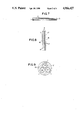
- FIGS. 1A and 1B show one kind of electronic electro-heating material
- FIG. 2 shows the sectional view of a defroster or drying apparatus made of electronic electrothermal conversion material
- FIG. 3A and 3B show two layered electronic electro-heating material
- FIG. 4 shows an electric heating dish made of the material shown in FIGS. 3A and 3B;
- FIG. 5 shows electronic electro-heating material made from KMg(AlSi 3 O 10 )F 2 material
- FIG. 6 shows a sleeve electro-heating element made of the material shown in FIG. 5;
- FIG. 7 shows multilayered superimposed electronic electro-heating material
- FIG. 8 shows electronic electro-heating material superimposed by mechanical method
- FIG. 9 shows the sectional view of the electronic electro-heating material made of honeycombed high-temperature-resistant insulating material
- FIG. 10 shows the sectional view of another honeycombed electronic electro-heating material
- FIG. 11 shows the electronic electro-heating element made from U shape glass tube or porcelain tube as the high-temperature-resistant insulating material.
- the process of the electronic electrothermal conversion material and its products according to this invention is as follows: two kinds of chloride, one is tin tetrachloride and another is any one of following: antimony trichloride, lead chloride, zinc chloride, indium chloride, are separately dissolved in the absolute ethyl alcohol or carbinol or acetone, then mixing them (to be called as solution A), the distilled aqueous solution of ammonium fluoride or hydrofluoric acid or tartaric acid is used as reducing agent (to be called as solution B).
- the high-temperature-resistant insulating material After being rinsed (acid-etch cleaning or alkaline cleaning), water scrubbed and de-ionized water scrubbed and fully dewatered, the high-temperature-resistant insulating material is put into a container with 350°-550° C. in which there is no open fire (this container is used as depositing chamber) and let it reach the same temperature as that of the container; the said solutions A and B, atomized uniformly by high pressure air, are put into depositing chamber, they can simultaneously be put into it, or at first the solution A then the solution B are put into the chamber, solution A reacts with water to produce gas of hydrogen chloride and high valent metal oxide, the metals of which correspond to the two kinds of chlorides (if the chlorides in solution A are tin tetrachloride and antimony trichloride, tin dioxide and antimony dioxide will be produced), part of metal oxides reduce to low valent metal oxide and metal single substances under reaction of reducing agent (if tin tetrach
- Such conductive semiconductor membrane contains uncomplete metal oxides and fluoric moleculae, after aging treatment, a stable structure is formed, therefore, when it works in the environment of dissipating heat timely, the output power is stable, once the temperature reduces to room temperature, its resistance is recoverable within an allowable range.
- the form of superimposing multiple layer of electronic electro-heating material can be used to obtain large power electronic electro-heating material.
- the large power means that the temperature can be raised rapidly and the service life prolonged under condition of larger average power.
- the service life is inversely proportional to the average power per unit area, the large power electronic electro-heating material obtained by superimposition possesses larger power for superimposed body but takes less part of power for every layer, so it can realize rapid rise of temperature and long service life.
- FIGS. 1A and 1B show shows an electronic electro-heating material, wherein 1--depositing layer (conductive membrane), 2--the silver oar electrodes, 3--the insulating slice, the chemical component of which is Al 2 O 3 or KMg(AlSi 3 O 10 )F 2 . 2 is connected to a power source.
- Such super thin electronic electro-heating material can be used to make products of a high efficiency defroster, heating dish, dry apparatus, iron, electro-heating demister etc.
- FIG. 2 shows the sectional view of defroster or drying apparatus, wherein 4--the electronic electro-heating material shown in FIG. 1, 5--the insulating slice, 6--metallic case.
- a uniform thermal field is formed around the surface of "6" at working time, it can uniformly defrost or dry clothing, and can be used as a heat source plate of heating equipment.
- FIGS. 3A and 3B show shows the electronic electro-heating material, both surfaces of which possess conductive membrane, wherein 1 is depositing face (conductive membrance), 2 are electrodes, 3 is a slice of insulating material.
- FIG. 4 shows the sectional view of a heating dish made of the electro-heating material shown in FIGS. 3A and 3B, wherein 5 are the insulating slices, 7 is the large power slice shown in FIG. 3, 8 is the sealing filler (e.g. epoxy resin), 9,10 are the circular metallic cases separately, 11 is the air band.
- the surface of 9 transfers heat and serves as a working area, the temperature of the surface of 10 is lower than that of the surface of 9 due to the separation of the air band 11.
- FIG. 5 shows large power electronic electro-heating body made by insulating material, the chemical component of which is KMg(AlSi 3 O 10 )F 2 and its thickness is 0.1 mm.
- 2 and 12 are the electrodes
- 1 is the depositing area.
- the electrodes 2 and 12 are connected to the power source separately
- FIG. 6 shows a sleeve shape large power electro-heating element, wherein 2 and 12 are the electrodes (a thin and long silver oar is connected with metallic slice outward), 13 is the electronic electro heating material shown is FIG. 5.
- Such material is rolled up to form large power electro-heating coil, it can be used to heat or dewax the oil delivery pipe, or can be used to heat various kinds of conduits.
- FIG. 7 shows a sectional view of superimposed large power electronic electro-heating material, wherein 14--metallic plate, 15--enamel layer, 1 is depositing surface. 1 is connected with trapezoidal silver oar electrodes.
- Such large power electronic electro-heating material can be used as a glazing apparatus, or as an electro-heating surface for food treatment, etc.
- the process for producing this material is as follows: The high-temperature-resistant insulating material is coated on a metal plate, e.g. enamel, then is formed by means of sintering, after deposition treatment on it, the treatment of coating the high-temperature-resistant material and deposition are repeated once again, above procedures are repeated for several times to form the electronic electro-heating material finally.
- FIG. 8 shows a large power body superimposed by means of the mechanical method, wherein 16--the large power element shown in FIG. 3, 17--the insulating layer, 18--the metallic radiating plate.
- the temperature of this equipment rises rapidly, it can be used to heat a large amount of liquid or gas flow.
- FIG. 9 shows a sectional view of a high-power honeycombed body, wherein 1--the depositing layer, 20--the glass or porcelain tube, 21--the fixed case, 19--the insulating filler. While 1 is heating at work, the liquid passing through 20 is heated.
- FIG. 10 shows another high-power honeycombed body, wherein 22--thin wall of the high-temperature-resistant insulating material, all the inner wall surface has been treated by deposition. This equipment is a cheap heater for a large amount of gas.
- FIG. 11 shows a heating element made of glass or porcelain tube, wherein 1 is the depositing face, 24--the tube wall, 23--electrodes, which is sealed by insulating glue and lead out by conductors.
- a heating element made of glass or porcelain tube, wherein 1 is the depositing face, 24--the tube wall, 23--electrodes, which is sealed by insulating glue and lead out by conductors.
- Such an element can be immersed in the corrosive liquor (e.g. electroplating solution, caustic soda solution) to heat it.
- the corrosive liquor e.g. electroplating solution, caustic soda solution
- the material according to this invention can be used up to 500° C. without open fire and light, so it can be used as a heat source, where open fire is prohibited. As the auxiliary fire-proof material is no longer needed, the cost will be reduced.
- the heat-inertia of the material according to this invention is small, so it can be used as the heat source in the thermal field of constant temperature where the difference in temperature desired is extremely small.
- the material according to this invention can be used as a heat source in the corrosive environment.
- the material according to this invention has a long service life. Let us take the defroster of a refrigerator for example, the service life will be as long as 10,000 hours or so, the ability to resist the impulse voltage of 220 v may be 10 million times or so.
- a large area heating element according to this invention can be manufactured in very thin form and the thermal field produced is uniform, so there is a wide field for its practical application.
- the technological temperature used in its manufacture is moderate, and the technological equipments are simple, so it is easy to produce, and the cost is low.
- dielectric slice KMg (AlSi 3 O 10 )F 2 used in this invention is of low cost low.
- a thin high-power electrothermal conversion body can be formed by superimposing method according to this invention to gain both effects of large power and long service life.
- the material according to this invention contains uncomplete oxide semiconductor, the speed of forming the charge carriers in electrical field is high, temperature of element rises rapidly, benefit of energy-saving is substantial, it is a unique, effective for energy-saving electrothermal conversion material.
- the heat is conducted by dielectric substance instead of the air as a heat-transfer medium, so the thermal availability of the electric heating products is very high.
Landscapes
- Engineering & Computer Science (AREA)
- Chemical & Material Sciences (AREA)
- Life Sciences & Earth Sciences (AREA)
- Mechanical Engineering (AREA)
- Microelectronics & Electronic Packaging (AREA)
- Physics & Mathematics (AREA)
- Wood Science & Technology (AREA)
- Zoology (AREA)
- Food Science & Technology (AREA)
- Polymers & Plastics (AREA)
- Thermal Sciences (AREA)
- General Engineering & Computer Science (AREA)
- Ceramic Engineering (AREA)
- Manufacturing & Machinery (AREA)
- Chemical Kinetics & Catalysis (AREA)
- Metallurgy (AREA)
- Organic Chemistry (AREA)
- Sustainable Development (AREA)
- General Chemical & Material Sciences (AREA)
- Materials Engineering (AREA)
- Inorganic Chemistry (AREA)
- Combustion & Propulsion (AREA)
- Electromagnetism (AREA)
- Resistance Heating (AREA)
- Surface Treatment Of Glass (AREA)
- Manufacturing Of Electric Cables (AREA)
- Surface Heating Bodies (AREA)
- Investigating Or Analyzing Materials By The Use Of Fluid Adsorption Or Reactions (AREA)
Abstract
The present invention relates to the field of electro-thermal conversion material and its products, made by semiconductor material. The process of making the electrothermal conversion material is as follows: a liquor is composed by dissolving two kinds of chloride (tin tetrachloride, etc.) in ethyl alcohol or carbinol, and another liquor, ammonium fluoride. After atomization of these two liquors, under the condition of high temperature, high valent metal oxide, low valent metal oxide and metal single substance etc, the metals of which correspond to the two kinds of chloride, deposit onto the surface of the high-temperature-resistant insulating material, forming a conductive semiconductor membrane.
Description
The present invention relates to the field of electrothermal conversion material made from semiconductor material, and its products.
The semiconductor electrothermal conversion material nowadays used, i.e, material PTC, is sintered by a compound of barium titanate series, its shortcomings are: poor heat-conductance, a lower ability to withstand electric voltage, brittleness, complication in manufacture, high cost, acute current variation in use (may be up to 105), strict limitation in temperature-rise (about 300° C. or so) due to the restriction by the lower Curie temperature of the PTC material.
The object of this invention is to avoid the shortcoming of the prementioned prior art and to provide an electronic electrothermal conversion material, its products and the method for production thereof, which are cheaper, easier to produce, highly efficient in electrothermal conversion, fast in raising its temperature, possible to heat without open fire in a certain range of temperatures, lower thermal inertia, corrosion-resistant and durable in service.
According to this invention the method for the production of the electronic electrothermal conversion material and its products comprises following steps:
(a) dissolve two kinds of chlorides, i.e. tin tetrachloride and any one of the followings: antimony trichloride, lead chloride, zinc chloride or indium chloride, into one of the following organic liquors: ethyl alchohol, carbinol and acetone;
(b) use any one of the aqueous solutions of ammonium fluoride, hydrofluoric acid and tartaric acid as a reducing agent;
(c) make the high-temperature-resistant insulating material rinsed and dewatered, then put it into a container, the temperature of which should be 350°-550° C., and let the insulating material reach the same temperature as that of the container;
(d) put the atomized organic solution with two kinds of chlorides dissolved, and the atomized solution used as a reducing agent into the container holding said high-temperature-resistant insulating material to produce fluoric moleculae as well as high valent metal oxide, low valent metal oxide and metal single substances, the metals of which correspond to the metals of the above mentioned two kinds of chloride; these substances precipitate onto the high-temperature-resistant insulating material to form a conductive semiconductor membrance;
(e) connect the electrodes from the said conductive semiconductor membrane outward to a power sourece.
According to this invention the electronic electrothermal conversion material and its products consist of power supply electrodes, high-temperature-resistant insulating material, and conductive semiconductor membrane precipitated on the surface of the said material, the said conductive semiconductor membrane is made of fluoric moleculae as well as high valent metal oxide, low valent metal oxide and metal single substances, the metals of which correspond to said two kinds of chlorides, the first of which is tin tetrachloride and the second is any one of the followings: antimony trichloride, lead chloride, zinc chloride and indium chloride.
FIGS. 1A and 1B show one kind of electronic electro-heating material;
FIG. 2 shows the sectional view of a defroster or drying apparatus made of electronic electrothermal conversion material;
FIG. 3A and 3B show two layered electronic electro-heating material;
FIG. 4 shows an electric heating dish made of the material shown in FIGS. 3A and 3B;
FIG. 5 shows electronic electro-heating material made from KMg(AlSi3 O10)F2 material;
FIG. 6 shows a sleeve electro-heating element made of the material shown in FIG. 5;
FIG. 7 shows multilayered superimposed electronic electro-heating material;
FIG. 8 shows electronic electro-heating material superimposed by mechanical method;
FIG. 9 shows the sectional view of the electronic electro-heating material made of honeycombed high-temperature-resistant insulating material;
FIG. 10 shows the sectional view of another honeycombed electronic electro-heating material;
FIG. 11 shows the electronic electro-heating element made from U shape glass tube or porcelain tube as the high-temperature-resistant insulating material.
The process of the electronic electrothermal conversion material and its products according to this invention is as follows: two kinds of chloride, one is tin tetrachloride and another is any one of following: antimony trichloride, lead chloride, zinc chloride, indium chloride, are separately dissolved in the absolute ethyl alcohol or carbinol or acetone, then mixing them (to be called as solution A), the distilled aqueous solution of ammonium fluoride or hydrofluoric acid or tartaric acid is used as reducing agent (to be called as solution B). After being rinsed (acid-etch cleaning or alkaline cleaning), water scrubbed and de-ionized water scrubbed and fully dewatered, the high-temperature-resistant insulating material is put into a container with 350°-550° C. in which there is no open fire (this container is used as depositing chamber) and let it reach the same temperature as that of the container; the said solutions A and B, atomized uniformly by high pressure air, are put into depositing chamber, they can simultaneously be put into it, or at first the solution A then the solution B are put into the chamber, solution A reacts with water to produce gas of hydrogen chloride and high valent metal oxide, the metals of which correspond to the two kinds of chlorides (if the chlorides in solution A are tin tetrachloride and antimony trichloride, tin dioxide and antimony dioxide will be produced), part of metal oxides reduce to low valent metal oxide and metal single substances under reaction of reducing agent (if tin tetrachloride and antimony trichloride are used, low valent metal oxide and metal single substances are tin monoxide, antimony monoxide and tin, antimony correspondingly), at the same time, fluoric moleculae is dissociated. These substantial particles deposit onto superficial layer of high-temperature-resistant insulating material (Term "deposition" means the process that the substantial particles deposit gradually on to surface of certain body under specified temperature), and a conductive semiconductor membrance will be formed. Owing to the treatment of rinsing and dewatering the high-temperature-resistant insulating material, the absorption affinity of the surface of the material is very strong, the association between the conductive layer and the superficial layer of the insulating material is firm. Such conductive semiconductor membrane contains uncomplete metal oxides and fluoric moleculae, after aging treatment, a stable structure is formed, therefore, when it works in the environment of dissipating heat timely, the output power is stable, once the temperature reduces to room temperature, its resistance is recoverable within an allowable range.
Owing to existance of high and low valent metal oxides and metal single substances simultaneously in the electronic electro-heating material, the temperature rises rapidly, the highest temperature may reach 900° C., the optimum working temperature is 300° C. or so, if it works up to 500° C., there will be no open fire. The higher the concentration of low valent metal oxides and metal single substances is, the faster will be the speed of elcctrothermal conversion, the stronger the high-temperature-resistant ability, the worse the transparency of the depositing layer (conductive membrane), but on the contrary, the better the transparency.
Owing to being of no open fire at the working time of such electronic electro-heating material, the form of superimposing multiple layer of electronic electro-heating material can be used to obtain large power electronic electro-heating material. The large power means that the temperature can be raised rapidly and the service life prolonged under condition of larger average power. As the service life is inversely proportional to the average power per unit area, the large power electronic electro-heating material obtained by superimposition possesses larger power for superimposed body but takes less part of power for every layer, so it can realize rapid rise of temperature and long service life.
Now further detailed description for the electronic electro-heating material and its products according to this invention will be made with reference to the drawings.
FIGS. 1A and 1B show shows an electronic electro-heating material, wherein 1--depositing layer (conductive membrane), 2--the silver oar electrodes, 3--the insulating slice, the chemical component of which is Al2 O3 or KMg(AlSi3 O10)F2. 2 is connected to a power source. Such super thin electronic electro-heating material can be used to make products of a high efficiency defroster, heating dish, dry apparatus, iron, electro-heating demister etc.
FIG. 2 shows the sectional view of defroster or drying apparatus, wherein 4--the electronic electro-heating material shown in FIG. 1, 5--the insulating slice, 6--metallic case. A uniform thermal field is formed around the surface of "6" at working time, it can uniformly defrost or dry clothing, and can be used as a heat source plate of heating equipment.
FIGS. 3A and 3B show shows the electronic electro-heating material, both surfaces of which possess conductive membrane, wherein 1 is depositing face (conductive membrance), 2 are electrodes, 3 is a slice of insulating material.
FIG. 4 shows the sectional view of a heating dish made of the electro-heating material shown in FIGS. 3A and 3B, wherein 5 are the insulating slices, 7 is the large power slice shown in FIG. 3, 8 is the sealing filler (e.g. epoxy resin), 9,10 are the circular metallic cases separately, 11 is the air band. When 7 works with its two surfaces, the surface of 9 transfers heat and serves as a working area, the temperature of the surface of 10 is lower than that of the surface of 9 due to the separation of the air band 11.
FIG. 5 shows large power electronic electro-heating body made by insulating material, the chemical component of which is KMg(AlSi3 O10)F2 and its thickness is 0.1 mm. In the figure, 2 and 12 are the electrodes, 1 is the depositing area. The electrodes 2 and 12 are connected to the power source separately, FIG. 6 shows a sleeve shape large power electro-heating element, wherein 2 and 12 are the electrodes (a thin and long silver oar is connected with metallic slice outward), 13 is the electronic electro heating material shown is FIG. 5. Such material is rolled up to form large power electro-heating coil, it can be used to heat or dewax the oil delivery pipe, or can be used to heat various kinds of conduits.
FIG. 7 shows a sectional view of superimposed large power electronic electro-heating material, wherein 14--metallic plate, 15--enamel layer, 1 is depositing surface. 1 is connected with trapezoidal silver oar electrodes. Such large power electronic electro-heating material can be used as a glazing apparatus, or as an electro-heating surface for food treatment, etc. The process for producing this material is as follows: The high-temperature-resistant insulating material is coated on a metal plate, e.g. enamel, then is formed by means of sintering, after deposition treatment on it, the treatment of coating the high-temperature-resistant material and deposition are repeated once again, above procedures are repeated for several times to form the electronic electro-heating material finally.
FIG. 8 shows a large power body superimposed by means of the mechanical method, wherein 16--the large power element shown in FIG. 3, 17--the insulating layer, 18--the metallic radiating plate. The temperature of this equipment rises rapidly, it can be used to heat a large amount of liquid or gas flow.
FIG. 9 shows a sectional view of a high-power honeycombed body, wherein 1--the depositing layer, 20--the glass or porcelain tube, 21--the fixed case, 19--the insulating filler. While 1 is heating at work, the liquid passing through 20 is heated.
FIG. 10 shows another high-power honeycombed body, wherein 22--thin wall of the high-temperature-resistant insulating material, all the inner wall surface has been treated by deposition. This equipment is a cheap heater for a large amount of gas.
FIG. 11 shows a heating element made of glass or porcelain tube, wherein 1 is the depositing face, 24--the tube wall, 23--electrodes, which is sealed by insulating glue and lead out by conductors. Such an element can be immersed in the corrosive liquor (e.g. electroplating solution, caustic soda solution) to heat it.
Following are the advantages of this invention compared with prior art.
The material according to this invention can be used up to 500° C. without open fire and light, so it can be used as a heat source, where open fire is prohibited. As the auxiliary fire-proof material is no longer needed, the cost will be reduced.
The heat-inertia of the material according to this invention is small, so it can be used as the heat source in the thermal field of constant temperature where the difference in temperature desired is extremely small.
Owing to the corrosion-proof character the material according to this invention can be used as a heat source in the corrosive environment.
The material according to this invention has a long service life. Let us take the defroster of a refrigerator for example, the service life will be as long as 10,000 hours or so, the ability to resist the impulse voltage of 220 v may be 10 million times or so.
A large area heating element according to this invention can be manufactured in very thin form and the thermal field produced is uniform, so there is a wide field for its practical application.
According to this invention the technological temperature used in its manufacture is moderate, and the technological equipments are simple, so it is easy to produce, and the cost is low.
The material of dielectric slice KMg (AlSi3 O10)F2 used in this invention is of low cost low. Consider the material of 0.2 mm thick for example, per cm2 of this material costs only RMB 0.004 Yuen, it is a great superiority in competition. A thin high-power electrothermal conversion body can be formed by superimposing method according to this invention to gain both effects of large power and long service life.
The material according to this invention contains uncomplete oxide semiconductor, the speed of forming the charge carriers in electrical field is high, temperature of element rises rapidly, benefit of energy-saving is substantial, it is a unique, effective for energy-saving electrothermal conversion material. Particularly, with the electro-heating elements according to this invention the heat is conducted by dielectric substance instead of the air as a heat-transfer medium, so the thermal availability of the electric heating products is very high.
Claims (14)
1. An electronic electrothermal conversion material and its products comprising power supply electrodes, high temperature-resistant insulating material and a conductive semiconductor membrane precipitated on a surface of said insulating material, said membrane being made of fluoric molecules as well as high valent metal oxide, low valent metal oxide and metal single substances, metals of which correspond to two kinds of chlorides, the first of which is tin tetrachloride and the second is one of the group consisting of antimony trichloride, lead chloride, zinc chloride and indium chloride.
2. The material and its products according to claim 1, wherein said high-temperature-resistant insulating material is selected from the group consisting of glass, quartz, graphite, mica, enamel and ceramic.
3. The material and its products according to claim 1, wherein said high-temperature-resistant insulating material has one of the following shapes: slice, arc and sleeve, and wherein said conductive semiconductor membranes are on both surfaces of said insulating material.
4. The material and its products according to claim 2, wherein said high-temperature-resistant insulating material has one of the following shapes: slice, arc and sleeve, and wherein said conductive semiconductor membranes are on both surfaces of said insulating material.
5. The material and its products according to claim 1, wherein said high-temperature-resistant insulating material is multilayered, and wherein said conductive semiconductor membrane is between these layers.
6. The material and its products according to claim 2, wherein the high-temperature-resistant insulating material is multilayered, and wherein said conductive semiconductor membrane is between these layers.
7. The material and its products according to claim 1, wherein said high-temperature-resistant insulating material is honeycombed, and wherein said conductive semiconductor membrane is on an inner surface of the material.
8. The material and its products according to claim 2, wherein said high-temperature-resistant insulating material is honeycombed, and wherein said conductive semiconductor membrane is on an inner surface of the material.
9. The and its products according to claim 1, wherein a chemical component of said high-temperature-resistant insulating material is one of the group consisting of KMg (AlSi3 O10)F2 and Al2 O3, and wherein said conductive semiconductor membrane is on the surface of the material.
10. A method for manufacturing electronic electrothermal conversion material and its products comprising:
(a) dissolving two kinds of chloride, consisting of tin tetrachloride and one of the group consisting of antimony trichloride, lead chloride, zinc chloride and indium chloride, into one of the following organic liquors selected from the group consisting of ethyl alcohol, carbinol and acetone;
(b) using any one of aqueous solutions selected from the group consisting of ammonium fluoride, hydrofluoric acid and tartaric acid as a reducing agent;
(c) making high-temperature-resistant insulating material rinsed and dewatered, putting it into a container, the temperature of which is 350°-550° C., and allowing the insulating material to reach the same temperature as that of the container;
(d) putting the atomized organic liquor with two kinds of chlorides dissolved and the atomized liquor used as reducing agent into the container holding said high-temperature-resistant insulating material to produce fluoric molecules as well as high valent metal oxide, low valent metal oxide and metal single substances, the metals of which correspond to the above mentioned two kinds of chlorides; precipitating these substances onto the high-temperature-resistant insulating material to form a conductive semiconductor membrane; and
(e) connecting the electrodes from said conductive semiconductor membrane outward to a power source.
11. The method according to claim 10, wherein the said high-temperature-resistant insulating material is one of the group consisting of glass, quartz, graphite, mica, enamel and ceramic.
12. The method according to claim 10, wherein the chemical component of the said high-temperature-resistant insulating material is one of the group consisting of KMg(AlSi3 O10)F2 and Al2 O3.
13. The method as claimed in claim 10, wherein the step of putting said two kinds of liquors into the container includes at first putting the organic liquor with two kinds of chlorides dissolved into the container, then putting the liquor used as reducing agent into the container also.
14. The method as claimed in claim 10, wherein the step of putting said two kinds of liquors into the container comprises putting the organic liquor with two kinds of chloride dissolved and the liquor used as a reducing agent into the container simultaneously.
Applications Claiming Priority (2)
| Application Number | Priority Date | Filing Date | Title |
|---|---|---|---|
| CN88100015.9A CN1013334B (en) | 1988-01-06 | 1988-01-06 | High power electrothermal convertor and processing technique thereof |
| TW88100015 | 1988-06-01 |
Publications (1)
| Publication Number | Publication Date |
|---|---|
| US4916427A true US4916427A (en) | 1990-04-10 |
Family
ID=4831122
Family Applications (1)
| Application Number | Title | Priority Date | Filing Date |
|---|---|---|---|
| US07/287,110 Expired - Lifetime US4916427A (en) | 1988-01-06 | 1988-12-20 | Electronic electrothermal conversion material, its products and method for production thereof |
Country Status (5)
| Country | Link |
|---|---|
| US (1) | US4916427A (en) |
| EP (1) | EP0323827B1 (en) |
| JP (1) | JP2628519B2 (en) |
| CN (1) | CN1013334B (en) |
| AU (1) | AU617399B2 (en) |
Cited By (3)
| Publication number | Priority date | Publication date | Assignee | Title |
|---|---|---|---|---|
| GB2355991A (en) * | 1999-11-05 | 2001-05-09 | Nippon Sheet Glass Co Ltd | Metal oxide film formation from antimony chloride solution |
| CN100441056C (en) * | 2005-01-05 | 2008-12-03 | 林正平 | Method for manufacturing semiconductor electrothermal film |
| US20100170403A1 (en) * | 2003-01-29 | 2010-07-08 | Sfk Systems A/S | Method And An Apparatus For Thawing Frozen Meat |
Families Citing this family (4)
| Publication number | Priority date | Publication date | Assignee | Title |
|---|---|---|---|---|
| CN101527978B (en) * | 2008-03-05 | 2014-02-05 | 孔喜 | Electrothermal film part and product thereof |
| CN111447695B (en) * | 2020-05-05 | 2022-12-30 | 中山市烯帝科技有限公司 | Manufacturing method and formula of graphene far infrared heating plate |
| JP7162164B1 (en) * | 2021-05-07 | 2022-10-28 | 福建晶▲しい▼新材料科技有限公司 | Semiconductor electrothermal film precursor solution, semiconductor electrothermal film structure, and method for manufacturing electrothermal structure |
| CN119943736A (en) * | 2024-12-24 | 2025-05-06 | 君原电子科技(海宁)有限公司 | Method for preparing ceramic disc with built-in heater of electrostatic chuck |
Citations (4)
| Publication number | Priority date | Publication date | Assignee | Title |
|---|---|---|---|---|
| US4104507A (en) * | 1977-01-14 | 1978-08-01 | Design & Manufacturing Corporation | PTC heater for enhancing thermal actuator response |
| GB2085699A (en) * | 1980-10-10 | 1982-04-28 | Jung & Lindig Bleiind | Heating foil as a heating system for buildings |
| GB2085700A (en) * | 1980-10-10 | 1982-04-28 | Jung & Lindig Bleiind | Process for producing heating foils as a heating system for buildings. |
| US4499334A (en) * | 1983-12-22 | 1985-02-12 | The United States Of America As Represented By The Secretary Of The Air Force | Heat resistant sheathed insulated electrical conductors |
Family Cites Families (3)
| Publication number | Priority date | Publication date | Assignee | Title |
|---|---|---|---|---|
| GB1517341A (en) * | 1975-01-02 | 1978-07-12 | Day Specialties | Coating solutions for dielectric materials |
| JPS54150417A (en) * | 1978-05-19 | 1979-11-26 | Hitachi Ltd | Production of transparent conductive layer |
| JP5019125B2 (en) | 2008-01-07 | 2012-09-05 | 住友電工焼結合金株式会社 | Method for manufacturing rotor for internal gear pump |
-
1988
- 1988-01-06 CN CN88100015.9A patent/CN1013334B/en not_active Expired
- 1988-12-20 US US07/287,110 patent/US4916427A/en not_active Expired - Lifetime
-
1989
- 1989-01-02 EP EP89100021A patent/EP0323827B1/en not_active Expired - Lifetime
- 1989-01-03 AU AU27670/89A patent/AU617399B2/en not_active Ceased
- 1989-01-05 JP JP64000716A patent/JP2628519B2/en not_active Expired - Fee Related
Patent Citations (4)
| Publication number | Priority date | Publication date | Assignee | Title |
|---|---|---|---|---|
| US4104507A (en) * | 1977-01-14 | 1978-08-01 | Design & Manufacturing Corporation | PTC heater for enhancing thermal actuator response |
| GB2085699A (en) * | 1980-10-10 | 1982-04-28 | Jung & Lindig Bleiind | Heating foil as a heating system for buildings |
| GB2085700A (en) * | 1980-10-10 | 1982-04-28 | Jung & Lindig Bleiind | Process for producing heating foils as a heating system for buildings. |
| US4499334A (en) * | 1983-12-22 | 1985-02-12 | The United States Of America As Represented By The Secretary Of The Air Force | Heat resistant sheathed insulated electrical conductors |
Cited By (3)
| Publication number | Priority date | Publication date | Assignee | Title |
|---|---|---|---|---|
| GB2355991A (en) * | 1999-11-05 | 2001-05-09 | Nippon Sheet Glass Co Ltd | Metal oxide film formation from antimony chloride solution |
| US20100170403A1 (en) * | 2003-01-29 | 2010-07-08 | Sfk Systems A/S | Method And An Apparatus For Thawing Frozen Meat |
| CN100441056C (en) * | 2005-01-05 | 2008-12-03 | 林正平 | Method for manufacturing semiconductor electrothermal film |
Also Published As
| Publication number | Publication date |
|---|---|
| EP0323827A3 (en) | 1989-10-25 |
| AU617399B2 (en) | 1991-11-28 |
| CN1013334B (en) | 1991-07-24 |
| EP0323827B1 (en) | 1993-04-14 |
| JP2628519B2 (en) | 1997-07-09 |
| AU2767089A (en) | 1989-07-06 |
| JPH0256885A (en) | 1990-02-26 |
| EP0323827A2 (en) | 1989-07-12 |
| CN1034107A (en) | 1989-07-19 |
Similar Documents
| Publication | Publication Date | Title |
|---|---|---|
| US7003220B2 (en) | Quartz heater | |
| CN1162046C (en) | Large area thin film resistive heating element and method | |
| US4916427A (en) | Electronic electrothermal conversion material, its products and method for production thereof | |
| CN109862631A (en) | A kind of preparation method of novel composite flat plate electric heating film | |
| CN1153506C (en) | Process of mfg. electrothermal SnO2:F film heating pipe by ultrasonic spray | |
| CN102685943B (en) | Nanometer material electrothermal film | |
| US3574584A (en) | Method of fabricating glass coated metal substrates | |
| CN109392204B (en) | Scale-inhibiting double-runner annular-cavity tube electric heater with heat release surface being electric insulation surface | |
| US5725912A (en) | Method of manufacturing an electric heating film of semiconductor | |
| CN1024978C (en) | Method for manufacturing semiconductor heating element | |
| CN1349371A (en) | Electroformed alloy electric heating element and manufacturing method thereof | |
| CN1091566C (en) | Red infrared radiation electrothermal film and its prodn. method | |
| WO2005055662A1 (en) | A high temperature, high efficient and multifunction inorganic electric heating film and manufacture method thereof | |
| CN2428938Y (en) | Electroformed alloy heating element | |
| JPS64357B2 (en) | ||
| KR100262450B1 (en) | Insulting coating method for electric heating catalysis | |
| CN1599515A (en) | Ceramic thermo-electric film heating pipe and manufacturing method thereof | |
| KR102830580B1 (en) | Metal Pipe coated with heating Sheet | |
| RU68658U1 (en) | FUEL HEATER | |
| CN203057553U (en) | Transparent heat-emission film | |
| US6835673B1 (en) | Semiconductor impedance thermal film processing process | |
| JPS6135268B2 (en) | ||
| JPH02144876A (en) | Sheath heater | |
| JPS62150685A (en) | Manufacture of panel heater | |
| CN1625306A (en) | Ceramic electrothermal film heating pipe and its manufacturing method |
Legal Events
| Date | Code | Title | Description |
|---|---|---|---|
| STCF | Information on status: patent grant |
Free format text: PATENTED CASE |
|
| CC | Certificate of correction | ||
| FEPP | Fee payment procedure |
Free format text: PAYOR NUMBER ASSIGNED (ORIGINAL EVENT CODE: ASPN); ENTITY STATUS OF PATENT OWNER: SMALL ENTITY |
|
| FPAY | Fee payment |
Year of fee payment: 4 |
|
| FEPP | Fee payment procedure |
Free format text: PAYOR NUMBER ASSIGNED (ORIGINAL EVENT CODE: ASPN); ENTITY STATUS OF PATENT OWNER: SMALL ENTITY Free format text: PAYER NUMBER DE-ASSIGNED (ORIGINAL EVENT CODE: RMPN); ENTITY STATUS OF PATENT OWNER: SMALL ENTITY |
|
| FPAY | Fee payment |
Year of fee payment: 8 |
|
| FPAY | Fee payment |
Year of fee payment: 12 |