US4901877A - Bee proof beverage container - Google Patents
Bee proof beverage container Download PDFInfo
- Publication number
- US4901877A US4901877A US07/376,845 US37684589A US4901877A US 4901877 A US4901877 A US 4901877A US 37684589 A US37684589 A US 37684589A US 4901877 A US4901877 A US 4901877A
- Authority
- US
- United States
- Prior art keywords
- lugs
- beverage container
- lid
- container
- tab
- Prior art date
- Legal status (The legal status is an assumption and is not a legal conclusion. Google has not performed a legal analysis and makes no representation as to the accuracy of the status listed.)
- Expired - Fee Related
Links
- 235000013361 beverage Nutrition 0.000 title claims description 22
- 239000007788 liquid Substances 0.000 claims description 15
- 241000238631 Hexapoda Species 0.000 abstract description 9
- 241000257303 Hymenoptera Species 0.000 abstract description 3
- 241000256856 Vespidae Species 0.000 description 6
- 229910052782 aluminium Inorganic materials 0.000 description 3
- XAGFODPZIPBFFR-UHFFFAOYSA-N aluminium Chemical compound [Al] XAGFODPZIPBFFR-UHFFFAOYSA-N 0.000 description 3
- 230000001012 protector Effects 0.000 description 3
- 230000000881 depressing effect Effects 0.000 description 2
- 235000014214 soft drink Nutrition 0.000 description 2
- 238000010276 construction Methods 0.000 description 1
- 230000000994 depressogenic effect Effects 0.000 description 1
- 230000035622 drinking Effects 0.000 description 1
- 238000004519 manufacturing process Methods 0.000 description 1
- 229910052751 metal Inorganic materials 0.000 description 1
- 239000002184 metal Substances 0.000 description 1
- 239000008267 milk Substances 0.000 description 1
- 210000004080 milk Anatomy 0.000 description 1
- 235000013336 milk Nutrition 0.000 description 1
- 230000035939 shock Effects 0.000 description 1
Images
Classifications
-
- B—PERFORMING OPERATIONS; TRANSPORTING
- B65—CONVEYING; PACKING; STORING; HANDLING THIN OR FILAMENTARY MATERIAL
- B65D—CONTAINERS FOR STORAGE OR TRANSPORT OF ARTICLES OR MATERIALS, e.g. BAGS, BARRELS, BOTTLES, BOXES, CANS, CARTONS, CRATES, DRUMS, JARS, TANKS, HOPPERS, FORWARDING CONTAINERS; ACCESSORIES, CLOSURES, OR FITTINGS THEREFOR; PACKAGING ELEMENTS; PACKAGES
- B65D17/00—Rigid or semi-rigid containers specially constructed to be opened by cutting or piercing, or by tearing of frangible members or portions
- B65D17/28—Rigid or semi-rigid containers specially constructed to be opened by cutting or piercing, or by tearing of frangible members or portions at lines or points of weakness
- B65D17/401—Rigid or semi-rigid containers specially constructed to be opened by cutting or piercing, or by tearing of frangible members or portions at lines or points of weakness characterised by having the line of weakness provided in an end wall
- B65D17/4012—Rigid or semi-rigid containers specially constructed to be opened by cutting or piercing, or by tearing of frangible members or portions at lines or points of weakness characterised by having the line of weakness provided in an end wall for opening partially by means of a tearing tab
-
- B—PERFORMING OPERATIONS; TRANSPORTING
- B65—CONVEYING; PACKING; STORING; HANDLING THIN OR FILAMENTARY MATERIAL
- B65D—CONTAINERS FOR STORAGE OR TRANSPORT OF ARTICLES OR MATERIALS, e.g. BAGS, BARRELS, BOTTLES, BOXES, CANS, CARTONS, CRATES, DRUMS, JARS, TANKS, HOPPERS, FORWARDING CONTAINERS; ACCESSORIES, CLOSURES, OR FITTINGS THEREFOR; PACKAGING ELEMENTS; PACKAGES
- B65D2517/00—Containers specially constructed to be opened by cutting, piercing or tearing of wall portions, e.g. preserving cans or tins
- B65D2517/0001—Details
- B65D2517/0022—Means for preventing insects from entering container
Definitions
- This invention relates to a pop-top beverage container and is more particularly concerned with a bee proof beverage container.
- pop-top beverage containers have been extensively used for containing soft drinks and other consumable liquids.
- Such pop-top containers have aluminum tops to which are affixed operating tabs.
- the operating tab is conventionally used for separating a prescored portion of the can top from the remaining top and depressing the flap into the can.
- the tab is conventionally connected to a rivet pin at the center of the can top and operates as a lever with a minimal lifting portion on one side of the pin and reacting detent portion on the other side of the pin, which engages the edge of the scored flap for depressing the flap into the can or container.
- the can is not resealable and provides a relatively wide opening through which various insects, such as bees and hornets, can enter the interior of the can. Once in the interior, the insect usually eventually falls into the liquid and remains there. A person drinking the beverage, cannot detect, from looking at the outside of the container, whether or not an insect is in the container. Thus, from time to time, persons who drink these soft drinks out of doors, such as in a person's backyard or on the golf course, will find that, a bee or hornet or other insect will be floating in the liquid and will be received in a person's mouth.
- Morehead teaches to provide a protector for the opening which is a flat cover having a number of small apertures.
- the cover is pivotally mounted to the top of the container so that it may be rotated into a position over the opening of the container, once the container has been opened.
- the cover has a plurality of spaced, parallel slits which will permit the liquid to pass through the slits when a person drinks or pours from the can.
- an additional element namely the protector to the aluminum top is relatively expensive, and furthermore, a person opening the drink, must remember to pivot the protector into a position where it overlies the opening.
- None of this prior art provides a pop-top container which when opened, automatically provides slits through which an insect cannot readily pass.
- the present invention includes a hollow body of a container for a beverage or some other consumable liquid.
- the end of this body is closed by a conventional aluminum top having a tab which is pivotally mounted in conventional fashion on the top.
- the inventive concept of the present invention is the provision of a plurality of individual outwardly protruding fingers on the end of the detent of the tab and which fingers will move downwardly as the tab is lifted so as to depress, simultaneously, prescored lugs of the container top.
- These lugs are arranged in spaced parallel closely adjacent relationship and correspond in number to the number of fingers on the detent.
- each individual finger acts upon an individual lug so as to break it away from at least a portion of the remainder of the lid and depress the same downwardly, thereby providing parallel slits in the lid through which the liquid can pass.
- Another object of the present invention is to provide a bee proof beverage container which is inexpensive to manufacture, durable in structure and efficient in operation.
- Another object of the present invention is to provide a bee proof beverage container which can be manufactured as easily and readily as a conventional beverage container and which has the added capability of protecting the liquid from becoming contaminated.
- Another object of the present invention is to provide a bee proof beverage container which can be safely used out of doors.
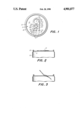
- FIG. 1 is a plan view of a bee proof beverage container constructed in accordance with the present invention
- FIG. 2 is a cross-sectional view taken substantially along line 2--2 in FIG. 1;
- FIG. 3 is a cross-sectional view similar to FIG. 2 but showing the tab in its lifted position such as when the container is opened and the lugs depressed to their open position.
- numeral 10 denotes generally the body of a beverage container, can or closure of the present invention.
- This container body 10 is preferably cylindrical and receives on its open end portion, a lid, cap or top 11 of the container.
- This top 11 is provided with a conventional reversibly bent rim 12 which overlies and is secured to the edge portion of the container body 10.
- the web 13 of the lid, cap or top 11 extends across the open end of body 10.
- An upstanding axially disposed fulcrum pin 14 is mounted on the central portion of web 13.
- the opening tab 15 is a relatively rigid, stamped metal member which is received generally flat on the central portion of the outer surface of web 13 of lid 11.
- the tab 15 is defined by straight, parallel side edges 15, 15a which merge into a convex, rear edge 15b at rear end of the tab 15.
- Inwardly of the rear edge 15b is a circular finger hole 15c formed in the front end of tab 15.
- hole 15e Forwardly of hole 15c and in about the central portion of tab 15 is a generally U-shaped hole 15e.
- This hole 15e divides the tab 15 into two longitudinally extending, spaced parallel pivot arms 15f connected by their ends to the lift ring 15d and by their other ends to detent plate 15g.
- the inner central portion of the detent plate 15g protrudes into the hole 15e to provide a hinge member 15h through which the fulcrum brad or pin 14 protrudes.
- This pin 14 and hinge member 15h form the sole link of the tab 15 to the web 13.
- a plurality of spaced, parallel, camming fingers 15i Protruding forwardly from the transverse forward edge of the detent plate 15g are a plurality of spaced, parallel, camming fingers 15i.
- the distal ends of the camming fingers 15i are rounded or convexed while the proximal ends of fingers 15i are integrally connected to the forward edge of detent plate 15g.
- Respectively below and cooperating with the fingers 15i are a corresponding number of juxtaposed, transversely spaced, elongated, narrow, displaceable lugs 17 defined by three continuous scorelines or cut lines 17a.
- Each lug 18 is initially a portion of the web 13 which seals the can or container 10. When lugs 18 are displaced, they leave a like number of spaced, juxtaposed, parallel, narrow straight slits or slots 19 in web 13.
- Scorelines 17a however, penetrate only partially through the thickness of the web 13 and, therefore, do not destroy the air tight, liquid tight seal by web 13.
- Scorelines 17a are denoted in FIG. 1 by broken lines in which opposed side portions of the scorelines are parallel and the ends of these parallel portions are joined by semi-circular portions.
- the beverage container of the present invention is opened by simply lifting the lift ring 15d away from and outwardly of the web 13. This causes the detent plate 15 to move downwardly as the hinge member 15h bends. The ends of the fingers 15i thus push downwardly, respectively on the lugs 18, thereby pushing them into the interior of the container 10. A portion of the lugs 17 will remain attached to the lid and yet the slits or slots 19 will be opened sufficiently for the liquid to be readily poured out of the container.
- the width of each slit or slot is preferably 3/32 inch or less, thereby assuring that substantially all bees and hornets cannot pass through these slits or slots 19 and into the interior of the container.
Landscapes
- Engineering & Computer Science (AREA)
- Mechanical Engineering (AREA)
- Closures For Containers (AREA)
Abstract
A container with a lid which is provided with scorelines defining a plurality of long narrow lugs. A tab is secured by its midportion to the central portion of the lid and has at one end a plurality of fingers which respectively terminate over the lugs for pushing the lugs into the container when the tab is lifted. The displaced lugs leave parallel, narrow slits which preclude the entry of insects, such as bees, into the container.
Description
This invention relates to a pop-top beverage container and is more particularly concerned with a bee proof beverage container.
In the past, pop-top beverage containers have been extensively used for containing soft drinks and other consumable liquids. Such pop-top containers have aluminum tops to which are affixed operating tabs. The operating tab is conventionally used for separating a prescored portion of the can top from the remaining top and depressing the flap into the can. The tab is conventionally connected to a rivet pin at the center of the can top and operates as a lever with a minimal lifting portion on one side of the pin and reacting detent portion on the other side of the pin, which engages the edge of the scored flap for depressing the flap into the can or container.
Once open, the can is not resealable and provides a relatively wide opening through which various insects, such as bees and hornets, can enter the interior of the can. Once in the interior, the insect usually eventually falls into the liquid and remains there. A person drinking the beverage, cannot detect, from looking at the outside of the container, whether or not an insect is in the container. Thus, from time to time, persons who drink these soft drinks out of doors, such as in a person's backyard or on the golf course, will find that, a bee or hornet or other insect will be floating in the liquid and will be received in a person's mouth. Usually there are no serious consequences to receiving the bee or hornet in a person's mouth since the person will usually spit out the liquid, before the insect has attacked him. Nevertheless, the shock of finding a bee or hornet in a person's beverage usually convinces a person not to drink any more of the liquid contained in that particular open container.
In the past, efforts have been made to protect the opening of a pop-top type container so as to prevent or preclude the likelihood that foreign matter will be accumulated in the liquid carried by the container. The patent to Morehead U.S. Pat. No. 4,537,326 recognizes the applicant's problem but does not provide applicant's solution to that problem. Specifically, Morehead teaches to provide a protector for the opening which is a flat cover having a number of small apertures. The cover is pivotally mounted to the top of the container so that it may be rotated into a position over the opening of the container, once the container has been opened. The cover has a plurality of spaced, parallel slits which will permit the liquid to pass through the slits when a person drinks or pours from the can. Of course, the provision of an additional element, namely the protector to the aluminum top is relatively expensive, and furthermore, a person opening the drink, must remember to pivot the protector into a position where it overlies the opening.
The patent to Stuart U.S. Pat. No. 3,292,828 discloses a pull tab-type can closure wherein the openings are very small so as to protect children from cutting their fingers on the edges of the can.
The patent to Bartolomeo U.S. Pat. No. 2,927,695 teaches to dispose a screen over the opening of a milk carton to prevent ingress of insects or the like.
The patent to Mandel U.S. Pat. No. 4,463,866 teaches to provide a resealable construction for the pop-top can so that the resealing of the can or container will preclude foreign objects from ending up within the can.
None of this prior art provides a pop-top container which when opened, automatically provides slits through which an insect cannot readily pass.
Briefly described, the present invention includes a hollow body of a container for a beverage or some other consumable liquid. The end of this body is closed by a conventional aluminum top having a tab which is pivotally mounted in conventional fashion on the top. The inventive concept of the present invention is the provision of a plurality of individual outwardly protruding fingers on the end of the detent of the tab and which fingers will move downwardly as the tab is lifted so as to depress, simultaneously, prescored lugs of the container top. These lugs are arranged in spaced parallel closely adjacent relationship and correspond in number to the number of fingers on the detent. Thus, each individual finger acts upon an individual lug so as to break it away from at least a portion of the remainder of the lid and depress the same downwardly, thereby providing parallel slits in the lid through which the liquid can pass.
Accordingly, it is an object of the present invention to provide a container with an openable top which will provide a plurality of narrow openings, each of which is sufficiently small that an insect, such as a bee or hornet cannot crawl or fly through that opening.
Another object of the present invention is to provide a bee proof beverage container which is inexpensive to manufacture, durable in structure and efficient in operation.
Another object of the present invention is to provide a bee proof beverage container which can be manufactured as easily and readily as a conventional beverage container and which has the added capability of protecting the liquid from becoming contaminated.
Another object of the present invention is to provide a bee proof beverage container which can be safely used out of doors.
Other objects, features, and advantages of the present invention will become apparent from the following description when taken in conjunction with the accompanying drawings wherein like characters of reference designate corresponding parts throughout the several views.
FIG. 1 is a plan view of a bee proof beverage container constructed in accordance with the present invention;
FIG. 2 is a cross-sectional view taken substantially along line 2--2 in FIG. 1; and
FIG. 3 is a cross-sectional view similar to FIG. 2 but showing the tab in its lifted position such as when the container is opened and the lugs depressed to their open position.
Referring now in detail to the embodiment chosen for the purpose of illustrating the present invention, numeral 10 denotes generally the body of a beverage container, can or closure of the present invention. This container body 10 is preferably cylindrical and receives on its open end portion, a lid, cap or top 11 of the container. This top 11 is provided with a conventional reversibly bent rim 12 which overlies and is secured to the edge portion of the container body 10. The web 13 of the lid, cap or top 11 extends across the open end of body 10. An upstanding axially disposed fulcrum pin 14 is mounted on the central portion of web 13.
Received on the fulcrum pin 14 is an opening tab, denoted generally by the numeral 15. The opening tab 15 is a relatively rigid, stamped metal member which is received generally flat on the central portion of the outer surface of web 13 of lid 11. The tab 15 is defined by straight, parallel side edges 15, 15a which merge into a convex, rear edge 15b at rear end of the tab 15. Inwardly of the rear edge 15b is a circular finger hole 15c formed in the front end of tab 15. Thus, there is generally a lifting ring or annulus 15d on one end portion of the tab 15.
Forwardly of hole 15c and in about the central portion of tab 15 is a generally U-shaped hole 15e. This hole 15e divides the tab 15 into two longitudinally extending, spaced parallel pivot arms 15f connected by their ends to the lift ring 15d and by their other ends to detent plate 15g.
The inner central portion of the detent plate 15g protrudes into the hole 15e to provide a hinge member 15h through which the fulcrum brad or pin 14 protrudes. This pin 14 and hinge member 15h form the sole link of the tab 15 to the web 13. Thus, when the lift ring 15d is moved outwardly, away from the surface of web 13, the arms 15f pivot the detent plate 15g downwardly as the hinge member 15h bends.
Protruding forwardly from the transverse forward edge of the detent plate 15g are a plurality of spaced, parallel, camming fingers 15i. In the present embodiment, I have illustrated three spaced, parallel camming fingers 15i, the central finger 15i lying along the longitudinal centerline 16 of tab 15 and the other two fingers 15i lying laterally on opposite sides outwardly of the central finger 15i.
The distal ends of the camming fingers 15i are rounded or convexed while the proximal ends of fingers 15i are integrally connected to the forward edge of detent plate 15g.
Respectively below and cooperating with the fingers 15i are a corresponding number of juxtaposed, transversely spaced, elongated, narrow, displaceable lugs 17 defined by three continuous scorelines or cut lines 17a. Each lug 18 is initially a portion of the web 13 which seals the can or container 10. When lugs 18 are displaced, they leave a like number of spaced, juxtaposed, parallel, narrow straight slits or slots 19 in web 13. Scorelines 17a, however, penetrate only partially through the thickness of the web 13 and, therefore, do not destroy the air tight, liquid tight seal by web 13. Scorelines 17a are denoted in FIG. 1 by broken lines in which opposed side portions of the scorelines are parallel and the ends of these parallel portions are joined by semi-circular portions.
In operation, the beverage container of the present invention is opened by simply lifting the lift ring 15d away from and outwardly of the web 13. This causes the detent plate 15 to move downwardly as the hinge member 15h bends. The ends of the fingers 15i thus push downwardly, respectively on the lugs 18, thereby pushing them into the interior of the container 10. A portion of the lugs 17 will remain attached to the lid and yet the slits or slots 19 will be opened sufficiently for the liquid to be readily poured out of the container. The width of each slit or slot is preferably 3/32 inch or less, thereby assuring that substantially all bees and hornets cannot pass through these slits or slots 19 and into the interior of the container.
It will be obvious to those skilled in the art that many variations may be made in the embodiment here chosen for the purpose of illustrating the present invention, without departing from the scope thereof as defined by the appended claims.
Claims (8)
1. A beverage container comprising, a container body for containing a liquid and a lid for closing said container body for confining said liquid in said container body, the improvement comprising, said lid being provided with a plurality of spaced scorelines for defining individually outlined, displaceable lugs in said lid, a tab having detent means carried on said lid, said detent means including means for simultaneously engaging the outer surfaces of all of said lugs and for urging said lugs simultaneously downwardly into said container, thereby providing in said lid a plurality of spaced juxtaposed slots through which the liquid can be discharged when the container is tilted.
2. The beverage container defined in claim 1 wherein said lugs are straight, narrow, elongated members and said slots are straight, narrow, and elongated.
3. The beverage container defined in claim 1 in which the maximum dimension of each of said slots is 3/32 inch.
4. The beverage container defined in claim 1 wherein said means includes a plurality of individual fingers protruding from said detent means and terminating respectively over said lugs.
5. The beverage container defined in claim 1 wherein said lugs are straight, narrow, elongated members disposed in parallel relationship to each other, and said detent means includes a plurality of fingers protruding from said detent means and terminating with their distal ends over intermediate portions of said lugs.
6. The beverage container defined in claim 5 wherein said tab has a longitudinal centerline and wherein one of said fingers extends along said centerline, the other of said fingers being on opposite sides of said one of said fingers.
7. The beverage container defined in claim 6 wherein said lugs are each straight and parallel to each other and below said fingers respectively.
8. The beverage container defined in claim 1 including a pin passing through the central portion of said tab for securing said tab on said lid.
Priority Applications (1)
| Application Number | Priority Date | Filing Date | Title |
|---|---|---|---|
| US07/376,845 US4901877A (en) | 1989-07-07 | 1989-07-07 | Bee proof beverage container |
Applications Claiming Priority (1)
| Application Number | Priority Date | Filing Date | Title |
|---|---|---|---|
| US07/376,845 US4901877A (en) | 1989-07-07 | 1989-07-07 | Bee proof beverage container |
Publications (1)
| Publication Number | Publication Date |
|---|---|
| US4901877A true US4901877A (en) | 1990-02-20 |
Family
ID=23486744
Family Applications (1)
| Application Number | Title | Priority Date | Filing Date |
|---|---|---|---|
| US07/376,845 Expired - Fee Related US4901877A (en) | 1989-07-07 | 1989-07-07 | Bee proof beverage container |
Country Status (1)
| Country | Link |
|---|---|
| US (1) | US4901877A (en) |
Cited By (20)
| Publication number | Priority date | Publication date | Assignee | Title |
|---|---|---|---|---|
| US5145086A (en) * | 1991-05-17 | 1992-09-08 | Krause Arthur A | Captive tear tab with protective means for container opening |
| USD332402S (en) | 1989-09-29 | 1993-01-12 | Cmb Foodcan Plc | Can end |
| WO1993008087A1 (en) * | 1991-10-16 | 1993-04-29 | Wilfried Waldbaur | Beverage can tear-off closure |
| US5269432A (en) * | 1993-04-19 | 1993-12-14 | Beckertgis Nicholas G | Insect-proof and tamper-evident cover for beverage container |
| US5497896A (en) * | 1994-12-12 | 1996-03-12 | Shand; Ronnie A. | Container opener with extendable member |
| US5617970A (en) * | 1996-01-05 | 1997-04-08 | Lee; Hae B. | Protector for drink opening |
| BE1009640A3 (en) * | 1995-09-27 | 1997-06-03 | Schroyens Werner | Safety device for drink cans |
| USD387667S (en) * | 1996-12-02 | 1997-12-16 | Dayton Reliable Tool & Mfg. Co. | Round back open window economy tab |
| USD388704S (en) | 1996-12-02 | 1998-01-06 | Dayton Reliable Tool & Mfg. Co. | Flat back open window economy tab |
| USD390463S (en) | 1996-12-02 | 1998-02-10 | Dayton Reliable Tool & Mfg. Co. | Round back narrow window economy tab |
| USD390464S (en) | 1996-12-02 | 1998-02-10 | Dayton Reliable Tool & Mfg. Co. | Flat back narrow window economy tab |
| US5775534A (en) * | 1995-11-24 | 1998-07-07 | Webb; Michael Reginald | Beverage container having filtered opening |
| US5845801A (en) * | 1997-12-09 | 1998-12-08 | Heitl; Thomas L. | Safety shield for pop top beverage containers |
| US6375029B2 (en) * | 1999-04-19 | 2002-04-23 | Alcoa Inc. | Easy-open misting container |
| US20050077316A1 (en) * | 2003-10-08 | 2005-04-14 | Roberts Thomas C. | Multiple-opening container and method |
| US20050284263A1 (en) * | 2004-06-28 | 2005-12-29 | Lawrence Gerald Klosterman | Ring-tab extending sleeve for easy opening and re-closing the opening of a beverage container |
| US8584890B2 (en) | 2004-10-07 | 2013-11-19 | Thomas C. Roberts | Multiple-opening container and method |
| US9457930B1 (en) * | 2011-07-22 | 2016-10-04 | Fgt Top Llc | Flip-up pop-top can lid |
| USD804947S1 (en) | 2016-08-01 | 2017-12-12 | Jeffrey L. Straw | Can guard |
| USD882398S1 (en) | 2018-07-31 | 2020-04-28 | Not To Bee, Llc | Can guard |
Citations (10)
| Publication number | Priority date | Publication date | Assignee | Title |
|---|---|---|---|---|
| US2106453A (en) * | 1935-03-27 | 1938-01-25 | Sefco Inc | Portable strainer for insertion in the mouths of liquid containers |
| US2927695A (en) * | 1957-10-23 | 1960-03-08 | Frank T Bartolomeo | Screen means for pour openings of paper beverage receptacles |
| US3292828A (en) * | 1964-09-17 | 1966-12-20 | Nat Can Corp | Easy opening can end |
| US3301459A (en) * | 1965-04-16 | 1967-01-31 | Timothy F Gardner | Closure for drinking containers |
| US3938695A (en) * | 1974-01-18 | 1976-02-17 | Stanley Ruff | Drink-through slosh-inhibiting closure lids for potable open-top containers |
| US4020969A (en) * | 1975-04-18 | 1977-05-03 | Nissin Shokuhin Kaisha, Ltd. | Lid of a receptacle for instant cooking food |
| US4331255A (en) * | 1980-08-18 | 1982-05-25 | Fournier George J | Cup cover |
| US4463866A (en) * | 1983-03-11 | 1984-08-07 | George Mandel | Contamination protection member for opening and resealing device |
| US4537326A (en) * | 1983-12-13 | 1985-08-27 | Morehead Clyde D | Protector for drink opening |
| US4619372A (en) * | 1986-04-21 | 1986-10-28 | Mcfarland Joseph R | Cap for hot beverage cup |
-
1989
- 1989-07-07 US US07/376,845 patent/US4901877A/en not_active Expired - Fee Related
Patent Citations (11)
| Publication number | Priority date | Publication date | Assignee | Title |
|---|---|---|---|---|
| US2106453A (en) * | 1935-03-27 | 1938-01-25 | Sefco Inc | Portable strainer for insertion in the mouths of liquid containers |
| US2927695A (en) * | 1957-10-23 | 1960-03-08 | Frank T Bartolomeo | Screen means for pour openings of paper beverage receptacles |
| US3292828A (en) * | 1964-09-17 | 1966-12-20 | Nat Can Corp | Easy opening can end |
| US3301459A (en) * | 1965-04-16 | 1967-01-31 | Timothy F Gardner | Closure for drinking containers |
| US3938695A (en) * | 1974-01-18 | 1976-02-17 | Stanley Ruff | Drink-through slosh-inhibiting closure lids for potable open-top containers |
| US4085861A (en) * | 1974-01-18 | 1978-04-25 | Ruff Stanley L | Insulating drink-through closure lids for potable open-top containers |
| US4020969A (en) * | 1975-04-18 | 1977-05-03 | Nissin Shokuhin Kaisha, Ltd. | Lid of a receptacle for instant cooking food |
| US4331255A (en) * | 1980-08-18 | 1982-05-25 | Fournier George J | Cup cover |
| US4463866A (en) * | 1983-03-11 | 1984-08-07 | George Mandel | Contamination protection member for opening and resealing device |
| US4537326A (en) * | 1983-12-13 | 1985-08-27 | Morehead Clyde D | Protector for drink opening |
| US4619372A (en) * | 1986-04-21 | 1986-10-28 | Mcfarland Joseph R | Cap for hot beverage cup |
Cited By (23)
| Publication number | Priority date | Publication date | Assignee | Title |
|---|---|---|---|---|
| USD332402S (en) | 1989-09-29 | 1993-01-12 | Cmb Foodcan Plc | Can end |
| US5145086A (en) * | 1991-05-17 | 1992-09-08 | Krause Arthur A | Captive tear tab with protective means for container opening |
| WO1993008087A1 (en) * | 1991-10-16 | 1993-04-29 | Wilfried Waldbaur | Beverage can tear-off closure |
| US5269432A (en) * | 1993-04-19 | 1993-12-14 | Beckertgis Nicholas G | Insect-proof and tamper-evident cover for beverage container |
| US5497896A (en) * | 1994-12-12 | 1996-03-12 | Shand; Ronnie A. | Container opener with extendable member |
| BE1009640A3 (en) * | 1995-09-27 | 1997-06-03 | Schroyens Werner | Safety device for drink cans |
| US5775534A (en) * | 1995-11-24 | 1998-07-07 | Webb; Michael Reginald | Beverage container having filtered opening |
| US5617970A (en) * | 1996-01-05 | 1997-04-08 | Lee; Hae B. | Protector for drink opening |
| USD390464S (en) | 1996-12-02 | 1998-02-10 | Dayton Reliable Tool & Mfg. Co. | Flat back narrow window economy tab |
| USD390463S (en) | 1996-12-02 | 1998-02-10 | Dayton Reliable Tool & Mfg. Co. | Round back narrow window economy tab |
| USD388704S (en) | 1996-12-02 | 1998-01-06 | Dayton Reliable Tool & Mfg. Co. | Flat back open window economy tab |
| USD387667S (en) * | 1996-12-02 | 1997-12-16 | Dayton Reliable Tool & Mfg. Co. | Round back open window economy tab |
| US5845801A (en) * | 1997-12-09 | 1998-12-08 | Heitl; Thomas L. | Safety shield for pop top beverage containers |
| US6375029B2 (en) * | 1999-04-19 | 2002-04-23 | Alcoa Inc. | Easy-open misting container |
| US20050077316A1 (en) * | 2003-10-08 | 2005-04-14 | Roberts Thomas C. | Multiple-opening container and method |
| US20050284263A1 (en) * | 2004-06-28 | 2005-12-29 | Lawrence Gerald Klosterman | Ring-tab extending sleeve for easy opening and re-closing the opening of a beverage container |
| US7089825B2 (en) | 2004-06-28 | 2006-08-15 | Lawrence Gerald Klosterman | Ring-tab extending sleeve for easy opening and re-closing the opening of a beverage container |
| US8584890B2 (en) | 2004-10-07 | 2013-11-19 | Thomas C. Roberts | Multiple-opening container and method |
| US9546022B2 (en) | 2004-10-07 | 2017-01-17 | Thomas C. Roberts | Multiple-opening container and method |
| US10501233B2 (en) | 2004-10-07 | 2019-12-10 | Thomas C. Roberts | Multiple-opening container and method |
| US9457930B1 (en) * | 2011-07-22 | 2016-10-04 | Fgt Top Llc | Flip-up pop-top can lid |
| USD804947S1 (en) | 2016-08-01 | 2017-12-12 | Jeffrey L. Straw | Can guard |
| USD882398S1 (en) | 2018-07-31 | 2020-04-28 | Not To Bee, Llc | Can guard |
Similar Documents
| Publication | Publication Date | Title |
|---|---|---|
| US4901877A (en) | Bee proof beverage container | |
| US5269432A (en) | Insect-proof and tamper-evident cover for beverage container | |
| US4537326A (en) | Protector for drink opening | |
| US5090584A (en) | Multi-function cup lid | |
| US4899902A (en) | No spill lid | |
| US4463866A (en) | Contamination protection member for opening and resealing device | |
| US5197624A (en) | Cup lid | |
| US5119955A (en) | Sanitary can closure | |
| US4489848A (en) | Beverage container cover | |
| US5273176A (en) | Reclosable cover for a beverage can | |
| KR0141618B1 (en) | Improved sanitary conditions of can cap | |
| US3977559A (en) | Lid for food container | |
| US5145086A (en) | Captive tear tab with protective means for container opening | |
| US6290084B1 (en) | Rotary protective cover attachment for beverage container | |
| CA2258724C (en) | Dome lid for drinking cup | |
| US4309921A (en) | Can top opener | |
| US4705186A (en) | Can end assembly | |
| US3977561A (en) | Can end with nondetachable tear tab and opening ring | |
| US3090542A (en) | Closure cap for waxed paper cup | |
| US8870012B2 (en) | Flip-up pop-top can lid | |
| CN101801800B (en) | Container for a substance, in particular a drink, with a tear-open closing element | |
| KR100457139B1 (en) | Container | |
| US5816427A (en) | Insect-proof and tamper-evident cover for beverage container | |
| EP0169835A1 (en) | Resilient closure | |
| US4162742A (en) | Easy opening top closure member for a container |
Legal Events
| Date | Code | Title | Description |
|---|---|---|---|
| REMI | Maintenance fee reminder mailed | ||
| LAPS | Lapse for failure to pay maintenance fees | ||
| FP | Lapsed due to failure to pay maintenance fee |
Effective date: 19930220 |
|
| STCH | Information on status: patent discontinuation |
Free format text: PATENT EXPIRED DUE TO NONPAYMENT OF MAINTENANCE FEES UNDER 37 CFR 1.362 |