US4901743A - Safety glove bag - Google Patents

Safety glove bag Download PDF

Info

Publication number
US4901743A
US4901743A US07/278,732 US27873288A US4901743A US 4901743 A US4901743 A US 4901743A US 27873288 A US27873288 A US 27873288A US 4901743 A US4901743 A US 4901743A
Authority
US
United States
Prior art keywords
pipe
manifold
pouches
sleeve
containment
Prior art date
Legal status (The legal status is an assumption and is not a legal conclusion. Google has not performed a legal analysis and makes no representation as to the accuracy of the status listed.)
Expired - Lifetime
Application number
US07/278,732
Inventor
Kurt Hittler
Current Assignee (The listed assignees may be inaccurate. Google has not performed a legal analysis and makes no representation or warranty as to the accuracy of the list.)
Grayling Industries Inc
Original Assignee
Grayling Industries Inc
Priority date (The priority date is an assumption and is not a legal conclusion. Google has not performed a legal analysis and makes no representation as to the accuracy of the date listed.)
Filing date
Publication date
Application filed by Grayling Industries Inc filed Critical Grayling Industries Inc
Priority to US07/278,732 priority Critical patent/US4901743A/en
Assigned to GRAYLING INDUSTRIES, INC., A CORP. OF GA reassignment GRAYLING INDUSTRIES, INC., A CORP. OF GA ASSIGNMENT OF ASSIGNORS INTEREST. Assignors: HITTLER, KURT
Priority to US07/351,530 priority patent/US4872252A/en
Application granted granted Critical
Publication of US4901743A publication Critical patent/US4901743A/en
Anticipated expiration legal-status Critical
Expired - Lifetime legal-status Critical Current

Links

Images

Classifications

    • BPERFORMING OPERATIONS; TRANSPORTING
    • B08CLEANING
    • B08BCLEANING IN GENERAL; PREVENTION OF FOULING IN GENERAL
    • B08B9/00Cleaning hollow articles by methods or apparatus specially adapted thereto
    • B08B9/02Cleaning pipes or tubes or systems of pipes or tubes
    • B08B9/023Cleaning the external surfaces
    • BPERFORMING OPERATIONS; TRANSPORTING
    • B08CLEANING
    • B08BCLEANING IN GENERAL; PREVENTION OF FOULING IN GENERAL
    • B08B15/00Preventing escape of dirt or fumes from the area where they are produced; Collecting or removing dirt or fumes from that area
    • B08B15/02Preventing escape of dirt or fumes from the area where they are produced; Collecting or removing dirt or fumes from that area using chambers or hoods covering the area
    • B08B15/026Boxes for removal of dirt, e.g. for cleaning brakes, glove- boxes
    • YGENERAL TAGGING OF NEW TECHNOLOGICAL DEVELOPMENTS; GENERAL TAGGING OF CROSS-SECTIONAL TECHNOLOGIES SPANNING OVER SEVERAL SECTIONS OF THE IPC; TECHNICAL SUBJECTS COVERED BY FORMER USPC CROSS-REFERENCE ART COLLECTIONS [XRACs] AND DIGESTS
    • Y10TECHNICAL SUBJECTS COVERED BY FORMER USPC
    • Y10STECHNICAL SUBJECTS COVERED BY FORMER USPC CROSS-REFERENCE ART COLLECTIONS [XRACs] AND DIGESTS
    • Y10S29/00Metal working
    • Y10S29/079Removable debris receptacle
    • YGENERAL TAGGING OF NEW TECHNOLOGICAL DEVELOPMENTS; GENERAL TAGGING OF CROSS-SECTIONAL TECHNOLOGIES SPANNING OVER SEVERAL SECTIONS OF THE IPC; TECHNICAL SUBJECTS COVERED BY FORMER USPC CROSS-REFERENCE ART COLLECTIONS [XRACs] AND DIGESTS
    • Y10TECHNICAL SUBJECTS COVERED BY FORMER USPC
    • Y10STECHNICAL SUBJECTS COVERED BY FORMER USPC CROSS-REFERENCE ART COLLECTIONS [XRACs] AND DIGESTS
    • Y10S29/00Metal working
    • Y10S29/094Debris remover, catcher, or deflector
    • YGENERAL TAGGING OF NEW TECHNOLOGICAL DEVELOPMENTS; GENERAL TAGGING OF CROSS-SECTIONAL TECHNOLOGIES SPANNING OVER SEVERAL SECTIONS OF THE IPC; TECHNICAL SUBJECTS COVERED BY FORMER USPC CROSS-REFERENCE ART COLLECTIONS [XRACs] AND DIGESTS
    • Y10TECHNICAL SUBJECTS COVERED BY FORMER USPC
    • Y10STECHNICAL SUBJECTS COVERED BY FORMER USPC CROSS-REFERENCE ART COLLECTIONS [XRACs] AND DIGESTS
    • Y10S29/00Metal working
    • Y10S29/102Debris chute

Definitions

  • This invention relates to the removal of asbestos or other hazardous materials, and, more particularly, to the removal of pipe insulation or lagging containing asbestos.
  • the Natale device comprises a flexible, transparent bag having attached thereto and extending into the interior thereof arm holes and sleeves which are terminated in gloves for the operator.
  • the top of the bag is sealed around the pipe, and the bag is provided with a self sealing port through which a water hose is introduced to permit spraying of the asbestos, and through which subsequently a vacuum hose is introduced to maintain a negative pressure within the bag.
  • the device is capable only of operating on one section of pipe at a time, and must be slid along the pipe to a new length thereof to be treated as soon as the asbestos has been removed from a first length of the pipe.
  • the bottom portion When the bag is filled with debris, the bottom portion is tied off from the upper portion prior to removal of the bag from the pipe, and the vacuum hose is used to vacuum up any loose pieces of insulation remaining.
  • the present invention comprises a method and apparatus for removing asbestos insulation or the like from large lengths of pipe without the necessity of moving the apparatus along the pipe as soon as a section thereof has been completed. Additionally, the apparatus is capable of being operated by a plurality of workers simultaneously, thereby materially decreasing the length of time necessary to strip an entire pipe of its insulation.
  • the invention in a preferred embodiment thereof, comprises an elongated tubular sleeve or manifold for loose mounting around the pipe, and a plurality of debris collection pouches depending from the sleeve or manifold and joined thereto by neck portions.
  • Each portion of the manifold from which a pouch depends is joined to the adjacent portion by an annular sleeve or neck.
  • Means are provided for tieing the extreme ends of the manifold securely to the pipe, and further means are provided for supporting the annular sleeves loosely about the pipe.
  • the manifold In operation, the manifold is placed about the pipe and sealed, and its extreme ends are tied securely to the pipe.
  • the support means for the annular sleeves are placed thereabout to permit communication between adjacent portions of the manifold while supporting the annular sleeves.
  • the insulation is then stripped from the pipe by suitable means, such as the operator spraying with water or other liquid, and then chiseling, cutting, or prying loose, and the stripped material falls into and thus is collected by the pouch or pouches, depending upon how many operators are active.
  • the arrangement of the invention can be operated by one person, going from pouch area to pouch area, or by several operators simultaneously, without the necessity of moving the apparatus along the pipe length, except in cases of extremely long pipes.
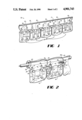
  • FIG. 1 is a perspective view of a preferred embodiment of the present invention.
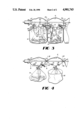
  • FIG. 2 is a perspective view of two of the debris collecting pouches shown in greater detail than in FIG. 1.
  • FIG. 3 is a perspective view of the pouches of FIG. 2, illustrating different states in the operation of the invention.
  • FIG. 4 is a perspective view of the pouches of FIG. 2 after they have been readied for disposal.
  • the safety glove bag 10 of the present invention comprises an elongated tubular sleeve or manifold 11, preferably airtight, having a longitudinally extending opening 12 in the top thereof and designed and dimensioned to fit loosely around a pipe from which insulation or lagging is to be removed.
  • a suitable closing and sealing means -3 which may be an adhesive tape or the like, extends along sleeve 11 at the opening 12, and is used to seal opening 12 shut after the sleeve has been mounted on the pipe.
  • first and second self-sealing openings 17 and 18, which afford air tight connections from the exterior of the assembly to the interior of each of the bags 14 for a water hose and a vacuum hose, as will be discussed more fully in connection with FIG. 2.
  • Each of the pouches 14 has a pair of openings 19 to which are attached, interiorly of the pouch, a pair of sleeves 21, which terminate in gloves 22.
  • a tool bag 23 which is designed to contain the necessary tools for the insulation removal, and which is accessible by the operator from the interior of the pouch 14 by means of sleeves 21 and gloves 22, into which the operator thrusts his arms. The structure as thus far described prevents any communication of the interior of the safety glove bag with the exterior or ambient atmosphere, while enabling an operator to operate on the asbestos on the pipe through sleeves 21 and gloves 22 without exposure to the asbestos.
  • FIG. 2 two of the pouches 14 of FIG. 1 in greater detail, and depicting separate steps in the operation of the invention.
  • indentations 24, 24 form the necked down portions 16, 16 which join pouches 14 to sleeve or manifold 11.
  • Indentations 24 also form a plurality of annular portions 26 in sleeve 11.
  • Annular portions or sleeves 26 are supported loosely by suitable tieing support means 27. Where the annular sleeve 26 is on the extreme end of the assembly, tieing support means 27 is used to tie the portion 26 securely to the pipe being treated, as best seen in FIG. 3.
  • a water hose 28, and a vacuum hose 29 connected to a HEPA filtration system, not shown, are connected to self sealing connections 17 and 18 such that there is no leakage from the interior of pouches 14 to the exterior.
  • a continuation 31 of hose 28 is attached to connection 17 on the interior of the pouch 14 and terminates in a nozzle 32.
  • FIG. 3 depicts further the step of spraying the insulation on the pipe with water through hose 28 and 31 and nozzle 32.
  • a negative pressure is created within the manifold and pouch interior by vacuum hose 29 so that if any leaks exist, the direction of leakage will be to the interior, and not to the exterior.
  • the right hand pouch 14 in FIG. 3 depicts the conclusion of the insulation removal. After spraying, hose 31 and nozzle 32 are placed in tool bag 23, and hose 28 may then be disconnected.
  • sleeves 21 may be inverted and knotted, as shown in FIG. 3. Then sleeve 21 is inverted, i.e., pulled out, the interior of the sleeve becomes the exterior, and vice versa, hence that surface of the sleeve which was exposed to the asbestos is the interior and hence is not exposed to the ambient air.
  • FIG. 4 Left hand pouch 14 is shown tied tight by means 33. In order that the pouch 14 may be completely sealed off, it is first twisted at the necked down portion 16, and then tieing means 33 is knotted about the twisted portion, as shown. The annular sleeves 26 are likewise tied securely to the pipe by means 27, as shown, and then the pouch 14 is placed in a receptacle 34, and with the HEPA filtration system still activated the pouch is separated from manifold 11 by cutting along lines B--B, B--B, or along line A--A. Receptacle 34 may then be sealed, as by tieing, not shown, and disposed of.

Landscapes

  • Engineering & Computer Science (AREA)
  • Mechanical Engineering (AREA)
  • Working Measures On Existing Buildindgs (AREA)

Abstract

A safety glove bag system for the removal of hazardous materials from elongated pipes or the like without danger or exposure of the operator to the hazardous material. The system utilizes a series of disposal pouches connected to a manifold which surrounds the pipe, and each of the disposal pouches may be removed from the assembly without disrupting the removal process.

Description

TECHNICAL FIELD
This invention relates to the removal of asbestos or other hazardous materials, and, more particularly, to the removal of pipe insulation or lagging containing asbestos.
BACKGROUND OF THE INVENTION
Exposure to asbestos, or more particularly, to an atmosphere containing asbestos fibers or dust, creates a significant health hazard. Pipes that are covered with asbestos insulation do not, normally, create such a hazard, but if the insulation is damaged, it is essential that it be removed or repaired as soon as possible. The awareness of the dangers inherent in the presence of asbestos has led to the removal of asbestos insulation, even when undamaged. As an example, quite often a potential purchaser of a building or house will demand removal of all asbestos before consummating the purchase.
Both federal and state laws require extraordinary protection for workers engaged in the removal of asbestos containing materials, and, to afford such protection without seriously hampering the work effort, numerous devices have been used.
In U.S. Pat. No. 4,626,291 of Natale, there is shown one such device for removing asbestos insulation from pipes which affords a large degree of protection for the worker. The Natale device comprises a flexible, transparent bag having attached thereto and extending into the interior thereof arm holes and sleeves which are terminated in gloves for the operator. The top of the bag is sealed around the pipe, and the bag is provided with a self sealing port through which a water hose is introduced to permit spraying of the asbestos, and through which subsequently a vacuum hose is introduced to maintain a negative pressure within the bag. The device is capable only of operating on one section of pipe at a time, and must be slid along the pipe to a new length thereof to be treated as soon as the asbestos has been removed from a first length of the pipe. Practical considerations dictate the maximum length of pipe that can be treated. For example, the operator must be able to reach, through the sleeves, all portions of the pipe section under treatment. Thus, quite literally, the length of the operator's arms is a limiting factor. Where the insulated pipe to be treated is of significant length the removal operation becomes tedious and time consuming, inasmuch as only one section at a time may be treated.
When the bag is filled with debris, the bottom portion is tied off from the upper portion prior to removal of the bag from the pipe, and the vacuum hose is used to vacuum up any loose pieces of insulation remaining.
Arrangements similar to the Natale device are shown in U.K. Pat. No. 1,567,270 of Atkinson, and in Canadian Pat. No. 1,188,191 of Atkinson. These arrangements are basically the same as the Natale device, differing primarily in minor details, and are subject to the same operational limitations discussed in connection with Natale.
SUMMARY OF THE INVENTION
The present invention comprises a method and apparatus for removing asbestos insulation or the like from large lengths of pipe without the necessity of moving the apparatus along the pipe as soon as a section thereof has been completed. Additionally, the apparatus is capable of being operated by a plurality of workers simultaneously, thereby materially decreasing the length of time necessary to strip an entire pipe of its insulation.
The invention, in a preferred embodiment thereof, comprises an elongated tubular sleeve or manifold for loose mounting around the pipe, and a plurality of debris collection pouches depending from the sleeve or manifold and joined thereto by neck portions. Each portion of the manifold from which a pouch depends is joined to the adjacent portion by an annular sleeve or neck. Means are provided for tieing the extreme ends of the manifold securely to the pipe, and further means are provided for supporting the annular sleeves loosely about the pipe.
In operation, the manifold is placed about the pipe and sealed, and its extreme ends are tied securely to the pipe. The support means for the annular sleeves are placed thereabout to permit communication between adjacent portions of the manifold while supporting the annular sleeves. The insulation is then stripped from the pipe by suitable means, such as the operator spraying with water or other liquid, and then chiseling, cutting, or prying loose, and the stripped material falls into and thus is collected by the pouch or pouches, depending upon how many operators are active.
When a pouch is full, or its associated section of pipe is clean, it is tied off at the neck portion, the support means for the annular sleeve is tightened to seal the annular sleeves to the pipe, and the pouch is then removed by cutting either at the tied sleeves, or above the tied neck portion. In this manner, dust and debris are never exposed to the ambient air, either from the pouch being removed, or from adjacent pouches.
The arrangement of the invention can be operated by one person, going from pouch area to pouch area, or by several operators simultaneously, without the necessity of moving the apparatus along the pipe length, except in cases of extremely long pipes.
BRIEF DESCRIPTION OF THE DRAWING
The various features and advantages of the present invention will be more clearly seen and understood from the following detailed description, read in conjunction with the accompanying drawings, in which:
FIG. 1 is a perspective view of a preferred embodiment of the present invention.
FIG. 2 is a perspective view of two of the debris collecting pouches shown in greater detail than in FIG. 1.
FIG. 3 is a perspective view of the pouches of FIG. 2, illustrating different states in the operation of the invention; and
FIG. 4 is a perspective view of the pouches of FIG. 2 after they have been readied for disposal.
DETAILED DESCRIPTION
The safety glove bag 10 of the present invention, as illustrated in FIG. 1, comprises an elongated tubular sleeve or manifold 11, preferably airtight, having a longitudinally extending opening 12 in the top thereof and designed and dimensioned to fit loosely around a pipe from which insulation or lagging is to be removed. A suitable closing and sealing means -3, which may be an adhesive tape or the like, extends along sleeve 11 at the opening 12, and is used to seal opening 12 shut after the sleeve has been mounted on the pipe.
Depending from manifold 11 is a plurality of debris collection pouches 14,14 each one of which is joined to sleeve 11 by a necked down portion 16. Located in sleeve 11 above each necked down portion 16 are first and second self-sealing openings 17 and 18, which afford air tight connections from the exterior of the assembly to the interior of each of the bags 14 for a water hose and a vacuum hose, as will be discussed more fully in connection with FIG. 2.
Each of the pouches 14 has a pair of openings 19 to which are attached, interiorly of the pouch, a pair of sleeves 21, which terminate in gloves 22. Located between each pair of sleeves 21, on the interior of the pouch 14, is a tool bag 23 which is designed to contain the necessary tools for the insulation removal, and which is accessible by the operator from the interior of the pouch 14 by means of sleeves 21 and gloves 22, into which the operator thrusts his arms. The structure as thus far described prevents any communication of the interior of the safety glove bag with the exterior or ambient atmosphere, while enabling an operator to operate on the asbestos on the pipe through sleeves 21 and gloves 22 without exposure to the asbestos.
In FIG. 2 are shown two of the pouches 14 of FIG. 1 in greater detail, and depicting separate steps in the operation of the invention. As can be seen in FIG. 2 indentations 24, 24 form the necked down portions 16, 16 which join pouches 14 to sleeve or manifold 11. Indentations 24 also form a plurality of annular portions 26 in sleeve 11. Annular portions or sleeves 26 are supported loosely by suitable tieing support means 27. Where the annular sleeve 26 is on the extreme end of the assembly, tieing support means 27 is used to tie the portion 26 securely to the pipe being treated, as best seen in FIG. 3.
Once the manifold of sleeve 11 is in place along with the associated support means 27, a water hose 28, and a vacuum hose 29 connected to a HEPA filtration system, not shown, are connected to self sealing connections 17 and 18 such that there is no leakage from the interior of pouches 14 to the exterior. A continuation 31 of hose 28 is attached to connection 17 on the interior of the pouch 14 and terminates in a nozzle 32.
In FIG. 3, the left hand pouch 14 is shown as being located at the one extreme end of manifold 11, and, as a consequence left hand support member 27 tightly binds its corresponding annular sleeve 26 to the pipe, as shown. FIG. 3 depicts further the step of spraying the insulation on the pipe with water through hose 28 and 31 and nozzle 32. At the same time, a negative pressure is created within the manifold and pouch interior by vacuum hose 29 so that if any leaks exist, the direction of leakage will be to the interior, and not to the exterior. The right hand pouch 14 in FIG. 3 depicts the conclusion of the insulation removal. After spraying, hose 31 and nozzle 32 are placed in tool bag 23, and hose 28 may then be disconnected. In addition, the sleeves 21 may be inverted and knotted, as shown in FIG. 3. Then sleeve 21 is inverted, i.e., pulled out, the interior of the sleeve becomes the exterior, and vice versa, hence that surface of the sleeve which was exposed to the asbestos is the interior and hence is not exposed to the ambient air.
The final steps in the process of the present invention are shown in FIG. 4. Left hand pouch 14 is shown tied tight by means 33. In order that the pouch 14 may be completely sealed off, it is first twisted at the necked down portion 16, and then tieing means 33 is knotted about the twisted portion, as shown. The annular sleeves 26 are likewise tied securely to the pipe by means 27, as shown, and then the pouch 14 is placed in a receptacle 34, and with the HEPA filtration system still activated the pouch is separated from manifold 11 by cutting along lines B--B, B--B, or along line A--A. Receptacle 34 may then be sealed, as by tieing, not shown, and disposed of.
The foregoing description has illustrated a preferred embodiment of the invention and a preferred method of using or operating it. Numerous changes or modifications may occur to workers in the art without departure from the spirit and scope of the invention as set forth in the following claims.
Claims (12)

I claim:
1. An apparatus for use in removing hazardous material from an elongated pipe said apparatus comprising
a containment bag having an elongated, substantially tubular manifold sized to be loosely mounted about the pipe for insuring continuous removal of hazardous material along the entire length of elongated pipe,
a plurality of debris collection pouches depending from said manifold, each of said pouches being joined to said manifold by a neck portion,
adjacent pouches being joined by a series of mutually spaced annular portions of said manifold,
means for tieing the extreme ends of said manifold tightly to the pipe,
and means for supporting said annular portions of said manifold loosely about the pipe.
2. The containment bag of claim 1 wherein said manifold has a seam that extends from one end thereof to the other.
3. The containment bag of claim 2 wherein said seam is located along a side of said manifold opposite to the side to which said neck portions are joined.
4. The containment bag of claim 1 wherein said support means comprises a plurality of straps.
5. The containment bag of claim 1 wherein said manifold, said pouches and said necks are formed of a unitary clear plastic material.
6. The containment bag of claim 1 wherein said neck portion is formed by indentations in each of said pouches.
7. Apparatus for use in the removal of hazardous material from an elongated pipe comprising:
means adapted to extend substantially coextensive with a entire length of the pipe for permitting continuous removal of the hazardous material throughout the entire length of the pipe, said means comprising a manifold for loosely surrounding the pipe along said entire length,
support means for loosely supporting said manifold at a plurality of support positions,
a plurality of material containment members depending from said manifold at spaced intervals along its length with annular sections of manifold therebetween and loosely surrounding the pipe, said support means being adapted to surround said annular sections,
each of said containment members being joined to said manifold by a neck portion, and
a pair of reentrant sleeves attached to each of said containment means, each of said sleeves terminating in a glove.
8. Apparatus as claimed in claim 7 wherein each of said containment members has first and second self sealing openings therein, located between said sleeves and said manifold.
9. Apparatus as claimed in claim 8 wherein said neck portion is formed by indentations in each of said containment members.
10. Apparatus as claimed in claim 9 wherein said indentatons are located in each of said containment members between said sleeves and said self sealing openings.
11. Apparatus for use in removing hazardous material from an elongated pipe comprising a containment bag that has an elongated sleeve sized and configured to be mounted loosely about the pipe for insuring continuous removal of hazardous material along the entire length of the elongated pipe from which a series of pouches depend with internal spacial communication established between said bag sleeve and said bag pouches, and a glove mounted to each of said pouches, whereby the sleeve is mounted about the pipe and hazardous material manually removed from a series of sections of the pipe covered by the sleeve and collected in the series of pouches located beneath the pipe sections.
12. The apparatus of claim 11 wherein said pouches depend from said sleeve at a series of joints that are mutually spaced by longitudinal portions of said elongated sleeve, and wherein said apparatus further comprises tieing means for supporting said longitudinal, sleeve portions loosely from the pipe.
US07/278,732 1988-12-02 1988-12-02 Safety glove bag Expired - Lifetime US4901743A (en)

Priority Applications (2)

Application Number Priority Date Filing Date Title
US07/278,732 US4901743A (en) 1988-12-02 1988-12-02 Safety glove bag
US07/351,530 US4872252A (en) 1988-12-02 1989-05-15 Method of removing hazardous material

Applications Claiming Priority (1)

Application Number Priority Date Filing Date Title
US07/278,732 US4901743A (en) 1988-12-02 1988-12-02 Safety glove bag

Related Child Applications (1)

Application Number Title Priority Date Filing Date
US07/351,530 Division US4872252A (en) 1988-12-02 1989-05-15 Method of removing hazardous material

Publications (1)

Publication Number Publication Date
US4901743A true US4901743A (en) 1990-02-20

Family

ID=23066125

Family Applications (1)

Application Number Title Priority Date Filing Date
US07/278,732 Expired - Lifetime US4901743A (en) 1988-12-02 1988-12-02 Safety glove bag

Country Status (1)

Country Link
US (1) US4901743A (en)

Cited By (11)

* Cited by examiner, † Cited by third party
Publication number Priority date Publication date Assignee Title
US5025716A (en) * 1987-01-21 1991-06-25 Jitsuo Inagaki Installation for processing foods in a sterilized condition
DE4011234A1 (en) * 1990-04-06 1991-10-10 Bernd Proesler Removal of asbestos dust from areas of buildings - involves enclosing affected area by air tight panels and removing dust with vacuum cleaner
US5520449A (en) * 1995-03-24 1996-05-28 Klak; Joseph V. Asbestos glove bag
US5536077A (en) * 1994-08-19 1996-07-16 Ross; Kurt D. Safety glove bag and method of making same
US5553933A (en) * 1994-08-19 1996-09-10 Grayling Industries, Inc. Safety glove bag and method of making same
US5671983A (en) * 1995-12-19 1997-09-30 Miller; Angela Lockable storage bag containing internal disposed hand covering element
US5704988A (en) * 1995-04-17 1998-01-06 Lyons; William G. Flexible "throw-away" sheet of trough for wet removal of asbestos
US5785396A (en) * 1997-04-03 1998-07-28 Israel; Hal C. Glove bag
US6056440A (en) * 1999-02-17 2000-05-02 Nattrass; Peter J. Sift proofing membrane for bulk lift bag and method
US20040027036A1 (en) * 2001-11-02 2004-02-12 Jim Hall System for safely inspecting matter possibly containing chemical or biological agents
CN106670186A (en) * 2017-01-03 2017-05-17 武刚 Recovering method of broken magnets in clean room and specialized plastic gloves

Citations (6)

* Cited by examiner, † Cited by third party
Publication number Priority date Publication date Assignee Title
US4089571A (en) * 1976-04-08 1978-05-16 Landy Jerome J Glove port and insert
GB1567270A (en) * 1977-03-07 1980-05-14 Atkinson W F Protective apparatus for facilitating the safe handling ofsubstances dangerous to health
GB2157822A (en) * 1984-04-18 1985-10-30 Asbebag Limited Protective device for facilitating the safe handling of substances dangerous to health
WO1986005431A1 (en) * 1985-03-13 1986-09-25 William James Hamlet A detachable receptacle and stripping apparatus for stripping lagging
US4626291A (en) * 1983-10-20 1986-12-02 Thomas Natale Portable containment device for treatment of hazardous materials
US4812700A (en) * 1983-10-20 1989-03-14 Gpac, Inc. Portable containment device for treatment of hazardous materials

Patent Citations (8)

* Cited by examiner, † Cited by third party
Publication number Priority date Publication date Assignee Title
US4089571A (en) * 1976-04-08 1978-05-16 Landy Jerome J Glove port and insert
GB1567270A (en) * 1977-03-07 1980-05-14 Atkinson W F Protective apparatus for facilitating the safe handling ofsubstances dangerous to health
US4626291A (en) * 1983-10-20 1986-12-02 Thomas Natale Portable containment device for treatment of hazardous materials
US4812700A (en) * 1983-10-20 1989-03-14 Gpac, Inc. Portable containment device for treatment of hazardous materials
US4812700B1 (en) * 1983-10-20 1991-08-13 Gpac Inc
US4626291B1 (en) * 1983-10-20 1992-01-14 Gpac Inc
GB2157822A (en) * 1984-04-18 1985-10-30 Asbebag Limited Protective device for facilitating the safe handling of substances dangerous to health
WO1986005431A1 (en) * 1985-03-13 1986-09-25 William James Hamlet A detachable receptacle and stripping apparatus for stripping lagging

Cited By (12)

* Cited by examiner, † Cited by third party
Publication number Priority date Publication date Assignee Title
US5025716A (en) * 1987-01-21 1991-06-25 Jitsuo Inagaki Installation for processing foods in a sterilized condition
DE4011234A1 (en) * 1990-04-06 1991-10-10 Bernd Proesler Removal of asbestos dust from areas of buildings - involves enclosing affected area by air tight panels and removing dust with vacuum cleaner
US5536077A (en) * 1994-08-19 1996-07-16 Ross; Kurt D. Safety glove bag and method of making same
US5553933A (en) * 1994-08-19 1996-09-10 Grayling Industries, Inc. Safety glove bag and method of making same
US5632846A (en) * 1994-08-19 1997-05-27 Ross; Kurt D. Method of producing safety glove bags
US5520449A (en) * 1995-03-24 1996-05-28 Klak; Joseph V. Asbestos glove bag
US5704988A (en) * 1995-04-17 1998-01-06 Lyons; William G. Flexible "throw-away" sheet of trough for wet removal of asbestos
US5671983A (en) * 1995-12-19 1997-09-30 Miller; Angela Lockable storage bag containing internal disposed hand covering element
US5785396A (en) * 1997-04-03 1998-07-28 Israel; Hal C. Glove bag
US6056440A (en) * 1999-02-17 2000-05-02 Nattrass; Peter J. Sift proofing membrane for bulk lift bag and method
US20040027036A1 (en) * 2001-11-02 2004-02-12 Jim Hall System for safely inspecting matter possibly containing chemical or biological agents
CN106670186A (en) * 2017-01-03 2017-05-17 武刚 Recovering method of broken magnets in clean room and specialized plastic gloves

Similar Documents

Publication Publication Date Title
US4626291A (en) Portable containment device for treatment of hazardous materials
US4901743A (en) Safety glove bag
US4812700A (en) Portable containment device for treatment of hazardous materials
US5017197A (en) Glove bag and method of use
US4883329A (en) Asbestos containment bag with slide fastener closure
CA1226181A (en) Method and apparatus for removing protective coating from pipe section
US5553933A (en) Safety glove bag and method of making same
US5725009A (en) Fitting removal fluid discharge bag
US4746175A (en) Detachable receptacle and stripping apparatus for stripping lagging
CA1327517C (en) Apparatus and method for the safe and effective, large scale removal and disposal of hazardous materials from building components
DE69508636D1 (en) Device for handling and cutting flat material on a vacuum table with a device for sealing the end areas of the table
AU612150B2 (en) Device and method for handling injurious materials
US5536077A (en) Safety glove bag and method of making same
US4869156A (en) Controlled environment system and method for constructing same
US4872252A (en) Method of removing hazardous material
JPH04502272A (en) Asbestos removal equipment and its removal method
EP0159908A2 (en) Protective device for facilitating the safe handling of substances dangerous to health
US4912358A (en) Portable containment device for treatment of hazardous materials
US20200290099A1 (en) Enclosure for containment of material
CA2314629C (en) Method of removing hazardous insulation material
WO2024246775A1 (en) System and methods for deploying end effector of a collaborative robot in a glovebox
US5131934A (en) Apparatus for removing hazardous particulate and fibrous materials
EP1277523B1 (en) A method for removing tubes containing asbestos
GB2173143A (en) Enclosure device
US4803771A (en) Process for removing asbestos using taped troughs

Legal Events

Date Code Title Description
AS Assignment

Owner name: GRAYLING INDUSTRIES, INC., 2205 DOUBLE CREEK LANE,

Free format text: ASSIGNMENT OF ASSIGNORS INTEREST.;ASSIGNOR:HITTLER, KURT;REEL/FRAME:004979/0998

Effective date: 19881202

Owner name: GRAYLING INDUSTRIES, INC., A CORP. OF GA, GEORGIA

Free format text: ASSIGNMENT OF ASSIGNORS INTEREST;ASSIGNOR:HITTLER, KURT;REEL/FRAME:004979/0998

Effective date: 19881202

STCF Information on status: patent grant

Free format text: PATENTED CASE

FPAY Fee payment

Year of fee payment: 4

SULP Surcharge for late payment
FPAY Fee payment

Year of fee payment: 8

FPAY Fee payment

Year of fee payment: 12