US4901350A - Closed-loop audio attenuator - Google Patents

Closed-loop audio attenuator Download PDF

Info

Publication number
US4901350A
US4901350A US07/340,834 US34083489A US4901350A US 4901350 A US4901350 A US 4901350A US 34083489 A US34083489 A US 34083489A US 4901350 A US4901350 A US 4901350A
Authority
US
United States
Prior art keywords
input
signal
current
differential amplifier
output
Prior art date
Legal status (The legal status is an assumption and is not a legal conclusion. Google has not performed a legal analysis and makes no representation as to the accuracy of the status listed.)
Expired - Lifetime
Application number
US07/340,834
Inventor
Fred J. Anderson
Richard A. Kennedy
Gregory J. Manlove
Jeffrey J. Marrah
Current Assignee (The listed assignees may be inaccurate. Google has not performed a legal analysis and makes no representation or warranty as to the accuracy of the list.)
Delphi Technologies Inc
Original Assignee
Delco Electronics LLC
Priority date (The priority date is an assumption and is not a legal conclusion. Google has not performed a legal analysis and makes no representation as to the accuracy of the date listed.)
Filing date
Publication date
Application filed by Delco Electronics LLC filed Critical Delco Electronics LLC
Priority to US07/340,834 priority Critical patent/US4901350A/en
Assigned to DELCO ELECTRONICS CORPORATION, A CORP. OF DE. reassignment DELCO ELECTRONICS CORPORATION, A CORP. OF DE. ASSIGNMENT OF ASSIGNORS INTEREST. Assignors: ANDERSON, FRED J., KENNEDY, RICHARD A., MANLOVE, GREGORY J., MARRAH, JEFFREY J.
Application granted granted Critical
Publication of US4901350A publication Critical patent/US4901350A/en
Priority to EP19900302871 priority patent/EP0393842A3/en
Priority to JP2101549A priority patent/JPH02295321A/en
Assigned to DELPHI TECHNOLOGIES INC. reassignment DELPHI TECHNOLOGIES INC. ASSIGNMENT OF ASSIGNORS INTEREST (SEE DOCUMENT FOR DETAILS). Assignors: DELCO ELECTRONICS CORPORATION
Anticipated expiration legal-status Critical
Expired - Lifetime legal-status Critical Current

Links

Images

Classifications

    • HELECTRICITY
    • H03ELECTRONIC CIRCUITRY
    • H03GCONTROL OF AMPLIFICATION
    • H03G3/00Gain control in amplifiers or frequency changers
    • H03G3/20Automatic control
    • H03G3/30Automatic control in amplifiers having semiconductor devices
    • H03G3/3005Automatic control in amplifiers having semiconductor devices in amplifiers suitable for low-frequencies, e.g. audio amplifiers
    • H03G3/301Automatic control in amplifiers having semiconductor devices in amplifiers suitable for low-frequencies, e.g. audio amplifiers the gain being continuously variable
    • HELECTRICITY
    • H03ELECTRONIC CIRCUITRY
    • H03GCONTROL OF AMPLIFICATION
    • H03G3/00Gain control in amplifiers or frequency changers
    • H03G3/20Automatic control
    • H03G3/30Automatic control in amplifiers having semiconductor devices
    • H03G3/34Muting amplifier when no signal is present
    • H03G3/344Muting responsive to the amount of noise (noise squelch)
    • HELECTRICITY
    • H03ELECTRONIC CIRCUITRY
    • H03GCONTROL OF AMPLIFICATION
    • H03G3/00Gain control in amplifiers or frequency changers
    • H03G3/20Automatic control
    • H03G3/30Automatic control in amplifiers having semiconductor devices
    • H03G3/34Muting amplifier when no signal is present
    • H03G3/345Muting during a short period of time when noise pulses are detected, i.e. blanking
    • HELECTRICITY
    • H04ELECTRIC COMMUNICATION TECHNIQUE
    • H04BTRANSMISSION
    • H04B1/00Details of transmission systems, not covered by a single one of groups H04B3/00 - H04B13/00; Details of transmission systems not characterised by the medium used for transmission
    • H04B1/06Receivers
    • H04B1/10Means associated with receiver for limiting or suppressing noise or interference
    • HELECTRICITY
    • H04ELECTRIC COMMUNICATION TECHNIQUE
    • H04BTRANSMISSION
    • H04B1/00Details of transmission systems, not covered by a single one of groups H04B3/00 - H04B13/00; Details of transmission systems not characterised by the medium used for transmission
    • H04B1/06Receivers
    • H04B1/16Circuits
    • H04B1/1646Circuits adapted for the reception of stereophonic signals
    • H04B1/1661Reduction of noise by manipulation of the baseband composite stereophonic signal or the decoded left and right channels
    • H04B1/1669Reduction of noise by manipulation of the baseband composite stereophonic signal or the decoded left and right channels of the demodulated composite stereo signal

Definitions

  • This invention relates to adaptive audio processing of detected signals in an FM Stereo receiver and more particularly to a closed-loop audio attenuator which provides accurate attenuation control over the crucial narrow range of control signal where attenuation is desired.
  • Blend is the reduction in L-R content
  • rolloff is the reduction of high-frequency content (where noise is not easily masked by program material)
  • audio attenuation is the reduction of the overall audio signal level in a gradual squelch-type action.
  • blend is applied when the RF signal drops below a level of 50 to 100 uV or during slight signal disturbances, while rolloff and attenuation are best applied only as conditions degrade severely.
  • the application of audio processing is very dependent upon the response of the FM receiver to multipath interference and loss of signal.
  • the noise output of the detector under weak signal conditions dictates the threshold of both rolloff and attenuation. This is due to the relative steepness of the S/N curve vs. RF input for the FM detector.
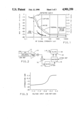
  • the noise characteristic can be divided into three distinct regions as influenced by receiver noise floor, thermal noise at the antenna, and detector-generated (capture) noise. The graph shown in FIG. 1, illustrates this behavior.
  • Blend is typically applied as soon as the thermal noise at the antenna begins to limit the stereo S/N. It should be noted that the stereo S/N ratio is about 23 dB worse than mono at this point. Rolloff is best applied at a point below, say, 10 uV, where the detector is contributing the majority of the noise power. Finally, when the overall S/N ratio collapses and the noise floor rises to within 20 dB or so of the full-strength detected audio, an audio attenuation action is desirable to keep the overall noise volume below a point of annoyance to the listener.
  • the need for an audio attenuator varies. With certain receivers, the slope is much gentler and the point of convergence of the two curves (detected audio and noise) is at a lower audio level. In such receivers the need for an audio attenuator has not been great. However, hard-limiting switched-capacitor type FM detectors have much steeper noise slopes and need an audio attenuator to enhance listenability under weak or no signal conditions. As a subjective rule, the level of the noise floor (which increases as signal strength decreases) should remain at least 22 dB below full quieting 100% modulated audio. In accordance with the present invention a closed-loop audio attenuator circuit is provided that insures that these concerns are met.
  • Ultrasonic noise is a good indicator of signal strength at low RF levels.
  • an audio attenuator which provides a controlled, predictable reaction to USN and thus variations in signal strength at low RF signal levels.
  • the attenuator include s a master section comprising a differential amplifier which is connected in a closed-loop with a multiplier and a gain stage.
  • the closed-loop circuit is preceded by an input amplifier which responds to the USN input through an RC time constant circuit. This time constant determines how quickly the attenuator reacts to signal disturbances, as indicated by variations in the USN voltage.
  • the master sections response to the signal from the gain stage is mirrored by a slave section which applies the actual audio signal attenuation.
  • the closed-loop configuration confines this linear control action to a very narrow range. Outside of this range, the circuit provides either full attenuation (15-20 dB nominal) or no attenuation (0 dB).
  • the closed-loop configuration is desirable because the crucial voltage range at the output of the USN detector, where a large amount of attenuation action is needed, is very small compared to the entire range of USN voltage.
  • FIG. 1 is a graph illustrating noise characteristics as a function of signal strength
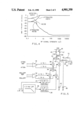
  • FIG. 2 is a block diagram of the closed-loop attenuator of the present invention
  • FIG. 3 is a graph showing the range over which linear control of attenuation is applied
  • FIG. 4 is a graph illustrating the effect of the closed-loop attenuator of the present invention on the S/N curve
  • FIG. 5 is a block diagram of the L+R steering section
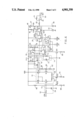
  • FIG. 6 is a detailed schematic diagram of the invention.
  • FIG. 1 illustrates the correlation of in-band audible noise to Ultrasonic noise (USN) i.e. noise in the ultrasonic frequency range of the detected composite signal (from 100-200 kHz).
  • USN Ultrasonic noise
  • AGC level AM disturbances on AGC
  • AM level AM level
  • the USN voltage may be generated by band pass filtering thehigh-frequency (100 kHz-200 kHz) noise band in the detected composite signal, and thereafter rectifying and low pass filtering to approximately 1 kHz.
  • the resulting DC control voltage referenced to an arbitrary reference voltage representing quiet conditions
  • the function of the closed-loop attenuator of the present invention is to provide controlled, predictable reaction to the USN voltage.
  • the USN voltage is applied to one input of an input amplifier 10 through an RC time constant circuit 12. This time constant determines how quickly the attenuator will react to variations in the USN voltage.
  • the other input of the amplifier 10 is connected to a USN reference voltage which determines the trip point of the amplifier 10.
  • the controlled, predictable reaction to the USN voltage is accomplished through the use ofa gain stage 14 in a closed-loop which includes a multiplier 16 responsive to the output of the amplifier 10 and to the output of a master differential amplifier 18 which responds to the output of the gain stage 14.
  • the output of the master amplifier is mirrored by a slave differentialamplifier 20 which applies the actual audio signal attenuation.
  • the closed-loop configuration confines this linear control action to a very narrow range as shown in FIG. 3. Outside of this range, the circuit provides either full attenuation (15-20 dB nominal) or no attenuation (0 ds).
  • the attenuator's effect on the S/N curve is shown in FIG. 4.
  • FIG. 5 A block diagram of the L+R signal steering section of the receiver is shownin FIG. 5.
  • the L+R input signal is fed directly to a voltage to current converter 24 and through a lowpass filter 26 to a voltage to current converter 28 to produce direct and lowpass-filtered varying current versions of the L+R signal.
  • the direct and low-passed signals are applied to multipliers 32 and 34 which are controlled from differential amplifier 30 in proportion to the voltage level of ROLLOFF with respect to ROLLOFF REF. If Rolloff is very high, the direct signal will be multiplied by 1 and the low-passed signal will be multiplied by 0, thus resulting in only a direct signal when the signals are added together at the summer 36.
  • the closed-loop audio attenuator includes multipliers 38 and 40 which steer signal currents arriving from the rolloff multipliers and froma 100 uA quiet current arriving from a current source 42 in accordance withthe relationship between the ATTEN REF and ATTEN voltages applied to masteramplifier 18. This results in a proportional mix of signal and quiet currents at the output of summer 44.
  • the output of the summer 44 is applied to the current mirror 46 comprising transistors P25, P26 and resistors 45, 47.
  • the difference between the output of current mirror 46 and current source 48 is applied to an output stage comprising amplifier 50 and resistors 49 and 51.
  • the time constant section 12 comprises resistor 52and capacitor 54 and applies filtering to the USN voltage to avoid excessive chewing or modulation of the audio signal as a result of rapid noise fluctuations.
  • the input amplifier comprises bipolar transistors Q1, Q2, P channel MOS transistors P8, P9, and resistors 56, 58.
  • Q1 & Q2 form adifferential input pair, with a trip point, USN REF, established by fixed resistors 60, 62 and variable resistor 64 connected to the base of transistor Q2.
  • P8 and P9 form a current mirror to link the input amplifier10 with the multiplier 16.
  • the input amplifier Q1, Q2, P8 and P9 provide a differential current to the multiplier 16.
  • the differential current is a function of the difference in voltage between USN and USN REF and the current flowing through the input amplifier as established by the resistor66 and current source comprising N channel MOS devices N18, N19 and resistors 68, 70.
  • the multiplier 16 comprises transistors Q10 and Q11 which modulate the current from the input amplifier 10 in accordance with the voltage output of the master differential amplifier 18.
  • P12 and P13 reflect the current through the transistor Q11 of multiplier 16 to a resistor 72 which converts the current to a voltage.
  • the capacitor 74 across the resistor 72 is for stabilization.
  • Master amplifier 18 comprises transistors Q14-Q17 andresistors 76, 78 connected with current source comprising transistor N20 and resistor 80. The amplifier 18 amplifies the voltage at the base of Q16and feeds back a differential control voltage from nodes A and B to the multiplier 16.
  • the differential voltage at nodes A and B is also applied to the slave circuitry Q21-Q24 which applies the variable attenuation to the L+R signalcurrent.
  • the output current of the slave amplifier 20 contains less AC information and the same DC information to produce an attenuation of the signal. Due to the high gain stage and feedback, a linear relationship is established between the USN voltage and the audio gain when USN is less than USN REF. The ultimate gain is set by the current through the input amplifier 10 and the resistor72 in the gain stage.
  • the closed-loop audio attenuator of the present invention provides an overall volume reduction in order to make severe noise conditions more tolerable. Due to the closed-loop nature of the circuit, precise and predictable attenuation levels can be designed against expected USN noise curves.
  • the three important parameters of the circuit are gain (overall volume reduction), trip point (USN level where attenuation action starts),and time constant (response time to USN disturbances).
  • the gain is determined by open-loop gain; in particular, it is most easily varied by adjusting the gain of the input amplifier 10 (FIG. 2).
  • the trip point is determined by the reference voltage at the input amplifier 10, and the time constant is determined by the value of the RC network of the timer section 12.
Landscapes

  • Engineering & Computer Science (AREA)
  • Computer Networks & Wireless Communication (AREA)
  • Signal Processing (AREA)
  • Multimedia (AREA)
  • Stereo-Broadcasting Methods (AREA)
  • Amplifiers (AREA)
  • Noise Elimination (AREA)
  • Control Of Amplification And Gain Control (AREA)

Abstract

A closed-loop attenuator for an FM stereo receiver provides attenuation to the L+R audio signal in a controlled and predictable reaction to an ultrasonic noise (USN) voltage presented to an input amplifier. This is accomplished through a closed-loop circuit configuration including a multiplier which modulates the current output of the input amplifier in accordance with the output of a master differential amplifier and supplies the modulated current to a gain stage connected to the input of the master differential amplifier. The output of the master amplifier is mirrored by a slave differential amplifier which applies the actual audio signal attenuation. The closed-loop configuration confines this linear control action to a very narrow range. Outside of this range, the circuit provides either full attenuation or no attenuation.

Description

FIELD OF THE INVENTION
This invention relates to adaptive audio processing of detected signals in an FM Stereo receiver and more particularly to a closed-loop audio attenuator which provides accurate attenuation control over the crucial narrow range of control signal where attenuation is desired.
BACKGROUND OF THE INVENTION
Reduction of noise to enhance the perceived signal-to-noise ratio is the primary function of typical audio processors applied to FM receivers. These circuits are usually applied to the detected audio signal after stereo decoding has taken place. The three most commonly applied audio processing mechanisms are blend, rolloff, and audio attenuation (or mute). Blend is the reduction in L-R content, rolloff is the reduction of high-frequency content (where noise is not easily masked by program material), and audio attenuation is the reduction of the overall audio signal level in a gradual squelch-type action.
As signal conditions degrade, these mechanisms are applied in this order to minimize the disruptive effect as perceived by the listener. Typically, blend is applied when the RF signal drops below a level of 50 to 100 uV or during slight signal disturbances, while rolloff and attenuation are best applied only as conditions degrade severely.
The application of audio processing is very dependent upon the response of the FM receiver to multipath interference and loss of signal. In particular, the noise output of the detector under weak signal conditions dictates the threshold of both rolloff and attenuation. This is due to the relative steepness of the S/N curve vs. RF input for the FM detector. As the signal level is reduced, the noise characteristic can be divided into three distinct regions as influenced by receiver noise floor, thermal noise at the antenna, and detector-generated (capture) noise. The graph shown in FIG. 1, illustrates this behavior.
Blend is typically applied as soon as the thermal noise at the antenna begins to limit the stereo S/N. It should be noted that the stereo S/N ratio is about 23 dB worse than mono at this point. Rolloff is best applied at a point below, say, 10 uV, where the detector is contributing the majority of the noise power. Finally, when the overall S/N ratio collapses and the noise floor rises to within 20 dB or so of the full-strength detected audio, an audio attenuation action is desirable to keep the overall noise volume below a point of annoyance to the listener.
Depending on the slope of the FM detector noise characteristic, the need for an audio attenuator varies. With certain receivers, the slope is much gentler and the point of convergence of the two curves (detected audio and noise) is at a lower audio level. In such receivers the need for an audio attenuator has not been great. However, hard-limiting switched-capacitor type FM detectors have much steeper noise slopes and need an audio attenuator to enhance listenability under weak or no signal conditions. As a subjective rule, the level of the noise floor (which increases as signal strength decreases) should remain at least 22 dB below full quieting 100% modulated audio. In accordance with the present invention a closed-loop audio attenuator circuit is provided that insures that these concerns are met.
SUMMARY OF THE INVENTION
Ultrasonic noise (USN) is a good indicator of signal strength at low RF levels. In accordance with the present invention an audio attenuator is disclosed which provides a controlled, predictable reaction to USN and thus variations in signal strength at low RF signal levels. The attenuator include s a master section comprising a differential amplifier which is connected in a closed-loop with a multiplier and a gain stage. The closed-loop circuit is preceded by an input amplifier which responds to the USN input through an RC time constant circuit. This time constant determines how quickly the attenuator reacts to signal disturbances, as indicated by variations in the USN voltage. The master sections response to the signal from the gain stage is mirrored by a slave section which applies the actual audio signal attenuation. The closed-loop configuration confines this linear control action to a very narrow range. Outside of this range, the circuit provides either full attenuation (15-20 dB nominal) or no attenuation (0 dB). The closed-loop configuration is desirable because the crucial voltage range at the output of the USN detector, where a large amount of attenuation action is needed, is very small compared to the entire range of USN voltage.
BRIEF DESCRIPTION OF THE DRAWINGS
The above and other advantages of the invention will become more apparent from the following description taken in conjunction with the accompanying drawings wherein like references refer to like parts and wherein:
FIG. 1 is a graph illustrating noise characteristics as a function of signal strength,
FIG. 2 is a block diagram of the closed-loop attenuator of the present invention,
FIG. 3 is a graph showing the range over which linear control of attenuation is applied,
FIG. 4 is a graph illustrating the effect of the closed-loop attenuator of the present invention on the S/N curve,
FIG. 5 is a block diagram of the L+R steering section,
FIG. 6 is a detailed schematic diagram of the invention.
DESCRIPTION OF THE PREFERRED EMBODIMENT
Referring now to the drawings, FIG. 1 illustrates the correlation of in-band audible noise to Ultrasonic noise (USN) i.e. noise in the ultrasonic frequency range of the detected composite signal (from 100-200 kHz). Among several possible audio processing flags (AGC level, AM disturbances on AGC, AM level, 19 kHz pilot noise etc.) the USN level gives the most reliable representation of in-band noise with the maximum dynamic range. The USN voltage may be generated by band pass filtering thehigh-frequency (100 kHz-200 kHz) noise band in the detected composite signal, and thereafter rectifying and low pass filtering to approximately 1 kHz. The resulting DC control voltage (referenced to an arbitrary reference voltage representing quiet conditions) is an accurate representation of the noise level.
The function of the closed-loop attenuator of the present invention is to provide controlled, predictable reaction to the USN voltage. As shown in FIG. 2, the USN voltage is applied to one input of an input amplifier 10 through an RC time constant circuit 12. This time constant determines how quickly the attenuator will react to variations in the USN voltage. The other input of the amplifier 10 is connected to a USN reference voltage which determines the trip point of the amplifier 10. The controlled, predictable reaction to the USN voltage is accomplished through the use ofa gain stage 14 in a closed-loop which includes a multiplier 16 responsive to the output of the amplifier 10 and to the output of a master differential amplifier 18 which responds to the output of the gain stage 14. The output of the master amplifier is mirrored by a slave differentialamplifier 20 which applies the actual audio signal attenuation. The closed-loop configuration confines this linear control action to a very narrow range as shown in FIG. 3. Outside of this range, the circuit provides either full attenuation (15-20 dB nominal) or no attenuation (0 ds). The attenuator's effect on the S/N curve is shown in FIG. 4.
A block diagram of the L+R signal steering section of the receiver is shownin FIG. 5. The L+R input signal is fed directly to a voltage to current converter 24 and through a lowpass filter 26 to a voltage to current converter 28 to produce direct and lowpass-filtered varying current versions of the L+R signal. The direct and low-passed signals are applied to multipliers 32 and 34 which are controlled from differential amplifier 30 in proportion to the voltage level of ROLLOFF with respect to ROLLOFF REF. If Rolloff is very high, the direct signal will be multiplied by 1 and the low-passed signal will be multiplied by 0, thus resulting in only a direct signal when the signals are added together at the summer 36. If Rolloff is very low with respect to Rolloff Ref, then the direct signal will be multiplied by 0 and the low-passed signal will be multiplied by 1,thus resulting in only a rolled-off signal when the signals are added together. Similarly, when the amplifier 30 is only partially tilted at a given Rolloff level, a partially rolled-off signal will result due to the proportional mixing of direct and low-passed signal.
Similarly, the closed-loop audio attenuator includes multipliers 38 and 40 which steer signal currents arriving from the rolloff multipliers and froma 100 uA quiet current arriving from a current source 42 in accordance withthe relationship between the ATTEN REF and ATTEN voltages applied to masteramplifier 18. This results in a proportional mix of signal and quiet currents at the output of summer 44. The output of the summer 44 is applied to the current mirror 46 comprising transistors P25, P26 and resistors 45, 47. The difference between the output of current mirror 46 and current source 48 is applied to an output stage comprising amplifier 50 and resistors 49 and 51.
Referring now to FIG. 6, the time constant section 12 comprises resistor 52and capacitor 54 and applies filtering to the USN voltage to avoid excessive chewing or modulation of the audio signal as a result of rapid noise fluctuations. The input amplifier comprises bipolar transistors Q1, Q2, P channel MOS transistors P8, P9, and resistors 56, 58. Q1 & Q2 form adifferential input pair, with a trip point, USN REF, established by fixed resistors 60, 62 and variable resistor 64 connected to the base of transistor Q2. P8 and P9 form a current mirror to link the input amplifier10 with the multiplier 16. The input amplifier Q1, Q2, P8 and P9 provide a differential current to the multiplier 16. The differential current is a function of the difference in voltage between USN and USN REF and the current flowing through the input amplifier as established by the resistor66 and current source comprising N channel MOS devices N18, N19 and resistors 68, 70.
The multiplier 16 comprises transistors Q10 and Q11 which modulate the current from the input amplifier 10 in accordance with the voltage output of the master differential amplifier 18. P12 and P13 reflect the current through the transistor Q11 of multiplier 16 to a resistor 72 which converts the current to a voltage. The capacitor 74 across the resistor 72is for stabilization. Master amplifier 18 comprises transistors Q14-Q17 andresistors 76, 78 connected with current source comprising transistor N20 and resistor 80. The amplifier 18 amplifies the voltage at the base of Q16and feeds back a differential control voltage from nodes A and B to the multiplier 16.
As the USN voltage falls below the trip point, current begins to flow through the multiplier 16. This current is steered through Q10 and Q11 of the multiplier 16 as a function of the node voltages A and B which provides the closed-loop feedback. The output current of the multiplier 16is reflected across the resistor 72 to generate the voltage ATTEN which is applied to the input of the master amplifier 18. As USN decreases in voltage, ATTEN increases, causing the voltage on node A to decrease and the voltage on node B to increase. This, in turn, causes the multiplier 16to begin attenuating the percentage of multiplier current flowing across resistor 72.
The differential voltage at nodes A and B is also applied to the slave circuitry Q21-Q24 which applies the variable attenuation to the L+R signalcurrent. As the voltage on node A decreases, the output current of the slave amplifier 20 contains less AC information and the same DC information to produce an attenuation of the signal. Due to the high gain stage and feedback, a linear relationship is established between the USN voltage and the audio gain when USN is less than USN REF. The ultimate gain is set by the current through the input amplifier 10 and the resistor72 in the gain stage.
The closed-loop audio attenuator of the present invention provides an overall volume reduction in order to make severe noise conditions more tolerable. Due to the closed-loop nature of the circuit, precise and predictable attenuation levels can be designed against expected USN noise curves. The three important parameters of the circuit are gain (overall volume reduction), trip point (USN level where attenuation action starts),and time constant (response time to USN disturbances). The gain is determined by open-loop gain; in particular, it is most easily varied by adjusting the gain of the input amplifier 10 (FIG. 2). The trip point is determined by the reference voltage at the input amplifier 10, and the time constant is determined by the value of the RC network of the timer section 12.
Claims (3)

The embodiments of the invention in which an exclusive property or privilege is claimed are defined as follows:
1. An audio attenuator circuit for an FM stereo receiver providing substantially linear audio attenuation over a predefined range of RF signal strength, comprising a slave section for combining proportional amounts of L+R signal and quiet signal in accordance with a differential control signal to thereby produce an attenuated audio signal, control means comprising a master differential amplifier responsive to a reference voltage and to an input voltage from a gain stage and providing said differential control signal as an output, an input amplifier responsive to an ultrasonic noise input of predetermined duration and magnitude, current multiplier means for modulating a current output of said input amplifier in accordance with a differential output of said master differential amplifier and for applying the modulated current output to said gain stage.
2. A closed-loop audio attenuator providing a controlled, predictable reaction to an ultrasonic noise (USN) voltage, comprising an input amplifier responsive to the differential between said USN voltage and to a reference voltage, a closed-loop circuit comprising a current multiplier, a master differential amplifier and a gain stage connected to the input of said master differential amplifier, said current multiplier modulating a current from the input amplifier in response to an output of said master differential amplifier and supplying the modulated current to said gain stage, slave differential amplifier means for combining proportional amounts of L+R signal current and quiet current in accordance with the output of the master differential amplifier to produce an attenuated audio output signal as a function of said USN voltage.
3. An audio attenuator circuit for attenuating an audio signal in response to variations in an ultrasonic noise input signal, comprising ultrasonic noise detector means including an input differential amplifier responsive at one input to an ultrasonic noise reference voltage, time delay means applying said ultrasonic noise input to a second input of said input differential amplifier for establishing a predetermined response time to variations in the noise input signal, said input amplifier providing an output current proportional to the amount the noise input signal exceeds the noise reference voltage, a master differential amplifier responsive to an attenuation reference input, a gain stage providing an attenuation input voltage to said master differential amplifier, said master differential amplifier providing a differential output voltage as a function of the difference between said attenuation reference input and said attenuation input voltage, a current multiplier for modulating the current from said input differential amplifier by the voltage output of said master differential amplifier and supplying the modulated current to said gain stage, slave differential amplifier means for developing an audio output signal by combining proportional amounts of L+R signal current and quiet current as a function of the differential voltage output of said master amplifier.
US07/340,834 1989-04-20 1989-04-20 Closed-loop audio attenuator Expired - Lifetime US4901350A (en)

Priority Applications (3)

Application Number Priority Date Filing Date Title
US07/340,834 US4901350A (en) 1989-04-20 1989-04-20 Closed-loop audio attenuator
EP19900302871 EP0393842A3 (en) 1989-04-20 1990-03-16 Closed-loop audio attenuator
JP2101549A JPH02295321A (en) 1989-04-20 1990-04-17 Closed loop audio attenuator

Applications Claiming Priority (1)

Application Number Priority Date Filing Date Title
US07/340,834 US4901350A (en) 1989-04-20 1989-04-20 Closed-loop audio attenuator

Publications (1)

Publication Number Publication Date
US4901350A true US4901350A (en) 1990-02-13

Family

ID=23335125

Family Applications (1)

Application Number Title Priority Date Filing Date
US07/340,834 Expired - Lifetime US4901350A (en) 1989-04-20 1989-04-20 Closed-loop audio attenuator

Country Status (3)

Country Link
US (1) US4901350A (en)
EP (1) EP0393842A3 (en)
JP (1) JPH02295321A (en)

Cited By (1)

* Cited by examiner, † Cited by third party
Publication number Priority date Publication date Assignee Title
US5661810A (en) * 1993-03-24 1997-08-26 Robert Bosch Gmbh Circuit arrangement for deriving signals for masking audio signals

Families Citing this family (1)

* Cited by examiner, † Cited by third party
Publication number Priority date Publication date Assignee Title
JP2013074554A (en) * 2011-09-29 2013-04-22 Icom Inc Gain control circuit, fm receiver and computer program

Citations (1)

* Cited by examiner, † Cited by third party
Publication number Priority date Publication date Assignee Title
US4198543A (en) * 1979-01-19 1980-04-15 General Motors Corporation Stereo composite processor for stereo radio receiver

Family Cites Families (5)

* Cited by examiner, † Cited by third party
Publication number Priority date Publication date Assignee Title
JPS5646352U (en) * 1979-09-17 1981-04-25
JPS5646346A (en) * 1979-09-21 1981-04-27 Hitachi Ltd Control system for fm stereo demodulation
JPS5672551A (en) * 1979-11-19 1981-06-16 Hitachi Ltd Frequency modulation receiver
JPS6053342A (en) * 1983-09-02 1985-03-27 Nec Corp Control circuit
JPS6388922A (en) * 1986-10-01 1988-04-20 Pioneer Electronic Corp Fm stereo tuner

Patent Citations (1)

* Cited by examiner, † Cited by third party
Publication number Priority date Publication date Assignee Title
US4198543A (en) * 1979-01-19 1980-04-15 General Motors Corporation Stereo composite processor for stereo radio receiver

Cited By (1)

* Cited by examiner, † Cited by third party
Publication number Priority date Publication date Assignee Title
US5661810A (en) * 1993-03-24 1997-08-26 Robert Bosch Gmbh Circuit arrangement for deriving signals for masking audio signals

Also Published As

Publication number Publication date
JPH02295321A (en) 1990-12-06
EP0393842A2 (en) 1990-10-24
EP0393842A3 (en) 1991-08-07

Similar Documents

Publication Publication Date Title
JP2784514B2 (en) FM Receiver with Improved Audio Response to Rayleigh Fade Received Signal
US6104919A (en) Intermodulation distortion reduction circuit utilizing variable attenuation
US4207543A (en) Adaptive filter network
US4480335A (en) Noise removing apparatus in an FM receiver
US5574791A (en) Combined de-esser and high-frequency enhancer using single pair of level detectors
EP0701322B1 (en) AM receiver
US6456833B1 (en) Method for noise reduction in the reception of RF FM signals
JP2000508497A (en) External interference signal elimination circuit in code division multiple access portable terminal
US4901350A (en) Closed-loop audio attenuator
US4221928A (en) Noise reduction circuit for stereo signals
JPH045295B2 (en)
US4198603A (en) Radio receiver audio attenuator
US4694500A (en) Control voltage generating circuit for activating a noise reduction circuit in an FM stereo receiver
US5701345A (en) Multipath interference reduction system and method
US5151939A (en) Adaptive audio processor for am stereo signals
US4107463A (en) Stereophonic noise suppression system
JPH02215240A (en) Fm stereo circuit
US5493617A (en) Frequency bandwidth dependent exponential release for dynamic filter
US4947431A (en) Held music history circuit
JPH07336247A (en) AM radio receiver
JP2000049633A (en) Receiver device
JPS5931077Y2 (en) fm stereo receiver
JP3182191B2 (en) Radio receiver
JPH056938B2 (en)
JPS6333379Y2 (en)

Legal Events

Date Code Title Description
AS Assignment

Owner name: DELCO ELECTRONICS CORPORATION, A CORP. OF DE., IND

Free format text: ASSIGNMENT OF ASSIGNORS INTEREST.;ASSIGNORS:ANDERSON, FRED J.;KENNEDY, RICHARD A.;MANLOVE, GREGORY J.;AND OTHERS;REEL/FRAME:005066/0348;SIGNING DATES FROM 19890404 TO 19890407

STCF Information on status: patent grant

Free format text: PATENTED CASE

FPAY Fee payment

Year of fee payment: 4

SULP Surcharge for late payment
FPAY Fee payment

Year of fee payment: 8

FPAY Fee payment

Year of fee payment: 12

AS Assignment

Owner name: DELPHI TECHNOLOGIES INC., MICHIGAN

Free format text: ASSIGNMENT OF ASSIGNORS INTEREST;ASSIGNOR:DELCO ELECTRONICS CORPORATION;REEL/FRAME:017115/0208

Effective date: 20050930