US4900654A - Photographic elements containing reflective or diffusely transmissive supports - Google Patents
Photographic elements containing reflective or diffusely transmissive supports Download PDFInfo
- Publication number
- US4900654A US4900654A US07/243,523 US24352388A US4900654A US 4900654 A US4900654 A US 4900654A US 24352388 A US24352388 A US 24352388A US 4900654 A US4900654 A US 4900654A
- Authority
- US
- United States
- Prior art keywords
- polyester
- microbeads
- cellulose acetate
- support
- weight
- Prior art date
- Legal status (The legal status is an assumption and is not a legal conclusion. Google has not performed a legal analysis and makes no representation as to the accuracy of the status listed.)
- Expired - Lifetime
Links
- 229920000728 polyester Polymers 0.000 claims abstract description 146
- 229920002301 cellulose acetate Polymers 0.000 claims abstract description 83
- 239000011325 microbead Substances 0.000 claims abstract description 60
- 239000011800 void material Substances 0.000 claims abstract description 32
- 239000000203 mixture Substances 0.000 claims description 67
- -1 silver halide Chemical class 0.000 claims description 50
- 230000005855 radiation Effects 0.000 claims description 22
- 239000004332 silver Substances 0.000 claims description 21
- 229910052709 silver Inorganic materials 0.000 claims description 21
- 239000000839 emulsion Substances 0.000 claims description 18
- 229920000139 polyethylene terephthalate Polymers 0.000 claims description 11
- 239000005020 polyethylene terephthalate Substances 0.000 claims description 11
- 125000000218 acetic acid group Chemical group C(C)(=O)* 0.000 claims 4
- 230000000704 physical effect Effects 0.000 abstract description 4
- 229940081735 acetylcellulose Drugs 0.000 description 64
- LYCAIKOWRPUZTN-UHFFFAOYSA-N Ethylene glycol Chemical compound OCCO LYCAIKOWRPUZTN-UHFFFAOYSA-N 0.000 description 35
- 238000003384 imaging method Methods 0.000 description 29
- 239000000463 material Substances 0.000 description 25
- 239000011159 matrix material Substances 0.000 description 25
- 238000000034 method Methods 0.000 description 21
- 229920002678 cellulose Polymers 0.000 description 18
- 239000002245 particle Substances 0.000 description 13
- 230000005540 biological transmission Effects 0.000 description 12
- 229920001634 Copolyester Polymers 0.000 description 11
- 238000001125 extrusion Methods 0.000 description 11
- 239000000835 fiber Substances 0.000 description 10
- VTYYLEPIZMXCLO-UHFFFAOYSA-L Calcium carbonate Chemical compound [Ca+2].[O-]C([O-])=O VTYYLEPIZMXCLO-UHFFFAOYSA-L 0.000 description 8
- QVGXLLKOCUKJST-UHFFFAOYSA-N atomic oxygen Chemical compound [O] QVGXLLKOCUKJST-UHFFFAOYSA-N 0.000 description 8
- 239000001301 oxygen Substances 0.000 description 8
- 229910052760 oxygen Inorganic materials 0.000 description 8
- 230000008569 process Effects 0.000 description 8
- 238000012545 processing Methods 0.000 description 8
- 239000007787 solid Substances 0.000 description 8
- 238000010521 absorption reaction Methods 0.000 description 7
- 239000002253 acid Substances 0.000 description 7
- 150000002148 esters Chemical class 0.000 description 7
- 230000009477 glass transition Effects 0.000 description 7
- WGCNASOHLSPBMP-UHFFFAOYSA-N hydroxyacetaldehyde Natural products OCC=O WGCNASOHLSPBMP-UHFFFAOYSA-N 0.000 description 7
- 238000002156 mixing Methods 0.000 description 7
- OFOBLEOULBTSOW-UHFFFAOYSA-N Malonic acid Chemical compound OC(=O)CC(O)=O OFOBLEOULBTSOW-UHFFFAOYSA-N 0.000 description 6
- 239000004743 Polypropylene Substances 0.000 description 6
- GWEVSGVZZGPLCZ-UHFFFAOYSA-N Titan oxide Chemical compound O=[Ti]=O GWEVSGVZZGPLCZ-UHFFFAOYSA-N 0.000 description 6
- 238000005266 casting Methods 0.000 description 6
- 239000007795 chemical reaction product Substances 0.000 description 6
- 239000003086 colorant Substances 0.000 description 6
- 229920001155 polypropylene Polymers 0.000 description 6
- 238000002834 transmittance Methods 0.000 description 6
- 238000004458 analytical method Methods 0.000 description 5
- 238000000576 coating method Methods 0.000 description 5
- 239000000155 melt Substances 0.000 description 5
- 239000011368 organic material Substances 0.000 description 5
- 229920000642 polymer Polymers 0.000 description 5
- 239000000047 product Substances 0.000 description 5
- 238000011160 research Methods 0.000 description 5
- 229920001169 thermoplastic Polymers 0.000 description 5
- 239000004416 thermosoftening plastic Substances 0.000 description 5
- KKEYFWRCBNTPAC-UHFFFAOYSA-N Terephthalic acid Chemical compound OC(=O)C1=CC=C(C(O)=O)C=C1 KKEYFWRCBNTPAC-UHFFFAOYSA-N 0.000 description 4
- YIMQCDZDWXUDCA-UHFFFAOYSA-N [4-(hydroxymethyl)cyclohexyl]methanol Chemical compound OCC1CCC(CO)CC1 YIMQCDZDWXUDCA-UHFFFAOYSA-N 0.000 description 4
- 239000000654 additive Substances 0.000 description 4
- 239000001913 cellulose Substances 0.000 description 4
- 239000011248 coating agent Substances 0.000 description 4
- WOZVHXUHUFLZGK-UHFFFAOYSA-N dimethyl terephthalate Chemical compound COC(=O)C1=CC=C(C(=O)OC)C=C1 WOZVHXUHUFLZGK-UHFFFAOYSA-N 0.000 description 4
- 230000000977 initiatory effect Effects 0.000 description 4
- QQVIHTHCMHWDBS-UHFFFAOYSA-N isophthalic acid Chemical compound OC(=O)C1=CC=CC(C(O)=O)=C1 QQVIHTHCMHWDBS-UHFFFAOYSA-N 0.000 description 4
- 239000010936 titanium Substances 0.000 description 4
- QTBSBXVTEAMEQO-UHFFFAOYSA-M Acetate Chemical compound CC([O-])=O QTBSBXVTEAMEQO-UHFFFAOYSA-M 0.000 description 3
- DNIAPMSPPWPWGF-UHFFFAOYSA-N Propylene glycol Chemical compound CC(O)CO DNIAPMSPPWPWGF-UHFFFAOYSA-N 0.000 description 3
- 150000007513 acids Chemical class 0.000 description 3
- 230000015572 biosynthetic process Effects 0.000 description 3
- 229910000019 calcium carbonate Inorganic materials 0.000 description 3
- 238000010276 construction Methods 0.000 description 3
- 238000011161 development Methods 0.000 description 3
- 150000001991 dicarboxylic acids Chemical class 0.000 description 3
- MTHSVFCYNBDYFN-UHFFFAOYSA-N diethylene glycol Chemical compound OCCOCCO MTHSVFCYNBDYFN-UHFFFAOYSA-N 0.000 description 3
- 239000000975 dye Substances 0.000 description 3
- 230000000694 effects Effects 0.000 description 3
- 150000002334 glycols Chemical class 0.000 description 3
- 238000005286 illumination Methods 0.000 description 3
- 229910010272 inorganic material Inorganic materials 0.000 description 3
- 239000011147 inorganic material Substances 0.000 description 3
- 238000002844 melting Methods 0.000 description 3
- BDJRBEYXGGNYIS-UHFFFAOYSA-N nonanedioic acid Chemical compound OC(=O)CCCCCCCC(O)=O BDJRBEYXGGNYIS-UHFFFAOYSA-N 0.000 description 3
- 230000003287 optical effect Effects 0.000 description 3
- 239000000126 substance Substances 0.000 description 3
- QPFMBZIOSGYJDE-UHFFFAOYSA-N 1,1,2,2-tetrachloroethane Chemical compound ClC(Cl)C(Cl)Cl QPFMBZIOSGYJDE-UHFFFAOYSA-N 0.000 description 2
- PXGZQGDTEZPERC-UHFFFAOYSA-N 1,4-cyclohexanedicarboxylic acid Chemical compound OC(=O)C1CCC(C(O)=O)CC1 PXGZQGDTEZPERC-UHFFFAOYSA-N 0.000 description 2
- IJGRMHOSHXDMSA-UHFFFAOYSA-N Atomic nitrogen Chemical compound N#N IJGRMHOSHXDMSA-UHFFFAOYSA-N 0.000 description 2
- 229920008347 Cellulose acetate propionate Polymers 0.000 description 2
- 229920002284 Cellulose triacetate Polymers 0.000 description 2
- 108010010803 Gelatin Proteins 0.000 description 2
- NNLVGZFZQQXQNW-ADJNRHBOSA-N [(2r,3r,4s,5r,6s)-4,5-diacetyloxy-3-[(2s,3r,4s,5r,6r)-3,4,5-triacetyloxy-6-(acetyloxymethyl)oxan-2-yl]oxy-6-[(2r,3r,4s,5r,6s)-4,5,6-triacetyloxy-2-(acetyloxymethyl)oxan-3-yl]oxyoxan-2-yl]methyl acetate Chemical compound O([C@@H]1O[C@@H]([C@H]([C@H](OC(C)=O)[C@H]1OC(C)=O)O[C@H]1[C@@H]([C@@H](OC(C)=O)[C@H](OC(C)=O)[C@@H](COC(C)=O)O1)OC(C)=O)COC(=O)C)[C@@H]1[C@@H](COC(C)=O)O[C@@H](OC(C)=O)[C@H](OC(C)=O)[C@H]1OC(C)=O NNLVGZFZQQXQNW-ADJNRHBOSA-N 0.000 description 2
- WNLRTRBMVRJNCN-UHFFFAOYSA-N adipic acid Chemical compound OC(=O)CCCCC(O)=O WNLRTRBMVRJNCN-UHFFFAOYSA-N 0.000 description 2
- 125000001931 aliphatic group Chemical group 0.000 description 2
- 238000000149 argon plasma sintering Methods 0.000 description 2
- TZCXTZWJZNENPQ-UHFFFAOYSA-L barium sulfate Chemical compound [Ba+2].[O-]S([O-])(=O)=O TZCXTZWJZNENPQ-UHFFFAOYSA-L 0.000 description 2
- 230000008901 benefit Effects 0.000 description 2
- 230000002457 bidirectional effect Effects 0.000 description 2
- WERYXYBDKMZEQL-UHFFFAOYSA-N butane-1,4-diol Chemical compound OCCCCO WERYXYBDKMZEQL-UHFFFAOYSA-N 0.000 description 2
- 125000004432 carbon atom Chemical group C* 0.000 description 2
- 230000008859 change Effects 0.000 description 2
- 238000001816 cooling Methods 0.000 description 2
- 238000010586 diagram Methods 0.000 description 2
- 235000012489 doughnuts Nutrition 0.000 description 2
- 238000004945 emulsification Methods 0.000 description 2
- 238000005516 engineering process Methods 0.000 description 2
- 239000008273 gelatin Substances 0.000 description 2
- 229920000159 gelatin Polymers 0.000 description 2
- 235000019322 gelatine Nutrition 0.000 description 2
- 235000011852 gelatine desserts Nutrition 0.000 description 2
- 239000007788 liquid Substances 0.000 description 2
- 239000004973 liquid crystal related substance Substances 0.000 description 2
- 230000008018 melting Effects 0.000 description 2
- 238000000465 moulding Methods 0.000 description 2
- KYTZHLUVELPASH-UHFFFAOYSA-N naphthalene-1,2-dicarboxylic acid Chemical compound C1=CC=CC2=C(C(O)=O)C(C(=O)O)=CC=C21 KYTZHLUVELPASH-UHFFFAOYSA-N 0.000 description 2
- 229920005615 natural polymer Polymers 0.000 description 2
- 239000002667 nucleating agent Substances 0.000 description 2
- 230000000149 penetrating effect Effects 0.000 description 2
- YWAKXRMUMFPDSH-UHFFFAOYSA-N pentene Chemical compound CCCC=C YWAKXRMUMFPDSH-UHFFFAOYSA-N 0.000 description 2
- 230000035699 permeability Effects 0.000 description 2
- 239000004014 plasticizer Substances 0.000 description 2
- 229920000573 polyethylene Polymers 0.000 description 2
- 229920000098 polyolefin Polymers 0.000 description 2
- 238000010791 quenching Methods 0.000 description 2
- 230000000171 quenching effect Effects 0.000 description 2
- CXMXRPHRNRROMY-UHFFFAOYSA-N sebacic acid Chemical compound OC(=O)CCCCCCCCC(O)=O CXMXRPHRNRROMY-UHFFFAOYSA-N 0.000 description 2
- 230000003595 spectral effect Effects 0.000 description 2
- 239000012798 spherical particle Substances 0.000 description 2
- 239000003381 stabilizer Substances 0.000 description 2
- 229920002994 synthetic fiber Polymers 0.000 description 2
- DNIAPMSPPWPWGF-VKHMYHEASA-N (+)-propylene glycol Chemical compound C[C@H](O)CO DNIAPMSPPWPWGF-VKHMYHEASA-N 0.000 description 1
- YPFDHNVEDLHUCE-UHFFFAOYSA-N 1,3-propanediol Substances OCCCO YPFDHNVEDLHUCE-UHFFFAOYSA-N 0.000 description 1
- JKFYKCYQEWQPTM-UHFFFAOYSA-N 2-azaniumyl-2-(4-fluorophenyl)acetate Chemical compound OC(=O)C(N)C1=CC=C(F)C=C1 JKFYKCYQEWQPTM-UHFFFAOYSA-N 0.000 description 1
- LAWHHRXCBUNWFI-UHFFFAOYSA-N 2-pentylpropanedioic acid Chemical compound CCCCCC(C(O)=O)C(O)=O LAWHHRXCBUNWFI-UHFFFAOYSA-N 0.000 description 1
- OONPLQJHBJXVBP-UHFFFAOYSA-N 3-(2-phenylethenyl)phthalic acid Chemical compound OC(=O)C1=CC=CC(C=CC=2C=CC=CC=2)=C1C(O)=O OONPLQJHBJXVBP-UHFFFAOYSA-N 0.000 description 1
- SBBQDUFLZGOASY-OWOJBTEDSA-N 4-[(e)-2-(4-carboxyphenyl)ethenyl]benzoic acid Chemical compound C1=CC(C(=O)O)=CC=C1\C=C\C1=CC=C(C(O)=O)C=C1 SBBQDUFLZGOASY-OWOJBTEDSA-N 0.000 description 1
- WSSSPWUEQFSQQG-UHFFFAOYSA-N 4-methyl-1-pentene Chemical compound CC(C)CC=C WSSSPWUEQFSQQG-UHFFFAOYSA-N 0.000 description 1
- 229910000968 Chilled casting Inorganic materials 0.000 description 1
- 229920000742 Cotton Polymers 0.000 description 1
- 229940090898 Desensitizer Drugs 0.000 description 1
- VGGSQFUCUMXWEO-UHFFFAOYSA-N Ethene Chemical compound C=C VGGSQFUCUMXWEO-UHFFFAOYSA-N 0.000 description 1
- 239000005977 Ethylene Substances 0.000 description 1
- 239000004677 Nylon Substances 0.000 description 1
- ISWSIDIOOBJBQZ-UHFFFAOYSA-N Phenol Chemical compound OC1=CC=CC=C1 ISWSIDIOOBJBQZ-UHFFFAOYSA-N 0.000 description 1
- 239000004698 Polyethylene Substances 0.000 description 1
- 239000004793 Polystyrene Substances 0.000 description 1
- 101100386054 Saccharomyces cerevisiae (strain ATCC 204508 / S288c) CYS3 gene Proteins 0.000 description 1
- BQCADISMDOOEFD-UHFFFAOYSA-N Silver Chemical compound [Ag] BQCADISMDOOEFD-UHFFFAOYSA-N 0.000 description 1
- 229910021607 Silver chloride Inorganic materials 0.000 description 1
- 229910021612 Silver iodide Inorganic materials 0.000 description 1
- KDYFGRWQOYBRFD-UHFFFAOYSA-N Succinic acid Natural products OC(=O)CCC(O)=O KDYFGRWQOYBRFD-UHFFFAOYSA-N 0.000 description 1
- SMEGJBVQLJJKKX-HOTMZDKISA-N [(2R,3S,4S,5R,6R)-5-acetyloxy-3,4,6-trihydroxyoxan-2-yl]methyl acetate Chemical compound CC(=O)OC[C@@H]1[C@H]([C@@H]([C@H]([C@@H](O1)O)OC(=O)C)O)O SMEGJBVQLJJKKX-HOTMZDKISA-N 0.000 description 1
- SJOOOZPMQAWAOP-UHFFFAOYSA-N [Ag].BrCl Chemical compound [Ag].BrCl SJOOOZPMQAWAOP-UHFFFAOYSA-N 0.000 description 1
- HOLVRJRSWZOAJU-UHFFFAOYSA-N [Ag].ICl Chemical compound [Ag].ICl HOLVRJRSWZOAJU-UHFFFAOYSA-N 0.000 description 1
- 238000005299 abrasion Methods 0.000 description 1
- 125000002777 acetyl group Chemical group [H]C([H])([H])C(*)=O 0.000 description 1
- 239000001361 adipic acid Substances 0.000 description 1
- 235000011037 adipic acid Nutrition 0.000 description 1
- 238000005054 agglomeration Methods 0.000 description 1
- 230000002776 aggregation Effects 0.000 description 1
- 150000008064 anhydrides Chemical class 0.000 description 1
- 238000013459 approach Methods 0.000 description 1
- 125000003118 aryl group Chemical group 0.000 description 1
- 239000012298 atmosphere Substances 0.000 description 1
- 230000004888 barrier function Effects 0.000 description 1
- IISBACLAFKSPIT-UHFFFAOYSA-N bisphenol A Chemical group C=1C=C(O)C=CC=1C(C)(C)C1=CC=C(O)C=C1 IISBACLAFKSPIT-UHFFFAOYSA-N 0.000 description 1
- 238000007664 blowing Methods 0.000 description 1
- CDQSJQSWAWPGKG-UHFFFAOYSA-N butane-1,1-diol Chemical compound CCCC(O)O CDQSJQSWAWPGKG-UHFFFAOYSA-N 0.000 description 1
- KDYFGRWQOYBRFD-NUQCWPJISA-N butanedioic acid Chemical compound O[14C](=O)CC[14C](O)=O KDYFGRWQOYBRFD-NUQCWPJISA-N 0.000 description 1
- 229910052799 carbon Inorganic materials 0.000 description 1
- 230000015556 catabolic process Effects 0.000 description 1
- 239000003795 chemical substances by application Substances 0.000 description 1
- 239000000084 colloidal system Substances 0.000 description 1
- 239000012141 concentrate Substances 0.000 description 1
- 230000008602 contraction Effects 0.000 description 1
- 238000007796 conventional method Methods 0.000 description 1
- 238000002788 crimping Methods 0.000 description 1
- 238000002425 crystallisation Methods 0.000 description 1
- 230000008025 crystallization Effects 0.000 description 1
- 230000007423 decrease Effects 0.000 description 1
- 230000003247 decreasing effect Effects 0.000 description 1
- 238000006731 degradation reaction Methods 0.000 description 1
- 230000001419 dependent effect Effects 0.000 description 1
- 238000013461 design Methods 0.000 description 1
- VNGOYPQMJFJDLV-UHFFFAOYSA-N dimethyl benzene-1,3-dicarboxylate Chemical compound COC(=O)C1=CC=CC(C(=O)OC)=C1 VNGOYPQMJFJDLV-UHFFFAOYSA-N 0.000 description 1
- 238000009826 distribution Methods 0.000 description 1
- 238000001035 drying Methods 0.000 description 1
- 230000005670 electromagnetic radiation Effects 0.000 description 1
- RTZKZFJDLAIYFH-UHFFFAOYSA-N ether Substances CCOCC RTZKZFJDLAIYFH-UHFFFAOYSA-N 0.000 description 1
- 230000001747 exhibiting effect Effects 0.000 description 1
- 238000002474 experimental method Methods 0.000 description 1
- 238000005562 fading Methods 0.000 description 1
- 239000000945 filler Substances 0.000 description 1
- 238000011049 filling Methods 0.000 description 1
- 239000012467 final product Substances 0.000 description 1
- 239000007789 gas Substances 0.000 description 1
- 238000005227 gel permeation chromatography Methods 0.000 description 1
- 239000008187 granular material Substances 0.000 description 1
- 230000005484 gravity Effects 0.000 description 1
- 238000010438 heat treatment Methods 0.000 description 1
- ACCCMOQWYVYDOT-UHFFFAOYSA-N hexane-1,1-diol Chemical compound CCCCCC(O)O ACCCMOQWYVYDOT-UHFFFAOYSA-N 0.000 description 1
- 229920005621 immiscible polymer blend Polymers 0.000 description 1
- 230000006872 improvement Effects 0.000 description 1
- 239000000976 ink Substances 0.000 description 1
- 239000011256 inorganic filler Substances 0.000 description 1
- 229910003475 inorganic filler Inorganic materials 0.000 description 1
- 229910003480 inorganic solid Inorganic materials 0.000 description 1
- 230000031700 light absorption Effects 0.000 description 1
- 238000001459 lithography Methods 0.000 description 1
- 239000000314 lubricant Substances 0.000 description 1
- 238000004519 manufacturing process Methods 0.000 description 1
- 239000006224 matting agent Substances 0.000 description 1
- 238000002074 melt spinning Methods 0.000 description 1
- 238000012986 modification Methods 0.000 description 1
- 230000004048 modification Effects 0.000 description 1
- 239000003607 modifier Substances 0.000 description 1
- WPUMVKJOWWJPRK-UHFFFAOYSA-N naphthalene-2,7-dicarboxylic acid Chemical compound C1=CC(C(O)=O)=CC2=CC(C(=O)O)=CC=C21 WPUMVKJOWWJPRK-UHFFFAOYSA-N 0.000 description 1
- SLCVBVWXLSEKPL-UHFFFAOYSA-N neopentyl glycol Chemical compound OCC(C)(C)CO SLCVBVWXLSEKPL-UHFFFAOYSA-N 0.000 description 1
- 229910052757 nitrogen Inorganic materials 0.000 description 1
- 230000006911 nucleation Effects 0.000 description 1
- 238000010899 nucleation Methods 0.000 description 1
- 229920001778 nylon Polymers 0.000 description 1
- 230000035515 penetration Effects 0.000 description 1
- UWJJYHHHVWZFEP-UHFFFAOYSA-N pentane-1,1-diol Chemical compound CCCCC(O)O UWJJYHHHVWZFEP-UHFFFAOYSA-N 0.000 description 1
- 239000000049 pigment Substances 0.000 description 1
- 229920003023 plastic Polymers 0.000 description 1
- 239000004033 plastic Substances 0.000 description 1
- 229920002492 poly(sulfone) Polymers 0.000 description 1
- 239000004848 polyfunctional curative Substances 0.000 description 1
- 229920005629 polypropylene homopolymer Polymers 0.000 description 1
- 229920002223 polystyrene Polymers 0.000 description 1
- 229920000166 polytrimethylene carbonate Polymers 0.000 description 1
- 239000000843 powder Substances 0.000 description 1
- 238000002360 preparation method Methods 0.000 description 1
- 238000007639 printing Methods 0.000 description 1
- 238000003672 processing method Methods 0.000 description 1
- 125000001501 propionyl group Chemical group O=C([*])C([H])([H])C([H])([H])[H] 0.000 description 1
- 238000002601 radiography Methods 0.000 description 1
- 230000000452 restraining effect Effects 0.000 description 1
- 230000035945 sensitivity Effects 0.000 description 1
- 238000000926 separation method Methods 0.000 description 1
- ADZWSOLPGZMUMY-UHFFFAOYSA-M silver bromide Chemical compound [Ag]Br ADZWSOLPGZMUMY-UHFFFAOYSA-M 0.000 description 1
- ZUNKMNLKJXRCDM-UHFFFAOYSA-N silver bromoiodide Chemical compound [Ag].IBr ZUNKMNLKJXRCDM-UHFFFAOYSA-N 0.000 description 1
- 229940045105 silver iodide Drugs 0.000 description 1
- HKZLPVFGJNLROG-UHFFFAOYSA-M silver monochloride Chemical compound [Cl-].[Ag+] HKZLPVFGJNLROG-UHFFFAOYSA-M 0.000 description 1
- 239000002904 solvent Substances 0.000 description 1
- 101150035983 str1 gene Proteins 0.000 description 1
- 238000005482 strain hardening Methods 0.000 description 1
- 239000012209 synthetic fiber Substances 0.000 description 1
- 125000000383 tetramethylene group Chemical group [H]C([H])([*:1])C([H])([H])C([H])([H])C([H])([H])[*:2] 0.000 description 1
- 229920002725 thermoplastic elastomer Polymers 0.000 description 1
- 239000004408 titanium dioxide Substances 0.000 description 1
- 238000012546 transfer Methods 0.000 description 1
- 239000012905 visible particle Substances 0.000 description 1
- 238000001429 visible spectrum Methods 0.000 description 1
- 239000003039 volatile agent Substances 0.000 description 1
- 238000009736 wetting Methods 0.000 description 1
- 230000002087 whitening effect Effects 0.000 description 1
Images
Classifications
-
- C—CHEMISTRY; METALLURGY
- C08—ORGANIC MACROMOLECULAR COMPOUNDS; THEIR PREPARATION OR CHEMICAL WORKING-UP; COMPOSITIONS BASED THEREON
- C08J—WORKING-UP; GENERAL PROCESSES OF COMPOUNDING; AFTER-TREATMENT NOT COVERED BY SUBCLASSES C08B, C08C, C08F, C08G or C08H
- C08J9/00—Working-up of macromolecular substances to porous or cellular articles or materials; After-treatment thereof
- C08J9/32—Working-up of macromolecular substances to porous or cellular articles or materials; After-treatment thereof from compositions containing microballoons, e.g. syntactic foams
-
- C—CHEMISTRY; METALLURGY
- C08—ORGANIC MACROMOLECULAR COMPOUNDS; THEIR PREPARATION OR CHEMICAL WORKING-UP; COMPOSITIONS BASED THEREON
- C08J—WORKING-UP; GENERAL PROCESSES OF COMPOUNDING; AFTER-TREATMENT NOT COVERED BY SUBCLASSES C08B, C08C, C08F, C08G or C08H
- C08J5/00—Manufacture of articles or shaped materials containing macromolecular substances
- C08J5/18—Manufacture of films or sheets
-
- C—CHEMISTRY; METALLURGY
- C08—ORGANIC MACROMOLECULAR COMPOUNDS; THEIR PREPARATION OR CHEMICAL WORKING-UP; COMPOSITIONS BASED THEREON
- C08L—COMPOSITIONS OF MACROMOLECULAR COMPOUNDS
- C08L67/00—Compositions of polyesters obtained by reactions forming a carboxylic ester link in the main chain; Compositions of derivatives of such polymers
-
- C—CHEMISTRY; METALLURGY
- C08—ORGANIC MACROMOLECULAR COMPOUNDS; THEIR PREPARATION OR CHEMICAL WORKING-UP; COMPOSITIONS BASED THEREON
- C08J—WORKING-UP; GENERAL PROCESSES OF COMPOUNDING; AFTER-TREATMENT NOT COVERED BY SUBCLASSES C08B, C08C, C08F, C08G or C08H
- C08J2367/00—Characterised by the use of polyesters obtained by reactions forming a carboxylic ester link in the main chain; Derivatives of such polymers
-
- Y—GENERAL TAGGING OF NEW TECHNOLOGICAL DEVELOPMENTS; GENERAL TAGGING OF CROSS-SECTIONAL TECHNOLOGIES SPANNING OVER SEVERAL SECTIONS OF THE IPC; TECHNICAL SUBJECTS COVERED BY FORMER USPC CROSS-REFERENCE ART COLLECTIONS [XRACs] AND DIGESTS
- Y10—TECHNICAL SUBJECTS COVERED BY FORMER USPC
- Y10S—TECHNICAL SUBJECTS COVERED BY FORMER USPC CROSS-REFERENCE ART COLLECTIONS [XRACs] AND DIGESTS
- Y10S264/00—Plastic and nonmetallic article shaping or treating: processes
- Y10S264/47—Processes of splitting film, webs or sheets
-
- Y—GENERAL TAGGING OF NEW TECHNOLOGICAL DEVELOPMENTS; GENERAL TAGGING OF CROSS-SECTIONAL TECHNOLOGIES SPANNING OVER SEVERAL SECTIONS OF THE IPC; TECHNICAL SUBJECTS COVERED BY FORMER USPC CROSS-REFERENCE ART COLLECTIONS [XRACs] AND DIGESTS
- Y10—TECHNICAL SUBJECTS COVERED BY FORMER USPC
- Y10S—TECHNICAL SUBJECTS COVERED BY FORMER USPC CROSS-REFERENCE ART COLLECTIONS [XRACs] AND DIGESTS
- Y10S430/00—Radiation imagery chemistry: process, composition, or product thereof
- Y10S430/151—Matting or other surface reflectivity altering material
-
- Y—GENERAL TAGGING OF NEW TECHNOLOGICAL DEVELOPMENTS; GENERAL TAGGING OF CROSS-SECTIONAL TECHNOLOGIES SPANNING OVER SEVERAL SECTIONS OF THE IPC; TECHNICAL SUBJECTS COVERED BY FORMER USPC CROSS-REFERENCE ART COLLECTIONS [XRACs] AND DIGESTS
- Y10—TECHNICAL SUBJECTS COVERED BY FORMER USPC
- Y10T—TECHNICAL SUBJECTS COVERED BY FORMER US CLASSIFICATION
- Y10T428/00—Stock material or miscellaneous articles
- Y10T428/13—Hollow or container type article [e.g., tube, vase, etc.]
- Y10T428/1352—Polymer or resin containing [i.e., natural or synthetic]
- Y10T428/1372—Randomly noninterengaged or randomly contacting fibers, filaments, particles, or flakes
-
- Y—GENERAL TAGGING OF NEW TECHNOLOGICAL DEVELOPMENTS; GENERAL TAGGING OF CROSS-SECTIONAL TECHNOLOGIES SPANNING OVER SEVERAL SECTIONS OF THE IPC; TECHNICAL SUBJECTS COVERED BY FORMER USPC CROSS-REFERENCE ART COLLECTIONS [XRACs] AND DIGESTS
- Y10—TECHNICAL SUBJECTS COVERED BY FORMER USPC
- Y10T—TECHNICAL SUBJECTS COVERED BY FORMER US CLASSIFICATION
- Y10T428/00—Stock material or miscellaneous articles
- Y10T428/13—Hollow or container type article [e.g., tube, vase, etc.]
- Y10T428/1352—Polymer or resin containing [i.e., natural or synthetic]
- Y10T428/1376—Foam or porous material containing
-
- Y—GENERAL TAGGING OF NEW TECHNOLOGICAL DEVELOPMENTS; GENERAL TAGGING OF CROSS-SECTIONAL TECHNOLOGIES SPANNING OVER SEVERAL SECTIONS OF THE IPC; TECHNICAL SUBJECTS COVERED BY FORMER USPC CROSS-REFERENCE ART COLLECTIONS [XRACs] AND DIGESTS
- Y10—TECHNICAL SUBJECTS COVERED BY FORMER USPC
- Y10T—TECHNICAL SUBJECTS COVERED BY FORMER US CLASSIFICATION
- Y10T428/00—Stock material or miscellaneous articles
- Y10T428/249921—Web or sheet containing structurally defined element or component
- Y10T428/249953—Composite having voids in a component [e.g., porous, cellular, etc.]
-
- Y—GENERAL TAGGING OF NEW TECHNOLOGICAL DEVELOPMENTS; GENERAL TAGGING OF CROSS-SECTIONAL TECHNOLOGIES SPANNING OVER SEVERAL SECTIONS OF THE IPC; TECHNICAL SUBJECTS COVERED BY FORMER USPC CROSS-REFERENCE ART COLLECTIONS [XRACs] AND DIGESTS
- Y10—TECHNICAL SUBJECTS COVERED BY FORMER USPC
- Y10T—TECHNICAL SUBJECTS COVERED BY FORMER US CLASSIFICATION
- Y10T428/00—Stock material or miscellaneous articles
- Y10T428/249921—Web or sheet containing structurally defined element or component
- Y10T428/249953—Composite having voids in a component [e.g., porous, cellular, etc.]
- Y10T428/249978—Voids specified as micro
-
- Y—GENERAL TAGGING OF NEW TECHNOLOGICAL DEVELOPMENTS; GENERAL TAGGING OF CROSS-SECTIONAL TECHNOLOGIES SPANNING OVER SEVERAL SECTIONS OF THE IPC; TECHNICAL SUBJECTS COVERED BY FORMER USPC CROSS-REFERENCE ART COLLECTIONS [XRACs] AND DIGESTS
- Y10—TECHNICAL SUBJECTS COVERED BY FORMER USPC
- Y10T—TECHNICAL SUBJECTS COVERED BY FORMER US CLASSIFICATION
- Y10T428/00—Stock material or miscellaneous articles
- Y10T428/249921—Web or sheet containing structurally defined element or component
- Y10T428/249953—Composite having voids in a component [e.g., porous, cellular, etc.]
- Y10T428/249986—Void-containing component contains also a solid fiber or solid particle
-
- Y—GENERAL TAGGING OF NEW TECHNOLOGICAL DEVELOPMENTS; GENERAL TAGGING OF CROSS-SECTIONAL TECHNOLOGIES SPANNING OVER SEVERAL SECTIONS OF THE IPC; TECHNICAL SUBJECTS COVERED BY FORMER USPC CROSS-REFERENCE ART COLLECTIONS [XRACs] AND DIGESTS
- Y10—TECHNICAL SUBJECTS COVERED BY FORMER USPC
- Y10T—TECHNICAL SUBJECTS COVERED BY FORMER US CLASSIFICATION
- Y10T428/00—Stock material or miscellaneous articles
- Y10T428/25—Web or sheet containing structurally defined element or component and including a second component containing structurally defined particles
- Y10T428/254—Polymeric or resinous material
-
- Y—GENERAL TAGGING OF NEW TECHNOLOGICAL DEVELOPMENTS; GENERAL TAGGING OF CROSS-SECTIONAL TECHNOLOGIES SPANNING OVER SEVERAL SECTIONS OF THE IPC; TECHNICAL SUBJECTS COVERED BY FORMER USPC CROSS-REFERENCE ART COLLECTIONS [XRACs] AND DIGESTS
- Y10—TECHNICAL SUBJECTS COVERED BY FORMER USPC
- Y10T—TECHNICAL SUBJECTS COVERED BY FORMER US CLASSIFICATION
- Y10T428/00—Stock material or miscellaneous articles
- Y10T428/29—Coated or structually defined flake, particle, cell, strand, strand portion, rod, filament, macroscopic fiber or mass thereof
- Y10T428/2913—Rod, strand, filament or fiber
-
- Y—GENERAL TAGGING OF NEW TECHNOLOGICAL DEVELOPMENTS; GENERAL TAGGING OF CROSS-SECTIONAL TECHNOLOGIES SPANNING OVER SEVERAL SECTIONS OF THE IPC; TECHNICAL SUBJECTS COVERED BY FORMER USPC CROSS-REFERENCE ART COLLECTIONS [XRACs] AND DIGESTS
- Y10—TECHNICAL SUBJECTS COVERED BY FORMER USPC
- Y10T—TECHNICAL SUBJECTS COVERED BY FORMER US CLASSIFICATION
- Y10T428/00—Stock material or miscellaneous articles
- Y10T428/29—Coated or structually defined flake, particle, cell, strand, strand portion, rod, filament, macroscopic fiber or mass thereof
- Y10T428/2913—Rod, strand, filament or fiber
- Y10T428/2933—Coated or with bond, impregnation or core
- Y10T428/2938—Coating on discrete and individual rods, strands or filaments
-
- Y—GENERAL TAGGING OF NEW TECHNOLOGICAL DEVELOPMENTS; GENERAL TAGGING OF CROSS-SECTIONAL TECHNOLOGIES SPANNING OVER SEVERAL SECTIONS OF THE IPC; TECHNICAL SUBJECTS COVERED BY FORMER USPC CROSS-REFERENCE ART COLLECTIONS [XRACs] AND DIGESTS
- Y10—TECHNICAL SUBJECTS COVERED BY FORMER USPC
- Y10T—TECHNICAL SUBJECTS COVERED BY FORMER US CLASSIFICATION
- Y10T428/00—Stock material or miscellaneous articles
- Y10T428/29—Coated or structually defined flake, particle, cell, strand, strand portion, rod, filament, macroscopic fiber or mass thereof
- Y10T428/2913—Rod, strand, filament or fiber
- Y10T428/298—Physical dimension
Definitions
- the present invention is directed to photographic elements having supports such as film supports having a polyester continuous phase containing cellulose ester microbeads dispersed therein which are at least partially bordered by voids.
- the supports have unique properties of texture, whiteness in the absence of colorants, diffuse transmission of light, and generally good physical properties such as tensile properties.
- Blends of linear polyesters with other incompatible materials of organic or inorganic nature to form microvoided structures are well-known in the art.
- U.S. Pat. No. 3,154,461 discloses, for example, the linear polyester, poly(ethylene terephthalate), blended with, for example, calcium carbonate.
- U.S. Pat. No. 3,944,699 discloses blends of linear polyester, preferably poly(ethylene terephthalate) with 3 to 27% of organic material such as ethylene or propylene polymer.
- U.S. Pat. No. 3,640,944 also discloses the use of poly(ethylene terephthalate) but blended with 8% organic material such as polysulfone or poly(4-methyl, 1-pentene).
- 4,377,616 discloses a blend of polypropylene to serve as the matrix with a small percentage of another and incompatible organic material, nylon, to initiate microvoiding in the polypropylene matrix.
- U.K. Patent Specification No. 1,563,591 discloses linear polyester polymers, and particularly poly(ethylene terephthalate), for making an opaque thermoplastic film support in which have been blended finely divided particles of barium sulfate together with a void-promoting polyolefin, such as polyethylene, polypropylene and poly-4-methyl-1-pentene.
- spherical particles initiate voids of unusual regularity and orientation in a stratified relationship throughout the matrix material after biaxial orientation of the extruded film.
- Each void tends to be of like shape, not necessarily of like size since the size depends upon the size of the particle.
- each void assumes a shape defined by two opposed and edge contacting concave disks.
- the voids tend to have a lens-like or biconvex shape.
- the voids are oriented so that the two major dimensions are aligned in correspondence with the direction of orientation of the film structure.
- One major dimension is aligned with machine direction orientation
- a second major dimension is aligned with the transverse direction orientation
- a minor dimension approximately corresponds to the cross-section dimension of the void-initiating particle.
- the voids generally tend to be closed cells, and thus there is virtually no path open from one side of a biaxially oriented film to the other side through which liquid or gas can traverse.
- the film Upon biaxial orientation of the resulting extruded film, the film becomes white and opaque, the opacity resulting from light being scattered from the walls of the microvoids.
- the transmission of light through the film becomes lessened with increased number and with increased size of the microvoids relative to the size of a particle within each microvoid.
- a matte finish on the surface of the film results, as discussed in U.S. Pat. No. 3,154,461.
- the particles adjacent the surfaces of the film tend to be incompressible and thus form projections without rupturing the surface.
- Such matte finishes enable the film to be written upon with pencil or with inks, crayons, and the like.
- U.S. Pat. No. 4,377,616 discloses that preferred particle size of a void initiating sphere may be about 0.1 to about 10 microns, and that preferred particle size range from about 0.75 to about 2 microns.
- U.S. Pat. No. 3,154,461 specifies that a range of sizes may be approximately 0.3 micron to approximately 20 microns, and that when calcium carbonate is used, its size may range from 1 to 5 microns.
- the linear polyester component of the film may comprise any thermoplastic film forming polyester which may be produced by condensing one or more dicarboxylic acids or a lower alkyl diester thereof, such as terephthalic acid, isophthalic acid, 2,5-,2,6- or 2,7-naphthalene dicarboxylic acid, succinic acid, sebacic acid, adipic acid, azelaic acid, bibenzoic acid, and hexahydroterephthalic acid, or bis-p-carboxy phenoxy ethane, with one or more glycols.
- dicarboxylic acids or a lower alkyl diester thereof such as terephthalic acid, isophthalic acid, 2,5-,2,6- or 2,7-naphthalene dicarboxylic acid, succinic acid, sebacic acid, adipic acid, azelaic acid, bibenzoic acid, and hexahydroterephthalic acid, or bis-p-carbox
- Such glycols may include ethylene glycol, 1,3-propanediol, 1,4-butanediol, neopentyl glycol, and 1,4-cyclohexanedimethanol. Also, a copolyester of any of the above-indicated materials may be used.
- the preferred polyester is poly(ethylene terephthalate).
- U.S. Pat. No. 3,944,699 also indicates that the extrusion, quenching and stretching of the film may be effected by any process which is known in the art for producing oriented film, such as by a flat film process or a bubble or tubular process.
- the flat film process involves extruding the blend through a slit dye and rapidly quenching the extruded web upon a chilled casting drum so that the polyester component of the film is quenched into the amorphous state.
- the quenched film is then biaxially oriented by stretching in mutually perpendicular directions at a temperature above the glass transition temperature of the polyester.
- the film may be stretched in one direction and then in a second direction or may be simultaneously stretched in both directions. After the film has been stretched it is heat set by heating to a temperature sufficient to crystallize the polyester while restraining the film against retraction in both directions of stretching.
- Paper is essentially a non-woven sheet of more or less randomly arrayed fibers.
- the key properties of these structures are opacity, texture, strength, and stability.
- fiber technology evolved synergistically with paper, and today we have a variety of synthetic fibers and synthetic papers.
- the synthetic materials have never quite matched the cellulose-based natural polymers, like cotton for fibers and cellulose pulps for papers.
- the natural polymers are generally weaker and less stable.
- a serious problem, for example, is brightness reversion or fading of papers and fibers.
- the present invention advances the state of these prior arts.
- this invention is concerned with creating opacity by stretching or orienting plastic materials to induce microvoids which scatter light, preferably white light.
- a large body of prior art deals with this technique, wherein a plurality of inorganic solid particles are used as the dispersed phase, around which the microvoids form.
- Some significant problems associated with this approach are: (1) agglomeration and particle size control, (2) abrasive wear of extrusion equipment, guides, and cutters, (3) high specific gravity of these solids, (4) poor void nucleation around the solid particles due to the low thermal contraction of solids relative to liquids and polymer wetting and adhesion to the solid surfaces, (5) cost of these materials on a volume basis, and (6) handling and processing problems in general. In every case, the invention reduces or eliminates the problem.
- the prior art also teaches a variety of methods of creating surface texture. Often the surface is roughened by physical means like abrasion, crimping, etc. Many chemical methods are also used to react with, etch, or otherwise alter the surface. Flame, electrical corona, and electromagnetic radiations are often employed. Coating technology is well advanced for filling and whitening, and often inorganic materials are major components of these coatings. Even if the orientation or stretching step is eliminated, a coating step is required. Not only do most of the problems above remain, but new ones are created in such areas as adhesion, uniformity, and coating stability.
- the cited prior art concentrates on synthetic paper compositions and methods of manufacturing directly related to this invention, namely compositions of matter involving polyesters and/or cellulose esters, stretching incompatible/immiscible thermoplastic blends to create voided structures with or without texture, and some of the properties and problems associated with the use of inorganic, nonmelting materials.
- the blend compositions and processing methods of this invention constitute a significant improvement over the immiscible polymer blend systems found in the prior art.
- this invention is directed to a photographic element comprised of a reflective or diffusely transmissive support and, coated on the support, at least one radiation-sensitive silver halide emulsion layer.
- the photographic element is characterized in that the support is comprised of a continuous polyester phase having dispersed therein microbeads of cellulose acetate which are at least partially bordered by void space, the microbeads of cellulose acetate being present in an amount of 10-30% by weight based on the weight of the polyester, the void space occupying 2-50% by volume of the support.
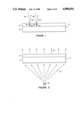
- FIG. 1 is a schematic diagram of a photographic element according to the invention being imagewise exposed
- FIG. 2 is a schematic diagram of a photographic element according to the invention being back illuminated
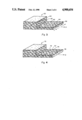
- FIG. 3 is a perspective view in section illustrating a preferred embodiment of a support satisfying the requirements of the invention
- FIG. 4 is a perspective view in section illustrating an alternate construction of a support satisfying the requirements of the invention
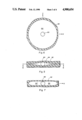
- FIGS. 5 and 7 are enlarged sectional views illustrating a microbead of cellulose acetate entrapped in a void in a polyester continuous phase
- FIG. 6 is a sectional view taken along section line 6--6 in FIG. 5;
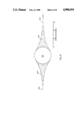
- FIG. 8 is a graphical view illustrating the change in size of microvoids surrounding microbeads as a function of the stretch ratio
- FIGS. 9, 10, and 11 are photomicrographs of supports formed of a polyester continuous phase, cellulose ester microbeads forming a second phase, and microvoids bordering the microbeads.
- FIG. 1 A photographic element 10 satisfying the requirements of the invention is shown in FIG. 1.
- the photographic element is comprised of a support 12 and an imaging unit 14 coated on the support.
- the imaging unit is comprised of at least one radiation-sensitive silver halide emulsion layer.
- the imaging unit consists of a single silver halide emulsion layer.
- Black-and-white photographic elements for example, often contain a single silver halide emulsion layer.
- the imaging unit can be comprised of a plurality of silver halide emulsion layers.
- color photographic elements typically contain blue, green, and red color forming layer units. Each of these color forming layer units contains at least one silver halide emulsion layer.
- each color forming layer unit contains three separate silver halide emulsion layers of similar spectral sensitivity within a single color forming layer unit, but differing in speed.
- the photographic element is being imagewise exposed to radiation capable of producing a latent image in the silver halide emulsion layer or layers of the imaging unit.
- Exposing radiation indicated by arrows 16a and 16b, strikes the imaging unit.
- Part of the incident radiation is absorbed in the imaging unit, with the remainder penetrating the imaging unit and striking the support, as indicated by arrows 18a and 18b.
- a very high percentage of the exposing radiation striking the support is reflected, as indicated by arrows 20a and 20b.
- the reflected radiation traverses the imaging unit a second time, where, again, it is in part absorbed.
- the unabsorbed radiation is indicated by arrows 22a and 22b.
- the reflective support allows exposing radiation to penetrate the imaging unit twice, almost doubling the opportunity for its absorption. This is in direct contrast to a photographic element having a transparent or absorptive support, which relies almost entirely on radiation producing a latent image in the imaging unit based on a single penetration of the imaging unit.
- a photographic element with a reflective support exhibits a higher photographic speed than a photographic element with a transmissive or absorptive support.
- the photographic elements of this invention exhibit higher effective speeds than photographic elements with comparable imaging units and conventional reflective supports, since the reflective supports which satisfy the requirements of this invention reflect a larger percentage of exposing radiation that impinges upon them, particularly when the wavelength of the exposing radiation is in the blue (400 to 500 nm) and near ultraviolet (280 to 400 nm) range. Very large increases in reflection as compared to conventional titania loaded reflective photographic supports are observed at exposing wavelengths of 450 nm or less.
- a portion of the exposing radiation incident on the support 12 is neither reflected nor absorbed, but is transmitted through the support. This portion of the radiation is not shown in FIG. 1, since it is possible to reduce transmitted radiation to a negligibly small portion of the total radiation while concurrently increasing reflected radiation by increasing the thickness of the support.
- FIG. 2 the photographic element 10 is shown after it has been imagewise exposed and processed to produce an image.
- the second mode of viewing is transmission viewing.
- an illumination source 30 directs light, indicated by arrows 32, to the support 12. While a portion of this light, not shown, is reflected by the support, a significant portion of the incident light enters the support and is diffusely transmitted. Diffuse transmission differs from specular transmission in that the light becomes scattered during the course of penetrating the support. Stated another way, even with the imaging unit exhibiting zero density or being entirely omitted, one viewing the support 12 from above (as shown) could not see the light source, but could see transmitted light, indicated by arrows 34, emanating from the support. With no image present in the imaging unit, the illuminated support appears uniformly white. When the imaging unit contains an image, this is superimposed on the illuminated white background provided by the support, and the image is readily viewed.
- the support were specularly transmissive (i.e., transparent), viewed from above (as shown), the viewer could see the illumination source as well as any image present in the imaging unit. This is visually objectionable, since the two images, the illumination source and the image in the imaging unit are superimposed.
- a significant advantage of the photographic elements of this invention over those of the prior art is that a support construction is provided that is capable of use as either a reflective or diffuse transmission support.
- FIG. 3 illustrates a support 60 satisfying the requirements of this invention which has been biaxially oriented [biaxially stretched, i.e., stretched in both the longitudinal (X) and transverse (Y) directions], as indicated by the arrows.
- the support 60 is illustrated in section, showing microbeads 62 contained within circular microvoids 64 in the polymeric continuous matrix 66.
- the microvoids 64 surrounding the microbeads 62 are theoretically regular in shape, but on microscopic examination often show irregularities, particularly when the random spacing of the microbeads results in two or more microbeads being located in close proximity.
- FIG. 4 also illustrates a support 70 which has been unidirectionally oriented (stretched in one direction only, as indicated by the arrow).
- Microbeads 72 are contained between microvoid lobes 74 and 74'.
- the microvoid lobes in this instance form at opposite sides of the microbeads as the sheet is stretched.
- the stretching is done in only the longitudinal direction (X) as indicated by the arrow, the microvoids will form on the leading and trailing sides of the microbeads. This is because of the unidirectional orientation as opposed to the bidirectional orientation of the sheet shown in FIG. 4. This is the only difference between the supports of FIGS. 3 and 4.
- FIGS. 5 and 6 are sectional views which illustrate on an enlarged scale a microbead 80 being entrapped within the polymeric continuous matrix 82 and encircled by microvoid 84. This lshape results from the support being stretched in both the X and Y directions.
- FIG. 7 is a view similar to FIG. 5, except illustrating in enlarged form microbead 90 entrapped in the polymeric continuous matrix 92, having formed on opposite sides thereof microvoid lobes 94 and 94', which are formed when the support is stretched only in the direction of the arrow X.
- FIG. 8 is an enlargement illustrating a specific manner in which microvoids can be formed in a polyester continuous matrix as the support is stretched or oriented.
- the formation of the microvoids 100 and 100' around microbeads 102 is illustrated on a stretch ratio scale as the support is stretched up to 4 times its original dimension. For example, as the support is stretched 4 times its original dimension in the X direction (4X), the microvoids extend to the points 104 and 104', respectively.
- FIGS. 9 and 10 are actual photomicrographs of sections of a support according to this invention which has been frozen and fractured. The continuous polymeric matrix, microbeads, and microvoids are obvious.
- FIG. 11 is an actual photomicrograph of a section of support oriented in one direction. The scale of these photomicrographs is indicated at the top of each in micrometers ( ⁇ m).
- the supports are comprised of a continuous thermoplastic polyester phase having dispersed therein microbeads of cellulose ester which are at least partially bordered by voids.
- the supports are conveniently in the form of sheets or film.
- the polyester is relatively strong and tough, while the cellulose acetate is relatively hard and brittle.
- the present invention provides supports comprising a continuous thermoplastic polyester phase having dispersed therein microbeads of cellulose ester which are at least partially bordered by voids, the microbeads of cellulose acetate being present in an amount of 10-30% by weight based on the weight of polyester, the voids occupying 2-50% by volume of the shaped article, the composition of the shaped article when consisting only of the polyester continuous phase and microbeads of cellulose ester bordered by voids characterized by having a Kubelka-Munk R value (infinite thickness) of 0.90 to 1.0 and the following Kubelka-Munk values when formed into a 3 mil (76.2 microns) thick film:
- the opacity values indicate that the article is opaque
- the SX values indicate a large amount of light scattering through the thickness of the article
- the KX values indicate a low amount of light absorption through the thickness of the article
- the Ti values indicate a low level amount of internal transmittance of the thickness of the article.
- the R (infinite thickness) values indicate a large amount of light reflectance.
- the Kubelka-Munk values which are dependent on thickness of the article must be specified at a certain thickness.
- the supports themselves may be very thin, e.g., less than 1 mil (25.4 micron) or they may be thicker, e.g., 20 mils (508 microns)
- the Kubelka-Munk values, except for R( ⁇ ) are specified at 3 mils (76.2 microns) and in the absence of any additives which would effect optical properties.
- the polyester containing microbeads at least partially bordered by voids, without additives should be formed in a 3 mils (approx. 75 ⁇ m) thick film for determination of Kubelka-Munk values.
- the supports according to this invention are useful, for example, when in the forms of sheets or films. In the absence of additives or colorants, they are very white.
- the supports are very resistant to wear, moisture, oil, tearing, etc.
- the polyester (or copolyester) phase may be any article-forming polyester such as a polyester capable of being cast into a film or sheet, spun into fibers, extruded into rods or extrusion, blow-molded into containers such as bottles, etc.
- the polyesters should have a glass transition temperature between 50° C. and 150° C., preferably 60°-100° C., should be orientable, and have an I.V. of at least 0.55, preferably 0.6 to 0.9.
- Suitable polyesters include those produced from aromatic, aliphatic or cycloaliphatic dicarboxylic acids of 4-20 carbon atoms and aliphatic or alicyclic glycols having from 2-24 carbon atoms.
- suitable dicarboxylic acids include terephthalic, isophthalic, phthalic, naphthalene dicarboxylic acid, succinic, glutaric, adipic, azelaic, sebacic, fumaric, maleic, itaconic, 1,4-cyclohexanedicarboxylic, and mixtures thereof.
- suitable glycols include ethylene glycol, propylene glycol, butanediol, pentanediol, hexanediol, 1,4-cyclohexanedimethanol, diethylene glycol, and mixtures thereof.
- polyesters are well known in the art and may be produced by well-known techniques, e.g., those described in U.S. Pat. Nos. 2,465,319 and 2,901,466.
- the preferred polyester is polyethylene terephthalate having a Tg of about 80° C.
- suitable polyesters include liquid crystal copolyesters formed by the inclusion of a suitable amount of a co-acid component such as stilbene dicarboxylic acid. Examples of such liquid crystal copolyesters are those disclosed in U.S. Pat. Nos. 4,420,607, 4,459,402 and 4,468,510.
- Blends of polyesters and/or copolyesters are useful in the present invention. Also, small amounts of other polymers such as polyolefins can be tolerated in the continuous matrix.
- Suitable cellulose acetates are those having an acetyl content of 28 to 44.8% by weight, and a viscosity of 0.01-90 seconds. Such cellulose acetates are well known in the art. Small contents of propionyl can usually be tolerated. Also, processes for preparing such cellulose acetates are well known in the art. Suitable commercially available cellulose acetates include the following which are marketed by Eastman Chemical Products, Inc.:
- the microbeads of cellulose esters range in size from 0.1-50 microns, and are present in an amount of 10-30% by weight based on the weight of the polyester.
- the microbeads of cellulose acetate have a Tg of at least 20° C. higher than the Tg of the polyester and are hard compared to the polyester.
- the microbeads of cellulose acetate are at least partially bordered by voids.
- the void space in the shaped article should occupy 2-50%, preferably 20-30%, by volume of the shaped article.
- the voids may completely encircle the microbeads, e.g., a void may be in the shape of a doughnut (or flattened doughnut) encircling a microbead, or the voids may only partially border the microbeads, e.g., a pair of voids may border a microbead on opposite sides.
- the invention does not require but permits the use or addition of a plurality of organic and inorganic materials such as fillers, pigments, anti-blocks, anti-stats, plasticizers, dyes, stabilizers, nucleating agents, etc. These materials may be incorporated into the matrix phases, into the dispersed phases, or may exist as separate dispersed phases.
- organic and inorganic materials such as fillers, pigments, anti-blocks, anti-stats, plasticizers, dyes, stabilizers, nucleating agents, etc.
- microvoids form on cooling without requiring nucleating agents.
- the voids assume characteristic shapes from the balanced biaxial orientation of paperlike films to the uniaxial orientation of microvoided/satin-like fibers.
- Balanced microvoids are largely circular in the plane of orientation while fiber microvoids are elongated in the direction of the fiber axis.
- the size of the microvoids and the ultimate physical properties depend upon the degree and balance of the orientation, temperature and rate of stretching, crystallization kinetics, the size distribution of the microbeads, and the like.
- the supports according to this invention are prepared by
- the mixture may be formed by forming a melt of the polyester and mixing therein the cellulose acetate.
- the cellulose acetate may be in the form of solid or semi-solid microbeads, or in molten form. Due to the incompatability between the polyester and cellulose acetate, there is no attraction or adhesion between them, allowing the cellulose acetate to "bead-up" if molten to form dispersed microbeads upon mixing. If solid or semi-solid, the microbeads become uniformly dispersed in the polyester upon mixing.
- a shaped article is formed by processes such as extrusion, casting or molding. Examples of extrusion or casting would be extruding or casting a film or sheet. Such forming methods are well known in the art. If sheets or film material are cast or extruded, it is important that such article be oriented by stretching, at least in one direction. Methods of unilaterally or bilaterally orienting sheet or film material are well known in the art. Basically, such methods comprise stretching the sheet or film at least in the machine or longitudinal direction after it is cast or extruded by an amount of about 1.5-10 (usually 3-4) times its original dimension.
- Such sheet or film may also be stretched in the transverse or cross-machine direction by apparatus and methods well known in the art, in amounts of generally 1.5-10 (usually 3-4) times the original dimension.
- apparatus and methods are well known in the art--e.g., they are described in such U.S. Pat. Nos. 3,903,234, incorporated herein by reference.
- the voids, or void spaces, referred to herein surrounding the microbeads are formed as the polyester continuous matrix is stretched at a temperature between the polyester Tg and the cellulose acetate Tg.
- the microbeads of cellulose acetate are relatively hard compared to the polyester continuous matrix.
- the polyester continuous matrix slides over the microbeads as it is stretched, causing voids to be formed at the sides in the direction or directions of stretch, which voids elongate as the polyester matrix continues to be stretched.
- the final size and shape of the voids depends on the direction(s) and amount of stretching.
- stretching is only in one direction, microvoids will form at the sides of the microbeads in the direction of stretching. If stretching is in two directions (bidirectional stretching), in effect such stretching has vector components extending radially from any given position to result in a doughnut-shaped void surrounding each microbead.
- the preferred preform stretching operation simultaneously opens the microvoids and orients the matrix material.
- the final product properties depend on and can be controlled by stretching time-temperature relationships and on the type and degree of stretch. For maximum opacity and texture, the stretching is done just above the glass transition temperature of the matrix material. When stretching is done in the neighborhood of the higher glass transition temperature, both phases stretch together and opacity decreases. In the former case, the materials are pulled apart, a mechanical anti-compatibilization process. In the latter case, they are drawn together, a mechanical compatibilization process.
- Two examples are high-speed melt spinning of fibers and melt blowing of fibers and films to form non-woven/spun-bonded products. In summary, the scope of this invention includes the complete range of forming operations just described.
- void formation occurs independent of, and does not require, crystalline orientation of the matrix phase.
- Opaque, microvoided films have been made in accordance with the methods of this invention using completely amorphous, non-crystallizing copolyesters as the matrix phase.
- Crystallizable/orientable (strain hardening) matrix materials are preferred for some properties like tensile strength and barrier effectiveness.
- amorphous matrix materials have special utility in other areas like tear resistance and heat sealability.
- the specific matrix composition can be tailored to meet many product needs. The complete range from crystalline to amorphous matrix materials is part of the invention.
- the specified materials were combined and mixed in a dry state prior to extrusion.
- Most of the materials used in these examples are granules (ground through a 2 millimeter screen) and fine powders. This form permits good dry blending without separation during processing. In most cases, the mixed materials were dried under vacuum conditions with nitrogen bleed to carry off the volatiles. Of course, when substantial amounts of low-melting materials were used, separate drying was done, followed by mixing and immediate extrusion.
- the relative amounts of the polyester, cellulose ester, and other materials are indicated by mass ratios; and all percents are weight %. During extrusion, the materials are melted and mixed as viscous melts.
- Shear emulsification of the immiscible melts was enhanced with a mixing section centrally located in the metering section of the extruder screw. Residence time was kept small by design; for example, screw L/D was 24:1 [Killion 1.25 inch (31.8 mm) extruder] and the dies were joined directly to the extruder via small-sized adaptors. The extrudate is quenched to form flat films or sheet. The required orientation was carried out by conventional equipment and methods associated with the specific forming operation.
- Blends were prepared with a polyester and a cellulose acetate.
- the polyester is Polyester A (described below) and the cellulose ester is cellulose acetate CA-398-30.
- Two blends (80/20) and (90/10) were melt cast to form sheets between 15 to 20 mils (381 to 508 microns) thick. These sheets were simultaneously stretched 4X (a multiple of 4) in both directions to form white, paper-like films just over 1 mil (25.4 microns) thick.
- the films of this invention are highly diffuse reflective over the visible spectrum and remain highly reflective in the near UV (300 to 400 nanometer wavelengths) region. Typical films properties and processing conditions are given below.
- Example 2 This example is an example of prior art. It is given here for direct comparison with Example 1. Blends were prepared with the same polyester as Example 1 and inorganic materials. The inorganics are titanium dioxide (Rutile R-100) and calcium carbonate (Microwhite 25). A (90/10) blend of the polyester and each of the inorganics was melt cast to form sheets between 15 to 20 mils (381 to 508 microns) thick. These sheets were simultaneously stretched 4X in both directions to form white, plastic-like films just over 1 mil (25.4 microns) thick. Typical film properties and processing conditions are given below.
- Blends were prepared with a polyester and a cellulose acetate.
- the polyester is a blend of Polyester A and Polyester A containing a covalently bound colorant.
- the cellulose acetate is CA-398-30.
- Two (80/20) blends (one containing 0.5% red moiety and one containing 0.5% blue moiety) were melt cast to form sheets 20 mils (508 microns) thick. These sheets were simultaneously stretched 4X in both directions to form pastel-colored, paper-like films about 1.75 mils (44.5 microns) thick. Typical film properties and processing conditions are given below.
- Blends were prepared with a polyester and a mixed cellulose ester, cellulose acetate propionate.
- the polyester is Polyester A and the cellulose ester is CAP-482-20.
- This (90/10) blend and a (90/10) blend made like Example 1 were melt cast to form sheets 15 mils (381 microns) thick. These sheets were simultaneously stretched 4X in both directions to form translucent, paper-like films about 1 mil (25.4 microns) thick. Typical film properties and processing conditions are given below.
- Blends were prepared with the same polyester and cellulose acetate as Example 1.
- the specific blends (95/5), (90/10), (85/15), (80/20), (75/25), and (70/30) were melt cast to form sheets 25 mils (635 microns) thick.
- Extrusion conditions were similar to those of Example 1. These sheets were simultaneously stretched 3X in both directions to form white, paper-like films 3 mils (76.2 microns) thick. These sheets were also simultaneously stretched 4X in both directions to form white, paper-like films 2 mils (50.8 microns) thick. Typical film optical properties are given below.
- Example 2 shows that light-colored, opaque structures developed when the dispersed phase was colored.
- the polyester of Example 1 was mixed with a cellulose acetate (CA-320S, containing a covalently bonded colorant).
- a (90/10) blend (containing 0.13% red moiety) was melt cast to form sheets 15 mils (381 microns) thick. These sheets were stretched as in Example 1 yielding uniformly pastel-red, opaque, paper-like films.
- a blend was prepared with a polyester and a cellulose acetate.
- the polyester is Polyester B (described below) and the cellulose acetate is CA-398-30.
- a (90/10) blend was melt cast to form sheets between 15 to 20 mils (381 to 508 microns) thick.
- a Brabender 3/4-inch (19-mm) laboratory extruder without a mixing screw was used at 110 RPM and 260° C. (melt temperature). These sheets were simultaneously stretched 4X in both directions to form white, paper-like films just over 1 mil (25.4 microns) thick. These films contained visible particles of cellulose acetate resulting from the incomplete shear emulsification on this machine.
- Example 2 shows that white, opaque properties developed over a range of stretching conditions.
- a (90/10) blend of the same materials as Example 1 was melt cast using the equipment of Example 6. Stretching conditions were (2 ⁇ 1), (2 ⁇ 2), (3 ⁇ 1), (3 ⁇ 2), (3 ⁇ 3), (4 ⁇ 1), (4 ⁇ 2), (4 ⁇ 3) and (4 ⁇ 4). Whiteness and opacity were visually evident at all levels of stretching, increasing with balance and degree of stretch.
- polyester/polyester blends can be used with cellulose acetates to produce articles of this invention.
- the specific blends of this example are (65/25/10) and (65/15/20) using Polyester A, Polyester C, and CA-398-30 respectively. Films were made as in Example 1, and the resulting properties were similar. The films of this example, however, were more flexible due to the presence of the thermoplastic elastomer in the blend.
- Blends were prepared with a polyester and a cellulose acetate.
- the polyester is Polyester A and the cellulose acetate is CA-394-60S.
- the following blends (95/5), (90/10), (85/15), and (80/20) were melt extruded and simultaneously biaxially oriented on a laboratory blown film line.
- the oriented tubes had a layflat width of 9 to 12 inches (22.9 to 30.5 centimeters), and the film thickness was about 0.5 mil (12.7 microns). These films were white, opaque, and had tissue paper qualities. Typical film properties and processing conditions are given below.
- Blends were prepared with a polyester and a cellulose acetate.
- the polyester is a blend of Polyester A and Polyester A containing a covalently bound colorant.
- the cellulose acetate is CA-398-30.
- Four (80/20) blends were melt extruded and simultaneously biaxially oriented as in Example 10. Typical film properties and processing conditions are given below.
- a (90/10) blend was prepared with a higher glass transition polyester, Polyester D, and a cellulose acetate (CA-394-60S). This blend was melt extruded at a melt temperature of 270° C. and simultaneously biaxially oriented at about 140° C. as in Example 10. The resulting film was white, opaque, and paper-like. This blend system is especially attractive if high temperature resistant products are being manufactured.
- the blends of this example were prepared from a polyester, a polypropylene, and a cellulose acetate.
- the polyester is Polyester A; the polypropylene homopolymer is PP 4230; and the cellulose acetate is CA-394-60S.
- Three blends (70/10/20), (75/5/20), and (77/3/20) were melt extruded and simultaneously biaxially oriented as in Example 10. White, opaque, paper-like films were made, however film strength and quality decreased as the level of polypropylene increased.
- a (90/10) blend was prepared with a polyester, Polyester A, and a cellulose triacetate CA-436-80S. This blend was melt extruded at a melt temperature of 275° C. and simultaneously biaxially oriented as in Example 10. White, opaque, paper-like films were made, however the quality of the film was degraded by the presence of small particles of incompletely melted cellulose triacetate.
- Blends were prepared with a polyester, Polyester A, a water-dispersible polyester, and a cellulose acetate (CA-398-30).
- the blend was melt extruded and simultaneously biaxially oriented as in Example 10.
- the white, opaque, paper-like films were of good quality, with an enhanced hydrophilic character due to the presence of the hydrophilic polyester.
- a (90/10) blend of an amorphous copolyester and a cellulose acetate was prepared.
- the copolyester was Polyester E, and the cellulose acetate was CA-394-60S.
- the blend was melt extruded and simultaneously biaxially oriented as in Example 10; however the white, opaque, paper-like films had a faint, yellowish tint, indicating greater thermal degradation.
- a (90/10) blend of another copolyester and a cellulose acetate was prepared.
- the copolyester was Polyester F and the cellulose acetate was CA-398-30.
- the blend was melt extruded and simultaneously biaxially oriented as in Example 10. A good quality, white, opaque, paper-like film resulted.
- a (90/10) blend was prepared from a polyester, Polyester A, and a lower viscosity cellulose acetate (CA-398-3).
- a second (90/10) blend of this polyester with a lower percent acetyl cellulose acetate (CA-320S) was also prepared. Both blends were melt extruded and simultaneously biaxially oriented as in Example 10. Good quality, white, opaque, paper-like films resulted.
- CA cellulose acetates
- ratios or parts are given, e.g., 80/20, they are parts by weight, with the polyester weight specified first.
- SX is the scattering coefficient of the whole thickness of the article and is determined as follows: ##EQU1## wherein:
- Ar ctgh is the inverse hyperbolic cotangent ##EQU2##
- Ro is reflectance with black tile behind sheet
- R is reflectance with white tile behind sheet
- KX is the absorption coefficient of the whole thickness of the article and is determined as follows:
- R (infinity) is the reflectance of an article if the article was so thick that additional thickness would not change it and is determined as follows:
- Ti is the internal light transmittance and is determined as follows:
- Ro, R and Rg are determined in a conventional manner using a Diano Match-Scan II Spectrophotometer (Milton Roy Co.) using a wavelength of 560 nanometers.
- X in the formulae SX and KX is the thickness of the article. A full description of these terms is found in "Business, Science and Industry” 3rd Edition, by Deane B. Judd & Gunter Wyszecki, published by John Wiley & Sons, N.Y. (1975), pages 397-439, which is incorporated herein by reference.
- Glass transition temperatures, Tg, and melt temperatures, Tm are determined using a Perkin-Elmer DSC-2 Differential Scanning Calorimeter.
- ester forming derivatives of the acids may be used rather than the acids themselves as is conventional practice.
- dimethyl isophthalate may be used rather than isophthalic acid.
- oxygen permeability is determined according to ASTM D 3985, in cubic centimeters permeating a 1 mil (25.4 ⁇ m) thick sample, 100 inches square (approx. 64,500 cm 2 ), for a 24-hour period under oxygen partial pressure difference of one atmosphere at 30° C. using a MOCON Oxtran 10-50 instrument.
- Oxygen permeability is also given in S.I. (Systems International) units in cubic centimeters permeating a 1 cm. thick sample, 1 cm. square, for 1 second at atmospheric pressure.
- the imaging units of the photographic elements of this invention contain one or more radiation-sensitive silver halide emulsion layers.
- the silver halide emulsion layers can take any convenient conventional form.
- the photographic elements contain a single silver halide emulsion layer.
- a silver halide emulsion can consist of radiation-sensitive silver halide grains and a vehicle.
- the silver halide grains can be chosen from among silver bromide, silver chloride, silver iodide, silver chlorobromide, silver chloroiodide, silver bromoiodide, silver chlorobromoiodide, or mixtures thereof.
- the vehicle can be comprised of a hydrophilic colloid peptizer, such as gelatin or a gelatin derivative.
- Suitable imaging units containing one or more silver halide emulsion layers are illustrated by Research Disclosure, Vo. 176, Dec. 1978, Item 17643, the disclosure of which is here incorporated by reference. Research Disclosure is published by Kenneth Mason Publications, Ltd., Emsworth, Hampshire P010 7DD, England. The silver halide grain structures of silver halide emulsions are specifically disclosed by Section I of Item 17643. Vehicles for the emulsions are specifically illustrated by Section IX of Item 17643.
- Antifoggants and stabilizers are Antifoggants and stabilizers
- Imaging units containing one or more radiation-sensitive tabular grain silver halide emulsion layers illustrated by Research Disclosure, Vol. 225, Jan. 1983, Item 22534; Abbott et al U.S. Pat. No. 4,425,426; Daubendiek et al U.S. Pat. No. 4,672,027 and 4,693,964; Sowinski et al U.S. Pat. No. 4,656,122; Maskasky U.S. Pat. Nos. 4,173,320 and 4,173,323; and Reeves U.S. Pat. No. 4,435,499.
- the imaging units can be exposed and processed by any convenient conventional technique. Such techniques are illustrated by the items of paragraphs (a), (b), and (c), cited above.
Landscapes
- Chemical & Material Sciences (AREA)
- Polymers & Plastics (AREA)
- Organic Chemistry (AREA)
- Engineering & Computer Science (AREA)
- Health & Medical Sciences (AREA)
- Chemical Kinetics & Catalysis (AREA)
- Medicinal Chemistry (AREA)
- Materials Engineering (AREA)
- Manufacturing & Machinery (AREA)
- Manufacture Of Porous Articles, And Recovery And Treatment Of Waste Products (AREA)
- Compositions Of Macromolecular Compounds (AREA)
- Shaping By String And By Release Of Stress In Plastics And The Like (AREA)
- Manufacture Of Macromolecular Shaped Articles (AREA)
- Artificial Filaments (AREA)
Abstract
Description
______________________________________
Opacity          about 0.78 to about 1.0
SX               25 or less
KX               about 0.001 to 0.2
Ti               about 0.02 to 1.0
______________________________________
__________________________________________________________________________
Cellulose
      Viscosity.sup.1 Acetyl
                            Hydroxyl
                                  Melting     Number Average
Acetate     Poises    Content
                            Content
                                  Range Tg,   Molecular
Type  Seconds
            (Pascal-Sec.)
                      %.sup.2
                            %.sup.2
                                  °C.
                                        °C.
                                              Weight.sup.3
__________________________________________________________________________
CA-394-60S
      60.0  22.8      39.5  4.0   240-260
                                        186   60,000
CA-398-3
      3.0   1.14      39.8  3.5   230-250
                                        180   30,000
CA-398-6
      6.0   2.28      39.8  3.5   230-250
                                        182   35,000
CA-398-10
      10.0  3.80      39.8  3.5   230-250
                                        185   40,000
CA-398-30
      30.0  11.40     39.7  3.5   230-250
                                        189   50,000
CA-320S
      0.05  0.02      32.0  8.4   190-269
                                        about about
                                        180-190
                                              18,000
CA-436-80S
      80    30.4      43.7  0.82  269-300
                                        180   102,000
__________________________________________________________________________
 .sup.1 ASTM D817 (Formula A) and D1343
 .sup.2 ASTM D817
 .sup.3 Molecular weights are polystyrene equivalent molecular weights,
 using Gel Permeation Chromatography
______________________________________
EXAMPLE 1
TYPICAL CAST & TENTERED FILM PROPERTIES
FOR 80/20 & 90/10 POLYESTER/CELLULOSE ACETATE
______________________________________
Material       (80) Polyester A
                            (90) Polyester A
               (20) CA-398-30
                            (10) CA-398-30
Melt Temp., °C.
               260          262
Screw Speed (rpm)
               50           50
Cast Roll Temp., °C.
               82           58
Cast Roll Speed (fpm)
               6.0 (1.83    --
               meters/min)
Stretch Temp., °C.
               120          110
Film Thickness (mil)
               1.37 (34.8   1.17 (29.7
               microns)     microns)
Inherent Visc. (dl/g)
               0.590        0.623
Density (g/cc) 1.023        1.303
Tensile Yield  7.40/6.67    12.8/12.6
(10.sup.3 psi)(mPa)*
               (51.0/46.0)  (88.3/86.9)
Tensile Break (10.sup.3 psi)
               10.4/8.74    23.5/22.4
               (71.7/60.3)  (162/154)
Elongation to Break (%)
               70/61        92/77
Oxygen Transmission
               16.0(6.30)   9.54(3.76)
(cc-mil/100 in.sup.2 24-hr-atm)
 ##STR1##
Kubelka-Munk Analysis
(560 nm):
Scattering SX  3.644        2.308
Absorption KX  0.002x       0.002x
Transmittance T(i)
               0.214        0.302
Reflectance R(inf)
               0.966        0.966
Opacity        0.812        0.722
______________________________________
 *megaPascals
______________________________________
EXAMPLE 2
CAST & TENTERED FILM PROPERTIES
FOR 90/10 POLYESTER/INORGANIC FILLER
______________________________________
Material       (90) Polyester A
                            (90) Polyester A
               (10) Rutile R-100
                            (10) Microwhite 25
Melt Temp., °C.
               263          263
Screw Speed (rpm)
               50           50
Cast Roll Temp., °C.
               42           50
Cast Roll Speed (fpm)
               -- meter/min --
Stretch Temp., °C.
               110          110
Film Thickness (mil)
               1.13 (28.7   1.33(33.8
               microns)     microns)
Inherent Visc. (dl/g)
               0.563        0.573
Density (g/cc) 1.432        1.323
Tensile Yield  11.3/12.0    10.8/11.2
(10.sup.3 psi)(mPa)*
               (77.9/82.7)  (74.5/77.2)
Tensile Break (10.sup.3 psi)
               18.6/20.3    16.5/17.7
               (128/140)    (114/122)
Elongation to Break (%)
               103/100      73/71
Oxygen Transmission
               8.72 (3.43)  10.2 (4.02)
(cc-mil/100 in.sup.2 24-hr-atm)
 ##STR2##
Kubelka-Munk Analysis
(560 nm):
Scattering SX  2.310        1.115
Absorption KX  0.005x       0.008x
Transmittance T(i)
               0.300        0.468
Reflectance R(inf)
               0.936        0.886
Opacity        0.742        0.591
______________________________________
 *megaPascals
______________________________________
EXAMPLE 3
FOR 75/5/20 POLYESTER/RED POLYESTER/CELLULOSE
ACETATE 75/5/20 POLYESTER/BLUE
POLYESTER/CELLULOSE ACETATE
______________________________________
Material       (75) Polyester A
                            (75) Polyester A
               (5) Polyester A
                            (5) Polyester A
               (Red)        (Blue)
               (20) CA-398-30
                            (20) CA-398-30
Melt Temp., °C.
               260          260
Screw Speed (rpm)
               50           50
Cast Roll Temp., °C.
               82           82
Cast Roll Speed (fpm)
               6.0 (1.83    6.0 (1.83
               meters/min)  meters/min)
Stretch Temp., °C.
               120          125
Film Thickness (mil)
               1.78 (45.2   1.75 (44.4
               microns)     microns)
Inherent Visc. (dl/g)
               0.640        0.672
Density (g/cc) 0.889        0.895
Tensile Yield  6.19/6.00    4.97/4.92
(10.sup.3 psi)(mPa)*
               (42.7/41.4)  (34.3/33.9)
Tensile Break (10.sup.3 psi)
               8.10/7.75    5.78/5.38
               (55.8/53.4)  (39.9/37.1)
Elongation to Break (%)
               50/42        41/23
Oxygen Transmission
               18.4 (7.24)  21.8 (8.58)
(cc-mil/100 in.sup.2 24-hr-atm)
 ##STR3##
Kubelka-Munk Analysis
(560 nm):
Scattering SX  5.571        6.530
Absorption KX  2.332x       2.408x
Transmittance T(i)
               0.003        0.000
Reflectance R(inf)
               0.413        0.434
Opacity        1.000        1.000
______________________________________
 *megaPascals
______________________________________
EXAMPLE 4
CAST & TENTERED FILM PROPERTIES
FOR 90/10 POLYESTER/CELLULOSE ACETATE
AND 90/10 POLYESTER/CELLULOSE ACETATE PROPIONATE
______________________________________
Material       (90) Polyester A
                            (90) Polyester A
               (10) CA-398-30
                            (10) CAP-482-20
Melt Temp., °C.
               264          264
Screw Speed (rpm)
               50           50
Cast Roll Temp., °C.
               49           49
Cast Roll Speed (fpm)
               6.0 (1.83    6.0 (1.83
               meters/min)  meters/min)
Stretch Temp., °C.
               105          115
Film Thickness (mil)
               1.03 (26.2   0.94 (23.9
               microns)     microns)
Inherent Visc. (dl/g)
               0.603        0.665
Density (g/cc) 1.192        1.364
Tensile Yield  13.5/13.7    15.9/15.1
(10.sup.3 psi)(mPA)*
               (93.1/94.5)  (111/104)
Tensile Break (10.sup.3 psi)
               25.5/25.9    29.0/29.2
               (176/179)    (200/201)
Elongation to Break (%)
               84/78        103/108
Oxygen Transmission
               8.01 (3.15)  7.34 (2.89)
(cc-mil/100 in.sup.2 24-hr-atm)
 ##STR4##
Kubelka-Munk Analysis
(560 nm):
Scattering SX  2.397        0.398
Absorption KX  0.006x       0.006x
Transmittance T(i)
               0.292        0.711
Reflectance R(inf)
               0.930        0.848
Opacity        0.756        0.334
______________________________________
 *megaPascals
__________________________________________________________________________
EXAMPLE 5
KUBELKA-MUNK ANALYSES
Polyester/
Cellulose
       Stretch
            Stretch
                Reheat
Acetate
       Ratios
            Temp.,
                Time
                    Thickness Kubelka-Munk Values
(Mass Ratio)
       (X x Y)
            °C.
                (Sec)
                    (Mils)
                        (Microns)
                              SX  KX  T(i)
                                          R∞
                                              Opacity
__________________________________________________________________________
99/1   3 × 3
            100 45  2.7 68.6  0.201
                                  0.012X
                                      0.822
                                          0.710
                                              0.233
98/2   3 × 3
            100 45  2.8 71.1  0.272
                                  0.014X
                                      0.775
                                          0.730
                                              0.289
95/5   3 × 3
            100 60  2.9 73.7  0.861
                                  0.013X
                                      0.529
                                          0.838
                                              0.545
90/10  3 × 3
            100 75  3.2 81.3  2.611
                                  0.014X
                                      0.271
                                          0.901
                                              0.794
85/15  3 × 3
            100 75  3.7 94.0  6.484
                                  0.015X
                                      0.128
                                          0.933
                                              0.917
80/20  3 × 3
            100 75  4.0 102   11.892
                                  0.013X
                                      0.073
                                          0.954
                                              0.958
75/25  3 × 3
            100 60  3.4 86.4  12.126
                                  0.016X
                                      0.071
                                          0.950
                                              0.961
70/30  3 × 3
            110 75  5.2 132   19.160
                                  0.015X
                                      0.045
                                          0.961
                                              0.978
75/25  3.5 × 3.5
            115 60  2.7 68.6  7.262
                                  0.012X
                                      0.117
                                          0.945
                                              0.922
70/30  3.5 ×  3.5
            115 60  5.0 127   21.990
                                  0.012X
                                      0.040
                                          0.967
                                              0.980
99/1   4 × 4
            110 60  1.6 40.6  0.195
                                  0.011X
                                      0.828
                                          0.719
                                              0.224
98/2   4 × 4
            110 60  1.6 40.6  0.260
                                  0.011X
                                      0.785
                                          0.749
                                              0.273
95/5   4 × 4
            110 60  1.8 45.7  0.745
                                  0.010X
                                      0.567
                                          0.851
                                              0.497
90/10  4 × 4
            110 60  2.1 53.3  2.583
                                  0.010X
                                      0.274
                                          0.914
                                              0.782
85/15  4 × 4
            115 60  2.0 50.8  4.076
                                  0.009X
                                      0.193
                                          0.937
                                              0.851
80/20  4 × 4
            115 45  2.7 68.6  9.699
                                  0.011X
                                      0.090
                                          0.954
                                              0.943
70/30  4 × 4
            120 120 5.8 147   22.634
                                  0.015X
                                      0.037
                                          0.964
                                              0.983
__________________________________________________________________________
__________________________________________________________________________
EXAMPLE 10
BLOWN FILM PROPERTIES
__________________________________________________________________________
Material of Blend
              (95) Polyester A
                        (90) Polyester A
                                  (85) Polyester A
                                            (80) Polyester A
              (5) CA-394-60S
                        (10) CA-394-60S
                                  (15) CA-394-60S
                                            (20) CA-394-60S
Extruder Melt Temp., °C.
              255       254       260       260
Extruder Pressure, psig
              1400      1400      1500      1400
(megaPascals) (9.66)    (9.66)    (10.34)   (9.66)
Extruder Screw (rpm)
              40        40        50        50
NIP Speed, ft/min
              46        46        43        51
(meters/min)  (14.0)    (14.0)    (13.1)    (15.5)
Film Thickness, mil
              0.49      0.49      0.59      0.48
(microns)     (12.4)    (12.4)    (15.0)    (12.2)
Area Weight, grams/sq ft
              1.71      1.60      2.01      1.27
[grams/(meter).sup.2 ]
              (18.4)    (17.2)    (21.6)    (13.7)
Density (sp. gr.)
              1.301     1.302     1.208     1.120
Yield Stress, 10.sup.3 psi
              8.6/7.6   7.8/5.9   5.3/7.4   5.1/6.4
(MD/TD)*
(megaPascals or mPa)
              (59.3/52.4)
                        (53.8/40.7)
                                  (36.5/51.0)
                                            (35.2/44.1)
__________________________________________________________________________
 *(Machine Direction/Transverse Direction)
__________________________________________________________________________
EXAMPLE 11
BLOWN FILM PROPERTIES
__________________________________________________________________________
Material or Blend
             (80) Polyester A
                      (75) Polyester A
                              (75) Polyester A
                                       (80) Polyester A
             (20) CA-398-30
                      (5) Polyester A
                              (5) Polyester A
                                       (5) Polyester A
                      (Yellow)
                              (Red)    (Blue)
                      (20) CA-398-30
                              (20) CA-398-30
                                       (20) CA-398-30
Extruder Melt Temp., °C.
             255      255     256      257
Extruder Pressure, psig
             1400     1400    1400     1400
(megaPascals)
             (9.66)   (9.66)  (9.66)   (9.66)
Extruder Screw, rpm
             50       50      50       50
(meters/min) (15.5)   (15.5)  (15.5)   (15.5)
NIP Speed (ft/min)
             51       51      51       51
Film Thickness, mil
             0.60     0.53    0.49     0.48
(microns)    (15.2)   (13.5)  (12.4)   (12.2)
Area Weight, grams/sq ft
             1.84     1.57    1.53     1.44
[grams/(meter).sup.2 ]
             (19.8)   (16.9)  (16.5)   (15.5)
Inherent Viscosity (dl/gm)
             0.629    0.650   0.660    0.657
Density (sp. gr.)
             1.143    1.143   1.109    1.117
Yield Stress, 10.sup.3 psi
             8.8/7.2  9.1/8.2 8.1/7.6  8.0/7.6
(MD/TD)
(megaPascals)
             (60.7/49.6)
                      (62.7/56.5)
                              (55.8/52.4)
                                       (55.2/52.4)
Oxygen Transmission
             11.5     12.2    11.7     11.8
(cc-mil/100 in.sup.2 -24 hr-atm)
 ##STR5##    (4.53)   (4.80)  (4.61)   (4.65)
__________________________________________________________________________
______________________________________
Polyester A is described as follows:
Reaction Product Of:
Dicarboxylic acid(s)
                    dimethyl terephthalate
or Ester Thereof
Glycol(s)           ethylene glycol
I.V.                0.70
Tg                  80° C.
Tm                  255° C.
Polyester B is described as follows:
Reaction Product Of:
Dicarboxylic acid(s)
                    dimethyl terephthalate
or Ester Thereof
Glycol(s)           ethylene glycol
I.V.                0.64
Tg                  80° C.
Tm                  255° C.
Polyester C is described as follows:
Reaction Product Of:
Dicarboxylic acid(s)
                    99.5 mol % 1,4-cyclo-
or Ester Thereof    hexanedicarboxylic
                    acid
                    0.5 mol % trimellatic
                    anhydride
Glycol(s)           91.1 mol % 1,4-cyclo-
                    hexanedimethanol
                    8.9 mol % poly(tetra-
                    methylene ether glycol)
I.V.                1.05
Tg                  below 0° C.
Tm                  200° C.
Polyester D is described as follows:
Reaction Product Of:
Dicarboxylic acid(s)
                    Naphthalene dicarboxylic
or Ester Thereof    acid
Glycol(s)           ethylene glycol
I.V.                0.80
Tg                  125° C.
Tm                  265° C.
Polyester E is described as follows:
Reaction Product Of:
Dicarboxylic acid(s)
                    terephthalic acid
or Ester Thereof
Glycol(s)           69 mol % ethylene glycol
                    31 mol % 1,4-cyclo-
                    hexanedimethanol
I.V.                0.75
Tg                  80° C.
Tm                  amorphous
Polyester F is described as follows:
Reaction Product Of:
Dicarboxylic acid(s)
                    75 mol % terephthalic
or Ester Thereof    acid
                    25 mol % trans-4,4'-
                    stilbene dicarboxylic
                    acid
Glycol(s)           ethylene glycol
I.V.                0.8
Tg                  95° C.
Tm                  215° C.
______________________________________
b=(a.sup.2 -1)1/2
KX=SX(a-1)
R(infinity)=a-(a.sup.2 -1).sup.1/2
Ti=[(a-Ro).sup.2 -b.sup.2 ].sup.1/2
______________________________________
Tensile Strength at Yield
                      ASTM D882
Tensile Strength at Break
                      ASTM D882
Elongation at Break   ASTM D882
______________________________________
Claims (8)
______________________________________
       Opacity      0.78 to 1.0
       SX           25 or less
       KX           0.001 to 0.2
       T(i)         0.02 to 1.0
______________________________________
______________________________________
Opacity          about 0.78 to about 1.0
SX               25 or less
KX               about 0.001 to 0.2
T(i)             about 0.02 to 1.0
______________________________________
Priority Applications (1)
| Application Number | Priority Date | Filing Date | Title |
|---|---|---|---|
| US07/243,523 US4900654A (en) | 1987-05-05 | 1988-09-09 | Photographic elements containing reflective or diffusely transmissive supports |
Applications Claiming Priority (2)
| Application Number | Priority Date | Filing Date | Title |
|---|---|---|---|
| US07/047,821 US4770931A (en) | 1987-05-05 | 1987-05-05 | Shaped articles from polyester and cellulose ester compositions |
| US07/243,523 US4900654A (en) | 1987-05-05 | 1988-09-09 | Photographic elements containing reflective or diffusely transmissive supports |
Related Parent Applications (1)
| Application Number | Title | Priority Date | Filing Date |
|---|---|---|---|
| US07/047,821 Continuation-In-Part US4770931A (en) | 1987-05-05 | 1987-05-05 | Shaped articles from polyester and cellulose ester compositions |
Publications (1)
| Publication Number | Publication Date |
|---|---|
| US4900654A true US4900654A (en) | 1990-02-13 |
Family
ID=21951171
Family Applications (3)
| Application Number | Title | Priority Date | Filing Date |
|---|---|---|---|
| US07/047,821 Expired - Fee Related US4770931A (en) | 1987-05-05 | 1987-05-05 | Shaped articles from polyester and cellulose ester compositions |
| US07/205,882 Expired - Fee Related US4942005A (en) | 1987-05-05 | 1988-06-13 | Method of making a shaped polyester article |
| US07/243,523 Expired - Lifetime US4900654A (en) | 1987-05-05 | 1988-09-09 | Photographic elements containing reflective or diffusely transmissive supports |
Family Applications Before (2)
| Application Number | Title | Priority Date | Filing Date |
|---|---|---|---|
| US07/047,821 Expired - Fee Related US4770931A (en) | 1987-05-05 | 1987-05-05 | Shaped articles from polyester and cellulose ester compositions |
| US07/205,882 Expired - Fee Related US4942005A (en) | 1987-05-05 | 1988-06-13 | Method of making a shaped polyester article |
Country Status (6)
| Country | Link |
|---|---|
| US (3) | US4770931A (en) |
| EP (1) | EP0360818B1 (en) |
| JP (1) | JPH02503324A (en) |
| CA (1) | CA1324477C (en) |
| DE (1) | DE3882047T2 (en) |
| WO (1) | WO1988008869A1 (en) |
Cited By (24)
| Publication number | Priority date | Publication date | Assignee | Title |
|---|---|---|---|---|
| WO1991017486A1 (en) * | 1990-05-02 | 1991-11-14 | Eastman Kodak Company | Receiver sheet for toner images |
| US5223383A (en) * | 1989-12-27 | 1993-06-29 | Eastman Kodak Company | Photographic elements containing reflective or diffusely transmissive supports |
| US5368997A (en) * | 1993-03-11 | 1994-11-29 | Fuji Photo Film Co., Ltd. | Silver halide photographic material with polyester support |
| US5510233A (en) * | 1993-02-02 | 1996-04-23 | Fuji Photo Film Co., Ltd. | Photographic material |
| US5830571A (en) | 1995-06-05 | 1998-11-03 | Avery Dennison Corporation | Heat resistant pressure sensitive adhesive constructions |
| GB2325750A (en) * | 1997-05-23 | 1998-12-02 | Eastman Kodak Co | Photographic element with a microvoided support |
| GB2325749A (en) * | 1997-05-23 | 1998-12-02 | Eastman Kodak Co | Photographic element with microvoided support |
| US6017685A (en) * | 1998-09-17 | 2000-01-25 | Eastman Kodak Company | Transmission duplitized display materials with biaxially oriented polyolefin sheets |
| US6020116A (en) * | 1998-09-17 | 2000-02-01 | Eastman Kodak Company | Reflective display material with biaxially oriented polyolefin sheet |
| US6030756A (en) * | 1998-09-17 | 2000-02-29 | Eastman Kodak Company | Day/night photographic display material with biaxially oriented polyolefin sheet |
| US6063552A (en) * | 1998-09-17 | 2000-05-16 | Eastman Kodak Company | Photographic clear display materials with biaxially oriented polyolefin sheet |
| US6071654A (en) * | 1998-09-17 | 2000-06-06 | Eastman Kodak Company | Nontransparent transmission display material with maintained hue angle |
| US6080532A (en) * | 1998-09-17 | 2000-06-27 | Eastman Kodak Company | Clear duplitized display materials |
| US6083669A (en) * | 1998-12-21 | 2000-07-04 | Eastman Kodak Company | Photographic transmission display materials with voided polyester |
| US6093521A (en) * | 1998-12-21 | 2000-07-25 | Eastman Kodak Company | Photographic day/night display material with voided polyester |
| US6162549A (en) * | 1998-09-17 | 2000-12-19 | Eastman Kodak Company | Day/night imaging display material with biaxially oriented polyolefin sheet |
| US6180304B1 (en) | 1998-09-17 | 2001-01-30 | Eastman Kodak Company | Translucent imaging paper display materials with biaxially oriented polyolefin sheet |
| US6197416B1 (en) | 1998-09-17 | 2001-03-06 | Eastman Kodak Company | Transmission imaging display material with biaxially oriented polyolefin sheet |
| US6200740B1 (en) | 1998-09-17 | 2001-03-13 | Eastman Kodak Company | Photographic transmission display materials with biaxially oriented polyolefin sheet |
| US6261994B1 (en) | 1998-09-17 | 2001-07-17 | Eastman Kodak Company | Reflective imaging display material with biaxially oriented polyolefin sheet |
| US20030081313A1 (en) * | 2001-06-22 | 2003-05-01 | Masanori Hiraishi | Polarizing element, and plane light source unit and liquid crystal display apparatus using the same |
| EP1372031A1 (en) * | 2002-06-12 | 2003-12-17 | Eastman Kodak Company | Lenticular imaging with incorporated microbeads |
| US20040110074A1 (en) * | 2002-09-26 | 2004-06-10 | Eastman Kodak Company | Imaging member adhered to vacuous core base |
| EP1431815A1 (en) * | 2002-12-20 | 2004-06-23 | Eastman Kodak Company | Microbead and immiscible polymer voided polyester for use in imaging media |
Families Citing this family (70)
| Publication number | Priority date | Publication date | Assignee | Title |
|---|---|---|---|---|
| US4770931A (en) * | 1987-05-05 | 1988-09-13 | Eastman Kodak Company | Shaped articles from polyester and cellulose ester compositions |
| WO1991002645A1 (en) * | 1989-08-18 | 1991-03-07 | Foster-Miller, Inc. | Vessel construction |
| US5202165A (en) * | 1989-08-18 | 1993-04-13 | Foster-Miller, Inc. | Vessel construction |
| US4994312A (en) * | 1989-12-27 | 1991-02-19 | Eastman Kodak Company | Shaped articles from orientable polymers and polymer microbeads |
| US5141685A (en) * | 1989-12-27 | 1992-08-25 | Eastman Kodak Company | Forming shaped articles from orientable polymers and polymer microbeads |
| US5143765A (en) * | 1989-12-27 | 1992-09-01 | Eastman Kodak Company | Shaped articles from orientable polymers and polymer microbeads |
| CA2038306A1 (en) * | 1990-04-30 | 1991-10-31 | Larry K. Maier | Microvoided supports for receiving element used in thermal dye transfer |
| US5292783A (en) * | 1990-11-30 | 1994-03-08 | Eastman Kodak Company | Aliphatic-aromatic copolyesters and cellulose ester/polymer blends |
| DE69132548T2 (en) * | 1990-11-30 | 2001-06-28 | Eastman Chemical Co., Kingsport | Aliphatic-aromatic copolyesters |
| US5156905A (en) * | 1990-12-03 | 1992-10-20 | Eastman Kodak Company | Shaped articles from melt-blown, oriented fibers of polymers containing microbeads |
| DE69219371T3 (en) * | 1991-01-22 | 2003-04-17 | Toray Industries | Reflector for flat light sources |
| JPH05320396A (en) * | 1991-01-31 | 1993-12-03 | Unitika Ltd | Weight-lightened polyester film and its production |
| US5342684A (en) * | 1991-08-15 | 1994-08-30 | R. J. Reynolds Tobacco Company | Polymeric die-cuttable lidding materials |
| US5306461A (en) * | 1992-10-28 | 1994-04-26 | Hoechst Celanese Corporation | Extrusion blow molding of filled liquid crystal polymers |
| US5336464A (en) * | 1992-11-20 | 1994-08-09 | Hoechst Celanese Corporation | Extrusion blow molding of thermotropic liquid crystalline polymers |
| US5443783A (en) * | 1993-03-23 | 1995-08-22 | Hoechst Celanese Corp. | Process for blow molding articles from liquid crystal polymers |
| US6313202B1 (en) * | 1993-05-28 | 2001-11-06 | Eastman Chemical Company | Cellulose ester blends |
| US6599458B1 (en) | 1994-10-20 | 2003-07-29 | Fuji Photo Film Co., Ltd. | Cellulose triacetate film and process for producing the same |
| US5562645A (en) * | 1995-05-31 | 1996-10-08 | Kimberly-Clark Corporation | Article with soft absorbent pulp sheet |
| US6004641A (en) * | 1997-07-11 | 1999-12-21 | Sinclair & Rush, Inc. | Molded plastisol article with textured exterior |
| RU2127664C1 (en) * | 1997-09-23 | 1999-03-20 | Валерий Григорьевич Бутко | Composite with cellulose fillers |
| US6180211B1 (en) | 1998-04-03 | 2001-01-30 | Russell K. Held | Composite laminate and method therefor |
| DE19943330C2 (en) * | 1999-09-10 | 2002-03-07 | Renolit Werke Gmbh | Film printable with organic inks by inkjet |
| DE50015479D1 (en) | 1999-09-10 | 2009-01-22 | Renolit Ag | USE OF PLASTIC FOILS FOR PRINTING WITH ORGANIC INK IN THE INKJET PROCESS |
| US6379780B1 (en) | 1999-12-27 | 2002-04-30 | Eastman Kodak Company | Permeable surface imaging support |
| JP4492767B2 (en) * | 2000-02-25 | 2010-06-30 | 三菱瓦斯化学株式会社 | Resin composition |
| US6649250B2 (en) | 2001-10-11 | 2003-11-18 | Eastman Kodak Company | Gloss coating on permeable surface imaging support |
| US6890642B2 (en) * | 2002-03-11 | 2005-05-10 | Eastman Kodak Company | Surface formed lenses on voided polymer light diffuser |
| US7029819B2 (en) * | 2003-11-12 | 2006-04-18 | Eastman Kodak Company | Phosphor screen and imaging assembly |
| US20050100836A1 (en) * | 2003-11-12 | 2005-05-12 | Eastman Kodak Company | Phosphor screen and imaging assembly |
| US20050119359A1 (en) * | 2003-12-02 | 2005-06-02 | Shelby Marcus D. | Void-containing polyester shrink film |
| WO2005061596A1 (en) * | 2003-12-02 | 2005-07-07 | Eastman Chemical Company | Void-containing polyester shrink film |
| WO2005105903A2 (en) * | 2004-05-05 | 2005-11-10 | Garware Polyester Ltd. | Low density white polyester film |
| CA2573154A1 (en) * | 2004-07-08 | 2006-02-09 | Bfs Diversified Products, Llc | Mold resistant construction boards and methods for their manufacture |
| US20070004813A1 (en) * | 2004-09-16 | 2007-01-04 | Eastman Chemical Company | Compositions for the preparation of void-containing articles |
| US20060121219A1 (en) * | 2004-12-07 | 2006-06-08 | Eastman Chemical Co. | Void-containing polyester shrink film with improved density retention |
| JP5433419B2 (en) * | 2006-10-03 | 2014-03-05 | アグファ−ゲバルト | Non-transparent microvoided axially stretched film, method for producing the same, and watermark pattern forming method therefor |
| EP2132597B1 (en) * | 2007-03-27 | 2015-01-28 | Agfa-Gevaert N.V. | Non-transparent microvoided biaxially stretched film, its use in synthetic paper and an image recording element comprising same |
| US20090004505A1 (en) * | 2007-05-16 | 2009-01-01 | Dennis Carespodi | Composition For Laminate Having Reduced Metal Content, System, And Method Of Making Thereof |
| US20090227735A1 (en) * | 2008-03-07 | 2009-09-10 | Eastman Chemical Company | Miscible polyester blends and shrinkable films prepared therefrom |
| US8668980B2 (en) | 2010-12-07 | 2014-03-11 | E I Du Pont De Nemours And Company | Filled polyimide films and coverlays comprising such films |
| US8546489B2 (en) | 2010-12-07 | 2013-10-01 | E I Du Pont De Nemours And Company | Polymer blend compositions |
| US8975305B2 (en) | 2012-02-10 | 2015-03-10 | Kimberly-Clark Worldwide, Inc. | Rigid renewable polyester compositions having a high impact strength and tensile elongation |
| US10858762B2 (en) | 2012-02-10 | 2020-12-08 | Kimberly-Clark Worldwide, Inc. | Renewable polyester fibers having a low density |
| US10329393B2 (en) | 2012-12-12 | 2019-06-25 | Eastman Chemical Company | Copolysters plasticized with polymeric plasticizer for shrink film applications |
| AU2014304181B2 (en) * | 2013-08-09 | 2017-08-17 | Kimberly-Clark Worldwide, Inc. | Flexible polymeric material with shape retention properties |
| WO2015019201A1 (en) | 2013-08-09 | 2015-02-12 | Kimberly-Clark Worldwide, Inc. | Anisotropic polymeric material |
| AU2014304180B2 (en) | 2013-08-09 | 2017-05-04 | Kimberly-Clark Worldwide, Inc. | Technique for selectively controlling the porosity of a polymeric material |
| US11447601B2 (en) | 2016-08-18 | 2022-09-20 | Eastman Chemical Company | Polyester compositions which comprise tetramethylcyclobutanediol and ethylene glycol for calendering |
| JP7128802B2 (en) | 2016-08-18 | 2022-08-31 | イーストマン ケミカル カンパニー | Polyester composition containing tetramethylcyclobutanediol and ethylene glycol with improved catalyst system |
| JP7130621B2 (en) | 2016-08-18 | 2022-09-05 | イーストマン ケミカル カンパニー | Polyester composition containing tetramethylcyclobutanediol and ethylene glycol with improved catalyst system |
| JP2021501238A (en) | 2017-10-30 | 2021-01-14 | イーストマン ケミカル カンパニー | Low density void-containing film |
| US10543656B2 (en) | 2018-01-11 | 2020-01-28 | Eastman Chemical Company | Tough shrinkable films |
| JP7481084B2 (en) * | 2018-08-31 | 2024-05-10 | イーストマン ケミカル カンパニー | Resin composition and resin molded body |
| MX2021003703A (en) | 2018-10-08 | 2021-06-04 | Eastman Chem Co | CRYSTALIZABLE SHRINK FILMS AND THERMOFORMABLE SHEETS MADE OF RESIN BLENDS. |
| CN112789155B (en) | 2018-10-08 | 2024-03-15 | 伊士曼化工公司 | Crystallizable shrink film and thermoformable sheet made from reactor-grade resin |
| GB201819929D0 (en) * | 2018-12-06 | 2019-01-23 | Dupont Teijin Films Us Lp | Polymeric film and uses thereof |
| JP7802657B2 (en) | 2019-10-08 | 2026-01-20 | イーストマン ケミカル カンパニー | Catalyst systems for crystallizable reactor-grade resins. |
| WO2021072020A1 (en) | 2019-10-08 | 2021-04-15 | Eastman Chemical Company | Catalyst systems for crystallizable reactor grade resins with recycled content |
| EP4048727A1 (en) | 2019-10-25 | 2022-08-31 | Eastman Chemical Company | Crystallizable shrinkable films and thermoformable films and sheets made from reactor grade resins with recycled content |
| MX2022012324A (en) | 2020-04-06 | 2022-10-27 | Eastman Chem Co | Crystallizable shrinkable films and thermoformable sheets made from resin blends. |
| US20230331907A1 (en) | 2020-10-08 | 2023-10-19 | Eastman Chemical Company | Shrinkable polyester films |
| TW202315906A (en) | 2021-10-08 | 2023-04-16 | 美商伊士曼化學公司 | Shrinkable polyester films with reduced shrinkage |
| US20250002642A1 (en) | 2021-11-22 | 2025-01-02 | Eastman Chemical Company | Process for making recyclable copolyesters articles with living hinges |
| CN118339083A (en) | 2021-11-22 | 2024-07-12 | 伊士曼化工公司 | Method of making recyclable copolyester articles with living hinges |
| EP4436891A1 (en) | 2021-11-22 | 2024-10-02 | Eastman Chemical Company | Recyclable copolyesters articles with living hinges |
| US20250002641A1 (en) | 2021-11-22 | 2025-01-02 | Eastman Chemical Company | Recyclable copolyesters articles with living hinges |
| KR20240167667A (en) | 2022-03-18 | 2024-11-27 | 이스트만 케미칼 컴파니 | Multilayer crystallizable and shrinkable films and sheets |
| KR20240173366A (en) | 2022-04-06 | 2024-12-11 | 이스트만 케미칼 컴파니 | Multilayer shrinkable polyester film with improved toughness |
| EP4702091A1 (en) | 2023-04-28 | 2026-03-04 | Void Technologies Limited | Polyolefin composition with ionomeric cavitation agent |
Citations (4)
| Publication number | Priority date | Publication date | Assignee | Title |
|---|---|---|---|---|
| US2909449A (en) * | 1956-02-03 | 1959-10-20 | Du Pont | Vinylidene chloride copolymer coating compositions |
| US4187113A (en) * | 1975-11-05 | 1980-02-05 | Imperial Chemical Industries Limited | Voided films of polyester with polyolefin particles |
| US4427775A (en) * | 1979-12-06 | 1984-01-24 | Purdue Research Foundation | Mycelial pellets having a support core |
| US4603073A (en) * | 1983-12-22 | 1986-07-29 | Minnesota Mining And Manufacturing Company | Opaque polyester film containing fine carbon black particles |
Family Cites Families (26)
| Publication number | Priority date | Publication date | Assignee | Title |
|---|---|---|---|---|
| FR508874A (en) * | 1920-01-09 | 1920-10-26 | Paul Leon Eugene Pech | Seawater washing and foaming soap |
| US3154461A (en) * | 1960-03-07 | 1964-10-27 | Minnesota Mining & Mfg | Matte-finish polymeric film and method of forming the same |
| JPS4640794B1 (en) * | 1968-03-26 | 1971-12-02 | ||
| US3640944A (en) * | 1969-01-31 | 1972-02-08 | Minnesota Mining & Mfg | Modified polyester film for punched tapes |
| GB1339903A (en) * | 1969-12-19 | 1973-12-05 | Kuraray Co | Method of producing fibrous sheet material |
| US3697367A (en) * | 1969-12-31 | 1972-10-10 | Kimberly Clark Co | Low density composite polymer film |
| US3630990A (en) * | 1970-01-09 | 1971-12-28 | Eastman Kodak Co | Textile fibers |
| JPS4814657B1 (en) * | 1970-05-26 | 1973-05-09 | ||
| US3795720A (en) * | 1972-03-17 | 1974-03-05 | Kimberly Clark Co | Method of producing a low density composite sheet material |
| US3944699A (en) * | 1972-10-24 | 1976-03-16 | Imperial Chemical Industries Limited | Opaque molecularly oriented and heat set linear polyester film and process for making same |
| US3903234A (en) * | 1973-02-01 | 1975-09-02 | Du Pont | Process for preparing filled, biaxially oriented, polymeric film |
| GB1563591A (en) * | 1975-10-23 | 1980-03-26 | Ici Ltd | Films of synthetic polymeric materials |
| IT1123063B (en) * | 1975-10-23 | 1986-04-30 | Ici Ltd | FILMS OF SYNTHETIC POLYMERIC MATERIALS |
| GB1531031A (en) * | 1976-04-27 | 1978-11-01 | Formica Int | Process for the preparation of thermoplastic sheets or webs and products obtained thereby |
| GB1563592A (en) * | 1976-09-07 | 1980-03-26 | Ici Ltd | Films of synthetic polymeric materials |
| US4320207A (en) * | 1979-01-25 | 1982-03-16 | Diafoil Company Limited | Polyester film containing fine powder of crosslinked polymer |
| JPS5618626A (en) * | 1979-07-25 | 1981-02-21 | Oji Yuka Gouseishi Kk | Synthetic paper having excellent luster and slip |
| EP0080274B1 (en) * | 1981-11-23 | 1986-05-14 | Imperial Chemical Industries Plc | Process of melt spinning of a blend of a fibre-forming polymer and an immiscible polymer and melt spun fibres produced by such process |
| US4377616A (en) * | 1981-12-30 | 1983-03-22 | Mobil Oil Corporation | Lustrous satin appearing, opaque film compositions and method of preparing same |
| US4438175A (en) * | 1983-04-28 | 1984-03-20 | Mobil Oil Corporation | Synthetic film with a paper-like surface and method of forming same |
| GB8328279D0 (en) * | 1983-10-22 | 1983-11-23 | Smith & Nephew Res | Polymer blend films |
| US4560614A (en) * | 1984-12-19 | 1985-12-24 | Mobil Oil Corporation | Non-blocking opaque film |
| US4578297A (en) * | 1985-07-11 | 1986-03-25 | Mobil Oil Corporation | Polymer film/polymer foam laminate and heat-resistant container fabricated therefrom |
| US4582752A (en) * | 1985-07-11 | 1986-04-15 | Mobil Oil Corporation | Heat shrinkable, lustrous satin appearing, opaque film compositions |
| US4582736A (en) * | 1985-07-11 | 1986-04-15 | Mobil Oil Corporation | Coextruded pressure sensitive label stock material with integral peelable backing |
| US4770931A (en) * | 1987-05-05 | 1988-09-13 | Eastman Kodak Company | Shaped articles from polyester and cellulose ester compositions |
-
1987
- 1987-05-05 US US07/047,821 patent/US4770931A/en not_active Expired - Fee Related
-
1988
- 1988-04-27 JP JP63503980A patent/JPH02503324A/en active Pending
- 1988-04-27 DE DE88904151T patent/DE3882047T2/en not_active Expired - Fee Related
- 1988-04-27 EP EP88904151A patent/EP0360818B1/en not_active Expired - Lifetime
- 1988-04-27 WO PCT/US1988/001314 patent/WO1988008869A1/en not_active Ceased
- 1988-05-02 CA CA000565694A patent/CA1324477C/en not_active Expired - Fee Related
- 1988-06-13 US US07/205,882 patent/US4942005A/en not_active Expired - Fee Related
- 1988-09-09 US US07/243,523 patent/US4900654A/en not_active Expired - Lifetime
Patent Citations (4)
| Publication number | Priority date | Publication date | Assignee | Title |
|---|---|---|---|---|
| US2909449A (en) * | 1956-02-03 | 1959-10-20 | Du Pont | Vinylidene chloride copolymer coating compositions |
| US4187113A (en) * | 1975-11-05 | 1980-02-05 | Imperial Chemical Industries Limited | Voided films of polyester with polyolefin particles |
| US4427775A (en) * | 1979-12-06 | 1984-01-24 | Purdue Research Foundation | Mycelial pellets having a support core |
| US4603073A (en) * | 1983-12-22 | 1986-07-29 | Minnesota Mining And Manufacturing Company | Opaque polyester film containing fine carbon black particles |
Cited By (30)
| Publication number | Priority date | Publication date | Assignee | Title |
|---|---|---|---|---|
| US5223383A (en) * | 1989-12-27 | 1993-06-29 | Eastman Kodak Company | Photographic elements containing reflective or diffusely transmissive supports |
| WO1991017486A1 (en) * | 1990-05-02 | 1991-11-14 | Eastman Kodak Company | Receiver sheet for toner images |
| US5510233A (en) * | 1993-02-02 | 1996-04-23 | Fuji Photo Film Co., Ltd. | Photographic material |
| US5368997A (en) * | 1993-03-11 | 1994-11-29 | Fuji Photo Film Co., Ltd. | Silver halide photographic material with polyester support |
| US5830571A (en) | 1995-06-05 | 1998-11-03 | Avery Dennison Corporation | Heat resistant pressure sensitive adhesive constructions |
| US6040036A (en) * | 1997-05-23 | 2000-03-21 | Eastman Kodak Company | Sheets having a microvoided layer of strength sufficient to prevent bend cracking in an imaging member |
| GB2325750A (en) * | 1997-05-23 | 1998-12-02 | Eastman Kodak Co | Photographic element with a microvoided support |
| GB2325749A (en) * | 1997-05-23 | 1998-12-02 | Eastman Kodak Co | Photographic element with microvoided support |
| GB2325750B (en) * | 1997-05-23 | 2002-05-15 | Eastman Kodak Co | Sheets having a microvoided layer of strength sufficient to prevent bend cracking in an imaging member |
| GB2325749B (en) * | 1997-05-23 | 2002-05-08 | Eastman Kodak Co | Photographic element with microvoided sheet of opalescent appearance |
| US6261994B1 (en) | 1998-09-17 | 2001-07-17 | Eastman Kodak Company | Reflective imaging display material with biaxially oriented polyolefin sheet |
| US6017685A (en) * | 1998-09-17 | 2000-01-25 | Eastman Kodak Company | Transmission duplitized display materials with biaxially oriented polyolefin sheets |
| US6071654A (en) * | 1998-09-17 | 2000-06-06 | Eastman Kodak Company | Nontransparent transmission display material with maintained hue angle |
| US6080532A (en) * | 1998-09-17 | 2000-06-27 | Eastman Kodak Company | Clear duplitized display materials |
| US6063552A (en) * | 1998-09-17 | 2000-05-16 | Eastman Kodak Company | Photographic clear display materials with biaxially oriented polyolefin sheet |
| US6020116A (en) * | 1998-09-17 | 2000-02-01 | Eastman Kodak Company | Reflective display material with biaxially oriented polyolefin sheet |
| US6162549A (en) * | 1998-09-17 | 2000-12-19 | Eastman Kodak Company | Day/night imaging display material with biaxially oriented polyolefin sheet |
| US6180304B1 (en) | 1998-09-17 | 2001-01-30 | Eastman Kodak Company | Translucent imaging paper display materials with biaxially oriented polyolefin sheet |
| US6197416B1 (en) | 1998-09-17 | 2001-03-06 | Eastman Kodak Company | Transmission imaging display material with biaxially oriented polyolefin sheet |
| US6200740B1 (en) | 1998-09-17 | 2001-03-13 | Eastman Kodak Company | Photographic transmission display materials with biaxially oriented polyolefin sheet |
| US6242142B1 (en) | 1998-09-17 | 2001-06-05 | Eastman Kodak Company | Nontransparent transmission display material with maintained hue angle |
| US6030756A (en) * | 1998-09-17 | 2000-02-29 | Eastman Kodak Company | Day/night photographic display material with biaxially oriented polyolefin sheet |
| US6093521A (en) * | 1998-12-21 | 2000-07-25 | Eastman Kodak Company | Photographic day/night display material with voided polyester |
| US6083669A (en) * | 1998-12-21 | 2000-07-04 | Eastman Kodak Company | Photographic transmission display materials with voided polyester |
| US20030081313A1 (en) * | 2001-06-22 | 2003-05-01 | Masanori Hiraishi | Polarizing element, and plane light source unit and liquid crystal display apparatus using the same |
| EP1372031A1 (en) * | 2002-06-12 | 2003-12-17 | Eastman Kodak Company | Lenticular imaging with incorporated microbeads |
| US20040110074A1 (en) * | 2002-09-26 | 2004-06-10 | Eastman Kodak Company | Imaging member adhered to vacuous core base |
| US6864023B2 (en) | 2002-09-26 | 2005-03-08 | Eastman Kodak Company | Imaging member adhered to vacuous core base |
| US7135258B2 (en) * | 2002-09-26 | 2006-11-14 | Eastman Kodak Company | Imaging member adhered to vacuous core base |
| EP1431815A1 (en) * | 2002-12-20 | 2004-06-23 | Eastman Kodak Company | Microbead and immiscible polymer voided polyester for use in imaging media |
Also Published As
| Publication number | Publication date |
|---|---|
| US4942005A (en) | 1990-07-17 |
| WO1988008869A1 (en) | 1988-11-17 |
| CA1324477C (en) | 1993-11-23 |
| EP0360818A1 (en) | 1990-04-04 |
| US4770931A (en) | 1988-09-13 |
| JPH02503324A (en) | 1990-10-11 |
| EP0360818B1 (en) | 1993-06-23 |
| DE3882047T2 (en) | 1994-01-13 |
| DE3882047D1 (en) | 1993-07-29 |
Similar Documents
| Publication | Publication Date | Title |
|---|---|---|
| US4770931A (en) | Shaped articles from polyester and cellulose ester compositions | |
| US5223383A (en) | Photographic elements containing reflective or diffusely transmissive supports | |
| US3944699A (en) | Opaque molecularly oriented and heat set linear polyester film and process for making same | |
| US4187113A (en) | Voided films of polyester with polyolefin particles | |
| EP2196849B1 (en) | Method of producing a polyester film by coextrusion | |
| US3765999A (en) | Synthetic paper | |
| US6004664A (en) | Film having fine voids and manufacture thereof | |
| US4912333A (en) | X-ray intensifying screen permitting an improved relationship of imaging speed to sharpness | |
| US5843578A (en) | Film having fine voids and manufacture thereof | |
| US6071654A (en) | Nontransparent transmission display material with maintained hue angle | |
| US6984322B2 (en) | Voided polyester film | |
| EP0582750A1 (en) | Photographic material with opaque polyester film support | |
| US6153351A (en) | Imaging element with thin biaxially oriented color layer | |
| JP2002363322A (en) | White polyester film | |
| US20040062921A1 (en) | Nacreous polyester sheet | |
| JP3185817B2 (en) | Cavity-containing polyester film for thermal recording | |
| KR0141317B1 (en) | Improved Polymer Film | |
| JP3314820B2 (en) | Gas barrier void-containing polyester film | |
| JPH069811A (en) | White polyester film | |
| JP4736647B2 (en) | Base film for rewritable recording medium and rewritable recording medium using the same | |
| JPH0623891A (en) | Easy adhesive cavity-containing polyester film | |
| JPH08188665A (en) | White polyester film |
Legal Events
| Date | Code | Title | Description |
|---|---|---|---|
| AS | Assignment |
Owner name: EASTMAN KODAK COMPANY, ROCHESTER, NEW YORK, A NEW Free format text: ASSIGNMENT OF ASSIGNORS INTEREST.;ASSIGNORS:POLLOCK, MARK A.;STOWELL, WILLIAM J.;KRUTAK, JAMES J.;REEL/FRAME:004934/0664;SIGNING DATES FROM 19880906 TO 19880909 |
|
| FEPP | Fee payment procedure |
Free format text: PAYOR NUMBER ASSIGNED (ORIGINAL EVENT CODE: ASPN); ENTITY STATUS OF PATENT OWNER: LARGE ENTITY |
|
| STCF | Information on status: patent grant |
Free format text: PATENTED CASE |
|
| FPAY | Fee payment |
Year of fee payment: 4 |
|
| FEPP | Fee payment procedure |
Free format text: PAYER NUMBER DE-ASSIGNED (ORIGINAL EVENT CODE: RMPN); ENTITY STATUS OF PATENT OWNER: LARGE ENTITY Free format text: PAYOR NUMBER ASSIGNED (ORIGINAL EVENT CODE: ASPN); ENTITY STATUS OF PATENT OWNER: LARGE ENTITY |
|
| FPAY | Fee payment |
Year of fee payment: 8 |
|
| FPAY | Fee payment |
Year of fee payment: 12 |