US4805045A - Apparatus for loading and unloading a tape cartridge - Google Patents
Apparatus for loading and unloading a tape cartridge Download PDFInfo
- Publication number
- US4805045A US4805045A US07/170,632 US17063288A US4805045A US 4805045 A US4805045 A US 4805045A US 17063288 A US17063288 A US 17063288A US 4805045 A US4805045 A US 4805045A
- Authority
- US
- United States
- Prior art keywords
- tape cartridge
- tape
- loading
- loading rack
- slot
- Prior art date
- Legal status (The legal status is an assumption and is not a legal conclusion. Google has not performed a legal analysis and makes no representation as to the accuracy of the status listed.)
- Expired - Fee Related
Links
- 230000008878 coupling Effects 0.000 claims description 15
- 238000010168 coupling process Methods 0.000 claims description 15
- 238000005859 coupling reaction Methods 0.000 claims description 15
- 230000003287 optical effect Effects 0.000 claims description 11
- 230000000994 depressogenic effect Effects 0.000 claims description 4
- 238000012544 monitoring process Methods 0.000 claims description 2
- 230000001105 regulatory effect Effects 0.000 claims description 2
- 230000007246 mechanism Effects 0.000 abstract description 54
- 238000001514 detection method Methods 0.000 abstract 1
- 239000011248 coating agent Substances 0.000 description 7
- 238000000576 coating method Methods 0.000 description 7
- 238000003780 insertion Methods 0.000 description 6
- 230000037431 insertion Effects 0.000 description 6
- 230000003993 interaction Effects 0.000 description 4
- 238000013461 design Methods 0.000 description 3
- 230000008901 benefit Effects 0.000 description 2
- 238000004883 computer application Methods 0.000 description 2
- 238000011161 development Methods 0.000 description 2
- 230000006870 function Effects 0.000 description 2
- 230000000717 retained effect Effects 0.000 description 2
- 208000000044 Amnesia Diseases 0.000 description 1
- 208000026139 Memory disease Diseases 0.000 description 1
- 238000004891 communication Methods 0.000 description 1
- 238000010276 construction Methods 0.000 description 1
- 238000013500 data storage Methods 0.000 description 1
- 230000009849 deactivation Effects 0.000 description 1
- 230000002401 inhibitory effect Effects 0.000 description 1
- 239000000463 material Substances 0.000 description 1
- 230000013011 mating Effects 0.000 description 1
- 230000006984 memory degeneration Effects 0.000 description 1
- 208000023060 memory loss Diseases 0.000 description 1
- 230000002093 peripheral effect Effects 0.000 description 1
- 230000011664 signaling Effects 0.000 description 1
- 230000007723 transport mechanism Effects 0.000 description 1
Images




Classifications
-
- G—PHYSICS
- G11—INFORMATION STORAGE
- G11B—INFORMATION STORAGE BASED ON RELATIVE MOVEMENT BETWEEN RECORD CARRIER AND TRANSDUCER
- G11B23/00—Record carriers not specific to the method of recording or reproducing; Accessories, e.g. containers, specially adapted for co-operation with the recording or reproducing apparatus ; Intermediate mediums; Apparatus or processes specially adapted for their manufacture
- G11B23/20—Record carriers not specific to the method of recording or reproducing; Accessories, e.g. containers, specially adapted for co-operation with the recording or reproducing apparatus ; Intermediate mediums; Apparatus or processes specially adapted for their manufacture with provision for splicing to provide permanent or temporary connections
- G11B23/26—Record carriers not specific to the method of recording or reproducing; Accessories, e.g. containers, specially adapted for co-operation with the recording or reproducing apparatus ; Intermediate mediums; Apparatus or processes specially adapted for their manufacture with provision for splicing to provide permanent or temporary connections of leaders for loading or threading, e.g. to form a temporary connection
-
- G—PHYSICS
- G11—INFORMATION STORAGE
- G11B—INFORMATION STORAGE BASED ON RELATIVE MOVEMENT BETWEEN RECORD CARRIER AND TRANSDUCER
- G11B15/00—Driving, starting or stopping record carriers of filamentary or web form; Driving both such record carriers and heads; Guiding such record carriers or containers therefor; Control thereof; Control of operating function
- G11B15/60—Guiding record carrier
- G11B15/66—Threading; Loading; Automatic self-loading
- G11B15/67—Threading; Loading; Automatic self-loading by extracting end of record carrier from container or spool
-
- G—PHYSICS
- G11—INFORMATION STORAGE
- G11B—INFORMATION STORAGE BASED ON RELATIVE MOVEMENT BETWEEN RECORD CARRIER AND TRANSDUCER
- G11B15/00—Driving, starting or stopping record carriers of filamentary or web form; Driving both such record carriers and heads; Guiding such record carriers or containers therefor; Control thereof; Control of operating function
- G11B15/675—Guiding containers, e.g. loading, ejecting cassettes
- G11B15/67581—Guiding containers, e.g. loading, ejecting cassettes with pivoting movement of the cassette holder
- G11B15/67592—Guiding containers, e.g. loading, ejecting cassettes with pivoting movement of the cassette holder inside the apparatus
Definitions
- the present invention relates generally to the storage of data on magnetic recording tape, and in particular, to the storage of data on magnetic tape in cartridge form.
- the 3480 tape cartridge is comprised of a single reel containing a quantity of magnetic tape and contained in a rectangular enclosure having dimensions on the order of 4 inches in width, 5 inches in length, and 1 inch in height.
- the cartridge enclosure includes an aperture in one of its major faces, to receive means for rotating the reel of tape contained within the cartridge, and an aperture in one of its corners, for gaining access to the free end of the web of tape.
- a so-called “leader block” is connected to the free end of the tape, and is frictionally received within the open corner of the cartridge so that it is capable of being withdrawn from and replaced within the cartridge by appropriate means.
- IBM Corporation has also developed equipment for receiving the tape cartridge and for properly placing the web of tape which it contains in operative association with a magnetic read/write head. Further details regarding such equipment may be had with reference to U.S. Pat. Nos. 4,432,508; 4,399,959; 4,399,936; and 4,335,858, which illustrate various different devices which have been developed by the IBM Corporation to accommodate its 3480 tape cartridge.
- the IBM 3480 tape cartridge houses only a single reel of magnetic recording tape.
- the leader block which is connected to the free end of the web of tape is used to introduce the web of tape to the transport apparatus (and the read/write head).
- the transport apparatus must be provided with appropriate means for withdrawing the leader block from its nesting within the 3480 tape cartridge, and for threading the leader block (and the web of tape) through the apparatus and past the read/write head.
- means must also be provided for unthreading the web of tape (and the leader block) from the apparatus, and for replacing the leader block within its nesting in the 3480 tape cartridge.
- the oxide coating (formed on the inner most face of the tape on the supply reel) normally faces toward the interior of the transport apparatus due to its orientation.
- air-bearings are provided on either side of the read/write head to avoid contact between the bearings and the web of tape which passes across them.
- these patent applications describe a system for engaging the leader block of a 3480 tape cartridge and for guiding the leader block through the transport apparatus using a threading mechanism which is directly associated with the take-up reel of the apparatus, rather than requiring the use of an independent loading mechanism.
- a threading mechanism which is directly associated with the take-up reel of the apparatus, rather than requiring the use of an independent loading mechanism.
- the oxide coating is oriented so as to avoid contact with guiding structures such as bearings and idler rollers, and the tape path for the web of tape is significantly extended from that which would result from conventional placement of the 3480 tape cartridge within the transport apparatus.
- an apparatus for loading and unloading a tape cartridge particularly an IBM 3480 tape cartridge
- a tape cartridge which generally comprises means for receiving the tape cartridge along one of its side edges, so that what is normally considered to be the rear edge of the tape cartridge is laterally received within the loading/unloading mechanism, while providing suitable means for properly interacting with the tape cartridge in this modified orientation.
- means are provided for receiving the tape cartridge along one of its side edges, and for urging the tape cartridge into a standby position. From this standby position, the cartridge is then capable of being lowered into engagement with the drive mechanism which is to operate the supply reel of the tape cartridge. In the course of these operations, a pin is caused to engage the leader block of the tape cartridge so that the tape cartridge is then ready for loading into the transport apparatus.
- Special features provided in connection with such a loading/unloading mechanism include a sensor for detecting the condition of the write-protect device associated with the tape cartridge, sensors for monitoring the condition of the tape cartridge within the apparatus, and means for assisting in loading and unloading of the tape cartridge in a simplified, yet fail-safe fashion.
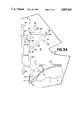
- FIG. 1 is a fragmented, perspective view of a preferred embodiment tape cartridge loading/unloading mechanism in accordance with the present invention.
- FIG. 2 is a partial, elevational view showing the means used to urge the tape cartridge into its seated position.
- FIGS. 3A and 3B are top plan views of the means used to engage the slot in the leader block of a seated tape cartridge.
- FIG. 4 is a side elevational view of the means used to determine the condition of the write-protect device associated with the tape cartridge.
- FIG. 5 is a schematic view of the means used to interface the tape cartridge with the loading/unloading mechanism so as to regulate loading and unloading of the tape cartridge in accordance with the operating mode of the apparatus, to avoid damage to the tape cartridge.
- FIG. 6 is a partially sectioned, elevational view of the loading/unloading mechanism of FIG. 1, showing the tape cartridge placed within the loading/unloading mechanism in a standby position.
- FIG. 7 is a partially sectioned, elevational view similar to FIG. 6, showing the tape cartridge in an operative position.
- FIG. 1 generally illustrates a preferred embodiment loading/unloading mechanism 1 in accordance with the present invention.
- the loading/unloading mechanism 1 is specially suited to receive an IBM 3480 tape cartridge 2 within a transport apparatus 3 which is capable of being located within the confines of a standard 51/4 inch form factor or footprint.
- the tape cartridge 2 (See FIGS. 3A and 3B) generally comprises a quantity of magnetic recording tape 4 wound upon a supply reel 5 and contained within a housing 6.
- An aperture 7 in the lower most face 8 of the housing 6 (see FIGS. 6 & 7) enables communication with a coupling 9 (preferably a geared, magnetic coupling) for operating (rotating) the supply reel 5 as will be described more fully below.
- a corner 10 of the housing 6 (see FIGS. 6 & 7) is open, and receives a leader block 11, which is used to securely engage the free end 12 of the web of tape 4.
- the tape cartridge 2 is to be received within the loading/unloading mechanism 1 along a side edge 13, so that the edge 14 of the tape cartridge 2 which is normally considered to be its rear edge is positioned laterally, along the left side of the transport apparatus 3 as viewed from the front of the loading/unloading mechanism 1.
- the face of the loading/unloading mechanism 1 takes the form of a bezel 15 having an opening 16, the periphery of which is correspondingly configured to the longitudinal cross-section of the tape cartridge 2, as it is to be inserted into the loading/unloading mechanism 1.
- the bezel 15 is provided with a chamfer at 17, to receive the narrowed front face 18 of the tape cartridge 2 and prevent reversed (180°) insertion of the tape cartridge 2.
- the opening 16 is enclosed by a hinged door 19 (See FIGS. 6 and 7).
- the loading rack 20 generally comprises a pair of rails 21, 22 which are pivotally associated with the bed 23 of the transport apparatus 3 at the pivots 24.
- the right most rail 21 extends from its pivot 24 to a position short of the bezel 15.
- the left most rail 22 extends from its pivot 24, fully through a slot 25 provided in the bezel 15, so that the end 26 of the left rail 22 can serve as an actuator handle as will be described more fully below.
- the rails 21, 22 are connected together by at least one cross-support 27 so as to strengthen the loading rack 20, and to cause parallel movement of the rails 21, 22 responsive to movement of the handle 26.
- a pair of stops 28 and a spring 29 are associated with the bed 23 of the transport apparatus 3.
- the stops 28 are spaced from the bezel 15 by a distance which slightly exceeds the width of the tape cartridge 2.
- the spring 29 serves to bias the tape cartridge 2 against the inside lower lip 31 of the bezel 15, or other stops coming from the transport bed 23 and located just inside the bezel 15, if provided. This longitudinally seats the tape cartridge 2 in what is essentially a standby position 35 in the loading/unloading mechanism 1 (See FIG. 6), which readies the tape cartridge 2 for subsequent loading as will be described more fully below.
- Each of the rails 21, 22 are provided with a support 36 for receiving a spring loaded arm 37 at the pivots 38.
- the forward most edge 40 of the arm 37 is provided with a leaf shaped extension, which is operatively connected to the rails 21, 22 by a pair of springs 41.
- the leaf-shaped extension 40 of the spring loaded arm 37 is normally spaced from the cartridge receiving surfaces 21a, 22a of the rails 21, 22 by a distance which is slightly more than the height of the tape cartridge 2. This is done to avoid possible interference with the tape cartridge 2 as it is inserted through (or ejected from) the opening 16 of the bezel 15, and onto the loading rack 2.
- the tape cartridge 2 is then capable of being lowered to an operative position 42 by means of the handle 26 (See FIG. 7).
- Lowering the handle 26 causes the leaf-shaped extension 40 of the spring loaded arm 37 to contact the upper face of the tape cartridge 2, which in turn causes the tape cartridge 2 to be pulled downwardly under the influence of the spring loaded arm 37 so that the lower face 8 of the tape cartridge 2 comes to rest upon a series of pedestals 43, and so that the coupling 9 of the supply reel 5 of the tape cartridge 2 is received upon the corresponding coupling 44 of a supply motor positioned beneath the bed 23 of the transport apparatus 3.
- the pedestals 43 serve to place the tape cartridge 2 at the proper height with respect to the bed 23 of the transport apparatus 3 so as to bring the coupling 9 of the supply reel 5 into proper engagement with the coupling 44, and so as to place a configured guide pin 45 in proper registration with the leader block 11 of the tape cartridge 2 as will be described more fully below.
- the spring 29 serves to longitudinally orient the tape cartridge 2 within the loading/unloading mechanism 1. Proper transverse positioning of the tape cartridge 2 within the loading/unloading mechanism 1 is achieved by providing the right rail 21 of the loading rack 20 with one or more wedges 46 which extend upwardly from the right rail 21 and along the front face 18 of the tape cartridge 2, as shown in FIG. 2.
- Each wedge 46 is provided with an inclined surface 47 which is configured to cooperate with the corresponding incline of a spring 48 which extends upwardly from the bed 23 of the transport apparatus 3. Consequently, as the tape cartridge 2 is lowered to the operative position 42, the inclined surface 47 is brought into contact with the inclined surface 48, so that further downward progression of the wedge 46 urges the wedge 46 against the front face 18 of the tape cartridge 2, in turn urging the tape cartridge 2 in the direction of the arrow 49 and into an alignment stop 50.
- the tape cartridge 2 becomes seated (in the operative position 42) for proper mating with the coupling 44, and for proper interaction with the remainder of the loading/unloading mechanism 1 as will be describe more fully below.
- the loading/unloading mechanism 1 In receiving the tape cartridge 2 within the loading/unloading mechanism 1 as previously described, a number of considerations present themselves in assuring that the aligned tape cartridge 2 is ready to be operated upon by the transport apparatus 3.
- the loading/unloading mechanism 1 therefore includes a number of devices which assure proper interaction between a properly seated tape cartridge 2 and the remainder of the transport apparatus 3 as follows.
- FIGS. 3A and 3B illustrates a pin locating mechanism 53 which is useful in providing this function.
- the pin locating mechanism 53 generally comprises a pair of arms 54, 55 placed in operative association with one another as follows.
- the arm 54 is essentially V-shaped, with its apex 56 attached to the bed 23 of the transport apparatus 3 at the pivot 57.
- a first leg 58 of the arm 54 terminates in an upwardly extending protrusion 59 which is in general alignment with the extension 22a of the left rail 22, while the second leg 60 of the arm 54 terminates at a pivot 61 for receiving the second of the arms 55.
- the arm 55 is provided with an upwardly extending shoulder 62 at one end, and a pin 63 configured for cooperative engagment within a slot 64 in the bed 23 of the transport apparatus 3 at its other end.
- a spring 65 serves to normally bias the pin locating mechanism 53 to the position shown in FIG. 3A.
- the pin 63 of the pin locating mechanism 53 is located just inboard of the loading rack 20, while the protrusion 59 is located in general alignment with the extension 22a of the left rail 22.
- the pin 63 is placed in proper position for the acceptance of a tape cartridge 2 within the loading/unloading mechanism 1, while the protrusion 59 serves to support the initially empty loading rack 20 in the standby position 35, and to prevent lowering of the loading rack 20 without having first placed a tape cartridge 2 within the loading/unloading mechanism 1.
- the side edge 13 of the tape cartridge 2 is caused to contact the shoulder 62 of the arm 55, urging the arm 55 in the general direction of the arrow 66.
- This serves to draw the pin 63 inwardly toward the leader block 11 as the tape cartridge 2 comes to be seated in its standby position at 35, and to draw the protrusion 59 out from beneath the extension 22a of the left rail 22, freeing the loading rack 20 for movement to the operative position 42 upon downward movement of the handle 26.
- the shoulder 62 is preferably curved to facilitate movement of the arm 55 across the edge 13 of the tape cartridge 2 in the course of these operations.
- the pin 63 of the arm 55 is configured to receive the guide pin 45 which is ultimately used to engage the slot 52 of the leader block 11, for loading and unloading.
- the guide pin 45 has a broadened base 70 which narrows at a shoulder 71 and terminates at a narrowed guide 72, which features are configured to engage the correspondingly configured slot 52 which the manufacturer conventionally provides in the leader block 11 of the tape cartridge 2.
- the narrowed guide 72 enters the slot 52 of the leader block 11 as a consequence of movement of the pin 63 as previously described.
- the features of the guide pin 45 come to be seated within the corresponding features of the slot 52 of the leader block 11, and the pin locating mechanism 53 is forced downwardly under the influence of the tape cartridge 2, and ultimately the loading rack 20, against the forces exerted by a coil spring 33 associated with the pivot 57.
- the pin 63 is lowered from the guide pin 45 to ready the leader block 11 for withdrawal from the tape cartridge 2.
- the tape cartridge 2 is conventionally provided with a write-protect tab 74 which is capable of being selectively re-oriented in the event that further data recording is not to take place, to protect the contents of the tape. It is therefore important for the loading/unloading mechanism 1 to provide a means for detecting whether or not the write-protect tab 74 has been re-oriented in the tape cartridge 2 so as to inhibit the writing of information on the web of tape 4, and prevent a corresponding loss of data. To this end, the write-protect means 75 shown in FIG. 4 is provided.
- the write-protect means 75 generally comprises a lever 76 which is connected to the support bed 23 of the transport apparatus 3 at a pivot 77.
- a first end 78 of the lever 76 is provided with a protrusion 79 which is normally biased toward the tape cartridge 2 by a spring 80, and which is sized and generally oriented the write-protect tab 74, if oriented so as not to prevent the writing of data or to enter the cavity 81 which is developed if the write-protect tab 74 is oriented to prevent the writing of data.
- the other end of the lever 76 is provided with a flag 82 which is capable of interrupting a beam of light projected from the source 83 of an optical interrupter 84, to its corresponding sensor 85.
- the flag 82 and optical interrupter 84 are positioned so that extension of the protrusion 79 of the lever 76 determines whether or not light from the source 83 will reach the sensor 85.
- This provides a signal which can be used to electronically enable or disable the writing of data in accordance with the condition of the write-protect tab 74 on the tape cartridge 2.
- the writing of data is disabled in the absence of light on the sensor 85, so that the contents of the tape cartridge 2 will be protected even in the event of a failure of the optical interrupter 84 (or its associated systems).
- the spring 80 will bias the protrusion 79 of the lever 76 fully to the right, which could hamper insertion of the tape cartridge 2 into the loading/unloading mechanism 1.
- the end 78 of the lever 76 is additionally provided with an inclined latch 86 which is cantilevered outwardly from the lever 76, extending over the left rail 22.
- the left rail 22 is drawn away from the incline of the latch 86, freeing the protrusion 79 for operation as previously described.
- the latch 86 again serves to draw the protrusion 79 away from the tape cartridge 2 as the tape cartridge 2 is raised to the standby position 35.
- the loading/unloading mechanism 1 is provided with a number of fail-safe features.
- the protrusion 59 of the pin locating mechanism 53 serves to prevent lowering of the handle 26 until such time as a tape cartridge 2 has been loaded into the mechanism 1, and has been correctly seated on the loading rack 20.
- the write-protect means 75 serves to prevent the loss of data to be retained.
- an interlocking system 90 which serves to prevent improper operation of the loading/unloading mechanism 1 through its various cycles, as follows.
- the left rail 22 is capable of being moved between a standby position 35 and an operative position 42 by means of the handle 26.
- a spring 91 is preferably provided to normally bias the left rail 22, and therefore the loading rack 20, to the standby position 35 so that the tape cartridge 2 is normally seated just within the opening 16 of the bezel 15.
- a spring latch or a series of mechanical detents could also be provided to serve this function, if desired.
- a gate 92 is provided which is pivoted for rotation at 93 in accordance with operation of a solenoid 94, between a first operative position 95 which is in general alignment with the left rail 22, and a second operative position 96 (shown in phantom) which is not.
- the height of the gate 92 is approximately equal to the distance between the bottom of the left rail 22 when in the standby position 35 and the top of the left rail 22 when in the operative position 42.
- the solenoid 94 is normally biased to its extended position, under the influence of a spring 97, so that the gate 92 is normally biased to the operative position 95 in alignment with the left rail 22.
- the loading rack 20 and the tape cartridge 2 cannot be lowered to the operative position 42 until the solenoid 94 has been activated.
- the left rail 22 cannot be lowered from the standby position 35.
- this also prevents the left rail 22 from being raised from the operative position 42 under similar circumstances (power off, power failure, etc.). This serves to prevent attempts to remove the tape cartridge 2 from the loading/unloading mechanism 1 (when inoperative) to avoid damage to the tape cartridge 2, particularly in the event that the web of tape 4 and the leader block 11 have not yet been returned to the tape cartridge 2.
- the solenoid 94 also receives operative signals from an optical interrupter 100, in association with a pair of flags 101, 102.
- a first flag 101 is mounted at the end of a lever 103 which is adapted to pivot at 104 under the influence of a spring 105.
- the opposite end 106 of the lever 103 is positioned beneath the left rail 22 so that when the left rail 22 is moved to the operative position 42, the left rail 22 pushes down on the end 106 of the lever 103 so that the flag 101 is pivoted upwardly, and away from between the source 107 and sensor 108 of the optical interrupter 100.
- the end 106 of the lever 103 is additionally provided with an inclined projection 109, which cooperates with a corresponding incline 110 associated with the gate 92 to similarly draw the flag 101 away from between the source 107 and sensor 108 of the optical interrupter 100 when the gate 92 is in the operative position 95, overlying the left rail 22 as previously described.
- a second flag 102 is mounted at the end of yet another lever 111, which is adapted to pivot at 112 under the influence of a spring 113.
- the opposite end 114 of the lever 111 is positioned beneath the loading rack 20 so that when a tape cartridge 2 is properly received and seated in the operative position 42, the end 114 of the lever 111 is depressed so that the flag 102 is withdrawn from between the source 107 and sensor 108 of the optical interrupter 100.
- a tape cartridge 2 is first located on the loading rack 20, then in the standby position 35.
- gate 92 is retracted under the influence of the solenoid 94, enabling the left rail 22 to be lowered to the operative position 42.
- both of the flags 101, 102 are withdrawn from between the source 107 and sensor 108 of the optical interrupter 100, generating an electrical signal.
- This signal is then used (e.g. in a switching circuit or a microprocessor) to interrupt power to the solenoid 94, which causes the gate 92 to assume a position over the left rail 22.
- a suitable signal is generated (e.g., in a switching circuit or a microprocessor) to again activate the solenoid 94, and withdraw the gate 92 from its position over the left rail 22, to permit the spring 97 (or an operator) to raise the loading rack 20 to the standby position 35.
- a suitable signal is generated (e.g., in a switching circuit or a microprocessor) to again activate the solenoid 94, and withdraw the gate 92 from its position over the left rail 22, to permit the spring 97 (or an operator) to raise the loading rack 20 to the standby position 35.
- the tape cartridge 2 is returned to the standby position 35, or is raised beyond the inside lower lip 31 of the opening 16 in the bezel 15, for discharge from the loading/unloading mechanism 1, depends upon the forces which are applied to the loading rack 20 by the spring 97, or the operator's positioning of the handle 26.
- the tape cartridge 2 can be returned to a standby position in engagement with the inside lower lip 31 of the bezel 15.
- a stronger spring would result in ejection of the tape cartridge 2 from the loading/unloading mechanism 1, with the assistance of the spring 29.
- the gate 92 (upon deactivation of the solenoid 94) will be brought into contact with the side of the left rail 22 until such time as the handle 26 is fully raised to release the tape cartridge 2 from the apparatus.
- the gate 92 will immediately assume a position beneath the left rail 22, preventing further operation of the transport apparatus 3 until such time as appropriate operating conditions are met.
- steps should be taken, where possible, to assure that the tape cartridge 2 is installed in its proper orientation, rather than enabling an operator to accidentally install the tape cartridge 2 in some other orientation.
- This is particularly important in view of the fact that the present invention addresses the insertion of a tape cartridge 2 into the loading/unloading mechanism 1 in an orientation which is rotated essentially 90 degrees from the normally expected positioning of the tape cartridge 2. For this reason, means are provided to assure that the tape cartridge 2 is received within the loading/unloading mechanism 1 in the proper orientation.
- the chamfer 17 in the bezel 15 is configured to receive the tape cartridge 2 along its side edge 13 rather than its rear edge 14.
- the depth of the tape cartridge 2 is greater than its width, only proper orientation of the tape cartridge 2 within the loading/unloading mechanism 1 will enable the tape cartridge 2 to fit between the stops 28 and the inside lower lip 31 of the bezel 15, while attempts at longitudinal insertion of the tape cartridge 2 will be inhibited by the stops 28.
- Steps should also be taken, where possible, to facilitate unloading of the tape cartridge 2.
- the tape cartridge 2 to which the present invention relates is operated by means of geared, magnetic couplings 9, 44 which establish an operative connection with the supply reel 5 of the tape cartridge 2 when the tape cartridge 2 is moved to the operative position 42.
- this magnet will generally exert a force of attraction on the order of 15 to 16 pounds. This represents a substantial loading which can make movement of the handle 26 from the operative position to the standby position quite difficult.
- each of the rails 21, 22 are preferably configured as is best illustrated in FIGS. 6 and 7, with a bend at 115.
- the bend 115 By positioning the bend 115 close to the pivots 24, preferably near the edge 13 of the tape cartridge 2, and away from the handle 26, a mechanical advantage is developed which assists in lifting the tape cartridge 2 from the coupling 44 during unloading of the tape cartridge 2.
- the bend 115 serves to in essence "peal away” the tape cartridge 2 from the coupling 44, further facilitating removal of the tape cartridge 2 from the coupling. It is also to be noted that the bend 115 will assist in smoothly lowering the tape cartridge 2 onto the coupling 44 during a loading operation, as well.
Landscapes
- Automatic Tape Cassette Changers (AREA)
Abstract
Description
Claims (45)
Priority Applications (1)
| Application Number | Priority Date | Filing Date | Title |
|---|---|---|---|
| US07/170,632 US4805045A (en) | 1986-03-21 | 1988-03-15 | Apparatus for loading and unloading a tape cartridge |
Applications Claiming Priority (2)
| Application Number | Priority Date | Filing Date | Title |
|---|---|---|---|
| US84244986A | 1986-03-21 | 1986-03-21 | |
| US07/170,632 US4805045A (en) | 1986-03-21 | 1988-03-15 | Apparatus for loading and unloading a tape cartridge |
Related Parent Applications (1)
| Application Number | Title | Priority Date | Filing Date |
|---|---|---|---|
| US84244986A Continuation | 1986-03-21 | 1986-03-21 |
Publications (1)
| Publication Number | Publication Date |
|---|---|
| US4805045A true US4805045A (en) | 1989-02-14 |
Family
ID=26866303
Family Applications (1)
| Application Number | Title | Priority Date | Filing Date |
|---|---|---|---|
| US07/170,632 Expired - Fee Related US4805045A (en) | 1986-03-21 | 1988-03-15 | Apparatus for loading and unloading a tape cartridge |
Country Status (1)
| Country | Link |
|---|---|
| US (1) | US4805045A (en) |
Cited By (8)
| Publication number | Priority date | Publication date | Assignee | Title |
|---|---|---|---|---|
| US4924335A (en) * | 1987-05-27 | 1990-05-08 | Nakamichi Corporation | Tape cartridge loading mechanism with engagement means to retain cartridge |
| US5155639A (en) * | 1988-11-03 | 1992-10-13 | U.S. Philips Corporation | Transport apparatus for a single reel tape cartridge |
| US5177646A (en) * | 1989-07-13 | 1993-01-05 | Samsung Electronics Co., Ltd. | Apparatus for preventing accidental recording of a tape recorder |
| US5374003A (en) * | 1993-04-07 | 1994-12-20 | Storage Technology Corporation | Tape threading system for a helical tape drive |
| WO2000030091A1 (en) * | 1998-11-12 | 2000-05-25 | Koninklijke Philips Electronics N.V. | Storage system including a storage device and a storage container and positioning means for positioning the storage container in the storage device |
| US20020096589A1 (en) * | 2000-10-25 | 2002-07-25 | Mitsumi Electric Co. Ltd. | Loading mechanism capable of reducing the number of components |
| US20030047634A1 (en) * | 2001-09-10 | 2003-03-13 | Mitsumi Electric Co., Ltd. | Loading mechanism in which a drive ring comprising a press formed product is used |
| US20160278231A1 (en) * | 2013-11-01 | 2016-09-22 | Hewlett Packard Enterprise Development Lp | Top loading cartridge |
Citations (49)
| Publication number | Priority date | Publication date | Assignee | Title |
|---|---|---|---|---|
| US3643893A (en) * | 1969-08-04 | 1972-02-22 | Bell & Howell Co | Web-threading apparatus |
| US3659804A (en) * | 1970-06-26 | 1972-05-02 | Eastman Kodak Co | Web take-up device |
| US3704942A (en) * | 1971-03-05 | 1972-12-05 | Hokushin Electric Works | Automatic film-loading projector |
| US3910527A (en) * | 1974-03-08 | 1975-10-07 | Ibm | Web distribution controlled servomechanism in a reel-to-reel web transport |
| US3949423A (en) * | 1973-10-31 | 1976-04-06 | Sony Corporation | Cassette locating and holding devices in a cassette tape recording and/or reproducing apparatus |
| US3951357A (en) * | 1972-03-08 | 1976-04-20 | Ricoh Co., Ltd. | Automatic cartridge tape draw-out device |
| US4015799A (en) * | 1975-11-14 | 1977-04-05 | International Business Machines Corporation | Adaptive reel-to-reel tape control system |
| US4023748A (en) * | 1974-08-19 | 1977-05-17 | Basf Aktiengesellschaft | Cassette loading and tape tensioning system |
| US4107753A (en) * | 1975-09-12 | 1978-08-15 | Victor Company Of Japan, Limited | Cassette holder capable of rotation through a larger angle of inclination |
| US4125881A (en) * | 1977-05-19 | 1978-11-14 | International Business Machines Corporation | Tape motion control for reel-to-reel drive |
| US4161004A (en) * | 1977-04-05 | 1979-07-10 | Shugart Associates | Head positioning mechanism for recording/playback machine |
| US4196873A (en) * | 1977-12-20 | 1980-04-08 | Nippon Electric Co., Ltd. | Two tape-cartridge type magnetic-tape recording/reproducing apparatus |
| US4208681A (en) * | 1977-12-23 | 1980-06-17 | International Business Machines Corporation | Cartridge type record player having a three position holder |
| US4227224A (en) * | 1978-03-06 | 1980-10-07 | Clarion Co., Ltd. | Cassette tape recording/reproducing apparatus |
| US4256996A (en) * | 1979-01-29 | 1981-03-17 | Spin Physics, Inc. | Web transport system |
| US4305025A (en) * | 1980-05-12 | 1981-12-08 | The Singer Company | Velocity servo with adaptive tachometer feedback |
| US4323832A (en) * | 1977-08-05 | 1982-04-06 | Fujitsu Limited | System for controlling the speed of a magnetic tape transport motor |
| US4334656A (en) * | 1980-06-30 | 1982-06-15 | International Business Machines Corporation | Automatic tape threading apparatus for magnetic tape transports |
| US4335858A (en) * | 1980-06-30 | 1982-06-22 | International Business Machines Corporation | Apparatus for threading tape over a tape path including a channel conforming to said path |
| US4370683A (en) * | 1978-11-28 | 1983-01-25 | Burroughs Corporation | Cross-coupled servo control mechanism for reel-to-reel tape drives |
| US4377829A (en) * | 1979-12-29 | 1983-03-22 | Pioneer Electronic Corporation | Player for magnetic tape cartridge recordings |
| US4383660A (en) * | 1981-03-30 | 1983-05-17 | International Business Machines Corp. | Single reel tape cartridge with leader block door seal |
| US4389600A (en) * | 1981-10-26 | 1983-06-21 | International Business Machines Corporation | Tape media interlayer tension check |
| US4398227A (en) * | 1981-03-16 | 1983-08-09 | Storage Technology Corporation | Magnetic tape drive with adaptive servo |
| US4399936A (en) * | 1981-10-26 | 1983-08-23 | International Business Machines Corp. | Pantocam web threading apparatus |
| US4399959A (en) * | 1981-10-26 | 1983-08-23 | International Business Machines Corp. | Constant force windup spring web threading system |
| US4407462A (en) * | 1980-08-15 | 1983-10-04 | Hitachi, Ltd. | Web drive apparatus |
| US4426047A (en) * | 1982-03-26 | 1984-01-17 | International Business Machines Corp. | Single reel tape cartridge |
| US4432508A (en) * | 1981-01-14 | 1984-02-21 | Hitachi, Ltd. | Automatic tape threading device |
| US4434444A (en) * | 1980-02-08 | 1984-02-28 | Olympus Optical Company Ltd. | Tape cassette loading device for cassette tape recorder |
| US4441129A (en) * | 1980-10-16 | 1984-04-03 | Olympus Optical Co., Ltd. | Eject device of magnetic recording tape driving apparatus for tape cassette |
| US4447838A (en) * | 1981-02-24 | 1984-05-08 | Olympus Optical Co., Ltd. | Cassette loading/unloading apparatus for cassette tape recorder |
| US4448368A (en) * | 1982-03-23 | 1984-05-15 | Raymond Engineering Inc. | Control for tape drive system |
| US4452406A (en) * | 1982-03-26 | 1984-06-05 | International Business Machines Corporation | Leader block for single reel tape cartridge |
| US4467379A (en) * | 1980-12-09 | 1984-08-21 | Canon Kabushiki Kaisha | Recording and/or reproducing device making use of a cassette |
| US4477850A (en) * | 1981-01-20 | 1984-10-16 | Victor Company Of Japan, Ltd. | Adapter for a miniature type tape cassette |
| US4477851A (en) * | 1982-06-07 | 1984-10-16 | Microtek Storage Corporation | Magnetic data storage and drive apparatus |
| US4500965A (en) * | 1982-06-04 | 1985-02-19 | Cipher Data Products, Inc. | Capstanless magnetic tape drive with electronic equivalent to length of tape |
| US4514667A (en) * | 1982-04-29 | 1985-04-30 | International Business Machines Corporation | Method and apparatus for the constant speed control of brushless DC motors |
| US4520970A (en) * | 1983-10-03 | 1985-06-04 | Kennedy Company | Cartridge tape drive having vacuum auto-threading |
| US4532563A (en) * | 1981-05-18 | 1985-07-30 | Canon Kabushiki Kaisha | Cassette tape tensioning device |
| US4536811A (en) * | 1979-05-22 | 1985-08-20 | Pioneer Electronic Corporation | Cassette tape player having supply and take-up motors positioned vertically above a cassette receiving mechanism |
| US4544971A (en) * | 1982-03-29 | 1985-10-01 | Fanuc Ltd. | Memory cassette holding apparatus |
| US4544110A (en) * | 1981-12-30 | 1985-10-01 | Agfa-Gevaert Aktiengesellschaft | Apparatus for introducing strip-shaped material into cassettes or the like |
| US4555077A (en) * | 1983-11-25 | 1985-11-26 | Electronic Processors, Inc. | Tape cartridge |
| US4564875A (en) * | 1981-05-29 | 1986-01-14 | Victor Company Of Japan, Ltd. | Cassette loading device in a cassette tape recorder |
| US4608614A (en) * | 1983-06-24 | 1986-08-26 | International Business Machines Corp. | Apparatus for threading magnetic tape in a magnetic tape transport |
| US4646177A (en) * | 1983-11-25 | 1987-02-24 | Electronic Processors, Inc. | Automatic tape threading system for use in a tape transport system |
| US4704645A (en) * | 1985-11-01 | 1987-11-03 | Cipher Data Products, Inc. | Transport for tape cartridge with leader block |
-
1988
- 1988-03-15 US US07/170,632 patent/US4805045A/en not_active Expired - Fee Related
Patent Citations (50)
| Publication number | Priority date | Publication date | Assignee | Title |
|---|---|---|---|---|
| US3643893A (en) * | 1969-08-04 | 1972-02-22 | Bell & Howell Co | Web-threading apparatus |
| US3659804A (en) * | 1970-06-26 | 1972-05-02 | Eastman Kodak Co | Web take-up device |
| US3704942A (en) * | 1971-03-05 | 1972-12-05 | Hokushin Electric Works | Automatic film-loading projector |
| US3951357A (en) * | 1972-03-08 | 1976-04-20 | Ricoh Co., Ltd. | Automatic cartridge tape draw-out device |
| US3949423A (en) * | 1973-10-31 | 1976-04-06 | Sony Corporation | Cassette locating and holding devices in a cassette tape recording and/or reproducing apparatus |
| US3910527A (en) * | 1974-03-08 | 1975-10-07 | Ibm | Web distribution controlled servomechanism in a reel-to-reel web transport |
| US4023748A (en) * | 1974-08-19 | 1977-05-17 | Basf Aktiengesellschaft | Cassette loading and tape tensioning system |
| US4107753A (en) * | 1975-09-12 | 1978-08-15 | Victor Company Of Japan, Limited | Cassette holder capable of rotation through a larger angle of inclination |
| US4015799A (en) * | 1975-11-14 | 1977-04-05 | International Business Machines Corporation | Adaptive reel-to-reel tape control system |
| US4161004A (en) * | 1977-04-05 | 1979-07-10 | Shugart Associates | Head positioning mechanism for recording/playback machine |
| US4161004B1 (en) * | 1977-04-05 | 1986-01-21 | ||
| US4125881A (en) * | 1977-05-19 | 1978-11-14 | International Business Machines Corporation | Tape motion control for reel-to-reel drive |
| US4323832A (en) * | 1977-08-05 | 1982-04-06 | Fujitsu Limited | System for controlling the speed of a magnetic tape transport motor |
| US4196873A (en) * | 1977-12-20 | 1980-04-08 | Nippon Electric Co., Ltd. | Two tape-cartridge type magnetic-tape recording/reproducing apparatus |
| US4208681A (en) * | 1977-12-23 | 1980-06-17 | International Business Machines Corporation | Cartridge type record player having a three position holder |
| US4227224A (en) * | 1978-03-06 | 1980-10-07 | Clarion Co., Ltd. | Cassette tape recording/reproducing apparatus |
| US4370683A (en) * | 1978-11-28 | 1983-01-25 | Burroughs Corporation | Cross-coupled servo control mechanism for reel-to-reel tape drives |
| US4256996A (en) * | 1979-01-29 | 1981-03-17 | Spin Physics, Inc. | Web transport system |
| US4536811A (en) * | 1979-05-22 | 1985-08-20 | Pioneer Electronic Corporation | Cassette tape player having supply and take-up motors positioned vertically above a cassette receiving mechanism |
| US4377829A (en) * | 1979-12-29 | 1983-03-22 | Pioneer Electronic Corporation | Player for magnetic tape cartridge recordings |
| US4434444A (en) * | 1980-02-08 | 1984-02-28 | Olympus Optical Company Ltd. | Tape cassette loading device for cassette tape recorder |
| US4305025A (en) * | 1980-05-12 | 1981-12-08 | The Singer Company | Velocity servo with adaptive tachometer feedback |
| US4334656A (en) * | 1980-06-30 | 1982-06-15 | International Business Machines Corporation | Automatic tape threading apparatus for magnetic tape transports |
| US4335858A (en) * | 1980-06-30 | 1982-06-22 | International Business Machines Corporation | Apparatus for threading tape over a tape path including a channel conforming to said path |
| US4407462A (en) * | 1980-08-15 | 1983-10-04 | Hitachi, Ltd. | Web drive apparatus |
| US4441129A (en) * | 1980-10-16 | 1984-04-03 | Olympus Optical Co., Ltd. | Eject device of magnetic recording tape driving apparatus for tape cassette |
| US4467379A (en) * | 1980-12-09 | 1984-08-21 | Canon Kabushiki Kaisha | Recording and/or reproducing device making use of a cassette |
| US4432508A (en) * | 1981-01-14 | 1984-02-21 | Hitachi, Ltd. | Automatic tape threading device |
| US4477850A (en) * | 1981-01-20 | 1984-10-16 | Victor Company Of Japan, Ltd. | Adapter for a miniature type tape cassette |
| US4447838A (en) * | 1981-02-24 | 1984-05-08 | Olympus Optical Co., Ltd. | Cassette loading/unloading apparatus for cassette tape recorder |
| US4398227A (en) * | 1981-03-16 | 1983-08-09 | Storage Technology Corporation | Magnetic tape drive with adaptive servo |
| US4383660A (en) * | 1981-03-30 | 1983-05-17 | International Business Machines Corp. | Single reel tape cartridge with leader block door seal |
| US4532563A (en) * | 1981-05-18 | 1985-07-30 | Canon Kabushiki Kaisha | Cassette tape tensioning device |
| US4564875A (en) * | 1981-05-29 | 1986-01-14 | Victor Company Of Japan, Ltd. | Cassette loading device in a cassette tape recorder |
| US4399936A (en) * | 1981-10-26 | 1983-08-23 | International Business Machines Corp. | Pantocam web threading apparatus |
| US4389600A (en) * | 1981-10-26 | 1983-06-21 | International Business Machines Corporation | Tape media interlayer tension check |
| US4399959A (en) * | 1981-10-26 | 1983-08-23 | International Business Machines Corp. | Constant force windup spring web threading system |
| US4544110A (en) * | 1981-12-30 | 1985-10-01 | Agfa-Gevaert Aktiengesellschaft | Apparatus for introducing strip-shaped material into cassettes or the like |
| US4448368A (en) * | 1982-03-23 | 1984-05-15 | Raymond Engineering Inc. | Control for tape drive system |
| US4452406A (en) * | 1982-03-26 | 1984-06-05 | International Business Machines Corporation | Leader block for single reel tape cartridge |
| US4426047A (en) * | 1982-03-26 | 1984-01-17 | International Business Machines Corp. | Single reel tape cartridge |
| US4544971A (en) * | 1982-03-29 | 1985-10-01 | Fanuc Ltd. | Memory cassette holding apparatus |
| US4514667A (en) * | 1982-04-29 | 1985-04-30 | International Business Machines Corporation | Method and apparatus for the constant speed control of brushless DC motors |
| US4500965A (en) * | 1982-06-04 | 1985-02-19 | Cipher Data Products, Inc. | Capstanless magnetic tape drive with electronic equivalent to length of tape |
| US4477851A (en) * | 1982-06-07 | 1984-10-16 | Microtek Storage Corporation | Magnetic data storage and drive apparatus |
| US4608614A (en) * | 1983-06-24 | 1986-08-26 | International Business Machines Corp. | Apparatus for threading magnetic tape in a magnetic tape transport |
| US4520970A (en) * | 1983-10-03 | 1985-06-04 | Kennedy Company | Cartridge tape drive having vacuum auto-threading |
| US4555077A (en) * | 1983-11-25 | 1985-11-26 | Electronic Processors, Inc. | Tape cartridge |
| US4646177A (en) * | 1983-11-25 | 1987-02-24 | Electronic Processors, Inc. | Automatic tape threading system for use in a tape transport system |
| US4704645A (en) * | 1985-11-01 | 1987-11-03 | Cipher Data Products, Inc. | Transport for tape cartridge with leader block |
Cited By (11)
| Publication number | Priority date | Publication date | Assignee | Title |
|---|---|---|---|---|
| US4924335A (en) * | 1987-05-27 | 1990-05-08 | Nakamichi Corporation | Tape cartridge loading mechanism with engagement means to retain cartridge |
| US5155639A (en) * | 1988-11-03 | 1992-10-13 | U.S. Philips Corporation | Transport apparatus for a single reel tape cartridge |
| US5177646A (en) * | 1989-07-13 | 1993-01-05 | Samsung Electronics Co., Ltd. | Apparatus for preventing accidental recording of a tape recorder |
| US5374003A (en) * | 1993-04-07 | 1994-12-20 | Storage Technology Corporation | Tape threading system for a helical tape drive |
| WO2000030091A1 (en) * | 1998-11-12 | 2000-05-25 | Koninklijke Philips Electronics N.V. | Storage system including a storage device and a storage container and positioning means for positioning the storage container in the storage device |
| US20020096589A1 (en) * | 2000-10-25 | 2002-07-25 | Mitsumi Electric Co. Ltd. | Loading mechanism capable of reducing the number of components |
| US6585183B2 (en) * | 2000-10-25 | 2003-07-01 | Mitsumi Electric Co., Ltd. | Loading mechanism capable of reducing the number of components |
| US20030047634A1 (en) * | 2001-09-10 | 2003-03-13 | Mitsumi Electric Co., Ltd. | Loading mechanism in which a drive ring comprising a press formed product is used |
| US6749141B2 (en) * | 2001-09-10 | 2004-06-15 | Mitsumi Electric Co., Ltd. | Loading mechanism in which a drive ring comprising a press formed product is used |
| US20160278231A1 (en) * | 2013-11-01 | 2016-09-22 | Hewlett Packard Enterprise Development Lp | Top loading cartridge |
| US10264696B2 (en) * | 2013-11-01 | 2019-04-16 | Hewlett Packard Enterprise Development Lp | Top loading cartridge |
Similar Documents
| Publication | Publication Date | Title |
|---|---|---|
| US5465187A (en) | Magnetic tape cartridge having leader block retainer mechanism | |
| US3950787A (en) | Cassette holding device for tape recording and/or reproducing apparatus | |
| US3900170A (en) | Tape cassette | |
| KR100848122B1 (en) | 1 reel tape cartridge and recording / playback apparatus using the same | |
| US4679747A (en) | Apparatus for loading and unloading the leader block of a tape cartridge | |
| KR940001433Y1 (en) | Tape cassette apparatus with loading apparatus | |
| US4498112A (en) | Tape cartridge receptacle | |
| US4805045A (en) | Apparatus for loading and unloading a tape cartridge | |
| US3900171A (en) | Tape cassette | |
| US4828201A (en) | Apparatus for coupling a drive motor to a leader block loading/unloading mechanism | |
| WO1997002565A1 (en) | Recording medium device and recording and/or reproduction apparatus equipped with the recording medium device | |
| US4826101A (en) | Apparatus for loading and unloading the leader block of a tape cartridge | |
| US5232180A (en) | Magnetic tape cartridge having leader block latch mechanism | |
| JPS61292261A (en) | Cartridge handler | |
| EP0238296A2 (en) | Apparatus for loading and unloading a tape cartridge | |
| KR100300484B1 (en) | Recording-medium cartridge loading device | |
| US4949914A (en) | Tape transport with rigid arm threader mechanism for leader block tape cartridge | |
| JP3585169B2 (en) | Cartridge positioning device | |
| EP0238260A2 (en) | Transport apparatus for receiving and operating upon a tape cartridge | |
| EP0239291A2 (en) | Transport apparatus for recording tape | |
| JPH09115275A (en) | Inquiry apparatus for memory inside information on cassette | |
| EP0106065B1 (en) | Manually operated cartridge holder | |
| KR100427919B1 (en) | Magnetic recording and reproducing device for large and small cassette types | |
| US5999363A (en) | Cassette housing having cassette stoppers to prevent mis-insertion | |
| JP3433589B2 (en) | Recording medium mounting device |
Legal Events
| Date | Code | Title | Description |
|---|---|---|---|
| AS | Assignment |
Owner name: NORTH AMERICAN PHILIPS CORPORATION A CORPORATION Free format text: ASSIGNMENT OF ASSIGNORS INTEREST.;ASSIGNOR:LASER MAGNETIC STORAGE INTERNATIONAL COMPANY, A NY PARTNERSHIP;REEL/FRAME:005711/0135 Effective date: 19910515 |
|
| FPAY | Fee payment |
Year of fee payment: 4 |
|
| FEPP | Fee payment procedure |
Free format text: PAYOR NUMBER ASSIGNED (ORIGINAL EVENT CODE: ASPN); ENTITY STATUS OF PATENT OWNER: LARGE ENTITY |
|
| FPAY | Fee payment |
Year of fee payment: 8 |
|
| AS | Assignment |
Owner name: PLASMON LMS, INC., COLORADO Free format text: ASSIGNMENT OF ASSIGNORS INTEREST;ASSIGNOR:PHILIPS ELECTRONICS NORTH AMERICA CORPORATION;REEL/FRAME:009866/0718 Effective date: 19990218 |
|
| AS | Assignment |
Owner name: PLASMON LMS, INC., COLORADO Free format text: ASSIGNMENT OF ASSIGNORS INTEREST;ASSIGNOR:PHILLIPS ELECTRONCIS NORTH AMERICA CORPORATION;REEL/FRAME:010415/0800 Effective date: 19990218 |
|
| REMI | Maintenance fee reminder mailed | ||
| LAPS | Lapse for failure to pay maintenance fees | ||
| FP | Lapsed due to failure to pay maintenance fee |
Effective date: 20010214 |
|
| STCH | Information on status: patent discontinuation |
Free format text: PATENT EXPIRED DUE TO NONPAYMENT OF MAINTENANCE FEES UNDER 37 CFR 1.362 |