US4723098A - Electronic ballast circuit for fluorescent lamps - Google Patents
Electronic ballast circuit for fluorescent lamps Download PDFInfo
- Publication number
- US4723098A US4723098A US07/033,701 US3370187A US4723098A US 4723098 A US4723098 A US 4723098A US 3370187 A US3370187 A US 3370187A US 4723098 A US4723098 A US 4723098A
- Authority
- US
- United States
- Prior art keywords
- circuit
- frequency
- circuit means
- inverter
- voltage
- Prior art date
- Legal status (The legal status is an assumption and is not a legal conclusion. Google has not performed a legal analysis and makes no representation as to the accuracy of the status listed.)
- Expired - Lifetime
Links
Images


Classifications
-
- H—ELECTRICITY
- H05—ELECTRIC TECHNIQUES NOT OTHERWISE PROVIDED FOR
- H05B—ELECTRIC HEATING; ELECTRIC LIGHT SOURCES NOT OTHERWISE PROVIDED FOR; CIRCUIT ARRANGEMENTS FOR ELECTRIC LIGHT SOURCES, IN GENERAL
- H05B41/00—Circuit arrangements or apparatus for igniting or operating discharge lamps
- H05B41/14—Circuit arrangements
- H05B41/26—Circuit arrangements in which the lamp is fed by power derived from DC by means of a converter, e.g. by high-voltage DC
- H05B41/28—Circuit arrangements in which the lamp is fed by power derived from DC by means of a converter, e.g. by high-voltage DC using static converters
- H05B41/295—Circuit arrangements in which the lamp is fed by power derived from DC by means of a converter, e.g. by high-voltage DC using static converters with semiconductor devices and specially adapted for lamps with preheating electrodes, e.g. for fluorescent lamps
- H05B41/298—Arrangements for protecting lamps or circuits against abnormal operating conditions
- H05B41/2981—Arrangements for protecting lamps or circuits against abnormal operating conditions for protecting the circuit against abnormal operating conditions
-
- H—ELECTRICITY
- H02—GENERATION; CONVERSION OR DISTRIBUTION OF ELECTRIC POWER
- H02H—EMERGENCY PROTECTIVE CIRCUIT ARRANGEMENTS
- H02H7/00—Emergency protective circuit arrangements specially adapted for specific types of electric machines or apparatus or for sectionalised protection of cable or line systems, and effecting automatic switching in the event of an undesired change from normal working conditions
- H02H7/10—Emergency protective circuit arrangements specially adapted for specific types of electric machines or apparatus or for sectionalised protection of cable or line systems, and effecting automatic switching in the event of an undesired change from normal working conditions for converters; for rectifiers
- H02H7/12—Emergency protective circuit arrangements specially adapted for specific types of electric machines or apparatus or for sectionalised protection of cable or line systems, and effecting automatic switching in the event of an undesired change from normal working conditions for converters; for rectifiers for static converters or rectifiers
- H02H7/122—Emergency protective circuit arrangements specially adapted for specific types of electric machines or apparatus or for sectionalised protection of cable or line systems, and effecting automatic switching in the event of an undesired change from normal working conditions for converters; for rectifiers for static converters or rectifiers for inverters, i.e. DC/AC converters
- H02H7/1227—Emergency protective circuit arrangements specially adapted for specific types of electric machines or apparatus or for sectionalised protection of cable or line systems, and effecting automatic switching in the event of an undesired change from normal working conditions for converters; for rectifiers for static converters or rectifiers for inverters, i.e. DC/AC converters responsive to abnormalities in the output circuit, e.g. short circuit
-
- H—ELECTRICITY
- H05—ELECTRIC TECHNIQUES NOT OTHERWISE PROVIDED FOR
- H05B—ELECTRIC HEATING; ELECTRIC LIGHT SOURCES NOT OTHERWISE PROVIDED FOR; CIRCUIT ARRANGEMENTS FOR ELECTRIC LIGHT SOURCES, IN GENERAL
- H05B41/00—Circuit arrangements or apparatus for igniting or operating discharge lamps
- H05B41/14—Circuit arrangements
- H05B41/36—Controlling
- H05B41/38—Controlling the intensity of light
- H05B41/39—Controlling the intensity of light continuously
- H05B41/392—Controlling the intensity of light continuously using semiconductor devices, e.g. thyristor
-
- Y—GENERAL TAGGING OF NEW TECHNOLOGICAL DEVELOPMENTS; GENERAL TAGGING OF CROSS-SECTIONAL TECHNOLOGIES SPANNING OVER SEVERAL SECTIONS OF THE IPC; TECHNICAL SUBJECTS COVERED BY FORMER USPC CROSS-REFERENCE ART COLLECTIONS [XRACs] AND DIGESTS
- Y10—TECHNICAL SUBJECTS COVERED BY FORMER USPC
- Y10S—TECHNICAL SUBJECTS COVERED BY FORMER USPC CROSS-REFERENCE ART COLLECTIONS [XRACs] AND DIGESTS
- Y10S315/00—Electric lamp and discharge devices: systems
- Y10S315/07—Starting and control circuits for gas discharge lamp using transistors
Definitions
- the present invention relates to a ballast circuit for fluorescent or other gaseous discharge lamps. More particularly, it relates to an electronic ballast circuit for energizing fluorescent lamps at high frequency from a conventional 60 Hz power source.
- fluorescent is intended to include other gaseous discharge lamps such as high-intensity discharge lamps. It is known that these lamps operate more efficiently at frequencies higher than 60 Hz. Typically, such frequencies may range from 15 KHz to as high as 100 KHz. In the prior art, there have been many suggestions of electronic ballast circuits capable of high frequency operation, and there have also been commercial attempts to provide such electronic ballasts.
- the lamp current should be regulated to a degree higher than some may have thought necessary in earlier ballast circuits.
- conventional 60 Hz line voltage is the only practical source of power.
- a measure or factor sometimes used by lamp manufacturers to limit or define operating specifications of a ballast to ensure longer lamp life is the "crest factor" which is defined as the ration of the peak amplitude of the lamp current to the rms value of lamp current.
- crest factor is defined as the ration of the peak amplitude of the lamp current to the rms value of lamp current.
- the crest factor is improved simply by adding large filters to the full wave rectified source voltage, but, in turn, adding bulky and costly components and reducing the overall efficiency of the ballast.
- a principal object of the present invention is to provide an electronic ballast circuit for fluorescent lamps which regulates lamp current such that the crest factor of lamp current achieves a value of less than 1.6. It is further object of the present invention to do so without adding bulky and expensive filter components for filtering the source voltage.
- the present invention includes a half-bridge inverter circuit designed to resonate at a predetermined high frequency.
- a negative feedback circuit senses lamp current and varies the excitation frequency of the lamp circuit to regulate lamp current.
- the frequency response of the feedback circuit is sufficiently high so that it is capable of responding to amplitude changes in the source voltage.
- the lamp current may be regulated to a high degree, sufficient to reduce the crest factor of lamp current to values less than 1.6, if desired.
- the lamp current is sensed and a signal is generated representative of lamp current.
- the feedback loop contains a variable frequency oscillator which generates the gating signal for the semi-conductor switches of the inverter and thereby determines the operating frequency of the inverter.
- the inverter circuit itself sometimes referred to herein as te "resonant amplifier” is therefore driven at a predetermined, controlled frequency which preferably is in a range of frequencies slightly above the actual resonant frequency of the inverter.
- Sensed lamp current controls the inverter frequency such that as lamp current is sensed to increase, the operating frequency is increased, thereby resulting in a reduced gain of the resonant amplifier, and a reduced voltage applied to the lamp circuit. That is, as the inverter driving frequency is increased, the response or "gain" of the inverter decreases. In this manner, lamp current can be regulated to achieve the desirable crest factors indicated above.
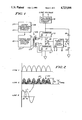
- FIG. 1 is a functional block diagram of an electronic ballast circuit using negative feedback to regulate lamp current
- FIG. 2 shows idealized wave forms of signals illustrating the operation of the circuitry of FIG. 1;
- FIG. 3 is a circuit schematic diagram, partly in functional block form, of an electronic ballast for gaseous discharge lamps constructed according to the present invention
- FIG. 4 is schematic diagram, partly in functional block form, of the timing and frequency control circuitry of FIG. 3;
- FIG. 5 is a plot of gain versus frequency of the inverter circuit of FIG. 3.
- FIG. 6 contains graphs of idealized wave forms illustrating the performance of the operation of the circuitry of FIG. 3.
- reference numeral 10 generally designates a thyristor/capacitor bridge circuit including first and second thyristors (silicon control rectifiers) 11, 12 connected in series with a full-wave rectifier circuit 13 which receives standard 60 Hz line power and converts it to a full-wave rectifier circuit 13 which receives standard 60 Hz line power and converts it to a full-wave rectified output signal of 120 Hz, such as is illustrated in idealized form on line 1 of FIG. 2.
- the bridge circuit 10 also includes first and second balanced capacitors 16, 17 connected in series to form two legs of the bridge.
- the diagonal branch of the bridge includes a power transformer generally designed 20, the output of which is coupled to a lamp load circuit comprising gaseous discharge lamps, such as fluorescent lamps, diagrammatically represented by the block 21.
- capacitors 16 and 17 and the inductance (including any reflected impedance from the load) of transformer 20 form a resonant circuit when thyristors 11, 12 are conducting.
- the thyristors 11, 12 are gated "on" by a signal coupled through a pulse transformer generally designed 23.
- the transformer 23 includes a primary winding 24 driven by the Timing and Feedback Control Circuit 27, and first and second secondary windings 25, 26 which are connected in circuit respectively with the gate leads of thyristors 11, 12 in such a manner that current flowing through primary winding 24 of transformer 23 in one polarity will cause thyristor 11 to conduct, and current flowing through the primary winding 24 in the opposite polarity will cause thyristor 12 to conduct.
- Timing for the Timing and Feedback Control Circuit 27 is derived from a Zero Cross-Over Detector Circuit 28 which receives a signal from a secondary winding in the power transformer 20. That signal is designated X-X, and the Zero Cross-Over Detector Circuit 28 generates a pulse each time the load current reverses polarity.
- a signal designated R is generated in the lamp circuit representative of lamp current.
- the signal R is a level signal (not a sinusoidal signal) having a magnitude representative of a value of lamp current averaged over a number of cycles of the high frequency lamp current.
- capacitor 16 discharges at least partly, and a current represented by arrows I 1 flows through thyristor 11 and the primary of transformer 20 from the positive to the negative terminal, and thence through capacitor 17 to ground. Because the transformer 20 and capacitors 16 and 17 form a resonant circuit, the current I 1 will reverse in polarity dependent upon the resonant frequency of the circuit, and thereafter thyristor 12 will be gated to conduction with current flowing in the direction of the arrows I 1 . Thyristor 11 will be non-conducting at this time.
- a high-frequency current oscillating at a frequency (which may be, for example, in the range of 20 KHz to 50 KHz) is generated in the lamp circuit and coupled to energize the lamp load.
- the positive half of the symmetrical resulting wave form at the output of the power transformer 20, again in idealized form, is seen on line 2 of FIG. 2.
- the envelope of the wave form is shown in phantom as a series of cusps and designated 30. It corresponds to the frequency and same general shape as the 120 Hz rectified line voltage of line 1.
- the lamp current goes to zero as the source voltage goes to zero during the inter-cusp period.
- a storage capacitor may be used to supply a carry over voltage in the inter-cusp period, in which case the envelope may be as seen at 33 on line 2. In either case, since the lamp current will have a generally similar envelope, the crest factor for lamp current is undesirably high.
- the Zero Cross-Over Detector Circuit 28 generates a signal at a time represented in FIG. 2 by reference numeral 34 when current I 1 or I 2 goes through a zero value.
- the timing portion of the control circuit 27 thereupon establishes a fixed time delay represented diagrammatically by the arrow tD in line 3. If the lamp current, represented by the value of the signal R is a value which corresponds to a predetermined or reference value of current reflecting a desired lamp current, then the thyristor which is to be fired will be triggered at the end of the time t D .
- the feedback control circuit 27 delays the timing pulse proportionately so that, for example, the thyristor to be gated will not be gated on until a time t 1 . This will reduce the energy coupled to the resonant circuit and thus it will reduce the voltage applied to the power transformer 20. If, on the other hand, the magnitude of the signal R is less than the reference signal, it indicates that lamp current is less than the predetermined value, and the triggering of the thyristors will be advanced such as is illustrated at t 2 in line 3, causing more energy to be coupled to the power transformer 20 since the thyristors will be energized earlier in the cycle of inverter current.
- lamp current is regulated as explained in my co-pending application.
- the response time of the feedback control circuit for the system of FIG. 2 is relatively slow--that is, of the order of a few tenths of a second.
- the -3 db point of the frequency response characteristic of the feedback circuit is of the order of 2-5 cy/sec.
- the amplitude of voltage applied to thelamp circuit and the amplitude of lamp current vary in accordance with the envelope of the voltage wave form seen on line 2.
- the resulting crest factor for lamp current is, as explained above, undesirable from the standpoint of criteria established by lamp manufacturers for longevity of lamps.
- the envelope of the signal of line 2 with the intercusp voltage going to zero represents peak lamp current and the arrow designated I RMS designates rms lamp current; and the crest factor has a value nominally in the range of 2.0-3.0.
- FIG. 3 there is shown a preferred circuit for achieving a regulated lamp current with reduced amplitude modulation of the voltage applied to the lamps and an improved crest factor for a lamp current.
- an inverter in the form of a halfbridge circuit is generally designated 110. It includes first and second semi-conductor switches 111, 112. The controlled switches illustrated are MOSFET transistors, although other semiconductor switches may also be used. MOSFET transistors were selected because of their higher frequency response, enabling the inverter frequency to be increased and thereby reducing the size of other components.
- the nominal operating frequency of the inverter of FIG. 3 is in the range of 50-100 KHz, and the nominal resonant frequency is 50 KHz.
- MOSFET transistors are suited to this application because, as will be appreciated from an understanding of the circuit, they are turned “on” (i.e., to a state of conduction) when no forward current is flowing in the branch in which the MOSFET is located, and they are turned “off” when forward current is flowing. This suits the application to the faster turn on and turn off times of MOSFET transistors compared, for example, to those of bipolar transistors.
- the inverter circuit 110 includes capacitors 116 and 117 in the other branches. To energize the inverter circuit 110, 60 Hz line voltage is connected top a rectifier bridge circuit 113, the output of which is fed to the inverter circuit 110, as illustrated.
- a power transformer generally designated 120 has a primary winding 120A connected between the common junction of the transistors 111, 112 and the common junction of the capacitors 116, 117--that is, the power transformer 120 is connected in the diagonal branch of the bridge circuit 110.
- a first secondary winding designated 120B feeds the lamp load circuit 121 which may include fluorescent or other gaseous discharge lamps, such as high intensity discharge lamps, in any number of configurations.
- a capacitor 122 is connected across the secondary winding 120B and forms the capacitive reactance in combination with the inductive reactance of the transformers 120 to define the resonant frequency of the inverter which in the illustrated embodiment is approximately 50 KHz, as indicated.
- the transistors 111, 112 are triggered at mutually exclusive times by a drive transformer 123 having a primary winding 124 which is connected to the output of a logic and frequency controlled circuitry 127.
- Transformer 123 also has a first secondary winding 125 which is connected to the gate of transistor 111, and a second secondary winding 126 which is connected to the gate of transistor 112 as seen.
- the details of the logic and frequency control circuitry 127 will be described in connection with FIG. 4, and it is analogous to the logic and feedback control circuitry 27 of FIG. 1 in that it is responsive to a signal representative of lamp current to regulate the value of lamp current.
- the circuitry 127 does so in a different manner.
- the circuitry 127 cooperates with and takes advantage of the frequency response characteristic of the bridge 110 and controls the operating frequency of the bridge in relation to its resonant frequency to achieve an overall desired output or "gain” in achieving current regulation.
- reference numeral 135 designates a curve showing the relationship between frequency and the gain of the inverter circuit or "resonant amplifier” as it is sometimes called.
- the resonance of the amplifier is defined, as indicated above, primarily by the capacitor 122 and the leakage inductance of the power transformer 120.
- the resonant frequency of the inverter is designated F R and as can be seen, as the frequency of operation increases above the resonant frequency, the gain of the inverter decreases. Further, it will be observed that the gain decreases monotonically, though not necessarily linearly between the resonant frequency F R and a frequency F 1 .
- the frequency control circuitry 127 senses average lamp current and generates an output signal which is coupled to the transformer 123 to gate the transistors 111, 112 in alternate half-cycles. The frequency of that gating or triggering signal is increased as lamp current increases, thereby to decrease the voltage applied to the lamp load circuit at the secondary winding 120B, resulting in lowering the lamp current.
- the carry-over voltage circuitry includes a diode 136 having its cathode connected to the positive output of the full wave rectifier bridge circuit 113 and its anode connected to a storage capacitor 137.
- the junction between diode 136 and capacitor 137 is coupled by means of an inductor 138 and a diode 139 to the junction between the transistors 111, 112 which, it will be observed, is also an input terminal to the primary winding 120A of power transformer 120.
- the half wave rectifier formed by diode 139 and 140 provides a voltage equal to one half peak supply voltage and permits capacitor 137 to be charged from the high frequency output of the inverter circuit rather than from the line supply; thereby minimizing line current distortion and retaining a high input power factor.
- the capacitor 137 is relatively large to provide storage of sufficient energy. It is charged through diode 139 and inductor 138, and it discharges through diode 136 when amplitude of the output voltage of the bridge circuit 113 falls below the level of voltage stored across capacitor 137.
- a diode 140 may be connected as shown across diode 139 and transistor 112.
- a first input signal is derived from a secondary winding 141 of transformer 120 which may be coupled to a filament circuit for one or more lamps in the load circuit 121.
- a current transformer generally designated 142 senses the current flowing in the load of the secondary winding 141 and generates a signal e i on line 143 which is representative of lamp load current. Additional lamp filaments may be energized by a secondary winding 144.
- Another secondary winding 145 generates a signal, e o , which is representative of lamp voltage.
- the signal e o is also fed to the Logic and Frequency Control Circuitry 127 along line 146 and is used for lamp voltage limiting as discussed further below.
- Still another secondary filament winding of transformer 120 is designated 155 having an output lead 156 which is coupled with a starting capacitor 157 to the high voltage secondary.
- First and second resistors 148, 149 may be connected in series across the transistors 111, 112 to form a voltage divider; and the signal at the junction between the resistors 148, 149 is representative of the amplitude of the source voltage. That signal is fed along a lead 150 to the Logic and Frequency Control Circuitry 127 and may be used to protect against source over-voltage.
- a current transformer 151 senses current flowing in the primary of transformer 120 and including a secondary winding 152.
- the signal on line 153 is designated i p and represents the phase of local current. It is coupled along a line 153 to an input of the Logic and Frequency Control Circuitry 127.
- the output leads of the Logic and Frequency Control Circuit are designated 161 and 162; and they are connected directly to the terminals of the primary winding 124 of transformer 123.
- Power for the Logic and Frequency Control Circuitry 127 is derived from a conventional bridge rectifier circuit generally designated 163 which is capacitively coupled to the line voltage and which generates an output signal on a line 164 coupled through a conventional voltage regulator circuit 165 to generate logic and control power for the circuitry 127.
- a zener diode 164A and filter capacitor 164B are also connected as shown, as in conventional.
- FIG. 4 the Logic and Frequency Control Circuitry 127 is seen in functional block form.
- the secondary winding 145 of power transformer 120 and lead 146 on which the signal e o appears are repeated.
- the signal e o is representative of lamp voltage, and it is coupled through a bridge rectifier circuit 170 to a summing junction 171.
- the signal e i representing lamp current generated on line 143 from current transformer 142 is coupled through a bridge rectifier circuit 172 to a summing junction 173.
- the other input from summing junction 171 is a signal designated e s which is generated by a start circuit enclosed within dashed line 175.
- the start circuit 175 is actuated by the voltage signal on line 165A when power is turned on and voltage is sensed at the output of the low voltage regulator 165.
- the start circuit includes a differentiator 175A which feeds the negative input of an operational amplifier 175B, the output of which is inverted by inverter 175C.
- the start circuit generates an output voltage for a predetermined time as graphically illustrated in FIG. 4, and it then has a gradual fall time, reducing to zero volts.
- the purpose of the start circuit 175 is to force the operating frequency to a high value during start-up so that the lamp filaments may be heated for a time before voltage is applied to the lamps.
- the output of summing junction 171 is fed through a filter 176 and a diode 177 to the input terminal of a voltage controlled oscillator 178.
- the output frequency of the voltage controlled oscillator 178 increases as the input voltage increases.
- the other terminal of summing junction 173 is received from the output of a phase detector circuit enclosed within dashed lime 179.
- One input to the phase detector circuit 179 is received on line 153 from current transformer 151 and is representative of the phase of inverter current, ip.
- the other input signal to phase detector 179 is the drive signal on line 161 which is coupled to the primary 124 of the drive transformer 123. This signal is representative of the phase of the voltage across the primary since it determines the triggering of the semiconductor switches 111, 112 as indicated above. That signal is coupled to a first Schmitt trigger circuit 180 to square it and a differentiator 181 to an AND gate 182.
- the signal i p is fed to a second Schmitt trigger circuit 183 to the other input of AND gate 182.
- Phase detector circuit 179 has a characteristic as diagrammatically illustrated in FIG. 4.
- the output signal of the phase detector 179 is a positive voltage.
- the operating frequency of the inverter increases above the resonant frequency, indicating that the current i p lags the voltage e p , the output voltage is zero.
- the phase angle of current becomes leading and the output voltage increases. That output voltage is fed to the summing junction 173.
- the output of the summing junction 173 is fed through a filter 185 and a diode 186 to the input of the voltage control oscillator 178.
- the frequency of the voltage control oscillator 178 determines the operating frequency of the inverter. As that frequency increases from the resonant frequency, the gain of the inverter will decrease continuously.
- the start circuit 175 generates the signal e s which is coupled through the junction 171, filter 176 and diode 177 to the input of voltage control oscillator 178 to set the operating frequency at a high value.
- lamp voltage is low until the filaments are heated.
- the output signal of the start circuit 175 will then ramp down to zero volts, and under normal conditions, the voltage applied to the lamp circuit will increase as the frequency of the voltage controlled oscillator 78 decreases, thereby decreasing the drive frequency of the semiconductor switches 111, 112.
- the inverter drive frequency will decrease toward resonant and the voltage applied to the lamps will correspondingly increase.
- the applied voltage to the lamps will increase, thereby also causing an increase in the signal e o on line 146.
- the voltage applied to the lamps will continue to increase until the lamps ignite or e o increases sufficiently to limit the decrease in drive frequency.
- the signal e o will decrease since the voltage across the lamps will decrease; and the signal e i representative of lamp current coupled to the other summing junction 173 will be the controlling signal, as described above.
- the drive frequency of the inverter will normally be in the range above resonant frequency. Should the drive frequency decrease toward resonance, the output of the phase detector circuit 179 will be added to the output of the rectifier 172 at summing junction 173, thereby prohibiting operation beneath the resonant frequency.
- the output signal of rectifier 172 (which is representative of lamp current) will control.
- the frequency of voltage controlled oscillator will also increase and the gain of the inverter will be reduced.
- the frequency of the voltage controlled oscillator 178 will decrease, thereby increasing the gain of the inverter circuit.
- the lamp current is regulated.
- the phase detector circuit 179 defines a lower limit to the operating frequency range of the inverter.
- the signal e o on line 146 increases to drive the frequency of the voltage controlled oscillator 178 to a higher frequency and thereby reduce the gain of the inverter and avoid an over-voltage condition.
- the function of the diodes 177, 186 is to provide that the higher output signal from either summing junction 171 or summing junction 173 be effective to drive the voltage controlled oscillator 178. That is, the two output signals of the summing junctions are not added. Rather, the signal having the greater magnitude controls the operating or drive frequency.
- the characteristic of the voltage-to-frequency converter 178 is such that as the input signal increases, the frequency of the output signal also increases.
- FIG. 5 To illustrate the effect of increasing the frequency of the signal coupled to the drive transformer 123, reference is made to FIG. 5 and the characteristic 135.
- the gain will diminish, thereby reducing the amplitude of the voltage at the secondary winding 120B of transformer 120 and consequently reducing lamp current.
- the circuitry of FIG. 4- namely, the feedback control circuitry or frequency control circuitry as it is sometimes referred, to have a frequency response such that its minus 3 db frequency point is approximately 5 KHz for a resonant frequency of 50 KHz (F R if FIG. 5), a crest factor of 1.6 or less can be achieved.
- line 1 diagrammatically illustrates the envelope of the voltage applied to the primary winding 120A of power transformer 120, but due to the regulating effecting achieved by varying the drive frequency to the inverter, the output voltage of the transformer 120 is seen as represented in an idealized form on line 2 of FIG. 6.
- the operating frequency range was greater than the resonant frequency of the inverter amplifier
- persons skilled in the art would be able to modify the system which has been disclosed and operate on other portions of the frequency characteristics, such as before the resonant frequency.
Landscapes
- Engineering & Computer Science (AREA)
- Power Engineering (AREA)
- Circuit Arrangements For Discharge Lamps (AREA)
Abstract
Description
Claims (19)
Priority Applications (1)
| Application Number | Priority Date | Filing Date | Title |
|---|---|---|---|
| US07/033,701 US4723098A (en) | 1980-10-07 | 1987-04-03 | Electronic ballast circuit for fluorescent lamps |
Applications Claiming Priority (3)
| Application Number | Priority Date | Filing Date | Title |
|---|---|---|---|
| US06/194,783 US4477748A (en) | 1980-10-07 | 1980-10-07 | Solid state ballast |
| US66139784A | 1984-10-16 | 1984-10-16 | |
| US07/033,701 US4723098A (en) | 1980-10-07 | 1987-04-03 | Electronic ballast circuit for fluorescent lamps |
Related Parent Applications (1)
| Application Number | Title | Priority Date | Filing Date |
|---|---|---|---|
| US66139784A Continuation | 1980-10-07 | 1984-10-16 |
Publications (1)
| Publication Number | Publication Date |
|---|---|
| US4723098A true US4723098A (en) | 1988-02-02 |
Family
ID=27364471
Family Applications (1)
| Application Number | Title | Priority Date | Filing Date |
|---|---|---|---|
| US07/033,701 Expired - Lifetime US4723098A (en) | 1980-10-07 | 1987-04-03 | Electronic ballast circuit for fluorescent lamps |
Country Status (1)
| Country | Link |
|---|---|
| US (1) | US4723098A (en) |
Cited By (60)
| Publication number | Priority date | Publication date | Assignee | Title |
|---|---|---|---|---|
| US4920472A (en) * | 1989-05-31 | 1990-04-24 | Deltec Electronics Corporation | Crest factor correction circuit |
| US5010468A (en) * | 1984-12-10 | 1991-04-23 | Nilssen Ole K | Power-line-operated high frequency power supply |
| US5013974A (en) * | 1987-08-24 | 1991-05-07 | Nilssen Ole K | Electronic ballast with improved lamp current crest factor |
| US5051661A (en) * | 1989-01-09 | 1991-09-24 | Lee Sang Woo | Protective circuit for fluorescent lamp stabilizer |
| US5084652A (en) * | 1989-08-31 | 1992-01-28 | Toshiba Lighting & Technology Corporation | Fluorescent lamp lighting apparatus |
| US5087861A (en) * | 1989-09-01 | 1992-02-11 | Deltove Limited | Discharge lamp life and lamp lumen life-extender module, circuitry, and methodology |
| US5089751A (en) * | 1989-05-26 | 1992-02-18 | North American Philips Corporation | Fluorescent lamp controllers with dimming control |
| US5111118A (en) * | 1988-07-15 | 1992-05-05 | North American Philips Corporation | Fluorescent lamp controllers |
| US5138233A (en) * | 1991-03-07 | 1992-08-11 | Motorola, Inc. | Driver circuit for a plurality of gas discharge lamps |
| US5187411A (en) * | 1989-09-01 | 1993-02-16 | Systems And Service International, Inc. | Discharge lamp life and lamp lumen life-extender module, circuitry, and methodology |
| US5235254A (en) * | 1990-04-23 | 1993-08-10 | Pi Electronics Pte. Ltd. | Fluorescent lamp supply circuit |
| WO1994004011A1 (en) * | 1992-08-01 | 1994-02-17 | Coolite Limited | Fluorescent tube driver and lighting system |
| US5371438A (en) * | 1993-01-19 | 1994-12-06 | Bobel; Andrzej A. | Energy conversion device having an electronic converter with DC input terminal for delivering a high frequency signal |
| US5408162A (en) * | 1992-03-26 | 1995-04-18 | Linear Technology Corporation | Fluorescent lamp power supply and control unit |
| US5489823A (en) * | 1978-03-20 | 1996-02-06 | Nilssen; Ole K. | Electronic ballast for gas discharge lamp |
| US5502635A (en) * | 1993-01-19 | 1996-03-26 | Andrzej A. Bobel | Parallel resonant integrated inverter ballast for gas discharge lamps |
| US5517087A (en) * | 1995-09-08 | 1996-05-14 | Jetta Computer Co., Ltd. | Fluorescent lamp ignition circuit |
| US5548189A (en) * | 1992-03-26 | 1996-08-20 | Linear Technology Corp. | Fluorescent-lamp excitation circuit using a piezoelectric acoustic transformer and methods for using same |
| US5563477A (en) * | 1994-04-15 | 1996-10-08 | Knobel Ag Lichttechnische Komponenten | Method for operating a ballast for discharge lamps |
| US5652479A (en) * | 1995-01-25 | 1997-07-29 | Micro Linear Corporation | Lamp out detection for miniature cold cathode fluorescent lamp system |
| WO1998009482A1 (en) * | 1996-08-30 | 1998-03-05 | Unitrend Power Technologies, Corp. | Universal high intensity discharge (hid) electronic starter |
| US5754012A (en) * | 1995-01-25 | 1998-05-19 | Micro Linear Corporation | Primary side lamp current sensing for minature cold cathode fluorescent lamp system |
| US5757140A (en) * | 1978-03-20 | 1998-05-26 | Nilssen; Ole K. | Electronic ballast with frequency control |
| US5767630A (en) * | 1996-09-18 | 1998-06-16 | Linear Technology Corporation | Methods and apparatus for obtaining floating output drive to fluorescent lamps and minimizing installation requirements |
| US5770926A (en) * | 1995-12-28 | 1998-06-23 | Samsung Electronics, Co., Ltd. | Feedback control system of an electronic ballast which detects arcing of a lamp |
| US5818669A (en) * | 1996-07-30 | 1998-10-06 | Micro Linear Corporation | Zener diode power dissipation limiting circuit |
| US5825223A (en) * | 1996-07-30 | 1998-10-20 | Micro Linear Corporation | Technique for controlling the slope of a periodic waveform |
| US5844378A (en) * | 1995-01-25 | 1998-12-01 | Micro Linear Corp | High side driver technique for miniature cold cathode fluorescent lamp system |
| USRE35994E (en) * | 1992-07-06 | 1998-12-15 | Icecap, Inc. | Variable control, current sensing ballast |
| US5896015A (en) * | 1996-07-30 | 1999-04-20 | Micro Linear Corporation | Method and circuit for forming pulses centered about zero crossings of a sinusoid |
| US5965989A (en) * | 1996-07-30 | 1999-10-12 | Micro Linear Corporation | Transformer primary side lamp current sense circuit |
| US6121733A (en) * | 1991-06-10 | 2000-09-19 | Nilssen; Ole K. | Controlled inverter-type fluorescent lamp ballast |
| US6127785A (en) * | 1992-03-26 | 2000-10-03 | Linear Technology Corporation | Fluorescent lamp power supply and control circuit for wide range operation |
| US6188183B1 (en) | 1998-06-13 | 2001-02-13 | Simon Richard Greenwood | High intensity discharge lamp ballast |
| US6232727B1 (en) * | 1998-10-07 | 2001-05-15 | Micro Linear Corporation | Controlling gas discharge lamp intensity with power regulation and end of life protection |
| US6282105B1 (en) * | 1997-03-27 | 2001-08-28 | Jacques Emile Boudan | Power supply system for a group of lamps |
| US6294867B1 (en) | 1999-01-25 | 2001-09-25 | Judd Lynn | Flourescent lamp with uniform output |
| US6344980B1 (en) | 1999-01-14 | 2002-02-05 | Fairchild Semiconductor Corporation | Universal pulse width modulating power converter |
| US6384544B1 (en) | 1998-06-13 | 2002-05-07 | Hatch Transformers, Inc. | High intensity discharge lamp ballast |
| US6459213B1 (en) * | 1978-03-20 | 2002-10-01 | Ole K. Nilssen | Ballast for parallel-connected lamps |
| US20040066153A1 (en) * | 2002-10-07 | 2004-04-08 | Nemirow Arthur T. | Electronic ballast with DC output flyback converter |
| US20040155607A1 (en) * | 1998-12-11 | 2004-08-12 | Rust Timothy James | Method for starting a discharge lamp using high energy initial pulse |
| US20040178746A1 (en) * | 2003-03-11 | 2004-09-16 | Bruce Industries, Inc. | Low frequency output electronic ballast |
| US6836077B2 (en) * | 2001-07-05 | 2004-12-28 | General Electric Company | Electronic elimination of striations in linear lamps |
| EP1372362A3 (en) * | 2002-06-11 | 2006-04-05 | Patent-Treuhand-Gesellschaft für elektrische Glühlampen mbH | Circuit with a current control and a near-capacitive mode detection for operating a discharge lamp |
| EP1377135A3 (en) * | 2002-06-11 | 2006-05-03 | Patent-Treuhand-Gesellschaft für elektrische Glühlampen mbH | Circuit with a near-capacitive mode detection for operating a discharge lamp |
| US20070273304A1 (en) * | 2006-05-26 | 2007-11-29 | Simon Richard Greenwood | High intensity discharge lamp ballast |
| US20080012507A1 (en) * | 2006-07-07 | 2008-01-17 | Mehmet Nalbant | High Current Fast Rise And Fall Time LED Driver |
| US20080042588A1 (en) * | 2004-11-29 | 2008-02-21 | Cho Sing Chan | Electronic Ballast With Preheating and Dimming Control |
| US20090001903A1 (en) * | 2007-05-25 | 2009-01-01 | Innocom Technology (Shenzhen) Co., Ltd. | Backligth module having detecting circuit and direct current voltage compensation circuit |
| DE202008008165U1 (en) * | 2008-06-18 | 2009-11-05 | Tridonicatco Gmbh & Co. Kg | Operating device for gas discharge lamps or other lamps with lamp current measurement |
| US8084952B1 (en) * | 2008-09-22 | 2011-12-27 | Universal Lighting Technologies, Inc | Method and system to detect zero current conditions in an electronic ballast by monitoring voltage across a buck inductor |
| DE19612716B4 (en) * | 1995-03-30 | 2012-01-19 | Fairchild Korea Semiconductor Ltd. | Feedback control system for an electronic load |
| US20120170322A1 (en) * | 2010-12-30 | 2012-07-05 | Echostar Technologies L.L.C. | Apparatus, systems and methods for power supply employing single-stage forward voltage conversion |
| CN104105256A (en) * | 2013-04-15 | 2014-10-15 | 张根清 | Solar power supply injection phase-locking light-emitting diode LED array lamp |
| CN104105289A (en) * | 2013-04-15 | 2014-10-15 | 阮小青 | Direct-current low-voltage power supply injection-locking power synthesis double black light lamp |
| CN104105314A (en) * | 2013-04-15 | 2014-10-15 | 张根清 | Solar power supply injection phase-locking power synthesis high-pressure sodium lamp |
| US20150028821A1 (en) * | 2013-07-23 | 2015-01-29 | Leadtrend Technology Corp. | Control circuit for reducing touch current of a power converter and operation method thereof |
| US20150229221A1 (en) * | 2010-12-03 | 2015-08-13 | Sunpower Corporation | Regulation of powertrain converter circuit |
| CN111983524A (en) * | 2020-08-26 | 2020-11-24 | 西南交通大学 | Transformer winding fault assessment method based on oscillatory wave time-frequency transformation |
Citations (60)
| Publication number | Priority date | Publication date | Assignee | Title |
|---|---|---|---|---|
| US2928994A (en) * | 1956-10-22 | 1960-03-15 | Widakowich Marius | Transistor inverters for feeding fluorescent tubes |
| US3047789A (en) * | 1959-11-25 | 1962-07-31 | Gen Electric | Inverter circuit |
| US3072822A (en) * | 1961-05-19 | 1963-01-08 | Julian C Holmes | Emission current regulator |
| US3265930A (en) * | 1962-05-03 | 1966-08-09 | Gen Electric | Current level switching apparatus for operating electric discharge lamps |
| US3449629A (en) * | 1968-05-16 | 1969-06-10 | Westinghouse Electric Corp | Light,heat and temperature control systems |
| US3541421A (en) * | 1968-07-10 | 1970-11-17 | Union Carbide Corp | High power factor circuit for reactive loads |
| US3611021A (en) * | 1970-04-06 | 1971-10-05 | North Electric Co | Control circuit for providing regulated current to lamp load |
| US3648106A (en) * | 1970-02-24 | 1972-03-07 | Westinghouse Electric Corp | Dynamic reactorless high-frequency vapor lamp ballast |
| US3662216A (en) * | 1970-06-18 | 1972-05-09 | Gen Electric | Alternating current power modulator with parallel lc circuit controlling the relative phase of voltage and current applied to switching means |
| US3681654A (en) * | 1971-02-18 | 1972-08-01 | Wagner Electric Corp | Light-regulating power supply circuit for gaseous discharge lamp |
| US3684919A (en) * | 1970-12-10 | 1972-08-15 | Berkey Colortran Mfg Inc | Dimmer circuit |
| DE2110287A1 (en) * | 1971-03-04 | 1972-09-21 | Siemens Ag | Method and arrangement for keeping the current and / or the power of an electrical device constant, in particular a gas discharge lamp |
| US3719858A (en) * | 1971-08-02 | 1973-03-06 | Hunt Electronics Co | Overload protection system for a light dimmer unit |
| FR2168892A2 (en) * | 1971-07-13 | 1973-09-07 | Radiotechnique Compelec | |
| US3821601A (en) * | 1973-06-13 | 1974-06-28 | Westinghouse Electric Corp | Regulated dimmer for incandescent lamps |
| US3879652A (en) * | 1973-08-13 | 1975-04-22 | Westinghouse Electric Corp | AC solid state power controller with minimized internal power supply requirements |
| US3885197A (en) * | 1974-02-01 | 1975-05-20 | Lear Siegler Inc | Light dimmer |
| US3890562A (en) * | 1972-11-13 | 1975-06-17 | Gen Electric | Regulated power supply utilizing a halfwave switch |
| US3890537A (en) * | 1974-01-02 | 1975-06-17 | Gen Electric | Solid state chopper ballast for gaseous discharge lamps |
| US3904922A (en) * | 1973-11-19 | 1975-09-09 | Xerox Corp | Lamp control and lamp switch circuit |
| US3936726A (en) * | 1974-09-03 | 1976-02-03 | General Electric Company | Gating control for a static switching arrangement with improved dynamic response |
| US3969652A (en) * | 1974-01-04 | 1976-07-13 | General Electric Company | Electronic ballast for gaseous discharge lamps |
| US3999100A (en) * | 1975-05-19 | 1976-12-21 | Morton B. Leskin | Lamp power supply using a switching regulator and commutator |
| US4004188A (en) * | 1975-09-26 | 1977-01-18 | General Electric Company | Starting circuit for inverter operated gaseous discharge lamps |
| DE2642272A1 (en) * | 1975-10-28 | 1977-05-05 | Gen Electric | ELECTRONIC CONTROL ARRANGEMENT FOR GAS DISCHARGE LAMPS |
| FR2345003A1 (en) * | 1977-02-25 | 1977-10-14 | Gte Sylvania Inc | Fluorescent lamp auto oscillating circuit - is protected against voltage, current and temp. excursions and has pulse frequency correction adjustment |
| US4060752A (en) * | 1976-03-01 | 1977-11-29 | General Electric Company | Discharge lamp auxiliary circuit with dI/dt switching control |
| US4127798A (en) * | 1976-03-30 | 1978-11-28 | Anderson John E | Lamp circuit |
| US4200830A (en) * | 1977-08-10 | 1980-04-29 | Esb Incorporated | Series resonant battery charger and control therefor |
| US4210846A (en) * | 1978-12-05 | 1980-07-01 | Lutron Electronics Co., Inc. | Inverter circuit for energizing and dimming gas discharge lamps |
| US4220896A (en) * | 1978-08-16 | 1980-09-02 | The United States Of America As Represented By The Secretary Of The Interior | High frequency lighting inverter with constant power ballast |
| US4238710A (en) * | 1978-12-27 | 1980-12-09 | Datapower, Inc. | Symmetry regulated high frequency ballast |
| US4240009A (en) * | 1978-02-27 | 1980-12-16 | Paul Jon D | Electronic ballast |
| DE3025487A1 (en) * | 1979-07-06 | 1981-01-22 | Sonelt Corp | CONTROL UNIT FOR DISCHARGE LAMPS |
| US4251752A (en) * | 1979-05-07 | 1981-02-17 | Synergetics, Inc. | Solid state electronic ballast system for fluorescent lamps |
| US4253046A (en) * | 1978-12-11 | 1981-02-24 | Datapower, Inc. | Variable intensity control apparatus for operating a gas discharge lamp |
| US4259614A (en) * | 1979-07-20 | 1981-03-31 | Kohler Thomas P | Electronic ballast-inverter for multiple fluorescent lamps |
| US4277728A (en) * | 1978-05-08 | 1981-07-07 | Stevens Luminoptics | Power supply for a high intensity discharge or fluorescent lamp |
| US4287468A (en) * | 1978-08-28 | 1981-09-01 | Robert Sherman | Dimmer control system |
| US4291254A (en) * | 1979-03-12 | 1981-09-22 | Patent-und-Gesellschaft fur elektrische Gluhlampen m.b.H. | Discharge lamp energization circuit, particularly for audio and supersonic frequency operation of high-pressure discharge lamps |
| EP0048977A2 (en) * | 1980-09-26 | 1982-04-07 | Toshiba Electric Equipment Corporation | Discharge lamp operating apparatus |
| US4329627A (en) * | 1976-02-02 | 1982-05-11 | Esquire, Inc. | High frequency thyristor circuit for energizing a gaseous discharge lamp |
| US4334183A (en) * | 1979-05-31 | 1982-06-08 | Siemens Aktiengesellschaft | Electronic sensor on/off switch |
| US4356433A (en) * | 1980-07-07 | 1982-10-26 | The Nuarc Company, Inc. | HID Lamp power supply |
| US4358716A (en) * | 1980-04-14 | 1982-11-09 | White Castle System, Inc. | Adjustable electrical power control for gas discharge lamps and the like |
| US4392086A (en) * | 1979-09-28 | 1983-07-05 | Toshiba Electric Equipment Corporation | Apparatus for operating a gaseous discharge lamp |
| US4414493A (en) * | 1981-10-06 | 1983-11-08 | Thomas Industries Inc. | Light dimmer for solid state ballast |
| US4435749A (en) * | 1982-02-26 | 1984-03-06 | Thomas Industries Inc. | High frequency inverter fault protection system |
| US4441054A (en) * | 1982-04-12 | 1984-04-03 | Gte Products Corporation | Stabilized dimming circuit for lamp ballasts |
| US4442382A (en) * | 1982-07-06 | 1984-04-10 | Chiu Technical Corporation | Constant power switching power supply |
| DE3312575A1 (en) * | 1983-01-08 | 1984-07-12 | Trilux-Lenze Gmbh + Co Kg, 5760 Arnsberg | Electronic ballast for fluorescent lamps |
| US4461980A (en) * | 1982-08-25 | 1984-07-24 | Nilssen Ole K | Protection circuit for series resonant electronic ballasts |
| US4463286A (en) * | 1981-02-04 | 1984-07-31 | North American Philips Lighting Corporation | Lightweight electronic ballast for fluorescent lamps |
| US4464606A (en) * | 1981-03-25 | 1984-08-07 | Armstrong World Industries, Inc. | Pulse width modulated dimming arrangement for fluorescent lamps |
| US4471269A (en) * | 1981-12-14 | 1984-09-11 | U.S. Philips Corporation | Circuit arrangement for operating a high-pressure gas discharge lamp |
| US4477748A (en) * | 1980-10-07 | 1984-10-16 | Thomas Industries, Inc. | Solid state ballast |
| US4498031A (en) * | 1983-01-03 | 1985-02-05 | North American Philips Corporation | Variable frequency current control device for discharge lamps |
| US4523131A (en) * | 1982-12-10 | 1985-06-11 | Honeywell Inc. | Dimmable electronic gas discharge lamp ballast |
| US4585974A (en) * | 1983-01-03 | 1986-04-29 | North American Philips Corporation | Varible frequency current control device for discharge lamps |
| US4682084A (en) * | 1985-08-28 | 1987-07-21 | Innovative Controls, Incorporated | High intensity discharge lamp self-adjusting ballast system sensitive to the radiant energy or heat of the lamp |
-
1987
- 1987-04-03 US US07/033,701 patent/US4723098A/en not_active Expired - Lifetime
Patent Citations (61)
| Publication number | Priority date | Publication date | Assignee | Title |
|---|---|---|---|---|
| US2928994A (en) * | 1956-10-22 | 1960-03-15 | Widakowich Marius | Transistor inverters for feeding fluorescent tubes |
| US3047789A (en) * | 1959-11-25 | 1962-07-31 | Gen Electric | Inverter circuit |
| US3072822A (en) * | 1961-05-19 | 1963-01-08 | Julian C Holmes | Emission current regulator |
| US3265930A (en) * | 1962-05-03 | 1966-08-09 | Gen Electric | Current level switching apparatus for operating electric discharge lamps |
| US3449629A (en) * | 1968-05-16 | 1969-06-10 | Westinghouse Electric Corp | Light,heat and temperature control systems |
| US3541421A (en) * | 1968-07-10 | 1970-11-17 | Union Carbide Corp | High power factor circuit for reactive loads |
| US3648106A (en) * | 1970-02-24 | 1972-03-07 | Westinghouse Electric Corp | Dynamic reactorless high-frequency vapor lamp ballast |
| US3611021A (en) * | 1970-04-06 | 1971-10-05 | North Electric Co | Control circuit for providing regulated current to lamp load |
| US3662216A (en) * | 1970-06-18 | 1972-05-09 | Gen Electric | Alternating current power modulator with parallel lc circuit controlling the relative phase of voltage and current applied to switching means |
| US3684919A (en) * | 1970-12-10 | 1972-08-15 | Berkey Colortran Mfg Inc | Dimmer circuit |
| US3681654A (en) * | 1971-02-18 | 1972-08-01 | Wagner Electric Corp | Light-regulating power supply circuit for gaseous discharge lamp |
| DE2110287A1 (en) * | 1971-03-04 | 1972-09-21 | Siemens Ag | Method and arrangement for keeping the current and / or the power of an electrical device constant, in particular a gas discharge lamp |
| FR2168892A2 (en) * | 1971-07-13 | 1973-09-07 | Radiotechnique Compelec | |
| US3719858A (en) * | 1971-08-02 | 1973-03-06 | Hunt Electronics Co | Overload protection system for a light dimmer unit |
| US3890562A (en) * | 1972-11-13 | 1975-06-17 | Gen Electric | Regulated power supply utilizing a halfwave switch |
| US3821601A (en) * | 1973-06-13 | 1974-06-28 | Westinghouse Electric Corp | Regulated dimmer for incandescent lamps |
| US3879652A (en) * | 1973-08-13 | 1975-04-22 | Westinghouse Electric Corp | AC solid state power controller with minimized internal power supply requirements |
| US3904922A (en) * | 1973-11-19 | 1975-09-09 | Xerox Corp | Lamp control and lamp switch circuit |
| US3890537A (en) * | 1974-01-02 | 1975-06-17 | Gen Electric | Solid state chopper ballast for gaseous discharge lamps |
| US3969652A (en) * | 1974-01-04 | 1976-07-13 | General Electric Company | Electronic ballast for gaseous discharge lamps |
| US3885197A (en) * | 1974-02-01 | 1975-05-20 | Lear Siegler Inc | Light dimmer |
| US3936726A (en) * | 1974-09-03 | 1976-02-03 | General Electric Company | Gating control for a static switching arrangement with improved dynamic response |
| US3999100A (en) * | 1975-05-19 | 1976-12-21 | Morton B. Leskin | Lamp power supply using a switching regulator and commutator |
| US4004188A (en) * | 1975-09-26 | 1977-01-18 | General Electric Company | Starting circuit for inverter operated gaseous discharge lamps |
| DE2642272A1 (en) * | 1975-10-28 | 1977-05-05 | Gen Electric | ELECTRONIC CONTROL ARRANGEMENT FOR GAS DISCHARGE LAMPS |
| US4042856A (en) * | 1975-10-28 | 1977-08-16 | General Electric Company | Chopper ballast for gaseous discharge lamps with auxiliary capacitor energy storage |
| US4329627A (en) * | 1976-02-02 | 1982-05-11 | Esquire, Inc. | High frequency thyristor circuit for energizing a gaseous discharge lamp |
| US4060752A (en) * | 1976-03-01 | 1977-11-29 | General Electric Company | Discharge lamp auxiliary circuit with dI/dt switching control |
| US4127798A (en) * | 1976-03-30 | 1978-11-28 | Anderson John E | Lamp circuit |
| FR2345003A1 (en) * | 1977-02-25 | 1977-10-14 | Gte Sylvania Inc | Fluorescent lamp auto oscillating circuit - is protected against voltage, current and temp. excursions and has pulse frequency correction adjustment |
| US4200830A (en) * | 1977-08-10 | 1980-04-29 | Esb Incorporated | Series resonant battery charger and control therefor |
| US4240009A (en) * | 1978-02-27 | 1980-12-16 | Paul Jon D | Electronic ballast |
| US4277728A (en) * | 1978-05-08 | 1981-07-07 | Stevens Luminoptics | Power supply for a high intensity discharge or fluorescent lamp |
| US4220896A (en) * | 1978-08-16 | 1980-09-02 | The United States Of America As Represented By The Secretary Of The Interior | High frequency lighting inverter with constant power ballast |
| US4287468A (en) * | 1978-08-28 | 1981-09-01 | Robert Sherman | Dimmer control system |
| US4210846A (en) * | 1978-12-05 | 1980-07-01 | Lutron Electronics Co., Inc. | Inverter circuit for energizing and dimming gas discharge lamps |
| US4253046A (en) * | 1978-12-11 | 1981-02-24 | Datapower, Inc. | Variable intensity control apparatus for operating a gas discharge lamp |
| US4238710A (en) * | 1978-12-27 | 1980-12-09 | Datapower, Inc. | Symmetry regulated high frequency ballast |
| US4291254A (en) * | 1979-03-12 | 1981-09-22 | Patent-und-Gesellschaft fur elektrische Gluhlampen m.b.H. | Discharge lamp energization circuit, particularly for audio and supersonic frequency operation of high-pressure discharge lamps |
| US4251752A (en) * | 1979-05-07 | 1981-02-17 | Synergetics, Inc. | Solid state electronic ballast system for fluorescent lamps |
| US4334183A (en) * | 1979-05-31 | 1982-06-08 | Siemens Aktiengesellschaft | Electronic sensor on/off switch |
| DE3025487A1 (en) * | 1979-07-06 | 1981-01-22 | Sonelt Corp | CONTROL UNIT FOR DISCHARGE LAMPS |
| US4259614A (en) * | 1979-07-20 | 1981-03-31 | Kohler Thomas P | Electronic ballast-inverter for multiple fluorescent lamps |
| US4392086A (en) * | 1979-09-28 | 1983-07-05 | Toshiba Electric Equipment Corporation | Apparatus for operating a gaseous discharge lamp |
| US4358716A (en) * | 1980-04-14 | 1982-11-09 | White Castle System, Inc. | Adjustable electrical power control for gas discharge lamps and the like |
| US4356433A (en) * | 1980-07-07 | 1982-10-26 | The Nuarc Company, Inc. | HID Lamp power supply |
| EP0048977A2 (en) * | 1980-09-26 | 1982-04-07 | Toshiba Electric Equipment Corporation | Discharge lamp operating apparatus |
| US4477748A (en) * | 1980-10-07 | 1984-10-16 | Thomas Industries, Inc. | Solid state ballast |
| US4463286A (en) * | 1981-02-04 | 1984-07-31 | North American Philips Lighting Corporation | Lightweight electronic ballast for fluorescent lamps |
| US4464606A (en) * | 1981-03-25 | 1984-08-07 | Armstrong World Industries, Inc. | Pulse width modulated dimming arrangement for fluorescent lamps |
| US4414493A (en) * | 1981-10-06 | 1983-11-08 | Thomas Industries Inc. | Light dimmer for solid state ballast |
| US4471269A (en) * | 1981-12-14 | 1984-09-11 | U.S. Philips Corporation | Circuit arrangement for operating a high-pressure gas discharge lamp |
| US4435749A (en) * | 1982-02-26 | 1984-03-06 | Thomas Industries Inc. | High frequency inverter fault protection system |
| US4441054A (en) * | 1982-04-12 | 1984-04-03 | Gte Products Corporation | Stabilized dimming circuit for lamp ballasts |
| US4442382A (en) * | 1982-07-06 | 1984-04-10 | Chiu Technical Corporation | Constant power switching power supply |
| US4461980A (en) * | 1982-08-25 | 1984-07-24 | Nilssen Ole K | Protection circuit for series resonant electronic ballasts |
| US4523131A (en) * | 1982-12-10 | 1985-06-11 | Honeywell Inc. | Dimmable electronic gas discharge lamp ballast |
| US4498031A (en) * | 1983-01-03 | 1985-02-05 | North American Philips Corporation | Variable frequency current control device for discharge lamps |
| US4585974A (en) * | 1983-01-03 | 1986-04-29 | North American Philips Corporation | Varible frequency current control device for discharge lamps |
| DE3312575A1 (en) * | 1983-01-08 | 1984-07-12 | Trilux-Lenze Gmbh + Co Kg, 5760 Arnsberg | Electronic ballast for fluorescent lamps |
| US4682084A (en) * | 1985-08-28 | 1987-07-21 | Innovative Controls, Incorporated | High intensity discharge lamp self-adjusting ballast system sensitive to the radiant energy or heat of the lamp |
Non-Patent Citations (8)
| Title |
|---|
| Schematic 1, Basic Commercial Circuit dated 5/1/81. * |
| Schematic 2, Revised Circuit dated 12/16/81. * |
| Schematic 3, Single Lamp Version of Schematic 2 dated 7/7/82. * |
| Schematic 4, Low Voltage Supply Revision and Two Lamp Version dated 5/7/82. * |
| Schematic 5, Low Voltage Supply Revision and Four Lamp Version dated 5/7/82. * |
| Schematic 6, Revised Two Lamp Version of Schematic 2. * |
| Schematic 7, Circuit Diagram of Semiconductor Chip U1 in Schematics 1 6. * |
| Schematic 7, Circuit Diagram of Semiconductor Chip U1 in Schematics 1-6. |
Cited By (77)
| Publication number | Priority date | Publication date | Assignee | Title |
|---|---|---|---|---|
| US5757140A (en) * | 1978-03-20 | 1998-05-26 | Nilssen; Ole K. | Electronic ballast with frequency control |
| US6459213B1 (en) * | 1978-03-20 | 2002-10-01 | Ole K. Nilssen | Ballast for parallel-connected lamps |
| US5489823A (en) * | 1978-03-20 | 1996-02-06 | Nilssen; Ole K. | Electronic ballast for gas discharge lamp |
| US5010468A (en) * | 1984-12-10 | 1991-04-23 | Nilssen Ole K | Power-line-operated high frequency power supply |
| US5013974A (en) * | 1987-08-24 | 1991-05-07 | Nilssen Ole K | Electronic ballast with improved lamp current crest factor |
| US5111118A (en) * | 1988-07-15 | 1992-05-05 | North American Philips Corporation | Fluorescent lamp controllers |
| US5051661A (en) * | 1989-01-09 | 1991-09-24 | Lee Sang Woo | Protective circuit for fluorescent lamp stabilizer |
| US5089751A (en) * | 1989-05-26 | 1992-02-18 | North American Philips Corporation | Fluorescent lamp controllers with dimming control |
| US4920472A (en) * | 1989-05-31 | 1990-04-24 | Deltec Electronics Corporation | Crest factor correction circuit |
| US5084652A (en) * | 1989-08-31 | 1992-01-28 | Toshiba Lighting & Technology Corporation | Fluorescent lamp lighting apparatus |
| US5187411A (en) * | 1989-09-01 | 1993-02-16 | Systems And Service International, Inc. | Discharge lamp life and lamp lumen life-extender module, circuitry, and methodology |
| US5087861A (en) * | 1989-09-01 | 1992-02-11 | Deltove Limited | Discharge lamp life and lamp lumen life-extender module, circuitry, and methodology |
| US5235254A (en) * | 1990-04-23 | 1993-08-10 | Pi Electronics Pte. Ltd. | Fluorescent lamp supply circuit |
| US5138233A (en) * | 1991-03-07 | 1992-08-11 | Motorola, Inc. | Driver circuit for a plurality of gas discharge lamps |
| US6121733A (en) * | 1991-06-10 | 2000-09-19 | Nilssen; Ole K. | Controlled inverter-type fluorescent lamp ballast |
| US5408162A (en) * | 1992-03-26 | 1995-04-18 | Linear Technology Corporation | Fluorescent lamp power supply and control unit |
| US6127785A (en) * | 1992-03-26 | 2000-10-03 | Linear Technology Corporation | Fluorescent lamp power supply and control circuit for wide range operation |
| US5548189A (en) * | 1992-03-26 | 1996-08-20 | Linear Technology Corp. | Fluorescent-lamp excitation circuit using a piezoelectric acoustic transformer and methods for using same |
| USRE35994E (en) * | 1992-07-06 | 1998-12-15 | Icecap, Inc. | Variable control, current sensing ballast |
| WO1994004011A1 (en) * | 1992-08-01 | 1994-02-17 | Coolite Limited | Fluorescent tube driver and lighting system |
| US5371438A (en) * | 1993-01-19 | 1994-12-06 | Bobel; Andrzej A. | Energy conversion device having an electronic converter with DC input terminal for delivering a high frequency signal |
| US5502635A (en) * | 1993-01-19 | 1996-03-26 | Andrzej A. Bobel | Parallel resonant integrated inverter ballast for gas discharge lamps |
| US5563477A (en) * | 1994-04-15 | 1996-10-08 | Knobel Ag Lichttechnische Komponenten | Method for operating a ballast for discharge lamps |
| US5652479A (en) * | 1995-01-25 | 1997-07-29 | Micro Linear Corporation | Lamp out detection for miniature cold cathode fluorescent lamp system |
| US5844378A (en) * | 1995-01-25 | 1998-12-01 | Micro Linear Corp | High side driver technique for miniature cold cathode fluorescent lamp system |
| US5754012A (en) * | 1995-01-25 | 1998-05-19 | Micro Linear Corporation | Primary side lamp current sensing for minature cold cathode fluorescent lamp system |
| DE19612716B4 (en) * | 1995-03-30 | 2012-01-19 | Fairchild Korea Semiconductor Ltd. | Feedback control system for an electronic load |
| US5517087A (en) * | 1995-09-08 | 1996-05-14 | Jetta Computer Co., Ltd. | Fluorescent lamp ignition circuit |
| US5770926A (en) * | 1995-12-28 | 1998-06-23 | Samsung Electronics, Co., Ltd. | Feedback control system of an electronic ballast which detects arcing of a lamp |
| US5818669A (en) * | 1996-07-30 | 1998-10-06 | Micro Linear Corporation | Zener diode power dissipation limiting circuit |
| US5825223A (en) * | 1996-07-30 | 1998-10-20 | Micro Linear Corporation | Technique for controlling the slope of a periodic waveform |
| US5896015A (en) * | 1996-07-30 | 1999-04-20 | Micro Linear Corporation | Method and circuit for forming pulses centered about zero crossings of a sinusoid |
| US5965989A (en) * | 1996-07-30 | 1999-10-12 | Micro Linear Corporation | Transformer primary side lamp current sense circuit |
| US5798615A (en) * | 1996-08-30 | 1998-08-25 | Unitrend Power Technology, Corp. | Universal high intensity discharge electronic starter |
| AU718639B2 (en) * | 1996-08-30 | 2000-04-20 | Unitrend Power Technologies, Corp. | Universal high intensity discharge (HID) electronic starter |
| WO1998009482A1 (en) * | 1996-08-30 | 1998-03-05 | Unitrend Power Technologies, Corp. | Universal high intensity discharge (hid) electronic starter |
| US5767630A (en) * | 1996-09-18 | 1998-06-16 | Linear Technology Corporation | Methods and apparatus for obtaining floating output drive to fluorescent lamps and minimizing installation requirements |
| US6282105B1 (en) * | 1997-03-27 | 2001-08-28 | Jacques Emile Boudan | Power supply system for a group of lamps |
| US6188183B1 (en) | 1998-06-13 | 2001-02-13 | Simon Richard Greenwood | High intensity discharge lamp ballast |
| US6384544B1 (en) | 1998-06-13 | 2002-05-07 | Hatch Transformers, Inc. | High intensity discharge lamp ballast |
| US6495971B1 (en) | 1998-06-13 | 2002-12-17 | Hatch Transformers, Inc. | High intensity discharge lamp ballast |
| US6232727B1 (en) * | 1998-10-07 | 2001-05-15 | Micro Linear Corporation | Controlling gas discharge lamp intensity with power regulation and end of life protection |
| US6900600B2 (en) * | 1998-12-11 | 2005-05-31 | Monolithic Power Systems, Inc. | Method for starting a discharge lamp using high energy initial pulse |
| US7880397B2 (en) | 1998-12-11 | 2011-02-01 | Monolithic Power Systems, Inc. | Method for starting a discharge lamp using high energy initial pulse |
| US7355354B2 (en) | 1998-12-11 | 2008-04-08 | Monolithic Power Systems, Inc. | Method for starting a discharge lamp using high energy initial pulse |
| US20040155607A1 (en) * | 1998-12-11 | 2004-08-12 | Rust Timothy James | Method for starting a discharge lamp using high energy initial pulse |
| US6344980B1 (en) | 1999-01-14 | 2002-02-05 | Fairchild Semiconductor Corporation | Universal pulse width modulating power converter |
| US6469914B1 (en) | 1999-01-14 | 2002-10-22 | Fairchild Semiconductor Corporation | Universal pulse width modulating power converter |
| US6294867B1 (en) | 1999-01-25 | 2001-09-25 | Judd Lynn | Flourescent lamp with uniform output |
| US6836077B2 (en) * | 2001-07-05 | 2004-12-28 | General Electric Company | Electronic elimination of striations in linear lamps |
| EP1372362A3 (en) * | 2002-06-11 | 2006-04-05 | Patent-Treuhand-Gesellschaft für elektrische Glühlampen mbH | Circuit with a current control and a near-capacitive mode detection for operating a discharge lamp |
| EP1377135A3 (en) * | 2002-06-11 | 2006-05-03 | Patent-Treuhand-Gesellschaft für elektrische Glühlampen mbH | Circuit with a near-capacitive mode detection for operating a discharge lamp |
| US20040066153A1 (en) * | 2002-10-07 | 2004-04-08 | Nemirow Arthur T. | Electronic ballast with DC output flyback converter |
| US6864642B2 (en) | 2002-10-07 | 2005-03-08 | Bruce Industries, Inc. | Electronic ballast with DC output flyback converter |
| US20040178746A1 (en) * | 2003-03-11 | 2004-09-16 | Bruce Industries, Inc. | Low frequency output electronic ballast |
| US6879113B2 (en) | 2003-03-11 | 2005-04-12 | Bruce Industries, Inc. | Low frequency output electronic ballast |
| US20080042588A1 (en) * | 2004-11-29 | 2008-02-21 | Cho Sing Chan | Electronic Ballast With Preheating and Dimming Control |
| US7728528B2 (en) | 2004-11-29 | 2010-06-01 | Century Concept Ltd | Electronic ballast with preheating and dimming control |
| US7589480B2 (en) | 2006-05-26 | 2009-09-15 | Greenwood Soar Ip Ltd. | High intensity discharge lamp ballast |
| US20070273304A1 (en) * | 2006-05-26 | 2007-11-29 | Simon Richard Greenwood | High intensity discharge lamp ballast |
| US20080012507A1 (en) * | 2006-07-07 | 2008-01-17 | Mehmet Nalbant | High Current Fast Rise And Fall Time LED Driver |
| US8188682B2 (en) | 2006-07-07 | 2012-05-29 | Maxim Integrated Products, Inc. | High current fast rise and fall time LED driver |
| US7859198B2 (en) | 2007-05-25 | 2010-12-28 | Innocom Technology (Shenzhen) Co., Ltd. | Backlight module having detecting circuit and direct current voltage compensation circuit |
| US20090001903A1 (en) * | 2007-05-25 | 2009-01-01 | Innocom Technology (Shenzhen) Co., Ltd. | Backligth module having detecting circuit and direct current voltage compensation circuit |
| DE202008008165U1 (en) * | 2008-06-18 | 2009-11-05 | Tridonicatco Gmbh & Co. Kg | Operating device for gas discharge lamps or other lamps with lamp current measurement |
| US8084952B1 (en) * | 2008-09-22 | 2011-12-27 | Universal Lighting Technologies, Inc | Method and system to detect zero current conditions in an electronic ballast by monitoring voltage across a buck inductor |
| US20150229221A1 (en) * | 2010-12-03 | 2015-08-13 | Sunpower Corporation | Regulation of powertrain converter circuit |
| US9496794B2 (en) * | 2010-12-03 | 2016-11-15 | Sunpower Corporation | Regulation of powertrain converter circuit |
| US20120170322A1 (en) * | 2010-12-30 | 2012-07-05 | Echostar Technologies L.L.C. | Apparatus, systems and methods for power supply employing single-stage forward voltage conversion |
| US9013896B2 (en) * | 2010-12-30 | 2015-04-21 | Echostar Technologies L.L.C. | Apparatus, systems and methods for power supply employing single-stage forward voltage conversion |
| CN104105314A (en) * | 2013-04-15 | 2014-10-15 | 张根清 | Solar power supply injection phase-locking power synthesis high-pressure sodium lamp |
| CN104105289A (en) * | 2013-04-15 | 2014-10-15 | 阮小青 | Direct-current low-voltage power supply injection-locking power synthesis double black light lamp |
| CN104105256A (en) * | 2013-04-15 | 2014-10-15 | 张根清 | Solar power supply injection phase-locking light-emitting diode LED array lamp |
| US20150028821A1 (en) * | 2013-07-23 | 2015-01-29 | Leadtrend Technology Corp. | Control circuit for reducing touch current of a power converter and operation method thereof |
| US9318950B2 (en) * | 2013-07-23 | 2016-04-19 | Leadtrend Technology Corp. | Control circuit for reducing touch current of a power converter and operation method thereof |
| CN111983524A (en) * | 2020-08-26 | 2020-11-24 | 西南交通大学 | Transformer winding fault assessment method based on oscillatory wave time-frequency transformation |
| CN111983524B (en) * | 2020-08-26 | 2021-06-08 | 西南交通大学 | Transformer winding fault assessment method based on oscillatory wave time-frequency transformation |
Similar Documents
| Publication | Publication Date | Title |
|---|---|---|
| US4723098A (en) | Electronic ballast circuit for fluorescent lamps | |
| EP0178852B1 (en) | Electronic ballast circuit for fluorescent lamps | |
| US4952849A (en) | Fluorescent lamp controllers | |
| US5111118A (en) | Fluorescent lamp controllers | |
| US5220250A (en) | Fluorescent lamp lighting arrangement for "smart" buildings | |
| EP0399613B1 (en) | Fluorescent lamp controllers with dimming control | |
| US5089751A (en) | Fluorescent lamp controllers with dimming control | |
| US4005335A (en) | High frequency power source for fluorescent lamps and the like | |
| US5187414A (en) | Fluorescent lamp controllers | |
| US4127798A (en) | Lamp circuit | |
| US6072282A (en) | Frequency controlled quick and soft start gas discharge lamp ballast and method therefor | |
| EP0541769B2 (en) | Circuit for driving a gas discharge lamp load | |
| US4585974A (en) | Varible frequency current control device for discharge lamps | |
| US5612597A (en) | Oscillating driver circuit with power factor correction, electronic lamp ballast employing same and driver method | |
| US5446347A (en) | Electronic ballast with special DC supply | |
| US5089753A (en) | Arrangement for predicting failure in fluorescent lamp systems | |
| EP0059064A1 (en) | Lamp driver circuits | |
| US6144169A (en) | Triac dimmable electronic ballast with single stage feedback power factor inverter | |
| JPH048917B2 (en) | ||
| US5130613A (en) | Fluorescent lamp arrangement with an integral motion sensor | |
| US5019959A (en) | Ballast circuit | |
| JP3050256B2 (en) | Discharge lamp lighting device | |
| JPH11135289A (en) | Lighting device for discharge lamp | |
| JP3378117B2 (en) | Lighting device | |
| JPH01160367A (en) | Inverter |
Legal Events
| Date | Code | Title | Description |
|---|---|---|---|
| STCF | Information on status: patent grant |
Free format text: PATENTED CASE |
|
| FEPP | Fee payment procedure |
Free format text: PAYOR NUMBER ASSIGNED (ORIGINAL EVENT CODE: ASPN); ENTITY STATUS OF PATENT OWNER: LARGE ENTITY |
|
| REMI | Maintenance fee reminder mailed | ||
| FPAY | Fee payment |
Year of fee payment: 4 |
|
| SULP | Surcharge for late payment | ||
| FEPP | Fee payment procedure |
Free format text: PAYER NUMBER DE-ASSIGNED (ORIGINAL EVENT CODE: RMPN); ENTITY STATUS OF PATENT OWNER: LARGE ENTITY Free format text: PAYOR NUMBER ASSIGNED (ORIGINAL EVENT CODE: ASPN); ENTITY STATUS OF PATENT OWNER: LARGE ENTITY |
|
| AS | Assignment |
Owner name: NORTH AMERICAN PHILIPS CORPORATION, NEW YORK Free format text: ASSIGNMENT OF ASSIGNORS INTEREST.;ASSIGNOR:THOM,AS INDUSTRIES, INC.;REEL/FRAME:006508/0887 Effective date: 19930126 |
|
| FPAY | Fee payment |
Year of fee payment: 8 |
|
| FPAY | Fee payment |
Year of fee payment: 12 |