US4704449A - Poly(iminomethylene) copolymer from isocyanides - Google Patents
Poly(iminomethylene) copolymer from isocyanides Download PDFInfo
- Publication number
- US4704449A US4704449A US06/781,495 US78149585A US4704449A US 4704449 A US4704449 A US 4704449A US 78149585 A US78149585 A US 78149585A US 4704449 A US4704449 A US 4704449A
- Authority
- US
- United States
- Prior art keywords
- isocyanide
- group
- copolymer
- substituted
- alkyl
- Prior art date
- Legal status (The legal status is an assumption and is not a legal conclusion. Google has not performed a legal analysis and makes no representation as to the accuracy of the status listed.)
- Expired - Fee Related
Links
- -1 Poly(iminomethylene) copolymer Polymers 0.000 title claims abstract description 62
- 150000002527 isonitriles Chemical class 0.000 title description 25
- 125000000217 alkyl group Chemical group 0.000 claims abstract description 62
- 125000003545 alkoxy group Chemical group 0.000 claims abstract description 33
- 229910052739 hydrogen Inorganic materials 0.000 claims abstract description 27
- 239000001257 hydrogen Substances 0.000 claims abstract description 23
- 125000001997 phenyl group Chemical group [H]C1=C([H])C([H])=C(*)C([H])=C1[H] 0.000 claims abstract description 18
- UFHFLCQGNIYNRP-UHFFFAOYSA-N Hydrogen Chemical compound [H][H] UFHFLCQGNIYNRP-UHFFFAOYSA-N 0.000 claims abstract description 17
- 125000000753 cycloalkyl group Chemical group 0.000 claims abstract description 15
- 125000001624 naphthyl group Chemical group 0.000 claims abstract description 9
- 125000004430 oxygen atom Chemical group O* 0.000 claims abstract description 9
- 125000000392 cycloalkenyl group Chemical group 0.000 claims abstract description 8
- 238000005227 gel permeation chromatography Methods 0.000 claims abstract description 8
- 125000001424 substituent group Chemical group 0.000 claims abstract description 7
- 150000002431 hydrogen Chemical class 0.000 claims abstract description 6
- 125000004209 (C1-C8) alkyl group Chemical group 0.000 claims abstract description 5
- 125000004648 C2-C8 alkenyl group Chemical group 0.000 claims abstract description 4
- 229920001577 copolymer Polymers 0.000 claims description 52
- XFXPMWWXUTWYJX-UHFFFAOYSA-N Cyanide Chemical compound N#[C-] XFXPMWWXUTWYJX-UHFFFAOYSA-N 0.000 claims description 49
- 125000002496 methyl group Chemical group [H]C([H])([H])* 0.000 claims description 41
- HEDRZPFGACZZDS-UHFFFAOYSA-N Chloroform Chemical compound ClC(Cl)Cl HEDRZPFGACZZDS-UHFFFAOYSA-N 0.000 claims description 36
- 239000000178 monomer Substances 0.000 claims description 34
- 125000004432 carbon atom Chemical group C* 0.000 claims description 27
- 229920001519 homopolymer Polymers 0.000 claims description 22
- FAGLEPBREOXSAC-UHFFFAOYSA-N tert-butyl isocyanide Chemical group CC(C)(C)[N+]#[C-] FAGLEPBREOXSAC-UHFFFAOYSA-N 0.000 claims description 17
- 125000003118 aryl group Chemical group 0.000 claims description 10
- 125000000999 tert-butyl group Chemical group [H]C([H])([H])C(*)(C([H])([H])[H])C([H])([H])[H] 0.000 claims description 10
- ZRKSVHFXTRFQFL-UHFFFAOYSA-N isocyanomethane Chemical class C[N+]#[C-] ZRKSVHFXTRFQFL-UHFFFAOYSA-N 0.000 claims description 7
- 125000001495 ethyl group Chemical group [H]C([H])([H])C([H])([H])* 0.000 claims description 6
- 125000001449 isopropyl group Chemical group [H]C([H])([H])C([H])(*)C([H])([H])[H] 0.000 claims description 6
- 125000004108 n-butyl group Chemical group [H]C([H])([H])C([H])([H])C([H])([H])C([H])([H])* 0.000 claims description 6
- 125000004123 n-propyl group Chemical group [H]C([H])([H])C([H])([H])C([H])([H])* 0.000 claims description 5
- 125000002914 sec-butyl group Chemical group [H]C([H])([H])C([H])([H])C([H])(*)C([H])([H])[H] 0.000 claims description 5
- 150000003254 radicals Chemical class 0.000 claims description 3
- 125000001973 tert-pentyl group Chemical group [H]C([H])([H])C([H])([H])C(*)(C([H])([H])[H])C([H])([H])[H] 0.000 claims description 3
- ZANHUOZJSFYTKD-UHFFFAOYSA-N 2-isocyano-2-methylbutane Chemical compound CCC(C)(C)[N+]#[C-] ZANHUOZJSFYTKD-UHFFFAOYSA-N 0.000 claims description 2
- ZDLHLZMVBGZIMY-UHFFFAOYSA-N 2-isocyano-2-methylpentane Chemical compound CCCC(C)(C)[N+]#[C-] ZDLHLZMVBGZIMY-UHFFFAOYSA-N 0.000 claims description 2
- 101100177155 Arabidopsis thaliana HAC1 gene Proteins 0.000 claims 1
- 101100434170 Oryza sativa subsp. japonica ACR2.1 gene Proteins 0.000 claims 1
- 101100434171 Oryza sativa subsp. japonica ACR2.2 gene Proteins 0.000 claims 1
- 229920000642 polymer Polymers 0.000 abstract description 47
- 101100386054 Saccharomyces cerevisiae (strain ATCC 204508 / S288c) CYS3 gene Proteins 0.000 abstract 1
- 101150035983 str1 gene Proteins 0.000 abstract 1
- LFQSCWFLJHTTHZ-UHFFFAOYSA-N Ethanol Chemical compound CCO LFQSCWFLJHTTHZ-UHFFFAOYSA-N 0.000 description 80
- FOSDKQXKZPWNNK-UHFFFAOYSA-N isocyanoethene Chemical class C=C[N+]#[C-] FOSDKQXKZPWNNK-UHFFFAOYSA-N 0.000 description 41
- 239000003054 catalyst Substances 0.000 description 31
- 238000000034 method Methods 0.000 description 22
- PXHVJJICTQNCMI-UHFFFAOYSA-N nickel Substances [Ni] PXHVJJICTQNCMI-UHFFFAOYSA-N 0.000 description 22
- VLKZOEOYAKHREP-UHFFFAOYSA-N n-Hexane Chemical compound CCCCCC VLKZOEOYAKHREP-UHFFFAOYSA-N 0.000 description 21
- 238000007334 copolymerization reaction Methods 0.000 description 20
- 238000002360 preparation method Methods 0.000 description 16
- CUJRVFIICFDLGR-UHFFFAOYSA-N acetylacetonate Chemical compound CC(=O)[CH-]C(C)=O CUJRVFIICFDLGR-UHFFFAOYSA-N 0.000 description 15
- 229910052799 carbon Inorganic materials 0.000 description 15
- HUMNYLRZRPPJDN-UHFFFAOYSA-N benzaldehyde Chemical compound O=CC1=CC=CC=C1 HUMNYLRZRPPJDN-UHFFFAOYSA-N 0.000 description 14
- 235000019441 ethanol Nutrition 0.000 description 14
- VEQPNABPJHWNSG-UHFFFAOYSA-N Nickel(2+) Chemical compound [Ni+2] VEQPNABPJHWNSG-UHFFFAOYSA-N 0.000 description 13
- 239000000203 mixture Substances 0.000 description 13
- OKTJSMMVPCPJKN-UHFFFAOYSA-N Carbon Chemical group [C] OKTJSMMVPCPJKN-UHFFFAOYSA-N 0.000 description 11
- 238000006243 chemical reaction Methods 0.000 description 11
- 238000006116 polymerization reaction Methods 0.000 description 11
- YYROPELSRYBVMQ-UHFFFAOYSA-N 4-toluenesulfonyl chloride Chemical compound CC1=CC=C(S(Cl)(=O)=O)C=C1 YYROPELSRYBVMQ-UHFFFAOYSA-N 0.000 description 10
- BMGNSKKZFQMGDH-FDGPNNRMSA-L nickel(2+);(z)-4-oxopent-2-en-2-olate Chemical compound [Ni+2].C\C([O-])=C\C(C)=O.C\C([O-])=C\C(C)=O BMGNSKKZFQMGDH-FDGPNNRMSA-L 0.000 description 10
- XYZMOVWWVXBHDP-UHFFFAOYSA-N cyclohexyl isocyanide Chemical compound [C-]#[N+]C1CCCCC1 XYZMOVWWVXBHDP-UHFFFAOYSA-N 0.000 description 8
- 229910052757 nitrogen Inorganic materials 0.000 description 8
- 230000015572 biosynthetic process Effects 0.000 description 7
- 150000001728 carbonyl compounds Chemical class 0.000 description 7
- QNGNSVIICDLXHT-UHFFFAOYSA-N para-ethylbenzaldehyde Natural products CCC1=CC=C(C=O)C=C1 QNGNSVIICDLXHT-UHFFFAOYSA-N 0.000 description 7
- SMWDFEZZVXVKRB-UHFFFAOYSA-N Quinoline Chemical compound N1=CC=CC2=CC=CC=C21 SMWDFEZZVXVKRB-UHFFFAOYSA-N 0.000 description 6
- 125000003342 alkenyl group Chemical group 0.000 description 6
- 239000011203 carbon fibre reinforced carbon Substances 0.000 description 6
- 238000003379 elimination reaction Methods 0.000 description 6
- 239000002244 precipitate Substances 0.000 description 6
- 239000007787 solid Substances 0.000 description 6
- 239000002904 solvent Substances 0.000 description 6
- 238000003756 stirring Methods 0.000 description 6
- KCCAPMXVCPVFEH-UHFFFAOYSA-N 1-isocyanoethylbenzene Chemical compound [C-]#[N+]C(C)C1=CC=CC=C1 KCCAPMXVCPVFEH-UHFFFAOYSA-N 0.000 description 5
- VVJKKWFAADXIJK-UHFFFAOYSA-N Allylamine Chemical compound NCC=C VVJKKWFAADXIJK-UHFFFAOYSA-N 0.000 description 5
- 238000001460 carbon-13 nuclear magnetic resonance spectrum Methods 0.000 description 5
- 230000002860 competitive effect Effects 0.000 description 5
- 150000001875 compounds Chemical class 0.000 description 5
- 238000000921 elemental analysis Methods 0.000 description 5
- ZHNUHDYFZUAESO-UHFFFAOYSA-N formamide Substances NC=O ZHNUHDYFZUAESO-UHFFFAOYSA-N 0.000 description 5
- 150000002576 ketones Chemical class 0.000 description 5
- 239000000463 material Substances 0.000 description 5
- 239000000047 product Substances 0.000 description 5
- 239000011541 reaction mixture Substances 0.000 description 5
- FJJYHTVHBVXEEQ-UHFFFAOYSA-N 2,2-dimethylpropanal Chemical compound CC(C)(C)C=O FJJYHTVHBVXEEQ-UHFFFAOYSA-N 0.000 description 4
- IJGRMHOSHXDMSA-UHFFFAOYSA-N Atomic nitrogen Chemical compound N#N IJGRMHOSHXDMSA-UHFFFAOYSA-N 0.000 description 4
- CSNNHWWHGAXBCP-UHFFFAOYSA-L Magnesium sulfate Chemical compound [Mg+2].[O-][S+2]([O-])([O-])[O-] CSNNHWWHGAXBCP-UHFFFAOYSA-L 0.000 description 4
- 238000004458 analytical method Methods 0.000 description 4
- 239000004020 conductor Substances 0.000 description 4
- 125000000524 functional group Chemical group 0.000 description 4
- 238000004519 manufacturing process Methods 0.000 description 4
- SHIGCAOWAAOWIG-UHFFFAOYSA-N n-prop-2-enylformamide Chemical compound C=CCNC=O SHIGCAOWAAOWIG-UHFFFAOYSA-N 0.000 description 4
- 239000007858 starting material Substances 0.000 description 4
- 229920002554 vinyl polymer Polymers 0.000 description 4
- OKTJSMMVPCPJKN-OUBTZVSYSA-N Carbon-13 Chemical compound [13C] OKTJSMMVPCPJKN-OUBTZVSYSA-N 0.000 description 3
- YMWUJEATGCHHMB-UHFFFAOYSA-N Dichloromethane Chemical compound ClCCl YMWUJEATGCHHMB-UHFFFAOYSA-N 0.000 description 3
- RTZKZFJDLAIYFH-UHFFFAOYSA-N Diethyl ether Chemical compound CCOCC RTZKZFJDLAIYFH-UHFFFAOYSA-N 0.000 description 3
- KFZMGEQAYNKOFK-UHFFFAOYSA-N Isopropanol Chemical compound CC(C)O KFZMGEQAYNKOFK-UHFFFAOYSA-N 0.000 description 3
- LRHPLDYGYMQRHN-UHFFFAOYSA-N N-Butanol Chemical compound CCCCO LRHPLDYGYMQRHN-UHFFFAOYSA-N 0.000 description 3
- 238000005481 NMR spectroscopy Methods 0.000 description 3
- XBDQKXXYIPTUBI-UHFFFAOYSA-M Propionate Chemical compound CCC([O-])=O XBDQKXXYIPTUBI-UHFFFAOYSA-M 0.000 description 3
- 230000003197 catalytic effect Effects 0.000 description 3
- BERDEBHAJNAUOM-UHFFFAOYSA-N copper(I) oxide Inorganic materials [Cu]O[Cu] BERDEBHAJNAUOM-UHFFFAOYSA-N 0.000 description 3
- KRFJLUBVMFXRPN-UHFFFAOYSA-N cuprous oxide Chemical compound [O-2].[Cu+].[Cu+] KRFJLUBVMFXRPN-UHFFFAOYSA-N 0.000 description 3
- 229940112669 cuprous oxide Drugs 0.000 description 3
- 125000000113 cyclohexyl group Chemical group [H]C1([H])C([H])([H])C([H])([H])C([H])(*)C([H])([H])C1([H])[H] 0.000 description 3
- WBJINCZRORDGAQ-UHFFFAOYSA-N formic acid ethyl ester Natural products CCOC=O WBJINCZRORDGAQ-UHFFFAOYSA-N 0.000 description 3
- 238000011835 investigation Methods 0.000 description 3
- DLEDOFVPSDKWEF-UHFFFAOYSA-N lithium butane Chemical compound [Li+].CCC[CH2-] DLEDOFVPSDKWEF-UHFFFAOYSA-N 0.000 description 3
- MZRVEZGGRBJDDB-UHFFFAOYSA-N n-Butyllithium Substances [Li]CCCC MZRVEZGGRBJDDB-UHFFFAOYSA-N 0.000 description 3
- 238000003786 synthesis reaction Methods 0.000 description 3
- LXJDXBGQVSHLOJ-UHFFFAOYSA-N 3-isocyanoprop-1-ene Chemical compound C=CC[N+]#[C-] LXJDXBGQVSHLOJ-UHFFFAOYSA-N 0.000 description 2
- CSCPPACGZOOCGX-UHFFFAOYSA-N Acetone Chemical compound CC(C)=O CSCPPACGZOOCGX-UHFFFAOYSA-N 0.000 description 2
- KWOLFJPFCHCOCG-UHFFFAOYSA-N Acetophenone Chemical compound CC(=O)C1=CC=CC=C1 KWOLFJPFCHCOCG-UHFFFAOYSA-N 0.000 description 2
- 125000000746 allylic group Chemical group 0.000 description 2
- 238000011914 asymmetric synthesis Methods 0.000 description 2
- BKFAZDGHFACXKY-UHFFFAOYSA-N cobalt(II) bis(acetylacetonate) Chemical compound [Co+2].CC(=O)[CH-]C(C)=O.CC(=O)[CH-]C(C)=O BKFAZDGHFACXKY-UHFFFAOYSA-N 0.000 description 2
- 239000011243 crosslinked material Substances 0.000 description 2
- 239000011982 enantioselective catalyst Substances 0.000 description 2
- 125000002485 formyl group Chemical group [H]C(*)=O 0.000 description 2
- 238000010348 incorporation Methods 0.000 description 2
- BPCWCZCOOFUXGQ-UHFFFAOYSA-N isocyanoethane Chemical class CC[N+]#[C-] BPCWCZCOOFUXGQ-UHFFFAOYSA-N 0.000 description 2
- 239000007788 liquid Substances 0.000 description 2
- 229910052943 magnesium sulfate Inorganic materials 0.000 description 2
- 230000003287 optical effect Effects 0.000 description 2
- 238000001556 precipitation Methods 0.000 description 2
- 238000001228 spectrum Methods 0.000 description 2
- 125000004213 tert-butoxy group Chemical group [H]C([H])([H])C(O*)(C([H])([H])[H])C([H])([H])[H] 0.000 description 2
- 150000003624 transition metals Chemical group 0.000 description 2
- ZWAJLVLEBYIOTI-OLQVQODUSA-N (1s,6r)-7-oxabicyclo[4.1.0]heptane Chemical compound C1CCC[C@@H]2O[C@@H]21 ZWAJLVLEBYIOTI-OLQVQODUSA-N 0.000 description 1
- DSSYKIVIOFKYAU-XCBNKYQSSA-N (R)-camphor Chemical compound C1C[C@@]2(C)C(=O)C[C@@H]1C2(C)C DSSYKIVIOFKYAU-XCBNKYQSSA-N 0.000 description 1
- POILWHVDKZOXJZ-ARJAWSKDSA-M (z)-4-oxopent-2-en-2-olate Chemical compound C\C([O-])=C\C(C)=O POILWHVDKZOXJZ-ARJAWSKDSA-M 0.000 description 1
- YDSHJACSERITKI-UHFFFAOYSA-N 1-isocyano-3,3-dimethylbut-1-ene Chemical compound CC(C)(C)C=C[N+]#[C-] YDSHJACSERITKI-UHFFFAOYSA-N 0.000 description 1
- 238000001644 13C nuclear magnetic resonance spectroscopy Methods 0.000 description 1
- HIKRJHFHGKZKRI-UHFFFAOYSA-N 2,4,6-Trimethylbenzaldehyde Natural products CC1=CC(C)=C(C=O)C(C)=C1 HIKRJHFHGKZKRI-UHFFFAOYSA-N 0.000 description 1
- LMUGWOGYBVBCTH-UHFFFAOYSA-N 2,4,6-trimethylbenzaldehyde Chemical compound CC1=CC(C)=C(C=O)C(C)=C1.CC1=CC(C)=C(C=O)C(C)=C1 LMUGWOGYBVBCTH-UHFFFAOYSA-N 0.000 description 1
- FYWDERDSWGLOSI-UHFFFAOYSA-N 2-isocyanoethenylbenzene Chemical compound [C-]#[N+]C=CC1=CC=CC=C1 FYWDERDSWGLOSI-UHFFFAOYSA-N 0.000 description 1
- 125000000094 2-phenylethyl group Chemical group [H]C1=C([H])C([H])=C(C([H])=C1[H])C([H])([H])C([H])([H])* 0.000 description 1
- RNBCQLCYZIHPON-UHFFFAOYSA-N 3-(4-bromophenyl)-2-methylprop-2-enal Chemical compound O=CC(C)=CC1=CC=C(Br)C=C1 RNBCQLCYZIHPON-UHFFFAOYSA-N 0.000 description 1
- UQRONKZLYKUEMO-UHFFFAOYSA-N 4-methyl-1-(2,4,6-trimethylphenyl)pent-4-en-2-one Chemical group CC(=C)CC(=O)Cc1c(C)cc(C)cc1C UQRONKZLYKUEMO-UHFFFAOYSA-N 0.000 description 1
- HBAQYPYDRFILMT-UHFFFAOYSA-N 8-[3-(1-cyclopropylpyrazol-4-yl)-1H-pyrazolo[4,3-d]pyrimidin-5-yl]-3-methyl-3,8-diazabicyclo[3.2.1]octan-2-one Chemical class C1(CC1)N1N=CC(=C1)C1=NNC2=C1N=C(N=C2)N1C2C(N(CC1CC2)C)=O HBAQYPYDRFILMT-UHFFFAOYSA-N 0.000 description 1
- CURLTUGMZLYLDI-UHFFFAOYSA-N Carbon dioxide Chemical compound O=C=O CURLTUGMZLYLDI-UHFFFAOYSA-N 0.000 description 1
- 241000723346 Cinnamomum camphora Species 0.000 description 1
- 229910021589 Copper(I) bromide Inorganic materials 0.000 description 1
- 229910021591 Copper(I) chloride Inorganic materials 0.000 description 1
- 229910018274 Cu2 O Inorganic materials 0.000 description 1
- 238000005169 Debye-Scherrer Methods 0.000 description 1
- 229910021586 Nickel(II) chloride Inorganic materials 0.000 description 1
- 229920002873 Polyethylenimine Polymers 0.000 description 1
- 239000004793 Polystyrene Substances 0.000 description 1
- 101150108015 STR6 gene Proteins 0.000 description 1
- ACWQBUSCFPJUPN-UHFFFAOYSA-N Tiglaldehyde Natural products CC=C(C)C=O ACWQBUSCFPJUPN-UHFFFAOYSA-N 0.000 description 1
- UCCMSWQUQJLQQP-UHFFFAOYSA-N [C-]#N.[C-]#N.[C-]#N.[NH6+3] Chemical compound [C-]#N.[C-]#N.[C-]#N.[NH6+3] UCCMSWQUQJLQQP-UHFFFAOYSA-N 0.000 description 1
- 239000012042 active reagent Substances 0.000 description 1
- 238000007259 addition reaction Methods 0.000 description 1
- 125000003158 alcohol group Chemical group 0.000 description 1
- 150000001299 aldehydes Chemical class 0.000 description 1
- 125000005233 alkylalcohol group Chemical group 0.000 description 1
- 238000004873 anchoring Methods 0.000 description 1
- 239000006227 byproduct Substances 0.000 description 1
- 229960000846 camphor Drugs 0.000 description 1
- 229930008380 camphor Natural products 0.000 description 1
- 239000003990 capacitor Substances 0.000 description 1
- 150000001721 carbon Chemical group 0.000 description 1
- 229960004424 carbon dioxide Drugs 0.000 description 1
- 235000011089 carbon dioxide Nutrition 0.000 description 1
- 239000003153 chemical reaction reagent Substances 0.000 description 1
- 150000008280 chlorinated hydrocarbons Chemical class 0.000 description 1
- 238000004587 chromatography analysis Methods 0.000 description 1
- 238000002485 combustion reaction Methods 0.000 description 1
- 239000002131 composite material Substances 0.000 description 1
- 229920001940 conductive polymer Polymers 0.000 description 1
- 239000000470 constituent Substances 0.000 description 1
- OXBLHERUFWYNTN-UHFFFAOYSA-M copper(I) chloride Chemical compound [Cu]Cl OXBLHERUFWYNTN-UHFFFAOYSA-M 0.000 description 1
- 238000004132 cross linking Methods 0.000 description 1
- 125000001995 cyclobutyl group Chemical group [H]C1([H])C([H])([H])C([H])(*)C1([H])[H] 0.000 description 1
- 125000001162 cycloheptenyl group Chemical group C1(=CCCCCC1)* 0.000 description 1
- 125000000582 cycloheptyl group Chemical group [H]C1([H])C([H])([H])C([H])([H])C([H])([H])C([H])(*)C([H])([H])C1([H])[H] 0.000 description 1
- 125000000596 cyclohexenyl group Chemical group C1(=CCCCC1)* 0.000 description 1
- 125000002433 cyclopentenyl group Chemical group C1(=CCCC1)* 0.000 description 1
- 125000001511 cyclopentyl group Chemical group [H]C1([H])C([H])([H])C([H])([H])C([H])(*)C1([H])[H] 0.000 description 1
- 125000001559 cyclopropyl group Chemical group [H]C1([H])C([H])([H])C1([H])* 0.000 description 1
- 125000004663 dialkyl amino group Chemical group 0.000 description 1
- 125000004986 diarylamino group Chemical group 0.000 description 1
- 239000003989 dielectric material Substances 0.000 description 1
- 125000001664 diethylamino group Chemical group [H]C([H])([H])C([H])([H])N(*)C([H])([H])C([H])([H])[H] 0.000 description 1
- 238000004090 dissolution Methods 0.000 description 1
- 230000008030 elimination Effects 0.000 description 1
- 230000002708 enhancing effect Effects 0.000 description 1
- 150000002148 esters Chemical group 0.000 description 1
- 238000001704 evaporation Methods 0.000 description 1
- 230000008020 evaporation Effects 0.000 description 1
- 238000002474 experimental method Methods 0.000 description 1
- 150000004820 halides Chemical class 0.000 description 1
- 125000000623 heterocyclic group Chemical group 0.000 description 1
- 150000002430 hydrocarbons Chemical group 0.000 description 1
- QIUBLANJVAOHHY-UHFFFAOYSA-N hydrogen isocyanide Chemical compound [NH+]#[C-] QIUBLANJVAOHHY-UHFFFAOYSA-N 0.000 description 1
- 125000002883 imidazolyl group Chemical group 0.000 description 1
- 238000002329 infrared spectrum Methods 0.000 description 1
- 238000007689 inspection Methods 0.000 description 1
- 230000003993 interaction Effects 0.000 description 1
- 125000002462 isocyano group Chemical group *[N+]#[C-] 0.000 description 1
- 238000002955 isolation Methods 0.000 description 1
- 238000006317 isomerization reaction Methods 0.000 description 1
- 229910052751 metal Inorganic materials 0.000 description 1
- 239000002184 metal Substances 0.000 description 1
- 150000002739 metals Chemical class 0.000 description 1
- 238000012986 modification Methods 0.000 description 1
- 230000004048 modification Effects 0.000 description 1
- STQQIODQZNGDAG-UHFFFAOYSA-N n-ethyl-n-isocyanoethanamine Chemical compound CCN(CC)[N+]#[C-] STQQIODQZNGDAG-UHFFFAOYSA-N 0.000 description 1
- 229910052759 nickel Inorganic materials 0.000 description 1
- QMMRZOWCJAIUJA-UHFFFAOYSA-L nickel dichloride Chemical compound Cl[Ni]Cl QMMRZOWCJAIUJA-UHFFFAOYSA-L 0.000 description 1
- 125000004433 nitrogen atom Chemical group N* 0.000 description 1
- SJYNFBVQFBRSIB-UHFFFAOYSA-N norbornadiene Chemical compound C1=CC2C=CC1C2 SJYNFBVQFBRSIB-UHFFFAOYSA-N 0.000 description 1
- 239000003960 organic solvent Substances 0.000 description 1
- 125000002524 organometallic group Chemical group 0.000 description 1
- RCIBIGQXGCBBCT-UHFFFAOYSA-N phenyl isocyanide Chemical class [C-]#[N+]C1=CC=CC=C1 RCIBIGQXGCBBCT-UHFFFAOYSA-N 0.000 description 1
- 239000002798 polar solvent Substances 0.000 description 1
- 229920000441 polyisocyanide Polymers 0.000 description 1
- 230000000379 polymerizing effect Effects 0.000 description 1
- 229920002223 polystyrene Polymers 0.000 description 1
- 125000002924 primary amino group Chemical group [H]N([H])* 0.000 description 1
- 238000007342 radical addition reaction Methods 0.000 description 1
- 238000001953 recrystallisation Methods 0.000 description 1
- 238000001226 reprecipitation Methods 0.000 description 1
- 150000003839 salts Chemical class 0.000 description 1
- 239000000758 substrate Substances 0.000 description 1
- 239000000725 suspension Substances 0.000 description 1
- 230000002194 synthesizing effect Effects 0.000 description 1
- 229920001897 terpolymer Polymers 0.000 description 1
- ACWQBUSCFPJUPN-HWKANZROSA-N trans-2-methyl-2-butenal Chemical compound C\C=C(/C)C=O ACWQBUSCFPJUPN-HWKANZROSA-N 0.000 description 1
- 229910052723 transition metal Inorganic materials 0.000 description 1
- 150000003623 transition metal compounds Chemical class 0.000 description 1
- 238000002061 vacuum sublimation Methods 0.000 description 1
- 125000000391 vinyl group Chemical group [H]C([*])=C([H])[H] 0.000 description 1
Images
Classifications
-
- H—ELECTRICITY
- H01—ELECTRIC ELEMENTS
- H01G—CAPACITORS; CAPACITORS, RECTIFIERS, DETECTORS, SWITCHING DEVICES, LIGHT-SENSITIVE OR TEMPERATURE-SENSITIVE DEVICES OF THE ELECTROLYTIC TYPE
- H01G4/00—Fixed capacitors; Processes of their manufacture
- H01G4/002—Details
- H01G4/005—Electrodes
- H01G4/008—Selection of materials
-
- C—CHEMISTRY; METALLURGY
- C08—ORGANIC MACROMOLECULAR COMPOUNDS; THEIR PREPARATION OR CHEMICAL WORKING-UP; COMPOSITIONS BASED THEREON
- C08F—MACROMOLECULAR COMPOUNDS OBTAINED BY REACTIONS ONLY INVOLVING CARBON-TO-CARBON UNSATURATED BONDS
- C08F26/00—Homopolymers and copolymers of compounds having one or more unsaturated aliphatic radicals, each having only one carbon-to-carbon double bond, and at least one being terminated by a single or double bond to nitrogen or by a heterocyclic ring containing nitrogen
- C08F26/02—Homopolymers and copolymers of compounds having one or more unsaturated aliphatic radicals, each having only one carbon-to-carbon double bond, and at least one being terminated by a single or double bond to nitrogen or by a heterocyclic ring containing nitrogen by a single or double bond to nitrogen
-
- C—CHEMISTRY; METALLURGY
- C08—ORGANIC MACROMOLECULAR COMPOUNDS; THEIR PREPARATION OR CHEMICAL WORKING-UP; COMPOSITIONS BASED THEREON
- C08G—MACROMOLECULAR COMPOUNDS OBTAINED OTHERWISE THAN BY REACTIONS ONLY INVOLVING UNSATURATED CARBON-TO-CARBON BONDS
- C08G61/00—Macromolecular compounds obtained by reactions forming a carbon-to-carbon link in the main chain of the macromolecule
- C08G61/02—Macromolecular compounds containing only carbon atoms in the main chain of the macromolecule, e.g. polyxylylenes
- C08G61/04—Macromolecular compounds containing only carbon atoms in the main chain of the macromolecule, e.g. polyxylylenes only aliphatic carbon atoms
-
- H—ELECTRICITY
- H05—ELECTRIC TECHNIQUES NOT OTHERWISE PROVIDED FOR
- H05K—PRINTED CIRCUITS; CASINGS OR CONSTRUCTIONAL DETAILS OF ELECTRIC APPARATUS; MANUFACTURE OF ASSEMBLAGES OF ELECTRICAL COMPONENTS
- H05K1/00—Printed circuits
- H05K1/02—Details
- H05K1/09—Use of materials for the conductive, e.g. metallic pattern
-
- C—CHEMISTRY; METALLURGY
- C08—ORGANIC MACROMOLECULAR COMPOUNDS; THEIR PREPARATION OR CHEMICAL WORKING-UP; COMPOSITIONS BASED THEREON
- C08G—MACROMOLECULAR COMPOUNDS OBTAINED OTHERWISE THAN BY REACTIONS ONLY INVOLVING UNSATURATED CARBON-TO-CARBON BONDS
- C08G2261/00—Macromolecular compounds obtained by reactions forming a carbon-to-carbon link in the main chain of the macromolecule
- C08G2261/30—Monomer units or repeat units incorporating structural elements in the main chain
- C08G2261/33—Monomer units or repeat units incorporating structural elements in the main chain incorporating non-aromatic structural elements in the main chain
- C08G2261/332—Monomer units or repeat units incorporating structural elements in the main chain incorporating non-aromatic structural elements in the main chain containing only carbon atoms
-
- H—ELECTRICITY
- H05—ELECTRIC TECHNIQUES NOT OTHERWISE PROVIDED FOR
- H05K—PRINTED CIRCUITS; CASINGS OR CONSTRUCTIONAL DETAILS OF ELECTRIC APPARATUS; MANUFACTURE OF ASSEMBLAGES OF ELECTRICAL COMPONENTS
- H05K2201/00—Indexing scheme relating to printed circuits covered by H05K1/00
- H05K2201/03—Conductive materials
- H05K2201/032—Materials
- H05K2201/0329—Intrinsically conductive polymer [ICP]; Semiconductive polymer
Definitions
- the present invention relates to poly(iminomethylene)polymers, particularly copolymers thereof.
- This invention also relates to vinyl isocyanide compounds for the preparation thereof.
- these polymers renders them of interest and useful as chiral supports for asymmetrical catalysts.
- these polymers have a backbone of carbon atoms each having a nitrogen atom bonded directly thereto by means of a double bond which renders them of interest as building blocks for novel conducting polymeric materials.
- poly(iminomethylene)copolymers of which at least one comonomer thereof is a vinyl isocyanide.
- a poly(iminomethylene)polymer having at least one recurring structural unit of the formula: ##STR3## wherein R and R', which are the same or different, are each hydrogen, a C 1 -C 8 alkyl group or C 3 -C 7 cycloalkyl group which alkyl or cycloalkyl groups are unsubstituted or substituted by lower alkyl or alkoxy groups or which contain up to four non-catenated oxygen atoms, a C 2 -C 8 alkenyl group or a C 5 -C 7 cycloalkenyl group which is unsubstituted or substituted by lower alkyl or alkoxy groups, a phenyl group or naphthyl group which is unsubstituted or substituted by lower alkyl or alkoxy groups, with the proviso that at least one of R and R' be a substituent other than hydrogen; R" is hydrogen; and
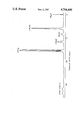
- FIG. 1 is a carbon-13 NMR spectrum of a copolymer, in accordance with the present invention, obtained from equimolar amounts of methyl isocyanide and tert-butyl isocyanide.
- vinyl isocyanides RR'C ⁇ C(R")NC
- nickel (II) catalysts to give the corresponding poly(vinyliminomethylenes).
- the corresponding poly(vinyliminomethylene) is obtained as a yellow to brown solid which is soluble in chloroform.
- the polymers can be purified by dissolution in chloroform and reprecipitation with ethanol.
- the poly(vinyliminomethylene)homopolymers of the present invention have the structural formula: ##STR5## wherein R and R', which are the same or different, may be hydrogen or an alkyl or alkenyl group of practically any size.
- R and R' which are the same or different, may be hydrogen or an alkyl or alkenyl group of practically any size.
- the alkyl group be a C 1 -C 8 group, which may either be a straight chain or branched-chain alkyl group, or a C 3 -C 7 cycloalkyl group which alkyl or cycloalkyl groups are unsubstituted or substituted by lower alkyl or alkoxy groups or which contain up to four non-catenated oxygen atoms.
- the alkenyl group be a C 2 -C 8 group, which may either be a straight chain or branched-chain alkenyl group, or a C 5 -C 7 cycloalkenyl group which is unsubstituted or substituted by lower alkyl or alkoxy groups.
- R and R' may also be an aryl group such as phenyl or naphthyl, both of which may be unsubstituted or substituted by lower alkyl or alkoxy groups.
- lower alkyl herein and below is meant C 1 -C 4 alkyl radicals such as methyl, ethyl, n-propyl, isopropyl, n-butyl, sec-butyl and tert-butyl.
- lower alkoxy is meant C 1 -C 4 alkoxy radicals such as methoxy, ethoxy, n-propoxy, isopropoxy, n-butoxy, sec-butoxy and tert-butoxy.
- non-catenated oxygen atoms oxygen atoms which are not directly linked to each other but which are, rather, interspersed throughout the carbon chain.
- R and R' it is also necessary that at least one of R or R' be a substituent other than hydrogen.
- R" is hydrogen and n has a value such that the polymer weight-average molecular weight is in the range of about 2,000 to 400,000 as determined by gel permeation chromatography. However, it is preferable that n have a value such that the polymer molecular weight is in the range of about 10,000 to 80,000. Moreover, the polymers generally have a polydispersivity (Mw/Mn) in the range of 1.7-2.4. However, polydispersivities as high as 3.9 have been observed.
- R and R' be a C 1 -C 8 straight chain or branched chain alkyl group or a C 3 -C 7 cycloalkyl group which alkyl or cycloalkyl groups are unsubstituted or substituted by lower alkyl or alkoxy groups or which contain up to four non-catenated oxygen atoms.
- alkyl substituents the most preferred groups are methyl, ethyl, n-propyl, isopropyl, n-butyl, sec-butyl or tert-butyl.
- cycloalkyl substituents cyclopropyl, cyclobutyl, cyclopentyl, cyclohexyl and cycloheptyl may be used, and for the cycloalkenyl substituents, cyclopentenyl, cyclohexenyl and cycloheptenyl may be used.
- alkyl, alkenyl, cycloalkyl and cycloalkenyl groups such as those in the range of 8 to 12 carbon atoms are specifically contemplated as being equivalent to the described groups of the present invention.
- R and R' may also be an aryl group such as phenyl or naphthyl, both of which may be unsubstituted or substituted by lower alkyl or alkoxy groups. However, particularly preferred is an unsubstituted phenyl group.
- the poly(vinyliminomethylene)homopolymers of the present invention are prepared by the polymerization of a vinyl isocyanide compound.
- the vinyl isocyanide compound starting material can be prepared according to the method of Schollkopf, Ann., 1977, 1167 as described below according to the following equations: ##STR6##
- CH 3 NC is placed in a 2 l-3 neck flask, which is fitted with a stirrer, a dropping funnel, and an immersed low-temperature thermometer, with THF.
- This mixture is cooled to -78° C. and the n-BuLi is added at a rate such that the temperature never rises above -70° C.
- the benzaldehyde/THF mixture is added at a rate such that the temperature never rises above -70° C.
- Stirring is continued for about 10 minutes more, and the tosyl chloride/THF is dropped in such that the temperature never rises above -65° C. Stirring is continued for an additional 15 minutes and the reaction mixture is allowed to warm to 30°-35° C.
- the reaction vessel is then flushed with N 2 and opened to the air. About 500 ml of H 2 O is added, and then about 500 ml of Et 2 O (diethyl ether). The aqueous layer is washed with about 300 ml of Et 2 O. The Et 2 O layers are combined and dried over MgSO 4 at about -20° C. for about 11/2 hrs. This mixture is then filtered, the MgSO 4 is washed with Et 2 O and then the solvent is pumped through a -78° C. trap.
- the remaining liquid is vacuum distilled.
- Example 1 was repeated except that pivalaldehyde (CH 3 ) 3 CCHO was used as the carbonyl compound in equation (1b) instead of benzaldehyde. A yield of about 75% of the corresponding vinyl isocyanide (CH 3 ) 3 CCH ⁇ CHNC was obtained.
- Example 1 was repeated except that 2,4,6-trimethylbenzaldehyde(2,4,6-(CH 3 ) 3 C 6 H 2 CHO) was used as the carbonyl compound in equation (1b) instead of benzaldehyde.
- a yield of about 41% of the corresponding vinyl isocyanide (2,4,6-(CH 3 ) 3 C 6 H 2 CH ⁇ CHNC) was obtained as a solid which was purified by recrystallization and vacuum sublimation.
- Example 1 was repeated except that 2-methyl-2-buten-1-aldehyde(tiglaldehyde)(C 3 ⁇ C(CH 3 )CHO) was used as the carbonyl compound in equation (1b) instead of benzaldehyde. A yield of about 57% of the corresponding vinyl compound (CH 3 CH ⁇ C(CH 3 )CH ⁇ CHNC) was obtained.
- Example 1 was repeated except that phenyl methyl ketone (C 6 H 5 COCH 3 ) was used as the carbonyl compound in equation (1b) instead of benzaldehyde. A yield of about 38% of the corresponding vinyl compound (C 6 H 5 C(CH 3 ) ⁇ CHNC) was obtained.
- vinyl isocyanide starting materials according to the method of Saegusa et al (Tetrahedron, 1971, 27, 3795) which is particularly useful for preparing vinyl isocyanides of the formula: ##STR7## wherein R a and R b , which may be the same or different, are each hydrogen; alkyl of about 1 to 8 carbon atoms, which may be straight or branched chain; unsubstituted phenyl or phenyl substituted by lower alkyl or alkoxy; and unsubstituted naphthyl or naphthyl substituted by lower alkyl or alkoxy.
- the vinyl isocyanide preparation according to the method of Saegusa et al entails (1) the preparation of an allyl formamide from an allyl amine, (2) the preparation of the allyl isocyanide from the allyl formamide and (3) the preparation, by isomerization, of the vinyl isocyanide from the allyl isocyanide, in accordance with the following equations: ##STR8##
- the allyl amine is refluxed with ethyl formate, to form the allyl formamide. Then, the allyl formamide is allowed to react with tosyl chloride (as defined above) in the presence of a base, such as quinoline, to yield the allylic isocyanide upon elimination. Finally, the allylic isocyanide is isomerized to the corresponding vinyl isocyanide in the presence of a cuprous catalyst, such as cuprous oxide.
- a cuprous catalyst such as cuprous oxide.
- R a1 and R a2 may be the same or different and are each hydrogen; an alkyl group of about 1 to 8 carbon atoms, which may be a straight or branched chain; an unsubstituted phenyl group or phenyl substituted by a lower alkyl or alkoxy of about 1 to 4 carbon atoms; R b is a straight chain or branched chain alkyl group of about 1 to 8 carbon atoms; an unsubstituted phenyl group or a phenyl group substituted by a lower alkyl or alkoxy or about 1 to 4 carbon atoms.
- R a1 , R a2 and R b be hydrogen or lower alkyl groups having from about 1 to 4 carbon atoms such as methyl, ethyl, n-propyl, isopropyl, n-butyl, sec-butyl and tert-butyl groups.
- alkyl groups such as those in the range of 8 to 12 carbon atoms are specifically contemplated as being equivalent to the described alkyl groups of the present invention.
- cycloalkyl, alkenyl and cycloalkenyl groups having between 1 and 12 carbon atoms are specifically contemplated as being equivalent to the described substituent alkyl groups of the present invention.
- the tosyl chloride and quinoline are combined in a 500 ml 2-neck round bottom flask fitted with a greased-joint ⁇ -methallyl formamide filled dropping funnel and an outlet.
- the vessel is first filled with N 2 and placed in an oil bath heated to 75° C. The pressure is reduced and the formamide dropped in over about 15 minutes.
- the effluents are allowed to pass through the reaction vessel outlet and through a -78° C. trap, where the product is collected. This liquid is redistilled to yield ⁇ -methallyl isocyanide.
- this method of vinyl isocyanide production is quite advantageous as it provides a method by which certain vinyl isocyanide compounds can be made without the occurrence of competitive elimination reactions to a significant extent.
- cuprous oxide is the cuprous catalyst of choice
- cuprous compounds such as the cuprous halides, CuCl and CuBr, may also be used according to the present invention.
- the vinyl isocyanides prepared are identifiable by their infrared spectra and their proton and carbon-13 n.m.r. spectra.
- R and R' which are the same or different, are each hydrogen, a C 1 -C 8 alkyl group or a C 3 -C 7 cycloalkyl group which is unsubstituted or substituted by lower alkyl or alkoxy groups; a C 1 -C 8 alkenyl group or a C 5 -C 7 cycloalkenyl group which is unsubstituted or substituted by lower alkyl or alkoxy groups; a phenyl group or naphthyl group which is unsubstituted or substituted by lower alkyl or alkoxy groups; with the proviso that at least one of R or R' be a substituent other than hydrogen; and R" is hydrogen.
- lower alkyl C 1 -C 4 alkyl radicals such as methyl, ethyl, n-propyl, isopropyl, n-butyl, sec-butyl and tert-butyl.
- lower alkoxy is meant C 1 -C 4 alkoxy radicals such as methoxy, ethoxy, n-propoxy, isopropoxy, n-butoxy, sec-butoxy and tert-butoxy.
- the vinyl isocyanides of the present invention are also easily characterized by correct C, H and N analyses.
- vinyl isocyanides 1 and 2 and 4 are are easily characterized by correct C, H and N analyses on their crystalline cis-(RNC) 2 Mo(CO) 4 complexes obtained by reactions of the isocyanides with the norbornadiene complex C 7 H 8 Mo(CO) 4 in hexane at room temperature, using the well-known procedure of King, R. B. "Organometallic Synthesis: Volume 1, Transition Metal Compounds," Academic Press, N.Y., N.Y. (1965) p. 124.
- the crystalline vinyl isocyanide 3 is easily characterized by correct C, H, and N analyses on a vacuum sublimed sample. ##STR9##
- this method of vinyl isocyanide production is quite advantageous as it provides a method by which certain vinyl isocyanide compounds can be made without the occurrence of competitive elimination reactions which might otherwise preclude their formation.
- the monomers may be either homopolymerized to form a poly(vinyliminomethylene) homopolymer, or they may also be copolymerized with another isocyanide monomer to form a poly(vinyliminomethylene) copolymer.
- the vinyl isocyanide monomer may be polymerized with two other polymerizable monomers to form a terpolymer.
- the homopolymers of the present invention generally yield soluble polymers having measured weight-average molecular weights in the range of about 2,000 to 400,000, more preferably in the range of about 10,000 to 80,000 as determined by gel permeation chromatography.
- the homopolymers of the present invention generally have a polydispersivity (Mw/Mn) in the range of 1.7 to 2.4, although polydispersivities as high as 3.9 have been observed.
- Nickel (II) derivatives have been found to be effective catalysts for both the homopolymerization and copolymerization reactions. While any of the known nickel (II) derivatives can be used, it is preferred that the nickel (II) derivative be NiCl 2 ; Ni(acac) 2 , where (acac) represents acetylacetonate; NiCl 2 .6H 2 O; and Ni(dpm) 2 , where (dpm) represents dipivaloylmethide. While the nickel (II) derivative catalyst may be employed in the amount of about 0.05 to 2.0 mole % relative to the amount of the isocyanide starting material employed, it is preferred that about 0.5 to 1.25 mole % of the catalyst be used.
- the nickel (II) catalyst is used relative to the isocyanide.
- the monomer or monomers be added to the catalyst. That is, the catalyst is added first to the reaction vessel.
- Co(acac) 2 rather than Ni(acac) 2 under otherwise identical conditions gives a polymer of higher molecular weight but a much lower yield of polymer. In general, it appears that Co(acac) 2 is a less active catalyst than Ni(acac) 2 .
- an optically active nickel (II) complex catalyst to preferentially form either left-handed or right-handed poly(vinyliminomethylene) helices from an achiral vinyl isocyanide monomer.
- One particularly useful catalyst in this regard might be an optically active nickel (II) complex from a chiral ⁇ -diketone derived from camphor having the formula: ##STR10## wherein R is (CH 3 ) 3 C-- or C 3 F 7 .
- Such a chiral catalyst would be expected to be used in synthesizing chiral polymers for use as catalyst supports in asymmetric synthesis. This would provide a very useful synthesis of chiral polymers requiring only catalytic amounts of the optically active reagent.
- Ni(dpm) 2 (0.102 mmol) is dissolved in hexane at 0° C. to form a 0.00510M solution in the hexane.
- 1.718 g of (CH 3 ) 2 C ⁇ CH--NC (21.2 mmol) is dissolved in 20.0 ml of hexane at 0° C. to form a 1.06M solution in hexane.
- the catalyst is added first, then the isocyanide).
- the hexane is stirred and maintained at 0° C. during addition and that temperature is maintained overnight during reaction. However, it was noted that a precipitate began to form after about 20 seconds and remained in suspension.
- (CH 3 ) 3 C--CH ⁇ CH--NC was prepared from pivalaldehyde and methyl isocyanide in 76% yield using the mthod of Schollkopf as described above.
- the homopolymerization of (CH 3 ) 3 C--CH ⁇ CH--NC was then investigated under a variety of conditions. The results of these investigations with the recited conditions for each example are listed in Table 2.
- homopolymers of the vinyl isocyanides are generally soluble in solvents such as chloroform, it has been found that the homopolymerization of 2,4,6-(CH 3 ) 3 C 6 H 2 CH ⁇ CHNC and of the dienyl isocyanide CH 3 CH ⁇ C(CH 3 )CH ⁇ CHNC yields insoluble polymers when using the usual nickel (II) catalysts.
- a soluble poly(iminomethylene) copolymer may be obtained by copolymerizing the isocyanide monomer yielding an insoluble homopolymer with an isocyanide having the isocyanide functionality attached to a sterically hindered carbon.
- tertiary carbon bearing compounds which may be used are tert-butyl isocyanide, tert-pentyl isocyanide and tert-hexyl isocyanide.
- isocyanides bearing tert-butyl, tert-pentyl and tert-hexyl radicals are isocyanides bearing tert-butyl, tert-pentyl and tert-hexyl radicals.
- tert-butyl isocyanide isocyanide.
- any tri-alkyl or tri-aryl-substituted methyl isocyanide may be used.
- the tri-alkyl-substituted methyl isocyanides have 1 to 6 carbon atoms per alkyl group, while the tri-aryl groups have about 6 to 12 carbon atoms per aryl group.
- R groups, for RNC, which may be used to render the isocyanide sterically hindered are ##STR11## alkyl, where Ph is a phenyl group which may be unsubstituted or substituted by lower alkyl and lower alkoxy groups of 1 to 6 carbon atoms; and alkyl in the formula designates lower alkyl groups of 1 to 6 carbon atoms.
- RNC which may be used to render the isocyanide sterically hindered
- alkyl where Ph is a phenyl group which may be unsubstituted or substituted by lower alkyl and lower alkoxy groups of 1 to 6 carbon atoms
- alkyl in the formula designates lower alkyl groups of 1 to 6 carbon atoms.
- Me where Me is methyl may be used.
- R groups such as ##STR13## where, as above, Ph is a phenyl group which may be unsubstituted or substituted by lower alkyl and lower alkoxy groups of 1 to 6 carbon atoms.
- X--CH ⁇ CH-- wherein X is defined as groups such as tert-butyl, tert-pentyl, tert-hexyl groups or the groups ##STR14## as described above.
- X may be also be a radical of the formula: ##STR15## wherein Ar is an unsubstituted aryl group or aryl group substituted by one or more lower alkyl or alkoxy groups with a total of 6 to 12 carbon atoms, and wherein Alkyl is an alkyl group of 1 to about 6 carbon atoms.
- dialkyl-amino groups with alkyl groups of 1 to about 8 carbon atoms, whose carbon atoms may be branched or linear.
- the R group of RNC may be diethylamino groups.
- diaryl-amino groups having aryl groups of 6 to about 12 carbon atoms may be used.
- the aryl groups may be unsubstituted, such as phenyl, or substituted with 1 to 6 carbon atoms.
- Table 3 summarizes some of the isocyanide copolymerizations which have been conducted. It is noted that all of these copolymerizations were performed in ethanol solutions using 0.5% nickel (II) acetylacetonate catalyst. However, the other nickel catalysts already described could also be used. Initially, copolymerizations with tert-butyl isocyanide were investigated as the homopolymer obtained from tert-butyl isocyanide is among the most soluble of the simple isocyanide homopolymers.
- Copolymerizations of methyl and ethyl isocyanides with ⁇ -phenylethyl isocyanide gave chloroform-soluble polymers with molecular weights (M w ) in the range of 25,000 ⁇ 2,000 but relatively little of the methyl or ethyl isocyanide was incorporated into this copolymer. See Table 3. Copolymerization of cyclohexyl isocyanide with ⁇ -phenylethyl isocyanide yielded an initially soluble copolymer incorporating reasonable amounts of cyclohexyl isocyanide (Table 3), but this copolymer became insoluble upon standing. Copolymerizations of the vinyl isocyanides CH 3 CH ⁇ CHNC and (CH 3 ) 2 C ⁇ CHNC with ⁇ -phenylethyl isocyanide give materials in which substantial amounts of the vinyl isocyanide were incorporated.
- Copolymerizations with other sterically hindered isocyanides such as tert-butylvinyl isocyanide (CH 3 ) 3 CCH ⁇ CHNC, were also conducted since this vinyl isocyanide has been found to give soluble homopolymers having molecular weights in the range of about 50,000 to 400,000 depending upon the polymerization conditions.
- soluble copolymer of cyclohexyl isocyanide with (CH 3 ) 3 CCH ⁇ CHNC shown to have a molecular weight (M w ) of about 72,000 and to contain some cyclohexyl isocyanide units by a broad resonance at ⁇ 26.0 in its carbon-13 NMR spectrum (Table 3).
- copolymerizations with tert-butyl isocyanide appear to be generally quite useful, although the resulting polymers have relatively low molecular weights.
- Soluble copolymers having higher molecular weights can often be obtained through copolymerization with C 6 H 5 CH(CH 3 )NC or (CH 3 ) 3 CCH ⁇ CHNC but incorporation of other isocyanide units into these polymer backbones in reasonable amounts is usually difficult.
- Substituted vinyl isocyanides such as CH 3 CH ⁇ CHNC, (CH 3 ) 2 C ⁇ CHNC, and 2,4,6-(CH 3 ) 3 C 6 H 2 CH ⁇ CHNC which give insoluble homopolymers are most readily incorporated into soluble copolymers using the methods and compositions of the present invention.
- This observation suggests that vinyl isocyanides polymerize more rapidly with nickel (II) catalysts than isocyanides in which the isocyano group is bonded to an sp 3 carbon atom.
- the copolymers of the present invention utilizing tertiary carbon bearing isocyanides such as tert-butyl isocyanide as one of the starting monomers being sterically hindered have a weight-average molecular weight (Mw) in the range of about 1,000 to about 70,000, and a number-average molecular weight (Mn) in the range of about 500 to 25,000. These copolymers have a polydispersivity (Mw/Mn) in the range of about 2.0 to 4.0.
- copolymers of the present invention utilizing sterically hindered secondary carbon bearing isocyanides such as those where R of RNC is of the ##STR16## series have a Mw in the range of about 5,000 to about 35,000, and a Mn in the range of about 1,000 to about 15,000. These copolymers have a polydispersivity in the range of about 2.0 to 3.0.
- copolymers of the present invention utilizing sterically hindered vinylogous isocyanides such as those where R of RNC is t-BuCH ⁇ CH-- have a Mw in the range of about 40,000 to about 80,000, and a Mn in the range of about 15,000 to 40,000. These copolymers have a polydispersivity in the range of about 2.0 to 3.0.
- the copolymers of the present invention now make it possible to incorporate into poly(iminomethylene) polymers a much wider variety of pendant functional groups than was previously possible.
- pendant functional groups such as alcohol, ester, alkoxy, phosphino groups or even heterocyclic groups such as imidazole groups.
- lower alkyl alcohols such as ethanol have already been mentioned as have chlorinated hydrocarbons such as chloroform.
- other such solvents may be used such as isopropyl alcohol, n-butyl alcohol or dichloromethane.
- other types of relatively polar solvents may also be used such as ketones such as acetone.
- the homopolymers and copolymers of the present invention are used advantageously in the formation of highly conjugated conducting materials.
- the polymers of the present invention may be used in manufactured articles where electroconductivity is required in the manner provided by U.S. Pat. No. 4,304,987 which is specifically incorporated herein by reference in its entirety.
- various metals and salts thereof to the polymer compositions for enhancing conductivity in the manner provided by U.S. Pat. Nos. 3,867,315 and 3,978,378, which are specifically incorporated herein by reference in their entirety.
- polymers of the present invention may be used advantageously in the preparation of printed circuits in the manner provided by U.S. Pat. No. 4,371,459 which is specifically incorporated herein by reference in its entirety.
- the conductive polymers of the present invention may be fabricated, particularly into thin layered capacitors or printed circuits, with the conductive material being coextruded with dielectric materials using the coextrusion apparatus of U.S. Pat. No. 3,557,265 which is incorporated by reference herein in its entirety.
- copolymers of the present invention it is now possible to greatly increase the range of functional groups that can be incorporated into poly(iminomethylenes) having the desired solubility and molecular weight properties. Accordingly, these copolymers increase the range of applications for these materials as chiral supports for asymmetric catalysts and for the preparation of novel conducting materials.
Landscapes
- Chemical & Material Sciences (AREA)
- Engineering & Computer Science (AREA)
- Microelectronics & Electronic Packaging (AREA)
- Health & Medical Sciences (AREA)
- Chemical Kinetics & Catalysis (AREA)
- Medicinal Chemistry (AREA)
- Polymers & Plastics (AREA)
- Organic Chemistry (AREA)
- Power Engineering (AREA)
- Materials Engineering (AREA)
- Manufacturing & Machinery (AREA)
- Addition Polymer Or Copolymer, Post-Treatments, Or Chemical Modifications (AREA)
Abstract
A poly(vinyliminomethylene) polymer having at least one recurring structural unit of the formula: ##STR1## wherein R and R', which are the same or different, are each hydrogen, a C1 -C8 alkyl group or C3 -C7 cycloalkyl group which alkyl or cycloalkyl groups are unsubstituted or substituted by lower alkyl or alkoxy groups or which contain up to four non-catenated oxygen atoms, a C2 -C8 alkenyl group or a C5 -C7 cycloalkenyl group which is unsubstituted or substituted by lower alkyl or alkoxy groups, a phenyl group or naphthyl group which is unsubstituted or substituted by lower alkyl or alkoxy groups, with the proviso that at least one of R and R' be a substituent other than hydrogen; R" is hydrogen; and n has a value such that the weight-average molecular weight is in the range of about 2,000 to 400,000 as determined by gel permeation chromatography.
Description
This application is a continuation-in-part of application Ser. No. 666,902 filed on Oct. 31, 1984, now U.S. Pat. No. 4,609,716.
1. Field of the Invention
The present invention relates to poly(iminomethylene)polymers, particularly copolymers thereof. This invention also relates to vinyl isocyanide compounds for the preparation thereof.
2. Description of the Prior Art
The homopolymerization of isocyanides, RNC, yields a rather unusual class of polymers, namely the poly(iminomethylenes), having the formula ##STR2## These polymers are of interest as their viscosity behavior, Debye-Scherrer X-ray composites, and optical rotation data suggest that the polymers have a rigid rod helical structure. The same structure appears to be consistent with observations from molecular models. F. Millich, Adv. Polym. Sci., 19, 117 (1975) and Chem. Rev., 72, 101 (1972). With the recognition that a helical structure is the most likely structure, subsequent experimentation soon indicated that various isocyanide oligomers could be resolved into fractions having (+) and (-) signs of optical rotation. R. J. M. Nolte et al, J. Am. Chem. Soc. 96, 5932 (1974). Hence, the poly(iminomethylenes) appear to have a chiral helical rigid rod structure.
The chirality of these polymers renders them of interest and useful as chiral supports for asymmetrical catalysts. Moreover, these polymers have a backbone of carbon atoms each having a nitrogen atom bonded directly thereto by means of a double bond which renders them of interest as building blocks for novel conducting polymeric materials.
The first characterized high polymer of an isocyanide, RNC, and a catalytic synthetic procedure were reported in 1965. However, although some polyisocyanide studies have been conducted, as described above, more extensive investigations of the synthesis and properties of these polymers have been hampered by the extreme insolubility of most of the poly(iminomethylenes). Moreover, the polymer insolubilities have largely prevented investigations pertaining to the possible uses for these polymers. With the combination of chirality and rigidity, the poly(iminomethylenes) should offer a wide range of uses such as selective supports in chromatography, as enantioselective catalysts, and as specific reagents with respect to substrates of biochemical importance. Unfortunately, the realization of these possiblities has been frustrated due to the pervasive insolubility of the poly(iminomethylenes).
For example, among the poly(iminomethylenes) derived from simple isocyanides, those prepared from phenethyl and tert-butyl isocyanides have been found to be soluble in chloroform, whereas those prepared from methyl, ethyl, n-butyl, isopropyl, cyclohexyl and phenyl isocyanides are insoluble in chloroform. Rec. Trav. Chim. Pays-Bas., 1973, 92, 83, R. J. M. Nolte et al. Similarly, among the polymers obtained from the homopolymerization of vinyl isocyanides, those prepared from (CH3)3 CCH═CHNC, C6 H5 CH═CHNC and C6 H5 C(CH3)═CHNC are soluble in chloroform, whereas those prepared from CH3 CH═CHNC, (CH3)2 C═CHNC, 2,4,6-(CH3)3 C6 H2 CH═CHNC, and CH3 CH═C(CH3)CH═CHNC are insoluble in chloroform.
Thus, the limited number of isocyanides that polymerize to soluble poly(iminoethylenes) severely limits the range of pendant groups that can be attached to a soluble poly(iminomethylene) backbone through the homopolymerization of isocyanides.
Hence, a need continues to exist for a poly(iminomethylene) type polymer which is soluble and which would, therefore, facilitate the study and use of these polymers.
Accordingly, it is an object of the present invention to provide poly(iminoethylene)polymers which have excellent solubility.
It is also an object of this invention to provide poly(iminomethylene)polymers which have, by virtue of their molecular structure, a variety of pendant groups.
In particular, it is an object of the present invention to provide poly(iminomethylene)copolymers of which at least one comonomer thereof is a vinyl isocyanide.
It is also an object of this invention to provide vinyl isocyanide monomers to be used in the preparation of the present polymers.
According to the present invention, the foregoing and other objects are attained by providing a poly(iminomethylene)polymer having at least one recurring structural unit of the formula: ##STR3## wherein R and R', which are the same or different, are each hydrogen, a C1 -C8 alkyl group or C3 -C7 cycloalkyl group which alkyl or cycloalkyl groups are unsubstituted or substituted by lower alkyl or alkoxy groups or which contain up to four non-catenated oxygen atoms, a C2 -C8 alkenyl group or a C5 -C7 cycloalkenyl group which is unsubstituted or substituted by lower alkyl or alkoxy groups, a phenyl group or naphthyl group which is unsubstituted or substituted by lower alkyl or alkoxy groups, with the proviso that at least one of R and R' be a substituent other than hydrogen; R" is hydrogen; and n has a value such that the weight-average molecular weight (Mw) is in the range of about 2,000 to 400,000 as determined by gel permeation chromatography.
FIG. 1 is a carbon-13 NMR spectrum of a copolymer, in accordance with the present invention, obtained from equimolar amounts of methyl isocyanide and tert-butyl isocyanide.
According to one aspect of the present invention it has been found that vinyl isocyanides, RR'C═C(R")NC, can be homopolymerized with nickel (II) catalysts to give the corresponding poly(vinyliminomethylenes). By an appropriate choice of the vinyl isocyanide monomer, the corresponding poly(vinyliminomethylene) is obtained as a yellow to brown solid which is soluble in chloroform. The polymers can be purified by dissolution in chloroform and reprecipitation with ethanol.
Available infrared (IR) data as well as proton and carbon-13 nuclear magnetic resonance (NMR) data for the poly(vinyliminomethylenes) indicate that the polymerization of the vinyl isocyanide occurs through the isocyanide functionality rather than through the carbon-carbon double bond. Therefore, the poly(vinyliminomethylenes) of the present invention have the structural formula: ##STR4## with pendant carbon-carbon double bonds. This type of structure is extremely advantageous for use in the following applications:
(1) Formation of highly conjugated conducting materials arising from the pendant carbon-carbon double bonds.
(2) Photocrosslinking of soluble poly(vinyliminomethylenes) through the photo-initiated free radical addition reactions of the pendant carbon-carbon double bonds to give insoluble cross-linked materials. Moreover, as the cross-linked materials would, most likely, be conducting, such materials would be very useful in the manufacture of printed circuits.
(3) The use of the pendant carbon-carbon double bonds as a site for anchoring transition metal functionalities of catalytic interest. This would be a new example of the known non-classical bonding interaction of the π electrons of unsaturated moieties with transition metal orbitals. This would be expected to generate novel polymer-supported catalysts. Indeed, such catalysts could be useful for asymmetric synthesis, if the poly(vinyliminomethylene) were resolved into the pure enantiomers, i.e., the right and left-handed helices.
(4) The carbon-carbon double bonds would provide sites for further chemical reaction such as, cross-linking or addition reactions.
The poly(vinyliminomethylene)homopolymers of the present invention have the structural formula: ##STR5## wherein R and R', which are the same or different, may be hydrogen or an alkyl or alkenyl group of practically any size. However, it is preferable that the alkyl group be a C1 -C8 group, which may either be a straight chain or branched-chain alkyl group, or a C3 -C7 cycloalkyl group which alkyl or cycloalkyl groups are unsubstituted or substituted by lower alkyl or alkoxy groups or which contain up to four non-catenated oxygen atoms. It is preferable that the alkenyl group be a C2 -C8 group, which may either be a straight chain or branched-chain alkenyl group, or a C5 -C7 cycloalkenyl group which is unsubstituted or substituted by lower alkyl or alkoxy groups. R and R' may also be an aryl group such as phenyl or naphthyl, both of which may be unsubstituted or substituted by lower alkyl or alkoxy groups. By lower alkyl, herein and below is meant C1 -C4 alkyl radicals such as methyl, ethyl, n-propyl, isopropyl, n-butyl, sec-butyl and tert-butyl. By lower alkoxy is meant C1 -C4 alkoxy radicals such as methoxy, ethoxy, n-propoxy, isopropoxy, n-butoxy, sec-butoxy and tert-butoxy.
By the expression "non-catenated oxygen atoms" is meant oxygen atoms which are not directly linked to each other but which are, rather, interspersed throughout the carbon chain.
However, in addition to the above definitions of R and R', it is also necessary that at least one of R or R' be a substituent other than hydrogen.
R" is hydrogen and n has a value such that the polymer weight-average molecular weight is in the range of about 2,000 to 400,000 as determined by gel permeation chromatography. However, it is preferable that n have a value such that the polymer molecular weight is in the range of about 10,000 to 80,000. Moreover, the polymers generally have a polydispersivity (Mw/Mn) in the range of 1.7-2.4. However, polydispersivities as high as 3.9 have been observed.
For the above-described homopolymer, it is more preferable yet that R and R' be a C1 -C8 straight chain or branched chain alkyl group or a C3 -C7 cycloalkyl group which alkyl or cycloalkyl groups are unsubstituted or substituted by lower alkyl or alkoxy groups or which contain up to four non-catenated oxygen atoms. Of the alkyl substituents, the most preferred groups are methyl, ethyl, n-propyl, isopropyl, n-butyl, sec-butyl or tert-butyl. For the cycloalkyl substituents, cyclopropyl, cyclobutyl, cyclopentyl, cyclohexyl and cycloheptyl may be used, and for the cycloalkenyl substituents, cyclopentenyl, cyclohexenyl and cycloheptenyl may be used.
However, larger alkyl, alkenyl, cycloalkyl and cycloalkenyl groups such as those in the range of 8 to 12 carbon atoms are specifically contemplated as being equivalent to the described groups of the present invention.
As indicated R and R' may also be an aryl group such as phenyl or naphthyl, both of which may be unsubstituted or substituted by lower alkyl or alkoxy groups. However, particularly preferred is an unsubstituted phenyl group.
The poly(vinyliminomethylene)homopolymers of the present invention are prepared by the polymerization of a vinyl isocyanide compound. The vinyl isocyanide compound starting material can be prepared according to the method of Schollkopf, Ann., 1977, 1167 as described below according to the following equations: ##STR6##
The present inventors have found that this method works particularly well when the carbonyl compound of (1b) is an aldehyde and not a ketone. By using aldehyde carbonyls in this method, competitive elimination reactions appear to be largely avoided. By contrast, such competitive elimination reactions are often a problem when ketones are used.
The preparation of the vinyl isocyanide compounds by this method will now be further illustrated by certain examples and references which are provided for purposes of illustration only and are not intended to limit the present invention.
Amounts used:
9.21 g CH3 NC (0.224 mol) in 275 ml dry THF
140 ml of 1.6N n-BuLi (in hexane) (0.224 mol)
24.4 g benzaldehyde (0.230 mol) in 100 ml dry THF
The n-BuLi, benzaldehyde/THF, tosyl chloride/THF are flushed with N2 and placed in the freezer to store until needed. All operations in the following procedure were conducted under N2.
CH3 NC is placed in a 2 l-3 neck flask, which is fitted with a stirrer, a dropping funnel, and an immersed low-temperature thermometer, with THF. This mixture is cooled to -78° C. and the n-BuLi is added at a rate such that the temperature never rises above -70° C. Then the benzaldehyde/THF mixture is added at a rate such that the temperature never rises above -70° C. Stirring is continued for about 10 minutes more, and the tosyl chloride/THF is dropped in such that the temperature never rises above -65° C. Stirring is continued for an additional 15 minutes and the reaction mixture is allowed to warm to 30°-35° C.
At this temperature is added the KOH/CH3 OH solution over a period of about 40 minutes. Stirring is continued for an additional 20 minutes after addition is complete. The mixture is then pumped through a dry-ice trap to remove most of the solvents.
The reaction vessel is then flushed with N2 and opened to the air. About 500 ml of H2 O is added, and then about 500 ml of Et2 O (diethyl ether). The aqueous layer is washed with about 300 ml of Et2 O. The Et2 O layers are combined and dried over MgSO4 at about -20° C. for about 11/2 hrs. This mixture is then filtered, the MgSO4 is washed with Et2 O and then the solvent is pumped through a -78° C. trap.
The remaining liquid is vacuum distilled.
Yield=7.031 g (54.4 mmol) 24.7% of the phenyl vinyl isocyanide.
Example 1 was repeated except that pivalaldehyde (CH3)3 CCHO was used as the carbonyl compound in equation (1b) instead of benzaldehyde. A yield of about 75% of the corresponding vinyl isocyanide (CH3)3 CCH═CHNC was obtained.
Example 1 was repeated except that 2,4,6-trimethylbenzaldehyde(2,4,6-(CH3)3 C6 H2 CHO) was used as the carbonyl compound in equation (1b) instead of benzaldehyde. A yield of about 41% of the corresponding vinyl isocyanide (2,4,6-(CH3)3 C6 H2 CH═CHNC) was obtained as a solid which was purified by recrystallization and vacuum sublimation.
Example 1 was repeated except that 2-methyl-2-buten-1-aldehyde(tiglaldehyde)(C3 ═C(CH3)CHO) was used as the carbonyl compound in equation (1b) instead of benzaldehyde. A yield of about 57% of the corresponding vinyl compound (CH3 CH═C(CH3)CH═CHNC) was obtained.
Example 1 was repeated except that phenyl methyl ketone (C6 H5 COCH3) was used as the carbonyl compound in equation (1b) instead of benzaldehyde. A yield of about 38% of the corresponding vinyl compound (C6 H5 C(CH3)═CHNC) was obtained.
It is also possible to produce vinyl isocyanide starting materials according to the method of Saegusa et al (Tetrahedron, 1971, 27, 3795) which is particularly useful for preparing vinyl isocyanides of the formula: ##STR7## wherein Ra and Rb, which may be the same or different, are each hydrogen; alkyl of about 1 to 8 carbon atoms, which may be straight or branched chain; unsubstituted phenyl or phenyl substituted by lower alkyl or alkoxy; and unsubstituted naphthyl or naphthyl substituted by lower alkyl or alkoxy.
The vinyl isocyanide preparation according to the method of Saegusa et al entails (1) the preparation of an allyl formamide from an allyl amine, (2) the preparation of the allyl isocyanide from the allyl formamide and (3) the preparation, by isomerization, of the vinyl isocyanide from the allyl isocyanide, in accordance with the following equations: ##STR8##
According to the above method, in general, the allyl amine is refluxed with ethyl formate, to form the allyl formamide. Then, the allyl formamide is allowed to react with tosyl chloride (as defined above) in the presence of a base, such as quinoline, to yield the allylic isocyanide upon elimination. Finally, the allylic isocyanide is isomerized to the corresponding vinyl isocyanide in the presence of a cuprous catalyst, such as cuprous oxide.
In the above equations (1), (2) and (3), Ra1 and Ra2 may be the same or different and are each hydrogen; an alkyl group of about 1 to 8 carbon atoms, which may be a straight or branched chain; an unsubstituted phenyl group or phenyl substituted by a lower alkyl or alkoxy of about 1 to 4 carbon atoms; Rb is a straight chain or branched chain alkyl group of about 1 to 8 carbon atoms; an unsubstituted phenyl group or a phenyl group substituted by a lower alkyl or alkoxy or about 1 to 4 carbon atoms.
It is more preferred, however, that Ra1, Ra2 and Rb be hydrogen or lower alkyl groups having from about 1 to 4 carbon atoms such as methyl, ethyl, n-propyl, isopropyl, n-butyl, sec-butyl and tert-butyl groups.
However, larger alkyl groups such as those in the range of 8 to 12 carbon atoms are specifically contemplated as being equivalent to the described alkyl groups of the present invention. Moreover, cycloalkyl, alkenyl and cycloalkenyl groups having between 1 and 12 carbon atoms are specifically contemplated as being equivalent to the described substituent alkyl groups of the present invention.
By the above method of the present invention it is possible to obtain vinyl isocyanides which correspond to those which, in theory, could be obtained by using ketones as the carbonyl compounds in the method of Schollkopf. However, the use of ketones as carbonyl compound starting materials in the Schollkopf method often give rise to competitive elimination reactions which significantly affect the yield of vinyl isocyanide product. By the method of the present invention, it is possible to avoid this drawback.
The preparation of the vinyl isocyanide compounds by the method of the present invention will now be further illustrated by certain examples and references which are provided for purposes of illustration only and are not intended to limit the present invention.
Amounts Used
20.473 g β-methallylamine (288 mmol)
21.261 g ethyl formate (327 mmol)
The above constituents are refluxed for 5 hours. The heat is discontinued and stirring is conducted under N2.
The excess ethyl formate and EtOH (ethyl alcohol by-product) are distilled off at ambient pressure. Then the product is distilled under vacuum B.P.1.0 mm=84°-85° C.
Yield 25.236 g (255 mmol) 88.5%
Amounts used
25.147 g β-methallyl formamide (253 mmol)
65.0 g tosyl chloride (341 mmol)
125 g quinoline (978 mmol)
The tosyl chloride and quinoline are combined in a 500 ml 2-neck round bottom flask fitted with a greased-joint β-methallyl formamide filled dropping funnel and an outlet. The vessel is first filled with N2 and placed in an oil bath heated to 75° C. The pressure is reduced and the formamide dropped in over about 15 minutes. The effluents are allowed to pass through the reaction vessel outlet and through a -78° C. trap, where the product is collected. This liquid is redistilled to yield β-methallyl isocyanide. B.P.=128° C.-130° C. Yield=8.648 g (107 mmol) 44.3%.
Amounts Used
8.148 g of β-methallylisocyanide (100 mmol)
0.141 g of Cu2 O (0.985 mmol)
To neat β-methallyl isocyanide, which is stirring under N2, is added cuprous oxide. After about 5 seconds, the reaction mixture turns dark and effervesces in a slow but steady fashion. The reaction apparatus became warm.
The reaction mixture is allowed to stir for about 4 hours. Then the mixture is distilled. B.P.=118°-120° C.
Yield=6.984 g (86.0 mmol)=86.0%.
As indicated above, this method of vinyl isocyanide production is quite advantageous as it provides a method by which certain vinyl isocyanide compounds can be made without the occurrence of competitive elimination reactions to a significant extent.
While cuprous oxide is the cuprous catalyst of choice, other cuprous compounds such as the cuprous halides, CuCl and CuBr, may also be used according to the present invention.
The vinyl isocyanides prepared are identifiable by their infrared spectra and their proton and carbon-13 n.m.r. spectra.
According to this aspect of the present invention are disclosed vinyl isocyanides of the formula:
RR'C═C(R")N═C
wherein R and R', which are the same or different, are each hydrogen, a C1 -C8 alkyl group or a C3 -C7 cycloalkyl group which is unsubstituted or substituted by lower alkyl or alkoxy groups; a C1 -C8 alkenyl group or a C5 -C7 cycloalkenyl group which is unsubstituted or substituted by lower alkyl or alkoxy groups; a phenyl group or naphthyl group which is unsubstituted or substituted by lower alkyl or alkoxy groups; with the proviso that at least one of R or R' be a substituent other than hydrogen; and R" is hydrogen.
It is noted that by lower alkyl is meant C1 -C4 alkyl radicals such as methyl, ethyl, n-propyl, isopropyl, n-butyl, sec-butyl and tert-butyl. By lower alkoxy is meant C1 -C4 alkoxy radicals such as methoxy, ethoxy, n-propoxy, isopropoxy, n-butoxy, sec-butoxy and tert-butoxy.
The vinyl isocyanides of the present invention are also easily characterized by correct C, H and N analyses. For example, vinyl isocyanides 1 and 2 and 4 are are easily characterized by correct C, H and N analyses on their crystalline cis-(RNC)2 Mo(CO)4 complexes obtained by reactions of the isocyanides with the norbornadiene complex C7 H8 Mo(CO)4 in hexane at room temperature, using the well-known procedure of King, R. B. "Organometallic Synthesis: Volume 1, Transition Metal Compounds," Academic Press, N.Y., N.Y. (1965) p. 124.
For example, the crystalline vinyl isocyanide 3 is easily characterized by correct C, H, and N analyses on a vacuum sublimed sample. ##STR9##
As indicated above, this method of vinyl isocyanide production is quite advantageous as it provides a method by which certain vinyl isocyanide compounds can be made without the occurrence of competitive elimination reactions which might otherwise preclude their formation.
Once the vinyl isocyanide monomer compounds are obtained, the monomers may be either homopolymerized to form a poly(vinyliminomethylene) homopolymer, or they may also be copolymerized with another isocyanide monomer to form a poly(vinyliminomethylene) copolymer. Of course, the vinyl isocyanide monomer may be polymerized with two other polymerizable monomers to form a terpolymer.
It has been found that the homopolymers of the present invention generally yield soluble polymers having measured weight-average molecular weights in the range of about 2,000 to 400,000, more preferably in the range of about 10,000 to 80,000 as determined by gel permeation chromatography. The homopolymers of the present invention generally have a polydispersivity (Mw/Mn) in the range of 1.7 to 2.4, although polydispersivities as high as 3.9 have been observed.
Nickel (II) derivatives have been found to be effective catalysts for both the homopolymerization and copolymerization reactions. While any of the known nickel (II) derivatives can be used, it is preferred that the nickel (II) derivative be NiCl2 ; Ni(acac)2, where (acac) represents acetylacetonate; NiCl2.6H2 O; and Ni(dpm)2, where (dpm) represents dipivaloylmethide. While the nickel (II) derivative catalyst may be employed in the amount of about 0.05 to 2.0 mole % relative to the amount of the isocyanide starting material employed, it is preferred that about 0.5 to 1.25 mole % of the catalyst be used. However, it is most preferred if about 1 mole % of the nickel (II) catalyst is used relative to the isocyanide. However, in polymerizing the vinyl isocyanide compound, along or with another isocyanide monomer, it is preferred that the monomer or monomers be added to the catalyst. That is, the catalyst is added first to the reaction vessel.
The use of Co(acac)2 rather than Ni(acac)2 under otherwise identical conditions gives a polymer of higher molecular weight but a much lower yield of polymer. In general, it appears that Co(acac)2 is a less active catalyst than Ni(acac)2.
In addition to the use of Ni(dpm)2 and Ni(acac)2 as catalysts, it also appears possible to use an optically active nickel (II) complex catalyst to preferentially form either left-handed or right-handed poly(vinyliminomethylene) helices from an achiral vinyl isocyanide monomer. One particularly useful catalyst in this regard might be an optically active nickel (II) complex from a chiral β-diketone derived from camphor having the formula: ##STR10## wherein R is (CH3)3 C-- or C3 F7. Such a chiral catalyst would be expected to be used in synthesizing chiral polymers for use as catalyst supports in asymmetric synthesis. This would provide a very useful synthesis of chiral polymers requiring only catalytic amounts of the optically active reagent.
The above-described homopolymers and the preparation thereof will now be further illustrated by certain examples and references which are provided for purposes of illustration only and are not intended to limit the present invention.
Homopolymerization of (CH3)2 C═CH--NC using Ni(dpm)2 as a catalyst.
0.0434 g of Ni(dpm)2 (0.102 mmol) is dissolved in hexane at 0° C. to form a 0.00510M solution in the hexane. Then, 1.718 g of (CH3)2 C═CH--NC (21.2 mmol) is dissolved in 20.0 ml of hexane at 0° C. to form a 1.06M solution in hexane. (Thus, the catalyst is added first, then the isocyanide). The hexane is stirred and maintained at 0° C. during addition and that temperature is maintained overnight during reaction. However, it was noted that a precipitate began to form after about 20 seconds and remained in suspension.
After overnight reaction, the reaction mixture is washed with EtOH and filtered. The solid is dissolved in CHCl3 and filtered. The amber solution is reduced in volume. EtOH is added causing a dark yellow precipitate to form. This solid is filtered and suction-dried.
It is noted that, where possible, all procedures were performed at 0° C.
A yield of 1.456 g (84.7%) of polymer product was obtained.
Homopolymerization of (CH3)2 C═CH--NC using Ni(acac)2 as a catalyst.
0.0201 g of Ni(acac)2 (0.102 mmol) is dissolved in EtOH to form a 0.00508M solution in the EtOH. Then, 1.657 g of (CH3)2 C═CH--NC (20.4 mmol) is dissolved in 20.0 ml of EtOH at 0° C. to form a 1.02M solution in the EtOH. The EtOH is stirred and maintained at 0° C. during addition and that temperature is maintained overnight during reaction. However, it was noted that a precipitate began to form after about 30 seconds and a thick orange-yellow gel formed after about 5 minutes.
After overnight reaction, the reaction mixture is washed with EtOH and filtered. The amber solution is reduced in volume. EtOH is added causing a dark yellow precipitate to form. This solid is filtered and suction-dried.
It is noted, again, that where possible, all procedures were performed at 0° C.
A yield of 1.032 g (62.3%) of polymer product was obtained.
Various vinyl isocyanide monomers were homopolymerized along the lines of Examples 7 and 8 using various nickel (II) catalysts. The poly(vinyliminomethylene) homopolymers were characterized upon isolation to obtain the molecular weight (Mw) and polydispersivity (Mw/Mn). The results obtained are summarized below in Table 1.
                                  TABLE 1
__________________________________________________________________________
POLYMERIZATION OF VINYL ISOCYANIDES
TO POLY(VINYLIMINOMETHYLENES)
USING NICKEL (II) CATALYSTS
No.
   Vinyl Isocyanide Monomer
                  Catalyst.sup.(a)
                         Yield, %
                              Mw   M.sub.w /M.sub.n
                                       [η].sup.(b)
__________________________________________________________________________
 9 (CH.sub.3).sub.3 CCH═CHNC
                  NiCl.sub.2
                         43   71,300
                                   1.82
                                       0.31
10 (CH.sub.3).sub.3 CCH═CHNC
                  Ni(acac).sub.2
                         48   51,200
                                   1.91
                                       0.26
11 C.sub.6 H.sub.5 CH═CHNC
                  NiCl.sub.2
                         60   14,000
                                   1.79
                                       0.098
12 C.sub.6 H.sub.5 CH═CHNC
                  Ni(acac).sub.2
                         55   11,000
                                   1.72
                                       0.095
13 2,4,6-(CH.sub.3).sub.3 C.sub.6 H.sub.2 CH═CHNC
                  NiCl.sub.2
                         83   insoluble
14 2,4,6-(CH.sub.3).sub.3 C.sub.6 H.sub.2 CH═CHNC
                  Ni(acac).sub.2
                         90   insoluble
15 C.sub.6 H.sub.5 C(CH.sub.3)CH═CHNC
                  NiCl.sub.2
                         37   42,800
                                   2.30
                                       0.28
16 C.sub.6 H.sub.5 C(CH.sub.3)CH═CHNC
                  NiCl.sub.2
                         25   74,500
                                   2.39
                                       0.46
17 C.sub.6 H.sub.5 C(CH.sub.3)CH═CHNC
                  NiCl.sub.2.6H.sub.2 O
                         21   46,300
                                   2.15
                                       0.27
18 C.sub.6 H.sub.5 C(CH.sub.3)CH═CHNC
                  NiCl.sub.2.6H.sub.2 O
                         29   58,700
                                   2.32
                                       0.35
19 C.sub.6 H.sub.5 C(CH.sub.3)CH═CHNC
                  Ni(acac).sub.2
                         28   40,200
                                   2.22
                                       0.22
20 C.sub.6 H.sub.5 C(CH.sub.3)CH═CHNC
                  Ni(acac).sub.2
                         30   63,300
                                   1.98
                                       0.36
21 CH.sub.3 CH═C(CH.sub.3)CH═CHNC
                  NiCl.sub.2
                         97   insoluble
22 CH.sub.3 CH═C(CH.sub.3)CH═CHNC
                  NiCl.sub.2.6H.sub.2 O
                         100  insoluble
23 CH.sub.3 CH═C(CH.sub.3)CH═CHNC
                  Ni(acac).sub.2
                         99   insoluble
__________________________________________________________________________
 .sup.(a) In all of these experiments about 1 mole % of the nickel (II)
 catalyst was used relative to the isocyanide.
 .sup.(b) Inherent Viscosity
The particular vinyl isocyanide, (CH3)3 C--CH═CH--NC, was prepared from pivalaldehyde and methyl isocyanide in 76% yield using the mthod of Schollkopf as described above. The homopolymerization of (CH3)3 C--CH═CH--NC was then investigated under a variety of conditions. The results of these investigations with the recited conditions for each example are listed in Table 2.
                                  TABLE 2
__________________________________________________________________________
POLYMERIZATIONS OF (CH.sub.3).sub.3 C--CH═CH--NC
Example                                  Analyses, %.sup.(c)
No.  Catalyst Solvent
                   Temp.sup.(a)
                            Yield
                                Mw.sup.(b)
                                    M.sub.w /M.sub.n.sup.(b)
                                         C  H  N
__________________________________________________________________________
24   Ni(acac).sub.2 , 0.088%
              EtOH R.T.     52% 165,000
                                    1.8  75.5
                                            10.2
                                               12.6
25   Ni(acac).sub.2 , 0.20%
              EtOH R.T.     58% 144,000
                                    1.8  76.2
                                            10.3
                                               12.7
26   Ni(acac).sub.2 , 0.47%
              EtOH R.T.     58% 144,000
                                    1.9  76.7
                                            10.3
                                               12.7
27   Ni(acac).sub.2 , 0.95%
              EtOH R.T.     48%  51,000
                                    1.9  75.1
                                            10.1
                                               12.5
28   Ni(acac).sub.2 , 0.94%
              EtOH R.T.     20% 145,000
                                    1.8  74.2
                                            10.2
                                               12.7
29   Ni(acac).sub.2 , 0.51%
              EtOH 40° C.
                            57% 150,000
                                    1.9  76.9
                                            10.2
                                               12.8
30   Ni(acac).sub.2 , 0.48%
              EtOH  0° C.
                            62% 270,000
                                    1.9  76.8
                                            10.2
                                               12.8
31   Ni(acac).sub.2 , 0.48%
              EtOH -780C T R.T..sup.(d)
                            63% 400,000
                                    3.9  76.8
                                            10.2
                                               12.8
32   Ni(dpm).sub.2 , 0.50%
              EtOH R.T.     69%  97,000
                                    2.0  76.7
                                            10.2
                                               12.8
33   Ni(dpm).sub.2  , 0.48%
              EtOH R.T.     73% 192,000
                                    2.3  76.8
                                            10.2
                                               12.8
__________________________________________________________________________
 .sup.(a) R.T. = room temperature (25° C.).
 .sup.(b) Data obtained using gel permeation chromatography.
 .sup.(c) Calculated for [(CH.sub.3).sub.3 CCH═CHNC].sub.n : C, 77.0;
 H, 10.2; N, 12.8.
 .sup.(d) Polymerization appeared to begin when the temperature of the
 reaction reached -16° C.
According to yet another aspect of the present invention, it has been found that the copolymerization of an isocyanide yielding an insoluble homopolymer upon polymerization with a second isocyanide, which yields a soluble homopolymer (i.e., soluble in a non-reactive organic solvent) upon polymerization, often results in a soluble copolymer containing pendant groups arising from both isocyanides. In such copolymers, the presence of pendant groups from each of the isocyanide comonomers is indicated by the C-13 NMR spectra thereof. Moreover, elemental analysis for carbon, hydrogen and nitrogen can be used to determine the ratio of these pendant groups.
For example, while the homopolymers of the vinyl isocyanides are generally soluble in solvents such as chloroform, it has been found that the homopolymerization of 2,4,6-(CH3)3 C6 H2 CH═CHNC and of the dienyl isocyanide CH3 CH═C(CH3)CH═CHNC yields insoluble polymers when using the usual nickel (II) catalysts. However, quite surprisingly, it has been found that the copolymerization of these compounds, such as 2,4,6-(CH3)3 C6 H2 CH═CHNC, with an approximately equimolar amount of an isocyanide compound having the isocyanide group attached to a sterically hindered carbon, such as a tertiary carbon, as in tert-butyl isocyanide, yields a soluble copolymer. It appears that in copolymerizing either of the above two monomers with another isocyanide monomer, it is necessary that the latter compound have the isocyanide group attached to a sterically hindered carbon in order that the formed copolymer be soluble. By approximately equimolar amount is meant about 75 to 125 molar % of the one isocyanide monomer relative to the other.
For example, it has been found that the copolymerization of 2,4,6-(CH3)3 C6 H2 CH═CHNC with an equimolar amount of tert-butyl isocyanide using a nickel (II) acetylacetonate catalyst gave a soluble polymer suggested by elemental analysis of C,H and N to consist of about 95% of 2,4,6-(CH3)3 C6 H2 CH═CHNC units. Apparently, the role of the sterically hindered tertiary carbon bearing isocyanide is to inhibit the chain growth of the 2,4,6-(CH3)3 C6 H2 CH═CHNC polymerization so that the degree of polymerizaton is prevented from being so high that the polymer is insoluble.
Thus, in instances where a particular isocyanide monomer does not, upon homopolymerization, result in the production of a soluble poly(iminomethylene), a soluble poly(iminomethylene) copolymer may be obtained by copolymerizing the isocyanide monomer yielding an insoluble homopolymer with an isocyanide having the isocyanide functionality attached to a sterically hindered carbon. Preferential examples of tertiary carbon bearing compounds which may be used are tert-butyl isocyanide, tert-pentyl isocyanide and tert-hexyl isocyanide. Those are isocyanides bearing tert-butyl, tert-pentyl and tert-hexyl radicals. However, most preferred is tert-butyl isocyanide. Nevertheles, any tri-alkyl or tri-aryl-substituted methyl isocyanide may be used. However, it is preferred if the tri-alkyl-substituted methyl isocyanides have 1 to 6 carbon atoms per alkyl group, while the tri-aryl groups have about 6 to 12 carbon atoms per aryl group.
However, other sterically hindered isocyanides may be used such as those bearing secondary carbons attached directly to the isocyanide nitrogen and which are sterically hindered. For example, R groups, for RNC, which may be used to render the isocyanide sterically hindered are ##STR11## alkyl, where Ph is a phenyl group which may be unsubstituted or substituted by lower alkyl and lower alkoxy groups of 1 to 6 carbon atoms; and alkyl in the formula designates lower alkyl groups of 1 to 6 carbon atoms. For example, the group ##STR12## Me, where Me is methyl may be used.
Of course, it is also possible to use R groups such as ##STR13## where, as above, Ph is a phenyl group which may be unsubstituted or substituted by lower alkyl and lower alkoxy groups of 1 to 6 carbon atoms.
It is also possible to use the vinylogous sterically hindered group, X--CH═CH--, wherein X is defined as groups such as tert-butyl, tert-pentyl, tert-hexyl groups or the groups ##STR14## as described above.
Generally, X may be also be a radical of the formula: ##STR15## wherein Ar is an unsubstituted aryl group or aryl group substituted by one or more lower alkyl or alkoxy groups with a total of 6 to 12 carbon atoms, and wherein Alkyl is an alkyl group of 1 to about 6 carbon atoms.
Moreover, it is also possible to use dialkyl-amino groups with alkyl groups of 1 to about 8 carbon atoms, whose carbon atoms may be branched or linear. For example, the R group of RNC may be diethylamino groups.
Similarly, the various diaryl-amino groups having aryl groups of 6 to about 12 carbon atoms may be used. The aryl groups may be unsubstituted, such as phenyl, or substituted with 1 to 6 carbon atoms.
In general, when utilizing such sterically hindered isocyanide monomer, a sufficient amount is used to have about 5-95% by wt. thereof in the polymer. However, it is usually best to have between about 20-80% by wt. therein.
Table 3 summarizes some of the isocyanide copolymerizations which have been conducted. It is noted that all of these copolymerizations were performed in ethanol solutions using 0.5% nickel (II) acetylacetonate catalyst. However, the other nickel catalysts already described could also be used. Initially, copolymerizations with tert-butyl isocyanide were investigated as the homopolymer obtained from tert-butyl isocyanide is among the most soluble of the simple isocyanide homopolymers.
In order to highlight the information and examples of Table 3, the present copolymers and the preparation thereof will now be further illustrated by the following example which is provided for purposes of illustration only and is not intended to limit the present invention.
0.635 g. (15.5 mmoles) of methyl isocyanide, 1.263 g. (15.2 mmoles) of tert-butyl isocyanide 0.0376 g. (0.146 mmoles) of nickel (II) acetylacetonate, and 30 ml. of ethanol were stirred together at room temperature. The mixture turned amber after 5 minutes and became turbid after 1 hour. After the precipitation appeared to be complete, the precipitate was filtered and washed with ethanol. The solid was then dissolved in chloroform. Concentration of the filtered chloroform solution followed by addition of ethanol gave a precipitate which was filtered and dried overnight to give 0.253 g. (13% yield based on the total weight of isocyanide monomers used) of copolymer. The carbon-13 NMR spectrum of this copolymer is shown in FIG. 1. The presence of CH3 N═C units in the copolymer backbone is indicated by the resonance at δ41.9 and the presence of (CH3)3 CN═C units in the copolymer backbone is indicated by the resonances at δ58.1 and δ30.3. Two different imino carbon resonances were observed (δ169.8 and δ160.6) indicating that approximately half of the amino carbons are bonded to methyl groups and half to tert-butyl groups. The elemental analyses (C, 68.2; H, 10.0; N, 21.8 after correcting for incomplete combustion) suggest a poly(iminomethylene) containing 44% CH3 NC units and 56% (CH3)3 CNC units (Calcd. for (CH3 NC)0.44 [(CH3)3 CNC]0.58 : C, 68.4; H, 9.9; N, 21.7).
                                  TABLE 3
__________________________________________________________________________
COPOLYMERIZATIONS OF ISOCYANIDES.sup.(a)
                      Copolymer
Comonomers.sup.(b),(c)
                      Solubility.sup.(e)
                                    Molecular Weights.sup.(f)
                                                Composition.sup.(g)
No.
   R in RNC R' in R'NC
                      Yield, %.sup.(d)
                            EtOH
                                CHCl.sub.3
                                    M.sub.w
                                        M.sub.n
                                            M.sub.w /M.sub.n
                                                RNC, %
                                                     R'NC,
__________________________________________________________________________
                                                     %
(A) Copolymers with tBuNC
35 Bu.sup.t (50)
            Me(50)    13    -   +    5,100
                                        1,600
                                            3.2 56   44
36 Bu.sup.t (33)
            Me(67)     5    -   +    6,800
                                        2,300
                                            2.9 42   58
37 Bu.sup.t (17)
            Me(83)    58    +   +
38 Bu.sup.t (9)
            Me(91)     8    +   +
39 Bu.sup.t (50)
            Et(50)    31    -   +    5,500
                                        1,900
                                            2.9 45   55
40 Bu.sup.t (50)
            Cx(50)    51    -   -
41 Bu.sup.t (80)
            Cx(20)    21    -   -
42 Bu.sup.t (50)
            Vi(50)    30    +   +
43 Bu.sup.t (9)
            Vi(91)    25    +   +
44 Bu.sup.t (50)
            MeCH═CH(50)
                      28    -   +    2,200
                                          580
                                            3.9 25   75
45 Bu.sup.t (10)
            MeCH═CH(90)
                      68    -   -
46 Bu.sup.t (50)
            Me.sub.2 C═CH(50)
                      22    -   +    1,600
                                          660
                                            2.5 <5   >95
47 Bu.sup.t (50)
            MesCH═CH(50)
                      17    -   +   59,000
                                        19,000
                                            3.2 8    92
48 Bu.sup.t (50)
            Et.sub.2 N(50)
                      51    +   +
(B) Copolymers with PhCHMe
48 PhCHMe(50)
            Me(50)    58    -   +   23,000
                                        9,000
                                            2.6 90   10
49 PhCHMe(50)
            Et(50)    49    -   +   27,000
                                        10,400
                                            2.6 87   13
50 PhCHMe(50)
            Cx(50)    87    -   .sup.  +.sup.(h)
                                                58   42
51 PhCHMe(50)
            Vi(50)    21    -   +   10,600
                                        5,200
                                            2.0 90   10
52 PhCHMe(50)
            MeCH═CH(50)
                      56    -   +    5,600
                                        2,400
                                            2.3 45   55
53 PhCHMe(50)
            Me.sub.2 C═CH(50)
                      70    -   +   12,000
                                        4,800
                                            2.5 45   55
(C) Copolymers with tBuCH═CHNC
54 tBuCH═CH(50)
            Me(50)    31    -    +  43,000
                                        17,000
                                            2.5 87   13
55 tBuCH═CH(50)
            Et(50)    37    -   .sup.  +.sup.(h)
                                                50   50
56 tBuCH═CH(50)
            Cx(50)    19    -   +   72,000
                                        36,000
                                            2.0 i    i
57 tBuCH═CH(50)
            Vi(50)    47    -   -
58 tBuCH═CH(50)
            MesCH═CH(50)
                      57    -   +   44,000
                                        19,000
                                            2.4 30   70
(D) Other Copolymers
59 Me(50)   Vi(50)    40    -   -
60 Me(50)   Et.sub.2 N(50)
                      62    +   +
61 Vi(50)   Cx(50)    29    -   -
__________________________________________________________________________
 .sup.(a) All of the listed copolymerizations were run in ethanol solution
 using 0.5 mole % of nickel (II) acetylacetonate relative to the total
 isocyanides. The ethanolinsolubles polymers precipitated. They were washe
 with ethanol. The chloroformsoluble polymers were purified by dissolving
 in chloroform, concentrating the filtered chloroform solution in vacuum,
 and then precipitation with excess ethanol.
 .sup.(b) Me--methyl, Et--ethyl, Vi = vinyl, Cx = cyclohexyl, Bu.sup.t =
 tertbutyl, Mes = 2,4,6trimethylphenyl (mesityl).
 .sup.(c) The mole percentages of each comonomer used are given in
 parentheses.
 .sup.(d) Yields are given relative to the total isocyanide comonomers
 introduced.
 .sup.(e) (+) means soluble and (-) means insoluble in ethanol and
 chloroform.
 .sup.(f) The molecular weights were determined by gel permeation
 chromatography using polystyrene as a standard.
 .sup.(g) The compositions of the copolymers were determined from
 analytical data from carbon, hydrogen, and nitrogen corrected to % C + %
 + % N = 100%. The analytic results were consistent with the carbon13 NMR
 spectra which were run in CDCl.sub.3.
 .sup.(h) These copolymers were soluble in chloroform when freshly prepare
 but became partially insoluble upon standing so that molecular weight
 determinations were not feasible.
 .sup.(i) Analytical data could not be used to determine the composition o
 this copolymer since tBuCH═CHNC and C × NC have the same
 elemental composition (C.sub.7 H.sub.11 N). The incorporation of
 appreciable amounts of cyclohexyl isocyanide into this copolymer is
 indicated by a broad resonance at w26.0 in its carbon13 NMR spectrum in
 addition to resonances attributable to tBuCH═CHNC units.
In view of the relatively low molecular weights of the copolymers with tert-butyl isocyanide, copolymerizations with other sterically hindered isocyanides such as α-phenylethyl isocyanide, C6 H5 CH(CH3)NC, were conducted since the homopolymer from α-phenylethyl isocyanide, while soluble in chloroform, has a much higher molecular weight than the homopolymer from tert-butyl isocyanide. Copolymerizations of methyl and ethyl isocyanides with α-phenylethyl isocyanide gave chloroform-soluble polymers with molecular weights (Mw) in the range of 25,000±2,000 but relatively little of the methyl or ethyl isocyanide was incorporated into this copolymer. See Table 3. Copolymerization of cyclohexyl isocyanide with α-phenylethyl isocyanide yielded an initially soluble copolymer incorporating reasonable amounts of cyclohexyl isocyanide (Table 3), but this copolymer became insoluble upon standing. Copolymerizations of the vinyl isocyanides CH3 CH═CHNC and (CH3)2 C═CHNC with α-phenylethyl isocyanide give materials in which substantial amounts of the vinyl isocyanide were incorporated.
Copolymerizations with other sterically hindered isocyanides such as tert-butylvinyl isocyanide (CH3)3 CCH═CHNC, were also conducted since this vinyl isocyanide has been found to give soluble homopolymers having molecular weights in the range of about 50,000 to 400,000 depending upon the polymerization conditions. Of particular interest is the soluble copolymer of cyclohexyl isocyanide with (CH3)3 CCH═CHNC shown to have a molecular weight (Mw) of about 72,000 and to contain some cyclohexyl isocyanide units by a broad resonance at δ26.0 in its carbon-13 NMR spectrum (Table 3). Determination of the composition of this copolymer by elemental analysis is impossible since tert-butylvinyl and cyclohexyl isocyanides are C7 H11 N isomers. Inspection of Table 3 shows the formation of polymers incorporating 44 to 58% of methyl or ethyl isocyanide units (Table 1) which had molecular weights (Mw) in the range of about 5,000-7,000 and which were soluble in chloroform but insoluble in ethanol. Attempted copolymerization of cyclohexyl isocyanide with tert-butyl isocyanide gave only an insoluble polymer similar to the homopolymer obtained from cyclohexyl isocyanide alone. Attempted copolymerization of vinyl isocyanide and of diethylaminoisocyanide with tert-butyl isocyanide failed to precipitate any polymer from the ethanolic polymerization solution and only low molecular weight non-polymeric materials were isolated after evaporation of the ethanol. However, copolymerization of several substituted vinyl isocyanides, CH3 CH═CHNC, (CH3)2 C═CHNC, and 2,4,6-(CH3)3 C6 H2 CH═CHNC, with tert-butyl isocyanide in an approximate 1:1 mole ratio gave chloroform-soluble copolymers shown by carbon-13 NMR spectroscopy and elemental analyses to contain at least 75% of the vinylic isocyanide unit in the poly(iminomethylene) backbone.
Thus, according to the present invention, it is now possible to incorporate isocyanides, which themselves form insoluble homopolymers, into soluble poly(iminomethylenes) through copolymerization with a second isocyanide. By judicious selection of the monomer units, it is possible to achieve an optimum combination of solubility properties, molecular structure and molecular weight.
With respect to the copolymers of the present invention, copolymerizations with tert-butyl isocyanide appear to be generally quite useful, although the resulting polymers have relatively low molecular weights. Soluble copolymers having higher molecular weights can often be obtained through copolymerization with C6 H5 CH(CH3)NC or (CH3)3 CCH═CHNC but incorporation of other isocyanide units into these polymer backbones in reasonable amounts is usually difficult. Substituted vinyl isocyanides such as CH3 CH═CHNC, (CH3)2 C═CHNC, and 2,4,6-(CH3)3 C6 H2 CH═CHNC which give insoluble homopolymers are most readily incorporated into soluble copolymers using the methods and compositions of the present invention. This observation suggests that vinyl isocyanides polymerize more rapidly with nickel (II) catalysts than isocyanides in which the isocyano group is bonded to an sp3 carbon atom.
Generally, the copolymers of the present invention utilizing tertiary carbon bearing isocyanides such as tert-butyl isocyanide as one of the starting monomers being sterically hindered have a weight-average molecular weight (Mw) in the range of about 1,000 to about 70,000, and a number-average molecular weight (Mn) in the range of about 500 to 25,000. These copolymers have a polydispersivity (Mw/Mn) in the range of about 2.0 to 4.0.
The copolymers of the present invention utilizing sterically hindered secondary carbon bearing isocyanides such as those where R of RNC is of the ##STR16## series have a Mw in the range of about 5,000 to about 35,000, and a Mn in the range of about 1,000 to about 15,000. These copolymers have a polydispersivity in the range of about 2.0 to 3.0.
The copolymers of the present invention utilizing sterically hindered vinylogous isocyanides, such as those where R of RNC is t-BuCH═CH-- have a Mw in the range of about 40,000 to about 80,000, and a Mn in the range of about 15,000 to 40,000. These copolymers have a polydispersivity in the range of about 2.0 to 3.0.
As already noted, the copolymers of the present invention now make it possible to incorporate into poly(iminomethylene) polymers a much wider variety of pendant functional groups than was previously possible. For example, as equivalent to the groups already described, it is now possible to incorporate in the polymers, pendant functional groups such as alcohol, ester, alkoxy, phosphino groups or even heterocyclic groups such as imidazole groups. These, of course, are in addition to the various hydrocarbon groups already mentioned. In short, any functional group can be incorporated into the polymers provided that such group does not greatly prejudice the polymerization reaction.
With respect to the various solvents which can be used for the polymerization reactions, lower alkyl alcohols such as ethanol have already been mentioned as have chlorinated hydrocarbons such as chloroform. However, other such solvents may be used such as isopropyl alcohol, n-butyl alcohol or dichloromethane. Further, other types of relatively polar solvents may also be used such as ketones such as acetone.
As already noted, the homopolymers and copolymers of the present invention are used advantageously in the formation of highly conjugated conducting materials. As such the polymers of the present invention may be used in manufactured articles where electroconductivity is required in the manner provided by U.S. Pat. No. 4,304,987 which is specifically incorporated herein by reference in its entirety. Moreover, it is also possible to add various metals and salts thereof to the polymer compositions for enhancing conductivity in the manner provided by U.S. Pat. Nos. 3,867,315 and 3,978,378, which are specifically incorporated herein by reference in their entirety.
Additionally, the polymers of the present invention may be used advantageously in the preparation of printed circuits in the manner provided by U.S. Pat. No. 4,371,459 which is specifically incorporated herein by reference in its entirety.
Along these lines, the conductive polymers of the present invention may be fabricated, particularly into thin layered capacitors or printed circuits, with the conductive material being coextruded with dielectric materials using the coextrusion apparatus of U.S. Pat. No. 3,557,265 which is incorporated by reference herein in its entirety.
Furthermore, by using the copolymers of the present invention, it is now possible to greatly increase the range of functional groups that can be incorporated into poly(iminomethylenes) having the desired solubility and molecular weight properties. Accordingly, these copolymers increase the range of applications for these materials as chiral supports for asymmetric catalysts and for the preparation of novel conducting materials.
Having now fully described this invention, it will be apparent to one of ordinary skill in the art that many changes and modifications can be made thereto without departing from the spirit or scope of the invention as set forth herein.
Claims (13)
1. A poly(vinyliminomethylene) copolymer having:
(a) at least one recurring structural unit of the formula: ##STR17## wherein R and R', which are the same or different, are each hydrogen, a C1 -C8 alkyl group or C3 -C7 cycloalkyl goup which alkyl or cycloalkyl groups are unsubstituted or substituted by lower alkyl or alkoxy groups or which contain up to four non-catenated oxygen atoms, a C2 -C8 alkenyl group or a C5 -C7 cycloalkenyl group which is unsubstituted or substituted by lower alkyl or alkoxy groups, a phenyl group or naphthyl group which is unsubstituted or substituted by lower alkyl or alkoxy groups, with the proviso that at least one of R and R' be a substituent other than hydrogen; and R" is hydrogen; and
(b) at least one other isocyanide structural unit derived from an isocyanide monomer copolymerizable therewith, and n in the above formula has a value such that the weight-average molecular weight of the copolymer is in the range of about 2,000 to 400,000 as determined by gel permeation chromatography.
2. A poly(vinyliminomethylene) copolymer of claim 1, wherein either R or R' or both are a C1 -C8 straight-chain or branched-chain alkyl group which is unsubstituted or substituted by lower alkoxy groups or which contain up to four non-catenated oxygen atoms.
3. A poly(vinyliminomethylene) copolymer of claim 1, wherein either R or R' or both are a methyl, ethyl, n-propyl, isopropyl, n-butyl, sec-butyl or tert-butyl group.
4. A poly(vinyliminomethylene) copolymer comprising at least two different recurring isocyanide-derived structural units, comprising:
(a) at least one recurring isocyanide structural unit derived from a sterically hindered isocyanide-derived of the formula:
X--CH═CH--N.tbd.C
wherein X is selected from the group of tert-butyl, tert-pentyl, tert-hexyl, and radicals of the formula: ##STR18## wherein Ar is an unsubstituted aryl group or aryl group substituted by one or more lower alkyl or alkoxy groups with a total of 6-12 carbon atoms, and wherein Alkyl is an alkyl group of 1 to about 6 carbon atoms; and
(b) at least one other recurring isocyanide structural unit derived from an isocyanide monomer copolymerizable therewith.
5. A poly(vinyliminomethylene) copolymer of claim 4, wherein said sterically hindered isocyanide comprises from about 5% to about 95% by weight of the total copolymer weight.
6. A poly(vinyliminomethylene) copolymer of claim 5, wherein said sterically hindered isocyanide comprises from about 20% to about 80% by weight of the total copolymer weight.
7. The copolymer of claim 4, wherein said isocyanide monomer copolymerizable therewith is an isocyanide monomer the homopolymer of which is substantially insoluble in chloroform.
8. The copolymer of claim 4, wherein said isocyanide monomer copolymerizable therewith is selected from the group consisting of 2,4,6-(CH3)C6 H2 CH═CHNC, CH3 CH═C(CH3)CH═CHNC, ##STR19## CH3 CH═CHNC, and (CH3)2 C═CHNC.
9. A copolymer of claim 4, wherein said sterically hindered isocyanide is (CH3)3 CCH═CHNC and said other isocyanide monomer copolymerizable therewith is ##STR20##
10. A copolymer having at least two different recurring isocyanide structural units, comprising:
(a) at least one recurring sterically hindered isocyanide structural unit derived from an isocyanide monomer selected from the group consisting of a trialkyl-substituted methyl isocyanide having 1-6 carbon atoms per alkyl group and a tri-aryl-substituted methyl isocyanide having 6-12 carbon atoms per aryl group, and
(b) at least one other isocyanide structural unit derived from an isocyanide monomer copolymerizable therewith, and wherein said copolymer has a weight-average molecular weight in the range of about 1,000 to 70,000 as determined by gel permeation chromotography.
11. A copolymer of claim 10, wherein said sterically hindered isocyanide monomer is selected from the group consisting of tert-butyl isocyanide, tert-pentyl isocyanide and tert-hexyl isocyanide.
12. A poly(vinyliminomethylene) copolymer having:
(a) at least one recurring structural unit of the formula: ##STR21## wherein R and R', which are the same or different, are each hydrogen, a C1 -C8 alkyl group or a C3 -C7 cycloalkyl group which alkyl or cycloalkyl groups are unsubstituted or substituted by lower alkyl or alkoxy groups or which contain up to four non-catenated oxygen atoms, a C2 -C8 alkenyl group or a C5 -C7 cycloalkenyl group which is unsubstituted or substituted by lower alkyl or alkoxy groups, a phenyl group or a naphthyl group which is unsubstituted or substituted by lower alkyl or alkoxy groups, with the proviso that at least one of R and R' be a substituent other than hydrogen; and R" is hydrogen; and
(b) at least one other structural unit derived from a monomer copolymerizable therewith, and wherein n in the above formula has a value such that the weight-average molecular weight of the copolymer is in the range of about 2,000 to 400,000 as determined by gel permeation chromatography.
13. A copolymer having at least two different recurring isocyanide structural units, comprising:
(a) at least one recurring sterically hindered isocyanide structural unit derived from an isocyanide monomer unit of the formula:
R--NC
wherein R represents a ##STR22## group or a ##STR23## group, wherein Ph is a phenyl group which is unsubstituted or substituted by a lower alkyl and lower alkoxy groups of 1-6 carbon atoms, and alkyl in the formula representing R is a lower alkyl group of 1-6 carbon atoms; and
(b) at least one other isocyanide structural unit derived from an isocyanide monomer copolymerizable therewith, and wherein said copolymer has a weight-average molecular molecular weight in the range of about 5,000-35,000.
Priority Applications (1)
| Application Number | Priority Date | Filing Date | Title |
|---|---|---|---|
| US06/781,495 US4704449A (en) | 1984-10-31 | 1985-09-30 | Poly(iminomethylene) copolymer from isocyanides |
Applications Claiming Priority (2)
| Application Number | Priority Date | Filing Date | Title |
|---|---|---|---|
| US06/666,902 US4609716A (en) | 1984-10-31 | 1984-10-31 | Poly(vinyliminomethylene) from vinyl isocyanide |
| US06/781,495 US4704449A (en) | 1984-10-31 | 1985-09-30 | Poly(iminomethylene) copolymer from isocyanides |
Related Parent Applications (1)
| Application Number | Title | Priority Date | Filing Date |
|---|---|---|---|
| US06/666,902 Continuation-In-Part US4609716A (en) | 1984-10-31 | 1984-10-31 | Poly(vinyliminomethylene) from vinyl isocyanide |
Publications (1)
| Publication Number | Publication Date |
|---|---|
| US4704449A true US4704449A (en) | 1987-11-03 |
Family
ID=27099566
Family Applications (1)
| Application Number | Title | Priority Date | Filing Date |
|---|---|---|---|
| US06/781,495 Expired - Fee Related US4704449A (en) | 1984-10-31 | 1985-09-30 | Poly(iminomethylene) copolymer from isocyanides |
Country Status (1)
| Country | Link |
|---|---|
| US (1) | US4704449A (en) |
Cited By (1)
| Publication number | Priority date | Publication date | Assignee | Title |
|---|---|---|---|---|
| EP0872326A1 (en) * | 1997-04-17 | 1998-10-21 | Clariant GmbH | Method of making polymer laminates |
Citations (5)
| Publication number | Priority date | Publication date | Assignee | Title |
|---|---|---|---|---|
| US3200087A (en) * | 1962-04-27 | 1965-08-10 | Ethyl Corp | Polymerization of carbodimides to solid polymers |
| US3423333A (en) * | 1964-09-29 | 1969-01-21 | Celanese Corp | Isonitrile polymers |
| FR1575868A (en) * | 1968-06-10 | 1969-07-25 | ||
| US4062787A (en) * | 1975-10-06 | 1977-12-13 | Compagnie Francaise De Raffinage | N-Substituted acrylamidines, copolymers of N-substituted acrylamidines and esters of acrylic and methacrylic acid and uses of the copolymers |
| US4609716A (en) * | 1984-10-31 | 1986-09-02 | The University Of Georgia | Poly(vinyliminomethylene) from vinyl isocyanide |
-
1985
- 1985-09-30 US US06/781,495 patent/US4704449A/en not_active Expired - Fee Related
Patent Citations (5)
| Publication number | Priority date | Publication date | Assignee | Title |
|---|---|---|---|---|
| US3200087A (en) * | 1962-04-27 | 1965-08-10 | Ethyl Corp | Polymerization of carbodimides to solid polymers |
| US3423333A (en) * | 1964-09-29 | 1969-01-21 | Celanese Corp | Isonitrile polymers |
| FR1575868A (en) * | 1968-06-10 | 1969-07-25 | ||
| US4062787A (en) * | 1975-10-06 | 1977-12-13 | Compagnie Francaise De Raffinage | N-Substituted acrylamidines, copolymers of N-substituted acrylamidines and esters of acrylic and methacrylic acid and uses of the copolymers |
| US4609716A (en) * | 1984-10-31 | 1986-09-02 | The University Of Georgia | Poly(vinyliminomethylene) from vinyl isocyanide |
Non-Patent Citations (9)
| Title |
|---|
| CA 68:10558(v): "Copolymerization of Isonitriles by Boron Trifluoride Ethyl Etherate," by S. Iwatsuki et al. and Kogyo Kagaku Zasshi, vol. 70, 10 (1967) pp. 1822-1825 and English Language version thereof. |
| CA 68:10558(v): Copolymerization of Isonitriles by Boron Trifluoride Ethyl Etherate, by S. Iwatsuki et al. and Kogyo Kagaku Zasshi, vol. 70, 10 (1967) pp. 1822 1825 and English Language version thereof. * |
| CA 70:47921(m); Polymerization of Isocyanides II. Cationic Copolymerization of Isocyanides and Nippon Kagaku Zasshi, vol. 89, 9 (1968) and English language version corresponding thereto. Yamamoto et al. * |
| CA 99:195702(e): Poly(Iminomethylenes) Charge Transfer Interactions by Oostveen, F. A. et al. * |
| Kogyo Kagaku Zasshi, vol. 70, 10 (1967), pp. 1822 1825. * |
| Kogyo Kagaku Zasshi, vol. 70, 10 (1967), pp. 1822-1825. |
| Nippon Kagaku Zasshi, vol. 89, 9, (1968), pp. 78 80. * |
| Nippon Kagaku Zasshi, vol. 89, 9, (1968), pp. 78-80. |
| Proc. IUPAC, Macromol. Symp., 28th, 1982, p. 451. * |
Cited By (1)
| Publication number | Priority date | Publication date | Assignee | Title |
|---|---|---|---|---|
| EP0872326A1 (en) * | 1997-04-17 | 1998-10-21 | Clariant GmbH | Method of making polymer laminates |
Similar Documents
| Publication | Publication Date | Title |
|---|---|---|
| US6133402A (en) | Polycarbonates made using high activity catalysts | |
| EP0558556B1 (en) | Hyperbranched polyesters | |
| US4405771A (en) | Organometallic polymers, their preparation and compositions containing them | |
| WO1989006253A1 (en) | Hydrogenated derivative of ring-opening copolymer and process for its production | |
| JPH07502772A (en) | Rare earth metal coordination compounds as lactone polymerization catalysts | |
| Masuda et al. | Synthesis and properties of poly (1-chloro-1-alkynes) | |
| US4507462A (en) | Low molecular weight aromatic polymers with biphenylene end groups | |
| US4609716A (en) | Poly(vinyliminomethylene) from vinyl isocyanide | |
| Hazer | Synthesis of styrene-tetrahydrofuran branched block copolymers | |
| CN112661893A (en) | Main catalyst for copolymerization of ethylene and cycloolefin, and polymerization method and application thereof | |
| EP2634197B1 (en) | Catalyst for norbornene monomer polymerization and method for producing norbornene polymer | |
| CN108912010A (en) | A kind of schiff bases manganese compound, preparation method and its application | |
| CN115710284B (en) | A catalyst for synthesizing lactide from lactic acid and its preparation method and application | |
| US5314976A (en) | Photo-responsive conductive polymers and the processes of making the same | |
| US4999410A (en) | Acrylate ester ether derivatives | |
| US5216083A (en) | Polymerization of cis-5,6-bis(trimethylsiloxy)-1,3-cyclohexadiene and other substituted cyclohexadienes | |
| CN111233939B (en) | Asymmetric iminacenaphthene nickel halide complex and preparation method and application thereof | |
| Xi et al. | Esters of alternating copolymers of maleic or 2, 3‐dimethylmaleic anhydride with alkyl vinyl ethers | |
| KR100785187B1 (en) | Process for preparing cyclic olefin copolymer with controlled gel production | |
| JP5340547B2 (en) | Process for producing aromatic polymer | |
| US5128418A (en) | Polymerization of cis-5,6-bis(trimethylsiloxy)-1,3-cyclohexadiene and other substituted cyclohexadienes | |
| Pu | Application of chiral polybinaphthyl-based Lewis acid catalysts to the asymmetric organozinc additions to aldehydes | |
| KR102657864B1 (en) | Transition metal complex catalyst composition for polymerization of ring ester monomer and manufacturing method of polymer by using the same | |
| US20260108869A1 (en) | Catalysts and processes for stereoselective ring-opening polymerization | |
| JP2649269B2 (en) | Phthalocyanine dicarboxylic acid alkyl ester-terephthalic acid alkyl ester copolymer and method for producing the same |
Legal Events
| Date | Code | Title | Description |
|---|---|---|---|
| AS | Assignment |
Owner name: UNIVERSITY OF GEORGIA, THE, ATHENS, GA Free format text: ASSIGNMENT OF ASSIGNORS INTEREST.;ASSIGNORS:KING, ROBERT B.;BORODINSKY, LESTER;REEL/FRAME:004932/0374 Effective date: 19880706 |
|
| REMI | Maintenance fee reminder mailed | ||
| LAPS | Lapse for failure to pay maintenance fees | ||
| FP | Lapsed due to failure to pay maintenance fee |
Effective date: 19911103 |
|
| STCH | Information on status: patent discontinuation |
Free format text: PATENT EXPIRED DUE TO NONPAYMENT OF MAINTENANCE FEES UNDER 37 CFR 1.362 |