US4636212A - Ultraviolet radiation absorbing intraocular lens - Google Patents
Ultraviolet radiation absorbing intraocular lens Download PDFInfo
- Publication number
- US4636212A US4636212A US06/713,014 US71301485A US4636212A US 4636212 A US4636212 A US 4636212A US 71301485 A US71301485 A US 71301485A US 4636212 A US4636212 A US 4636212A
- Authority
- US
- United States
- Prior art keywords
- test
- ultraviolet radiation
- lens
- intraocular lens
- polymer
- Prior art date
- Legal status (The legal status is an assumption and is not a legal conclusion. Google has not performed a legal analysis and makes no representation as to the accuracy of the status listed.)
- Expired - Fee Related
Links
Images
Classifications
-
- A—HUMAN NECESSITIES
- A61—MEDICAL OR VETERINARY SCIENCE; HYGIENE
- A61F—FILTERS IMPLANTABLE INTO BLOOD VESSELS; PROSTHESES; DEVICES PROVIDING PATENCY TO, OR PREVENTING COLLAPSING OF, TUBULAR STRUCTURES OF THE BODY, e.g. STENTS; ORTHOPAEDIC, NURSING OR CONTRACEPTIVE DEVICES; FOMENTATION; TREATMENT OR PROTECTION OF EYES OR EARS; BANDAGES, DRESSINGS OR ABSORBENT PADS; FIRST-AID KITS
- A61F2/00—Filters implantable into blood vessels; Prostheses, i.e. artificial substitutes or replacements for parts of the body; Appliances for connecting them with the body; Devices providing patency to, or preventing collapsing of, tubular structures of the body, e.g. stents
- A61F2/02—Prostheses implantable into the body
- A61F2/14—Eye parts, e.g. lenses or corneal implants; Artificial eyes
- A61F2/16—Intraocular lenses
-
- A—HUMAN NECESSITIES
- A61—MEDICAL OR VETERINARY SCIENCE; HYGIENE
- A61L—METHODS OR APPARATUS FOR STERILISING MATERIALS OR OBJECTS IN GENERAL; DISINFECTION, STERILISATION OR DEODORISATION OF AIR; CHEMICAL ASPECTS OF BANDAGES, DRESSINGS, ABSORBENT PADS OR SURGICAL ARTICLES; MATERIALS FOR BANDAGES, DRESSINGS, ABSORBENT PADS OR SURGICAL ARTICLES
- A61L27/00—Materials for grafts or prostheses or for coating grafts or prostheses
- A61L27/14—Macromolecular materials
- A61L27/16—Macromolecular materials obtained by reactions only involving carbon-to-carbon unsaturated bonds
-
- A—HUMAN NECESSITIES
- A61—MEDICAL OR VETERINARY SCIENCE; HYGIENE
- A61L—METHODS OR APPARATUS FOR STERILISING MATERIALS OR OBJECTS IN GENERAL; DISINFECTION, STERILISATION OR DEODORISATION OF AIR; CHEMICAL ASPECTS OF BANDAGES, DRESSINGS, ABSORBENT PADS OR SURGICAL ARTICLES; MATERIALS FOR BANDAGES, DRESSINGS, ABSORBENT PADS OR SURGICAL ARTICLES
- A61L27/00—Materials for grafts or prostheses or for coating grafts or prostheses
- A61L27/50—Materials characterised by their function or physical properties, e.g. injectable or lubricating compositions, shape-memory materials, surface modified materials
-
- A—HUMAN NECESSITIES
- A61—MEDICAL OR VETERINARY SCIENCE; HYGIENE
- A61F—FILTERS IMPLANTABLE INTO BLOOD VESSELS; PROSTHESES; DEVICES PROVIDING PATENCY TO, OR PREVENTING COLLAPSING OF, TUBULAR STRUCTURES OF THE BODY, e.g. STENTS; ORTHOPAEDIC, NURSING OR CONTRACEPTIVE DEVICES; FOMENTATION; TREATMENT OR PROTECTION OF EYES OR EARS; BANDAGES, DRESSINGS OR ABSORBENT PADS; FIRST-AID KITS
- A61F2/00—Filters implantable into blood vessels; Prostheses, i.e. artificial substitutes or replacements for parts of the body; Appliances for connecting them with the body; Devices providing patency to, or preventing collapsing of, tubular structures of the body, e.g. stents
- A61F2/02—Prostheses implantable into the body
- A61F2/14—Eye parts, e.g. lenses or corneal implants; Artificial eyes
- A61F2/16—Intraocular lenses
- A61F2002/16965—Lens includes ultraviolet absorber
-
- A—HUMAN NECESSITIES
- A61—MEDICAL OR VETERINARY SCIENCE; HYGIENE
- A61F—FILTERS IMPLANTABLE INTO BLOOD VESSELS; PROSTHESES; DEVICES PROVIDING PATENCY TO, OR PREVENTING COLLAPSING OF, TUBULAR STRUCTURES OF THE BODY, e.g. STENTS; ORTHOPAEDIC, NURSING OR CONTRACEPTIVE DEVICES; FOMENTATION; TREATMENT OR PROTECTION OF EYES OR EARS; BANDAGES, DRESSINGS OR ABSORBENT PADS; FIRST-AID KITS
- A61F2250/00—Special features of prostheses classified in groups A61F2/00 - A61F2/26 or A61F2/82 or A61F9/00 or A61F11/00 or subgroups thereof
- A61F2250/0058—Additional features; Implant or prostheses properties not otherwise provided for
- A61F2250/0096—Markers and sensors for detecting a position or changes of a position of an implant, e.g. RF sensors, ultrasound markers
- A61F2250/0098—Markers and sensors for detecting a position or changes of a position of an implant, e.g. RF sensors, ultrasound markers radio-opaque, e.g. radio-opaque markers
-
- A—HUMAN NECESSITIES
- A61—MEDICAL OR VETERINARY SCIENCE; HYGIENE
- A61L—METHODS OR APPARATUS FOR STERILISING MATERIALS OR OBJECTS IN GENERAL; DISINFECTION, STERILISATION OR DEODORISATION OF AIR; CHEMICAL ASPECTS OF BANDAGES, DRESSINGS, ABSORBENT PADS OR SURGICAL ARTICLES; MATERIALS FOR BANDAGES, DRESSINGS, ABSORBENT PADS OR SURGICAL ARTICLES
- A61L2430/00—Materials or treatment for tissue regeneration
- A61L2430/16—Materials or treatment for tissue regeneration for reconstruction of eye parts, e.g. intraocular lens, cornea
Definitions
- This invention relates to an intraocular lens capable of absorbing ultraviolet radiation and, additionally, to a method for forming the lens.
- the problem of restoring useful vision to a human eye after its cataractus natural lens has been removed has been with us since the introduction of cataract surgery.
- the solution to this problem has included the use of spectacle lenses, contact lenses, and permanent implantation into the eye of a man-made lens, i.e., an intraocular lens.
- PMMA polymethylmethacrylte
- the cornea and crystalline lens work together to absorb ultraviolet radiation or light.
- the cornea absorbs virtually all of the ultraviolet radiation below 300 nanometers (nm) that reaches the eye (almost all ultraviolet radiation below 286 nm is absorbed by the ozone layer in the earth's atmosphere).
- the cornea also absorbs a portion of the ultraviolet radiation between 300 nm and 400 nm, the natural crystalline lens absorbs the major portion of the ultraviolet radiation in this range.
- ultraviolet radiation is considered by many opthamologists as a casual factor in erythropsia ("pink vision"), cystoid macular edema, and macular degeneration.
- polymethylmethacrylate does not absorb any significant portion of the ultraviolet radiation in the 300-400 nm range, persons who have had a polymethylmethacrylate intraocular lens implant have been prone to retinal damage from ultraviolet radiation or have had to protect their pseudophakic eye by using spectacle lenses having ultraviolet light absorbing capability.
- an intraocular lens that has ultraviolet absorbing capabilities, firstly to protect the retina of the eye from radiation damage, and secondly to retard damage to the intraocular lens itself from such ultraviolet radiation. It is desired that the ultraviolet absorbing intraocular lens have absorbing capabilities which approximate the capabilities of the natural crystalline lens which has been removed. Further, the ultraviolet absorbing intraocular lens may be biocompatible with body fluids and tissue and have desired optical properties.
- the intraocular lens comprises an ultraviolet radiation absorbing co-polymer physically trapped within a polymer matrix, such as polymethylmethacrylate for example.
- the ultraviolet absorbing co-polymer is formed by co-polymerizing a polymerizable derivative of dihydroxybenzophenone with a monomer suitable for making intraocular lenses, e.g., methyl methacrylate.
- the intraocular lens is biocompatible with body tissue and fluids and has about the same capability for absorbing ultraviolet radiation as does the natural crystalline lens of the eye.
- the ultraviolet radiation absorbing intraocular lens is formed by co-polymerizing a polymerizable derivative of 2,4-dihydroxybenzophenone and methyl methacrylate monomer to form an ultraviolet radiation absorbing co-polymer additive.
- the ultraviolet radiation absorbing co-polymer additive is mixed with methyl methacrylate monomer for forming a prepolymer solution.
- the prepolymer solution is cured to form the ultraviolet radiation absorbing intraocular lens.
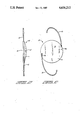
- FIG. 1 is a plan view of an exemplary intraocular lens assembly comprising a lens having an ultraviolet radiation absorbing capability provided in accordance with practice of this invention.
- FIG. 2 is a side view of the exemplary intraocular lens assembly of FIG. 1.
- FIGS. 1 and 2 there is shown a plan view (FIG. 1) and a side view (FIG. 2) of an intraocular lens assembly 10 for implantation into the human eye provided in accordance with practice of principles of this invention.
- the intraocular lens assembly 10 comprises one or more non-optical "haptic" components 12 connected to an optical component or lens 14.
- the haptic components are useful for supporting or attaching the lens to an aphakic eye.
- the lens 14 comprises an ultraviolet radiation absorbing co-polymer physically trapped within a polymer matrix for example, of polymethylmethacrylate.
- the ultraviolet radiation absorbing co-polymer is formed by co-polymerizing a polymerizable chromophoric compound for example, a polymerizable derivative of dihydroxybenzophenone, with a monomer suitable for making such lenses, for example, with methyl methacrylate.
- the resulting intraocular lens preferably has about the same capability for absorbing ultraviolet radiation as does the natural crystalline lens of the eye and is biocompatible with body tissue and fluids.
- the lens 14 of the assembly 10 is a "planoconvex lens", i.e., it has a convex surface 16 on one side and a flat or planar surface 18 on its other side, lenses having any desired design configuration can be provided.
- two haptics 12 are shown, fewer or more haptics can be used as desired and the haptics can have configurations other than the configuration of the haptics shown in the exemplary embodiment.
- the lens 14 preferably is formed in a series of steps which include co-polymerizing the selected polymerizable chromophoric compound with methyl methacrylate monomer to form an ultraviolet radiation absorbing co-polymer additive; dissolving the ultraviolet radiation absorbing co-polymer additive in methyl methacrylate monomer to form a prepolymer solution; curing the prepolymer solution; and finishing the lens as necessary from the cured prepolymer.
- Exemplary chromophoric compounds useful in practice of this invention are ethylenically unsaturated derivatives of dihydroxybenzophenone selected from the group consisting of: ##STR1## wherein X is an ethylenically unsaturated radical selected from the group consisting of acryloxy beta-hydroxypropyl and methacryloxy beta-hydroxypropyl radicals and wherein R represents a radical selected from the class consisting of hydrogen and hydroxy radicals.
- dihydroxybenzophenone derivatives useful in practice of this invention, there may include derivatives of 2,4-dihydroxybenzophenone such as 4-acryloxy beta-hydroxypropyl ether of 2,4-dihydroxybenzophenone; the 4-methacryloxy beta-hydroxypropyl ether of 2,4-dihydroxybenzophenone, i.e., 2-hydroxy-4-(2-hydroxy-3-methacrylyloxy)propoxybenzophenone; the 4-acryloxy beta-hydroxypropyl ether of 2,2',4-trihydroxybenzophenone; the 4-methacryloxy beta-hydroxypropyl ether of 2,2',4-trihydroxybenzophenone; the 4,4'-di(acryloxy beta-hydroxypropyl) ether of 2,2',4,4'-tetrahydroxybenzophenone; and the 4,4'-di(methacryloxy beta-hydroxypropyl) ether of 2,2',4,4'-tetrahydroxybenzophenone.
- 2,4-dihydroxybenzophenone
- chromophoric compounds may also be used such as allylic substituted benzophenones, i.e., 2-hydroxy-3-allyl-4,4' dimethoxybenzophenone, ethylenically or allylically substituted phenyl benzotriazoles, provided that they are capable of readily undergoing vinyl-type polymerization reactions and thus can form a co-polymer with methyl methacrylate monomer.
- allylic substituted benzophenones i.e., 2-hydroxy-3-allyl-4,4' dimethoxybenzophenone, ethylenically or allylically substituted phenyl benzotriazoles
- the chromophoric compound is a material sold by National Starch and Chemical Corporation, Resin Division, Bridgewater, N.J., under the trademark PERMASORB MA.
- PERMASORB MA is represented by National Starch to include 2-hydroxy-4-(2-hydroxy-3-methacrylyloxy)propoxybenzophenone, which has the following chemical structure: ##STR2##
- methyl methacrylate monomer and PERMASORB MA are dissolved in dry ethyl acetate to form a "monomer mix".
- An "initiator mix” is prepared by dissolving an initiator in dry ethyl acetate.
- initiators are benzoyl peroxide, tert-butyl hydro peroxide, cumene hydro peroxide, 2-azobisisobutyronitrile, and azoisobutylnitrile (AIBN) and the like.
- the monomer mix and initiator mix are mixed together in a reaction flask and heated to reflux at about 77° C. ⁇ 3° C. for a period of time to form the co-polymer of methyl methacrylate and PERMASORB MA co-polymer).
- the reaction mixture is then cooled and added to 5 to 6 times its volume of anhydrous methanol which causes the ultraviolet radiation absorbing PMMA/PERMASORB MA co-polynmer to precipitate as a solid polymer mass.
- the ultraviolet radiation absorbing solid polymer mass is comminuted, i.e., ground into a fine powder, and dried.
- the comminuted co-polymer is purified by "Soxhlet" extraction to remove remaining unreacted raw materials and solvents.
- the solid co-polymer is then vacuum dried and comminuted.
- the comminuted co-polymer (the ultraviolet radiation absorbing PMMA/PERMASORB MA co-polymer additive) is dissolved in methyl methacrylate monomer to form a prepolymer solution and the prepolymer solution is cured to form the ultraviolet radiation absorbing intraocular lens of this invention wherein the PMMA/PERMASORB MA co-polymer is trapped within the polymethylmethacrylate matrix of the lens.
- the prepolymer solution can be poured into a mold having a desired optical configuration.
- the mold after it is filled, is then placed into an autoclave and subjected to elevated temperature and pressure conditions for curing the lens.
- the mold After completion of the desired time-temperature/pressure cycle in the autoclave, the mold is removed therefrom and the lens blank is removed from the mold.
- the edges are then removed from the lens blank by machining and haptics are connected to the lens in appropriate holes formed in its edges. After the haptics are attached, the finished intraocular lens is inspected, sterilized, and packaged for shipment.
- the ratio of the weight of the chromophoric compound to the total weight of chromophoric compound plus methyl methacrylate monomer in the monomer mix is small enough so that the co-polymer formed, i.e., the co-polymer additive, is soluble in polymethylmethacrylate. This is important so that the finished intraocular lens has a desired optical clarity.
- the ratio of the weight of PERMASORB MA to the total weight of PERMASORB MA plus methyl methacrylate monomer in the monomer mix is such that, upon polymerization of the monomer mix, less than about 15 percent by weight of the PMMA/PERMASORB MA co-polymer additive formed comprises PERMASORB MA.
- the PMMA/PERMASORB MA co-polymer comprises less than about 15% by weight PERMASORB MA because it has been found that when such a co-polymer additive comprises a higher weight percentage of PERMASORB MA, the co-polymer is not soluble at any proportion in polymethylmethacrylate. Thus, lenses formed using PMMA/PERMASORB MA co-polymer additive comprising more than about 15% by weight PERMASORB MA tend to be cloudy or hazy.
- lenses formed using PMMA/PERMASORB MA co-polymer additives comprising 16.1 %, 22.5%, and 50% by weight PERMASORB MA all produced hazy lenses, while lenses formed of PMMA/PERMASORB MA co-polymer additive comprising 5.7%, 10%, and 12% were clear. Surprisingly, this appears to be the case regardless of the weight ratio of PMMA/PERMASORB MA co-polymer additive to MMA monomer used to form the PMMA/PERMASORB MA intraocular lens.
- the finished lens comprises from about four percent to about five percent by weight PERMASORB MA.
- an initiator mix was prepared by dissolving 1 gram of azoisobutylnitrile (AIBN) at room temperature in 25 grams of dry ethyl acetate.
- AIBN azoisobutylnitrile
- the co-polymer was then filtered and extracted in methanol with a Soxhlet extractor using a cellulose thimble. After methanol extraction, the co-polymer blob was placed in a blender with methanol and again a fine suspension of the co-polymer was formed. The suspension was filtered and, to remove any cellulose fibers from the co-polymer, the filtered co-polymer blob was placed in methylene chloride (CH 2 Cl 2 ) and dissolved. The methylene chloride/co-polymer solution was then filtered and the co-polymer was reprecipitated from the filtered solution in methanol. The co-polymer (the PMMA/PERMASORB MA co-polymer additive) was then dried and ground into a fine powder.
- methylene chloride CH 2 Cl 2
- the prepolymer solution about 30 percent by weight of the co-polymer powder (the PMMA/PERMASORB MA co-polymer additive) was placed into a reaction flask with about 70 percent by weight methyl methacrylate monomer. The monomer/co-polymer mixture was stirred for about 14 hours at room temperature to dissolve the powder. Benzoyl peroxide initiator was added (0.05% by weight based on the weight of methyl methacrylate monomer) and mixed into the prepolymer solution for about 30 minutes at room temperature. The prepolymer solution was then subjected to a vacuum process to remove any dissolved gases and air bubbles.
- the co-polymer powder the PMMA/PERMASORB MA co-polymer additive
- the degassed prepolymer solution was filtered through a 5 micron filter as it was being poured into a mold for curing.
- the mold was then placed into a casting chamber and subjected to conditions of temperature, pressure, and time for polymerizing or curing the prepolymer solution to form a solid polymeric ultraviolet radiation absorbing material comprising the ultraviolet radiation absorbing co-polymer additive physically trapped within a polymethylmethacrylate polymer matrix.
- An intraocular lens provided in accordance with this invention is finished from the ultraviolet radiation absorbing polymeric material by machining and other appropriate lens finishing operations.
- a device that is to be implanted in the body is biocompatible with body tissue and fluids, i.e., it does not produce adverse local or systemic responses or cause sensitization leading to an allergic response when implanted.
- FDA Food and Drug Administration
- the amount of MMA monomer that leaches from materials prepared in accordance with Example 1 was determined by measuring the amount of MMA monomer in such a material before and after a 24-hour saline extraction.
- UVI-EXPOSED Three cast sheets of test material were subjected to ethylene oxide sterilization. The three sample sheets were then divided into two parts each and labeled as follows: UVI-EXPOSED, UVI-UNEXPOSED, UVII-EXPOSED, UVII-UNEXPOSED, UVIII-EXPOSED, and UVIII-UNEXPOSED.
- % MMA monomer was measured by dissolving the entire piece of material in acetone and performing a gas chromatograph (GC) analysis for MMA monomer content.
- GC gas chromatograph
- the method used to perform the GC analysis was similar to Galin, M. A. et al; Methyl Methacrylate Monomer in Intraocular Lenses of PMMA; Arch. Opthalmol, Vol. 98, January 1980, pp 120-121. All other sample pieces were placed into separate glass containers filled with USP saline solution for extraction at 37 ⁇ 4° C.
- the amount of MMA monomer that leaches from materials prepared in accordance with Example 1 was determined by measuring the amount of MMA monomer in saline extract during a 21-day saline extraction.
- UVIA-EXPOSED Three cast sheets of test material were subjected to ethylene oxide sterilization. The three sample sheets of test material were then divided into two parts each and labeled as follows: UVIA-EXPOSED, UVIA-UNEXPOSED, UVIIA-EXPOSED, UVIIA-UNEXPOSED, UVIIIA-EXPOSED, and UVIIIA-UNEXPOSED.
- Each of the six labeled test material sample parts were then divided into smaller pieces for subsequent sampling.
- a representative piece of each sample part was removed for % MMA residual monomer analysis.
- % MMA monomer was measured by dissolving the entire piece of test material in acetone and performing GC analysis for MMA monomer content.
- All other sample pieces of test material were placed into separate glass containers filled with USP saline solution for extraction at 37 ⁇ 4° C. (similar to the environment within the natural eye).
- Representative extract samples were removed at various time periods throughout the 21-day extraction, i.e., days 4 through 7, days 12 and 13, and days 19 and 20, and subjected to GC analysis for determination of % extracted MMA monomer.
- the ratio of aqueous to acrylic was 30 to 1.
- test material The amount of PERMASORB MA that leaches from materials prepared in accordance with Example 1 (test material) was determined by subjecting such test materials to 20 days saline extraction and then measuring the before and after UV transmission of the extract.
- Example 3 The test of this Example was run in conjunction with Example 3 described above. However, subsequent to the initiation of the extraction time period, the following procedure was followed: Representative sample test material pieces and extract samples from each glass container were removed at various time periods throughout the 21-day extraction, i.e., days 4 through 7, days 12 and 13, and days 19 and 20. For each test material sample removed, its thickness and % UV transmission were measured. For each extract sample removed, a measurement of the % UV transmission was performed. The UV spectrophotometer is repeatable to ⁇ 1% providing a method that can reliably quantify 2.2 ppm PERMASORB MA. The sensitivity of the instrument is 0.7 ppm.
- Tables 3 through 8 contain the results of these studies (excluding the results of the HPLC determination).
- the PERMASORB MA was being extracted, increased absorption of the saline extract solutions would be anticipated.
- increased transmission of the test material samples would be anticipated.
- neither of these two observations occurred with any significance.
- the difference in % UV transmission can be attributed to the accuracy ( ⁇ 1%) of the UV spectrophotometer.
- test material Eight (8) samples of cast material prepared in accordance with Example 1 (test material) were used. Four of the eight (8) samples of test material were sterilized by ethylene oxide sterilization.
- test material samples were placed in a 10 ml vial and then dissolved in HPLC grade acetone for 24 hours at room temperature. All sample vials were sealed with a teflon septum. (Note: To accelerate solution, some samples were subjected to ultrasonification at 65° C. This was sometimes necessary due to the degree of cross-linking.)
- Example 1 To determine if photodegradation of material prepared in accordance with Example 1 (test material) could occur, such materials were subjected to high dosage ultraviolet radiation. The materials were subjected to two levels of exposure; the first level was equivalent to 7.8 years of normal eye exposure to UV radiation and the second level was equivalent to 14.5 years. The UV radiation exposed samples were evaluated for any increase in residual MMA monomer, changes in their UV transmission characteristics, and the extent, if any, of changes in PERMASORB MA and MMA leachability rates compared to non-UV exposed control material.
- the results of the 7.8 year and 14.5 year ultraviolet exposure tests showed no changes between the before and after exposed test material samples.
- the residual monomer in the samples both before and after exposure were the same; the ultraviolet transmission of the material before and after exposure to high dosages of UV radiation remained unchanged; and there was no difference in the monomer leachability, i.e., none detected, on the before and after exposure samples.
- the same results were found with regard to the PERMASORB MA leachability of the samples, i.e., none detected.
- Example 2-7 In addition to the analytical tests set forth in Examples 2-7, which indicated that leaching is not a problem, various in-vivo and in-vitro biological tests were conducted by an independent testing laboratory on materials prepared in accordance with Example 1 to confirm that such materials are biologically compatible with body tissue and fluids.
- mice Healthy, young, white mice ranging in body weight from 17 to 23 grams were injected either intraveneously or intraperitoneally with one of four different extracts (saline, alcohol/saline, polyethylene glycol 400, and cottonseed oil) of a material prepared in accordance with Example 1.
- the extracts were prepared at 121° C. for one hour. Two groups, each consisting of five mice, were used for each extract. One group was injected with the extract of the test material, while the other group was injected with a blank. After injection, the animals were observed immediately and at 4, 24, 48, and 72 hours. Initial and final body weights were recorded, as well as mortalities and/or reactions. If, during the observation period, none of the animals treated with the extract of the test material show a significantly greater reaction than the animals treated with the blank, the material meets the requirements of the test. The results of the tests are recorded in Table 11.
- extracts saline, alcohol/saline, polyethylene glycol 400, and cottonseed oil
- a microscopic evaluation of the implanted tissue was also conducted 7 days after implantation following routine staining of the tissues with Hematoxylin and Eosin. Tissue reactions were recorded for inflammation, chronic irritation, foreign body response, tissue scarring, and necrosis. The results of the microscopic evaluation are listed in Table 14.
- test material prepared in accordance with Example 1 is a non-irritant.
- Extracts of material prepared in accordance with Example 1 were injected into the anterior chamber of the eyes of a number of rabbits to determine the irritation or toxicity potential of the extracts.
- Rabbits were anesthetized by intramuscular injection of Acepromazine/Ketamine HCl combination (61 mg/ml) given at a dose of 0.75 ml/kg body weight. Following successful anesthesia, an ocular speculum (lid retractor) was put into place. The eye was steadied by gently grasping the palpebral conjunctiva with a pair of fine-toothed forceps. A 1 cc syringe containing test or control extract and attached to a 27 g needle was introduced into the anterior chamber of the eye. The needle was inserted about 0.5 cm into the anterior chamber at the corneal-scleral junction and parallel to the iris.
- a second syringe with 27 g needle was inserted at a remote point from the first. Approximately 0.2 ml of the aqueous fluid was evacuated immediately prior to injecting 0.2 ml of test or control extract via the first syringe. After the procedure, rabbits were returned to their cages and allowed to recover.
- Biomicroscope slit lamp examinations were conducted prior to treatment, at day one, day three, and termination (McDonald-Shaddock score system). Control animals were examined prior to treatment and at termination. Additionally, macroscopic observations of the eyes were conducted daily (Draize System); body weights were recorded prior to treatment and at termination; and on a representative number of eyes, tonometry readings (Schiotz tonometer) were taken before and after treatments.
- the rabbits were killed by injection of T-61 Euthanasia Drug.
- the eyes were quickly removed and placed in 10% neutral buffered formalin for possible histological processing.
- 0 Normal. May appear blanched to reddish pink without perilimbal injection (except at 12:00 and 6:00 o'clock positions) with vessels of the palpebral and bulbar conjunctiva easily observed (FIG. 2).
- +1 A flushed, reddish color predominately confined to the palpebral conjunctival with some perilimbal injection, but primarily confined to the lower and upper parts of the eye from the 4:00 and 7:00 and 11:00 to 1:00 o'clock positions.
- +2 Bright red color of the palpebral conjunctiva with accompanying perilimbal injection covering at least 75% of the circumference of the perilimbal region (FIG. 3).
- +3 Dark, beefy red color with congestion of both the bulbar and the palpebral conjunctiva along with pronounced perilimbal injection and the presence of petechia on the conjunctiva.
- the petechia generally predominates along the nictitating membrane and the upper palpebral conjunctiva.
- +3 Swelling definite with partial eversion of the upper and lower eyelids essentially equivalent. This can be easily ascertained by looking at the animal head-on and noticing the positioning of the eyelids; if the eye margins do not meet, eversion has occurred.
- Discharge is defined as a whitish, gray precipitate, which should not be confused with the small amount of clear, inspisated, mucoid material that can be formed in the medial canthus of a substantial number of rabbit eyes. This material can be removed with a cotton swab before the animals are used.
- +1 Discharge above normal and present on the inner portion of the eye, but not on the lids or hairs of the eyelids.
- the scoring scheme measures the severity of corneal cloudiness and the area of the cornea involved. Severity of corneal coloudiness is graded as follows.
- 0 Normal cornea. Appears with the slit lamp as having a bright gray line on the epithelial surface and a bright gray line on the endothelial surface with a marblelike gray appearance of the stroma.
- +2 Moderate loss of transparency.
- the cloudiness extends all the way to the endothelium.
- the stroma has lost its marblelike appearance and is homogeneously white. With diffuse illumination, underlying structures are clearly visible.
- +3 Involvement of the entire thickness of the stroma. With optical section, the endothelial surface is still visible. However, with diffuse illumination, the underlying structures are just barely visible (to the extent that the observer is still able to grade flare, ulceris, observe for pupillary response, and note lenticular changes).
- the surface area of the cornea relative to the area of cloudiness is divided into five grades from 0 to +4.
- 0 Normal cornea with no area of cloudiness.
- fluorescein is a valuable aid in defining epithelial damage.
- +1 Slight fluorescein staining confined to a small focus. With diffuse illumination, the underlying structures are easily visible. (The outline of the pupillary margin is as if there were no fluorescein staining.)
- +2 Moderate fluorescein staining confined to a small focus. With diffuse illumination, the underlying structures are clearly visible, although there is some loss of detail.
- +3 Marked fluorescein staining. Staining may involve a larger portion of the cornea. With diffuse illumination, underlying structures are barely visible, but are not completely obliterated.
- the intensity of the Tyndall phenomenon is scored by comparing the normal Tyndall effect observed when the slit-lamp beam passes through the lens with that seen in the anterior chamber.
- the presence of aqueous flare is presumptive evidence of breakdown of the blood-aqueous barrier.
- the primary, secondary, and tertiary vessels are utilized as an aid to determining a subjective ocular score for iris involvement.
- the assumption is made that the greater the hyperemia of the vessels and the more the secondary and tertiary vessels are involved, the greater the intensity of iris involvement.
- the scores range from 0 to +4.
- 0 Normal iris without any hyperemia of the iris vessels. Occasionally around the 12:00 to 1:00 o'clock position near the pupillary border and the 6:00 and 7:00 o'clock position near the pupillary border, there is a small area around 1-3 mm in diameter in which both the secondary and tertiary vessels are slightly hyperemic.
- +1 Minimal injection of secondary vessels, but not tertiary. Generally, it is uniform, but may be of greater intensity at the 1:00 or 6:00 o'clock position. If it is confined to the 1:00 or 6:00 o'clock position, the tertiary vessels must be substantially hyperemic.
- +2 Minimal injection of tertiary vessels and minimal to moderate injection of the secondary vessels.
- +3 Moderate injection of the secondary and tertiary vessels with slight swelling of the iris stroma (this gives the iris surface a slightly rugose appearance, which is usually most prominent near the 3:00 and 9:00 o'clock positions).
- +4 Marked injection of the secondary and tertiary vessels with marked swelling of the iris stroma.
- the iris appears rugose; may be accompanied by hemorrhage (hyphema) in the anterior chamber.
- Pannus is vascularization or the penetration of new blood vessels into the corneal stroma.
- the vessels are derived from the limbal vascular loops.
- Pannus is divided into three grades.
- +1 Vascularization is present, but vessels have not invaded the entire corneal circumference. Where localized vessel invasion has occurred, they have not penetrated beyond 2 mm.
- Iritis was the significant observation noted during the macroscopic observations. As the post-operative period progressed, the ulceris diminished. At seven (7) days, the gross appearance of the majority of the eyes was similar to the non-treated control group.
- Tonometry readings (Schiotz with standard 5.5 g wt) taken prior to and after treatment indicated that the removal and instillation of approximately equal volumes of fluid caused an immediate increase in intraocular pressure. There was some evidence that the ocular pressure had returned to normal by 7 days, but the influence of general anesthetics and/or euthanasia drug was not determined. The results of the tonometry readings are in Table 18.
- a monolayer of L-929 Mouse Fibroblast cells was grown to confluency and exposed to an extract of a test sample prepared by placing material prepared in accordance with Example 1 (test material) in 20 ml of Minimum Essential Medium (Eagle) and bovine serum (5%) and extracting at 37° C. for 24 hours. An MEM aliquot was used as a negative control. After exposure to the extract, the cells were examined microscopically for cytotoxic effect (CTE). Cytotoxicity was scored as either Non-Toxic (N), Intermediate (I), or Toxic (T).
- N Indicates a negative or non-toxic response
- I Indicates an intermediate response, a subjective assessment of the extent of cellular response
- T Indicates a positive or toxic response consisting of greater than 50% cell death.
- a monolayer of L-929 Mouse Fibroblast cells was grown to confluency and overlaid with Medium 199 supplemented with serum, antibiotics, neutral red, and agar.
- An intraocular lens comprising material prepared in accordance with Example 1 (test material) was placed on the solidified overlay surface. Following incubation for 24 hours, the culture was macroscopically examined for evidence of cell decolorization to determine the zone of cell lysis. Any decolorized zone present was examined microscopically to confirm cell lysis. The results are listed in Table 20.
- test material is non-toxic for L-929 cells under the above described test conditions.
- a monolayer of L-929 Mouse Fibroblast cells was grown to confluency and overlaid with Medium 199 supplemented with serum, antibiotics, neutral red, and agar.
- a 1 cm 2 sheet of material prepared in accordance with Example 1 (test material) was placed on the solidified overlay surface. Following incubation for 24 hours, the culture was macroscopically examined for evidence of cell decolorization to determine the zone of cell lysis. Any decolorized zone present was examined microscopically to confirm cell lysis. The results are listed in Table 21.
- test material is non-toxic for L-929 cells under the above described conditions.
- Example 2 90 square centimeters of material prepared in accordance with Example 1 (test material) was placed in 30 ml of sodium chloride solution (0.9%) and extracted at 121° C. for 1 hour. The extract was divided into two tubes of 10 ml each.
- optical density of each sample solution was determined spectrophotometrically at 545 m ⁇ . Similarly, optical densities were recorded for a positive control (10 ml water and 0.2 ml blood) and a negative control (10 ml Sodium Chloride and 0.2 ml blood). The results are listed in Table 22.
- test material is non-hemolytic under conditions of this test.
- test material was sterilized with ethylene oxide and cut into small chips or lengths (3 cm ⁇ 0.5 cm). 2 grams of the test material were placed in each of two extracting tubes containing 10 ml of sodium chloride solution (0.9%).
- optical density of each sample solution was determined spectrophotometrically at 545 m ⁇ . Similarly, optical densities were recorded for a positive control (10 ml water and 0.2 ml blood) and a negative control (10 ml Sodium Chloride and 0.2 ml blood). The results are listed in Table 23.
- test material is non-hemolytic under conditions of the test.
- An intraocular lens comprising prepared in accordance with Example 1 (test material) was cut in half. Each half was placed in a separate extracting tube containing 10 ml of sodium chloride solution (0.9%).
- optical density of each sample solution was determined spectrophotometrically at 545 m ⁇ . Similarly, optical densities were recorded for a positive control (10 ml water and 0.2 ml blood) and a negative control (10 ml Sodium Chloride and 0.2 ml blood). The results are listed in Table 24.
- test material is non-hemolytic under conditions of the test.
- Example 1 Material prepared in accordance with Example 1 (test material) was cut into small chips or lengths (3 cm ⁇ 0.5 cm) and two grams of the material was placed into each of two extracting tubes containing 10 ml of sodium chloride solution (0.9%).
- optical density of each sample solution was determined spectrophotometrically at 545 m ⁇ . Similarly, optical densities were recorded for a positive control (10 ml water and 0.2 ml blood) and a negative control (10 ml Sodium Chloride and 0.2 ml blood). The results are listed in Table 25.
- test material is non-hemolytic under conditions of the test.
- test material Materials prepared in accordance with Example 1 (test material) were tested for their ability to cause mutagenic response in bacterial tester stains with and without the presence of an enzomatic activation system. The results of the test are in Table 26.
- test material Nine sample weights of material prepared in accordance with Example 1 (test material) were extracted in distilled water in the following ratios: 4,000 mg/20 ml, 500 mg/20 ml, 100 mg/20 ml, 50 mg/20 ml, 4 mg/20 ml, 3 mg/20 ml, 2 mg/20 ml, 1 mg/20 ml, 1 mg/40 ml. Each sample was extracted at 121° C. for one hour.
- the cells were resuspended, centrifuged, and decanted twice again, then stored for 72 hours at 4° C. At the end of the incubation period, the tubes at 37° C. were washed in the same manner as the refrigerated tubes. All tubes were assayed for protein content using a phenol reagent and measuring the degree of color development with the aid of a spectrophotometer. The average Optical Density (O. D.) of each set of five replicate tubes was determined and the percent of inhibition of cell growth was calculated as follows: ##EQU1##
- the precision of the assay is approximately ⁇ 10%. That is, the range of values expected for a non-toxic biomaterial in the nine point percent ICG assay would fall between ⁇ 10% inhibition. All nine extracts fall within this range and, therefore, do not produce inhibition of cell growth.
- PMMA/PERMASORB MA co-polymer materials prepared in accordance with Example 1 were also tested for transmittance of radiation and were compared to: (1) a standard intraocular lens formed of PMMA; (2) a human lens (age 22 years); and (3) a human lens (age 53 years). The results are listed below in Table 28.
- the UV absorbing lens material prepared in accordance with Example 1 has a capability to absorb ultraviolet radiation that is similar to the ultraviolet absorbing capability of a natural human lens.
- a homopolymer of such a polymerizable chromophoric compound described above can also be formed, comminuted, and mixed with methyl methacrylate monomer, which is then polymerized to form the ultraviolet radiation absorbing lens of this invention.
- the molecular weight of the homopolymer must be sufficiently high to inhibit leaching. Leaching can also be inhibited or prevented by addition of cross-linking agents such as ethylene glycol dimethacrylate to the methyl methacrylate monomer/homopolymer mixture.
Landscapes
- Health & Medical Sciences (AREA)
- Public Health (AREA)
- Veterinary Medicine (AREA)
- Oral & Maxillofacial Surgery (AREA)
- Chemical & Material Sciences (AREA)
- Transplantation (AREA)
- General Health & Medical Sciences (AREA)
- Life Sciences & Earth Sciences (AREA)
- Animal Behavior & Ethology (AREA)
- Epidemiology (AREA)
- Dermatology (AREA)
- Medicinal Chemistry (AREA)
- Ophthalmology & Optometry (AREA)
- Chemical Kinetics & Catalysis (AREA)
- Cardiology (AREA)
- Engineering & Computer Science (AREA)
- Biomedical Technology (AREA)
- Heart & Thoracic Surgery (AREA)
- Vascular Medicine (AREA)
- Materials For Medical Uses (AREA)
Abstract
Description
              TABLE 1
______________________________________
Results
% MMA Residual Monomer
Sample            0 Hours  24 Hours
______________________________________
UVI-UNEXPOSED     0.61     0.55
UVI-EXPOSED       0.56     0.57
UVII-UNEXPOSED    0.62     0.53
UVII-EXPOSED      0.53     0.49
UVIII-UNEXPOSED   0.53     0.58
UVIII-EXPOSED     0.56     0.53
______________________________________
              TABLE 2
______________________________________
% RESIDUAL MMA MONOMER LEVELS IN TEST
MATERIAL SAMPLES PRIOR TO LEACHING
Sample Identification
                 % MMA Monomer
______________________________________
UVIA EXPOSED     .46%
UVIA UNEXPOSED   .42%
UVIIA EXPOSED    .45%
UVIIA UNEXPOSED  .47%
UVIIIA EXPOSED   .43%
UVIIIA UNEXPOSED .43%
______________________________________
              TABLE 3
______________________________________
RESIDUAL MMA MONOMER IN EXTRACT AND % UV
TRANSMISSION OF TEST MATERIAL SAMPLE
AND EXTRACT
TEST SAMPLE IDENTIFICATION: UVIA-EXPOSED
      % UV
      Trans-            % UV    % UV
      mission  Thick-   Trans-  Trans-  % MMA
      of Test  ness     mission mission Residual
      Material of Test  Normalized
                                of Extract
                                        in
Day   at 390 nm
               Material to .705 mm
                                at 350 nm
                                        Extract**
______________________________________
 0    6.0      .68      5.4      88.7*
 5    6.2      .679     5.6     90.0    ND
 6    5.6      .679     5.0     88.0    ND
12    5.3      .729     5.8     87.0    ND
13    5.1      .728     5.6     89.0    ND
19    5.7      .705     5.7     89.3    ND
20    5.0      .705     5.0     88.8    ND
______________________________________
 *88.7% is the UV transmission of saline solution at 350 nm.
 **Detection Limit: 60 ppm MMA monomer to aqueous.
              TABLE 4
______________________________________
RESIDUAL MMA MONOMER IN EXTRACT AND % UV
TRANSMISSION OF TEST MATERIAL SAMPLE
AND EXTRACT
TEST SAMPLE IDENTIFICATION: UVIA-UNEXPOSED
      % UV
      Trans-            % UV    % UV
      mission  Thick-   Trans-  Trans-  % MMA
      of Test  ness     mission mission Residual
      Material of Test  Normalized
                                of Extract
                                        in
Day   at 390 nm
               Material to .705 mm
                                at 350 nm
                                        Extract**
______________________________________
0     6.8      .670     5.9      88.7*
6     6.8      .670     5.9     85.2    ND
7     6.5      .680     5.9     83.5    ND
13    6.7      .669     5.8     88.8    ND
______________________________________
 *88.7% is the UV transmission of saline solution at 350 nm.
 **Detection Limit: 60 ppm MMA monomer to aqueous.
              TABLE 5
______________________________________
RESIDUAL MMA MONOMER IN EXTRACT AND % UV
TRANSMISSION OF TEST MATERIAL SAMPLE
AND EXTRACT
TEST SAMPLE IDENTIFICATION: UVIIA-EXPOSED
      % UV
      Trans-            % UV    % UV
      mission  Thick-   Trans-  Trans-  % MMA
      of Test  ness     mission mission Residual
      Material of Test  Normalized
                                of Extract
                                        in
Day   at 390 nm
               Material to .705 mm
                                at 350 nm
                                        Extract**
______________________________________
0     5.7      .68      5.1      88.7*
4     5.3      .718     5.6     88.8    ND
5     4.8      .722     5.2     90.0    ND
6     5.1      .722     5.5     88.7    ND
18    6.0      .695     5.7     89.7    ND
20    5.7      .695     5.5     90.2    ND
______________________________________
 *88.7% is the UV transmission of saline solution at 350 nm.
 **Detection Limit: 60 ppm MMA monomer to aqueous.
              TABLE 6
______________________________________
RESIDUAL MMA MONOMER IN EXTRACT AND % UV
TRANSMISSION OF TEST MATERIAL SAMPLE
AND EXTRACT
TEST SAMPLE IDENTIFICATION: UVIIA-UNEXPOSED
      % UV
      Trans-            % UV    % UV
      mission  Thick-   Trans-  Trans-  % MMA
      of Test  ness     mission mission Residual
      Material of Test  Normalized
                                of Extract
                                        in
Day   at 390 nm
               Material to .705 mm
                                at 350 nm
                                        Extract**
______________________________________
 0    5.7      .68      5.1      88.7*
12    6.4      .680     5.8     88.3    ND
13    5.6      .682     5.1     88.5    ND
19    5.8      .678     5.2     89.4    ND
20    6.4      .677     5.7     88.5    ND
______________________________________
 *88.7% is the UV transmission of saline solution at 350 nm.
 **Detection Limit: 60 ppm MMA monomer to aqueous.
              TABLE 7
______________________________________
RESIDUAL MMA MONOMER IN EXTRACT AND % UV
TRANSMISSION OF TEST MATERIAL SAMPLE
AND EXTRACT
TEST SAMPLE IDENTIFICATION: UVIIIA-EXPOSED
      % UV
      Trans-            % UV    % UV
      mission  Thick-   Trans-  Trans-  % MMA
      of Test  ness     mission mission Residual
      Material of Test  Normalized
                                of Extract
                                        in
Day   at 390 nm
               Material to .705 mm
                                at 350 nm
                                        Extract**
______________________________________
 0    6.4      .65      5.1      88.7*
 4    4.0      .750     4.8     88.5    ND
 5    4.0      .745     4.8     90.0    ND
12    5.0      .740     5.8     87.7    ND
13    5.0      .739     5.7     89.5    ND
18    5.5      .710     5.6     89.7    ND
20    5.3      .710     5.4     89.7    ND
______________________________________
 *88.7% is the UV transmission of saline solution at 350 nm.
 **Detection Limit: 60 ppm MMA monomer to aqueous.
              TABLE 8
______________________________________
RESIDUAL MMA MONOMER IN EXTRACT AND % UV
TRANSMISSION OF TEST MATERIAL SAMPLE
AND EXTRACT
TEST SAMPLE IDENTIFICATION: UVIIIA-UNEXPOSED
      % UV
      Trans-            % UV    % UV
      mission  Thick-   Trans-  Trans-  % MMA
      of Test  ness     mission mission Residual
      Material of Test  Normalized
                                of Extract
                                        in
Day   at 390 nm
               Material to .705 mm
                                at 350 nm
                                        Extract**
______________________________________
 6    5.0      .718     5.3      89.0*
12    4.9      .715     5.1     89.0    ND
14    4.9      .714     5.1     89.0    ND
19    5.5      .713     5.7     88.4    ND
20    4.9      .715     5.1     88.5    ND
______________________________________
 *88.7% is the UV transmission of saline solution at 350 nm.
 **Detection Limit: 60 ppm MMA monomer to aqueous.
              TABLE 9
______________________________________
Test Sample   PERMASORB MA (ppm)
______________________________________
1. (sterilized)
              7
2. (non-sterilized)
              ND
3. (non-sterilized)
              ND
4. (sterilized)
              ND
5. (non-sterilized)
              7
6. (non-sterilized)
              ND
7. (sterilized)
              8
8. (sterilized)
              9
______________________________________
              TABLE 10
______________________________________
Sample          AIBN, g/100 ml
______________________________________
XP-30-81-0041/0032
                <0.008
XP-30-81-0041/0045
                <0.008
XP-30-81-0041/0047
                <0.008
______________________________________
                                  TABLE 11
__________________________________________________________________________
            Mortality and Body Weight Data
            TEST MATERIAL     BLANK
Extract Dose
            Animal
                 Weight (gms)
                         # Dead/
                              Animal
                                   Weight (gms)
                                           # Dead/
and Route   Number
                 Day 0
                     Day 3
                         # Tested
                              Number
                                   Day 0
                                       Day 2
                                           # Tested
__________________________________________________________________________
Sodium Chloride
            1    22  23  0/5  1    21  21  0/5
Injection   2    20  23       2    21  25
(I.V.: 50 ml/Kg)
            3    22  22       3    22  24
            4    21  22       4    22  25
            5    19  23       5    20  24
Ethanol in Sodium
            1    19  21  0/5  1    19  23  0/5
Chloride Injection (1:20)
            2    17  21       2    19  23
(I.V.: 50 ml/Kg)
            3    19  23       3    22  24
            4    18  21       4    19  23
            5    19  21       5    19  21
Polyethylene Glycol 400
            1    19  20  0/5  1    18  21  0/5
(I.P.: 10 g/Kg)
            2    18  21       2    19  23
            3    21  25       3    20  24
            4    21  25       4    20  25
            5    19  21       5    19  22
Cottonseed Oil
            1    19  25  0/5  1    18  23  0/5
(I.P.: 50 ml/Kg)
            2    21  26       2    18  22
            3    22  25       3    21  25
            4    20  22       4    19  22
            5    19  21       5    21  26
__________________________________________________________________________
              TABLE 12
______________________________________
          Rab-
          bit  24 HR.    48 HR.    72 HR.
Extract         No.    ER   ED   ER   ED   ER   ED
______________________________________
Sodium  Test    7057   0    0    0    0    0    0
Chloride
        Blank          0    0    0    0    0    0
(SC)    Test    7058   0    0    0    0    0    0
        Blank          0    0    0    0    0    0
Alcohol in
        Test    7059   0    0    0    0    0    0
Sodium  Blank          0    0    0    0    0    0
Chloride
        Test    7060   0    0    0    0    0    0
1:20    Blank          0    0    0    0    0    0
(AS)
Poly-   Test    7061   0    0    0    0    0    0
ethylene
        Blank          0    0    0    0    0    0
Glycol  Test    7062   0    0    0    0    0    0
400     Blank          0    0    0    0    0    0
(PEG)
Cottonseed
        Test    7063   3    3    3    3    2    2
Oil     Blank          3    3    3    3    2    2
(CSO)   Test    7064   3    2    2    2    1    1
        Blank          3    2    2    2    1    1
______________________________________
.sup.--X Test -  .sup.--X Blank =
               Δ    Pass   Fail
______________________________________
SC 0 - 0 =     0          X
AS 0 - 0 =     0          X
PEG 0 - 0 =    0          X
CSO 2.3 - 2.3 =
               0          X
______________________________________
 Key
 ER = Erythema
 0 = None
 1 = Barely Perceptible
 2 = Well Defined
 3 = Moderate
 4 = Severe
 ED = Edema
 0 = None
 1 = Barely Perceptible
 2 = Well Defined
 3 = Raised 1 mm
 4 = Raised >1 mm
              TABLE 13
______________________________________
Results of Macroscopic Examination:
______________________________________
Scoring
Rabbit   Sample        Test   Control
______________________________________
6773     1             1      0
         2             1      0
         3             0      0
         4             0      0
         5             0      0
6789     1             0      0
         2             0      0
         3             0      0
         4             0      0
         5             0      0
         Mean (.sup.--X)
                       0.2    0.0
______________________________________
Scoring Key
Score            Capsule Formation
______________________________________
0                None Noted
1                Up to 0.5 mm
2                0.5 to 1.0 mm
3                1.0 to 2.0 mm
4                >2.0 mm
______________________________________
Reaction Index
X (Test) - X (Control) = 0.2
______________________________________
  0-0.5            Not Significant
0.6-1.0            Trace
1.1-2.0            Slight
2.1-3.0            Moderate
>3.1               Marked
______________________________________
                                  TABLE 14
__________________________________________________________________________
            Animal No:
            TEST      CONTROL       DIFFERENCE
OBSERVATION (0-4)
            6773
               6789   6773
                         6789       (Test # - Control)
__________________________________________________________________________
Inflammation
Polymorphonuclear
            0  0      0  0
Lymphocytes 1  1      1  1
Plasma Cells
            0  0      0  0
Macrophages 1  1      1  1
Giant Cells 0  0      0  0
Sub Total (× 2)
                   8            8 = 0
Fibroplasia 2  2      2  2
Fibrosis    1  1      1  1
Fatty infiltrate
            0  0      0  0
Necrosis    0  0      0  0
Sub Total          6            6 = 0
TOTAL          TEST:
                   14    CONTROL:
                                14 =
                                    0
Foreign Debris
            0  0      0  0
Number Sites Examined
            4  4      2  2
Results:
__________________________________________________________________________
 Score Guide (TestControl): 0 = Non irritant. 1-15 = Slight, 16-30 =
 Moderate. >30 = Severe for a two rabbit test.
______________________________________
        No.
Group   Rabbits    Right Eye    Left Eye
______________________________________
I       6          0.2 ml extract;
                                0.2 ml control
                   UV exposed   solution
II      6          0.2 ml extract;
                                0.2 ml control
                   not exposed  solution
III     3          No treatment No treatment
______________________________________
                                  TABLE 15
__________________________________________________________________________
SLIT LAMP EXAMINATION
       CONJUNCTIVA        CORNEA
       Conges-   Dis-
                     Aqueous              Floure-
Rabbit No.
       tion Swelling
                 charge
                     Flare
                          Iris
                              Pannus
                                  Opacity
                                       Area
                                          scein
__________________________________________________________________________
Lab No.   Interval:   Pre-treat
                         Examination By:
Group I
0558
    R  0    0    0   0    0   0   0    0  0
    L  0    0    0   0    0   0   0    0   1+
0803
    R  0    0    0   0    0   0   0    0  0
    L  0    0    0   0    0   0   0    0  0
0870
    R  0    0    0   0    0   0   0    0  0
    L  0    0    0   0    0   0   0    0  0
0871
    R  0    0    0   0    0   0   0    0  0
    L  0    0    0   0    0   0   0    0  0
0795
    R  0    0    0   0    0   0   0    0  0
    L  0    0    0   0    0   0   0    0  0
0868
    R  0    0    0   0    0   0   0    0   1+
    L  0    0    0   0    0   0   0    0  0
Group II
0817
    R  0    0    0   0    0   0   0    0  0
    L  0    0    0   0    0   0   0    0  0
0822
    R  0    0    0   0    0   0   0    0  0
    L  0    0    0   0    0   0   0    0  0
0806
    R  0    0    0   0    0   0   0    0  0
    L  0    0    0   0    0   0   0    0  0
0808
    R  0    0    0   0    0   0   0    0  0
    L  0    0    0   0    0   0   0    0   1+
0814
    R  0    0    0   0    0   0   0    0  0
    L  0    0    0   0    0   0   0    0  0
0824
    R  0    0    0   0    0   0   0    0   1+
    L  0    0    0   0    0   0   0    0  0
Group III
0809
    R  0    0    0   0    0   0   0    0  0
    L  0    0    0   0    0   0   0    0  0
0810
    R  0    0    0   0    0   0   0    0  0
    L  0    0    0   0    0   0   0    0   1+
0820
    R  0    0    0   0    0   0   0    0  0
    L  0    0    0   0    0   0   0    0  0
Lab No.   Interval:   Day 1
                         Examination By:
Group I - Exposed Material
0558
    R   1+  0    0   0     1+ 0   0    0
    L   2+  0    0   0     1+ 0   0    0
0803
    R   3+  0    0   0     2+ 0   0    0
    L   3+  0    0   0     2+ 0   0    0
0870
    R  0    0     2+ 0     1+ 0   0    0
    L   1+  0    0   0     1+ 0   0    0
0871
    R  0    0    0   0    0   0   0    0
    L  0    0    0   0    0   0   0    0
0795
    R   3+  0    0   0     1+ 0   0    0
    L  0    0    0   0     1+ 0   0    0
0868
    R    2+ 0     1+ 0     1+ 0   0    0
    L  0    0    0   0     1+ 0   0    0
Group II - Unexposed Material
0817
    R  0    0    0   0     1+ 0   0    0
    L   2+  0    0   0     1+ 0   0    0
0822
    R   2+  0    0   0     2+ 0   0    0
    L   2+  0    0   0     1+ 0   0    0
0806
    R   2+  0    0   0     2+ 0   0    0
    L   1+  0    0   0     1+ 0   0    0
0808
    R   3+  0    0   0     3+ 0   0    0
    L  0    0    0   0     1+ 0   0    0
0814
    R   2+  0    0   0     2+ 0   0    0
    L   1+  0    0   0    0   0   0    0
*0824
    R   4+  0    0   0     3+ 0   0    0
    L  0    0    0    1+   3+ 0   0    0
Lab No.   Interval:   Day 3
                         Examination By:
Group I - Exposed Material
0558
    R   2+  0    0    1+  0   0   0    0
    L   2+  0    0   0    0   0   0    0
0803
    R   2+  0    0   0     1+ 0   0    0
    L   1+  0    0   0     1+ 0   0    0
0870
    R   1+  0    0    1+  0   0   0    0
    L  0    0    0   0     1+ 0   0    0
0871
    R  0    0    0   0     1+ 0   0    0
    L   1+  0    0   0     1+ 0   0    0
0795
    R   1+  0    0    1+   1+ 0   0    0
    L   2+  0    0   0     1+ 0   0    0
0868
    R   1+  0    0   0     1+ 0   0    0
    L   1+  0    0   0    0   0   0    0
Group II - Unexposed Material
0817
    R   1+  0    0   0    0   0   0    0
    L   2+  0    0    1+  0   0   0    0
0822
    R   2+  0    0   0    0   0   0    0
    L   3+  0    0    2+  0   0   0    0
0806
    R   3+  0    0    1+   3+ 0   0    0
    L   3+  0    0    1+  0   0    1+  0
0808
    R   2+  0    0   0    0   0   0    0
    L   2+  0    0   0     1+ 0   0    0
0814
    R   2+  0    0   0     1+ 0   0    0
    L   2+  0    0   0    0   0   0    0
0824
    R   3+  0    0    1+   2+ 0   0    0
    L   4+  0    0    1+   3+ 0   0    0
Lab No.   Interval:  7-Day Terminal
                         Examination By:
Group I - Exposed Material
0558
    R  0    0    0   0    0   0   0    0  0
    L  0    0    0   0    0   0   0    0  0
0803
    R  0    0    0   0    0   0   0    0  0
    L   1+  0    0   0    0   0   0    0  0
0870
    R  0    0    0   0    0   0   0    0  0
    L  0    0    0   0    0    1+ 0    0  0
0871
    R  0    0    0   0    0   0   0    0  0
    L  0    0    0   0    0   0   0    0  0
0795
    R  0    0    0   0    0   0   0    0  0
    L  0    0    0   0    0   0   0    0  0
0868
    R  0    0    0   0    0   0   0    0  0
    L  0    0    0   0    0   0   0    0  0
Group II - Unexposed Material
0817
    R  0    0    0   0    0   0   0    0  0
    L   1+  0    0   0    0   0   0    0  0
0822
    R  0    0    0   0    0   0   0    0  0
    L  0    0    0   0    0   0   0    0  0
0806
    R  0    0    0   0    0   0   0    0  0
    L  0    0    0   0    0   0   0    0  0
0808
    R  0    0    0   0    0   0   0    0  0
    L  0    0    0   0    0   0   0    0  0
0814
    R  0    0    0   0    0   0   0    0  0
    L  0    0    0   0    0   0   0    0  0
0824
    R  0    0    0   0    0   0   0    0  0
    L  0    0    0   0    0   0   0    0  0
Group III - Negative Controls
0809
    R  0    0    0   0    0   0   0    0  0
    L  0    0    0   0    0   0   0    0   1+
0810
    R  0    0    0   0    0   0   0    0  0
    L  0    0    0   0    0   0   0    0  0
0820
    R  0    0    0   0    0   0   0    0  0
    L  0    0    0   0    0   0   0    0  0
__________________________________________________________________________
 R =  Right Eye
 L = Left Eye
 *Difficulties were encountered with the right eye at surgery which
 contributed to these findings.
              TABLE 16
______________________________________
ANTERIOR CHAMBER OBSERVATIONS
        Iris Ad-
        hered to
                Fibrinous
        Puncture
                Material
Group No. Day
Rabbit No.
          1     3     7   1   3   7   Other
______________________________________
I.   0558   R     --  X   --  --  --  --  Fold in corneal epithe-
            L     X   X   X   --  --  --  lium distorted pupil
                                          Day 3
     0803   R     X   X   --  --  X   --  Possible cataract start-
            L     X   X   X   --  --  X   ing in left eye
     0870   R     --  --  --  X   --  --  None
            L     X   X   X   --  --  --
     0871   R     --  X   X   --  --  --  Corneal irregularity
            L     --  X   --  --  --  --  day 3
     0795   R     X   X   --  X   --  --  None
            L     X   X   --  --  --  --
     0868   R     --  X   X   X   --  --  None
            L     X   X   X   --  --  --
II.  0817   R     X   X   --  --  --  --  Pupil distorted day 7
            L     X   X   --  --  --  --
     0822   R     X   X   --  X   --  --  None
            L     X   X   X   X   --  --
     0806   R     X   X   X   X   X   --  Possible cataract start-
            L     X   X   --  --  --  --  ing in right eye
     0808   R     X   X   --  X   --  --  None
            L     X   --  --  X   --  --
     0814   R     X   X   X   X   --  --  None
            L     --  X   --  --  X   --
     0824   R     --  X   X   X   X   X   Distorted Pupil
            L     X   X   X   X   X   X   Day 3, 7
______________________________________
 R = Right Eye (Test)
 L = Left Eye (Treated Control)
                                  TABLE 17
__________________________________________________________________________
MACROSCOPIC OBSERVATIONS
SUMMARY OF OCULAR SCORES
(Draize System)
                                     Test-Right
                                     Control-Left
                                     Lab No.
            Days:
            1     2     3     4   5   6  7
            T  C  T  C  T  C  T C T C T C T C
__________________________________________________________________________
Group I - (Exposed)
NO: 0558
Cornea (× 5)
            0  0  0  0  0  0  0 0 0 0 0 0 0 0
Iris Score (× 5)
            5  10 5  10 5  5  0 0 0 0 0 0 0 0
Conjunctiva Score (× 2)
            0  0  0  0  0  0  0 0 0 0 0 0 0 0
Total Score 5  10 5  10 5  5  0 0 0 0 0 0 0 0
NO: 0803
Cornea (× 5)
            0  0  0  0  0  0  0 0 0 0 0 0 0 0
Iris Score (× 5)
            10 10 10 10 10 5  5 5 5 5 0 0 0 0
Conjunctiva Score (× 2)
            0  0  0  0  0  0  0 0 0 0 0 0 0 0
Total Score 10 10 10 10 10 5  5 5 5 5 0 0 0 0
NO: 0870
Cornea (× 5)
            0  0  0  0  0  0  0 0 0 0 0 0 0 0
Iris Score (× 5)
            10 5  10 5  5  5  0 0 0 0 0 0 0 0
Conjunctiva Score (× 2)
            2  0  0  0  0  0  0 0 0 0 0 0 0 0
Total Score 12 5  10 5  5  5  0 0 0 0 0 0 0 0
NO: 0871
Cornea (× 5)
            0  0  0  0  0  0  0 0 0 0 0 0 0 0
Iris Score (× 5)
            0  0  0  0  0  0  0 0 0 0 0 0 0 0
Conjunctiva Score (× 2)
            0  0  0  0  0  0  0 0 0 0 0 0 0 0
Total Score 0  0  0  0  0  0  0 0 0 0 0 0 0 0
NO: 0795
Cornea (× 5)
            0  0  0  0  0  0  0 0 0 0 0 0 0 0
Iris Score (× 5)
            10 5  10 5  5  5  0 5 0 0 0 0 0 0
Conjunctiva Score (× 2)
            0  0  0  0  0  0  0 0 0 0 0 0 0 0
Total Score 10 5  10 5  5  5  0 5 0 0 0 0 0 0
NO: 0863
Cornea (× 5)
            0  0  0  0  0  0  0 0 0 0 0 0 0 0
Iris Score (× 5)
            5  5  5  5  5  5  0 0 0 0 0 0 0 0
Conjunctiva Score (× 2)
            0  0  0  0  0  0  0 0 0 0 0 0 0 0
Total Score 5  5  5  5  5  5  0 0 0 0 0 0 0 0
Group II - (Not Exposed)
NO: 0824
Cornea (× 5)
            0  0  0  0  0  0  0 0 0 0 0 0 0 0
Iris Score (× 5)
            10 10 10 10 5  10 5 5 5 5 5 5 0 0
Conjunctiva Score (× 2)
            0  0  0  0  0  0  0 0 0 0 0 0 0 0
Total Score 10 10 10 10 5  10 5 5 5 5 5 5 0 0
NO: 0817
Cornea (× 5)
            0  0  0  0  0  0  0 0 0 0 0 0 0 0
Iris Score (× 5)
            5  5  5  5  5  0  0 0 0 0 0 0 0 0
Conjunctiva Score (× 2)
            0  0  0  0  0  0  0 0 0 0 0 0 0 0
Total Score 5  5  5  5  5  0  0 0 0 0 0 0 0 0
NO: 0822
Cornea (× 5)
            0  0  0  0  0  0  0 0 0 0 0 0 0 0
Iris Score (× 5)
            0  0  0  0  0  0  0 0 0 0 0 0 0 0
Conjunctiva Score (× 2)
            0  0  0  0  0  0  0 0 0 0 0 0 0 0
Total Score 0  0  0  0  0  0  0 0 0 0 0 0 0 0
NO: 0806
Cornea (× 5)
            0  0  0  0  0  0  0 0 0 0 0 0 0 0
Iris Score (× 5)
            5  0  5  0  10 0  5 0 5 0 0 0 0 0
Conjunctiva Score (× 2)
            0  0  0  0  0  0  0 0 0 0 0 0 0 0
Total Score 5  0  5  0  10 0  5 0 5 0 0 0 0 0
NO: 0808
Cornea (× 5)
            0  0  0  0  0  0  0 0 0 0 0 0 0 0
Iris Score (× 5)
            10 5  10 5  5  5  0 0 0 0 0 0 0 0
Conjunctiva Score (× 2)
            0  0  0  0  0  0  0 0 0 0 0 0 0 0
Total Score 10 5  10 5  5  5  0 0 0 0 0 0 0 0
NO: 0814
Cornea (× 5)
            0  0  0  0  0  0  0 0 0 0 0 0 0 0
Iris Score (× 5)
            5  5  5  5  0  0  5 0 0 0 0 0 0 0
Conjunctiva Score (× 2)
            0  0  0  0  0  0  0 0 0 0 0 0 0 0
Total Score 5  5  5  5  0  0  5 0 0 0 0 0 0 0
Group III - Sham-Control
NO: 0809
Cornea (× 5)
            0  0  0  0  0  0  0 0 0 0 0 0 0 0
Iris Score (× 5)
            0  0  0  0  0  0  0 0 0 0 0 0 0 0
Conjunctiva Score (× 2)
            0  0  0  0  0  0  0 0 0 0 0 0 0 0
Total Score 0  0  0  0  0  0  0 0 0 0 0 0 0 0
NO: 0810
Cornea (× 5)
            0  0  0  0  0  0  0 0 0 0 0 0 0 0
Iris Score (× 5)
            0  0  0  0  0  0  0 0 0 0 0 0 0 0
Conjunctiva Score (× 2)
            0  0  0  0  0  0  0 0 0 0 0 0 0 0
Total Score 0  0  0  0  0  0  0 0 0 0 0 0 0 0
NO: 0820
Cornea (× 5)
            0  0  0  0  0  0  0 0 0 0 0 0 0 0
Iris Score (× 5)
            0  0  0  0  0  0  0 0 0 0 0 0 0 0
Conjunctiva Score (× 2)
            0  0  0  0  0  0  0 0 0 0 0 0 0 0
Total Score 0  0  0  0  0  0  0 0 0 0 0 0 0 0
__________________________________________________________________________
______________________________________
(1)  Cornea
(A)     Opacity-degree of density (area most dense
        taken for reading)
        No opacity                0
        Scattered or diffuse area, details
                                  1
        of iris clearly visible
        Easily discernible translucent areas,
                                  2
        details of iris slightly obscured
        Opalescent areas, no details of iris
                                  3
        visible, size of pupil barely
        discernible
        Opaque, iris invisible    4
(B)     Area of cornea involved
        One quarter (or less) but not zero
                                  1
        Greater than one quarter, but less
        than half
        Greater than half, but less than
                                  3
        three quarters
        Greater than three quarters, up to
                                  4
        a whole area
Score equals A × B × 5
                  Total maximum = 80
(2)  Iris
(A)     Values
        Normal                    0
        Folds above normal, congestion,
                                  1
        swelling, circumcorneal injection
        (any or all of these or combination
        of any thereof) iris still reacting
        to light (sluggish reactions are
        positive)
        No reaction to light, hemorrhage,
                                  2
        gross destruction (any or all
        of these)
Score equals A × 5
                  Total maximum = 10
(3)  Conjunctivae
(A)     Redness (refers to palpebral and bulbar
        conjunctivae excluding cornea and iris)
        Vessels normal            0
        Vessels definitely injected above
                                  1
        normal
        More diffuse, deeper crimson red,
                                  2
        individual vessels not easily
        discernible
        Diffuse beefy red         3
(B)     Chemosis
        No swelling               0
        Any swelling above normal (includes
                                  1
        nictitating membrane)
        Obvious swelling with partial
                                  2
        eversion of lids
        Swelling with lids about half closed
                                  3
        Swelling with lids half closed to
                                  4
        completely closed
(C)     Discharge
        No discharge              0
        Any amount different from normal
                                  1
        (does not include small amounts
        observed in inner canthus of
        normal animals)
        Discharge with moistening of the
                                  2
        lids and hairs adjacent to lids
        Discharge with moistening of the
                                  3
        lids and hairs and considerable
        area around the eye
Score equals A + B + C × 2
                  Total maximum = 20
______________________________________
 The maximum total score is the sum of all scores obtained for the cornea,
 iris, and conjunctivae. Total maximum score possible = 110.
              TABLE 18
______________________________________
           At Surgery
                    At Termination
Group Rabbit No. Pre    Post  Anesthetized
                                       Euthanized
______________________________________
I     0558   R       N.T. 20+   N.T.     12.0
             L       4.5  20+   N.T.     10.0
      0803   R       6.5  20+   N.T.      5.0
             L       5.0  20+   N.T.      3.0
      0870   R       6.5  20+   N.T.     11.0
             L       8.0  20+   N.T.     10.0
II    0817   R       6.0  20+   6.0      11.0
             L       N.T. 20+   4.5       6.0
      0822   R       7.0  20+   4.5      12.0
             L       N.T. 20+   4.5      14.0
      0808   R       5.5  20+   N.T.     N.T.
             L       6.0  20+   N.T.     N.T.
______________________________________
 N.T. = Not taken.
 R = Right eye.
 L = Left eye.
              TABLE 19
______________________________________
OBSERVATION PERIOD
         24 Hours  48 Hours 72 Hours
______________________________________
Test Material
           N           N        N
Control    N           N        N
______________________________________
 Comments:
 Positive control toxic at 24 hours.
              TABLE 20
______________________________________
               Score Zone of Lysis (mm)
______________________________________
Test Material    N       --
Negative Control (USP
                 N       --
Negative Control
Plastic)
Positive Control T       9
(Latex)
______________________________________
 N (Nontoxic) No change in cell morphology in proximity to test sample.
 T (Toxic) Death and/or degeneration of cells directly beneath the area of
 test sample and possibly also within a zone extended beyond the test
 sample. Where a zone of lysis was observed, the distance from the edge of
 the sample to the edge of the zone  measured and reported in millimeters
 (mm).
              TABLE 21
______________________________________
               Score Zone of Lysis (mm)
______________________________________
Test Material    N       --
Negative Control (USP
                 N       --
Negative Control
Plastic)
Positive Control (Latex)
                 T       8
______________________________________
 N (Nontoxic) No change in cell morphology in proximity to test sample.
 T (Toxic) Death and/or degeneration of cells directly beneath the area of
 test sample and possibly also within a zone extended beyond the test
 sample. Where a zone of lysis was observed, the distance from the edge of
 the sample to the edge of the zone was measured and reported in
 millimeters (mm).
              TABLE 22
______________________________________
Negative Control = 0
                 absorbance = 0% hemolysis.
Positive Control = 1.699
                 absorbance = 100% hemolysis.
Test #1 = 0      absorbance = 0% hemolysis.
Test #2 = 0      absorbance = 0% hemolysis.
______________________________________
 Mean Hemolysis 0%.
              TABLE 23
______________________________________
Negative Control = 0
                 absorbance = 0% hemolysis.
Positive Control = 1.699
                 absorbance = 100% hemolysis.
Test #1 = 0.009  absorbance = 0.5% hemolysis.
Test #2 = 0.004  absorbance = 0.2% hemolysis.
______________________________________
 Mean hemolysis 0.4%.
              TABLE 24
______________________________________
Negative Control = 0
                 absorbance = 0% hemolysis.
Positive Control = 1.699
                 absorbance = 100% hemolysis.
Test #1 = 0.004  absorbance = 0.2% hemolysis.
Test #2 = 0.009  absorbance = 0.5% hemolysis.
______________________________________
 Mean Hemolysis 0.4%.
              TABLE 25
______________________________________
Negative Control = 0
                 absorbance = 0% hemolysis.
Positive Control = 1.699
                 absorbance = 100% hemolysis.
Test #1 = 0      absorbance = 0% hemolysis.
Test #2 = 0      absorbance = 0% hemolysis.
______________________________________
 Mean Hemolysis 0%.
              TABLE 26
______________________________________
I. Spontaneous Mutation Rate
Strain       Revertants/Plate
______________________________________
TA 98        26
TA 100       198
TA 1537      11
______________________________________
II. Mutagen Test
                   Dose/
Strain Sample      Plate    S-9 Mix
                                   Evaluation
______________________________________
TA 98  Unknown     10    mm.sup.2
                              +      Non-mutagenic
TA 100 Unknown     10    mm.sup.2
                              +      Non-mutagenic
TA 1537
       Unknown     10    mm.sup.2
                              +      Non-mutagenic
TA 98  Unknown     10    mm.sup.2
                              -      Non-mutagenic
TA 100 Unknown     10    mm.sup.2
                              -      Non-mutagenic
TA 1537
       Unknown     10    mm.sup.2
                              -      Non-mutagenic
benzopyreneha.
       10          μg +    Mutagenic
benzopyreneha.
       10          μg +    Mutagenic
TA 1537
       α-benzopyrene
                   10    μg
                              +      Mutagenic
______________________________________
              TABLE 27
______________________________________
Extract        Percent of Cell Growth Inhibition
______________________________________
1.   4,000   mg/20 ml  0
2.   500     mg/20 ml  0
3.   100     mg/20 ml  0
4.   50      mg/20 ml  0
5.   4       mg/20 ml  0
6.   3       mg/20 ml  0
7.   2       mg/20 ml  0
8.   1       mg/20 ml  0
9.   1       mg/40 ml  0
______________________________________
              TABLE 28
______________________________________
TRANSMITTANCE OF ULTRAVIOLET LIGHT ABSORB-
ING INTRAOCULAR LENS MATERIAL PREPARED
ACCORDING TO EXAMPLE 1 WITH COMPARISONS
                  UV Absorbing
                  Lens Material
      Pure        Prepared    Human   Human
Wave- PMMA Lens   According to
                              Lens    Lens
length
      Material    Example 1   (22 yrs)
                                      (53 yrs)
(mm)  (1)         (2)         (3)     (4)
______________________________________
UV-A
320   88%         <1.0%       <1.0%   <1.0%
330   89%         <1.0%       <1.0%   <1.0%
340   89%         <1.0%       <1.0%   <1.0%
350   90%         <1.0%       <1.0%   <1.0%
360   91%         <1.0%       <1.0%   <1.0%
370   91%         <1.0%       <1.0%   <1.0%
380   91%         <1.0%       <1.0%   <1.0%
390   92%         1.5%        5.0%    <1.0%
395   92%         6.0%        10.0%    2.0%
400   92%         18.0%       15.0%    5.0%
Visual
450   92%         88.0%       85.0%   *
500   92%         92.0%       93.0%   *
550   92%         92.0%       95.0%   *
600   92%         92.0%       95.0%   *
650   92%         92.0%       95.0%   *
700   92%         92.0%       95.0%   *
______________________________________
 (1) Direct transmittance of PMMA sample 1.05 mm thick.
 (2) Direct transmittance of UV absorbing lens material .92 mm thick
 prepared according to the Example.
 (3) Direct transmittance of human lens 22 years.
 (4) Direct transmittance of human lens 53 years up to 400 nm; data not
 available over 400 nm.
Claims (6)
Priority Applications (2)
| Application Number | Priority Date | Filing Date | Title |
|---|---|---|---|
| US06/713,014 US4636212A (en) | 1982-05-10 | 1985-03-18 | Ultraviolet radiation absorbing intraocular lens |
| US06/948,328 US4753654A (en) | 1985-03-18 | 1986-12-31 | Ultraviolet radiation absorbing intraocular lens |
Applications Claiming Priority (2)
| Application Number | Priority Date | Filing Date | Title |
|---|---|---|---|
| US37666682A | 1982-05-10 | 1982-05-10 | |
| US06/713,014 US4636212A (en) | 1982-05-10 | 1985-03-18 | Ultraviolet radiation absorbing intraocular lens |
Related Parent Applications (1)
| Application Number | Title | Priority Date | Filing Date |
|---|---|---|---|
| US37666682A Continuation-In-Part | 1982-05-10 | 1982-05-10 |
Related Child Applications (1)
| Application Number | Title | Priority Date | Filing Date |
|---|---|---|---|
| US06/948,328 Continuation US4753654A (en) | 1985-03-18 | 1986-12-31 | Ultraviolet radiation absorbing intraocular lens |
Publications (1)
| Publication Number | Publication Date |
|---|---|
| US4636212A true US4636212A (en) | 1987-01-13 |
Family
ID=27007498
Family Applications (1)
| Application Number | Title | Priority Date | Filing Date |
|---|---|---|---|
| US06/713,014 Expired - Fee Related US4636212A (en) | 1982-05-10 | 1985-03-18 | Ultraviolet radiation absorbing intraocular lens |
Country Status (1)
| Country | Link |
|---|---|
| US (1) | US4636212A (en) |
Cited By (52)
| Publication number | Priority date | Publication date | Assignee | Title |
|---|---|---|---|---|
| US4740070A (en) * | 1984-06-05 | 1988-04-26 | Ppg Industries, Inc. | Optical filter |
| US4753654A (en) * | 1985-03-18 | 1988-06-28 | Optical Radiation Corporation | Ultraviolet radiation absorbing intraocular lens |
| US4765977A (en) * | 1986-11-28 | 1988-08-23 | Baron Neville A | Ophthalmic liquid sunglasses |
| US4788007A (en) * | 1986-11-28 | 1988-11-29 | Baron Neville A | Ophthalmic U.V. absorptive emollient |
| WO1988009663A1 (en) * | 1987-06-09 | 1988-12-15 | Mdr Group, Inc. | Viscoelastic vitreous substitute with uv blocker |
| US4795461A (en) * | 1985-07-19 | 1989-01-03 | Pharmacia Ab | UV absorbing lens material |
| US4861840A (en) * | 1986-12-03 | 1989-08-29 | Barnes-Hind, Inc. | Novel siloxanyl acrylic monomer and gas-permeable contact lenses made therefrom |
| US4863463A (en) * | 1987-12-21 | 1989-09-05 | Tjan Tik T | Artificial intra-ocular lens for implantation in the capsular bag |
| US4863466A (en) * | 1986-04-01 | 1989-09-05 | Schlegel Hans Joachim | Intra-ocular implant lens |
| US4872877A (en) * | 1987-03-17 | 1989-10-10 | Dennis T. Grendahl | Intraocular lens with ultraviolet screening agent |
| US4872878A (en) * | 1987-03-17 | 1989-10-10 | Dennis T. Grendahl | Optical brigthener in an intraocular lens |
| EP0359829A4 (en) * | 1988-03-03 | 1991-01-16 | Hoya Corporation | Process for producing intraocular lens for correcting cyanopia |
| US5008102A (en) * | 1986-02-26 | 1991-04-16 | York Kenneth K | Biocompatible intraocular light-screening compositions and methods of intraocular light screening |
| US5037435A (en) * | 1990-03-02 | 1991-08-06 | Optical Radiation Corporation | Haptics for intraocular lenses having high fracture toughness |
| US5089180A (en) * | 1989-08-31 | 1992-02-18 | Iolab Corporation | Method of preparing composite single-piece intraocular lenses with colored haptics |
| EP0589809A1 (en) * | 1992-09-04 | 1994-03-30 | Laboratoires Domilens S.A. | Intra-ocular implant for spectral restoration or correction |
| US5364256A (en) | 1986-01-28 | 1994-11-15 | Ophthalmic Research Group International, Inc. | Apparatus for the production of plastic lenses |
| US5415816A (en) | 1986-01-28 | 1995-05-16 | Q2100, Inc. | Method for the production of plastic lenses |
| US5480927A (en) * | 1994-05-20 | 1996-01-02 | Ciba Geigy Corporation | Method of increasing the concentration of radiation-absorbing agents in optical and ophthalmic lenses |
| US5514214A (en) | 1993-09-20 | 1996-05-07 | Q2100, Inc. | Eyeglass lens and mold spin coater |
| US5529728A (en) | 1986-01-28 | 1996-06-25 | Q2100, Inc. | Process for lens curing and coating |
| US5562734A (en) * | 1995-05-31 | 1996-10-08 | Zimmer, Inc. | Method for reducing gamma radiation sterilization induced discoloration |
| US5683456A (en) * | 1988-10-26 | 1997-11-04 | Pharmacia, Inc. | Fabrication of an intraocular lens |
| WO1997041806A1 (en) * | 1996-05-09 | 1997-11-13 | Prism Ophthalmics | Prismatic intraocular lenses and related methods of using such lenses to restore vision in patients with central field loss |
| US5928575A (en) | 1996-04-19 | 1999-07-27 | Q2100, Inc. | Methods for eyeglass lens curing using ultraviolet light |
| US5968094A (en) * | 1995-09-18 | 1999-10-19 | Emmetropia, Inc. | Compound intraocular lens |
| US6201037B1 (en) | 1986-01-28 | 2001-03-13 | Ophthalmic Research Group International, Inc. | Plastic lens composition and method for the production thereof |
| US6244707B1 (en) | 1998-07-21 | 2001-06-12 | Wesley Jessen Corporation | UV blocking lenses and material containing benzotriazoles and benzophenones |
| US6280171B1 (en) | 1996-06-14 | 2001-08-28 | Q2100, Inc. | El apparatus for eyeglass lens curing using ultraviolet light |
| US6441119B1 (en) | 1999-09-20 | 2002-08-27 | Hoya Corporation | Optical materials having good ultraviolet absorbability and method for producing them |
| US6448304B1 (en) | 1999-09-20 | 2002-09-10 | Hoya Corporation | Optical materials having good ultraviolet absorbability and method for producing them |
| WO2004029675A1 (en) * | 2002-09-25 | 2004-04-08 | Medennium, Inc. | Method of manufacturing ophthalmic lenses made from hydrophobic acrylic polymers |
| US6730244B1 (en) | 1986-01-28 | 2004-05-04 | Q2100, Inc. | Plastic lens and method for the production thereof |
| US20050033420A1 (en) * | 2003-05-28 | 2005-02-10 | Bruce A. Christie | Mask configured to maintain nutrient transport without producing visible diffraction patterns |
| US20050143812A1 (en) * | 2003-12-29 | 2005-06-30 | Paul Marlene L. | Intraocular lenses having a visible light-selective-transmissive-region |
| US20060122349A1 (en) * | 2004-12-07 | 2006-06-08 | Key Medical Technologies, Inc. | Nanohybrid polymers for ophthalmic applications |
| US20060203192A1 (en) * | 1999-03-01 | 2006-09-14 | David Miller | System and method for increasing the depth of focus of the human eye |
| US20060235514A1 (en) * | 2005-04-14 | 2006-10-19 | Silvestrini Thomas A | Corneal optic formed of degradation resistant polymer |
| US20060271027A1 (en) * | 2003-06-17 | 2006-11-30 | Thomas Silvestrini | Method and apparatus for aligning a mask with the visual axis of an eye |
| US7354980B1 (en) | 2004-03-12 | 2008-04-08 | Key Medical Technologies, Inc. | High refractive index polymers for ophthalmic applications |
| US20080182957A1 (en) * | 2004-11-22 | 2008-07-31 | Jason Clay Pearson | Copolymerizable azo compounds and articles containing them |
| US20080215147A1 (en) * | 2007-01-29 | 2008-09-04 | Werblin Research & Development Corp. | Intraocular lens system |
| US20090076235A1 (en) * | 2004-11-22 | 2009-03-19 | Jason Clay Pearson | Copolymerizable methine and anthraquinone compounds and articles containing them |
| US20100085534A1 (en) * | 2004-04-30 | 2010-04-08 | Abbott Medical Optics Inc. | Ophthalmic devices having a highly selective violet light transmissive filter and related methods |
| US20110040378A1 (en) * | 2007-01-29 | 2011-02-17 | Werblin Research & Development Corp. | Intraocular lens system |
| US20110040376A1 (en) * | 2009-08-13 | 2011-02-17 | Acufocus, Inc. | Masked intraocular implants and lenses |
| US8066768B2 (en) | 2007-01-29 | 2011-11-29 | Werblin Research & Development Corp. | Intraocular lens system |
| US8066769B2 (en) | 2007-01-29 | 2011-11-29 | Werblin Research & Development Corp. | Intraocular lens system |
| USD656526S1 (en) | 2009-11-10 | 2012-03-27 | Acufocus, Inc. | Ocular mask |
| US9204962B2 (en) | 2013-03-13 | 2015-12-08 | Acufocus, Inc. | In situ adjustable optical mask |
| US9427922B2 (en) | 2013-03-14 | 2016-08-30 | Acufocus, Inc. | Process for manufacturing an intraocular lens with an embedded mask |
| US9545303B2 (en) | 2011-12-02 | 2017-01-17 | Acufocus, Inc. | Ocular mask having selective spectral transmission |
Citations (2)
| Publication number | Priority date | Publication date | Assignee | Title |
|---|---|---|---|---|
| US3162676A (en) * | 1962-06-18 | 1964-12-22 | Nat Starch Chem Corp | Ethylenically unsaturated derivatives of 2, 4-dihydroxybenzophenone |
| US4390676A (en) * | 1976-11-15 | 1983-06-28 | Schering Corporation | Ultraviolet absorbing lenses |
-
1985
- 1985-03-18 US US06/713,014 patent/US4636212A/en not_active Expired - Fee Related
Patent Citations (3)
| Publication number | Priority date | Publication date | Assignee | Title |
|---|---|---|---|---|
| US3162676A (en) * | 1962-06-18 | 1964-12-22 | Nat Starch Chem Corp | Ethylenically unsaturated derivatives of 2, 4-dihydroxybenzophenone |
| US3173893A (en) * | 1962-06-18 | 1965-03-16 | Nat Starch Chem Corp | Polymeric compositions resistant to ultra-violet light containing benzophenone derivatives |
| US4390676A (en) * | 1976-11-15 | 1983-06-28 | Schering Corporation | Ultraviolet absorbing lenses |
Cited By (122)
| Publication number | Priority date | Publication date | Assignee | Title |
|---|---|---|---|---|
| US4740070A (en) * | 1984-06-05 | 1988-04-26 | Ppg Industries, Inc. | Optical filter |
| US4753654A (en) * | 1985-03-18 | 1988-06-28 | Optical Radiation Corporation | Ultraviolet radiation absorbing intraocular lens |
| US4795461A (en) * | 1985-07-19 | 1989-01-03 | Pharmacia Ab | UV absorbing lens material |
| US6201037B1 (en) | 1986-01-28 | 2001-03-13 | Ophthalmic Research Group International, Inc. | Plastic lens composition and method for the production thereof |
| US6206673B1 (en) | 1986-01-28 | 2001-03-27 | Ophthalmic Research Group International, Inc. | Plastic lens and plastic lens manufacturing system |
| US6730244B1 (en) | 1986-01-28 | 2004-05-04 | Q2100, Inc. | Plastic lens and method for the production thereof |
| US6331058B1 (en) | 1986-01-28 | 2001-12-18 | Ophthalmic Research Group International, Inc. | Plastic lens composition and method for the production thereof |
| US5364256A (en) | 1986-01-28 | 1994-11-15 | Ophthalmic Research Group International, Inc. | Apparatus for the production of plastic lenses |
| US5529728A (en) | 1986-01-28 | 1996-06-25 | Q2100, Inc. | Process for lens curing and coating |
| US6494702B1 (en) | 1986-01-28 | 2002-12-17 | Q2100, Inc. | Apparatus for the production of plastic lenses |
| US5415816A (en) | 1986-01-28 | 1995-05-16 | Q2100, Inc. | Method for the production of plastic lenses |
| US5516468A (en) | 1986-01-28 | 1996-05-14 | Q2100, Inc. | Method for the production of plastic lenses |
| US5008102A (en) * | 1986-02-26 | 1991-04-16 | York Kenneth K | Biocompatible intraocular light-screening compositions and methods of intraocular light screening |
| US4863466A (en) * | 1986-04-01 | 1989-09-05 | Schlegel Hans Joachim | Intra-ocular implant lens |
| US5041244A (en) * | 1986-11-28 | 1991-08-20 | Liquid Sunglasses Corporation | Ophthalmic liquid sunglasses |
| US4788007A (en) * | 1986-11-28 | 1988-11-29 | Baron Neville A | Ophthalmic U.V. absorptive emollient |
| US4765977A (en) * | 1986-11-28 | 1988-08-23 | Baron Neville A | Ophthalmic liquid sunglasses |
| US4861840A (en) * | 1986-12-03 | 1989-08-29 | Barnes-Hind, Inc. | Novel siloxanyl acrylic monomer and gas-permeable contact lenses made therefrom |
| US4872878A (en) * | 1987-03-17 | 1989-10-10 | Dennis T. Grendahl | Optical brigthener in an intraocular lens |
| US4872877A (en) * | 1987-03-17 | 1989-10-10 | Dennis T. Grendahl | Intraocular lens with ultraviolet screening agent |
| US4853374A (en) * | 1987-06-09 | 1989-08-01 | M.D.R. Group, Inc. | Viscoelastic vitreous substitute with UV blocker |
| WO1988009663A1 (en) * | 1987-06-09 | 1988-12-15 | Mdr Group, Inc. | Viscoelastic vitreous substitute with uv blocker |
| US4863463A (en) * | 1987-12-21 | 1989-09-05 | Tjan Tik T | Artificial intra-ocular lens for implantation in the capsular bag |
| EP0359829A4 (en) * | 1988-03-03 | 1991-01-16 | Hoya Corporation | Process for producing intraocular lens for correcting cyanopia |
| US5683456A (en) * | 1988-10-26 | 1997-11-04 | Pharmacia, Inc. | Fabrication of an intraocular lens |
| US5089180A (en) * | 1989-08-31 | 1992-02-18 | Iolab Corporation | Method of preparing composite single-piece intraocular lenses with colored haptics |
| US5037435A (en) * | 1990-03-02 | 1991-08-06 | Optical Radiation Corporation | Haptics for intraocular lenses having high fracture toughness |
| EP0589809A1 (en) * | 1992-09-04 | 1994-03-30 | Laboratoires Domilens S.A. | Intra-ocular implant for spectral restoration or correction |
| FR2696937A1 (en) * | 1992-09-04 | 1994-04-22 | Dalloz Sa Christian | Intraocular implant for restoration or spectral correction. |
| US5514214A (en) | 1993-09-20 | 1996-05-07 | Q2100, Inc. | Eyeglass lens and mold spin coater |
| US5480927A (en) * | 1994-05-20 | 1996-01-02 | Ciba Geigy Corporation | Method of increasing the concentration of radiation-absorbing agents in optical and ophthalmic lenses |
| US5562734A (en) * | 1995-05-31 | 1996-10-08 | Zimmer, Inc. | Method for reducing gamma radiation sterilization induced discoloration |
| US5968094A (en) * | 1995-09-18 | 1999-10-19 | Emmetropia, Inc. | Compound intraocular lens |
| US6171528B1 (en) | 1996-04-19 | 2001-01-09 | Q2100, Inc. | Methods and apparatus for eyeglass lens curing using ultraviolet light |
| US6200124B1 (en) | 1996-04-19 | 2001-03-13 | Q1200 | Apparatus for eyeglass lens curing using ultraviolet light |
| US6174465B1 (en) | 1996-04-19 | 2001-01-16 | Q2100, Inc. | Methods for eyeglass lens curing using ultaviolet light |
| US6241505B1 (en) | 1996-04-19 | 2001-06-05 | Q2100, Inc. | Apparatus for eyeglass lens curing using ultraviolet light |
| US6328445B1 (en) | 1996-04-19 | 2001-12-11 | Q2100, Inc. | Methods and apparatus for eyeglass lens curing using ultraviolet light |
| US6022498A (en) | 1996-04-19 | 2000-02-08 | Q2100, Inc. | Methods for eyeglass lens curing using ultraviolet light |
| US5928575A (en) | 1996-04-19 | 1999-07-27 | Q2100, Inc. | Methods for eyeglass lens curing using ultraviolet light |
| US5976423A (en) | 1996-04-19 | 1999-11-02 | Q2100, Inc. | Methods and apparatus for eyeglass lens curing using ultraviolet light |
| WO1997041806A1 (en) * | 1996-05-09 | 1997-11-13 | Prism Ophthalmics | Prismatic intraocular lenses and related methods of using such lenses to restore vision in patients with central field loss |
| US6280171B1 (en) | 1996-06-14 | 2001-08-28 | Q2100, Inc. | El apparatus for eyeglass lens curing using ultraviolet light |
| US6244707B1 (en) | 1998-07-21 | 2001-06-12 | Wesley Jessen Corporation | UV blocking lenses and material containing benzotriazoles and benzophenones |
| US8343215B2 (en) | 1999-03-01 | 2013-01-01 | Acufocus, Inc. | System and method for increasing the depth of focus of the human eye |
| US8752958B2 (en) | 1999-03-01 | 2014-06-17 | Boston Innovative Optics, Inc. | System and method for increasing the depth of focus of the human eye |
| US7404637B2 (en) | 1999-03-01 | 2008-07-29 | Boston Innovative Optics, Inc. | System and method for increasing the depth of focus of the human eye |
| US20090059168A1 (en) * | 1999-03-01 | 2009-03-05 | Boston Innovative Optics, Inc. | System and method for increasing the depth focus of the human eye |
| US7404638B2 (en) | 1999-03-01 | 2008-07-29 | Boston Innovative Optics, Inc. | System and method for increasing the depth of focus of the human eye |
| US20060203192A1 (en) * | 1999-03-01 | 2006-09-14 | David Miller | System and method for increasing the depth of focus of the human eye |
| US6448304B1 (en) | 1999-09-20 | 2002-09-10 | Hoya Corporation | Optical materials having good ultraviolet absorbability and method for producing them |
| US20040141230A1 (en) * | 1999-09-20 | 2004-07-22 | Masahisa Kosaka | Optical materials having good ultraviolet absorbability and method for producing them |
| US7009025B2 (en) | 1999-09-20 | 2006-03-07 | Hoya Corporation | Optical materials having good ultraviolet absorbability and method for producing them |
| US6441119B1 (en) | 1999-09-20 | 2002-08-27 | Hoya Corporation | Optical materials having good ultraviolet absorbability and method for producing them |
| US6673888B2 (en) | 1999-09-20 | 2004-01-06 | Hoya Corporation | Optical materials having good ultraviolet absorbability and method for producing them |
| WO2004029675A1 (en) * | 2002-09-25 | 2004-04-08 | Medennium, Inc. | Method of manufacturing ophthalmic lenses made from hydrophobic acrylic polymers |
| US20060271180A1 (en) * | 2003-05-28 | 2006-11-30 | Christie Bruce A | Mask configured to maintain nutrient transport without producing visible diffraction patterns |
| US20060271182A1 (en) * | 2003-05-28 | 2006-11-30 | Christie Bruce A | Mask configured to maintain nutrient transport without producing visible diffraction patterns |
| US20060271179A1 (en) * | 2003-05-28 | 2006-11-30 | Christie Bruce A | Mask configured to maintain nutrient transport without producing visible diffraction patterns |
| US8858624B2 (en) | 2003-05-28 | 2014-10-14 | Acufocus, Inc. | Method for increasing the depth of focus of a patient |
| US20060079959A1 (en) * | 2003-05-28 | 2006-04-13 | Christie Bruce A | Mask configured to maintain nutrient transport without producing visible diffraction patterns |
| US20060079960A1 (en) * | 2003-05-28 | 2006-04-13 | Christie Bruce A | Mask configured to maintain nutrient transport without producing visible diffraction patterns |
| US20060271181A1 (en) * | 2003-05-28 | 2006-11-30 | Christie Bruce A | Mask configured to maintain nutrient transport without producing visible diffraction patterns |
| US20060268228A1 (en) * | 2003-05-28 | 2006-11-30 | Christie Bruce A | Mask configured to maintain nutrient transport without producing visible diffraction patterns |
| US20060271183A1 (en) * | 2003-05-28 | 2006-11-30 | Christie Bruce A | Mask configured to maintain nutrient transport without producing visible diffraction patterns |
| US8460374B2 (en) | 2003-05-28 | 2013-06-11 | Acufocus, Inc. | Mask configured to maintain nutrient transport without producing visible diffraction patterns |
| US20060271177A1 (en) * | 2003-05-28 | 2006-11-30 | Christie Bruce A | Mask configured to maintain nutrient transport without producing visible diffraction patterns |
| US20060268227A1 (en) * | 2003-05-28 | 2006-11-30 | Christie Bruce A | Mask configured to maintain nutrient transport without producing visible diffraction patterns |
| US20060271176A1 (en) * | 2003-05-28 | 2006-11-30 | Christie Bruce A | Mask configured to maintain nutrient transport without producing visible diffraction patterns |
| US20060274265A1 (en) * | 2003-05-28 | 2006-12-07 | Christie Bruce A | Mask configured to maintain nutrient transport without producing visible diffraction patterns |
| US7628810B2 (en) | 2003-05-28 | 2009-12-08 | Acufocus, Inc. | Mask configured to maintain nutrient transport without producing visible diffraction patterns |
| US9138142B2 (en) | 2003-05-28 | 2015-09-22 | Acufocus, Inc. | Masked intraocular devices |
| US20050033420A1 (en) * | 2003-05-28 | 2005-02-10 | Bruce A. Christie | Mask configured to maintain nutrient transport without producing visible diffraction patterns |
| US20060271027A1 (en) * | 2003-06-17 | 2006-11-30 | Thomas Silvestrini | Method and apparatus for aligning a mask with the visual axis of an eye |
| US20060271026A1 (en) * | 2003-06-17 | 2006-11-30 | Silvestrini Thomas A | Method and apparatus for aligning a mask with the visual axis of an eye |
| US8079706B2 (en) | 2003-06-17 | 2011-12-20 | Acufocus, Inc. | Method and apparatus for aligning a mask with the visual axis of an eye |
| US20070225691A1 (en) * | 2003-06-17 | 2007-09-27 | Silvestrini Thomas A | Method and apparatus for aligning a mask with the visual axis of an eye |
| US8864824B2 (en) | 2003-06-17 | 2014-10-21 | Acufocus, Inc. | Method and apparatus for aligning a mask with the visual axis of an eye |
| US8388681B2 (en) | 2003-12-29 | 2013-03-05 | Abbott Medical Optics Inc. | Intraocular lenses having a visible light-selective-transmissive-region |
| US8043371B2 (en) | 2003-12-29 | 2011-10-25 | Abbott Medical Optics Inc. | Intraocular lenses having a visible light-selective-transmissive-region |
| US20050143812A1 (en) * | 2003-12-29 | 2005-06-30 | Paul Marlene L. | Intraocular lenses having a visible light-selective-transmissive-region |
| US7354980B1 (en) | 2004-03-12 | 2008-04-08 | Key Medical Technologies, Inc. | High refractive index polymers for ophthalmic applications |
| US20100085534A1 (en) * | 2004-04-30 | 2010-04-08 | Abbott Medical Optics Inc. | Ophthalmic devices having a highly selective violet light transmissive filter and related methods |
| US8292428B2 (en) | 2004-04-30 | 2012-10-23 | Abbott Medical Optics Inc. | Ophthalmic devices having a highly selective violet light transmissive filter and related methods |
| US8047650B2 (en) | 2004-04-30 | 2011-11-01 | Abbott Medical Optics Inc. | Ophthalmic devices having a highly selective violet light transmissive filter and related methods |
| US8501890B2 (en) | 2004-11-22 | 2013-08-06 | Abbott Medical Optics Inc. | Copolymerizable methine and anthraquinone compounds and articles containing them |
| US8785627B2 (en) | 2004-11-22 | 2014-07-22 | Abbott Medical Optics Inc. | Copolymerizable methine and anthraquinone compounds and articles containing them |
| US8360576B2 (en) | 2004-11-22 | 2013-01-29 | Abbott Medical Optics Inc. | Copolymerizable methine and anthraquinone compounds and articles containing them |
| US20080182957A1 (en) * | 2004-11-22 | 2008-07-31 | Jason Clay Pearson | Copolymerizable azo compounds and articles containing them |
| US20090076235A1 (en) * | 2004-11-22 | 2009-03-19 | Jason Clay Pearson | Copolymerizable methine and anthraquinone compounds and articles containing them |
| US8188203B2 (en) | 2004-11-22 | 2012-05-29 | Abbott Medical Optics Inc. | Copolymerizable azo compounds and articles containing them |
| US9056934B2 (en) | 2004-12-07 | 2015-06-16 | Key Medical Technologies, Inc. | Nanohybrid polymers for ophthalmic applications |
| US10421830B2 (en) | 2004-12-07 | 2019-09-24 | Key Medical Technologies, Inc. | Nanohybrid polymers for ophthalmic applications |
| US7446157B2 (en) | 2004-12-07 | 2008-11-04 | Key Medical Technologies, Inc. | Nanohybrid polymers for ophthalmic applications |
| US8048972B2 (en) | 2004-12-07 | 2011-11-01 | Key Medical Technologies, Inc. | Nanohybrid polymers for ophthalmic applications |
| US20080064840A1 (en) * | 2004-12-07 | 2008-03-13 | Khalid Mentak | Nanohybrid Polymers for Ophthalmic Applications |
| US20060122349A1 (en) * | 2004-12-07 | 2006-06-08 | Key Medical Technologies, Inc. | Nanohybrid polymers for ophthalmic applications |
| US20100261858A1 (en) * | 2004-12-07 | 2010-10-14 | Key Medical Technologies, Inc. | Nanohybrid polymers for ophthalmic applications |
| US8420753B2 (en) | 2004-12-07 | 2013-04-16 | Key Medical Technologies, Inc. | Nanohybrid polymers for ophthalmic applications |
| US7745555B2 (en) | 2004-12-07 | 2010-06-29 | Key Medical Technologies, Inc. | Nanohybrid polymers for ophthalmic applications |
| US20060235514A1 (en) * | 2005-04-14 | 2006-10-19 | Silvestrini Thomas A | Corneal optic formed of degradation resistant polymer |
| US8287592B2 (en) | 2005-04-14 | 2012-10-16 | Acufocus, Inc. | Ophthalmic devices having a degradation resistant polymer |
| US7976577B2 (en) | 2005-04-14 | 2011-07-12 | Acufocus, Inc. | Corneal optic formed of degradation resistant polymer |
| US20060265058A1 (en) * | 2005-04-14 | 2006-11-23 | Silvestrini Thomas A | Corneal mask formed of degradation resistant polymer and providing reduced corneal deposits |
| US20110040378A1 (en) * | 2007-01-29 | 2011-02-17 | Werblin Research & Development Corp. | Intraocular lens system |
| US20080215147A1 (en) * | 2007-01-29 | 2008-09-04 | Werblin Research & Development Corp. | Intraocular lens system |
| US8066768B2 (en) | 2007-01-29 | 2011-11-29 | Werblin Research & Development Corp. | Intraocular lens system |
| US8066769B2 (en) | 2007-01-29 | 2011-11-29 | Werblin Research & Development Corp. | Intraocular lens system |
| US9398949B2 (en) | 2007-01-29 | 2016-07-26 | Emmetropia, Inc. | Intraocular lens system |
| US7811320B2 (en) | 2007-01-29 | 2010-10-12 | Werblin Research & Development Corp. | Intraocular lens system |
| US9005281B2 (en) | 2009-08-13 | 2015-04-14 | Acufocus, Inc. | Masked intraocular implants and lenses |
| US20110040376A1 (en) * | 2009-08-13 | 2011-02-17 | Acufocus, Inc. | Masked intraocular implants and lenses |
| US9492272B2 (en) | 2009-08-13 | 2016-11-15 | Acufocus, Inc. | Masked intraocular implants and lenses |
| USD656526S1 (en) | 2009-11-10 | 2012-03-27 | Acufocus, Inc. | Ocular mask |
| USD681086S1 (en) | 2009-11-10 | 2013-04-30 | Acufocus, Inc. | Ocular mask |
| US9545303B2 (en) | 2011-12-02 | 2017-01-17 | Acufocus, Inc. | Ocular mask having selective spectral transmission |
| US9204962B2 (en) | 2013-03-13 | 2015-12-08 | Acufocus, Inc. | In situ adjustable optical mask |
| US9603704B2 (en) | 2013-03-13 | 2017-03-28 | Acufocus, Inc. | In situ adjustable optical mask |
| US10350058B2 (en) | 2013-03-13 | 2019-07-16 | Acufocus, Inc. | In situ adjustable optical mask |
| US10939995B2 (en) | 2013-03-13 | 2021-03-09 | Acufocus, Inc. | In situ adjustable optical mask |
| US11771552B2 (en) | 2013-03-13 | 2023-10-03 | Acufocus, Inc. | In situ adjustable optical mask |
| US9427922B2 (en) | 2013-03-14 | 2016-08-30 | Acufocus, Inc. | Process for manufacturing an intraocular lens with an embedded mask |
Similar Documents
| Publication | Publication Date | Title |
|---|---|---|
| US4753654A (en) | Ultraviolet radiation absorbing intraocular lens | |
| Glasser et al. | A comparison of the efficacy and toxicity of and intraocular pressure response to viscous solutions in the anterior chamber | |
| Nadler et al. | Glare disability in eyes with intraocular lenses | |
| Bourne et al. | The ultrastructure of Descemet's membrane: III. Fuchs' dystrophy | |
| Apple et al. | Complications of cataract and refractive surgery: a clinicopathological documentation | |
| FI104973B (en) | Process for purification of hyaluronic acid | |
| Ueno et al. | Effects of visible-light irradiation on vitreous structure in the presence of a photosensitizer | |
| Liu et al. | Biomechanics of sclera crosslinked using genipin in rabbit | |
| DE3927667A1 (en) | USE OF PHOTOPOLYMERIZABLE MATERIALS AS INTROCULAR LENS FILLING MATERIAL IN THE FIGHT AGAINST CATARACT AND OTHER EYE DISEASES | |
| Goebbels et al. | Endothelial barrier function after phacoemulsification: a comparison between diabetic and non-diabetic patients | |
| Babizhayev et al. | Revival of the lens transparency with N-acetylcarnosine | |
| Terry et al. | Tissue toxicity of laser-damaged intraocular lens implants | |
| Gangwani et al. | Posterior capsule opacification and capsular bag performance of a microincision intraocular lens | |
| Persad et al. | Phototoxicity of chlorpromazine on retinal pigment epithelial cells | |
| Kormas et al. | Accelerated CXL versus accelerated contact lens–assisted CXL for progressive keratoconus in adults | |
| Nuzzi et al. | Influence of posterior vitreous detachment and type of intraocular lens on lipid peroxidation in the human vitreous | |
| Skelnik et al. | Neodymium: YAG laser interaction with Alcon IOGEL hydrogel intraocular lenses: an in vitro toxicity assay | |
| DE60109838T2 (en) | Eyepiece tissue regeneration inductors | |
| Chirila | Melanized poly (HEMA) hydrogels: basic research and potential use | |
| Yamauchi | Synthetic vitreous body of PVA hydrogel | |
| Argento et al. | Study of the lens epithelial cell density in cataractous eyes operated on with extracapsular and intercapsular techniques | |
| Lakomaa et al. | Trace element analysis of human cataractous lenses by neutron activation analysis and atomic absorption spectrometry with special reference to pseudo-exfoliation of the lens capsule | |
| JPH0522546B2 (en) | ||
| EP0665022A1 (en) | Viscoelastic solution of N,O-carboxymethyl chitosan for ophthalmic use | |
| Gurelik et al. | Acute corneal decompensation after silicone oil removal |
Legal Events
| Date | Code | Title | Description |
|---|---|---|---|
| AS | Assignment |
Owner name: OPTICAL RADIATION CORPORATION, 1300 OPTICAL DRIVE, Free format text: ASSIGNMENT OF ASSIGNORS INTEREST.;ASSIGNORS:POSIN, THOMAS;LAWSON, DANIEL D.;REEL/FRAME:004404/0229 Effective date: 19850416 |
|
| FEPP | Fee payment procedure |
Free format text: PAYOR NUMBER ASSIGNED (ORIGINAL EVENT CODE: ASPN); ENTITY STATUS OF PATENT OWNER: LARGE ENTITY |
|
| FPAY | Fee payment |
Year of fee payment: 4 |
|
| REMI | Maintenance fee reminder mailed | ||
| LAPS | Lapse for failure to pay maintenance fees | ||
| FP | Lapsed due to failure to pay maintenance fee |
Effective date: 19950118 |
|
| AS | Assignment |
Owner name: EUROPEAN AMERICAN BANK, NEW YORK Free format text: SECURITY AGREEMENT/COLLATERAL ASSIGNMENT;ASSIGNORS:OPTICAL RADIATION CORPORATION;OPTICAL RADIATION CORPORATION;REEL/FRAME:008077/0745;SIGNING DATES FROM 19960403 TO 19960719 Owner name: NATIONSBANK, N.A., NORTH CAROLINA Free format text: SECURITY AGREEMENT/COLLATERAL ASSIGNMENT;ASSIGNORS:OPTICAL RADIATION CORPORATION;OPTICAL RADIATION CORPORATION;REEL/FRAME:008077/0745;SIGNING DATES FROM 19960403 TO 19960719 Owner name: NATIONAL CITY BANK, KENTUCKY, KENTUCKY Free format text: SECURITY AGREEMENT/COLLATERAL ASSIGNMENT;ASSIGNORS:OPTICAL RADIATION CORPORATION;OPTICAL RADIATION CORPORATION;REEL/FRAME:008077/0745;SIGNING DATES FROM 19960403 TO 19960719 Owner name: NATIONSBANK, N.A., AS AGENT*, NORTH CAROLINA Free format text: SECURITY AGREEMENT/COLLATERAL ASSIGNMENT;ASSIGNORS:OPTICAL RADIATION CORPORATION;OPTICAL RADIATION CORPORATION;REEL/FRAME:008077/0745;SIGNING DATES FROM 19960403 TO 19960719 |
|
| STCH | Information on status: patent discontinuation |
Free format text: PATENT EXPIRED DUE TO NONPAYMENT OF MAINTENANCE FEES UNDER 37 CFR 1.362 |