US4587696A - Buckle for seat belt - Google Patents
Buckle for seat belt Download PDFInfo
- Publication number
- US4587696A US4587696A US06/552,694 US55269483A US4587696A US 4587696 A US4587696 A US 4587696A US 55269483 A US55269483 A US 55269483A US 4587696 A US4587696 A US 4587696A
- Authority
- US
- United States
- Prior art keywords
- latch piece
- buckle
- slider
- tang
- release button
- Prior art date
- Legal status (The legal status is an assumption and is not a legal conclusion. Google has not performed a legal analysis and makes no representation as to the accuracy of the status listed.)
- Expired - Fee Related
Links
- 230000037431 insertion Effects 0.000 description 5
- 238000003780 insertion Methods 0.000 description 5
- 230000000994 depressogenic effect Effects 0.000 description 4
- 230000006835 compression Effects 0.000 description 1
- 238000007906 compression Methods 0.000 description 1
- 230000000881 depressing effect Effects 0.000 description 1
- 239000000463 material Substances 0.000 description 1
- 229920003002 synthetic resin Polymers 0.000 description 1
- 239000000057 synthetic resin Substances 0.000 description 1
Images


Classifications
-
- A—HUMAN NECESSITIES
- A44—HABERDASHERY; JEWELLERY
- A44B—BUTTONS, PINS, BUCKLES, SLIDE FASTENERS, OR THE LIKE
- A44B11/00—Buckles; Similar fasteners for interconnecting straps or the like, e.g. for safety belts
- A44B11/25—Buckles; Similar fasteners for interconnecting straps or the like, e.g. for safety belts with two or more separable parts
- A44B11/2503—Safety buckles
- A44B11/2507—Safety buckles actuated by a push-button
- A44B11/2511—Safety buckles actuated by a push-button acting perpendicularly to the main plane of the buckle, e.g. placed on the front face of the buckle
-
- Y—GENERAL TAGGING OF NEW TECHNOLOGICAL DEVELOPMENTS; GENERAL TAGGING OF CROSS-SECTIONAL TECHNOLOGIES SPANNING OVER SEVERAL SECTIONS OF THE IPC; TECHNICAL SUBJECTS COVERED BY FORMER USPC CROSS-REFERENCE ART COLLECTIONS [XRACs] AND DIGESTS
- Y10—TECHNICAL SUBJECTS COVERED BY FORMER USPC
- Y10T—TECHNICAL SUBJECTS COVERED BY FORMER US CLASSIFICATION
- Y10T24/00—Buckles, buttons, clasps, etc.
- Y10T24/45—Separable-fastener or required component thereof [e.g., projection and cavity to complete interlock]
- Y10T24/45225—Separable-fastener or required component thereof [e.g., projection and cavity to complete interlock] including member having distinct formations and mating member selectively interlocking therewith
- Y10T24/45602—Receiving member includes either movable connection between interlocking components or variable configuration cavity
- Y10T24/45623—Receiving member includes either movable connection between interlocking components or variable configuration cavity and operator therefor
- Y10T24/45639—Receiving member includes either movable connection between interlocking components or variable configuration cavity and operator therefor including pivotally connected element on receiving member
- Y10T24/45644—Receiving member includes either movable connection between interlocking components or variable configuration cavity and operator therefor including pivotally connected element on receiving member for shifting pivotally connected interlocking component
-
- Y—GENERAL TAGGING OF NEW TECHNOLOGICAL DEVELOPMENTS; GENERAL TAGGING OF CROSS-SECTIONAL TECHNOLOGIES SPANNING OVER SEVERAL SECTIONS OF THE IPC; TECHNICAL SUBJECTS COVERED BY FORMER USPC CROSS-REFERENCE ART COLLECTIONS [XRACs] AND DIGESTS
- Y10—TECHNICAL SUBJECTS COVERED BY FORMER USPC
- Y10T—TECHNICAL SUBJECTS COVERED BY FORMER US CLASSIFICATION
- Y10T24/00—Buckles, buttons, clasps, etc.
- Y10T24/45—Separable-fastener or required component thereof [e.g., projection and cavity to complete interlock]
- Y10T24/45225—Separable-fastener or required component thereof [e.g., projection and cavity to complete interlock] including member having distinct formations and mating member selectively interlocking therewith
- Y10T24/45602—Receiving member includes either movable connection between interlocking components or variable configuration cavity
- Y10T24/45717—Receiving member includes either movable connection between interlocking components or variable configuration cavity having cavity with side walls and axially biased component capping end
Definitions
- This invention relates to improvements in a buckle for a seat belt used to restrain the seat occupant in a vehicle or the like.
- the buckle comprises a buckle body to which webbing is connected and a tang inserted in and engaged with the buckle body.
- the tang is inserted into the buckle body after the seat occupant has taken his seat, and is held in engagement with the buckle body by a latch piece, and the engagement of the tang by the latch piece is released by a release button being depressed prior to the alighting of the seat occupant from the vehicle, and then the tang is removed from the buckle body.
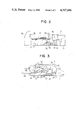
- FIGS. 1 to 5 show a preferred embodiment of the present invention, FIG. 1 being an exploded perspective view, FIG. 2 being a plan view (of only one half of the device), FIG. 3 being a cross-sectional view in the latched condition, FIG. 4 being a cross-sectional view in the non-latched condition, and FIG. 5 being a cross-sectional view in the released condition.
- a buckle for a seat belt comprises a base 20, a release button 64, a tang 82 and a latch piece 56 all incorporated in a space defined by an upper cover 10 and a lower cover 16.
- the upper cover 10 is generally of a container-like shape, and an opening 12 for exposing the release button 64 therethrough is formed in the upper wall of the upper cover 10 and an insertion hole 14 for forcing the tang 82 thereinto is formed in the forward (left as viewed in FIG. 3) side wall of the upper cover 10.
- the lower cover 16 has a recess 18 for containing therein a spring 36 for biasing the tang 82 and is made integral with the upper cover 10 by screws or the like, not shown.
- the base 20 comprises a narrow portion 22, a wide portion 24 and a pair of side wall portions 26 upwardly extending from the opposite sides of the narrow portion 22.
- the narrow portion 22 is formed with an H-shaped hole 28 and a slider 32 is inserted on a protruded portion 30 provided by the H-shape.
- the slider 32 has a resiliently deformable extension 34 formed of a synthetic resin material, is made movable along the protruded portion 30 in the center of the base 20 and is biased in one direction (the leftward direction as viewed in FIG. 3) by the spring 36 contained in the recess 18.
- the extension 34 serves to actuate a contact 38 of a switch 40 by the tapered surface 35 thereof.
- the switch 40 is held by a switch holder 42 which is fixed to the base 20 by the insertion portion 48 of the wide portion 24 being inserted into grooves 46 formed in a pair of arm portions 44.
- a harness 50 of the switch 40 may be drawn out through a hollow portion 52 of the holder 42.
- the opposite side portions 58 of the latch piece 56 are pivotably inserted in pivot holes 54 formed in the side wall portions 26 and protrusions 68 formed at the end portion of the arms 66 of the release button 64 are fitted in semicircular cut-aways 62, and the release button 64 may be pivoted about the protrusions 68.
- Each arm 66 of the release button 64 has a portion that can bear against an inwardly projecting portion 72 of the base 20 at an upwardly facing surface 70 and that can bear against a projection 176 of the latch piece 56 at a lower surface 74 see FIG. 1.
- the release button 64 has a side edge that prevents the release button from slipping upward through the opening 12 of the upper cover 10 at the region of the side edge 76.
- the latch piece 56 has a downwardly bulged latch portion 80 in the midportion thereof, and this latch portion 80 is engageable with the latch surface 86 of the latch hole 84 of the tang 82.
- a stop 88 for preventing the floating up of the tang 82 is formed on each side wall portion 26 of the base 20.
- a torsion coil spring 90 comprises a body portion 92, a pair of coil spring portions 94 and a pair of leg portions 96 and in their natural condition, the body portion 92 and leg portions 96 generally form right angles with each other.
- This torsion coil spring 90 has the distal ends 98 of its leg portions 96 inserted in the holes 102 of the latch piece 56, its spring portions 94 fitted in the cut-outs 104 of the side wall portions 26, and its body portion 92 brought into contact with the lower surface of the release button 64.
- FIG. 3 What is shown in FIG. 3 is the condition during latching, and what is shown in FIG. 4 is the condition during non-latching. That is, the biasing force of the torsion coil spring 90 is transmitted to the release button 64 through the body portion 92 and the release button 64 is in its leftwardly turned condition. The biasing force of the torsion coil spring 90 is also transmitted to the latch piece 56 through the leg portions 96, but in the condition of FIG. 4, the slider 32 is moved leftwardly by the biasing force of the compression coil spring 36 and slips under the latch portion 80 of the latch piece 56 to thereby prevent rightward turning thereof. Thus, the latch piece 56 does not hamper the insertion of the tang 82.
- the tapered surface 35 of the slider 32 pushes up the contact 38 to close the switch 40, thus indicating that the tang 82 has been completely mounted on the buckle 100.
- the slider 32 and the switch 40 are disposed in substantially vertically overlapping condition (the switch 40 is made upright) and therefore, the buckle body 100 need not be elongated in lateral direction (the direction of insertion of the tang 82).
- the extension 34 is resilient and this ensures reliable operation of the switch 40.
- the webbing (not shown) connected to the tang 82 and the base 20 restrains the seat occupant.
- the release button 64 may be depressed downwardly as shown in FIG. 5. Thereupon, the release button 64 is turned rightwardly about the protrusions 68 against the biasing force of the spring 90 and bears against the projection 176 at the lower surface 74 thereof to thereby turn the latch piece 56 in the pivot holes 54. As a result, the engagement between the latch portion 80 of the latch piece and the latch surface 86 of the tang is released and thus, the tang 82 becomes capable of being drawn out.
- the release button 64 and the latch piece 56 are biased at the same time by a single spring and therefore, as compared with a case where they are biased by discrete springs, the number of parts is reduced and the entire device becomes compact. Also, if attention is given to the width and length of the spring portion 94, the magnitude of the biasing force imparted to the release button 64 and the latch piece 56 can be made substantially constant irrespective of their rotated condition. This will enhance the operability of the release button 64 and will ensure the engagement and disengagement between the latch piece and the tang 82.
- the center of pivotal movement of the latch piece 56 is selected to be at the mid-portion thereof, and a projection 176 serving as a release force acting portion is formed at one end the latch piece and a latch portion 80 is formed at the other end of the latch piece, and the projection 176 is positioned near the protrusions 68 which are the center of pivotal movement of the release button 64, and it is the free end of the release button on which a force is exerted by the hand.
- a great lever ratio can be secured and the latch piece 56 may be pivoted only by applying a small pressure force to the free end of the button 64 so that the restraint of the tang 82 may be easily released.
- a buckle for a seat belt in which the feeling during depression of the release button is stable and which is simple and compact in structure.
Landscapes
- Automotive Seat Belt Assembly (AREA)
- Buckles (AREA)
Abstract
Description
Claims (9)
Applications Claiming Priority (2)
| Application Number | Priority Date | Filing Date | Title |
|---|---|---|---|
| JP1982179876U JPS5983409U (en) | 1982-11-30 | 1982-11-30 | Buckle for seat belt |
| JP57-179876[U] | 1982-11-30 |
Publications (1)
| Publication Number | Publication Date |
|---|---|
| US4587696A true US4587696A (en) | 1986-05-13 |
Family
ID=16073441
Family Applications (1)
| Application Number | Title | Priority Date | Filing Date |
|---|---|---|---|
| US06/552,694 Expired - Fee Related US4587696A (en) | 1982-11-30 | 1983-11-17 | Buckle for seat belt |
Country Status (2)
| Country | Link |
|---|---|
| US (1) | US4587696A (en) |
| JP (1) | JPS5983409U (en) |
Cited By (16)
| Publication number | Priority date | Publication date | Assignee | Title |
|---|---|---|---|---|
| US4660260A (en) * | 1985-05-22 | 1987-04-28 | Kabushiki Kaisha Toka-Rika-Denki-Seisakusho | Buckle device |
| US4670951A (en) * | 1985-05-24 | 1987-06-09 | Loyds' Industri A.S. | Fastening means for a safety belt for a car or the like |
| US4677715A (en) * | 1985-07-17 | 1987-07-07 | Aciers Et Outillage Peugeot | Buckle, especially for a safety belt |
| US4766654A (en) * | 1984-10-19 | 1988-08-30 | Katsuyama Kinzoku Kogyo Kabushiki Kaisha | Push button buckle assembly for a seat belt |
| EP0318031A1 (en) * | 1987-11-26 | 1989-05-31 | Nippon Seiko Kabushiki Kaisha | Buckle device with switch for detecting tongue lock |
| US4876772A (en) * | 1988-02-25 | 1989-10-31 | Indiana Mills & Manufacturing, Inc. | Safety belt buckle |
| US4942649A (en) * | 1988-02-25 | 1990-07-24 | Indiana Mills & Manufacturing, Inc. | Safety belt buckle |
| US5005267A (en) * | 1988-09-28 | 1991-04-09 | Katsuyama Kinzoku Kogyo Kabushiki Kaisha | Buckle assembly for seat belt |
| US5054171A (en) * | 1989-06-14 | 1991-10-08 | Kabushiki Kaisha Tokai-Rika-Denki-Seisakusho | Buckle device |
| US7296825B1 (en) | 1999-05-11 | 2007-11-20 | Autoliv Asp, Inc. | Multiple output buckle switch |
| WO2017059437A1 (en) * | 2015-10-02 | 2017-04-06 | Shield Restraint Systems, Inc. | Load indicators for personal restraint systems and associated systems and methods |
| US9814282B2 (en) | 2016-02-02 | 2017-11-14 | Shield Restraint Systems, Inc. | Harsh environment buckle assemblies and associated systems and methods |
| CN108839634A (en) * | 2018-05-28 | 2018-11-20 | 浙江松原汽车安全系统股份有限公司 | A kind of safety belt lock catch |
| US10604259B2 (en) | 2016-01-20 | 2020-03-31 | Amsafe, Inc. | Occupant restraint systems having extending restraints, and associated systems and methods |
| US10611334B2 (en) | 2017-02-07 | 2020-04-07 | Shield Restraint Systems, Inc. | Web adjuster |
| US20220354222A1 (en) * | 2022-07-21 | 2022-11-10 | Biothane Coated Webbing Corp. | Seat belt buckle |
Citations (12)
| Publication number | Priority date | Publication date | Assignee | Title |
|---|---|---|---|---|
| US3189966A (en) * | 1963-04-25 | 1965-06-22 | Capewell Mfg Company | Safety belt buckle |
| US3425103A (en) * | 1966-04-11 | 1969-02-04 | Irving Air Chute Co Inc | Pushbutton type safety seat belt buckle |
| US3494007A (en) * | 1968-06-21 | 1970-02-10 | American Safety Equip | Safety belt buckle |
| US3605209A (en) * | 1970-02-24 | 1971-09-20 | Gateway Industries | Safety belt buckle |
| US3708838A (en) * | 1971-11-16 | 1973-01-09 | American Safety Equip | Push button buckle |
| US4000385A (en) * | 1975-11-06 | 1976-12-28 | Allied Chemical Corporation | Electric switch for safety belt buckle with wiping self cleaning contact structure |
| DE2648418A1 (en) * | 1976-10-26 | 1978-04-27 | Herbert Baumann | Safety device for vehicle - has switches in seat belt locks connected into ignition circuit to control starting |
| GB1531823A (en) * | 1977-05-06 | 1978-11-08 | British Leyland Uk Ltd | Seat belt harness fastening for use by children in vehicles |
| US4377888A (en) * | 1979-12-19 | 1983-03-29 | Nsk-Warner K. K. | Buckle of a seat belt for a vehicle |
| US4382320A (en) * | 1980-09-02 | 1983-05-10 | Fuji Kiko Kabushiki Kaisha | Seat belt buckle |
| US4391024A (en) * | 1980-04-10 | 1983-07-05 | Nsk-Warner K.K. | Buckle device |
| US4394792A (en) * | 1980-05-14 | 1983-07-26 | Aciers Et Outillage Peugeot | Buckle for a safety belt |
-
1982
- 1982-11-30 JP JP1982179876U patent/JPS5983409U/en active Pending
-
1983
- 1983-11-17 US US06/552,694 patent/US4587696A/en not_active Expired - Fee Related
Patent Citations (12)
| Publication number | Priority date | Publication date | Assignee | Title |
|---|---|---|---|---|
| US3189966A (en) * | 1963-04-25 | 1965-06-22 | Capewell Mfg Company | Safety belt buckle |
| US3425103A (en) * | 1966-04-11 | 1969-02-04 | Irving Air Chute Co Inc | Pushbutton type safety seat belt buckle |
| US3494007A (en) * | 1968-06-21 | 1970-02-10 | American Safety Equip | Safety belt buckle |
| US3605209A (en) * | 1970-02-24 | 1971-09-20 | Gateway Industries | Safety belt buckle |
| US3708838A (en) * | 1971-11-16 | 1973-01-09 | American Safety Equip | Push button buckle |
| US4000385A (en) * | 1975-11-06 | 1976-12-28 | Allied Chemical Corporation | Electric switch for safety belt buckle with wiping self cleaning contact structure |
| DE2648418A1 (en) * | 1976-10-26 | 1978-04-27 | Herbert Baumann | Safety device for vehicle - has switches in seat belt locks connected into ignition circuit to control starting |
| GB1531823A (en) * | 1977-05-06 | 1978-11-08 | British Leyland Uk Ltd | Seat belt harness fastening for use by children in vehicles |
| US4377888A (en) * | 1979-12-19 | 1983-03-29 | Nsk-Warner K. K. | Buckle of a seat belt for a vehicle |
| US4391024A (en) * | 1980-04-10 | 1983-07-05 | Nsk-Warner K.K. | Buckle device |
| US4394792A (en) * | 1980-05-14 | 1983-07-26 | Aciers Et Outillage Peugeot | Buckle for a safety belt |
| US4382320A (en) * | 1980-09-02 | 1983-05-10 | Fuji Kiko Kabushiki Kaisha | Seat belt buckle |
Cited By (23)
| Publication number | Priority date | Publication date | Assignee | Title |
|---|---|---|---|---|
| US4766654A (en) * | 1984-10-19 | 1988-08-30 | Katsuyama Kinzoku Kogyo Kabushiki Kaisha | Push button buckle assembly for a seat belt |
| US4660260A (en) * | 1985-05-22 | 1987-04-28 | Kabushiki Kaisha Toka-Rika-Denki-Seisakusho | Buckle device |
| US4670951A (en) * | 1985-05-24 | 1987-06-09 | Loyds' Industri A.S. | Fastening means for a safety belt for a car or the like |
| US4677715A (en) * | 1985-07-17 | 1987-07-07 | Aciers Et Outillage Peugeot | Buckle, especially for a safety belt |
| EP0318031A1 (en) * | 1987-11-26 | 1989-05-31 | Nippon Seiko Kabushiki Kaisha | Buckle device with switch for detecting tongue lock |
| US4920620A (en) * | 1987-11-26 | 1990-05-01 | Nippon Seiko Kabushiki Kaisha | Buckle device with switch for detecting tongue lock |
| US4876772A (en) * | 1988-02-25 | 1989-10-31 | Indiana Mills & Manufacturing, Inc. | Safety belt buckle |
| US4942649A (en) * | 1988-02-25 | 1990-07-24 | Indiana Mills & Manufacturing, Inc. | Safety belt buckle |
| US5005267A (en) * | 1988-09-28 | 1991-04-09 | Katsuyama Kinzoku Kogyo Kabushiki Kaisha | Buckle assembly for seat belt |
| EP0362657A3 (en) * | 1988-09-28 | 1991-07-17 | Katsuyama Finetech Kabushiki Kaisha | Buckle assembly for seat belt |
| US5054171A (en) * | 1989-06-14 | 1991-10-08 | Kabushiki Kaisha Tokai-Rika-Denki-Seisakusho | Buckle device |
| US7296825B1 (en) | 1999-05-11 | 2007-11-20 | Autoliv Asp, Inc. | Multiple output buckle switch |
| WO2017059437A1 (en) * | 2015-10-02 | 2017-04-06 | Shield Restraint Systems, Inc. | Load indicators for personal restraint systems and associated systems and methods |
| US20170106833A1 (en) * | 2015-10-02 | 2017-04-20 | Shield Restraint Systems, Inc. | Load indicators for personal restraint systems and associated systems and methods |
| CN108289531A (en) * | 2015-10-02 | 2018-07-17 | 谢尔德约束系统公司 | Thermote for personal restraint system and associated system and method |
| US10086795B2 (en) * | 2015-10-02 | 2018-10-02 | Shield Restraint Systems, Inc. | Load indicators for personal restraint systems and associated systems and methods |
| RU2726711C1 (en) * | 2015-10-02 | 2020-07-15 | Шилд Рестрейнт Системз, Инк. | Load indicators for individual retention systems and corresponding systems and methods |
| US10604259B2 (en) | 2016-01-20 | 2020-03-31 | Amsafe, Inc. | Occupant restraint systems having extending restraints, and associated systems and methods |
| US9814282B2 (en) | 2016-02-02 | 2017-11-14 | Shield Restraint Systems, Inc. | Harsh environment buckle assemblies and associated systems and methods |
| US10611334B2 (en) | 2017-02-07 | 2020-04-07 | Shield Restraint Systems, Inc. | Web adjuster |
| CN108839634A (en) * | 2018-05-28 | 2018-11-20 | 浙江松原汽车安全系统股份有限公司 | A kind of safety belt lock catch |
| CN108839634B (en) * | 2018-05-28 | 2024-02-20 | 浙江松原汽车安全系统股份有限公司 | Safety belt lock catch |
| US20220354222A1 (en) * | 2022-07-21 | 2022-11-10 | Biothane Coated Webbing Corp. | Seat belt buckle |
Also Published As
| Publication number | Publication date |
|---|---|
| JPS5983409U (en) | 1984-06-05 |
Similar Documents
| Publication | Publication Date | Title |
|---|---|---|
| US3833781A (en) | Seat belt buckle switch with knife and clip contact assembly | |
| US4180716A (en) | Switch having lock-off and lock-on | |
| US4638533A (en) | Variable release seat belt buckle | |
| JP2004214099A (en) | Push button switch device | |
| US4575908A (en) | Lock for seat belt buckle | |
| GB1589993A (en) | Seat belt buckle | |
| JPS6239693Y2 (en) | ||
| US4121065A (en) | Toggle switch lever lock | |
| US4686740A (en) | Stopper for door | |
| US4377888A (en) | Buckle of a seat belt for a vehicle | |
| JPH04221503A (en) | Belt-locking fastener for safety belt device | |
| US5216788A (en) | Impact-protected safety belt buckle | |
| CA1052542A (en) | Buckles for vehicle safety belts | |
| US4391023A (en) | Buckle arrangement for seat belts | |
| US4956529A (en) | Compact switch device | |
| US4450604A (en) | Buckle for seat belt | |
| US4998328A (en) | Buckle device | |
| US3675281A (en) | Seat belt buckle assembly | |
| US4219714A (en) | Lock-off switch | |
| JP2002237229A (en) | Key switch device assembling method | |
| JPH0540727Y2 (en) | ||
| US4930195A (en) | Present invention relates to a safety-belt buckle | |
| JP2002017581A (en) | Attachable and detachable handle for container | |
| US4563797A (en) | Safety belt buckle | |
| JPH0617635Y2 (en) | In-vehicle storage box closed position locking device |
Legal Events
| Date | Code | Title | Description |
|---|---|---|---|
| AS | Assignment |
Owner name: NSK-WARNER K.K., 3-2, MARUNOUCHI 2-CHOME CHIYODA-K Free format text: ASSIGNMENT OF ASSIGNORS INTEREST.;ASSIGNORS:UEDA, TAKEO;MORINAGA, MASARU;REEL/FRAME:004199/0198 Effective date: 19831110 Owner name: NSK-WARNER K.K., 3-2, MARUNOUCHI 2-CHOME CHIYODA-K Free format text: ASSIGNMENT OF ASSIGNORS INTEREST;ASSIGNORS:UEDA, TAKEO;MORINAGA, MASARU;REEL/FRAME:004199/0198 Effective date: 19831110 |
|
| FEPP | Fee payment procedure |
Free format text: PAYOR NUMBER ASSIGNED (ORIGINAL EVENT CODE: ASPN); ENTITY STATUS OF PATENT OWNER: LARGE ENTITY |
|
| AS | Assignment |
Owner name: NIPPON SEIKO KABUSHIKI KAISHA, A CORP. OF JAPAN, J Free format text: ASSIGNMENT OF ASSIGNORS INTEREST.;ASSIGNOR:NSK WARNER K.K.;REEL/FRAME:005014/0587 Effective date: 19890125 |
|
| REMI | Maintenance fee reminder mailed | ||
| LAPS | Lapse for failure to pay maintenance fees | ||
| STCH | Information on status: patent discontinuation |
Free format text: PATENT EXPIRED DUE TO NONPAYMENT OF MAINTENANCE FEES UNDER 37 CFR 1.362 |
|
| FP | Lapsed due to failure to pay maintenance fee |
Effective date: 19900513 |