US455923A - gronwald - Google Patents
gronwald Download PDFInfo
- Publication number
- US455923A US455923A US455923DA US455923A US 455923 A US455923 A US 455923A US 455923D A US455923D A US 455923DA US 455923 A US455923 A US 455923A
- Authority
- US
- United States
- Prior art keywords
- milk
- bottles
- vessel
- steam
- filling
- Prior art date
- Legal status (The legal status is an assumption and is not a legal conclusion. Google has not performed a legal analysis and makes no representation as to the accuracy of the status listed.)
- Expired - Lifetime
Links
Images



Classifications
-
- B—PERFORMING OPERATIONS; TRANSPORTING
- B65—CONVEYING; PACKING; STORING; HANDLING THIN OR FILAMENTARY MATERIAL
- B65B—MACHINES, APPARATUS OR DEVICES FOR, OR METHODS OF, PACKAGING ARTICLES OR MATERIALS; UNPACKING
- B65B11/00—Wrapping, e.g. partially or wholly enclosing, articles or quantities of material, in strips, sheets or blanks, of flexible material
- B65B11/02—Wrapping articles or quantities of material, without changing their position during the wrapping operation, e.g. in moulds with hinged folders
- B65B11/025—Wrapping articles or quantities of material, without changing their position during the wrapping operation, e.g. in moulds with hinged folders by webs revolving around stationary articles
Definitions
- JOHANN FRANZ HUGO GRONW ALD OF BERLIN, GERMANY, 'ASSIGNOR OF TWO-FIFTHS TO EMIL HEINRICH CONRAD OEHLMANN, OF SAME PLACE.
- the object of the present invention is to prepare milk in such a manner as to enable it to be preserved in its natural normal-condition for indefinite periods.
- the said invention is valuable both for I 5 economic and hygienic reasons.
- the milk is then exposed to circulating aqueous vapor of 100 centigrade temperature during a definite time and is then under pressure filled into suitable vessels contained in a hermetically-closed receiver and likewise sterilized by aqueous vapor of 100 centigrade, and the vessels are then hermetically closed.
- the principal features of the new process are, first, neutralization of the milk; second, the period during which it is exposed to aqueous vapor of 100 temperature; third, the
- the first operation is neutralization of the milk. Owing to unsuitable feeding of the cattle from which the milk is derived, the latter usually shows acid reaction and contains free lactic acid. This has to be remedied,as the acid in the milk would cause, even in milk free from germs, separation of the proteines and consequent coagulation of the milk.
- the time during which the flowingaqueous vapors (at are permitted to act upon 5 the milk has also carefully to be regulated,- beoause, even if the conditions as to neutralization are fulfilled and the milk is free from germs, yet heating beyond the right time will also cause coagulation of the proteine.
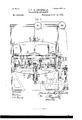
- FIG. 1 is an elevation of the apparatus for bottling the milk.
- Fig. 2 shows the filling and closing apparatus in section.
- Figs. 3 to 8 showvarious details of the saine; and
- Figs. 9 and 10 illustrate an apparatus for filling large vessels, such as casks or barrels.
- Fig. 11 is an elevation of the apparatus for preparing the milk for bottling or for being otherwise put up;-
- the entire'apparatus for preparing the milk consists of the pan or boiler-A and the filling and closing apparatus 13.
- the panor boiler A is'of"known-construction and has a steam jacket, and the'clos'ely-fitting lid is provided wi-th an inle't-fu'nn e1, pressure-gagaand therhas 'been measured off (sa-y,-for' instance, one hundred lit'ers)andpoured by the funnel a, intothepan A, the two-Way cock I) of the steampipe 0 is-so set that steam passes ingto-this-end' passed through a purifying.
- the milk is maintained at the temperature of 100 for as long a time as appears requisite to enable it to be kept. During. these operations the filling andclosing apparatus is prepared for further manipulation of the milk.
- the plate or table I supported on brackets t and serving for the reception of the receptacles-for'themilk say bottles.
- table Dg-Figs. 2 and h consists of asolid plate k and lan upper'part Z, capable of being heated; (Se'e Figs.- 2,-5-,- and S.)
- the upper part of the tray is fitted with as many shells, boxes, or frames m, Fig. 7, (made, say, of copper,) as there are bottles to be filled at one operation. If, for instance, the apparatus is to work up one hundred liters of milk at each operation and fill it intoliter-bottles, there will be onehundred boxes or shells m. steam for the table D, and the steam, guided by a spiral partition 01., Figs. 3 and 4, passes around all the shells or boxes m and ultimately issues through the aperture 0, Fig. 3, into the body of the apparatus B.
- a bottle fitted preferably, with a stoppering device of the kind shown in the drawings, (see Figs. 5, 6, 7, and 8,)
- Figs. '7 and S is inserted into each. All the tubes L are attached to the filling-vessel M, sosuspended in the upper part 71 of the filling apparatus as to be vertically movable. They are held in position by guide-cones u on the sheet-metal, plate N. Into the upper portion it, above the filling-vessel M,stea1n is also-admitted through the branch '0, cock 0, and elbow-pipe w, Fig.- 2.
- valves t are open, the steam or aqueous vapor passes through the pipes or tubes L to-the bottom of the bottles and then escapes through the mouths'of the bottles to the interior of the apparatus, so that all the bottles are
- the pipe 0 supplies sterilized in' their interior also.
- the said valves t in the tubes L are opened by lowering the filling-vessel M. Every valve has a prolonged stem at: projecting somewhat beyond the end of the tube L. Consequently each valve t is closed when the vessel M is at such a level that the stems 0c are clear of the bottom of the bottles, Fig. 7.
- NVhen the vessel. M is empty and all the bottles are full, (which is ascertained by a window 1d,) the wheel P is turned, chain Q, passing over wheels Q, wound up, and vessel M raised until it touches the top portion h. Pawl V then takes into the notch 2 and the hand-wheel is stopped. All the tubes L are thus raised out of the bottles, being guided by the plate N, which is not raised. The bottles are now in the position shown in Fig. 5.
- the plate G is then raised and all the stoppers are turned over into the bottlen:1outh, and by a downward motion of the plate the projections r on the rings P fasten the stoppering devices,
- the bottles being thus filled and closed, the connections k between the top and bottom portions of the apparatus are re leased, the pawl V is raised clear of the notch, and the hand-wheel P, being turned, will further raise vessel M, (which, as stated, already bears against the lid 71,) and the latter is carried upward, its rollers X guiding it on suitable uprights, and the table D becomes readily accessible to the operator, who, having fixed wheel P in position by the pawl V, can easily remove the bottles from the apparatus and set the same aside to be cooled slowly.
- the sequence of operations is as follows: The apparatus being empty and steam and milk inlets closed, the upper portion It is raised, so that the bottles may be put into place.
- the bottles are set in the shells or boxes m, the operator beginning, preferhand-wheel P, so that the wheel stops.
- the pan A now empty, is refilled and the milk in the filling-vessel M is allowed to settle.
- pawl V is set free and vessel M gradually lowered. This causes the valves t to open, so that the milk flows evenly into all the bottles and fills all of them alike.
- hand-wheel P is turned, raising vessel M and tubes L until the engagement of the pawl shows that the tubes L are withdrawn from the bottles.
- the wheel K is now operated to depress the long arm of the lever J. Consequently the plate G rises and the projections a" of the rings F place the stoppers on the bottle-mouths.
- the described form of apparatus is not convenient, and the modification shown in Figs. 9 and lOhas been devisedfor this purpose.
- the pan remains unaltered.
- Thefilling apparatus B Figs. 9 and 10
- This apparatus is divided into two compartments I II, the upper for receiving the milk before it is allowed to flow into the barrel.
- a branched steampipe 0 is fitted, one branch leading below the perforated bottom Z in order to distribute the steam properly.
- the upper branch can admit'stealn into the lid-of the apparatus and is fitted with a stop within the compartment and a handle outside of the same.
- WVhen the cask is in the proper position, whichcan be ascertained by a sight-hole in the compare ment I, the rod r, and byit the tap it, is lowered into the position shown in Fig. 9.
- outlet of the tap depresses the back-pressure valve and passes into the cask, but without establishing communication with the compartment II. This only takes place when the handle of rod 0- is turned, acting on the plug of tap h.
- the milk now flows through tap h and past the back-pressure valveinto the cask.
- lVhen' the cask is full, the rod r is turned back, and this closes the tap h.
- the backpressure valve closes automatically and the milk is hermetically inclosed.
- the door of theapparatus is now opened and the cask removed.
- ⁇ Vhen-milk is tobe drawn from the cask, the drawoff cock (Z is opened, the vent d in-the lid having first been opened.
- the vent d carries a casing or chamber filled with sterilized wadding or cotton-wool, so that all air passing through it is filtered and likewise sterilized. Any desired quantities may therefore be successively drawn from the cask-Without affecting the keeping quality of the remainder.
- the cask or barrel may be treated with hot steam from the pipe C by pushing back the spring back-pressure valve in the bung of the cask, which closes automatically when branch pipe 0 is withdrawn. This makes the interior of the cask sterile.
- Suitable U-shaped pipes conduct steam fromthe compartment I to the compartment IIfor alike purpose. Pressuregages, safetyvalves, and thermometers serve to indicate and control tension and temperature of the aqueous vapor.
- the cock 0 is opened and the milk is, through pipe E and branch 10, passed into compartment II.
- a glazed and graduated sighthole U2 in the side of the apparatus shows the quantity passed into the compartment II, and this permits of the cock 0 being closed when just that quantity of milk has flowed into compartment II as will exactly fill the cask introduced into compartment I.
- the apparatus described permits, as will-be" seen, the filling of suitable vessels of any size with appropriate quantities of sterilized-milk and the preservation of the latter i-ndefi-" nitely.
- a sterilizing apparatus the combination of a closed receptacle for bottles or ves-' sels, a reservoir, filling-conduits extending and ducts for supplying steam and material to be preserved to said reservoir, substantially as set forth.
Landscapes
- Engineering & Computer Science (AREA)
- Mechanical Engineering (AREA)
- Dairy Products (AREA)
Description
(No Model.) 7 Sheets-Sheet 1.
J. F. H. GRON-WALD'.
STERILIZING APPARATUS. No. 455,923. Patented July 14, 1891.
/\ (O) 3 wooa- Qj i 9 Li. J? F iii:
mi'nessas: I fif L-Z i zz n t mama ravens no, vucno xmo, WASNINGYON, n. c.
(No Modl.) 7 Sheets-Sheet 3.
J. P. H. GRONWALD. STERILIZING APPARATUS.
Qflffarney;
. Patented July 14,1891.
7 Sheets-Sheet, 4f
(No Model.)
J. I. H. GRONWALD. STERILIZING APPARATUS. N0. 455,923. I
"""Pa tented July 14, 189
mama.
0;- li ZMJMQ (No Mbdel.) .7 Sheets-Sheet 5.
. H. GRONW ALD.
ILIZING APPARATUS.
No. 455,923. Patented July 14 1891.
- mi'nesses:
7 Sheets-Sheet 6.
(No Model.)
J. F. H. GRONWALD. STERILIZING APPARATUS.
Patented July 14, 1891.
III: II
Wifrwssa-fl THE mums PEYERS 0a., mvm-unm, WASHINOYON, a. c
UNITED STATES PATENT OFFICE.
JOHANN FRANZ HUGO GRONW ALD, OF BERLIN, GERMANY, 'ASSIGNOR OF TWO-FIFTHS TO EMIL HEINRICH CONRAD OEHLMANN, OF SAME PLACE.
STERILIZING APPARATUS.
SPECIFICATION forming part of Letters Patent No. 455,923, dated July 14, 1891.
Application filed May 28, 1889.
To all whom it may concern:
Be it known that I, J OHANN FRANZ HUGO GRONWALD, a subject of the King of Prussia, residing in Berlin, Germany, have invented certain new and useful Improvements in Apparatus for Preparing Milk so as to Enable the Same to be Preserved Indefinitely, of which the following is a full, clear, and exact description.
The object of the present invention is to prepare milk in such a manner as to enable it to be preserved in its natural normal-condition for indefinite periods.
The said invention is valuable both for I 5 economic and hygienic reasons.
It is well known that when milk is prepared for consumption by boiling and by reason of the accidents frequently occurring when this is done (such as boiling over and burning) and by deterioration of the milk when it is to keep for some time, particularly in warm weather, waste of time and money is caused, which in the aggregate represents a not inconsiderable loss. To prevent such losses 2 5 must necessarily be beneficial to the general public. By this invention the losses above referred to are avoided. The milk prepared as hereinafter stated is ready for consumption and requires no further boiling, it will 0 not turn even by continued application of heat above summer temperature, centigrade,) and the advantage of using such milk, the price of which will be about equal to that of the milk usually sold, is obvious.
A further important consideration is the following: It is a well-established fact that milk is not unfrequently a vehicle for disease-germs, which are capable of transmission from the organism of animals to that of mankind. Tuberculosis and scrofula are these. It is also acknowledged by medical men thatthe diarrhea so frequently occurring in an epidemic form in summer, and which deciniates infants, is caused by infection through milk. Thus damage to health and loss of human life consequent upon the consumption of diseased milk are by no means slight and have caused competent authorities to utter urgent demands for germ-free milk. Milk go-treated according to this invention fulfills this requirement, being free from all infec- Serial No. 312,371. (No model.)
tious matters, all micro-organisms contained in the milk, whether ferments or diseasegerms, being killed in the treatment. The hygienic importance of the said invention must therefore also .be acknowledged. In other respects the quality of the milk is not aifected, the'separation of the caseine and fatty matters taking place by the same manipulations as with fresh milk.. The taste of the milk prepared according, to this invention is also better than that of ordinary boiled milk, the latter always having a peculiar taste. Inaccordance with this invention good milk is first examined as to the 6 amount of alkaline matter it contains. It is required that the milk should be neutral. If there is acidity, this is corrected by the addition of bicarbonate of potassium, an alkaline salt usually contained in the milk. The milk is then exposed to circulating aqueous vapor of 100 centigrade temperature during a definite time and is then under pressure filled into suitable vessels contained in a hermetically-closed receiver and likewise sterilized by aqueous vapor of 100 centigrade, and the vessels are then hermetically closed.
The principal features of the new process are, first, neutralization of the milk; second, the period during which it is exposed to aqueous vapor of 100 temperature; third, the
separate sterilization of the receptacles for re-- ceiving the milk and of the closing devices therefor.
The first operation is neutralization of the milk. Owing to unsuitable feeding of the cattle from which the milk is derived, the latter usually shows acid reaction and contains free lactic acid. This has to be remedied,as the acid in the milk would cause, even in milk free from germs, separation of the proteines and consequent coagulation of the milk. Next, the time during which the flowingaqueous vapors (at are permitted to act upon 5 the milk has also carefully to be regulated,- beoause, even if the conditions as to neutralization are fulfilled and the milk is free from germs, yet heating beyond the right time will also cause coagulation of the proteine. Third- I00 ly, separate sterilization is required of the receptacles for the milk and of the devices forclosingthe same by circulating aqueous vapors of 100 centigrade temperature in a closedvessel hermetically closed against the atmosphere, as it is by this means alone that freedom from germs of the receptacles, and especially of the closing devices, can be insured.
The apparatus for carrying this process into practice are represented in the accompanying drawingsfln which- Figure 1 is an elevation of the apparatus for bottling the milk. Fig. 2 shows the filling and closing apparatus in section. Figs. 3 to 8 showvarious details of the saine; and Figs. 9 and 10 illustrate an apparatus for filling large vessels, such as casks or barrels. Fig. 11 is an elevation of the apparatus for preparing the milk for bottling or for being otherwise put up;-
The entire'apparatus for preparing the milk consists of the pan or boiler-A and the filling and closing apparatus 13. The panor boiler A is'of"known-construction and has a steam jacket, and the'clos'ely-fitting lid is provided wi-th an inle't-fu'nn e1, pressure-gagaand therhas 'been measured off (sa-y,-for' instance, one hundred lit'ers)andpoured by the funnel a, intothepan A, the two-Way cock I) of the steampipe 0 is-so set that steam passes ingto-this-end' passed through a purifying.
vessel 0', filled with charcoal or other suitable purifying agents. Simultaneously with the operation last hereinabove mentioned the stop-cock e is opened, and the branch pipe f on pipe C admits fresh steam into the pan A.
and upon the milk," so that the milk is surroundedby boiling steam. The boiling. will therefore not affect its composition. The milk is maintained at the temperature of 100 for as long a time as appears requisite to enable it to be kept. During. these operations the filling andclosing apparatus is prepared for further manipulation of the milk.
The filling and closing apparatus consists of 'a-bottom portion g=and-a lid h, so secured thereto" as to'be. readily removable but yet steam-tiglit. In the bottom-portion g is arranged the plate or table I), supported on brackets t and serving for the reception of the receptacles-for'themilk say bottles. The
table Dg-Figs. 2 and h consists of asolid plate k and lan upper'part Z, capable of being heated; (Se'e Figs.- 2,-5-,- and S.) The upper part of the tray is fitted with as many shells, boxes, or frames m, Fig. 7, (made, say, of copper,) as there are bottles to be filled at one operation. If, for instance, the apparatus is to work up one hundred liters of milk at each operation and fill it intoliter-bottles, there will be onehundred boxes or shells m. steam for the table D, and the steam, guided by a spiral partition 01., Figs. 3 and 4, passes around all the shells or boxes m and ultimately issues through the aperture 0, Fig. 3, into the body of the apparatus B. In each box or shell there is a bottle fitted, preferably, with a stoppering device of the kind shown in the drawings, (see Figs. 5, 6, 7, and 8,)
' and thus all the bottles are evenly heated to 100 centigrade. The stoppers of all the bottles are open and rest on stout rings P. (See Fig. 5.) Four suchrings a-re'provided in an apparatus of the" dimensions above stated, and,-'as shown in Fig; 4E, they are so arranged thatth'e' stoppers of allthe'bottles' can readily be rest-ed thereon. The ringsP'are connected 1 wi-ththe star-shapedplate G by rods-p, which pass through stays,making tight join-tswith the interior of table D, and into holes or re cesses in the plate G. The plate Griscapable of vertical motion.- It is connectedwitlif a stout plunger q, Fig. 2, passingv through stuffing-box H in the lowerportionof theapparatus. This plunger iscarried by theshort arm of a lever J The latter is-oper'ated by a screw-spindle and wheel K-,-afid by these means the plate G can be raised and-lowered. By the rising and fallingofthe plate-G" the insertion and securing of the bottle stoppers are effected. To this end angle-pieces r, Fig. 5, are so secured upon' the rings P that'one such an gle-piece is inserted between the strap.
carrying. each stopper and the lever s on the bottle. 1 When the bottlesplaced in the" shells on'the table D have been filled, the lever J is depressed and plate G-raised. (See-Fig. 6'.) Consequently the angle =pieces r raise the stoppers, and these, retained by theirwi-re straps, are placed on the mouths of the corresponding bottles. The lever J is next raised,
plate G now descends, and the angle piecesr bear on the levers s, depress the same, and thereby tighten the stoppers and their packing, so thatall the bottles are simultaneously closedwithout removal front the apparatus. Before the bottles are filled they are also sterilized by circulating steam. To this end a tube L, tinned and fitted with'a valve't,
Figs. '7 and S, is inserted into each. All the tubes L are attached to the filling-vessel M, sosuspended in the upper part 71 of the filling apparatus as to be vertically movable. They are held in position by guide-cones u on the sheet-metal, plate N. Into the upper portion it, above the filling-vessel M,stea1n is also-admitted through the branch '0, cock 0, and elbow-pipe w, Fig.- 2. l/Vhen the valves t are open, the steam or aqueous vapor passes through the pipes or tubes L to-the bottom of the bottles and then escapes through the mouths'of the bottles to the interior of the apparatus, so that all the bottles are The pipe 0 supplies sterilized in' their interior also. The said valves t in the tubes L are opened by lowering the filling-vessel M. Every valve has a prolonged stem at: projecting somewhat beyond the end of the tube L. Consequently each valve t is closed when the vessel M is at such a level that the stems 0c are clear of the bottom of the bottles, Fig. 7. The steam, however, passes freely through the tubes L when filling-vessel M is lowered sufficiently to cause the stems 00 to bear upon the bottom of the bottles, raising the valves 2, Fig. 8. WVhen the apparatus B has been thoroughly sterilized by the aqueous vapor circulating within it, the stop-cock O is so set that access of steam through pipe -v to the part it is prevented, and connection is made between that portion of the apparatus (through pipe Rand siphon S) and pan A, the filling-vessel M being first raised so far that all the valves 15 of the tubes L close. The steam, acting from above upon the milk in the pan A, causes the same to flow throughsiphon S, pipe R, cock 0, and elbow-pipe w, the latter passing (so as to make a tight joint) through the sleeve T on the bottom of the filling-vessel M. The entire quantity of milk passes from pan A to the vessel M. By the window a, Fig. 1, it can be ascertained when the milk has passed, and then the vessel M is lowered, whereby the valves in the tubes L are caused to rise and the milk flows uniformly into all the bottles.
NVhen the vessel. M is empty and all the bottles are full, (which is ascertained by a window 1d,) the wheel P is turned, chain Q, passing over wheels Q, wound up, and vessel M raised until it touches the top portion h. Pawl V then takes into the notch 2 and the hand-wheel is stopped. All the tubes L are thus raised out of the bottles, being guided by the plate N, which is not raised. The bottles are now in the position shown in Fig. 5. The plate G is then raised and all the stoppers are turned over into the bottlen:1outh, and by a downward motion of the plate the projections r on the rings P fasten the stoppering devices, The bottles being thus filled and closed, the connections k between the top and bottom portions of the apparatus are re leased, the pawl V is raised clear of the notch, and the hand-wheel P, being turned, will further raise vessel M, (which, as stated, already bears against the lid 71,) and the latter is carried upward, its rollers X guiding it on suitable uprights, and the table D becomes readily accessible to the operator, who, having fixed wheel P in position by the pawl V, can easily remove the bottles from the apparatus and set the same aside to be cooled slowly.
The sequence of operations, therefore, is as follows: The apparatus being empty and steam and milk inlets closed, the upper portion It is raised, so that the bottles may be put into place. The bottles are set in the shells or boxes m, the operator beginning, preferhand-wheel P, so that the wheel stops. The
connections between lid and bottom portion are now fastened, pawl V is released, and the vessel M lowered until it rests on the plate N. This causes the rodsac to touch the bottom of the bottles, the valves 25 rise, and tubes L are opened. Cocks b and O are now so adjusted that steam flows from pipe 0 into the table D and over the filling-vessel M, filling the interior of apparatus B and the bottles, and so heats all the parts, at the same time sterilizing the same. The wheel P is then turned until pawl V engageswith the notch 1. This raises the vessel M and by the valves it closes the tubes L. The cock 0 is then reversed, and the milk meanwhile prepared in the apparatus A, as described, is brought over at a temperature of 100. The pan A, now empty, is refilled and the milk in the filling-vessel M is allowed to settle. When all agitation in the milk contained in the filling-vessel has ceased, pawl V is set free and vessel M gradually lowered. This causes the valves t to open, so that the milk flows evenly into all the bottles and fills all of them alike. Then the bottles are full, hand-wheel P is turned, raising vessel M and tubes L until the engagement of the pawl shows that the tubes L are withdrawn from the bottles. The wheel K is now operated to depress the long arm of the lever J. Consequently the plate G rises and the projections a" of the rings F place the stoppers on the bottle-mouths. lVhen the operator has ascertained the completion of this operation by looking through window u, he reverses wheel K, raises the long arm of lever J, and brings down plate Gwith considerable force. The projections r on rings P will consequently force down the levers s of the stoppering devices, securing all of the latter and closing all the bottles hermetically. This completes the operation, and, the steam -inlets being closed and the lid-raised, the bottles are removed for the introduction of a fresh supply.
For large'vessels, such as casks and the like, the described form of apparatus is not convenient, and the modification shown in Figs. 9 and lOhas been devisedfor this purpose. The pan remains unaltered. Thefilling apparatus B, Figs. 9 and 10, has a hermetically-closing door by which the casks or the, like are introduced and placed on the truck y. This apparatus is divided into two compartments I II, the upper for receiving the milk before it is allowed to flow into the barrel. Into the lower portion I, fitted with a perforated false bottom Z, a branched steampipe 0 is fitted, one branch leading below the perforated bottom Z in order to distribute the steam properly. The upper branch can admit'stealn into the lid-of the apparatus and is fitted with a stop within the compartment and a handle outside of the same. WVhen the cask is in the proper position, whichcan be ascertained by a sight-hole in the compare ment I, the rod r, and byit the tap it, is lowered into the position shown in Fig. 9. outlet of the tap depresses the back-pressure valve and passes into the cask, but without establishing communication with the compartment II. This only takes place when the handle of rod 0- is turned, acting on the plug of tap h. The milk now flows through tap h and past the back-pressure valveinto the cask. lVhen' the cask is full, the rod r is turned back, and this closes the tap h. As soon as the tap is raised again'by rod r the backpressure valve closes automatically and the milk is hermetically inclosed. The door of theapparatus is now opened and the cask removed.
\Vhen-milk is tobe drawn from the cask, the drawoff cock (Z is opened, the vent d in-the lid having first been opened. The vent d carries a casing or chamber filled with sterilized wadding or cotton-wool, so that all air passing through it is filtered and likewise sterilized. Any desired quantities may therefore be successively drawn from the cask-Without affecting the keeping quality of the remainder. To obtain greater security as to the keeping of the milk than the filtration of air, the cask or barrel may be treated with hot steam from the pipe C by pushing back the spring back-pressure valve in the bung of the cask, which closes automatically when branch pipe 0 is withdrawn. This makes the interior of the cask sterile.
Suitable U-shaped pipes conduct steam fromthe compartment I to the compartment IIfor alike purpose. Pressuregages, safetyvalves, and thermometers serve to indicate and control tension and temperature of the aqueous vapor. When the iuteriorof the apparatus and the cask are thoroughly sterilized, the cock 0 is opened and the milk is, through pipe E and branch 10, passed into compartment II. A glazed and graduated sighthole U2 in the side of the apparatus shows the quantity passed into the compartment II, and this permits of the cock 0 being closed when just that quantity of milk has flowed into compartment II as will exactly fill the cask introduced into compartment I. This done, the truck y is drawn forward by the rod 00 (passing through a stuffing-box in the side of the ap- The paratus) until the upper branch 0 of the pipe is clear of the cask and the valve opened by such pipe has closed again. This will bring the back-pressure valve in the headof the barrel, Fig. 1.0, under the tap h, which isv'ertically adjustable. Rods Z guide this tap. Its outlet is secured in the bottom of the compartment by a stuffing-box, and at its lower end it has outlet-slots. On the plug of this tan a rod 0' is rovided which )ass'es through an air-tight stuffing-box m, filled with sterilized wadding. Sterilizedair may be preliminarily compressed in the cask by suitable apparatus, which thencontains-only so much milk as will be expelled through cock (1 by the compressed airit contains after the back-pressure valvesare closed.
The apparatus described permits, as will-be" seen, the filling of suitable vessels of any size with appropriate quantities of sterilized-milk and the preservation of the latter i-ndefi-" nitely.
Having now described my invention, what- I claim as new,and desire to secure by Letters Patent, is
1. For filling milk prepared as above specified into bottles or thelike, the-apparatu-s-hayin g the plate or table D and the-movable plate G, carrying rings F, fitted with projections r for supporting and operating the stoppering devices, arranged in conjunction with suitable necessary parts, all as set forth, and shown in the drawings.
2. In a sterilizing apparatus, the combination of a closed receptacle for bottles or ves-' sels, a reservoir, filling-conduits extending and ducts for supplying steam and material to be preserved to said reservoir, substantially as set forth.
In witness whereof I have hereunto set my hand in presence of twowit-nesses.
JOHANN FRANZ HUGO GRONWALD.
\Vitnesses:
E. OEHLMANN, B. ROI.
Publications (1)
| Publication Number | Publication Date |
|---|---|
| US455923A true US455923A (en) | 1891-07-14 |
Family
ID=2524801
Family Applications (1)
| Application Number | Title | Priority Date | Filing Date |
|---|---|---|---|
| US455923D Expired - Lifetime US455923A (en) | gronwald |
Country Status (1)
| Country | Link |
|---|---|
| US (1) | US455923A (en) |
-
0
- US US455923D patent/US455923A/en not_active Expired - Lifetime
Similar Documents
| Publication | Publication Date | Title |
|---|---|---|
| JP6830755B2 (en) | Equipment and methods for filling containers with carbonated fillings | |
| US2380984A (en) | Method of canning | |
| US2514027A (en) | Method of canning food products under aseptic conditions | |
| US2862528A (en) | Sterilizing and packaging beverages | |
| US20210187141A1 (en) | Method and apparatus for sterilizing endoscopes | |
| JP2017506092A (en) | Device and method for transferring a sterile product between two containers | |
| JP6836548B2 (en) | Positive pressure holding method in tank and positive pressure holding device in tank | |
| AU599132B2 (en) | A method and an arrangement for the sterilization of a filter | |
| US3835762A (en) | Device for the sterilization of food products in flexible packages | |
| US3050914A (en) | Sterilizing procedures for aseptic canning | |
| JPH06171618A (en) | Liquid food processing and packaging methods | |
| US3117009A (en) | Method and apparatus for producing a starter culture for making cheese and the like | |
| JP3719470B2 (en) | Liquefied gas flow down device for aseptic filling | |
| US2019034A (en) | Water cooler and dispenser | |
| US1881855A (en) | Method for preserving | |
| CN209847880U (en) | Infusion preparation system of plastic ampoule | |
| JP2000190922A (en) | Filling device | |
| US1624572A (en) | Flush valve for pasteurizers | |
| US4926913A (en) | Method and a device for aseptic transfer of an amount of liquid from one space to another | |
| WO2012165005A1 (en) | Retort sterilization method for container-packed product | |
| US1915516A (en) | Process for extracting cow's milk by vacuum | |
| US2226946A (en) | Method of and apparatus for handling milk | |
| US913600A (en) | Process of pasteurizing milk. | |
| JPH08183595A (en) | Method for manufacturing canned beverage | |
| US1052210A (en) | Sterilizing apparatus. |