US4533987A - Power supply system - Google Patents

Power supply system Download PDF

Info

Publication number
US4533987A
US4533987A US06/440,425 US44042582A US4533987A US 4533987 A US4533987 A US 4533987A US 44042582 A US44042582 A US 44042582A US 4533987 A US4533987 A US 4533987A
Authority
US
United States
Prior art keywords
inverters
power
phase
output
high frequency
Prior art date
Legal status (The legal status is an assumption and is not a legal conclusion. Google has not performed a legal analysis and makes no representation as to the accuracy of the status listed.)
Expired - Fee Related
Application number
US06/440,425
Inventor
Yoshiaki Tomofuji
Takayoshi Maeda
Current Assignee (The listed assignees may be inaccurate. Google has not performed a legal analysis and makes no representation or warranty as to the accuracy of the list.)
Panasonic Electric Works Co Ltd
Original Assignee
Matsushita Electric Works Ltd
Priority date (The priority date is an assumption and is not a legal conclusion. Google has not performed a legal analysis and makes no representation as to the accuracy of the date listed.)
Filing date
Publication date
Application filed by Matsushita Electric Works Ltd filed Critical Matsushita Electric Works Ltd
Assigned to MATSUSHITA ELECTRIC WORKS, LTD reassignment MATSUSHITA ELECTRIC WORKS, LTD ASSIGNMENT OF ASSIGNORS INTEREST. Assignors: MAEDA, TAKAYOSHI, TOMOFUJI, YOSHIAKI
Application granted granted Critical
Publication of US4533987A publication Critical patent/US4533987A/en
Anticipated expiration legal-status Critical
Expired - Fee Related legal-status Critical Current

Links

Images

Classifications

    • HELECTRICITY
    • H02GENERATION; CONVERSION OR DISTRIBUTION OF ELECTRIC POWER
    • H02MAPPARATUS FOR CONVERSION BETWEEN AC AND AC, BETWEEN AC AND DC, OR BETWEEN DC AND DC, AND FOR USE WITH MAINS OR SIMILAR POWER SUPPLY SYSTEMS; CONVERSION OF DC OR AC INPUT POWER INTO SURGE OUTPUT POWER; CONTROL OR REGULATION THEREOF
    • H02M3/00Conversion of DC power input into DC power output
    • H02M3/22Conversion of DC power input into DC power output with intermediate conversion into AC
    • H02M3/24Conversion of DC power input into DC power output with intermediate conversion into AC by static converters
    • H02M3/28Conversion of DC power input into DC power output with intermediate conversion into AC by static converters using discharge tubes with control electrode or semiconductor devices with control electrode to produce the intermediate AC
    • H02M3/285Single converters with a plurality of output stages connected in parallel
    • HELECTRICITY
    • H02GENERATION; CONVERSION OR DISTRIBUTION OF ELECTRIC POWER
    • H02MAPPARATUS FOR CONVERSION BETWEEN AC AND AC, BETWEEN AC AND DC, OR BETWEEN DC AND DC, AND FOR USE WITH MAINS OR SIMILAR POWER SUPPLY SYSTEMS; CONVERSION OF DC OR AC INPUT POWER INTO SURGE OUTPUT POWER; CONTROL OR REGULATION THEREOF
    • H02M7/00Conversion of AC power input into DC power output; Conversion of DC power input into AC power output
    • H02M7/42Conversion of DC power input into AC power output without possibility of reversal
    • H02M7/44Conversion of DC power input into AC power output without possibility of reversal by static converters
    • H02M7/48Conversion of DC power input into AC power output without possibility of reversal by static converters using discharge tubes with control electrode or semiconductor devices with control electrode

Definitions

  • the present invention relates to a power supply system utilizing a 3 phase power source in which line current distortion is diminished.
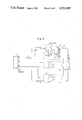
  • FIG. 1 illustrates a circuit of a conventional power supply system and FIG. 2 wave forms at respective portions thereof.
  • a full wave rectifying bridge consisting of diodes D 1 . . . D 6 linked to a 3 phase power source
  • the AC voltages are converted into a DC voltage V DC and, then this DC voltage is introduced into an inverter 2 for inversion into a high frequency wave, which is applied to a load 3.
  • FIG. 3 shows an exemplary circuit of the inverter 2, in which an oscillator circuit is composed of transistors Q1 and Q2 and a transformer T.
  • the load 3 comprises any equipment which utilizes AC power, e.g., motor, etc.
  • the RPM of the motor is controlled by altering the oscillation frequency or output voltage of the inverter 2.
  • the inverter 2 may be omitted. In such a power supply system, since the 3 phase alternating currents at the input are subjected to full wave rectification by diodes D 1 . . . D 6 , comparisons between the input voltages of respective phases are made.
  • the line current wave form I from the 3 phase power source takes the form of a quiescent 1/3 ⁇ radian period and conducting 2/3 ⁇ radian periods during the half cycle, as shown in FIG. 2.
  • the distortion factor of this current I shows as high a value as 27%.
  • a large distortion factor means a large high harmonic component, which naturally results in increased loss in the transformer.
  • the secondary output is delta-connected which causes a short-circuiting current caused by the third high harmonic to flow, thereby further increasing loss.
  • an object of the invention is the provision of a power supply system which obtains at its output a high frequency power with nearly constant amplitude. This is accomplished by inverting the power in a plurality of AC phases into a high frequency power and superposing each in series. In this way, the line current distortion of the 3 phase power source is greatly reduced, thereby attaining smaller loss and a reduction in overall size of the system and higher operating efficiency.
  • FIG. 1 illustrates a circuit of a conventional power supply system
  • FIGS. 2 and 3 are drawings which explain the FIG. 1 system
  • FIG. 4 is a graph explaining the operation principle of the invention.
  • FIG. 5 is a schematic representation of a first embodiment of this invention.
  • FIG. 6 is a graph explaining operation of the FIG. 5 circuit
  • FIG. 7 is a schematic representation of a second embodiment of the invention.
  • FIG. 8 illustrates the application of the present invention to a load comprising a discharge lamp lighting fixture.
  • FIG. 4 shows graphs depicting the operation principle of the invention.
  • V 12 , V 31 and V 23 shown by broken lines denote, respectively, voltages of a 3 phase AC power source represented by sine waves differing 120 degrees (2/3 ⁇ radians) in phase.
  • 3 phase alternating current the sum of the powers in all phases at every instant is always constant and thus not time-dependent.
  • the superposition of respective powers is accomplished by inverting each of the 3 phase AC voltages into a high frequency wave and then superposing the high frequency wave.
  • respective 3 phase AC voltages are converted to respective high frequency waves, all of which have the same frequency and the same zero cross point in time, with the high frequency waves being superposed.
  • the high frequency waves corresponding to the voltages V 23 and V 31 of this example are in phase and the high frequency wave corresponding to the voltage V 12 differs 180 degrees in phase from V 23 and V 31 .
  • there exist only two types of voltages one positive the other negative. It is simple to superpose two alternating currents differing 180 degrees in phase after bringing them into phase. One way this would be done is by merely alternating the connection on the secondary side of the transformer, if used for this purpose.
  • FIG. 5 illustrates a first embodiment of this invention, in which the aforementioned operation principle has been embodied in a physical circuit.
  • an inverter 4 is connected across lines P1 and P2 of a 3 phase power source, the inverter 4 being composed of a rectifier DB, like transistor switching elements Q1 and Q2, an output transformer T, a power source E B for providing control current for the switching elements, and resistances R 1 and R 2 .
  • Inverters 4' and 4" are similarly connected across lines P2 and P3, and P3 and P1. The secondary sides of the output transformers of the respective inverters are connected in series, thereby providing power to the load 3.
  • the inverter 4 is used also as the control to equalize the oscillation frequency of the respective inverters and to make the zero crossing points of the high frequency waves produced by the respective inverters occur at the same time. Accordingly, all the switching signals for the transistors of the inverters 4, 4' and 4" are taken from the inverter 4 and are applied to control terminals of switching elements of the inverters. The high frequency waves shown in FIG. 4 are produced at the output of the switching transistors of the various inverters. If the connections of the secondary side of the transformers T are suitably connected, a series connection can be achieved in which all high frequency waves are in phase.
  • FIG. 5 circuit A description of the operation of the FIG. 5 circuit follows.
  • the inverter 4 is self-excited, but the inverters 4' and 4" are separately excited.
  • the inverter 4 is being self-excited, exactly the same signal which is turning the switching elements of inverter 4 on and off is produced on windings I, I' and II, II'. Since each of these windings is linked to the control terminal of the switching elements of inverter 4' and 4", these inverters will oscillate with the same frequency and timing as the inverter 4, enabling the inverters to have respective high frequency output waves which all have the same frequency and zero cross point timing as discussed earlier with reference to FIG. 4.
  • FIG. 6 illustrates the operation wave forms for the FIG. 5 circuit, showing that a current I12 in phase with the voltage V12 across lines P1 and P2 flows in the inverter 4. Similarly, a current I13 in phase with the voltage V31 flows in inverter 4" and the line current I1 is, then, represented by the sum of these currents I12 and I13.
  • the distortion factor of the line current I1 is, for example, 9%, which corresponds to 1/3 of the distortion which exists in prior art systems, and it is verifiable that this factor can be reduced to as little as 3% by utilizing oscillating type inverters.
  • Other line currents I2 and I3 have the identical form and a phase difference of 120 degrees, respectively. They are capable of supplying the load 3 with a high frequency power with a constant amplitude.
  • FIG. 7 illustrates a second embodiment of this invention in which the outputs from inverters 4, 4' and 4" are superposed in series and then rectified by a rectifier DB' and smoothed with a condenser C, yielding a DC power.
  • the superposed high frequency voltage provides an instantaneous power which is constant independent of time with a constant amplitude and, therefore, only small capacitance is required of the condenser for smoothing.
  • the AC input current distortion is small. For this reason, reduction of loss in the power supply transformer, miniaturization of the whole system and a high efficiency can be achieved.
  • FIG. 8 shows a power supply system of this invention used with a discharge lamp lighting fixture having a series-connected circuit of a choke coil CH and a discharge lamp LA connected as a load.
  • a discharge lamp lighting fixture uses an inverter as a single phase power source
  • the AC input current distortion was found to be on the order of 30%, showing a large adverse effect due to distortion.
  • rectifying and smoothing circuits are necessary to obtain direct current from a single phase power source and the input current will have quiescent time, as described earlier, further creating distortion.
  • the embodiment of this invention which enables a high frequency wave to be obtained with a constant amplitude and reduced AC input current distortion, the luminous efficiency of a discharge lamp can be increased and a power saving achieved.
  • the choke coil CH may be omitted.

Landscapes

  • Engineering & Computer Science (AREA)
  • Power Engineering (AREA)
  • Inverter Devices (AREA)
  • Ac-Ac Conversion (AREA)

Abstract

A power supply system is disclosed in which each of the phases of a three phase AC source are rectified and inverted. During inversion high frequency signals are obtained corresponding to the phases of the AC source which are synchronized so that their zero cross points occur at the same time. The high frequency signals are superposed in series to produce an output signal for a load which has a constant power and diminished current distortion.

Description

BACKGROUND OF THE INVENTION
The present invention relates to a power supply system utilizing a 3 phase power source in which line current distortion is diminished.
FIG. 1 illustrates a circuit of a conventional power supply system and FIG. 2 wave forms at respective portions thereof. Referring to FIG. 1, with a full wave rectifying bridge consisting of diodes D1 . . . D6 linked to a 3 phase power source, the AC voltages are converted into a DC voltage VDC and, then this DC voltage is introduced into an inverter 2 for inversion into a high frequency wave, which is applied to a load 3.
FIG. 3 shows an exemplary circuit of the inverter 2, in which an oscillator circuit is composed of transistors Q1 and Q2 and a transformer T. The load 3, comprises any equipment which utilizes AC power, e.g., motor, etc. In some instances, the RPM of the motor is controlled by altering the oscillation frequency or output voltage of the inverter 2. For equipment which uses DC power, the inverter 2 may be omitted. In such a power supply system, since the 3 phase alternating currents at the input are subjected to full wave rectification by diodes D1 . . . D6, comparisons between the input voltages of respective phases are made. Thus, considering the half cycle of a phase voltage, power is delivered to the load only for the range of 2/3 when the voltage is higher than in the other two phases. As a result, the line current wave form I from the 3 phase power source takes the form of a quiescent 1/3π radian period and conducting 2/3π radian periods during the half cycle, as shown in FIG. 2. The distortion factor of this current I, as actually measured, shows as high a value as 27%. A large distortion factor means a large high harmonic component, which naturally results in increased loss in the transformer. In the 3 phase power source, the secondary output is delta-connected which causes a short-circuiting current caused by the third high harmonic to flow, thereby further increasing loss. For this reason, the efficiency of the power supply transformer declines, permitting only a smaller power than initially designed to be delivered to a load. Conversely, to achieve a desired power output requires a power supply larger than is necessary, which is uneconomical. Since the loss which occurs inside the transformer is mostly converted into heat, the service life of the transformer is shortened. If the transformer is designed for higher heat resistance, an increase in cost results.
As an alternative, a power supply system like that described in U.S. Pat. No. 4,143,414 has been proposed. In this system, to each phase of the 3 phase AC power source, is joined an AC-DC converter composed of a first rectifier, a DC-AC converter and a second rectifier, all connected in series, and the output is delivered by connecting the DC ouputs from respective converters in parallel. Even in this system, voltage comparison is performed because respective second rectifiers are connected in parallel at the final DC output stage. Consequently, an input current quiescent period is produced on the 3 phase AC side, resulting in a higher distortion factor. Thus this system involves a similar deficiency as was involved in the prior art power supply system first described.
The present invention has been designed to overcome the above-mentioned difficulty. Thus, an object of the invention is the provision of a power supply system which obtains at its output a high frequency power with nearly constant amplitude. This is accomplished by inverting the power in a plurality of AC phases into a high frequency power and superposing each in series. In this way, the line current distortion of the 3 phase power source is greatly reduced, thereby attaining smaller loss and a reduction in overall size of the system and higher operating efficiency.
This invention, as well as its features and advantages, will become more apparent from the following description taken with reference to the drawings showing the operation principles and various embodiments.
BRIEF DESCRIPTION OF THE DRAWINGS
FIG. 1 illustrates a circuit of a conventional power supply system;
FIGS. 2 and 3 are drawings which explain the FIG. 1 system;
FIG. 4 is a graph explaining the operation principle of the invention;
FIG. 5 is a schematic representation of a first embodiment of this invention;
FIG. 6 is a graph explaining operation of the FIG. 5 circuit;
FIG. 7 is a schematic representation of a second embodiment of the invention; and
FIG. 8 illustrates the application of the present invention to a load comprising a discharge lamp lighting fixture.
DETAILED DESCRIPTION OF THE INVENTION
FIG. 4 shows graphs depicting the operation principle of the invention. V12, V31 and V23 shown by broken lines denote, respectively, voltages of a 3 phase AC power source represented by sine waves differing 120 degrees (2/3π radians) in phase. As a characteristic feature of 3 phase alternating current, the sum of the powers in all phases at every instant is always constant and thus not time-dependent. For example, in commercial products, which make use of symmetrical 3 phase alternating current, the power is represented by P=3EI cosψ, assuming that the effective values of the ring voltage and ring current are E and I and the power factor is cosψ when the load is in ring connection. Thus a constant power can be supplied to the load while keeping the AC input currents of the 3 phase power source in sine wave form. With a single phase power source, the original power undergoes a change in the sine wave form and this makes it impossible to provide the load with a constant power while curtailing AC input current distortion. The 3 phase full wave rectifying system illustrated as prior art above does not embody use of the feature of constant sum of the powers and thus produces larger distortions of AC input currents.
In order to make the feature of the 3 phase power source available, it is necessary to provide the respective powers of the three phases of the alternating current in superposable form, but if they are superposed in the state of 3 phases, for example, when only a transformer is connected to each phase and the output sides of the 3 transformers are superposed in series, the sum of the voltages will become 0, resulting in inability to supply power to the load. Accordingly, in the present invention the superposition of respective powers is accomplished by inverting each of the 3 phase AC voltages into a high frequency wave and then superposing the high frequency wave.
As shown in FIG. 4, respective 3 phase AC voltages are converted to respective high frequency waves, all of which have the same frequency and the same zero cross point in time, with the high frequency waves being superposed. The high frequency waves corresponding to the voltages V23 and V31 of this example are in phase and the high frequency wave corresponding to the voltage V12 differs 180 degrees in phase from V23 and V31. Thus over a span of time t0, there exist only two types of voltages, one positive the other negative. It is simple to superpose two alternating currents differing 180 degrees in phase after bringing them into phase. One way this would be done is by merely alternating the connection on the secondary side of the transformer, if used for this purpose. Accordingly, it becomes possible to superpose respective 3 phase AC powers in series, enabling the production of a high frequency power output having an amplitude which is constant over time. The constant amplitude results from the inversion of respective three phases of the AC power into high frequency waves which are superposed which achieves the objective of obtaining constant power. This process is identical to converting 3 phase AC power to a constant power independently of time and, thereafter inverting it to a high frequency power without modification, these two operations being performed at once. Thus the method used in the invention permits the AC input current distortion to be greatly curtailed.
FIG. 5 illustrates a first embodiment of this invention, in which the aforementioned operation principle has been embodied in a physical circuit. Describing this circuit with reference to FIG. 5, an inverter 4 is connected across lines P1 and P2 of a 3 phase power source, the inverter 4 being composed of a rectifier DB, like transistor switching elements Q1 and Q2, an output transformer T, a power source EB for providing control current for the switching elements, and resistances R1 and R2. Inverters 4' and 4" are similarly connected across lines P2 and P3, and P3 and P1. The secondary sides of the output transformers of the respective inverters are connected in series, thereby providing power to the load 3. The inverter 4 is used also as the control to equalize the oscillation frequency of the respective inverters and to make the zero crossing points of the high frequency waves produced by the respective inverters occur at the same time. Accordingly, all the switching signals for the transistors of the inverters 4, 4' and 4" are taken from the inverter 4 and are applied to control terminals of switching elements of the inverters. The high frequency waves shown in FIG. 4 are produced at the output of the switching transistors of the various inverters. If the connections of the secondary side of the transformers T are suitably connected, a series connection can be achieved in which all high frequency waves are in phase.
A description of the operation of the FIG. 5 circuit follows. The inverter 4 is self-excited, but the inverters 4' and 4" are separately excited. Thus as the inverter 4 is being self-excited, exactly the same signal which is turning the switching elements of inverter 4 on and off is produced on windings I, I' and II, II'. Since each of these windings is linked to the control terminal of the switching elements of inverter 4' and 4", these inverters will oscillate with the same frequency and timing as the inverter 4, enabling the inverters to have respective high frequency output waves which all have the same frequency and zero cross point timing as discussed earlier with reference to FIG. 4.
FIG. 6 illustrates the operation wave forms for the FIG. 5 circuit, showing that a current I12 in phase with the voltage V12 across lines P1 and P2 flows in the inverter 4. Similarly, a current I13 in phase with the voltage V31 flows in inverter 4" and the line current I1 is, then, represented by the sum of these currents I12 and I13. The distortion factor of the line current I1 is, for example, 9%, which corresponds to 1/3 of the distortion which exists in prior art systems, and it is verifiable that this factor can be reduced to as little as 3% by utilizing oscillating type inverters. Other line currents I2 and I3 have the identical form and a phase difference of 120 degrees, respectively. They are capable of supplying the load 3 with a high frequency power with a constant amplitude.
FIG. 7 illustrates a second embodiment of this invention in which the outputs from inverters 4, 4' and 4" are superposed in series and then rectified by a rectifier DB' and smoothed with a condenser C, yielding a DC power. In this arrangement the superposed high frequency voltage provides an instantaneous power which is constant independent of time with a constant amplitude and, therefore, only small capacitance is required of the condenser for smoothing. As in the first embodiment shown in FIG. 5, the AC input current distortion is small. For this reason, reduction of loss in the power supply transformer, miniaturization of the whole system and a high efficiency can be achieved.
FIG. 8 shows a power supply system of this invention used with a discharge lamp lighting fixture having a series-connected circuit of a choke coil CH and a discharge lamp LA connected as a load. When a discharge lamp lighting fixture uses an inverter as a single phase power source, the AC input current distortion was found to be on the order of 30%, showing a large adverse effect due to distortion. Although it is desirable to keep the amplitude of the high frequency wave constant by using a DC power source in order to elevate the luminous efficiency and thereby achieve a power saving, rectifying and smoothing circuits are necessary to obtain direct current from a single phase power source and the input current will have quiescent time, as described earlier, further creating distortion. That is to say, elevating the luminous efficiency of a discharge lamp, while reducing the AC input current distortion, was impossible with single phase power sources. According to the embodiment of this invention, which enables a high frequency wave to be obtained with a constant amplitude and reduced AC input current distortion, the luminous efficiency of a discharge lamp can be increased and a power saving achieved. In addition, by providing the output transformers inside the inverters 4, 4' and 4" with a magnetic leakage effect, the choke coil CH may be omitted.
As described hereinabove, with the power supply system of this invention equipped with high frequency power inverters for inverting the power in respective phases of a 3 phase power source into high frequency waves and superposing these waves in series with the proper oscillation timings, it is not only possible to make the AC input current distortions very small, but also to obtain a constant power at the output, consequently achieving high efficiency, miniaturization of components and a reduced cost for the power supply transformers. In addition, a significant reduction in noise to the supply lines and reduction or elimination of interference with other equipment may be attained.
Although the foregoing description has been specific to a 3 phase power source as input, it should be appreciated that this invention is applicable in general to polyphase AC voltage inputs.
Moreover, other variants may be made without departing from the spirit and scope of the invention. Accordingly, the foregoing description is merely exemplary of the invention and does not limit it, the invention being defined by the appended claims.

Claims (2)

What is claimed is:
1. A power supply system comprising:
a source providing three phase AC power at a predetermined frequency, said source having output lines respectively corresponding to each of the phases of said AC power;
a plurality of rectifiers connected to respective pairs of said output lines;
a plurality of inverters each connected to an output of a respective one of said rectifiers and comprising an oscillation circuit, each said inverter providing by means of said oscillation circuit an oscillating output signal at a predetermined higher frequency than said predetermined frequency, the output signals of all of said inverters being at the same predetermined higher frequency;
a control means for operating the oscillation circuits of said inverters, said control means synchronizing the oscillation period of the oscillation circuits of the inverters such that the output signals of said inverters have the same zero cross point timing;
means connected to the outputs of said inverters for superposing in series and phase the outputs of said inverters to produce a high frequency power source.
2. A power supply system as in claim 1 further comprising:
a rectifying circuit connected to the output of said superposing means; and,
a smoothing circuit connected to the output of said rectifying circuit.
US06/440,425 1981-11-11 1982-11-09 Power supply system Expired - Fee Related US4533987A (en)

Applications Claiming Priority (2)

Application Number Priority Date Filing Date Title
JP56180679A JPS5883584A (en) 1981-11-11 1981-11-11 Power source device
JP56-180679 1981-11-11

Publications (1)

Publication Number Publication Date
US4533987A true US4533987A (en) 1985-08-06

Family

ID=16087404

Family Applications (1)

Application Number Title Priority Date Filing Date
US06/440,425 Expired - Fee Related US4533987A (en) 1981-11-11 1982-11-09 Power supply system

Country Status (3)

Country Link
US (1) US4533987A (en)
JP (1) JPS5883584A (en)
DE (1) DE3241413A1 (en)

Cited By (20)

* Cited by examiner, † Cited by third party
Publication number Priority date Publication date Assignee Title
US4695933A (en) * 1985-02-11 1987-09-22 Sundstrand Corporation Multiphase DC-DC series-resonant converter
US4713093A (en) * 1985-07-15 1987-12-15 Kraftelektronik Ab Electrostatic dust precipitator
US5008797A (en) * 1989-12-20 1991-04-16 Sundstrand Corporation Power converter utilizing line replaceable units
US5105351A (en) * 1989-06-30 1992-04-14 Kabushiki Kaisha Toshiba X-ray power supply with plural frequency converters
US5367448A (en) * 1992-08-07 1994-11-22 Carroll Lawrence B Three phase AC to DC power converter
WO1997022174A1 (en) * 1995-12-14 1997-06-19 Abb Daimler-Benz Transportation (Sweden) Ab A converter device
US6061256A (en) * 1997-02-10 2000-05-09 Abb Patent Gmbh Apparatus for conversion of a three-phase voltage into an isolated DC voltage
US6262901B1 (en) * 2000-09-29 2001-07-17 Anastastios V. Simopoulos Adjustable DC-to-DC converter with synchronous rectification and digital current sharing
US6307761B1 (en) * 1998-03-23 2001-10-23 Fidelix Y.K. Single stage high power-factor converter
US6377482B1 (en) * 1999-05-17 2002-04-23 Ascom Energy Systems Ag Device and method for line-voltage dependent thyristor controlled pre-charging of output capacitors in a three-level pulse rectifier system
WO2003026112A3 (en) * 2001-09-19 2003-11-20 Cooper Cameron Corp Universal power supply system
US20040140566A1 (en) * 1996-11-21 2004-07-22 Chang-Oh Jeong Composition for a wiring, a wiring using the composition, manufacturing method thereof, a display using the wiring and a manufacturing method thereof
US20040246753A1 (en) * 2001-09-19 2004-12-09 Peter Kunow DC converter
US20040252431A1 (en) * 2001-09-19 2004-12-16 Peter Kunow Universal energy supply system
US20040262998A1 (en) * 2001-09-19 2004-12-30 Peter Kunow Dc voltage converting device
US20050029476A1 (en) * 2000-05-11 2005-02-10 Cooper Cameron Corporation Electric control and supply system
US20050185349A1 (en) * 2000-10-30 2005-08-25 Klaus Biester Control and supply system
US20090160340A1 (en) * 2007-12-25 2009-06-25 Harison Toshiba Lighting Corp. Dielectric barrier discharge lamp lighting device
US20100244561A1 (en) * 2001-09-19 2010-09-30 Cameron International Corporation DC Voltage Converting Device
US8233255B1 (en) 2008-04-01 2012-07-31 Redkoh Industries, Inc. Systems and methods of power conversion for electrostatic precipitators

Citations (2)

* Cited by examiner, † Cited by third party
Publication number Priority date Publication date Assignee Title
US3614461A (en) * 1969-08-11 1971-10-19 Gen Electric Canada Circuit for keeping the frequency of an inverter synchronized with the frequency of another source
US3697717A (en) * 1971-11-19 1972-10-10 Gen Electric Induction cooking appliance with multicylinder power circuits

Family Cites Families (2)

* Cited by examiner, † Cited by third party
Publication number Priority date Publication date Assignee Title
DE2652275A1 (en) * 1976-11-17 1978-05-18 Boehringer Andreas Sinusoidal mains frequency AC extraction - is performed by filter including rectifier and boosts converter with DC intermediate system
US4143414A (en) * 1978-04-10 1979-03-06 General Motors Corporation Three phase ac to dc voltage converter with power line harmonic current reduction

Patent Citations (2)

* Cited by examiner, † Cited by third party
Publication number Priority date Publication date Assignee Title
US3614461A (en) * 1969-08-11 1971-10-19 Gen Electric Canada Circuit for keeping the frequency of an inverter synchronized with the frequency of another source
US3697717A (en) * 1971-11-19 1972-10-10 Gen Electric Induction cooking appliance with multicylinder power circuits

Cited By (41)

* Cited by examiner, † Cited by third party
Publication number Priority date Publication date Assignee Title
US4695933A (en) * 1985-02-11 1987-09-22 Sundstrand Corporation Multiphase DC-DC series-resonant converter
US4713093A (en) * 1985-07-15 1987-12-15 Kraftelektronik Ab Electrostatic dust precipitator
US5105351A (en) * 1989-06-30 1992-04-14 Kabushiki Kaisha Toshiba X-ray power supply with plural frequency converters
US5008797A (en) * 1989-12-20 1991-04-16 Sundstrand Corporation Power converter utilizing line replaceable units
US5367448A (en) * 1992-08-07 1994-11-22 Carroll Lawrence B Three phase AC to DC power converter
WO1997022174A1 (en) * 1995-12-14 1997-06-19 Abb Daimler-Benz Transportation (Sweden) Ab A converter device
US6052293A (en) * 1995-12-14 2000-04-18 Daimlerchrysler Ag Converter device for connection between a single-phase side on a single or multi-phase side
US20040140566A1 (en) * 1996-11-21 2004-07-22 Chang-Oh Jeong Composition for a wiring, a wiring using the composition, manufacturing method thereof, a display using the wiring and a manufacturing method thereof
US6061256A (en) * 1997-02-10 2000-05-09 Abb Patent Gmbh Apparatus for conversion of a three-phase voltage into an isolated DC voltage
US6307761B1 (en) * 1998-03-23 2001-10-23 Fidelix Y.K. Single stage high power-factor converter
US6377482B1 (en) * 1999-05-17 2002-04-23 Ascom Energy Systems Ag Device and method for line-voltage dependent thyristor controlled pre-charging of output capacitors in a three-level pulse rectifier system
US7615893B2 (en) 2000-05-11 2009-11-10 Cameron International Corporation Electric control and supply system
US20050029476A1 (en) * 2000-05-11 2005-02-10 Cooper Cameron Corporation Electric control and supply system
US6262901B1 (en) * 2000-09-29 2001-07-17 Anastastios V. Simopoulos Adjustable DC-to-DC converter with synchronous rectification and digital current sharing
US8212378B2 (en) 2000-10-30 2012-07-03 Cameron International Corporation Control and supply system
US20090296428A1 (en) * 2000-10-30 2009-12-03 Cameron International Corporation Control and supply system
US7576447B2 (en) 2000-10-30 2009-08-18 Cameron International Corporation Control and supply system
US20050185349A1 (en) * 2000-10-30 2005-08-25 Klaus Biester Control and supply system
US8536731B2 (en) 2001-05-07 2013-09-17 Cameron International Corporation Electric control and supply system
US20100019573A1 (en) * 2001-05-07 2010-01-28 Cameron International Corporation Electric control and supply system
GB2396492B (en) * 2001-09-19 2006-08-09 Cooper Cameron Corp Universal power supply system
US20100244561A1 (en) * 2001-09-19 2010-09-30 Cameron International Corporation DC Voltage Converting Device
US7453170B2 (en) 2001-09-19 2008-11-18 Cameron International Corporation Universal energy supply system
WO2003026112A3 (en) * 2001-09-19 2003-11-20 Cooper Cameron Corp Universal power supply system
US20050013148A1 (en) * 2001-09-19 2005-01-20 Peter Kunow Universal power supply system
US20040262998A1 (en) * 2001-09-19 2004-12-30 Peter Kunow Dc voltage converting device
US20040252431A1 (en) * 2001-09-19 2004-12-16 Peter Kunow Universal energy supply system
US20040246753A1 (en) * 2001-09-19 2004-12-09 Peter Kunow DC converter
US8492927B2 (en) 2001-09-19 2013-07-23 Cameron International Corporation Universal power supply system
US7683505B2 (en) 2001-09-19 2010-03-23 Cameron International Corporation Universal energy supply system
US7759827B2 (en) 2001-09-19 2010-07-20 Cameron International Corporation DC voltage converting device having a plurality of DC voltage converting units connected in series on an input side and in parallel on an output side
US7433214B2 (en) 2001-09-19 2008-10-07 Cameron International Corporation DC converter
US7851949B2 (en) 2001-09-19 2010-12-14 Cameron International Corporation DC converter
GB2396492A (en) * 2001-09-19 2004-06-23 Cooper Cameron Corp Universal power supply system
US8106538B2 (en) 2001-09-19 2012-01-31 Cameron International Corporation DC voltage converting device
US8106536B2 (en) 2001-09-19 2012-01-31 Cameron International Corporation Universal power supply system
US8212410B2 (en) 2002-11-12 2012-07-03 Cameron International Corporation Electric control and supply system
US20100019930A1 (en) * 2002-11-12 2010-01-28 Camerson International Corporation Electric Control and Supply System
US7956547B2 (en) * 2007-12-25 2011-06-07 Harison Toshiba Lighting Corp. Dielectric barrier discharge lamp lighting device
US20090160340A1 (en) * 2007-12-25 2009-06-25 Harison Toshiba Lighting Corp. Dielectric barrier discharge lamp lighting device
US8233255B1 (en) 2008-04-01 2012-07-31 Redkoh Industries, Inc. Systems and methods of power conversion for electrostatic precipitators

Also Published As

Publication number Publication date
JPS5883584A (en) 1983-05-19
DE3241413A1 (en) 1983-06-09
DE3241413C2 (en) 1989-05-11

Similar Documents

Publication Publication Date Title
US4533987A (en) Power supply system
US4730243A (en) EMI reduction circuit
US4934822A (en) PWM-controlled power supply capable of eliminating modulation-frequency signal components from ground potentials
JPH10174437A (en) Uninterruptible power supply system
CN110546874B (en) Power conversion system
JPS6268068A (en) power converter
EP1460752A1 (en) A parallel feed-forward compensating type power factor correction circuit for a three-phase power source
JPS58133170A (en) Dc power source device
RU2223590C1 (en) Bridge inverter
JPH01231662A (en) Dc power supply
EP0078864A1 (en) Transistor inverter device
JPH0637375A (en) High frequency power source for laser oscillator
JP2710373B2 (en) Power supply unit continuous energization test method
JPH0746847A (en) Three-phase rectifier
JP2615932B2 (en) High voltage DC power supply
JPH04265A (en) Power converter
JP3315586B2 (en) Boost type three-phase full-wave rectifier and control method thereof
JPH10277739A (en) Power source for arc working
JPH10327583A (en) Inverter device
JPH02174563A (en) Inverter control circuit
KR20020021740A (en) Serial connect type diode rectifier circuit
JPS5926115B2 (en) discharge lamp lighting device
JPS628155Y2 (en)
JPS6030097A (en) Discharge lamp dimming firing device
JPH10136650A (en) Rectifying circuit

Legal Events

Date Code Title Description
AS Assignment

Owner name: MATSUSHITA ELECTRIC WORKS, LTD 1048 OAZA KADOMA KA

Free format text: ASSIGNMENT OF ASSIGNORS INTEREST.;ASSIGNORS:TOMOFUJI, YOSHIAKI;MAEDA, TAKAYOSHI;REEL/FRAME:004401/0984

Effective date: 19850225

FEPP Fee payment procedure

Free format text: PAYOR NUMBER ASSIGNED (ORIGINAL EVENT CODE: ASPN); ENTITY STATUS OF PATENT OWNER: LARGE ENTITY

FPAY Fee payment

Year of fee payment: 4

FPAY Fee payment

Year of fee payment: 8

REMI Maintenance fee reminder mailed
LAPS Lapse for failure to pay maintenance fees
FP Lapsed due to failure to pay maintenance fee

Effective date: 19970806

STCH Information on status: patent discontinuation

Free format text: PATENT EXPIRED DUE TO NONPAYMENT OF MAINTENANCE FEES UNDER 37 CFR 1.362