US4515446A - Zoom objective - Google Patents

Zoom objective Download PDF

Info

Publication number
US4515446A
US4515446A US06/452,122 US45212282A US4515446A US 4515446 A US4515446 A US 4515446A US 45212282 A US45212282 A US 45212282A US 4515446 A US4515446 A US 4515446A
Authority
US
United States
Prior art keywords
lens
lens component
sub
zooming
component
Prior art date
Legal status (The legal status is an assumption and is not a legal conclusion. Google has not performed a legal analysis and makes no representation as to the accuracy of the status listed.)
Expired - Lifetime
Application number
US06/452,122
Inventor
Sadatoshi Takahashi
Sadahiko Tsuji
Akira Tajima
Toshiaki Asano
Setsuo Minami
Current Assignee (The listed assignees may be inaccurate. Google has not performed a legal analysis and makes no representation or warranty as to the accuracy of the list.)
Canon Inc
Original Assignee
Canon Inc
Priority date (The priority date is an assumption and is not a legal conclusion. Google has not performed a legal analysis and makes no representation as to the accuracy of the date listed.)
Filing date
Publication date
Application filed by Canon Inc filed Critical Canon Inc
Assigned to CANON KABUSHIKI KAISHA reassignment CANON KABUSHIKI KAISHA ASSIGNMENT OF ASSIGNORS INTEREST. Assignors: ASANO, TOSHIAKI, MINAMI, SETSUO, TAJIMA, AKIRA, TAKAHASHI, SADATOSHI, TSUJI, SADAHIKO
Application granted granted Critical
Publication of US4515446A publication Critical patent/US4515446A/en
Anticipated expiration legal-status Critical
Expired - Lifetime legal-status Critical Current

Links

Images

Classifications

    • GPHYSICS
    • G02OPTICS
    • G02BOPTICAL ELEMENTS, SYSTEMS OR APPARATUS
    • G02B15/00Optical objectives with means for varying the magnification
    • G02B15/14Optical objectives with means for varying the magnification by axial movement of one or more lenses or groups of lenses relative to the image plane for continuously varying the equivalent focal length of the objective
    • G02B15/144Optical objectives with means for varying the magnification by axial movement of one or more lenses or groups of lenses relative to the image plane for continuously varying the equivalent focal length of the objective having four groups only
    • G02B15/1441Optical objectives with means for varying the magnification by axial movement of one or more lenses or groups of lenses relative to the image plane for continuously varying the equivalent focal length of the objective having four groups only the first group being positive
    • G02B15/144113Optical objectives with means for varying the magnification by axial movement of one or more lenses or groups of lenses relative to the image plane for continuously varying the equivalent focal length of the objective having four groups only the first group being positive arranged +-++
    • GPHYSICS
    • G02OPTICS
    • G02BOPTICAL ELEMENTS, SYSTEMS OR APPARATUS
    • G02B15/00Optical objectives with means for varying the magnification
    • G02B15/14Optical objectives with means for varying the magnification by axial movement of one or more lenses or groups of lenses relative to the image plane for continuously varying the equivalent focal length of the objective
    • G02B15/144Optical objectives with means for varying the magnification by axial movement of one or more lenses or groups of lenses relative to the image plane for continuously varying the equivalent focal length of the objective having four groups only
    • G02B15/1441Optical objectives with means for varying the magnification by axial movement of one or more lenses or groups of lenses relative to the image plane for continuously varying the equivalent focal length of the objective having four groups only the first group being positive
    • G02B15/144105Optical objectives with means for varying the magnification by axial movement of one or more lenses or groups of lenses relative to the image plane for continuously varying the equivalent focal length of the objective having four groups only the first group being positive arranged +-+-

Definitions

  • This invention relates to zoom objectives, and, more particularly, to compact zoom objectives suited (to photographic optical systems) for still cameras, 8 m/m cine cameras, video cameras, etc.
  • This 4-component zoom objective is generally composed of the 1st lens component counting from the object side and is stationary during zooming and axially movable for focusing; the 2nd component is axially movable for varying the overall focal length; the 3rd component is axially movable for compensating the image shift resulting from the movement of the 2nd component; and the 4th component is stationary during zooming and forms an image of magnification satisfying the overall focal length.
  • the 2nd lens component mainly performs the magnification varying effect.
  • the lens system comprises, from front to rear, a 1st lens group of positive power, a 2nd lens group of negative power, a 3rd lens group of positive power and a 4th lens group of positive or negative power, whereby when zooming from the wide angle to the telephoto position, the 1st and 3rd lens groups move forward as a unit, while the 2nd lens group moves rearward.
  • zoom objectives comprising four lens groups of which three are moved to effect zooming, include those specified in U.S. Pat. Nos. 4,240,700 and 4,306,776.
  • An object of the present invention is to improve the above-described drawbacks of the conventional zoom objective, and to provide a 4-component zoom objective which takes a compact form when in the shortest focal length.
  • Another object of the present invention is to provide a zoom objective having an extended range with a high relative aperture and all aberrations well corrected for excellent imaging performance over the extended range.
  • the zoom objective is constructed from a 1st lens group of positive power, a 2nd lens group of negative power, a 3rd lends group of positive power and a 4th lens group of either positive or negative power arranged in this order from front, wherein the aforesaid 1st, 2nd and 3rd lens groups are made movable independently of one another to effect zooming, whereby features of the 2nd lens group are designed so as to allow for the image magnification of the 2nd lens group to vary in a range including that region where the image magnification exceeds unity, in other words, the absolute value of the image magnification is not less than 1.
  • the 1st and 3rd lens groups are made to lie farther from the focal plane, and the 2nd lens group to lie nearer thereto than when in zooming positions for the short focal lengths.
  • a compact, extended-range, high relative aperture zoom objective is achieved.
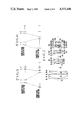
  • FIGS. 1 through 6 are diagrams illustrating different traces of movement of the zoom objective of the invention respectively.
  • FIG. 7 is a longitudinal section of an embodiment of a zoom objective according to the present invention.
  • FIGS. 8-a-1 through 4, 8-b-1 through -4 and 8-c-1 through 4 are graphic representations of the aberrations of the zoom objective of FIG. 7 in different zooming positions.
  • the zoom objective of the present invention has four lens components of which the first three components counting from the front are axially movable in different relation to each other where the image magnification of the 2nd lens component include the unity, and that when zoomed from the short to the long focal length position, the 1st and 3rd components move forward and the 2nd component moves in the opposite direction thereby achieving the above-described objects of the invention.
  • the zoom objective of the invention By moving the 1st lens component forward as zooming is performed from the short to the long focal length position, an object point for the 2nd component can be put nearer thereto so that the image magnification changing effect can be increased. Therefore, the total movement of the 2nd lens component itself can be reduced to effect an equivalent result to that attained by a longer movement thereof. Therefore, it becomes possible to reduce the axial air space between the 2nd and 3rd lens components when in zooming positions for the shortest focal lengths. As a result, the total length of the entire lens system in the shortest focal length position can be shortened. Further, the image magnification of the 2nd lens component includes the unity, (larger than the absolute value of the image magnification value -1).
  • paraxial arrangements according to the present invention.
  • the paraxial arrangement of a 1st embodiment is shown in Table 1, and the locus of zooming movement of each lens component is depicted in FIG. 1.
  • f 1 through f 4 are the focal lengths of the 1st through 4th lens components respectively, e 1 the distance between the principal planes of the 1st and 2nd lens components, e 2 the distance between the principal planes of the 2nd and 3rd lens components, e 3 the distance between the principal planes of the 3rd and 4th lens components, the numerical data for the shortest and longest focal length positions being given.
  • image magnifications ⁇ 2 through ⁇ 4 the 2nd through 4th lens components contribute to a magnification of the entire system for either of the shortest and longest focal lengths. It should be pointed out that the image magnification of the 1st lens component is always zero with respect to an object point at infinity. It is noted from Table 1 that the 2nd and 3rd lens components in use contribute the respective range of magnifications each across units.
  • An example of a specific thick zoom objective having the same zooming locus as that of FIG. 1 can be constructed in accordance with the following numerical data for the radii of curvature, R, the axial thicknesses and air spaces, D, and the refractive indices, N, and Abbe numbers, ⁇ , of the glasses of the respective lens elements with subscripts numbered consecutively from front to rear.
  • FIG. 7 there is illustrated a sectional view of this specific zoom objective in the intermediate focal length position. Further, the aberrations are shown in FIGS. 8-a-1 through 4, FIGS. 8-b-1 through 4 and FIGS. 8-c-1 through 4 where (a) designates the shortest focal length position, (b) the intermediate focal length position and (c) the longest focal length position.
  • the total optical length when in the shortest focal length setting is 95.0 mm, and when in the longest focal length setting, 108.7 mm, and the telephoto ratio is 1.47.
  • total optical length herein used means the distance from the front vertex of the lens system to the image plane
  • telephoto ratio means the value obtained by dividing the smallest total optical length by the longest focal length.
  • the lens system disclosed in Japanese Pat. No. Sho 41-13667 has the total optical lengths of 103.86 mm in the shortest focal length setting and 116.63 mm in the longest focal length setting with the telephoto ratio of 2.29. It is evident from comparison with this conventional numerical example that the present invention has achieved a valuable reduction in the size of the zoom objective.
  • Table 2 shows the paraxial arrangement of the 2nd embodiment, and the locus of zooming movement of each component is illustrated in FIG. 2. It is noticed that as illustrated in FIG. 2, when zooming from the shortest focal length position, the 1st lens component at first moves slightly toward the rear and then moves toward the front.
  • the 3rd embodiment has the paraxial arrangement shown in Table 3 below and the locus of movement of each component illustrated in FIG. 3.
  • the image magnification of the 3rd lens component is used within the limitation not exceeding unity.
  • the 1st lens component moves most forward when zoomed to intermediate positions, and then moves rearward to a farther position for the longest focal length than that for the shortest focal length. Such positioning of the 1st lens component for the longest focal length contributes to an improvement of the magnification changing effect of the 2nd lens component.
  • the 4th embodiment has the paraxial arrangement shown in Table 4 below with the locus of movement of each component in FIG. 4.
  • the image magnification of the 3rd lens component is used in a range exceeding unity.
  • the paraxial arrangement of the 5th embodiment is shown in Table 5 with the locus of movement of each component in FIG. 5.
  • This embodiment is adapted to have the 4th lens component of negative power.
  • the 3rd lens component is non-linearly moved to play a role of serving as the compensator for maintaining the constant image plane.
  • the 3rd lens component is most forward toward the object when in the intermediate focal length positions, and more rearward toward the image when in the longest focal length position than that when in the intermediate positions. But, the positioning of the 3rd lens component more forward when in the longest focal length setting than when in the shortest one heightens the magnification changing effect.

Landscapes

  • Physics & Mathematics (AREA)
  • General Physics & Mathematics (AREA)
  • Optics & Photonics (AREA)
  • Lenses (AREA)

Abstract

A zoom objective comprising four lens groups of which the first three lens groups counting from the object side are movable for zooming, whereby the refractive powers and the conditions of zooming movement of the aforesaid three lens groups are properly specified so as to improve the compactness while still maintaining good correction of aberrations.

Description

BACKGROUND OF THE INVENTION
1. Field of the Invention
This invention relates to zoom objectives, and, more particularly, to compact zoom objectives suited (to photographic optical systems) for still cameras, 8 m/m cine cameras, video cameras, etc.
2. Description of the Prior Art
In the past, there have been many proposals for zoom objectives composed of four lens components (or groups), or so-called 4-component zoom objectives. This 4-component zoom objective is generally composed of the 1st lens component counting from the object side and is stationary during zooming and axially movable for focusing; the 2nd component is axially movable for varying the overall focal length; the 3rd component is axially movable for compensating the image shift resulting from the movement of the 2nd component; and the 4th component is stationary during zooming and forms an image of magnification satisfying the overall focal length. In such a type of zoom objective, the 2nd lens component mainly performs the magnification varying effect. Since the total zooming movement is determined by the focal length of the 2nd lens component, therefore, the increase in the zooming ratio calls for an increase of the total movement of the 2nd lens component. For this reason, a large space for the movement of 2nd and 3rd lens components is required, thus producing a drawback that the total length of the lens system is unavoidably increased. Another drawback of the zoom objective of the type described is that, as the zoom ratio increases, the physical dimensions of any part of the overall lens system must be increased.
Attempts have been made to improve these drawbacks so that it is possible to design a zoom objective of an increased zoom ratio while still permitting a minimization of the bulk and size of the entire lens system by means such as disclosed in Japanese Patent Publication No. Sho 41-13667 (U.S. Pat. No. 3,481,666). According to this prior art, the lens system comprises, from front to rear, a 1st lens group of positive power, a 2nd lens group of negative power, a 3rd lens group of positive power and a 4th lens group of positive or negative power, whereby when zooming from the wide angle to the telephoto position, the 1st and 3rd lens groups move forward as a unit, while the 2nd lens group moves rearward. However, this type of zoom objective becomes impossible to maintain the image plane constant where the image magnification of the 2nd lens group exceeds unity, or the absolute value of image magnification becomes not less than 1, and, therefore, to provide an optical system of constant image plane. This fact has first been found out by the applicant of this patent application. This is the very essential cause which prohibits increase of the zoom ratio of this type of zoom objective and further reduction of the bulk and size of the lens system.
Other zoom objectives comprising four lens groups of which three are moved to effect zooming, include those specified in U.S. Pat. Nos. 4,240,700 and 4,306,776.
SUMMARY OF THE INVENTION
An object of the present invention is to improve the above-described drawbacks of the conventional zoom objective, and to provide a 4-component zoom objective which takes a compact form when in the shortest focal length.
Another object of the present invention is to provide a zoom objective having an extended range with a high relative aperture and all aberrations well corrected for excellent imaging performance over the extended range.
To achieve these objects, according to the present invention, the zoom objective is constructed from a 1st lens group of positive power, a 2nd lens group of negative power, a 3rd lends group of positive power and a 4th lens group of either positive or negative power arranged in this order from front, wherein the aforesaid 1st, 2nd and 3rd lens groups are made movable independently of one another to effect zooming, whereby features of the 2nd lens group are designed so as to allow for the image magnification of the 2nd lens group to vary in a range including that region where the image magnification exceeds unity, in other words, the absolute value of the image magnification is not less than 1. Further in zooming positions for the long focal lengths, the 1st and 3rd lens groups are made to lie farther from the focal plane, and the 2nd lens group to lie nearer thereto than when in zooming positions for the short focal lengths. Thus, a compact, extended-range, high relative aperture zoom objective is achieved.
BRIEF DESCRIPTION OF THE DRAWINGS
FIGS. 1 through 6 are diagrams illustrating different traces of movement of the zoom objective of the invention respectively.
FIG. 7 is a longitudinal section of an embodiment of a zoom objective according to the present invention.
FIGS. 8-a-1 through 4, 8-b-1 through -4 and 8-c-1 through 4 are graphic representations of the aberrations of the zoom objective of FIG. 7 in different zooming positions.
DETAILED DESCRIPTION OF THE PREFERRED EMBODIMENTS
The zoom objective of the present invention has four lens components of which the first three components counting from the front are axially movable in different relation to each other where the image magnification of the 2nd lens component include the unity, and that when zoomed from the short to the long focal length position, the 1st and 3rd components move forward and the 2nd component moves in the opposite direction thereby achieving the above-described objects of the invention.
The features of the zoom objective of the invention will next be described. By moving the 1st lens component forward as zooming is performed from the short to the long focal length position, an object point for the 2nd component can be put nearer thereto so that the image magnification changing effect can be increased. Therefore, the total movement of the 2nd lens component itself can be reduced to effect an equivalent result to that attained by a longer movement thereof. Therefore, it becomes possible to reduce the axial air space between the 2nd and 3rd lens components when in zooming positions for the shortest focal lengths. As a result, the total length of the entire lens system in the shortest focal length position can be shortened. Further, the image magnification of the 2nd lens component includes the unity, (larger than the absolute value of the image magnification value -1). Therefore remarkable variation of the magnification of the 2nd lens component due to the shift of the object point for the 2nd lens component (the image point of the 1st lens component) as compared with the image magnification of the 2nd lens component below the unity can be obtained. That is, the variation of image magnification of the 2nd lens component across unity makes it possible to obtain a large magnification varying effect by the shorter total movement of the 2nd lens component. According to the prior art, however, as the 1st and 3rd lens components move as a unit, when the 2nd lens component exceeds unity, no solution of the image shift compensating equation is in existence. Unlike this, when the 1st and 3rd lens components are moved in different relation, it is made possible to maintain the constant image plane despite the 2nd lens component is used in excess of unity. Since the magnification varying efficiency of the 2nd and 3rd lens components are made the highest, the total length of the entire system can therefore be reduced remarkably. It is to be noted that the 4th lens component is stationary during zooming, and therefore this invention is effective whether the power of the 4th lens component is positive or negative.
Next there are illustrated paraxial arrangements according to the present invention. The paraxial arrangement of a 1st embodiment is shown in Table 1, and the locus of zooming movement of each lens component is depicted in FIG. 1. f1 through f4 are the focal lengths of the 1st through 4th lens components respectively, e1 the distance between the principal planes of the 1st and 2nd lens components, e2 the distance between the principal planes of the 2nd and 3rd lens components, e3 the distance between the principal planes of the 3rd and 4th lens components, the numerical data for the shortest and longest focal length positions being given. There are also listed image magnifications β2 through β4 the 2nd through 4th lens components contribute to a magnification of the entire system for either of the shortest and longest focal lengths. It should be pointed out that the image magnification of the 1st lens component is always zero with respect to an object point at infinity. It is noted from Table 1 that the 2nd and 3rd lens components in use contribute the respective range of magnifications each across units.
              TABLE 1                                                     
______________________________________                                    
Focal Length of                                                           
             Shortest Focal                                               
                         Longest Focal                                    
Entire System                                                             
             Length Setting                                               
                         Length Setting                                   
______________________________________                                    
             11.275      64.35                                            
f.sub.1      63.00                                                        
f.sub.2      -14.81                                                       
f.sub.3      23.85                                                        
f.sub.4      37.86                                                        
e.sub.1      8.00        36.71                                            
e.sub.2      33.03       8.00                                             
e.sub.3      17.89       30.07                                            
β.sub.2 -0.368      -1.289                                           
β.sub.3 -0.810      -1.321                                           
β.sub.4 0.600       0.600                                            
______________________________________                                    
 wherein:                                                                 
 f1 through f4 are the focal lengths of the 1st through 4th lens component
 respectively;                                                            
 e1 is the distance between the principal planes of the 1st and 2nd lens  
 components;                                                              
 e2 is the distance between the principal planes of the 2nd and 3rd lens  
 components;                                                              
 e3 is the distance between the principal planes of the 3rd and 4th lens  
 component; and                                                           
 β2 through β4 are the image magnifications for the 2nd through 
 4th lens components.                                                     
An example of a specific thick zoom objective having the same zooming locus as that of FIG. 1 can be constructed in accordance with the following numerical data for the radii of curvature, R, the axial thicknesses and air spaces, D, and the refractive indices, N, and Abbe numbers, ν, of the glasses of the respective lens elements with subscripts numbered consecutively from front to rear.
______________________________________                                    
Focal Length: 11.275-64.35 F-number: 1:1.4                                
Image Angle = 58 - 10.8°                                           
R1 = 154.762                                                              
           D1 = 2.15    N1 = 1.80518 ν1 = 25.4                         
R2 = 49.927                                                               
           D2 = 10.50   N2 = 1.51633 ν2 = 64.1                         
R3 = -174.969                                                             
           D3 = 0.15                                                      
R4 = 46.034                                                               
           D4 = 6.50    N3 = 1.69680 ν3 = 55.5                         
R5 = 400.457                                                              
           D5 = Variable                                                  
R6 = 60.091                                                               
           D6 = 1.10    N4 = 1.77250 ν4 = 49.6                         
R7 = 16.952                                                               
           D7 = 5.54                                                      
R8 = -18.446                                                              
           D8 = 1.10    N5 = 1.77250 ν5 = 49.6                         
R9 = 27.383                                                               
           D9 = 4.00    N6 = 1.84666 ν6 = 23.9                         
R10 = -111.505                                                            
           D10 = Variable                                                 
R11 = 209.999                                                             
           D11 = 3.00   N7 = 1.77250 ν7 = 49.6                         
R12 = -41.363                                                             
           D12 = 0.15                                                     
R13 = 31.501                                                              
           D13 = 4.20   N8 = 1.78590 ν8 =  44.2                        
R14 = -62.815                                                             
           D14 = 1.00   N9 = 1.84666 ν9 = 23.9                         
R15 = 173.867                                                             
           D15 = Variable                                                 
R16 = 0.0  D16 = 1.00                                                     
R17 = 14.799                                                              
           D17 = 2.20   N10 = 1.65160 ν10 = 58.6                       
R18 = 19.175                                                              
           D18 = 0.15                                                     
R19 = 9.781                                                               
           D19 = 2.20   N11 = 1.60311 ν11 = 60.7                       
R20 = 17.041                                                              
           D20 = 1.50                                                     
R21 = 51.584                                                              
           D21 = 1.00   N12 = 1.84666 ν12 = 23.9                       
R22 = 8.196                                                               
           D22 = 5.04                                                     
R23 = 31.529                                                              
           D23 = 0.80   N13 = 1.60342 ν13 = 38.0                       
R24 = 14.583                                                              
           D24 = 3.00   N14 = 1.66672 ν14 = 48.3                       
R25 = -19.379                                                             
______________________________________                                    
Thick Lens Separations during Zooming                                     
with Object at Infinity                                                   
Focal Length                                                              
            D5          D10     D15                                       
______________________________________                                    
 11.275      0.664      26.005  1.00                                      
29.66       20.758      13.492  7.091                                     
64.35       29.372       0.980  13.182                                    
______________________________________                                    
In FIG. 7, there is illustrated a sectional view of this specific zoom objective in the intermediate focal length position. Further, the aberrations are shown in FIGS. 8-a-1 through 4, FIGS. 8-b-1 through 4 and FIGS. 8-c-1 through 4 where (a) designates the shortest focal length position, (b) the intermediate focal length position and (c) the longest focal length position. In this specific embodiment, the total optical length when in the shortest focal length setting is 95.0 mm, and when in the longest focal length setting, 108.7 mm, and the telephoto ratio is 1.47. The term "total optical length" herein used means the distance from the front vertex of the lens system to the image plane, and the term "telephoto ratio" means the value obtained by dividing the smallest total optical length by the longest focal length. Unlike this, the lens system disclosed in Japanese Pat. No. Sho 41-13667, has the total optical lengths of 103.86 mm in the shortest focal length setting and 116.63 mm in the longest focal length setting with the telephoto ratio of 2.29. It is evident from comparison with this conventional numerical example that the present invention has achieved a valuable reduction in the size of the zoom objective.
Table 2 shows the paraxial arrangement of the 2nd embodiment, and the locus of zooming movement of each component is illustrated in FIG. 2. It is noticed that as illustrated in FIG. 2, when zooming from the shortest focal length position, the 1st lens component at first moves slightly toward the rear and then moves toward the front.
              TABLE 2                                                     
______________________________________                                    
Focal Length of                                                           
             Shortest Focal                                               
                         Longest Focal                                    
Entire System                                                             
             Length Setting                                               
                         Length Setting                                   
______________________________________                                    
             11.00       66.0                                             
f.sub.1      60.00                                                        
f.sub.2      -14.00                                                       
f.sub.3      21.99                                                        
f.sub.4      74.04                                                        
e.sub.1      8.00        34.48                                            
e.sub.2      33.80       8.00                                             
e.sub.3      6.00        18.77                                            
β.sub.2 -0.368      -1.216                                           
β.sub.3 -0.710      -1.291                                           
β.sub.4 0.701       0.701                                            
______________________________________                                    
 wherein:                                                                 
 f1 through f4 are the focal lengths of the 1st through 4th lens component
 respectively;                                                            
 e1 is the distance between the principal planes of the 1st and 2nd lens  
 components;                                                              
 e2 is the distance between the principal planes of the 2nd and 3rd lens  
 components;                                                              
 e3 is the distance between the principal planes of the 3rd and 4th lens  
 component; and                                                           
 β2 through β4 are the image agnifications for the 2d through 4t
 lens components.                                                         
The 3rd embodiment has the paraxial arrangement shown in Table 3 below and the locus of movement of each component illustrated in FIG. 3. In this embodiment, the image magnification of the 3rd lens component is used within the limitation not exceeding unity. The 1st lens component moves most forward when zoomed to intermediate positions, and then moves rearward to a farther position for the longest focal length than that for the shortest focal length. Such positioning of the 1st lens component for the longest focal length contributes to an improvement of the magnification changing effect of the 2nd lens component.
              TABLE 3                                                     
______________________________________                                    
Focal Length of                                                           
             Shortest Focal                                               
                         Longest Focal                                    
Entire System                                                             
             Length Setting                                               
                         Length Setting                                   
______________________________________                                    
             11.00       66.0                                             
f.sub.1      60.00                                                        
f.sub.2      -14.00                                                       
f.sub.3      21.99                                                        
f.sub.4      74.04                                                        
e.sub.1      8.00        37.16                                            
e.sub.2      33.79       8.00                                             
e.sub.3      6.00        12.17                                            
β.sub.2 -0.368      -1.584                                           
β.sub.3 -0.710      -0.991                                           
β.sub.4 0.701       0.701                                            
______________________________________                                    
 wherein:                                                                 
 f1 through f4 are the focal lengths of the 1st through 4th lens component
 respectively;                                                            
 e1 is the distance between the principal planes of the 1st and 2nd lens  
 components;                                                              
 e2 is the distance between the principal planes of the 2nd and 3rd lens  
 components;                                                              
 e3 is the distance between the principal planes of the 3rd and 4th lens  
 component; and                                                           
 β2 through β4 are the image magnifications for the 2d through  
 4th lens components.                                                     
The 4th embodiment has the paraxial arrangement shown in Table 4 below with the locus of movement of each component in FIG. 4. In this embodiment, the image magnification of the 3rd lens component is used in a range exceeding unity.
              TABLE 4                                                     
______________________________________                                    
Focal Length of                                                           
             Shortest Focal                                               
                         Longest Focal                                    
Entire System                                                             
             Length Setting                                               
                         Length Setting                                   
______________________________________                                    
             11.00       66.0                                             
f.sub.1      63.00                                                        
f.sub.2      -14.00                                                       
f.sub.3      25.79                                                        
f.sub.4      40.52                                                        
e.sub.1      11.00       39.95                                            
e.sub.2      32.17       8.00                                             
e.sub.3      6.00        17.16                                            
β.sub.2 -0.368      -1.547                                           
β.sub.3 -1.01       -1.443                                           
β.sub.4 0.469       0.469                                            
______________________________________                                    
 wherein:                                                                 
 f1 through f4 are the focal lengths of the 1st through 4th lens component
 respectively;                                                            
 e1 is the distance between the principal planes of the 1st and 2nd lens  
 components;                                                              
 e2 is the distance between the principal planes of the 2nd and 3rd lens  
 components;                                                              
 e3 is the distance between the principal planes of the 3rd and 4th lens  
 component; and                                                           
  β2 through β4 are the image magnifications for the 2d through 
 4th lens components.                                                     
The paraxial arrangement of the 5th embodiment is shown in Table 5 with the locus of movement of each component in FIG. 5. This embodiment is adapted to have the 4th lens component of negative power. It is also to be noted that the 3rd lens component is non-linearly moved to play a role of serving as the compensator for maintaining the constant image plane. The 3rd lens component is most forward toward the object when in the intermediate focal length positions, and more rearward toward the image when in the longest focal length position than that when in the intermediate positions. But, the positioning of the 3rd lens component more forward when in the longest focal length setting than when in the shortest one heightens the magnification changing effect.
              TABLE 5                                                     
______________________________________                                    
Focal Length of                                                           
             Shortest Focal                                               
                         Longest Focal                                    
Entire System                                                             
             Length Setting                                               
                         Length Setting                                   
______________________________________                                    
             11.0        66.7                                             
f.sub.1      66.0                                                         
f.sub.2      -13.34                                                       
f.sub.3      13.44                                                        
f.sub.4      -45.57                                                       
e.sub.1      8.00        40.72                                            
e.sub.2      29.64       5.87                                             
e.sub.3      6.00        9.35                                             
β.sub.2 -0.299      -1.117                                           
β.sub.3 -0.401      -0.650                                           
β.sub.4 1.392       1.392                                            
______________________________________                                    
 wherein:                                                                 
 f1 through f4 are the focal lengths of the 1st through 4th lens component
 respectively;                                                            
 e1 is the distance between the principal planes of the 1st and 2nd lens  
 components;                                                              
 e2 is the distance between the principal planes of the 2nd and 3rd lens  
 components;                                                              
 e3 is the distance between the principal planes of the 3rd and 4th lens  
 component; and                                                           
 β2 through β4 are the image magnifications for the 2d through  
 4th lens components.                                                     
Though the foregoing embodiments each have been represented in such form that either one of the 1st through 3rd lens components is non-linearized, it is also possible to non-linearize the locus of movement of two or all of them. The latter will be put into practice in the view point that the cam shape is more smoothed, and a naturalness of the magnification changing effect is obtained. A practical example of the locus of movement of this zoom lens is illustrated in FIG. 6. The lens components in the zoom lens of FIG. 6 are given exactly the same powers as those shown in FIG. 2. When zooming from the shortest to the longest focal length position, the 1st lens component moves monotonously forward non-linearly the 2nd lens component moves monotonously rearward non-linearly, and the 3rd lens component moves monotonously forward linearly.

Claims (5)

What we claim:
1. A zoom objective comprising:
from front to rear, a first positive lens component, a second negative lens component, a third positive lens component and a fourth lens component;
said first, second and third lens components moving independently of one another when zooming, and said fourth lens component being held stationary during zooming;
said first and third lens components lying more toward the front when in the telephoto side than when in the wide angle side, and said second lens component lying more toward the rear when in the telephoto side than when in the wide angle side; and
said second lens component being arranged to move in such a way that its magnification power varies to exceed unity.
2. A zoom objective according to claim 1, wherein said first lens component moves first toward the front and then toward the rear as zooming is being performed from the wide angle to the telephoto position.
3. A zoom objective according to claim 1, wherein said first lens component takes the frontmost position at an intermediate point in the zooming range.
4. A zoom objective according to claim 1, wherein said third lens component takes the frontmost position at an intermediate point in the zooming range.
5. A zoom objective according to claim 4, wherein said fourth lens component has a negative refractive power.
US06/452,122 1981-12-29 1982-12-22 Zoom objective Expired - Lifetime US4515446A (en)

Applications Claiming Priority (2)

Application Number Priority Date Filing Date Title
JP56-212994 1981-12-29
JP56212994A JPS58116509A (en) 1981-12-29 1981-12-29 zoom lens

Publications (1)

Publication Number Publication Date
US4515446A true US4515446A (en) 1985-05-07

Family

ID=16631703

Family Applications (1)

Application Number Title Priority Date Filing Date
US06/452,122 Expired - Lifetime US4515446A (en) 1981-12-29 1982-12-22 Zoom objective

Country Status (2)

Country Link
US (1) US4515446A (en)
JP (1) JPS58116509A (en)

Cited By (6)

* Cited by examiner, † Cited by third party
Publication number Priority date Publication date Assignee Title
US4687303A (en) * 1983-07-14 1987-08-18 Canon Kabushiki Kaisha Zoom lens system
US4696553A (en) * 1982-03-04 1987-09-29 Canon Kabushiki Kaisha Zoom lens having a large zoom ratio
US4749265A (en) * 1983-07-14 1988-06-07 Canon Kabushiki Kaisha Zoom lens
US6353506B1 (en) * 1999-08-19 2002-03-05 Ricoh Company, Ltd. Compact zoom lens and a camera using the zoom lens
US20070014025A1 (en) * 2005-04-22 2007-01-18 Canon Kabushiki Kaisha Optical system
US20150260968A1 (en) * 2014-03-11 2015-09-17 Kazuyasu Ohashi Zoom lens unit, imaging device, and monitoring video camera

Families Citing this family (2)

* Cited by examiner, † Cited by third party
Publication number Priority date Publication date Assignee Title
JP3100693B2 (en) * 1990-10-09 2000-10-16 旭光学工業株式会社 Variable magnification projection lens
JPH05107477A (en) * 1991-10-15 1993-04-30 Nikon Corp Telescoping zoom lens constructed with five groups of lenses

Citations (3)

* Cited by examiner, † Cited by third party
Publication number Priority date Publication date Assignee Title
FR1404284A (en) * 1963-08-27 1965-06-25 Nippon Kogaku Kk Vari-focal lens with large aperture and large variation ratio
US4240700A (en) * 1977-07-30 1980-12-23 Asahi Kogaku Kabushiki Kaisha Wide angle zoom lens having a high variation ratio
JPS57169716A (en) * 1981-04-10 1982-10-19 Minolta Camera Co Ltd Zoom lens system of high variable magnification including wide angle region

Family Cites Families (1)

* Cited by examiner, † Cited by third party
Publication number Priority date Publication date Assignee Title
JPS554022A (en) * 1978-06-23 1980-01-12 Canon Inc Expanding method for variable power range and zoom lens system

Patent Citations (3)

* Cited by examiner, † Cited by third party
Publication number Priority date Publication date Assignee Title
FR1404284A (en) * 1963-08-27 1965-06-25 Nippon Kogaku Kk Vari-focal lens with large aperture and large variation ratio
US4240700A (en) * 1977-07-30 1980-12-23 Asahi Kogaku Kabushiki Kaisha Wide angle zoom lens having a high variation ratio
JPS57169716A (en) * 1981-04-10 1982-10-19 Minolta Camera Co Ltd Zoom lens system of high variable magnification including wide angle region

Cited By (9)

* Cited by examiner, † Cited by third party
Publication number Priority date Publication date Assignee Title
US4696553A (en) * 1982-03-04 1987-09-29 Canon Kabushiki Kaisha Zoom lens having a large zoom ratio
US4687303A (en) * 1983-07-14 1987-08-18 Canon Kabushiki Kaisha Zoom lens system
US4749265A (en) * 1983-07-14 1988-06-07 Canon Kabushiki Kaisha Zoom lens
US6353506B1 (en) * 1999-08-19 2002-03-05 Ricoh Company, Ltd. Compact zoom lens and a camera using the zoom lens
US20070014025A1 (en) * 2005-04-22 2007-01-18 Canon Kabushiki Kaisha Optical system
US7426079B2 (en) * 2005-04-22 2008-09-16 Canon Kabushiki Kaisha Optical system
US20150260968A1 (en) * 2014-03-11 2015-09-17 Kazuyasu Ohashi Zoom lens unit, imaging device, and monitoring video camera
US9671597B2 (en) * 2014-03-11 2017-06-06 Ricoh Company, Ltd. Zoom lens unit, imaging device, and monitoring video camera
US10215973B2 (en) 2014-03-11 2019-02-26 Ricoh Company, Ltd. Zoom lens unit, imaging device, and monitoring video camera

Also Published As

Publication number Publication date
JPS58116509A (en) 1983-07-11

Similar Documents

Publication Publication Date Title
US5253113A (en) Wide-angle zoom lens having five lens units
US4838666A (en) Wide angle zoom lens of long back focal distance
US5042927A (en) Compact zoom lens
US4934796A (en) Zoom lens
US5050972A (en) Zoom lens
US4830477A (en) Zoom lens capable of obtaining focal lengths beyond a variable focal length range
US5337187A (en) Zoom lens system
US4776679A (en) Objective of variable focal length
US5299064A (en) Zoom lens of rear focus type
US5341243A (en) Zoom lens of rear focus type
US5111338A (en) Zoom Lens
US4687302A (en) Zoom lens
US5189557A (en) High variable magnification range zoom lens
US6061186A (en) Zoom lens
US4720180A (en) High magnification range zoom lens
US5530592A (en) Zoom lens of rear focus type
US5363242A (en) Zoom lens of rear focus type
US4639096A (en) High range zoom lens
US4991942A (en) Zoom lens
US5528427A (en) Zoom lens
JPH0519169A (en) Zoom lens
US4749266A (en) Compact zoom lens having a large aperture and good aberation correction over an extended zooming range
JPH07113957A (en) Inner focus type zoom lens
US5699198A (en) Internal focusing zoom lens system
US5095387A (en) Zoom lens

Legal Events

Date Code Title Description
AS Assignment

Owner name: CANON KABUSHIKI KAISHA; NO. 3-30-2, SHIMOMARUKO, O

Free format text: ASSIGNMENT OF ASSIGNORS INTEREST.;ASSIGNORS:TAKAHASHI, SADATOSHI;TSUJI, SADAHIKO;TAJIMA, AKIRA;AND OTHERS;REEL/FRAME:004079/0800

Effective date: 19821202

STCF Information on status: patent grant

Free format text: PATENTED CASE

FEPP Fee payment procedure

Free format text: PAYOR NUMBER ASSIGNED (ORIGINAL EVENT CODE: ASPN); ENTITY STATUS OF PATENT OWNER: LARGE ENTITY

FPAY Fee payment

Year of fee payment: 4

FPAY Fee payment

Year of fee payment: 8

FPAY Fee payment

Year of fee payment: 12