US4512948A - Method for making poly(ethylene terephthalate) article - Google Patents
Method for making poly(ethylene terephthalate) article Download PDFInfo
- Publication number
- US4512948A US4512948A US06/354,473 US35447382A US4512948A US 4512948 A US4512948 A US 4512948A US 35447382 A US35447382 A US 35447382A US 4512948 A US4512948 A US 4512948A
- Authority
- US
- United States
- Prior art keywords
- temperature
- article
- heat setting
- shrinkage
- mold
- Prior art date
- Legal status (The legal status is an assumption and is not a legal conclusion. Google has not performed a legal analysis and makes no representation as to the accuracy of the status listed.)
- Expired - Lifetime
Links
- -1 poly(ethylene terephthalate) Polymers 0.000 title claims abstract description 62
- 238000000034 method Methods 0.000 title claims abstract description 48
- 229920000139 polyethylene terephthalate Polymers 0.000 title claims abstract description 34
- 239000005020 polyethylene terephthalate Substances 0.000 title claims abstract description 32
- 238000009998 heat setting Methods 0.000 claims abstract description 68
- 238000001816 cooling Methods 0.000 claims abstract description 23
- 238000010791 quenching Methods 0.000 claims description 27
- 238000010438 heat treatment Methods 0.000 claims description 22
- 238000000071 blow moulding Methods 0.000 claims description 12
- 230000000171 quenching effect Effects 0.000 claims description 12
- 238000002425 crystallisation Methods 0.000 claims description 8
- 230000008025 crystallization Effects 0.000 claims description 8
- 239000004033 plastic Substances 0.000 claims description 6
- 229920003023 plastic Polymers 0.000 claims description 6
- 238000004519 manufacturing process Methods 0.000 claims description 3
- 230000008569 process Effects 0.000 abstract description 28
- CURLTUGMZLYLDI-UHFFFAOYSA-N Carbon dioxide Chemical compound O=C=O CURLTUGMZLYLDI-UHFFFAOYSA-N 0.000 description 24
- 239000007789 gas Substances 0.000 description 22
- 229910002092 carbon dioxide Inorganic materials 0.000 description 13
- IJGRMHOSHXDMSA-UHFFFAOYSA-N Atomic nitrogen Chemical compound N#N IJGRMHOSHXDMSA-UHFFFAOYSA-N 0.000 description 12
- QVGXLLKOCUKJST-UHFFFAOYSA-N atomic oxygen Chemical compound [O] QVGXLLKOCUKJST-UHFFFAOYSA-N 0.000 description 11
- 239000001569 carbon dioxide Substances 0.000 description 11
- 239000001301 oxygen Substances 0.000 description 11
- 229910052760 oxygen Inorganic materials 0.000 description 11
- 239000000047 product Substances 0.000 description 11
- 238000012360 testing method Methods 0.000 description 10
- XLYOFNOQVPJJNP-UHFFFAOYSA-N water Substances O XLYOFNOQVPJJNP-UHFFFAOYSA-N 0.000 description 10
- 238000007664 blowing Methods 0.000 description 8
- 229920000642 polymer Polymers 0.000 description 6
- 230000008901 benefit Effects 0.000 description 5
- 229920001577 copolymer Polymers 0.000 description 5
- 230000035699 permeability Effects 0.000 description 5
- WERYXYBDKMZEQL-UHFFFAOYSA-N butane-1,4-diol Chemical compound OCCCCO WERYXYBDKMZEQL-UHFFFAOYSA-N 0.000 description 4
- 229910001873 dinitrogen Inorganic materials 0.000 description 4
- 238000011049 filling Methods 0.000 description 4
- 229910052757 nitrogen Inorganic materials 0.000 description 4
- 239000000654 additive Substances 0.000 description 3
- 230000004888 barrier function Effects 0.000 description 3
- MTHSVFCYNBDYFN-UHFFFAOYSA-N diethylene glycol Chemical compound OCCOCCO MTHSVFCYNBDYFN-UHFFFAOYSA-N 0.000 description 3
- 239000000463 material Substances 0.000 description 3
- QPFMBZIOSGYJDE-UHFFFAOYSA-N 1,1,2,2-tetrachloroethane Chemical compound ClC(Cl)C(Cl)Cl QPFMBZIOSGYJDE-UHFFFAOYSA-N 0.000 description 2
- LLLVZDVNHNWSDS-UHFFFAOYSA-N 4-methylidene-3,5-dioxabicyclo[5.2.2]undeca-1(9),7,10-triene-2,6-dione Chemical compound C1(C2=CC=C(C(=O)OC(=C)O1)C=C2)=O LLLVZDVNHNWSDS-UHFFFAOYSA-N 0.000 description 2
- 229920002799 BoPET Polymers 0.000 description 2
- UFWIBTONFRDIAS-UHFFFAOYSA-N Naphthalene Chemical compound C1=CC=CC2=CC=CC=C21 UFWIBTONFRDIAS-UHFFFAOYSA-N 0.000 description 2
- KKEYFWRCBNTPAC-UHFFFAOYSA-N Terephthalic acid Chemical compound OC(=O)C1=CC=C(C(O)=O)C=C1 KKEYFWRCBNTPAC-UHFFFAOYSA-N 0.000 description 2
- 239000000498 cooling water Substances 0.000 description 2
- 238000003869 coulometry Methods 0.000 description 2
- 230000003247 decreasing effect Effects 0.000 description 2
- 230000000694 effects Effects 0.000 description 2
- 239000000835 fiber Substances 0.000 description 2
- 239000012530 fluid Substances 0.000 description 2
- 230000006872 improvement Effects 0.000 description 2
- 238000002347 injection Methods 0.000 description 2
- 239000007924 injection Substances 0.000 description 2
- 229920000728 polyester Polymers 0.000 description 2
- 238000002360 preparation method Methods 0.000 description 2
- YPFDHNVEDLHUCE-UHFFFAOYSA-N propane-1,3-diol Chemical compound OCCCO YPFDHNVEDLHUCE-UHFFFAOYSA-N 0.000 description 2
- 238000007669 thermal treatment Methods 0.000 description 2
- PZZOEXPDTYIBPI-UHFFFAOYSA-N 2-[[2-(4-hydroxyphenyl)ethylamino]methyl]-3,4-dihydro-2H-naphthalen-1-one Chemical compound C1=CC(O)=CC=C1CCNCC1C(=O)C2=CC=CC=C2CC1 PZZOEXPDTYIBPI-UHFFFAOYSA-N 0.000 description 1
- MMINFSMURORWKH-UHFFFAOYSA-N 3,6-dioxabicyclo[6.2.2]dodeca-1(10),8,11-triene-2,7-dione Chemical group O=C1OCCOC(=O)C2=CC=C1C=C2 MMINFSMURORWKH-UHFFFAOYSA-N 0.000 description 1
- OKTJSMMVPCPJKN-UHFFFAOYSA-N Carbon Chemical compound [C] OKTJSMMVPCPJKN-UHFFFAOYSA-N 0.000 description 1
- 229920001634 Copolyester Polymers 0.000 description 1
- CBENFWSGALASAD-UHFFFAOYSA-N Ozone Chemical compound [O-][O+]=O CBENFWSGALASAD-UHFFFAOYSA-N 0.000 description 1
- ISWSIDIOOBJBQZ-UHFFFAOYSA-N Phenol Chemical compound OC1=CC=CC=C1 ISWSIDIOOBJBQZ-UHFFFAOYSA-N 0.000 description 1
- 239000002202 Polyethylene glycol Substances 0.000 description 1
- 101100386054 Saccharomyces cerevisiae (strain ATCC 204508 / S288c) CYS3 gene Proteins 0.000 description 1
- 239000002253 acid Substances 0.000 description 1
- 230000002411 adverse Effects 0.000 description 1
- 239000003963 antioxidant agent Substances 0.000 description 1
- 239000006085 branching agent Substances 0.000 description 1
- 230000005587 bubbling Effects 0.000 description 1
- 229910052799 carbon Inorganic materials 0.000 description 1
- 239000003795 chemical substances by application Substances 0.000 description 1
- 238000004587 chromatography analysis Methods 0.000 description 1
- 238000004132 cross linking Methods 0.000 description 1
- 239000003431 cross linking reagent Substances 0.000 description 1
- TVIDDXQYHWJXFK-UHFFFAOYSA-N dodecanedioic acid Chemical class OC(=O)CCCCCCCCCCC(O)=O TVIDDXQYHWJXFK-UHFFFAOYSA-N 0.000 description 1
- 239000000975 dye Substances 0.000 description 1
- 230000005518 electrochemistry Effects 0.000 description 1
- 238000001704 evaporation Methods 0.000 description 1
- 230000008020 evaporation Effects 0.000 description 1
- 238000001125 extrusion Methods 0.000 description 1
- 125000003827 glycol group Chemical group 0.000 description 1
- 229920001903 high density polyethylene Polymers 0.000 description 1
- 239000004700 high-density polyethylene Substances 0.000 description 1
- 238000005259 measurement Methods 0.000 description 1
- 230000007246 mechanism Effects 0.000 description 1
- 239000000155 melt Substances 0.000 description 1
- 238000012986 modification Methods 0.000 description 1
- 230000004048 modification Effects 0.000 description 1
- 239000000178 monomer Substances 0.000 description 1
- 238000000465 moulding Methods 0.000 description 1
- 238000004806 packaging method and process Methods 0.000 description 1
- 239000012466 permeate Substances 0.000 description 1
- 230000000704 physical effect Effects 0.000 description 1
- 239000000049 pigment Substances 0.000 description 1
- 229920001707 polybutylene terephthalate Polymers 0.000 description 1
- 229920001225 polyester resin Polymers 0.000 description 1
- 239000004645 polyester resin Substances 0.000 description 1
- 229920001223 polyethylene glycol Polymers 0.000 description 1
- 229920005606 polypropylene copolymer Polymers 0.000 description 1
- 229920001451 polypropylene glycol Polymers 0.000 description 1
- 229920005629 polypropylene homopolymer Polymers 0.000 description 1
- 229920000915 polyvinyl chloride Polymers 0.000 description 1
- 239000004800 polyvinyl chloride Substances 0.000 description 1
- 229920006395 saturated elastomer Polymers 0.000 description 1
- 238000012216 screening Methods 0.000 description 1
- 238000007493 shaping process Methods 0.000 description 1
- 239000000243 solution Substances 0.000 description 1
- 239000003381 stabilizer Substances 0.000 description 1
- 101150035983 str1 gene Proteins 0.000 description 1
- 229920001169 thermoplastic Polymers 0.000 description 1
- 229920005992 thermoplastic resin Polymers 0.000 description 1
- 239000004416 thermosoftening plastic Substances 0.000 description 1
- 238000013022 venting Methods 0.000 description 1
- 238000005303 weighing Methods 0.000 description 1
Images

Classifications
-
- B—PERFORMING OPERATIONS; TRANSPORTING
- B29—WORKING OF PLASTICS; WORKING OF SUBSTANCES IN A PLASTIC STATE IN GENERAL
- B29C—SHAPING OR JOINING OF PLASTICS; SHAPING OF MATERIAL IN A PLASTIC STATE, NOT OTHERWISE PROVIDED FOR; AFTER-TREATMENT OF THE SHAPED PRODUCTS, e.g. REPAIRING
- B29C71/00—After-treatment of articles without altering their shape; Apparatus therefor
- B29C71/02—Thermal after-treatment
-
- B—PERFORMING OPERATIONS; TRANSPORTING
- B29—WORKING OF PLASTICS; WORKING OF SUBSTANCES IN A PLASTIC STATE IN GENERAL
- B29C—SHAPING OR JOINING OF PLASTICS; SHAPING OF MATERIAL IN A PLASTIC STATE, NOT OTHERWISE PROVIDED FOR; AFTER-TREATMENT OF THE SHAPED PRODUCTS, e.g. REPAIRING
- B29C49/00—Blow-moulding, i.e. blowing a preform or parison to a desired shape within a mould; Apparatus therefor
- B29C49/42—Component parts, details or accessories; Auxiliary operations
- B29C49/64—Heating or cooling preforms, parisons or blown articles
- B29C49/6472—Heating or cooling preforms, parisons or blown articles in several stages
-
- B—PERFORMING OPERATIONS; TRANSPORTING
- B29—WORKING OF PLASTICS; WORKING OF SUBSTANCES IN A PLASTIC STATE IN GENERAL
- B29C—SHAPING OR JOINING OF PLASTICS; SHAPING OF MATERIAL IN A PLASTIC STATE, NOT OTHERWISE PROVIDED FOR; AFTER-TREATMENT OF THE SHAPED PRODUCTS, e.g. REPAIRING
- B29C49/00—Blow-moulding, i.e. blowing a preform or parison to a desired shape within a mould; Apparatus therefor
- B29C49/42—Component parts, details or accessories; Auxiliary operations
- B29C49/78—Measuring, controlling or regulating
- B29C49/786—Temperature
- B29C2049/7864—Temperature of the mould
- B29C2049/78645—Temperature of the mould characterised by temperature values or ranges
-
- B—PERFORMING OPERATIONS; TRANSPORTING
- B29—WORKING OF PLASTICS; WORKING OF SUBSTANCES IN A PLASTIC STATE IN GENERAL
- B29C—SHAPING OR JOINING OF PLASTICS; SHAPING OF MATERIAL IN A PLASTIC STATE, NOT OTHERWISE PROVIDED FOR; AFTER-TREATMENT OF THE SHAPED PRODUCTS, e.g. REPAIRING
- B29C2949/00—Indexing scheme relating to blow-moulding
- B29C2949/07—Preforms or parisons characterised by their configuration
- B29C2949/0715—Preforms or parisons characterised by their configuration the preform having one end closed
-
- B—PERFORMING OPERATIONS; TRANSPORTING
- B29—WORKING OF PLASTICS; WORKING OF SUBSTANCES IN A PLASTIC STATE IN GENERAL
- B29C—SHAPING OR JOINING OF PLASTICS; SHAPING OF MATERIAL IN A PLASTIC STATE, NOT OTHERWISE PROVIDED FOR; AFTER-TREATMENT OF THE SHAPED PRODUCTS, e.g. REPAIRING
- B29C49/00—Blow-moulding, i.e. blowing a preform or parison to a desired shape within a mould; Apparatus therefor
- B29C49/02—Combined blow-moulding and manufacture of the preform or the parison
- B29C49/06—Injection blow-moulding
-
- B—PERFORMING OPERATIONS; TRANSPORTING
- B29—WORKING OF PLASTICS; WORKING OF SUBSTANCES IN A PLASTIC STATE IN GENERAL
- B29K—INDEXING SCHEME ASSOCIATED WITH SUBCLASSES B29B, B29C OR B29D, RELATING TO MOULDING MATERIALS OR TO MATERIALS FOR MOULDS, REINFORCEMENTS, FILLERS OR PREFORMED PARTS, e.g. INSERTS
- B29K2067/00—Use of polyesters or derivatives thereof, as moulding material
-
- B—PERFORMING OPERATIONS; TRANSPORTING
- B29—WORKING OF PLASTICS; WORKING OF SUBSTANCES IN A PLASTIC STATE IN GENERAL
- B29K—INDEXING SCHEME ASSOCIATED WITH SUBCLASSES B29B, B29C OR B29D, RELATING TO MOULDING MATERIALS OR TO MATERIALS FOR MOULDS, REINFORCEMENTS, FILLERS OR PREFORMED PARTS, e.g. INSERTS
- B29K2995/00—Properties of moulding materials, reinforcements, fillers, preformed parts or moulds
- B29K2995/0012—Properties of moulding materials, reinforcements, fillers, preformed parts or moulds having particular thermal properties
- B29K2995/0017—Heat stable
-
- Y—GENERAL TAGGING OF NEW TECHNOLOGICAL DEVELOPMENTS; GENERAL TAGGING OF CROSS-SECTIONAL TECHNOLOGIES SPANNING OVER SEVERAL SECTIONS OF THE IPC; TECHNICAL SUBJECTS COVERED BY FORMER USPC CROSS-REFERENCE ART COLLECTIONS [XRACs] AND DIGESTS
- Y10—TECHNICAL SUBJECTS COVERED BY FORMER USPC
- Y10S—TECHNICAL SUBJECTS COVERED BY FORMER USPC CROSS-REFERENCE ART COLLECTIONS [XRACs] AND DIGESTS
- Y10S264/00—Plastic and nonmetallic article shaping or treating: processes
- Y10S264/90—Direct application of fluid pressure differential to shape, reshape, i.e. distort, or sustain an article or preform and heat-setting, i.e. crystallizing of stretched or molecularly oriented portion thereof
- Y10S264/904—Maintaining article in fixed shape during heat-setting
Definitions
- This invention relates to improved methods of making hollow, biaxially oriented, heat set partially crystalline articles.
- it relates to biaxially oriented, heat set hollow poly(ethylene terephthalate) articles having a density of over 1.3860 and low permeabilities to carbon dioxide and oxygen gases, and also having a high "onset-of-shrinkage" temperature compared with hollow articles heat set according to prior art processes.
- biaxially oriented poly(ethylene terephthalate) hollow articles made by orientation blow molding of a preform or parison under conditions to provide biaxial orientation and concomitant crystallization, be further heat treated at higher temperatures than the orientation blowing temperature to further increase the density (or crystallinity) of the hollow article.
- Such increasing of the density or crystallinity by heating after shaping under orientation conditions is commonly known as heat setting.
- Collins in U.S. Pat. No. 4,039,641 discloses heat setting containers of an organic synthetic thermoplastic polymeric material.
- materials disclosed are high density polyethylene, polypropylene homopolymers and copolymers and polyesters such as poly(ethylene terephthalate) and poly(butylene terephthalate), including copolyesters such as ethylene terephthalate/isophthalate copolymers.
- heat setting is accomplished by blowing the plastic parison in a heated blow mold, preheated to the heat setting temperature.
- the heat setting temperature used is that normally encountered in heat setting of oriented films or fibers made from the given plastic material. It is not stated, however, what heat setting temperatures are "normal" for making oriented films or fibers from poly(ethylene terephthalate). See Collins, infra. However, for this plastic it is disclosed in Collins that the mold is preferably maintained at 130° to 220° C.
- the container should be cooled down to a temperature, for instance, below about 60° C.
- the heat setting temperature of the mold is 200° C. and in the other, it is 140° C.
- containers are stretch blow molded under conditions to biaxially orient the polyester molecules. It is explained that as a result of the stretch blow molding, the residual strain was large and that when heated subsequent to the molding, the residual strain was released, causing deformation of the container.
- the reference recommends heat setting the containers after blow molding. It is also recommended that the heat setting temperature in unstretched areas such as the neck be held to 95°-125° C. so that hazing will not occur in these areas. Other areas are heat set at a higher temperature. It is recommended that the heat setting of the highly strained areas of the container be in the range from 125° C. to 235° C. However, quenching of the heat set container at 100° C. or above is not disclosed.
- Unexamined Japanese Patent Application No. 77,672, laid open June 21, 1979, is similar except that it is not taught to heat set unoriented parts at a lower temperature than other parts.
- the highest temperature disclosed for heat setting is 130° C. and in the only specific example the oriented blow molded bottle is heat set by contacting with the hot blow mold kept at 130° C. and then lowering the mold temperature to 100° C. to prevent bottle deformation when the bottle is discharged from the mold.
- hazing occurs when higher heat setting mold temperatures are used.
- the reference does not disclose the present method or the novel products of the present invention.
- thermoplastic resin in the example specifically poly(ethylene terephthalate) to make a hollow article, and while the article is still in the mold to introduce hot gases for purposes of heat setting.
- the hot gas is at 180° C.
- the example does not disclose cooling the heat set article before removal from the mold, but the description of the drawing does describe this as an alternative treatment, using normal temperature compressed gas to cool the molded piece.
- a stretch blow molded hollow body including those made from poly(ethylene terephthalate) is heat set by introducing hot gas under pressure into the interior of the bottle while in the mold.
- normal temperature gas can be optionally blown into the article to cool the article before removal from the mold, or the heat set body can simply be exhausted to atmospheric.
- the heated gas for heat setting is at 200° C. In the specific example, no cooling before removal from the mold was disclosed. Again, the heating includes heating of the neck portion of the bottle.
- Scarlett U.S. Pat. No. 2,823,421 discloses heat setting of PET films using heat setting temperatures of 150°-250° C. after orientation stretching. This patent does not state, however, what "normal" PET film heat setting temperatures are. It does disclose that for a film stretched three times in each direction that a heat setting temperature of 200° C. is preferred by Scarlett.
- German Pat. No. 2,540,930 discloses heat setting of hollow articles.
- the blank or parison is blow molded at 70°-140° C. and then cooled in the mold to below 70° C. Thereafter, the bottle can be reheated to heat setting temperature in that mold or in a different mold.
- the heat setting temperature is said to be over 140° C. or higher.
- the entire bottle including the neck is heated in the heat setting step to the same temperature and the neck of the bottle crystallizes to an opaque state.
- the present process features biaxially orienting a parison preheated to orientation temperature, by inflating in a blow mold which has been preheated to the higher, heat setting temperature and holding the bottle or other hollow article against the mold wall for the short time necessary to effect heat setting.
- the process of the present invention also features thereafter cooling the heat set hollow article or bottle while under pressure but not below 100° C. and then exhausting the pressure in the bottle to essentially atmospheric or ambient pressure before further cooling of the article below 100° C. takes place.
- the prior art merely discloses that the bottle needs to be cooled to a self-sustaining condition or it discloses that it must be cooled to some specific temperature which is obviously very low and at which such bottles are self-sustaining.
- Collins U.S. Pat. No. 4,039,641 specifically discloses cooling to below 60° C. and in one specific example cools to 40° C., before releasing the gas pressure.
- the "onset-of shrinkage" temperature for the heat set sidewall of the poly(ethylene terephthalate) hollow articles or containers of the invention depends on the density of the sidewall and the temperature to which the hollow article is cooled before the inflating pressure of the article is exhausted to essentially atmospheric pressure.
- the onset-of-shrinkage temperature referred to herein was determined as described in Brady and Jabarin "Thermal Treatment of Cold-Formed Poly(Vinyl Chloride) Polymer Engineering and Science", pp. 686-90 of Vol. 17, No. 9, September, 1977, except that the samples were cut from the sidewalls of the bottles. No thermal treatment was effected on the cut samples prior to the tests.
- One advantage of the present process is that a great decrease in cycle time is obtained in my heat setting process over processes disclosed or suggested in the prior art, because the bottle is left in a mold only for the time necessary to cool it to the relatively high temperature range before indicated, so that the next cycle can be immediately started; or the bottle can be immediately removed from the mold in one embodiment without cooling.
- the process of the present invention is concerned with polymers of poly(ethylene terephthalate) having an inherent viscosity of at least 0.6.
- Poly(ethylene terephthalate) polymers useful in the present invention includes
- polymers where at least 97% of the polymer contains the repeating ethylene terephthalate units of the formula: ##STR1## with the remainder being minor amounts of ester-forming components, and
- copolymers of ethylene terephthalate wherein up to about 10 mole percent of the copolymer is prepared from the monomer units selected from butane-1,4-diol; diethylene glycol; propane-1,3-diol; poly tetramethylene glycol); poly ethylene glycol); poly(propylene glycol); 1,4-hydroxymethylcyclohexane and the like, substituted for the glycol moiety in the preparation of the copolymer, or isophthalic; naphthalene 1,4- or 2,6-dicarboxylic; adipic; sebacic; decane-1,10-dicarboxylic acids, and the like, substituted for up to 10 mole percent of the acid moiety (terephthalic acid) in the preparation of the copolymer.
- the poly(ethylene terephthalate) polymer can include various additives that do not adversely affect the polymer.
- additives are stabilizers, e.g., antioxidants or ultraviolet light screening agents, extrusion aids, additives designed to make the polymer more degradable or combustible, and dyes or pigments.
- cross-linking or branching agents such as are disclosed in U.S. Pat. No. 4,188,357 can be included in small amounts in order to increase the melt strength of the poly(ethylene terephthalate).
- the highly crystalline nature of such new products and the permeability properties are directly related to their density, so that the new products of the present invention have high densities and consequently low permeabilities coupled with higher onset-of-shrinkage temperatures not known in the prior art for heat set poly(ethylene terephthalate) hollow articles.
- Steps (3) and (4) thereafter exhausting the pressure from the hollow article at said temperature and allowing the article to cool further while not under internal pressure. Steps (3) and (4) result in a heat set article having a higher "onset-of-shrinkage" temperature than if all cooling or quenching be done under pressure down to ambient temperature.
- a transparent hollow article of poly(ethylene terephthalate) having an inherent viscosity of at least 0.6 dl./gm., the body portion of said article being biaxially oriented and heat set and having a density over 1.3860 gm./cc. and an onset-of-shrinkage temperature of over 80° C.
- the heat setting second temperature is in the range of 225° to 250° C.
- the product of this preferred process is a transparent hollow article of poly(ethylene terephthalate) having an inherent viscosity of at least 0.6 dl./gm., the body portion of said article being biaxially oriented and heat set and having a density over 1.3930 gm./cc. and an onset-of-shrinkage temperature of over 105° C.
- the present process of orientation blow molding and heat setting not only produces articles with increased density (crystallinity), with the known decrease in oxygen and carbon dioxide permeabilities but it also has the following advantages over the prior art:
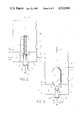
- FIGS. 1, 2 and 3 are each the same view looking at the flat side of one-half of a split blow mold, each showing the hollow plastic in various stages.
- FIG. 1 the parison 1 is shown after it is enclosed in the two halves of the split blow mold but before any air pressure has been applied.
- FIG. 2 shows parison 1 extended by the blow pin
- FIG. 3 shows the completely blown bottle 2.
- blow molding apparatus shown in the drawings and the description of its operation herein are suitable for effecting the process of, and making the product of, the present invention, and were used in the specific examples discussed hereafter.
- other specific blow molding apparatus can of course be used to effect the orientation blow molding at one temperture, heat setting at a higher temperature and subsequent cooling under shrinkage-resisting pressure to a desired temperature according to the invention and, finally, the exhausting of the internal pressure from the hollow article.
- 3 is body of the blow mold (i.e., one-half thereof), made up of neck ring 4, lower section 6 and upper section 7. Sections 6 and 7 are mostly separated by air gap 8 to minimize heat conduction therebetween and 6 and 7 are in physical contact only at narrow annular band 9.
- Lines 11 and 12 are provided for introducing cooling water into and from, respectively, channels (not shown) in 6.
- Lines 13 and 14 are provided for introducing cooling water into and from, respectively, neck ring 4 (one of the split halves of which is depicted in the figures).
- Lines 16 and 17 are for introducing oil for heating or cooling the mold, as the case may be, into and from the mold, respectively.
- Each of 11, 13 and 16 are connected to an appropriate source (not shown) of fluid under pressure.
- Electric resistance strip heater 18 encircles the bottom of section 7 and is used to help make up for loss of heat flowing vertically from section 7 to section 6.
- Blow mandrel 19 is shown inserted in parison 1; the blowing air is introduced into parison 1 via line 27 through cylinder 21 and passageways (not shown) in the end of mandrel 19, and the same passageways serve for exhaustion of air from the blown article.
- Cylinder 21 contains a mechanism which includes a piston (not shown) that has an O-ring that forms a seal against the top of the mandrel during operation.
- Stretch rod 22 is vertically movable through 21 and 19 by means not shown.
- a preheated injection molded parison 1 is enclosed in the split blow mold as shown in FIG. 1 and the mandrel is inserted.
- the upward progress of stretch rod 22 is begun a split second before introduction of blowing air through mandrel 19 and then the blowing air is introduced to blow the bottle against the walls of the mold.
- the stretch rod during initial blowing arrives at the position shown in FIG. 2 and is retracted before the blowing air is evacuated.
- the neck or finish area during the entire process is kept cool by the circulating cool water flowing through the halves of upper mold sections 6 and neck ring halves 4.
- section 7 is maintained at the desired heat setting temperature by circulating hot oil through 16, 7 and 17 and by heating the lower part of section 7 with resistance heater 18.
- FIG. 2 shows parison 1 elongated without any increase in the hoop direction, undoubtedly 1 is actually partly inflated before it reaches the position shown in FIG. 2, so that axial mechanical stretching and pneumatic inflation are occurring together.
- my apparatus was run as described here and as described in connection with the examples, it is equally possible (1) to complete the axial mechanical stretching before beginning pneumatic inflation, or, on the other hand, (2) not to use any mechanical axial stretching with the stretch rod at all; indeed, many commercial biaxially oriented bottles are made by blow molding without the use of any mechanical axial stretching.
- thermocouples 23 and 24 are thermocouples positioned as shown and 1/8 inch from the mold cavity wall. In extensive testing, it was shown that the temperature varied only about 4° to 5° F. between the two thermocouples with the hottest temperature being at 23 near the bottom of the bottle.
- the hot oil is displaced by a continuous flow of room temperature oil to cool the bottle to the desired "quench" temperature as determined by the average of the two thermocouple temperatures. Then the pressure is released and the mold opened.
- a bottle was blown identically to the others except that it was blown into a cold mold and cooled to 23° C.
- the control had no heat setting but was only biaxially oriented and not heat set, during the course of which its density increased to 1.3634 gms./cc. Its onset-of-shrinkage temperature was 46° C.
- the bottles in the examples represented by the data in Tables 1 and 2 were made from injection molded parisons having the general shape shown in FIG. 1. They were 7.2 inches long with a wall thickness of 145-150 mils and weighed 26 gms. The parisons were preheated to about 190° F. (outside surface 190° F., inside surface 188° F.). The parison at this temperature was enclosed in the split halves of the blow mold, one-half of which is shown in FIG. 1. Then the stretch rod 22 was pushed against the bottom of the parison for 0.15 second before the blow pressure air was applied at 100 psig for 0.5 second, after which it was increased to 300 psig, and the stretch rod was maintained in the position shown on FIG.
- the last two examples are a repetition of the example in Jap. 77,672, infra.
- the bottles were misshapen, i.e., they were completely out of round, and of course, they have lower onset temperatures and the densities are lower than the products of the invention.
- the bottles made at 250° C. heat setting temperature were made of 0.9 inherent viscosity PET.
- Carbon dioxide barrier properties of containers were determined by a gas chromatographic method.
- Containers were placed in a test fixture in which carbon dioxide gas at one atmosphere absolute was established and maintained at the outside surface and dry nitrogen gas at one atmosphere absolute at the inside surface. Carbon dioxide permeates through the wall from the outside to the inside of the container.
- the nitrogen gas inside the container was periodically sampled for permeated carbon dioxide with a gas chromatograph.
- the rate of carbon dioxide permeation was determined from the rate of increase of CO 2 concentration in the nitrogen gas inside the container.
- the system was calibrated by using an assayed calibrting gas of CO 2 in nitrogen supplied by Matheson Gas Products.
- Carbon dioxide test gas was moisturized to 50-100% relative humidity in the test fixture by evaporation of water from several sponges.
- Test temperature was controlled by placing the entire apparatus in a closed room which was controlled at 73° ⁇ 2° F.
- a method employing a Hersch coulometric detector was used to determine oxygen barrier properties of containers.
- the apparatus is similar to an Oxtran 100 Permeation Analyzer manufactured by Modern Controls, Elk River, Minn.
- a test fixture was used to establish oxygen and nitrogen gases at one atmosphere absolute at the outside and inside surfaces of the container respectively.
- Oxygen surrounding the outside surface was continuously replaced by a flowing gas stream which was vented to the atmospheric environment.
- the nitrogen gas inside the container was also a flowing system and served as a sweep gas. Oxygen permeated through the wall from the outside to the inside of the container where it was picked up by the nitrogen sweep gas and carried to the coulometric detector for measurement and venting to atmosphere.
- the output of the detector is directly proportional to the amount of oxygen it receives and calibration is computed from well established laws of electrochemistry. Both oxygen and nitrogen gases were moisturized by bubbling through tubes of water prior to entering the test fixture. Test temperature was controlled by placing the apparatus in a closed room which was maintained at 73° ⁇ 2° F.
- Table 3 The results in the following Table 3 are for nominal one-half liter bottles made from parisons each weighing about 25.85 grams and made as described for the bottles in connnection with Tables 1 and 2.
- the control bottles were merely blown under orientation conditions as before described and quenched to near room temperature without heat setting while the heat set bottles were heat set at 241° C. as indicated.
- the results illustrate the magnitude of the recognized improvement in the oxygen and carbon dioxide barrier properties of PET with increased density obtained by heat setting.
- the heat set hollow article is removed from the mold at heat-setting temperature and is cooled outside of the heat setting mold to the temperature of 100° C. or higher before designated prior to equalizing the internal pressure of the hollow article with the ambient atmosphere.
- the pressure is reduced to a pressure which maintains its volume about the same as when within the mold, the mold is opened, and the bottle is cooled without confinement in a mold.
- This cooling can simply be air cooling in the room temperature air.
- the desired quench temperature of 100° C. or higher is reached, the internal pressure is then released before further cooling.
- this last embodiment of my invention wherein the hollow article is removed under some pressure from the mold at heat setting temperature--so that the article outside the heat setting mold is allowed to cool under shrinkage-resisting pressure to below 100° C., as low as room temperature, e.g. 20° C., or even lower, the maximum benefit of higher onset-of-shrinkage temperatures is not realized, but the advantages of minimum cycle time and the energy savings still obtain. Accordingly, the invention includes this special embodiment; usually one cools to below 80° C., often below 70° C., before exhausting the air or other gas from the hollow article.
- the higher onset-of-shrinkage temperature obtained when cooling to no lower than 100° C. before releasing the shrinkage resisting pressure is not necessary for the particular end use of the hollow article.
- a bottle was made in the same manner as in the 230° C. bottles summarized in Table 4 except that the heat setting temperature was 240° C. and the pressure was 17 psig and this pressure was not released until the bottle had cooled to about 70° C. in the ambient atmosphere. Its density was 1.3975 gms./cc., the bottle volume was 520.5 cc. and the onset-of-shrinkage temperature was 149° C.
Landscapes
- Physics & Mathematics (AREA)
- Thermal Sciences (AREA)
- Engineering & Computer Science (AREA)
- Manufacturing & Machinery (AREA)
- Mechanical Engineering (AREA)
- Blow-Moulding Or Thermoforming Of Plastics Or The Like (AREA)
Abstract
Description
              TABLE 1
______________________________________
Heat                    Volume       Onset
Setting  Quench    Density.sup.(1)
                            2 min..sup. (2)
                                   24 hrs.
                                         Temp.
°C.
     Sec.    Temp. °C.
                       gm./cc.
                              cubic centimeters
                                          °C.
______________________________________
250  30      148       1.4013
250  120     148       1.4022
240  6       180       1.3980 497.9  497.4
240  6       170       1.3980 501.9  501.6
240  6       160       1.3980 506.2  506.1 184
240  6       150       1.3980 509.3  509.2
240  6       130       1.3978 513.9  514   172
240  6       120       1.3978 516.1  515.9 168
240  6       110       1.3978 518.5  518.4 --
240  6       100       1.3965 519.4  519.7 154
240  6       90        1.3970 520.8  520.9 143
240  6       80        1.3986 521.7  521.7 139
240  6       80        1.3982 none.sup.(3)
                                     521.8 --
240  6       60        1.3982 521.8  522.1 132
230  6       170       1.3950 493.1  493.6 --
230  6       160       1.3950 499.5  498.8 168
230  6       150       1.3950 504.1  503.8 --
230  6       140       1.3950 509.0  508.6
230  6       129       1.3950 512    511.6 148
230  6       124       1.3947 514.1  513.7 138
230  6       100       1.3947 520.7  519.8 120
230  6       85        1.3945 521.1  520.6 113
230  6       75        1.3945 521.4  520.9 104
230  6       60        1.3950 521.8  521.8  88
______________________________________
 .sup.(1) at midsidewall
 .sup.(2) overflow volume measured by filling with room temperature water
 minutes after opening mold.
 .sup.(3) allowed to cool 24 hours in air without filling with water until
 then.
                                  TABLE 2
__________________________________________________________________________
Heat              Volume
Setting
       Quench
             Density.sup.(1)
                  2 min..sup.(2)
                       24 hrs.
                           Onset
°C.
   Sec.
       Temp. °C.
             gm./cc.
                  cubic centimeters
                           Temp. °C.
__________________________________________________________________________
220
   6   160   1.3912
                  Deformed
220
   6   150   1.3928
                  500.9
                       500.7
220
   6   140   1.3910
                  502.9
                       502.9
220
   6   135   1.3912
                  506.0
                       505.8
                           114
220
   6   120   1.3914
                  513.9
                       513.6
                           108
220
   6   110   1.3918
                  517.5
                       517.4
                           100
220
   6   100   1.3918
                  519.8
                       519.5
                           94
220
   6   90    1.3923
                  520.5
                       520.5
                           88
220
   6   80    1.3919
                  521.2
                       521.4
                           83
220
   6   60    1.3922
                  521.5
                       521.5
                           76
200
   6   140   1.3867
                  Deformed
200
   6   130   1.3867
                  496.5
                       495.7
                           102
200
   6   115   1.3868
                  513.0
                       513.0
                           95
200
   6   100   1.3877
                  519.9
                       519.8
                           84
200
   6   90    1.3870
                  519.9
                       520.0
                           80
200
   6   80    1.3860
                  520.8
                       520.4
                           78
200
   6   60    1.3872
                  521.0
                       520.8
                           74
130
   6   100   1.3702
                  509  508.4
                           74    (Deformed)
130
   120 100   1.3744
                  512.2
                       511.7
                           74    (Deformed)
__________________________________________________________________________
 .sup.(1) at midsidewall
 .sup.(2) overflow volume measured by filling with room temperature water
 minutes after opening mold?
 .sup.(3) allowed to cool 24 hours in air without filling with water until
 then.
              TABLE 3
______________________________________
                             Carbon
Heat-Set
        Quench    Oxygen     Dioxide
Temper- Temper-   Permeation Permeation
                                      Density
ature °C.
        ature °C.
                  (cc/day atm)
                             (cc/day atm)
                                      gms./cc.
______________________________________
control           0.126      0.830    1.3630
control           0.128      0.760    1.3630
control           0.125      --
control           0.125      --
average           0.126      0.795
241     147       0.093      0.498    1.3996
241     148       0.087      --
241     147       0.089      0.499    1.4000
241     147       0.090      --
average           0.090      0.498
Average Improvement
              29%        37%
______________________________________
              TABLE 4
______________________________________
         Quench
Heat Setting
         Press    Temp.   Density
                                 Volume  Onset
°C.
     Sec.    Psig     °C.
                            gms./cc.
                                   ccs.    Temp.
______________________________________
230  6       23       170   1.3950 491     163
230  6       23       115   1.3950 515     127
______________________________________
Claims (7)
Priority Applications (13)
| Application Number | Priority Date | Filing Date | Title |
|---|---|---|---|
| CA000419874A CA1197961A (en) | 1982-03-03 | 1983-01-20 | Poly(ethylene terephthalate) articles and method |
| NZ203100A NZ203100A (en) | 1982-03-03 | 1983-01-26 | Blow moulding then heat setting poly(ethylene terephthalate)articles |
| ZA83909A ZA83909B (en) | 1982-03-03 | 1983-02-10 | Poly(ethylene terephthalate)articles and method |
| MX196286A MX164068B (en) | 1982-03-03 | 1983-02-15 | TRANSPARENT HOLLOW CONTAINER OF POLY (ETHYLENE TEREFTALATE) AND METHOD FOR ITS MANUFACTURE |
| AU11809/83A AU537534B2 (en) | 1982-03-03 | 1983-02-24 | Blow moulding then heatsetting in same mould at higher temp |
| GB08305375A GB2117697B (en) | 1982-03-03 | 1983-02-25 | Heat setting poly(ethylene terephthalate) articles |
| FR8303277A FR2522580B1 (en) | 1982-03-03 | 1983-02-28 | POLY (ETHYLENE-TEREPHTHALATE) ARTICLES AND THEIR MANUFACTURING METHOD |
| BR8301013A BR8301013A (en) | 1982-03-03 | 1983-03-02 | PROCESS FOR FORMATION OF A HOLY PLASTIC ARTICLE OF ETHYLENE POLYTEREFTALATE AND ARTICLE SO FORMED |
| DE3307549A DE3307549C2 (en) | 1982-03-03 | 1983-03-03 | Method for blow molding a biaxially oriented hollow body |
| BE0/210255A BE896077A (en) | 1982-03-03 | 1983-03-03 | POLY (ETHYLENE TEREPHTHALATE) OBJECTS AND PROCESS FOR MAKING THE SAME |
| JP58033891A JPS58162321A (en) | 1982-03-03 | 1983-03-03 | Poly ( ethylene terephthalate ) article and its manufacture |
| US06/557,566 US4476170A (en) | 1982-03-03 | 1983-12-02 | Poly(ethylene terephthalate) articles and method |
| JP62315446A JPS63183828A (en) | 1982-03-03 | 1987-12-15 | Manufacture of poly (ethylene terephthalate) |
Applications Claiming Priority (1)
| Application Number | Priority Date | Filing Date | Title |
|---|---|---|---|
| US06/354,476 US4419151A (en) | 1981-03-11 | 1982-03-03 | Crystal and germanium modification and process for its preparation |
Related Child Applications (1)
| Application Number | Title | Priority Date | Filing Date |
|---|---|---|---|
| US06/557,566 Division US4476170A (en) | 1982-03-03 | 1983-12-02 | Poly(ethylene terephthalate) articles and method |
Publications (1)
| Publication Number | Publication Date |
|---|---|
| US4512948A true US4512948A (en) | 1985-04-23 |
Family
ID=23393493
Family Applications (1)
| Application Number | Title | Priority Date | Filing Date |
|---|---|---|---|
| US06/354,473 Expired - Lifetime US4512948A (en) | 1982-03-03 | 1982-03-03 | Method for making poly(ethylene terephthalate) article |
Country Status (1)
| Country | Link |
|---|---|
| US (1) | US4512948A (en) |
Cited By (38)
| Publication number | Priority date | Publication date | Assignee | Title |
|---|---|---|---|---|
| FR2567066A1 (en) * | 1984-07-05 | 1986-01-10 | Petainer Sa | PROCESS FOR MANUFACTURING A CONTAINER |
| US4582665A (en) * | 1984-04-20 | 1986-04-15 | Owens-Illinois, Inc. | Method of making poly(ethylene terephthalate) articles |
| US4665682A (en) * | 1985-05-03 | 1987-05-19 | Continental Pet Technologies, Inc. | Method for producing a hot fillable, collapse resistant polyester container without the need to utilize set process techniques and/or non-conventional container geometries |
| US4698246A (en) * | 1986-03-05 | 1987-10-06 | International Paper Company | Novel laminates for paperboard cartons and a process of forming said laminates |
| FR2604118A1 (en) * | 1986-09-22 | 1988-03-25 | Owens Illinois Plastic Prod | PROCESS AND APPARATUS FOR THE MANUFACTURE OF A HOLLOW CONTAINER IN PARTIALLY CRYSTAL PLASTIC WITH BIAX THERMO-FIXED ORIENTATION |
| FR2606328A1 (en) * | 1986-11-10 | 1988-05-13 | Owens Illinois Plastic Prod | BIAXIALLY ORIENTED THERMOSET MULTI-LAYERED ARTICLES AND METHOD OF MANUFACTURE |
| US4836971A (en) * | 1986-03-04 | 1989-06-06 | Sidel | Method for manufacturing heat resistant PET containers |
| USH671H (en) | 1987-08-06 | 1989-09-05 | Process for forming thermoplastic parts especially large structural parts of high viscosity resin replicating mold surface | |
| US4883631A (en) * | 1986-09-22 | 1989-11-28 | Owens-Illinois Plastic Products Inc. | Heat set method for oval containers |
| US5013515A (en) * | 1982-05-10 | 1991-05-07 | Katashi Aoki | Injection stretching and blow molding process including a secondary treatment operation |
| US5122327A (en) * | 1991-04-18 | 1992-06-16 | Hoover Universal, Inc. | Blow molding method for making a reversely oriented hot fill container |
| US5128091A (en) * | 1991-02-25 | 1992-07-07 | Xerox Corporation | Processes for forming polymeric seamless belts and imaging members |
| US5145632A (en) * | 1989-06-29 | 1992-09-08 | Sidel | Process for the manufacture of pet containers designed to be filled with a hot liquid |
| US5352402A (en) * | 1989-10-23 | 1994-10-04 | Nissei Asb Machine Co., Ltd. | Method and apparatus for manufacturing biaxially oriented, thermally stable, blown containers |
| US5411477A (en) * | 1990-05-11 | 1995-05-02 | Saab; Mark A. | High-strength, thin-walled single piece catheters |
| WO1996030190A1 (en) * | 1995-03-27 | 1996-10-03 | Ruppman Kurt H Sr | Method of making a molded plastic container |
| US5631054A (en) * | 1992-04-30 | 1997-05-20 | Kao Corporation | Polyester container and process for producing the same |
| US5637167A (en) * | 1995-05-22 | 1997-06-10 | Continental Pet Technologies, Inc. | Method for post-mold attachment of a handle to a strain-oriented plastic container |
| US5730914A (en) * | 1995-03-27 | 1998-03-24 | Ruppman, Sr.; Kurt H. | Method of making a molded plastic container |
| US6168749B1 (en) * | 1995-12-02 | 2001-01-02 | Krupp Corpoplast Maschinenbau Gmbh | Method of manufacturing containers |
| US20020053760A1 (en) * | 1999-09-14 | 2002-05-09 | Boyd Timothy J. | Blow molding method and machine for producing pasteurizable containers |
| US20020076462A1 (en) * | 1999-11-09 | 2002-06-20 | Boyd Timothy J. | Blow molding method and machine for producing pasteurizable containers |
| US6413466B1 (en) | 2000-06-30 | 2002-07-02 | Schmalbach-Lubeca Ag | Plastic container having geometry minimizing spherulitic crystallization below the finish and method |
| US6514451B1 (en) | 2000-06-30 | 2003-02-04 | Schmalbach-Lubeca Ag | Method for producing plastic containers having high crystallinity bases |
| US6568156B2 (en) | 2000-06-30 | 2003-05-27 | Schmalbach-Lubeca Ag | Method of providing a thermally-processed commodity within a plastic container |
| US6626324B1 (en) | 2000-06-30 | 2003-09-30 | Schmalbach-Lubeca Ag | Plastic container having a crystallinity gradient |
| US6875396B1 (en) * | 2000-02-25 | 2005-04-05 | Tjandra Limanjaya | Hot fill container |
| US7229273B2 (en) | 2000-10-12 | 2007-06-12 | Board Of Regents, The University Of Texas System | Imprint lithography template having a feature size under 250 nm |
| US20090197150A1 (en) * | 2006-06-02 | 2009-08-06 | Toyo Seikan Kaisha, Ltd. | Fuel cell cartridge |
| JP2010528900A (en) * | 2007-06-07 | 2010-08-26 | シデル パーティシペイションズ | Method for producing a container which makes it possible to improve the mechanical strength |
| US20100221470A1 (en) * | 2007-06-07 | 2010-09-02 | Sidel Participations | Polymer vessel having a crystallinity gradient |
| US20110031659A1 (en) * | 2005-03-15 | 2011-02-10 | Graeme Warner | Stretch Blow Moulding Method and Apparatus |
| US20110070388A1 (en) * | 2009-09-22 | 2011-03-24 | Liquid Container L.P. | Pet containers with enhanced thermal properties |
| WO2012083002A2 (en) | 2010-12-17 | 2012-06-21 | Graham Packaging Lc, Lp. | Pet containers with enhanced thermal properties and process for making same |
| US20140091500A1 (en) * | 2005-03-08 | 2014-04-03 | Silgan Plastics Llc | Bottle with extended neck finish and method of making same |
| WO2014116904A1 (en) | 2013-01-25 | 2014-07-31 | The Procter & Gamble Company | Components for aerosol dispenser and aerosol dispenser made therewith |
| US9725802B2 (en) | 2014-11-11 | 2017-08-08 | Graham Packaging Company, L.P. | Method for making pet containers with enhanced silicon dioxide barrier coating |
| US20220009667A1 (en) * | 2018-11-22 | 2022-01-13 | Alpla Werke Alwin Lehner Gmbh & Co. Kg | Plastic container having at least a regional sharp-edged container geometry and process for producing the plastic container |
Citations (1)
| Publication number | Priority date | Publication date | Assignee | Title |
|---|---|---|---|---|
| US4385089A (en) * | 1977-05-04 | 1983-05-24 | Rhone-Poulenc Industries | Process for preparing biaxially oriented hollow shaped articles from thermoplastic materials |
-
1982
- 1982-03-03 US US06/354,473 patent/US4512948A/en not_active Expired - Lifetime
Patent Citations (1)
| Publication number | Priority date | Publication date | Assignee | Title |
|---|---|---|---|---|
| US4385089A (en) * | 1977-05-04 | 1983-05-24 | Rhone-Poulenc Industries | Process for preparing biaxially oriented hollow shaped articles from thermoplastic materials |
Cited By (64)
| Publication number | Priority date | Publication date | Assignee | Title |
|---|---|---|---|---|
| US5013515A (en) * | 1982-05-10 | 1991-05-07 | Katashi Aoki | Injection stretching and blow molding process including a secondary treatment operation |
| US4582665A (en) * | 1984-04-20 | 1986-04-15 | Owens-Illinois, Inc. | Method of making poly(ethylene terephthalate) articles |
| FR2567066A1 (en) * | 1984-07-05 | 1986-01-10 | Petainer Sa | PROCESS FOR MANUFACTURING A CONTAINER |
| US4665682A (en) * | 1985-05-03 | 1987-05-19 | Continental Pet Technologies, Inc. | Method for producing a hot fillable, collapse resistant polyester container without the need to utilize set process techniques and/or non-conventional container geometries |
| EP0511720A1 (en) * | 1985-05-03 | 1992-11-04 | Continental Pet Technologies, Inc. | Method for producing a hot fillable, collapse resistant polyester container |
| EP0200564A3 (en) * | 1985-05-03 | 1989-10-18 | Continental Pet Technologies, Inc. | Method for producing a hot fillable, collapse resistant polyester container without the need to utilize set process techniques and/or non-conventional container geometries |
| US4836971A (en) * | 1986-03-04 | 1989-06-06 | Sidel | Method for manufacturing heat resistant PET containers |
| US4698246A (en) * | 1986-03-05 | 1987-10-06 | International Paper Company | Novel laminates for paperboard cartons and a process of forming said laminates |
| US4883631A (en) * | 1986-09-22 | 1989-11-28 | Owens-Illinois Plastic Products Inc. | Heat set method for oval containers |
| FR2604118A1 (en) * | 1986-09-22 | 1988-03-25 | Owens Illinois Plastic Prod | PROCESS AND APPARATUS FOR THE MANUFACTURE OF A HOLLOW CONTAINER IN PARTIALLY CRYSTAL PLASTIC WITH BIAX THERMO-FIXED ORIENTATION |
| GB2197254A (en) * | 1986-11-10 | 1988-05-18 | Owens Illinois Plastic Prod | Multilayer biaxially oriented heatset articles and method of making |
| FR2606328A1 (en) * | 1986-11-10 | 1988-05-13 | Owens Illinois Plastic Prod | BIAXIALLY ORIENTED THERMOSET MULTI-LAYERED ARTICLES AND METHOD OF MANUFACTURE |
| GB2197254B (en) * | 1986-11-10 | 1990-08-22 | Owens Illinois Plastic Prod | Multilayer biaxially oriented heatset articles and method of making |
| USH671H (en) | 1987-08-06 | 1989-09-05 | Process for forming thermoplastic parts especially large structural parts of high viscosity resin replicating mold surface | |
| US5145632A (en) * | 1989-06-29 | 1992-09-08 | Sidel | Process for the manufacture of pet containers designed to be filled with a hot liquid |
| US5352402A (en) * | 1989-10-23 | 1994-10-04 | Nissei Asb Machine Co., Ltd. | Method and apparatus for manufacturing biaxially oriented, thermally stable, blown containers |
| US5501590A (en) * | 1989-10-23 | 1996-03-26 | Nissei Asb Machine Co., Ltd. | Apparatus for manufacturing biaxially oriented, thermally stable blown containers |
| US5540879A (en) * | 1989-10-23 | 1996-07-30 | Nissei Asb Machine Co., Ltd. | Method and apparatus for manufacturing biaxially oriented, thermally stable, blown containers |
| US5411477A (en) * | 1990-05-11 | 1995-05-02 | Saab; Mark A. | High-strength, thin-walled single piece catheters |
| US5128091A (en) * | 1991-02-25 | 1992-07-07 | Xerox Corporation | Processes for forming polymeric seamless belts and imaging members |
| US5122327A (en) * | 1991-04-18 | 1992-06-16 | Hoover Universal, Inc. | Blow molding method for making a reversely oriented hot fill container |
| US5631054A (en) * | 1992-04-30 | 1997-05-20 | Kao Corporation | Polyester container and process for producing the same |
| WO1996030190A1 (en) * | 1995-03-27 | 1996-10-03 | Ruppman Kurt H Sr | Method of making a molded plastic container |
| US5730914A (en) * | 1995-03-27 | 1998-03-24 | Ruppman, Sr.; Kurt H. | Method of making a molded plastic container |
| US5637167A (en) * | 1995-05-22 | 1997-06-10 | Continental Pet Technologies, Inc. | Method for post-mold attachment of a handle to a strain-oriented plastic container |
| US6168749B1 (en) * | 1995-12-02 | 2001-01-02 | Krupp Corpoplast Maschinenbau Gmbh | Method of manufacturing containers |
| US20020053760A1 (en) * | 1999-09-14 | 2002-05-09 | Boyd Timothy J. | Blow molding method and machine for producing pasteurizable containers |
| US6485669B1 (en) | 1999-09-14 | 2002-11-26 | Schmalbach-Lubeca Ag | Blow molding method for producing pasteurizable containers |
| US6749415B2 (en) | 1999-09-14 | 2004-06-15 | Schmalbach-Lubeca Ag | Blow molding machine for producing pasteurizable containers |
| US20020076462A1 (en) * | 1999-11-09 | 2002-06-20 | Boyd Timothy J. | Blow molding method and machine for producing pasteurizable containers |
| US6485670B1 (en) | 1999-11-09 | 2002-11-26 | Schmalbach-Lubeca Ag | Blow molding method for producing pasteurizable containers |
| US6767197B2 (en) | 1999-11-09 | 2004-07-27 | Schmalbach-Lubeca Ag | Blow molding machine for producing pasteurizable containers |
| US6875396B1 (en) * | 2000-02-25 | 2005-04-05 | Tjandra Limanjaya | Hot fill container |
| US6568156B2 (en) | 2000-06-30 | 2003-05-27 | Schmalbach-Lubeca Ag | Method of providing a thermally-processed commodity within a plastic container |
| US20030143348A1 (en) * | 2000-06-30 | 2003-07-31 | Silvers Kerry W | Plastic container for retaining a thermally-processed commodity |
| US6626324B1 (en) | 2000-06-30 | 2003-09-30 | Schmalbach-Lubeca Ag | Plastic container having a crystallinity gradient |
| US6681548B2 (en) | 2000-06-30 | 2004-01-27 | Schmalbach-Lubeca Ag | Method of providing a thermally stable finish for a plastic container |
| US6585124B2 (en) | 2000-06-30 | 2003-07-01 | Schmalbach-Lubeca Ag | Plastic container having geometry minimizing spherulitic crystallization below the finish and method |
| US6514451B1 (en) | 2000-06-30 | 2003-02-04 | Schmalbach-Lubeca Ag | Method for producing plastic containers having high crystallinity bases |
| US6413466B1 (en) | 2000-06-30 | 2002-07-02 | Schmalbach-Lubeca Ag | Plastic container having geometry minimizing spherulitic crystallization below the finish and method |
| US7229273B2 (en) | 2000-10-12 | 2007-06-12 | Board Of Regents, The University Of Texas System | Imprint lithography template having a feature size under 250 nm |
| US9248603B2 (en) * | 2005-03-08 | 2016-02-02 | Silgan Plastics Llc | Bottle with extended neck finish and method of making same |
| US10589454B2 (en) | 2005-03-08 | 2020-03-17 | Silgan Plastics Llc | Bottle with extended neck finish and method of making same |
| US10035292B2 (en) | 2005-03-08 | 2018-07-31 | Silgan Plastics Llc | Bottle with extended neck finish and method of making same |
| US20140091500A1 (en) * | 2005-03-08 | 2014-04-03 | Silgan Plastics Llc | Bottle with extended neck finish and method of making same |
| US20110031659A1 (en) * | 2005-03-15 | 2011-02-10 | Graeme Warner | Stretch Blow Moulding Method and Apparatus |
| US7981356B2 (en) * | 2005-03-15 | 2011-07-19 | Invoplas Pty Ltd | Stretch blow moulding method and apparatus |
| US20090197150A1 (en) * | 2006-06-02 | 2009-08-06 | Toyo Seikan Kaisha, Ltd. | Fuel cell cartridge |
| US20100237528A1 (en) * | 2007-06-07 | 2010-09-23 | Sidel Participations | Method for making vessels for improving the mechanical strength thereof |
| US20100221470A1 (en) * | 2007-06-07 | 2010-09-02 | Sidel Participations | Polymer vessel having a crystallinity gradient |
| EP2152495B1 (en) * | 2007-06-07 | 2016-01-06 | Sidel Participations | Method and machine for making containers allowing for the improvement of the mechanical strength thereof |
| JP2010528900A (en) * | 2007-06-07 | 2010-08-26 | シデル パーティシペイションズ | Method for producing a container which makes it possible to improve the mechanical strength |
| US8507063B2 (en) | 2009-09-22 | 2013-08-13 | Graham Packaging Lc, L.P. | Pet containers with enhanced thermal properties |
| US20110070388A1 (en) * | 2009-09-22 | 2011-03-24 | Liquid Container L.P. | Pet containers with enhanced thermal properties |
| US9023446B2 (en) | 2009-09-22 | 2015-05-05 | Graham Packaging Lc, L.P. | PET containers with enhanced thermal properties and process for making same |
| US10471642B2 (en) | 2009-09-22 | 2019-11-12 | Graham Packaging Pet Technologies Inc. | PET containers with enhanced thermal properties and process for making same |
| WO2012083002A2 (en) | 2010-12-17 | 2012-06-21 | Graham Packaging Lc, Lp. | Pet containers with enhanced thermal properties and process for making same |
| EP3124203A1 (en) | 2010-12-17 | 2017-02-01 | Graham Packaging PET Technologies Inc. | Pet containers with enhanced thermal properties and process for making same |
| US9758294B2 (en) | 2013-01-25 | 2017-09-12 | The Procter & Gamble Company | Components for aerosol dispenser and aerosol dispenser made therewith |
| WO2014116904A1 (en) | 2013-01-25 | 2014-07-31 | The Procter & Gamble Company | Components for aerosol dispenser and aerosol dispenser made therewith |
| US9725802B2 (en) | 2014-11-11 | 2017-08-08 | Graham Packaging Company, L.P. | Method for making pet containers with enhanced silicon dioxide barrier coating |
| US10421098B2 (en) | 2014-11-11 | 2019-09-24 | Graham Packaging Company, L.P. | PET containers with enhanced silicon dioxide barrier coating |
| US20220009667A1 (en) * | 2018-11-22 | 2022-01-13 | Alpla Werke Alwin Lehner Gmbh & Co. Kg | Plastic container having at least a regional sharp-edged container geometry and process for producing the plastic container |
| US11912458B2 (en) * | 2018-11-22 | 2024-02-27 | Alpla Werke Alwin Lehner Gmbh & Co. Kg | Plastic container having at least a regional sharp-edged container geometry and process for producing the plastic container |
Similar Documents
| Publication | Publication Date | Title |
|---|---|---|
| US4476170A (en) | Poly(ethylene terephthalate) articles and method | |
| US4871507A (en) | Method for forming hollow partially crystalline biaxially oriented heat set polyethylene terephthalate articles | |
| CA1197961A (en) | Poly(ethylene terephthalate) articles and method | |
| US4603066A (en) | Poly(ethylene terephthalate) articles | |
| US4839127A (en) | Method of making partially crystalline biaxially oriented hollow plastic heat set containers | |
| US4883631A (en) | Heat set method for oval containers | |
| US4385089A (en) | Process for preparing biaxially oriented hollow shaped articles from thermoplastic materials | |
| US4318882A (en) | Method for producing a collapse resistant polyester container for hot fill applications | |
| US4497855A (en) | Collapse resistant polyester container for hot fill applications | |
| US5352402A (en) | Method and apparatus for manufacturing biaxially oriented, thermally stable, blown containers | |
| NZ209211A (en) | Blow moulding a container in two moulds with intermould transfer under pressure | |
| US4582665A (en) | Method of making poly(ethylene terephthalate) articles | |
| US3294885A (en) | Method for blow molding thermoplastic | |
| US3745150A (en) | Amorphous polyethylene terephthalate container and process for making it | |
| US3496258A (en) | Method of polymer molding | |
| US4054629A (en) | Transfer blow molding technique | |
| JPH0397520A (en) | Manufacture of container made of polyehtylene terephthalate for filling with high temperature liquid | |
| US4853171A (en) | Method of making partially crystalline biazially oriented heat set containers | |
| US4002709A (en) | Controlled air in polyester tube extrusion for clear sealable parison | |
| US3288317A (en) | Molecularly oriented bottle | |
| CA1288913C (en) | Method and apparatus for making a partially crystalline, biaxially oriented heat set hollow plastic container | |
| US4891178A (en) | Method of making partially crystalline biaxially oriented hollow plastic free standing containers | |
| US20040026827A1 (en) | Method for the fabrication of crystallizable resins and articles therefrom | |
| US4421711A (en) | Molding of elongate, hollow, biaxially oriented thermoplastic shaped articles | |
| JPS6356104B2 (en) |
Legal Events
| Date | Code | Title | Description |
|---|---|---|---|
| AS | Assignment |
Owner name: OWENS-ILLINOIS, INC., A CORP. OF OH Free format text: ASSIGNMENT OF ASSIGNORS INTEREST.;ASSIGNOR:JABARIN, SALEH A.;REEL/FRAME:004068/0266 Effective date: 19820302 |
|
| STCF | Information on status: patent grant |
Free format text: PATENTED CASE |
|
| FEPP | Fee payment procedure |
Free format text: PAYOR NUMBER ASSIGNED (ORIGINAL EVENT CODE: ASPN); ENTITY STATUS OF PATENT OWNER: LARGE ENTITY |
|
| AS | Assignment |
Owner name: OWENS-ILLINOIS PLASTIC PRODUCTS INC., ONE SEAGATE, Free format text: ASSIGNMENT OF ASSIGNORS INTEREST. EFFECTIVE APRIL 15, 1987;ASSIGNOR:OWENS-ILLINOIS, INC.;REEL/FRAME:004875/0962 Effective date: 19870323 Owner name: OWENS-ILLINOIS PLASTIC PRODUCTS INC., A CORP. OF D Free format text: ASSIGNMENT OF ASSIGNORS INTEREST;ASSIGNOR:OWENS-ILLINOIS, INC.;REEL/FRAME:004875/0962 Effective date: 19870323 |
|
| FPAY | Fee payment |
Year of fee payment: 4 |
|
| FPAY | Fee payment |
Year of fee payment: 8 |
|
| FPAY | Fee payment |
Year of fee payment: 12 |