US4500590A - Dryer fabric having reduced permeability in the area of the pintle joint - Google Patents
Dryer fabric having reduced permeability in the area of the pintle joint Download PDFInfo
- Publication number
- US4500590A US4500590A US06/624,114 US62411484A US4500590A US 4500590 A US4500590 A US 4500590A US 62411484 A US62411484 A US 62411484A US 4500590 A US4500590 A US 4500590A
- Authority
- US
- United States
- Prior art keywords
- pintle
- fabric
- core
- sheath
- polymeric
- Prior art date
- Legal status (The legal status is an assumption and is not a legal conclusion. Google has not performed a legal analysis and makes no representation as to the accuracy of the status listed.)
- Expired - Lifetime
Links
- 239000004744 fabric Substances 0.000 title claims abstract description 105
- 230000035699 permeability Effects 0.000 title claims abstract description 33
- 238000004804 winding Methods 0.000 claims abstract description 71
- 238000000034 method Methods 0.000 claims abstract description 22
- 239000011800 void material Substances 0.000 claims abstract description 13
- 239000002131 composite material Substances 0.000 claims abstract description 12
- 229920000728 polyester Polymers 0.000 claims abstract description 12
- 239000000463 material Substances 0.000 claims description 57
- 239000011162 core material Substances 0.000 claims description 53
- 238000010438 heat treatment Methods 0.000 claims description 22
- 238000001035 drying Methods 0.000 claims description 12
- 239000004677 Nylon Substances 0.000 claims description 7
- 229920001778 nylon Polymers 0.000 claims description 7
- 238000004519 manufacturing process Methods 0.000 claims description 5
- 238000009998 heat setting Methods 0.000 claims description 4
- 239000000289 melt material Substances 0.000 claims description 3
- 238000000926 separation method Methods 0.000 claims description 3
- 239000007787 solid Substances 0.000 claims description 2
- 230000015572 biosynthetic process Effects 0.000 claims 1
- 238000007789 sealing Methods 0.000 claims 1
- 239000004033 plastic Substances 0.000 description 6
- 238000010276 construction Methods 0.000 description 5
- 238000003780 insertion Methods 0.000 description 2
- 230000037431 insertion Effects 0.000 description 2
- 230000003247 decreasing effect Effects 0.000 description 1
- 239000000945 filler Substances 0.000 description 1
- 239000000155 melt Substances 0.000 description 1
- 238000005086 pumping Methods 0.000 description 1
- 229920003002 synthetic resin Polymers 0.000 description 1
- 239000000057 synthetic resin Substances 0.000 description 1
- 238000009423 ventilation Methods 0.000 description 1
- 239000002759 woven fabric Substances 0.000 description 1
Images

Classifications
-
- D—TEXTILES; PAPER
- D21—PAPER-MAKING; PRODUCTION OF CELLULOSE
- D21F—PAPER-MAKING MACHINES; METHODS OF PRODUCING PAPER THEREON
- D21F1/00—Wet end of machines for making continuous webs of paper
- D21F1/0027—Screen-cloths
- D21F1/0072—Link belts
-
- Y—GENERAL TAGGING OF NEW TECHNOLOGICAL DEVELOPMENTS; GENERAL TAGGING OF CROSS-SECTIONAL TECHNOLOGIES SPANNING OVER SEVERAL SECTIONS OF THE IPC; TECHNICAL SUBJECTS COVERED BY FORMER USPC CROSS-REFERENCE ART COLLECTIONS [XRACs] AND DIGESTS
- Y10—TECHNICAL SUBJECTS COVERED BY FORMER USPC
- Y10S—TECHNICAL SUBJECTS COVERED BY FORMER USPC CROSS-REFERENCE ART COLLECTIONS [XRACs] AND DIGESTS
- Y10S162/00—Paper making and fiber liberation
- Y10S162/902—Woven fabric for papermaking drier section
-
- Y—GENERAL TAGGING OF NEW TECHNOLOGICAL DEVELOPMENTS; GENERAL TAGGING OF CROSS-SECTIONAL TECHNOLOGIES SPANNING OVER SEVERAL SECTIONS OF THE IPC; TECHNICAL SUBJECTS COVERED BY FORMER USPC CROSS-REFERENCE ART COLLECTIONS [XRACs] AND DIGESTS
- Y10—TECHNICAL SUBJECTS COVERED BY FORMER USPC
- Y10T—TECHNICAL SUBJECTS COVERED BY FORMER US CLASSIFICATION
- Y10T428/00—Stock material or miscellaneous articles
- Y10T428/249921—Web or sheet containing structurally defined element or component
- Y10T428/249922—Embodying intertwined or helical component[s]
Definitions
- This invention relates to a dryer belt fabric for use in drying paper in the dryer section of a papermaking machine.
- the invention relates to a permeable dryer belt fabric of the type which includes a number of plastic helix strips whose winding arcs are joined together by means of a pintle to form a mesh fabric of desired dimension having an open mesh pattern.
- the helical fabric is normally formed from a thermosetable synthetic resin monofilament. The helical fabric is desirable because it provides a smooth flat surface having fewer knuckles than woven fabric to avoid marking up the paper which contacts the fabric belt while at the same time providing an increased surface area for supporting the paper.
- the high permeability of the helical plastic belt fabric provides increased pocket ventilation and drying.
- the problem occurs that the mesh of the helical fabric is considerably open and the permeability of the fabric needs to be reduced in many applications.
- the permeability of the helical fabric is too high so that excessive air pumping occurs through the dryer fabric causing the paper web sheet to flutter excessively while being conveyed through the dryer section resulting in marking of the paper or even breaking of the web.
- a helical dryer fabric having good permeability characteristics in certain ranges of dryer fabric permeability.
- U.S. Pat. No. 4,362,776 it is proposed to stuff the individual helix strips with a fibrous multi-filament material prior to their being joined together in the fabric to reduce the permeability.
- a helical fabric for a dryer belt for drying paper which includes non-circular pintle strands.
- non-circular cross-sectional monofilaments as pintle yarns to join the individual helix strips together, it is sought to reduce the open area in the mesh and reduce the permeability of the fabric without need of stuffing the windings with filler strands.
- an important object of the present invention is to provide a dryer fabric and method for producing a dryer belt having reduced permeability characteristics.
- Still another important object of the present invention is to provide a dryer fabric and method by which the permeability of a dryer belt may be reduced for drying paper which are achieved, in part, by using an already carried out step of pintle insertion but utilizing a unique pintle.
- Still another important object of the present invention is to provide a dryer fabric and method by which the permeability in the pintle joint area of the dryer fabric is reduced without costly or labor extensive efforts.
- Still another important object of the present invention is to provide a dryer fabric and method wherein a composite pintle is used which has a pintle core which forms a pintle joint and a surrounding sheath of a low-melt polymeric material which is caused to soften and deform under heat treatment to fill open areas adjacent the pintle joint.
- the composite pintle is inserted into the pintle channel to form the pintle joint.
- the fabric is subjected to heat treatment under pressure which causes the winding arcs of the windings of the helix strips to penetrate the pintle core of the composite pintle causing the pintle core to be crimped.
- the low-melt plastic material of the pintle sheath forms a softened melt which flows in the direction of the crimp of the pintle core to project into the void spaces adjacent the pintle joint to close off these spaces and reduce the permeability of the fabric.
- the integrity of the pintle joint is increased by the additional material present in this area.
- the windings of the helix strips of the fabric have already been stuffed with a contoured monofilament stuffer strip as disclosed in applicant's co-pending application, described above, so that the overall permeability of the dryer fabric is reduced considerably providing a very low permeability characteristic for the fabric.
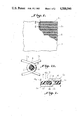
- FIG. 1 is a plan view with part of the helical dryer fabric shown in detail;
- FIG. 2 is a sectional view taken along line 2--2 of FIG. 1;
- FIG. 2A is an elevation illustrating a pintle joint with a composite pintle yarn inserted in a channel of the pintle joint in accordance with the present invention
- FIG. 3 is a top plan view of a pintle joint such as found in the prior art.
- FIG. 4 is a top plan view of a pintle joint formed by using a composite pintle wherein the fabric has been subjected to heat treatment causing a low-melt sheath material of the composite pintle to flow and form in open areas of the mesh surrounding the pintle joint to reduce the permeability of the fabric.
- the invention relates to a dryer fabric for a dryer belt used to dry a paper web in the dryer section of a papermaking machine.
- the invention relates to reducing the permeability of dryer fabric of the helical fabric type.
- the helical fabric is typically made by joining together a number of helical strips by intermeshing their winding arcs and inserting a pintle through a channel formed by the intermeshing winding arcs to join the helix strips together.
- Such a fabric and helix strips may be made in accordance with the teachings disclosed in U.S. Pat. Nos. 4,381,612 and 4,392,092.
- a section of a dryer belt 10 which includes a plurality of helical strips 12 having windings 14.
- the windings 14 consist of top runs 14a, bottom runs 14b, and winding arcs 16 which join the top and bottom runs of the windings.
- the strand 20 may be any suitable polymeric material such as polyester manufactured by the Shakespear Co. of Columbia, S.C. as type WP-803.
- the contoured monofilament strands have a generally inverted trapezoidal cross-section so that a contoured edge 22 is provided that extends over an end portion of the winding arcs which protrude into the winding space of the helix strips, as can best be seen in FIG. 2.
- This expedient is disclosed in applicant's co-pending application, described above, which teachings are hereby incorporated herein.
- the pintle means A includes a core B of a suitable polymeric material and an outer sheath layer C of a suitable low-melt polymeric material.
- the core B is polyester and the sheath material C is a low-melt nylon.
- the layer of sheath material C comprise approximately twenty-five percent of the total diameter of the pintle means A. For example, if the diameter of the core B is 0.9 mm., then the thickness of the sheath layer is 0.3 mm. for a total pintle diameter of 1.2 mm. It is desired that the diameter of the pintle core B be equal to or larger than that of the diameter of the monofilament material of which the helix strips 12 are made.
- the sheath material C is deformed by softening the material under heat treatment and pressure so that the material flows and assumes a flow profile 30 that projects into the area 26 normally left open.
- the pintle core B is crimped and defines alternating bends 32 which extend in opposing directions from that of the knuckles 34 of the winding arcs.
- the interior bights 36 of the winding arcs pull against the pintle and penetrate the pintle to crimp the pintle during heat setting under tension as will be more fully described hereinafter. This causes the softened pintle sheath material to flow in the direction of the crimp or bends of the pintle core and assume the preferred profile 30 which projects into open spaces in the area of the pintle joint.
- the helical strips are constructed in any suitable manner such as that disclosed in U.S. Pat. No. 4,392,902.
- the helix strips are joined together by intermeshing their winding arcs 16 and inserting the pintle means A through the channel of the intermeshed winding arcs to create a pintle joint and form the integral mesh fabric having an open mesh pattern as described heretofore.
- the windings 14 of the helical strips and pintle means A appear as shown in FIG. 2A.
- the runs of the windings 14 flatten out, as can best be seen in FIG. 2, and the pintle channel 18 assumes generally the diameter of that of the pintle core B.
- the sheath material C is a low-melt polymeric material which, in accordance with the present invention, means that it will begin to soften or melt, and flow at a temperature of about 400 to 425 degrees Fahrenheit. This is also the temperature range in which the remaining material of the fabric will be heat set. The melt temperature of the remaining fabric is much higher than that of the low-melt sheath material and higher than the heat set temperature range.
- the fabric is heat set and is thus thermally stabilized so that its dimensions will remain unchanged within required tolerances during use at normal dryer operating temperatures, i.e. 250 to 350 degrees Fahrenheit. This heat setting is more fully described in U.S. Pat. Nos. 4,381,612 and 4,346,138, hereby incorporated herein.
- a low-melt nylon is a suitable low-melt polymeric material. At a temperature in the range of 400 to 425 degrees Fahrenheit, the low-melt polymeric material will soften and begin to flow while the heat setting of the remaining fabric material and crimp of the core B occurs. The sheath material softens preferentially and flows to assume the preferred flow profile and projection into the void areas, as can best be seen in FIGS. 2 and 4.
- the pintle core B deforms about 15% of its original diameter when crimped.
- the low-melt sheath material deforms about fifty percent. This means that the radius of the sheath material deforms about double the original thickness of the sheath layer as can best be seen in FIG. 2.
- the fabric is placed on a frame and subjected to controlled heating, under tension, of the windings 14 of adjacent helix strips 12a and 12b pulling in opposing directions on the pintle means A causing the core B to crimp and the sheath material of C to flow in the directions of the crimp of the core B.
- the flow of low-melt material C assumes its solid properties prior to the heat treatment whereupon it occupies a considerable portion of the void spaces in the pintle joint area, as can best be seen in FIGS. 2 and 4.
- the fabric is removed from the frame and stuffer strands 20 are then inserted through the windings of the fabric.
- the fabric may then have its edges sealed to make the fabric structure integral.
- a helical dryer fabric for a dryer belt which has low permeability characteristics.
- the overall permeability characteristic of the dryer fabric is very low making it suitable for fine paper grade applications.
- pintle has been illustrated as an extruded polyester core and outer sheath surrounding the core, it is to be understood that the core may also be extruded or otherwise produced and then the low-melt sheath wrapped around the core material for insertion.
Landscapes
- Paper (AREA)
Abstract
A low permeability dryer fabric and method are disclosed which include a helical dryer fabric comprised of helix strips (12) whose winding arcs (16) are intermeshed and joined together by a composite pintle (A) to define a pintle joint. The composite pintle includes a polyester core (B) and an outer low-melt polymeric sheath (C) which has been heat softened and deformed and exhibits a profile (30) which occupies void areas in the mesh of the helical fabric in the area of the pintle joint.
Description
This invention relates to a dryer belt fabric for use in drying paper in the dryer section of a papermaking machine. In particular, the invention relates to a permeable dryer belt fabric of the type which includes a number of plastic helix strips whose winding arcs are joined together by means of a pintle to form a mesh fabric of desired dimension having an open mesh pattern. The helical fabric is normally formed from a thermosetable synthetic resin monofilament. The helical fabric is desirable because it provides a smooth flat surface having fewer knuckles than woven fabric to avoid marking up the paper which contacts the fabric belt while at the same time providing an increased surface area for supporting the paper. The plastic material and belt construction hold up extremely well under the stresses encountered when the belt is travelling endlessly at high speeds, typically 3,000 fpm, about the belt rollers for contacting the paper web being dryed on the dryer machine. Helical dryer fabric is shown in U.S. Pat. No. 4,346,138.
The high permeability of the helical plastic belt fabric provides increased pocket ventilation and drying. However, the problem occurs that the mesh of the helical fabric is considerably open and the permeability of the fabric needs to be reduced in many applications. In particular, for certain grades of paper, the permeability of the helical fabric is too high so that excessive air pumping occurs through the dryer fabric causing the paper web sheet to flutter excessively while being conveyed through the dryer section resulting in marking of the paper or even breaking of the web.
Proposals have been made for reducing the permeability of the helical fabric in paper drying applications. In U.S. Pat. No. 4,381,612 it has been proposed to insert a monofilament stuffer strand through the windings of the individual helix strips and seal the edges of the fabric so that the stuffer strips and helical fabric are made integral. In other embodiments, low-melt nylon strands are inserted in the windings of the helix strips. The strands are sized to insert easily within the windings. Once inserted, subsequent heat treatment causes the nylon strips to melt somewhat and flow to more desirably fill up the openness of the mesh pattern of the material and reduce the permeability. By this means, a helical dryer fabric is provided having good permeability characteristics in certain ranges of dryer fabric permeability. In U.S. Pat. No. 4,362,776 it is proposed to stuff the individual helix strips with a fibrous multi-filament material prior to their being joined together in the fabric to reduce the permeability.
In applicant's co-pending patent application Ser. No. 06/502,255, filed June 8, 1983, entitled LOW PERMEABILITY SPIRAL FABRIC AND METHOD, it is proposed to fill the windings of the individual helix strips with a contoured monofilament stuffing strand which has feathered edges that fit into the corner crevices of the intermeshing winding arcs located in the loop spaces of the windings. By this means, a heretofore open area of the helical mesh pattern that has been unable to be filled is partially closed off to reduce the permeability of the fabric and afford a low permeability characteristic which is desirable for many applications.
In U.S. Pat. No. 4,395,308 a helical fabric is disclosed for a dryer belt for drying paper which includes non-circular pintle strands. By utilizing non-circular cross-sectional monofilaments as pintle yarns to join the individual helix strips together, it is sought to reduce the open area in the mesh and reduce the permeability of the fabric without need of stuffing the windings with filler strands.
The above fabric constructions and methods have provided various ways of reducing dryer fabric permeability for a number of applications. Reducing the permeability of the helical mesh dryer fabric constructions even further is desirable to make their characteristics suitable for very fine grades of paper. Also, the reduction of permeability with decreased labor in the production methods and costs is sought in the development of these fabrics.
Accordingly, an important object of the present invention is to provide a dryer fabric and method for producing a dryer belt having reduced permeability characteristics.
Still another important object of the present invention is to provide a dryer fabric and method by which the permeability of a dryer belt may be reduced for drying paper which are achieved, in part, by using an already carried out step of pintle insertion but utilizing a unique pintle.
Still another important object of the present invention is to provide a dryer fabric and method by which the permeability in the pintle joint area of the dryer fabric is reduced without costly or labor extensive efforts.
Still another important object of the present invention is to provide a dryer fabric and method wherein a composite pintle is used which has a pintle core which forms a pintle joint and a surrounding sheath of a low-melt polymeric material which is caused to soften and deform under heat treatment to fill open areas adjacent the pintle joint.
The above objectives are accomplished according to the present invention by a dryer fabric construction of the type which includes a number of individual helix strips consisting of windings and winding arcs which are joined together by intermeshing the winding arcs of adjacent strips to form a pintle channel and inserting a pintle through the pintle channel to form a pintle joint and a helical mesh fabric having a mesh pattern with some void areas. The pintle is a composite pintle which includes a polyester core surrounded by a sheath of low-melt plastic material. In the fabric, the low-melt plastic material is deformed by heat treatment to where it projects into open spaces in an area of the pintle joint to reduce the air permeability in that area of the pintle joint. In accordance with the method, the composite pintle is inserted into the pintle channel to form the pintle joint. After the fabric is thus constructed by joining adjacent helix strips, the fabric is subjected to heat treatment under pressure which causes the winding arcs of the windings of the helix strips to penetrate the pintle core of the composite pintle causing the pintle core to be crimped. At the same time, the low-melt plastic material of the pintle sheath forms a softened melt which flows in the direction of the crimp of the pintle core to project into the void spaces adjacent the pintle joint to close off these spaces and reduce the permeability of the fabric. In addition, the integrity of the pintle joint is increased by the additional material present in this area. In a preferred form of the invention, the windings of the helix strips of the fabric have already been stuffed with a contoured monofilament stuffer strip as disclosed in applicant's co-pending application, described above, so that the overall permeability of the dryer fabric is reduced considerably providing a very low permeability characteristic for the fabric.
The construction designed to carry out the invention will be hereinafter described, together with other features thereof.
The invention will be more readily understood from a reading of the following specification and by reference to the accompanying drawings forming a part thereof, wherein an example of the invention is shown and wherein:
FIG. 1 is a plan view with part of the helical dryer fabric shown in detail;
FIG. 2 is a sectional view taken along line 2--2 of FIG. 1;
FIG. 2A is an elevation illustrating a pintle joint with a composite pintle yarn inserted in a channel of the pintle joint in accordance with the present invention;
FIG. 3 is a top plan view of a pintle joint such as found in the prior art; and
FIG. 4 is a top plan view of a pintle joint formed by using a composite pintle wherein the fabric has been subjected to heat treatment causing a low-melt sheath material of the composite pintle to flow and form in open areas of the mesh surrounding the pintle joint to reduce the permeability of the fabric.
The invention relates to a dryer fabric for a dryer belt used to dry a paper web in the dryer section of a papermaking machine. In particular, the invention relates to reducing the permeability of dryer fabric of the helical fabric type. The helical fabric is typically made by joining together a number of helical strips by intermeshing their winding arcs and inserting a pintle through a channel formed by the intermeshing winding arcs to join the helix strips together. Such a fabric and helix strips may be made in accordance with the teachings disclosed in U.S. Pat. Nos. 4,381,612 and 4,392,092.
Referring now in more detail to the drawings, a section of a dryer belt 10 is illustrated which includes a plurality of helical strips 12 having windings 14. The windings 14 consist of top runs 14a, bottom runs 14b, and winding arcs 16 which join the top and bottom runs of the windings.
Adjacent helix strips such as 12a and 12b have their winding arcs 16 alternately intermeshed with each other to define a pintle channel 18 which receives a pintle means A. The pintle means A forms a pintle joint between the adjacent helix strips and joins the strips together. In this manner, a helical mesh fabric is constructed having an open mesh pattern defined generally between the spaced windings of the helix strips joined together in the fabric. A contoured monofilament filling strand 20 is preferably inserted within the windings 14 of each helix strip 12 across the width of the fabric to close the open mesh pattern of the fabric between the windings of the helix strips. The strand 20 may be any suitable polymeric material such as polyester manufactured by the Shakespear Co. of Columbia, S.C. as type WP-803. As illustrated, the contoured monofilament strands have a generally inverted trapezoidal cross-section so that a contoured edge 22 is provided that extends over an end portion of the winding arcs which protrude into the winding space of the helix strips, as can best be seen in FIG. 2. This expedient is disclosed in applicant's co-pending application, described above, which teachings are hereby incorporated herein.
In accordance with the present invention, the pintle means A includes a core B of a suitable polymeric material and an outer sheath layer C of a suitable low-melt polymeric material. In a preferred embodiment, the core B is polyester and the sheath material C is a low-melt nylon. It is preferred that the layer of sheath material C comprise approximately twenty-five percent of the total diameter of the pintle means A. For example, if the diameter of the core B is 0.9 mm., then the thickness of the sheath layer is 0.3 mm. for a total pintle diameter of 1.2 mm. It is desired that the diameter of the pintle core B be equal to or larger than that of the diameter of the monofilament material of which the helix strips 12 are made. If the diameter of monofilament material of the helix strip 12 is 0.7 mm. for example, then the diameter of the pintle core is preferably 0.9 mm. The helix strips are preferably polyester material such as type WP0.809 manufactured by the Shakespear Company.
In the prior art, as can best be seen in FIG. 3, and as constructed in accordance with U.S. Pat. No. 4,392,092, the helical strips 12 are joined together by means of a pintle 24 which is inserted through the pintle channel defined by the intermeshing winding arcs of adjacent helix strips. The fabric so constructed is then placed on rollers and subjected to a heat treatment under pressure so that tension is placed on the windings of the helix strips and windings are flattened in an oval shape shown in FIG. 2. In this process, the pintle 24 is crimped such as shown in FIG. 3. This crimp amounts to approximately fifteen percent deformation of the pintle yarn 24 which was inserted in a generally straight configuration. As can be seen in FIG. 3, there is a space 26 created partially by the fact that the intermeshing winding arcs of adjacent helix strips are inclined to one another and this results in an angular separation "a" between the runs of the windings. This angular separation creates a void area in the fabric that cannot be entirely reached by a stuffing strand or strands inserted within the windings of the helix strips.
In accordance with the present invention, as can best be seen in FIG. 4, the sheath material C is deformed by softening the material under heat treatment and pressure so that the material flows and assumes a flow profile 30 that projects into the area 26 normally left open. The pintle core B is crimped and defines alternating bends 32 which extend in opposing directions from that of the knuckles 34 of the winding arcs. The interior bights 36 of the winding arcs pull against the pintle and penetrate the pintle to crimp the pintle during heat setting under tension as will be more fully described hereinafter. This causes the softened pintle sheath material to flow in the direction of the crimp or bends of the pintle core and assume the preferred profile 30 which projects into open spaces in the area of the pintle joint.
In accordance with the method, the helical strips are constructed in any suitable manner such as that disclosed in U.S. Pat. No. 4,392,902. The helix strips are joined together by intermeshing their winding arcs 16 and inserting the pintle means A through the channel of the intermeshed winding arcs to create a pintle joint and form the integral mesh fabric having an open mesh pattern as described heretofore. Prior to heat treatment and before tension, the windings 14 of the helical strips and pintle means A appear as shown in FIG. 2A. When subjected to heat treatment and tension, the runs of the windings 14 flatten out, as can best be seen in FIG. 2, and the pintle channel 18 assumes generally the diameter of that of the pintle core B.
The sheath material C is a low-melt polymeric material which, in accordance with the present invention, means that it will begin to soften or melt, and flow at a temperature of about 400 to 425 degrees Fahrenheit. This is also the temperature range in which the remaining material of the fabric will be heat set. The melt temperature of the remaining fabric is much higher than that of the low-melt sheath material and higher than the heat set temperature range. The fabric is heat set and is thus thermally stabilized so that its dimensions will remain unchanged within required tolerances during use at normal dryer operating temperatures, i.e. 250 to 350 degrees Fahrenheit. This heat setting is more fully described in U.S. Pat. Nos. 4,381,612 and 4,346,138, hereby incorporated herein.
A low-melt nylon is a suitable low-melt polymeric material. At a temperature in the range of 400 to 425 degrees Fahrenheit, the low-melt polymeric material will soften and begin to flow while the heat setting of the remaining fabric material and crimp of the core B occurs. The sheath material softens preferentially and flows to assume the preferred flow profile and projection into the void areas, as can best be seen in FIGS. 2 and 4.
The pintle core B deforms about 15% of its original diameter when crimped. The low-melt sheath material deforms about fifty percent. This means that the radius of the sheath material deforms about double the original thickness of the sheath layer as can best be seen in FIG. 2.
The fabric is placed on a frame and subjected to controlled heating, under tension, of the windings 14 of adjacent helix strips 12a and 12b pulling in opposing directions on the pintle means A causing the core B to crimp and the sheath material of C to flow in the directions of the crimp of the core B. After the fabric cools, the flow of low-melt material C assumes its solid properties prior to the heat treatment whereupon it occupies a considerable portion of the void spaces in the pintle joint area, as can best be seen in FIGS. 2 and 4. After heat treating, the fabric is removed from the frame and stuffer strands 20 are then inserted through the windings of the fabric. The fabric may then have its edges sealed to make the fabric structure integral.
By this means and method, a helical dryer fabric for a dryer belt is produced which has low permeability characteristics. In combination with the contoured monofilment filling strand 20, the overall permeability characteristic of the dryer fabric is very low making it suitable for fine paper grade applications.
While the pintle has been illustrated as an extruded polyester core and outer sheath surrounding the core, it is to be understood that the core may also be extruded or otherwise produced and then the low-melt sheath wrapped around the core material for insertion.
It will be understood, of course, that while the form of the invention herein shown and described constitutes a preferred embodiment of the invention, it is not intended to illustrate all possible form of the invention. It will also be understood that the words used are words of description rather than of limitation and that various changes may be made without departing from the spirit and scope of the invention herein disclosed.
Claims (25)
1. A permeable dryer belt fabric for use in drying paper in the dryer section of a paper making machine comprising:
a plurality of polymeric helix strips comprised of windings and winding arcs;
said helix strips being intermeshed together so that the winding arcs of adjacent helix strips intermesh with one another to define a pintle channel through said arcs;
a polymeric pintle core extending through said pintle channel to form a pintle joint and join adjacent helix strips together to form a mesh fabric having an open mesh pattern;
said pintle core having a crimped configuration with alternated bends engaged by a bight of alternating winding arcs of adjacent helix strips; and
a low-melt polymeric material carried generally around said pintle core which has been heat softened so that said material flows and exhibits a flow profile projecting generally in the direction of said bends in said crimped pintle core to fill void areas in said mesh pattern in an area of said pintle joint, said low-melt material retaining its solid properties in said flow profile.
2. The fabric of claim 1 wherein said flow profile of polymeric material is tapered from said bight of said winding arc inwardly of said windings.
3. The fabric of claim 1 comprising pintle means which includes said pintle core and a sheath surrounding said core which includes said low-melt polymeric material which has been softened by heat treatment and solidified to produce said flow profile.
4. The fabric of claim 1 wherein said pintle core is a polyester core and said low-melt polymeric material includes a sheath of said low-melt polymeric material surrounding said polyester core which has deformed by heat treatment to produce said flow profile, said polyester core having a diameter corresponding to the diameter of said pintle channel for joining said helix strips together.
5. The fabric of claim 1 wherein said pintle core has a diameter generally equal to that of said pintle channel.
6. The fabric of claim 1 wherein said windings of adjacent helix strips joined by a common pintle core are inclined to one another resulting in an angular separation of adjoining winding arcs of adjacent helix strips, and said low-melt sheath material occupying a portion of a void area between said angularly separated windings.
7. A method for producing a permeable dryer belt fabric for use in drying paper in the dryer section of a papermaking machine wherein the dryer belt fabric is of the type which is produced by providing a plurality of helix strips having windings with winding arcs which have been joined together by intermeshing the winding arcs of adjacent helix strips with one another to define a pintle channel and inserting a pintle through said pintle channel to form a pintle joint which joins said helix strips together resulting in formation of a mesh fabric having an open mesh pattern, heat setting said joined intermeshing helix strips to cause said pintle to be crimped and exhibit alternating side bends due to the fabric being placed under a tension and said windings of the helix strips being caused to pull on said pintle in opposing directions, wherein said method comprises selecting a composite pintle having a polymeric core material and an outer sheath material which has a lower melt point than the core material so that said sheath material softens preferentially to flow in the direction of said alternating bends of said pintle core during heat treatment of said fabric whereby a profiled flow of said sheath material projects into a portion of the void spaces of said mesh pattern in an area of said pintle joint.
8. The method of claim 7 including inserting a stuffer strip within the windings of said helix strips in said fabric to reduce fabric permeability.
9. The method of claim 7 including sealing the edges of said fabric with said monofilament stuffer strip inserted.
10. The method of claim 7 including selecting said polymeric core material to be polyester and said sheath material to be a low-melt nylon.
11. The method of claim 7 wherein said sheath material is deformed to approximately fifty percent of its original configuration.
12. The method of claim 7 wherein said sheath material flows essentially to one side of said pintle core in the direction of crimp of said pintle core with knuckles of said winding arcs of said windings extending in the opposite directions.
13. The method of claim 7 wherein said sheath comprises a layer about said pintle core approximating about twenty-five percent of the diameter of said composite pintle.
14. A method for producing a dryer felt fabric for use in drying paper in the drying section of a papermaking machine comprising the steps of:
providing a plurality of polymeric helix strips each of which includes a number of windings and winding arcs;
intermeshing the winding arcs of adjacent helix strips together to define a pintle channel;
inserting a pintle means through said pintle channel to define a pintle joint joining said helix strips to one another to provide a mesh fabric having an open mesh pattern;
selecting said pintle means to include a polymeric core and a sheath of low-melt polymeric material surrounding said polymeric core which softens and deforms when subjected to heat treatment to flow in a preferential direction to fill void areas of said open mesh pattern at the pintle joint;
subjecting said fabric to heat treatment under tension causing said pintle core to come into contact with said winding arcs of said adjoined windings; and
softening and deforming said polymeric sheath material by said heat treatment to cause said sheath material to flow and exhibit a flow profile in said preferential direction which reduces fabric permeability in an area of said pintle joint.
15. The method of claim 14 including subjecting said fabric to heat treatment under tension causing said pintle core to crimp and exhibit alternating side bends which alternate in accordance with said tension placed on said pintle core, said flow profile of said heat softened sheath material projecting in alternating directions in accordance with the alternating bends of said crimped pintle.
16. The method of claim 14 including inserting a monofilament stuffer strip through said windings of said helix strips to reduce the open area in said mesh pattern and the permeability of said fabric.
17. The method of claim 14 wherein said sheath comprises a layer about said pintle core approximating about twenty-five percent of the diameter of said composite pintle.
18. The method of claim 14 wherein said pintle sheath is deformed to approximately fifty percent of its original radius.
19. A permeable dryer belt fabric for use in drying paper in the dryer section of a papermaking machine of the type which includes a number of polymeric helix strips comprised of open loop windings and winding arcs, said helix strips being intermeshed together so that the winding arcs of adjacent helix strips intermesh with one another to define a pintle channel, and a pintle means extending through said pintle channel to form a pintle joint and join the adjacent helix strips together to provide a mesh fabric having an open mesh pattern, wherein said dryer belt fabric comprises:
said pintle means including a pintle core of polymeric material extending through said pintle channel contacting said winding arcs to join the adjacent helix strips together; and
a sheath of low-melt polymeric material generally surrounding said pintle core which is of a low-melt polymeric material which has been softened and deformed by heat treatment; so that said low-melt material exhibits a flow profile which projects into void spaces of said mesh pattern in an area of said pintle joint to reduce the permeability of the fabric.
20. The fabric of claim 19 including an elongated monofilament stuffer strip inserted through the winding loops of said helix strips in said fabric.
21. The fabric of claim 19 wherein said pintle core is a polyester and said sheath is a low-melt nylon.
22. The fabric of claim 19 wherein said pintle core has a diameter generally equal to that of said pintle channel.
23. The fabric of claim 19 wherein said sheath comprises approximately twenty-five percent of the diameter of said pintle means prior to heat treatment.
24. A method for producing a dryer felt fabric for use in drying paper in the drying section of a papermaking machine comprising the steps of:
providing a plurality of polymeric helix strips each of which includes a number of windings and winding arcs;
intermeshing the winding arcs of adjacent helix strips together to define a pintle channel;
inserting a pintle means through said pintle channel to define a pintle joint joining said helix strips to one another to provide a mesh fabric having an open mesh pattern;
selecting said pintle means to include a polymeric core and a sheath of low-melt polymeric material surrounding said polymeric core which softens and deforms when subjected to heat treatment to flow in a preferential direction to fill void areas of said open mesh pattern at the pintle joint;
subjecting said fabric to heat treatment causing said low-melt polymeric material to soften and deform so that said sheath material flows into void areas surrounding said pintle joint to reduce fabric permeability in the area of said pintle joint.
25. The method of claim 24 wherein said polymeric core includes polyester and said sheath material includes a low-melt nylon material.
Priority Applications (1)
| Application Number | Priority Date | Filing Date | Title |
|---|---|---|---|
| US06/624,114 US4500590A (en) | 1984-06-25 | 1984-06-25 | Dryer fabric having reduced permeability in the area of the pintle joint |
Applications Claiming Priority (1)
| Application Number | Priority Date | Filing Date | Title |
|---|---|---|---|
| US06/624,114 US4500590A (en) | 1984-06-25 | 1984-06-25 | Dryer fabric having reduced permeability in the area of the pintle joint |
Publications (1)
| Publication Number | Publication Date |
|---|---|
| US4500590A true US4500590A (en) | 1985-02-19 |
Family
ID=24500710
Family Applications (1)
| Application Number | Title | Priority Date | Filing Date |
|---|---|---|---|
| US06/624,114 Expired - Lifetime US4500590A (en) | 1984-06-25 | 1984-06-25 | Dryer fabric having reduced permeability in the area of the pintle joint |
Country Status (1)
| Country | Link |
|---|---|
| US (1) | US4500590A (en) |
Cited By (25)
| Publication number | Priority date | Publication date | Assignee | Title |
|---|---|---|---|---|
| US4579771A (en) * | 1984-08-10 | 1986-04-01 | Asten Group, Inc. | Laminated spiral mesh papermakers fabric |
| DE3534264A1 (en) * | 1985-09-26 | 1987-04-02 | Siteg Siebtech Gmbh | SPIRAL LINKED BAND WITH FILLING SPIRALS Wrapped Around the Plug Wire |
| US4696852A (en) * | 1985-03-27 | 1987-09-29 | Siteg Siebtechnik Gmbh | Spiral link belt of reduced air permeability and method of producing same |
| EP0292700A1 (en) * | 1987-05-14 | 1988-11-30 | Thomas Josef Heimbach GmbH & Co. | Spiral fabric |
| US4796749A (en) * | 1986-11-07 | 1989-01-10 | Siteg Siebtechnik Gmbh | Spiral link belt with composite helices |
| US4846231A (en) * | 1988-05-04 | 1989-07-11 | Asten Group, Inc. | Seam design for seamed felts |
| US4883096A (en) * | 1988-05-04 | 1989-11-28 | Asten Group, Inc. | Seam design for seamed felts |
| US4991630A (en) * | 1989-04-10 | 1991-02-12 | Asten Group, Inc. | Single layer pin seam fabric having perpendicular seaming loops and method |
| US5049425A (en) * | 1989-01-04 | 1991-09-17 | Abany International Corporation | Porous yarn for OMS pintles |
| US5053109A (en) * | 1988-05-04 | 1991-10-01 | Asten Group, Inc. | Single layer seamed papermakers fabric |
| US5104724A (en) * | 1991-06-07 | 1992-04-14 | Wangner Systems Corporation | Dryer fabric |
| DE4218884A1 (en) * | 1992-06-09 | 1993-12-16 | Siegfried Herrmann | Conveyor belt - comprises wire spirals held together by connecting wires, and pick=up ribs fixed to upper side |
| EP0666366A1 (en) * | 1994-02-04 | 1995-08-09 | SITEG Siebtechnik GmbH | Spiral fabric with low air permeability and process for making the same |
| US5503195A (en) * | 1994-11-15 | 1996-04-02 | Albany International Corp | Combination-type seaming pintles with wire leader |
| US5506033A (en) * | 1993-04-07 | 1996-04-09 | Wangner Systems Corporation | Dryer fabric edge seal |
| US5534333A (en) * | 1995-04-07 | 1996-07-09 | Shakespeare | Spiral fabric |
| US5731059A (en) * | 1993-04-07 | 1998-03-24 | Wangner Systems Corporation | Dryer fabric having an abrasion resistant edge |
| WO1998019077A1 (en) * | 1996-10-26 | 1998-05-07 | Scapa Group Plc | Expandable pintle wires |
| EP0945578A2 (en) * | 1998-03-25 | 1999-09-29 | Burrell Leder Beltech, Inc. | Flexible vandal-resistant panels |
| US6050394A (en) * | 1993-05-05 | 2000-04-18 | Maryland Wire Belt, Inc. | Component manufacture and operation of woven-wire conveyor belts |
| US6176271B1 (en) * | 1998-05-30 | 2001-01-23 | Scapa Group Plc | Fabric seams |
| US20040177482A1 (en) * | 2001-03-22 | 2004-09-16 | Aldrich William Daniel | Fabric seams |
| US20060005936A1 (en) * | 2003-12-15 | 2006-01-12 | Hans-Peter Breuer | Pintle for spiral fabrics |
| US20080173369A1 (en) * | 2007-01-19 | 2008-07-24 | Fernandes Lippi A | Paper machine fabric with trapezoidal shaped filaments |
| JP2020528970A (en) * | 2017-07-28 | 2020-10-01 | フェデラル−モーグル・パワートレイン・リミテッド・ライアビリティ・カンパニーFederal−Mogul Powertrain Llc | Braided fabric sleeve with hot melt adhesive yarn and how to build it |
Citations (6)
| Publication number | Priority date | Publication date | Assignee | Title |
|---|---|---|---|---|
| US4345730A (en) * | 1979-05-26 | 1982-08-24 | T. T. Haaksbergen B.V. | Method for the production of a link-belt and a link-belt produced thereby |
| US4351874A (en) * | 1980-03-24 | 1982-09-28 | Jwi, Ltd. | Low permeability dryer fabric |
| US4362776A (en) * | 1980-10-22 | 1982-12-07 | Siteg Siebtechnik Gmbh | Sieve belt with filler material |
| US4381612A (en) * | 1981-06-03 | 1983-05-03 | Wangner Systems, Inc. | Dryer fabric for papermaking machine and method |
| US4392902A (en) * | 1979-04-23 | 1983-07-12 | Steg Siebtechnik Gmbh | Method for producing a sieve belt of thermosettable synthetic resin helices for a papermaking machine |
| US4395308A (en) * | 1981-06-12 | 1983-07-26 | Scapa Dyers Inc. | Spiral fabric papermakers felt and method of making |
-
1984
- 1984-06-25 US US06/624,114 patent/US4500590A/en not_active Expired - Lifetime
Patent Citations (7)
| Publication number | Priority date | Publication date | Assignee | Title |
|---|---|---|---|---|
| US4392902A (en) * | 1979-04-23 | 1983-07-12 | Steg Siebtechnik Gmbh | Method for producing a sieve belt of thermosettable synthetic resin helices for a papermaking machine |
| US4345730A (en) * | 1979-05-26 | 1982-08-24 | T. T. Haaksbergen B.V. | Method for the production of a link-belt and a link-belt produced thereby |
| US4345730C1 (en) * | 1979-05-26 | 2001-06-05 | Siteg Siebtech Gmbh | Method for the production of a link-belt and a link-belt produced thereby |
| US4351874A (en) * | 1980-03-24 | 1982-09-28 | Jwi, Ltd. | Low permeability dryer fabric |
| US4362776A (en) * | 1980-10-22 | 1982-12-07 | Siteg Siebtechnik Gmbh | Sieve belt with filler material |
| US4381612A (en) * | 1981-06-03 | 1983-05-03 | Wangner Systems, Inc. | Dryer fabric for papermaking machine and method |
| US4395308A (en) * | 1981-06-12 | 1983-07-26 | Scapa Dyers Inc. | Spiral fabric papermakers felt and method of making |
Cited By (36)
| Publication number | Priority date | Publication date | Assignee | Title |
|---|---|---|---|---|
| US4579771A (en) * | 1984-08-10 | 1986-04-01 | Asten Group, Inc. | Laminated spiral mesh papermakers fabric |
| US4696852A (en) * | 1985-03-27 | 1987-09-29 | Siteg Siebtechnik Gmbh | Spiral link belt of reduced air permeability and method of producing same |
| DE3534264A1 (en) * | 1985-09-26 | 1987-04-02 | Siteg Siebtech Gmbh | SPIRAL LINKED BAND WITH FILLING SPIRALS Wrapped Around the Plug Wire |
| EP0219715A1 (en) * | 1985-09-26 | 1987-04-29 | SITEG Siebtechnik GmbH | Helical-joint belt with fill spirals wound around a wire plug |
| US4796749A (en) * | 1986-11-07 | 1989-01-10 | Siteg Siebtechnik Gmbh | Spiral link belt with composite helices |
| EP0292700A1 (en) * | 1987-05-14 | 1988-11-30 | Thomas Josef Heimbach GmbH & Co. | Spiral fabric |
| US4846231A (en) * | 1988-05-04 | 1989-07-11 | Asten Group, Inc. | Seam design for seamed felts |
| US4883096A (en) * | 1988-05-04 | 1989-11-28 | Asten Group, Inc. | Seam design for seamed felts |
| US5053109A (en) * | 1988-05-04 | 1991-10-01 | Asten Group, Inc. | Single layer seamed papermakers fabric |
| US5049425A (en) * | 1989-01-04 | 1991-09-17 | Abany International Corporation | Porous yarn for OMS pintles |
| US4991630A (en) * | 1989-04-10 | 1991-02-12 | Asten Group, Inc. | Single layer pin seam fabric having perpendicular seaming loops and method |
| US5104724A (en) * | 1991-06-07 | 1992-04-14 | Wangner Systems Corporation | Dryer fabric |
| DE4218884A1 (en) * | 1992-06-09 | 1993-12-16 | Siegfried Herrmann | Conveyor belt - comprises wire spirals held together by connecting wires, and pick=up ribs fixed to upper side |
| US5731059A (en) * | 1993-04-07 | 1998-03-24 | Wangner Systems Corporation | Dryer fabric having an abrasion resistant edge |
| US5506033A (en) * | 1993-04-07 | 1996-04-09 | Wangner Systems Corporation | Dryer fabric edge seal |
| US6050394A (en) * | 1993-05-05 | 2000-04-18 | Maryland Wire Belt, Inc. | Component manufacture and operation of woven-wire conveyor belts |
| US5514456A (en) * | 1994-02-04 | 1996-05-07 | Siteg Siebtechnik Gmbh | Spiral link belt with low permeability to air and method for its production |
| EP0666366A1 (en) * | 1994-02-04 | 1995-08-09 | SITEG Siebtechnik GmbH | Spiral fabric with low air permeability and process for making the same |
| US5503195A (en) * | 1994-11-15 | 1996-04-02 | Albany International Corp | Combination-type seaming pintles with wire leader |
| US5534333A (en) * | 1995-04-07 | 1996-07-09 | Shakespeare | Spiral fabric |
| US6212739B1 (en) | 1996-10-26 | 2001-04-10 | Robert L. Crook | Expandable pintle wires |
| AU719133B2 (en) * | 1996-10-26 | 2000-05-04 | Voith Fabrics Heidenheim Gmbh & Co Kg | Expandable pintle wires |
| WO1998019077A1 (en) * | 1996-10-26 | 1998-05-07 | Scapa Group Plc | Expandable pintle wires |
| US6435101B1 (en) | 1998-03-25 | 2002-08-20 | Burrell Leder Beltech, Inc. | Flexible vandal-resistant panels |
| EP0945578A2 (en) * | 1998-03-25 | 1999-09-29 | Burrell Leder Beltech, Inc. | Flexible vandal-resistant panels |
| US6176271B1 (en) * | 1998-05-30 | 2001-01-23 | Scapa Group Plc | Fabric seams |
| US20090151861A1 (en) * | 2001-03-22 | 2009-06-18 | Voith Fabrics Patent Gmbh | Fabric seams |
| US20040177482A1 (en) * | 2001-03-22 | 2004-09-16 | Aldrich William Daniel | Fabric seams |
| US7901530B2 (en) | 2001-03-22 | 2011-03-08 | Voith Fabrics Patent Gmbh | Fabric seams |
| US20060005936A1 (en) * | 2003-12-15 | 2006-01-12 | Hans-Peter Breuer | Pintle for spiral fabrics |
| US8225821B2 (en) * | 2003-12-15 | 2012-07-24 | Albany International Corp. | Pintle for spiral fabrics |
| EP1699976B1 (en) * | 2003-12-15 | 2016-03-16 | Albany International Corp. | Spiral fabrics with a pintle |
| US7721769B2 (en) * | 2007-01-19 | 2010-05-25 | Voith Patent Gmbh | Paper machine fabric with trapezoidal shaped filaments |
| US20080173369A1 (en) * | 2007-01-19 | 2008-07-24 | Fernandes Lippi A | Paper machine fabric with trapezoidal shaped filaments |
| JP2020528970A (en) * | 2017-07-28 | 2020-10-01 | フェデラル−モーグル・パワートレイン・リミテッド・ライアビリティ・カンパニーFederal−Mogul Powertrain Llc | Braided fabric sleeve with hot melt adhesive yarn and how to build it |
| US11370179B2 (en) * | 2017-07-28 | 2022-06-28 | Federal-Mogul Powertrain Llc | Braided textile sleeve with hot-melt adhesive yarn and method of construction thereof |
Similar Documents
| Publication | Publication Date | Title |
|---|---|---|
| US4362776A (en) | Sieve belt with filler material | |
| CA1239283A (en) | Low permeability spiral fabric and method | |
| US4381612A (en) | Dryer fabric for papermaking machine and method | |
| JP3839722B2 (en) | Industrial textiles assembled from pre-crimped components | |
| US4395308A (en) | Spiral fabric papermakers felt and method of making | |
| US4438789A (en) | Woven pin seam in fabric and method | |
| JP4099398B2 (en) | Base structure of stitched paper cloth | |
| US5238027A (en) | Papermakers fabric with orthogonal machine direction yarn seaming loops | |
| US4415625A (en) | Spiral linkage belt and method of making same | |
| US4583302A (en) | Helical dryer belt with profiled permeability | |
| EP0028630A1 (en) | Method for the production of a link-belt and a link-belt produced thereby. | |
| US5092373A (en) | Papermakers fabric with orthogonal machine direction yarn seaming loops | |
| GB2157328A (en) | Improved multilayer forming fabric | |
| JP4409445B2 (en) | Composite monofilament | |
| US5514456A (en) | Spiral link belt with low permeability to air and method for its production | |
| CA2140193C (en) | Coil seam for single layer industrial fabrics having an uneven shed pattern | |
| US5364692A (en) | Heat set spiral link fabric with modified stuffer yarns | |
| US4806208A (en) | Method of seaming a seamed felt on a papermaking machine with oppositely tapered pintle elements | |
| US5005610A (en) | Papermaking fabric pin seam with braided yarns in joining loops | |
| CN1188570C (en) | Seamed industrial fabrics | |
| EP0364066A1 (en) | Seam construction for papermakers fabric | |
| CA2130499C (en) | Papermakers fabric with orthogonal machine direction yarn seaming loops | |
| US5115582A (en) | Spiral fabric papermakers belt having adjustable permeability | |
| US4696852A (en) | Spiral link belt of reduced air permeability and method of producing same | |
| JP2006506541A (en) | On-machine seamable industrial fabric consisting of interconnected rings |
Legal Events
| Date | Code | Title | Description |
|---|---|---|---|
| AS | Assignment |
Owner name: WANGNER SYSTEMS CORPORATION, GREENVILLE, SC 29605 Free format text: ASSIGNMENT OF ASSIGNORS INTEREST.;ASSIGNOR:SMITH, RICHARD W.;REEL/FRAME:004278/0854 Effective date: 19840615 |
|
| STCF | Information on status: patent grant |
Free format text: PATENTED CASE |
|
| FEPP | Fee payment procedure |
Free format text: PAYOR NUMBER ASSIGNED (ORIGINAL EVENT CODE: ASPN); ENTITY STATUS OF PATENT OWNER: LARGE ENTITY |
|
| FPAY | Fee payment |
Year of fee payment: 4 |
|
| FPAY | Fee payment |
Year of fee payment: 8 |
|
| FPAY | Fee payment |
Year of fee payment: 12 |