US4484048A - Process and apparatus for the homogeneous, electromagnetic induction heating with transverse flux of conducting and non-magnetic flat products - Google Patents
Process and apparatus for the homogeneous, electromagnetic induction heating with transverse flux of conducting and non-magnetic flat products Download PDFInfo
- Publication number
- US4484048A US4484048A US06/396,050 US39605082A US4484048A US 4484048 A US4484048 A US 4484048A US 39605082 A US39605082 A US 39605082A US 4484048 A US4484048 A US 4484048A
- Authority
- US
- United States
- Prior art keywords
- product
- temperature
- heating
- current
- function
- Prior art date
- Legal status (The legal status is an assumption and is not a legal conclusion. Google has not performed a legal analysis and makes no representation as to the accuracy of the status listed.)
- Expired - Lifetime
Links
Images




Classifications
-
- H—ELECTRICITY
- H05—ELECTRIC TECHNIQUES NOT OTHERWISE PROVIDED FOR
- H05B—ELECTRIC HEATING; ELECTRIC LIGHT SOURCES NOT OTHERWISE PROVIDED FOR; CIRCUIT ARRANGEMENTS FOR ELECTRIC LIGHT SOURCES, IN GENERAL
- H05B6/00—Heating by electric, magnetic or electromagnetic fields
- H05B6/02—Induction heating
- H05B6/06—Control, e.g. of temperature, of power
- H05B6/062—Control, e.g. of temperature, of power for cooking plates or the like
-
- H—ELECTRICITY
- H05—ELECTRIC TECHNIQUES NOT OTHERWISE PROVIDED FOR
- H05B—ELECTRIC HEATING; ELECTRIC LIGHT SOURCES NOT OTHERWISE PROVIDED FOR; CIRCUIT ARRANGEMENTS FOR ELECTRIC LIGHT SOURCES, IN GENERAL
- H05B6/00—Heating by electric, magnetic or electromagnetic fields
- H05B6/02—Induction heating
- H05B6/10—Induction heating apparatus, other than furnaces, for specific applications
- H05B6/101—Induction heating apparatus, other than furnaces, for specific applications for local heating of metal pieces
- H05B6/103—Induction heating apparatus, other than furnaces, for specific applications for local heating of metal pieces multiple metal pieces successively being moved close to the inductor
- H05B6/104—Induction heating apparatus, other than furnaces, for specific applications for local heating of metal pieces multiple metal pieces successively being moved close to the inductor metal pieces being elongated like wires or bands
-
- H—ELECTRICITY
- H05—ELECTRIC TECHNIQUES NOT OTHERWISE PROVIDED FOR
- H05B—ELECTRIC HEATING; ELECTRIC LIGHT SOURCES NOT OTHERWISE PROVIDED FOR; CIRCUIT ARRANGEMENTS FOR ELECTRIC LIGHT SOURCES, IN GENERAL
- H05B2213/00—Aspects relating both to resistive heating and to induction heating, covered by H05B3/00 and H05B6/00
- H05B2213/03—Heating plates made out of a matrix of heating elements that can define heating areas adapted to cookware randomly placed on the heating plate
Definitions
- the present invention relates to a process and apparatus for the homogeneous heating of thin, conducting and nonmagnetic products of variable dimensions through the use of a transverse electromagnetic flux.
- Processes and devices for the electromagnetic induction heating of thin products with transverse flux are known. Such known processes and devices insure a relative homogeneity of heating only by the advance of the product, which reduces their application to strip.
- control of heating as a function of width is effected mechanically. Temperature differences generated in the course of heating are large and may result in deformations of the product. In other known systems, there is no regulation of the homogeneity of heating over the width.
- the principal object of the present invention is to effect the homogeneous heating at rest of a flat product having two finite dimensions, regardless of the magnitude of the dimensions, for example in the course of the manufacture of a range of sheet metal.
- heating is obtained by the principle of transverse flux, electromagnetic induction as applied to conducting, nonmagnetic products.
- the present invention is concerned more particularly with a process for the transverse flux, electromagnetic heating of conducting, nonmagnetic, flat products in order to obtain a homogeneity of temperature, characterized by:
- arrays of local heating heterogeneity each comprising at least one of the elementary arrays
- the process according to the invention further includes:
- means to create an alternating magnetic field said means being designated inductors and consisting of conductors forming current loops;
- the process according to the invention further includes, depending on the situation:
- the invention further concerns an apparatus for the electromagnetic alternating transverse flux heating of conducting, nonmagnetic, flat products in order to obtain a homogeneity of temperature, comprising at least one inductor, which consists of conductors forming a lattice of current loops and a magnetic circuit reinforcing the effectiveness of the apparatus, which effects the process according to the invention and is characterized in that it further comprises:
- FIG. 1 is a perspective view in part of a form of embodiment of the invention consisting of a heating installation comprising two inductor arrangements placed on either side of the product to be heated;
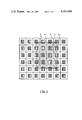
- FIGS. 2 and 3 are plan views of the windings of one of said inductors, respectively without the product and with the product;
- FIG. 4 is a perspective view of the inductor windings associated with a magnetic circuit to close the magnetic flux
- FIGS. 5 and 5A are block diagrams illustrating the operation of the devices according to the invention.
- FIGS. 6 and 7 are plan views of a form of the embodiment of an inductor adapted to the heating of strip, respectively without the product and with the product;
- FIG. 8 is a diagram functionally illustrating controls appropriate to the form of embodiment of FIGS. 6 and 7.
- the process according to the invention comprises the generation of currents (m) in the product, the currents being within arrays having dimensions and configurations resulting from the spatial variations of alternating magnetic fields to which the product is exposed.
- the intensities of the currents in each array are controlled such that the average value of the power dissipated per unit volume in each array is the same over the entire product.
- the boundaries are not compatible with a predetermined spatial distribution of the magnetic field, as the dimensions of the product are variable or the expansion due to heating causes an appreciable variation of said dimensions. At the boundaries, therefore, the elementary current arrays generated are not always those which would exist in the case of an infinite product.
- the average power per unit volume dissipated in one of these boundary arrays is different from that dissipated in an infinite product.
- certain arrays close to the boundary arrays may be perturbed. Such arrays are therefore referred to herein as arrays of local heating heterogeneity.
- an array of local heating heterogeneity always merges with the elementary array of induced current (m). In other words, there are no edge induced distrubances and the arrays are all homogeneous as discussed herein.
- arrays of local heating heterogeneity along the boundary are defined.
- the control of the power dissipated in each array of local heterogeneity is effected by the regulation of the intensity of current loops (b) facing this array of local heterogeneity thus defined.
- each array of local heating heterogeneity is defined by an elementary array.
- the current loops of the inductor not facing the product, i.e., those inductor loops having no part of the product directly over or under them, are extinguished or deenergized.
- An apparatus embodying the process according to the invention comprises:
- means (A) to generate an alternating magnetic field preferably inductors, that comprises conductors which form current loops traversed by variable current intensities and magnetic circuits enhancing the effectiveness of the device; and, depending on the specific case:
- means (B) to determine the position of the product with respect to the inductor and, in particular, the position of its boundaries;
- the heating device comprises identical, horizontal inductors (A1 and A2) facing each other, placed on both sides of the product (F) to be heated (FIG. 1).
- Each of the inductors comprises conductor windings (1) of a square configuration, placed regularly in accordance with an identical polar pitch in two orthogonal directions. In each of these directions, at each given instant, the current loops (b) of the conductor windings formed in this manner constitute a succession of alternating North and South magnetic poles (FIGS. 2 and 3).
- the closure of magnetic fluxes, to reinforce the efficiency of the apparatus, is insured by a magnetic circuit (2), possibly of a laminated construction.
- closure may be effected in one of the aforementioned directions as illustrated, or both, if desired. Closure in a single direction renders the control of the variation of the profile of the field in the orthogonal direction simpler, as the interactions between poles of two lines parallel to the direction to the closures are weaker (FIG. 4).
- the size of the pole is conventionally determined as a function of the maximum heating power per unit volume to be obtained, the thermal conductivity of the product and the maximum temperature difference permissible in the product during heating.
- the temperature differences in the product may be reduced, at the termination of the heating, by a reduction of the power per unit volume to which the termination differences are proportional in the first case.
- the frequency of the power supply of the apparatus conforms to two objectives:
- electromagnetic support of the product treated each of which may be of different thickness, resistivity and specific gravity. Adjustments of the frequency may thus be necessary to take into account variations of these parameters.
- the aforedescribed variation of the magnetic field further provides a stable support of the product between the inductors.
- Displacement of the product with respect to the inductors may be obtained by varying the profile of the magnetic field (reduction of intensity in the direction of the displacement) or by the addition of windings to constitute a linear, triphase motor, the latter devices being known in themselves.
- the position of the product with respect to the inductors is known, for example by its entry position and the displacements effected.
- a computer derives the value of the current intensities that must be passed through the poles to obtain homogeneous heating. These current intensities are substantially equal over the major portion of the product; they are different only for the poles close to the boundaries of the product.
- the embodiment may be simplified by controlling only the series of poles parallel to the edges of the product, with the relative variations in intensity thus concerning only two or three rows along each side edge of the product.
- the current intensities in each pole or group of poles are regulated by a suitable control device (G) connected to a source (S), the frequency of which may be variable.
- the rise in temperature desired may be obtained from entry in the computer (E) of a stored record of the temperature desired (C) and a measurement of the actual temperature (D) of the product, which values are compared by the computer (E).
- a function generator develops the mean desired temperature function of the product with respect to time and this temperature function is stored or used as it is developed.
- the computer (E) compares this temperature function record (C) with a temperature of the product calculated by the summation or integration of the heating already effected, to furnish the current intensity parameters required to obtain the temperature function desired.
- the calculated temperature may be compared with a measure of the actual temperature of the product to avoid slow integration drifting, or actual temperature may be used for direct control thus providing an automatic adaption of the mathematic heating model used by the computer.
- the inductors consist of poles (3) of an elongated configuration (FIGS. 6 and 7), which, at a given instant, are alternatingly north and south.
- a temperature sensor (4) placed to face each of the poles permits the regulation of the current of the corresponding pole as a function of an assigned temperature (C). In this manner, variations in the width and the position of the product (F) are taken into account implicitly. Poles which do not face the product are extinquished (deenergized).
- a computer may be used to determine the different current intensities required to obtain a correct transverse heating profile and, in response to a single temperature sensor and the computed intensity required for the profile, the total level of current intensities may be controlled.
- the products treated are rectangular.
- the length and the width of the product are inputs in the principal computer.
- the principal axis of the product is preferably parallel to the heating device, knowledge of the position of one of the points of the product, for example the center, with respect to the heating device makes it possible to determine completely the position of the product (particularly that of its boundaries) with respect to the inductor.
- the product upon its arrival, the product is placed symmetrically with respect to the two perpendicular axes known.
- the displacement of the product is effected by the successive extinction of rows of adjacent transverse poles, thus step by step, by a distance equal to a polar step.
- the computer is incremented at each extinction and thereby yields the position of the center at each instant.
- the increase in temperature is known, for example, by the integration as a function of time of the ratio of power per unit volume (determined by the computer) to the specific heat. It may be verified by measuring the temperature of the product with a contact thermometer.
Landscapes
- Physics & Mathematics (AREA)
- Electromagnetism (AREA)
- Engineering & Computer Science (AREA)
- Power Engineering (AREA)
- General Induction Heating (AREA)
Abstract
Description
Claims (13)
Applications Claiming Priority (2)
| Application Number | Priority Date | Filing Date | Title |
|---|---|---|---|
| FR8113689 | 1981-07-10 | ||
| FR8113689A FR2509562A1 (en) | 1981-07-10 | 1981-07-10 | METHOD AND APPARATUS FOR HOMOGENEOUS HEATING BY TRANSVERSE FLOW ELECTROMAGNETIC INDUCTION OF FLAT, CONDUCTOR AND AMAGNETIC PRODUCTS |
Publications (1)
| Publication Number | Publication Date |
|---|---|
| US4484048A true US4484048A (en) | 1984-11-20 |
Family
ID=9260458
Family Applications (1)
| Application Number | Title | Priority Date | Filing Date |
|---|---|---|---|
| US06/396,050 Expired - Lifetime US4484048A (en) | 1981-07-10 | 1982-07-07 | Process and apparatus for the homogeneous, electromagnetic induction heating with transverse flux of conducting and non-magnetic flat products |
Country Status (5)
| Country | Link |
|---|---|
| US (1) | US4484048A (en) |
| EP (1) | EP0070232B1 (en) |
| JP (1) | JPS5851493A (en) |
| DE (1) | DE3273178D1 (en) |
| FR (1) | FR2509562A1 (en) |
Cited By (19)
| Publication number | Priority date | Publication date | Assignee | Title |
|---|---|---|---|---|
| US4587392A (en) * | 1984-01-26 | 1986-05-06 | Cem - Compagnie Electro-Mecanique | Electro-magnetic induction scrolling device for heating flat products |
| US5308946A (en) * | 1992-02-06 | 1994-05-03 | Mohr Glenn R | Induction heating apparatus and method for heating metal strips and slabs |
| US5397877A (en) * | 1992-06-24 | 1995-03-14 | Celes | Device for the homogeneous inductive heating of metallic flat products on the move |
| US5510600A (en) * | 1991-12-03 | 1996-04-23 | Ea Technology Limited | Electromagnetic induction heating apparatus for heating elongated metal workpieces |
| WO2001019561A1 (en) * | 1999-09-14 | 2001-03-22 | Emitec Gesellschaft Für Emissionstechnologie Mbh | Method and device for joining a support matrix of a honeycomb on the end face using bonding technology |
| US6498328B2 (en) * | 2000-04-19 | 2002-12-24 | Celes | Transverse flux induction heating device with magnetic circuit of variable width |
| US20040164071A1 (en) * | 2002-04-08 | 2004-08-26 | Jfe Steel Corporation | Heat treatment apparatus, heat treatment method, medium on which heat treatment program is recorded, and steel product |
| US20050252587A1 (en) * | 2003-06-16 | 2005-11-17 | Yoshitsugu Iijima | Process for producing steel product and production facility therefor |
| EP1384391A4 (en) * | 2001-03-26 | 2006-07-05 | Nicholas V Ross | Transverse flux induction heating of conductive strip |
| EP1652942A4 (en) * | 2003-08-05 | 2007-02-21 | Jfe Steel Corp | PROCESS FOR PRODUCTION OF STEEL PRODUCTS AND PRODUCTION EQUIPMENT THEREFOR |
| US20090071954A1 (en) * | 2005-09-12 | 2009-03-19 | Takumi Fujita | Induction Tempering Method, Induction Tempering Apparatus, and Induction Tempered Product |
| EP1542508B2 (en) † | 2003-12-08 | 2010-10-20 | Whirlpool Corporation | A device for determining the location of cooking utensils on a cooking hob |
| CN103996481A (en) * | 2014-05-22 | 2014-08-20 | 西北工业大学 | Generation method of large-area uniform vertical variable coupling motion magnetic field |
| US10939600B2 (en) | 2018-11-28 | 2021-03-02 | International Business Machines Corporation | Flux residue detection |
| EP4243571A3 (en) * | 2016-03-30 | 2023-11-15 | Nippon Steel Corporation | Induction heating device and induction heating method |
| US12028956B2 (en) * | 2013-11-07 | 2024-07-02 | Illinois Tool Works Inc. | Large scale metal forming |
| US12189058B2 (en) | 2017-12-22 | 2025-01-07 | Seyond, Inc. | High resolution LiDAR using high frequency pulse firing |
| US12241999B2 (en) | 2016-12-31 | 2025-03-04 | Seyond, Inc. | 2D scanning high precision LiDAR using combination of rotating concave mirror and beam steering devices |
| US12276759B2 (en) | 2018-06-15 | 2025-04-15 | Seyond, Inc. | LiDAR systems and methods for focusing on ranges of interest |
Families Citing this family (6)
| Publication number | Priority date | Publication date | Assignee | Title |
|---|---|---|---|---|
| GB2122058B (en) * | 1982-05-28 | 1985-10-23 | Glaverbel | Method and apparatus for bonding glazing panels |
| FR2573947B1 (en) * | 1984-11-29 | 1987-01-02 | Cem Comp Electro Mec | DEVICE FOR HEATING FLAT PRODUCTS ON RUNNING BY ELECTROMAGNETIC INDUCTION ACCORDING TO A SQUARE MESH |
| JPS62150371A (en) * | 1985-12-25 | 1987-07-04 | Alps Electric Co Ltd | Heat pressure fixing device |
| JPH07101633B2 (en) * | 1987-09-28 | 1995-11-01 | 株式会社明電舎 | Flat plate induction heating device |
| FR2660743B1 (en) * | 1990-04-04 | 1995-08-04 | Sundgau Sarl Atel Const Elect | METHOD AND DEVICE FOR HEATING METAL PARTS IN AN INDUCTION OVEN. |
| CN109219985B (en) * | 2016-04-18 | 2021-12-03 | 阿尔卑斯南部欧洲有限责任公司 | Induction heater and dispenser |
Citations (10)
| Publication number | Priority date | Publication date | Assignee | Title |
|---|---|---|---|---|
| US2448009A (en) * | 1944-02-05 | 1948-08-31 | Westinghouse Electric Corp | Inductive heating of longitudinally moving metal strip |
| US2556223A (en) * | 1947-05-28 | 1951-06-12 | Westinghouse Electric Corp | Induction heating of flat metal by transverse flux |
| US2902572A (en) * | 1957-03-05 | 1959-09-01 | Penn Induction Company | Induction heating of metal strip |
| US3041434A (en) * | 1958-09-19 | 1962-06-26 | Deutsche Edelstahlwerke Ag | Method of and apparatus for inductively heating metal |
| CA909873A (en) * | 1972-09-12 | V. Sorokin Viktor | Method of and device for induction heating of flat bodies | |
| US3781506A (en) * | 1972-07-28 | 1973-12-25 | Gen Electric | Non-contacting temperature measurement of inductively heated utensil and other objects |
| US4054770A (en) * | 1975-03-10 | 1977-10-18 | The Electricity Council | Induction heating of strip and other elongate metal workpieces |
| US4122321A (en) * | 1977-02-16 | 1978-10-24 | Park-Ohio Industries, Inc. | Induction heating furnace |
| US4307276A (en) * | 1976-07-30 | 1981-12-22 | Nippon Steel Corporation | Induction heating method for metal products |
| US4321444A (en) * | 1975-03-04 | 1982-03-23 | Davies Evan J | Induction heating apparatus |
Family Cites Families (7)
| Publication number | Priority date | Publication date | Assignee | Title |
|---|---|---|---|---|
| DE903977C (en) * | 1940-01-21 | 1954-02-11 | Siemens Ag | Eddy current heater |
| DE921401C (en) * | 1941-08-23 | 1954-12-20 | Siemens Ag | Induction device for annealing and hardening armor plates |
| FR1202900A (en) * | 1957-03-05 | 1960-01-14 | Penn Induction Corp | Method and apparatus for induction heating of sheet metal strips |
| CH416879A (en) * | 1963-04-01 | 1966-07-15 | Baermann Max | Furnace for heating metallic parts |
| US3444346A (en) * | 1966-12-19 | 1969-05-13 | Texas Instruments Inc | Inductive heating of strip material |
| DE2556057C2 (en) * | 1975-12-12 | 1982-04-01 | Sundwiger Eisenhütte Maschinenfabrik Grah & Co, 5870 Hemer | Method and device for heating metal strips, in particular non-ferrous metal strips |
| DE2622825A1 (en) * | 1976-05-21 | 1977-12-01 | Siemens Ag | Continuous induction heating of wire - where electronic circuit provides accurate heating despite variations in inlet temp. of wire |
-
1981
- 1981-07-10 FR FR8113689A patent/FR2509562A1/en active Granted
-
1982
- 1982-07-06 EP EP82401267A patent/EP0070232B1/en not_active Expired
- 1982-07-06 DE DE8282401267T patent/DE3273178D1/en not_active Expired
- 1982-07-07 US US06/396,050 patent/US4484048A/en not_active Expired - Lifetime
- 1982-07-10 JP JP57119199A patent/JPS5851493A/en active Granted
Patent Citations (10)
| Publication number | Priority date | Publication date | Assignee | Title |
|---|---|---|---|---|
| CA909873A (en) * | 1972-09-12 | V. Sorokin Viktor | Method of and device for induction heating of flat bodies | |
| US2448009A (en) * | 1944-02-05 | 1948-08-31 | Westinghouse Electric Corp | Inductive heating of longitudinally moving metal strip |
| US2556223A (en) * | 1947-05-28 | 1951-06-12 | Westinghouse Electric Corp | Induction heating of flat metal by transverse flux |
| US2902572A (en) * | 1957-03-05 | 1959-09-01 | Penn Induction Company | Induction heating of metal strip |
| US3041434A (en) * | 1958-09-19 | 1962-06-26 | Deutsche Edelstahlwerke Ag | Method of and apparatus for inductively heating metal |
| US3781506A (en) * | 1972-07-28 | 1973-12-25 | Gen Electric | Non-contacting temperature measurement of inductively heated utensil and other objects |
| US4321444A (en) * | 1975-03-04 | 1982-03-23 | Davies Evan J | Induction heating apparatus |
| US4054770A (en) * | 1975-03-10 | 1977-10-18 | The Electricity Council | Induction heating of strip and other elongate metal workpieces |
| US4307276A (en) * | 1976-07-30 | 1981-12-22 | Nippon Steel Corporation | Induction heating method for metal products |
| US4122321A (en) * | 1977-02-16 | 1978-10-24 | Park-Ohio Industries, Inc. | Induction heating furnace |
Cited By (23)
| Publication number | Priority date | Publication date | Assignee | Title |
|---|---|---|---|---|
| US4587392A (en) * | 1984-01-26 | 1986-05-06 | Cem - Compagnie Electro-Mecanique | Electro-magnetic induction scrolling device for heating flat products |
| US5510600A (en) * | 1991-12-03 | 1996-04-23 | Ea Technology Limited | Electromagnetic induction heating apparatus for heating elongated metal workpieces |
| EP0817532A3 (en) * | 1991-12-03 | 1998-12-23 | Ea Technology Limited | Induction heating apparatus |
| US5308946A (en) * | 1992-02-06 | 1994-05-03 | Mohr Glenn R | Induction heating apparatus and method for heating metal strips and slabs |
| US5397877A (en) * | 1992-06-24 | 1995-03-14 | Celes | Device for the homogeneous inductive heating of metallic flat products on the move |
| WO2001019561A1 (en) * | 1999-09-14 | 2001-03-22 | Emitec Gesellschaft Für Emissionstechnologie Mbh | Method and device for joining a support matrix of a honeycomb on the end face using bonding technology |
| US6639193B2 (en) | 1999-09-14 | 2003-10-28 | Emitec Gesellschaft Für Emissionstechnologie Mbh | Method and apparatus for the end-surface connection of a carrier matrix of a honeycomb body by a joining technique |
| US6498328B2 (en) * | 2000-04-19 | 2002-12-24 | Celes | Transverse flux induction heating device with magnetic circuit of variable width |
| EP1384391A4 (en) * | 2001-03-26 | 2006-07-05 | Nicholas V Ross | Transverse flux induction heating of conductive strip |
| US20040164071A1 (en) * | 2002-04-08 | 2004-08-26 | Jfe Steel Corporation | Heat treatment apparatus, heat treatment method, medium on which heat treatment program is recorded, and steel product |
| US6891139B2 (en) * | 2002-04-08 | 2005-05-10 | Jfe Steel Corporation | Heat treatment apparatus, heat treatment method, medium on which heat treatment program is recorded, and steel product |
| US20050252587A1 (en) * | 2003-06-16 | 2005-11-17 | Yoshitsugu Iijima | Process for producing steel product and production facility therefor |
| US7857919B2 (en) | 2003-06-16 | 2010-12-28 | Jfe Steel Corporation | Process for producing steel product and production facility therefor |
| EP1652942A4 (en) * | 2003-08-05 | 2007-02-21 | Jfe Steel Corp | PROCESS FOR PRODUCTION OF STEEL PRODUCTS AND PRODUCTION EQUIPMENT THEREFOR |
| EP1542508B2 (en) † | 2003-12-08 | 2010-10-20 | Whirlpool Corporation | A device for determining the location of cooking utensils on a cooking hob |
| US20090071954A1 (en) * | 2005-09-12 | 2009-03-19 | Takumi Fujita | Induction Tempering Method, Induction Tempering Apparatus, and Induction Tempered Product |
| US12028956B2 (en) * | 2013-11-07 | 2024-07-02 | Illinois Tool Works Inc. | Large scale metal forming |
| CN103996481A (en) * | 2014-05-22 | 2014-08-20 | 西北工业大学 | Generation method of large-area uniform vertical variable coupling motion magnetic field |
| EP4243571A3 (en) * | 2016-03-30 | 2023-11-15 | Nippon Steel Corporation | Induction heating device and induction heating method |
| US12241999B2 (en) | 2016-12-31 | 2025-03-04 | Seyond, Inc. | 2D scanning high precision LiDAR using combination of rotating concave mirror and beam steering devices |
| US12189058B2 (en) | 2017-12-22 | 2025-01-07 | Seyond, Inc. | High resolution LiDAR using high frequency pulse firing |
| US12276759B2 (en) | 2018-06-15 | 2025-04-15 | Seyond, Inc. | LiDAR systems and methods for focusing on ranges of interest |
| US10939600B2 (en) | 2018-11-28 | 2021-03-02 | International Business Machines Corporation | Flux residue detection |
Also Published As
| Publication number | Publication date |
|---|---|
| EP0070232A1 (en) | 1983-01-19 |
| FR2509562A1 (en) | 1983-01-14 |
| JPS6256632B2 (en) | 1987-11-26 |
| DE3273178D1 (en) | 1986-10-16 |
| EP0070232B1 (en) | 1986-09-10 |
| FR2509562B1 (en) | 1984-06-29 |
| JPS5851493A (en) | 1983-03-26 |
Similar Documents
| Publication | Publication Date | Title |
|---|---|---|
| JPS6256632B2 (en) | ||
| US4054770A (en) | Induction heating of strip and other elongate metal workpieces | |
| US3444346A (en) | Inductive heating of strip material | |
| US2902572A (en) | Induction heating of metal strip | |
| EP1718117B1 (en) | Induction Heating Device and Process for Controlling Temperature Distribution | |
| US20090101636A1 (en) | Transverse Flux Electric Inductors | |
| US4321444A (en) | Induction heating apparatus | |
| KR920700097A (en) | High temperature electric heating device for manufacturing composite structure | |
| EP0452310B1 (en) | Support structures | |
| DE60029506T2 (en) | Method for stabilizing a magnetic field, device for generating a magnetic field and device for magnetic resonance imaging | |
| DE60214711T2 (en) | Magnetic heater | |
| GB2115552A (en) | Improvements relating to magnetic field gradiometers | |
| US4587392A (en) | Electro-magnetic induction scrolling device for heating flat products | |
| US2813186A (en) | Heat treatment apparatus | |
| JPH05258849A (en) | Induction-heated cooking apparatus | |
| US7126095B2 (en) | Frying hob arrangement with induction heating | |
| JP4313670B2 (en) | Sample heating device | |
| JPH07101633B2 (en) | Flat plate induction heating device | |
| US2556223A (en) | Induction heating of flat metal by transverse flux | |
| JPH0221116B2 (en) | ||
| EP0075782B1 (en) | Method and apparatus for controlling a product which is influenced by a metering process | |
| JP2892093B2 (en) | Magnetic shielding method | |
| CN115413076A (en) | Heating system and method of intelligent heating equipment | |
| RU2151201C1 (en) | Method of induction gradient heating and device for its realization | |
| JP2574193B2 (en) | Electromagnetic field analysis method |
Legal Events
| Date | Code | Title | Description |
|---|---|---|---|
| AS | Assignment |
Owner name: CEM COMPAGNIE ELECTRO-MECANIQUE 12, RUE PORTALIS F Free format text: ASSIGNMENT OF ASSIGNORS INTEREST.;ASSIGNORS:TRAVERS, ROGER;CAMUS, JEAN-PAUL;BRONNER, JEAN-CLAUDE;REEL/FRAME:004290/0180 Effective date: 19820628 Owner name: CEM COMPAGNIE ELECTRO-MECANIQUE,FRANCE Free format text: ASSIGNMENT OF ASSIGNORS INTEREST;ASSIGNORS:TRAVERS, ROGER;CAMUS, JEAN-PAUL;BRONNER, JEAN-CLAUDE;REEL/FRAME:004290/0180 Effective date: 19820628 |
|
| STCF | Information on status: patent grant |
Free format text: PATENTED CASE |
|
| FEPP | Fee payment procedure |
Free format text: PAYOR NUMBER ASSIGNED (ORIGINAL EVENT CODE: ASPN); ENTITY STATUS OF PATENT OWNER: LARGE ENTITY |
|
| FPAY | Fee payment |
Year of fee payment: 4 |
|
| FPAY | Fee payment |
Year of fee payment: 8 |
|
| FEPP | Fee payment procedure |
Free format text: PAYOR NUMBER ASSIGNED (ORIGINAL EVENT CODE: ASPN); ENTITY STATUS OF PATENT OWNER: LARGE ENTITY Free format text: PAYER NUMBER DE-ASSIGNED (ORIGINAL EVENT CODE: RMPN); ENTITY STATUS OF PATENT OWNER: LARGE ENTITY |
|
| FPAY | Fee payment |
Year of fee payment: 12 |