US4470592A - Apparatus for guiding a sheet - Google Patents

Apparatus for guiding a sheet Download PDF

Info

Publication number
US4470592A
US4470592A US06/442,641 US44264182A US4470592A US 4470592 A US4470592 A US 4470592A US 44264182 A US44264182 A US 44264182A US 4470592 A US4470592 A US 4470592A
Authority
US
United States
Prior art keywords
feed rolls
gear
bearing boxes
sheet
corrugated cardboard
Prior art date
Legal status (The legal status is an assumption and is not a legal conclusion. Google has not performed a legal analysis and makes no representation as to the accuracy of the status listed.)
Expired - Lifetime
Application number
US06/442,641
Inventor
Takehiro Takahashi
Current Assignee (The listed assignees may be inaccurate. Google has not performed a legal analysis and makes no representation or warranty as to the accuracy of the list.)
Mitsubishi Heavy Industries Ltd
Original Assignee
Mitsubishi Heavy Industries Ltd
Priority date (The priority date is an assumption and is not a legal conclusion. Google has not performed a legal analysis and makes no representation as to the accuracy of the date listed.)
Filing date
Publication date
Application filed by Mitsubishi Heavy Industries Ltd filed Critical Mitsubishi Heavy Industries Ltd
Assigned to MITSUBISHI JUKOGYO KABUSHIKI KAISHA reassignment MITSUBISHI JUKOGYO KABUSHIKI KAISHA ASSIGNMENT OF ASSIGNORS INTEREST. Assignors: TAKAHASHI, TAKEHIRO
Application granted granted Critical
Publication of US4470592A publication Critical patent/US4470592A/en
Anticipated expiration legal-status Critical
Expired - Lifetime legal-status Critical Current

Links

Images

Classifications

    • BPERFORMING OPERATIONS; TRANSPORTING
    • B65CONVEYING; PACKING; STORING; HANDLING THIN OR FILAMENTARY MATERIAL
    • B65HHANDLING THIN OR FILAMENTARY MATERIAL, e.g. SHEETS, WEBS, CABLES
    • B65H5/00Feeding articles separated from piles; Feeding articles to machines
    • B65H5/06Feeding articles separated from piles; Feeding articles to machines by rollers or balls, e.g. between rollers
    • B65H5/062Feeding articles separated from piles; Feeding articles to machines by rollers or balls, e.g. between rollers between rollers or balls
    • BPERFORMING OPERATIONS; TRANSPORTING
    • B31MAKING ARTICLES OF PAPER, CARDBOARD OR MATERIAL WORKED IN A MANNER ANALOGOUS TO PAPER; WORKING PAPER, CARDBOARD OR MATERIAL WORKED IN A MANNER ANALOGOUS TO PAPER
    • B31BMAKING CONTAINERS OF PAPER, CARDBOARD OR MATERIAL WORKED IN A MANNER ANALOGOUS TO PAPER
    • B31B50/00Making rigid or semi-rigid containers, e.g. boxes or cartons
    • B31B50/02Feeding or positioning sheets, blanks or webs
    • B31B50/04Feeding sheets or blanks
    • B31B50/042Feeding sheets or blanks using rolls, belts or chains
    • BPERFORMING OPERATIONS; TRANSPORTING
    • B31MAKING ARTICLES OF PAPER, CARDBOARD OR MATERIAL WORKED IN A MANNER ANALOGOUS TO PAPER; WORKING PAPER, CARDBOARD OR MATERIAL WORKED IN A MANNER ANALOGOUS TO PAPER
    • B31BMAKING CONTAINERS OF PAPER, CARDBOARD OR MATERIAL WORKED IN A MANNER ANALOGOUS TO PAPER
    • B31B50/00Making rigid or semi-rigid containers, e.g. boxes or cartons
    • B31B50/02Feeding or positioning sheets, blanks or webs
    • B31B50/04Feeding sheets or blanks
    • B31B50/06Feeding sheets or blanks from stacks
    • B31B50/062Feeding sheets or blanks from stacks from the underside of a magazine
    • BPERFORMING OPERATIONS; TRANSPORTING
    • B65CONVEYING; PACKING; STORING; HANDLING THIN OR FILAMENTARY MATERIAL
    • B65HHANDLING THIN OR FILAMENTARY MATERIAL, e.g. SHEETS, WEBS, CABLES
    • B65H2511/00Dimensions; Position; Numbers; Identification; Occurrences
    • B65H2511/20Location in space
    • B65H2511/22Distance
    • BPERFORMING OPERATIONS; TRANSPORTING
    • B65CONVEYING; PACKING; STORING; HANDLING THIN OR FILAMENTARY MATERIAL
    • B65HHANDLING THIN OR FILAMENTARY MATERIAL, e.g. SHEETS, WEBS, CABLES
    • B65H2511/00Dimensions; Position; Numbers; Identification; Occurrences
    • B65H2511/20Location in space
    • B65H2511/22Distance
    • B65H2511/224Nip between rollers, between belts or between rollers and belts

Definitions

  • This invention relates to apparatus for guiding a sheet in a corrugated cardboard sheet box-making machine, and more particularly, to apparatus for effectively and efficiently accommodating corrugated cardboard sheet of different thicknesses.
  • machines are provided for successively performing various operations on the corrugated sheet cardboard.
  • machines are provided for feeding the sheet through a printing operation and then through a slitting and scoring operation.
  • These machines include feed rolls for moving the sheet through the successive operations and sheet guiding and supporting means by which the sheet is guided as it is progressively moved through the box-making machine by the feed rolls.
  • corrugated cardboard sheet of differing thicknesses may be fed in successive runs.
  • apparatus which in a simple manner effects the adjustment of the position of the guide plates simultaneously with the adjustment of the position of the feed roll so that a constant difference between the level of the upper periphery of the adjustable feed roll and the upper surface of the guide plate is maintained.
  • this adjustment is made by a single adjusting means which, upon movement thereof, effects simultaneously the adjustment of the position of the feed roll and the adjustment of the position of the guide plate by corresponding amounts.
  • an apparatus for guiding a corrugated cardboard sheet in a transfer portion and machining portion of a corrugated cardboard sheet box-making machine.
  • Eccentric bearing boxes are provided for supporting feed rolls and receiving rolls which define a path of travel for the corrugated cardboard sheet.
  • the eccentric bearing boxes are rotatable to adjust the position of the rolls vertically depending on the thickness of the sheet then being run through the machine.
  • the apparatus further includes sheet guide means for guiding the corrugated cardboard sheet to the receiving rolls and feed rolls.
  • the sheet guide means includes guide plates supported on brackets which in turn are supported on portions of the eccentric bearing boxes.
  • the eccentric bearing boxes include gears accessible from the exterior of a supporting frame of the apparatus.
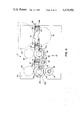
  • An adjusting lever including a pinion which engages one of the aforementioned gears is provided for effecting vertical adjustment of the feed rolls by rotating the eccentric bearing boxes to accommodate corrugated cardboard sheet of varying thicknesses. Adjustment of the position of the eccentric bearing boxes for moving the feed rolls simultaneously effects corresponding adjustment of the position of the guide plates so that a constant difference in level between the guide plates and the upper periphery of the feed rolls is maintained.
  • FIG. 1 is a diagrammatic view illustrating a conventional prior art machine for making corrugated cardboard boxes.
  • FIGS. 2 to 5 are a series of perspective views showing a corrugated cardboard sheet at various stages of the box-making operation.
  • FIG. 6 is an enlarged side elevation view of a printing portion of the machine shown in FIG. 1.
  • FIG. 7 is an enlarged sectional view taken along the line VII--VII of FIG. 6.
  • FIG. 8 is a side elevation view showing an ideal arrangement for a corrugated cardboard sheet, feed rolls and sheet guides.
  • FIG. 9 is a view similar to FIG. 8 but showing such an arrangement in a conventional machine.
  • FIG. 10 is a top plan view of apparatus embodying this invention.
  • FIG. 11 is a sectional view taken along the line XI--XI of FIG. 10.
  • FIG. 12 is a sectional view taken along the line XII--XII of FIG. 10.
  • FIG. 13 is a sectional view taken along the line XIII--XIII of FIG. 10.
  • FIG. 14 is a side elevation view taken in the direction of the line XIV--XIV of FIG. 10.
  • FIG. 15 is a side elevation view, partly in section of an apparatus showing another embodiment of this invention.
  • FIGS. 1-7 In order to provide a better understanding of the invention, before proceeding with the detailed description of the invention which is the subject of this application, a conventional prior art machine illustrated in FIGS. 1-7 will first be described.
  • the conventional corrugated cardboard sheet box-making machine there illustrated includes provision for passing corrugated cardboard sheets 1 through a sheet feed portion 2, printing portions 3, 3' and a sheet discharge portion 4.
  • corrugated cardboard sheets 1 that have been sent from the preceding step are stacked on a table 6 of the sheet feed portion 2 as depicted in FIG. 2 and the lowermost corrugated cardboard sheets are kicked one by one into a pair of feed rolls 7, 8 by a kicker 5.
  • the corrugated cardboard sheet 1 fed toward the left in FIG. 1 by feed rolls 7, 8 and transferred between a printing cylinder 9 of the printing portion 3 and a receiving roll 10 along a sheet guide 27, where it is printed as represented by symbol a on the sheet identified by the numeral 1' in FIG. 3.
  • the corrugated cardboard sheet 1' is transferred between a printing cylinder 15 of the printing portion 3' and a receiving roll 16 by two pairs of feed rolls 11, 12 and 13, 14 and is printed as represented by symbol a' on the sheet identified by the numeral 1" in FIG. 4.
  • the corrugated cardboard sheet 1" is then passed through two pairs of line marking rolls 21, 22 and 23, 24 of the sheet discharge portion 4 by two pairs of feed rolls 17, 18 and 19, 20 and then through a slitter roll 25 and a receiving roll 26.
  • a corrugated cardboard sheet 1'" equipped with a ruled line k and slits S is obtained as depicted in FIG. 5.
  • FIGS. 6 and 7 illustrate the construction of the sheet guide 27 disposed in the printing portion 3 shown in FIG. 1.
  • the sheet guide 27 of the printing portion 3' also has the same construction.
  • each of supports 28, 28 has upper and lower bolt holes 28a, 28a and one of its ends is fixed to the inner side surface of a corresponding frame unit 3a, 3b.
  • Each leg 27b of a guide plate 27a has an elongated hole 27c extending in the vertical direction and the guide plate 27a is fixed to the support 28a by two bolts 29, 29 so that its level may be adjusted. This level adjustment of the guide plate 27a is made manually by use of the elongated holes 27c.
  • FIG. 8 illustrates an ideal state in which the corrugated cardboard sheet 1 having a thickness t is guided on the upper surface of the guide plate 27a by two pairs of feed rolls 11, 12 and 13, 14, the sheet being moved in the direction indicated by an arrow.
  • the ideal state means one in which:
  • the corrugated cardboard sheet 1 is free from warp;
  • the angle of entrance ⁇ of the corrugated cardboard sheet to the feed rolls 11, 12 or 13, 14 is at right angles with respect to the plane including the axial centers C 11 and C 12 of the feed rolls 11 and 12, and the plane including the axial centers C 13 and C 14 of the feed rolls 13 and 14;
  • FIG. 9 shows the relation between the conventional feed rolls 11, 12 and 13, 14 and the guide plate 27a with respect to the corrugated cardboard sheet 1 or 1'. Successive runs of corrugated cardboard sheets processed in the machine may vary in thickness. Assume that the feed rolls 12, 14 represented by solid line in FIG. 9 are adjusted at positions corresponding to the maximum thickness (t max ) of the corrugated cardboard sheet, and the level of each guide plate 27a is set at a position which is a distance h below the upper periphery of the feed rolls 12, 14. It will be now assumed that machining of the corrugated cardboard sheet is finished under such a state and a corrugated cardboard sheet having a smaller thickness t' is then to be sent through the machine.
  • t max maximum thickness
  • this invention there is provided a sheet guide apparatus which is compact in construction but can maintain always a predetermined level of accuracy of finishing irrespective of the thickness of the corrugated cardboard sheets to be machined.
  • the position adjustment of the feed rolls or receiving rolls is made in an interlocking arrangement with the position adjustment of the sheet guide plates. It is not necessary to separately adjust the position of the sheet guide plates as in the conventional apparatus. Accordingly, a predetermined level of accuracy of finishing can be maintained without requiring the loss of time in machining the corrugated cardboard sheets and the production efficiency as well as quality of the products is markedly improved.
  • the sheet guide apparatus 35 of this invention comprises a plurality of sheet guides 36 and brackets 37, 38 and 39.
  • Each sheet guide 36 in turn comprises a guide plate 36a and legs 36b fixed to the guide plate 36a in the T form.
  • the brackets 37, 37 extend longitudinally over bearing supports 51 and 52, and beyond the shaft of a receiving roll 32.
  • the brackets 38, 39 are disposed at the shaft portions of feed rolls 33, 34 so as to encompass the lower semicircular portion of the bearing supports 51 and 52.
  • Brackets 38, 39 are fixed to the lower edge of the bracket 37, as shown in FIG. 11.
  • the legs 36b are fixed to a bracket 40 which is fixed to the inner side surface of the brcket 37 and the sheet guide 36 keeps the upper surface of the guide plate 36a horizontal and is interconnected to the bracket 37 at the position shown in the drawing.
  • eccentric bearing boxes 49, 50 are rotatably mounted in openings in frames 31a, 31b, respectively.
  • Each eccentric bearing box has a center which is displaced eccentrically by a distance e from the center of the feed roll 34.
  • the bearing boxes rotatably support both shaft end portions of the feed roll 34 by means of bearings 53 that are positioned within the hollow interior of the bearing boxes.
  • the portions of the bearing boxes 49, 50 projecting outside the frames 31a, 31b have gears 49a, 50a, respectively.
  • the bearing supports 51, 52 are fixed to the inner surfaces of the eccentric bearing boxes 49, 50, respectively in such a manner that their inner diameter surfaces keep a slight gap between the outer circumferential surfaces of the shafts 34a, 34a of the feed roll 34.
  • a shaft 48 is rotatably supported by the frames 31a and 31b below the feed roll 34.
  • An idle gear 47 is keyed to each end of the shaft 48, and engaged with a corresponding one of the gears 49a and 50a.
  • a shaft 43 is rotatably supported in an opening in the frame 31a.
  • a pinion 46 is keyed at one of the ends of a cylindrical portion 43a of the shaft 43, and engages one of the idle gears 47.
  • a bracket 44 equipped with a set screw 45 is fitted also to this end of the shaft 43. The lower end of the bracket 44 is fixed to the frame 31a.
  • the shaft 43 includes a square portion 43b and a handle 42, having a corresponding square opening therein is mounted on the portion 43a, as shown in FIG. 14.
  • the bearing supports 51, 52 include transversely projecting portions 51a, 52a, respectively, about which the brackets 37, 39 are rotatably fitted.
  • eccentric bearing boxes 49, 50 each having a center which is displaced eccentrically by the distance e from the center of the feed roll 33, are rotatably supported by the frames 31a, 31b and support rotatably both shaft ends of the feed roll 33 by their bearings 53.
  • the brackets 37, 38 rotatably engage with the bearing supports 51, 52 at their transversely projecting portions 51a, 52a.
  • idle gears 55 are provided, as shown in FIGS. 10, 11 and 14.
  • the idle gears 55 are keyed to both ends of a shaft 54 which is rotatably supported by the frames 31a, 31b.
  • One of the idle gears 55 is engaged between both gears 49a, 49a on the eccentric bearing boxes 49, 49, and the other idle gear 55 is engaged between both gears 50a, 50a on the eccentric bearing boxes 50, 50, as shown in FIGS. 11 and 14.
  • the handle 42 can be turned in one direction to increase the gap g 33 between the feed rolls 33 and 33' and the gap g 34 between the feed rolls 34 and 34' (see FIG. 14), and in the opposite direction to decrease those gaps.
  • the gaps g 33 and g 34 can be decreased if the handle 42 is rotated clockwise in FIG. 14.
  • the rotation of the handle 42 causes rotation of the pinion 46, the idle gears 47, 47 and the shaft 48, and thereby of the gears 49a, 50a.
  • the centers c 34 and c 33 of the feed rolls 34 and 33 move on a semicircular orbit having the eccentricity e between the centers c' 34 , c' 33 of the feed rolls 34, 33 and the centers of the eccentric bearing boxes 49, 50 as the radius.
  • the level of the feed rolls 33 and 34 can be adjusted in the interlocking arrangement with each other within the range corresponding to 2e, that is, in the distance from c 34 , c 33 to c' 34 , c' 33 .
  • the brackets 37, 39, 38 move up and down following the rotation of the eccentric bearing boxes 49, 50 via the bearing supports 51, 52, as shown in FIGS. 12 and 13.
  • the sheet guide 36, which is supported on the brackets also moves up and down together with the brackets 37, 39, 38 by the same amount as the centers of the feed rolls 33 and 34 are moved and simultaneously therewith. Therefore, the level difference h between the upper edges of the feed rolls 33, 34 and the upper surface of each guide plate 36a (see FIG. 8) is maintained at a constant value.
  • the positions of the feed rolls 33, 34 can be adjusted to suitable positions in the vertical direction by simply moving the handle 42 clockwise or counterclockwise, as described above.
  • the position of the upper surface of each guide plate is adjusted so as to follow the displacement in the vertical direction resulting from the adjustment of the feed rolls 33, 34.
  • the positions of the feed rolls 33, 34 and the guide plate 36a are adjusted, but it is also possible to support the receiving rolls 32 by the frames 31a, 31b using the same construction as the feed rolls 33, 34 and to adjust their position integrally with the feed rolls. It is also possible to independently adjust the position of the receiving rolls 32 in response to the adjustment of the feed rolls. Furthermore, in the embodiment described above, the positions of the receiving rolls 32 and feed rolls 33, 34 can be adjusted in the vertical direction in integral arrangement with each guide plate 36a. However, the following construction may also be employed. As shown in FIG.
  • the guide plates 36a are formed integrally with one another by use of the bracket 37 which is the same as one used in the embodiment described above, and the receiving roll 32 is rotatably supported by the eccentric bearing boxes 49, 50.
  • the idle gears 47, 55 are arranged as shown in FIG. 15 and the shaft 48 is operated by the handle 42 in the same manner as shown in FIGS. 12 and 14 so as to adjust the positions of the receiving roll 32, feed rolls 33 and guide plates 36a in the vertical direction.
  • the sheet guide 36 is engaged with the eccentric bearing boxes 49, 50 in the embodiment described above, it is also possible to use such a construction in which the eccentric bearing boxes 49, 50 are fitted to the receiving roll 32' and to the feed roll 34' and the bracket 37 is suspended from these eccentric bearing boxes so that the positions of each guide plate 36a, receiving roll 32' and feed rolls 33', 34' can be integrally adjusted in the vertical direction.

Landscapes

  • Engineering & Computer Science (AREA)
  • Mechanical Engineering (AREA)
  • Making Paper Articles (AREA)
  • Delivering By Means Of Belts And Rollers (AREA)
  • Feeding Of Articles By Means Other Than Belts Or Rollers (AREA)

Abstract

An apparatus is provided for guiding a corrugated cardboard sheet in a transfer portion and machining portion of a corrugated cardboard sheet box-making machine. Eccentric bearing boxes are provided for supporting feed rolls which define a path of travel for the corrugated cardboard sheet. The eccentric bearing boxes are rotatable to adjust the position of the rolls vertically depending on the thickness of the sheet then being run through the machine. The apparatus further includes sheet guide means for guiding the corrugated cardboard sheet to the feed rolls. The sheet guide means includes guide plates supported on brackets which in turn are supported on portions of the eccentric bearing boxes. Adjustment of the position of the eccentric bearing boxes for moving the feed rolls simultaneously effects corresponding adjustment of the position of the guide plates so that a constant difference in level between the guide plates and the upper periphery of the feed rolls is maintained.

Description

BACKGROUND OF THE INVENTION
1. Field of The Invention
This invention relates to apparatus for guiding a sheet in a corrugated cardboard sheet box-making machine, and more particularly, to apparatus for effectively and efficiently accommodating corrugated cardboard sheet of different thicknesses.
2. Description of The Prior Art
In the making of corrugated cardboard sheet boxes, machines are provided for successively performing various operations on the corrugated sheet cardboard. For example, machines are provided for feeding the sheet through a printing operation and then through a slitting and scoring operation. These machines include feed rolls for moving the sheet through the successive operations and sheet guiding and supporting means by which the sheet is guided as it is progressively moved through the box-making machine by the feed rolls.
In the normal operation of such machines, corrugated cardboard sheet of differing thicknesses may be fed in successive runs. In order to accommodate such board of differing thickness it is necessary to adjust correspondingly the gap between the feed rolls through which the board is fed.
In order to effect satisfactory operation of the machine it is desirable that the difference in height between the upper periphery of the lower feed roll and the upper surface of the corresponding guide plate be maintained at a constant value. However, in conventional machines when adjustment of the feed rolls is made the position of the guide plate is not usually adjusted because of the time involved in obtaining access for the adjustment of the guide plates and the time for effecting such adjustment. In conventional machines such adjustment requires a substantial amount of effort and a corresponding amount of time and hence adversely affects production. On the other hand, if the adjustment of the guide plates is not made in general correspondence with the adjustment of the feed roll, sheets of smaller thickness for example are not fed in a proper manner to the feed rolls and timing errors occur in the printing and ruling of the cardboard sheet, resulting in the production of products lacking the desired accuracy of finishing.
In accordance with this invention, apparatus is provided which in a simple manner effects the adjustment of the position of the guide plates simultaneously with the adjustment of the position of the feed roll so that a constant difference between the level of the upper periphery of the adjustable feed roll and the upper surface of the guide plate is maintained. Moreover, this adjustment is made by a single adjusting means which, upon movement thereof, effects simultaneously the adjustment of the position of the feed roll and the adjustment of the position of the guide plate by corresponding amounts. By this arrangement the difference in height between the guide plate and the upper periphery of the adjustable feed roll is maintained at a constant value and corrugated sheet of varying thickness is fed with satisfactory speed and timing through the apparatus, resulting in improved quality of the finished product.
Accordingly, it is an object of this invention to provide apparatus of this type wherein adjustment of the feed rolls and of the guide plate is effected simultaneously and in substantially the same amount by a single adjusting means so as to maintain a constant difference between the level of the upper periphery of the adjustable feed roll and the upper surface of the guide plate regardless of the thickness of the corrugated cardboard sheet being supplied to the machine.
It is another object of this invention to effect this adjustment in a simple, easy and efficient manner without the necessity of opening any portion of the apparatus to secure work space and both the quantity and quality of the manufactured products are increased
In describing the invention in detail later in the specification a detailed illustration and description of a conventional corrugated cardboard sheet box-making machine is set forth so that the problems of the prior art and the advantages of the apparatus of this invention can be better appreciated.
SUMMARY OF THE INVENTION
In one form thereof, an apparatus is provided for guiding a corrugated cardboard sheet in a transfer portion and machining portion of a corrugated cardboard sheet box-making machine. Eccentric bearing boxes are provided for supporting feed rolls and receiving rolls which define a path of travel for the corrugated cardboard sheet. The eccentric bearing boxes are rotatable to adjust the position of the rolls vertically depending on the thickness of the sheet then being run through the machine. The apparatus further includes sheet guide means for guiding the corrugated cardboard sheet to the receiving rolls and feed rolls. The sheet guide means includes guide plates supported on brackets which in turn are supported on portions of the eccentric bearing boxes. The eccentric bearing boxes include gears accessible from the exterior of a supporting frame of the apparatus. An adjusting lever including a pinion which engages one of the aforementioned gears is provided for effecting vertical adjustment of the feed rolls by rotating the eccentric bearing boxes to accommodate corrugated cardboard sheet of varying thicknesses. Adjustment of the position of the eccentric bearing boxes for moving the feed rolls simultaneously effects corresponding adjustment of the position of the guide plates so that a constant difference in level between the guide plates and the upper periphery of the feed rolls is maintained.
BRIEF DESCRIPTION OF THE DRAWINGS
FIG. 1 is a diagrammatic view illustrating a conventional prior art machine for making corrugated cardboard boxes.
FIGS. 2 to 5 are a series of perspective views showing a corrugated cardboard sheet at various stages of the box-making operation.
FIG. 6 is an enlarged side elevation view of a printing portion of the machine shown in FIG. 1.
FIG. 7 is an enlarged sectional view taken along the line VII--VII of FIG. 6.
FIG. 8 is a side elevation view showing an ideal arrangement for a corrugated cardboard sheet, feed rolls and sheet guides.
FIG. 9 is a view similar to FIG. 8 but showing such an arrangement in a conventional machine.
FIG. 10 is a top plan view of apparatus embodying this invention.
FIG. 11 is a sectional view taken along the line XI--XI of FIG. 10.
FIG. 12 is a sectional view taken along the line XII--XII of FIG. 10.
FIG. 13 is a sectional view taken along the line XIII--XIII of FIG. 10.
FIG. 14 is a side elevation view taken in the direction of the line XIV--XIV of FIG. 10.
FIG. 15 is a side elevation view, partly in section of an apparatus showing another embodiment of this invention.
DETAILED DESCRIPTION OF THE PREFERRED EMBODIMENTS
In order to provide a better understanding of the invention, before proceeding with the detailed description of the invention which is the subject of this application, a conventional prior art machine illustrated in FIGS. 1-7 will first be described.
Referring to FIG. 1, the conventional corrugated cardboard sheet box-making machine there illustrated includes provision for passing corrugated cardboard sheets 1 through a sheet feed portion 2, printing portions 3, 3' and a sheet discharge portion 4.
In FIG. 1, corrugated cardboard sheets 1 that have been sent from the preceding step are stacked on a table 6 of the sheet feed portion 2 as depicted in FIG. 2 and the lowermost corrugated cardboard sheets are kicked one by one into a pair of feed rolls 7, 8 by a kicker 5. The corrugated cardboard sheet 1 fed toward the left in FIG. 1 by feed rolls 7, 8 and transferred between a printing cylinder 9 of the printing portion 3 and a receiving roll 10 along a sheet guide 27, where it is printed as represented by symbol a on the sheet identified by the numeral 1' in FIG. 3. Subsequently, the corrugated cardboard sheet 1' is transferred between a printing cylinder 15 of the printing portion 3' and a receiving roll 16 by two pairs of feed rolls 11, 12 and 13, 14 and is printed as represented by symbol a' on the sheet identified by the numeral 1" in FIG. 4. The corrugated cardboard sheet 1" is then passed through two pairs of line marking rolls 21, 22 and 23, 24 of the sheet discharge portion 4 by two pairs of feed rolls 17, 18 and 19, 20 and then through a slitter roll 25 and a receiving roll 26. Thus, a corrugated cardboard sheet 1'" equipped with a ruled line k and slits S is obtained as depicted in FIG. 5.
FIGS. 6 and 7 illustrate the construction of the sheet guide 27 disposed in the printing portion 3 shown in FIG. 1. The sheet guide 27 of the printing portion 3' also has the same construction. In FIGS. 6 and 7, each of supports 28, 28 has upper and lower bolt holes 28a, 28a and one of its ends is fixed to the inner side surface of a corresponding frame unit 3a, 3b. Each leg 27b of a guide plate 27a has an elongated hole 27c extending in the vertical direction and the guide plate 27a is fixed to the support 28a by two bolts 29, 29 so that its level may be adjusted. This level adjustment of the guide plate 27a is made manually by use of the elongated holes 27c.
FIG. 8 illustrates an ideal state in which the corrugated cardboard sheet 1 having a thickness t is guided on the upper surface of the guide plate 27a by two pairs of feed rolls 11, 12 and 13, 14, the sheet being moved in the direction indicated by an arrow. The ideal state means one in which:
(1) The corrugated cardboard sheet 1 is free from warp;
(2) The angle of entrance θ of the corrugated cardboard sheet to the feed rolls 11, 12 or 13, 14 is at right angles with respect to the plane including the axial centers C11 and C12 of the feed rolls 11 and 12, and the plane including the axial centers C13 and C14 of the feed rolls 13 and 14; and
(3) The level difference h between the upper edges of the lower feed rolls 12, 14 and the upper surface of the guide plate 27a satisfies the relation h=(t-g)/2, where g is the gap between feed rolls 11, 12 and between feed rolls 13, 14.
FIG. 9 shows the relation between the conventional feed rolls 11, 12 and 13, 14 and the guide plate 27a with respect to the corrugated cardboard sheet 1 or 1'. Successive runs of corrugated cardboard sheets processed in the machine may vary in thickness. Assume that the feed rolls 12, 14 represented by solid line in FIG. 9 are adjusted at positions corresponding to the maximum thickness (tmax) of the corrugated cardboard sheet, and the level of each guide plate 27a is set at a position which is a distance h below the upper periphery of the feed rolls 12, 14. It will be now assumed that machining of the corrugated cardboard sheet is finished under such a state and a corrugated cardboard sheet having a smaller thickness t' is then to be sent through the machine. It is necessary in this case to move the feed rolls 12, 14 vertically upward by an amount (tmax -t') to the position represented by dotted line and indicated by the numerals 12', 14'. Although it is also necessary to move up the guide plate 27a upwardly by the same amount (tmax -t'), to maintain the difference h between the upper periphery of the feed rolls 12, 14 and level of the guide plate 27a. However, this is usually not done because of the time required in conventional machines and the resulting loss of production. In conventional machines, it is necessary to provide work space to make this adjustment, and the printing portions 3, 3' and the discharge portion 4 shown in FIG. 1 must be opened to secure this work space. This requires a substantial amount of time.
However, if the level adjustment of the guide plate 27a is not made, its difference in level with respect to the feed rolls 12', 14' becomes h' which is greater than h.
If a corrugated cardboard sheet having the thickness t' and warp enters under such a condition, the state represented by dotted line in FIG. 9 is reached. Under this state, the tip of the corrugated cardboard sheet 1' impinges against the feed roll 14' at the point b and the angle of entrance of the sheet is not a right angle with respect to the plane C13 -C'14 including the axial centers C13 and C14 of the feed rolls 13 and 14. Accordingly, the feed speed of the corrugated cardboard sheet 1' does not match with the peripheral speed of the feed roll in its adjusted position 14'.
This phenomenon also takes place when the corrugated cardboard sheet 1' passes the feed rolls 11 and 12', and all the other feed and receiving rolls, resulting in the timing error of the feed of the corrugated cardboard sheet to printing and ruling thereon. Therefore, the resulting products have a low accuracy of finishing.
These deficiencies of prior art apparatus are overcome by the apparatus of this invention. By this invention there is provided a sheet guide apparatus which is compact in construction but can maintain always a predetermined level of accuracy of finishing irrespective of the thickness of the corrugated cardboard sheets to be machined. According to this invention, the position adjustment of the feed rolls or receiving rolls is made in an interlocking arrangement with the position adjustment of the sheet guide plates. It is not necessary to separately adjust the position of the sheet guide plates as in the conventional apparatus. Accordingly, a predetermined level of accuracy of finishing can be maintained without requiring the loss of time in machining the corrugated cardboard sheets and the production efficiency as well as quality of the products is markedly improved.
The preferred embodiment of the present device will now be described with reference to FIGS. 10 to 14. In FIGS. 10 and 11, the sheet guide apparatus 35 of this invention comprises a plurality of sheet guides 36 and brackets 37, 38 and 39. Each sheet guide 36 in turn comprises a guide plate 36a and legs 36b fixed to the guide plate 36a in the T form.
The brackets 37, 37 extend longitudinally over bearing supports 51 and 52, and beyond the shaft of a receiving roll 32. The brackets 38, 39 are disposed at the shaft portions of feed rolls 33, 34 so as to encompass the lower semicircular portion of the bearing supports 51 and 52. Brackets 38, 39 are fixed to the lower edge of the bracket 37, as shown in FIG. 11. The legs 36b are fixed to a bracket 40 which is fixed to the inner side surface of the brcket 37 and the sheet guide 36 keeps the upper surface of the guide plate 36a horizontal and is interconnected to the bracket 37 at the position shown in the drawing.
Referring now to FIG. 12, eccentric bearing boxes 49, 50 are rotatably mounted in openings in frames 31a, 31b, respectively. Each eccentric bearing box has a center which is displaced eccentrically by a distance e from the center of the feed roll 34. The bearing boxes rotatably support both shaft end portions of the feed roll 34 by means of bearings 53 that are positioned within the hollow interior of the bearing boxes. The portions of the bearing boxes 49, 50 projecting outside the frames 31a, 31b have gears 49a, 50a, respectively. The bearing supports 51, 52 are fixed to the inner surfaces of the eccentric bearing boxes 49, 50, respectively in such a manner that their inner diameter surfaces keep a slight gap between the outer circumferential surfaces of the shafts 34a, 34a of the feed roll 34.
A shaft 48 is rotatably supported by the frames 31a and 31b below the feed roll 34. An idle gear 47 is keyed to each end of the shaft 48, and engaged with a corresponding one of the gears 49a and 50a.
A shaft 43 is rotatably supported in an opening in the frame 31a.
A pinion 46 is keyed at one of the ends of a cylindrical portion 43a of the shaft 43, and engages one of the idle gears 47. A bracket 44 equipped with a set screw 45 is fitted also to this end of the shaft 43. The lower end of the bracket 44 is fixed to the frame 31a. The shaft 43 includes a square portion 43b and a handle 42, having a corresponding square opening therein is mounted on the portion 43a, as shown in FIG. 14. The bearing supports 51, 52 include transversely projecting portions 51a, 52a, respectively, about which the brackets 37, 39 are rotatably fitted.
Similarly, as shown in FIG. 13, eccentric bearing boxes 49, 50, each having a center which is displaced eccentrically by the distance e from the center of the feed roll 33, are rotatably supported by the frames 31a, 31b and support rotatably both shaft ends of the feed roll 33 by their bearings 53. The brackets 37, 38 rotatably engage with the bearing supports 51, 52 at their transversely projecting portions 51a, 52a.
Where two sets of feed rolls 33, 33' and 34, 34' are employed, idle gears 55 are provided, as shown in FIGS. 10, 11 and 14. The idle gears 55 are keyed to both ends of a shaft 54 which is rotatably supported by the frames 31a, 31b. One of the idle gears 55 is engaged between both gears 49a, 49a on the eccentric bearing boxes 49, 49, and the other idle gear 55 is engaged between both gears 50a, 50a on the eccentric bearing boxes 50, 50, as shown in FIGS. 11 and 14.
This embodiment of the invention described operates in the following manner. The handle 42 can be turned in one direction to increase the gap g33 between the feed rolls 33 and 33' and the gap g34 between the feed rolls 34 and 34' (see FIG. 14), and in the opposite direction to decrease those gaps. For example, the gaps g33 and g34 can be decreased if the handle 42 is rotated clockwise in FIG. 14. The rotation of the handle 42 causes rotation of the pinion 46, the idle gears 47, 47 and the shaft 48, and thereby of the gears 49a, 50a. The centers c34 and c33 of the feed rolls 34 and 33 move on a semicircular orbit having the eccentricity e between the centers c'34, c'33 of the feed rolls 34, 33 and the centers of the eccentric bearing boxes 49, 50 as the radius. Thus, the level of the feed rolls 33 and 34 can be adjusted in the interlocking arrangement with each other within the range corresponding to 2e, that is, in the distance from c34, c33 to c'34, c'33.
When the adjusting operation described above is conducted, the brackets 37, 39, 38 move up and down following the rotation of the eccentric bearing boxes 49, 50 via the bearing supports 51, 52, as shown in FIGS. 12 and 13. The sheet guide 36, which is supported on the brackets also moves up and down together with the brackets 37, 39, 38 by the same amount as the centers of the feed rolls 33 and 34 are moved and simultaneously therewith. Therefore, the level difference h between the upper edges of the feed rolls 33, 34 and the upper surface of each guide plate 36a (see FIG. 8) is maintained at a constant value.
In this embodiment, if the thickness of the corrugated cardboard sheet supplied through the gaps g (see FIG. 1) between the group of upper and lower rolls changes, the positions of the feed rolls 33, 34 can be adjusted to suitable positions in the vertical direction by simply moving the handle 42 clockwise or counterclockwise, as described above. At the same time, the position of the upper surface of each guide plate is adjusted so as to follow the displacement in the vertical direction resulting from the adjustment of the feed rolls 33, 34. Accordingly, this arrangement altogether eliminates the problem with the prior art apparatus and makes it possible to efficiently produce corrugated cardboard sheet having stabilized accuracy of finishing. Moreover, the adjusting means, namely the handle 42, is easily accessible, the adjustment can be easily and quickly made, and the adjustment of the guide plates does not require opening portions of the apparatus to secure work space.
In the embodiment described above, the positions of the feed rolls 33, 34 and the guide plate 36a are adjusted, but it is also possible to support the receiving rolls 32 by the frames 31a, 31b using the same construction as the feed rolls 33, 34 and to adjust their position integrally with the feed rolls. It is also possible to independently adjust the position of the receiving rolls 32 in response to the adjustment of the feed rolls. Furthermore, in the embodiment described above, the positions of the receiving rolls 32 and feed rolls 33, 34 can be adjusted in the vertical direction in integral arrangement with each guide plate 36a. However, the following construction may also be employed. As shown in FIG. 15, the guide plates 36a are formed integrally with one another by use of the bracket 37 which is the same as one used in the embodiment described above, and the receiving roll 32 is rotatably supported by the eccentric bearing boxes 49, 50. The idle gears 47, 55 are arranged as shown in FIG. 15 and the shaft 48 is operated by the handle 42 in the same manner as shown in FIGS. 12 and 14 so as to adjust the positions of the receiving roll 32, feed rolls 33 and guide plates 36a in the vertical direction.
Although the sheet guide 36 is engaged with the eccentric bearing boxes 49, 50 in the embodiment described above, it is also possible to use such a construction in which the eccentric bearing boxes 49, 50 are fitted to the receiving roll 32' and to the feed roll 34' and the bracket 37 is suspended from these eccentric bearing boxes so that the positions of each guide plate 36a, receiving roll 32' and feed rolls 33', 34' can be integrally adjusted in the vertical direction.

Claims (7)

It is claimed:
1. Apparatus for guiding corrugated cardboard sheet in a corrugated cardboard sheet box-making machine comprising:
(a) a pair of feed rolls for moving sheets through the machine;
(b) eccentric bearing boxes for supporting the ends of one of said feed rolls;
(c) means for rotating said bearing boxes to adjust the position of said one of said feed rolls for varying the gap between said feed rolls;
(d) sheet guide means for guiding said sheet; and
(e) means responsive to movement of said bearing boxes for adjusting the position of said guide means to maintain a constant difference in level between the periphery of said adjustable feed roll at said gap and the level of said guide means.
2. The apparatus as recited in claim 1 wherein said means for rotating said bearing boxes includes a first gear fixed to each bearing box and means engaging said first gear for rotating said gear.
3. The apparatus as recited in claim 2 wherein said means for rotating said first gear comprises:
(a) a second gear engaging said first gear;
(b) a pinion engaging said second gear; and
(c) a handle for moving said pinion to effect rotation thereof.
4. The apparatus as recited in claim 1 including:
(a) spaced frames for supporting the ends of said feed rolls;
(b) said bearing boxes being mounted in said frames, each bearing box having a first gear fixed thereto and accessible from the exterior of said frames; and
(c) said means for rotating said bearing boxes comprises means engaging said first gear for effecting rotatio thereof.
5. The apparatus as recited in claim 4 and further including:
(a) a shaft mounted on said frames;
(b) second gears mounted on said shaft and engaging said first gears;
(c) a pinion mounted on one of said frames and engaging one of said second gears; and
(d) a handle for moving said pinion to effect rotation thereof for adjusting the position of said one of said feed rolls and of said guide means.
6. The apparatus as recited in claim 2 and including:
(a) a second pair of feed rolls;
(b) second eccentric bearing boxes for one of said second pair of feed rolls, said second eccentric bearing boxes having a first gear mounted thereon;
(c) an idle gear engaging said first gear of said first eccentric bearing boxes and said first gear of said second eccentric bearing boxes to effect simultaneous adjustment of the gap between said first pair of feed rolls and the gap between said second pair of feed rolls.
7. The apparatus as recited in claim 1 wherein said means for adjusting the position of said one of said feed rolls and of said guide means includes:
(a) a bearing support mounted on each of said eccentric bearing boxes and movable therewith;
(b) brackets engaging said bearing supports, said guide means being supported by said brackets;
(c) whereby movement of said bearing supports by rotation of said eccentric bearing boxes effects corresponding movement of said brackets to adjust the position of said guide means simultaneously with adjustment of the position of said one of said feed rolls and in substantially the same amount.
US06/442,641 1981-11-19 1982-11-18 Apparatus for guiding a sheet Expired - Lifetime US4470592A (en)

Applications Claiming Priority (2)

Application Number Priority Date Filing Date Title
JP56-172185[U] 1981-11-19
JP1981172185U JPS5876728U (en) 1981-11-19 1981-11-19 Sheet guide device

Publications (1)

Publication Number Publication Date
US4470592A true US4470592A (en) 1984-09-11

Family

ID=15937147

Family Applications (1)

Application Number Title Priority Date Filing Date
US06/442,641 Expired - Lifetime US4470592A (en) 1981-11-19 1982-11-18 Apparatus for guiding a sheet

Country Status (5)

Country Link
US (1) US4470592A (en)
EP (1) EP0080128A3 (en)
JP (1) JPS5876728U (en)
AU (1) AU544209B2 (en)
DE (1) DE80128T1 (en)

Cited By (8)

* Cited by examiner, † Cited by third party
Publication number Priority date Publication date Assignee Title
DE3034767A1 (en) * 1979-11-30 1981-06-04 De La Rue Giori S.A., Lausanne TRANSPORTATION DEVICE FOR TRANSFERING SHEETS BETWEEN TWO PRINTING UNITS OF A COMBINED PRINTING MACHINE
US4815726A (en) * 1987-12-24 1989-03-28 Ncr Corporation Quick release document transport apparatus
US4899656A (en) * 1988-03-11 1990-02-13 Maschinenfabrik Goebel Gmbh Machine for processing a continuous web or sheets
US5197645A (en) * 1989-09-07 1993-03-30 Nordlof Richard D Roll type stock feed apparatus with pneumatically actuated roll release
US5439544A (en) * 1993-09-20 1995-08-08 Chesapeake Corporation No-crush roll system and method in a double backer
CN111674096A (en) * 2020-07-21 2020-09-18 福建兴方舟科技有限公司 Paper separating and wire pressing machine for machining corrugated box
CN113696538A (en) * 2021-08-31 2021-11-26 常州三源光伏材料有限公司 Processing device for manufacturing corrugated paper packaging box
EP4538207A1 (en) * 2023-10-13 2025-04-16 Bobst Mex Sa Feeder module

Families Citing this family (7)

* Cited by examiner, † Cited by third party
Publication number Priority date Publication date Assignee Title
JPH0357474Y2 (en) * 1984-10-05 1991-12-27
JPH0339230Y2 (en) * 1985-04-11 1991-08-19
JPH0730603Y2 (en) * 1988-01-12 1995-07-12 三洋電機株式会社 Paper feeder
ES2068055B1 (en) * 1991-08-12 1995-10-16 Embalaje Iberoamericana PERFECTED MACHINE FOR ASSEMBLING CONTAINERS
FR2767282B1 (en) * 1997-08-12 1999-10-29 Jean Claude Serre METHOD AND MACHINE FOR MOUNTING A BOX WITH POLYGONAL SECTION FROM A CORRUGATED CARDBOARD CUT
CN104325685B (en) * 2014-10-07 2019-03-05 广东鸿铭智能股份有限公司 Paper feeder
CN110561824A (en) * 2019-09-15 2019-12-13 安徽佰特包装制品有限公司 Front edge paper feeding mechanism for corrugated carton production line

Citations (3)

* Cited by examiner, † Cited by third party
Publication number Priority date Publication date Assignee Title
US1381589A (en) * 1921-06-14 Feed mechanism for machines for marking mail
US3454271A (en) * 1967-05-17 1969-07-08 Deritend Eng Co Apparatus used in the production,for example,of blanks of board,plastics,or other sheet material
US4158429A (en) * 1977-03-28 1979-06-19 Honshyuseishi Kabushiki Kaishya Apparatus for feeding elongate sheet materials

Family Cites Families (3)

* Cited by examiner, † Cited by third party
Publication number Priority date Publication date Assignee Title
US1832481A (en) * 1930-03-10 1931-11-17 Gebhart Folding Box Company Box making machine
US2412243A (en) * 1943-10-19 1946-12-10 Samuel M Langston Co Adjusting and driving mechanism for rotary members
US3529709A (en) * 1969-03-20 1970-09-22 Southworth Machine Co Method of register feeding

Patent Citations (3)

* Cited by examiner, † Cited by third party
Publication number Priority date Publication date Assignee Title
US1381589A (en) * 1921-06-14 Feed mechanism for machines for marking mail
US3454271A (en) * 1967-05-17 1969-07-08 Deritend Eng Co Apparatus used in the production,for example,of blanks of board,plastics,or other sheet material
US4158429A (en) * 1977-03-28 1979-06-19 Honshyuseishi Kabushiki Kaishya Apparatus for feeding elongate sheet materials

Cited By (10)

* Cited by examiner, † Cited by third party
Publication number Priority date Publication date Assignee Title
DE3034767A1 (en) * 1979-11-30 1981-06-04 De La Rue Giori S.A., Lausanne TRANSPORTATION DEVICE FOR TRANSFERING SHEETS BETWEEN TWO PRINTING UNITS OF A COMBINED PRINTING MACHINE
US4815726A (en) * 1987-12-24 1989-03-28 Ncr Corporation Quick release document transport apparatus
US4899656A (en) * 1988-03-11 1990-02-13 Maschinenfabrik Goebel Gmbh Machine for processing a continuous web or sheets
US5197645A (en) * 1989-09-07 1993-03-30 Nordlof Richard D Roll type stock feed apparatus with pneumatically actuated roll release
US5439544A (en) * 1993-09-20 1995-08-08 Chesapeake Corporation No-crush roll system and method in a double backer
CN111674096A (en) * 2020-07-21 2020-09-18 福建兴方舟科技有限公司 Paper separating and wire pressing machine for machining corrugated box
CN111674096B (en) * 2020-07-21 2022-04-19 福建兴方舟科技有限公司 Paper separating and wire pressing machine for machining corrugated box
CN113696538A (en) * 2021-08-31 2021-11-26 常州三源光伏材料有限公司 Processing device for manufacturing corrugated paper packaging box
CN113696538B (en) * 2021-08-31 2023-11-10 常州三源光伏材料有限公司 A processing device for making corrugated cardboard boxes
EP4538207A1 (en) * 2023-10-13 2025-04-16 Bobst Mex Sa Feeder module

Also Published As

Publication number Publication date
AU9060982A (en) 1983-08-11
AU544209B2 (en) 1985-05-23
JPS5876728U (en) 1983-05-24
EP0080128A3 (en) 1985-01-23
EP0080128A2 (en) 1983-06-01
DE80128T1 (en) 1983-10-27

Similar Documents

Publication Publication Date Title
US4470592A (en) Apparatus for guiding a sheet
DE69219305D1 (en) Improved sheet feeder for feeding successive sheets of cardboard from a stack
US3841216A (en) Method of and apparatus for correcting deviations in length and registration in a continuous strip of material
US4041849A (en) Apparatus for folding carton sheet
US3093037A (en) Section forming mechanism
DE69114850T2 (en) DEVICE FOR STACKING BOWS.
SE429212B (en) DEVICE FOR PROCESSING CURRENT MATERIALS
CN216889209U (en) Feeding device for paperboard slotting machine
CN112406257A (en) Auxiliary equipment for coated paper laminating machine
US4349188A (en) Re-registering feeder and method of registering
US3120828A (en) Roof seaming machine
SE442090B (en) DEVICE FOR THE REGULATION OF THE WIDTH AND HEALING OF COATING MATERIALS ON A ROLLER SUBMITTED IN A KERL WITH COATING MATERIAL
US3147676A (en) Scoring device
CN118495210B (en) Paperboard conveying and positioning device and positioning method thereof
US2767651A (en) Roll printing machines
US3030841A (en) Blade mounting
CN219906262U (en) Cardboard automatic feeding machine
US4294145A (en) Machine for the crosscutting of a web conveyed as a multi-ply web
AU2811299A (en) Sheet feeding apparatus for a corrugated fiberboard container making machine
US1742335A (en) Paper-products machine
US618252A (en) Fhe dorr s petterj co
JPH0585454B2 (en)
US5636567A (en) Printing press with web feed metering system
US2776619A (en) Bearing supports for roll printing machines
CN218928746U (en) Paperboard grooving machine and feeding assembly thereof

Legal Events

Date Code Title Description
AS Assignment

Owner name: MITSUBISHI JUKOGYO KABUSHIKI KAISHA, 5-1, MARUNOUC

Free format text: ASSIGNMENT OF ASSIGNORS INTEREST.;ASSIGNOR:TAKAHASHI, TAKEHIRO;REEL/FRAME:004070/0110

Effective date: 19821116

Owner name: MITSUBISHI JUKOGYO KABUSHIKI KAISHA, JAPAN

Free format text: ASSIGNMENT OF ASSIGNORS INTEREST;ASSIGNOR:TAKAHASHI, TAKEHIRO;REEL/FRAME:004070/0110

Effective date: 19821116

STCF Information on status: patent grant

Free format text: PATENTED CASE

FEPP Fee payment procedure

Free format text: PAYOR NUMBER ASSIGNED (ORIGINAL EVENT CODE: ASPN); ENTITY STATUS OF PATENT OWNER: LARGE ENTITY

FPAY Fee payment

Year of fee payment: 4

FPAY Fee payment

Year of fee payment: 8

FPAY Fee payment

Year of fee payment: 12