US4468066A - Oil capture scoop - Google Patents

Oil capture scoop Download PDF

Info

Publication number
US4468066A
US4468066A US06/490,700 US49070083A US4468066A US 4468066 A US4468066 A US 4468066A US 49070083 A US49070083 A US 49070083A US 4468066 A US4468066 A US 4468066A
Authority
US
United States
Prior art keywords
shaft
scoop
oil
recesses
shaft means
Prior art date
Legal status (The legal status is an assumption and is not a legal conclusion. Google has not performed a legal analysis and makes no representation as to the accuracy of the status listed.)
Expired - Lifetime
Application number
US06/490,700
Inventor
Jorge A. Alcorta
Robert J. Kildea
Current Assignee (The listed assignees may be inaccurate. Google has not performed a legal analysis and makes no representation or warranty as to the accuracy of the list.)
RTX Corp
Original Assignee
United Technologies Corp
Priority date (The priority date is an assumption and is not a legal conclusion. Google has not performed a legal analysis and makes no representation as to the accuracy of the date listed.)
Filing date
Publication date
Application filed by United Technologies Corp filed Critical United Technologies Corp
Priority to US06/490,700 priority Critical patent/US4468066A/en
Assigned to UNITED TECHNOLGIES CORPORATION reassignment UNITED TECHNOLGIES CORPORATION ASSIGNMENT OF ASSIGNORS INTEREST. Assignors: ALCORTA, JORGE A., KILDEA, ROBERT J.
Application granted granted Critical
Publication of US4468066A publication Critical patent/US4468066A/en
Anticipated expiration legal-status Critical
Expired - Lifetime legal-status Critical Current

Links

Images

Classifications

    • FMECHANICAL ENGINEERING; LIGHTING; HEATING; WEAPONS; BLASTING
    • F01MACHINES OR ENGINES IN GENERAL; ENGINE PLANTS IN GENERAL; STEAM ENGINES
    • F01DNON-POSITIVE DISPLACEMENT MACHINES OR ENGINES, e.g. STEAM TURBINES
    • F01D25/00Component parts, details, or accessories, not provided for in, or of interest apart from, other groups
    • F01D25/18Lubricating arrangements
    • FMECHANICAL ENGINEERING; LIGHTING; HEATING; WEAPONS; BLASTING
    • F16ENGINEERING ELEMENTS AND UNITS; GENERAL MEASURES FOR PRODUCING AND MAINTAINING EFFECTIVE FUNCTIONING OF MACHINES OR INSTALLATIONS; THERMAL INSULATION IN GENERAL
    • F16CSHAFTS; FLEXIBLE SHAFTS; ELEMENTS OR CRANKSHAFT MECHANISMS; ROTARY BODIES OTHER THAN GEARING ELEMENTS; BEARINGS
    • F16C33/00Parts of bearings; Special methods for making bearings or parts thereof
    • F16C33/30Parts of ball or roller bearings
    • F16C33/66Special parts or details in view of lubrication
    • F16C33/6637Special parts or details in view of lubrication with liquid lubricant
    • F16C33/6659Details of supply of the liquid to the bearing, e.g. passages or nozzles
    • F16C33/6677Details of supply of the liquid to the bearing, e.g. passages or nozzles from radial inside, e.g. via a passage through the shaft and/or inner ring
    • FMECHANICAL ENGINEERING; LIGHTING; HEATING; WEAPONS; BLASTING
    • F16ENGINEERING ELEMENTS AND UNITS; GENERAL MEASURES FOR PRODUCING AND MAINTAINING EFFECTIVE FUNCTIONING OF MACHINES OR INSTALLATIONS; THERMAL INSULATION IN GENERAL
    • F16CSHAFTS; FLEXIBLE SHAFTS; ELEMENTS OR CRANKSHAFT MECHANISMS; ROTARY BODIES OTHER THAN GEARING ELEMENTS; BEARINGS
    • F16C19/00Bearings with rolling contact, for exclusively rotary movement
    • F16C19/22Bearings with rolling contact, for exclusively rotary movement with bearing rollers essentially of the same size in one or more circular rows, e.g. needle bearings
    • F16C19/24Bearings with rolling contact, for exclusively rotary movement with bearing rollers essentially of the same size in one or more circular rows, e.g. needle bearings for radial load mainly
    • F16C19/26Bearings with rolling contact, for exclusively rotary movement with bearing rollers essentially of the same size in one or more circular rows, e.g. needle bearings for radial load mainly with a single row of rollers
    • FMECHANICAL ENGINEERING; LIGHTING; HEATING; WEAPONS; BLASTING
    • F16ENGINEERING ELEMENTS AND UNITS; GENERAL MEASURES FOR PRODUCING AND MAINTAINING EFFECTIVE FUNCTIONING OF MACHINES OR INSTALLATIONS; THERMAL INSULATION IN GENERAL
    • F16CSHAFTS; FLEXIBLE SHAFTS; ELEMENTS OR CRANKSHAFT MECHANISMS; ROTARY BODIES OTHER THAN GEARING ELEMENTS; BEARINGS
    • F16C19/00Bearings with rolling contact, for exclusively rotary movement
    • F16C19/54Systems consisting of a plurality of bearings with rolling friction
    • F16C19/55Systems consisting of a plurality of bearings with rolling friction with intermediate floating or independently-driven rings rotating at reduced speed or with other differential ball or roller bearings
    • FMECHANICAL ENGINEERING; LIGHTING; HEATING; WEAPONS; BLASTING
    • F16ENGINEERING ELEMENTS AND UNITS; GENERAL MEASURES FOR PRODUCING AND MAINTAINING EFFECTIVE FUNCTIONING OF MACHINES OR INSTALLATIONS; THERMAL INSULATION IN GENERAL
    • F16CSHAFTS; FLEXIBLE SHAFTS; ELEMENTS OR CRANKSHAFT MECHANISMS; ROTARY BODIES OTHER THAN GEARING ELEMENTS; BEARINGS
    • F16C2360/00Engines or pumps
    • F16C2360/23Gas turbine engines

Definitions

  • This invention relates to intershaft bearings and means for providing oil thereto.
  • Twin spool gas turbine engines and other kinds of rotating machinery may include concentric shafts which rotate at different speeds or in opposite directions.
  • one shaft may be supported from the other through a bearing. It is typical of the prior art to bring oil to the inner race of a bearing through passageways in the shaft to which the inner race is attached. If the bearing is external of the outer shaft, and if the oil supply for the bearing comes from within the inner shaft, the oil must be brought across the annulus between the inner and outer shaft and thence to the inner race of the bearing.
  • certain problems may arise in transferring the oil from the inner shaft radially across the annulus to the outer shaft.
  • One object of the present invention is to enable oil to be brought from within one shaft to a concentric surrounding shaft across an annular gap therebetween with a minimum of splashing, even if one shaft has a high angular velocity relative to the other shaft.
  • a shaft assembly comprises an inner shaft, an outer shaft surrounding and spaced from the inner shaft and adapted to rotate counter to the inner shaft and defining an axially extending annulus therebetween, a plurality of circumferentially disposed recesses in the inside surface of the outer shaft substantially aligned with the outlets of oil carrying passageways through the inner shaft for receiving oil from the passageways, and passage means in fluid communication with the recesses for carrying oil therefrom through the outer shaft.
  • the recesses in the outer shaft which capture the oil from the oil compartments are in the form of a plurality of circumferentially, closely spaced apart scoops having opposed spaced apart wall surfaces which are oriented substantially parallel to the relative velocity vector of the jets of oil as they travel from the inner shaft across the annulus, thereby reducing splashing of the oil as it enters the recesses.
  • FIG. 1 is a simplified cross-sectional view of the rear bearing compartment portion of a dual spool gas turbine engine.
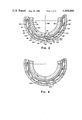
  • FIG. 2 is a sectional view taken along the line 2--2 of FIG. 1.
  • FIG. 3 is a view taken along the line 3--3 of FIG. 1.
  • FIG. 4 is a view similar to FIG. 2 showing an alternate embodiment of the invention.
  • FIG. 1 As an exemplary embodiment of the present invention consider the portion of a twin spool gas turbine engine shown in FIG. 1, which has been simplified for clarity. More specifically, what is shown in FIG. 1 is the rearward end portion of the low spool 10, the rearward end portion of the high spool 12, and a portion of nonrotating, fixed support structure 14. The low and high spools 10, 12 rotate counter to each other about the engine axis 15.
  • the low spool 10 comprises a main, hollow, inner shaft 16, a hub 18, a turbine wheel 20, a spline adapter 22, and a splined shaft 23 integral with the hub 18.
  • the spline adapter 22 is fixed relative to the inner shaft 16 by means not shown.
  • the hub 18 is also fixed relative to the main shaft 16 and rotates therewith through a spline connection 24 between the shaft 23 and the spline adapter 22.
  • the turbine wheel 20, in this embodiment, is the last or furthest downstream stage of the low spool 10 and is attached to the hub 18 by means of bolts 26 and nuts 28.
  • the low spool 10 also includes an outer bearing support shaft 30 concentric with the main shaft 16, integral with the hub 18, and extending axially upstream from the hub 18.
  • the portion of the high spool 12 shown in FIG. 1 comprises a shaft assembly 32 and a portion of a hub 34 integral with the shaft assembly 32.
  • a turbine wheel of the high spool is attached directly to the hub 34, but is outside the view of FIG. 1.
  • the shaft assembly 32 is disposed radially between the inner shaft 16 and outer shaft 30.
  • the low spool 10 is mounted for rotation with respect to the fixed support structure 14 and is supported by the structure 14 through a first roller bearing 36 disposed radially outwardly of the splined shaft 23 and downstream of the low spool hub 18.
  • a ball bearing (not shown) supports the forward end of the low spool 10.
  • the first bearing 36 comprises an outer race 38, and inner race 40, and a plurality of rolling elements 42 disposed therebetween.
  • the outer race 38 is fixedly attached to the support structure 14; and the inner race 40 is fixedly attached to and rotates with the low spool 10. Oil is fed to the first bearing 36 from within the main shaft 16 by means of a plurality of radial holes 41 through, respectively, the main shaft 16 spline adapter 22 and splined shaft 23, which holes are in fluid communication with each other.
  • the aft end of the high spool 12 is supported or "hung" from the low spool 10 through a second roller bearing 44 disposed between the high spool shaft assembly 32 and the low spool outer shaft 30.
  • the second bearing 44 includes an outer race 46, an inner race 48, and a plurality of rolling elements 50 disposed therebetween in conventional fashion.
  • the outer race 46 is fixedly attached to the outer shaft 30 and rotates therewith; and the inner race 48 is fixedly attached to the shaft assembly 32 and rotates therewith.
  • the low spool 10 includes a sleeve 52 surrounding the main shaft 16 and radially spaced therefrom defining an axially extending annulus 54 therebetween.
  • the sleeve 52 is integral with and a part of the spline adapter 22, although it need not be.
  • the sleeve 52 has a radially inwardly facing surface 56 and a radially outwardly facing surface 58. Extending radially inwardly from the inwardly facing surface 56 to an outwardly facing surface 60 of the shaft 16 are a plurality of walls 62, each wall 62 defining a separate, axially elongated oil compartment 64 (see, also, FIG. 3).
  • the oil compartments 64 are found in number in the present instance, and are circumferentially and evenly spaced apart from each other. Each compartment 64 has associated with it an oil entrance passageway 66 through the shaft 16 and an oil exit passageway 68 through the sleeve 52.
  • the oil entrance passageway 66 has an outlet 70 and an inlet 72.
  • the oil exit passageway 68 has an inlet 74 and an outlet 76.
  • the outlet 70 is intentionally not aligned with the inlet 74.
  • the shaft assembly 32 includes a shaft end portion 78 and an annular oil scoop ring 80.
  • the ring 80 fits tightly against the inside surface 82 of the shaft end portion 78.
  • the ring 80 is spaced radially outwardly from the surface 58 of the sleeve 52 thereby defining a second annulus 85 therebetween of varying radial width due to the uneveness of the ring's inner surface 84.
  • Within the surface 84 are a plurality of circumferentially spaced apart recesses 86 which are in substantially the same axial plane as the outlets 76 of the oil exit passageways 68.
  • the phrase "axial plane" is a plane perpendicular to the engine axis 15. In the present embodiment, and as best seen in FIG.
  • the recesses 86 are radially extending slots through the scoop ring 80.
  • Each of the plurality of recesses 86 is in fluid communication with the inner race 48 of the bearing 44 by means of passageways 88 through the shaft assembly 32, which passageways are interconnected to each other by means of an annulus 123 in the shaft 78.
  • passageways 88 through the shaft assembly 32, which passageways are interconnected to each other by means of an annulus 123 in the shaft 78.
  • the radial component of the velocity vector 92 is small relative to the tangential velocity of the oil. This is due to two features of the present invention: first, the hereinabove-mentioned reduction in the radial velocity to zero as the oil enters the compartment 64; and, second, the short radial distance between the inlets 74 and the outlets 76 of the passageways 68 (i.e., there is little distance or time to gain radial speed).
  • the oil from the oil exit passageways 68 travels across the second annulus 85 and enters the recesses 86 of the shaft assembly 32.
  • the oil is fed from the recesses 86 to the inner race 48 of the bearing 44 via the passageways 88.
  • Each recess 86 comprises a bottom wall surface 94 which faces radially inwardly; radially extending, axially spaced apart, opposed sidewall surfaces 96; and, first and second scoop surfaces 98, 100, respectively.
  • the scoop surfaces 98, 100 adjoin the opposing sidewall surfaces and are substantially parallel to each other.
  • the first scoop surface 98 faces radially inwardly, and the second scoop surface 100 faces radially outwardly.
  • Arrows 102, 103 indicate the direction of rotation of the high and low spools 12, 10, respectively.
  • the radially inwardly facing first scoop surface 98 of a recess 86 is circumferentially spaced from the radially outwardly facing second scoop surface 100 of that recess in the direction of rotation 102 of the shaft assembly 32.
  • the radially inwardly facing first scoop surface 98 of one recess 86 and the radially outwardly facing second scoop surface 100 of the next adjacent (in the direction of rotation 102) recess 86 substantially intersect along a line 104 (FIG. 1) parallel to the axis 15, thereby defining a wedge 106.
  • the radially inwardly facing first scoop surface 98 forms an angle with a radial line (such as the line 108) passing through the intersection line 104, which angle is at least 90° and is substantially equal to or greater than the angle the velocity vector 92 makes with the same line under normal operating conditions.
  • the object is to minimize, if not eliminate, striking of the oil against the surface 98, which would cause the oil to splash toward the annulus 85. Oil striking the surface 100 tend to splash radially outwardly toward the bottom surface 94 of the recess, which is less of a problem.
  • the ring 80 includes an annular depression 110 immediately aft of the recesses 86, and a plurality of circumferentially spaced apart dishlike depressions 87 immediately forward of the recesses 86.
  • Passageways 114, 116 through the ring 80 provide fluid communication between the recesses 86 and, respectively, the annulus 110 and depressions 87 for returning the recaptured oil mist to the recesses 86, with the help of centrifugal forces.
  • the ring 80 includes baffles 126, 128, and 129 which reduce the radial dimension of the annulus 85 to a minimum in two axial planes causing most of the air to flow through holes 67 in the sleeve 52 into and through annulus 54 (around compartments 64) away from the area of oil transfer across annulus 85.
  • FIG. 4 An alternate embodiment for the construction of the recesses 86 is shown in FIG. 4. The only difference is that the outwardly facing scoop surface 200 is curved rather than flat. Flat is preferable for ease of machining.

Landscapes

  • Engineering & Computer Science (AREA)
  • General Engineering & Computer Science (AREA)
  • Mechanical Engineering (AREA)
  • Rolling Contact Bearings (AREA)

Abstract

A plurality of circumferentially spaced apart oil scoops are designed to capture oil being slung from an inner shaft across an annulus to an outer shaft which rotates in a direction opposite to the inner shaft. The scoops rotate with and are a part of the outer shaft assembly. The scoops, in one embodiment, are defined by opposed spaced apart wall surfaces oriented substantially parallel to the relative velocity vector of the jets of oil as they travel outwardly from the inner shaft across the annulus. Splashing of the oil as it is picked up by the scoops is minimized by this invention.

Description

The Government has rights in this invention pursuant to Contract No. F33657-79-C-0730 awarded by the Department of the Air Force.
DESCRIPTION CROSS REFERENCE TO RELATED PATENT APPLICATIONS
This application is of related subject matter to commonly owned U.S Pat. application Ser. No. 490,699, now U.S Pat. No. 4,453,784, herewith titled "Means For Feeding Oil Between Counterrotating Shafts" by Robert J. Kildea, Jorge A. Alcorta and Brian Richardson.
TECHNICAL FIELD
This invention relates to intershaft bearings and means for providing oil thereto.
BACKGROUND ART
Twin spool gas turbine engines and other kinds of rotating machinery may include concentric shafts which rotate at different speeds or in opposite directions. In some cases one shaft may be supported from the other through a bearing. It is typical of the prior art to bring oil to the inner race of a bearing through passageways in the shaft to which the inner race is attached. If the bearing is external of the outer shaft, and if the oil supply for the bearing comes from within the inner shaft, the oil must be brought across the annulus between the inner and outer shaft and thence to the inner race of the bearing. Depending upon the bearing and shaft arrangement and the relative axial velocity of one shaft to the other, certain problems may arise in transferring the oil from the inner shaft radially across the annulus to the outer shaft. For example, due to large centrifugal forces, it is difficult to prevent the oil from splashing as it strikes the outer shaft after flowing across the annulus. Splashing produces an oil mist within the annulus which can be swept away by air flow through the annulus. Over a period of time the loss of oil may be significant. If temperatures, temperature gradients and the relative angular velocities of the shafts permit, annular intershaft seals may be disposed on either side of the oil stream flowing across the annulus to prevent loss of the oil mist. Close seals may not be possible in situations where high temperatures, large thermal gradients, and high relative angular velocities are present. It is to these latter problems that the present invention is directed.
Commonly owned U.S. Pat. No. 3,756,672 is directed to damping shaft vibrations of two concentric rotating shafts wherein one shaft is supported from the other shaft by means of a bearing disposed therebetween. Several bearing and shaft arrangements are shown. None of them appear to have the problems which the present invention is intended to solve.
DISCLOSURE OF INVENTION
One object of the present invention is to enable oil to be brought from within one shaft to a concentric surrounding shaft across an annular gap therebetween with a minimum of splashing, even if one shaft has a high angular velocity relative to the other shaft.
In accordance with the present invention, a shaft assembly comprises an inner shaft, an outer shaft surrounding and spaced from the inner shaft and adapted to rotate counter to the inner shaft and defining an axially extending annulus therebetween, a plurality of circumferentially disposed recesses in the inside surface of the outer shaft substantially aligned with the outlets of oil carrying passageways through the inner shaft for receiving oil from the passageways, and passage means in fluid communication with the recesses for carrying oil therefrom through the outer shaft. In a preferred embodiment the recesses in the outer shaft which capture the oil from the oil compartments are in the form of a plurality of circumferentially, closely spaced apart scoops having opposed spaced apart wall surfaces which are oriented substantially parallel to the relative velocity vector of the jets of oil as they travel from the inner shaft across the annulus, thereby reducing splashing of the oil as it enters the recesses.
The foregoing and other objects, features and advantages of the present invention will become more apparent in the light of the following detailed description of preferred embodiments thereof as shown in the accompanying drawing.
BRIEF DESCRIPTION OF THE DRAWING
FIG. 1 is a simplified cross-sectional view of the rear bearing compartment portion of a dual spool gas turbine engine.
FIG. 2 is a sectional view taken along the line 2--2 of FIG. 1.
FIG. 3 is a view taken along the line 3--3 of FIG. 1.
FIG. 4 is a view similar to FIG. 2 showing an alternate embodiment of the invention.
BEST MODE FOR CARRYING OUT THE INVENTION
As an exemplary embodiment of the present invention consider the portion of a twin spool gas turbine engine shown in FIG. 1, which has been simplified for clarity. More specifically, what is shown in FIG. 1 is the rearward end portion of the low spool 10, the rearward end portion of the high spool 12, and a portion of nonrotating, fixed support structure 14. The low and high spools 10, 12 rotate counter to each other about the engine axis 15.
The low spool 10 comprises a main, hollow, inner shaft 16, a hub 18, a turbine wheel 20, a spline adapter 22, and a splined shaft 23 integral with the hub 18. The spline adapter 22 is fixed relative to the inner shaft 16 by means not shown. The hub 18 is also fixed relative to the main shaft 16 and rotates therewith through a spline connection 24 between the shaft 23 and the spline adapter 22. The turbine wheel 20, in this embodiment, is the last or furthest downstream stage of the low spool 10 and is attached to the hub 18 by means of bolts 26 and nuts 28. The low spool 10 also includes an outer bearing support shaft 30 concentric with the main shaft 16, integral with the hub 18, and extending axially upstream from the hub 18.
The portion of the high spool 12 shown in FIG. 1 comprises a shaft assembly 32 and a portion of a hub 34 integral with the shaft assembly 32. A turbine wheel of the high spool is attached directly to the hub 34, but is outside the view of FIG. 1. The shaft assembly 32 is disposed radially between the inner shaft 16 and outer shaft 30.
The low spool 10 is mounted for rotation with respect to the fixed support structure 14 and is supported by the structure 14 through a first roller bearing 36 disposed radially outwardly of the splined shaft 23 and downstream of the low spool hub 18. A ball bearing (not shown) supports the forward end of the low spool 10. The first bearing 36 comprises an outer race 38, and inner race 40, and a plurality of rolling elements 42 disposed therebetween. The outer race 38 is fixedly attached to the support structure 14; and the inner race 40 is fixedly attached to and rotates with the low spool 10. Oil is fed to the first bearing 36 from within the main shaft 16 by means of a plurality of radial holes 41 through, respectively, the main shaft 16 spline adapter 22 and splined shaft 23, which holes are in fluid communication with each other.
The aft end of the high spool 12 is supported or "hung" from the low spool 10 through a second roller bearing 44 disposed between the high spool shaft assembly 32 and the low spool outer shaft 30. The second bearing 44 includes an outer race 46, an inner race 48, and a plurality of rolling elements 50 disposed therebetween in conventional fashion. The outer race 46 is fixedly attached to the outer shaft 30 and rotates therewith; and the inner race 48 is fixedly attached to the shaft assembly 32 and rotates therewith.
The arrangement of shafts and bearings in this embodiment is sometimes referred to as a "piggyback" arrangement since the loads imposed upon the bearing 44, which directly supports the high spool 12, are ultimately passed through the bearing 36 which directly supports the low spool. It is this type of arrangement which sometimes requires, as in the present embodiment, that the oil being fed into a bearing jump across an annulus between shafts which are rotating at different speeds and/or in opposite directions.
In accordance with the present invention, the low spool 10 includes a sleeve 52 surrounding the main shaft 16 and radially spaced therefrom defining an axially extending annulus 54 therebetween. In this embodiment the sleeve 52 is integral with and a part of the spline adapter 22, although it need not be. The sleeve 52 has a radially inwardly facing surface 56 and a radially outwardly facing surface 58. Extending radially inwardly from the inwardly facing surface 56 to an outwardly facing surface 60 of the shaft 16 are a plurality of walls 62, each wall 62 defining a separate, axially elongated oil compartment 64 (see, also, FIG. 3). The oil compartments 64 are found in number in the present instance, and are circumferentially and evenly spaced apart from each other. Each compartment 64 has associated with it an oil entrance passageway 66 through the shaft 16 and an oil exit passageway 68 through the sleeve 52. The oil entrance passageway 66 has an outlet 70 and an inlet 72. The oil exit passageway 68 has an inlet 74 and an outlet 76. The outlet 70 is intentionally not aligned with the inlet 74.
The shaft assembly 32 includes a shaft end portion 78 and an annular oil scoop ring 80. The ring 80 fits tightly against the inside surface 82 of the shaft end portion 78. The ring 80 is spaced radially outwardly from the surface 58 of the sleeve 52 thereby defining a second annulus 85 therebetween of varying radial width due to the uneveness of the ring's inner surface 84. Within the surface 84 are a plurality of circumferentially spaced apart recesses 86 which are in substantially the same axial plane as the outlets 76 of the oil exit passageways 68. As used herein, the phrase "axial plane" is a plane perpendicular to the engine axis 15. In the present embodiment, and as best seen in FIG. 2, the recesses 86 are radially extending slots through the scoop ring 80. Each of the plurality of recesses 86 is in fluid communication with the inner race 48 of the bearing 44 by means of passageways 88 through the shaft assembly 32, which passageways are interconnected to each other by means of an annulus 123 in the shaft 78. A more detailed description of the recesses 86 is set forth below.
In operation, oil flows along the inside surface 90 of the main shaft 16 and into the passageways 66, whereupon the radial and angular velocity of the oil increases due to the centrifugal forces created by the rotating shaft. Since the outlets 70 of the oil entrance passageways 66 and the inlets 74 to the oil exit passageways 68 are not radially aligned, the oil entering the compartments 64 from the passageways 66 must travel in a substantially axial direction to reach the exit passageway 68. Its radial velocity is thereby reduced to zero. Upon traveling through the exit passageways 68, a radial velocity is once again imparted to the oil. The velocity vector of the oil as it leaves the outlets 76 of the passageways 68 is depicted by the velocity vector 92 in FIG. 2. Note that the radial component of the velocity vector 92 is small relative to the tangential velocity of the oil. This is due to two features of the present invention: first, the hereinabove-mentioned reduction in the radial velocity to zero as the oil enters the compartment 64; and, second, the short radial distance between the inlets 74 and the outlets 76 of the passageways 68 (i.e., there is little distance or time to gain radial speed). The oil from the oil exit passageways 68 travels across the second annulus 85 and enters the recesses 86 of the shaft assembly 32. The oil is fed from the recesses 86 to the inner race 48 of the bearing 44 via the passageways 88.
The shape of the recesses 86 in this preferred embodiment is best shown in FIGS. 1 and 2. Each recess 86 comprises a bottom wall surface 94 which faces radially inwardly; radially extending, axially spaced apart, opposed sidewall surfaces 96; and, first and second scoop surfaces 98, 100, respectively. The scoop surfaces 98, 100 adjoin the opposing sidewall surfaces and are substantially parallel to each other. The first scoop surface 98 faces radially inwardly, and the second scoop surface 100 faces radially outwardly. Arrows 102, 103 indicate the direction of rotation of the high and low spools 12, 10, respectively. The radially inwardly facing first scoop surface 98 of a recess 86 is circumferentially spaced from the radially outwardly facing second scoop surface 100 of that recess in the direction of rotation 102 of the shaft assembly 32. The radially inwardly facing first scoop surface 98 of one recess 86 and the radially outwardly facing second scoop surface 100 of the next adjacent (in the direction of rotation 102) recess 86 substantially intersect along a line 104 (FIG. 1) parallel to the axis 15, thereby defining a wedge 106. In a cross section perpendicular to the axis 15, the radially inwardly facing first scoop surface 98 forms an angle with a radial line (such as the line 108) passing through the intersection line 104, which angle is at least 90° and is substantially equal to or greater than the angle the velocity vector 92 makes with the same line under normal operating conditions. The object is to minimize, if not eliminate, striking of the oil against the surface 98, which would cause the oil to splash toward the annulus 85. Oil striking the surface 100 tend to splash radially outwardly toward the bottom surface 94 of the recess, which is less of a problem.
Some splashing of the oil as it enters the recesses 86 may be unavoidable; and there may be a mist of oil within and above the recesses 86, which mist can move through the annulus 85 and be lost. Over a long period of time this loss can be significant, and it is desirable to reduce the loss to a minimum. For this reason the ring 80 includes an annular depression 110 immediately aft of the recesses 86, and a plurality of circumferentially spaced apart dishlike depressions 87 immediately forward of the recesses 86. Passageways 114, 116 through the ring 80 provide fluid communication between the recesses 86 and, respectively, the annulus 110 and depressions 87 for returning the recaptured oil mist to the recesses 86, with the help of centrifugal forces. To further reduce the amount of oil lost to air flowing through the annulus 85 from the cavity 65 to the cavity 124, the ring 80 includes baffles 126, 128, and 129 which reduce the radial dimension of the annulus 85 to a minimum in two axial planes causing most of the air to flow through holes 67 in the sleeve 52 into and through annulus 54 (around compartments 64) away from the area of oil transfer across annulus 85.
An alternate embodiment for the construction of the recesses 86 is shown in FIG. 4. The only difference is that the outwardly facing scoop surface 200 is curved rather than flat. Flat is preferable for ease of machining.
Although the invention has been shown and described with respect to a preferred embodiment thereof, it should be understood by those skilled in the art that other various changes and omissions in the form and detail thereof may be made therein without departing from the spirit and the scope of the invention.

Claims (4)

We claim:
1. A shaft assembly comprising:
first hollow shaft means rotatable about an axis and having an inner surface and an outwardly facing surface;
second shaft means adapted to rotate about said axis in a direction counter to the direction of rotation of said first shaft means and including a shaft portion surrounding said first shaft means, said shaft portion having a radially inwardly facing surface spaced radially outwardly from said outwardly facing surface defining an axially extending annulus therebetween, said shaft portion including wall means defining a plurality of circumferentially and closely spaced apart recesses in said inwardly facing surface, each of said recesses including a radially inwardly facing bottom wall surface, radially extending, axially spaced apart, opposed side wall surfaces, and first and second scoop surfaces adjoining said side wall surfaces, said first scoop surface facing radially inwardly and said second scoop surface facing radially outwardly, said first scoop surface being spaced circumferentially from said second scoop surface in the direction of rotation of said outer shaft means, said first scoop surface of each recess and said second scoop surface of the recess adjacent thereto substantially intersecting along a line parallel to said axis defining a wedge;
said inner shaft means having a plurality of oil passageways extending from said inner surface to said outwardly facing surface, said oil passageways having outlets in the same axial plane as said recesses for directing oil from said oil passageways, across said second annulus, into said recesses; and
means defining second passageways through said second shaft means in fluid communication with said recesses for carrying oil from said recesses through said second shaft means.
2. The shaft assembly according to claim 1 wherein said first scoop surface is flat, and, in a cross section perpendicular to said axis, said first scoop surface forms an angle with a radial line passing through said intersection line of said first and second scoop surfaces, which angle is at least 90° and is selected to be substantially equal to or greater than the angle of the velocity vector of the oil from said passageway outlets under normal engine operating conditions.
3. The shaft assembly according to claim 2 wherein said second scoop surface is flat and parallel to said first scoop surface.
4. A shaft assembly comprising:
first shaft means rotatable about an axis and including hollow inner shaft means and an outer shaft portion spaced radially outwardly from said inner shaft means, said inner shaft means having an inner surface and an outwardly facing surface;
second shaft means rotatable about said axis in a direction counter to the direction of rotation of said first shaft means and including means defining a shaft end portion disposed radially between said inner shaft means and outer shaft portion of said first shaft means and having a radially inwardly facing surface spaced radially outwardly from said inner shaft means defining an axially extending annulus therebetween, including wall means defining a plurality of circumferentially and closely spaced apart recesses in said inwardly facing surface, each of said recesses including a radially inwardly facing bottom wall surface, radially extending, axially spaced apart, opposed side wall surfaces, and first and second scoop surfaces adjoining said side wall surfaces, said first scoop surface being flat and facing radially inwardly and said second scoop surface facing radially outwardly, said first scoop surface being spaced circumferentially from said second scoop surface in the direction of rotation of said outer shaft means, said first scoop surface of each recess and said second scoop surface of the recess adjacent thereto substantially intersecting along a line parallel to said axis defining a wedge, wherein, in a cross section perpendicular to said axis, said first scoop surface forms an angle with a radial line passing through said intersection line of said first and second scoop surfaces, which angle is at least 90° and is selected to be substantially equal to or greater than the angle of the velocity vector of the oil from said passageway outlets under normal engine operating conditions;
first bearing means disposed between said second shaft means end portion and said first shaft means outer shaft portion, said bearing means comprising inner race means, outer race means, and rolling elements disposed between said inner and outer race means, said outer race means being attached to and fixed relative to said first shaft means outer shaft portion, said inner race means being attached to and fixed relative to said second shaft means end portion;
said inner shaft means having a plurality of oil passageways extending from said inner surface to said outwardly facing surface, said oil passageways having outlets in the same axial plane as said recesses for directing oil from said oil passageways, across said second annulus, into said recesses; and
means defining second passageways in said second shaft means in fluid communication with said recesses for carrying oil from said recesses, through said second shaft means, to said first bearing means inner race means.
US06/490,700 1983-05-02 1983-05-02 Oil capture scoop Expired - Lifetime US4468066A (en)

Priority Applications (1)

Application Number Priority Date Filing Date Title
US06/490,700 US4468066A (en) 1983-05-02 1983-05-02 Oil capture scoop

Applications Claiming Priority (1)

Application Number Priority Date Filing Date Title
US06/490,700 US4468066A (en) 1983-05-02 1983-05-02 Oil capture scoop

Publications (1)

Publication Number Publication Date
US4468066A true US4468066A (en) 1984-08-28

Family

ID=23949118

Family Applications (1)

Application Number Title Priority Date Filing Date
US06/490,700 Expired - Lifetime US4468066A (en) 1983-05-02 1983-05-02 Oil capture scoop

Country Status (1)

Country Link
US (1) US4468066A (en)

Cited By (23)

* Cited by examiner, † Cited by third party
Publication number Priority date Publication date Assignee Title
EP0222991A1 (en) * 1985-09-09 1987-05-27 Siemens Aktiengesellschaft Labyrinth shaft seal with a draining scoop for leaking oil
US4683714A (en) * 1986-06-17 1987-08-04 General Motors Corporation Oil scavenge system
WO1992011470A1 (en) * 1990-12-21 1992-07-09 Fag Kugelfischer Georg Schäfer Kgaa Device for removing oil from annular spaces
EP0831204A1 (en) * 1996-08-30 1998-03-25 United Technologies Corporation Gas turbine engine bearing compartment seal
US20060193545A1 (en) * 2005-02-25 2006-08-31 Honeywell International Inc. Rolling element bearing cage with improved pilot surface lubrication
US20060251512A1 (en) * 2005-05-06 2006-11-09 General Electric Company Apparatus for scavenging lubricating oil
US20060257062A1 (en) * 2005-05-13 2006-11-16 Aisin Ai Co., Ltd. Lubricating mechanism for a transfer
US20060263202A1 (en) * 2005-05-19 2006-11-23 Honeywell International, Inc. Curved blade oil scoop
US20090294216A1 (en) * 2007-08-30 2009-12-03 Honeywell International, Inc. Systems for supplying oil from an oil source to a bearing assembly
US20110243741A1 (en) * 2010-04-06 2011-10-06 Uffe Eriksen Lubrication System for a Bearing
EP2157289A3 (en) * 2008-07-31 2012-04-04 General Electric Company Pumping impeller oil seal
US20140300058A1 (en) * 2012-12-05 2014-10-09 Snecma Sealing of turbine engine enclosures produced by brush seal and labyrinth
US20160069186A1 (en) * 2014-09-05 2016-03-10 Rolls-Royce Plc Liquid-capturing shaft
US9441541B2 (en) 2012-04-27 2016-09-13 General Electric Company Oil scoop manifold
US20160281527A1 (en) * 2015-03-27 2016-09-29 United Technologies Corporation Oil scoop with integrated sensor
US20170191378A1 (en) * 2015-12-30 2017-07-06 General Electric Company Method and system for centrifugal pump
US9732630B2 (en) 2015-03-27 2017-08-15 United Technologies Corporation Oil scoop and shaft with axially-oriented hole
EP3239481A1 (en) * 2016-04-27 2017-11-01 Rolls-Royce plc Oil chamber wall with through-holes
EP2538037A3 (en) * 2011-06-22 2018-04-04 Hamilton Sundstrand Corporation Engine bearing compartment
US10047649B2 (en) 2015-06-29 2018-08-14 United Technologies Corporation Concentric axial oil scoop
US10677094B2 (en) * 2015-04-30 2020-06-09 Rolls-Royce Plc Transfer couplings
US11286854B2 (en) 2019-08-08 2022-03-29 Raytheon Technologies Corporation Ducted oil scoop for gas turbine engine
EP3045657B1 (en) * 2014-12-16 2026-01-21 RTX Corporation Sealing system between a bearing compartment and an interface between two shafts of a gas turbine engine

Citations (4)

* Cited by examiner, † Cited by third party
Publication number Priority date Publication date Assignee Title
US1773833A (en) * 1927-12-16 1930-08-26 Houdaille Hershey Corp Self-lubricating fan
US3936057A (en) * 1972-08-11 1976-02-03 Howaldtswerke - Deutsche Werft Aktiengesellschaft Hamburg Und Kiel Shaft seals
US4342489A (en) * 1980-10-07 1982-08-03 Teledyne Industries, Inc. Bearing lubricating injector
US4378197A (en) * 1980-06-13 1983-03-29 Societe Nationale D'etude Et De Construction De Moteurs D'aviation, "S.N.E.C.M.A." Inter-shaft bearing for multibody turbojet engines with damping by a film of oil

Patent Citations (4)

* Cited by examiner, † Cited by third party
Publication number Priority date Publication date Assignee Title
US1773833A (en) * 1927-12-16 1930-08-26 Houdaille Hershey Corp Self-lubricating fan
US3936057A (en) * 1972-08-11 1976-02-03 Howaldtswerke - Deutsche Werft Aktiengesellschaft Hamburg Und Kiel Shaft seals
US4378197A (en) * 1980-06-13 1983-03-29 Societe Nationale D'etude Et De Construction De Moteurs D'aviation, "S.N.E.C.M.A." Inter-shaft bearing for multibody turbojet engines with damping by a film of oil
US4342489A (en) * 1980-10-07 1982-08-03 Teledyne Industries, Inc. Bearing lubricating injector

Cited By (39)

* Cited by examiner, † Cited by third party
Publication number Priority date Publication date Assignee Title
EP0222991A1 (en) * 1985-09-09 1987-05-27 Siemens Aktiengesellschaft Labyrinth shaft seal with a draining scoop for leaking oil
US4741630A (en) * 1985-09-09 1988-05-03 Kraftwerk Union Aktiengesellschaft Device for the leakage-free removal of bearing oil from sliding bearings for rotation shafts of high-speed machines
EP0306634A3 (en) * 1985-09-09 1990-03-28 Siemens Aktiengesellschaft Labyrinth shaft seal with a draining scoop for leaking oil
US4683714A (en) * 1986-06-17 1987-08-04 General Motors Corporation Oil scavenge system
WO1992011470A1 (en) * 1990-12-21 1992-07-09 Fag Kugelfischer Georg Schäfer Kgaa Device for removing oil from annular spaces
EP0831204A1 (en) * 1996-08-30 1998-03-25 United Technologies Corporation Gas turbine engine bearing compartment seal
US6131914A (en) * 1996-08-30 2000-10-17 United Technologies Corporation Gas turbine engine bearing compartment seal
US20060193545A1 (en) * 2005-02-25 2006-08-31 Honeywell International Inc. Rolling element bearing cage with improved pilot surface lubrication
US20060251512A1 (en) * 2005-05-06 2006-11-09 General Electric Company Apparatus for scavenging lubricating oil
US7334982B2 (en) 2005-05-06 2008-02-26 General Electric Company Apparatus for scavenging lubricating oil
US20060257062A1 (en) * 2005-05-13 2006-11-16 Aisin Ai Co., Ltd. Lubricating mechanism for a transfer
US7484893B2 (en) * 2005-05-13 2009-02-03 Aisin Al Co., Ltd. Lubricating mechanism for a transfer
US20060263202A1 (en) * 2005-05-19 2006-11-23 Honeywell International, Inc. Curved blade oil scoop
US7244096B2 (en) 2005-05-19 2007-07-17 Honeywell International, Inc. Curved blade oil scoop
US20090294216A1 (en) * 2007-08-30 2009-12-03 Honeywell International, Inc. Systems for supplying oil from an oil source to a bearing assembly
US7931407B2 (en) 2007-08-30 2011-04-26 Honeywell International Inc. Systems for supplying oil from an oil source to a bearing assembly
EP2157289A3 (en) * 2008-07-31 2012-04-04 General Electric Company Pumping impeller oil seal
US8690540B2 (en) * 2010-04-06 2014-04-08 Siemens Aktiengesellschaft Lubrication system for a bearing
US20110243741A1 (en) * 2010-04-06 2011-10-06 Uffe Eriksen Lubrication System for a Bearing
EP2538037A3 (en) * 2011-06-22 2018-04-04 Hamilton Sundstrand Corporation Engine bearing compartment
US9441541B2 (en) 2012-04-27 2016-09-13 General Electric Company Oil scoop manifold
US20140300058A1 (en) * 2012-12-05 2014-10-09 Snecma Sealing of turbine engine enclosures produced by brush seal and labyrinth
US9879607B2 (en) * 2012-12-05 2018-01-30 Snecma Sealing of turbine engine enclosures produced by brush seal and labyrinth
US10113429B2 (en) * 2014-09-05 2018-10-30 Rolls-Royce Plc Liquid-capturing shaft
US20160069186A1 (en) * 2014-09-05 2016-03-10 Rolls-Royce Plc Liquid-capturing shaft
EP3045657B1 (en) * 2014-12-16 2026-01-21 RTX Corporation Sealing system between a bearing compartment and an interface between two shafts of a gas turbine engine
US9797268B2 (en) * 2015-03-27 2017-10-24 United Technologies Corporation Oil scoop with integrated sensor
US9732630B2 (en) 2015-03-27 2017-08-15 United Technologies Corporation Oil scoop and shaft with axially-oriented hole
US20160281527A1 (en) * 2015-03-27 2016-09-29 United Technologies Corporation Oil scoop with integrated sensor
US10677094B2 (en) * 2015-04-30 2020-06-09 Rolls-Royce Plc Transfer couplings
US10047649B2 (en) 2015-06-29 2018-08-14 United Technologies Corporation Concentric axial oil scoop
US10060290B2 (en) * 2015-12-30 2018-08-28 General Electric Company Method and system for centrifugal pump
EP3187700A3 (en) * 2015-12-30 2017-08-16 General Electric Company Method and system for centrifugal pump
CN106979077A (en) * 2015-12-30 2017-07-25 通用电气公司 Method and system for centrifugal pump
US20170191378A1 (en) * 2015-12-30 2017-07-06 General Electric Company Method and system for centrifugal pump
US20170314417A1 (en) * 2016-04-27 2017-11-02 Rolls-Royce Plc Oil chamber wall
EP3239481A1 (en) * 2016-04-27 2017-11-01 Rolls-Royce plc Oil chamber wall with through-holes
US10519804B2 (en) 2016-04-27 2019-12-31 Rolls-Royce Plc Oil chamber wall
US11286854B2 (en) 2019-08-08 2022-03-29 Raytheon Technologies Corporation Ducted oil scoop for gas turbine engine

Similar Documents

Publication Publication Date Title
US4453784A (en) Means for feeding oil between counterrotating shafts
US4468066A (en) Oil capture scoop
US4265334A (en) Apparatus for lubrication of a differential bearing mounted between concentric shafts
US7935164B2 (en) Vortex air-oil separator system
US7562519B1 (en) Gas turbine engine with an air cooled bearing
US6513335B2 (en) Device for supplying seal air to bearing boxes of a gas turbine engine
US3243243A (en) Bearing assembly
US4502274A (en) Lubricating and cooling system for intershaft bearing of turbojet
US7959532B2 (en) Hydraulic seal for a gearbox of a tip turbine engine
US2911267A (en) Failsafe bearing lubrication
US8083030B2 (en) Gearbox lubrication supply system for a tip engine
US6872003B2 (en) Oil-damped rolling bearing
US7631485B2 (en) Tip turbine engine with a heat exchanger
US8757959B2 (en) Tip turbine engine comprising a nonrotable compartment
US6131914A (en) Gas turbine engine bearing compartment seal
US11300008B2 (en) Lubrication scavenge system for a turbine engine with counter-rotating shafts
US4551062A (en) Device for passing a fluid flow through a barrier
US10920615B2 (en) Self pressurizing squeeze film damper
EP3453912B1 (en) Self pressurizing squeeze film damper
US7244096B2 (en) Curved blade oil scoop
EP3473914B1 (en) Lubricant scoop
US20130087412A1 (en) Dynamically-lubricated bearing and method of dynamically lubricating a bearing
JPH02221717A (en) Bearing assembly for engine
US3063673A (en) Centripetal turbine
US3534557A (en) Rotary bladed fluid flow machine,e.g. a fan lift engine

Legal Events

Date Code Title Description
AS Assignment

Owner name: UNITED TECHNOLGIES CORPORATION, HARTFORD, CT., A C

Free format text: ASSIGNMENT OF ASSIGNORS INTEREST.;ASSIGNORS:ALCORTA, JORGE A.;KILDEA, ROBERT J.;REEL/FRAME:004128/0687

Effective date: 19830421

STCF Information on status: patent grant

Free format text: PATENTED CASE

FPAY Fee payment

Year of fee payment: 4

FPAY Fee payment

Year of fee payment: 8

FEPP Fee payment procedure

Free format text: PAYOR NUMBER ASSIGNED (ORIGINAL EVENT CODE: ASPN); ENTITY STATUS OF PATENT OWNER: LARGE ENTITY

FPAY Fee payment

Year of fee payment: 12