US4433933A - Connector for fiber reinforced plastic tension rods - Google Patents
Connector for fiber reinforced plastic tension rods Download PDFInfo
- Publication number
- US4433933A US4433933A US06/345,058 US34505882A US4433933A US 4433933 A US4433933 A US 4433933A US 34505882 A US34505882 A US 34505882A US 4433933 A US4433933 A US 4433933A
- Authority
- US
- United States
- Prior art keywords
- groove
- rod
- connector
- metal connector
- inch
- Prior art date
- Legal status (The legal status is an assumption and is not a legal conclusion. Google has not performed a legal analysis and makes no representation as to the accuracy of the status listed.)
- Expired - Fee Related
Links
- 229920002430 Fibre-reinforced plastic Polymers 0.000 title description 15
- 239000011151 fibre-reinforced plastic Substances 0.000 title description 15
- 239000002184 metal Substances 0.000 claims abstract description 19
- 239000000463 material Substances 0.000 claims abstract description 3
- 229920003023 plastic Polymers 0.000 abstract description 4
- 239000004033 plastic Substances 0.000 abstract description 4
- 230000001464 adherent effect Effects 0.000 abstract 1
- 239000000835 fiber Substances 0.000 description 7
- 229910000831 Steel Inorganic materials 0.000 description 6
- 239000010959 steel Substances 0.000 description 6
- 239000011152 fibreglass Substances 0.000 description 5
- 238000006073 displacement reaction Methods 0.000 description 4
- 150000001875 compounds Chemical class 0.000 description 3
- 238000010276 construction Methods 0.000 description 3
- 230000008878 coupling Effects 0.000 description 3
- 238000010168 coupling process Methods 0.000 description 3
- 238000005859 coupling reaction Methods 0.000 description 3
- 238000004382 potting Methods 0.000 description 3
- 229920005989 resin Polymers 0.000 description 3
- 239000011347 resin Substances 0.000 description 3
- 230000006835 compression Effects 0.000 description 2
- 238000007906 compression Methods 0.000 description 2
- 239000003822 epoxy resin Substances 0.000 description 2
- 239000003129 oil well Substances 0.000 description 2
- 229920000647 polyepoxide Polymers 0.000 description 2
- 238000005086 pumping Methods 0.000 description 2
- 230000007704 transition Effects 0.000 description 2
- 230000009471 action Effects 0.000 description 1
- 239000003795 chemical substances by application Substances 0.000 description 1
- 230000007797 corrosion Effects 0.000 description 1
- 238000005260 corrosion Methods 0.000 description 1
- 230000007423 decrease Effects 0.000 description 1
- -1 epoxy resin Chemical class 0.000 description 1
- 239000003365 glass fiber Substances 0.000 description 1
- 230000004048 modification Effects 0.000 description 1
- 238000012986 modification Methods 0.000 description 1
- 229920003002 synthetic resin Polymers 0.000 description 1
- 239000000057 synthetic resin Substances 0.000 description 1
Images

Classifications
-
- F—MECHANICAL ENGINEERING; LIGHTING; HEATING; WEAPONS; BLASTING
- F16—ENGINEERING ELEMENTS AND UNITS; GENERAL MEASURES FOR PRODUCING AND MAINTAINING EFFECTIVE FUNCTIONING OF MACHINES OR INSTALLATIONS; THERMAL INSULATION IN GENERAL
- F16C—SHAFTS; FLEXIBLE SHAFTS; ELEMENTS OR CRANKSHAFT MECHANISMS; ROTARY BODIES OTHER THAN GEARING ELEMENTS; BEARINGS
- F16C7/00—Connecting-rods or like links pivoted at both ends; Construction of connecting-rod heads
- F16C7/02—Constructions of connecting-rods with constant length
- F16C7/026—Constructions of connecting-rods with constant length made of fibre reinforced resin
-
- F—MECHANICAL ENGINEERING; LIGHTING; HEATING; WEAPONS; BLASTING
- F16—ENGINEERING ELEMENTS AND UNITS; GENERAL MEASURES FOR PRODUCING AND MAINTAINING EFFECTIVE FUNCTIONING OF MACHINES OR INSTALLATIONS; THERMAL INSULATION IN GENERAL
- F16B—DEVICES FOR FASTENING OR SECURING CONSTRUCTIONAL ELEMENTS OR MACHINE PARTS TOGETHER, e.g. NAILS, BOLTS, CIRCLIPS, CLAMPS, CLIPS OR WEDGES; JOINTS OR JOINTING
- F16B11/00—Connecting constructional elements or machine parts by sticking or pressing them together, e.g. cold pressure welding
- F16B11/006—Connecting constructional elements or machine parts by sticking or pressing them together, e.g. cold pressure welding by gluing
- F16B11/008—Connecting constructional elements or machine parts by sticking or pressing them together, e.g. cold pressure welding by gluing of tubular elements or rods in coaxial engagement
-
- Y—GENERAL TAGGING OF NEW TECHNOLOGICAL DEVELOPMENTS; GENERAL TAGGING OF CROSS-SECTIONAL TECHNOLOGIES SPANNING OVER SEVERAL SECTIONS OF THE IPC; TECHNICAL SUBJECTS COVERED BY FORMER USPC CROSS-REFERENCE ART COLLECTIONS [XRACs] AND DIGESTS
- Y10—TECHNICAL SUBJECTS COVERED BY FORMER USPC
- Y10T—TECHNICAL SUBJECTS COVERED BY FORMER US CLASSIFICATION
- Y10T403/00—Joints and connections
- Y10T403/47—Molded joint
- Y10T403/473—Socket or open cup for bonding material
-
- Y—GENERAL TAGGING OF NEW TECHNOLOGICAL DEVELOPMENTS; GENERAL TAGGING OF CROSS-SECTIONAL TECHNOLOGIES SPANNING OVER SEVERAL SECTIONS OF THE IPC; TECHNICAL SUBJECTS COVERED BY FORMER USPC CROSS-REFERENCE ART COLLECTIONS [XRACs] AND DIGESTS
- Y10—TECHNICAL SUBJECTS COVERED BY FORMER USPC
- Y10T—TECHNICAL SUBJECTS COVERED BY FORMER US CLASSIFICATION
- Y10T403/00—Joints and connections
- Y10T403/70—Interfitted members
- Y10T403/7047—Radially interposed shim or bushing
- Y10T403/7051—Wedging or camming
- Y10T403/7052—Engaged by axial movement
Definitions
- the invention relates to metal fittings for coupling fiber reinforced plastic (FRP) tension rods end-to-end, and is particularly adapted for connecting a string of fiberglass sucker rods used in pumping an oil well.
- FRP fiber reinforced plastic
- tubular metal end fittings In order to connect the fiberglass rods end-to-end, tubular metal end fittings have been required for encasing and gripping the end portions of the rods.
- the inside of the fitting is sometimes provided with a longitudinal series of inclined annular grooves each concentric to the tube axis forming wedge-shaped annular voids between the inner surface of the fitting and the outer cylindrical surface of the rod.
- the voids are filled with a potting compound such as an epoxy resin which bonds to the rod but does not adhere to the inner surfaces of the metal tube, so that the slip of the resin wedges on the tube surface due to tensile forces on the rod produces radial compressive holding forces to grip the rod.
- the present invention provides a tubular metal connector for an FRP rod, said connector having a continuous helical inner wedge-shaped groove so that when filled with bonding material the compressive forces are not applied concentrically in the same plane to the rod under tension and the displacement of the outer fibers of the rod is not in transverse planes.
- the sum of the circumferential pressures at any location along the rod under the wedge are more uniform than with concentric wedges because the highs and lows do not occur in single planes.
- radial pressure varies around the rod in any transverse plane depending upon the helical wedge location at any given point around its circumference.
- Another object is to provide an improved metal connector which continuously distributes compressive gripping forces along the outer surface of the FRP rod under tension enclosed within the connector.
- a further object is to provide an improved connector having wedge-shaped means inclined at an angle designed to produce distributed radial compressive forces to the FRP rod without causing shear failure at the bond.
- a still further object is to provide an improved connector having wedge-shaped means graduated in size at one end of the connector to make the transition in stress from the rod to the connector more gradual.
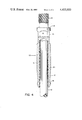
- FIG. 1 is a longitudinal section of the improved metal connector fitting.
- FIG. 2 is an end view of the open end thereof.
- FIG. 3 is an enlargement of the portion circled in FIG. 1.
- FIG. 4 is a view similar to FIG. 1 showing an FRP tension rod, bonded in the fitting by resin filling the helical groove of the fitting.
- fiber reinforced plastic applies to a fiber reinforced synthetic resin such as resin-bonded fiberglass which has higher tensile strength than steel on a strength-to-weight ratio. While the preferred embodiment of the invention disclosed and described herein is adapted to connect sucker rods end-to-end used in pumping oil wells, it is also adapted for other uses such as electrical utility strain rods and guy rods.
- the improved connector fitting indicated generally at 10 in the drawings is formed from metal of high tensile strength such as steel having 85,000 to 115,000 PSI.
- the body 11 of the connector is tubular with one end open to receive the end portion of an FRP cylindrical rod 12, and the other end closed.
- the closed end is provided with a threaded portion 13 adapted to be screwed into a conventional rod coupling (not shown) which connects to the threaded end of a like connector on the end portion of a like rod 12.
- An annular shoulder 14 is preferably provided on the connector 10 adjacent to the threaded portion 12 and exterior flat surfaces 15 are formed in the body 11 of the connector adjacent to the shoulder 14 for being engaged by a wrench when connecting to a coupling.
- the tubular body portion 11 of connector 10 extends from the flat surfaces 15 to the opposite open end, and an exterior annular shoulder 16 is formed on the open end by gradually tapering the outer surface inwardly as at 17, preferably at an angle of about 5°. This tapered portion allows the jaws of a fishing tool of well-known construction to engage the shoulder 16 and remove the connector with its sucker rod engaged therein from the well casing in the event of failure or breakage of the rod.
- the tubular body of the connector is formed interiorly with a continuous helical wedge-shaped groove 18 having an outwardly inclined surface 19 at an angle b of about 5° to 9° to the longitudinal axis of the connector.
- the inner edge of the inclined surface terminates in a flat helical band 20 for conforming to the cylindrical surface of an FRP rod 12, which may be 5/8 to 11/4 inch diameter.
- the axial pitch a of the helical groove 18 may vary from about 1/4 inch to 1/2 inch which, of course, varies the radial depth c of the groove accordingly. For an axial pitch of 1/4 inch the depth c is about 0.035 to 0.038 inch.
- the helical groove 18 is filled with a potting compound, such as epoxy resin, which forms a helical plastic wedge 21 and bonds to the surface of the FRP rod 12 but does not adhere to the metal surface of the groove 18.
- a potting compound such as epoxy resin
- the groove is treated with a release agent to insure that the helical plastic wedge will slip on the inclined surface of the groove when the rod is under tension and cause an inward compressive force to enhance the gripping action on the FRP rod.
- the range of about 5° to 9° for the angle of inclination of the groove is fairly critical, as too small an angle produces a high transverse force tending to crush the rod, and too large an angle tends to cause a shear bond failure between the rod and the potting compound.
- the interior open end portion 22 of the bore of the body 11 is relieved or enlarged very slightly by axial boring which increases the width of the helical band 20a and decreases the depth of the helical groove 18a in that area.
- the purpose of this relieved portion is to reduce the amount of inward compressive force applied by the plastic wedge to the rod in that area and provide a more gradual transition in the stress applied to the rod entering the connector. Failure of the rod due to excessive compressive force usually occurs in that area.
- Fiberglass rods having their end portions secured in steel connector fittings according to the present invention have been tested in tension to failure at 66,000 PSI.
- the present improved connector fitting having a continuous helical wedge to impart compressive gripping forces to an FRP tension rod avoids maximum displacement of the outer fibers of the rod in transverse planes and distributes the forces in a helical pattern so that radial pressure around in any transverse plane varies, depending upon the location at any given point around the circumference.
- the sum of the circumferential pressures along the rod are more uniform as the highs and lows do not occur in common transverse planes.
Landscapes
- Engineering & Computer Science (AREA)
- General Engineering & Computer Science (AREA)
- Mechanical Engineering (AREA)
- Reinforcement Elements For Buildings (AREA)
Abstract
A metal connector (10) for the end portion of a plastic tension rod (12) having a continuous wedge-shaped internal helical groove (18) adapted to be filled with bonding material (21) bonded to the rod (12) and non-adherent to the metal surface of the groove (18).
Description
The invention relates to metal fittings for coupling fiber reinforced plastic (FRP) tension rods end-to-end, and is particularly adapted for connecting a string of fiberglass sucker rods used in pumping an oil well.
For many years steel sucker rods have been used in beam-pumped wells, although such rods have certain disadvantages such as low corrosion resistance and excessive aggregate weight to lift, especially in deep wells.
Recently, fiberglass sucker rods have been tested and found to be very satisfactory. Such rods are highly corrosive resistant, have substantially higher tensile strength than steel on a strength-to-weight basis, and weigh approximately one-third as much as a steel rod of substantially the same diameter.
In order to connect the fiberglass rods end-to-end, tubular metal end fittings have been required for encasing and gripping the end portions of the rods. The inside of the fitting is sometimes provided with a longitudinal series of inclined annular grooves each concentric to the tube axis forming wedge-shaped annular voids between the inner surface of the fitting and the outer cylindrical surface of the rod. The voids are filled with a potting compound such as an epoxy resin which bonds to the rod but does not adhere to the inner surfaces of the metal tube, so that the slip of the resin wedges on the tube surface due to tensile forces on the rod produces radial compressive holding forces to grip the rod.
The main disadvantage of the foregoing concentric wedge construction is that the radial compression forces generated by each resin wedge are applied to the rod at the small end of the wedge in a single plane at right angles to its longitudinal axis. This results in displacing the outer glass fibers inwardly and placing them in a preloaded tensile condition over the underlying greater amount of internal fibers, and the resulting stacking of the inner fibers resists radial displacement thereof and aggravates the stress differential between the inner and outer fibers. Thus, the combination of compression and displacement due to high tensile loads tends to overstress the outer fibers and cause failure thereof.
The present invention provides a tubular metal connector for an FRP rod, said connector having a continuous helical inner wedge-shaped groove so that when filled with bonding material the compressive forces are not applied concentrically in the same plane to the rod under tension and the displacement of the outer fibers of the rod is not in transverse planes. Hence, the sum of the circumferential pressures at any location along the rod under the wedge are more uniform than with concentric wedges because the highs and lows do not occur in single planes. On the contrary, radial pressure varies around the rod in any transverse plane depending upon the helical wedge location at any given point around its circumference.
It is an object of the present invention to provide an improved FRP tension rod connector having wedge means to grip the rod under tension in a helical path.
Another object is to provide an improved metal connector which continuously distributes compressive gripping forces along the outer surface of the FRP rod under tension enclosed within the connector.
A further object is to provide an improved connector having wedge-shaped means inclined at an angle designed to produce distributed radial compressive forces to the FRP rod without causing shear failure at the bond.
A still further object is to provide an improved connector having wedge-shaped means graduated in size at one end of the connector to make the transition in stress from the rod to the connector more gradual.
These and other objects are accomplished by the improvements comprising the present invention, a preferred embodiment of which is disclosed and described herein as exemplifying the best known mode of carrying out the invention. Various modifications and changes in details of construction are comprehended within the appended claims.
FIG. 1 is a longitudinal section of the improved metal connector fitting.
FIG. 2 is an end view of the open end thereof.
FIG. 3 is an enlargement of the portion circled in FIG. 1.
FIG. 4 is a view similar to FIG. 1 showing an FRP tension rod, bonded in the fitting by resin filling the helical groove of the fitting.
The term fiber reinforced plastic (FRP) applies to a fiber reinforced synthetic resin such as resin-bonded fiberglass which has higher tensile strength than steel on a strength-to-weight ratio. While the preferred embodiment of the invention disclosed and described herein is adapted to connect sucker rods end-to-end used in pumping oil wells, it is also adapted for other uses such as electrical utility strain rods and guy rods.
The improved connector fitting indicated generally at 10 in the drawings is formed from metal of high tensile strength such as steel having 85,000 to 115,000 PSI. The body 11 of the connector is tubular with one end open to receive the end portion of an FRP cylindrical rod 12, and the other end closed. The closed end is provided with a threaded portion 13 adapted to be screwed into a conventional rod coupling (not shown) which connects to the threaded end of a like connector on the end portion of a like rod 12.
An annular shoulder 14 is preferably provided on the connector 10 adjacent to the threaded portion 12 and exterior flat surfaces 15 are formed in the body 11 of the connector adjacent to the shoulder 14 for being engaged by a wrench when connecting to a coupling. The tubular body portion 11 of connector 10 extends from the flat surfaces 15 to the opposite open end, and an exterior annular shoulder 16 is formed on the open end by gradually tapering the outer surface inwardly as at 17, preferably at an angle of about 5°. This tapered portion allows the jaws of a fishing tool of well-known construction to engage the shoulder 16 and remove the connector with its sucker rod engaged therein from the well casing in the event of failure or breakage of the rod.
The tubular body of the connector is formed interiorly with a continuous helical wedge-shaped groove 18 having an outwardly inclined surface 19 at an angle b of about 5° to 9° to the longitudinal axis of the connector.
Preferably the inner edge of the inclined surface terminates in a flat helical band 20 for conforming to the cylindrical surface of an FRP rod 12, which may be 5/8 to 11/4 inch diameter. The axial pitch a of the helical groove 18 may vary from about 1/4 inch to 1/2 inch which, of course, varies the radial depth c of the groove accordingly. For an axial pitch of 1/4 inch the depth c is about 0.035 to 0.038 inch.
As shown in FIG. 4, when the rod 12 is inserted into the tubular body of the connector 10, the helical groove 18 is filled with a potting compound, such as epoxy resin, which forms a helical plastic wedge 21 and bonds to the surface of the FRP rod 12 but does not adhere to the metal surface of the groove 18. Preferably, the groove is treated with a release agent to insure that the helical plastic wedge will slip on the inclined surface of the groove when the rod is under tension and cause an inward compressive force to enhance the gripping action on the FRP rod.
The range of about 5° to 9° for the angle of inclination of the groove is fairly critical, as too small an angle produces a high transverse force tending to crush the rod, and too large an angle tends to cause a shear bond failure between the rod and the potting compound.
Preferably, the interior open end portion 22 of the bore of the body 11 is relieved or enlarged very slightly by axial boring which increases the width of the helical band 20a and decreases the depth of the helical groove 18a in that area. The purpose of this relieved portion is to reduce the amount of inward compressive force applied by the plastic wedge to the rod in that area and provide a more gradual transition in the stress applied to the rod entering the connector. Failure of the rod due to excessive compressive force usually occurs in that area.
Fiberglass rods having their end portions secured in steel connector fittings according to the present invention have been tested in tension to failure at 66,000 PSI.
The present improved connector fitting having a continuous helical wedge to impart compressive gripping forces to an FRP tension rod avoids maximum displacement of the outer fibers of the rod in transverse planes and distributes the forces in a helical pattern so that radial pressure around in any transverse plane varies, depending upon the location at any given point around the circumference. The sum of the circumferential pressures along the rod are more uniform as the highs and lows do not occur in common transverse planes.
Claims (9)
1. A metal connector for the end portion of an FRP rod subjected to longitudinal tension, comprising a tubular body for encasing the rod and having a threaded end portion adapted to be coupled to a like connector, said body having a continuous wedge-shaped internal helical groove having a surface inclined radially at an angle toward the longitudinal axis of the body, the inner edge of said groove adapted to conform to the outer surface of said rod, and said groove adapted to be filled with bonding material that bonds to the rod but does not adhere to said groove.
2. A metal connector as described in claim 1, wherein the axial pitch said groove is between about 1/4 inch and about 1/2 inch.
3. A metal connector as described in claim 2, wherein the inclined surface of the groove is inclined at an angle of between about 5° and about 9° to the longitudinal axis of the body.
4. A metal connector as described in claim 3, wherein the inner edge of said groove terminates in a flat helical band for conforming to the outer surface of the rod.
5. A metal connector as described in claim 1, wherein the inclined surface of the groove is inclined at an angle of between about 5° and about 9° to the longitudinal axis of the body.
6. A metal connector as described in claim 5, wherein the inner edge of said groove terminates in a flat helical band for conforming to the outer surface of the rod.
7. A metal connector as described in claim 1, wherein the depth of the helical groove is relatively shallow at the opposite end portion of the body.
8. A metal connector as described in claim 7, wherein the axial pitch of said groove is between about 1/4 inch and about 1/2 inch.
9. A metal connector as described in claim 8, wherein the inclined surface of said groove is inclined at an angle of between about 5° and about 9° to the longitudinal axis of the body.
Priority Applications (1)
| Application Number | Priority Date | Filing Date | Title |
|---|---|---|---|
| US06/345,058 US4433933A (en) | 1982-02-02 | 1982-02-02 | Connector for fiber reinforced plastic tension rods |
Applications Claiming Priority (1)
| Application Number | Priority Date | Filing Date | Title |
|---|---|---|---|
| US06/345,058 US4433933A (en) | 1982-02-02 | 1982-02-02 | Connector for fiber reinforced plastic tension rods |
Publications (1)
| Publication Number | Publication Date |
|---|---|
| US4433933A true US4433933A (en) | 1984-02-28 |
Family
ID=23353302
Family Applications (1)
| Application Number | Title | Priority Date | Filing Date |
|---|---|---|---|
| US06/345,058 Expired - Fee Related US4433933A (en) | 1982-02-02 | 1982-02-02 | Connector for fiber reinforced plastic tension rods |
Country Status (1)
| Country | Link |
|---|---|
| US (1) | US4433933A (en) |
Cited By (21)
| Publication number | Priority date | Publication date | Assignee | Title |
|---|---|---|---|---|
| US4585368A (en) * | 1984-09-17 | 1986-04-29 | Pagan Augustine J | Sucker rod assembly |
| EP0186624A1 (en) * | 1984-12-11 | 1986-07-02 | Ciba-Geigy Ag | Fibre-reinforced synthetic material connecting rod |
| DE3519679A1 (en) * | 1985-06-01 | 1986-12-04 | Beitz, Wolfgang, Prof.Dr.-Ing. | Process for producing releasible connections (screw, positive shaft-hub and linear positive-locking connections) by shaped elements of plastic |
| US4919560A (en) * | 1989-04-28 | 1990-04-24 | Fiberglass Technologies, Inc. | Oil well sucker rod |
| EP0461253A4 (en) * | 1989-12-21 | 1992-03-11 | Hitachi Construction Machinery Co., Ltd. | Member made of fiber-reinforced resin and production thereof |
| US5253946A (en) * | 1992-05-20 | 1993-10-19 | Dover Resources, Inc. | Sucker rod end fitting |
| US5513477A (en) * | 1995-02-28 | 1996-05-07 | International Composites Systems, Llc | Segmented, graded structural utility poles |
| US5525003A (en) * | 1993-12-29 | 1996-06-11 | Conoco Inc. | Connection termination for composite rods |
| US5762438A (en) * | 1996-10-29 | 1998-06-09 | Preformed Line Products Company | Fiberglass rod end fitting |
| RU2169250C1 (en) * | 2000-05-11 | 2001-06-20 | Открытое акционерное общество Опытно-экспериментальный завод геофизической аппаратуры "Альтернатива" | Glass-reinforced plastic sucker rod |
| RU2182642C1 (en) * | 2000-11-22 | 2002-05-20 | Пышнов Виктор Николаевич | Sucker rod (versions) |
| US6481102B1 (en) | 1999-12-02 | 2002-11-19 | Tommie D. Hill | Attachment devices, systems, and methods for a tendon, rod, or other elongated member |
| RU2232865C2 (en) * | 2002-05-24 | 2004-07-20 | Пышнов Виктор Николаевич | Pumping bar |
| US20040202521A1 (en) * | 2003-04-11 | 2004-10-14 | Karel Bostik | Shear coupling |
| US20140202897A1 (en) * | 2013-01-21 | 2014-07-24 | Grit Inc. | Flexible sports bag |
| US8834059B2 (en) * | 2012-09-14 | 2014-09-16 | Delaware Capital Formation, Inc. | Retrievable connector for composite material sucker rod |
| US9624736B1 (en) * | 2016-03-04 | 2017-04-18 | Tenaris Connections B.V. | Sucker rod end |
| US9777579B2 (en) | 2012-12-10 | 2017-10-03 | General Electric Company | Attachment of composite article |
| US9797257B2 (en) | 2012-12-10 | 2017-10-24 | General Electric Company | Attachment of composite article |
| US10190371B2 (en) | 2015-12-17 | 2019-01-29 | Sigma Lift Solutions, Corp. | Sucker rod |
| US11815133B2 (en) | 2017-03-31 | 2023-11-14 | Crompton Technology Group Limited | Composite shaft |
Citations (7)
| Publication number | Priority date | Publication date | Assignee | Title |
|---|---|---|---|---|
| US974719A (en) | 1910-03-30 | 1910-11-01 | Charles Stevenson | Wire cable, socket, and coupling. |
| US1643110A (en) | 1924-08-11 | 1927-09-20 | American Cable Co Inc | Attachment for wire rope and process for producing the same |
| GB681550A (en) | 1949-07-06 | 1952-10-29 | N F B Displacement Pump Co Ltd | Improvements in and relating to means for attaching wire ropes to sockets |
| US3540763A (en) | 1968-06-27 | 1970-11-17 | Alfred A Yee | Splice sleeve for reinforcing bars |
| US3570074A (en) | 1968-11-12 | 1971-03-16 | Westinghouse Electric Corp | Rope end fitting |
| US4024013A (en) | 1974-01-11 | 1977-05-17 | Valentin Evstafievich Khadzhi | Method of producing citrine crystals |
| US4205926A (en) | 1977-08-15 | 1980-06-03 | Carlson Drexel T | Sucker rod and coupling therefor |
-
1982
- 1982-02-02 US US06/345,058 patent/US4433933A/en not_active Expired - Fee Related
Patent Citations (7)
| Publication number | Priority date | Publication date | Assignee | Title |
|---|---|---|---|---|
| US974719A (en) | 1910-03-30 | 1910-11-01 | Charles Stevenson | Wire cable, socket, and coupling. |
| US1643110A (en) | 1924-08-11 | 1927-09-20 | American Cable Co Inc | Attachment for wire rope and process for producing the same |
| GB681550A (en) | 1949-07-06 | 1952-10-29 | N F B Displacement Pump Co Ltd | Improvements in and relating to means for attaching wire ropes to sockets |
| US3540763A (en) | 1968-06-27 | 1970-11-17 | Alfred A Yee | Splice sleeve for reinforcing bars |
| US3570074A (en) | 1968-11-12 | 1971-03-16 | Westinghouse Electric Corp | Rope end fitting |
| US4024013A (en) | 1974-01-11 | 1977-05-17 | Valentin Evstafievich Khadzhi | Method of producing citrine crystals |
| US4205926A (en) | 1977-08-15 | 1980-06-03 | Carlson Drexel T | Sucker rod and coupling therefor |
Non-Patent Citations (1)
| Title |
|---|
| D. L. Watkins & John Haarsma-Fiberglass Sucker Rods in Beam-Pumped Oil Wells, Society of Petroleum Engineers, pp. 731-732, May 1978. |
Cited By (23)
| Publication number | Priority date | Publication date | Assignee | Title |
|---|---|---|---|---|
| US4585368A (en) * | 1984-09-17 | 1986-04-29 | Pagan Augustine J | Sucker rod assembly |
| EP0186624A1 (en) * | 1984-12-11 | 1986-07-02 | Ciba-Geigy Ag | Fibre-reinforced synthetic material connecting rod |
| DE3519679A1 (en) * | 1985-06-01 | 1986-12-04 | Beitz, Wolfgang, Prof.Dr.-Ing. | Process for producing releasible connections (screw, positive shaft-hub and linear positive-locking connections) by shaped elements of plastic |
| US4919560A (en) * | 1989-04-28 | 1990-04-24 | Fiberglass Technologies, Inc. | Oil well sucker rod |
| EP0461253A4 (en) * | 1989-12-21 | 1992-03-11 | Hitachi Construction Machinery Co., Ltd. | Member made of fiber-reinforced resin and production thereof |
| US5253946A (en) * | 1992-05-20 | 1993-10-19 | Dover Resources, Inc. | Sucker rod end fitting |
| US5525003A (en) * | 1993-12-29 | 1996-06-11 | Conoco Inc. | Connection termination for composite rods |
| US5513477A (en) * | 1995-02-28 | 1996-05-07 | International Composites Systems, Llc | Segmented, graded structural utility poles |
| US5762438A (en) * | 1996-10-29 | 1998-06-09 | Preformed Line Products Company | Fiberglass rod end fitting |
| US6481102B1 (en) | 1999-12-02 | 2002-11-19 | Tommie D. Hill | Attachment devices, systems, and methods for a tendon, rod, or other elongated member |
| RU2169250C1 (en) * | 2000-05-11 | 2001-06-20 | Открытое акционерное общество Опытно-экспериментальный завод геофизической аппаратуры "Альтернатива" | Glass-reinforced plastic sucker rod |
| RU2182642C1 (en) * | 2000-11-22 | 2002-05-20 | Пышнов Виктор Николаевич | Sucker rod (versions) |
| RU2232865C2 (en) * | 2002-05-24 | 2004-07-20 | Пышнов Виктор Николаевич | Pumping bar |
| US20040202521A1 (en) * | 2003-04-11 | 2004-10-14 | Karel Bostik | Shear coupling |
| US8834059B2 (en) * | 2012-09-14 | 2014-09-16 | Delaware Capital Formation, Inc. | Retrievable connector for composite material sucker rod |
| US9777579B2 (en) | 2012-12-10 | 2017-10-03 | General Electric Company | Attachment of composite article |
| US9797257B2 (en) | 2012-12-10 | 2017-10-24 | General Electric Company | Attachment of composite article |
| US20140202897A1 (en) * | 2013-01-21 | 2014-07-24 | Grit Inc. | Flexible sports bag |
| US9375062B2 (en) * | 2013-01-21 | 2016-06-28 | Grit Inc. | Flexible sports bag |
| US10190371B2 (en) | 2015-12-17 | 2019-01-29 | Sigma Lift Solutions, Corp. | Sucker rod |
| US9624736B1 (en) * | 2016-03-04 | 2017-04-18 | Tenaris Connections B.V. | Sucker rod end |
| US11815133B2 (en) | 2017-03-31 | 2023-11-14 | Crompton Technology Group Limited | Composite shaft |
| US12169002B2 (en) | 2017-03-31 | 2024-12-17 | Crompton Technology Group Limited | Composite shaft |
Similar Documents
| Publication | Publication Date | Title |
|---|---|---|
| US4360288A (en) | Fiberglass sucker rod construction | |
| US4475839A (en) | Sucker rod fitting | |
| US4653953A (en) | Sucker rod construction | |
| US4024913A (en) | Well installations employing non-metallic lines, tubing casing and machinery | |
| US5895079A (en) | Threaded connections utilizing composite materials | |
| CA1119464A (en) | Sucker rod and coupling therefor | |
| CA1271087A (en) | Sucker rod coupling pin prepared from fiber- reinforced plastics material | |
| US4919560A (en) | Oil well sucker rod | |
| US4875717A (en) | End connectors for filament wound tubes | |
| US5253946A (en) | Sucker rod end fitting | |
| US4787771A (en) | Loaded sucker rod fitting | |
| US9605493B2 (en) | Downhole coupling | |
| US4494890A (en) | Multi-wedge connector | |
| JPS61502971A (en) | Well pipe fittings | |
| US4500224A (en) | Coupling for sucker rod assembly | |
| US3889579A (en) | Oil well pumping system having reinforced plastic sucker rod | |
| USRE32865E (en) | Fiberglass sucker rod construction | |
| US20160102694A1 (en) | Sucker rod and end fitting with compression preset | |
| US4548428A (en) | Anti back-out steel coupling system for nonmetallic composite pipe | |
| US8834059B2 (en) | Retrievable connector for composite material sucker rod | |
| US2874937A (en) | Corrosion-resistant sucker rod and method of constructing same | |
| US6364368B1 (en) | Internal flush coupling for composite coiled tubing | |
| US4315699A (en) | Multiwedge connector | |
| CN104011318A (en) | Sucker rod apparatus and method | |
| US4522529A (en) | Pre-stressed fiber-resin sucker rod and method of making same |
Legal Events
| Date | Code | Title | Description |
|---|---|---|---|
| AS | Assignment |
Owner name: SHAKESPEARE COMPANY THE, 1801 MAIN ST., COLUMBIA, Free format text: ASSIGNMENT OF ASSIGNORS INTEREST.;ASSIGNORS:PARSONS, JAMES H. JR.;HARDY-THE MC LAIN, PHILIPPE;TRINGALI, DOMINICK;REEL/FRAME:003960/0642;SIGNING DATES FROM 19820112 TO 19820118 |
|
| FEPP | Fee payment procedure |
Free format text: MAINTENANCE FEE REMINDER MAILED (ORIGINAL EVENT CODE: REM.); ENTITY STATUS OF PATENT OWNER: LARGE ENTITY |
|
| LAPS | Lapse for failure to pay maintenance fees | ||
| STCH | Information on status: patent discontinuation |
Free format text: PATENT EXPIRED DUE TO NONPAYMENT OF MAINTENANCE FEES UNDER 37 CFR 1.362 |
|
| FP | Lapsed due to failure to pay maintenance fee |
Effective date: 19880228 |