US4430969A - Composite rocker arm and process - Google Patents
Composite rocker arm and process Download PDFInfo
- Publication number
- US4430969A US4430969A US06/387,362 US38736282A US4430969A US 4430969 A US4430969 A US 4430969A US 38736282 A US38736282 A US 38736282A US 4430969 A US4430969 A US 4430969A
- Authority
- US
- United States
- Prior art keywords
- rocker arm
- accordance
- engine part
- amide
- mole percent
- Prior art date
- Legal status (The legal status is an assumption and is not a legal conclusion. Google has not performed a legal analysis and makes no representation as to the accuracy of the status listed.)
- Expired - Fee Related
Links
- 239000002131 composite material Substances 0.000 title claims abstract description 67
- 238000000034 method Methods 0.000 title claims description 22
- 229920000642 polymer Polymers 0.000 claims description 43
- OKTJSMMVPCPJKN-UHFFFAOYSA-N Carbon Chemical compound [C] OKTJSMMVPCPJKN-UHFFFAOYSA-N 0.000 claims description 13
- -1 carboxylic acid compound Chemical class 0.000 claims description 13
- 229910002804 graphite Inorganic materials 0.000 claims description 13
- 239000010439 graphite Substances 0.000 claims description 13
- 229920001169 thermoplastic Polymers 0.000 claims description 12
- 239000004416 thermosoftening plastic Substances 0.000 claims description 12
- 239000000835 fiber Substances 0.000 claims description 10
- 239000004033 plastic Substances 0.000 claims description 9
- 229920003023 plastic Polymers 0.000 claims description 9
- 229920001343 polytetrafluoroethylene Polymers 0.000 claims description 9
- 239000004810 polytetrafluoroethylene Substances 0.000 claims description 9
- GWEVSGVZZGPLCZ-UHFFFAOYSA-N Titan oxide Chemical compound O=[Ti]=O GWEVSGVZZGPLCZ-UHFFFAOYSA-N 0.000 claims description 8
- 125000004432 carbon atom Chemical group C* 0.000 claims description 8
- 239000003365 glass fiber Substances 0.000 claims description 8
- 125000001997 phenyl group Chemical group [H]C1=C([H])C([H])=C(*)C([H])=C1[H] 0.000 claims description 8
- 125000002915 carbonyl group Chemical group [*:2]C([*:1])=O 0.000 claims description 6
- 238000011417 postcuring Methods 0.000 claims description 6
- 125000003368 amide group Chemical group 0.000 claims description 5
- 239000011521 glass Substances 0.000 claims description 5
- 238000006116 polymerization reaction Methods 0.000 claims description 4
- 239000004408 titanium dioxide Substances 0.000 claims description 4
- 150000004984 aromatic diamines Chemical class 0.000 claims description 3
- 238000001746 injection moulding Methods 0.000 claims description 3
- 239000007787 solid Substances 0.000 claims description 3
- 238000004513 sizing Methods 0.000 claims description 2
- 125000000325 methylidene group Chemical group [H]C([H])=* 0.000 claims 2
- 239000012779 reinforcing material Substances 0.000 claims 2
- 239000007795 chemical reaction product Substances 0.000 claims 1
- 238000005553 drilling Methods 0.000 claims 1
- 230000007423 decrease Effects 0.000 abstract description 4
- 239000000446 fuel Substances 0.000 abstract description 4
- 150000004985 diamines Chemical class 0.000 description 15
- 239000007789 gas Substances 0.000 description 11
- 238000010438 heat treatment Methods 0.000 description 11
- 229910052751 metal Inorganic materials 0.000 description 11
- 239000002184 metal Substances 0.000 description 11
- 239000000203 mixture Substances 0.000 description 10
- 239000003921 oil Substances 0.000 description 10
- ARCGXLSVLAOJQL-UHFFFAOYSA-N trimellitic acid Chemical compound OC(=O)C1=CC=C(C(O)=O)C(C(O)=O)=C1 ARCGXLSVLAOJQL-UHFFFAOYSA-N 0.000 description 7
- PAYRUJLWNCNPSJ-UHFFFAOYSA-N Aniline Chemical compound NC1=CC=CC=C1 PAYRUJLWNCNPSJ-UHFFFAOYSA-N 0.000 description 6
- 229910001018 Cast iron Inorganic materials 0.000 description 6
- 150000008064 anhydrides Chemical class 0.000 description 6
- 238000002485 combustion reaction Methods 0.000 description 6
- 230000006835 compression Effects 0.000 description 6
- 238000007906 compression Methods 0.000 description 6
- 239000003502 gasoline Substances 0.000 description 6
- 238000002347 injection Methods 0.000 description 6
- 239000007924 injection Substances 0.000 description 6
- WZCQRUWWHSTZEM-UHFFFAOYSA-N 1,3-phenylenediamine Chemical compound NC1=CC=CC(N)=C1 WZCQRUWWHSTZEM-UHFFFAOYSA-N 0.000 description 5
- HLBLWEWZXPIGSM-UHFFFAOYSA-N 4-Aminophenyl ether Chemical compound C1=CC(N)=CC=C1OC1=CC=C(N)C=C1 HLBLWEWZXPIGSM-UHFFFAOYSA-N 0.000 description 5
- 125000003118 aryl group Chemical group 0.000 description 5
- 238000003754 machining Methods 0.000 description 5
- 238000000465 moulding Methods 0.000 description 5
- 239000010959 steel Substances 0.000 description 5
- 239000000126 substance Substances 0.000 description 5
- XLYOFNOQVPJJNP-UHFFFAOYSA-N water Substances O XLYOFNOQVPJJNP-UHFFFAOYSA-N 0.000 description 5
- QVGXLLKOCUKJST-UHFFFAOYSA-N atomic oxygen Chemical compound [O] QVGXLLKOCUKJST-UHFFFAOYSA-N 0.000 description 4
- 239000001301 oxygen Substances 0.000 description 4
- 229910052760 oxygen Inorganic materials 0.000 description 4
- UHOVQNZJYSORNB-UHFFFAOYSA-N Benzene Chemical compound C1=CC=CC=C1 UHOVQNZJYSORNB-UHFFFAOYSA-N 0.000 description 3
- 239000004952 Polyamide Substances 0.000 description 3
- 229910000831 Steel Inorganic materials 0.000 description 3
- 150000001266 acyl halides Chemical class 0.000 description 3
- 238000004132 cross linking Methods 0.000 description 3
- 239000000463 material Substances 0.000 description 3
- 229920002647 polyamide Polymers 0.000 description 3
- IJGRMHOSHXDMSA-UHFFFAOYSA-N Atomic nitrogen Chemical compound N#N IJGRMHOSHXDMSA-UHFFFAOYSA-N 0.000 description 2
- 229910001208 Crucible steel Inorganic materials 0.000 description 2
- 239000004962 Polyamide-imide Substances 0.000 description 2
- 238000010521 absorption reaction Methods 0.000 description 2
- 230000004888 barrier function Effects 0.000 description 2
- 125000003178 carboxy group Chemical group [H]OC(*)=O 0.000 description 2
- 125000002843 carboxylic acid group Chemical group 0.000 description 2
- 239000000567 combustion gas Substances 0.000 description 2
- 238000001816 cooling Methods 0.000 description 2
- 229920001577 copolymer Polymers 0.000 description 2
- 239000002283 diesel fuel Substances 0.000 description 2
- 239000003822 epoxy resin Substances 0.000 description 2
- 125000005462 imide group Chemical group 0.000 description 2
- 238000004519 manufacturing process Methods 0.000 description 2
- 125000001570 methylene group Chemical group [H]C([H])([*:1])[*:2] 0.000 description 2
- 230000000704 physical effect Effects 0.000 description 2
- 229920002312 polyamide-imide Polymers 0.000 description 2
- 229920000647 polyepoxide Polymers 0.000 description 2
- 239000002952 polymeric resin Substances 0.000 description 2
- 150000003141 primary amines Chemical group 0.000 description 2
- CYIDZMCFTVVTJO-UHFFFAOYSA-N pyromellitic acid Chemical compound OC(=O)C1=CC(C(O)=O)=C(C(O)=O)C=C1C(O)=O CYIDZMCFTVVTJO-UHFFFAOYSA-N 0.000 description 2
- 229920003002 synthetic resin Polymers 0.000 description 2
- 238000012360 testing method Methods 0.000 description 2
- 239000003039 volatile agent Substances 0.000 description 2
- 210000000707 wrist Anatomy 0.000 description 2
- SMDGQEQWSSYZKX-UHFFFAOYSA-N 3-(2,3-dicarboxyphenoxy)phthalic acid Chemical compound OC(=O)C1=CC=CC(OC=2C(=C(C(O)=O)C=CC=2)C(O)=O)=C1C(O)=O SMDGQEQWSSYZKX-UHFFFAOYSA-N 0.000 description 1
- UITKHKNFVCYWNG-UHFFFAOYSA-N 4-(3,4-dicarboxybenzoyl)phthalic acid Chemical compound C1=C(C(O)=O)C(C(=O)O)=CC=C1C(=O)C1=CC=C(C(O)=O)C(C(O)=O)=C1 UITKHKNFVCYWNG-UHFFFAOYSA-N 0.000 description 1
- 238000012935 Averaging Methods 0.000 description 1
- 239000004215 Carbon black (E152) Substances 0.000 description 1
- 240000008620 Fagopyrum esculentum Species 0.000 description 1
- 235000009419 Fagopyrum esculentum Nutrition 0.000 description 1
- 239000004677 Nylon Substances 0.000 description 1
- 239000004642 Polyimide Substances 0.000 description 1
- 239000004734 Polyphenylene sulfide Substances 0.000 description 1
- 101150108015 STR6 gene Proteins 0.000 description 1
- 101100386054 Saccharomyces cerevisiae (strain ATCC 204508 / S288c) CYS3 gene Proteins 0.000 description 1
- BLRPTPMANUNPDV-UHFFFAOYSA-N Silane Chemical compound [SiH4] BLRPTPMANUNPDV-UHFFFAOYSA-N 0.000 description 1
- RTAQQCXQSZGOHL-UHFFFAOYSA-N Titanium Chemical compound [Ti] RTAQQCXQSZGOHL-UHFFFAOYSA-N 0.000 description 1
- 239000004963 Torlon Substances 0.000 description 1
- 229920003997 Torlon® Polymers 0.000 description 1
- 239000002253 acid Substances 0.000 description 1
- 150000008065 acid anhydrides Chemical class 0.000 description 1
- 150000001263 acyl chlorides Chemical class 0.000 description 1
- 230000002411 adverse Effects 0.000 description 1
- 229910052782 aluminium Inorganic materials 0.000 description 1
- XAGFODPZIPBFFR-UHFFFAOYSA-N aluminium Chemical compound [Al] XAGFODPZIPBFFR-UHFFFAOYSA-N 0.000 description 1
- 150000001408 amides Chemical class 0.000 description 1
- 229920003235 aromatic polyamide Polymers 0.000 description 1
- 150000001733 carboxylic acid esters Chemical class 0.000 description 1
- 238000005266 casting Methods 0.000 description 1
- 238000006243 chemical reaction Methods 0.000 description 1
- 238000000576 coating method Methods 0.000 description 1
- 230000000295 complement effect Effects 0.000 description 1
- 150000001875 compounds Chemical class 0.000 description 1
- 238000007796 conventional method Methods 0.000 description 1
- 238000010411 cooking Methods 0.000 description 1
- 230000007797 corrosion Effects 0.000 description 1
- 238000005260 corrosion Methods 0.000 description 1
- 210000003298 dental enamel Anatomy 0.000 description 1
- 238000013461 design Methods 0.000 description 1
- 229920001971 elastomer Polymers 0.000 description 1
- 239000004744 fabric Substances 0.000 description 1
- 238000010304 firing Methods 0.000 description 1
- 238000007667 floating Methods 0.000 description 1
- 238000005242 forging Methods 0.000 description 1
- ANSXAPJVJOKRDJ-UHFFFAOYSA-N furo[3,4-f][2]benzofuran-1,3,5,7-tetrone Chemical compound C1=C2C(=O)OC(=O)C2=CC2=C1C(=O)OC2=O ANSXAPJVJOKRDJ-UHFFFAOYSA-N 0.000 description 1
- 229930195733 hydrocarbon Natural products 0.000 description 1
- 239000011261 inert gas Substances 0.000 description 1
- 125000005647 linker group Chemical group 0.000 description 1
- 230000003137 locomotive effect Effects 0.000 description 1
- 238000002844 melting Methods 0.000 description 1
- 230000008018 melting Effects 0.000 description 1
- 150000002739 metals Chemical class 0.000 description 1
- 238000003801 milling Methods 0.000 description 1
- 238000012986 modification Methods 0.000 description 1
- 230000004048 modification Effects 0.000 description 1
- 239000000178 monomer Substances 0.000 description 1
- 229910052757 nitrogen Inorganic materials 0.000 description 1
- NJPPVKZQTLUDBO-UHFFFAOYSA-N novaluron Chemical compound C1=C(Cl)C(OC(F)(F)C(OC(F)(F)F)F)=CC=C1NC(=O)NC(=O)C1=C(F)C=CC=C1F NJPPVKZQTLUDBO-UHFFFAOYSA-N 0.000 description 1
- 229920001778 nylon Polymers 0.000 description 1
- 229920002492 poly(sulfone) Polymers 0.000 description 1
- 229920001721 polyimide Polymers 0.000 description 1
- 229920000069 polyphenylene sulfide Polymers 0.000 description 1
- 230000008707 rearrangement Effects 0.000 description 1
- 229920005989 resin Polymers 0.000 description 1
- 239000011347 resin Substances 0.000 description 1
- 239000005060 rubber Substances 0.000 description 1
- 230000035939 shock Effects 0.000 description 1
- 229910000077 silane Inorganic materials 0.000 description 1
- 101150035983 str1 gene Proteins 0.000 description 1
- 238000006467 substitution reaction Methods 0.000 description 1
- 229920005992 thermoplastic resin Polymers 0.000 description 1
- 229920001187 thermosetting polymer Polymers 0.000 description 1
- 229910052719 titanium Inorganic materials 0.000 description 1
- 239000010936 titanium Substances 0.000 description 1
- 125000005590 trimellitic acid group Chemical group 0.000 description 1
- SRPWOOOHEPICQU-UHFFFAOYSA-N trimellitic anhydride Chemical compound OC(=O)C1=CC=C2C(=O)OC(=O)C2=C1 SRPWOOOHEPICQU-UHFFFAOYSA-N 0.000 description 1
Images


Classifications
-
- F—MECHANICAL ENGINEERING; LIGHTING; HEATING; WEAPONS; BLASTING
- F01—MACHINES OR ENGINES IN GENERAL; ENGINE PLANTS IN GENERAL; STEAM ENGINES
- F01L—CYCLICALLY OPERATING VALVES FOR MACHINES OR ENGINES
- F01L1/00—Valve-gear or valve arrangements, e.g. lift-valve gear
- F01L1/12—Transmitting gear between valve drive and valve
- F01L1/18—Rocking arms or levers
-
- F—MECHANICAL ENGINEERING; LIGHTING; HEATING; WEAPONS; BLASTING
- F02—COMBUSTION ENGINES; HOT-GAS OR COMBUSTION-PRODUCT ENGINE PLANTS
- F02F—CYLINDERS, PISTONS OR CASINGS, FOR COMBUSTION ENGINES; ARRANGEMENTS OF SEALINGS IN COMBUSTION ENGINES
- F02F7/00—Casings, e.g. crankcases
- F02F7/0085—Materials for constructing engines or their parts
-
- F—MECHANICAL ENGINEERING; LIGHTING; HEATING; WEAPONS; BLASTING
- F01—MACHINES OR ENGINES IN GENERAL; ENGINE PLANTS IN GENERAL; STEAM ENGINES
- F01L—CYCLICALLY OPERATING VALVES FOR MACHINES OR ENGINES
- F01L2301/00—Using particular materials
-
- F—MECHANICAL ENGINEERING; LIGHTING; HEATING; WEAPONS; BLASTING
- F02—COMBUSTION ENGINES; HOT-GAS OR COMBUSTION-PRODUCT ENGINE PLANTS
- F02B—INTERNAL-COMBUSTION PISTON ENGINES; COMBUSTION ENGINES IN GENERAL
- F02B2275/00—Other engines, components or details, not provided for in other groups of this subclass
- F02B2275/34—Lateral camshaft position
-
- F—MECHANICAL ENGINEERING; LIGHTING; HEATING; WEAPONS; BLASTING
- F02—COMBUSTION ENGINES; HOT-GAS OR COMBUSTION-PRODUCT ENGINE PLANTS
- F02F—CYLINDERS, PISTONS OR CASINGS, FOR COMBUSTION ENGINES; ARRANGEMENTS OF SEALINGS IN COMBUSTION ENGINES
- F02F1/00—Cylinders; Cylinder heads
- F02F1/24—Cylinder heads
- F02F2001/244—Arrangement of valve stems in cylinder heads
- F02F2001/245—Arrangement of valve stems in cylinder heads the valve stems being orientated at an angle with the cylinder axis
-
- F—MECHANICAL ENGINEERING; LIGHTING; HEATING; WEAPONS; BLASTING
- F05—INDEXING SCHEMES RELATING TO ENGINES OR PUMPS IN VARIOUS SUBCLASSES OF CLASSES F01-F04
- F05C—INDEXING SCHEME RELATING TO MATERIALS, MATERIAL PROPERTIES OR MATERIAL CHARACTERISTICS FOR MACHINES, ENGINES OR PUMPS OTHER THAN NON-POSITIVE-DISPLACEMENT MACHINES OR ENGINES
- F05C2253/00—Other material characteristics; Treatment of material
- F05C2253/16—Fibres
Definitions
- This invention relates to engines, and more particularly, to engine parts and a process for making the same.
- amide-imide polymers have been developed for use in molding and producing various products, such as wire coatings, enamels, films, impregnating materials, and cooking utensils.
- Typifying these prior art amide-imide products, polymers and molding processes are those described in U.S. Pat. Nos. 3,546,152; 3,573,260; 3,582,248; 3,660,193; 3,748,304; 3,753,998; 4,016,140; 4,084,144; 4,136,085; 4,186,236; 4,167,620; and 4,224,214.
- These prior art products, polymers, and molding processes have met with varying degrees of success.
- An improved lightweight composite engine part is provided for use in gasoline and diesel powered automotive engines, truck engines, aircraft engines, marine engines, single and two cylinder engines, such as lawn mower engines, portable generators, and other internal combustion engines.
- the lightweight composite engine part decreases gasoline and fuel consumption, attentuates noise for quieter performance, and permits increased speed of operation.
- the lightweight composite engine part produces higher horsepower for its weight than conventional engine parts, while maintaining its shape, dimensional stability, and structural integrity at engine operating conditions.
- the lightweight composite engine part decreases centrifugal, reciprocating, and inertial forces, momentum, and load on the engine.
- the composite engine part has a greater stiffness-to-weight ratio than metal, is flame resistant, and is stable to heat.
- the composite engine part is capable of effectively functioning at engine operating temperatures and start-up conditions during hot and cold weather.
- the composite engine part has high mechanical strength, thermal stability, fatigue strength, and excellent tensile, compressive, and flexural strength.
- the composite engine part is resistant to wear, corrosion, impact, rupture, and creep, and reliably operates in the presence of engine fuels, oils, and exhaust gases.
- the composite engine part can be injection molded. Injection molding permits closer tolerances with less secondary machining operations for production efficiency and economy. Finished surfaces of injected molded composite engine parts are of better quality and have fewer knit lines, seams, and flashes than to engine parts made from cold metal forging, casting, fabrication, or other conventional techniques. If desired, some of the composite engine parts can be insert molded or compression molded.
- the lightweight composite engine part is made of durable, impact-resistant, hybrid or composite material which includes special proportions of an amide-imide resinous polymer, preferably reinforced with graphite and/or glass fibers.
- the amide-imide resinous polymer can also be blended with polytetrafluoroethylene (PTFE) and/or titanium dioxide.
- PTFE polytetrafluoroethylene
- Composite engine parts which are injection molded or otherwise made from amide-imide resinous polymers have better elongation, stiffness, moduli, and strength at engine operating conditions than do other plastics, such as epoxy resin, polyimides, aramids, polyphenylene sulfide, polytetrafluoroethylene, and nylon.
- a particularly suitable amide-imide resinous polymer is commercially available from Amoco Chemicals Corporation under the trademark and product designation TORLON.
- the composite engine part takes the form of a thermoplastic, amide-imide resinous polymeric rocker arm.
- the thermoplastic rocker arm has a pivot portion about which the rocker arm pivots, a valve drive portion for driving a valve, and a driven portion.
- the pivot portion is positioned generally between the valve drive portion and the driven portion and defines a pin hole for receiving a rocker arm pin.
- the valve drive portion is a generally convex cammed portion which cammingly engages and drives the valve.
- the driven portion is driven by a push rod and defines an internally threaded hole which receives a threaded stud against which the push rod is secured.
- the pivot portion defines a ball socket at one end of the rocker arm which pivotally engages and pivots upon a pivot pin;
- the valve drive portion is a channel-shaped cammed portion at the other end of the rocker arm to cammingly engage and drive the valve and
- the driven portion is a cam follower which abuttingly engages and is driven by an overhead cam.
- An oil hole preferably extends through the pivot portion to communicate with the ball socket.
- the composite rocker arm is preferably injection molded, allowed to cool below its plastic deformation temperature to solidify its shape, and then post cured by solid state polymerization to increase its strength.
- Composite valve train parts such as composite rocker arms increase the natural frequency of the valve train.
- Composite valve train parts are more stable at engine operating conditions, minimize floating, and substantially prevent the valve train from getting out of synchronization with the cam.
- Composite valve trains produce less deflection and distortion, and enhance better cam timing.
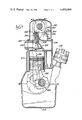
- FIG. 1 is a cross-sectional view of an automotive composite rocker arm in accordance with principles of the present invention
- FIG. 2 is a perspective view of the composite rocker arm
- FIG. 3 is a cross-sectional view of the composite rocker arm with a socket-type stud
- FIG. 4 is a cross-sectional view of the composite rocker arm with a ball-type stud
- FIG. 5 is a perspective view of another composite rocker arm in accordance with principles of the present invention.
- FIG. 6 is a cross-sectional view of the composite rocker arm shown in FIG. 5 with associated engine parts;
- FIG. 7 is a cross-sectional view of an automotive overhead cam engine with the composite rocker arm of FIGS. 5 and 6.
- the automotive engine 10 of FIG. 1 has lightweight composite engine parts to reduce its weight, decrease fuel consumption, and improve engine performance.
- Engine 10 is a gasoline powered, four stroke, spark ignition engine.
- the illustrated engine is a V-6 engine with 6 cylinders arranged in a V-shaped firing pattern.
- the composite engine parts are described hereinafter with particular reference to the illustrated engine, it will be apparent that the engine parts can also be used in other types of gasoline powered automotive engines, as well as in diesel powered automotive engines, truck engines, aircraft engines, marine engines, locomotive engines, lawn mower engines, portable generators, and other internal combustion engines.
- the composite engine parts can be used in 1, 2, 4, 6, 8 or more cylinder engines including V-arranged cylinder engines, aligned cylinder engines, horizontally opposed cylinder engines, rotary engines, etc.
- engine 10 has a cast iron block 11 and head 12.
- the block has many chambers including a cooling chamber 13 and six combustion chambers 14 which provide cylinders.
- the head has an exhaust manifold and an intake manifold 16 which communicate with the cylinders and an overhead carburetor (not shown).
- Extending below the block is an oil pan 18.
- Extending above the head is a rocker arm cover 20.
- a distributor 22 with an internal set of spark plugs (not shown) is provided to ignite the gaseous air mixture in the cylinders.
- a metal crankshaft 24 drives the pistons 26 through connecting rods 28.
- a counterweight 30 on crankshaft 24 balances the pistons.
- the crankshaft 24 drives a metal camshaft 32 through a set of timing gears 34 and 36.
- the timing gears include a crankshaft gear or drive pulley 34 mounted on the crankshaft 24, and a camshaft gear or driven pulley 36 mounted on the camshaft 32.
- a fabric reinforced, rubber timing belt 38 or timing chain drivingly connects the crankshaft gear 34 and the camshaft gear 36.
- the camshaft gear 36 has twice the diameter and twice as many teeth as the crankshaft gear 34, so that the camshaft 18 moves at one-half the speed of the crankshaft.
- the crankshaft gear drives the camshaft gear directly without a timing belt or timing chain.
- Metal cams 40 are mounted on the camshaft 32 to reciprocatingly drive the valve trains 46.
- Each valve train has a valve lifter 48, a push rod 50, a rocker arm 52, a valve spring retainer 54, a compression spring 56, and a valve 58 which opens and closes the exhaust manifold or the intake manifold 16.
- the intake valve 58 opens and closes the intake manifold 16.
- the exhaust valve opens and closes the exhaust manifold.
- the lifter 48 rides upon and follows the cam 40.
- the push rod 50 is seated in a recess of the lifter and is connected to the rocker arm 52 by a threaded stud 60 and nut 62.
- the bottom end of the stud 60 is shaped complementary to the top end of the push rod to securely receive and engage the push rod.
- the rocker arm 52 pivots upon a rocker arm shaft, fulcrum or pin 62 and reciprocatingly drives the valve stem 64 of the valve 58.
- the piston 26 reciprocatingly slides against a metal liner that provides the cylinder walls.
- a set of piston rings is press fit or snap fit on the head of the piston.
- the piston rings include a compression ring 66, a barrier ring 68, and an oil scraper ring 70.
- the piston is pivotally connected to the connecting rod 28 through a wrist pin 72 and a bushing 74.
- the connecting rod is pivotally connected to the crankshaft 24 through a split ring metal bearing 76.
- each piston has an intake stroke, a compression stroke, a power stroke, and an exhaust stroke.
- the intake stroke the piston moves downward and the inlet valve is opened to permit a gaseous air mixture to fill the combustion chamber.
- the compression stroke the intake and exhaust valves are closed and the piston moves upward to compress the gaseous air mixture.
- the spark plug is ignited to combust the gaseous air mixture in the combustion chamber and the rapidly expanding combustion gases drive the piston downward.
- the exhaust stroke the exhaust valve is opened and the piston moves upward to discharge the combustion gases (exhaust gases).
- the pistons can be made of metal, although it is preferred that they are at least partially made of a thermoplastic, amide-imide resinous polymer to reduce the weight of the engine.
- amide-imide engine parts are referred to as composite engine parts.
- the exhaust valve can also be at least partially made of a thermoplastic, amide-imide resinous polymer.
- the composite, thermoplastic amide-imide resinous polymeric rocker arm 52 has an annular, longitudinally extending valve-driven portion 100 at one end, a downwardly facing, generally convex, cammed drive portion 102 at the other end, and an intermediate pivot portion 104 between the ends.
- the driven portion 100 has an internally threaded hole 108 for threadedly receiving a threaded stud or rocker arm connector 60 against which the push rod 50 is secured.
- the stud has a socket-shaped foot which abuttingly receives a rounded cap or ball-like tip 112 of the push rod 50.
- the push rod drives the driven portion 100.
- the valve drive portion 102 cammingly engages and drives the free end of the valve stem 64 to open and close the valve.
- the pivot portion 104 has a pin hole for pivotally receiving a rocker arm pin or shaft 116.
- An upright, longitudinally extending, arcuate rib 118 extends between and connects the driven portion 100 and the drive portion 102. Rib 118 helps strengthen and reinforce the composite rocker arm.
- the rocker arm 52 shown in FIG. 4 is identical to the rocker arm shown in FIGS. 2 and 3.
- the threaded stud 120 has a balled foot 124 and the push rod 126 has a cup-shaped cap 128 defining a ball socket which abuttingly receives the balled foot 124 of the stud.
- the composite rocker arm 52 is approximately 70% lighter than conventional rocker arms of this type.
- the composite rocker arm 52 substantially maintains its shape and structural integrity at engine operating conditions.
- the automotive overhead cam engine 200 shown in FIG. 7 is generally similar to the automotive engine 10 shown in FIG. 1, except that the camshaft 201 and the overhead cams 202 are positioned above the cast iron or steel engine head 212, as well as above the composite rocker arm 203 and the valve 258.
- each valve train has an internally threaded cylindrical base 205, a nut 206, a threaded oil fed pedestal 207 with a ball-shaped tip 208 which provides a pivot pin, a composite tappet 203, a valve spring retainer 254, a compression spring (valve spring) 256, and a valve 258.
- the cylindrical base 205 is mounted to the top of the engine head 212.
- the threaded stud or pivot pin 207 is threadedly connected to the internally threaded cylindrical base 205 and held by the nut 206.
- the composite rocker arm 203 pivots on the balled tip 208 of the pivot pin 205 and is driven by the overhead cam 202.
- the composite rocker arm 203 drives the valve stem 264 of the valve 258.
- the valve spring retainer 254 retains the valve spring 256.
- the intake and exhaust valves open and close the intake and exhaust manifolds, respectively.
- the other engine parts in the overhead cam engine 200 of FIG. 7 are substantially similar to the engine parts of FIG. 1.
- the engine parts of the overhead cam engine 200 of FIG. 7 have been given numbers similar to their corresponding engine parts in the engine of FIG. 1, except in the 200 series, such as piston 226, connecting rod 228, etc.
- the composite, thermoplastic, amide-imide resinous polymeric rocker arm 203 has a pivot portion 300 defining a ball socket 302 at one end, a channel-shaped, cammed valve drive portion 306 at the other end, and an intermediate, generally convex driven portion 308 providing an arcuate cam follower between the pivot portion 300 and the drive portion 306.
- the pivot portion has a concave ball-shaped socket 302 which pivotally receives and pivots on the balled tip 208 of the pivot pin 207.
- An oil hole 310 extends through the pivot portion to communicate with the socket 302 for passage of oil to the pivot pin.
- the channel-shaped, cammed valve drive portion 306 faces generally downwardly, as does the pivot pin portion 300, in a direction generally opposite the upwardly facing cam follower 308.
- the valve drive portion 306 cammingly engages and reciprocatingly drives the free end of the valve stem 264 to open and close the valve.
- the composite rocker arm 203 is approximately 70% lighter than conventional rocker arms of that type.
- the composite rocker arm 203 maintains its structural shape and integrity at engine operating conditions.
- the composite rocker arms 52 and 203 are preferably injection molded for closer tolerances, minimal secondary machining operations and enhanced structural strength.
- the injection molding temperature (polymer melt temperature) of the polymer is preferably from 630° F. to 670° F., which is above the plastic deformation temperature of the amide-imide polymer.
- the molded rocker arm should be allowed to cool below its plastic deformation temperature to solidify its shape and polymeric orientation.
- the total molding and cooling time ranges from 120 to 300 seconds, depending on the grade of the polymeric resin and the desired cross-sectional thickness of the rocker arm.
- the cooled molded engine part providing the blank is then post cured by solid state polymerization by progressively heating the molded engine part below its melting temperature to enhance its dimensional strength and integrity.
- the specific time and temperatures depend upon the desired size of the molded part.
- the molded engine part is preheated in the presence of a circulating gas in an oven for a period of time such that a major portion of the volatiles contained in the injection molded engine part are vaporized and removed, while simultaneously increasing the deflection temperature of the polymer from about 15° F. to 35° F. without deformation of the engine part.
- Preheating can be carried out by heating the molded part from an initial temperature to a final temperature with either continuous or stepwise increases in temperature over a period of time, or at a single temperature, for a sufficient time to vaporize and remove the volatiles and increase the polymer's deflection temperature.
- Imidization, cross-linking and chain extension take place during preheating. Continuous or stepwise preheating increases tensile strength and elongation properties of the molded engine parts.
- the molded engine part can be preheated in a stepwise manner from an initial preheating temperature of 300° F. to 330° F. for 20 to 30 hours to a final preheating temperature of 410° F. to 430° F. for 20 to 30 hours.
- the molded part is heated (post cured) at a temperature of about 330° F. for 24 hours, about 475° F. for 24 hours, and about 500° F. for 24 hours. More specifically, the molded article is heated in the presence of a circulating gas at about 5° F. to 25° F., and preferably about 5° F. to 15° F., below the increased deflection temperature of the polymer for a period of time such that substantial imidization, chain extension and cross-linking take place without deformation of the molded article.
- heating is continued for a period of time sufficient to increase the deflection temperature by about 15° F. to 35° F.
- the heating is at a temperature ranging from about 450° F. to 490° F. for a period of at least 20 hours.
- the temperature is increased to about 5° F. to 25° F. below the polymer's new deflection temperature and held at the new temperature for a sufficient time to increase the polymer's deflection temperature by about 15° F. to 35° F.
- such heating is at about 480° F. to 520° F. for a period of at least 20 hours.
- Heating is continued in this manner to increase the polymer's deflection temperature to its maximum attainable value without deformation of the molded article.
- the final heating stage is carried out at about 5° F. to 25° F., and preferably from about 5° F. to 15° F., below the maximum attainable temperature for at least 20 hours, and most preferably at least 40 hours.
- the heated part is then cooled.
- the molded part In order to best enhance the physical properties of the molded engine part, it is preferred to heat the molded part from about 460° F. to about 480° F. for about 20 to 30 hours, then from about 490° F. to 510° F. for about 20 to 30 hours, and subsequently from about 495° F. to about 525° F. for about 20 to 60 hours.
- Post curing should be carried out in the presence of a circulating gas which flows through and around the molded engine part to remove water and gases from the polymeric resin.
- the amount of circulation and the circulation flow pattern should be coordinated to maximize removal of water and the gases without causing substantial variations in temperature. While inert gases, such as nitrogen, can be used, it is preferred that the circulating gas be an oxygen-containing gas, most preferably air, because oxygen tends to facilitate cross-linking of the polymer molecules.
- Post curing is preferably carried out in a circulating air oven, although it can be carried out in any other suitable apparatus.
- Post cured engine parts are resistant to thermal shock at temperatures of at least 500° F. and exhibit significantly improved tensile strength and elongation as compared with untreated molded, amide-imide resinous engine parts.
- a more detailed explanation of heat treatment by post curing is described in Chen U.S. Pat. No. 4,167,620, which is hereby incorporated by reference.
- the molded engine part undergoes various machining operations.
- the post cured rocker arm is drilled to provide the pin hole 114 and a stud hole 108, and the stud hole 108 is tapped or internally threaded.
- the profile and excess material can be cut on a milling machine.
- the surfaces of the rocker arm are ground, as desired.
- the pivot portion of the rocker arm is cut with a ball end mill to provide the ball socket 302.
- An oil hole 310 can be drilled through the pivot portion 300 so as to communicate with the socket 302.
- a Woodruff cutter is used to cut an elongated groove or channel in the valve drive portion 306 of the rocker arm.
- the rocker arm can be cut to the desired profile as well as to remove excess material.
- the cam follower 308 and other surfaces are ground, as desired.
- machining operations described above are preferably conducted after the injection molded engine part is post cured, one or more of these machining operations can be conducted before post curing if desired.
- the composite engine part and the thermoplastic, amide-imide resinous polymer contained therein substantially maintain their shape, dimensional stability and structural integrity at engine operating conditions. Usual engine operating temperatures do not exceed 350° F. Oil cooled engine operating temperatures range from about 200° F. to 250° F.
- the composite thermoplastic, amide-imide resinous, polymeric engine part is impervious and chemically resistant to oil, gasoline, diesel fuel, and engine exhaust gases at engine operating conditions.
- the thermoplastic resin in the composite engine part comprises 40% to 100%, preferably 65% to 75%, by weight amide-imide resinous polymer.
- the polymer is preferably reinforced with graphite fibers and/or glass fibers. In molded parts the fibers have an average length of 6 to 10 mils and a preferred diameter of about 0.2 to 0.4 mils. The ratio of the length to diameter of the fibers is from 2 to 70, averaging about 20. While the above fiber lengths and diameters are preferred for best structural strength, other lengths and diameters can be used, if desired.
- the graphite fibers can be granulated or chopped and can be optionally sized or coated with a polysulfone sizing or some other polymer which will maintain its structural integrity at engine operating conditions.
- the glass fibers can be milled or chopped and can be sized with silane or some other polymer than maintains its structural integrity at engine operating conditions.
- Chopped graphite and glass fibers are preferably sized, while granulated graphite fibers are preferably unsized.
- the thermoplastic, amide-imide resinous polymer comprises 10% to 50%, preferably 30% to 34%, by weight graphite fibers or 10% to 60%, preferably 30% to 34%, by weight glass fibers.
- the polymer can have as much as 3% and preferably 1/2% to 1% by weight powdered or granular polytetrafluoroethylene (PTFE) and/or as much as 6% by weight titanium dioxide. In some circumstances it may be desirable to add more PTFE.
- PTFE polytetrafluoroethylene
- the polymer ⁇ s molding characteristics and molecular weight can be controlled to facilitate polymerization with an additional monomer, such as trimellitic acid (TMA), and can be prepared with the desired flow properties by the methods described in Hanson U.S. Pat. No. 4,136,085, which is hereby incorporated by reference.
- TMA trimellitic acid
- the polymer can be blended with graphite, glass, PTFE, and titanium dioxide by the method described in Chen U.S. Pat. No. 4,224,214, which is hereby incorporated by reference.
- the most preferred amide-imide polymer is reinforced with 30% by weight graphite fibers and has the following engineering properties:
- the preferred, glass reinforced, thermoplastic amide-imide resinous polymer comprises 30% by weight glass fibers and has the following properties:
- the amide-imide polymers are prepared by reacting an aromatic polycarboxylic acid compound (acyl halide carboxylic acid and/or carboxylic acid esters) having at least three carboxylic acid groups such as trimellitic acid (TMA), 4-trimellitoyl anhydride halide (4-TMAC), pyromellitic anhydride, pyromellitic acid, 3,4,3',4' benzophenone tetracarboxylic acid or an anhydride thereof, or oxybis benzene dicarboxylic acid or an anhydride thereof.
- TMA trimellitic acid
- 4-TMAC 4-trimellitoyl anhydride halide
- pyromellitic anhydride pyromellitic acid
- pyromellitic acid 3,4,3',4' benzophenone tetracarboxylic acid or an anhydride thereof
- oxybis benzene dicarboxylic acid or an anhydride thereof oxybis benzene dicar
- the amide-imide polymers are preferably prepared by reacting an acyl halide derivative of an aromatic tricarboxylic acid anhydride with a mixture of largely- or wholly-aromatic primary diamines.
- the resulting products are polyamides wherein the linking groups are predominantly amide groups, although some may be imide groups, and wherein the structure contains free carboxylic acid groups which are capable of further reaction.
- Such polyamides are moderate molecular weight polymeric compounds having in their molecule units of: ##STR1## and units of: ##STR2## and, optionally, units of: ##STR3## wherein the free carboxyl groups are ortho to one amide group, Z is an aromatic moiety containing 1 to 4 benzene rings or lower-alkyl-substituted benzene rings, R 1 , R 2 and R 3 are different and are divalent wholly- or largely-aromatic hydrocarbon radicals.
- hydrocarbon radicals may be a divalent aromatic hydrocarbon radical of from 6 to about 10 carbon atoms, or two divalent aromatic hydrocarbon radicals each of from 6 to about 10 carbon atoms joined directly or by stable linkages such as --O--, methylene, --CO--, --SO 2 --, --S--; for example, --R'--O--R'--, --R'--CH 2 --R'--, --R'--CO--R'--, --R'---SO 2 --R'-- and --R'--S--R'--.
- the polyamides are capable of substantially complete imidization by heating by which they form the polyamide-imide structure having to a substantial extent reoccurring units of: ##STR4## and units of: ##STR5## and, optionally, units of: ##STR6## wherein one carbonyl group is meta to and one carbonyl group is para to each amide group and wherein Z, R 1 , R 2 and R 3 are defined as above.
- Typical copolymers of this invention have up to about 50 percent imidization prior to heat treatment, typically about 10 to about 40 percent.
- the polyamide-imide copolymers are prepared from an anhydride-containing substance and a mixture of wholly- or partially-aromatic primary diamines.
- the anhydride-containing substance is an acyl halide derivative of the anhydride of an aromatic tricarboxylic acid which contains 1 to 4 benzene rings or lower-alkyl-substituted benzene rings and wherein two of the carboxyl groups are ortho to one another.
- the anhydride-containing substance is an acyl halide derivative of an acid anhydride having a single benzene or lower-alkyl-substituted benzene ring, and most preferably, the substance is the acyl chloride derivative of trimellitic acid anhydride (4-TMAC).
- the mixture of diamines contains two or more, preferably two or three, wholly- or largely-aromatic primary diamines. More particularly, they are wholly- or largely-aromatic primary diamines containing from 6 to about 10 carbon atoms or wholly- or largely-aromatic primary diamines composed of two divalent aromatic moieties of from 6 to about 10 carbon atoms, each moiety containing one primary amine group, and the moieties linked directly or through, for example, a bridging --O--, --S--, --SO 2 --, --CO--, or methylene group.
- the mixture of aromatic primary diamines is two-component and is composed of meta-phenylenediamine (MPDA) and p,p'-oxybis(aniline) (OBA), p,p'-methylenebis (aniline) (MBA), and p,p'-oxybis(aniline), p,p'-sulfonylbis(aniline) (SOBA), and p,p'-oxybis(aniline), p,p'-sulfonylbis(aniline) and meta-phenylenediamine, or p,p'-sulfonylbis (aniline) and p,p'-methylenebis(aniline).
- the mixture of primary aromatic diamines contains meta-phenylenediamine and p,p'-oxybis(aniline).
- the aromatic nature of the diamines provides the excellent thermal properties of the copolymers while the primary amine groups permit the desired imide rings and amide linkages to be formed.
- the preferred range is from about 30 mole % of the former and about 70 mole % of the latter to about 70 mole % of the former and about 30 mole % of the latter.
Landscapes
- Engineering & Computer Science (AREA)
- Mechanical Engineering (AREA)
- General Engineering & Computer Science (AREA)
- Chemical & Material Sciences (AREA)
- Combustion & Propulsion (AREA)
- Macromolecular Compounds Obtained By Forming Nitrogen-Containing Linkages In General (AREA)
Abstract
Description
              I
______________________________________
                                    ASTM
               Typical              Test
Property       Value    Units       Method
______________________________________
Mechanical Properties
Tensile Strength        psi          D1708
@ -321° F.
               22,800
@  73° F.
               29,400
@ 275° F.
               22,800
@ 450° F.
               15,700
Tensile Elongation      %            D1708
@ -321° F.
               3
@  73° F.
               6
@ 275° F.
               14
@ 450° F.
               11
Tensile Modulus         psi          D1708
@  73° F.
               3,220,000
Flexural Strength       psi         D790
@ -321° F.
               45,000
@  73° F.
               50,700
@ 275° F.
               37,600
@ 450° F.
               25,200
Flexural Modulus        psi         D790
@ -321° F.
               3,570,000
@  73° F.
               2,880,000
@ 275° F.
               2,720,000
@ 450° F.
               2,280,000
Compressive Strength
               32,700   psi         D695
Shear Strength          psi         D732
@  73° F.
               17,300
Izod Impact             ft.-lbs./in.
                                    D256
@  73° F.
               0.9
Thermal Properties
Deflection Temperature  ° F. D648
@ 264 psi      540
Coefficient of Linear
Thermal Expansion
               5 × 10.sup.-6
                        in./in./° F.
                                    D696
Thermal Conductivity
               3.6      btu-in.
                        hr.-ft..sup.2 -°F.
                                    C177
Flammability   94V0     Underwriters
                        Laboratories
                                    94
Limiting Oxygen Index
               52       %            D2863
General Properties
Density        1.42     g/cc        D792
Hardness "Rockwell" E
               94
Water Absorption
               0.26     %           D570
______________________________________
              TABLE II
______________________________________
                                    ASTM
               Typical              Test
Property       Value    Units       Method
______________________________________
Mechanical Properties
Tensile Strength        psi          D1708
@ -321° F.
               29,500
@  73° F.
               29,700
@ 275° F.
               23,100
@ 450° F.
               16,300
Tensile Elongation      %            D1708
@ -321° F.
               4
@  73° F.
               7
@ 275° F.
               15
@ 450° F.
               12
Tensile Modulus         psi          D1708
@  73° F.
               1,560,000
Flexural Strength       psi         D790
@ -321° F.
               54,400
@  73° F.
               48,300
@ 275° F.
               35,900
@ 450° F.
               26,200
Flexural Modulus        psi         D790
@ -321° F.
               2,040,000
@  73° F.
               1,700,000
@ 275° F.
               1,550,000
@ 450° F.
               1,430,000
Compressive Strength
               34,800   psi         D695
Shear Strength          psi         D732
@  73° F.
               20,100
Izod Impact             ft. - lbs./in.
                                    D256
@  73° F.
               1.5
Thermal Properties
Deflection Temperature  °F.  D648
@ 264 psi      539
Coefficient of Linear
Thermal Expansion
               9 × 10.sup.-6
                        in./in./°F.
                                    D696
Thermal Conductivity
               2.5      btu-in.
                        hr.-ft..sup.2 -°F.
                                    C177
Flammability   94V0     Underwriters
                        Laboratories 94
Limiting Oxygen Index
               51       %            D2863
Electrical Properties
Dielectric Constant                 D150
@ 10.sup.3 Hz  4.4
@ 10.sup.6 Hz  6.5
Dissipation Factor                  D150
@ 10.sup.3 Hz  .022
@ 10.sup.6 Hz  .023
Volume Resistivity
               6 × 10.sup.16
                        ohms-in.    D257
Surface Resistivity
               1 × 10.sup.18
                        ohms        D257
Dielectric Strength
               835      volts/mil.
General Properties
Density        1.56     g/cc        D792
Hardness "Rockwell" E
               94
Water Absorption
               0.24     %           D570
______________________________________
Claims (30)
Priority Applications (1)
| Application Number | Priority Date | Filing Date | Title |
|---|---|---|---|
| US06/387,362 US4430969A (en) | 1982-06-11 | 1982-06-11 | Composite rocker arm and process |
Applications Claiming Priority (1)
| Application Number | Priority Date | Filing Date | Title |
|---|---|---|---|
| US06/387,362 US4430969A (en) | 1982-06-11 | 1982-06-11 | Composite rocker arm and process |
Publications (1)
| Publication Number | Publication Date |
|---|---|
| US4430969A true US4430969A (en) | 1984-02-14 |
Family
ID=23529551
Family Applications (1)
| Application Number | Title | Priority Date | Filing Date |
|---|---|---|---|
| US06/387,362 Expired - Fee Related US4430969A (en) | 1982-06-11 | 1982-06-11 | Composite rocker arm and process |
Country Status (1)
| Country | Link |
|---|---|
| US (1) | US4430969A (en) |
Cited By (16)
| Publication number | Priority date | Publication date | Assignee | Title |
|---|---|---|---|---|
| US4674453A (en) * | 1986-01-21 | 1987-06-23 | Dove Jr James E | Rocker arm and method of forming the same |
| US4875442A (en) * | 1987-12-24 | 1989-10-24 | Ngk Spark Plug Co., Ltd. | Ceramic rocker arm |
| US4995281A (en) * | 1989-07-31 | 1991-02-26 | Ford Motor Company | Lightweight rocker arm |
| US5269267A (en) * | 1991-04-25 | 1993-12-14 | Gerald Beaumont | Mechanism for controlling valve timing |
| US5669342A (en) * | 1994-04-14 | 1997-09-23 | Ina Walzlager Schaeffler Kg | Device for simultaneous actuation of at least two gas exchange valves |
| US6273043B1 (en) | 2000-03-16 | 2001-08-14 | Raymond A. Barton | Mounting plate and rocker arm assembly |
| US6279522B1 (en) * | 1999-03-19 | 2001-08-28 | Tecumseh Products Company | Drive train for overhead cam engine |
| US6349688B1 (en) * | 2000-02-18 | 2002-02-26 | Briggs & Stratton Corporation | Direct lever overhead valve system |
| US20040037981A1 (en) * | 2002-08-20 | 2004-02-26 | Scimed Life Systems, Inc. | Solid state polymerized medical services |
| DE102004055159A1 (en) * | 2004-11-16 | 2006-05-18 | Deutz Ag | Actuation device e.g. for gas shuttle valve, has rocker arm directly or indirectly fastened to cylinder head of lifting internal-combustion engine with cam shaft operable by drive element |
| US20090295036A1 (en) * | 2004-06-07 | 2009-12-03 | Quantum Leap Packaging, Llc | Ultra high-temperature plastic package and method of manufacture |
| US20100170463A1 (en) * | 2008-11-07 | 2010-07-08 | Jose Correa Neto | Powder metal rocker arm |
| TWI424119B (en) * | 2010-12-16 | 2014-01-21 | ||
| US9163535B2 (en) | 2012-11-12 | 2015-10-20 | Ge Oil & Gas Compression Systems, Llc | Crosshead lubrication system |
| US9644568B2 (en) | 2015-01-30 | 2017-05-09 | Ford Global Technologies, Llc | Reinforced composite cylinder block |
| US9739304B2 (en) * | 2012-11-12 | 2017-08-22 | Ge Oil & Gas Compression Systems, Llc | Light composite crosshead |
Citations (4)
| Publication number | Priority date | Publication date | Assignee | Title |
|---|---|---|---|---|
| US3748304A (en) * | 1972-03-28 | 1973-07-24 | Standard Oil Co | Amide-imide copolymers |
| US4016140A (en) * | 1972-03-30 | 1977-04-05 | Standard Oil Company | Amide-imide copolymer moldings and method of preparation |
| US4216682A (en) * | 1977-08-23 | 1980-08-12 | Honda Giken Kogyo Kabushiki Kaisha | Fiber-reinforced light alloy cast article |
| US4224214A (en) * | 1978-07-25 | 1980-09-23 | Standard Oil Company (Indiana) | Injection molding of amic acid and amide-imide polymers and molding compositions |
-
1982
- 1982-06-11 US US06/387,362 patent/US4430969A/en not_active Expired - Fee Related
Patent Citations (4)
| Publication number | Priority date | Publication date | Assignee | Title |
|---|---|---|---|---|
| US3748304A (en) * | 1972-03-28 | 1973-07-24 | Standard Oil Co | Amide-imide copolymers |
| US4016140A (en) * | 1972-03-30 | 1977-04-05 | Standard Oil Company | Amide-imide copolymer moldings and method of preparation |
| US4216682A (en) * | 1977-08-23 | 1980-08-12 | Honda Giken Kogyo Kabushiki Kaisha | Fiber-reinforced light alloy cast article |
| US4224214A (en) * | 1978-07-25 | 1980-09-23 | Standard Oil Company (Indiana) | Injection molding of amic acid and amide-imide polymers and molding compositions |
Non-Patent Citations (2)
| Title |
|---|
| Wise, Charles, "Plastic Engine Is Off and Running," Machine Design, vol. 52, No. 10, (May 8, 1980), pp. 24-26. |
| Wise, Charles, Plastic Engine Is Off and Running, Machine Design, vol. 52, No. 10, (May 8, 1980), pp. 24 26. * |
Cited By (19)
| Publication number | Priority date | Publication date | Assignee | Title |
|---|---|---|---|---|
| US4674453A (en) * | 1986-01-21 | 1987-06-23 | Dove Jr James E | Rocker arm and method of forming the same |
| US4875442A (en) * | 1987-12-24 | 1989-10-24 | Ngk Spark Plug Co., Ltd. | Ceramic rocker arm |
| US4995281A (en) * | 1989-07-31 | 1991-02-26 | Ford Motor Company | Lightweight rocker arm |
| US5269267A (en) * | 1991-04-25 | 1993-12-14 | Gerald Beaumont | Mechanism for controlling valve timing |
| US5669342A (en) * | 1994-04-14 | 1997-09-23 | Ina Walzlager Schaeffler Kg | Device for simultaneous actuation of at least two gas exchange valves |
| US6279522B1 (en) * | 1999-03-19 | 2001-08-28 | Tecumseh Products Company | Drive train for overhead cam engine |
| US6349688B1 (en) * | 2000-02-18 | 2002-02-26 | Briggs & Stratton Corporation | Direct lever overhead valve system |
| US6273043B1 (en) | 2000-03-16 | 2001-08-14 | Raymond A. Barton | Mounting plate and rocker arm assembly |
| US20040037981A1 (en) * | 2002-08-20 | 2004-02-26 | Scimed Life Systems, Inc. | Solid state polymerized medical services |
| WO2004018550A1 (en) * | 2002-08-20 | 2004-03-04 | Scimed Life Systems, Inc. | Solid state polymerized transformed thermoplastic articles |
| US6881372B2 (en) | 2002-08-20 | 2005-04-19 | Boston Scientific Scimed, Inc. | Solid state polymerized medical services |
| US20090295036A1 (en) * | 2004-06-07 | 2009-12-03 | Quantum Leap Packaging, Llc | Ultra high-temperature plastic package and method of manufacture |
| US7803307B2 (en) * | 2004-06-07 | 2010-09-28 | Interplex Qlp, Inc. | Ultra high-temperature plastic package and method of manufacture |
| DE102004055159A1 (en) * | 2004-11-16 | 2006-05-18 | Deutz Ag | Actuation device e.g. for gas shuttle valve, has rocker arm directly or indirectly fastened to cylinder head of lifting internal-combustion engine with cam shaft operable by drive element |
| US20100170463A1 (en) * | 2008-11-07 | 2010-07-08 | Jose Correa Neto | Powder metal rocker arm |
| TWI424119B (en) * | 2010-12-16 | 2014-01-21 | ||
| US9163535B2 (en) | 2012-11-12 | 2015-10-20 | Ge Oil & Gas Compression Systems, Llc | Crosshead lubrication system |
| US9739304B2 (en) * | 2012-11-12 | 2017-08-22 | Ge Oil & Gas Compression Systems, Llc | Light composite crosshead |
| US9644568B2 (en) | 2015-01-30 | 2017-05-09 | Ford Global Technologies, Llc | Reinforced composite cylinder block |
Similar Documents
| Publication | Publication Date | Title |
|---|---|---|
| US4433652A (en) | Composite valve and process | |
| US4440069A (en) | Composite piston and process | |
| US4453505A (en) | Composite push rod and process | |
| US4432925A (en) | Composite piston ring and process | |
| US4430906A (en) | Composite wrist pin and process | |
| US4458555A (en) | Composite connecting rod and process | |
| US4430970A (en) | Composite tappet | |
| US4432311A (en) | Composite valve spring retainer and process | |
| US4430969A (en) | Composite rocker arm and process | |
| US4433964A (en) | Composite timing gears and process | |
| US4726334A (en) | Composite cylinder housing and process | |
| US4848292A (en) | Internal combustion engine block and cylinder head | |
| Nunney | Light and heavy vehicle technology | |
| US4459945A (en) | Cam controlled reciprocating piston device | |
| Shibata et al. | Tribological application of MMC for reducing engine weight | |
| US4398527A (en) | Internal combustion engine having manifold and combustion surfaces coated with a foam | |
| CN1954143B (en) | High strength steel cylinder liner for diesel engine | |
| US5285752A (en) | Internal combustion engine | |
| CA2288071A1 (en) | Internal combustion engine | |
| Kumar | Comprehensive review on role of surface modification techniques to prevent failure of IC engine parts | |
| WO2017001875A1 (en) | New type of internal combustion engine | |
| Trzesniowski | Powertrain | |
| CN1032057A (en) | Multi-cylinder integral assembly four strokes oscillating piston internal combustion engine | |
| KR102267019B1 (en) | Piston with increasing wear resistance of Piston ring and and method for manufacturing this same | |
| CN1152074A (en) | Five-piston four-stroke engine |
Legal Events
| Date | Code | Title | Description |
|---|---|---|---|
| AS | Assignment |
Owner name: STANDARD OIL COMPANY (INDIANA), CHICAGO, IL A CORP Free format text: ASSIGNMENT OF ASSIGNORS INTEREST.;ASSIGNORS:HOLTZBERG, MATTHEW W.;SPAULDING, LAWRENCE D.;REEL/FRAME:004014/0500;SIGNING DATES FROM 19820608 TO 19820609 |
|
| CC | Certificate of correction | ||
| MAFP | Maintenance fee payment |
Free format text: PAYMENT OF MAINTENANCE FEE, 4TH YEAR, PL 96-517 (ORIGINAL EVENT CODE: M170); ENTITY STATUS OF PATENT OWNER: LARGE ENTITY Year of fee payment: 4 |
|
| MAFP | Maintenance fee payment |
Free format text: PAYMENT OF MAINTENANCE FEE, 8TH YEAR, PL 96-517 (ORIGINAL EVENT CODE: M171); ENTITY STATUS OF PATENT OWNER: LARGE ENTITY Year of fee payment: 8 |
|
| FEPP | Fee payment procedure |
Free format text: PAYOR NUMBER ASSIGNED (ORIGINAL EVENT CODE: ASPN); ENTITY STATUS OF PATENT OWNER: LARGE ENTITY |
|
| FEPP | Fee payment procedure |
Free format text: PAYOR NUMBER ASSIGNED (ORIGINAL EVENT CODE: ASPN); ENTITY STATUS OF PATENT OWNER: LARGE ENTITY Free format text: PAYER NUMBER DE-ASSIGNED (ORIGINAL EVENT CODE: RMPN); ENTITY STATUS OF PATENT OWNER: LARGE ENTITY |
|
| FEPP | Fee payment procedure |
Free format text: MAINTENANCE FEE REMINDER MAILED (ORIGINAL EVENT CODE: REM.); ENTITY STATUS OF PATENT OWNER: LARGE ENTITY |
|
| LAPS | Lapse for failure to pay maintenance fees | ||
| FP | Lapsed due to failure to pay maintenance fee |
Effective date: 19960214 |
|
| STCH | Information on status: patent discontinuation |
Free format text: PATENT EXPIRED DUE TO NONPAYMENT OF MAINTENANCE FEES UNDER 37 CFR 1.362 |