US4420366A - Method for manufacturing shadow mask - Google Patents

Method for manufacturing shadow mask Download PDF

Info

Publication number
US4420366A
US4420366A US06/478,544 US47854483A US4420366A US 4420366 A US4420366 A US 4420366A US 47854483 A US47854483 A US 47854483A US 4420366 A US4420366 A US 4420366A
Authority
US
United States
Prior art keywords
ferric chloride
chloride solution
ions
shadow mask
weight
Prior art date
Legal status (The legal status is an assumption and is not a legal conclusion. Google has not performed a legal analysis and makes no representation as to the accuracy of the status listed.)
Expired - Lifetime
Application number
US06/478,544
Inventor
Koichiro Oka
Hiroshi Tanaka
Makoto Harigae
Current Assignee (The listed assignees may be inaccurate. Google has not performed a legal analysis and makes no representation or warranty as to the accuracy of the list.)
Toshiba Corp
Original Assignee
Tokyo Shibaura Electric Co Ltd
Priority date (The priority date is an assumption and is not a legal conclusion. Google has not performed a legal analysis and makes no representation as to the accuracy of the date listed.)
Filing date
Publication date
Application filed by Tokyo Shibaura Electric Co Ltd filed Critical Tokyo Shibaura Electric Co Ltd
Assigned to TOKYO SHIBAURA DENKI KABUSHIKI KAISHA, A CORP. OF JAPAN reassignment TOKYO SHIBAURA DENKI KABUSHIKI KAISHA, A CORP. OF JAPAN ASSIGNMENT OF ASSIGNORS INTEREST. Assignors: HARIGAE, MAKOTO, OKA, KOICHIRO, TANAKA, HIROSHI
Application granted granted Critical
Publication of US4420366A publication Critical patent/US4420366A/en
Anticipated expiration legal-status Critical
Expired - Lifetime legal-status Critical Current

Links

Images

Classifications

    • HELECTRICITY
    • H01ELECTRIC ELEMENTS
    • H01JELECTRIC DISCHARGE TUBES OR DISCHARGE LAMPS
    • H01J9/00Apparatus or processes specially adapted for the manufacture, installation, removal, maintenance of electric discharge tubes, discharge lamps, or parts thereof; Recovery of material from discharge tubes or lamps
    • H01J9/02Manufacture of electrodes or electrode systems
    • H01J9/14Manufacture of electrodes or electrode systems of non-emitting electrodes
    • H01J9/142Manufacture of electrodes or electrode systems of non-emitting electrodes of shadow-masks for colour television tubes
    • CCHEMISTRY; METALLURGY
    • C23COATING METALLIC MATERIAL; COATING MATERIAL WITH METALLIC MATERIAL; CHEMICAL SURFACE TREATMENT; DIFFUSION TREATMENT OF METALLIC MATERIAL; COATING BY VACUUM EVAPORATION, BY SPUTTERING, BY ION IMPLANTATION OR BY CHEMICAL VAPOUR DEPOSITION, IN GENERAL; INHIBITING CORROSION OF METALLIC MATERIAL OR INCRUSTATION IN GENERAL
    • C23FNON-MECHANICAL REMOVAL OF METALLIC MATERIAL FROM SURFACE; INHIBITING CORROSION OF METALLIC MATERIAL OR INCRUSTATION IN GENERAL; MULTI-STEP PROCESSES FOR SURFACE TREATMENT OF METALLIC MATERIAL INVOLVING AT LEAST ONE PROCESS PROVIDED FOR IN CLASS C23 AND AT LEAST ONE PROCESS COVERED BY SUBCLASS C21D OR C22F OR CLASS C25
    • C23F1/00Etching metallic material by chemical means
    • C23F1/10Etching compositions
    • C23F1/14Aqueous compositions
    • C23F1/16Acidic compositions
    • C23F1/26Acidic compositions for etching refractory metals
    • CCHEMISTRY; METALLURGY
    • C23COATING METALLIC MATERIAL; COATING MATERIAL WITH METALLIC MATERIAL; CHEMICAL SURFACE TREATMENT; DIFFUSION TREATMENT OF METALLIC MATERIAL; COATING BY VACUUM EVAPORATION, BY SPUTTERING, BY ION IMPLANTATION OR BY CHEMICAL VAPOUR DEPOSITION, IN GENERAL; INHIBITING CORROSION OF METALLIC MATERIAL OR INCRUSTATION IN GENERAL
    • C23FNON-MECHANICAL REMOVAL OF METALLIC MATERIAL FROM SURFACE; INHIBITING CORROSION OF METALLIC MATERIAL OR INCRUSTATION IN GENERAL; MULTI-STEP PROCESSES FOR SURFACE TREATMENT OF METALLIC MATERIAL INVOLVING AT LEAST ONE PROCESS PROVIDED FOR IN CLASS C23 AND AT LEAST ONE PROCESS COVERED BY SUBCLASS C21D OR C22F OR CLASS C25
    • C23F1/00Etching metallic material by chemical means
    • C23F1/10Etching compositions
    • C23F1/14Aqueous compositions
    • C23F1/16Acidic compositions
    • C23F1/28Acidic compositions for etching iron group metals

Definitions

  • the present invention relates to a method for manufacturing a shadow mask, comprising spraying a sheet for a shadow mask with an etching solution so as to form apertures which allow an electron beam to pass therethrough.
  • a mild steel plate has been used as a shadow mask mounted in a color cathode ray tube.
  • the diameter and pitch of the electron beam apertures must be made very small with high precision.
  • the pitch is 0.2 mm
  • the aperture diameter on the side of the electron gun is about 0.10 mm.
  • a shadow mask for a color cathode ray tube The most important function of a shadow mask for a color cathode ray tube is to transmit an electron beam through apertures in the shadow mask and to radiate correctly the electron beam onto predetermined positions of a phosphor screen.
  • the shadow mask expands due to heat from the electron beams radiated from the electron gun. As a result, the electron beam is not be radiated correctly onto the predetermined positions of the phosphor screen, resulting in so-called mislanding and hence poor color purity.
  • invar steel has a very low linear expansion coefficient, it may be used to solve the above problem.
  • Invar steel is a nickel steel material and has a general composition of 0.20% or less of carbon, 0.5% of manganese, 36% of nickel and the remainder of iron.
  • Invar steel has a very low linear expansion coefficient of about 1 ⁇ 10 -6 /deg in a temperature range of 0° to 40° C. This linear expansion coefficient is about one-tenth of that of mild steel.
  • an etching solution of ferric chloride is sprayed onto a sheet of an alloy (e.g., invar steel) containing iron and nickel as the major components to form an aperture for passing the electron beam therethrough.
  • an alloy e.g., invar steel
  • the etching resistance of the photoresist film formed on a nonetching portion is degraded, so that an undesired portion is etched.
  • an amount of free hydrochloric acid in the solution of ferric chloride is below the predetermined range, nickel hydroxide and iron hydroxide are produced, and are precipitated and deposited on the etched portion.
  • a zigzag pattern 2 occurs in a portion of an edge shape which defines an aperture 1. The size of the aperture then varies and cannot be precisely and uniformly controlled, resulting in a nonuniform screen of the color cathode ray tube.
  • a method for manufacturing a shadow mask by spraying an Fe-Ni alloy sheet with a ferric chloride solution to form an aperture for passing an electron beam therethrough, wherein the ferric chloride solution is controlled to have a content of 0.30 ⁇ 0.20% by weight of free hydrochloric acid within a ferric chloride solution temperature range between 40° C.
  • the Fe-Ni alloy sheet is preferably made of invar steel.
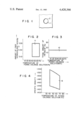
  • FIG. 1 is a plan view showing a edge shape of an aperture formed in a shadow mask according to a conventional method
  • FIG. 2 is a graph showing the relationship between a temperature of a ferric chloride solution and an amount of free hydrochloric acid
  • FIG. 3 is a graph showing the relationship between the temperature of the ferric chloride solution and the total amount of Fe ++ and Ni ++ ions.
  • FIG. 4 is a graph showing the relationship between the temperature of the ferric chloride solution and its specific gravity.
  • ferric chloride solutions were prepared. These ferric chloride solutions were respectively sprayed onto invar steel sheets for forming shadow masks, to form apertures therein for passing electron beams therethrough. Using a test method for examining the shape of the aperture and the condition of a photoresist film, a safe range in a relationship between a temperature of a ferric chloride solution and an amount of free hydrochloric acid was determined. Results are shown in FIG. 2. When the ferric chloride solution was kept at a temperature range between 40° C. and 70° C., safe range 11 was found wherein free hydrochloric acid falls within a range of 0.30 ⁇ 0.20% by weight (i.e., ranges between 0.10% by weight and 0.50% by weight).

Landscapes

  • Chemical & Material Sciences (AREA)
  • Engineering & Computer Science (AREA)
  • Chemical Kinetics & Catalysis (AREA)
  • General Chemical & Material Sciences (AREA)
  • Materials Engineering (AREA)
  • Mechanical Engineering (AREA)
  • Metallurgy (AREA)
  • Organic Chemistry (AREA)
  • Manufacturing & Machinery (AREA)
  • ing And Chemical Polishing (AREA)
  • Electrodes For Cathode-Ray Tubes (AREA)

Abstract

A method for manufacturing a shadow mask by spraying an Fe-Ni alloy sheet with a ferric chloride solution to form apertures for passing an electron beam the ferric chloride solution is controlled to have 0.30±0.20% by weight of free hydrochloric acid within a ferric chloride solution temperature range between 40° C. and 70° C., to have a total amount of Fe++ ions and Ni++ ions of not more than 15% by weight, and to have a specific gravity which falls within a region bounded between a curve plotted according to a relation 1.461-(4.63×10⁻⁴ T)-(1.96×10⁻⁶ ×T2) (where T is a ferric chloride solution temperature) and a curve plotted according to a relation 1.552+(7.79×10⁻⁵ ×T)-(1.18×10⁻⁵ ×T2).

Description

BACKGROUND OF THE INVENTION
The present invention relates to a method for manufacturing a shadow mask, comprising spraying a sheet for a shadow mask with an etching solution so as to form apertures which allow an electron beam to pass therethrough.
Conventionally, a mild steel plate has been used as a shadow mask mounted in a color cathode ray tube. In a shadow mask mounted in a color cathode ray tube which requires a high definition and high resolution display, the diameter and pitch of the electron beam apertures must be made very small with high precision. For example, in a shadow mask having circular apertures for passing the electron beams therethrough, the pitch is 0.2 mm, and the aperture diameter on the side of the electron gun is about 0.10 mm.
The most important function of a shadow mask for a color cathode ray tube is to transmit an electron beam through apertures in the shadow mask and to radiate correctly the electron beam onto predetermined positions of a phosphor screen. However, during operation the shadow mask expands due to heat from the electron beams radiated from the electron gun. As a result, the electron beam is not be radiated correctly onto the predetermined positions of the phosphor screen, resulting in so-called mislanding and hence poor color purity.
This leads to a decisive drawback in the color cathode ray tube. Since invar steel has a very low linear expansion coefficient, it may be used to solve the above problem. Invar steel is a nickel steel material and has a general composition of 0.20% or less of carbon, 0.5% of manganese, 36% of nickel and the remainder of iron. Invar steel has a very low linear expansion coefficient of about 1×10⁻⁶ /deg in a temperature range of 0° to 40° C. This linear expansion coefficient is about one-tenth of that of mild steel.
In general, an etching solution of ferric chloride is sprayed onto a sheet of an alloy (e.g., invar steel) containing iron and nickel as the major components to form an aperture for passing the electron beam therethrough. In this case, when free hydrochloric acid in a solution of ferric chloride exceeds a predetermined range, the etching resistance of the photoresist film formed on a nonetching portion is degraded, so that an undesired portion is etched. However, when an amount of free hydrochloric acid in the solution of ferric chloride is below the predetermined range, nickel hydroxide and iron hydroxide are produced, and are precipitated and deposited on the etched portion. As shown in FIG. 1 a zigzag pattern 2 occurs in a portion of an edge shape which defines an aperture 1. The size of the aperture then varies and cannot be precisely and uniformly controlled, resulting in a nonuniform screen of the color cathode ray tube.
When the numbers of Fe++ ions and Ni++ ions which do not contribute to an etching reaction increases in the solution of ferric chloride to where they exceed a predetermined range, an exchange speed of etching ions (Fe+++ ions) at an etching interface varies and cannot be controlled. Furthermore, a zigzag pattern is formed in a portion of an edge shape which defines an aperture, as shown in FIG. 1. The size of the aperture varies in the same manner as when there is too little hydrochloric acid.
When a temperature of the ferric chloride solution is lowered to a predetermined temperature, the etching property of the solution is degraded. However, when the temperature of the solution exceeds the predetermined temperature range, the etching resistance of the photoresist film is degraded due to swelling, and an undesired portion of the plate is etched.
There is a correlation between a solution temperature and its specific gravity. In general, when the specific gravity of the solution is too low, or the temperature too high, its viscosity decreases. In etching of the Fe-Ni alloy, when etching ions have a constant diffusion rate, the etching rate increases greatly. As a result, especially in a polycrystalline Fe-Ni alloy having various crystal planes, the surface which tends to be dissolved is etched first. The portion of the plate which defines the aperture for passing an electron beam therethrough has a zigzag pattern, as shown in FIG. 1. Highly precise dimensioning of the aperture cannot be performed as in the case of too little free hydrochloric acid. On the other hand, when the specific gravity of the solution is too high, or the temperature too low its viscosity increases too much, and the mobility of etching ions is restricted. The etching rate is then lowered, which is not desirable in mass production. As a result, the ranges of temperature and specific gravity must be determined from the viewpoint of mass production of the shadow mask versus quality.
SUMMARY OF THE INVENTION
It is an object of the present invention to provide a method for manufacturing a shadow mask so as to form accurate, uniform apertures of a shadow mask.
In order to achieve the above object, there is provided a method for manufacturing a shadow mask by spraying an Fe-Ni alloy sheet with a ferric chloride solution to form an aperture for passing an electron beam therethrough, wherein the ferric chloride solution is controlled to have a content of 0.30±0.20% by weight of free hydrochloric acid within a ferric chloride solution temperature range between 40° C. and 70° C., to have a total amount of Fe++ ions and Ni++ ions of not more than 15% by weight, and to have a specific gravity which falls within a region bounded between a curve plotted according to a relation 1.46l-(4.63×10⁻⁴ ×T)-(1.96×10⁻⁶ ×T2) (where T is a ferric chloride solution temperature) and a curve plotted according to a relation 1.552 +(7.79×10⁻⁵ ×T)-(1.18×10⁻⁵ ×T2). According to the present invention, the Fe-Ni alloy sheet is preferably made of invar steel.
BRIEF DESCRIPTION OF THE DRAWINGS
FIG. 1 is a plan view showing a edge shape of an aperture formed in a shadow mask according to a conventional method;
FIG. 2 is a graph showing the relationship between a temperature of a ferric chloride solution and an amount of free hydrochloric acid;
FIG. 3 is a graph showing the relationship between the temperature of the ferric chloride solution and the total amount of Fe++ and Ni++ ions; and
FIG. 4 is a graph showing the relationship between the temperature of the ferric chloride solution and its specific gravity.
DETAILED DESCRIPTION OF THE PREFERRED EMBODIMENT
Various types of ferric chloride solutions were prepared. These ferric chloride solutions were respectively sprayed onto invar steel sheets for forming shadow masks, to form apertures therein for passing electron beams therethrough. Using a test method for examining the shape of the aperture and the condition of a photoresist film, a safe range in a relationship between a temperature of a ferric chloride solution and an amount of free hydrochloric acid was determined. Results are shown in FIG. 2. When the ferric chloride solution was kept at a temperature range between 40° C. and 70° C., safe range 11 was found wherein free hydrochloric acid falls within a range of 0.30 ±0.20% by weight (i.e., ranges between 0.10% by weight and 0.50% by weight). It was found that a more preferable safe range was 0.3±0.1% by weight. When the amount of free hydrochloric acid fell within this safe range, it was found that the photoresist film was not etched, the shape of each aperture was circular, and variations in aperture shape were very small. As a result, it is expected that a uniform screen of the color cathode ray tube can be obtained.
In the same test method as described above, the relationship between the temperature of the ferric chloride solution and a total amount of Fe++ and Ni++ ions was examined. It was found that an optimum safe range 12 in FIG. 3 corresponded to a total amount of Fe++ and Ni++ ions of not more than 15% by weight. Since the total amount of Fe++ and Ni++ ions was kept within the above range, an etching rate was properly controlled, and the aperture shape was substantially circular.
In the same test method as described above, the relationship between the temperature of the ferric chloride solution and its specific gravity was determined. When the solution temperature was kept in a safe range in FIG. 4 (i.e., the range between 40° C. and 70° C.), it was found that the specific gravity of the solution fell within a region bounded by a curve plotted according to a relation 1.461-(4.63×10⁻⁴ ×T)-(1.96×10⁻⁶ ×T2) (where T was the temperature of the solution) and a curve plotted according to a relation 1.552+(7.79×10⁻⁵ ×T)-(1.18×10⁻⁵ ×T2). It was found under this assumption that the etching resistance of the photoresist film was not degraded and the etching rate of the etching solution did not decrease. Furthermore, it was also found that the aperture shape was circular and control of aperture size was easily performed.
Claims (3)

What we claim is:
1. A method for manufacturing a shadow mask by spraying an Fe-Ni alloy sheet with a ferric chloride solution to form an aperture for passing an electron beam therethrough, wherein the ferric chloride solution is controlled to have a content of 0.30±0.20% by weight of free hydrochloric acid within a ferric chloride solution temperature range between 40° C. and 70° C., to have a total amount of Fe++ ions and Ni++ ions of not more than 15% by weight, and to have a specific gravity which falls within a region bounded between a curve plotted according to a relation 1.46l-(4.63×10⁻⁴ ×T)-(1.96×10⁻⁶ ×T2) (where T is a ferric chloride solution temperature) and a curve plotted according to a relation 1.552 +(7.79×10⁻⁵ ×T)-(1.18×10⁻⁵ ×T2).
2. A method according to claim 1, wherein the content of free hydrochloric acid is 0.30±0.l0% by weight within the ferric chloride solution temperature range between 40° C. and 70° C.
3. A method according to claim 1, wherein the Fe-Ni alloy comprises invar steel.
US06/478,544 1982-03-29 1983-03-24 Method for manufacturing shadow mask Expired - Lifetime US4420366A (en)

Applications Claiming Priority (2)

Application Number Priority Date Filing Date Title
JP57048974A JPS58167770A (en) 1982-03-29 1982-03-29 Preparation of shadow mask
JP57-48974 1982-03-29

Publications (1)

Publication Number Publication Date
US4420366A true US4420366A (en) 1983-12-13

Family

ID=12818234

Family Applications (1)

Application Number Title Priority Date Filing Date
US06/478,544 Expired - Lifetime US4420366A (en) 1982-03-29 1983-03-24 Method for manufacturing shadow mask

Country Status (2)

Country Link
US (1) US4420366A (en)
JP (1) JPS58167770A (en)

Cited By (9)

* Cited by examiner, † Cited by third party
Publication number Priority date Publication date Assignee Title
US4482426A (en) * 1984-04-02 1984-11-13 Rca Corporation Method for etching apertures into a strip of nickel-iron alloy
US4528246A (en) * 1982-08-27 1985-07-09 Tokyo Shibaura Denki Kabushiki Kaisha Shadow mask
EP0158178A1 (en) * 1984-03-26 1985-10-16 Kabushiki Kaisha Toshiba Method of manufacturing shadow mask
EP0174196A3 (en) * 1984-09-06 1986-08-06 Kabushiki Kaisha Toshiba Material for in-tube components & method of manufacture thereof
US4751424A (en) * 1987-02-27 1988-06-14 Rca Licensing Corporation Iron-nickel alloy shadow mask for a color cathode-ray tube
US5560840A (en) * 1994-12-19 1996-10-01 International Business Machines Corporation Selective etching of nickle/iron alloys
US5718874A (en) * 1996-12-19 1998-02-17 Thomson Consumer Electronics, Inc. Solvent extraction method of separating ferric chloride from nickel chloride
US5863681A (en) * 1996-09-19 1999-01-26 Wickeder Westgalenstahl Gmbh Composite shadow mask
US6063434A (en) * 1996-02-12 2000-05-16 Samsung Display Devices Co., Ltd. Paste composition for screen printing of CRT shadow mask and screen printing method using the same

Families Citing this family (1)

* Cited by examiner, † Cited by third party
Publication number Priority date Publication date Assignee Title
GB2167814B (en) * 1984-05-08 1988-10-19 Mitsubishi Motors Corp Fuel injection pump

Citations (2)

* Cited by examiner, † Cited by third party
Publication number Priority date Publication date Assignee Title
US2684892A (en) * 1953-01-14 1954-07-27 Rca Corp Ferric chloride etching solutions
US3824136A (en) * 1972-10-06 1974-07-16 Us Army Etching of aluminum fluidic devices

Patent Citations (2)

* Cited by examiner, † Cited by third party
Publication number Priority date Publication date Assignee Title
US2684892A (en) * 1953-01-14 1954-07-27 Rca Corp Ferric chloride etching solutions
US3824136A (en) * 1972-10-06 1974-07-16 Us Army Etching of aluminum fluidic devices

Cited By (12)

* Cited by examiner, † Cited by third party
Publication number Priority date Publication date Assignee Title
US4528246A (en) * 1982-08-27 1985-07-09 Tokyo Shibaura Denki Kabushiki Kaisha Shadow mask
EP0158178A1 (en) * 1984-03-26 1985-10-16 Kabushiki Kaisha Toshiba Method of manufacturing shadow mask
US4585518A (en) * 1984-03-26 1986-04-29 Kabushiki Kaisha Toshiba Method of manufacturing shadow mask
US4482426A (en) * 1984-04-02 1984-11-13 Rca Corporation Method for etching apertures into a strip of nickel-iron alloy
EP0174196A3 (en) * 1984-09-06 1986-08-06 Kabushiki Kaisha Toshiba Material for in-tube components & method of manufacture thereof
US4751424A (en) * 1987-02-27 1988-06-14 Rca Licensing Corporation Iron-nickel alloy shadow mask for a color cathode-ray tube
US5560840A (en) * 1994-12-19 1996-10-01 International Business Machines Corporation Selective etching of nickle/iron alloys
US5723062A (en) * 1994-12-19 1998-03-03 International Business Machines Corporation Selective etching of nickle/iron alloys
US5989443A (en) * 1994-12-19 1999-11-23 International Business Machines Corporation Selective etching of nickle/iron alloys
US6063434A (en) * 1996-02-12 2000-05-16 Samsung Display Devices Co., Ltd. Paste composition for screen printing of CRT shadow mask and screen printing method using the same
US5863681A (en) * 1996-09-19 1999-01-26 Wickeder Westgalenstahl Gmbh Composite shadow mask
US5718874A (en) * 1996-12-19 1998-02-17 Thomson Consumer Electronics, Inc. Solvent extraction method of separating ferric chloride from nickel chloride

Also Published As

Publication number Publication date
JPS58167770A (en) 1983-10-04

Similar Documents

Publication Publication Date Title
US4420366A (en) Method for manufacturing shadow mask
US4734615A (en) Color cathode ray tube
US4724012A (en) Material for in-tube components and method of manufacturing it
US4665338A (en) Front end elements for a color cathode ray tube
KR950014058B1 (en) Manufacturing process of shadow mask and shadow mask plate therefor
EP0174196B1 (en) Material for in-tube components & method of manufacture thereof
US4751424A (en) Iron-nickel alloy shadow mask for a color cathode-ray tube
KR900009076B1 (en) Shadow mask
US4472236A (en) Method for etching Fe-Ni alloy
US6060112A (en) Color cathode ray tube and method of manufacturing the same
EP0251821A2 (en) Shadow mask, and method of manufacturing the same
EP0079738B1 (en) Metal component for a colour cathode ray tube
US4585518A (en) Method of manufacturing shadow mask
US6354902B1 (en) Method of producing color selection electrode and cathode ray tube
US2762942A (en) Apertured mask
US3730719A (en) Method and article for color kinescope screen and mask production
JP3032245B2 (en) Shadow mask and method of manufacturing the same
JP2819654B2 (en) Color cathode ray tube
US3679499A (en) Process of back etching a perforated metal mask for color tv tubes
JPS61114440A (en) high definition shadow mask
JPH0366395B2 (en)
US4245019A (en) Method for reducing pattern stripes in slotted mask screens for cathode ray tubes
US6388371B1 (en) Color cathode ray tube and method for manufacturing a shadow mask for a color cathode ray tube
JPS62126524A (en) Manufacture of inner shield
JPS6235434A (en) Color picture tube

Legal Events

Date Code Title Description
AS Assignment

Owner name: TOKYO SHIBAURA DENKI KABUSHIKI KAISHA 72 HORIKAWA-

Free format text: ASSIGNMENT OF ASSIGNORS INTEREST.;ASSIGNORS:OKA, KOICHIRO;TANAKA, HIROSHI;HARIGAE, MAKOTO;REEL/FRAME:004109/0851

Effective date: 19830305

STCF Information on status: patent grant

Free format text: PATENTED CASE

MAFP Maintenance fee payment

Free format text: PAYMENT OF MAINTENANCE FEE, 4TH YEAR, PL 97-247 (ORIGINAL EVENT CODE: M173); ENTITY STATUS OF PATENT OWNER: LARGE ENTITY

Year of fee payment: 4

FEPP Fee payment procedure

Free format text: PAYOR NUMBER ASSIGNED (ORIGINAL EVENT CODE: ASPN); ENTITY STATUS OF PATENT OWNER: LARGE ENTITY

MAFP Maintenance fee payment

Free format text: PAYMENT OF MAINTENANCE FEE, 8TH YEAR, PL 97-247 (ORIGINAL EVENT CODE: M174); ENTITY STATUS OF PATENT OWNER: LARGE ENTITY

Year of fee payment: 8

MAFP Maintenance fee payment

Free format text: PAYMENT OF MAINTENANCE FEE, 12TH YEAR, LARGE ENTITY (ORIGINAL EVENT CODE: M185); ENTITY STATUS OF PATENT OWNER: LARGE ENTITY

Year of fee payment: 12