US4376099A - Process for recovering Cr(VI) ions from a chlorate cell liquor - Google Patents
Process for recovering Cr(VI) ions from a chlorate cell liquor Download PDFInfo
- Publication number
- US4376099A US4376099A US06/295,699 US29569981A US4376099A US 4376099 A US4376099 A US 4376099A US 29569981 A US29569981 A US 29569981A US 4376099 A US4376099 A US 4376099A
- Authority
- US
- United States
- Prior art keywords
- alkali metal
- ions
- chlorate
- exchange resin
- resin bed
- Prior art date
- Legal status (The legal status is an assumption and is not a legal conclusion. Google has not performed a legal analysis and makes no representation as to the accuracy of the status listed.)
- Expired - Fee Related
Links
Images


Classifications
-
- C—CHEMISTRY; METALLURGY
- C25—ELECTROLYTIC OR ELECTROPHORETIC PROCESSES; APPARATUS THEREFOR
- C25B—ELECTROLYTIC OR ELECTROPHORETIC PROCESSES FOR THE PRODUCTION OF COMPOUNDS OR NON-METALS; APPARATUS THEREFOR
- C25B15/00—Operating or servicing cells
- C25B15/08—Supplying or removing reactants or electrolytes; Regeneration of electrolytes
-
- C—CHEMISTRY; METALLURGY
- C01—INORGANIC CHEMISTRY
- C01G—COMPOUNDS CONTAINING METALS NOT COVERED BY SUBCLASSES C01D OR C01F
- C01G37/00—Compounds of chromium
- C01G37/003—Preparation involving a liquid-liquid extraction, an adsorption or an ion-exchange
-
- C—CHEMISTRY; METALLURGY
- C22—METALLURGY; FERROUS OR NON-FERROUS ALLOYS; TREATMENT OF ALLOYS OR NON-FERROUS METALS
- C22B—PRODUCTION AND REFINING OF METALS; PRETREATMENT OF RAW MATERIALS
- C22B3/00—Extraction of metal compounds from ores or concentrates by wet processes
- C22B3/20—Treatment or purification of solutions, e.g. obtained by leaching
- C22B3/42—Treatment or purification of solutions, e.g. obtained by leaching by ion-exchange extraction
-
- Y—GENERAL TAGGING OF NEW TECHNOLOGICAL DEVELOPMENTS; GENERAL TAGGING OF CROSS-SECTIONAL TECHNOLOGIES SPANNING OVER SEVERAL SECTIONS OF THE IPC; TECHNICAL SUBJECTS COVERED BY FORMER USPC CROSS-REFERENCE ART COLLECTIONS [XRACs] AND DIGESTS
- Y02—TECHNOLOGIES OR APPLICATIONS FOR MITIGATION OR ADAPTATION AGAINST CLIMATE CHANGE
- Y02P—CLIMATE CHANGE MITIGATION TECHNOLOGIES IN THE PRODUCTION OR PROCESSING OF GOODS
- Y02P10/00—Technologies related to metal processing
- Y02P10/20—Recycling
-
- Y—GENERAL TAGGING OF NEW TECHNOLOGICAL DEVELOPMENTS; GENERAL TAGGING OF CROSS-SECTIONAL TECHNOLOGIES SPANNING OVER SEVERAL SECTIONS OF THE IPC; TECHNICAL SUBJECTS COVERED BY FORMER USPC CROSS-REFERENCE ART COLLECTIONS [XRACs] AND DIGESTS
- Y10—TECHNICAL SUBJECTS COVERED BY FORMER USPC
- Y10S—TECHNICAL SUBJECTS COVERED BY FORMER USPC CROSS-REFERENCE ART COLLECTIONS [XRACs] AND DIGESTS
- Y10S210/00—Liquid purification or separation
- Y10S210/902—Materials removed
- Y10S210/911—Cumulative poison
- Y10S210/912—Heavy metal
- Y10S210/913—Chromium
Definitions
- This invention relates to a process for recovering Cr(VI) ions from a chlorate cell liquor containing an alkali metal chlorate, an alkali metal chloride and Cr(VI) ions, and for re-using the recovered Cr(VI) ions in an electrolysis step for manufacturing an alkali metal chlorate, said chlorate cell liquor resulting from an electrolytic process for manufacturing an alkali metal chlorate in which an alkali metal chloride is electrolytically oxidized to an alkali metal chlorate.
- a chlorate cell liquor contains mainly sodium chlorate and sodium chloride.
- Cr(VI) ions Bo the term "Cr(VI) ions” we mean chromate and/or dichromate.
- Cr(VI) ions we mean chromate and/or dichromate.
- the attached Cr(VI) ions are removed by water-washing or recrystallization, and a refined aqueous chlorate solution can be produced only by dissolving the recrystallized solid chlorate in fresh water.
- this requires a complicated process and equipment.
- Chlorine dioxide is a commercially important material in such fields as pulp bleaching and fat decoloring, and also has recently been used for the purpose of environmental protection and pollution abatement as in the removal of phenols from industrial sewage and in the denitration of industrial waste gases.
- a process for manufacturing chlorine dioxide by reacting an alkali metal chlorate with hydrochloric acid in a single generator-crystallizer is described in Japanese Patent Publication No. 43401/1980 and Japanese Patent Public Disclosure (Kokai) No. 74296/1979.
- This process comprises a step of feeding an alkali metal chlorate and hydrochloric acid to a single generator-crystallizer, a step of evaporating water from an aqueous reaction medium in the single generator-crystallizer, therein depositing the corresponding alkali metal chloride, a step of withdrawing a gaseous mixture consisting of chlorine dioxide, chlorine and water vapor and a step of recovering said alkali metal chloride.
- a palladium complex is added as a catalyst for manufacturing the valuable chlorine dioxide efficiently.
- Another object of this invention is to provide a process for manufacturing a solid chlorate containing no Cr(VI) ions and for manufacturing a refined aqueous chlorate solution easily.
- Still another object of this invention is to provide a Cr(VI) ion-substantially free chlorate cell liquor to be fed to a single generator-crystallizer for manufacturing chlorine dioxide for the purpose of preventing catalytic poisoning of an added catalysis.
- a further object of this invention is to provide a process for closing the clorate cycle with respect to Cr(VI) ions so as to protect the environment.
- FIG. 1 shows a flow diagram of the process for recovering Cr(VI) ions from a chlorate cell liquor
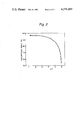
- FIG. 2 shows a relation between the pH-value of a Cr(VI) ions-containing chlorate cell liquor which is passed through an anion exchange resin bed and the adsorption ratio of Cr(VI) ions;
- FIG. 3 shows elution curves obtained by regeneration of an anion exchange resin bed adsorbing Cr(VI) ions.
- a Cr(VI) ions-containing chlorate cell liquor containing an alkali metal chlorate and an alkali metal chloride is acidified to a pH-value of from 1 to 5, and then passed through an anion exchange resin bed, by which most of the Cr(VI) ions are separated. Then, an aqueous alkali metal chloride and/or alkali metal chlorate solution containing a barium salt soluble in water is added to the effluent at a pH-value above 7 to precipitate barium chromate.
- the precipitate is filtered and a Cr(VI) ion-substantially free chlorate cell liquor is obtained.
- the filtered precipitate of barium chromate is dissolved in an aqueous hydrochloric acid solution, which is, then, passed through a cation exchange resin bed to adsorb only barium ions and an aqueous hydrochloric acid solution containing Cr(VI) ions is obtained.
- the anion exchange resin bed is regenerated more efficiently with an eluent containing 0.05 to 1.0 mol/l of an aqueous alkali metal hydroxide, 1.0 to 5.0 mol/l of an alkali metal chloride and 0.1 to 5.0 mol/l of an alkali metal chlorate.
- the Cr(VI) ions-containing aqueous hydrochloric acid solution passed through the cation exchange resin bed and the Cr(VI) ions-containing aqueous alkali metal hydroxide solution containing an alkali metal chloride and an alkali metal chlorate from the regeneration stage of the anion exchange resin bed are mixed and returned to the electrolysis step after adjusting the pH-value and the chloride concentration.
- the cation exchange resin bed which adsorbs the barium ions is regenerated by passing an eluent of an alkali metal chloride and/or an alkali metal chlorate through it.
- the effluent of an alkali metal chloride and/or an alkali metal chlorate containing barium ions is returned to the vessel to be used for precipitating barium chromate.
- Said alkali metal chlorate is commonly sodium chlorate or potassium chlorate
- said alkali metal chloride is commonly sodium chloride or potassium chloride
- said barium salt soluble in water is commonly barium chloride or barium nitrate.
- FIG. 1 A detailed explanation referring to the flow diagram (FIG. 1) is given below.
- a chlorate cell liquor flowing out of an electrolysis step (1) commonly contains an alkali metal chlorate of 3.2-5.2 mol/l, an alkali metal chloride of 1.4-2.6 mol/l and Cr(VI) ions of about 3.0 ⁇ 10 -2 g-ions/l.
- Cr(VI) ions of about 3.0 ⁇ 10 -2 g-ions/l.
- the pH-value of the chlorate cell liquor should be adjusted from 1 to 5, preferably from 1.5 to 3.
- Said anion exchange resin is commonly a strongly basic anion exchange resin or a weakly basic anion exchange resin.
- the pH-value of the chlorate cell liquor must be adjusted to above 7, at which the Cr(VI) ions take the form of CrO 4 2- , and an aqueous alkali metal chlorate and/or alkali metal chloride solution containing a barium salt soluble in water is added to the chlorate cell liquor at a gram-ion ratio of barium ions to Cr(VI) ions of from 1 to 8. If the gram-ion ratio of barium ions to Cr(VI) ions is higher than 8, there is no particular advantage. In this process, if a flocculant or a filter aid commonly used is added, the filtration becomes easier.
- the precipitate of barium chromate is filtered mechanically in a process (4) and the concentration of Cr(VI) ions in a chlorate cell liquor is reduced to some parts per million. Said chlorate cell liquor is fed to a chlorate crystallization process, a refined chlorate solution tank, or a single generator-crystallizer for manufacturing chlorine dioxide.
- the filter cake of barium chromate is readily dissolved in an aqueous hydrochloric acid solution at a concentration weaker than 6 N. It is not preferred to use the aqueous hydrochloric acid solution at a concentration of stronger than 6 N, because this will reduce the Cr(VI) ions to Cr(III) ions.
- Barium ions contained in the aqueous hydrochloric acid solution which also contains a few Cr(VI) ions, are adsorbed by passing it through a cation exchange resin bed (6), and then the effluent passed through the cation exchange resin bed containing Cr(VI) ions is sent to a subsequent step (7).
- the cation exchange resin bed (6) adsorbing barium ions are regenerated by passing an eluent of an aqueous alkali metal chlorate and/or alkali metal chloride solution through the bed. This effluent containing barium ions is returned to the precipitation step (3) for re-use.
- the concentrations of the alkali metal chlorate and the alkali metal chloride in the eluent to regenerate the cation exchange resin are equivalent to those of the chlorate cell liquor, the concentrations of the alkali metal chlorate and the alkali metal chloride of the Cr(VI) ion-substantially free chlorate cell liquor will remain unchanged. It is desirable to keep the concentrations of the alkali metal chlorate and the alkali metal chloride in the feed to the single generator-crystallizer as constant as possible. In this process, a strongly acidic cation exchange resin can be used in the cation exchange column.
- the anion exchange resin bed (2) adsorbing Cr(VI) ions is regenerated by passing an eluent of an aqueous alkali metal hydroxide solution containing an alkali metal chloride and an alkali metal chlorate through the bed.
- the alkali metal chloride and the alkali metal chlorate concentrations should be used from 1.0 to 5.0 mol/l and from 0.1 to 5.0 mol/l, respectively, and the concentration of the alkali metal hydroxide is from 0.05 to 1.0 mol/l.
- the concentration of the alkali metal hydroxide is less than 0.05 mol/l, efficient regeneration is not attained, and if it is more than 1.0 mol/l, a large amount of an acid for neutralizing is necessary.
- the lower limit of the chloride concentration of the eluent is set by its usefulness for the electrolytic step, while the upper limit is set by the solubility of the alkali metal chloride.
- the upper limit of the chlorate concentration of the eluent is set by the solubility of the alkali metal chlorate, while with a concentration of less than 0.1 mol/l, little elution takes place.
- the effluent from the regeneration stage of the anion exchange resin bed is sent to the step (7) for adjusting pH and NaCl concentration.
- the Cr(VI) ions-containing hydrochloric acid solution passed through the cation exchange resin bed and the Cr(VI) ions-containing alkali metal hydroxide solution containing an alkali metal chloride and an alkali metal chlorate from the regeneration stage of the anion exchange resin bed are mixed and returned to the electrolysis step after suitably adjusting the pH value and the concentration of the alkali metal chlorides.
- the chlorate cell liquor can be utilized after passing only through an anion exchange resin bed, for example, as in the case of using the chlorate cell liquor for manufacturing chlorine dioxide.
- the amount of the BaCrO 4 precipitate was 3.1 g and the precipitate was dissolved in 220 ml of 0.5 N-HCl.
- Said HCl solution containing barium ions and Cr(VI) ions was passed through a cation exchange resin bed made by packing 50 ml of a cation exchange resin, IR-120-B, into a column, by which 99 percent of barium ions were separated, with the resulting effluent being 220 ml of a 0.5 N-HCl solution containing 5.5 ⁇ 10 -2 g-ion/l Cr(VI) ions.
- Said cation exchange resin bed with adsorbed barium ions was regenerated by passing 230 ml of an eluent containing 3.74 mol/l NaClO 3 , 2.00 mol/l NaCl and having a pH of 2.10, and consequently an effluent containing 3.74 mol/l NaClO 3 , 2.00 mol/l NaCl and 4.9 ⁇ 10 -2 g-ion/l barium ions was obtained.
- An appropriate amount of BaCl 2 was added to said effluent to adjust the concentration of the barium ions to 1.13 ⁇ 10 -1 g-ion/l and the effluent was returned to the BaCrO 4 precipitation step.
- the anion exchange resin bed adsorbing Cr(VI) ions was regenerated by passing 8.5 liters of eluent containing 4.6 mol/l NaCl, 1.09 mol/l NaClO 3 and 0.1 mol/l NaOH through it, and consequently an effluent containing 4.6 mol/l NaCl, 1.09 mol/l NaClO 3 , 3.0 ⁇ 10 -2 g-ion/l Cr(VI) ions and 0.1 mol/l NaOH was obtained.
- the conditions for the electrolytic oxydation in a cell equipped with a Pt-Ir anode and a stainless steel cathode were as follows: temperature of 60° C., current density of 25 A/dm 2 , and current concentration of 10 A/l.
- Said effluent was sent to a storage tank from which it was fed to a single generator-crystallizer for manufacturing chlorine dioxide, virtually a glass vessel of 3 liter volume.
- the reaction medium contained 1.0 mol/l NaClO 3 , 4.8 mol/l NaCl and 0.17 mol/l HCl, and a catalyst prepared from palladium and glycine was added to give a concentration of 3.9 ⁇ 10 -4 mol/l.
- the chlorate cell liquor, from which most of the Cr(VI) ions had been recovered was fed at a flow rate of 7.2 ml/min at a reaction temperature of 70° C. and a reaction pressure of 185 mmHg. Consequently, a reaction yield of 96.2% for producing chlorine dioxide was attained and 2.44 mol/hr of NaCl was crystallized.
- the anion exchange resin bed adsorbing Cr(VI) ions was regenerated by passing an eluent containing 0.1 mol/l NaOH, 4.6 mol/l NaCl and 1.09 mol/l NaClO 3 .
- Said NaCl contained in the eluent was derived from the single generator-crystallizer.
- An effluent containing 4.6 L mol/l NaCl, 1.09 mol/l NaClO 3 , 0.1 mol/l NaOH and 3.0 ⁇ 10 -2 g-ion/l Cr(VI) ions was obtained.
- Said effluent was returned to an electrolytic cell after adjusting the pH-value to 6.60 by adding an appropriate amount of HCl.
- the conditions for the electrolytic oxydation in a cell equipped with a Pt-Ir anode and a stainless steel cathode were as follows: temperature of 60° C., current density of 25 A/dm 2 , and current concentration of 10 A/l. After electrolytic oxidation for 48 hours, a chlorate cell liquor containing 3.74 mol/l NaClO 3 , 1.93 mol/l NaCl, and 3.0 ⁇ 10 -2 g-ion/l Cr(VI) ions and with a pH of 6.90 was obtained. In the meanwhile, the experiments described above were repeated except that the pH-value of the chloride cell liquor was varied from 1 to 6, and the adsorption ratios of Cr(VI) ions were measured. The results obtained are given in FIG. 2.
- a reaction medium of the composition after three months of the operation described above was prepared and a chlorate cell liquor containing 3.74 mol/l NaClO 3 , 2.00 mol/l NaCl and 3.1 ⁇ 10 -2 g-ion/l of Cr(VI) ions was fed for reaction.
- the reaction temperature was elevated to 89.8° C. at 175 mmHg, and the yield of the chlorine dioxide producing reaction was reduced to 86.1%.
- An anion exchange resin bed consisting of a 3.5 cm-diameter column packed with one liter of an anion exchange resin, IRA 400 adsorbing 0.27 g-ion of Cr(VI) ions was prepared, and 0.27 g-ion/l Cr(VI) ions were adsorbed thereby.
- Said anion exchange resin bed was regenerated by passing an eluent containing 1.5 mol/l NaClO 3 , 2.0 mol/l NaCl and 0.1 mol/l NaOH through it. The elution curve obtained is given in FIG. 3-(1).
- Example 4 The experiment of Example 4 was repeated except that the composition of the eluent was 3.3 mol/l NaCl and 0.1 mol/l NaOH. The elution curve obtained is given in FIG. 3-(2).
- Example 4 The experiment of Example 4 was repeated except that the composition of the eluent was 0.1 mol/l NaOH. Consequently, there was no regeneration effect.
- An anion exchange resin bed consisting of a 13.5 mm-diameter column packed with 13 ml of an anion exchange resin, IRA400 adsorbing 3.0 ⁇ 10 -3 g-ion of Cr(VI) ions was prepared. Said anion exchange resin bed was regenerated by passing through it 40 ml of an eluent the compositions of which were given in Table 2. The elution ratios obtained are also given in Table 2.
- An anion exchange resin bed consisting of a 3.5 cm-diameter column packed with one liter of an anion exchange resin, IRA400, adsorbing 0.3 g-ion of Cr(VI) ions was prepared.
- the elution ratio is reduced remarkably at a concentration of NaCl less than 1.0 mol/l, even if the concentration of NaOH is B 0.1 mol/l. Moreover, the elution ratio decreases to below 70% at a concentration of NaClO 3 less than 0.1 mol/l, even if the concentration of NaCl is more than 1.0 mol/l.
Landscapes
- Chemical & Material Sciences (AREA)
- Organic Chemistry (AREA)
- Engineering & Computer Science (AREA)
- Metallurgy (AREA)
- Materials Engineering (AREA)
- Life Sciences & Earth Sciences (AREA)
- Electrochemistry (AREA)
- Inorganic Chemistry (AREA)
- Chemical Kinetics & Catalysis (AREA)
- Environmental & Geological Engineering (AREA)
- General Life Sciences & Earth Sciences (AREA)
- Geochemistry & Mineralogy (AREA)
- Geology (AREA)
- Manufacturing & Machinery (AREA)
- Mechanical Engineering (AREA)
- Electrolytic Production Of Non-Metals, Compounds, Apparatuses Therefor (AREA)
Abstract
Description
                                  TABLE 1
__________________________________________________________________________
              Initial      Filtrate
barium ions   Composition  Composition
Cr(VI) ions   Cr(VI)
                  NaClO.sub.3
                       NaCl
                           Cr(VI)
                               NaClO.sub.3
                                    NaCl
gram-ion ratio
              (ppm)
                  (mol/l)
                       (mol/l)
                           (ppm)
                               (mol/l)
                                    (mol/l)
__________________________________________________________________________
Example
      1.0     70.0
                  3.76 2.05
                           9.7 3.76 2.05
      2.0     70.0
                  3.76 2.05
                           5.0 3.76 2.05
      4.0     70.0
                  3.76 2.05
                           1.7 3.76 2.05
      8.0     70.0
                  3.76 2.05
                           0.1 3.76 2.05
Reference
      0.5     70.0
                  3.76 2.05
                           50.2
                               3.76 2.05
Example
      10.0    70.0
                  3.76 2.05
                           0.1 3.76 2.05
__________________________________________________________________________
              TABLE 2
______________________________________
         Eluent Compositions
                          Result
         NaClO.sub.3
                NaCl      NaOH    Elution
         (mol/l)
                (mol/l)   (mol/l) ratio (%)
______________________________________
Example    2.00     1.40      0.05  75.0
           2.00     1.40      0.20  78.8
           2.00     1.40      0.51  80.6
           2.00     1.40      0.89  88.1
Reference  2.00     1.40       0.005
                                     7.0
Example    2.00     1.40      1.50  88.0
           0        0         1.00  53.9
______________________________________
 ##STR1##
-  It is obvious that the elution ratio is remarkably reduced at a NaOH
 concentration of lower than 0.05 mol/l, and there is no particular
 improvement at a NaOH concentration of higher than 0.89 mol/l, and higher
 NaOH concentration is not preferred to avoid too much amount of acid to
 neutralize the NaOH. Moreover, when the eluent contains neither
 NaClO.sub.3 nor NaCl, the elution ratio is also reduced.
              TABLE 3
______________________________________
                          Result
         Eluent Compositions
                          Elution
         NaOH  NaClO.sub.3
                          NaCl    ratio (%)
______________________________________
Example    0.1     1.0        1.0   71.5
           0.1     1.0        2.0   73.6
           0.1     1.0        3.3   76.7
           0.1     1.0        4.6   78.0
           0.1     2.3        1.0   76.4
           0.1     3.8        1.0   80.8
           0.1     0.1        4.6   73.3
Reference  0.1     0          2.0   66.3
Example    0.1     0          3.3   68.1
           0.1     0          4.9   69.7
           0.1     0.2        0.1    3.5
           0.1     0.01       4.6   69.9
______________________________________
Claims (8)
Applications Claiming Priority (4)
| Application Number | Priority Date | Filing Date | Title |
|---|---|---|---|
| JP55-121430 | 1980-09-02 | ||
| JP55121430A JPS603009B2 (en) | 1980-09-02 | 1980-09-02 | Separation and reuse method of Cr(V1) ions in chlorate production electrolyte |
| JP18756780A JPS5939373B2 (en) | 1980-12-29 | 1980-12-29 | Method for separating and reusing Cr(6) ions in chlorate production electrolyte |
| JP55-187567 | 1980-12-29 |
Publications (1)
| Publication Number | Publication Date |
|---|---|
| US4376099A true US4376099A (en) | 1983-03-08 |
Family
ID=26458792
Family Applications (1)
| Application Number | Title | Priority Date | Filing Date |
|---|---|---|---|
| US06/295,699 Expired - Fee Related US4376099A (en) | 1980-09-02 | 1981-08-24 | Process for recovering Cr(VI) ions from a chlorate cell liquor |
Country Status (2)
| Country | Link |
|---|---|
| US (1) | US4376099A (en) |
| CA (1) | CA1183489A (en) |
Cited By (7)
| Publication number | Priority date | Publication date | Assignee | Title |
|---|---|---|---|---|
| EP0204217A1 (en) * | 1985-05-28 | 1986-12-10 | Sumitomo Chemical Company, Limited | Recovery of metals adsorbed on chelating agents |
| US4773974A (en) * | 1986-10-29 | 1988-09-27 | Tenneco Canada Inc. | Production of hexavalent chromium for use in chlorate cells |
| US4834848A (en) * | 1986-10-29 | 1989-05-30 | Tenneco Canada Inc. | Electrical removal of chromium from chlorate solutions |
| ES2033580A1 (en) * | 1990-07-16 | 1993-03-16 | Chemetics Int | Process for the separation of sulphate |
| US5254321A (en) * | 1990-11-13 | 1993-10-19 | Huron Tech Corp. | Process for chromium removal using an inorganic sulfur compound |
| US5336475A (en) * | 1990-11-13 | 1994-08-09 | Huron Tech Corp. | Process for chromium removal using an inorganic sulfur compound |
| US6833123B2 (en) * | 2000-08-10 | 2004-12-21 | Institute Of Nuclear Energy Research | Method for liquid chromate ion and oxy-metal ions removal and stabilization |
Citations (5)
| Publication number | Priority date | Publication date | Assignee | Title |
|---|---|---|---|---|
| US3427236A (en) * | 1965-03-16 | 1969-02-11 | Mo Och Domsjoe Ab | Process for the preparation of an alkali metal chlorate solution for use in a chlorine dioxide generation process |
| US3664950A (en) * | 1970-06-23 | 1972-05-23 | Atomic Energy Commission | Process for selective removal and recovery of chromates from water |
| US3835001A (en) * | 1973-04-30 | 1974-09-10 | Penn Olin Chem Co | Ion exchange removal of dichromates from electrolytically produced alkali metal chlorate-chloride solutions |
| US3980751A (en) * | 1974-11-20 | 1976-09-14 | Huron Chemicals Limited | Ion exchange chromate removal |
| US4036751A (en) * | 1976-01-23 | 1977-07-19 | Kurita Water Industries Ltd. | Method of treating water containing chromate |
-
1981
- 1981-08-19 CA CA000384211A patent/CA1183489A/en not_active Expired
- 1981-08-24 US US06/295,699 patent/US4376099A/en not_active Expired - Fee Related
Patent Citations (5)
| Publication number | Priority date | Publication date | Assignee | Title |
|---|---|---|---|---|
| US3427236A (en) * | 1965-03-16 | 1969-02-11 | Mo Och Domsjoe Ab | Process for the preparation of an alkali metal chlorate solution for use in a chlorine dioxide generation process |
| US3664950A (en) * | 1970-06-23 | 1972-05-23 | Atomic Energy Commission | Process for selective removal and recovery of chromates from water |
| US3835001A (en) * | 1973-04-30 | 1974-09-10 | Penn Olin Chem Co | Ion exchange removal of dichromates from electrolytically produced alkali metal chlorate-chloride solutions |
| US3980751A (en) * | 1974-11-20 | 1976-09-14 | Huron Chemicals Limited | Ion exchange chromate removal |
| US4036751A (en) * | 1976-01-23 | 1977-07-19 | Kurita Water Industries Ltd. | Method of treating water containing chromate |
Cited By (9)
| Publication number | Priority date | Publication date | Assignee | Title |
|---|---|---|---|---|
| EP0204217A1 (en) * | 1985-05-28 | 1986-12-10 | Sumitomo Chemical Company, Limited | Recovery of metals adsorbed on chelating agents |
| US4797264A (en) * | 1985-05-28 | 1989-01-10 | Sumitomo Chemical Company, Limited | Recovery of metals adsorbed on chelating agents |
| US4773974A (en) * | 1986-10-29 | 1988-09-27 | Tenneco Canada Inc. | Production of hexavalent chromium for use in chlorate cells |
| EP0266128A3 (en) * | 1986-10-29 | 1988-11-02 | Tenneco Canada Inc. | Production of hexavalent chromium for use in chlorate cells |
| US4834848A (en) * | 1986-10-29 | 1989-05-30 | Tenneco Canada Inc. | Electrical removal of chromium from chlorate solutions |
| ES2033580A1 (en) * | 1990-07-16 | 1993-03-16 | Chemetics Int | Process for the separation of sulphate |
| US5254321A (en) * | 1990-11-13 | 1993-10-19 | Huron Tech Corp. | Process for chromium removal using an inorganic sulfur compound |
| US5336475A (en) * | 1990-11-13 | 1994-08-09 | Huron Tech Corp. | Process for chromium removal using an inorganic sulfur compound |
| US6833123B2 (en) * | 2000-08-10 | 2004-12-21 | Institute Of Nuclear Energy Research | Method for liquid chromate ion and oxy-metal ions removal and stabilization |
Also Published As
| Publication number | Publication date |
|---|---|
| CA1183489A (en) | 1985-03-05 |
Similar Documents
| Publication | Publication Date | Title |
|---|---|---|
| DE69903332T2 (en) | METHOD FOR DEPLOYING THE METALION CONCENTRATION IN SALT SOLUTIONS | |
| US4155820A (en) | Purification of aqueous sodium chloride solution | |
| US4405465A (en) | Process for the removal of chlorate and hypochlorite from spent alkali metal chloride brines | |
| EP0175524B1 (en) | Electrolysis of alkali metal chloride solution | |
| US4108769A (en) | Process for reducing the mercury content of industrial waste waters | |
| US5211853A (en) | Method for the removal of chromium compounds from aqueous solutions | |
| KR950006681B1 (en) | Metals removal from aqueous peroxy acid or peroxy salts | |
| CA1040582A (en) | Ion exchange removal of dichromates in electrolysis | |
| US4268486A (en) | Selective chromate removal from a chlorate solution | |
| EP0025334B1 (en) | Chromate removal from concentrated chlorate solution by chemical precipitation | |
| CA1214429A (en) | Removal of chlorate from electrolyte cell brine | |
| US4397720A (en) | Removal of chlorate and hypochlorite from electrolyte cell brine | |
| US4481087A (en) | Process for removing chromate from solution | |
| JPH0416554B2 (en) | ||
| US3785942A (en) | Process for the recovery of mercury from waste solids | |
| US4190505A (en) | Electrolysis of sodium chloride in an ion-exchange membrane cell | |
| US3536597A (en) | Process for recovering mercury from a mercury-containing sludge | |
| US3788960A (en) | Recycling of ion exchange regenerant chemicals | |
| CA1183489A (en) | Process for recovering cr(vi) ions from a chlorate cell liquor | |
| HU213383B (en) | Method for producing aqueous sodium chloride solution and crystalline sodium chloride | |
| US4855059A (en) | Purification of brines with hydrous metal oxide ion exchangers | |
| US5409680A (en) | Purification of aqueous alkali metal chlorate solutions | |
| CN110983054A (en) | Method for separating and recovering cobalt and nickel from manganese sulfate solution | |
| US5356610A (en) | Method for removing impurities from an alkali metal chlorate process | |
| CA1139080A (en) | Stripping and recovery of dichromate in electrolytic chlorate systems |
Legal Events
| Date | Code | Title | Description |
|---|---|---|---|
| AS | Assignment |
Owner name: JAPAN CARLIT CO., LTD THE, NO. 2-1, MARUNOUCHI 1-C Free format text: ASSIGNMENT OF ASSIGNORS INTEREST.;ASSIGNORS:YAMAMOTO, HIDEO;ISA, ISAO;SHIBUYA, MORIOKI;REEL/FRAME:003913/0022 Effective date: 19810810 Owner name: JAPAN CARLIT CO., LTD., THE, JAPAN Free format text: ASSIGNMENT OF ASSIGNORS INTEREST;ASSIGNORS:YAMAMOTO, HIDEO;ISA, ISAO;SHIBUYA, MORIOKI;REEL/FRAME:003913/0022 Effective date: 19810810 |
|
| MAFP | Maintenance fee payment |
Free format text: PAYMENT OF MAINTENANCE FEE, 4TH YEAR, PL 96-517 (ORIGINAL EVENT CODE: M170); ENTITY STATUS OF PATENT OWNER: LARGE ENTITY Year of fee payment: 4 |
|
| MAFP | Maintenance fee payment |
Free format text: PAYMENT OF MAINTENANCE FEE, 8TH YEAR, PL 96-517 (ORIGINAL EVENT CODE: M171); ENTITY STATUS OF PATENT OWNER: LARGE ENTITY Year of fee payment: 8 |
|
| FEPP | Fee payment procedure |
Free format text: PAYOR NUMBER ASSIGNED (ORIGINAL EVENT CODE: ASPN); ENTITY STATUS OF PATENT OWNER: LARGE ENTITY |
|
| FEPP | Fee payment procedure |
Free format text: PAYOR NUMBER ASSIGNED (ORIGINAL EVENT CODE: ASPN); ENTITY STATUS OF PATENT OWNER: LARGE ENTITY Free format text: PAYER NUMBER DE-ASSIGNED (ORIGINAL EVENT CODE: RMPN); ENTITY STATUS OF PATENT OWNER: LARGE ENTITY |
|
| FEPP | Fee payment procedure |
Free format text: MAINTENANCE FEE REMINDER MAILED (ORIGINAL EVENT CODE: REM.); ENTITY STATUS OF PATENT OWNER: LARGE ENTITY |
|
| LAPS | Lapse for failure to pay maintenance fees | ||
| FP | Lapsed due to failure to pay maintenance fee |
Effective date: 19950308 |
|
| STCH | Information on status: patent discontinuation |
Free format text: PATENT EXPIRED DUE TO NONPAYMENT OF MAINTENANCE FEES UNDER 37 CFR 1.362 |