US4347458A - Photomultiplier tube having a gain modifying Nichrome dynode - Google Patents
Photomultiplier tube having a gain modifying Nichrome dynode Download PDFInfo
- Publication number
- US4347458A US4347458A US06/134,276 US13427680A US4347458A US 4347458 A US4347458 A US 4347458A US 13427680 A US13427680 A US 13427680A US 4347458 A US4347458 A US 4347458A
- Authority
- US
- United States
- Prior art keywords
- anode
- dynodes
- nichrome
- photocathode
- electron
- Prior art date
- Legal status (The legal status is an assumption and is not a legal conclusion. Google has not performed a legal analysis and makes no representation as to the accuracy of the status listed.)
- Expired - Lifetime
Links
Images
Classifications
-
- H—ELECTRICITY
- H01—ELECTRIC ELEMENTS
- H01J—ELECTRIC DISCHARGE TUBES OR DISCHARGE LAMPS
- H01J43/00—Secondary-emission tubes; Electron-multiplier tubes
- H01J43/04—Electron multipliers
- H01J43/06—Electrode arrangements
- H01J43/18—Electrode arrangements using essentially more than one dynode
- H01J43/20—Dynodes consisting of sheet material, e.g. plane, bent
Definitions
- the invention relates to a photomultiplier tube and particularly to a photomultiplier tube having at least one Nichrome dynode for reducing and stabilizing the anode sensitivity and gain of the tube.
- photomultiplier tubes In the manufacture of photomultiplier tubes it is desirable to have a photocathode which is highly sensitive to visible and near infrared light in order to obtain a high signal to noise ratio. It is also desirable to simultaneously maximize the sensitivity of both the photocathode and a plurality of dynodes to achieve high anode current gain.
- Method of sensitizing electron emissive surfaces of, for example, base layers of antimony on nickel substrates are well known in the art of electron discharge devices. Photoemissive materials and techniques relating thereto are, for example, described in "Photoemissive Materials" by A. H. Sommer, John Wiley and Sons, Inc., New York, 1968 and is herein incorporated by reference.
- a structure which provides a "buffer" layer between the nickel electrode substrate and the antimony base layer is described in U.S. Pat. No. 4,039,887 issued to McDonie on Aug. 2, 1977, entitled “Electron Emitter Including Porous Antimony", and incorporated by reference herein.
- the disclosed structure prevents alloying between the nickel substrate and the antimony base layer and provides an electrode which, when sensitized with alkali metal vapor, has the desired sensitivity.
- the problem of excessive anode sensitivity and unstable gain has been pronounced.
- the alkali antimonide dynodes in this tube structure have effective secondary emission gains ranging from 3.5 to 8 per electrode stage. It is believed that the gain instability is caused by a change in the chemical equilibrium of the secondary emissive surface of the electrode. Such a change can be caused by either the addition or depletion of alkali materials from the photoemissive surfaces due, for example, to electron bombardment of the photoemissive surfaces, or the migration of alkali-vapors within the tube.
- An electron multiplier device includes a plurality of dynodes comprising a substrate having a secondary emissive material thereon and at least one additional dynode of Nichrome whose exposed surface is substantially devoid of secondary emissive material.
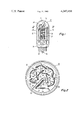
- FIG. 1 is a cross-sectional view of a photomultiplier tube of the present novel structure.
- FIG. 2 is an enlarged sectional view of the tube of FIG. 1 taken along line 2--2 in which the electrodes are shown in exaggerated detail.
- a photomultiplier tube 10 shown in FIGS. 1 and 2 is processed to activate or sensitize simultaneously various electron emissive surface portions of a plurality of electrodes within the tube's interior as described in U.S. Pat. No. 4,002,735 referenced above.
- the tube 10 has a glass envelope 12, with a stem 14.
- the stem 14 includes a length of exhaust tubulation 16 and a number of embedded metal pins 18 for making electrical contact to the electrodes within the interior of the tube 10.
- the electrode assembly includes a photocathode 19 comprising, in overlay sequence: a nickel supporting substrate 20, a thin film of manganese oxide 21 on a major surface of the substrate 20, and evaporated porous and solid antimony layers 22 and 23, respectively, on the manganese oxide film 21.
- Angularly disposed from the photocathode 19 is a mesh electrode 24, which is followed (proceeding counter-clockwise about the tube axis) by a series or chain of eight dynodes 26 and an anode 28.
- the anode is partially surrounded by an anode shield or final dynode 30.
- Each of the dynodes 26 comprises a nickel supporting substrate on a major surface of which is disposed a thin film of solid antimony 27.
- the final dynode 30 comprises a nickel based alloy commercially known as Nichrome.
- the Nichrome dynode is devoid of antimony.
- a plurality of support rods 31 provide structural support for the mesh electrode 24, the photocathode 19, the dynodes 26 and 30 and the anode 28.
- Electrons emitted from the photocathode 19 are propagated and concatenated by the plurality of dynodes 26 and the final dynode 30 to the anode 28.
- an enclosed potassium evaporation boat 34 Located within the tube 10 between the electrode assembly and the top of the tube 10, are an enclosed potassium evaporation boat 34, an enclosed sodium evaporation boat 36, and an enclosed cesium evaporation boat 38. These boats may be either resistance-heated, or heated by RF heating methods well known in the art, to release alkali metal vapors from a charge of reactant material placed within a central cavity within their interior. Alternatively, the sodium and potassium alkali materials may be combined and placed in one evaporation boat.
- the Nichrome dynode 30 is cleaned to remove organic materials and to provide a pristine surface.
- the cleaning scheduled is detailed in Example 1.
- a number of dynodes are cleaned simultaneously.
- the Nichrome dynode 30 is made from a magnesium deoxidized, aluminum free nickel chromium alloy comprising about 19 to 20% chromium, 1% maxiumum iron, 0.25% maximum manganese, 0.10% maximum carbon, 0.45% maximum silicon, 0.01% maximum aluminum and the remainder nickel.
- the dynodes are boiled in an oxide stripper made, for example, from 7 parts de-ionized water, 2 parts hydrogen peroxide and 1 part sodium hydroxide by volume.
- the parts are next ultrasonically rinsed in isopropyl alcohol for about 1 minute followed by an additional rinse in isopropyl alcohol.
- the parts are air blown dry and stored in covered glass containers in a dry nitrogen atmosphere.
- nichrome dynodes 30 Prior to storage the nichrome dynodes 30 are vacuum fired at 600° C. for 1 hour.
- the vacuum firing of the Nichrome dynodes 30 desorbs and removes surface contaminants which may be present after the cleaning procedure. The vacuum firing thus renders the Nichrome dynodes inert to the alkali vapors generated during activation.
- the interior of the tube is continually evacuated through the exhaust tubulation 16 by a pump system (not shown) interconnected thereto.
- the pump system is capable of establishing initial pressure levels of less than about 10 -4 torr (preferably, pressure levels less than about 10 -5 torr) within the tube interior.
- the activation of exposed surface portions 40 of the photocathode 19 and the dynodes 26 which are to be sensitized by exposure to the vapors of a plurality of alkali metals may proceed in the manner described in the aforementioned U.S. Pat. No. 4,002,735.
- the tube 10 is removed from the pump system (not shown) and aged, as described hereinafter, to scrub or bombard the dynodes 26 and 30 with electrons in order to stbilize the gain and anode sensitivity of the tube by driving excess alkali materials from the surface portions 40 of dynodes 26 and from the surface of the Nichrome dynode 30.
- the aging consists of applying about 1000 volts to energize the tube.
- a light (not shown) is adjusted until approximately 50 microamperes of anode current is indicated on a meter (not shown).
- the "light” aging is continued for 4 hours. At the end of the 4 hours the light is turned off and the voltage is increased to approximately 1300 volts. This "dark" aging is continued for about an additional 16 hours.
- Tubes having the novel final Nichrome dynode 30 described herein exhibit better anode current stability at 50 microamperes than tubes having the standard alkali antimonide final dynode.
- the final dynode 30 is formed from Nichrome.
- the nominal anode sensitivity of tubes produced having the novel Nichrome dynode is 1200 Amperes per lumen compared to a nominal anode sensitivity of 2400 Amperes per lumen for tubes having a final dynode with an alkali antimony secondary emissive surface.
- the signal to noise ratio of tubes having the Nichrome final dynode is lower than the signal to noise ratio of tubes with an alkali antimonide final dynode; however since the low secondary emission gain Nichrome dynode is adjacent to the anode, the noise contribution from the last dynode is small and the performance of the tube is substantially unaffected (see RCA Photomultiplier Manual, PT-61 p. 62 (1970) incorporated by reference herein).
- the relative contribution of any dynode stage to the total gain fluctuation or variance decreases with the proximity of the dynodes in the propagating and concatenating chain to the output or anode. The first stage contributes most to the total variance and the final stage contributes least.
- Tubes made with final dynodes comprising Nichrome evaporated on a nickel substrate showed good stability and a reduction in gain of about one-half the gain of the alkali antimonide final dynode; however, the preparation of the nichrome evaporated dynodes is an expensive, complicated process that introduces undesirable variables which are absent in "solid" Nichrome final dynodes as described herein.
- the above-described structure utilizes only one Nichrome dynode to reduce and stabilize the anode sensitivity and the gain of the tube, it is within the scope of the invention to increase the number of Nichrome dynodes in order to achieve the anode sensitivity and gain stability desired.
- additional Nichrome dynodes would be added to the propagating and concatenating chain at the anode end of the electron multiplier.
- the additional Nichrome dynodes would be mutually adjacent to one another and adjacent to the anode.
Landscapes
- Common Detailed Techniques For Electron Tubes Or Discharge Tubes (AREA)
Abstract
Description
Claims (5)
Priority Applications (2)
| Application Number | Priority Date | Filing Date | Title |
|---|---|---|---|
| US06/134,276 US4347458A (en) | 1980-03-26 | 1980-03-26 | Photomultiplier tube having a gain modifying Nichrome dynode |
| JP56043103A JPS5841620B2 (en) | 1980-03-26 | 1981-03-23 | photomultiplier tube |
Applications Claiming Priority (1)
| Application Number | Priority Date | Filing Date | Title |
|---|---|---|---|
| US06/134,276 US4347458A (en) | 1980-03-26 | 1980-03-26 | Photomultiplier tube having a gain modifying Nichrome dynode |
Publications (1)
| Publication Number | Publication Date |
|---|---|
| US4347458A true US4347458A (en) | 1982-08-31 |
Family
ID=22462601
Family Applications (1)
| Application Number | Title | Priority Date | Filing Date |
|---|---|---|---|
| US06/134,276 Expired - Lifetime US4347458A (en) | 1980-03-26 | 1980-03-26 | Photomultiplier tube having a gain modifying Nichrome dynode |
Country Status (2)
| Country | Link |
|---|---|
| US (1) | US4347458A (en) |
| JP (1) | JPS5841620B2 (en) |
Cited By (6)
| Publication number | Priority date | Publication date | Assignee | Title |
|---|---|---|---|---|
| US5619091A (en) * | 1994-10-03 | 1997-04-08 | Universities Research Association, Inc. | Diamond films treated with alkali-halides |
| US5656807A (en) * | 1995-09-22 | 1997-08-12 | Packard; Lyle E. | 360 degrees surround photon detector/electron multiplier with cylindrical photocathode defining an internal detection chamber |
| US5736731A (en) * | 1995-07-20 | 1998-04-07 | Hamamatsu Photonics K.K. | Photomultiplier tube comprising a second dynode having a saturated secondary electron emission ratio |
| US20080011537A1 (en) * | 2001-08-01 | 2008-01-17 | Delphi Technologies Inc. | Apparatus and method for steering a vehicle |
| GB2412231B (en) * | 2004-02-26 | 2008-09-24 | Electron Tubes Ltd | Photomultiplier |
| CN111466010A (en) * | 2017-10-09 | 2020-07-28 | 艾德特斯解决方案有限公司 | Method and apparatus for controlling contaminant deposition on electron-emitting surfaces of dynodes |
Citations (12)
| Publication number | Priority date | Publication date | Assignee | Title |
|---|---|---|---|---|
| US2390701A (en) * | 1943-01-27 | 1945-12-11 | Rca Corp | Secondary electron emitter |
| US2942132A (en) * | 1957-10-02 | 1960-06-21 | Rca Corp | Electron multiplier |
| US3346752A (en) * | 1965-04-27 | 1967-10-10 | Rca Corp | Electron multiplier dynode having an aperture of reduced secondary emission |
| US3449582A (en) * | 1966-02-02 | 1969-06-10 | Westinghouse Electric Corp | Electron multiplier device having an electrically insulating secondary emission control surface |
| US3891884A (en) * | 1972-06-26 | 1975-06-24 | Raytheon Co | Electron discharge device having electron multipactor suppression coating on window body |
| US3974411A (en) * | 1970-09-20 | 1976-08-10 | Rca Corporation | Channel plate electron multiplier tube having reduced astigmatism |
| US4002735A (en) * | 1975-06-04 | 1977-01-11 | Rca Corporation | Method of sensitizing electron emissive surfaces of antimony base layers with alkali metal vapors |
| US4023063A (en) * | 1973-04-19 | 1977-05-10 | U.S. Philips Corporation | Color tube having channel electron multiplier and screen pattern of concentric areas luminescent in different colors |
| US4039887A (en) * | 1975-06-04 | 1977-08-02 | Rca Corporation | Electron emitter including porous antimony |
| US4079286A (en) * | 1976-11-26 | 1978-03-14 | Rca Corporation | Grid having reduced secondary emission characteristics and electron discharge device including same |
| US4099079A (en) * | 1975-10-30 | 1978-07-04 | U.S. Philips Corporation | Secondary-emissive layers |
| US4160185A (en) * | 1977-12-14 | 1979-07-03 | Rca Corporation | Red sensitive photocathode having an aluminum oxide barrier layer |
-
1980
- 1980-03-26 US US06/134,276 patent/US4347458A/en not_active Expired - Lifetime
-
1981
- 1981-03-23 JP JP56043103A patent/JPS5841620B2/en not_active Expired
Patent Citations (12)
| Publication number | Priority date | Publication date | Assignee | Title |
|---|---|---|---|---|
| US2390701A (en) * | 1943-01-27 | 1945-12-11 | Rca Corp | Secondary electron emitter |
| US2942132A (en) * | 1957-10-02 | 1960-06-21 | Rca Corp | Electron multiplier |
| US3346752A (en) * | 1965-04-27 | 1967-10-10 | Rca Corp | Electron multiplier dynode having an aperture of reduced secondary emission |
| US3449582A (en) * | 1966-02-02 | 1969-06-10 | Westinghouse Electric Corp | Electron multiplier device having an electrically insulating secondary emission control surface |
| US3974411A (en) * | 1970-09-20 | 1976-08-10 | Rca Corporation | Channel plate electron multiplier tube having reduced astigmatism |
| US3891884A (en) * | 1972-06-26 | 1975-06-24 | Raytheon Co | Electron discharge device having electron multipactor suppression coating on window body |
| US4023063A (en) * | 1973-04-19 | 1977-05-10 | U.S. Philips Corporation | Color tube having channel electron multiplier and screen pattern of concentric areas luminescent in different colors |
| US4002735A (en) * | 1975-06-04 | 1977-01-11 | Rca Corporation | Method of sensitizing electron emissive surfaces of antimony base layers with alkali metal vapors |
| US4039887A (en) * | 1975-06-04 | 1977-08-02 | Rca Corporation | Electron emitter including porous antimony |
| US4099079A (en) * | 1975-10-30 | 1978-07-04 | U.S. Philips Corporation | Secondary-emissive layers |
| US4079286A (en) * | 1976-11-26 | 1978-03-14 | Rca Corporation | Grid having reduced secondary emission characteristics and electron discharge device including same |
| US4160185A (en) * | 1977-12-14 | 1979-07-03 | Rca Corporation | Red sensitive photocathode having an aluminum oxide barrier layer |
Cited By (6)
| Publication number | Priority date | Publication date | Assignee | Title |
|---|---|---|---|---|
| US5619091A (en) * | 1994-10-03 | 1997-04-08 | Universities Research Association, Inc. | Diamond films treated with alkali-halides |
| US5736731A (en) * | 1995-07-20 | 1998-04-07 | Hamamatsu Photonics K.K. | Photomultiplier tube comprising a second dynode having a saturated secondary electron emission ratio |
| US5656807A (en) * | 1995-09-22 | 1997-08-12 | Packard; Lyle E. | 360 degrees surround photon detector/electron multiplier with cylindrical photocathode defining an internal detection chamber |
| US20080011537A1 (en) * | 2001-08-01 | 2008-01-17 | Delphi Technologies Inc. | Apparatus and method for steering a vehicle |
| GB2412231B (en) * | 2004-02-26 | 2008-09-24 | Electron Tubes Ltd | Photomultiplier |
| CN111466010A (en) * | 2017-10-09 | 2020-07-28 | 艾德特斯解决方案有限公司 | Method and apparatus for controlling contaminant deposition on electron-emitting surfaces of dynodes |
Also Published As
| Publication number | Publication date |
|---|---|
| JPS5841620B2 (en) | 1983-09-13 |
| JPS56149762A (en) | 1981-11-19 |
Similar Documents
| Publication | Publication Date | Title |
|---|---|---|
| US4639638A (en) | Photomultiplier dynode coating materials and process | |
| US4039887A (en) | Electron emitter including porous antimony | |
| US4160185A (en) | Red sensitive photocathode having an aluminum oxide barrier layer | |
| US3372967A (en) | Method of making a multi-alkali cathode | |
| US4002735A (en) | Method of sensitizing electron emissive surfaces of antimony base layers with alkali metal vapors | |
| US2393803A (en) | Method of making long life secondary electron emitters | |
| US3434876A (en) | Photosensitive cathodes | |
| US4009409A (en) | Fast warmup cathode and method of making same | |
| JPH0322014B2 (en) | ||
| US4341427A (en) | Method for stabilizing the anode sensitivity of a photomultiplier tube | |
| US4339469A (en) | Method of making potassium, cesium, rubidium, antimony photocathode | |
| US3884539A (en) | Method of making a multialkali electron emissive layer | |
| JPS5841620B2 (en) | photomultiplier tube | |
| US3712700A (en) | Method of making an electron emitter device | |
| US2401737A (en) | Phototube and method of manufacture | |
| US5463272A (en) | Cathode for photoelectric emission, cathode for secondary electron emission, electron multiplier tube, and photomultiplier tube | |
| JP2719297B2 (en) | Transmission type photocathode and method for manufacturing photoelectric tube and transmission type photocathode | |
| US2077633A (en) | Photoelectric tube | |
| US3202854A (en) | Pickup tube target having an additive therein for reduced resistivity | |
| US1906448A (en) | Photo-electric tube | |
| US5017831A (en) | Glow discharge lamp with getter material on anode | |
| US4305972A (en) | Method for expeditiously processing a sodium-potassium-cesium-antimony photocathode | |
| US4568567A (en) | Method of removing trace quantities of alkali metal impurities from a bialkali-antimonide photoemissive cathode | |
| US5619091A (en) | Diamond films treated with alkali-halides | |
| US1568694A (en) | Photo-electric device |
Legal Events
| Date | Code | Title | Description |
|---|---|---|---|
| STCF | Information on status: patent grant |
Free format text: PATENTED CASE |
|
| AS | Assignment |
Owner name: NPD SUBSIDIARY INC., 38 Free format text: ASSIGNMENT OF ASSIGNORS INTEREST.;ASSIGNOR:RCA CORPORATION;REEL/FRAME:004815/0001 Effective date: 19870625 |
|
| AS | Assignment |
Owner name: BURLE TECHNOLOGIES, INC., A CORP. OF DE Free format text: ASSIGNMENT OF ASSIGNORS INTEREST.;ASSIGNOR:BURLE INDUSTRIES, INC., A CORP. OF PA;REEL/FRAME:004940/0962 Effective date: 19870728 Owner name: BURLE INDUSTRIES, INC. Free format text: MERGER;ASSIGNOR:NPD SUBSIDIARY, INC., 38;REEL/FRAME:004940/0936 Effective date: 19870714 Owner name: BANCBOSTON FINANCIAL COMPANY Free format text: SECURITY INTEREST;ASSIGNOR:BURLE INDUSTRIES, INC., A CORP. OF PA;REEL/FRAME:004940/0952 Effective date: 19870714 |
|
| AS | Assignment |
Owner name: BANCBOSTON FINANCIAL COMPANY, A MA BUSINESS TRUST Free format text: SECURITY INTEREST;ASSIGNOR:BURLE TECHNOLOGIES, INC., A DE CORPORATION;REEL/FRAME:005707/0021 Effective date: 19901211 |
|
| AS | Assignment |
Owner name: BARCLAYS BUSINESS CREDIT, INC. Free format text: SECURITY INTEREST;ASSIGNOR:BURLE TECHNOLOGIES, INC., A DE CORP.;REEL/FRAME:006309/0001 Effective date: 19911025 |