US4345505A - Firing pin locking system - Google Patents

Firing pin locking system Download PDF

Info

Publication number
US4345505A
US4345505A US06/158,197 US15819780A US4345505A US 4345505 A US4345505 A US 4345505A US 15819780 A US15819780 A US 15819780A US 4345505 A US4345505 A US 4345505A
Authority
US
United States
Prior art keywords
bolt
gun
disposition
aft
lugs
Prior art date
Legal status (The legal status is an assumption and is not a legal conclusion. Google has not performed a legal analysis and makes no representation as to the accuracy of the status listed.)
Expired - Lifetime
Application number
US06/158,197
Inventor
Raymond A. Patenaude
Steven R. Duke
John K. Coolidge
Current Assignee (The listed assignees may be inaccurate. Google has not performed a legal analysis and makes no representation or warranty as to the accuracy of the list.)
General Dynamics OTS Inc
Original Assignee
General Electric Co
Priority date (The priority date is an assumption and is not a legal conclusion. Google has not performed a legal analysis and makes no representation as to the accuracy of the date listed.)
Filing date
Publication date
Application filed by General Electric Co filed Critical General Electric Co
Priority to US06/158,197 priority Critical patent/US4345505A/en
Application granted granted Critical
Publication of US4345505A publication Critical patent/US4345505A/en
Assigned to MARTIN MARIETTA CORPORATION reassignment MARTIN MARIETTA CORPORATION ASSIGNMENT OF ASSIGNORS INTEREST (SEE DOCUMENT FOR DETAILS). Assignors: GENERAL ELECTRIC COMPANY
Assigned to LOCKHEED MARTIN CORPORATION reassignment LOCKHEED MARTIN CORPORATION ASSIGNMENT OF ASSIGNORS INTEREST (SEE DOCUMENT FOR DETAILS). Assignors: MARTIN MARIETTA CORPORATION
Assigned to GENERAL DYNAMICS ARMAMENT SYSTEMS, INC. reassignment GENERAL DYNAMICS ARMAMENT SYSTEMS, INC. ASSIGNMENT OF ASSIGNORS INTEREST (SEE DOCUMENT FOR DETAILS). Assignors: LOCKHEED MARTIN CORPORATION
Anticipated expiration legal-status Critical
Expired - Lifetime legal-status Critical Current

Links

Images

Classifications

    • FMECHANICAL ENGINEERING; LIGHTING; HEATING; WEAPONS; BLASTING
    • F41WEAPONS
    • F41AFUNCTIONAL FEATURES OR DETAILS COMMON TO BOTH SMALLARMS AND ORDNANCE, e.g. CANNONS; MOUNTINGS FOR SMALLARMS OR ORDNANCE
    • F41A17/00Safety arrangements, e.g. safeties
    • F41A17/64Firing-pin safeties, i.e. means for preventing movement of slidably- mounted strikers
    • F41A17/66Firing-pin safeties, i.e. means for preventing movement of slidably- mounted strikers automatically operated, i.e. operated by breech opening or closing movement
    • FMECHANICAL ENGINEERING; LIGHTING; HEATING; WEAPONS; BLASTING
    • F41WEAPONS
    • F41AFUNCTIONAL FEATURES OR DETAILS COMMON TO BOTH SMALLARMS AND ORDNANCE, e.g. CANNONS; MOUNTINGS FOR SMALLARMS OR ORDNANCE
    • F41A3/00Breech mechanisms, e.g. locks
    • F41A3/12Bolt action, i.e. the main breech opening movement being parallel to the barrel axis
    • F41A3/36Semi-rigid bolt locks, i.e. having locking elements movably mounted on the bolt or on the barrel or breech housing
    • F41A3/38Semi-rigid bolt locks, i.e. having locking elements movably mounted on the bolt or on the barrel or breech housing having rocking locking elements, e.g. pivoting levers or vanes

Definitions

  • This invention relates to mechanisms for locking and actuation of the firing pins of gun bolts in automatic guns, such as Gatling type guns, and, more particularly, to such mechanisms in gun bolts where the bolts are locked by cammed locking lugs.
  • cammed locking lugs to lock gun bolts to gun barrels is well known, and is shown, for example, in "The Machine Gun” by G. M. Chinn, Vol. IV, Parts X and XI, pp. 371, 384, 385, Dept. of the Navy, 1955. Therein are shown for example: “FIG. 6-76-Locking Rollers Are Cammed Free of Barrel Extension by Rails in Receiver.” “FIG. 6-89 [and 6-90]-Recoiling Barrel Extension Cams Lugs Free of Bolt.” In U.S. Pat. No. 3,608,427 issued Sept. 28, 1971 to R. H.
  • a feature of this invention is the provision of a gun bolt having a firing pin which is movable to and between an aft disposition whereat the forward end of said pin is aft of the face of the gun bolt and a forward disposition whereat said forward end is forward of said face, locking means movable to and between a locked disposition whereat said gun bolt is locked to fixedly close the chamber of the gun and an unlocked disposition, and intermediate means responsive to the disposition of said locking means for locking said pin in its aft disposition when said locking means is not in its locked disposition.
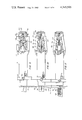
  • FIG. 1 is a perspective view of a portion of a gun bolt of the type shown in U.S. Pat. No. 4,294,158, issued Oct. 13, 1981 to R. A. Patenaude et al, which is improved by the incorporation of an embodiment of this invention;
  • FIG. 2 is a top view of the gun bolt of FIG. 1 showing the gun bolt unlocked;
  • FIG. 3 is similar to FIG. 2 but showing the gun bolt partially locked
  • FIG. 4 is similar to FIG. 3 but showing the gun bolt fully locked
  • FIG. 5 is a partial detail view in transverse cross-section showing the locking slide captured to the body of the gun bolt
  • FIG. 6 is partial detail view in longitudinal cross-section showing the wing lock in elevation as nested in the pocket in the rotor;
  • FIG. 7 is a partial detail view in transverse cross-section showing the gun bolt journaled in the rotor
  • FIG. 8 is a partial detail view in longitudinal cross-section showing the cam follower and detent mechanism of the locking slide
  • FIG. 9 is a top view in partial cross-section of the gun bolt of FIG. 1 showing a portion of the firing pin mechanism and the gun bolt unlocked;
  • FIG. 10 is similar to FIG. 9 but showing the gun bolt partially locked
  • FIG. 11 is similar to FIG. 10 but showing the gun bolt fully locked
  • FIG. 12 is a detail view in side longitudinal cross-section of the gun bolt showing a portion of the firing pin mechanism
  • FIG. 13 is a detail view in front cross-section of the gun bolt showing a portion of the firing pin mechanism
  • FIG. 14 is a detail side view of the gun bolt with locking lug removed.
  • This invention is incorporated in a gun bolt of the type shown in U.S. Pat. No. 4,294,158, issued Oct. 13, 1981 to R. A. Patnaude et al, which in turn is incorporated in a gun of the type having a small diameter rotor shown in U.S. Pat. No. 3,834,272 issued Sept. 10, 1974 to R. A. Patenaude et al and U.S. Pat. No. 4,114,511 issued Sept. 19, 1978 to R. A. Patenaude.
  • the invention has utility in other gun bolts in other guns.
  • the gun bolt embodying this invention as shown in FIG. 1 includes a bolt body 10 and a slide 12. As shown in FIG. 5, the body has, in part, a T-shaped cross-section wherein the ends of the "T" provide rails 14 and the slide has a pair of depending and inward-going sides 16 encircling the rails to capture the slide to the body while permitting longitudinal relative motion.
  • gun bolts e.g., three, one for each gun barrel 17.
  • the gun barrels are fixed to the rotor 18 which is journaled for rotation in a housing 19, and each gun bolt is journaled for longitudinal reciprocation in a respective channel 20 in the rotor, as shown in FIG. 7.
  • the rotor in a Gatling type gun serves as a receiver.
  • Each of a symmetric pair of locking lugs 22 is nested in a respective recess 24 in the rotor 18 adjacent the channel 20.
  • Each gun bolt body 10 has a stud 32 fixed thereto on which is journaled a cam follower roller 34 which rides in a cam track 36 formed in the interior wall of the housing 19, and which cam track serves to reciprocate the bolt fore and aft as the rotor revolves about its longitudinal axis.
  • the rotor may be driven by appropriate means, such as an external drive, as shown in U.S. Pat. No. 3,834,272, supra.
  • Each slide 12 has a stud 38 fixed thereto on which is journaled a cam follower roller 40 which rides in a cam track 42 formed in the interior wall of the housing, and which cam track serves to reciprocate the slide relative to its respective gun bolt, as the assembly of the gun bolt and the slide reciprocates relative to the rotor.
  • the cam track 42 is not continuous, but rather is provided only where necessary to provide relative movement between the slide and the bolt body.
  • a detent mechanism is provided to hold the slide and the bolt body against relative movement.
  • a plunger 43 is disposed in a blind bore 43a and is biased outwardly by a helical compression spring 43b.
  • the plunger has a main body portion 43c of relatively large diameter and a cam follower portion 43d of relative smaller diameter.
  • the follower portion clears and passes through a slot 43e in the slide.
  • the body portion 43c will seat in either of two cups 43f or 43g in the slot, and when so seated, locks the slide of the bolt body.
  • the plunger is withdrawn from either cup by means of a cam surface 43h depressing the follower against the bias of the spring.
  • Each of a symmetric pair of actuator lugs 44 is pivotally captured to the slide 12 by a respective pin 46 and nested within a respective recess 48 into the side of the gun bolt body 10.
  • Each recess 48 has a respective ramp surface 50, which serves to cam the distal end of the lug 44 outwardly when the slide 12 is moved aft relative to the gun bolt body 10. As the distal end of the lug 44 moves outwardly it abuts a cam following surface 51 of the aft end 52 of the adjacent locking lugs 22 which is journaled on pivot 26 in the rotor and swings said aft end 52 outwardly and, thereby, the forward end 54 of the locking lug inwardly.
  • Each of the pair of locking lugs 22 also has a respective stud 62 fixed to the forward end.
  • the forward end of the slide 12 has a pair of somewhat arcuate slots 64 cut into its underface.
  • the lugs 44 progressively swing out, the lug aft ends 52 progressively move out, and the lug forward ends 54 progressively move in and the lugs 62 progressively enter into the respective arcuate slots 64.
  • the lugs 62 are fully into the blind forward ends of the slots, so that the slide precludes any pivotal movement of the locking lug.
  • the slide 12 which is controlled by its cam follower 40 in the cam track 42, not only drives the locking lugs into their bolt locking configuration by means of the ramp surfaces 50 and the actuator lugs 44, but also captures the locking lugs in their bolt locking configuration by means of the arcuate slots 64, so that any possibility of unlocking movement of the locking lugs at the time of firing is precluded.
  • the slide also has a symmetric pair of shoulders with respective ramp surfaces 66, which project into respective recesses 67 in each locking lug 22.
  • Each recess has a cam following surface 68, and as the slide moves forwardly on the bolt body, the ramp surface 66 engages the surface 68 to cam the locking lugs outwardly, while concurrently the cut out 64 clears the stud 62.
  • a stud 70 is integral with the body of the gun bolt and has a cross bar having two ends 72 which overlie an upwardly facing surface 74 of the slide. These overlying ends preclude any possible upward movement of the slide which might otherwise tend to permit disengagement of the studs 62 from the arcuate slots 64.
  • a firing pin 100 is disposed in a longitudinal bore 102 in the gun bolt body 10.
  • a cocking lever 104 passes through a radially extending slot 106 in the aft end of the body 10 and is fixed to the aft end of the firing pin.
  • the cocking lever rides on the cam surface 108 of an annular firing cam 110 which has a low or forward uncocked level 112, a ramp or cocking level 114, an up or aft cocked level 116, and a firing drop off 118.
  • a helical firing spring 120 is disposed on the firing pin and is compressed and released by the operation of the cocking lever.
  • the firing pin has a substantially conical head 122 which is adapted to pass through a reduced opening 124 into the face 126 of the head 56 of the gun bolt.
  • the pin has a portion 126a of reduced diameter which provides a forward facing annular shoulder 128.
  • a pair of retainer lugs 130 are disposed in a cross-slot 132 formed in the bolt body and extending between the recesses 55.
  • Each lug 130 is pivotally mounted to the body by a pin 134 passing through respective bores in the bolt body.
  • Each lug 130 also has a cam follower pin 136 projecting therefrom.
  • the forward underside portion of the slide 12 has a part of stepped cam surfaces 140, 142, 144, for driving the respective pins 136.
  • the forward ends of the retainer lugs 130 are normally biased apart by a helical compression spring 146 whose ends project into blind bores 148 in the lugs 130.
  • the aft ends of the lugs which have respective curved surfaces to straddle the reduced portion 126a of the firing pin, are thus normally biased together and abut the forward facing shoulder 128 of the firing pin, thereby precluding forward movement of the firing pin.
  • both locking lugs 22 are not present and swung into their bolt locking dispositions, the retaining lugs will not both be released from the annular shoulder 128, and the firing pin will be blocked from camming forward and projecting forward of the face of the gun bolt, irrespective of the action of the cocking lever and the main spring.

Landscapes

  • Engineering & Computer Science (AREA)
  • General Engineering & Computer Science (AREA)
  • Toys (AREA)

Abstract

A feature of this invention is the provision of a gun bolt having a firing pin which is movable to and between an aft disposition whereat the forward end of said pin is aft of the face of the gun bolt and a forward disposition whereat said forward end is forward of said face, locking means movable to and between a locked disposition whereat said gun bolt is locked to fixedly close the chamber of the gun and an unlocked disposition, and intermediate means responsive to the disposition of said locking means for locking said pin in its aft disposition when said locking means is not in its locked disposition.

Description

The U.S. Government has rights in this invention pursuant to Contract No. F08635-77-C-0173 awarded by the United States Air Force.
BACKGROUND OF THE INVENTION
1. Field of the Invention
This invention relates to mechanisms for locking and actuation of the firing pins of gun bolts in automatic guns, such as Gatling type guns, and, more particularly, to such mechanisms in gun bolts where the bolts are locked by cammed locking lugs.
2. Description of the Prior Art
The use of cammed locking lugs to lock gun bolts to gun barrels is well known, and is shown, for example, in "The Machine Gun" by G. M. Chinn, Vol. IV, Parts X and XI, pp. 371, 384, 385, Dept. of the Navy, 1955. Therein are shown for example: "FIG. 6-76-Locking Rollers Are Cammed Free of Barrel Extension by Rails in Receiver." "FIG. 6-89 [and 6-90]-Recoiling Barrel Extension Cams Lugs Free of Bolt." In U.S. Pat. No. 3,608,427 issued Sept. 28, 1971 to R. H. Colby, there is shown a gun bolt which is locked by lugs which are nested in pockets in the recoiling gun barrel extension and which are swung out to lock the gun bolt by cam followers which ride in a stationary cam track. In U.S. Pat. No. 3,603,201, issued Sept. 7, 1971 to A. J. Aloi there is shown a firing pin in a drop lock type gun bolt in a Gatling type gun which is actuated by an aft annular cam. In U.S. Pat. No. 4,295,410, issued Oct. 20, 1981 to R. A. Patenaude et al there is shown a gun bolt in a Gatling type gun which is locked by locking lugs which are operated by a slide which is controlled by a supplemental annular cam.
BRIEF DESCRIPTION OF THE INVENTION
It is an object of this invention to provide a mechanism for precluding projection of the firing pin of a gun bolt forward of the face of the gun bolt when the gun bolt is not in its locked position.
A feature of this invention is the provision of a gun bolt having a firing pin which is movable to and between an aft disposition whereat the forward end of said pin is aft of the face of the gun bolt and a forward disposition whereat said forward end is forward of said face, locking means movable to and between a locked disposition whereat said gun bolt is locked to fixedly close the chamber of the gun and an unlocked disposition, and intermediate means responsive to the disposition of said locking means for locking said pin in its aft disposition when said locking means is not in its locked disposition.
BRIEF DESCRIPTION OF THE DRAWING
These and other objects, features and advantages of the invention will be apparent from the following specification thereof taken in conjunction with the accompanying drawing in which:
FIG. 1 is a perspective view of a portion of a gun bolt of the type shown in U.S. Pat. No. 4,294,158, issued Oct. 13, 1981 to R. A. Patenaude et al, which is improved by the incorporation of an embodiment of this invention;
FIG. 2 is a top view of the gun bolt of FIG. 1 showing the gun bolt unlocked;
FIG. 3 is similar to FIG. 2 but showing the gun bolt partially locked;
FIG. 4 is similar to FIG. 3 but showing the gun bolt fully locked;
FIG. 5 is a partial detail view in transverse cross-section showing the locking slide captured to the body of the gun bolt;
FIG. 6 is partial detail view in longitudinal cross-section showing the wing lock in elevation as nested in the pocket in the rotor;
FIG. 7 is a partial detail view in transverse cross-section showing the gun bolt journaled in the rotor;
FIG. 8 is a partial detail view in longitudinal cross-section showing the cam follower and detent mechanism of the locking slide;
FIG. 9 is a top view in partial cross-section of the gun bolt of FIG. 1 showing a portion of the firing pin mechanism and the gun bolt unlocked;
FIG. 10 is similar to FIG. 9 but showing the gun bolt partially locked;
FIG. 11 is similar to FIG. 10 but showing the gun bolt fully locked;
FIG. 12 is a detail view in side longitudinal cross-section of the gun bolt showing a portion of the firing pin mechanism;
FIG. 13 is a detail view in front cross-section of the gun bolt showing a portion of the firing pin mechanism; and
FIG. 14 is a detail side view of the gun bolt with locking lug removed.
DESCRIPTION OF THE INVENTION
This invention is incorporated in a gun bolt of the type shown in U.S. Pat. No. 4,294,158, issued Oct. 13, 1981 to R. A. Patnaude et al, which in turn is incorporated in a gun of the type having a small diameter rotor shown in U.S. Pat. No. 3,834,272 issued Sept. 10, 1974 to R. A. Patenaude et al and U.S. Pat. No. 4,114,511 issued Sept. 19, 1978 to R. A. Patenaude. Of course, the invention has utility in other gun bolts in other guns.
The gun bolt embodying this invention as shown in FIG. 1 includes a bolt body 10 and a slide 12. As shown in FIG. 5, the body has, in part, a T-shaped cross-section wherein the ends of the "T" provide rails 14 and the slide has a pair of depending and inward-going sides 16 encircling the rails to capture the slide to the body while permitting longitudinal relative motion. There are a plurality of gun bolts, e.g., three, one for each gun barrel 17. The gun barrels are fixed to the rotor 18 which is journaled for rotation in a housing 19, and each gun bolt is journaled for longitudinal reciprocation in a respective channel 20 in the rotor, as shown in FIG. 7. As is well known, the rotor in a Gatling type gun serves as a receiver.
Each of a symmetric pair of locking lugs 22 is nested in a respective recess 24 in the rotor 18 adjacent the channel 20. A pin 26, which passes through a bore 28 in the lug 22 into a blind bore 30 in the rotor, pivotally captures the lug in the rotor.
Each gun bolt body 10 has a stud 32 fixed thereto on which is journaled a cam follower roller 34 which rides in a cam track 36 formed in the interior wall of the housing 19, and which cam track serves to reciprocate the bolt fore and aft as the rotor revolves about its longitudinal axis. The rotor may be driven by appropriate means, such as an external drive, as shown in U.S. Pat. No. 3,834,272, supra. Each slide 12 has a stud 38 fixed thereto on which is journaled a cam follower roller 40 which rides in a cam track 42 formed in the interior wall of the housing, and which cam track serves to reciprocate the slide relative to its respective gun bolt, as the assembly of the gun bolt and the slide reciprocates relative to the rotor. The cam track 42 is not continuous, but rather is provided only where necessary to provide relative movement between the slide and the bolt body. A detent mechanism is provided to hold the slide and the bolt body against relative movement. A plunger 43 is disposed in a blind bore 43a and is biased outwardly by a helical compression spring 43b. The plunger has a main body portion 43c of relatively large diameter and a cam follower portion 43d of relative smaller diameter. The follower portion clears and passes through a slot 43e in the slide. The body portion 43c will seat in either of two cups 43f or 43g in the slot, and when so seated, locks the slide of the bolt body. The plunger is withdrawn from either cup by means of a cam surface 43h depressing the follower against the bias of the spring.
Each of a symmetric pair of actuator lugs 44 is pivotally captured to the slide 12 by a respective pin 46 and nested within a respective recess 48 into the side of the gun bolt body 10. Each recess 48 has a respective ramp surface 50, which serves to cam the distal end of the lug 44 outwardly when the slide 12 is moved aft relative to the gun bolt body 10. As the distal end of the lug 44 moves outwardly it abuts a cam following surface 51 of the aft end 52 of the adjacent locking lugs 22 which is journaled on pivot 26 in the rotor and swings said aft end 52 outwardly and, thereby, the forward end 54 of the locking lug inwardly. As the forward end 54 swings inwardly, it enters a recess 55 in the bolt body aft of the head 56 of the bolt. This recess has an aft facing surface 58 which receives the forward facing and end surface 60 of the locking lug. Thus pressure against the face of the head 56 of the bolt body 10 is transmitted across the surfaces 58 and 60, through the locking lugs 22, to an arcuate surface 61 of the rotor 18.
Each of the pair of locking lugs 22 also has a respective stud 62 fixed to the forward end. The forward end of the slide 12 has a pair of somewhat arcuate slots 64 cut into its underface. As the slide 12 progressively moves aft, the lugs 44 progressively swing out, the lug aft ends 52 progressively move out, and the lug forward ends 54 progressively move in and the lugs 62 progressively enter into the respective arcuate slots 64. When the slide 12 is fully aft, the lugs 62 are fully into the blind forward ends of the slots, so that the slide precludes any pivotal movement of the locking lug.
Thus the slide 12 which is controlled by its cam follower 40 in the cam track 42, not only drives the locking lugs into their bolt locking configuration by means of the ramp surfaces 50 and the actuator lugs 44, but also captures the locking lugs in their bolt locking configuration by means of the arcuate slots 64, so that any possibility of unlocking movement of the locking lugs at the time of firing is precluded.
The slide also has a symmetric pair of shoulders with respective ramp surfaces 66, which project into respective recesses 67 in each locking lug 22. Each recess has a cam following surface 68, and as the slide moves forwardly on the bolt body, the ramp surface 66 engages the surface 68 to cam the locking lugs outwardly, while concurrently the cut out 64 clears the stud 62.
A stud 70 is integral with the body of the gun bolt and has a cross bar having two ends 72 which overlie an upwardly facing surface 74 of the slide. These overlying ends preclude any possible upward movement of the slide which might otherwise tend to permit disengagement of the studs 62 from the arcuate slots 64.
A firing pin 100 is disposed in a longitudinal bore 102 in the gun bolt body 10. A cocking lever 104 passes through a radially extending slot 106 in the aft end of the body 10 and is fixed to the aft end of the firing pin. The cocking lever rides on the cam surface 108 of an annular firing cam 110 which has a low or forward uncocked level 112, a ramp or cocking level 114, an up or aft cocked level 116, and a firing drop off 118. A helical firing spring 120 is disposed on the firing pin and is compressed and released by the operation of the cocking lever.
The firing pin has a substantially conical head 122 which is adapted to pass through a reduced opening 124 into the face 126 of the head 56 of the gun bolt. The pin has a portion 126a of reduced diameter which provides a forward facing annular shoulder 128. A pair of retainer lugs 130 are disposed in a cross-slot 132 formed in the bolt body and extending between the recesses 55. Each lug 130 is pivotally mounted to the body by a pin 134 passing through respective bores in the bolt body. Each lug 130 also has a cam follower pin 136 projecting therefrom. The forward underside portion of the slide 12 has a part of stepped cam surfaces 140, 142, 144, for driving the respective pins 136. The forward ends of the retainer lugs 130 are normally biased apart by a helical compression spring 146 whose ends project into blind bores 148 in the lugs 130. The aft ends of the lugs, which have respective curved surfaces to straddle the reduced portion 126a of the firing pin, are thus normally biased together and abut the forward facing shoulder 128 of the firing pin, thereby precluding forward movement of the firing pin. When the slide 12 is forward relative to the bolt body, in the bolt unlocked disposition shown in FIG. 9, the part of inner cam surfaces 144 respectively abut the pair of cam follower pins 136, and holds the part of retainer lugs 130 in their firing pin blocking disposition. When the slide 12 is aft relative to the bolt body, in the bolt locked disposition shown in FIG. 11, the cam surfaces 144 are clear of the pair of cam follower pins 136, but the spring 146 would continue to bias the aft ends of the retainer lugs together. However, when the forward ends 54 of the bolt locking lugs 22 are each present and are swung inwardly into their bolt locking disposition, they respectively abut the forward ends of the retainer lugs 130 and cam them together against the bias of the spring 146, so that the aft ends of the retainer lugs 130 clear the annular shoulder 128 and the firing pin is free to move forward under the control of the cocking lever 104 and the spring 120. If both locking lugs 22 are not present and swung into their bolt locking dispositions, the retaining lugs will not both be released from the annular shoulder 128, and the firing pin will be blocked from camming forward and projecting forward of the face of the gun bolt, irrespective of the action of the cocking lever and the main spring.
While the invention has been shown embodied in a Gatling type gun, it will be obvious that it has application to single barrel guns wherein the gun bolt is driven by rotating drum cam, such as is shown in U.S. Pat. No. 1,786,207 issued to R. F. Hudson on Dec. 23, 1930. In such case the two cam tracks 36 and 42 will be formed on the drum cam, rather than on the housing, and the gun bolt assembly will reciprocate in the receiver. In either case relative motion is provided between the cam tracks and the gun bolt assembly.

Claims (5)

What is claimed is:
1. A gun having a longitudinal axis and comprising:
a receiver;
a chamber;
a gun bolt movable along a path in said receiver parallel to said axis to and between the aft disposition whereat said chamber is open and a forward disposition whereat said chamber is closed by said gun bolt;
said gun bolt having a bolt face and carrying a firing pin, and a control means;
said firing pin being movable along a path in said gun bolt to and between an aft disposition whereat the forward end of said pin is aft of said bolt face and a forward disposition whereat said forward end is forward of said bolt face;
said control means being movable along a path to and between an aft disposition and a forward disposition relative to said gun bolt;
gun bolt locking means carried by said receiver and movable by said control means to and between a first disposition whereat said gun bolt is locked to said receiver to fixedly close said chamber and a second disposition whereat said gun bolt is free of said bolt locking means;
firing pin locking means carried by said gun bolt and movable to and between a first disposition whereat it interferes with movement of said firing pin and a second disposition whereat said firing pin is free to said pin locking means, said pin locking means being normally biased to its first disposition;
said bolt locking means, if and only if, it is substantially in its first disposition whereat said gun bolt is locked thereby positively causing said pin locking means to move to its second disposition whereat said pin is free thereof.
2. A gun according to claim 1 further including:
a cyclically operating first cam means for positively driving said gun bolt fore and aft in said receiver;
a cyclically operating second cam means for positively driving said control means fore and aft relative to said bolt; and
a cyclically operating third cam means for positively cocking and thereafter releasing said firing pin.
3. A gun according to claim 2 wherein:
said gun bolt locking means includes a pair of first lugs, each pivotally mounted to said receiver.
4. A gun according to claim 3 wherein:
said firing pin locking means includes a pair of second lugs, each pivotally mounted to said gun bolt, each one of said second lugs being disposed to be moved to its respective second disposition by a respective one of said first lugs being in its respective first disposition.
5. A gun according to claim 4 wherein:
said control means has a pair of first cam means for respectively positively moving said pair of first lugs to their respective first dispositions wherein said control means is in its aft disposition and a pair of second cam means for respectively positively moving said pair of first lugs to their respective second dispositions when said control means is in its forward disposition.
US06/158,197 1980-06-11 1980-06-11 Firing pin locking system Expired - Lifetime US4345505A (en)

Priority Applications (1)

Application Number Priority Date Filing Date Title
US06/158,197 US4345505A (en) 1980-06-11 1980-06-11 Firing pin locking system

Applications Claiming Priority (1)

Application Number Priority Date Filing Date Title
US06/158,197 US4345505A (en) 1980-06-11 1980-06-11 Firing pin locking system

Publications (1)

Publication Number Publication Date
US4345505A true US4345505A (en) 1982-08-24

Family

ID=22567064

Family Applications (1)

Application Number Title Priority Date Filing Date
US06/158,197 Expired - Lifetime US4345505A (en) 1980-06-11 1980-06-11 Firing pin locking system

Country Status (1)

Country Link
US (1) US4345505A (en)

Cited By (6)

* Cited by examiner, † Cited by third party
Publication number Priority date Publication date Assignee Title
US4494439A (en) * 1983-04-25 1985-01-22 General Electric Company Firing mechanism for high rate of fire revolving battery gun
US5065662A (en) * 1990-12-24 1991-11-19 General Electric Company Firing mechanism for revolving battery gun
EP0766056A3 (en) * 1995-09-30 1998-04-15 Rheinmetall Industrie Aktiengesellschaft Safety device for the percussion pin of a gun
EP2759798A3 (en) * 2009-03-10 2014-10-08 Rheinmetall Waffe Munition GmbH Breech system for an externally propelled or self-propelled gun
US9791224B1 (en) * 2017-03-13 2017-10-17 Carmelo Russo Firearm bolt carrier
US20230186709A1 (en) * 2019-07-15 2023-06-15 Acuity Technical Designs, LLC Intelligent integrated locking devices and systems

Citations (6)

* Cited by examiner, † Cited by third party
Publication number Priority date Publication date Assignee Title
US1057329A (en) * 1911-09-21 1913-03-25 Bruno Clarus Recoil-loader with fixed barrel.
US2962936A (en) * 1957-05-24 1960-12-06 Mach Tool Works Oerlikon Automatic firearm
US3603201A (en) * 1969-11-24 1971-09-07 Gen Electric Firing mechanism for high rate of fire revolving battery gun
US3608427A (en) * 1969-04-07 1971-09-28 Gen Electric Bolt locking system
US3834272A (en) * 1973-04-17 1974-09-10 Gen Electric Multibarrel automatic weapon
US4114511A (en) * 1977-05-25 1978-09-19 General Electric Company Endless conveyor mechanism

Patent Citations (6)

* Cited by examiner, † Cited by third party
Publication number Priority date Publication date Assignee Title
US1057329A (en) * 1911-09-21 1913-03-25 Bruno Clarus Recoil-loader with fixed barrel.
US2962936A (en) * 1957-05-24 1960-12-06 Mach Tool Works Oerlikon Automatic firearm
US3608427A (en) * 1969-04-07 1971-09-28 Gen Electric Bolt locking system
US3603201A (en) * 1969-11-24 1971-09-07 Gen Electric Firing mechanism for high rate of fire revolving battery gun
US3834272A (en) * 1973-04-17 1974-09-10 Gen Electric Multibarrel automatic weapon
US4114511A (en) * 1977-05-25 1978-09-19 General Electric Company Endless conveyor mechanism

Non-Patent Citations (1)

* Cited by examiner, † Cited by third party
Title
G. M. Chinn, The Machine Gun, vol. IV, Parts X and XI, pp. 371, 384, 385, Dept. of the Navy, 1955. *

Cited By (7)

* Cited by examiner, † Cited by third party
Publication number Priority date Publication date Assignee Title
US4494439A (en) * 1983-04-25 1985-01-22 General Electric Company Firing mechanism for high rate of fire revolving battery gun
US5065662A (en) * 1990-12-24 1991-11-19 General Electric Company Firing mechanism for revolving battery gun
EP0766056A3 (en) * 1995-09-30 1998-04-15 Rheinmetall Industrie Aktiengesellschaft Safety device for the percussion pin of a gun
EP2759798A3 (en) * 2009-03-10 2014-10-08 Rheinmetall Waffe Munition GmbH Breech system for an externally propelled or self-propelled gun
US9791224B1 (en) * 2017-03-13 2017-10-17 Carmelo Russo Firearm bolt carrier
US20230186709A1 (en) * 2019-07-15 2023-06-15 Acuity Technical Designs, LLC Intelligent integrated locking devices and systems
US12307849B2 (en) * 2019-07-15 2025-05-20 Integrated Solutions, Inc. Intelligent integrated locking devices and systems

Similar Documents

Publication Publication Date Title
US5722194A (en) Weapon bolt
US10012461B2 (en) Ambidextrous charging handle
US5581046A (en) Hand-held firearm with recoil attenuation
AU2011211387B2 (en) Breech guide device for a breech arrangement and a rapid fire weapon with a breech guide device
US3013355A (en) Firearm breech bolt mechanism with a bolt stop
US9200856B2 (en) Bolt assembly with improved rotating locking head
US3213558A (en) Means for mounting bolt-actuating device for firearms
US4345505A (en) Firing pin locking system
US2601808A (en) Breech bolt lock and actuator for firearms
US2577026A (en) Pivoted breech bolt lock for automatic firearms
US3380341A (en) Safing means for high rate of fire multi-barrel automatic weapon
US4494439A (en) Firing mechanism for high rate of fire revolving battery gun
EP0107920B1 (en) A firearm
US2774283A (en) Breech mechanism for a firearm
US4700608A (en) Machine gun
US4295410A (en) Gun bolt locking system
US4065998A (en) Gun lock and firing mechanism for 30mm cannon
US5726376A (en) Breechblock system for a gun
US2461670A (en) Automatic sear-releasing mechanism for firearms
US4054003A (en) Firearm safety device
US4760663A (en) Firearm
US2469053A (en) Automatic sear for automatic and semiautomatic firearms
EP1535012B1 (en) Small arm having a locked breech
US2775835A (en) Bolt mechanism for firearm
US3242816A (en) Accelerator mechanism

Legal Events

Date Code Title Description
STCF Information on status: patent grant

Free format text: PATENTED CASE

CC Certificate of correction
AS Assignment

Owner name: MARTIN MARIETTA CORPORATION, MARYLAND

Free format text: ASSIGNMENT OF ASSIGNORS INTEREST;ASSIGNOR:GENERAL ELECTRIC COMPANY;REEL/FRAME:007046/0736

Effective date: 19940322

AS Assignment

Owner name: LOCKHEED MARTIN CORPORATION, MARYLAND

Free format text: ASSIGNMENT OF ASSIGNORS INTEREST;ASSIGNOR:MARTIN MARIETTA CORPORATION;REEL/FRAME:008628/0518

Effective date: 19960128

AS Assignment

Owner name: GENERAL DYNAMICS ARMAMENT SYSTEMS, INC., VIRGINIA

Free format text: ASSIGNMENT OF ASSIGNORS INTEREST;ASSIGNOR:LOCKHEED MARTIN CORPORATION;REEL/FRAME:009046/0692

Effective date: 19970101