US4281411A - High speed digital communication receiver - Google Patents
High speed digital communication receiver Download PDFInfo
- Publication number
- US4281411A US4281411A US06/051,722 US5172279A US4281411A US 4281411 A US4281411 A US 4281411A US 5172279 A US5172279 A US 5172279A US 4281411 A US4281411 A US 4281411A
- Authority
- US
- United States
- Prior art keywords
- signals
- weighted
- combined
- receiver
- signal
- Prior art date
- Legal status (The legal status is an assumption and is not a legal conclusion. Google has not performed a legal analysis and makes no representation as to the accuracy of the status listed.)
- Expired - Lifetime
Links
- 238000004891 communication Methods 0.000 title abstract description 8
- 238000004260 weight control Methods 0.000 claims description 6
- 230000003111 delayed effect Effects 0.000 claims description 5
- 238000012545 processing Methods 0.000 claims description 5
- 230000003044 adaptive effect Effects 0.000 abstract description 6
- 238000010586 diagram Methods 0.000 description 7
- 230000001934 delay Effects 0.000 description 4
- 238000005562 fading Methods 0.000 description 4
- 230000005540 biological transmission Effects 0.000 description 3
- 230000003321 amplification Effects 0.000 description 2
- 238000013459 approach Methods 0.000 description 2
- 230000000694 effects Effects 0.000 description 2
- 238000000034 method Methods 0.000 description 2
- 238000003199 nucleic acid amplification method Methods 0.000 description 2
- 230000006978 adaptation Effects 0.000 description 1
- 239000002131 composite material Substances 0.000 description 1
- 230000002596 correlated effect Effects 0.000 description 1
- 238000013461 design Methods 0.000 description 1
- 238000001514 detection method Methods 0.000 description 1
- 238000012423 maintenance Methods 0.000 description 1
- 238000004519 manufacturing process Methods 0.000 description 1
- 238000012986 modification Methods 0.000 description 1
- 230000004048 modification Effects 0.000 description 1
- 238000012800 visualization Methods 0.000 description 1
Images


Classifications
-
- H—ELECTRICITY
- H04—ELECTRIC COMMUNICATION TECHNIQUE
- H04L—TRANSMISSION OF DIGITAL INFORMATION, e.g. TELEGRAPHIC COMMUNICATION
- H04L1/00—Arrangements for detecting or preventing errors in the information received
- H04L1/02—Arrangements for detecting or preventing errors in the information received by diversity reception
- H04L1/06—Arrangements for detecting or preventing errors in the information received by diversity reception using space diversity
Definitions
- This invention relates generally to communications systems and, more particularly, to communications system receivers for use in receiving signals which have been transmitted through a dispersive transmission medium, such as a fading multipath medium.
- the transmitted signal is conveyed through the multipath medium along a plurality of decorrelated paths so that a plurality of signals, each representing the transmitted signal but having varying energy contents, are received. Fading effects in such communication systems are reduced when each of the several diversity channels conveying a given signal have decorrelated fading characteristics. Accordingly, a plurality of diversity receivers are used and one or more of the diversity receiver channel signals having the greatest signal strengths are selected as most probably carrying a reliably detectable message signal. In another diversity approach, a composite signal is generated from a combination of all of the received diversity channel signals. In the latter case the diversity channel signals may be appropriately weighted before they are combined.
- a suitable signal processing technique which has heretofore been utilized in providing appropriate signal weights has been based on a mean-square error criterion, particularly with the transmission of digital data, the weighting factors being utilized to equalize the multipath distortion in each diversity channel to substantially remove any intersymbol interference and to provide proper diversity combining.
- a high speed digital communications receiver is used in a diversity receiver system in which a predetection combiner of the receiver utilizes a forward adaptive transversal filter equalizer, having a plurality of weighting sections, in each of the diversity channels for processing each of the received bandpass diversity signals prior to demodulation.
- the combined weighted output from the predetection combiner is then demodulated and the data therein appropriately reconstructed and an error signal generated.
- the error signal is modulated and limited for use in adaptive control circuitry which provides appropriate adaptive weighting signals for use in the processing of the received diversity signals at each of the forward filter equalizers.
- the unmodulated error signal is used in a backward adaptation control circuit for providing appropriate adaptive weighting signals for use in a single backward filter equalizer which suitably processes the reconstructed data to form a cancellation signal which is used to eliminate intersymbol interference and source correlation effects in the demodulated combined weighted output signal.
- a suitable timing system permits the receiver clock to follow transmitter clock variations and a novel automatic gain control system at the input IF receiver amplifiers is used to reduce the dynamic range requirements of the forward filter weight components.
- Such a system provides an effective implementation of an adaptive forward transversal filter equalization system useful with or without a backward filter equalizer and which provides advantages over the systems used or suggested prior thereto, as discussed in the Monsen patent.
- a disadvantage of the system described in the above-referenced Monsen patent is that the tapped delay lines required in each diversity channel must operate at intermediate frequencies (IF) so that they are normally implemented by utilizing surface wave tapped delay line devices.
- IF intermediate frequencies
- Such devices are relatively high loss devices at the intermediate frequencies of the radio equipment and, since they are not readily available commercially, they must often be specially made for the application in which they are to be used. For such reason and further because a number of such tapped delay line devices are required, one for each diversity channel, the overall cost thereof becomes relatively high.
- the system of the invention is arranged to perform the required time delay operation at baseband frequency, rather than at IF frequency, while the complex multiplication and correlations needed for weighting purposes can still be performed at IF frequencies utilizing simple PIN diode multipliers.
- Such an arrangement in accordance with the invention reduces the total number of tapped delay lines which are required. Further, the delay line operation performed at baseband signal frequency results in much less loss than that incurred at IF frequencies. Accordingly, the number of large gain-bandwidth RF amplifiers required for the overall system operation is considerably reduced over that previously required in the specific implementations of the system described in the above-referred-to Monsen patent.
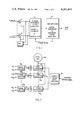
- FIG. 1 shows a broad block diagram of a high speed digital communications receiver utilizing a forward filter equalizer and diversity combiner
- FIG. 2 shows a more specific block diagram of a portion of a forward filter equalizer and diversity combiner of the prior art which is useful in the system of FIG. 1;
- FIG. 3 shows a more specific block diagram of a portion of a forward filter equalizer and diversity combiner in accordance with the invention, which is also useful in the system of FIG. 1;
- FIG. 4 shows a more specific block diagram of another portion of the forward filter equalizer and diversity combiner in accordance with the invention.
- FIG. 1 An overall system utilizing a forward transversal and filter equalizer is shown in broad block diagram form in FIG. 1.
- the system shown therein could be specifically implemented in accordance with a system of the type described in the aforesaid U.S. Pat. No. 3,897,664 issued to Peter Monsen.
- a plurality of diversity channels identified as “Channel 1" through “Channel D” supply a plurality of input signals to intermediate frequency (IF) amplifiers 10 at each channel.
- IF intermediate frequency
- a suitable automatic gain control (AGC) system essentially fixes all the IF amplifier gains according to the strongest of the receiver signals.
- AGC automatic gain control
- the signals from IF amplifiers 10 are supplied to a forward transversal filter equalizer, diversity combiner and demodulator 11.
- the output thereof, at baseband frequency, is then supplied to a data detector, error generator and backward transversal filter equalizer 12 for producing an output data signal.
- the error generator provides an error signal which is appropriately modulated and fed back to the forward filter equalizer for use in generating the desired weighting signals for use therein.
- An unmodulated error signal can be used for providing appropriate weighting signals for use in the backward filter equalizer.
- the input signal from the IF amplifier of each channel is supplied to a tapped delay line 15 shown as having time delays 15 1 through 15 N each identified as equal in a preferred embodiment to a time delay of ⁇ /2, where ⁇ /2 is one-half the data symbol interval as discussed in the Monsen patent.
- the signals at each tap are appropriately amplified by amplifiers 16 which may, in an appropriate system, be relatively large gain-bandwidth RF amplifiers having gains of approximately 30dB and bandwidths much larger than the signal in order to insure phase stability with temperature.
- the amplifiers are identified by the representations A ij and B ij respectively, where "i" designates the channel and "j" designates the delay line tap.
- Such amplifiers are required because of the relatively high losses incurred in the time delay device at the intermediate frequency involved.
- tapped delay lines may be in the form of tapped surface wave delay line devices which, at such frequencies, are known to produce relatively high losses along the delay line.
- the gains of amplifiers 16 are suitably arranged to provide a sufficient signal level at complex multipliers 17.
- the tapped signals are appropriately weighted by weighting signals (identified as W ij ).
- weighting signals are suitably controlled as described in the patent via weight control circuitry responsive to the error signal fed back from the error generator circuitry and to the time delayed received input signal which provides for suitable time alignment of the error signal and the received signal.
- the weighted signals at the outputs of multipliers 17 are appropriately combined at summing devices 18, the outputs of all of the channels being suitably combined at combiner 19.
- the latter combined signal is amplified by a pair of large gain-bandwidth RF amplifiers 20 and 21, the amplified signal thereupon being demodulated by demodulator 22 to supply the required signal at baseband frequency to the data detector and error generator of the system as shown in FIG. 1.
- the data detector, error generator and backward filter equalizer are all disclosed in detail in the aforesaid Monsen patent.
- a separate tapped delay line is required for each of the input channels and, because of the high losses incurred therein, sufficient signal amplification is required at each of the taps prior to the weighting of the tapped signals. Further, appropriate amplification is required prior to demodulation which converts the signal from IF to baseband frequency.
- four delay line devices and twenty-six large gain-bandwidth IF amplifiers are required.
- the signals present in FIG. 2 are complex in nature, i.e., such signals have real and imaginary components, although for simplicity only a single signal line is depicted in the drawings.
- FIG. 3 A significant reduction in complexity and cost compared to the system shown in FIG. 2 can be achieved when using a system in accordance with the invention, a preferred embodiment of which is shown in block diagram form in FIG. 3 for the portion of the overall system of FIG. 1 which corresponds to that depicted in FIG. 2.
- the signal from the IF amplifier of each channel is supplied to a signal splitter 25 which supplies N such signals to each of a plurality of N complex weighting multipliers 26.
- the input signal from channel 1 is supplied to N multipliers 26 1 , through 26 1N , the signal from channel 2 to multipliers 26 21 through 26 2N (not shown), and so on, to the signal from channel D which is supplied to multipliers 26 D1 through 26 DN .
- the input signal to each channel is also supplied through a time delay device 27 to a further signal splitter 28 which supplies such time delay signal to each of a plurality of N weight control complex correlators 29, in a similar manner.
- the latter signals are correlated with complex modulated error signals supplied from the error generator as discussed above with reference to FIGS. 1 and 2 to produce weight control signals for supply to the complex weighting multipliers 26 as desired.
- the generation of such complex error signals is described below with reference to FIG. 4.
- Time delays 27, as discussed above, are used in order to provide alignment of the received signal with such error signals.
- such latter time delay may correspond to the data symbol interval, ⁇ .
- the weighted signals from the complex multipliers 26 are then selectively combined, as shown, at each of a plurality of N combiners 30 1 through 30 N .
- the signals from multipliers 26 11 through 26 D1 are combined, at combiner 30, the signals from multipliers 26 12 through 26 D2 are combined at combiner 30 2 (not shown), and so on, to the signals from multipliers 26 1N through 26 DN at combiner 30 N .
- the outputs of combiners 30 1 through 30 N are each suitably amplified by a pair of large gain-bandwidth product IF amplifiers 31 1 through 31 N and 32 1 through 32 N as shown, the amplified outputs of which are each appropriately demodulated by demodulators 33 1 through 33 N , as shown.
- the output of demodulator 33 1 is supplied to a first delay element 34 1 of a plurality of delay elements 34 each having a delay equal to ⁇ /2 as discussed above with respect to the delay lines of FIG. 2.
- the outputs of the demodulators 33 2 through 33 N are combined with successive outputs of each of the successive delay elements 34 1 through 34 N-1 , as shown at combiners 35 1 through 35 N-1 , the successively combined signals being in each case supplied to the next successive delay element.
- the final combined signal at combiner 35 N-1 is supplied to the data detector and error generator of the overall system of FIG. 1, at the baseband frequency, as required.
- the specific error signals E ij depicted in FIG. 3 are obtained from the error signal, as shown in FIG. 4, which is fed back from the error generator of FIG. 1.
- the latter error signal for example, can be suitably digitized, in a manner discussed in the above-referenced Monsen patent, and supplied to a complex digital shift register 40 to supply a plurality of N time-shifted complex error signals which are each then supplied to frequency converters 41 1 through 41 N which shift the frequency upward by the frequency of local oscillator 42.
- the error signals are amplified and supplied to signal splitters 43 1 through 43 N for correlation with the time delayed received signals at complex correlators 29, as depicted in FIG. 3.
- the error signals, weighting signals and combined weighted signals, as well as the demodulated signals and the signals at the outputs of each of the taps of the baseband delay line device are all complex signals, i.e., such signals each have a real and an imaginary part in the same manner as discussed with respect to the signals in the above-referenced Monsen patent.
- the complex signals are not specifically shown as such in the figures, although it is clear to those in the art that both the real and imaginary parts thereof must be operated upon in substantially the manner as shown in the operation of the system described in the aforesaid Monsen patent.
- the delay elements thereof effectively correspond to a single delay line at baseband frequency, as opposed to the plurality of complex tapped delay lines (the number thereof being equal to the number of diversity channels D) required in the previous system shown in FIG. 2.
- the number of demodulators in FIG. 3 is increased over that needed in the previous system and becomes equal to the number of tapped delay elements, their implementation is considerably easier and less expensive than the implementation of the multiple IF delay lines required in FIG. 2.
- the number of large gain-bandwidth amplifiers required to be implemented in the system of FIG. 3 is reduced to the need for amplifiers 31 and 32 for each of the combined signals.
- the number of large gain-bandwidth IF amplifiers in the system of FIG. 3 is equal to 2N, while in the system of FIG. 3 the number of such amplifiers is equal to 2DN+2.
- the system of FIG. 3 requires six amplifiers while the system of FIG. 2 requires twenty-six such amplifiers.
- the use of fewer large gain-bandwidth amplifiers provides a significant advantage in reduced costs and complexity and increased reliability.
- each of the delay elements 34 1 through 34 N-1 need not necessarily be selected as equal to ⁇ /2 and, further, the time delays thereof need not necessarily be uniform but may differ from each other.
- the invention is not to be construed as limited to the specific embodiment disclosed above except defined by the appended claims.
Landscapes
- Engineering & Computer Science (AREA)
- Computer Networks & Wireless Communication (AREA)
- Signal Processing (AREA)
- Radio Transmission System (AREA)
Abstract
An improved high speed digital communications diversity receiver using a forward adaptive transversal filter equalizer, having a plurality of weighting sections in each diversity channel to provide a combined weighting signal, wherein the required complex multiplications and correlations needed for weighting purposes are performed at IF frequencies, while the time-delayed combining operations for providing the desired combined weighted output signal are performed at baseband frequencies. Such an arrangement reduces the number of tapped delay lines normally needed for such transversal filter equalizer operation and further reduces the signal losses incurred in operating delay line devices at intermediate frequencies so that fewer large gain-bandwidth product amplifiers are required in the system than the number required in previously available systems using such forward transversal filter equalizers.
Description
This invention relates generally to communications systems and, more particularly, to communications system receivers for use in receiving signals which have been transmitted through a dispersive transmission medium, such as a fading multipath medium.
In fading multipath transmission systems, such as those characterized by troposcatter communication links, for example, the transmitted signal is conveyed through the multipath medium along a plurality of decorrelated paths so that a plurality of signals, each representing the transmitted signal but having varying energy contents, are received. Fading effects in such communication systems are reduced when each of the several diversity channels conveying a given signal have decorrelated fading characteristics. Accordingly, a plurality of diversity receivers are used and one or more of the diversity receiver channel signals having the greatest signal strengths are selected as most probably carrying a reliably detectable message signal. In another diversity approach, a composite signal is generated from a combination of all of the received diversity channel signals. In the latter case the diversity channel signals may be appropriately weighted before they are combined. A suitable signal processing technique which has heretofore been utilized in providing appropriate signal weights has been based on a mean-square error criterion, particularly with the transmission of digital data, the weighting factors being utilized to equalize the multipath distortion in each diversity channel to substantially remove any intersymbol interference and to provide proper diversity combining.
Diversity channel receiver systems using such approach have been described in the prior art. One such system, for example, has been described in U.S. Pat. No. 3,879,664, issued on Apr. 22, 1975 to Peter Monsen. As disclosed therein, a high speed digital communications receiver is used in a diversity receiver system in which a predetection combiner of the receiver utilizes a forward adaptive transversal filter equalizer, having a plurality of weighting sections, in each of the diversity channels for processing each of the received bandpass diversity signals prior to demodulation. The combined weighted output from the predetection combiner is then demodulated and the data therein appropriately reconstructed and an error signal generated. The error signal is modulated and limited for use in adaptive control circuitry which provides appropriate adaptive weighting signals for use in the processing of the received diversity signals at each of the forward filter equalizers. The unmodulated error signal is used in a backward adaptation control circuit for providing appropriate adaptive weighting signals for use in a single backward filter equalizer which suitably processes the reconstructed data to form a cancellation signal which is used to eliminate intersymbol interference and source correlation effects in the demodulated combined weighted output signal. A suitable timing system permits the receiver clock to follow transmitter clock variations and a novel automatic gain control system at the input IF receiver amplifiers is used to reduce the dynamic range requirements of the forward filter weight components.
Such a system provides an effective implementation of an adaptive forward transversal filter equalization system useful with or without a backward filter equalizer and which provides advantages over the systems used or suggested prior thereto, as discussed in the Monsen patent. However, in many applications it may be desirable to further improve the structure and operation thereof so as to reduce the costs thereof and to improve the ease with which such a system can be manufactured.
A disadvantage of the system described in the above-referenced Monsen patent is that the tapped delay lines required in each diversity channel must operate at intermediate frequencies (IF) so that they are normally implemented by utilizing surface wave tapped delay line devices. Such devices are relatively high loss devices at the intermediate frequencies of the radio equipment and, since they are not readily available commercially, they must often be specially made for the application in which they are to be used. For such reason and further because a number of such tapped delay line devices are required, one for each diversity channel, the overall cost thereof becomes relatively high.
Moreover, in the system shown in the above-referenced Monsen patent a relatively large number of large gain-bandwidth product RF amplifiers are required, pairs of such amplifiers, for example, each having a gain of about 30dB, normally being utilized at each delay line tap in each channel. A similar pair thereof is also needed prior to demodulation of the combined signals. Such requirements further increase the costs of manufacture and maintenance of the system and tend to reduce the reliability of the operation thereof in the field.
In order to overcome the above disadvantages, the system of the invention is arranged to perform the required time delay operation at baseband frequency, rather than at IF frequency, while the complex multiplication and correlations needed for weighting purposes can still be performed at IF frequencies utilizing simple PIN diode multipliers. Such an arrangement in accordance with the invention reduces the total number of tapped delay lines which are required. Further, the delay line operation performed at baseband signal frequency results in much less loss than that incurred at IF frequencies. Accordingly, the number of large gain-bandwidth RF amplifiers required for the overall system operation is considerably reduced over that previously required in the specific implementations of the system described in the above-referred-to Monsen patent.
The system of the invention can be described in more detail with the assistance of the accompanying drawings wherein
FIG. 1 shows a broad block diagram of a high speed digital communications receiver utilizing a forward filter equalizer and diversity combiner;
FIG. 2 shows a more specific block diagram of a portion of a forward filter equalizer and diversity combiner of the prior art which is useful in the system of FIG. 1;
FIG. 3 shows a more specific block diagram of a portion of a forward filter equalizer and diversity combiner in accordance with the invention, which is also useful in the system of FIG. 1; and
FIG. 4 shows a more specific block diagram of another portion of the forward filter equalizer and diversity combiner in accordance with the invention.
An overall system utilizing a forward transversal and filter equalizer is shown in broad block diagram form in FIG. 1. The system shown therein, for example, could be specifically implemented in accordance with a system of the type described in the aforesaid U.S. Pat. No. 3,897,664 issued to Peter Monsen. Thus, a plurality of diversity channels, identified as "Channel 1" through "Channel D" supply a plurality of input signals to intermediate frequency (IF) amplifiers 10 at each channel. As discussed in the aforesaid Monsen patent, a suitable automatic gain control (AGC) system essentially fixes all the IF amplifier gains according to the strongest of the receiver signals. The signals from IF amplifiers 10 are supplied to a forward transversal filter equalizer, diversity combiner and demodulator 11. The output thereof, at baseband frequency, is then supplied to a data detector, error generator and backward transversal filter equalizer 12 for producing an output data signal. The error generator provides an error signal which is appropriately modulated and fed back to the forward filter equalizer for use in generating the desired weighting signals for use therein. An unmodulated error signal can be used for providing appropriate weighting signals for use in the backward filter equalizer.
While a specific implementation of the portions 11 and 12 of the system shown in FIG. 1 is described in detail in the above-mentioned Monsen patent, the forward filter equalizer and diversity combiner portion of such system is effectively reproduced in simplified block diagram form in FIG. 2 here, two channels of which are representatively depicted.
As can be seen therein, the input signal from the IF amplifier of each channel is supplied to a tapped delay line 15 shown as having time delays 151 through 15N each identified as equal in a preferred embodiment to a time delay of τ/2, where τ/2 is one-half the data symbol interval as discussed in the Monsen patent. The signals at each tap are appropriately amplified by amplifiers 16 which may, in an appropriate system, be relatively large gain-bandwidth RF amplifiers having gains of approximately 30dB and bandwidths much larger than the signal in order to insure phase stability with temperature. The amplifiers are identified by the representations Aij and Bij respectively, where "i" designates the channel and "j" designates the delay line tap. Such amplifiers are required because of the relatively high losses incurred in the time delay device at the intermediate frequency involved. For example, such tapped delay lines may be in the form of tapped surface wave delay line devices which, at such frequencies, are known to produce relatively high losses along the delay line. Accordingly, the gains of amplifiers 16 are suitably arranged to provide a sufficient signal level at complex multipliers 17.
The tapped signals are appropriately weighted by weighting signals (identified as Wij). Such weights are suitably controlled as described in the patent via weight control circuitry responsive to the error signal fed back from the error generator circuitry and to the time delayed received input signal which provides for suitable time alignment of the error signal and the received signal. The weighted signals at the outputs of multipliers 17 are appropriately combined at summing devices 18, the outputs of all of the channels being suitably combined at combiner 19. The latter combined signal is amplified by a pair of large gain- bandwidth RF amplifiers 20 and 21, the amplified signal thereupon being demodulated by demodulator 22 to supply the required signal at baseband frequency to the data detector and error generator of the system as shown in FIG. 1. The data detector, error generator and backward filter equalizer are all disclosed in detail in the aforesaid Monsen patent.
As seen in FIG. 2, a separate tapped delay line is required for each of the input channels and, because of the high losses incurred therein, sufficient signal amplification is required at each of the taps prior to the weighting of the tapped signals. Further, appropriate amplification is required prior to demodulation which converts the signal from IF to baseband frequency. For a four-channel system (D=4) and using a delay line having three taps (N=3), four delay line devices and twenty-six large gain-bandwidth IF amplifiers are required. As discussed in the Monsen patent, the signals present in FIG. 2 are complex in nature, i.e., such signals have real and imaginary components, although for simplicity only a single signal line is depicted in the drawings.
A significant reduction in complexity and cost compared to the system shown in FIG. 2 can be achieved when using a system in accordance with the invention, a preferred embodiment of which is shown in block diagram form in FIG. 3 for the portion of the overall system of FIG. 1 which corresponds to that depicted in FIG. 2. As seen in FIG. 3, the signal from the IF amplifier of each channel is supplied to a signal splitter 25 which supplies N such signals to each of a plurality of N complex weighting multipliers 26. Thus, the input signal from channel 1 is supplied to N multipliers 261, through 261N, the signal from channel 2 to multipliers 2621 through 262N (not shown), and so on, to the signal from channel D which is supplied to multipliers 26D1 through 26DN. The input signal to each channel is also supplied through a time delay device 27 to a further signal splitter 28 which supplies such time delay signal to each of a plurality of N weight control complex correlators 29, in a similar manner. The latter signals are correlated with complex modulated error signals supplied from the error generator as discussed above with reference to FIGS. 1 and 2 to produce weight control signals for supply to the complex weighting multipliers 26 as desired. The generation of such complex error signals is described below with reference to FIG. 4. Time delays 27, as discussed above, are used in order to provide alignment of the received signal with such error signals. In an exemplary embodiment, as shown here and as discussed in the Monsen patent, for example, such latter time delay may correspond to the data symbol interval, τ.
The weighted signals from the complex multipliers 26 are then selectively combined, as shown, at each of a plurality of N combiners 301 through 30N. Thus, the signals from multipliers 2611 through 26D1 are combined, at combiner 30, the signals from multipliers 2612 through 26D2 are combined at combiner 302 (not shown), and so on, to the signals from multipliers 261N through 26DN at combiner 30N. The outputs of combiners 301 through 30N are each suitably amplified by a pair of large gain-bandwidth product IF amplifiers 311 through 31N and 321 through 32N as shown, the amplified outputs of which are each appropriately demodulated by demodulators 331 through 33N, as shown. The output of demodulator 331 is supplied to a first delay element 341 of a plurality of delay elements 34 each having a delay equal to τ/2 as discussed above with respect to the delay lines of FIG. 2. The outputs of the demodulators 332 through 33N are combined with successive outputs of each of the successive delay elements 341 through 34N-1, as shown at combiners 351 through 35N-1, the successively combined signals being in each case supplied to the next successive delay element. The final combined signal at combiner 35N-1 is supplied to the data detector and error generator of the overall system of FIG. 1, at the baseband frequency, as required.
In the system of the invention the specific error signals Eij depicted in FIG. 3 are obtained from the error signal, as shown in FIG. 4, which is fed back from the error generator of FIG. 1. As shown in FIG. 4, the latter error signal, for example, can be suitably digitized, in a manner discussed in the above-referenced Monsen patent, and supplied to a complex digital shift register 40 to supply a plurality of N time-shifted complex error signals which are each then supplied to frequency converters 411 through 41N which shift the frequency upward by the frequency of local oscillator 42. The error signals are amplified and supplied to signal splitters 431 through 43N for correlation with the time delayed received signals at complex correlators 29, as depicted in FIG. 3.
Since the data detection and error generation (and the backward filter equalization operation, if used) in the overall system of the invention shown in FIG. 1 can be implemented in substantially the same manner as already disclosed in the above-referenced Monsen patent, such operations and the structures utilized therefor need not be described in more detail here. Similarly, the timing system disclosed in the aforesaid patent can be utilized here or, alternatively, a timing system such as that disclosed in Megabit Digital Troposcatter Subsystem (MDTS), Preliminary Design and Visualization Plan, Apr. 19, 1974, U.S. Army Contract No. DAAB07-74-C-0040 could also be used. Accordingly, the timing system need not be described in more detail here.
In the invention as disclosed with reference to FIG. 3 the error signals, weighting signals and combined weighted signals, as well as the demodulated signals and the signals at the outputs of each of the taps of the baseband delay line device, are all complex signals, i.e., such signals each have a real and an imaginary part in the same manner as discussed with respect to the signals in the above-referenced Monsen patent. For clarity, the complex signals are not specifically shown as such in the figures, although it is clear to those in the art that both the real and imaginary parts thereof must be operated upon in substantially the manner as shown in the operation of the system described in the aforesaid Monsen patent.
As can be seen in FIG. 3, the delay elements thereof effectively correspond to a single delay line at baseband frequency, as opposed to the plurality of complex tapped delay lines (the number thereof being equal to the number of diversity channels D) required in the previous system shown in FIG. 2. Moreover, while the number of demodulators in FIG. 3 is increased over that needed in the previous system and becomes equal to the number of tapped delay elements, their implementation is considerably easier and less expensive than the implementation of the multiple IF delay lines required in FIG. 2. Moreover, in addition to such advantages, the number of large gain-bandwidth amplifiers required to be implemented in the system of FIG. 3 is reduced to the need for amplifiers 31 and 32 for each of the combined signals. Thus, in a system having "D" diversity channels and having delay lines utilizing "N" taps, the number of large gain-bandwidth IF amplifiers in the system of FIG. 3 is equal to 2N, while in the system of FIG. 3 the number of such amplifiers is equal to 2DN+2. For example, for a system having four diversity channels (D=4) and three taps (N=3), the system of FIG. 3 requires six amplifiers while the system of FIG. 2 requires twenty-six such amplifiers. The use of fewer large gain-bandwidth amplifiers provides a significant advantage in reduced costs and complexity and increased reliability.
While the particular embodiment of the invention described above may be preferred in many applications, modifications thereto will occur to those in the art within the spirit and scope of the invention. For example, in some applications the specific time delays of each of the delay elements 341 through 34N-1 need not necessarily be selected as equal to τ/2 and, further, the time delays thereof need not necessarily be uniform but may differ from each other. Hence, the invention is not to be construed as limited to the specific embodiment disclosed above except defined by the appended claims.
Claims (9)
1. A receiver for processing signals transmitted through a dispersive medium from a transmitter and received in a plurality of diversity channels, said receiver comprising
forward transversal filter equalizer and combining means responsive to said received signals in each of said channels for processing said received signals to produce a combined demodulated weighted output signal, said forward transversal filter equalizer and combining means including
weighting means associate with each said diversity channel and responsive to the received signal at said channel and to an error signal for producing a plurality of weighted signals at each said channel;
means for selectively combining said plurality of weighted signals to produce a plurality of combined weighted signals;
means for demodulating each of said plurality of combined weighted signals to produce a plurality of demodulated weighted signals; and
time delay and combining means responsive to said demodulated weighted signals for combining said demodulated weighted signals at selected time spaced intervals to produce said combined demodulated weighted output signal; and
means responsive to said combined demodulated weighted output signal to produce said error signal.
2. A receiver in accordance with claim 1 and further including
means responsive to said derived error signal for producing a plurality of groups of error signals; and
further wherein said weighting means associated with each said channel includes
means responsive to the received signal at said channel for providing a first plurality of undelayed received signals and a second plurality of received signals time delayed by a second selected time interval;
a plurality of weight control means responsive to said plurality of time delayed received signals and to a selected group of said plurality of groups of error signals for producing a plurality of weight control signals; and
means responsive to said plurality of undelayed received signals and to said plurality of weight control signals for producing said plurality of weighted signals.
3. A receiver in accordance with claim 2 where said means for producing said plurality of groups of error signals includes means responsive to said derived error signal for providing a first plurality of error signals time delayed by time intervals substantially equal to said first selected time intervals; and
means responsive to said first plurality of error signals for providing said plurality of groups of said error signals.
4. A receiver in accordance with claims 1, 2 or 3 and further including
amplifying means responsive to each of said plurality of combined weighted signals for supplying amplified combined weighted signals to said demodulating means.
5. A receiver in accordance with claim 4 wherein each said amplifying means comprises a pair of amplifiers.
6. A receiver in accordance with claim 4 wherein the amplifiers of each said amplifying means each have gain-bandwidth products sufficiently large to insure phase stability thereof with temperature.
7. A receiver in accordance with claim 1 wherein the number of diversity channels is D and the number of said combined weighted signals is N, said time delay and combining means effectively corresponding to a single tapped delay line device and the number of said demodulating means being equal to N.
8. A receiver in accordance with claim 6 wherein the number of diversity channels is D and the number of said combined weighted signals is N, the number of said amplifiers being equal to 2N.
9. A receiver in accordance with claim 1 wherein said plurality of weighted signals are combined to produce a plurality of weighted signals at intermediate frequencies; and
said demodulating means produces a plurality of weighted signals which are time-delayed and combined by said time delay and combining means to produce said combined demodulated weighted output signal at baseband frequencies.
Priority Applications (1)
| Application Number | Priority Date | Filing Date | Title |
|---|---|---|---|
| US06/051,722 US4281411A (en) | 1979-06-25 | 1979-06-25 | High speed digital communication receiver |
Applications Claiming Priority (1)
| Application Number | Priority Date | Filing Date | Title |
|---|---|---|---|
| US06/051,722 US4281411A (en) | 1979-06-25 | 1979-06-25 | High speed digital communication receiver |
Publications (1)
| Publication Number | Publication Date |
|---|---|
| US4281411A true US4281411A (en) | 1981-07-28 |
Family
ID=21972978
Family Applications (1)
| Application Number | Title | Priority Date | Filing Date |
|---|---|---|---|
| US06/051,722 Expired - Lifetime US4281411A (en) | 1979-06-25 | 1979-06-25 | High speed digital communication receiver |
Country Status (1)
| Country | Link |
|---|---|
| US (1) | US4281411A (en) |
Cited By (28)
| Publication number | Priority date | Publication date | Assignee | Title |
|---|---|---|---|---|
| US4328585A (en) * | 1980-04-02 | 1982-05-04 | Signatron, Inc. | Fast adapting fading channel equalizer |
| US4403351A (en) * | 1981-12-07 | 1983-09-06 | Bell Telephone Laboratories, Incorporated | Method and apparatus for distinguishing between minimum and non-minimum phase fades |
| US4587620A (en) * | 1981-05-09 | 1986-05-06 | Nippon Gakki Seizo Kabushiki Kaisha | Noise elimination device |
| US4733402A (en) * | 1987-04-23 | 1988-03-22 | Signatron, Inc. | Adaptive filter equalizer systems |
| EP0333167A1 (en) * | 1988-03-18 | 1989-09-20 | Alcatel Telspace | Receiver for a space diversity radio transmission system comprising a diversity combiner |
| EP0333042A1 (en) * | 1988-03-18 | 1989-09-20 | Alcatel Telspace | Receiver for a space diversity radio transmission system |
| US4890298A (en) * | 1986-12-11 | 1989-12-26 | Plessey Overseas Limited | Troposcatter modem receiver |
| US4991015A (en) * | 1988-08-31 | 1991-02-05 | Siemens Aktiengesellschaft | Method and circuit arrangement for identifying the presence or absence of at least one frequency of a known value in an input signal compound of a plurality of frequencies |
| US5031193A (en) * | 1989-11-13 | 1991-07-09 | Motorola, Inc. | Method and apparatus for diversity reception of time-dispersed signals |
| US5155744A (en) * | 1989-02-01 | 1992-10-13 | Siemens Aktiengesellschaft | Combiner for radio receiving system which uses a viterbi demodulator |
| EP0409171A3 (en) * | 1989-07-17 | 1992-11-25 | Nec Corporation | Diversity receiving system for use in digital radio communication with means for selecting branch by estimating propagation path property |
| CH682363A5 (en) * | 1991-04-29 | 1993-08-31 | Ascom Radiocom Ag | |
| WO1993019526A1 (en) * | 1992-03-19 | 1993-09-30 | Motorola, Inc. | Method and apparatus for estimating signal weighting parameters in a diversity receiver |
| US5335251A (en) * | 1991-12-25 | 1994-08-02 | Matsushita Electric Industrial Co., Ltd. | Diversity receiver |
| US5361400A (en) * | 1990-11-05 | 1994-11-01 | Motorola, Inc. | Apparatus and method for removing distortion in a received signal |
| US5425059A (en) * | 1992-07-31 | 1995-06-13 | Nec Corporation | Adaptive receiving apparatus for digital communication system |
| US5524125A (en) * | 1993-06-25 | 1996-06-04 | Nec Corporation | Interference cancellation apparatus capable of adaptive equalization and interference cancellation at a high speed on fading diversity channels |
| US5530925A (en) * | 1993-08-02 | 1996-06-25 | Harris Corporation | Intermediate frequency combiner for a radio communication system |
| US5692018A (en) * | 1995-04-11 | 1997-11-25 | Nec Corporation | Time-diversity interference canceler with add/subtract/select circuit responsive to decision error |
| US5812942A (en) * | 1996-09-24 | 1998-09-22 | Motorola, Inc. | Balanced differential radio receiver and method of operation |
| US5937018A (en) * | 1997-05-29 | 1999-08-10 | Lucent Technologies Inc. | DC offset compensation using antenna arrays |
| US6870882B1 (en) * | 1999-10-08 | 2005-03-22 | At&T Corp. | Finite-length equalization over multi-input multi-output channels |
| US20050105630A1 (en) * | 1997-10-31 | 2005-05-19 | Siavash Alamouti | Low complexity maximum likelihood detection of concatenate space codes for wireless applications |
| US20070098054A1 (en) * | 2000-04-07 | 2007-05-03 | Natl. Institute Of Inform. And Communic. Tech. | Pseudo-random number sequence output unit, transmitter, receiver, communication system and filter unit |
| US20080008275A1 (en) * | 1997-09-16 | 2008-01-10 | Cingular Wireless Ii, Llc | Transmitter diversity technique for wireless communications |
| US7561619B2 (en) * | 2003-12-19 | 2009-07-14 | Intel Corporation | Feedback filter |
| USRE42219E1 (en) | 1998-11-24 | 2011-03-15 | Linex Technologies Inc. | Multiple-input multiple-output (MIMO) spread spectrum system and method |
| US9979467B1 (en) * | 2014-12-23 | 2018-05-22 | Paul F Mahoney | Troposcatter communications system |
Citations (5)
| Publication number | Priority date | Publication date | Assignee | Title |
|---|---|---|---|---|
| US2903576A (en) * | 1955-09-29 | 1959-09-08 | Itt | Diversity receiving combining system |
| US3659229A (en) * | 1970-11-02 | 1972-04-25 | Gen Electric | System and method for automatic adaptive equalization of communication channels |
| US3879664A (en) * | 1973-05-07 | 1975-04-22 | Signatron | High speed digital communication receiver |
| US3962637A (en) * | 1974-11-11 | 1976-06-08 | Hycom Incorporated | Ultrafast adaptive digital modem |
| US4112370A (en) * | 1976-08-06 | 1978-09-05 | Signatron, Inc. | Digital communications receiver for dual input signal |
-
1979
- 1979-06-25 US US06/051,722 patent/US4281411A/en not_active Expired - Lifetime
Patent Citations (5)
| Publication number | Priority date | Publication date | Assignee | Title |
|---|---|---|---|---|
| US2903576A (en) * | 1955-09-29 | 1959-09-08 | Itt | Diversity receiving combining system |
| US3659229A (en) * | 1970-11-02 | 1972-04-25 | Gen Electric | System and method for automatic adaptive equalization of communication channels |
| US3879664A (en) * | 1973-05-07 | 1975-04-22 | Signatron | High speed digital communication receiver |
| US3962637A (en) * | 1974-11-11 | 1976-06-08 | Hycom Incorporated | Ultrafast adaptive digital modem |
| US4112370A (en) * | 1976-08-06 | 1978-09-05 | Signatron, Inc. | Digital communications receiver for dual input signal |
Cited By (49)
| Publication number | Priority date | Publication date | Assignee | Title |
|---|---|---|---|---|
| US4328585A (en) * | 1980-04-02 | 1982-05-04 | Signatron, Inc. | Fast adapting fading channel equalizer |
| US4587620A (en) * | 1981-05-09 | 1986-05-06 | Nippon Gakki Seizo Kabushiki Kaisha | Noise elimination device |
| US4403351A (en) * | 1981-12-07 | 1983-09-06 | Bell Telephone Laboratories, Incorporated | Method and apparatus for distinguishing between minimum and non-minimum phase fades |
| US4890298A (en) * | 1986-12-11 | 1989-12-26 | Plessey Overseas Limited | Troposcatter modem receiver |
| US4733402A (en) * | 1987-04-23 | 1988-03-22 | Signatron, Inc. | Adaptive filter equalizer systems |
| AU620596B2 (en) * | 1988-03-18 | 1992-02-20 | Alcatel N.V. | A receiver for a space diversity radio transmission system, the receiver including a diversity combiner |
| AU620597B2 (en) * | 1988-03-18 | 1992-02-20 | Alcatel N.V. | A receiver for a space diversity radio transmission system, the receiver including a diversity combiner |
| FR2628914A1 (en) * | 1988-03-18 | 1989-09-22 | Alcatel Thomson Faisceaux | RECEIVER FOR SPACE DIVERSITY RADIO TRANSMISSION SYSTEM COMPRISING A DIVERSITY COMBINER |
| EP0333042A1 (en) * | 1988-03-18 | 1989-09-20 | Alcatel Telspace | Receiver for a space diversity radio transmission system |
| US4972434A (en) * | 1988-03-18 | 1990-11-20 | Alcatel N.V. | Receiver for a space diversity radio transmission system, the receiver including a diversity combiner |
| FR2628913A1 (en) * | 1988-03-18 | 1989-09-22 | Alcatel Thomson Faisceaux | RECEIVER FOR SPEED DIVERSITY RADIO TRANSMISSION SYSTEM |
| EP0333167A1 (en) * | 1988-03-18 | 1989-09-20 | Alcatel Telspace | Receiver for a space diversity radio transmission system comprising a diversity combiner |
| US4991015A (en) * | 1988-08-31 | 1991-02-05 | Siemens Aktiengesellschaft | Method and circuit arrangement for identifying the presence or absence of at least one frequency of a known value in an input signal compound of a plurality of frequencies |
| US5155744A (en) * | 1989-02-01 | 1992-10-13 | Siemens Aktiengesellschaft | Combiner for radio receiving system which uses a viterbi demodulator |
| EP0409171A3 (en) * | 1989-07-17 | 1992-11-25 | Nec Corporation | Diversity receiving system for use in digital radio communication with means for selecting branch by estimating propagation path property |
| US5031193A (en) * | 1989-11-13 | 1991-07-09 | Motorola, Inc. | Method and apparatus for diversity reception of time-dispersed signals |
| US5361400A (en) * | 1990-11-05 | 1994-11-01 | Motorola, Inc. | Apparatus and method for removing distortion in a received signal |
| CH682363A5 (en) * | 1991-04-29 | 1993-08-31 | Ascom Radiocom Ag | |
| US5335251A (en) * | 1991-12-25 | 1994-08-02 | Matsushita Electric Industrial Co., Ltd. | Diversity receiver |
| WO1993019526A1 (en) * | 1992-03-19 | 1993-09-30 | Motorola, Inc. | Method and apparatus for estimating signal weighting parameters in a diversity receiver |
| US5265122A (en) * | 1992-03-19 | 1993-11-23 | Motorola, Inc. | Method and apparatus for estimating signal weighting parameters in a diversity receiver |
| US5425059A (en) * | 1992-07-31 | 1995-06-13 | Nec Corporation | Adaptive receiving apparatus for digital communication system |
| US5524125A (en) * | 1993-06-25 | 1996-06-04 | Nec Corporation | Interference cancellation apparatus capable of adaptive equalization and interference cancellation at a high speed on fading diversity channels |
| US5530925A (en) * | 1993-08-02 | 1996-06-25 | Harris Corporation | Intermediate frequency combiner for a radio communication system |
| US5692018A (en) * | 1995-04-11 | 1997-11-25 | Nec Corporation | Time-diversity interference canceler with add/subtract/select circuit responsive to decision error |
| US5812942A (en) * | 1996-09-24 | 1998-09-22 | Motorola, Inc. | Balanced differential radio receiver and method of operation |
| US5937018A (en) * | 1997-05-29 | 1999-08-10 | Lucent Technologies Inc. | DC offset compensation using antenna arrays |
| US8355475B2 (en) | 1997-09-16 | 2013-01-15 | At&T Mobility Ii Llc | Diversity technique for wireless communications |
| US7587007B2 (en) * | 1997-09-16 | 2009-09-08 | At&T Mobility Ii Llc | Transmitter diversity technique for wireless communications |
| US9749032B2 (en) | 1997-09-16 | 2017-08-29 | At&T Mobility Ii Llc | Transmitter diversity technique for wireless communications |
| US20080008275A1 (en) * | 1997-09-16 | 2008-01-10 | Cingular Wireless Ii, Llc | Transmitter diversity technique for wireless communications |
| US20080063107A1 (en) * | 1997-09-16 | 2008-03-13 | At&T Mobility Ii Llc | Transmitter diversity technique for wireless communications |
| US9203499B2 (en) | 1997-09-16 | 2015-12-01 | At&T Mobility Ii Llc | Transmitter diversity technique for wireless communications |
| US20110170635A1 (en) * | 1997-09-16 | 2011-07-14 | Siavash Alamouti | Transmitter diversity technique for wireless communications |
| US7916806B2 (en) | 1997-09-16 | 2011-03-29 | At&T Mobility Ii Llc | Transmitter diversity technique for wireless communications |
| US8731107B2 (en) | 1997-10-31 | 2014-05-20 | At&T Mobility Ii Llc | Low complexity maximum likelihood detection of concatenated space codes for wireless applications |
| US8351545B2 (en) | 1997-10-31 | 2013-01-08 | At&T Mobility Ii Llc | Low complexity maximum likelihood detection of concatenated space codes for wireless applications |
| US20050105630A1 (en) * | 1997-10-31 | 2005-05-19 | Siavash Alamouti | Low complexity maximum likelihood detection of concatenate space codes for wireless applications |
| US7643568B2 (en) | 1997-10-31 | 2010-01-05 | At&T Mobility Ii Llc | Low complexity maximum likelihood detection of concatenated space codes for wireless applications |
| US9065516B2 (en) | 1997-10-31 | 2015-06-23 | At&T Mobility Ii, Llc | Low complexity maximum likelihood detection of concatenated space codes for wireless applications |
| USRE42219E1 (en) | 1998-11-24 | 2011-03-15 | Linex Technologies Inc. | Multiple-input multiple-output (MIMO) spread spectrum system and method |
| USRE43812E1 (en) | 1998-11-24 | 2012-11-20 | Linex Technologies, Inc. | Multiple-input multiple-output (MIMO) spread-spectrum system and method |
| US6870882B1 (en) * | 1999-10-08 | 2005-03-22 | At&T Corp. | Finite-length equalization over multi-input multi-output channels |
| US7796718B2 (en) * | 1999-10-08 | 2010-09-14 | Naofal Al-Dhahir | Finite-length equalization over multi-input multi-output (MIMO) channels |
| US20090323797A1 (en) * | 1999-10-08 | 2009-12-31 | Naofal Al-Dhahir | Finite-Length Equalization Over Multi-Input Multi-Output Channels |
| US7466780B2 (en) * | 2000-04-07 | 2008-12-16 | Ken Umeno | Pseudo-random number sequence filter, filtering method and data recording medium |
| US20070098054A1 (en) * | 2000-04-07 | 2007-05-03 | Natl. Institute Of Inform. And Communic. Tech. | Pseudo-random number sequence output unit, transmitter, receiver, communication system and filter unit |
| US7561619B2 (en) * | 2003-12-19 | 2009-07-14 | Intel Corporation | Feedback filter |
| US9979467B1 (en) * | 2014-12-23 | 2018-05-22 | Paul F Mahoney | Troposcatter communications system |
Similar Documents
| Publication | Publication Date | Title |
|---|---|---|
| US4733402A (en) | Adaptive filter equalizer systems | |
| US5859870A (en) | Time diversity transmission-reception system | |
| JP3338747B2 (en) | Interference wave canceller | |
| JP2705623B2 (en) | Diversity transmission / reception method and transceiver | |
| JP2982504B2 (en) | Adaptive receiver | |
| US8755761B1 (en) | Interference reduction for multiple signals | |
| KR100719637B1 (en) | Transmit diversity and reception equalization for radio links | |
| AU638785B2 (en) | Diversity reception of time-dispersed signals | |
| EP0687076A2 (en) | Diversity communication system with arrays of antennas using adaptive mezched filters and decision feedback equalizers | |
| EP0459823B1 (en) | Radio communication system | |
| US6006072A (en) | Method and apparatus for interference cancellation | |
| JPS63286027A (en) | Transmission path diversity transmission system | |
| US7167695B2 (en) | Diversity receiver and method of diversity reception | |
| US6564044B1 (en) | Simultaneous processing of multiple signals by an adaptive antenna | |
| EP0728384A1 (en) | Diversity receiver with combiner for equalization and diversity transmitter with splitter and delay | |
| JP2894088B2 (en) | Interference wave canceller | |
| JPH0744515B2 (en) | Interference wave removal method | |
| JPH04150320A (en) | Diversity receiver | |
| US6763077B1 (en) | Receiving apparatus and array combining method | |
| JP2516213B2 (en) | Receive path diversity method | |
| JPH088634A (en) | Delay time difference correction device for space diversity | |
| JPH0548567A (en) | Digital multiplex radio system | |
| JPH0563618A (en) | Diversity receiver | |
| JPH04160929A (en) | Adaptive automatic equalizing method for interference wave removing signal |
Legal Events
| Date | Code | Title | Description |
|---|---|---|---|
| STCF | Information on status: patent grant |
Free format text: PATENTED CASE |
|
| AS | Assignment |
Owner name: SIGNATRON, INC., A CORP OF DE. Free format text: ASSIGNMENT OF ASSIGNORS INTEREST.;ASSIGNOR:SIGNATRON, INC.;REEL/FRAME:004449/0932 Effective date: 19841127 |
|
| AS | Assignment |
Owner name: SUNDSTRAND CORPORATION Free format text: ASSIGNMENT OF ASSIGNORS INTEREST.;ASSIGNOR:SIGNATRON, INC., A CORP. OF DE;REEL/FRAME:005753/0666 Effective date: 19910625 |