US4259645A - High energy XeBr electric discharge laser - Google Patents
High energy XeBr electric discharge laser Download PDFInfo
- Publication number
- US4259645A US4259645A US06/028,778 US2877879A US4259645A US 4259645 A US4259645 A US 4259645A US 2877879 A US2877879 A US 2877879A US 4259645 A US4259645 A US 4259645A
- Authority
- US
- United States
- Prior art keywords
- xebr
- lasing medium
- hbr
- laser
- lasing
- Prior art date
- Legal status (The legal status is an assumption and is not a legal conclusion. Google has not performed a legal analysis and makes no representation as to the accuracy of the status listed.)
- Expired - Lifetime
Links
- 150000001793 charged compounds Chemical class 0.000 claims abstract description 14
- 230000015572 biosynthetic process Effects 0.000 claims abstract description 13
- 229910052736 halogen Inorganic materials 0.000 claims abstract description 8
- 150000002367 halogens Chemical class 0.000 claims abstract description 7
- 238000006243 chemical reaction Methods 0.000 claims abstract description 6
- 238000010521 absorption reaction Methods 0.000 claims abstract description 5
- 229910052724 xenon Inorganic materials 0.000 claims description 15
- 229910052734 helium Inorganic materials 0.000 claims description 9
- FHNFHKCVQCLJFQ-UHFFFAOYSA-N xenon atom Chemical compound [Xe] FHNFHKCVQCLJFQ-UHFFFAOYSA-N 0.000 claims description 7
- 229910052756 noble gas Inorganic materials 0.000 claims description 5
- 229910000042 hydrogen bromide Inorganic materials 0.000 claims 4
- 230000003287 optical effect Effects 0.000 claims 4
- 229910052754 neon Inorganic materials 0.000 claims 3
- WKBOTKDWSSQWDR-UHFFFAOYSA-N Bromine atom Chemical compound [Br] WKBOTKDWSSQWDR-UHFFFAOYSA-N 0.000 claims 1
- GDTBXPJZTBHREO-UHFFFAOYSA-N bromine Substances BrBr GDTBXPJZTBHREO-UHFFFAOYSA-N 0.000 claims 1
- 229910052794 bromium Inorganic materials 0.000 claims 1
- 230000005855 radiation Effects 0.000 abstract description 4
- 230000001427 coherent effect Effects 0.000 abstract description 2
- 230000005284 excitation Effects 0.000 abstract 1
- 238000005755 formation reaction Methods 0.000 description 10
- 239000001307 helium Substances 0.000 description 5
- SWQJXJOGLNCZEY-UHFFFAOYSA-N helium atom Chemical compound [He] SWQJXJOGLNCZEY-UHFFFAOYSA-N 0.000 description 5
- 239000000203 mixture Substances 0.000 description 5
- 238000001228 spectrum Methods 0.000 description 4
- -1 Xe2 + Chemical class 0.000 description 3
- 230000009102 absorption Effects 0.000 description 3
- 230000023266 generation of precursor metabolites and energy Effects 0.000 description 3
- 239000003990 capacitor Substances 0.000 description 2
- 230000000694 effects Effects 0.000 description 2
- 239000007789 gas Substances 0.000 description 2
- 238000012986 modification Methods 0.000 description 2
- 230000004048 modification Effects 0.000 description 2
- 230000003068 static effect Effects 0.000 description 2
- 230000002123 temporal effect Effects 0.000 description 2
- 238000000862 absorption spectrum Methods 0.000 description 1
- 238000000151 deposition Methods 0.000 description 1
- 238000010586 diagram Methods 0.000 description 1
- 230000008034 disappearance Effects 0.000 description 1
- 238000010494 dissociation reaction Methods 0.000 description 1
- 230000005593 dissociations Effects 0.000 description 1
- 238000002189 fluorescence spectrum Methods 0.000 description 1
- 238000005259 measurement Methods 0.000 description 1
- 230000010355 oscillation Effects 0.000 description 1
- 230000002459 sustained effect Effects 0.000 description 1
- 230000001052 transient effect Effects 0.000 description 1
Images


Classifications
-
- H—ELECTRICITY
- H01—ELECTRIC ELEMENTS
- H01S—DEVICES USING THE PROCESS OF LIGHT AMPLIFICATION BY STIMULATED EMISSION OF RADIATION [LASER] TO AMPLIFY OR GENERATE LIGHT; DEVICES USING STIMULATED EMISSION OF ELECTROMAGNETIC RADIATION IN WAVE RANGES OTHER THAN OPTICAL
- H01S3/00—Lasers, i.e. devices using stimulated emission of electromagnetic radiation in the infrared, visible or ultraviolet wave range
- H01S3/14—Lasers, i.e. devices using stimulated emission of electromagnetic radiation in the infrared, visible or ultraviolet wave range characterised by the material used as the active medium
- H01S3/22—Gases
- H01S3/223—Gases the active gas being polyatomic, i.e. containing two or more atoms
- H01S3/225—Gases the active gas being polyatomic, i.e. containing two or more atoms comprising an excimer or exciplex
Definitions
- the present invention pertains generally to lasers and more particularly to excimer lasers.
- the present invention overcomes the disadvantages and limitations of the prior art by providing a high energy XeBr electric discharge laser using HBr as a halogen donor.
- the electric discharge produces xenon metastables which react with the HBr halogen donor to form the XeBr exciplex according to the following harpooning reaction: Xe M *+HBr ⁇ XeBr*+H.
- formation of molecular ions is minimal so that output lasing energy is greatly increased.
- Another object of the present invention is to provide a high energy XeBr electric discharge laser which forms a minimal number of molecular ions.
- Another object of the present invention is to provide a high energy XeBr electric discharge laser which generates XeBr from harpooning reactions between Xe M * and HBr.
- FIG. 1 is a graph of the voltage, current and lasing magnitudes of the device of the present invention plotted versus time.
- FIG. 2 is a graph of microdensitometer traces of the lasing and fluorescent spectrum of XeBr and the lasing spectrum of Br 2 .
- FIG. 3 illustrates lasing energy versus charging voltage for various concentrations HBr with 5% xenon in a helium mixture.
- FIG. 4 is a graph of lasing energy versus filling pressure for various concentrations of HBr with 5% xenon in a helium mixture.
- FIG. 5 is a graph of lasing energy versus the number of shots for various concentrations of HBr with 5% xenon in a helium mixture.
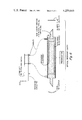
- FIG. 6 is a schematic diagram of the electric discharge laser structure utilized in accordance with the present invention.
- FIG. 1 illustrates the temporal discharge and lasing characteristics, at 48 psi filling pressure and 48 kV charging voltage, of the lasing mixture 0.1% HBr/5% Xe/94.9% He, in a cable-fed discharge device such as disclosed in Rev. Sci. Instrum. 49 772 (1978) and schematically illustrated in FIG. 6.
- XeBr halogen donor
- HBr halogen donor
- metastable xenon (Xe M *) produced by the electric discharge device is capable of producing XeBr* through harpooning collisions, as set forth above, with minimal generation of molecular ions which are produced in prior art e-beam devices and which tend to absorb XeBr laser radiation at 282 nm.
- Undesirable molecular ions are produced spontaneously in prior art e-beam excited lasers since energy pathways proceed downward through the initial formation of atomic and molecular ions by depositing large amounts of energy in the gaseous medium.
- the present invention utilizes electric discharges in which energy pathways proceed upward with minimal formation of molecular ions.
- the particular electric discharge laser structure utilized is a 120 cm active length uv preionized device illustrated in FIG. 6.
- a single capacitor discharge pulse charges an array of 76, 8-ft-long 40/100 cables distributed evenly along the discharge. This device delivers approximately 260 mJ per pulse at 248 nm in KrF.
- the voltage, current and lasing temporal characteristics illustrated in FIG. 1 are produced with 0.08- ⁇ F Capacitor charged to 48 kV.
- the voltage and current characteristics illustrated are similar to other noble-gas monohalide lasers utilizing this device. As shown, the lasing time is 20 ns which is short compared to the onset of instabilities in the discharge.
- the short lasing time is thought to be caused by the formation of transient absorbing species such as HBr + .
- lasing occurs from XeBr at 282 nm at approximately 100 nJ per pulse as well as simultaneous oscillation of Br 2 at 291 nm.
- the lasing and fluorescence spectrum of XeBr are shown in FIG. 2.
- the spectrum appear somewhat smooth with variations due to molecular band absorptions.
- the expanded spectrum at the bottom of FIG. 2 illustrates the simultaneous lasing of Br 2 at 291.3 nm.
- FIG. 3 illustrates lasing energy versus charging voltage for various HBr concentrations with 5% Xe in helium at 45 psia filling pressure. As shown, optimum lasing occurs with 0.1% HBr. Lowering the concentrations to 0.05% HBr results in similar peak enery but lowers the static fill lasing lifetime.
- FIG. 4 illustrates the lasing energy of the present invention versus filling pressure at 48 kV charging voltage for various HBr concentrations. As shown, the HBr absorbs the lasing energy at higher total filling pressures. This effect is especially prevalent for 0.3% HBr concentrations and higher, as shown in FIG. 4.
- FIG. 5 illustrates lasing energy versus the number of shots in a static fill gas for different HBr concentrations.
- the 0.3% HBr curve shows two effects from the disappearance of HBr.
- the initial rise in lasing energy is due to increased absorption from HBr while the subsequent decaying tail is associated with the depletion of the donor molecule.
- the present invention therefore provides a high energy XeBr electric discharge laser which utilizes HBr as a halogen donor.
- a high energy XeBr electric discharge laser which utilizes HBr as a halogen donor.
- Ne can be used in place of He to provide even greater output powers. It is therefore to be understood that within the scope of the appended claims the invention may be practiced otherwise than is specifically described.
Landscapes
- Physics & Mathematics (AREA)
- Electromagnetism (AREA)
- Engineering & Computer Science (AREA)
- Plasma & Fusion (AREA)
- Optics & Photonics (AREA)
- Lasers (AREA)
Abstract
A high energy XeBr laser for producing coherent radiation at 282 nm. The XeBr laser utilizes an electric discharge as the excitation source to minimize formation of molecular ions thereby minimizing absorption of laser radiation by the active medium. Additionally, HBr is used as the halogen donor which undergoes harpooning reactions with XeM * to form XeBr*.
Description
The present invention pertains generally to lasers and more particularly to excimer lasers.
Lasing of the XeBr e-beam excited exciplex has been known to the prior art as disclosed by S. K. Searles and G. A. Hart, Appl. Phys. Letts. 27 243 (1975). Although XeBr lasing as disclosed by Searles and Hart supra was the earliest noble gas monohalide excimer lased, XeBr has never shown any promise of becoming a useful coherent source. In fact, prior art emissions by XeBr e-beam excited lasers have been so close to threshold that measurements of output energy could not be made.
Although now known to the prior art, the use of e-beam excited discharges in prior art XeBr lasers, initially forms a large number of atomic and molecular ions such as Xe2 +, Ar2 +, and Ne2 + which function to absorb the 282 nm laser radiation, thereby impending generation of high energy lasing output. Formation of these atomic and molecular ions is unavoidable in prior art e-beam excited discharges since large amounts of energy are used for the formation of XeBr by dissociating Br2 and ionizing Xe to from free Xe+ and Br- which interact to form XeBr. However, many molecular ions are also initially formed in the active medium which have an absorption spectrum which overlaps 282 nm, resulting in low output lasing energies.
The present invention overcomes the disadvantages and limitations of the prior art by providing a high energy XeBr electric discharge laser using HBr as a halogen donor. According to the present invention, the electric discharge produces xenon metastables which react with the HBr halogen donor to form the XeBr exciplex according to the following harpooning reaction: XeM *+HBr→XeBr*+H. In this manner, formation of molecular ions is minimal so that output lasing energy is greatly increased.
It is therefore an object of the present invention to provide a high energy XeBr electric discharge laser.
It is also an object of the present invention to provide a high energy XeBr electric discharge laser which utilizes HBr as a halogen donor.
Another object of the present invention is to provide a high energy XeBr electric discharge laser which forms a minimal number of molecular ions.
Another object of the present invention is to provide a high energy XeBr electric discharge laser which generates XeBr from harpooning reactions between XeM * and HBr.
Other objects and further scope of applicability of the present invention will become apparent from the detailed description given hereinafter. The detailed description, indicating the preferred embodiment of the invention, is given only by way of illustration since various changes and modifications within the spirit and scope of the invention will become apparent to those skilled in the art from the detailed description. The foregoing Abstract of the Disclosure is for the purpose of providing a nonlegal brief statement to serve as a searching and scanning tool for scientists, engineers and researchers, and is not intended to limit the scope of the invention as disclosed herein, nor is it intended to be used in interpreting or in any way limiting the scope or fair meaning of the appended claims.
FIG. 1 is a graph of the voltage, current and lasing magnitudes of the device of the present invention plotted versus time.
FIG. 2 is a graph of microdensitometer traces of the lasing and fluorescent spectrum of XeBr and the lasing spectrum of Br2.
FIG. 3 illustrates lasing energy versus charging voltage for various concentrations HBr with 5% xenon in a helium mixture.
FIG. 4 is a graph of lasing energy versus filling pressure for various concentrations of HBr with 5% xenon in a helium mixture.
FIG. 5 is a graph of lasing energy versus the number of shots for various concentrations of HBr with 5% xenon in a helium mixture.
FIG. 6 is a schematic diagram of the electric discharge laser structure utilized in accordance with the present invention.
FIG. 1 illustrates the temporal discharge and lasing characteristics, at 48 psi filling pressure and 48 kV charging voltage, of the lasing mixture 0.1% HBr/5% Xe/94.9% He, in a cable-fed discharge device such as disclosed in Rev. Sci. Instrum. 49 772 (1978) and schematically illustrated in FIG. 6.
As with noble gas monochlorides, successful intense lasing of XeBr according to the present invention is based on utilizing the appropriate halogen donor (HBr) and lasing the excimer in an electric discharge where absorption caused by the formation of molecular ions such as Xe2 +, Ar2 +, Ne2 + and He2 + is minimized. Fractions of a percent of HBr in the basically helium gas mix do not degrade the performance of the electric discharge. Consequently, a glow discharge is capable of being sustained for a period of somewhat over 35 ns before the occurrence of streamer and arc formations. Furthermore, the sum of the dissociation energy of HBr (3.25 eV) and the photon energy of XeBr (4.4 eV) is well below the energy of xenon metastables. Consequently, XeBr* can be efficiently formed from the harpooning reaction XeM *+HBr→XeBr*+H. In other words, metastable xenon (XeM *) produced by the electric discharge device is capable of producing XeBr* through harpooning collisions, as set forth above, with minimal generation of molecular ions which are produced in prior art e-beam devices and which tend to absorb XeBr laser radiation at 282 nm. Undesirable molecular ions are produced spontaneously in prior art e-beam excited lasers since energy pathways proceed downward through the initial formation of atomic and molecular ions by depositing large amounts of energy in the gaseous medium. In contrast, the present invention utilizes electric discharges in which energy pathways proceed upward with minimal formation of molecular ions.
The particular electric discharge laser structure utilized is a 120 cm active length uv preionized device illustrated in FIG. 6. A single capacitor discharge pulse charges an array of 76, 8-ft-long 40/100 cables distributed evenly along the discharge. This device delivers approximately 260 mJ per pulse at 248 nm in KrF. The voltage, current and lasing temporal characteristics illustrated in FIG. 1 are produced with 0.08-μF Capacitor charged to 48 kV. The voltage and current characteristics illustrated are similar to other noble-gas monohalide lasers utilizing this device. As shown, the lasing time is 20 ns which is short compared to the onset of instabilities in the discharge. The short lasing time is thought to be caused by the formation of transient absorbing species such as HBr+. In any event, lasing occurs from XeBr at 282 nm at approximately 100 nJ per pulse as well as simultaneous oscillation of Br2 at 291 nm.
The lasing and fluorescence spectrum of XeBr are shown in FIG. 2. The spectrum appear somewhat smooth with variations due to molecular band absorptions. The expanded spectrum at the bottom of FIG. 2 illustrates the simultaneous lasing of Br2 at 291.3 nm.
FIG. 3 illustrates lasing energy versus charging voltage for various HBr concentrations with 5% Xe in helium at 45 psia filling pressure. As shown, optimum lasing occurs with 0.1% HBr. Lowering the concentrations to 0.05% HBr results in similar peak enery but lowers the static fill lasing lifetime.
FIG. 4 illustrates the lasing energy of the present invention versus filling pressure at 48 kV charging voltage for various HBr concentrations. As shown, the HBr absorbs the lasing energy at higher total filling pressures. This effect is especially prevalent for 0.3% HBr concentrations and higher, as shown in FIG. 4.
FIG. 5 illustrates lasing energy versus the number of shots in a static fill gas for different HBr concentrations. The 0.3% HBr curve shows two effects from the disappearance of HBr. The initial rise in lasing energy is due to increased absorption from HBr while the subsequent decaying tail is associated with the depletion of the donor molecule.
The present invention therefore provides a high energy XeBr electric discharge laser which utilizes HBr as a halogen donor. By utilizing an electric discharger system, rather than an e-beam discharge system, formation of molecular ions is minimized since energy pathways proceed upward through the formation of XeM *. XeBr is consequently formed through efficient harpooning reactions. In this manner, high energy outputs are obtained from the XeBr excim er laser of the present invention.
Obviously many modifications and variations of the present invention are possible in light of the above teachings. For example, Ne can be used in place of He to provide even greater output powers. It is therefore to be understood that within the scope of the appended claims the invention may be practiced otherwise than is specifically described.
Claims (12)
1. In an XeBr excimer laser, the improvement comprising:
a XeBr lasing medium including HBr as a bromine donor;
electric discharge means for exciting said lasing medium to minimize the formation of molecular ions such that high output energies are produced by said XeBr excimer laser.
2. The laser of claim 1 wherein said lasing medium comprises:
˜0.1% HBr
˜5% Xe
˜94.9% He
3. The laser of claim 1 wherein said lasing medium comprises:
˜0.1% HBr
˜5% Xe
˜94.9% Ne
4. The laser of claim 1 wherein said electrical discharge means comprises a cable fed discharge system which produces a fast current risetime pulse in said lasing medium.
5. A high energy XrBr noble gas monohalide excimer laser comprising:
an optical resonant cavity;
a XeBr lasing medium containing HBr as a halogen donor, said XeBr lasing medium disposed within said optical resonant cavity;
electrical discharge means for exciting said lasing medium to stimulate laser emission of XeBr and minimize formation of molecular ions in said lasing medium and thereby minimize energy absorption by said lasing medium.
6. The laser of claim 5 wherein said XeBr lasing medium comprises HBr, Xe and He.
7. The laser of claim 5 wherein said XeBr lasing medium comprises HBr, Xe and Ne.
8. The laser of claim 5 wherein said electrical discharge means comprise a cable fed discharge system.
9. A high energy XeBr noble gas mnohalide excimer laser comprising:
an optical resonant cavity delimited by an energy abstracting means,
a XeBr lasing medium containing HBr as a halogen donor, said XeBr lasing medium disposed within said optical resonant cavity;
electrical discharge means for exciting said lasing medium to generate XeM * to form XeBr* according to the reaction: XeM *+HBr→XeBr*+H, wherein M denotes metastable Xenon.
10. The laser of claim 9 wherein said XeBr lasing medium comprises HBr, Xe and He.
11. The laser of claim 9 wherein said XeBr lasing medium comprises HBr, Xe and Ne.
Priority Applications (1)
| Application Number | Priority Date | Filing Date | Title |
|---|---|---|---|
| US06/028,778 US4259645A (en) | 1979-04-10 | 1979-04-10 | High energy XeBr electric discharge laser |
Applications Claiming Priority (1)
| Application Number | Priority Date | Filing Date | Title |
|---|---|---|---|
| US06/028,778 US4259645A (en) | 1979-04-10 | 1979-04-10 | High energy XeBr electric discharge laser |
Publications (1)
| Publication Number | Publication Date |
|---|---|
| US4259645A true US4259645A (en) | 1981-03-31 |
Family
ID=21845361
Family Applications (1)
| Application Number | Title | Priority Date | Filing Date |
|---|---|---|---|
| US06/028,778 Expired - Lifetime US4259645A (en) | 1979-04-10 | 1979-04-10 | High energy XeBr electric discharge laser |
Country Status (1)
| Country | Link |
|---|---|
| US (1) | US4259645A (en) |
Cited By (3)
| Publication number | Priority date | Publication date | Assignee | Title |
|---|---|---|---|---|
| US4317087A (en) * | 1980-03-04 | 1982-02-23 | The United States Of America As Represented By The United States Department Of Energy | Apparatus for improving the working time of the XeBr laser |
| US4674098A (en) * | 1984-05-01 | 1987-06-16 | Robert Turner | Providing of gases for an excimer laser |
| CN106129792A (en) * | 2016-07-15 | 2016-11-16 | 华中科技大学 | The resonant check lateral light pump arrangement of a kind of metastable state gas laser and method |
Citations (1)
| Publication number | Priority date | Publication date | Assignee | Title |
|---|---|---|---|---|
| US3991385A (en) * | 1975-02-03 | 1976-11-09 | Owens-Illinois, Inc. | Gas laser with sputter-resistant cathode |
-
1979
- 1979-04-10 US US06/028,778 patent/US4259645A/en not_active Expired - Lifetime
Patent Citations (1)
| Publication number | Priority date | Publication date | Assignee | Title |
|---|---|---|---|---|
| US3991385A (en) * | 1975-02-03 | 1976-11-09 | Owens-Illinois, Inc. | Gas laser with sputter-resistant cathode |
Non-Patent Citations (9)
| Title |
|---|
| "1/4-J Discharge Pumped KrF Laser" by Sze et al; Rev. Sci. Instrum. 49(6), Jun. 1978. * |
| "High Energy Lasing of XeBr in an Electric Discharge" by Sze et al; Appl. Phys. Lett. 32(8), Apr. 1978. * |
| "Intense Lasing in Discharge Excited Noble-Gas Monochlorides" by Sze et al; Appl. Phys. Lett. 33(5), Sep. 1978. * |
| "KrCl Laser Oscillation at 222 nm" by Murray et al; Appl. Phys. Lett. 29(4), Aug. 1976. * |
| "Observation of Stimulated Emission in KrCl" by Gary Eden et al; Appl. Phys. Lett. 29(6), Sep. 1978. * |
| "Stimulated Emission at 281.8 nm from XeBr" by Searless et al; Appl. PHys. Lett. 27(4), Aug. 1975. * |
| "XeBr Exciplex Laser" by Searless; Appl. Phys. Lett. 28(10), May 1976. * |
| LA-UR-78-2748; "Improved Lasing Performance of XeCl Using Ar and Ne Diluents"; Appl. Phys. Lett. submitted Oct. 1978 by Robert E. Sze. * |
| LA-UR-79-193; "Theoretical Studies of Molecular Electronic Transition Lasers"; Annual Rev. of Phys. Chem. submitted by Hay et al. * |
Cited By (5)
| Publication number | Priority date | Publication date | Assignee | Title |
|---|---|---|---|---|
| US4317087A (en) * | 1980-03-04 | 1982-02-23 | The United States Of America As Represented By The United States Department Of Energy | Apparatus for improving the working time of the XeBr laser |
| US4674098A (en) * | 1984-05-01 | 1987-06-16 | Robert Turner | Providing of gases for an excimer laser |
| CN106129792A (en) * | 2016-07-15 | 2016-11-16 | 华中科技大学 | The resonant check lateral light pump arrangement of a kind of metastable state gas laser and method |
| WO2018010288A1 (en) * | 2016-07-15 | 2018-01-18 | 华中科技大学 | Resonance reinforced transverse optical pumping device and method for metastable gas laser |
| CN106129792B (en) * | 2016-07-15 | 2018-05-22 | 华中科技大学 | The resonant check lateral light pump arrangement and method of a kind of metastable state gas laser |
Similar Documents
| Publication | Publication Date | Title |
|---|---|---|
| Sze | Rare-gas halide avalanche discharge lasers | |
| Boichenko et al. | Exciplex rare-halide lasers | |
| US6501780B2 (en) | Method, system and apparatus for an electrically assisted chemical oxygen iodine laser | |
| Norris et al. | Compact sealed photopreionized TEA CO2 laser without heterogeneous catalysis or gas recycling | |
| US4259645A (en) | High energy XeBr electric discharge laser | |
| US4301425A (en) | XeCl Avalanche discharge laser employing Ar as a diluent | |
| Lomaev et al. | Cylindrical glow-discharge-pumped excimer lamps | |
| US4259646A (en) | High energy KrCl electric discharge laser | |
| Steyer et al. | Parametric study of x-ray preionized high-pressure rare gas halide lasers | |
| US4203078A (en) | Apparatus for and method of operating electron beam attachment stabilized devices for producing controlled discharges and/or visible and UV laser output | |
| Ishchenko et al. | Superradiative rare gas halide lasers excited by electric discharge | |
| Sze et al. | High‐energy lasing of XeBr in an electric discharge | |
| Sturzenegger et al. | Transversely excited double-discharge HCN laser | |
| Kline et al. | Preionized self-sustained laser discharges | |
| Boichenko et al. | On the possibility of pumping Xe2* lasers and VUV lamps in the afterglow of a background-electron multiplication wave | |
| US4606030A (en) | Vacuum ultraviolet laser | |
| Kudryavtsev et al. | Excimer gas-discharge tunable ArF laser | |
| Tarasenko et al. | Ultraviolet and infrared lasers with high efficiency | |
| Shuaibov | Multiwave excimer lamps using XeF/XeCl/KrF/KrCl molecules | |
| Lee et al. | Threshold kinetic processes for t-C4F9I | |
| Efthimiopoulos et al. | Characteristics of an ultraviolet preionized high power nitrogen laser | |
| Fedenev et al. | Simulation of NPL in experiments with e-beam pumping | |
| Apollonov et al. | High-Energy HF (DF) Lasers Based on Non-Chain Chemical Reaction | |
| Luches et al. | Kr2F∗ and Kr∗ 2 radiative lifetime measurements | |
| Marcus et al. | Gain and relaxation studies in transversely excited HF lasers |