US4240905A - High solids mixture aeration method - Google Patents
High solids mixture aeration method Download PDFInfo
- Publication number
- US4240905A US4240905A US06/031,296 US3129679A US4240905A US 4240905 A US4240905 A US 4240905A US 3129679 A US3129679 A US 3129679A US 4240905 A US4240905 A US 4240905A
- Authority
- US
- United States
- Prior art keywords
- bubble
- enclosure
- shearing means
- liquid
- aeration
- Prior art date
- Legal status (The legal status is an assumption and is not a legal conclusion. Google has not performed a legal analysis and makes no representation as to the accuracy of the status listed.)
- Expired - Lifetime
Links
Images


Classifications
-
- C—CHEMISTRY; METALLURGY
- C02—TREATMENT OF WATER, WASTE WATER, SEWAGE, OR SLUDGE
- C02F—TREATMENT OF WATER, WASTE WATER, SEWAGE, OR SLUDGE
- C02F3/00—Biological treatment of water, waste water, or sewage
- C02F3/02—Aerobic processes
- C02F3/12—Activated sludge processes
- C02F3/20—Activated sludge processes using diffusers
- C02F3/205—Moving, e.g. rotary, diffusers; Stationary diffusers with moving, e.g. rotary, distributors
-
- B—PERFORMING OPERATIONS; TRANSPORTING
- B01—PHYSICAL OR CHEMICAL PROCESSES OR APPARATUS IN GENERAL
- B01F—MIXING, e.g. DISSOLVING, EMULSIFYING OR DISPERSING
- B01F23/00—Mixing according to the phases to be mixed, e.g. dispersing or emulsifying
- B01F23/20—Mixing gases with liquids
- B01F23/23—Mixing gases with liquids by introducing gases into liquid media, e.g. for producing aerated liquids
- B01F23/2366—Parts; Accessories
- B01F23/2368—Mixing receptacles, e.g. tanks, vessels or reactors, being completely closed, e.g. hermetically closed
-
- B—PERFORMING OPERATIONS; TRANSPORTING
- B01—PHYSICAL OR CHEMICAL PROCESSES OR APPARATUS IN GENERAL
- B01F—MIXING, e.g. DISSOLVING, EMULSIFYING OR DISPERSING
- B01F23/00—Mixing according to the phases to be mixed, e.g. dispersing or emulsifying
- B01F23/20—Mixing gases with liquids
- B01F23/23—Mixing gases with liquids by introducing gases into liquid media, e.g. for producing aerated liquids
- B01F23/233—Mixing gases with liquids by introducing gases into liquid media, e.g. for producing aerated liquids using driven stirrers with completely immersed stirring elements
-
- B—PERFORMING OPERATIONS; TRANSPORTING
- B01—PHYSICAL OR CHEMICAL PROCESSES OR APPARATUS IN GENERAL
- B01F—MIXING, e.g. DISSOLVING, EMULSIFYING OR DISPERSING
- B01F23/00—Mixing according to the phases to be mixed, e.g. dispersing or emulsifying
- B01F23/20—Mixing gases with liquids
- B01F23/23—Mixing gases with liquids by introducing gases into liquid media, e.g. for producing aerated liquids
- B01F23/233—Mixing gases with liquids by introducing gases into liquid media, e.g. for producing aerated liquids using driven stirrers with completely immersed stirring elements
- B01F23/2331—Mixing gases with liquids by introducing gases into liquid media, e.g. for producing aerated liquids using driven stirrers with completely immersed stirring elements characterised by the introduction of the gas along the axis of the stirrer or along the stirrer elements
-
- B—PERFORMING OPERATIONS; TRANSPORTING
- B01—PHYSICAL OR CHEMICAL PROCESSES OR APPARATUS IN GENERAL
- B01F—MIXING, e.g. DISSOLVING, EMULSIFYING OR DISPERSING
- B01F23/00—Mixing according to the phases to be mixed, e.g. dispersing or emulsifying
- B01F23/20—Mixing gases with liquids
- B01F23/23—Mixing gases with liquids by introducing gases into liquid media, e.g. for producing aerated liquids
- B01F23/233—Mixing gases with liquids by introducing gases into liquid media, e.g. for producing aerated liquids using driven stirrers with completely immersed stirring elements
- B01F23/2331—Mixing gases with liquids by introducing gases into liquid media, e.g. for producing aerated liquids using driven stirrers with completely immersed stirring elements characterised by the introduction of the gas along the axis of the stirrer or along the stirrer elements
- B01F23/23311—Mixing gases with liquids by introducing gases into liquid media, e.g. for producing aerated liquids using driven stirrers with completely immersed stirring elements characterised by the introduction of the gas along the axis of the stirrer or along the stirrer elements through a hollow stirrer axis
-
- B—PERFORMING OPERATIONS; TRANSPORTING
- B01—PHYSICAL OR CHEMICAL PROCESSES OR APPARATUS IN GENERAL
- B01F—MIXING, e.g. DISSOLVING, EMULSIFYING OR DISPERSING
- B01F23/00—Mixing according to the phases to be mixed, e.g. dispersing or emulsifying
- B01F23/20—Mixing gases with liquids
- B01F23/23—Mixing gases with liquids by introducing gases into liquid media, e.g. for producing aerated liquids
- B01F23/233—Mixing gases with liquids by introducing gases into liquid media, e.g. for producing aerated liquids using driven stirrers with completely immersed stirring elements
- B01F23/2331—Mixing gases with liquids by introducing gases into liquid media, e.g. for producing aerated liquids using driven stirrers with completely immersed stirring elements characterised by the introduction of the gas along the axis of the stirrer or along the stirrer elements
- B01F23/23313—Mixing gases with liquids by introducing gases into liquid media, e.g. for producing aerated liquids using driven stirrers with completely immersed stirring elements characterised by the introduction of the gas along the axis of the stirrer or along the stirrer elements through a separate conduit substantially parallel with the stirrer axis
-
- B—PERFORMING OPERATIONS; TRANSPORTING
- B01—PHYSICAL OR CHEMICAL PROCESSES OR APPARATUS IN GENERAL
- B01F—MIXING, e.g. DISSOLVING, EMULSIFYING OR DISPERSING
- B01F23/00—Mixing according to the phases to be mixed, e.g. dispersing or emulsifying
- B01F23/20—Mixing gases with liquids
- B01F23/23—Mixing gases with liquids by introducing gases into liquid media, e.g. for producing aerated liquids
- B01F23/233—Mixing gases with liquids by introducing gases into liquid media, e.g. for producing aerated liquids using driven stirrers with completely immersed stirring elements
- B01F23/2331—Mixing gases with liquids by introducing gases into liquid media, e.g. for producing aerated liquids using driven stirrers with completely immersed stirring elements characterised by the introduction of the gas along the axis of the stirrer or along the stirrer elements
- B01F23/23314—Mixing gases with liquids by introducing gases into liquid media, e.g. for producing aerated liquids using driven stirrers with completely immersed stirring elements characterised by the introduction of the gas along the axis of the stirrer or along the stirrer elements through a hollow stirrer element
-
- B—PERFORMING OPERATIONS; TRANSPORTING
- B01—PHYSICAL OR CHEMICAL PROCESSES OR APPARATUS IN GENERAL
- B01F—MIXING, e.g. DISSOLVING, EMULSIFYING OR DISPERSING
- B01F23/00—Mixing according to the phases to be mixed, e.g. dispersing or emulsifying
- B01F23/20—Mixing gases with liquids
- B01F23/23—Mixing gases with liquids by introducing gases into liquid media, e.g. for producing aerated liquids
- B01F23/233—Mixing gases with liquids by introducing gases into liquid media, e.g. for producing aerated liquids using driven stirrers with completely immersed stirring elements
- B01F23/2336—Mixing gases with liquids by introducing gases into liquid media, e.g. for producing aerated liquids using driven stirrers with completely immersed stirring elements characterised by the location of the place of introduction of the gas relative to the stirrer
- B01F23/23362—Mixing gases with liquids by introducing gases into liquid media, e.g. for producing aerated liquids using driven stirrers with completely immersed stirring elements characterised by the location of the place of introduction of the gas relative to the stirrer the gas being introduced under the stirrer
-
- B—PERFORMING OPERATIONS; TRANSPORTING
- B01—PHYSICAL OR CHEMICAL PROCESSES OR APPARATUS IN GENERAL
- B01F—MIXING, e.g. DISSOLVING, EMULSIFYING OR DISPERSING
- B01F27/00—Mixers with rotary stirring devices in fixed receptacles; Kneaders
- B01F27/05—Stirrers
- B01F27/11—Stirrers characterised by the configuration of the stirrers
- B01F27/19—Stirrers with two or more mixing elements mounted in sequence on the same axis
- B01F27/191—Stirrers with two or more mixing elements mounted in sequence on the same axis with similar elements
-
- B—PERFORMING OPERATIONS; TRANSPORTING
- B01—PHYSICAL OR CHEMICAL PROCESSES OR APPARATUS IN GENERAL
- B01F—MIXING, e.g. DISSOLVING, EMULSIFYING OR DISPERSING
- B01F27/00—Mixers with rotary stirring devices in fixed receptacles; Kneaders
- B01F27/05—Stirrers
- B01F27/11—Stirrers characterised by the configuration of the stirrers
- B01F27/19—Stirrers with two or more mixing elements mounted in sequence on the same axis
- B01F27/192—Stirrers with two or more mixing elements mounted in sequence on the same axis with dissimilar elements
-
- Y—GENERAL TAGGING OF NEW TECHNOLOGICAL DEVELOPMENTS; GENERAL TAGGING OF CROSS-SECTIONAL TECHNOLOGIES SPANNING OVER SEVERAL SECTIONS OF THE IPC; TECHNICAL SUBJECTS COVERED BY FORMER USPC CROSS-REFERENCE ART COLLECTIONS [XRACs] AND DIGESTS
- Y02—TECHNOLOGIES OR APPLICATIONS FOR MITIGATION OR ADAPTATION AGAINST CLIMATE CHANGE
- Y02W—CLIMATE CHANGE MITIGATION TECHNOLOGIES RELATED TO WASTEWATER TREATMENT OR WASTE MANAGEMENT
- Y02W10/00—Technologies for wastewater treatment
- Y02W10/10—Biological treatment of water, waste water, or sewage
-
- Y—GENERAL TAGGING OF NEW TECHNOLOGICAL DEVELOPMENTS; GENERAL TAGGING OF CROSS-SECTIONAL TECHNOLOGIES SPANNING OVER SEVERAL SECTIONS OF THE IPC; TECHNICAL SUBJECTS COVERED BY FORMER USPC CROSS-REFERENCE ART COLLECTIONS [XRACs] AND DIGESTS
- Y10—TECHNICAL SUBJECTS COVERED BY FORMER USPC
- Y10S—TECHNICAL SUBJECTS COVERED BY FORMER USPC CROSS-REFERENCE ART COLLECTIONS [XRACs] AND DIGESTS
- Y10S261/00—Gas and liquid contact apparatus
- Y10S261/27—Gas circulated in circuit
Definitions
- the prior art methods for effecting mass transfer of a relatively small quantity of gas into a relatively large volume of liquid via bulk liquid agitation inevitably involves the irreversible and therefore inefficient conversion of mechanical energy to heat energy through viscous dissipation.
- the magnitude of the viscous dissipation loss is related to the viscosity of the liquid. If viscosity is low, then the viscous dissipation component is small. This condition is common to most wastewater treatment systems where total solids concentrations are low in the influent wastewater, e.g., 0.01 weight %, and the viscosity of the liquid-solid mixture is similar to that of water alone.
- One object of the present invention is to provide an aeration method for pseudoplastic liquid-solid mixtures which promotes gas dissolution by essentially a single stage cascade.
- Another object of this invention is to provide such an aeration method characterized by substantially lower power densities than heretofore achieved in such mixtures.
- Still another object of this invention is to provide such an aeration method which can be practiced with inexpensive yet reliable equipment.
- a still further object of this invention is to provide an aeration method useful in aerobic digestion of pseudoplastic wastewater sludge which promotes a high degree of gas dissolution at relatively low power densities.
- the invention relates to a method for the aeration of a high solids concentration pseudoplastic liquid-solid mixture such as wastewater sludge.
- a simplified force balance on a gas bubble rising in a Newtonian fluid indicates that the rise rate is directly related to bubble size and is inversely related to the fluid viscosity.
- the combination of small bubbles and high viscosity will gereatly increase the bubble residence time.
- An increase in bubble residence time has a positive effect on the mass transfer rate.
- simple diffusing of small gas bubbles in a well-known manner may provide adequate mass transfer performance.
- a high solids concentration fluid such as wastewater sludge, is a non-Newtonian pseudoplastic material.
- the phrase "pseudoplastic material” refers to those materials in which the viscosity varies inversely with the rate of shear, as for example, discussed in Transport Phenomenon, Bird, Stewart and Lightfoot, John Wiley & Sons, Inc, 1960, pp 11-13.
- the bubbles tend to effectively form a set of "tunnels" of an effectively lower viscosity through the mixture.
- the rate of bubble coalescence increases, increasing the bubble size which together with the lower effective viscosity significantly reduces the bubble residence time and the mass transfer rate.
- Bubbles injected into the enclosure bottom are repeatedly sheared at spaced intervals as they rise in the enclosure thereby preventing the formation of the low viscosity "tunnels.”
- the average bubble size remains low and the effecitve viscosity high, yielding higher mass transfer rates. All this is achieved with substantially no power penalty arising from the viscous nature of the fluid since the bubble shearing means are designed solely to shear bubbles while avoiding both axial and radial pumping.
- this invention provides a method for continuously aerating a high solids concentration pseudoplastic liquid-solid mixture having a total solids concentration of at least 2.5 weight % comprising the steps of (a) providing a sludge aeration enclosure having an equivalent height H to equivalent diameter D ratio H/D between 0.5 and 5.0; (b) providing within said enclosure: (i) at least one vertical rotatable shaft having at least two bubble shearing means connected thereto each with at least two symmetrically disposed outwardly extending arms forming a bubble shear assembly having a maximum equivalent arm length r; (ii) each bubble shearing means with an equivalent arm frontal width W such that the W/r ratio is less than 0.1; (iii) having a system maximum equivalent arm length R, such that the system maximum equivalent arm length R is at least 25% of the enclosure equivalent diameter D, and (iv) said bubble shearing means being vertically spaced from each other on said vertical rotatable shaft such that the ratio of the equivalent arm frontal width W to shea
- enclosure equivalent diameter D is determined in accordance with the following equation (1) where A equals the enclosure arithmetic average cross-sectional area (from top to bottom) and N equals the number of bubble shear assemblies in the enclosure. ##EQU1##
- equivalent height H refers to the arithmetic average liquid-solid mixture depth in the enclosure.
- the "maximum equivalent arm length", r of the bubble shear assembly refers to the arithmetic average length of the longest "two outwardly extending arms" (in the transverse direction of the enclosure) on a bubble shear assembly where the arms of different bubble shearing means may be of varying length.
- the "equivalent arm frontal width" W refers to the arithmetic average frontal width of each arm on each bubble shearing means.
- the "system maximum equivalent arm length" R is determined in accordance with the following equation (2) where the numerator equals the sum of the squares of the maximum equivalent arm length r for each shear assembly in the enclosure, and the denominator, N is again the number of bubble shear assemblies in the enclosure ##EQU2## For example, if the aeration assembly has three bubble shearing means each with outwardly extending arms of different lengths, the maximum equivalent arm length r is based on the arithmetic average length of the two bubble shearing means with the longest arms in the tranverse direction perpendicular to the rotating shaft axis.
- the rotating arms of a particular shear assembly will be of the same length, so that the transverse distance between the outer tips of each arm is 2R, and at least 50% of the enclosure equivalent diameter D. If however the arms of a particular bubble shear assembly are of different lengths, the maximum equivalent arm length r is the arithmetic average length for the two arms of such bubble shear assembly having the longest lengths in the transverse direction perpendicular to the rotating shaft axis.
- This invention may also be practiced in enclosures with multiple vertical shaft-bubble shear assemblies positioned within the enclosure at different locations in the transverse locations. This may be desirable if the enclosure is too large to insure adequate aeration with only one shear assembly, or it may be preferred to use two or more smaller shear assemblies instead of a single large shear assembly. In this instance, each shear assembly must have at least two symmetrically disposed outwardly extending arms, with a maximum equivalent arm length r such that the system maximum equivalent arm length R is at least 25% of the enclosure equivalent diameter D.
- the maximum equivalent arm length R for the system is once again determined by equation (2) and the enclosure equivalent diameter D is determined by equation (1).
- the system maximum equivalent arm length R must be at least 25% of the enclosure equivalent diameter D.
- the equivalent height H to equivalent diameter D ratio H/D must be between 0.5 and 5.0.
- the ratio of the equivalent frontal width W of each bubble shearing means on a bubble shearing assembly to the maximum equivalent arm length r of each bubble shear assembly W/r must be below 0.1.
- This embodiment differs from the embodiment where only a single shear assembly is used in a given enclosure. In that embodiment, the maximum equivalent arm length r is identical to the system maximum equivalent arm length R.
- FIG. 1 is a block diagram showing the operating characteristics of prior art aeration devices and devices according to the method of this invention.
- FIG. 2 is a schematic drawing of apparatus including a rotatable gas sparger which may be operated in accordance with this invention.
- FIG. 3 is a schematic isometric drawing of different apparatus including a stationary gas diffuser ring which may be used to practice the invention.
- FIGS. 4a, 4b and 4c are detailed schematic drawings of three types of bubble shearing means suitable for practicing this invention.
- FIGS. 5a and 5b schematic cross-section drawings taken in elevational and plan views, respectively, of gas aeration apparatus particularly suitable for practicing the invention in enclosures having relatively large height to diameter H/D ratios.
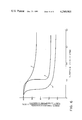
- FIG. 6 is a graph showing power consumption as a function of superficial velocity for a prior art marine propeller and the aeration method of this invention.
- a sludge aeration enclosure comprising floor 20, sidewalls 21 and 22, a back wall 23, and an unillustrated front wall.
- Other enclosure shapes such as circular sidewalls may be employed.
- one or more of the walls may be earthen.
- the enclosure is filled with pseudoplastic liquid-solid mixture such as wastewater sludge having a total solids concentration of at least 2.5 weight %.
- the equivalent height H to equivalent diameter D ratio H/D of the enclosure must be between 0.5 and 5.0. Preferably this ratio is in the range of 1.0 to 3.0.
- the sparging assembly may be a conventional rotating sparger well known in the art as for example described in McWhirter et al. U.S. Pat. No. 3,775,307, consisting of radially extending hollow sparging arms 27 provided with gas openings.
- the rotating sparger 25 satisfies the dimensional requirements of the bubble shearing means required to practice this invention, and constitutes one such means in addition to its function as the aeration gas bubble injection means.
- the shaft member 24 is hollow and the gas is introduced through gas conduit 28 to member 24 by means of rotating union 29. The other end of union 29 is connected to motor 30 through gear reducing means 31.
- Foam breaker 32 is preferably positioned on shaft 24, and may for example be a pitched-blade turbine of well-known construction. It has been observed that in the practice of this method that there is a tendency to form a relatively stable foam 33. Foam breaker 32 serves to prevent the growth of this foam to a level that may create a nuisance.
- first bubble shearing means 35 Spaced upwardly from the gas sparging assembly 25 is a first bubble shearing means 35 attached to shaft 24 through hub 36.
- the shearing means has eight symmetrically disposed outwardly extending arms 37. Since rotating sparger 25 functions as the second of the at least two bubble shearing means in this particular embodiment, it is included in the calculation of the value for the maximum equivalent arm length r, and accordingly, the value of the system maximum equivalent arm length R which must satisfy the relationship, R ⁇ 0.25 D.
- Shear arms 27 and 37 are designed with frontal width W such that the ratio of W to shearing means vertical spacing S is between 0.005 and 0.04.
- the ratio of the shear arm frontal width W to the maximum equivalent arm length r is preferably made as small as is practically and structurally possible, e.g., less than 0.02, so that arms 27 and 37 are preferably long and thin. It will be apparent that as the size of the enclosure and accordingly the diameter of the bubble shearing means increase, the absolute frontal width W must typically be increased to maintain structural integrity. At present the design upper limit on tank enclosure diameters for aerobic sludge digestion in the single enclosure design is 15 feet.
- This value is based on the estimated zone of influence of a 12 foot diameter bubble shearing means, which is believed to be about the largest size which will be within the preferred W/r ratio and still be structurally sound.
- the absolute magnitude of the equivalent arm frontal width, W is also low, i.e., below about 1.5 inches, to minimize the amount of fluid pumping unavoidably performed by the rotating arms.
- Shear arms 27 and 37 are preferably gently curved away from the direction of rotation to further minimize liquid pumping and to prevent stringy material such as wire or rags from clinging to the arm shearing face. Such materials would greatly increase the form drag and accordingly the power draw.
- Rotation of shaft 24 at a relatively high tip speed causes arms 27 and 37 to shear by direct impingement the coarse gas bubbles rising from the sparging assemblies into very fine bubbles. These bubbles then continue to rise substantially freely to the liquid surface 38.
- shear arms 27 and 37 generate very small eddy currents of a size similar in magnitude to the size of the rising gas bubble. These eddy currents also shear the rising gas bubbles. Such action results in a very high degree of mass transfer.
- gas is injected through a stationary diffuser ring 140 adjacent floor 120.
- the diffuser may for example consist of a porous ceramic body (as illustrated) or alternatively could be a donut-shaped pipe with spaced holes.
- Gas is admitted to diffuser 140 through conduit 141.
- cover 142 is provided over the gas space 143 above liquid level 138, as it will be assumed that the aeration gas is high purity oxygen and it is desirable to recover unconsumed aeration gas for recirculation. This may be accomplished by overhead conduit 144 and gas recirculation compressor 145.
- fresh aeration gas may be introduced to conduit 141 through conduit 146 and valve 147 therein. Spent gas is vented from gas space 143 through conduit 148 and valve 149 therein, spaced from recirculation conduit 144.
- bubble shearing means 135a and 135b are attached to shaft 124.
- the shearing means vertical spacing S and the shearing arm frontal width W are dimensioned such that the ratio W/S is between 0.005 and 0.04 for reasons previously discussed.
- bubble shearing means 135a and 135b each have four symmetrically disposed arms 137a and 137b. Selection of the number and dimensions of such arms is well understood by those skilled in the art, and in its broadest aspect this invention requires only two such arms for each shearing means.
- the shaft 124 is also fitted with a pitched blade turbine 132, which functions similar to the foam breaker 32 means of the FIG. 2 apparatus.
- turbine 132 differs somewhat in that it is located at a level corresponding to fluid surface 138 rather than being suspended thereabove.
- the device is designed to minimize the amount of bulk convective mixing in accordance with the objectives of this invention. Nonetheless, the device operates in a well-known manner, throwing coarse droplets of liquid radially outwardly from the axis of shaft 124 thereby preventing the formation of a stable foam.
- FIG. 4 illustrates in greater detail, several types of bubble shearing means 235 suitable for practicing the invention.
- thin circular rods 237a comprise the outwardly extending arms.
- arm equivalent frontal width W is the diameter of rods 237a.
- FIG. 4b illustrates long thin flat blades 237b as the outwardly extending arms of bubble shearing means 235b, similar to the construction illustrated in FIGS. 2 and 3.
- FIG. 4c illustrates a thin perforated plate 235c as the bubble shearing means, with fan-shaped blades 237c joined by webs 250 as the outwardly extending arms.
- FIG. 5a and 5b illustrate apparatus particularly suited for practicing the invention when the height to width ratio of the enclosure is relatively high, and/or the viscosity of the pseudoplastic liquid-solid mixture being aerated is relatively high.
- the aeration gas is introduced to the apparatus through rotating shaft 324 and discharged into the lower end of the enclosure through four arm rotating sparger 354 positioned above end 353.
- Four bubble shearing means 335a through 335d are equally longitudinally spaced and attached to shaft 324.
- Each bubble shearing means has two long thin arms extending outwardly and spaced 180 degrees apart. The arms on longitudinally adjacent bubble shearing means are positioned 90 degrees out-of-phase.
- Antiswirl baffles 355 are attached to the inner wall of the enclosure in transversely spaced relation to each other and extending radially inwardly.
- the bubbles rising from the enclosure lower end are repeatedly sheared into minute bubbles as they enter the zones of influence for shearing means 354, 335a, 335b, 335c and 335d.
- a single shearing arm rotating at a constant speed will: do a certain amount of pumping, draw a given amount of power, generate a certain amount of turbulence, shear a given quantity of gas bubbles and ultimately provide a certain amount of mass transfer.
- the addition of another shearing arm to a bubble shearing means will generally increase each of these effects.
- the viscosity of the pseudoplastic liquid-solid mixture to be aerated will influence the number of shearing arms to be used in any bubble shearing means.
- shearing intensity the rotational speed of the bubble shearing means
- the bubble rise velocity although a function of the gassing rate and gassing area, is also a function of the mixture viscosity. As the viscosity of the mixture increases the form drag on the rising gas bubbles increases, tending to reduce the bubble rise velocity.
- the power required to rotate a shearing arm is a direct function of the form drag produced by moving the shearing arm through the mixture.
- the magnitude of this form drag is also influenced by the viscosity of the mixture. Accordingly, for a given power it is possible to rotate a given bubble shearing means at a higher rotational speed in a less viscous mixture than in a more viscous mixture. Conversely, to achieve a similar power drag at a given rotational speed, the bubble shearing means for the more viscous mixture must have fewer shearing arms than the bubble shearing means for the less viscous mixture.
- the practitioner also has the option of employing additional shearing arms in the form of multiple bubble shearing means, rather than by just increasing the number of shearing arms on a bubble shearing means.
- additional shearing arms are normally better utilized by adding them in the form of additional bubble shearing means rather than by using more outwardly extending arms on existing bubble shearing means. It is not presently known exactly how one might optimize the configuration for a given aeration enclosure with respect to the number and design of the bubble shearing means. It is, however, speculated that optimization will be primarily a function of the enclosure depth.
- H the equivalent height (average fluid mixture depth) in the aeration enclosure and D equals the aeration enclosure equivalent diameter.
- D the aeration enclosure equivalent diameter
- the practitioner also has the option of employing multiple bubble shear assemblies in a given enclosure. This option becomes important when the required treatment volume becomes so large as to require multiple single enclosure designs for adequate treatment. Use of a single tank with multiple shear assemblies may have a large economic advantage relative to multiple single enclosures.
- the power drawn by moving the outwardly extending arms of a particular bubble shearing means through a fluid mixture is due primarily to form drag. This is especially true of rods and blades. It has previously been indicated that the magnitude of this power draw and therefore the magnitude of the drag is directly related to the W/r ratio of the bubble shearing assembly.
- a high W/r ratio indicates a high form drag and a high power draw for the shear assembly.
- a low W/r ratio as required by this invention provides a low form drag and a low power draw.
- Prior art paddle or blade aeration systems would nominally be designed at a W/r ratio of about 0.30 to 0.40 whereas the W/r ratio for this invention is below 0.1 and preferably below 0.02. This invention provides a high degree of gas dissolution at relatively low power densities below 1.5 SHP/1000 U.S. gallon capacity of the enclosure.
- the equivalent H/D ratio of between 0.5 and 5.0 represents an optimal range which balances the competing elements of economics and mass transfer rate.
- the enclosure provides an augmentation in mass transfer due to an increase in the average bubble retention time.
- an enclosure volume of 50,000 gal. is required. If this volume is provided in a single tank having an H/D ratio of about 1.75, the tank would have a diameter of 16.9 ft.
- a tank having an H/D of about 1.0 would have an enclosure height of 20.4 ft.; while with an H/D ratio of 0.25, the enclosure height would be reduced to 8.1 ft.
- This change also disadvantageously increases the surface area occupied by the enclosure.
- the equivalent H/D is maintained in the range of 1.0 to 3.0.
- the 25% lower limit on the system maximum equivalent arm length of the bubble shearing assembly as a function of enclosure equivalent diameter represents the minimum fluid-gas contacting area believed necessary to provide sufficient treatment in a given enclosure. With a system maximum equivalent arm length below about 25% of the enclosure equivalent diameter, there would be less than 25% volume utilizaton of the aeration enclosure. Preferably there is at least 50% volume utilization, which requires a system equivalent arm length R of at least 35% of the enclosure equivalent width D.
- the W/r ratio of each bubble shearing means is a major determinant of the amount of convective mixing caused by rotation of the high shear means. Since this invention seeks to avoid all convective mixing, this ratio is made as small as is structurally possible; but in any event is below about 0.10. High values for the W/r ratio results in a significant amount of radial and/or axial pumping, which in a high viscosity fluid causes an excessive power loss due to viscous dissipation. In addition to the power loss, the form drag of the bubble shearing means is also increased at larger values of W/r. The larger the form drag, the larger is the overall power requirement. Preferably, the W/r ratio is maintained below about 0.02.
- the W/S ratio is between 0.005 and 0.04.
- a value for the W/S ratio above 0.04 indicates that the bubble shearing means are spaced too closely together. The closer the spacing between adjacent bubble shearing means, the greater the hydraulic interaction between the adjacent shear arms becomes. This increases the convective effects during operation and leads to higher viscous dissipative losses. The effect is similar to that caused by increasing the W/r ratio. An excessively high value of W/S also leads to unnecessary power wastage.
- the function of the bubble shearing means is to insure that bubbles are resheared into minute bubbles before bubble coalescense and bubble tunneling dominates.
- the rising gas bubbles are resheared more than is necessary to augment the enhancement gained in a highly viscous, pseudoplastic fluid by repeatedly reducing bubble size.
- the W/S ratio is too low, then the tunneling and bubble coalescence effects begin to dominate and the contacting efficiency decreases.
- a preferred range for the W/S ratio is between 0.009 and 0.025.
- the power density is limited to below about 1.50 SHP/1000 U.S. gallon capacity of the enclosure. Values above this level merely increase the quantity of power which is used without significantly increasing gas utilization. At the lower end, the power density must be sufficient to rotate the shaft to perform the shearing function and transform the aeration method from essentially gas diffusion. Typically, the power density will be above about 0.10 SHP/1000 U.S. gallon capacity of the enclosure.
- the prior art has typically relied upon a two-step energy cascade for mass transfer in which a bulk wise mixing of the fluid makes dissolved gas available to the whole fluid mass.
- the prior art discloses two ways in which bulkwise fluid convection accomplishes this result.
- the convective currents may carry injected gas bubbles into the bulk of the fluid whereupon the gradual decay of these currents into small eddy currents does work on the gas bubbles resulting in mass transfer.
- the convective currents may carry previously dissolved gas, produced for example by a highly localized shearing action, into the bulk of the fluid.
- Each approach inherently suffers from the inefficiency introduced by viscous dissipation.
- this invention preferably avoids any appreciable amount of liquid pumping or convective mixing to insure that the gas is brought into intimate contact with the entire fluid content of the enclosure, initially introducing the gas bubbles over a radial distance less than 40% of the maximum equivalent arm length would result in an inadequate level or degree of aeration at any reasonable expenditure of power.
- the gas bubbles are introduced over a radial distance which is at least 75% of the maximum equivalent arm length r.
- the bubble shearing means be provided with shearing arms that sweep an area at least equivalent to the gas injection area.
- test vessel was a 38.5 inch deep cylindrical tank with a 22 inch inside diameter and a sloped floor.
- the gas injection means comprised a 12 inch diameter two-arm rotating sparger fitted on the end of a hollow shaft with a 0.25 inch equivalent arm frontal width W.
- the sparging assembly was located near the floor of the test vessel, and also served as a lower bubble shearing means. Spaced 12 inches above the sparger-lower bubble shearing means and fitted onto the same shaft was the upper bubble shearing means. The latter had four 8 inch radially extending arms spaced 90° from one another each having a frontal width of 0.125 inches.
- each shearing arm was curved away from the direction of rotation of the shaft to further minimize liquid pumping and collection of debris.
- the aeration assembly was also fitted with a 7 inch diameter pitched blade turbine (PBT) surface aeration device as a foam breaker.
- the PBT had a 45° pitch and a 1 inch frontal width and the bottom of the PBT was spaced 15 inches above the upper bubble shearing means.
- the liquid level was located just below the PBT (zero submergence).
- the vessel was also fitted with four 3 inch wide baffles spaced 90° apart extending from just above the liquid level in the vessel to just above the rotating sparger. The outermost edge of the baffles were located approximate the outer extent of the shear arms.
- the rotational speed was 375 RPM.
- a conventional submerged aeration system was also tested in tap water and 2 weight % solids activated sludge in the same vessel.
- This system was not fitted with a surface aeration device and consisted solely of a 6 inch diameter two-arm sparger located 28 inches below the liquid level and a 6 inch diameter marine propeller located 4.5 inches above the sparger.
- the marine propeller discharged axially downwardly onto the two-arm sparger.
- the rotational speed was 400 RPM, and data on power consumption was collected.
- FIG. 6 is a graph showing the performance of the conventional system in 2 weight % solids activated sludge (curve A) and tap water (curve B), while curve C shows the FIG. 2 system in tap water.
- the ratio of power consumption in the gassed mode to the power consumption in the ungassed mode is plotted as a function of superficial velocity of the aeration gas (feet per minute).
- Curve C data shows that the FIG. 2 system is essentially insensitive to the superficial velocity. There is a minor decrease in the power ratio at higher superficial velocities, but this can be attributed more to a change in the density of the gas-liquid mixture than to the phenomenon of flooding.
- Flooding is that phenomenon whereby the impeller becomes surrounded by a stationary gas envelope and the power drawn by the shaft drops abruptly.
- mass transfer also drops abruptly.
- the tap water data in curve B for the prior art system it became flooded in tap water at a gassing rate in the region of 0.2 fpm. In fact, there is over a 20% difference in the power ratio at the higher superficial velocities between the FIG. 2 system and the prior art system operating in tap water.
- FIG. 6 also shows by comparison of curves A and B that the prior art system operates substantially less efficiently (in terms of power consumption) when used for aeration of a 2weight % liquid-solids mixture as compared with tap water.
- FIG. 2 system was not operated with a liquid-solids mixture in accordance with this invention, other tests have shown that the power consumption of the present aeration method is less affected by increasing superficial velocity. Stated otherwise, flooding occurs at substantially higher superficial velocities in the practice of this invention as compared with the prior art. Accordingly, one may transfer the oxygen necessary to satisfy a broader range of oxygen uptake rates without exhibiting a serious decrease in operating efficiency.
- FIG. 2 type apparatus described in Example 1 was used in experiments for practice of this invention to continuously aerate activated sludge derived from wastewater.
- Table A summarizes the key parameters of the system:
- thermophilic digestion achieves more complete removal of biodegradable volatile suspended solids (VSS) than the same period of digestion at ambient temperature. A more stable residue is obtained which can be disposed of without nuisance. It is reported that thermophilic digestion effectively kills or eliminates pathogenic bacertia in the sludge, thereby avoiding a potential health hazard associated with its disposal.
- the biochemical reaction of wastewater aerobic digestion is exothermic.
- the temperature of the feed sludge increased substantially during digestion, i.e., from 13.5°-24.0° C. to 53.5°-60.0° C. during digestion. This indicates that the method was extremely effective in terms of uniformly distributing the oxygen aeration gas through the liquid-solid mixture, so that the exothermic reaction was able to proceed rapidly and heat the mixture to the desired thermophilic range.
- Example 2 Prior to the Example 2 experiment the same digestion enclosure was used with the submerged marine propeller system described in Example 1, for wastewater aerobic digestion with 99% oxygen (by volume). Gas power consumption data from experiments of this general type are included in Cruve A of FIG. 6. Operating data from these experiments was as follows:
- the first test was conducted at a lower solids concentration and a longer retention time relative to the second period. However, the difference in the retention time is relatively minor so that within experimental variance one can assume that the data was collected at the same average retention time. It should be noted that the results of the first testing period, as based on the percent volatile solids reduction, are better than those achieved in the second testing period at the higher solids concentration, i.e., the system performed better at the lower solids concentrations. This result is due to the flooding characteristics of the marine propeller system.
- the power ratio curve for the prior art system at 2 weight % solids shows that the device floods at a superficial velocity of approximately 0.09 fpm. If the superficial velocity must be above 0.09 fpm in order to supply the required oxygen for the biological process at the 2% solids concentration, then the system would operate in the flooded regime and the operating efficiency of the aeration method would degrade. Since the oxygen uptake rate of a wastewater sludge will increase at increasing solids concentrations thereby requiring higher gassing rates, the physical limitations of the aeration device and the biological requirements of the wastewater sludge are conflicting.
- Table D summarizes wastewater aerobic digestion operating data with 99% oxygen gas and the same test vessel as previously described for five different periods; A and B are with the Example 1 marine propeller submerged system and period C, D and E are with the Example 1 high shear system of this invention.
- Period A has a long retention time relative to the subsequent testing phases. To a large degree this accounts for the higher volatile solids reduction, but one should note the relatively low solids concentration employed in the digester during this testing phase.
- the digester's solids concentration was maintained at an average of 2.20 weight %. Higher solids concentrations were not possible because of the onset of flooding that accompanied the gassing rates required to satisfy the oxygen uptake rates of the sludge under digestion.
- the submerged marine propeller system operates continuously in a flooded regime. For this reason, the submerged marine propeller system must be operated at the lower solids concentrations.
- Table D shows that during periods C, D and E with practice of this invention, the system operated effectively at solids concentrations in excess of 2.5 weight %. In each of these periods the digester temperature was easily maintained above 50° C.
- the method of this invention has particular utility in the aeration of high solids concentration wastewater sludges.
- Such sludges not only have high apparent viscosities, but also exhibit pseudoplastic behavior.
- the invention has utility in the aeration of any high solids concentration pseudoplastic liquid-solid mixture.
- Such mixtures cannot be efficiently aerated by typical prior art methods, but are uniquely suited to the method of this invention.
- the high solids concentration pseudoplastic liquid-solid mixture is maintained in the aeration enclosure for the necessary duration to provide the required level of treatment.
- the method is being used for the thermophilic aerobic digestion of a wastewater sludge using an enriched oxygen gas, then depending upon the desired degree of treatment, retention times between 4 hours and 10 days are typical. Nonetheless, in certain other uses, as for example paper pulp treatment, for which this invention has potential utility, the mixture retention time must typically be greater than about 15 minutes to insure proper treatment.
Landscapes
- Chemical & Material Sciences (AREA)
- Chemical Kinetics & Catalysis (AREA)
- Life Sciences & Earth Sciences (AREA)
- Biodiversity & Conservation Biology (AREA)
- Microbiology (AREA)
- Hydrology & Water Resources (AREA)
- Engineering & Computer Science (AREA)
- Environmental & Geological Engineering (AREA)
- Water Supply & Treatment (AREA)
- Organic Chemistry (AREA)
- Aeration Devices For Treatment Of Activated Polluted Sludge (AREA)
- Mixers Of The Rotary Stirring Type (AREA)
- Treatment Of Sludge (AREA)
- Agricultural Chemicals And Associated Chemicals (AREA)
- Detergent Compositions (AREA)
Abstract
Description
H/D≦B≦H/D+3 (3)
              Table A
______________________________________
Equivalent height H/diameter D
                   = 2.406
Arm frontal width W/maximum
                   = 0.036 for sparger-
equivalent arm length r
                    lower bubble shearing
                    means
Arm frontal width W/maximum
                   = 0.018 for upper bubble
equivalent arm length r
                    shearing means
Arm frontal width W/shearing
                   = 0.0104
means spacing S
System maximum equivalent arm
length R/enclosure equivalent
                   = 0.32
diameter D
Outermost bubble injection
                   = 86% of maximum
location radius     equivalent arm
                    length r
______________________________________
              Table B
______________________________________
Sludge Feed Characteristics
Total Solids %        3.04-3.51
Volatile Solids (%)   2.34-3.36
Temperature (°C.)
                      13.5-24.0
Digester Characteristics
Total Solids (%)      2.42-3.51
Temperature (°C.)
                      53.5-60.0
Retention Time (Days) 1.7-3.7
Volatile Solids Reduction (%)
                      16.4-32.6
Shaft Power Density
(SHP/1000 U.S. Gallon)
                      0.50-2.52
______________________________________
              Table C
______________________________________
Sludge Feed Characteristics
Total Solids (%)      3.13-4.04
Volatile Solids (%)   2.52-2.92
Temperature (°C.)
                      19.4-18.7
Digester Characteristics
Total Solids (%)      2.10-2.99
Temperature (°C.)
                      50.4-50.2
Retention Time (Days) 4.2-4.0
Volatile Solids Reduction (%)
                      40.1-30.0
______________________________________
              Table D
______________________________________
            A     B       C       D     E
______________________________________
Feed Characteristics
Total Solids  3.14    2.80    3.70  4.13  3.97
Volatile Solids (%)
              2.46    2.18    2.84  3.19  2.70
Temperature (°C.)
              17.4    24.8    19.0  23.5  21.8
Digester Characteristics
Total Solids (%)
              2.16    2.20    3.00  3.01  3.42
Temperature (°C.)
              47.2    47.9    55.4  56.7  57.0
Retention Time (Days)
              4.1     2.3     2.4   2.7   2.88
Volatile Solids
Reduction (%) 36.3    25.8    25.8  29.8  26.0
______________________________________
Claims (8)
Priority Applications (14)
| Application Number | Priority Date | Filing Date | Title |
|---|---|---|---|
| US06/031,296 US4240905A (en) | 1979-04-18 | 1979-04-18 | High solids mixture aeration method |
| ZA00801755A ZA801755B (en) | 1979-04-18 | 1980-03-25 | High solids mixture aeration method |
| IN238/DEL/80A IN154074B (en) | 1979-04-18 | 1980-04-02 | |
| CA000349227A CA1137659A (en) | 1979-04-18 | 1980-04-03 | High solids mixture aeration method |
| JP4880080A JPS55157385A (en) | 1979-04-18 | 1980-04-15 | Method of aerating high solid matter mixture |
| BR8002348A BR8002348A (en) | 1979-04-18 | 1980-04-16 | PROCESS FOR CONTINUOUS AERATION OF A PSEUDOPLASTIC MIXTURE OF LIQUID / SOLIDS WITH HIGH SOLID CONCENTRATION |
| ES490614A ES490614A0 (en) | 1979-04-18 | 1980-04-16 | A METHOD TO CONTINUOUSLY AERATE A MIXTURE OF LIQUIDOSOLID, PSEUDOPLASTIC, WITH HIGH CONCENTRATION OF SOLIDS |
| NO801100A NO801100L (en) | 1979-04-18 | 1980-04-16 | PROCEDURE FOR AIRING OF MIXTURES CONTAINING SOLID SUBSTANCES. |
| AU57551/80A AU532882B2 (en) | 1979-04-18 | 1980-04-17 | High solids mixture aeration method |
| PH23911A PH17591A (en) | 1979-04-18 | 1980-04-17 | High solids mixture aeration method |
| DE8080102067T DE3060870D1 (en) | 1979-04-18 | 1980-04-17 | Apparatus and process for the aeration of a high solids concentration pseudoplastic liquid-solid mixture |
| EP19800102067 EP0017989B1 (en) | 1979-04-18 | 1980-04-17 | Apparatus and process for the aeration of a high solids concentration pseudoplastic liquid-solid mixture |
| DK163880A DK163880A (en) | 1979-04-18 | 1980-04-17 | PROCEDURE FOR CONTINUOUS BREATHING OF A LIQUID SOLID MIXTURE WITH LARGE DRUGS CONTENT |
| PL1980223541A PL127325B1 (en) | 1979-04-18 | 1980-04-17 | Apparatus for continuously aerating quasi-plastic fluid-solid mixture showing high concentration of solid particles |
Applications Claiming Priority (1)
| Application Number | Priority Date | Filing Date | Title |
|---|---|---|---|
| US06/031,296 US4240905A (en) | 1979-04-18 | 1979-04-18 | High solids mixture aeration method |
Publications (1)
| Publication Number | Publication Date |
|---|---|
| US4240905A true US4240905A (en) | 1980-12-23 |
Family
ID=21858654
Family Applications (1)
| Application Number | Title | Priority Date | Filing Date |
|---|---|---|---|
| US06/031,296 Expired - Lifetime US4240905A (en) | 1979-04-18 | 1979-04-18 | High solids mixture aeration method |
Country Status (14)
| Country | Link |
|---|---|
| US (1) | US4240905A (en) |
| EP (1) | EP0017989B1 (en) |
| JP (1) | JPS55157385A (en) |
| AU (1) | AU532882B2 (en) |
| BR (1) | BR8002348A (en) |
| CA (1) | CA1137659A (en) |
| DE (1) | DE3060870D1 (en) |
| DK (1) | DK163880A (en) |
| ES (1) | ES490614A0 (en) |
| IN (1) | IN154074B (en) |
| NO (1) | NO801100L (en) |
| PH (1) | PH17591A (en) |
| PL (1) | PL127325B1 (en) |
| ZA (1) | ZA801755B (en) |
Cited By (10)
| Publication number | Priority date | Publication date | Assignee | Title |
|---|---|---|---|---|
| US5312567A (en) * | 1991-02-01 | 1994-05-17 | Richter Gedeon Vegyeszeti Cyar Rt. | Complex mixer for dispersion of gases in liquid |
| US5431860A (en) * | 1991-02-01 | 1995-07-11 | Richter Gedeon Vegyeszeti Gyar Rt. | Complex mixing device for dispersion of gases in liquid |
| US5988604A (en) * | 1997-10-10 | 1999-11-23 | General Signal Corporation | Mixing impellers especially adapted for use in surface aeration |
| US20050155931A1 (en) * | 2004-01-15 | 2005-07-21 | Lee Shing H. | System and method for composting-free disposal of organic wastes |
| US20150290602A1 (en) * | 2014-04-15 | 2015-10-15 | Guangdong Xinbao Electric Joint-Stock Ltd. | Multifunctional food processor |
| US9200528B2 (en) | 2012-09-11 | 2015-12-01 | General Electric Company | Swirl interruption seal teeth for seal assembly |
| US20180056256A1 (en) * | 2016-08-31 | 2018-03-01 | Shanghai Bai Ge Home Goods Co., Ltd. | Bladed liquid agitator |
| US11299413B2 (en) * | 2019-09-30 | 2022-04-12 | Nanjing University | Method for modifying wastewater treatment device |
| US20230191352A1 (en) * | 2021-12-22 | 2023-06-22 | Inventage Lab Inc. | Solvent removing apparatus and method of manufacturing microsphere using the same |
| WO2025083225A1 (en) * | 2023-10-20 | 2025-04-24 | Basf Se | Reactor for performing a gas/liquid biphasic high-pressure reaction and an agitator device therefor |
Families Citing this family (3)
| Publication number | Priority date | Publication date | Assignee | Title |
|---|---|---|---|---|
| DE3514850A1 (en) * | 1985-04-24 | 1986-11-06 | EKATO Industrieanlagen Verwaltungsgesellschaft mbH u. Co, 7860 Schopfheim | METHOD AND DEVICE FOR PRODUCING OIL-BASED DRILLING SLUDGE |
| DE3810790C2 (en) * | 1988-03-30 | 1999-09-16 | Jaeger Arnold | Device for aerating water |
| US7462232B2 (en) * | 2002-05-14 | 2008-12-09 | Fmc Corporation | Microcrystalline cellulose compositions |
Citations (14)
| Publication number | Priority date | Publication date | Assignee | Title |
|---|---|---|---|---|
| US490525A (en) * | 1893-01-24 | Mixing apparatus | ||
| US2431478A (en) * | 1942-07-25 | 1947-11-25 | Raymond P Hill | Bleaching fibrous material |
| US2928661A (en) * | 1958-06-09 | 1960-03-15 | Albert S Maclaren | Gas and liquid mixing apparatus |
| US3210053A (en) * | 1964-08-04 | 1965-10-05 | Carl F Boester | Aerator structure |
| US3408051A (en) * | 1966-02-23 | 1968-10-29 | Mixing Equipment Co Inc | Column mixing apparatus |
| US3498459A (en) * | 1968-03-22 | 1970-03-03 | Lyco Systems Inc | Apparatus for biological treatment of raw waste water |
| US3775307A (en) * | 1971-04-08 | 1973-11-27 | Union Carbide Corp | System for gas sparging into liquid |
| US3779531A (en) * | 1970-08-21 | 1973-12-18 | R White | Top driven material shearing mixer and aerator |
| US3815879A (en) * | 1972-07-10 | 1974-06-11 | E Mikhailov | Device for stirring and aerating liquids in mass-exchange apparatus |
| US3926794A (en) * | 1974-06-28 | 1975-12-16 | Union Carbide Corp | Warm sludge digestion with oxygen |
| US3968035A (en) * | 1973-04-05 | 1976-07-06 | Eli Lilly And Company | Super-oxygenation method |
| US3969446A (en) * | 1974-06-03 | 1976-07-13 | Franklin Jr Grover C | Apparatus and method for aerating liquids |
| US4058433A (en) * | 1975-03-06 | 1977-11-15 | Gulf States Paper Corporation | Conversion of sulfur in blank liquor to eliminate odorous emissions and facilitate the collection of sulfate soaps |
| US4123317A (en) * | 1975-10-31 | 1978-10-31 | Myrens Verksted A/S | Method and an apparatus for processing finely divided fibrous pulp with gas without overpressure |
Family Cites Families (1)
| Publication number | Priority date | Publication date | Assignee | Title |
|---|---|---|---|---|
| US3154601A (en) * | 1959-08-06 | 1964-10-27 | Glatfelter Co P H | Aerator |
-
1979
- 1979-04-18 US US06/031,296 patent/US4240905A/en not_active Expired - Lifetime
-
1980
- 1980-03-25 ZA ZA00801755A patent/ZA801755B/en unknown
- 1980-04-02 IN IN238/DEL/80A patent/IN154074B/en unknown
- 1980-04-03 CA CA000349227A patent/CA1137659A/en not_active Expired
- 1980-04-15 JP JP4880080A patent/JPS55157385A/en active Granted
- 1980-04-16 ES ES490614A patent/ES490614A0/en active Granted
- 1980-04-16 BR BR8002348A patent/BR8002348A/en unknown
- 1980-04-16 NO NO801100A patent/NO801100L/en unknown
- 1980-04-17 DE DE8080102067T patent/DE3060870D1/en not_active Expired
- 1980-04-17 PH PH23911A patent/PH17591A/en unknown
- 1980-04-17 DK DK163880A patent/DK163880A/en not_active Application Discontinuation
- 1980-04-17 AU AU57551/80A patent/AU532882B2/en not_active Ceased
- 1980-04-17 PL PL1980223541A patent/PL127325B1/en unknown
- 1980-04-17 EP EP19800102067 patent/EP0017989B1/en not_active Expired
Patent Citations (14)
| Publication number | Priority date | Publication date | Assignee | Title |
|---|---|---|---|---|
| US490525A (en) * | 1893-01-24 | Mixing apparatus | ||
| US2431478A (en) * | 1942-07-25 | 1947-11-25 | Raymond P Hill | Bleaching fibrous material |
| US2928661A (en) * | 1958-06-09 | 1960-03-15 | Albert S Maclaren | Gas and liquid mixing apparatus |
| US3210053A (en) * | 1964-08-04 | 1965-10-05 | Carl F Boester | Aerator structure |
| US3408051A (en) * | 1966-02-23 | 1968-10-29 | Mixing Equipment Co Inc | Column mixing apparatus |
| US3498459A (en) * | 1968-03-22 | 1970-03-03 | Lyco Systems Inc | Apparatus for biological treatment of raw waste water |
| US3779531A (en) * | 1970-08-21 | 1973-12-18 | R White | Top driven material shearing mixer and aerator |
| US3775307A (en) * | 1971-04-08 | 1973-11-27 | Union Carbide Corp | System for gas sparging into liquid |
| US3815879A (en) * | 1972-07-10 | 1974-06-11 | E Mikhailov | Device for stirring and aerating liquids in mass-exchange apparatus |
| US3968035A (en) * | 1973-04-05 | 1976-07-06 | Eli Lilly And Company | Super-oxygenation method |
| US3969446A (en) * | 1974-06-03 | 1976-07-13 | Franklin Jr Grover C | Apparatus and method for aerating liquids |
| US3926794A (en) * | 1974-06-28 | 1975-12-16 | Union Carbide Corp | Warm sludge digestion with oxygen |
| US4058433A (en) * | 1975-03-06 | 1977-11-15 | Gulf States Paper Corporation | Conversion of sulfur in blank liquor to eliminate odorous emissions and facilitate the collection of sulfate soaps |
| US4123317A (en) * | 1975-10-31 | 1978-10-31 | Myrens Verksted A/S | Method and an apparatus for processing finely divided fibrous pulp with gas without overpressure |
Non-Patent Citations (2)
| Title |
|---|
| Budd et al., "High Purity Oxygen in Biological Sewage Treatment," Sewage and Industrial Wastes, Mar. 1957, pp. 237-253. _ * |
| Scaccia et al., "Ozone Contacting: What is the Answer," Presented at Sym. on Adv. Ozone Tech., Union Carbide, Published, Oct. 1978 pp. 3 & 14. _ * |
Cited By (15)
| Publication number | Priority date | Publication date | Assignee | Title |
|---|---|---|---|---|
| US5312567A (en) * | 1991-02-01 | 1994-05-17 | Richter Gedeon Vegyeszeti Cyar Rt. | Complex mixer for dispersion of gases in liquid |
| US5431860A (en) * | 1991-02-01 | 1995-07-11 | Richter Gedeon Vegyeszeti Gyar Rt. | Complex mixing device for dispersion of gases in liquid |
| US5988604A (en) * | 1997-10-10 | 1999-11-23 | General Signal Corporation | Mixing impellers especially adapted for use in surface aeration |
| US20050155931A1 (en) * | 2004-01-15 | 2005-07-21 | Lee Shing H. | System and method for composting-free disposal of organic wastes |
| US7041215B2 (en) * | 2004-01-15 | 2006-05-09 | Yes-Sun Holdings Limited | System for composting-free disposal of organic wastes |
| US9200528B2 (en) | 2012-09-11 | 2015-12-01 | General Electric Company | Swirl interruption seal teeth for seal assembly |
| US9435217B2 (en) | 2012-09-11 | 2016-09-06 | General Electric Company | Swirl interruption seal teeth for seal assembly |
| US20150290602A1 (en) * | 2014-04-15 | 2015-10-15 | Guangdong Xinbao Electric Joint-Stock Ltd. | Multifunctional food processor |
| US9533269B2 (en) * | 2014-04-15 | 2017-01-03 | Guangdong Xinbao Electric Joint-Stock Ltd. | Multifunctional food processor |
| US20180056256A1 (en) * | 2016-08-31 | 2018-03-01 | Shanghai Bai Ge Home Goods Co., Ltd. | Bladed liquid agitator |
| US11014059B2 (en) | 2016-08-31 | 2021-05-25 | Shanghai Bae Ge Home Goods Co., Ltd. | Bladed liquid agitator |
| US11299413B2 (en) * | 2019-09-30 | 2022-04-12 | Nanjing University | Method for modifying wastewater treatment device |
| US20230191352A1 (en) * | 2021-12-22 | 2023-06-22 | Inventage Lab Inc. | Solvent removing apparatus and method of manufacturing microsphere using the same |
| US11944949B2 (en) * | 2021-12-22 | 2024-04-02 | Inventage Lab Inc. | Solvent removing apparatus and method of manufacturing microsphere using the same |
| WO2025083225A1 (en) * | 2023-10-20 | 2025-04-24 | Basf Se | Reactor for performing a gas/liquid biphasic high-pressure reaction and an agitator device therefor |
Also Published As
| Publication number | Publication date |
|---|---|
| EP0017989A1 (en) | 1980-10-29 |
| PH17591A (en) | 1984-10-02 |
| ES8102993A1 (en) | 1981-02-16 |
| JPS5752877B2 (en) | 1982-11-10 |
| AU532882B2 (en) | 1983-10-20 |
| DE3060870D1 (en) | 1982-11-04 |
| ES490614A0 (en) | 1981-02-16 |
| IN154074B (en) | 1984-09-15 |
| AU5755180A (en) | 1980-10-23 |
| PL127325B1 (en) | 1983-10-31 |
| ZA801755B (en) | 1981-03-25 |
| DK163880A (en) | 1980-10-19 |
| EP0017989B1 (en) | 1982-09-22 |
| NO801100L (en) | 1980-10-20 |
| JPS55157385A (en) | 1980-12-08 |
| PL223541A1 (en) | 1981-02-13 |
| BR8002348A (en) | 1980-12-02 |
| CA1137659A (en) | 1982-12-14 |
Similar Documents
| Publication | Publication Date | Title |
|---|---|---|
| US4267052A (en) | Aeration method and apparatus | |
| US3643403A (en) | Downflow bubble contact aeration apparatus and method | |
| US4240905A (en) | High solids mixture aeration method | |
| US3630498A (en) | Apparatus for gasifying and degasifying a liquid | |
| US3840216A (en) | Vacuum aeration of liquid waste effluent | |
| CA2610327C (en) | Process and apparatus for increasing biological activity in waste treatment in bodies of water | |
| US3911064A (en) | System for gas sparging into liquid | |
| US4290885A (en) | Aeration device | |
| US3814396A (en) | Aeration apparatus | |
| US3969446A (en) | Apparatus and method for aerating liquids | |
| US4280911A (en) | Method for treating water | |
| US4455232A (en) | Method and apparatus for induced-flow circulation and pressurized aeration in a barrier oxidation ditch | |
| US4094774A (en) | Method and apparatus for oxygenating aerobically decomposable liquors | |
| US4532038A (en) | Flow control apparatus for aerobic sewage treatment | |
| US4009100A (en) | Method of treating waste water with jet nozzles | |
| US4869818A (en) | Orbital wastewater treatment system with combined surface aerator and submerged impeller | |
| GB2041773A (en) | Impeller for Dispersing Gas in Liquid | |
| US3207313A (en) | Apparatus for aeration of waste products | |
| EP0027911B1 (en) | Apparatus for contacting liquid with a gas | |
| US3951758A (en) | Method of operating a purifying plant and tank for practicing said method | |
| US4202762A (en) | Process and device for the aeration of waste water | |
| CA1122727A (en) | Waste water aeration tank | |
| JP2966993B2 (en) | Aeration apparatus and operation method thereof | |
| JP2001029975A (en) | Carrier stirring separation device | |
| Höfken et al. | Membrane aerators and stirring systems for the operation in large and small wastewater treatment plants |
Legal Events
| Date | Code | Title | Description |
|---|---|---|---|
| AS | Assignment |
Owner name: MORGAN GUARANTY TRUST COMPANY OF NEW YORK, AND MOR Free format text: MORTGAGE;ASSIGNORS:UNION CARBIDE CORPORATION, A CORP.,;STP CORPORATION, A CORP. OF DE.,;UNION CARBIDE AGRICULTURAL PRODUCTS CO., INC., A CORP. OF PA.,;AND OTHERS;REEL/FRAME:004547/0001 Effective date: 19860106 Owner name: MORGAN GUARANTY TRUST COMPANY OF NEW YORK, AND MORGAN BANK ( DELAWARE ) AS COLLATERAL ( AGENTS ) SEE RECORD FOR THE REMAINING ASSIGNEES., NEW YORK Free format text: MORTGAGE;ASSIGNORS:UNION CARBIDE CORPORATION, A CORP.,;STP CORPORATION, A CORP. OF DE.,;UNION CARBIDE AGRICULTURAL PRODUCTS CO., INC., A CORP. OF PA.,;AND OTHERS;REEL/FRAME:004547/0001 Effective date: 19860106 |
|
| AS | Assignment |
Owner name: UNION CARBIDE CORPORATION, Free format text: RELEASED BY SECURED PARTY;ASSIGNOR:MORGAN BANK (DELAWARE) AS COLLATERAL AGENT;REEL/FRAME:004665/0131 Effective date: 19860925 |
|
| AS | Assignment |
Owner name: UNION CARBIDE INDUSTRIAL GASES TECHNOLOGY CORPORAT Free format text: ASSIGNMENT OF ASSIGNORS INTEREST.;ASSIGNOR:UNION CARBIDE INDUSTRIAL GASES INC.;REEL/FRAME:005271/0177 Effective date: 19891220 |
|
| AS | Assignment |
Owner name: PRAXAIR TECHNOLOGY, INC., CONNECTICUT Free format text: CHANGE OF NAME;ASSIGNOR:UNION CARBIDE INDUSTRIAL GASES TECHNOLOGY CORPORATION;REEL/FRAME:006337/0037 Effective date: 19920611 |