US4240597A - Wing with improved leading edge for aircraft - Google Patents
Wing with improved leading edge for aircraft Download PDFInfo
- Publication number
- US4240597A US4240597A US05/937,348 US93734878A US4240597A US 4240597 A US4240597 A US 4240597A US 93734878 A US93734878 A US 93734878A US 4240597 A US4240597 A US 4240597A
- Authority
- US
- United States
- Prior art keywords
- wing
- percent
- chord
- leading edge
- transition point
- Prior art date
- Legal status (The legal status is an assumption and is not a legal conclusion. Google has not performed a legal analysis and makes no representation as to the accuracy of the status listed.)
- Expired - Lifetime
Links
Images
Classifications
-
- B—PERFORMING OPERATIONS; TRANSPORTING
- B64—AIRCRAFT; AVIATION; COSMONAUTICS
- B64C—AEROPLANES; HELICOPTERS
- B64C3/00—Wings
- B64C3/10—Shape of wings
- B64C3/14—Aerofoil profile
-
- B—PERFORMING OPERATIONS; TRANSPORTING
- B64—AIRCRAFT; AVIATION; COSMONAUTICS
- B64C—AEROPLANES; HELICOPTERS
- B64C23/00—Influencing air flow over aircraft surfaces, not otherwise provided for
- B64C23/06—Influencing air flow over aircraft surfaces, not otherwise provided for by generating vortices
- B64C23/065—Influencing air flow over aircraft surfaces, not otherwise provided for by generating vortices at the wing tips
- B64C23/069—Influencing air flow over aircraft surfaces, not otherwise provided for by generating vortices at the wing tips using one or more wing tip airfoil devices, e.g. winglets, splines, wing tip fences or raked wingtips
-
- Y—GENERAL TAGGING OF NEW TECHNOLOGICAL DEVELOPMENTS; GENERAL TAGGING OF CROSS-SECTIONAL TECHNOLOGIES SPANNING OVER SEVERAL SECTIONS OF THE IPC; TECHNICAL SUBJECTS COVERED BY FORMER USPC CROSS-REFERENCE ART COLLECTIONS [XRACs] AND DIGESTS
- Y02—TECHNOLOGIES OR APPLICATIONS FOR MITIGATION OR ADAPTATION AGAINST CLIMATE CHANGE
- Y02T—CLIMATE CHANGE MITIGATION TECHNOLOGIES RELATED TO TRANSPORTATION
- Y02T50/00—Aeronautics or air transport
- Y02T50/10—Drag reduction
Definitions
- the invention relates to aeronautics, but more particularly, the invention relates to fixed leading edge lift and tip modification of sustaining airfoils (wings) which intrinsically combine to maintain reduced aircraft takeoff and landing air speeds without inhibiting performance at high subsonic Mach numbers (M).
- wings sustaining airfoils
- Extendable leading edge devices offer more versatility than fixed leading edge devices because the movable leading edge devices effectively reduce the stall speed of a wing without hindering the thin wing profile required for high speed performance.
- movable leading edge devices may not be economically or otherwise feasible for some aircraft.
- Fixed leading edge devices and other fixed wing modifications may offer a better compromise.
- a fixed leading edge device which offers a good compromise between high and low aircraft speeds is taught in U.S. Pat. No. 4,050,651.
- Some devices affixed to a wing are known to enhance high lift, high speed wing performance.
- An example of such a device is an integral winglet extending from the tips of wings.
- a description and evaluation of such winglets appear in NASA Technical Note TN D8260 dated July, 1976 and AFFDL TR 76-6, dated February, 1976.
- the recommended leading edge radius for an NACA 64 A-109 airfoil section is 0.58 percent of the local chord.
- a wing with a 275 cm root chord and a 100 cm tip chord would have a root leading edge radius of 1.59 cm and a tip chord leading edge radius of 0.58 cm.
- NACA research memo A57B11 (FIG. 3) teaches a semispan variation of leading edge radius from about 0.6 percent at the root chord to 0.9 percent at 0.6 semispan and the tip chord. Using the same chord dimensions in the previous example, the wing would have a 1.65 cm leading edge radius at the root chord and a 0.9 cm radius at the tip chord. While a spanwise variation of leading edge radius and percent of local chord is taught, the leading edge radius is relatively small in relation to chord thickness or height.
- This invention is directed to a fixed leading edge device for low speed performance, and a fixed winglet, for high lift, high speed performance, which combine to give improved low and high speed performance for a thin, high speed wing. More preferably, the invention is used with a modified NACA 64 A-109 airfoil in combination with a Gates Learjet type aircraft.
- an improved leading edge for a thin, high performance wing is provided.
- the leading edge is characterized by a first leading edge portion which extends from near a wing root with a fixed dimension radius to a transition point where twice said fixed radius does not exceed about 100.6 percent of the wing thickness at about 5 percent of the transition point local chord; and a second leading edge portion that extends from the transition point to the wing tip chord and having a radius in percent of local chord that does not exceed the percent of local chord radius at the transition point.
- the leading edge is used in combination with a winglet that extends from each wing tip. More preferably, the leading edge and winglet are used in combination with a modified NACA 64 A-109 airfoil as installed on a Gates Learjet type aircraft.
- One aspect of the invention is directed to a thin, high speed wing having a fixed leading edge contour which neither substantially impedes slow speed performance nor substantially impairs high speed operation.
- Another aspect of the invention is that drag penalties associated with the leading edge contour and its relatively large leading edge radius (e.g., in comparison to the NACA 64 A-109 airfoil) are more than offset at the higher lift coefficients by an improved ratio of lift to drag provided by winglets at each wing tip.
- the leading edge contour and winglets intrinsically combine to give an NACA 64 A-109 wing improved performance as measured by low and high speed aircraft performance and aircraft specific fuel consumption.
- an object of the invention is to provide a fixed leading edge contour that enhances performance of a swept wing of the tapered type and more preferably a wing with an NACA 64 A-109 airfoil section.
- Another object of the invention is to combine the wing and the modified leading edge with winglets at each wing tip.
- a wing so modified with the leading edge contour in combination with the winglets give an aircraft improved performance as measured by: lower specific fuel consumption; low landing and takeoff speeds (i.e., M ⁇ 0.15); no substantial drag penalties at high lift, high air speeds (i.e., M about 0.6 to about 0.8); and improved stall speeds.
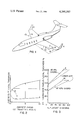
- FIG. 1 is an isometric view of an aircraft (e.g., a T-tail aircraft of the Gates Learjet type) including a wing with the leading contour of the invention in combination with winglets disposed at each wing tip;
- aircraft e.g., a T-tail aircraft of the Gates Learjet type
- FIG. 2 is a partial cross-sectional view taken generally along the line 2--2 of FIG. 1 showing the leading edge contour and dimensions expressed in percent chord at a transition point;
- FIG. 3 is a chart showing a leading edge radius and its variation in relation to percent semispan and prior art (i.e., U.S. Pat. No. 4,050,651).
- an improved high performance wing 10 is provided and is shown installed on a T-tail aircraft such as of the Gates Learjet type as manufactured by the Gates Learjet Corporation.
- the wing 10 is of the thin, high speed and tapered type and is more preferably defined as having: a 13 degree sweep at the quarter chord line; an aspect ratio of 6.72; a taper ratio of 0.39; and a dihedral angle of 2.5 degrees. More preferably, the wing has generally an NACA 64A-109 airfoil section that is modified generally at the lower surface at about the forward 15 percent of the chord line with the leading edge of the invention. Most preferably, the so modified wing has winglets 11 extending from each wing tip.
- the leading edge is divided into two portions across each semispan.
- a first portion 12 extends from near a wing root to a transition point 14 and a second portion 16 which extends from the transition point to near each wing tip.
- the transition point is located at least about 50 percent of semispan 17 and more preferably, at least about 70 percent to about 80 percent of semispan so that a major portion of the wing will have a large leading edge radius as will later become apparent.
- the first leading edge portion 12 has a fixed dimension radius selected from the range of about 1.12 percent to about 1.38 percent of the root chord, and more preferably, about 1.24 percent of the root chord.
- a wing having a 275 cm root chord would have a first leading edge portion with a leading edge radius of 3.41 cm to the transition point (e.g., 0.0124 ⁇ 275). Should the leading edge radius be expressed in percent of local chord across the first portion of the semispan, it would linearly increase at a constant slope.
- leading edge radius as a fixed dimension or as a percent of local chord does not give a relative indication between the relative size between the leading edge and thickness (or height) of a local chord.
- the ratio of 2 times the leading edge radius R to the local section thickness (or height) as measured at 5 or 10 percent of the local chord is a convenient factor for expressing such a thickness relationship.
- a second leading edge portion extends from the transition point to the tip cord.
- the second leading edge portion has a radius which is more conveniently expressed in percent of local chord so that it does not exceed the percent of local chord radius at the transition point. More preferably, the percent radius of the second leading edge portion equals a constant.
- FIG. 3 shows in percent, 2 times the leading edge radius divided by local chord thickness at 5 and 10 percent of the local chord, as a function of semispan, in percent.
- FIG. 3 gives a relative thickness contour of the leading edge in comparison to chord size across the semispan.
- FIG. 3 also compares the leading edge contour in comparison to the prior art. It should be noted that FIG. 3 normalizes semispan and that the actual semispan length for the leading edge contour shown with the invention (2667 cm) was approximately 183 cm longer than the semispan shown in the prior art.
- Winglets 11 extend from each wing tip at approximately 15 degrees from a vertical.
- the winglets are canted outboard from each other at their leading edge at approximately 4 to 11 degrees (i.e., 2 to 5.5 degrees for each winglet). Size of the winglet is as suggested in AFFDL Report TR 76-6. Using these guidelines, the winglet has a span from about 10 to about 20 percent of a wing semispan (e.g., 18 percent for the flight test data given herein) and has an aspect ratio from about 1.5 to about 2.5 and more preferably about 2.33.
- the winglets take advantage of a characteristic vortex flow that occurs around each wing tip, When the local flow angle is positive, the resultant force of the winglet has a component into the aircraft free stream direction.
- the winglet acts like the sail of a yacht in making use of a cross-wind airflow to produce a resultant force which reduces the wing's induced drag.
- the winglets effect a drag reduction of up to about 7 percent.
- the winglets intrinsically combine with the leading edge as previously described to provide improved aircraft performance at both high and low speeds.
- the relatively large leading edge contour provides the wing with capability of low air speeds during takeoff and landing.
- the winglets more than compensate for the drag penalty associated with the leading edge.
- the improved performance offered by the invention may best be illustrated by comparing similar aircraft where one is equipped with the prior art wing as described in U.S. Pat. No. 4,050,651 and the other is equipped with the wing of the invention as above described. Both wings as tested were of the modified NACA 64 A-109 type contour. However, the wing of the invention had an increased span of 366 cm and did not include tip tanks and the 2,000 pounds of fuel as normally carried therein. The stall speed for the aircraft using the wing of the invention was 90 knots while the stall speed for the aircraft using the prior art wing was 94 knots. Such low stall speeds are indicative of good wing performance for takeoff and landing. Both aircraft have substantially the same range (i.e., 1370 naut.
- An inherent advantage of the invention is that stall speeds of the aircraft are improved.
Landscapes
- Engineering & Computer Science (AREA)
- Aviation & Aerospace Engineering (AREA)
- Mechanical Engineering (AREA)
- Structures Of Non-Positive Displacement Pumps (AREA)
Abstract
Description
Claims (6)
Priority Applications (1)
| Application Number | Priority Date | Filing Date | Title |
|---|---|---|---|
| US05/937,348 US4240597A (en) | 1978-08-28 | 1978-08-28 | Wing with improved leading edge for aircraft |
Applications Claiming Priority (1)
| Application Number | Priority Date | Filing Date | Title |
|---|---|---|---|
| US05/937,348 US4240597A (en) | 1978-08-28 | 1978-08-28 | Wing with improved leading edge for aircraft |
Publications (1)
| Publication Number | Publication Date |
|---|---|
| US4240597A true US4240597A (en) | 1980-12-23 |
Family
ID=25469818
Family Applications (1)
| Application Number | Title | Priority Date | Filing Date |
|---|---|---|---|
| US05/937,348 Expired - Lifetime US4240597A (en) | 1978-08-28 | 1978-08-28 | Wing with improved leading edge for aircraft |
Country Status (1)
| Country | Link |
|---|---|
| US (1) | US4240597A (en) |
Cited By (33)
| Publication number | Priority date | Publication date | Assignee | Title |
|---|---|---|---|---|
| US4519746A (en) * | 1981-07-24 | 1985-05-28 | United Technologies Corporation | Airfoil blade |
| WO1985003051A1 (en) * | 1984-01-16 | 1985-07-18 | The Boeing Company | An airfoil having improved lift capability |
| USD292393S (en) | 1983-08-18 | 1987-10-20 | Rutan Elbert L | Airplane |
| US4776542A (en) * | 1987-05-27 | 1988-10-11 | Vigyan Research Associates, Inc. | Aircraft stall-spin entry deterrent system |
| US5039032A (en) * | 1988-11-07 | 1991-08-13 | The Boeing Company | High taper wing tip extension |
| US5213287A (en) * | 1991-11-04 | 1993-05-25 | Barron David R | Wing modification method and apparatus |
| US5275358A (en) * | 1991-08-02 | 1994-01-04 | The Boeing Company | Wing/winglet configurations and methods for aircraft |
| US5348253A (en) * | 1993-02-01 | 1994-09-20 | Gratzer Louis B | Blended winglet |
| US6484968B2 (en) * | 2000-12-11 | 2002-11-26 | Fort F. Felker | Aircraft with elliptical winglets |
| US6698684B1 (en) | 2002-01-30 | 2004-03-02 | Gulfstream Aerospace Corporation | Supersonic aircraft with spike for controlling and reducing sonic boom |
| WO2008022428A1 (en) * | 2006-08-25 | 2008-02-28 | A Partnership Of Jim Langley And Courtney Hunter | Aircraft wing modification and related methods |
| US20100181432A1 (en) * | 2008-06-20 | 2010-07-22 | Aviation Partners, Inc. | Curved Wing Tip |
| US7900877B1 (en) | 2009-12-01 | 2011-03-08 | Tamarack Aerospace Group, Inc. | Active winglet |
| US20110192937A1 (en) * | 2009-04-30 | 2011-08-11 | Airbus Operations Gmbh | Non-planar wing tip device for wings of aircraft, and wing comprising such a wing tip device |
| US8083171B2 (en) | 2002-01-30 | 2011-12-27 | Gulfstream Aerospace Corporation | Supersonic aircraft for reducing sonic boom effects at ground level |
| CN101166664B (en) * | 2005-04-28 | 2012-03-21 | 空中客车运营简化股份公司 | Aircraft with low noise, especially during take-off and landing |
| US8286434B2 (en) | 2005-12-15 | 2012-10-16 | Gulfstream Aerospace Corporation | Isentropic compression inlet for supersonic aircraft |
| US8393158B2 (en) | 2007-10-24 | 2013-03-12 | Gulfstream Aerospace Corporation | Low shock strength inlet |
| US20140306067A1 (en) * | 2013-02-05 | 2014-10-16 | Tamarack Aerospace Group, Inc. | Controllable airflow modification device periodic load control |
| US8944386B2 (en) | 2011-06-09 | 2015-02-03 | Aviation Partners, Inc. | Split blended winglet |
| US20150121838A1 (en) * | 2013-03-07 | 2015-05-07 | United Technologies Corporation | Conjoined reverse core flow engine arrangement |
| US9033282B2 (en) | 2010-07-14 | 2015-05-19 | Airbus Operations Limited | Wing tip device |
| US9162755B2 (en) | 2009-12-01 | 2015-10-20 | Tamarack Aerospace Group, Inc. | Multiple controllable airflow modification devices |
| US9302766B2 (en) | 2008-06-20 | 2016-04-05 | Aviation Partners, Inc. | Split blended winglet |
| US9555874B2 (en) * | 2010-04-12 | 2017-01-31 | Airbus Operations Gmbh | Fixed wing of an aircraft |
| US10053209B2 (en) | 2009-05-05 | 2018-08-21 | Aerostar Aircraft Corporation | Aircraft winglet design having a compound curve profile |
| WO2019116697A1 (en) | 2017-12-12 | 2019-06-20 | 国立研究開発法人宇宙航空研究開発機構 | Transonic airfoil, blade, and aircraft |
| US11279469B2 (en) * | 2016-07-12 | 2022-03-22 | The Aircraft Performance Company Gmbh | Airplane wing |
| US11427307B2 (en) * | 2018-01-15 | 2022-08-30 | The Aircraft Performance Company Gmbh | Airplane wing |
| US11440645B2 (en) * | 2013-12-04 | 2022-09-13 | Tamarack Aerospace Group, Inc. | Adjustable lift modification wingtip |
| US20230242242A1 (en) * | 2022-01-31 | 2023-08-03 | Airbus Operations Limited | Aircraft wing with movable wing tip device |
| US20230242245A1 (en) * | 2022-01-31 | 2023-08-03 | Airbus Operations Limited | Aircraft with movable wing tip device |
| US20240158071A1 (en) * | 2022-11-16 | 2024-05-16 | Airbus Operations Limited | Aircraft wing |
Citations (3)
| Publication number | Priority date | Publication date | Assignee | Title |
|---|---|---|---|---|
| US3659810A (en) * | 1968-05-20 | 1972-05-02 | James L Robertson | Inherently stable tapered wing flaperon airplane |
| US4032087A (en) * | 1975-02-18 | 1977-06-28 | Cleaves Prentiss B | Aircraft spoiler system |
| US4050651A (en) * | 1976-06-24 | 1977-09-27 | The Gates Rubber Company | Wing and reduced airspeed system for jet aircraft |
-
1978
- 1978-08-28 US US05/937,348 patent/US4240597A/en not_active Expired - Lifetime
Patent Citations (3)
| Publication number | Priority date | Publication date | Assignee | Title |
|---|---|---|---|---|
| US3659810A (en) * | 1968-05-20 | 1972-05-02 | James L Robertson | Inherently stable tapered wing flaperon airplane |
| US4032087A (en) * | 1975-02-18 | 1977-06-28 | Cleaves Prentiss B | Aircraft spoiler system |
| US4050651A (en) * | 1976-06-24 | 1977-09-27 | The Gates Rubber Company | Wing and reduced airspeed system for jet aircraft |
Non-Patent Citations (4)
| Title |
|---|
| Evans, "Leading Edge Contours for Thin Swept Wings", NACA RM A57B11, 3/1957. * |
| Hickey et al., "Large-Scale Wind-Tunnel Tests . . .", NACA RM A58A09, 5/1958. * |
| Ishimitsu et al., "Design Analysis of Winglets for Military Aircraft", AFFDL-7R-76-6, 2/1976. * |
| Whitcomb, "A Design Approach . . . for Wing-Tip Mounted Winglets", NASA TN 8260, 7/1976. * |
Cited By (83)
| Publication number | Priority date | Publication date | Assignee | Title |
|---|---|---|---|---|
| US4519746A (en) * | 1981-07-24 | 1985-05-28 | United Technologies Corporation | Airfoil blade |
| USD292393S (en) | 1983-08-18 | 1987-10-20 | Rutan Elbert L | Airplane |
| WO1985003051A1 (en) * | 1984-01-16 | 1985-07-18 | The Boeing Company | An airfoil having improved lift capability |
| US4655412A (en) * | 1984-01-16 | 1987-04-07 | The Boeing Company | Airfoil having improved lift capability |
| US4776542A (en) * | 1987-05-27 | 1988-10-11 | Vigyan Research Associates, Inc. | Aircraft stall-spin entry deterrent system |
| US5039032A (en) * | 1988-11-07 | 1991-08-13 | The Boeing Company | High taper wing tip extension |
| US5275358A (en) * | 1991-08-02 | 1994-01-04 | The Boeing Company | Wing/winglet configurations and methods for aircraft |
| US5213287A (en) * | 1991-11-04 | 1993-05-25 | Barron David R | Wing modification method and apparatus |
| US5348253A (en) * | 1993-02-01 | 1994-09-20 | Gratzer Louis B | Blended winglet |
| WO2002047979A3 (en) * | 2000-12-11 | 2002-12-12 | Fort F Felker | Aircraft with elliptical winglets |
| US6484968B2 (en) * | 2000-12-11 | 2002-11-26 | Fort F. Felker | Aircraft with elliptical winglets |
| US6698684B1 (en) | 2002-01-30 | 2004-03-02 | Gulfstream Aerospace Corporation | Supersonic aircraft with spike for controlling and reducing sonic boom |
| US8789789B2 (en) | 2002-01-30 | 2014-07-29 | Gulfstream Aerospace Corporation | Supersonic aircraft with spike for controlling and reducing sonic boom |
| US8083171B2 (en) | 2002-01-30 | 2011-12-27 | Gulfstream Aerospace Corporation | Supersonic aircraft for reducing sonic boom effects at ground level |
| CN101166664B (en) * | 2005-04-28 | 2012-03-21 | 空中客车运营简化股份公司 | Aircraft with low noise, especially during take-off and landing |
| US8333076B2 (en) | 2005-12-15 | 2012-12-18 | Gulfstream Aerospace Corporation | Isentropic compression inlet for supersonic aircraft |
| US9482155B2 (en) | 2005-12-15 | 2016-11-01 | Gulfstream Aerospace Corporation | Isentropic compression inlet for supersonic aircraft |
| US9334801B2 (en) | 2005-12-15 | 2016-05-10 | Gulfstream Aerospace Corporation | Supersonic aircraft jet engine installation |
| US8327645B2 (en) | 2005-12-15 | 2012-12-11 | Gulfstream Aerospace Corporation | Isentropic compression inlet for supersonic aircraft |
| US8286434B2 (en) | 2005-12-15 | 2012-10-16 | Gulfstream Aerospace Corporation | Isentropic compression inlet for supersonic aircraft |
| WO2008022428A1 (en) * | 2006-08-25 | 2008-02-28 | A Partnership Of Jim Langley And Courtney Hunter | Aircraft wing modification and related methods |
| US7980515B2 (en) | 2006-08-25 | 2011-07-19 | 0832042 B.C. Ltd. | Aircraft wing modification and related methods |
| US20100148010A1 (en) * | 2006-08-25 | 2010-06-17 | A Partnership Of Jim Langley And Courtney Hunter | Aircraft wing modification and related methods |
| US9027583B2 (en) | 2007-10-24 | 2015-05-12 | Gulfstream Aerospace Corporation | Low shock strength inlet |
| US8393158B2 (en) | 2007-10-24 | 2013-03-12 | Gulfstream Aerospace Corporation | Low shock strength inlet |
| US8739514B2 (en) | 2007-10-24 | 2014-06-03 | Gulfstream Aerospace Corporation | Low shock strength propulsion system |
| US8783039B2 (en) | 2007-10-24 | 2014-07-22 | Gulfstream Aerospace Corporation | Low shock strength propulsion system |
| US9302766B2 (en) | 2008-06-20 | 2016-04-05 | Aviation Partners, Inc. | Split blended winglet |
| US9381999B2 (en) | 2008-06-20 | 2016-07-05 | C. R. Bard, Inc. | Wing tip with optimum loading |
| US11511851B2 (en) | 2008-06-20 | 2022-11-29 | Aviation Partners, Inc. | Wing tip with optimum loading |
| US10589846B2 (en) * | 2008-06-20 | 2020-03-17 | Aviation Partners, Inc. | Split blended winglet |
| US20190233089A1 (en) * | 2008-06-20 | 2019-08-01 | Aviation Partners, Inc. | Split Blended Winglet |
| US10252793B2 (en) * | 2008-06-20 | 2019-04-09 | Aviation Partners, Inc. | Split blended winglet |
| US10005546B2 (en) | 2008-06-20 | 2018-06-26 | Aviation Partners, Inc. | Split blended winglet |
| US20100181432A1 (en) * | 2008-06-20 | 2010-07-22 | Aviation Partners, Inc. | Curved Wing Tip |
| US8490925B2 (en) * | 2009-04-30 | 2013-07-23 | Airbus Operations Gmbh | Non-planar wing tip device for wings of aircraft, and wing comprising such a wing tip device |
| US20110192937A1 (en) * | 2009-04-30 | 2011-08-11 | Airbus Operations Gmbh | Non-planar wing tip device for wings of aircraft, and wing comprising such a wing tip device |
| US10053209B2 (en) | 2009-05-05 | 2018-08-21 | Aerostar Aircraft Corporation | Aircraft winglet design having a compound curve profile |
| US7900877B1 (en) | 2009-12-01 | 2011-03-08 | Tamarack Aerospace Group, Inc. | Active winglet |
| US11111006B2 (en) | 2009-12-01 | 2021-09-07 | Tamarack Aerospace Group, Inc. | Multiple controlloable airflow modification devices |
| US8684315B2 (en) | 2009-12-01 | 2014-04-01 | Tamarack Aerospace Group, Inc. | Active winglet |
| US11912398B2 (en) | 2009-12-01 | 2024-02-27 | Tamarack Aerospace Group, Inc. | Multiple controllable airflow modification devices |
| US11884383B2 (en) | 2009-12-01 | 2024-01-30 | Tamarack Aerospace Group, Inc. | Active winglet |
| US20110186689A1 (en) * | 2009-12-01 | 2011-08-04 | Tamarack Aerospace Group, Inc. | Active winglet |
| US10486797B2 (en) | 2009-12-01 | 2019-11-26 | Tamarack Aerospace Group, Inc. | Active winglet |
| US9162755B2 (en) | 2009-12-01 | 2015-10-20 | Tamarack Aerospace Group, Inc. | Multiple controllable airflow modification devices |
| US9969487B2 (en) | 2009-12-01 | 2018-05-15 | Tamarack Aerospace Group, Inc. | Multiple controllable airflow modification devices |
| US9764825B2 (en) | 2009-12-01 | 2017-09-19 | Tamarack Aerospace Group, Inc. | Active winglet |
| US9555874B2 (en) * | 2010-04-12 | 2017-01-31 | Airbus Operations Gmbh | Fixed wing of an aircraft |
| US9193445B2 (en) | 2010-07-14 | 2015-11-24 | Airbus Operations Limited | Wing tip device |
| US12515787B2 (en) * | 2010-07-14 | 2026-01-06 | Airbus Operations Limited | Wing tip device |
| US20250100676A1 (en) * | 2010-07-14 | 2025-03-27 | Airbus Operations Limited | Wing tip device |
| US12234008B2 (en) * | 2010-07-14 | 2025-02-25 | Airbus Operations Limited | Wing tip device |
| US20240158070A1 (en) * | 2010-07-14 | 2024-05-16 | Airbus Operations Limited | Wing tip device |
| US9033282B2 (en) | 2010-07-14 | 2015-05-19 | Airbus Operations Limited | Wing tip device |
| US9199727B2 (en) | 2010-07-14 | 2015-12-01 | Airbus Operations Limited | Wing tip device |
| US11851164B2 (en) * | 2010-07-14 | 2023-12-26 | Airbus Operations Limited | Wing tip device |
| US20220073193A1 (en) * | 2010-07-14 | 2022-03-10 | Airbus Operations Limited | Wing tip device |
| US9434470B2 (en) | 2011-06-09 | 2016-09-06 | Aviation Partners, Inc. | Split spiroid |
| US9580170B2 (en) | 2011-06-09 | 2017-02-28 | Aviation Partners, Inc. | Split spiroid |
| US10787246B2 (en) * | 2011-06-09 | 2020-09-29 | Aviation Partners, Inc. | Wing tip with winglet and ventral fin |
| US10377472B2 (en) * | 2011-06-09 | 2019-08-13 | Aviation Partners, Inc. | Wing tip with winglet and ventral fin |
| US10106247B2 (en) | 2011-06-09 | 2018-10-23 | Aviation Partners, Inc. | Split blended winglet |
| US8944386B2 (en) | 2011-06-09 | 2015-02-03 | Aviation Partners, Inc. | Split blended winglet |
| US9038963B2 (en) | 2011-06-09 | 2015-05-26 | Aviation Partners, Inc. | Split spiroid |
| US10562610B2 (en) | 2013-02-05 | 2020-02-18 | Tamarack Aerospace Group, Inc. | Controllable airflow modification device periodic load control |
| US12017753B2 (en) | 2013-02-05 | 2024-06-25 | Tamarack Aerospace Group, Inc. | Controllable airflow modification device periodic load control |
| US9567066B2 (en) * | 2013-02-05 | 2017-02-14 | Tamarack Aerospace Group, Inc. | Controllable airflow modification device periodic load control |
| US20140306067A1 (en) * | 2013-02-05 | 2014-10-16 | Tamarack Aerospace Group, Inc. | Controllable airflow modification device periodic load control |
| US20150121838A1 (en) * | 2013-03-07 | 2015-05-07 | United Technologies Corporation | Conjoined reverse core flow engine arrangement |
| US9845159B2 (en) * | 2013-03-07 | 2017-12-19 | United Technologies Corporation | Conjoined reverse core flow engine arrangement |
| US12351298B2 (en) * | 2013-12-04 | 2025-07-08 | Tamarack Aerospace Group, Inc. | Adjustable lift modification wingtip |
| US20230227149A1 (en) * | 2013-12-04 | 2023-07-20 | Tamarack Aerospace Group, Inc. | Adjustable lift modification wingtip |
| US11440645B2 (en) * | 2013-12-04 | 2022-09-13 | Tamarack Aerospace Group, Inc. | Adjustable lift modification wingtip |
| US11279469B2 (en) * | 2016-07-12 | 2022-03-22 | The Aircraft Performance Company Gmbh | Airplane wing |
| WO2019116697A1 (en) | 2017-12-12 | 2019-06-20 | 国立研究開発法人宇宙航空研究開発機構 | Transonic airfoil, blade, and aircraft |
| US11299253B2 (en) | 2017-12-12 | 2022-04-12 | Japan Aerospace Exploration Agency | Transonic airfoil, wing, and aircraft |
| US11427307B2 (en) * | 2018-01-15 | 2022-08-30 | The Aircraft Performance Company Gmbh | Airplane wing |
| US12195170B2 (en) * | 2022-01-31 | 2025-01-14 | Airbus Operations Limited | Aircraft with movable wing tip device |
| US12157567B2 (en) * | 2022-01-31 | 2024-12-03 | Airbus Operations Limited | Aircraft wing with movable wing tip device |
| US20230242245A1 (en) * | 2022-01-31 | 2023-08-03 | Airbus Operations Limited | Aircraft with movable wing tip device |
| US20230242242A1 (en) * | 2022-01-31 | 2023-08-03 | Airbus Operations Limited | Aircraft wing with movable wing tip device |
| US20240158071A1 (en) * | 2022-11-16 | 2024-05-16 | Airbus Operations Limited | Aircraft wing |
Similar Documents
| Publication | Publication Date | Title |
|---|---|---|
| US4245804A (en) | Minimum drag wing configuration for aircraft operating at transonic speeds | |
| US4205810A (en) | Minimum drag wing configuration for aircraft operating at transonic speeds | |
| US4050651A (en) | Wing and reduced airspeed system for jet aircraft | |
| US4867396A (en) | Micro flap trailing edge device for an aircraft wing | |
| EP0681544A1 (en) | High-efficiency, supersonic aircraft | |
| US4655412A (en) | Airfoil having improved lift capability | |
| PATTERSON, JR et al. | Effect of a wing-tip mounted pusher turboprop on the aerodynamic characteristics of a semi-span wing | |
| Rinoie | Experiments on a 60-degree delta wing with rounded leading-edge vortex flaps | |
| Uhuad et al. | Wind tunnel investigation of the transonic aerodynamic characteristics of forward swept wings | |
| Galbraith | The aerodynamic characteristics of a GU25-5 (11) 8 aerofoil for low Reynolds numbers | |
| Conley | Winglet toe-out angle optimization for the gates learjet longhorn wing | |
| Polhamus | Drag due to lift at mach numbers up to 2.0 | |
| Smith | Wind-Tunnel Investigation at Subsonic and Supersonic Speeds of a Fighter Model Employing a Low-Aspect-Ratio Unswept Wing and a Horizontal Tail Mounted Well Above the Wing Plane-Longitudinal Stability and Control | |
| Hall et al. | Effects of Canards on Airplane Performance and Stability | |
| Newsom Jr et al. | Effects of wing-leading-edge modifications on a full-scale, low-wing general aviation airplane: Wind-tunnel investigation of high-angle-of-attack aerodynamic characteristics | |
| Polhamus et al. | Effect of airplane configuration on static stability at subsonic and transonic speeds | |
| RU2063365C1 (en) | Flying vehicle lifting surface tip | |
| Williams et al. | A study of the aerodynamic loads on sweptback wings at transonic speeds | |
| Whitcomb et al. | Transonic Investigation of Aerodynamic Characteristics of a Swept-wing Fighter-airplane Model with Leading-edge Droop in Combination with Outboard Chord-extensions and Notches | |
| Anderson et al. | Flight Investigation of the Low-speed Characteristics of a 35 Degree Swept-wing Airplane Equipped with an Area-suction Ejector Flap and Various Wing Leading-edge Devices | |
| Sweberg | publication (reference 1), presents a method for calculating the | |
| Lowry et al. | Effects of sweep on controls | |
| Mann et al. | Subsonic longitudinal and lateral-directional characteristics of a forward-swept-wing fighter configuration at angles of attack up to 47 deg | |
| Spearman | Effects of wing and tail location on the aerodynamic characteristicsof an airplane for Mach numbers from 0.25 to 4.63 | |
| Palmer et al. | A Transonic Wind-tunnel Investigation of the Longitudinal Force and Moment Characteristics of Two Delta Wings and One Clipped-tip Delta Wing of 4 Percent Thickness on a Slender Body |
Legal Events
| Date | Code | Title | Description |
|---|---|---|---|
| AS | Assignment |
Owner name: GATES LEARJET CORPORATION, A DE. CORP. Free format text: SECURITY INTEREST;ASSIGNOR:NATWEST USA CREDIT CORP.;REEL/FRAME:004825/0569 Effective date: 19871218 |
|
| AS | Assignment |
Owner name: LEARJET CORPORATION, WICHITA, KANSAS, A CORP. OF D Free format text: ASSIGNMENT OF ASSIGNORS INTEREST.;ASSIGNOR:GATES LEARJET CORPORATION, A CORP. OF DE;REEL/FRAME:004850/0568 Effective date: 19880404 Owner name: LEARJET CORPORATION, KANSAS Free format text: ASSIGNMENT OF ASSIGNORS INTEREST;ASSIGNOR:GATES LEARJET CORPORATION, A CORP. OF DE;REEL/FRAME:004850/0568 Effective date: 19880404 |
|
| AS | Assignment |
Owner name: NATWEST USA CREDIT CORP. Free format text: SECURITY INTEREST;ASSIGNOR:LEARJET CORPORATION;REEL/FRAME:004903/0881 Effective date: 19880404 |
|
| AS | Assignment |
Owner name: LJT ACQUISITION CORPORATION, A CORP. OF DE. Free format text: SECURITY INTEREST;ASSIGNOR:LEARJET CORPORATION, A CORP. OF DE.;REEL/FRAME:005452/0187 Effective date: 19900622 |
|
| AS | Assignment |
Owner name: LEARJET INC. A CORP. OF DE Free format text: CHANGE OF NAME;ASSIGNOR:LJT ACQUISITION CORPORATION, A CORP. OF DE;REEL/FRAME:006177/0019 Effective date: 19900622 |