US4192770A - Cracking catalyst restoration with boron compounds - Google Patents
Cracking catalyst restoration with boron compounds Download PDFInfo
- Publication number
- US4192770A US4192770A US05/909,234 US90923478A US4192770A US 4192770 A US4192770 A US 4192770A US 90923478 A US90923478 A US 90923478A US 4192770 A US4192770 A US 4192770A
- Authority
- US
- United States
- Prior art keywords
- catalyst
- boron
- cracking
- boron compound
- selectivity
- Prior art date
- Legal status (The legal status is an assumption and is not a legal conclusion. Google has not performed a legal analysis and makes no representation as to the accuracy of the status listed.)
- Expired - Lifetime
Links
- 239000003054 catalyst Substances 0.000 title claims abstract description 106
- 238000005336 cracking Methods 0.000 title claims abstract description 33
- 150000001639 boron compounds Chemical class 0.000 title claims abstract description 15
- 238000000034 method Methods 0.000 claims abstract description 35
- 229910052751 metal Inorganic materials 0.000 claims abstract description 26
- 239000002184 metal Substances 0.000 claims abstract description 26
- 229910052796 boron Inorganic materials 0.000 claims description 42
- ZOXJGFHDIHLPTG-UHFFFAOYSA-N Boron Chemical compound [B] ZOXJGFHDIHLPTG-UHFFFAOYSA-N 0.000 claims description 41
- PXHVJJICTQNCMI-UHFFFAOYSA-N Nickel Chemical compound [Ni] PXHVJJICTQNCMI-UHFFFAOYSA-N 0.000 claims description 20
- 239000003795 chemical substances by application Substances 0.000 claims description 19
- XEEYBQQBJWHFJM-UHFFFAOYSA-N Iron Chemical compound [Fe] XEEYBQQBJWHFJM-UHFFFAOYSA-N 0.000 claims description 14
- 229930195733 hydrocarbon Natural products 0.000 claims description 11
- 150000002430 hydrocarbons Chemical class 0.000 claims description 11
- 229910052759 nickel Inorganic materials 0.000 claims description 10
- 229910052720 vanadium Inorganic materials 0.000 claims description 10
- 239000004215 Carbon black (E152) Substances 0.000 claims description 7
- 238000004523 catalytic cracking Methods 0.000 claims description 7
- 229910052742 iron Inorganic materials 0.000 claims description 7
- HNPSIPDUKPIQMN-UHFFFAOYSA-N dioxosilane;oxo(oxoalumanyloxy)alumane Chemical compound O=[Si]=O.O=[Al]O[Al]=O HNPSIPDUKPIQMN-UHFFFAOYSA-N 0.000 claims description 5
- 239000010457 zeolite Substances 0.000 claims description 4
- 229910021536 Zeolite Inorganic materials 0.000 claims description 3
- QVGXLLKOCUKJST-UHFFFAOYSA-N atomic oxygen Chemical compound [O] QVGXLLKOCUKJST-UHFFFAOYSA-N 0.000 claims description 2
- 239000001301 oxygen Substances 0.000 claims description 2
- 229910052760 oxygen Inorganic materials 0.000 claims description 2
- 150000002484 inorganic compounds Chemical class 0.000 claims 1
- 229910010272 inorganic material Inorganic materials 0.000 claims 1
- GPPXJZIENCGNKB-UHFFFAOYSA-N vanadium Chemical compound [V]#[V] GPPXJZIENCGNKB-UHFFFAOYSA-N 0.000 claims 1
- 150000002739 metals Chemical class 0.000 abstract description 15
- YXFVVABEGXRONW-UHFFFAOYSA-N Toluene Chemical compound CC1=CC=CC=C1 YXFVVABEGXRONW-UHFFFAOYSA-N 0.000 description 12
- 239000003502 gasoline Substances 0.000 description 12
- KGBXLFKZBHKPEV-UHFFFAOYSA-N boric acid Chemical compound OB(O)O KGBXLFKZBHKPEV-UHFFFAOYSA-N 0.000 description 10
- 239000004327 boric acid Substances 0.000 description 10
- 239000000356 contaminant Substances 0.000 description 10
- 239000003921 oil Substances 0.000 description 10
- 239000000571 coke Substances 0.000 description 9
- IJGRMHOSHXDMSA-UHFFFAOYSA-N Atomic nitrogen Chemical compound N#N IJGRMHOSHXDMSA-UHFFFAOYSA-N 0.000 description 8
- LEONUFNNVUYDNQ-UHFFFAOYSA-N vanadium atom Chemical compound [V] LEONUFNNVUYDNQ-UHFFFAOYSA-N 0.000 description 8
- 238000006243 chemical reaction Methods 0.000 description 7
- 230000000694 effects Effects 0.000 description 7
- 238000005470 impregnation Methods 0.000 description 7
- 238000004519 manufacturing process Methods 0.000 description 7
- 239000007864 aqueous solution Substances 0.000 description 6
- 150000001875 compounds Chemical class 0.000 description 6
- 239000001257 hydrogen Substances 0.000 description 6
- 229910052739 hydrogen Inorganic materials 0.000 description 6
- -1 rare earth metal ions Chemical class 0.000 description 6
- UFHFLCQGNIYNRP-UHFFFAOYSA-N Hydrogen Chemical compound [H][H] UFHFLCQGNIYNRP-UHFFFAOYSA-N 0.000 description 5
- 239000007789 gas Substances 0.000 description 5
- 238000001354 calcination Methods 0.000 description 4
- 229910052757 nitrogen Inorganic materials 0.000 description 4
- 238000012360 testing method Methods 0.000 description 4
- JLPJTCGUKOBWRJ-UHFFFAOYSA-N tripentyl borate Chemical compound CCCCCOB(OCCCCC)OCCCCC JLPJTCGUKOBWRJ-UHFFFAOYSA-N 0.000 description 4
- 229910000323 aluminium silicate Inorganic materials 0.000 description 3
- 238000009835 boiling Methods 0.000 description 3
- 230000002939 deleterious effect Effects 0.000 description 3
- 230000008021 deposition Effects 0.000 description 3
- UIEKYBOPAVTZKW-UHFFFAOYSA-L naphthalene-2-carboxylate;nickel(2+) Chemical compound [Ni+2].C1=CC=CC2=CC(C(=O)[O-])=CC=C21.C1=CC=CC2=CC(C(=O)[O-])=CC=C21 UIEKYBOPAVTZKW-UHFFFAOYSA-L 0.000 description 3
- 239000000243 solution Substances 0.000 description 3
- OCKGFTQIICXDQW-ZEQRLZLVSA-N 5-[(1r)-1-hydroxy-2-[4-[(2r)-2-hydroxy-2-(4-methyl-1-oxo-3h-2-benzofuran-5-yl)ethyl]piperazin-1-yl]ethyl]-4-methyl-3h-2-benzofuran-1-one Chemical compound C1=C2C(=O)OCC2=C(C)C([C@@H](O)CN2CCN(CC2)C[C@H](O)C2=CC=C3C(=O)OCC3=C2C)=C1 OCKGFTQIICXDQW-ZEQRLZLVSA-N 0.000 description 2
- QGZKDVFQNNGYKY-UHFFFAOYSA-O Ammonium Chemical compound [NH4+] QGZKDVFQNNGYKY-UHFFFAOYSA-O 0.000 description 2
- CPLXHLVBOLITMK-UHFFFAOYSA-N Magnesium oxide Chemical compound [Mg]=O CPLXHLVBOLITMK-UHFFFAOYSA-N 0.000 description 2
- CTQNGGLPUBDAKN-UHFFFAOYSA-N O-Xylene Chemical compound CC1=CC=CC=C1C CTQNGGLPUBDAKN-UHFFFAOYSA-N 0.000 description 2
- PNEYBMLMFCGWSK-UHFFFAOYSA-N aluminium oxide Inorganic materials [O-2].[O-2].[O-2].[Al+3].[Al+3] PNEYBMLMFCGWSK-UHFFFAOYSA-N 0.000 description 2
- 238000004458 analytical method Methods 0.000 description 2
- 238000011109 contamination Methods 0.000 description 2
- 230000003247 decreasing effect Effects 0.000 description 2
- 231100001261 hazardous Toxicity 0.000 description 2
- 239000000463 material Substances 0.000 description 2
- 230000003647 oxidation Effects 0.000 description 2
- 238000007254 oxidation reaction Methods 0.000 description 2
- 239000003208 petroleum Substances 0.000 description 2
- 239000002574 poison Substances 0.000 description 2
- 231100000614 poison Toxicity 0.000 description 2
- 230000008929 regeneration Effects 0.000 description 2
- 238000011069 regeneration method Methods 0.000 description 2
- 239000008096 xylene Substances 0.000 description 2
- MQEOGDVCAHJFFW-UHFFFAOYSA-N (2,6-ditert-butylphenoxy)boronic acid Chemical compound CC(C)(C)C1=CC=CC(C(C)(C)C)=C1OB(O)O MQEOGDVCAHJFFW-UHFFFAOYSA-N 0.000 description 1
- LLQHSBBZNDXTIV-UHFFFAOYSA-N 6-[5-[[4-[2-(2,3-dihydro-1H-inden-2-ylamino)pyrimidin-5-yl]piperazin-1-yl]methyl]-4,5-dihydro-1,2-oxazol-3-yl]-3H-1,3-benzoxazol-2-one Chemical compound C1C(CC2=CC=CC=C12)NC1=NC=C(C=N1)N1CCN(CC1)CC1CC(=NO1)C1=CC2=C(NC(O2)=O)C=C1 LLQHSBBZNDXTIV-UHFFFAOYSA-N 0.000 description 1
- 229910011255 B2O3 Inorganic materials 0.000 description 1
- DGAQECJNVWCQMB-PUAWFVPOSA-M Ilexoside XXIX Chemical compound C[C@@H]1CC[C@@]2(CC[C@@]3(C(=CC[C@H]4[C@]3(CC[C@@H]5[C@@]4(CC[C@@H](C5(C)C)OS(=O)(=O)[O-])C)C)[C@@H]2[C@]1(C)O)C)C(=O)O[C@H]6[C@@H]([C@H]([C@@H]([C@H](O6)CO)O)O)O.[Na+] DGAQECJNVWCQMB-PUAWFVPOSA-M 0.000 description 1
- NIPNSKYNPDTRPC-UHFFFAOYSA-N N-[2-oxo-2-(2,4,6,7-tetrahydrotriazolo[4,5-c]pyridin-5-yl)ethyl]-2-[[3-(trifluoromethoxy)phenyl]methylamino]pyrimidine-5-carboxamide Chemical compound O=C(CNC(=O)C=1C=NC(=NC=1)NCC1=CC(=CC=C1)OC(F)(F)F)N1CC2=C(CC1)NN=N2 NIPNSKYNPDTRPC-UHFFFAOYSA-N 0.000 description 1
- VYPSYNLAJGMNEJ-UHFFFAOYSA-N Silicium dioxide Chemical compound O=[Si]=O VYPSYNLAJGMNEJ-UHFFFAOYSA-N 0.000 description 1
- NINIDFKCEFEMDL-UHFFFAOYSA-N Sulfur Chemical compound [S] NINIDFKCEFEMDL-UHFFFAOYSA-N 0.000 description 1
- 239000002253 acid Substances 0.000 description 1
- 239000008186 active pharmaceutical agent Substances 0.000 description 1
- 239000003125 aqueous solvent Substances 0.000 description 1
- 230000009286 beneficial effect Effects 0.000 description 1
- 229910021538 borax Inorganic materials 0.000 description 1
- ZADPBFCGQRWHPN-UHFFFAOYSA-N boronic acid Chemical compound OBO ZADPBFCGQRWHPN-UHFFFAOYSA-N 0.000 description 1
- 230000003197 catalytic effect Effects 0.000 description 1
- 239000002131 composite material Substances 0.000 description 1
- XDRVAZAFNWDVOE-UHFFFAOYSA-N cyclohexylboronic acid Chemical compound OB(O)C1CCCCC1 XDRVAZAFNWDVOE-UHFFFAOYSA-N 0.000 description 1
- 230000006866 deterioration Effects 0.000 description 1
- JKWMSGQKBLHBQQ-UHFFFAOYSA-N diboron trioxide Chemical compound O=BOB=O JKWMSGQKBLHBQQ-UHFFFAOYSA-N 0.000 description 1
- KRLAUZFLYKEWMF-UHFFFAOYSA-N dibutyl (2,6-ditert-butylphenyl) borate Chemical compound CCCCOB(OCCCC)OC1=C(C(C)(C)C)C=CC=C1C(C)(C)C KRLAUZFLYKEWMF-UHFFFAOYSA-N 0.000 description 1
- UQGFMSUEHSUPRD-UHFFFAOYSA-N disodium;3,7-dioxido-2,4,6,8,9-pentaoxa-1,3,5,7-tetraborabicyclo[3.3.1]nonane Chemical compound [Na+].[Na+].O1B([O-])OB2OB([O-])OB1O2 UQGFMSUEHSUPRD-UHFFFAOYSA-N 0.000 description 1
- 238000009826 distribution Methods 0.000 description 1
- 238000007580 dry-mixing Methods 0.000 description 1
- 238000001035 drying Methods 0.000 description 1
- VEPSWGHMGZQCIN-UHFFFAOYSA-H ferric oxalate Chemical compound [Fe+3].[Fe+3].[O-]C(=O)C([O-])=O.[O-]C(=O)C([O-])=O.[O-]C(=O)C([O-])=O VEPSWGHMGZQCIN-UHFFFAOYSA-H 0.000 description 1
- 239000012530 fluid Substances 0.000 description 1
- 238000004231 fluid catalytic cracking Methods 0.000 description 1
- 239000000446 fuel Substances 0.000 description 1
- 239000000295 fuel oil Substances 0.000 description 1
- 230000005484 gravity Effects 0.000 description 1
- 150000002431 hydrogen Chemical class 0.000 description 1
- 239000011261 inert gas Substances 0.000 description 1
- 150000002500 ions Chemical group 0.000 description 1
- 239000000395 magnesium oxide Substances 0.000 description 1
- 239000011159 matrix material Substances 0.000 description 1
- 150000001455 metallic ions Chemical class 0.000 description 1
- MLSKXPOBNQFGHW-UHFFFAOYSA-N methoxy(dioxido)borane Chemical compound COB([O-])[O-] MLSKXPOBNQFGHW-UHFFFAOYSA-N 0.000 description 1
- 239000000203 mixture Substances 0.000 description 1
- 238000002161 passivation Methods 0.000 description 1
- 238000001637 plasma atomic emission spectroscopy Methods 0.000 description 1
- 238000002360 preparation method Methods 0.000 description 1
- 229910052761 rare earth metal Inorganic materials 0.000 description 1
- 239000003079 shale oil Substances 0.000 description 1
- 239000000741 silica gel Substances 0.000 description 1
- 229910002027 silica gel Inorganic materials 0.000 description 1
- 239000011734 sodium Substances 0.000 description 1
- 229910052708 sodium Inorganic materials 0.000 description 1
- 239000004328 sodium tetraborate Substances 0.000 description 1
- 235000010339 sodium tetraborate Nutrition 0.000 description 1
- 229910052717 sulfur Inorganic materials 0.000 description 1
- 239000011593 sulfur Substances 0.000 description 1
- LGQXXHMEBUOXRP-UHFFFAOYSA-N tributyl borate Chemical compound CCCCOB(OCCCC)OCCCC LGQXXHMEBUOXRP-UHFFFAOYSA-N 0.000 description 1
- VLCLHFYFMCKBRP-UHFFFAOYSA-N tricalcium;diborate Chemical compound [Ca+2].[Ca+2].[Ca+2].[O-]B([O-])[O-].[O-]B([O-])[O-] VLCLHFYFMCKBRP-UHFFFAOYSA-N 0.000 description 1
- FAQYAMRNWDIXMY-UHFFFAOYSA-N trichloroborane Chemical compound ClB(Cl)Cl FAQYAMRNWDIXMY-UHFFFAOYSA-N 0.000 description 1
- BOOITXALNJLNMB-UHFFFAOYSA-N tricyclohexyl borate Chemical compound C1CCCCC1OB(OC1CCCCC1)OC1CCCCC1 BOOITXALNJLNMB-UHFFFAOYSA-N 0.000 description 1
- NFMWFGXCDDYTEG-UHFFFAOYSA-N trimagnesium;diborate Chemical compound [Mg+2].[Mg+2].[Mg+2].[O-]B([O-])[O-].[O-]B([O-])[O-] NFMWFGXCDDYTEG-UHFFFAOYSA-N 0.000 description 1
- XLYOFNOQVPJJNP-UHFFFAOYSA-N water Substances O XLYOFNOQVPJJNP-UHFFFAOYSA-N 0.000 description 1
- 239000001993 wax Substances 0.000 description 1
Images

Classifications
-
- C—CHEMISTRY; METALLURGY
- C10—PETROLEUM, GAS OR COKE INDUSTRIES; TECHNICAL GASES CONTAINING CARBON MONOXIDE; FUELS; LUBRICANTS; PEAT
- C10G—CRACKING HYDROCARBON OILS; PRODUCTION OF LIQUID HYDROCARBON MIXTURES, e.g. BY DESTRUCTIVE HYDROGENATION, OLIGOMERISATION, POLYMERISATION; RECOVERY OF HYDROCARBON OILS FROM OIL-SHALE, OIL-SAND, OR GASES; REFINING MIXTURES MAINLY CONSISTING OF HYDROCARBONS; REFORMING OF NAPHTHA; MINERAL WAXES
- C10G11/00—Catalytic cracking, in the absence of hydrogen, of hydrocarbon oils
- C10G11/02—Catalytic cracking, in the absence of hydrogen, of hydrocarbon oils characterised by the catalyst used
- C10G11/04—Oxides
- C10G11/05—Crystalline alumino-silicates, e.g. molecular sieves
-
- B—PERFORMING OPERATIONS; TRANSPORTING
- B01—PHYSICAL OR CHEMICAL PROCESSES OR APPARATUS IN GENERAL
- B01J—CHEMICAL OR PHYSICAL PROCESSES, e.g. CATALYSIS OR COLLOID CHEMISTRY; THEIR RELEVANT APPARATUS
- B01J29/00—Catalysts comprising molecular sieves
- B01J29/90—Regeneration or reactivation
-
- Y—GENERAL TAGGING OF NEW TECHNOLOGICAL DEVELOPMENTS; GENERAL TAGGING OF CROSS-SECTIONAL TECHNOLOGIES SPANNING OVER SEVERAL SECTIONS OF THE IPC; TECHNICAL SUBJECTS COVERED BY FORMER USPC CROSS-REFERENCE ART COLLECTIONS [XRACs] AND DIGESTS
- Y10—TECHNICAL SUBJECTS COVERED BY FORMER USPC
- Y10S—TECHNICAL SUBJECTS COVERED BY FORMER USPC CROSS-REFERENCE ART COLLECTIONS [XRACs] AND DIGESTS
- Y10S502/00—Catalyst, solid sorbent, or support therefor: product or process of making
- Y10S502/521—Metal contaminant passivation
Definitions
- This invention relates to restoring selectivity of cracking catalysts which are contaminated with metals during catalytic cracking operations.
- selectivity herein refers to conversion of the feed to desired gasoline range hydrocarbons. Corollary to increased selectivity is decreased production of coke and hydrogen.
- boron is known in the original preparation of catalysts suitably employed for cracking of heavy hydrocarbons; see e.g., U.K. Pat. No. 1,313,174 and Netherlands patent application No. 7614020. Additionally, boron is disclosed as a promoter for a variety of crystalline alumino-silicate catalysts in e.g., U.S. Pat. Nos. 3,293,192; 3,328,119; 3,346,512; 3,740,347; 3,758,538; 3,072,563; 3,803,026 and 4,029,716. However, no patents have been found disclosing the use of boron for restoring the selectivity of metals contaminated cracking catalyst.
- This invention provides a process for restoring, at least partially, the selectivity of a cracking catalyst which is contaminated with metals such as nickel, vanadium and iron during cracking operations which process comprises contacting said catalyst during cracking with at least one boron compound for a time sufficient to restore the activity of said catalyst.
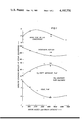
- FIG. 1 graphically compares product yields at a given conversion over as metals containing equilibrium catalyst treated with increasing concentrations of boron according to the invention.
- FIG. 2 illustrates the same relationship for a different catalyst containing lower level of metal contaminants and at a higher conversion.
- the cracking catalysts to which the process of this invention may be applied are those conventionally employed in the petroleum industry for the production of motor fuel range hydrocarbons from heavier hydrocarbon oils, mostly in the gas oil or higher boiling ranges.
- Such conventional cracking operations generally are conducted at temperatures in the range from about 400° C. (752° F.) to about 650° C. (1202° F.) at pressures ranging from subatmospheric pressure to several hundred atmospheres, with widely varying feed rates and fixed bed, moving bed, fluid catalyst, suspensoid or riser type operation and in the absence of added hydrogen, specific conditions depending upon the character of the feed and the products desired.
- the feedstocks to the cracking operations generally are hydrocarbons derived from petroleum, shale oils and/or tar sands and have an initial boiling point substantially above the gasoline boiling range. Exemplary feedstocks include gas oils, fuel oils, deasphalted oils, waxes, residual oils and the like.
- These processes normally employ such catalysts as various natural and treated clays, various composites of silica gel with alumina, magnesia and/or boria, activated alumina and such materials composited with naturally occurring or synthetic crystalline alumino silicates or, as they are sometimes referred to, zeolites.
- the zeolite component of such catalysts can have been ion exchanged to provide metallic ions, such as for example rare earth metal ions, which affect the activity of the catalysts.
- This invention is particularly applicable to zeolite-containing cracking catalysts.
- the cracking catalysts employed in the process of this invention will be at least partly deactivated by contamination thereon of metals such as nickel, vanadium and iron and will deteriorate to such extent that optimum product yields are no longer obtained.
- the process of this invention is generally applicable to cracking catalysts containing up to about 20,000 ppm or more of metals.
- the level of boron on the cracking catalyst is maintained by the addition of a boron-containing treating agent either to the fresh make-up catalyst or to the catalyst during operations.
- the treating agents employed in the process of this invention are compounds of boron and may be organic or inorganic.
- the treating agent compounds are either oxides or are convertible to oxides upon calcination of the catalyst containing the treating agent.
- Exemplary treating agents are boric acid, boric oxide, boron pentasulfide, boron trichloride, ammonium biborate, calcium borate, diborane, magnesium borate, methyl borate, butyl borate, tricyclohexyl borate, 2,6-ditert-butylphenyl dibutyl borate, cyclohexyl boronic acid, monoethyl dodecyl acid boronate and mixtures of these.
- Treating compounds such as sodium tetraborate containing significant proportions of sodium or other known cracking catalyst poisons are less desirable as the effects of such poisons tend to obscure the beneficial effect of the boron.
- the treating agents can be employed in any method which causes the treating agent to contact with and deposit on the catalyst. Exemplary methods include e.g., deposition from suitable carrying agents, impregnation and dry mixing.
- the treating agent may be applied to the catalyst before or after contamination with metals from the feed. Deposition is the preferred method.
- a suitable organic boron compound such as an alcohol ester, e.g., tri-n-pentylborate, is dissolved or dispersed in a suitable carrier, e.g., xylene, added to the hydrocarbon charge stock to the cracking process and is contacted with the catalyst under cracking conditions.
- amounts of the boron compound in the hydrocarbon feed may range from about 0.01 to about 10,000 ppm and preferably from about 0.1 to about 5000 ppm of said hydrocarbon.
- the boron treating compound such as boric acid in aqueous solution
- the boron-containing treating agent can be dissolved in either aqueous or non-aqueous solution.
- an aqueous solution of ammonium biborate may be used or if a non-aqueous solvent is desired a xylene solution of an aryl borate compound such as 2,6-ditert-butylphenyl borate may be used.
- the treating agent is applied to the catalyst in amounts of less than about 1%w of boron (calculated as metal) basis the cracking catalyst. It is generally preferred to supply an amount of boron in the range from about 0.05 to about 5 moles and particularly from about 0.1 to about 2 moles of boron per mole of contaminating metals.
- the amount of metals on the catalyst may be determined in any conventional manner, e.g., wet analysis, plasma emission spectroscopy and the like. This amount of added boron may be determined by any acceptable analytical procedure. The plasma emission procedure has been found particularly suitable.
- the catalyst can be further treated according to conventional procedures. These procedures involve calcination of the catalyst at elevated temperatures, suitably in the range from about 425° C. (797° F.) to about 870° C. (1598° F.) for a period of time ranging from about 0.05 to 30 hours or more in an inert gas or preferably in the presence of a free oxygen-containing gas to convert any boron agent not already in the form of oxide, to the oxide.
- This further treatment can be effected in a conventional catalyst regeneration step.
- the feedstocks concerned herewith are those which are conventionally employed in catalytic cracking processes for the production of gasoline from heavier hydrocarbon stocks and include such materials as gas oils, cycle oils, residuums and the like.
- a preferred mode of operation would be to add fresh makeup catalyst which has been treated to contain a level of boron below that desired in the equilibrium catalyst, and to add additional quantities of boron compound during the cracking operation to facilitate more even distribution of boron within the catalyst and to maintain desired control of treating levels, whereby the deleterious effects may be avoided for levels of boron greatly in excess of the contaminant metal concentration on the catalyst.
- the catalysts for Examples 1 and 2 were equilibrium catalysts obtained from commercial operations cracking feed derived from mid-continent crude. Each of the catalysts was treated with a boron treating agent and are shown as catalysts 1A and 2A, respectively.
- concentration of the metals on the catalysts at the beginning of each run were as follows:
- Example 1A Boron was added to the catalyst for Example 1A by dry impregnation with a solution of 5.44 grams of tripentylborate in 15 ml toluene applied to 50 grams of catalyst.
- the tripentylborate is oil soluble and thus could be added with the feed during cracking operations.
- the catalyst was dried to a temperature of 482° C. (900° F.) under nitrogen (to avoid hazardous oxidation of the toluene) and then was calcined in air at about 482° C. (900° F.).
- Example 2A For the catalyst of Example 2A the boron was added by dry impregnation with an aqueous solution of 0.74 grams of boric acid in 7.5 ml of water to 25 grams of catalyst, followed by drying in N 2 for 1 hour at 482° C. (900° F.) followed by calcination in air for one hour at temperatures of about 482° C. (900° F.).
- the gas oil feed for the examples had the following properties:
- Feed rate was varied to give at least three conversion levels to permit interpolation of the catalyst performance data to 70 or 75% by weight conversion as follows:
- a sample of the contaminated catalyst of example 1 was dry impregnated with an aqueous solution of boric acid so as to give the same level of added boron (4300 ppm) as example 1A.
- the boron containing catalyst was dried to a temperature of about 482° C. (900° F.) under nitrogen.
- One-half of the dried catalyst was tested to determine its cracking performance and the results are shown as example 3.
- the other half of the dried catalyst was calcined in air at about 482° C. (900° F.) for one hour to fix the boron on the catalyst. Results of the testing of the air calcined catalyst of Example 4 are summarized below:
- FIGS. 1 and 2 From the data illustrated in FIGS. 1 and 2 it can be seen that there is a preferred level of boron to be added to a given contaminated catalyst.
- FIG. 1 clearly shows an optimum level of boric acid to be added to the catalyst of Example 1.
- the catalyst of Example 2 shows a lower optimum level of boric acid to be added in agreement with its lower contaminants level.
- the base cracking catalyst employed in the following Examples 5-14 was a crystalline alumino silicate dispersed in a refractory oxide matrix and was an equilibrium catalyst obtained from a commercial fluid catalytic cracking unit cracking feed derived from Gulf Coast Crude. Performance testing of the base catalyst established that the low level of metal contaminants present in this equilibrium catalyst appeared to have essentially no effect on the catalytic cracking yields. Accordingly, any changes in catalyst performance are attributed to the added contaminant metal, and the boron restoration agent.
- the catalyst prepared as indicated in each example was tested for cracking performance as previously described and the results are summarized in Table 1.
- the base catalyst was calcined in air at about 538° C. for a period of 2 hours and was tested as described above.
- nickel was added by impregnation with solution of nickel naphthenate in toluene.
- the impregnated catalyst was dried to a temperature of about 538° C. under nitrogen (to avoid hazardous oxidation of the toluene) and then was calcined in air at about 538° C. for 2 hours to fix the added nickel on the catalyst, after which the catalyst was tested as described above.
- Example 7 The procedure of Example 7 was repeated except that a larger amount of boron (shown in the Table) was impregnated into the catalyst.
- Example 6 The procedure of Example 6 was repeated except that the nickel naphthenate was replaced with vanadium naphthenate and a larger amount of vanadium was impregnated into the catalyst (since vanadium is less deleterious than nickel).
- Example 7 The procedure of Example 7 was repeated except that the starting catalyst was the product of Example 9 and that a higher amount of boron (shown in the table) was added to the catalyst.
- Example 10 The procedure of Example 10 was repeated except that a still greater amount of boron was added to the catalyst (see table).
- Example 6 The procedure of Example 6 was repeated except that the nickel naphthenate was replaced with a still larger amount of iron oxalate since iron is least deleterious to cracking activity of the three tested metal contaminants.
- Example 7 The procedure of Example 7 was repeated except that the starting catalyst was the product of Example 12 and that a larger amount of boron was added (see table).
- Example 13 The procedure of Example 13 was repeated except that the still greater amount of boron was added, as shown in the table.
Landscapes
- Chemical & Material Sciences (AREA)
- Engineering & Computer Science (AREA)
- Organic Chemistry (AREA)
- Chemical Kinetics & Catalysis (AREA)
- Oil, Petroleum & Natural Gas (AREA)
- Materials Engineering (AREA)
- Crystallography & Structural Chemistry (AREA)
- General Chemical & Material Sciences (AREA)
- Production Of Liquid Hydrocarbon Mixture For Refining Petroleum (AREA)
- Catalysts (AREA)
Abstract
A process for restoring selectivity of cracking catalysts which are contaminated with metals during cracking operations which comprises contacting the catalyst with at least one boron compound for a time sufficient to restore selectivity of the catalyst.
Description
This invention relates to restoring selectivity of cracking catalysts which are contaminated with metals during catalytic cracking operations. The term selectivity herein refers to conversion of the feed to desired gasoline range hydrocarbons. Corollary to increased selectivity is decreased production of coke and hydrogen.
Conventionally catalytic cracking processes are used to crack heavy hydrocarbon feedstocks to produce gasoline and light distillate fractions and in which process there is no net consumption of hydrogen. Metals typically present in the feedstock, such as nickel, vanadium and iron tend to deposit on and contaminate the catalyst resulting in deterioration of its selectivity, which thereby results in decreased gasoline production. Further, the contaminant metals tend to increase undesirable coke production and to increase undesirable secondary cracking as manifested by an increase in hydrogen production.
The use of boron is known in the original preparation of catalysts suitably employed for cracking of heavy hydrocarbons; see e.g., U.K. Pat. No. 1,313,174 and Netherlands patent application No. 7614020. Additionally, boron is disclosed as a promoter for a variety of crystalline alumino-silicate catalysts in e.g., U.S. Pat. Nos. 3,293,192; 3,328,119; 3,346,512; 3,740,347; 3,758,538; 3,072,563; 3,803,026 and 4,029,716. However, no patents have been found disclosing the use of boron for restoring the selectivity of metals contaminated cracking catalyst.
This invention provides a process for restoring, at least partially, the selectivity of a cracking catalyst which is contaminated with metals such as nickel, vanadium and iron during cracking operations which process comprises contacting said catalyst during cracking with at least one boron compound for a time sufficient to restore the activity of said catalyst.
FIG. 1 graphically compares product yields at a given conversion over as metals containing equilibrium catalyst treated with increasing concentrations of boron according to the invention.
FIG. 2 illustrates the same relationship for a different catalyst containing lower level of metal contaminants and at a higher conversion.
The cracking catalysts to which the process of this invention may be applied are those conventionally employed in the petroleum industry for the production of motor fuel range hydrocarbons from heavier hydrocarbon oils, mostly in the gas oil or higher boiling ranges.
Such conventional cracking operations generally are conducted at temperatures in the range from about 400° C. (752° F.) to about 650° C. (1202° F.) at pressures ranging from subatmospheric pressure to several hundred atmospheres, with widely varying feed rates and fixed bed, moving bed, fluid catalyst, suspensoid or riser type operation and in the absence of added hydrogen, specific conditions depending upon the character of the feed and the products desired. The feedstocks to the cracking operations generally are hydrocarbons derived from petroleum, shale oils and/or tar sands and have an initial boiling point substantially above the gasoline boiling range. Exemplary feedstocks include gas oils, fuel oils, deasphalted oils, waxes, residual oils and the like.
These processes normally employ such catalysts as various natural and treated clays, various composites of silica gel with alumina, magnesia and/or boria, activated alumina and such materials composited with naturally occurring or synthetic crystalline alumino silicates or, as they are sometimes referred to, zeolites. The zeolite component of such catalysts can have been ion exchanged to provide metallic ions, such as for example rare earth metal ions, which affect the activity of the catalysts. This invention is particularly applicable to zeolite-containing cracking catalysts.
The cracking catalysts employed in the process of this invention will be at least partly deactivated by contamination thereon of metals such as nickel, vanadium and iron and will deteriorate to such extent that optimum product yields are no longer obtained. The process of this invention is generally applicable to cracking catalysts containing up to about 20,000 ppm or more of metals.
The level of boron on the cracking catalyst is maintained by the addition of a boron-containing treating agent either to the fresh make-up catalyst or to the catalyst during operations.
The treating agents employed in the process of this invention are compounds of boron and may be organic or inorganic. Suitably the treating agent compounds are either oxides or are convertible to oxides upon calcination of the catalyst containing the treating agent. Exemplary treating agents are boric acid, boric oxide, boron pentasulfide, boron trichloride, ammonium biborate, calcium borate, diborane, magnesium borate, methyl borate, butyl borate, tricyclohexyl borate, 2,6-ditert-butylphenyl dibutyl borate, cyclohexyl boronic acid, monoethyl dodecyl acid boronate and mixtures of these. Treating compounds such as sodium tetraborate containing significant proportions of sodium or other known cracking catalyst poisons are less desirable as the effects of such poisons tend to obscure the beneficial effect of the boron.
The treating agents can be employed in any method which causes the treating agent to contact with and deposit on the catalyst. Exemplary methods include e.g., deposition from suitable carrying agents, impregnation and dry mixing. The treating agent may be applied to the catalyst before or after contamination with metals from the feed. Deposition is the preferred method. A suitable organic boron compound such as an alcohol ester, e.g., tri-n-pentylborate, is dissolved or dispersed in a suitable carrier, e.g., xylene, added to the hydrocarbon charge stock to the cracking process and is contacted with the catalyst under cracking conditions. Suitably, amounts of the boron compound in the hydrocarbon feed may range from about 0.01 to about 10,000 ppm and preferably from about 0.1 to about 5000 ppm of said hydrocarbon. Alternately the boron treating compound, such as boric acid in aqueous solution, may be introduced into the regeneration zone along with the conventionally applied stripping steam. If the impregnation method is used, the boron-containing treating agent can be dissolved in either aqueous or non-aqueous solution. For example, an aqueous solution of ammonium biborate may be used or if a non-aqueous solvent is desired a xylene solution of an aryl borate compound such as 2,6-ditert-butylphenyl borate may be used. Typically the treating agent is applied to the catalyst in amounts of less than about 1%w of boron (calculated as metal) basis the cracking catalyst. It is generally preferred to supply an amount of boron in the range from about 0.05 to about 5 moles and particularly from about 0.1 to about 2 moles of boron per mole of contaminating metals.
The amount of metals on the catalyst may be determined in any conventional manner, e.g., wet analysis, plasma emission spectroscopy and the like. This amount of added boron may be determined by any acceptable analytical procedure. The plasma emission procedure has been found particularly suitable.
After deposition of the treating agent on the catalyst, the catalyst can be further treated according to conventional procedures. These procedures involve calcination of the catalyst at elevated temperatures, suitably in the range from about 425° C. (797° F.) to about 870° C. (1598° F.) for a period of time ranging from about 0.05 to 30 hours or more in an inert gas or preferably in the presence of a free oxygen-containing gas to convert any boron agent not already in the form of oxide, to the oxide. This further treatment can be effected in a conventional catalyst regeneration step.
The feedstocks concerned herewith are those which are conventionally employed in catalytic cracking processes for the production of gasoline from heavier hydrocarbon stocks and include such materials as gas oils, cycle oils, residuums and the like. For catalytic cracking operations with feeds containing high levels of contaminating nickel and vanadium a preferred mode of operation would be to add fresh makeup catalyst which has been treated to contain a level of boron below that desired in the equilibrium catalyst, and to add additional quantities of boron compound during the cracking operation to facilitate more even distribution of boron within the catalyst and to maintain desired control of treating levels, whereby the deleterious effects may be avoided for levels of boron greatly in excess of the contaminant metal concentration on the catalyst.
The following examples are given for the purpose of further illustrating the practice of the method of the present invention. However, it is to be understood that these examples are given by way of exemplification only, and are not intended in any way to limit the scope of the present invention.
The catalysts for Examples 1 and 2 were equilibrium catalysts obtained from commercial operations cracking feed derived from mid-continent crude. Each of the catalysts was treated with a boron treating agent and are shown as catalysts 1A and 2A, respectively. For the examples the concentration of the metals on the catalysts at the beginning of each run were as follows:
______________________________________ Example 1 1A 2 2A ______________________________________ Metal content, ppm Nickel 2700 2700 1300 1300 Vanadium 6300 6300 1100 1100 Iron 5900 5900 6600 6600B 0 4300 0 520 ______________________________________
Boron was added to the catalyst for Example 1A by dry impregnation with a solution of 5.44 grams of tripentylborate in 15 ml toluene applied to 50 grams of catalyst. The tripentylborate is oil soluble and thus could be added with the feed during cracking operations. Following the boron impregnation, the catalyst was dried to a temperature of 482° C. (900° F.) under nitrogen (to avoid hazardous oxidation of the toluene) and then was calcined in air at about 482° C. (900° F.). For the catalyst of Example 2A the boron was added by dry impregnation with an aqueous solution of 0.74 grams of boric acid in 7.5 ml of water to 25 grams of catalyst, followed by drying in N2 for 1 hour at 482° C. (900° F.) followed by calcination in air for one hour at temperatures of about 482° C. (900° F.).
Catalyst samples from the preceding and following examples were tested in a fixed bed micro-activity test catalytic cracking unit under standard conditions as shown in the following table:
______________________________________
Examples
______________________________________
Feed Preheat Temp.,     900
°F.
Catalyst Temp., °F.
                        900
Catalyst/oil ratio      2.5/1-7/1
Catalyst Holding Time, sec.
                        56
______________________________________
The gas oil feed for the examples had the following properties:
______________________________________
Gravity, °API      26.1
Sulfur, wt. %             0.8
Saturates, wt. %          56.88
Monoaromatics, wt. %      18.94
Diaromatics, wt. %        17.04
Triaromatics, wt. %       6.04
Tetraaromatics, wt. %     0.10
Basic Nitrogen Nuclei, wt. %
                          0.20
______________________________________
Feed rate was varied to give at least three conversion levels to permit interpolation of the catalyst performance data to 70 or 75% by weight conversion as follows:
______________________________________
Example         1        1A      2     3A
______________________________________
              70% Conv.  75% Conv.
WHSV for noted Conv.
                12       12      13.2  15
Yields @        70% Conv.    75% Conv.
H.sub.2, SFC/bbl
                460      270     190   130
C.sub.5 -450° F. Gasoline, % w
                51.2     55      57    59
Coke, % w       8.6      5       6.2   4.6
______________________________________
From the above it is apparent in both examples that gasoline yield has been increased and coke and hydrogen yields have been significantly reduced according to the invention through the addition of an organoboron compound in Example 1A or boric acid in Example 2A to the metal contaminated catalysts, as compared to the untreated catalysts of Examples 1 and 2, respectively.
For examples 3 and 4 a sample of the contaminated catalyst of example 1 was dry impregnated with an aqueous solution of boric acid so as to give the same level of added boron (4300 ppm) as example 1A. The boron containing catalyst was dried to a temperature of about 482° C. (900° F.) under nitrogen. One-half of the dried catalyst was tested to determine its cracking performance and the results are shown as example 3. The other half of the dried catalyst was calcined in air at about 482° C. (900° F.) for one hour to fix the boron on the catalyst. Results of the testing of the air calcined catalyst of Example 4 are summarized below:
______________________________________
Example           1        3        4
______________________________________
WHSV for 70% Conversion
                  12       12.5     12.5
Yields at 70% Conversion
H.sub.2, SCF/bbl  460      320      320
C.sub.5 -450° F. Gasoline, %w
                  51.2     55       55
Coke, %w          8.6      5.0      4.8
______________________________________
From the results it appears that calcination environment has no significant affect on the performance of contaminated catalysts impregnated with boric acid. Similar studies with an organo-boron (tripentylborate) impregnated catalyst showed slightly higher activity for the air calcined catalyst. It is worthy of note that, within the experimental uncertainty of the tests, the catalysts of Examples 3 and 4 showed the same catalytic performance as that of Example 1A indicating that this organoboron compound and boric acid are essentially equivalent in their efficacy for passivation of metal contaminants.
From the data illustrated in FIGS. 1 and 2 it can be seen that there is a preferred level of boron to be added to a given contaminated catalyst. In the drawing FIG. 1 clearly shows an optimum level of boric acid to be added to the catalyst of Example 1. In FIG. 2 the catalyst of Example 2 shows a lower optimum level of boric acid to be added in agreement with its lower contaminants level.
To further delineate the role of boron as a metals control agent, known amounts of each of nickel, vanadium and iron, were added to a base catalyst. The base cracking catalyst employed in the following Examples 5-14 was a crystalline alumino silicate dispersed in a refractory oxide matrix and was an equilibrium catalyst obtained from a commercial fluid catalytic cracking unit cracking feed derived from Gulf Coast Crude. Performance testing of the base catalyst established that the low level of metal contaminants present in this equilibrium catalyst appeared to have essentially no effect on the catalytic cracking yields. Accordingly, any changes in catalyst performance are attributed to the added contaminant metal, and the boron restoration agent. In the following examples the catalyst prepared as indicated in each example was tested for cracking performance as previously described and the results are summarized in Table 1.
The base catalyst was calcined in air at about 538° C. for a period of 2 hours and was tested as described above.
To a first portion of the base catalyst nickel was added by impregnation with solution of nickel naphthenate in toluene. The impregnated catalyst was dried to a temperature of about 538° C. under nitrogen (to avoid hazardous oxidation of the toluene) and then was calcined in air at about 538° C. for 2 hours to fix the added nickel on the catalyst, after which the catalyst was tested as described above.
To a portion of the base catalyst boron was added by impregnation with an aqueous solution of boric acid. The catalyst was dried and calcined in N2 at 482° C. (900° F.) for one hour and was tested as described above.
The procedure of Example 7 was repeated except that a larger amount of boron (shown in the Table) was impregnated into the catalyst.
The procedure of Example 6 was repeated except that the nickel naphthenate was replaced with vanadium naphthenate and a larger amount of vanadium was impregnated into the catalyst (since vanadium is less deleterious than nickel).
The procedure of Example 7 was repeated except that the starting catalyst was the product of Example 9 and that a higher amount of boron (shown in the table) was added to the catalyst.
The procedure of Example 10 was repeated except that a still greater amount of boron was added to the catalyst (see table).
The procedure of Example 6 was repeated except that the nickel naphthenate was replaced with a still larger amount of iron oxalate since iron is least deleterious to cracking activity of the three tested metal contaminants.
The procedure of Example 7 was repeated except that the starting catalyst was the product of Example 12 and that a larger amount of boron was added (see table).
The procedure of Example 13 was repeated except that the still greater amount of boron was added, as shown in the table.
              TABLE 1
______________________________________
EFFECTIVENESS OF BORON CONTROL
AGENT WITH ARTIFICIALLY CONTAMINATED
CATALYST
Equilibrium zeolitic catalyst Plus Contaminants
______________________________________
                     Base + 495 ppm N.
               Base  (0.84 mg At./100g Cat.)
Example          5       6       7     8
______________________________________
Boron, mg At./100g Cat.
                 0       0       1.06  3.2
Microactivity Results
WHSV at 70% Conv.
                 23      18      16.5  20.0
Yields at 70% Conv.
H.sub.2, SFC/B   25      270     170   190
Gasoline, %w     58.0    54      54.5  54.5
Coke, %w         2.8     5.4     5.0   5.2
                     Base + 1225 ppm V
               Base  (2.4 mg At./100g Cat.)
Example          5       9       10    11
______________________________________
Boron, mg At./100g Cat.
                 0       0       2.2   8.8
Microactivity Results
WHSV at 70% Conv.
                 23      20      20    20
Yields at 70% Conv.
H.sub.2, SCF/B   25      145     90    60
Gasoline, %w     58.0    56.0    56.0  56.5
Coke, %w         2.8     4.0     4.0   3.9
                     Base + 6550 ppm Fe
               Base  (11.7 mg At./100g Cat.)
Example          5       12      13    14
______________________________________
Boron, mg At./100g Cat.
                 0       0       10.9  43.0
Microactivity Results
WHSV at 70% Conv.
                 23      15.5    16    19
Yields at 70% Conv.
H.sub.2, SCF/B   25      400     310   230
Gasoline, w%     58.0    52.0    53.0  54.8
Coke, %w         2.8     7.8     6.9   5.3
______________________________________
Comparison of the results summarized in the table (Examples 7 and 8 vs. Example 6; Examples 10 & 11 vs. Example 9; and Examples 13 & 14 vs. Example 12) show that boron is an effective control agent against each of the contaminant metals, since hydrogen yields have been significantly reduced together with an increase in gasoline yield and generally lower coke production.
Claims (8)
1. A process for restoring the selectivity of a zeolite-containing cracking catalyst which has become contaminated with at least one metal from the group consisting of nickel, vanadium and iron which comprises contacting said catalyst with a sole treating agent consisting essentially of at least one boron compound for a time sufficient to apply less than 1%w of boron to the cracking catalyst and to restore the selectivity of said catalyst.
2. A process as in claim 1 wherein said catalyst is contacted with said boron compound to deposit on said catalyst an amount of boron in the range from about 0.05 to about 2 moles per mole of contaminating metal present on said catalyst.
3. A process as in claim 1 wherein said boron compound is mixed with a hydrocarbon oil feed and then charged to a catalytic cracking zone along with said cracking catalyst.
4. A process as in claim 1 wherein said boron compound is contacted with said catalyst by impregnating said catalyst with a solution of said boron compound.
5. A process as in claim 1 wherein said boron compound is an inorganic compound.
6. A process as in claim 1 wherein said boron compound is an organic boron compound.
7. A process as in claim 1 wherein said cracking catalyst is first contacted with said boron compound and then is heated in the presence of free oxygen to regenerate said catalyst.
8. A process as in claim 7 wherein said catalyst is heated to a temperature in the range from about 800° to about 1600° F. for a period of time from about 0.05 to about 30 hours.
Priority Applications (1)
| Application Number | Priority Date | Filing Date | Title |
|---|---|---|---|
| US05/909,234 US4192770A (en) | 1978-05-24 | 1978-05-24 | Cracking catalyst restoration with boron compounds |
Applications Claiming Priority (1)
| Application Number | Priority Date | Filing Date | Title |
|---|---|---|---|
| US05/909,234 US4192770A (en) | 1978-05-24 | 1978-05-24 | Cracking catalyst restoration with boron compounds |
Publications (1)
| Publication Number | Publication Date |
|---|---|
| US4192770A true US4192770A (en) | 1980-03-11 |
Family
ID=25426861
Family Applications (1)
| Application Number | Title | Priority Date | Filing Date |
|---|---|---|---|
| US05/909,234 Expired - Lifetime US4192770A (en) | 1978-05-24 | 1978-05-24 | Cracking catalyst restoration with boron compounds |
Country Status (1)
| Country | Link |
|---|---|
| US (1) | US4192770A (en) |
Cited By (22)
| Publication number | Priority date | Publication date | Assignee | Title |
|---|---|---|---|---|
| US4295955A (en) * | 1980-03-10 | 1981-10-20 | Uop Inc. | Attenuation of metal contaminants on cracking catalyst with a boron compound |
| US4364847A (en) * | 1980-02-25 | 1982-12-21 | Uop Inc. | Passivation of metal contaminants on cracking catalyst with a lithium compound |
| US4430199A (en) | 1981-05-20 | 1984-02-07 | Engelhard Corporation | Passivation of contaminant metals on cracking catalysts by phosphorus addition |
| US4439542A (en) * | 1982-08-17 | 1984-03-27 | The Standard Oil Company | Novel boride catalysts and process for the preparation and use thereof |
| US4511454A (en) * | 1982-08-17 | 1985-04-16 | The Standard Oil Company | Process for use of novel boride catalyst |
| US4613720A (en) * | 1986-01-14 | 1986-09-23 | E. I. Du Pont De Nemours And Company | Boron-treated zeolite catalyst for preparing light monoolefins |
| US4814066A (en) * | 1988-05-19 | 1989-03-21 | Phillips Petroleum Company | Reactivation of spent catalytic cracking catalyst |
| US4954244A (en) * | 1989-06-22 | 1990-09-04 | Phillips Petroleum Company | Treatment of spent cracking catalysts |
| US5071539A (en) * | 1985-08-30 | 1991-12-10 | Engelhard Corporation | FCC catalysts of increased effective heat capacity |
| US6110357A (en) * | 1994-09-28 | 2000-08-29 | Phillips Petroleum Company | Passivated catalysts for cracking process |
| WO2015094920A1 (en) | 2013-12-19 | 2015-06-25 | Basf Corporation | Fcc catalyst compositions containing boron oxide and phosphorus |
| WO2015094916A1 (en) | 2013-12-19 | 2015-06-25 | Basf Corporation | Boron oxide in fcc processes |
| KR20180011126A (en) * | 2015-05-20 | 2018-01-31 | 토탈 마케팅 서비스 | Process for producing biodegradable hydrocarbon fluids by hydrogenation |
| US9895680B2 (en) | 2013-12-19 | 2018-02-20 | Basf Corporation | FCC catalyst compositions containing boron oxide |
| US10086367B2 (en) | 2013-12-19 | 2018-10-02 | Basf Corporation | Phosphorus-containing FCC catalyst |
| KR20190097149A (en) * | 2016-12-14 | 2019-08-20 | 엑손모빌 리서치 앤드 엔지니어링 컴퍼니 | Oxygen Diversion Method in Fluid Contact Decomposer |
| KR20190108140A (en) * | 2017-01-19 | 2019-09-23 | 엑손모빌 리서치 앤드 엔지니어링 컴퍼니 | Conversion of Oxygenates to Hydrocarbons by Variable Catalyst Composition |
| KR20210003202A (en) * | 2018-05-23 | 2021-01-11 | 켈로그 브라운 앤드 루트 엘엘씨 | Control controller for use in catalytic olefin units |
| KR20210031742A (en) * | 2018-07-16 | 2021-03-22 | 차이나 페트로리움 앤드 케미컬 코포레이션 | Hydrocarbon oil catalytic cracking method and system |
| KR20210032467A (en) * | 2018-07-16 | 2021-03-24 | 차이나 페트로리움 앤드 케미컬 코포레이션 | Hydrocarbon oil catalytic cracking method, reactor and system |
| KR20230020118A (en) * | 2021-08-03 | 2023-02-10 | 포항공과대학교 산학협력단 | Use of PST-32 and PST-2 catalysts in the conversion of hydrocarbon |
| RU2794336C1 (en) * | 2022-04-12 | 2023-04-17 | Федеральное государственное бюджетное образовательное учреждение высшего образования "Московский государственный университет имени М.В. Ломоносова" (МГУ) | Method for passivation of heavy metals on cracking catalysts with boron-containing compounds |
Citations (3)
| Publication number | Priority date | Publication date | Assignee | Title |
|---|---|---|---|---|
| US2579133A (en) * | 1948-12-02 | 1951-12-18 | Gulf Research Development Co | Reactivating a silica-alumina catalyst by impregnation with boria |
| US2636845A (en) * | 1949-09-08 | 1953-04-28 | Standard Oil Dev Co | Reactivation of conversion catalysts |
| US4049573A (en) * | 1976-02-05 | 1977-09-20 | Mobil Oil Corporation | Zeolite catalyst containing oxide of boron or magnesium |
-
1978
- 1978-05-24 US US05/909,234 patent/US4192770A/en not_active Expired - Lifetime
Patent Citations (3)
| Publication number | Priority date | Publication date | Assignee | Title |
|---|---|---|---|---|
| US2579133A (en) * | 1948-12-02 | 1951-12-18 | Gulf Research Development Co | Reactivating a silica-alumina catalyst by impregnation with boria |
| US2636845A (en) * | 1949-09-08 | 1953-04-28 | Standard Oil Dev Co | Reactivation of conversion catalysts |
| US4049573A (en) * | 1976-02-05 | 1977-09-20 | Mobil Oil Corporation | Zeolite catalyst containing oxide of boron or magnesium |
Cited By (33)
| Publication number | Priority date | Publication date | Assignee | Title |
|---|---|---|---|---|
| US4364847A (en) * | 1980-02-25 | 1982-12-21 | Uop Inc. | Passivation of metal contaminants on cracking catalyst with a lithium compound |
| US4295955A (en) * | 1980-03-10 | 1981-10-20 | Uop Inc. | Attenuation of metal contaminants on cracking catalyst with a boron compound |
| US4430199A (en) | 1981-05-20 | 1984-02-07 | Engelhard Corporation | Passivation of contaminant metals on cracking catalysts by phosphorus addition |
| US4439542A (en) * | 1982-08-17 | 1984-03-27 | The Standard Oil Company | Novel boride catalysts and process for the preparation and use thereof |
| US4511454A (en) * | 1982-08-17 | 1985-04-16 | The Standard Oil Company | Process for use of novel boride catalyst |
| US5071539A (en) * | 1985-08-30 | 1991-12-10 | Engelhard Corporation | FCC catalysts of increased effective heat capacity |
| US4613720A (en) * | 1986-01-14 | 1986-09-23 | E. I. Du Pont De Nemours And Company | Boron-treated zeolite catalyst for preparing light monoolefins |
| US4814066A (en) * | 1988-05-19 | 1989-03-21 | Phillips Petroleum Company | Reactivation of spent catalytic cracking catalyst |
| US4954244A (en) * | 1989-06-22 | 1990-09-04 | Phillips Petroleum Company | Treatment of spent cracking catalysts |
| US6110357A (en) * | 1994-09-28 | 2000-08-29 | Phillips Petroleum Company | Passivated catalysts for cracking process |
| EP3083898A4 (en) * | 2013-12-19 | 2017-11-08 | BASF Corporation | Boron oxide in fcc processes |
| RU2696280C1 (en) * | 2013-12-19 | 2019-08-01 | Басф Корпорейшн | Fcc catalyst compositions containing boron oxide |
| CN105829504A (en) * | 2013-12-19 | 2016-08-03 | 巴斯夫公司 | Boron oxide in the FCC method |
| KR20160100962A (en) * | 2013-12-19 | 2016-08-24 | 바스프 코포레이션 | Boron oxide in fcc processes |
| US9441167B2 (en) | 2013-12-19 | 2016-09-13 | Basf Corporation | Boron oxide in FCC processes |
| US9796932B2 (en) | 2013-12-19 | 2017-10-24 | Basf Corporation | FCC catalyst compositions containing boron oxide and phosphorus |
| WO2015094920A1 (en) | 2013-12-19 | 2015-06-25 | Basf Corporation | Fcc catalyst compositions containing boron oxide and phosphorus |
| US10683458B2 (en) | 2013-12-19 | 2020-06-16 | Basf Corporation | FCC catalyst compositions containing boron oxide and phosphorus |
| US9895680B2 (en) | 2013-12-19 | 2018-02-20 | Basf Corporation | FCC catalyst compositions containing boron oxide |
| US10086367B2 (en) | 2013-12-19 | 2018-10-02 | Basf Corporation | Phosphorus-containing FCC catalyst |
| RU2678446C1 (en) * | 2013-12-19 | 2019-01-29 | Басф Корпорейшн | Boron oxide in fcc processes |
| WO2015094916A1 (en) | 2013-12-19 | 2015-06-25 | Basf Corporation | Boron oxide in fcc processes |
| US10525451B2 (en) | 2013-12-19 | 2020-01-07 | Basf Corporation | FCC catalyst compositions containing boron oxide |
| KR20180011126A (en) * | 2015-05-20 | 2018-01-31 | 토탈 마케팅 서비스 | Process for producing biodegradable hydrocarbon fluids by hydrogenation |
| KR20230135174A (en) * | 2015-05-20 | 2023-09-22 | 토탈에너지스 마케팅 써비씨즈 | Process for the production of biodegradable hydrocarbon fluids by hydrogenation |
| KR20190097149A (en) * | 2016-12-14 | 2019-08-20 | 엑손모빌 리서치 앤드 엔지니어링 컴퍼니 | Oxygen Diversion Method in Fluid Contact Decomposer |
| KR20190108140A (en) * | 2017-01-19 | 2019-09-23 | 엑손모빌 리서치 앤드 엔지니어링 컴퍼니 | Conversion of Oxygenates to Hydrocarbons by Variable Catalyst Composition |
| KR20210003202A (en) * | 2018-05-23 | 2021-01-11 | 켈로그 브라운 앤드 루트 엘엘씨 | Control controller for use in catalytic olefin units |
| KR20210031742A (en) * | 2018-07-16 | 2021-03-22 | 차이나 페트로리움 앤드 케미컬 코포레이션 | Hydrocarbon oil catalytic cracking method and system |
| KR20210032467A (en) * | 2018-07-16 | 2021-03-24 | 차이나 페트로리움 앤드 케미컬 코포레이션 | Hydrocarbon oil catalytic cracking method, reactor and system |
| KR20230020118A (en) * | 2021-08-03 | 2023-02-10 | 포항공과대학교 산학협력단 | Use of PST-32 and PST-2 catalysts in the conversion of hydrocarbon |
| US12152201B2 (en) | 2021-08-03 | 2024-11-26 | POSTECH Research and Business Development Foundation | Method of converting hydrocarbon using PST-32 and PST-2 zeolite catalysts |
| RU2794336C1 (en) * | 2022-04-12 | 2023-04-17 | Федеральное государственное бюджетное образовательное учреждение высшего образования "Московский государственный университет имени М.В. Ломоносова" (МГУ) | Method for passivation of heavy metals on cracking catalysts with boron-containing compounds |
Similar Documents
| Publication | Publication Date | Title |
|---|---|---|
| US4192770A (en) | Cracking catalyst restoration with boron compounds | |
| US3711422A (en) | Cracking catalyst restoration with antimony compounds | |
| US3977963A (en) | Method of negating the effects of metals poisoning on cracking catalysts | |
| US3437587A (en) | Molecular sieve catalyst | |
| US4148750A (en) | Redispersion of noble metals on supported catalysts | |
| Rabo | Unifying principles in zeolite chemistry and catalysis | |
| US3450644A (en) | Treatment of oxidatively regenerated molecular sieve catalysts | |
| US4747935A (en) | Process for the catalytic cracking of feedstocks containing nitrogen | |
| US4954244A (en) | Treatment of spent cracking catalysts | |
| US4810369A (en) | Process for the catalytic cracking of feedstocks containing high levels of nitrogen | |
| RU2603964C2 (en) | Improved metal passivator/trap for fcc processes | |
| US4238367A (en) | Passivation of metals on cracking catalyst with thallium | |
| US4190552A (en) | Passivation of metals on cracking catalysts with an antimony tris (hydrocarbyl sulfide) | |
| US4800185A (en) | Regeneraation of metal contaminated hydrocarbon conversion catalytsts | |
| US4198317A (en) | Passivation of metals which contaminate cracking catalysts with antimony tris (hydrocarbyl sulfonate) | |
| US3979279A (en) | Treatment of lube stock for improvement of oxidative stability | |
| CA1132122A (en) | Process for the catalytic cracking of hydrocarbon oils and catalyst for this process | |
| US4317713A (en) | In situ aluminum passivation process | |
| Doronin et al. | Advanced developments: Cracking catalysts and additives to them | |
| US6110357A (en) | Passivated catalysts for cracking process | |
| US4473463A (en) | Use of cracking catalysts passivated by barium | |
| US4263130A (en) | Process for cracking hydrocarbons with a catalyst passivated with an antimony tris (hydrocarbyl sulfide) | |
| CN1289269A (en) | A composition for converting hydrocarbons comprising a siliconized acid-treated zeolite containing zinc and boron and method for making such catalyst | |
| US3254021A (en) | Regeneration of hydrocracking catalyst with hydrogen and an aromatic containing hydrocarbon oil | |
| US5424262A (en) | Fluidized cracking catalyst with in situ metal traps |