US4171502A - Gaseous breakdown display device - Google Patents
Gaseous breakdown display device Download PDFInfo
- Publication number
- US4171502A US4171502A US05/497,747 US49774774A US4171502A US 4171502 A US4171502 A US 4171502A US 49774774 A US49774774 A US 49774774A US 4171502 A US4171502 A US 4171502A
- Authority
- US
- United States
- Prior art keywords
- electrodes
- fired
- dielectric
- gas
- precious metal
- Prior art date
- Legal status (The legal status is an assumption and is not a legal conclusion. Google has not performed a legal analysis and makes no representation as to the accuracy of the status listed.)
- Expired - Lifetime
Links
- 230000015556 catabolic process Effects 0.000 title abstract description 11
- 239000011159 matrix material Substances 0.000 claims abstract description 3
- 239000004020 conductor Substances 0.000 claims description 29
- 239000000758 substrate Substances 0.000 claims description 24
- 239000010970 precious metal Substances 0.000 claims description 18
- 230000000007 visual effect Effects 0.000 claims 1
- 230000005284 excitation Effects 0.000 abstract description 14
- 239000003086 colorant Substances 0.000 abstract description 2
- 239000000203 mixture Substances 0.000 description 25
- 238000001465 metallisation Methods 0.000 description 24
- 238000000034 method Methods 0.000 description 24
- 239000000919 ceramic Substances 0.000 description 22
- 239000007789 gas Substances 0.000 description 22
- 239000011230 binding agent Substances 0.000 description 20
- 239000011521 glass Substances 0.000 description 14
- 239000002245 particle Substances 0.000 description 13
- 239000002904 solvent Substances 0.000 description 12
- 238000005245 sintering Methods 0.000 description 10
- 239000003570 air Substances 0.000 description 9
- PNEYBMLMFCGWSK-UHFFFAOYSA-N aluminium oxide Inorganic materials [O-2].[O-2].[O-2].[Al+3].[Al+3] PNEYBMLMFCGWSK-UHFFFAOYSA-N 0.000 description 9
- 238000010304 firing Methods 0.000 description 9
- BQCADISMDOOEFD-UHFFFAOYSA-N Silver Chemical compound [Ag] BQCADISMDOOEFD-UHFFFAOYSA-N 0.000 description 7
- 238000009472 formulation Methods 0.000 description 7
- BASFCYQUMIYNBI-UHFFFAOYSA-N platinum Chemical compound [Pt] BASFCYQUMIYNBI-UHFFFAOYSA-N 0.000 description 7
- 229910052709 silver Inorganic materials 0.000 description 7
- 239000004332 silver Substances 0.000 description 7
- 239000003989 dielectric material Substances 0.000 description 6
- 239000000463 material Substances 0.000 description 6
- 229920000642 polymer Polymers 0.000 description 5
- 229910052751 metal Inorganic materials 0.000 description 4
- 239000002184 metal Substances 0.000 description 4
- 238000007639 printing Methods 0.000 description 4
- 238000010345 tape casting Methods 0.000 description 4
- ZWEHNKRNPOVVGH-UHFFFAOYSA-N 2-Butanone Chemical compound CCC(C)=O ZWEHNKRNPOVVGH-UHFFFAOYSA-N 0.000 description 3
- CSCPPACGZOOCGX-UHFFFAOYSA-N Acetone Chemical compound CC(C)=O CSCPPACGZOOCGX-UHFFFAOYSA-N 0.000 description 3
- KFZMGEQAYNKOFK-UHFFFAOYSA-N Isopropanol Chemical compound CC(C)O KFZMGEQAYNKOFK-UHFFFAOYSA-N 0.000 description 3
- YXFVVABEGXRONW-UHFFFAOYSA-N Toluene Chemical compound CC1=CC=CC=C1 YXFVVABEGXRONW-UHFFFAOYSA-N 0.000 description 3
- 238000007796 conventional method Methods 0.000 description 3
- 238000003475 lamination Methods 0.000 description 3
- 239000002923 metal particle Substances 0.000 description 3
- 229910052697 platinum Inorganic materials 0.000 description 3
- RUJPNZNXGCHGID-UHFFFAOYSA-N (Z)-beta-Terpineol Natural products CC(=C)C1CCC(C)(O)CC1 RUJPNZNXGCHGID-UHFFFAOYSA-N 0.000 description 2
- XKRFYHLGVUSROY-UHFFFAOYSA-N Argon Chemical compound [Ar] XKRFYHLGVUSROY-UHFFFAOYSA-N 0.000 description 2
- LFQSCWFLJHTTHZ-UHFFFAOYSA-N Ethanol Chemical compound CCO LFQSCWFLJHTTHZ-UHFFFAOYSA-N 0.000 description 2
- 239000001856 Ethyl cellulose Substances 0.000 description 2
- ZZSNKZQZMQGXPY-UHFFFAOYSA-N Ethyl cellulose Chemical compound CCOCC1OC(OC)C(OCC)C(OCC)C1OC1C(O)C(O)C(OC)C(CO)O1 ZZSNKZQZMQGXPY-UHFFFAOYSA-N 0.000 description 2
- KDLHZDBZIXYQEI-UHFFFAOYSA-N Palladium Chemical compound [Pd] KDLHZDBZIXYQEI-UHFFFAOYSA-N 0.000 description 2
- 229910000831 Steel Inorganic materials 0.000 description 2
- GWEVSGVZZGPLCZ-UHFFFAOYSA-N Titan oxide Chemical compound O=[Ti]=O GWEVSGVZZGPLCZ-UHFFFAOYSA-N 0.000 description 2
- 230000015572 biosynthetic process Effects 0.000 description 2
- 229910010293 ceramic material Inorganic materials 0.000 description 2
- 229920001249 ethyl cellulose Polymers 0.000 description 2
- 235000019325 ethyl cellulose Nutrition 0.000 description 2
- 230000008020 evaporation Effects 0.000 description 2
- 238000001704 evaporation Methods 0.000 description 2
- 238000001125 extrusion Methods 0.000 description 2
- 239000004615 ingredient Substances 0.000 description 2
- 238000010030 laminating Methods 0.000 description 2
- 239000007788 liquid Substances 0.000 description 2
- 238000004519 manufacturing process Methods 0.000 description 2
- 230000008018 melting Effects 0.000 description 2
- 238000002844 melting Methods 0.000 description 2
- 238000003801 milling Methods 0.000 description 2
- 238000012986 modification Methods 0.000 description 2
- 230000004048 modification Effects 0.000 description 2
- 238000007645 offset printing Methods 0.000 description 2
- 230000001590 oxidative effect Effects 0.000 description 2
- 239000004014 plasticizer Substances 0.000 description 2
- 229920003229 poly(methyl methacrylate) Polymers 0.000 description 2
- 239000004926 polymethyl methacrylate Substances 0.000 description 2
- 239000000843 powder Substances 0.000 description 2
- 238000004080 punching Methods 0.000 description 2
- 238000007789 sealing Methods 0.000 description 2
- 239000010959 steel Substances 0.000 description 2
- QJVXKWHHAMZTBY-GCPOEHJPSA-N syringin Chemical compound COC1=CC(\C=C\CO)=CC(OC)=C1O[C@H]1[C@H](O)[C@@H](O)[C@H](O)[C@@H](CO)O1 QJVXKWHHAMZTBY-GCPOEHJPSA-N 0.000 description 2
- 239000000080 wetting agent Substances 0.000 description 2
- POAOYUHQDCAZBD-UHFFFAOYSA-N 2-butoxyethanol Chemical compound CCCCOCCO POAOYUHQDCAZBD-UHFFFAOYSA-N 0.000 description 1
- FRWYFWZENXDZMU-UHFFFAOYSA-N 2-iodoquinoline Chemical compound C1=CC=CC2=NC(I)=CC=C21 FRWYFWZENXDZMU-UHFFFAOYSA-N 0.000 description 1
- 229920002799 BoPET Polymers 0.000 description 1
- 239000004593 Epoxy Substances 0.000 description 1
- PWHULOQIROXLJO-UHFFFAOYSA-N Manganese Chemical compound [Mn] PWHULOQIROXLJO-UHFFFAOYSA-N 0.000 description 1
- ZOKXTWBITQBERF-UHFFFAOYSA-N Molybdenum Chemical compound [Mo] ZOKXTWBITQBERF-UHFFFAOYSA-N 0.000 description 1
- 239000005041 Mylar™ Substances 0.000 description 1
- 239000004793 Polystyrene Substances 0.000 description 1
- 239000004809 Teflon Substances 0.000 description 1
- 229920006362 Teflon® Polymers 0.000 description 1
- XSTXAVWGXDQKEL-UHFFFAOYSA-N Trichloroethylene Chemical group ClC=C(Cl)Cl XSTXAVWGXDQKEL-UHFFFAOYSA-N 0.000 description 1
- MCMNRKCIXSYSNV-UHFFFAOYSA-N ZrO2 Inorganic materials O=[Zr]=O MCMNRKCIXSYSNV-UHFFFAOYSA-N 0.000 description 1
- YKTSYUJCYHOUJP-UHFFFAOYSA-N [O--].[Al+3].[Al+3].[O-][Si]([O-])([O-])[O-] Chemical compound [O--].[Al+3].[Al+3].[O-][Si]([O-])([O-])[O-] YKTSYUJCYHOUJP-UHFFFAOYSA-N 0.000 description 1
- 239000000853 adhesive Substances 0.000 description 1
- 230000001070 adhesive effect Effects 0.000 description 1
- 238000013019 agitation Methods 0.000 description 1
- 229910045601 alloy Inorganic materials 0.000 description 1
- 239000000956 alloy Substances 0.000 description 1
- 239000012080 ambient air Substances 0.000 description 1
- 229910052786 argon Inorganic materials 0.000 description 1
- 239000012298 atmosphere Substances 0.000 description 1
- 238000000498 ball milling Methods 0.000 description 1
- 230000009286 beneficial effect Effects 0.000 description 1
- LTPBRCUWZOMYOC-UHFFFAOYSA-N beryllium oxide Inorganic materials O=[Be] LTPBRCUWZOMYOC-UHFFFAOYSA-N 0.000 description 1
- 229910000416 bismuth oxide Inorganic materials 0.000 description 1
- 230000005587 bubbling Effects 0.000 description 1
- KKCMQBCXXPZGTI-UHFFFAOYSA-N cadmium sodium Chemical compound [Na].[Cd] KKCMQBCXXPZGTI-UHFFFAOYSA-N 0.000 description 1
- 239000003990 capacitor Substances 0.000 description 1
- 239000012876 carrier material Substances 0.000 description 1
- 238000005266 casting Methods 0.000 description 1
- 229920002301 cellulose acetate Polymers 0.000 description 1
- 229920006217 cellulose acetate butyrate Polymers 0.000 description 1
- 238000006243 chemical reaction Methods 0.000 description 1
- 239000003795 chemical substances by application Substances 0.000 description 1
- 238000005056 compaction Methods 0.000 description 1
- 239000000470 constituent Substances 0.000 description 1
- 238000010276 construction Methods 0.000 description 1
- 230000007812 deficiency Effects 0.000 description 1
- 238000006731 degradation reaction Methods 0.000 description 1
- 230000032798 delamination Effects 0.000 description 1
- TYIXMATWDRGMPF-UHFFFAOYSA-N dibismuth;oxygen(2-) Chemical compound [O-2].[O-2].[O-2].[Bi+3].[Bi+3] TYIXMATWDRGMPF-UHFFFAOYSA-N 0.000 description 1
- 239000006185 dispersion Substances 0.000 description 1
- 238000010981 drying operation Methods 0.000 description 1
- 230000002708 enhancing effect Effects 0.000 description 1
- 229920006332 epoxy adhesive Polymers 0.000 description 1
- 125000003700 epoxy group Chemical group 0.000 description 1
- 235000019441 ethanol Nutrition 0.000 description 1
- 238000007667 floating Methods 0.000 description 1
- PCHJSUWPFVWCPO-UHFFFAOYSA-N gold Chemical compound [Au] PCHJSUWPFVWCPO-UHFFFAOYSA-N 0.000 description 1
- 229910052737 gold Inorganic materials 0.000 description 1
- 239000010931 gold Substances 0.000 description 1
- 238000010438 heat treatment Methods 0.000 description 1
- 229910052734 helium Inorganic materials 0.000 description 1
- 239000001307 helium Substances 0.000 description 1
- SWQJXJOGLNCZEY-UHFFFAOYSA-N helium atom Chemical compound [He] SWQJXJOGLNCZEY-UHFFFAOYSA-N 0.000 description 1
- -1 keypton Chemical compound 0.000 description 1
- HCWCAKKEBCNQJP-UHFFFAOYSA-N magnesium orthosilicate Chemical compound [Mg+2].[Mg+2].[O-][Si]([O-])([O-])[O-] HCWCAKKEBCNQJP-UHFFFAOYSA-N 0.000 description 1
- 239000000391 magnesium silicate Substances 0.000 description 1
- 229910052919 magnesium silicate Inorganic materials 0.000 description 1
- 235000019792 magnesium silicate Nutrition 0.000 description 1
- 229910052748 manganese Inorganic materials 0.000 description 1
- 239000011572 manganese Substances 0.000 description 1
- QSHDDOUJBYECFT-UHFFFAOYSA-N mercury Chemical compound [Hg] QSHDDOUJBYECFT-UHFFFAOYSA-N 0.000 description 1
- 229910052753 mercury Inorganic materials 0.000 description 1
- 150000002739 metals Chemical class 0.000 description 1
- 229910052750 molybdenum Inorganic materials 0.000 description 1
- 239000011733 molybdenum Substances 0.000 description 1
- 229910052754 neon Inorganic materials 0.000 description 1
- GKAOGPIIYCISHV-UHFFFAOYSA-N neon atom Chemical compound [Ne] GKAOGPIIYCISHV-UHFFFAOYSA-N 0.000 description 1
- 230000003287 optical effect Effects 0.000 description 1
- 230000003647 oxidation Effects 0.000 description 1
- 238000007254 oxidation reaction Methods 0.000 description 1
- RVTZCBVAJQQJTK-UHFFFAOYSA-N oxygen(2-);zirconium(4+) Chemical compound [O-2].[O-2].[Zr+4] RVTZCBVAJQQJTK-UHFFFAOYSA-N 0.000 description 1
- 229910052763 palladium Inorganic materials 0.000 description 1
- 229920000647 polyepoxide Polymers 0.000 description 1
- 229920000728 polyester Polymers 0.000 description 1
- 229920001223 polyethylene glycol Polymers 0.000 description 1
- 229920002223 polystyrene Polymers 0.000 description 1
- 229920002689 polyvinyl acetate Polymers 0.000 description 1
- 239000011118 polyvinyl acetate Substances 0.000 description 1
- 239000004800 polyvinyl chloride Substances 0.000 description 1
- 229920000915 polyvinyl chloride Polymers 0.000 description 1
- 239000011148 porous material Substances 0.000 description 1
- 229920005989 resin Polymers 0.000 description 1
- 239000011347 resin Substances 0.000 description 1
- 238000000518 rheometry Methods 0.000 description 1
- 238000012216 screening Methods 0.000 description 1
- 238000007652 sheet-forming process Methods 0.000 description 1
- 239000002002 slurry Substances 0.000 description 1
- 238000005507 spraying Methods 0.000 description 1
- 239000000126 substance Substances 0.000 description 1
- 239000000725 suspension Substances 0.000 description 1
- 239000000454 talc Substances 0.000 description 1
- 229910052623 talc Inorganic materials 0.000 description 1
- 239000004408 titanium dioxide Substances 0.000 description 1
- 239000012780 transparent material Substances 0.000 description 1
- UBOXGVDOUJQMTN-UHFFFAOYSA-N trichloroethylene Natural products ClCC(Cl)Cl UBOXGVDOUJQMTN-UHFFFAOYSA-N 0.000 description 1
- 229910052724 xenon Inorganic materials 0.000 description 1
- FHNFHKCVQCLJFQ-UHFFFAOYSA-N xenon atom Chemical compound [Xe] FHNFHKCVQCLJFQ-UHFFFAOYSA-N 0.000 description 1
- 229910052845 zircon Inorganic materials 0.000 description 1
- GFQYVLUOOAAOGM-UHFFFAOYSA-N zirconium(iv) silicate Chemical compound [Zr+4].[O-][Si]([O-])([O-])[O-] GFQYVLUOOAAOGM-UHFFFAOYSA-N 0.000 description 1
Images
Classifications
-
- H—ELECTRICITY
- H01—ELECTRIC ELEMENTS
- H01J—ELECTRIC DISCHARGE TUBES OR DISCHARGE LAMPS
- H01J17/00—Gas-filled discharge tubes with solid cathode
- H01J17/38—Cold-cathode tubes
- H01J17/48—Cold-cathode tubes with more than one cathode or anode, e.g. sequence-discharge tube, counting tube, dekatron
- H01J17/49—Display panels, e.g. with crossed electrodes, e.g. making use of direct current
- H01J17/491—Display panels, e.g. with crossed electrodes, e.g. making use of direct current with electrodes arranged side by side and substantially in the same plane, e.g. for displaying alphanumeric characters
Definitions
- This invention relates to gaseous breakdown display devices, and more particularly, to a novel method for making the same.
- the present invention (1) overcomes these deficiencies by providing a process which utilizes materials which are capable of operating at high power levels in confined volumes and (2) which requires only a single firing step where metals which mill above the sintering temperature of the substrate are employed.
- This invention relates to a method for making a gaseous breakdown display device, which device comprises an inorganic dielectric body having precious metal excitation electrodes, a gas which has a high optical output under gaseous discharge conditions and a transparent face.
- the gas is contained within a sealed volume between the transparent face and the dielectric body, and the excitation electrodes are positioned in the dielectric body to excite the gas when an electrical potential is applied to the electrodes.
- the inventive method comprises the steps of
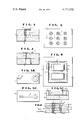
- FIG. 1 is a side view of a "dot-type" gaseous breakdown display device, said view being taken in the plane perpendicular to the line 1--1 in FIG. 2;
- FIG. 2 is a top view of several "dot-type" gaseous display devices on a single dielectric substrate;
- FIG. 3 is a side view of a line bar gaseous display device, taken in the plane perpendicular to the line 3--3 in FIG. 4;
- FIG. 4 is a top view of a line bar gaseous display device
- FIGS. 5 are views of the example.
- FIG. 6 is a cross-sectional view of a multilayer dielectric body doped with phosphors for emitting green, blue or red as used in a multicolor flat screen television display.
- the method of the present invention may involve making gaseous breakdown display devices from a single dielectric substrate having a cavity therein.
- one or more electrodes may be printed on the face of the substrate so that each runs along the face of the substrate and then into the cavity and, optionally, down the side wall of the cavity. The electrode must extend out from under the transparent face so that it may be attached to an electrical circuit.
- one or more holes may be punched in the unfired substrate such that, when filled with metallization, electrodes pass through the substrate and then lead into the cavity from the side or bottom of the cavity.
- Another preferred embodiment of the method of the present invention employs making a gaseous breakdown display device in which said device is part of a multilayer circuit board comprising a monolithic ceramic body, electrical conductors disposed in one or more layers within said body and bonded thereto, and electrical interconnecting means entirely within said body linking said conductors in different layers, said conductors and electrical interconnecting means being composed of gas-free precious metal particles sintered to said ceramic and to each other, comprising the steps of
- the metallization paste In any embodiment of the present invention employing buried metallizations in monolithic structures, the metallization paste must obviously be applied prior to sintering. Hence, the metal selected must melt at a temperature above the sintering temperature of the dielectric substrate sheet. However, where either (1) surface metallizations are employed, or (2) electrical conductor interconnecting means which are accessible from the outside of the fired monolithic structure are employed, the metallization need not have a melting point above the sintering temperature of the dielectric sheet. In the latter case, metallization pastes can be printed on the surface of, or used to fill holes in, the dielectric substrate, after firing to sinter the same; thereafter a second firing step is used to form electrically conducting printed patterns or interconnecting means on the pre-fired substrate. In any given embodiment of this process, a combination of metallizations may be employed, if so desired, as in the Example herein.
- FIG. 1 shows a side view of a gaseous breakdown display device (taken perpendicular to the line 1--1 in FIG. 2) comprising a monolithic ceramic substrate 1 made from two layers of alumina; an opening having a volume of gas 2 enclosed therein; a glass cover 3 which seals the gas in the opening in the alumina body; and excitation electrodes 4 in the shape of annular discs, the bottom electrode being buried between the alumina layers.
- the electrodes excite the gas and produce a visible glowing discharge.
- conductors 5 which are buried in the dielectric body, lead to the excitation electrodes and to the surface; these conductors can be referred to as "vias.”
- FIG. 2 there is shown a top view of nine enclosures each having an electrode structure as shown in FIG. 1; glass cover 3 is not shown.
- any numerical and/or alphabetical symbols can be produced by the gaseous discharge glow which emanates from any of the enclosures.
- this device could be used to display numerical information or alphabetical characters.
- the entire surface area over the nine cavities can be covered with a glass plate using conventional dielectric sealing techniques.
- FIG. 3 is a side view of part of a line bar display device (taken in a plane perpendicular to the line 3--3 in FIG. 4) showing glass cover 3.
- FIG. 4 is a top view of the complete line bar display device, but not showing glass cover 3. Electrodes 4 in the shape of rectangular bars are positioned in alumina body 1; gas 2 is contained in a channel within the alumina body. A glass cover may be positioned over the entire alumina body 1, or just over the line bar configuration.
- the important materials used in the method of this invention are the inorganic dielectric material and the precious metal excitation electrodes produced from metallizations applied to and fired on the dielectric body.
- a wide variety of dielectric materials may be used.
- ceramic materials consisting chiefly of alumina, steatite, zircon, aluminum silicate, zirconium dioxide, titanium dioxide, beryllium oxide, magnesium silicate, etc., and various combinations thereof, are illustrative of dielectric materials which may be employed.
- the fired-on precious metal excitation electrodes are critical and vital. If a multilayer dielectric body is utilized, the metallization used for any buried conductors must be able to be fired on and sintered compatibly with the dielectric material. The thermal expansion of the dielectric material and of the metallizations should match as closely as possible to minimize internal strains. Also, in multilayer structures the metallization should be substantially free of all dissolved, absorbed, adsorbed, or otherwise occluded gases (i.e., gas-free) to minimize bubbling, blistering and delamination during the firing of the metallized dielectric sheets. Any of the conventional precious metals may be used; these include platinum, palladium, silver, gold, alloys thereof and mixtures thereof.
- All of the metal particles should be in finely divided or powder form, that is, in the form of powders sufficiently finely divided to pass through a 325-mesh (U.S. standard sieve scale) screen.
- Suitable metallizations are disclosed in U.S. Pat. No. 3,511,640 and Ser. No. 756,394, filed Aug. 30, 1968. Molybdenum and manganese may also be used to form the electrodes, but only when non-oxidizing atmospheres can be tolerated. However, the preferred metallizations are of precious metals due to the convenience of air firing.
- the gaseous breakdown display devices of this invention are preferably made by applying precious metal compositions to an unfired dielectric body at the desired location(s); any lead-in wiring can also be supplied.
- the unfired body has a cavity into which the gas will be sealed.
- an unfired dielectric body is meant a sheet comprising finely divided ceramic particles and a temporary binder therefor.
- the gaseous breakdown display devices may be made from either one sheet or layer of unfired (unsintered) dielectric material, of from many layers thereof.
- the unfired dielectric is provided with a cavity, which after firing and enclosure with a transparent face serves as the sealed volume for the gas.
- the first step of the process involves preparing sheets each comprising finely divided ceramic particles and a temporary binder. These sheets are commonly referred to as "ceramic substrates," “green sheets,” or “tape” and are well known in the art.
- the temporary binder utilized should be of the type which can be completely removed by depolymerization, evaporation or oxidation. However, when a multilayer structure is employed, the removal should not be so rapid as to bloat or explode the laminate during the firing step.
- the binder in the film should be compatible with the binder in the metallization and both should be of the type which aid bonding during the laminating step if any.
- the binder should serve to retain the ceramic particulate in undisrupted position and facilitate the formation of dry, flexible sheets of the particulate ceramic material free of pinholes, cracks and other imperfections.
- suitable binders include polyvinyl chloride polymers, polystyrene polymers, polymethyl methacrylate resins, ethyl cellulose, cellulose acetate polymers, polyester polymers, and cellulose acetate-butyrate polymers. These binders, preferably together with a suitable solvent, may also be used in the metallizing compositions.
- the sheets may be produced by extrusion, in which case a solvent is not required. Where some other sheet-forming process is used (e.g., doctor blading), a solvent which is compatible with the binder is required. Some solvents which may be used include ethyl alcohol, isopropyl alcohol, acetone, methyl ethyl ketone, beta-terpineol and toluene. In addition, a plasticizer, a wetting agent and a deflocculant for assisting in enhancing sheet-forming characteristics, for dispersing the ceramic composition and for adjusting the viscosity of the sheet formulation are optional. Where they are used, they may be utilized in the combinations and in the quantities which are well known in the art.
- the weight ratio of ceramic dielectric composition to binder in the sheet formulation may vary between 95:5 to 60:40. Where multilayer structures are employed, the lowest proportion of binder should be used consistent with adequate bonding during the lamination step. Usually, formulations with finer particle sizes require a higher proportion of the binder.
- the sheet formulation may be mixed by any of the conventional methods, such as ball milling, roll milling, or by high speed agitation in an agitator or a homogenizer. In general, any method which produces a uniform dispersion is adequate.
- the sheet may be formed by any of the conventional methods such as by spraying the sheet formulation on a support, or screening on a support, or offset printing on a support, or by floating a low viscosity sheet formulation on an incompatible liquid, or by doctor blading. Where the sheet formulation is very viscous, the sheet may be produced by extrusion through a die onto a support. Doctor blading is the preferred method and requires a minimum amount of equipment while still providing accurate control over the sheet size and thickness which may vary to meet any specific requirements. Important process variables for doctor blading are the casting rate, rheology of the suspension, carrier and release from this carrier. Typical carrier materials are glass, steel, Mylar, Teflon, flexible belts, etc. In general, any nonreactive, flexible or rigid supporting material may be used. During sheet formation, the cavity in which the excitation gas will be sealed, may be formed.
- the sheet After the sheet is formed, it is dried, e.g. by evaporation of the solvent in air; this may be accelerated by applying heat and/or air circulation. Ovens, infrared heaters, air blowers, etc., may be used. After the drying operation, the sheet is stripped from its support. At this point, the sheet is flexible and may be easily cut into any desired shape or have portions punched therefrom. The sheets may be cut, punched or stamped to any convenient size with sufficient area to print a plurality of circuit portions thereon.
- the next step may (and in the case of multilayer structures does) involve punching holes to very close tolerances at desired locations in the sheets which have the desired configuration. Holes are punched in the sheets to produce a desired pattern for interconnection of the ultimate multilayer system. Different size and shape holes can be made to provide subsequent electrical connections throughout a stack of sheets. Following the hole punching operation, the sheets are ready to be coated with a metallizing composition to fill the holes and/or to form printed conductors, as desired.
- the step of filling the holes with a metallization paste is optional at this point in the process. If the holes are filled, the metal employed must melt at a temperature above the sintering temperature of the dielectric sheet. Generally, it is desirable to fill the holes at this point in the process since the holes are more readily accessible and the results obtained therefrom are more beneficial than when the holes are filled at any other stage of the process of this invention. In the alternative, the holes may be filled after the conductor patterns have been printed or even, in the case of laminated structures, the holes may be filled after the laminating step. If the holes are filled after the conductor patterns have been printed, there is a tendency to disrupt the conductor patterns by the rubbing action of squeegee blade and the screen contact if this printing technique is used. In any event, the exact sequence in steps as to filling the holes is not critical but it is desirable to fill the holes before any other printing operations are performed.
- the metallization which forms the excitation electrodes (and buried conductors if any) may be applied to the substrate by any of the known printing or stenciling techniques.
- a stencil may be pressed against a surface of the dielectric body and the metallizing composition sprayed or brushed into the uncovered portions of the dielectric body.
- the metallizing pattern may be produced by offset printing upon the body.
- the pattern is produced by screen stenciling techniques. The spacing between electrodes is determined by the thickness of the dielectric layers.
- the metallization is dried. If a multilayer structure is involved, after producing a metallized pattern on one or more ceramic sheets, the sheets are stacked in the proper registry with respect to one another and bonded into a monolithic laminate.
- the ceramic composition in the various sheets may be the same or may differ from layer to layer. Thus, in the laminate produced, different ceramic compositions may be used to obtain desired combinations of physical, chemical or electrical properties.
- the metallizing composition may be the same or may differ in composition or in configuration from sheet to sheet.
- the stack of sheets is bonded together into a laminate by any of the conventional techniques. The action of heat, pressure or solvent vapors, or any combination of these techniques may be used.
- solvent vapors can be used to soften the stack of films.
- the stack may be placed in a desiccator and subjected to solvent vapors.
- the solvent can be any solvent which will soften the ceramic sheet. By subjecting the stack of sheets to this solvent vapor action, the sheets become softened and are more readily laminated when the final pressure is applied. Also, the well known heat and pressure techniques are adaptable.
- the next step involves sintering in the usual manner for ceramic articles by heating for the desired time and at the desired temperatures.
- the choice of sintering time and sintering temperature depends on the particular ceramic composition and the particular article being sintered. It is important to appreciate that this step is carried out to remove the binders, complete any chemical reactions, densify the structure, complete the bonds between phases, control the grain and pore sizes, and establish the residual stresses.
- the metallized substrate is first heated at a lower temperature, preferably between 200° C. and 600° C. in air until the binders are volatized. Then the temperature is raised to a higher range, preferably between 1000° C. and 1750° C. until the particles are sintered.
- This sintered article is cooled and removed from the furnace.
- the sintered article may be cut into units if device blanks have not previously been cut. Thereby there is produced a monolithic dielectric structure comprising the excitation electrodes and any desired lead-in wiring.
- Any desirable gas such as neon, argon, air, helium, keypton, xenon, or a mixture thereof is then placed at the desired pressure in the designated channel or cavity within the dielectric body.
- the cavity can be of any desirable configuration depending on the characteristic gaseous discharge to be produced.
- a transparent face is then placed over the cavity to seal the gas within the dielectric body.
- Any suitable transparent material such as glass, polished alumina, etc., may be utilized provided, it can be made to adhere to the dielectric using suitable interfacing adhesives such as epoxies and glass frits. It is, of course, necessary that the covering which seals in the gas be transparent so that the glowing gas can be seen.
- the novel concept of this invention lies in the use of fired-on precious metal excitation electrodes and a dielectric body; both may be fired simultaneously in an oxidizing atmosphere during the manufacture.
- a hermetically sealed device capable of operating at high electric current densities, and consequently higher light output.
- the heat generated by this device can be efficiently dissipated because of the high thermal conductivity of the device materials.
- the device structure is compact (miniaturized) and can be "plugged" in as a complete unit.
- the drive circuitry for performing the logic functions of operating the display can be an integral part of the device structure. That is, the resistors, conductors and capacitors could be screen-printed and air fired on the dielectric structure and active elements attached to the dielectric structures.
- a multicolor flat-screen television display as shown in FIG. 6, can be produced according to this process.
- Various layers C, B and R of a multilayer dielectric body MDB are doped with phosphors that emit green, blue or red when bombarded by electrons and photons.
- phosphors that emit green, blue or red when bombarded by electrons and photons.
- a local gas discharge occurs in the channel or cavity between two excitation electrodes.
- the gaseous discharge causes the appropriate color to be excited.
- An observer viewing the discharge through the television face-plate sees a color which is the sum of the colors which are discharged in the channel (space).
- a matrix of such channels form a display whereby pictures or alphanumeric characters are produced.
- a flat, thin display device can be produced for applications where portability or limited space are important.
- a dielectric sheet was first prepared with the ingredients listed below in the following proportions by weight:
- the above ingredients were introduced into ball mill and milled for a period of four hours.
- the milled material was emptied into a container which was then placed in a vacuum chamber to remove air bubbles.
- a sheet was then prepared by pouring a sufficient quantity of the ceramic slurry onto a glass plate.
- a steel doctor blade was passed across the surface of the plate to provide a sheet having the desired thickness; in this case the sheet had a thickness of about 20 mils.
- the sheet was dried in ambient air for a period of two hours. The resultant dried sheet was flexible and able to be stripped from the glass substrate. Two rectangular portions (1 inch by 1 inch) were punched from the dried sheet.
- the rectangular sheets are hereinafter referred to as sheets 1 and 6, respectively.
- FIGS. 5A and 5B Two cylindrical holes 8 and 9 were then punched through sheet 1, about 10 mm. apart. Hole 8, to be filled with conductor metallization, was about 1/2-3/4 mm. in diameter; hole 9, the gas cavity was about 1/2-3/4 mm. in diameter.
- a platinum composition was then printed on the top of sheet 6 as conductor line 5 running from the point of sheet 6 where conductor via 8 will contact sheet 6 upon lamination of sheets 1 and 6, across the surface of sheet 6 and terminating in an open ring of metallization centered just under the spot where hole (gas cavity) 9 will contact sheet 6 upon lamination of sheets 1 and 6, each after the various metallization and firing steps have been completed.
- FIGS. 5A and 5B Two cylindrical holes 8 and 9 were then punched through sheet 1, about 10 mm. apart. Hole 8, to be filled with conductor metallization, was about 1/2-3/4 mm. in diameter; hole 9, the gas cavity was about 1/2-3/4 mm. in diameter.
- a platinum composition was then printed on the top of sheet 6 as conduct
- the platinum metallization used was a paste comprising four parts of gas-free platinum powder and one part temporary binder (8% ethyl cellulose and 92% beta-terpineol) as disclosed in Example 1 of U.S. Pat. No. 3,511,640.
- Ceramic sheet 1 was then stacked on metallized sheet 6 as indicated. Then the stack was subjected to a compaction force of approximately 10,000 pounds per square inch for 15 seconds. The pressure was removed and the laminate was ready for firing to produce a sintered structure. This was accomplished by placing the laminate in an ambient oven and heated slowly to a temperature of 600° C. over a period of 4 hours, until the organic vehicle system had been removed from the laminate. Then the temperature was raised rapidly to 1650° C. and held there for about 1 hour. During this time, the constituents of the ceramic dielectric composition and the particles of metal sintered into a multilayer monolithic ceramic body. The dimensional ratio of the green, unfired laminate to fired sintered structure was 1:2.
- Hole 8 was then filled with a silver composition; the silver composition was printed on the top of sheet 1 as conductors 7 and 10.
- the silver metallization composition comprised about 62% silver with an average particle size of about 1 micron; about 2% of cadmium sodium boroaluminosilicate glass frit with an average particle size of about 5 microns; about 9% free bismuth oxide; and about 26% inert liquid vehicle.
- FIG. 5C is a cross-sectional view of the resultant fired metallized stack, taken in the plane perpendicular to the center line of conductor 5 in FIG. 5B.
- the gas cavity was then filled with air at a pressure of about 12-20 cm. of mercury at 25° C. and hermetically sealed with a glass plate using an epoxy adhesive.
- Conductors 7 and 10 were then connected to a 0 to 1000 volt d.c. power supply through a 30 Kohm. resistor. Voltage was applied and gradually increased until a glow discharge occurred at about 460-500 volts d.c. The discharge continued at that voltage for 1000 hours without discernible degradation of the electrodes or diminution in discharge intensity
Landscapes
- Gas-Filled Discharge Tubes (AREA)
Abstract
A gaseous breakdown display device is disclosed capable of producing a chromatic picture or display pattern. This is accomplished by a selective excitation of electrodes associated with dielectric sheets containing phosphors capable of emitting the primary colors. Also disclosed is a dot matrix display device capable of producing an alphanumerical display device.
Description
This application is a divisional of my co-pending application Ser. No. 428,676 filed Dec. 27, 1973, now abandoned, which in turn is a divisional of Ser. No. 352,471 filed Apr. 18, 1973, now U.S. Pat. No. 3,788,722 which in turn is a continuation of application Ser. No. 83,387 filed Oct. 23, 1970, now abandoned, which in turn is a continuation-in-part of my application Ser. No. 819,555 filed Apr. 28, 1969, now abandoned.
This invention relates to gaseous breakdown display devices, and more particularly, to a novel method for making the same.
Due to the materials of construction and methods of producing such devices, prior art devices have not been capable of providing a high light output. The intense heat generated by gaseous discharge can harm the components of the device since the heat is enclosed in a small volume. The present invention (1) overcomes these deficiencies by providing a process which utilizes materials which are capable of operating at high power levels in confined volumes and (2) which requires only a single firing step where metals which mill above the sintering temperature of the substrate are employed.
This invention relates to a method for making a gaseous breakdown display device, which device comprises an inorganic dielectric body having precious metal excitation electrodes, a gas which has a high optical output under gaseous discharge conditions and a transparent face. In the device the gas is contained within a sealed volume between the transparent face and the dielectric body, and the excitation electrodes are positioned in the dielectric body to excite the gas when an electrical potential is applied to the electrodes. The inventive method comprises the steps of
(a) preparing an unsintered sheet having a cavity for the gas, said sheet comprising finely divided ceramic particles and a temporary binder therefor,
(b) applying a paste to said sheet in at least part of the desired electrode configuration, said paste comprising precious metal particles and a temporary binder therefor, said precious metal particles having a melting point above the temperature at which the sheet sinters,
(c) sintering the substrate with applied paste for a time and at a temperature sufficient to violatilize the temporary binders and to sinter said ceramic particles and said metal particles into a monolithic structure, wherein the metal particles form electrical conductors,
(d) filling the cavity with said gas and
(e) enclosing the cavity with the transparent face.
FIG. 1 is a side view of a "dot-type" gaseous breakdown display device, said view being taken in the plane perpendicular to the line 1--1 in FIG. 2;
FIG. 2 is a top view of several "dot-type" gaseous display devices on a single dielectric substrate;
FIG. 3 is a side view of a line bar gaseous display device, taken in the plane perpendicular to the line 3--3 in FIG. 4;
FIG. 4 is a top view of a line bar gaseous display device;
FIGS. 5 are views of the example; and
FIG. 6 is a cross-sectional view of a multilayer dielectric body doped with phosphors for emitting green, blue or red as used in a multicolor flat screen television display.
As indicated in the Summary of the Invention, the method of the present invention may involve making gaseous breakdown display devices from a single dielectric substrate having a cavity therein. In that embodiment, one or more electrodes may be printed on the face of the substrate so that each runs along the face of the substrate and then into the cavity and, optionally, down the side wall of the cavity. The electrode must extend out from under the transparent face so that it may be attached to an electrical circuit. Alternately, one or more holes may be punched in the unfired substrate such that, when filled with metallization, electrodes pass through the substrate and then lead into the cavity from the side or bottom of the cavity.
Another preferred embodiment of the method of the present invention employs making a gaseous breakdown display device in which said device is part of a multilayer circuit board comprising a monolithic ceramic body, electrical conductors disposed in one or more layers within said body and bonded thereto, and electrical interconnecting means entirely within said body linking said conductors in different layers, said conductors and electrical interconnecting means being composed of gas-free precious metal particles sintered to said ceramic and to each other, comprising the steps of
(a) preparing a plurality of said sheets, one of said sheets having a cavity for said gas,
(b) forming holes for said interconnecting means at desired locations in at least one of said sheets,
(c) filling said holes with paste comprising gas-free precious metal particles and a temporary binder therefor,
(d) printing the paste on selected areas of at least one of said sheets in the desired printed conductor configuration,
(e) assembling said sheets in a stack such that the printed conductors and filled conductor holes are in a desired relationship and such that the cavity for said gas is in the top of the uppermost layer of the stack,
(f) bonding the stacked sheets into a laminate,
(g) sintering as above,
(h) filling the cavity with said gas and
(i) sealing the cavity with the transparent face.
In any embodiment of the present invention employing buried metallizations in monolithic structures, the metallization paste must obviously be applied prior to sintering. Hence, the metal selected must melt at a temperature above the sintering temperature of the dielectric substrate sheet. However, where either (1) surface metallizations are employed, or (2) electrical conductor interconnecting means which are accessible from the outside of the fired monolithic structure are employed, the metallization need not have a melting point above the sintering temperature of the dielectric sheet. In the latter case, metallization pastes can be printed on the surface of, or used to fill holes in, the dielectric substrate, after firing to sinter the same; thereafter a second firing step is used to form electrically conducting printed patterns or interconnecting means on the pre-fired substrate. In any given embodiment of this process, a combination of metallizations may be employed, if so desired, as in the Example herein.
A more complete understanding of the devices produced by the present invention can be made from a study of the drawings. FIG. 1 shows a side view of a gaseous breakdown display device (taken perpendicular to the line 1--1 in FIG. 2) comprising a monolithic ceramic substrate 1 made from two layers of alumina; an opening having a volume of gas 2 enclosed therein; a glass cover 3 which seals the gas in the opening in the alumina body; and excitation electrodes 4 in the shape of annular discs, the bottom electrode being buried between the alumina layers. When an electric potential is applied to the conductors 5, the electrodes excite the gas and produce a visible glowing discharge. It is pointed out that conductors 5, which are buried in the dielectric body, lead to the excitation electrodes and to the surface; these conductors can be referred to as "vias."
In FIG. 2, there is shown a top view of nine enclosures each having an electrode structure as shown in FIG. 1; glass cover 3 is not shown. By using a plurality of these enclosures and the proper electrical excitation, any numerical and/or alphabetical symbols can be produced by the gaseous discharge glow which emanates from any of the enclosures. Thus, this device could be used to display numerical information or alphabetical characters. Furthermore, in lieu of an individual glass cover over each cavity, the entire surface area over the nine cavities can be covered with a glass plate using conventional dielectric sealing techniques.
FIG. 3 is a side view of part of a line bar display device (taken in a plane perpendicular to the line 3--3 in FIG. 4) showing glass cover 3. FIG. 4 is a top view of the complete line bar display device, but not showing glass cover 3. Electrodes 4 in the shape of rectangular bars are positioned in alumina body 1; gas 2 is contained in a channel within the alumina body. A glass cover may be positioned over the entire alumina body 1, or just over the line bar configuration.
The important materials used in the method of this invention are the inorganic dielectric material and the precious metal excitation electrodes produced from metallizations applied to and fired on the dielectric body. A wide variety of dielectric materials may be used. For example, ceramic materials consisting chiefly of alumina, steatite, zircon, aluminum silicate, zirconium dioxide, titanium dioxide, beryllium oxide, magnesium silicate, etc., and various combinations thereof, are illustrative of dielectric materials which may be employed.
The fired-on precious metal excitation electrodes are critical and vital. If a multilayer dielectric body is utilized, the metallization used for any buried conductors must be able to be fired on and sintered compatibly with the dielectric material. The thermal expansion of the dielectric material and of the metallizations should match as closely as possible to minimize internal strains. Also, in multilayer structures the metallization should be substantially free of all dissolved, absorbed, adsorbed, or otherwise occluded gases (i.e., gas-free) to minimize bubbling, blistering and delamination during the firing of the metallized dielectric sheets. Any of the conventional precious metals may be used; these include platinum, palladium, silver, gold, alloys thereof and mixtures thereof. All of the metal particles should be in finely divided or powder form, that is, in the form of powders sufficiently finely divided to pass through a 325-mesh (U.S. standard sieve scale) screen. Suitable metallizations are disclosed in U.S. Pat. No. 3,511,640 and Ser. No. 756,394, filed Aug. 30, 1968. Molybdenum and manganese may also be used to form the electrodes, but only when non-oxidizing atmospheres can be tolerated. However, the preferred metallizations are of precious metals due to the convenience of air firing.
The gaseous breakdown display devices of this invention are preferably made by applying precious metal compositions to an unfired dielectric body at the desired location(s); any lead-in wiring can also be supplied. The unfired body has a cavity into which the gas will be sealed. By an unfired dielectric body is meant a sheet comprising finely divided ceramic particles and a temporary binder therefor.
According to the method of this invention, the gaseous breakdown display devices may be made from either one sheet or layer of unfired (unsintered) dielectric material, of from many layers thereof. In either embodiment the unfired dielectric is provided with a cavity, which after firing and enclosure with a transparent face serves as the sealed volume for the gas.
The first step of the process involves preparing sheets each comprising finely divided ceramic particles and a temporary binder. These sheets are commonly referred to as "ceramic substrates," "green sheets," or "tape" and are well known in the art. The temporary binder utilized should be of the type which can be completely removed by depolymerization, evaporation or oxidation. However, when a multilayer structure is employed, the removal should not be so rapid as to bloat or explode the laminate during the firing step. The binder in the film should be compatible with the binder in the metallization and both should be of the type which aid bonding during the laminating step if any. Also, the binder should serve to retain the ceramic particulate in undisrupted position and facilitate the formation of dry, flexible sheets of the particulate ceramic material free of pinholes, cracks and other imperfections. Some suitable binders include polyvinyl chloride polymers, polystyrene polymers, polymethyl methacrylate resins, ethyl cellulose, cellulose acetate polymers, polyester polymers, and cellulose acetate-butyrate polymers. These binders, preferably together with a suitable solvent, may also be used in the metallizing compositions.
The sheets may be produced by extrusion, in which case a solvent is not required. Where some other sheet-forming process is used (e.g., doctor blading), a solvent which is compatible with the binder is required. Some solvents which may be used include ethyl alcohol, isopropyl alcohol, acetone, methyl ethyl ketone, beta-terpineol and toluene. In addition, a plasticizer, a wetting agent and a deflocculant for assisting in enhancing sheet-forming characteristics, for dispersing the ceramic composition and for adjusting the viscosity of the sheet formulation are optional. Where they are used, they may be utilized in the combinations and in the quantities which are well known in the art.
The weight ratio of ceramic dielectric composition to binder in the sheet formulation may vary between 95:5 to 60:40. Where multilayer structures are employed, the lowest proportion of binder should be used consistent with adequate bonding during the lamination step. Usually, formulations with finer particle sizes require a higher proportion of the binder. The sheet formulation may be mixed by any of the conventional methods, such as ball milling, roll milling, or by high speed agitation in an agitator or a homogenizer. In general, any method which produces a uniform dispersion is adequate.
The sheet may be formed by any of the conventional methods such as by spraying the sheet formulation on a support, or screening on a support, or offset printing on a support, or by floating a low viscosity sheet formulation on an incompatible liquid, or by doctor blading. Where the sheet formulation is very viscous, the sheet may be produced by extrusion through a die onto a support. Doctor blading is the preferred method and requires a minimum amount of equipment while still providing accurate control over the sheet size and thickness which may vary to meet any specific requirements. Important process variables for doctor blading are the casting rate, rheology of the suspension, carrier and release from this carrier. Typical carrier materials are glass, steel, Mylar, Teflon, flexible belts, etc. In general, any nonreactive, flexible or rigid supporting material may be used. During sheet formation, the cavity in which the excitation gas will be sealed, may be formed.
After the sheet is formed, it is dried, e.g. by evaporation of the solvent in air; this may be accelerated by applying heat and/or air circulation. Ovens, infrared heaters, air blowers, etc., may be used. After the drying operation, the sheet is stripped from its support. At this point, the sheet is flexible and may be easily cut into any desired shape or have portions punched therefrom. The sheets may be cut, punched or stamped to any convenient size with sufficient area to print a plurality of circuit portions thereon.
The next step may (and in the case of multilayer structures does) involve punching holes to very close tolerances at desired locations in the sheets which have the desired configuration. Holes are punched in the sheets to produce a desired pattern for interconnection of the ultimate multilayer system. Different size and shape holes can be made to provide subsequent electrical connections throughout a stack of sheets. Following the hole punching operation, the sheets are ready to be coated with a metallizing composition to fill the holes and/or to form printed conductors, as desired.
The step of filling the holes with a metallization paste is optional at this point in the process. If the holes are filled, the metal employed must melt at a temperature above the sintering temperature of the dielectric sheet. Generally, it is desirable to fill the holes at this point in the process since the holes are more readily accessible and the results obtained therefrom are more beneficial than when the holes are filled at any other stage of the process of this invention. In the alternative, the holes may be filled after the conductor patterns have been printed or even, in the case of laminated structures, the holes may be filled after the laminating step. If the holes are filled after the conductor patterns have been printed, there is a tendency to disrupt the conductor patterns by the rubbing action of squeegee blade and the screen contact if this printing technique is used. In any event, the exact sequence in steps as to filling the holes is not critical but it is desirable to fill the holes before any other printing operations are performed.
The metallization which forms the excitation electrodes (and buried conductors if any) may be applied to the substrate by any of the known printing or stenciling techniques. Thus, a stencil may be pressed against a surface of the dielectric body and the metallizing composition sprayed or brushed into the uncovered portions of the dielectric body. On the other hand, the metallizing pattern may be produced by offset printing upon the body. Preferably, the pattern is produced by screen stenciling techniques. The spacing between electrodes is determined by the thickness of the dielectric layers.
Following application, the metallization is dried. If a multilayer structure is involved, after producing a metallized pattern on one or more ceramic sheets, the sheets are stacked in the proper registry with respect to one another and bonded into a monolithic laminate. The ceramic composition in the various sheets may be the same or may differ from layer to layer. Thus, in the laminate produced, different ceramic compositions may be used to obtain desired combinations of physical, chemical or electrical properties. Also, the metallizing composition may be the same or may differ in composition or in configuration from sheet to sheet. The stack of sheets is bonded together into a laminate by any of the conventional techniques. The action of heat, pressure or solvent vapors, or any combination of these techniques may be used. While the action of pressure alone has been found to be adequate, solvent vapors can be used to soften the stack of films. For example, the stack may be placed in a desiccator and subjected to solvent vapors. The solvent can be any solvent which will soften the ceramic sheet. By subjecting the stack of sheets to this solvent vapor action, the sheets become softened and are more readily laminated when the final pressure is applied. Also, the well known heat and pressure techniques are adaptable.
The next step involves sintering in the usual manner for ceramic articles by heating for the desired time and at the desired temperatures. The choice of sintering time and sintering temperature depends on the particular ceramic composition and the particular article being sintered. It is important to appreciate that this step is carried out to remove the binders, complete any chemical reactions, densify the structure, complete the bonds between phases, control the grain and pore sizes, and establish the residual stresses. To achieve this end, the metallized substrate is first heated at a lower temperature, preferably between 200° C. and 600° C. in air until the binders are volatized. Then the temperature is raised to a higher range, preferably between 1000° C. and 1750° C. until the particles are sintered. This sintered article is cooled and removed from the furnace. The sintered article may be cut into units if device blanks have not previously been cut. Thereby there is produced a monolithic dielectric structure comprising the excitation electrodes and any desired lead-in wiring.
Any desirable gas, such as neon, argon, air, helium, keypton, xenon, or a mixture thereof is then placed at the desired pressure in the designated channel or cavity within the dielectric body. The cavity can be of any desirable configuration depending on the characteristic gaseous discharge to be produced.
A transparent face is then placed over the cavity to seal the gas within the dielectric body. Any suitable transparent material such as glass, polished alumina, etc., may be utilized provided, it can be made to adhere to the dielectric using suitable interfacing adhesives such as epoxies and glass frits. It is, of course, necessary that the covering which seals in the gas be transparent so that the glowing gas can be seen.
The novel concept of this invention lies in the use of fired-on precious metal excitation electrodes and a dielectric body; both may be fired simultaneously in an oxidizing atmosphere during the manufacture. In any event there is produced a hermetically sealed device capable of operating at high electric current densities, and consequently higher light output. The heat generated by this device can be efficiently dissipated because of the high thermal conductivity of the device materials. The device structure is compact (miniaturized) and can be "plugged" in as a complete unit. The drive circuitry for performing the logic functions of operating the display can be an integral part of the device structure. That is, the resistors, conductors and capacitors could be screen-printed and air fired on the dielectric structure and active elements attached to the dielectric structures.
Other modifications of this invention include gaseous display devices wherein the drive circuitry is entirely incorporated as part of the dielectric and circuitry on the outside of the dielectric body is hermetically sealed with a can or other appropriate cover; lead pins are positioned for external connection. Also, multilayer circuit boards comprising a monolithic ceramic body and interconnecting means, such as described in Ser. No. 806,256, filed Mar. 11, 1969, may be part of the display device and/or contain the display device.
In another embodiment, a multicolor flat-screen television display, as shown in FIG. 6, can be produced according to this process. Various layers C, B and R of a multilayer dielectric body MDB are doped with phosphors that emit green, blue or red when bombarded by electrons and photons. By means of the appropriate excitation electrodes, a local gas discharge occurs in the channel or cavity between two excitation electrodes. The gaseous discharge causes the appropriate color to be excited. An observer viewing the discharge through the television face-plate (screen, not shown in FIG. 6) sees a color which is the sum of the colors which are discharged in the channel (space). A matrix of such channels form a display whereby pictures or alphanumeric characters are produced. Thus, a flat, thin display device can be produced for applications where portability or limited space are important.
A preferred method of making the device in accordance with this invention is described in the Example, wherein all percentages and parts are by weight.
A dielectric sheet was first prepared with the ingredients listed below in the following proportions by weight:
190 grams powdered alumina
10 grams powdered talc
7.7 grams heat volatile binders (polymethyl methacrylate)
11.6 grams plasticizer (polyvinylacetate)
3.2 cc. wetting agent (butylcellosolve)
11.6 cc. release agent (Carbowax 200)
150 cc. solvent (trichloroethylene)
The above ingredients were introduced into ball mill and milled for a period of four hours. When milling was completed, the milled material was emptied into a container which was then placed in a vacuum chamber to remove air bubbles. A sheet was then prepared by pouring a sufficient quantity of the ceramic slurry onto a glass plate. A steel doctor blade was passed across the surface of the plate to provide a sheet having the desired thickness; in this case the sheet had a thickness of about 20 mils. The sheet was dried in ambient air for a period of two hours. The resultant dried sheet was flexible and able to be stripped from the glass substrate. Two rectangular portions (1 inch by 1 inch) were punched from the dried sheet. The rectangular sheets are hereinafter referred to as sheets 1 and 6, respectively. Two cylindrical holes 8 and 9 were then punched through sheet 1, about 10 mm. apart. Hole 8, to be filled with conductor metallization, was about 1/2-3/4 mm. in diameter; hole 9, the gas cavity was about 1/2-3/4 mm. in diameter. A platinum composition was then printed on the top of sheet 6 as conductor line 5 running from the point of sheet 6 where conductor via 8 will contact sheet 6 upon lamination of sheets 1 and 6, across the surface of sheet 6 and terminating in an open ring of metallization centered just under the spot where hole (gas cavity) 9 will contact sheet 6 upon lamination of sheets 1 and 6, each after the various metallization and firing steps have been completed. The disposition of metallization 5 and holes 8 and 9 on sheets 1 and 6 are shown in FIGS. 5A and 5B, respectively, which are overhead views of sheets 1 and 6, respectively.
The platinum metallization used was a paste comprising four parts of gas-free platinum powder and one part temporary binder (8% ethyl cellulose and 92% beta-terpineol) as disclosed in Example 1 of U.S. Pat. No. 3,511,640.
Ceramic sheet 1 was then stacked on metallized sheet 6 as indicated. Then the stack was subjected to a compaction force of approximately 10,000 pounds per square inch for 15 seconds. The pressure was removed and the laminate was ready for firing to produce a sintered structure. This was accomplished by placing the laminate in an ambient oven and heated slowly to a temperature of 600° C. over a period of 4 hours, until the organic vehicle system had been removed from the laminate. Then the temperature was raised rapidly to 1650° C. and held there for about 1 hour. During this time, the constituents of the ceramic dielectric composition and the particles of metal sintered into a multilayer monolithic ceramic body. The dimensional ratio of the green, unfired laminate to fired sintered structure was 1:2.
Hole 8 was then filled with a silver composition; the silver composition was printed on the top of sheet 1 as conductors 7 and 10. The silver metallization composition comprised about 62% silver with an average particle size of about 1 micron; about 2% of cadmium sodium boroaluminosilicate glass frit with an average particle size of about 5 microns; about 9% free bismuth oxide; and about 26% inert liquid vehicle.
The fired substrate and silver metallizations were then refired at 760° C. for about 10 minutes to form conductive silver electrodes. FIG. 5C is a cross-sectional view of the resultant fired metallized stack, taken in the plane perpendicular to the center line of conductor 5 in FIG. 5B.
The gas cavity was then filled with air at a pressure of about 12-20 cm. of mercury at 25° C. and hermetically sealed with a glass plate using an epoxy adhesive. Conductors 7 and 10 were then connected to a 0 to 1000 volt d.c. power supply through a 30 Kohm. resistor. Voltage was applied and gradually increased until a glow discharge occurred at about 460-500 volts d.c. The discharge continued at that voltage for 1000 hours without discernible degradation of the electrodes or diminution in discharge intensity
Since it is obvious that many changes and modifications can be made in the above-described details without departing from the nature and spirit of the invention, it is to be understood that the invention is not to be limited to said details except as set forth in the appended claims.
Claims (3)
1. A dot matrix gas discharge display device containing:
(a) an inorganic dielectric support substrate;
(b) a plurality of first fired on precious metal electrodes deposited and fired on said substrate;
(c) a plurality of second fired on precious metal electrodes spaced from and aligned with said first electrodes;
(d) a dielectric layer between at least a portion of said first and second fired on precious metal electrodes electrically isolating one from the other, said dielectric layer containing cavities filled with a gas to be ionized by at least a portion of one of each of said first and second electrodes, said plurality of second electrodes being fired on said dielectric layer;
(e) each of said cavities containing said gas capable of producing a visible glowing discharge when a potential is applied across said first and second fired on precious electrodes;
(f) said fired on precious metal electrodes arranged in a pattern and connected by conductors to a source of electrical operating potential whereby they may be selectively energized to produce a visual display;
said inorganic dielectric support substrate and dielectric layer constituting a monolithic dielectric body with said electrodes and conductors bonded therein, and
(g) a transparent cover means maintaining the gas in said cavities.
2. The display device of claim 1 wherein a conductor connecting said first fired on precious metal electrode to a source of electric operating potential is fired on said inorganic dielectric support substrate and another conductor connecting said second fired on precious metal electrode to said source of electrical operating potential is fired on a surface of said dielectric layer.
3. A gas discharge information display device comprising in combination,
a common dielectric substrate having at least one planar surface,
a plurality of pairs of coplanar line bar electrodes on said at least one planar surface of said common dielectric substrate and conductors for connecting said electrodes to a source of operating potential, each said pair of line bar electrodes defining a specific portion of an information display when discharge potentials are applied to the pair of line bar electrodes, said line bar electrodes being a fired on precious metal,
a dielectric layer bonded to said at least one planar surface of said common dielectric substrate and to a portion of each said line bar electrodes, the remaining uncoated portion of said line bar electrodes having regions adapted to be exposed to and contact a gaseous medium,
a gaseous medium in the regions between the gas contacting portions of each electrode of coplanar line bar electrode pairs, respectively, and
means confining said gaseous medium to said regions.
Priority Applications (1)
| Application Number | Priority Date | Filing Date | Title |
|---|---|---|---|
| US05/497,747 US4171502A (en) | 1970-10-23 | 1974-08-15 | Gaseous breakdown display device |
Applications Claiming Priority (2)
| Application Number | Priority Date | Filing Date | Title |
|---|---|---|---|
| US8338770A | 1970-10-23 | 1970-10-23 | |
| US05/497,747 US4171502A (en) | 1970-10-23 | 1974-08-15 | Gaseous breakdown display device |
Related Parent Applications (1)
| Application Number | Title | Priority Date | Filing Date |
|---|---|---|---|
| US05428676 Division | 1973-12-27 |
Publications (1)
| Publication Number | Publication Date |
|---|---|
| US4171502A true US4171502A (en) | 1979-10-16 |
Family
ID=26769235
Family Applications (1)
| Application Number | Title | Priority Date | Filing Date |
|---|---|---|---|
| US05/497,747 Expired - Lifetime US4171502A (en) | 1970-10-23 | 1974-08-15 | Gaseous breakdown display device |
Country Status (1)
| Country | Link |
|---|---|
| US (1) | US4171502A (en) |
Cited By (1)
| Publication number | Priority date | Publication date | Assignee | Title |
|---|---|---|---|---|
| US20170186680A1 (en) * | 2014-05-28 | 2017-06-29 | Ngk Spark Plug Co., Ltd. | Wiring substrate |
Citations (12)
| Publication number | Priority date | Publication date | Assignee | Title |
|---|---|---|---|---|
| US2030440A (en) * | 1934-01-03 | 1936-02-11 | Gen Electric | Manufacture of fabricated glass articles |
| US2405089A (en) * | 1943-09-03 | 1946-07-30 | Invex Inc | Gaseous discharge device |
| US2858480A (en) * | 1955-05-02 | 1958-10-28 | Shadowitz Albert | Self-luminous screen, television receiving system and display system |
| US2933648A (en) * | 1956-08-14 | 1960-04-19 | Gen Electric | Information display apparatus |
| US3260880A (en) * | 1961-06-06 | 1966-07-12 | Burroughs Corp | Electro-optical indicator devices with multiple anodes for each cell |
| US3334269A (en) * | 1964-07-28 | 1967-08-01 | Itt | Character display panel having a plurality of glow discharge cavities including resistive ballast means exposed to the glow discharge therein |
| US3363134A (en) * | 1965-12-08 | 1968-01-09 | Gen Electric | Arc discharge lamp having polycrystalline ceramic arc tube |
| US3479547A (en) * | 1966-11-22 | 1969-11-18 | Philips Corp | Device having a glow-discharge indicator tube for reproducing signs and glow-discharge tube for use in such a device |
| US3538371A (en) * | 1968-06-04 | 1970-11-03 | Fairchild Camera Instr Co | Glow discharge display device with suppressor plate |
| US3588571A (en) * | 1967-07-07 | 1971-06-28 | Sony Corp | Gaseous glow indicator tube formed on a substrate with a plurality of insulating layers |
| US3701918A (en) * | 1968-08-29 | 1972-10-31 | Philips Corp | Gaseous-flow, discharge display device with an array of hollow cathodes |
| US3743879A (en) * | 1970-12-31 | 1973-07-03 | Burroughs Corp | Cold cathode display panel having a multiplicity of gas cells |
-
1974
- 1974-08-15 US US05/497,747 patent/US4171502A/en not_active Expired - Lifetime
Patent Citations (12)
| Publication number | Priority date | Publication date | Assignee | Title |
|---|---|---|---|---|
| US2030440A (en) * | 1934-01-03 | 1936-02-11 | Gen Electric | Manufacture of fabricated glass articles |
| US2405089A (en) * | 1943-09-03 | 1946-07-30 | Invex Inc | Gaseous discharge device |
| US2858480A (en) * | 1955-05-02 | 1958-10-28 | Shadowitz Albert | Self-luminous screen, television receiving system and display system |
| US2933648A (en) * | 1956-08-14 | 1960-04-19 | Gen Electric | Information display apparatus |
| US3260880A (en) * | 1961-06-06 | 1966-07-12 | Burroughs Corp | Electro-optical indicator devices with multiple anodes for each cell |
| US3334269A (en) * | 1964-07-28 | 1967-08-01 | Itt | Character display panel having a plurality of glow discharge cavities including resistive ballast means exposed to the glow discharge therein |
| US3363134A (en) * | 1965-12-08 | 1968-01-09 | Gen Electric | Arc discharge lamp having polycrystalline ceramic arc tube |
| US3479547A (en) * | 1966-11-22 | 1969-11-18 | Philips Corp | Device having a glow-discharge indicator tube for reproducing signs and glow-discharge tube for use in such a device |
| US3588571A (en) * | 1967-07-07 | 1971-06-28 | Sony Corp | Gaseous glow indicator tube formed on a substrate with a plurality of insulating layers |
| US3538371A (en) * | 1968-06-04 | 1970-11-03 | Fairchild Camera Instr Co | Glow discharge display device with suppressor plate |
| US3701918A (en) * | 1968-08-29 | 1972-10-31 | Philips Corp | Gaseous-flow, discharge display device with an array of hollow cathodes |
| US3743879A (en) * | 1970-12-31 | 1973-07-03 | Burroughs Corp | Cold cathode display panel having a multiplicity of gas cells |
Cited By (2)
| Publication number | Priority date | Publication date | Assignee | Title |
|---|---|---|---|---|
| US20170186680A1 (en) * | 2014-05-28 | 2017-06-29 | Ngk Spark Plug Co., Ltd. | Wiring substrate |
| US9881861B2 (en) * | 2014-05-28 | 2018-01-30 | Ngk Spark Plug Co., Ltd. | Wiring substrate |
Similar Documents
| Publication | Publication Date | Title |
|---|---|---|
| US5747931A (en) | Plasma display and method of making same | |
| US3189978A (en) | Method of making multilayer circuits | |
| US4109377A (en) | Method for preparing a multilayer ceramic | |
| US4766027A (en) | Method for making a ceramic multilayer structure having internal copper conductors | |
| US3838204A (en) | Multilayer circuits | |
| US4024629A (en) | Fabrication techniques for multilayer ceramic modules | |
| US5283104A (en) | Via paste compositions and use thereof to form conductive vias in circuitized ceramic substrates | |
| KR100662132B1 (en) | Embossed Plasma Display Back Panel | |
| KR940002284B1 (en) | Micro-electronics devices | |
| JP3226280B2 (en) | Method for manufacturing multilayer circuit board | |
| US5661882A (en) | Method of integrating electronic components into electronic circuit structures made using LTCC tape | |
| JP3583144B2 (en) | Plasma display and method of manufacturing the same | |
| EP0285873A2 (en) | Method of producing a multi-layered ceramic capacitor | |
| KR100304888B1 (en) | back panel and ceramic green tape for a plasma display device and method therof | |
| JPH0369189A (en) | Manufacture of thick film device | |
| US3788722A (en) | Process for producing a gaseous breakdown display device | |
| US4171502A (en) | Gaseous breakdown display device | |
| WO1988005959A1 (en) | Ceramic substrate with conductively-filled vias and method for producing | |
| CA1044300A (en) | Gaseous breakdown display device and process for producing same | |
| US4810420A (en) | Thick film copper via-fill inks | |
| JP2001338528A (en) | Conductive frit for sealing and sealing member using the same as well as image forming device | |
| JPH03108203A (en) | Conductive paste and wiring board | |
| US4504340A (en) | Material and process set for fabrication of molecular matrix print head | |
| US3873169A (en) | Multiple digit display device and method of manufacturing same | |
| US6286204B1 (en) | Method for fabricating double sided ceramic circuit boards using a titanium support substrate |
Legal Events
| Date | Code | Title | Description |
|---|---|---|---|
| AS | Assignment |
Owner name: OWENS-ILLINOIS TELEVISION PRODUCTS INC., SEAGATE, Free format text: ASSIGNMENT OF ASSIGNORS INTEREST.;ASSIGNOR:OWENS-ILLINOIS, INC., A CORP. OF OHIO;REEL/FRAME:004772/0648 Effective date: 19870323 Owner name: OWENS-ILLINOIS TELEVISION PRODUCTS INC.,OHIO Free format text: ASSIGNMENT OF ASSIGNORS INTEREST;ASSIGNOR:OWENS-ILLINOIS, INC., A CORP. OF OHIO;REEL/FRAME:004772/0648 Effective date: 19870323 |