US4044830A - Multiple-completion geothermal energy production systems - Google Patents
Multiple-completion geothermal energy production systems Download PDFInfo
- Publication number
- US4044830A US4044830A US05/375,751 US37575173A US4044830A US 4044830 A US4044830 A US 4044830A US 37575173 A US37575173 A US 37575173A US 4044830 A US4044830 A US 4044830A
- Authority
- US
- United States
- Prior art keywords
- geothermal
- wells
- zone
- fluid
- reservoir
- Prior art date
- Legal status (The legal status is an assumption and is not a legal conclusion. Google has not performed a legal analysis and makes no representation as to the accuracy of the status listed.)
- Expired - Lifetime
Links
- 238000004519 manufacturing process Methods 0.000 title claims abstract description 15
- 239000012530 fluid Substances 0.000 claims abstract description 43
- XLYOFNOQVPJJNP-UHFFFAOYSA-N water Substances O XLYOFNOQVPJJNP-UHFFFAOYSA-N 0.000 claims abstract description 35
- 238000000034 method Methods 0.000 claims abstract description 19
- 238000005553 drilling Methods 0.000 claims abstract description 10
- 230000033001 locomotion Effects 0.000 claims abstract description 6
- 238000002347 injection Methods 0.000 claims description 16
- 239000007924 injection Substances 0.000 claims description 16
- 238000011084 recovery Methods 0.000 claims description 16
- 239000004568 cement Substances 0.000 claims description 7
- 239000002184 metal Substances 0.000 claims description 7
- 239000007787 solid Substances 0.000 claims description 5
- 238000000926 separation method Methods 0.000 claims description 4
- 230000001351 cycling effect Effects 0.000 claims 2
- 230000001939 inductive effect Effects 0.000 claims 1
- 238000005065 mining Methods 0.000 abstract description 10
- 230000005611 electricity Effects 0.000 abstract description 3
- 239000012267 brine Substances 0.000 description 15
- HPALAKNZSZLMCH-UHFFFAOYSA-M sodium;chloride;hydrate Chemical compound O.[Na+].[Cl-] HPALAKNZSZLMCH-UHFFFAOYSA-M 0.000 description 15
- 238000012546 transfer Methods 0.000 description 12
- 239000011435 rock Substances 0.000 description 9
- 150000003839 salts Chemical class 0.000 description 9
- 230000008901 benefit Effects 0.000 description 6
- 239000000446 fuel Substances 0.000 description 5
- 238000009434 installation Methods 0.000 description 5
- VYPSYNLAJGMNEJ-UHFFFAOYSA-N Silicium dioxide Chemical compound O=[Si]=O VYPSYNLAJGMNEJ-UHFFFAOYSA-N 0.000 description 4
- NINIDFKCEFEMDL-UHFFFAOYSA-N Sulfur Chemical compound [S] NINIDFKCEFEMDL-UHFFFAOYSA-N 0.000 description 4
- 238000005260 corrosion Methods 0.000 description 4
- 230000007797 corrosion Effects 0.000 description 4
- 230000035699 permeability Effects 0.000 description 4
- 229910052717 sulfur Inorganic materials 0.000 description 4
- 239000011593 sulfur Substances 0.000 description 4
- 238000006243 chemical reaction Methods 0.000 description 3
- 230000000694 effects Effects 0.000 description 3
- 239000002803 fossil fuel Substances 0.000 description 3
- VNWKTOKETHGBQD-UHFFFAOYSA-N methane Chemical compound C VNWKTOKETHGBQD-UHFFFAOYSA-N 0.000 description 3
- 238000003860 storage Methods 0.000 description 3
- 241000272875 Ardeidae Species 0.000 description 2
- FAPWRFPIFSIZLT-UHFFFAOYSA-M Sodium chloride Chemical compound [Na+].[Cl-] FAPWRFPIFSIZLT-UHFFFAOYSA-M 0.000 description 2
- 238000005299 abrasion Methods 0.000 description 2
- 239000003245 coal Substances 0.000 description 2
- 239000002360 explosive Substances 0.000 description 2
- 238000000605 extraction Methods 0.000 description 2
- 239000007789 gas Substances 0.000 description 2
- NNPPMTNAJDCUHE-UHFFFAOYSA-N isobutane Chemical compound CC(C)C NNPPMTNAJDCUHE-UHFFFAOYSA-N 0.000 description 2
- 239000007788 liquid Substances 0.000 description 2
- 239000000463 material Substances 0.000 description 2
- 239000003758 nuclear fuel Substances 0.000 description 2
- 230000000704 physical effect Effects 0.000 description 2
- 230000000630 rising effect Effects 0.000 description 2
- 239000004576 sand Substances 0.000 description 2
- 239000011780 sodium chloride Substances 0.000 description 2
- 229910000975 Carbon steel Inorganic materials 0.000 description 1
- BVKZGUZCCUSVTD-UHFFFAOYSA-L Carbonate Chemical compound [O-]C([O-])=O BVKZGUZCCUSVTD-UHFFFAOYSA-L 0.000 description 1
- 235000019738 Limestone Nutrition 0.000 description 1
- 229920001967 Metal rubber Polymers 0.000 description 1
- 241001158692 Sonoma Species 0.000 description 1
- 229910000831 Steel Inorganic materials 0.000 description 1
- 230000009471 action Effects 0.000 description 1
- 230000003213 activating effect Effects 0.000 description 1
- 238000004378 air conditioning Methods 0.000 description 1
- 230000004075 alteration Effects 0.000 description 1
- 238000013459 approach Methods 0.000 description 1
- 230000001174 ascending effect Effects 0.000 description 1
- 230000033228 biological regulation Effects 0.000 description 1
- 238000009835 boiling Methods 0.000 description 1
- 239000010962 carbon steel Substances 0.000 description 1
- 239000011248 coating agent Substances 0.000 description 1
- 238000000576 coating method Methods 0.000 description 1
- 238000009833 condensation Methods 0.000 description 1
- 230000005494 condensation Effects 0.000 description 1
- 239000004020 conductor Substances 0.000 description 1
- 238000001816 cooling Methods 0.000 description 1
- 238000000151 deposition Methods 0.000 description 1
- 230000008021 deposition Effects 0.000 description 1
- 238000011161 development Methods 0.000 description 1
- 238000009826 distribution Methods 0.000 description 1
- 230000003628 erosive effect Effects 0.000 description 1
- 239000013529 heat transfer fluid Substances 0.000 description 1
- 238000010438 heat treatment Methods 0.000 description 1
- 238000002513 implantation Methods 0.000 description 1
- 238000011065 in-situ storage Methods 0.000 description 1
- 229910052500 inorganic mineral Inorganic materials 0.000 description 1
- 238000011835 investigation Methods 0.000 description 1
- 239000001282 iso-butane Substances 0.000 description 1
- 239000006028 limestone Substances 0.000 description 1
- 230000014759 maintenance of location Effects 0.000 description 1
- 230000007246 mechanism Effects 0.000 description 1
- 238000013508 migration Methods 0.000 description 1
- 230000005012 migration Effects 0.000 description 1
- 239000011707 mineral Substances 0.000 description 1
- 238000012986 modification Methods 0.000 description 1
- 230000004048 modification Effects 0.000 description 1
- 239000003345 natural gas Substances 0.000 description 1
- 239000002245 particle Substances 0.000 description 1
- 239000003208 petroleum Substances 0.000 description 1
- 238000012545 processing Methods 0.000 description 1
- 238000005086 pumping Methods 0.000 description 1
- 230000003134 recirculating effect Effects 0.000 description 1
- 230000001105 regulatory effect Effects 0.000 description 1
- 238000007789 sealing Methods 0.000 description 1
- 239000000377 silicon dioxide Substances 0.000 description 1
- 239000010959 steel Substances 0.000 description 1
- 239000000126 substance Substances 0.000 description 1
- 238000006467 substitution reaction Methods 0.000 description 1
- 239000002352 surface water Substances 0.000 description 1
- 230000002459 sustained effect Effects 0.000 description 1
- 230000029305 taxis Effects 0.000 description 1
- 230000008646 thermal stress Effects 0.000 description 1
- -1 volcanic turf Substances 0.000 description 1
- 238000010792 warming Methods 0.000 description 1
- 239000003643 water by type Substances 0.000 description 1
Images
Classifications
-
- E—FIXED CONSTRUCTIONS
- E21—EARTH OR ROCK DRILLING; MINING
- E21B—EARTH OR ROCK DRILLING; OBTAINING OIL, GAS, WATER, SOLUBLE OR MELTABLE MATERIALS OR A SLURRY OF MINERALS FROM WELLS
- E21B43/00—Methods or apparatus for obtaining oil, gas, water, soluble or meltable materials or a slurry of minerals from wells
- E21B43/34—Arrangements for separating materials produced by the well
- E21B43/35—Arrangements for separating materials produced by the well specially adapted for separating solids
-
- E—FIXED CONSTRUCTIONS
- E21—EARTH OR ROCK DRILLING; MINING
- E21B—EARTH OR ROCK DRILLING; OBTAINING OIL, GAS, WATER, SOLUBLE OR MELTABLE MATERIALS OR A SLURRY OF MINERALS FROM WELLS
- E21B43/00—Methods or apparatus for obtaining oil, gas, water, soluble or meltable materials or a slurry of minerals from wells
- E21B43/30—Specific pattern of wells, e.g. optimising the spacing of wells
- E21B43/305—Specific pattern of wells, e.g. optimising the spacing of wells comprising at least one inclined or horizontal well
-
- F—MECHANICAL ENGINEERING; LIGHTING; HEATING; WEAPONS; BLASTING
- F03—MACHINES OR ENGINES FOR LIQUIDS; WIND, SPRING, OR WEIGHT MOTORS; PRODUCING MECHANICAL POWER OR A REACTIVE PROPULSIVE THRUST, NOT OTHERWISE PROVIDED FOR
- F03G—SPRING, WEIGHT, INERTIA OR LIKE MOTORS; MECHANICAL-POWER PRODUCING DEVICES OR MECHANISMS, NOT OTHERWISE PROVIDED FOR OR USING ENERGY SOURCES NOT OTHERWISE PROVIDED FOR
- F03G4/00—Devices for producing mechanical power from geothermal energy
- F03G4/074—Safety arrangements
-
- F—MECHANICAL ENGINEERING; LIGHTING; HEATING; WEAPONS; BLASTING
- F24—HEATING; RANGES; VENTILATING
- F24T—GEOTHERMAL COLLECTORS; GEOTHERMAL SYSTEMS
- F24T10/00—Geothermal collectors
- F24T10/20—Geothermal collectors using underground water as working fluid; using working fluid injected directly into the ground, e.g. using injection wells and recovery wells
-
- F—MECHANICAL ENGINEERING; LIGHTING; HEATING; WEAPONS; BLASTING
- F24—HEATING; RANGES; VENTILATING
- F24T—GEOTHERMAL COLLECTORS; GEOTHERMAL SYSTEMS
- F24T10/00—Geothermal collectors
- F24T10/30—Geothermal collectors using underground reservoirs for accumulating working fluids or intermediate fluids
-
- Y—GENERAL TAGGING OF NEW TECHNOLOGICAL DEVELOPMENTS; GENERAL TAGGING OF CROSS-SECTIONAL TECHNOLOGIES SPANNING OVER SEVERAL SECTIONS OF THE IPC; TECHNICAL SUBJECTS COVERED BY FORMER USPC CROSS-REFERENCE ART COLLECTIONS [XRACs] AND DIGESTS
- Y02—TECHNOLOGIES OR APPLICATIONS FOR MITIGATION OR ADAPTATION AGAINST CLIMATE CHANGE
- Y02E—REDUCTION OF GREENHOUSE GAS [GHG] EMISSIONS, RELATED TO ENERGY GENERATION, TRANSMISSION OR DISTRIBUTION
- Y02E10/00—Energy generation through renewable energy sources
- Y02E10/10—Geothermal energy
Definitions
- the present invention relates to utilization of geothermal energy and more particularly to an improved system for maximizing the transfer of geothermal energy from a subsurface zone to the surface for utilization.
- geothermal plants in the United States are those operating at The Geysers, Sonoma, California, and others are formulating plants for geothermal power development in the Imperial Valley of California.
- the plants in operation in the United States and Italy rely on direct thermal fluid mining methods. Such methods have entailed serious problems due to the high salinity of the steam causing cavitation, abrasion, scaling and corrosion of the equipment over short intervals.
- geological prospecting techniques are not very accurate and if a dry well results or a well with insufficient steam pressure the venture is a total loss. Drilling of adjacent thermal direct fluid recovery wells entails the risk of lowering the bottom hole pressure of the whole field.
- the downhole heat exchanger system represents a truly non-polluting source of energy in that no pollution products are permitted to reach the surface.
- the energy capacity of a single well is not sufficient to justify the installation and operation of a generation plant. Therefore, multiple wells are required to develop sufficient steam to operate the turbine generator. This requires the utilization of a greater area of the surface for drilling the multiple wells and a greater investment cost to drill the well at each site.
- the separate location of the multiple wells requires water injection lines running to each well site and steam gathering lines running from each site to the generating plant. All of this involves capital investment and entails heat loss each time the steam or water is moved.
- the multiple-completion geothermal system of the invention generally includes a plurality of geothermal wells, each having a first end converging toward and meeting at a first point and having a second end diverging from said point and terminating in a geothermal zone, each second end being spaced from any other second end of said geothermal wells.
- This system further includes a reservoir located at said first point receiving heated geothermal fluid from the second end of each well, outlet means connected to said reservoir for conducting the heated geothermal fluid in turn to separation means and energy conversion means.
- the system in accordance with the invention also may include control means for sequentially activating production from each of the plurality of wells in sequence to promote movement of hydrothermal fluids within the geothermal zone.
- the system may require further structure.
- the fluid will operate as a carrier for the heat energy to deliver it to the surface under pressure.
- the implantation of closed end heat exchangers at the ends of the wells requires means for conducting heat exchange fluid to the heat exchangers which may be connected to the turbine to return the condensate to the heat exchanger in a closed cycle loop.
- Heat transfer to the heat exchanger in a dry geothermal zone may also be enhanced by injection of water into the zone external to the heat exchanger to create hot fluid to increase the transfer rate of heat to the outside surface of the heat exchanger.
- the system of the invention minimizes the amount of surface area needed for access to the subsurface geothermal zone, the amount of surface area needed for collection and conversion of the goethermal fluid to electrical energy and minimizes the external piping conduits and energy loss that would be entailed in the separate spaced drilling of multiple wells to tap and mine the geothermal energy in a known geothermal resource area.
- the system of the invention also includes provision for controlled collection of the energy and in a manner to promote convection and movement of the hydrothermal fluids to increase the rate of energy recovery and to decrease the possibility of scaling and fouling the external portions of the wells being utilized for collection and transfer of heat.
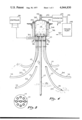
- FIG. 1 is a perspective view of a multiple-completion geothermal mining system in accordance with the invention
- FIG. 2 is a sectional view taken along line 2--2 of FIG. 1;
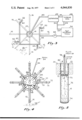
- FIG. 3 is a schematic view of a further embodiment of a mining system in accordance with the invention.
- FIG. 4 is a top enlarged view of the system of FIG. 3;
- FIG. 5 is an enlarged cross-sectional view of a closed end heat exchanger
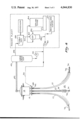
- FIG. 6 is a plan view of a geothermal mining system in accordance with the invention.
- the system includes a plurality of geothermal wells 10 each having a first, open, upper end 12 converging toward and meeting within a surface point bounded by a closed reservoir 14.
- the lower end 16 of each well terminates within a geothermal zone 18.
- the ends are positioned in a predetermined pattern such as those of wells 20 and 22 which are spaced vertically from each and the ends of wells 20 and 24 which are spaced horizontally from each other.
- Each well contains a valve 26, suitably a servo-controlled valve such that production from each well can be individually controlled, suitably by a time sequencer controller 28 which activates or deactivates each valve 26 according to a predetermined program by sending signals through lines 30.
- the sequential production of wells 10, especially by rotating production in a circular pattern, will promote convective movement of the hydrothermal fluid 32 within the geothermal zone 18, and thus, increase heat transfer and recovery and decrease the possiblity of scale forming on the external surface 24 of the portion of the well casings within the zone 18.
- the geothermal, heated fluid recovered from the wells collects within the reservoir 14.
- the reservoir may be located on the surface but is preferably recessed below the surface to take advantage of the insulating and warming effects of the subsurface strata.
- the reservoir is preferably a steel vessel 34 bounded by a concrete layer 36 and includes a removable lid 38 secured by bolts 40.
- the collected steam is transferred through conduit 42 containing a pressure regulating valve 43 to a separator 45. Condensate and solids are removed through line 44 and the steam is delivered through line 46 to the power plant 48.
- the power plant can be a direct prime mover engine or a turbine generator. Condensate is removed through line 50 and may be recovered or recycled to the wells.
- Geothermal fields are classified according to their production of hot water, hot water and steam, or dry steam.
- the system of FIG. 1 can be used for the recovery of geothermal heat values from all of these types of fields.
- Hot water fields typically produce temperatures between 60° and 100° C., with gradients of 30° to 70° C/km. Because of the low enthalpy, hot water fields are not now being used to generate electricity. They are being used instead for space heating and air conditioning.
- For electrical production most geothermal fields produce both water and steam at temperatures greater than 100° C. The highest temperature field in use to date is at Cerro Prieto, Mexico, at which temperatures have been measured up to 380° C.
- the dry steam fields in commercial use have temperatures at 210° C. (The Geysers, U.S.) to 260° C. (Larderello, Italy).
- a source of heat In general, magmatic intrusions at shallow depths of 7 to 15 km provide a heat source at a temperature above 100° C., typically from 200° to 400° C. 2.
- a source of water Commercial wells produce more than 20 tons/hour of water and steam. The best well, located in the Cerro Prieto field, produces 350 tons/hour. The water is believed to come from surface sources rather than being magmatic water. Therefore, it is probably replenishable at a rate determined by pressure, permeablility, source availability and other factors. Reinjection may be utilized to replenish the source and dispose of unwanted surface water such as condensate from the turbine. 3.
- a permeable rock aquifer A permeable rock aquifer.
- any permeable rock can serve as an aquifer such as deltaic sand, volcanic turf, base salt flows, ignimbrite, greywacke, carbonate volcanics and limestone.
- Convection currents through the rock are believed to be the primary heat transfer mechanism between the magma and upper levels of the aquifer; these can be reached by drilling. Pressures in the aquifer may be as high as 2000 psi or more. Both thermal conductivity and permeability are critical parameters which limit the energy production of the well. 4.
- a cap rock A rock layer of low permeability is required above the aquifer to limit the heat transfer by convection. The heat loss transfer through the cap rock to the surface primarily by convection is very low; this allows the system to remain hot. Many systems are believed to be self-sealing due to mineral, primarily silica, depositions of the hot water flashed and cold near the surface.
- geothermal aquifers can be mined by direct thermal mining methods in the system of the invention which will provide the same advantages of collection of the thermal fluid at a single point, thus reducing capital investment and well installation costs and the surface area needed for converting the fluid to mechanical or electrical energy.
- the wet geothermal areas can more efficiently be mined by the downhole heat exchanger relation of the multiple-completion system of this invention.
- Dry geothermal areas may also be mined by either method.
- a man-made aquifer may be developed by explosion-stimulated methods. If the hole is hot and dry and not fractured, a large aquifer could be developed by hydrofracturing alone or in combination with explosive induced means.
- the downhole heat exchanger offers the opportunity to recover heat from the dry and hot geothermal area without the need to inject water to the zone to create a hydrothermal fluid.
- the system is hot, dry and fractured, water can be introduced from the surface internal of the well casing or external of the well casing and the resultant steam collected through the annulus of the well removed and harnessed to produce energy.
- the system may be utilized as such with the downhole heat exchanger to produce steam by indirect heat exchange methods or hydrofracturing and enhancement can be practiced through additional thermal stress fracturing or by the use of high explosive or nuclear devices to fracture large quantities of hot rock as described in my copending application Ser. No. 99,898, filed Dec. 21, 1970, which disclosed a system for producing a rubble cone cavity in a hot, dry rock geothermal zone, the disclosure of which is incorporated herein by reference.
- the separator 45 would be a flash unit and the wet steam is delivered to the power plant 48 while the separated salts and condensate are removed through line 44.
- the salts may be separated into commercial salts for sale, may be concentrated and disposed or may be reinjected into the zone.
- separation of solids may be required in a cyclone separator to minimize cavitation of the turbine blades.
- FIGS. 3 and 4 Hydrothermal injection systems for mining a dry field are illustrated in FIGS. 3 and 4.
- an external water injection system is illustrated in which water is injected into the dry, porous geothermal zone 18 by means of a plurality of water injection wells 52.
- the wells are spaced about the periphery of the geothermal zone being mined and extend from the surface to the zone 18 and preferably extend below the level of the ends 16 of the geothermal wells 10, so as to form a rising body of pressurized, heated hydrothermal fluid.
- the water injection wells 52 can be supplied separately with water, or as illustrated can be supplied from a central storage tank 54 and pumped by means of pump 58 through line 36 to each of the injection wells 52.
- the branch input conduit 60 to each injection well 52 contains a valve 62 so that production may be cycled to induce movement of the hydrothermal fluid.
- the hydrothermal fluid enters the ends 16 of the recovery wells 10, collects in reservoir 14 and is transferred through line 42 to the separator 45 and turbine generator 48. Condensate in lines 50 and 44 is recycled through line 64 to the storage tank 54 for reinjection in the zone 18 through wells 52.
- FIG. 4 A preferred injection-recovery system is illustrated in FIG. 4.
- water injection is internal of the recovery well casing. This again simplifies the installation, minimizes surface installation of long lengths of pipes and totally obviates the necessity of separate injection wells.
- a further incidental benefit is that the decending water is heated by the ascending geothermal fluid.
- the delivery pipe 56 is connected to a single distribution ring 68 which may surround the outside of the casing for recovery wells 10 or may be positioned on the inside surface of the casings.
- the branch inlets 60 again contain a valve 62.
- the inlets 60 sealingly penetrate the casing of each well 10 and are connected to a water injection pipe 70.
- the end 72 of the water injection pipe preferably extends past the end 16 of the casing and into the porous or fractured geothermal zone 18 at a depth below the ends 16 of the casing 10.
- each recovery well contains a plug 74 such as a metal-rubber layer over a cement layer.
- the terminal portion of the casing of each well contains or forms a closed heat exchanger 76.
- An injection pipe 78 delivers heat exchange fluid to the top 79 of the heat exchanger which is heated to form vapor therein.
- the vapor leaves through perforations 80 in the top 79 and rises through the annular space in each casing and collects within the reservoir 14 and after separation in separator 45 and conversion to electricity in turbine-generator 48 is recycled to storage tank 54 for reinjection as previously described.
- the borehole is preferably cased with a metal casing which is in turn cased with a layer of concrete 81.
- a metal casing which is in turn cased with a layer of concrete 81.
- the metal surface 24 be directly exposed to the hydrothermal fluid. Referring again to FIG. 5, this installation is effected by lining the borehole with a metal casing 85.
- the casing is perforated at 77 at the location corresponding to the top of the heat exchanger 76.
- the casing is then temporarily plugged directly below the perforations 77. Cement is delivered to the temporary plug area and squeezed through the perforations 77 to form a plug 81 in the annular area outside the casing 85.
- the upper casing 85 is then cased in cement.
- the temporary plug is then drilled out and the lower plug 74 is inserted and the top 79 of the heat exchanger is installed.
- the closed-cycle system for extraction of heat from a geothermal zone provides a choice of heat exchange fluids such as isobutane or water.
- Demineralized water is the fluid of choice since its thermal and physical properties permit high heat transfer capabilities, and steam vapor is directly usable in conventional and economically available condensing steam turbines. Condensate is easily handled for return to the heat recovery zone. Also, demineralized water can be readily produced in conventional and economically available equipment and all of its physical properties and handling techniques are well known.
- FIG. 6 A schematic illustration of a more detailed embodiment of the downhole heat exchanger is illustrated in FIG. 6.
- FIG. 6 has been designed for the recovery of sufficient heat energy for the production of 50 megawatts (at the generator terminals) of electric power.
- the system includes a plurality of downhole heat exchanger recovery wells 10 having a plugged end 74 within a geothermal zone 18.
- the upper ends 19 of the wells 10 converge to and meet in a reservoir 14.
- the steam output from the reservoir is delivered through line 42 to a vapor-liquid separator 45, condensed through line 46 to a turbogenerator 48.
- the low pressure steam from the turbo generator is delivered through line 50 to a condenser 80 which receives a continuous supply of cold water circulating through circuit 82 containing a cooling tower 84.
- the condensate from condenser 80 joins line 56 through line 88. Demineralized water from supply tank 54 and the condensate are pumped by means of power condensate pump 90 and preheat condensate pump 92 to the injection ring 68.
- the steam is vaporized within the outer casing while it passes through the reservoir geothermal heat zone 18.
- the inner pipe returns the condensate from the above-ground power plant turbine condenser and vapor-condensate separator down to the well bottom to complete the heat exchange fluid transport circuit.
- the inner pipe also serves to preheat the condensate up to the boiling thermal equilibrium established during operation. The preheating requires vapor condensation.
- This condensate is separated from the power vapor fluid in a vapor-condensate separator and recycled.
- the power vapor is used in a conventional condensing type vapor turbine in a totally enclosed recycle system and thus the power fluid is conserved.
- the power vapor turbine has an indirect exhaust vapor condenser and condensate recycle pumping system.
- the following calculations for feasibility of the system of the invention were based on a heat assumed to have generally constant temperatures unaffected by the heat recovered.
- the generalized heat zone conditions assumed were starting at 3,000 feet below grade with a temperature of 500° F. and extending 5,000 feet below grade to a temperature of 700° F.
- the heat zone was also assumed to be filled with hot brine under pressure, typical of the heat zone in the Niland area of the Imperial Valley.
- the geothermal zone 18 was assumed to be a porous sandstone filled with hot brine.
- the outside heat transfer from coefficients and fouling factors are the limiting elements for maximizing heat recovery from the brine into the heat exchange power fluid.
- the rate of heat removal is limited by heat zone porosity and permeability. If the assumed sand particle diameter is less than 0.039 inch (1 mm) in diameter, permeability rather than the outside-to-pipe film coefficient controls the rate of heat transfer.
- the outer casing size of 13.375 inches O.D. is preferred since for the depth and temperature specified in the heat recovery zones this is about the largest size casing (heat transfer surface) which provides an economic weight (strength) per unit length required to withstand the internal and collapsing pressure encountered as well as the problems associated with offset drilling.
- the inner pipe will be selected to satisfy the overall system flow hydrodynamic requirements. It is expected that long life would be experienced with heavy wall carbon steel casings in the above conditions.
- a further advantage of the directional slant drilling multiple-completion system of the invention is that it provides greater heat exchange area within the zone of heat collection, thus reducing the amount of wells necessary to produce a given amount of power. By slant drilling through the 3,000 to 5,000 foot zone under consideration, it is estimated that 10 wells must be drilled to provide the desired heat exchange surface area.
- the typical casing requirements will require about 8,000 feet of the casing within the zone forming the heat exchanger which will be connected to 1800 feet of cemented production casing and then to 50 feet of cemented 20 inch second string which in turn is then connected to 50 feet of cemented 36 inch conductor casing.
- the top end 19 of the wells can readily be separated by 25 to 150 feet and can be located in the surface zone bounded by a single reservoir 14.
- Each well at the bottom should produce steam at 320 psia at a temperature of 423° F.
- the rising steam should maintain a pressure at the top after condensing the down-coming return condensate of 165 psia and a temperature of 366° F.
- At the vapor-liquid separator 45 such wells will provide 857,000 lbs. per hour vapor and 343,000 lbs. per hour of condensate.
- This vapor has an inert pressure of 130 psia and a temperature of 350° F. to provide a heat input to the turbogenerator of 1023 ⁇ 10 6 Btu/hour and a heat rate of 20,500 Btu/kWh gross at the generated terminals. This is sufficient to provide 15 megawatts at the generated terminals.
- the condenser returns this vapor as power condensate at a rate of 1714 gallons per minute at a temperature of 125° F. which combines with the preheat condensate at 773 gallons per minute to be returned to develop the necessary steam to power the system.
- Feasibility was based on costs for well completion equipment, well gathering piping, condensate return piping, flash separator, flash water and condensate pumps.
- the estimate includes costs of all equipment, materials, direct and indirectly, freight taxes and insurance, engineering, contractors burden and profit and a 15% contingency and including costs of capital.
- the comparison of costs of energy produced with the system of the invention as contrasted with other sources is shown in the following table.
Landscapes
- Engineering & Computer Science (AREA)
- Life Sciences & Earth Sciences (AREA)
- Geology (AREA)
- Mining & Mineral Resources (AREA)
- Combustion & Propulsion (AREA)
- Chemical & Material Sciences (AREA)
- Sustainable Energy (AREA)
- General Engineering & Computer Science (AREA)
- Mechanical Engineering (AREA)
- Fluid Mechanics (AREA)
- Sustainable Development (AREA)
- Geochemistry & Mineralogy (AREA)
- General Life Sciences & Earth Sciences (AREA)
- Physics & Mathematics (AREA)
- Environmental & Geological Engineering (AREA)
- Hydrology & Water Resources (AREA)
- Engine Equipment That Uses Special Cycles (AREA)
Abstract
A system for the mining of geothermal energy in which a plurality of geothermal wells radiate from a single surface site into a subsurface geothermal reservoir. The wells can be drilled by conventional slant drilling techniques and each may contain a closed end heat exchanger which receives water and generates steam. Some of the heat exchangers are disposed vertically and others are implanted horizontally. By alternating production of the wells in a programmed cyclical manner, convective movement of the hydrothermal fluid will occur within the geothermal zone. The generated steam is collected in a reservoir at the surface site and utilized to generate electricity. The condensate from the turbine can be recycled to the wells.
Description
1. Field of the Invention
The present invention relates to utilization of geothermal energy and more particularly to an improved system for maximizing the transfer of geothermal energy from a subsurface zone to the surface for utilization.
2. Description of the Prior Art
There exists, essentially untapped, massive quantities of heat available from magma which has migrated to zones close to the surface. Such conditions exist in large regions of the United States and in other locations throughout the world such as in Italy, New Zealand and Japan. Frequently, tectonic activity has produced fault lines which have permitted deep, subsurface waters to come in contact with magmatic rocks and return to the surface along fault lines as heated water, or in a few cases as steam. Similarly, tectonic activity below ancient subsidence areas, more recently overlain, have resulted in migration of heat into brine pools of varying salinity which lodged in these sinks. There are some 1.8 million acres in the United States which are designated as KGRA (Known Geothermal Resource Areas) and most of these KGRA are situated in the Western states.
The only operating geothermal plants in the United States are those operating at The Geysers, Sonoma, California, and others are formulating plants for geothermal power development in the Imperial Valley of California. The plants in operation in the United States and Italy rely on direct thermal fluid mining methods. Such methods have entailed serious problems due to the high salinity of the steam causing cavitation, abrasion, scaling and corrosion of the equipment over short intervals. Moreover, geological prospecting techniques are not very accurate and if a dry well results or a well with insufficient steam pressure the venture is a total loss. Drilling of adjacent thermal direct fluid recovery wells entails the risk of lowering the bottom hole pressure of the whole field. It is estimated that a brine pool exists in the Niland area of the Imperial Valley of California which occupies an area of 25 square miles. About a dozen geothermal wells have been drilled in the area, which produce as much as a million pounds per hour of brine per well for sustained periods. Flashing this brine would produce about 200,000 pounds per hour of steam which in turn could produce about 10,000 kW of electric power per well.
However, because of the high salinity of the brines, all attempts to utilize these brines have been unsuccessful. Since the discovery of these wells, several companies have spent millions of dollars trying to extract chemicals and generate power from the brines. Neither operation has been commerically successful because of the high operating costs and associated material costs necessary to withstand the corrosive and erosive environment and to dispose of the salt and concentrated salt bitterns.
Further to the South in Mexico, another brine pool exists of a size comparable to the Niland pool. The brine is lower in salinity in this pool. Exploratory investigation suggests the existence of seven or eight similar brine pools between Niland and the pool at Cerro Prieto in Mexico. In all, the power generating potential from geothermal energy in the Imperial Valley is estimated to be as high as 30,000 MW. Successful exploitation of this potential by conventional direct thermal mining methods would require either selective use of the lower salinity brine or disposal of vast amounts of salt and concentrated salt bitterns. Geothermal energy represents a clean, pollution free alternative to fossil fuel energy sources and does not entail the hazards or the environmentally unacceptable aspects of nuclear produced power.
The problems inherent in the conventional direct thermal mining approaches are avoided by use of the downhole heat exchanger disclosed in U.S. Pat. No. 3,470,943 since the geothermal brines remain in the pool and heat is extracted by in situ circulation of a clean, stable, secondary heat transfer fluid inside the downhole heat exchanger which is placed at the lower part of the casing within the geothermal zone. Thus, the downhole heat exchanger provides a means for utilizing the heat contained in the brine pools by extracting only the heat energy, leaving the brine recirculating in the underground pool. The advantages are many.
No saline fluids are brought to the surface; hence there are no disposal problems and reinjection wells are not required. The reservoir inventory and pressure is undisturbed. Except for extraction of heat, which is readily replenishable, nothing has been changed in the reservoir. Subsidence therefore will be avoided by this method.
Since the interior of the casing is contacted only by pure fluids, no corrosion or scaling will occur internally. The outside of the casing is in contact with the reservoir aquifer but the brine is at a pressure which does not allow the dissolved salts to precipitate. Hence, there is no abrasive action from the solids as in a flowing well. The convective currents within the aquifer are expected to be of insufficient velocity to result in abrasion. The low velocity should also promote the retention of a thin, passive coating of corrosion products which inhibit further corrosion.
The downhole heat exchanger system represents a truly non-polluting source of energy in that no pollution products are permitted to reach the surface. However, the energy capacity of a single well is not sufficient to justify the installation and operation of a generation plant. Therefore, multiple wells are required to develop sufficient steam to operate the turbine generator. This requires the utilization of a greater area of the surface for drilling the multiple wells and a greater investment cost to drill the well at each site. Furthermore, the separate location of the multiple wells requires water injection lines running to each well site and steam gathering lines running from each site to the generating plant. All of this involves capital investment and entails heat loss each time the steam or water is moved.
The multiple-completion geothermal system of the invention generally includes a plurality of geothermal wells, each having a first end converging toward and meeting at a first point and having a second end diverging from said point and terminating in a geothermal zone, each second end being spaced from any other second end of said geothermal wells. This system further includes a reservoir located at said first point receiving heated geothermal fluid from the second end of each well, outlet means connected to said reservoir for conducting the heated geothermal fluid in turn to separation means and energy conversion means. The system in accordance with the invention also may include control means for sequentially activating production from each of the plurality of wells in sequence to promote movement of hydrothermal fluids within the geothermal zone.
Depending on the condition of the geothermal zone, the system may require further structure. In a wet geothermal zone, the fluid will operate as a carrier for the heat energy to deliver it to the surface under pressure. In the case of a dry geothermal zone or one containing a molten brine pool with insufficient pressure, the implantation of closed end heat exchangers at the ends of the wells requires means for conducting heat exchange fluid to the heat exchangers which may be connected to the turbine to return the condensate to the heat exchanger in a closed cycle loop. Heat transfer to the heat exchanger in a dry geothermal zone may also be enhanced by injection of water into the zone external to the heat exchanger to create hot fluid to increase the transfer rate of heat to the outside surface of the heat exchanger.
It is apparent that the system of the invention minimizes the amount of surface area needed for access to the subsurface geothermal zone, the amount of surface area needed for collection and conversion of the goethermal fluid to electrical energy and minimizes the external piping conduits and energy loss that would be entailed in the separate spaced drilling of multiple wells to tap and mine the geothermal energy in a known geothermal resource area. The system of the invention also includes provision for controlled collection of the energy and in a manner to promote convection and movement of the hydrothermal fluids to increase the rate of energy recovery and to decrease the possibility of scaling and fouling the external portions of the wells being utilized for collection and transfer of heat.
These and many other objects and attendant advantages of the invention will become apparent as the invention becomes readily understood by reference to the following detailed description when considered in conjunction with the accompanying drawings.
FIG. 1 is a perspective view of a multiple-completion geothermal mining system in accordance with the invention;
FIG. 2 is a sectional view taken along line 2--2 of FIG. 1;
FIG. 3 is a schematic view of a further embodiment of a mining system in accordance with the invention;
FIG. 4 is a top enlarged view of the system of FIG. 3;
FIG. 5 is an enlarged cross-sectional view of a closed end heat exchanger; and
FIG. 6 is a plan view of a geothermal mining system in accordance with the invention.
Referring now to FIGS. 1 and 2, the system includes a plurality of geothermal wells 10 each having a first, open, upper end 12 converging toward and meeting within a surface point bounded by a closed reservoir 14. The lower end 16 of each well terminates within a geothermal zone 18. The ends are positioned in a predetermined pattern such as those of wells 20 and 22 which are spaced vertically from each and the ends of wells 20 and 24 which are spaced horizontally from each other.
Each well contains a valve 26, suitably a servo-controlled valve such that production from each well can be individually controlled, suitably by a time sequencer controller 28 which activates or deactivates each valve 26 according to a predetermined program by sending signals through lines 30. The sequential production of wells 10, especially by rotating production in a circular pattern, will promote convective movement of the hydrothermal fluid 32 within the geothermal zone 18, and thus, increase heat transfer and recovery and decrease the possiblity of scale forming on the external surface 24 of the portion of the well casings within the zone 18.
The geothermal, heated fluid recovered from the wells collects within the reservoir 14. The reservoir may be located on the surface but is preferably recessed below the surface to take advantage of the insulating and warming effects of the subsurface strata. The reservoir is preferably a steel vessel 34 bounded by a concrete layer 36 and includes a removable lid 38 secured by bolts 40.
The collected steam is transferred through conduit 42 containing a pressure regulating valve 43 to a separator 45. Condensate and solids are removed through line 44 and the steam is delivered through line 46 to the power plant 48. The power plant can be a direct prime mover engine or a turbine generator. Condensate is removed through line 50 and may be recovered or recycled to the wells.
Geothermal fields are classified according to their production of hot water, hot water and steam, or dry steam. The system of FIG. 1 can be used for the recovery of geothermal heat values from all of these types of fields. Hot water fields typically produce temperatures between 60° and 100° C., with gradients of 30° to 70° C/km. Because of the low enthalpy, hot water fields are not now being used to generate electricity. They are being used instead for space heating and air conditioning. For electrical production most geothermal fields produce both water and steam at temperatures greater than 100° C. The highest temperature field in use to date is at Cerro Prieto, Mexico, at which temperatures have been measured up to 380° C. Similarly, the dry steam fields in commercial use have temperatures at 210° C. (The Geysers, U.S.) to 260° C. (Larderello, Italy).
The geothermal fields in production have the following basic geological characteristics:
1. A source of heat. In general, magmatic intrusions at shallow depths of 7 to 15 km provide a heat source at a temperature above 100° C., typically from 200° to 400° C. 2. A source of water. Commercial wells produce more than 20 tons/hour of water and steam. The best well, located in the Cerro Prieto field, produces 350 tons/hour. The water is believed to come from surface sources rather than being magmatic water. Therefore, it is probably replenishable at a rate determined by pressure, permeablility, source availability and other factors. Reinjection may be utilized to replenish the source and dispose of unwanted surface water such as condensate from the turbine. 3. A permeable rock aquifer. Almost any permeable rock can serve as an aquifer such as deltaic sand, volcanic turf, base salt flows, ignimbrite, greywacke, carbonate volcanics and limestone. Convection currents through the rock are believed to be the primary heat transfer mechanism between the magma and upper levels of the aquifer; these can be reached by drilling. Pressures in the aquifer may be as high as 2000 psi or more. Both thermal conductivity and permeability are critical parameters which limit the energy production of the well. 4. A cap rock. A rock layer of low permeability is required above the aquifer to limit the heat transfer by convection. The heat loss transfer through the cap rock to the surface primarily by convection is very low; this allows the system to remain hot. Many systems are believed to be self-sealing due to mineral, primarily silica, depositions of the hot water flashed and cold near the surface.
All of these geothermal aquifers can be mined by direct thermal mining methods in the system of the invention which will provide the same advantages of collection of the thermal fluid at a single point, thus reducing capital investment and well installation costs and the surface area needed for converting the fluid to mechanical or electrical energy. However, for the reasons previously discussed, the wet geothermal areas can more efficiently be mined by the downhole heat exchanger relation of the multiple-completion system of this invention. Dry geothermal areas may also be mined by either method. A man-made aquifer may be developed by explosion-stimulated methods. If the hole is hot and dry and not fractured, a large aquifer could be developed by hydrofracturing alone or in combination with explosive induced means. The downhole heat exchanger offers the opportunity to recover heat from the dry and hot geothermal area without the need to inject water to the zone to create a hydrothermal fluid.
If the system is hot, dry and fractured, water can be introduced from the surface internal of the well casing or external of the well casing and the resultant steam collected through the annulus of the well removed and harnessed to produce energy. If the system is hot, dry and unfractured, it may be utilized as such with the downhole heat exchanger to produce steam by indirect heat exchange methods or hydrofracturing and enhancement can be practiced through additional thermal stress fracturing or by the use of high explosive or nuclear devices to fracture large quantities of hot rock as described in my copending application Ser. No. 99,898, filed Dec. 21, 1970, which disclosed a system for producing a rubble cone cavity in a hot, dry rock geothermal zone, the disclosure of which is incorporated herein by reference.
Referring again to FIGS. 1 and 2, in a system for mining wet geothermal energy, the separator 45 would be a flash unit and the wet steam is delivered to the power plant 48 while the separated salts and condensate are removed through line 44. The salts may be separated into commercial salts for sale, may be concentrated and disposed or may be reinjected into the zone. In a system in which fairly dry steam is directly recovered, separation of solids may be required in a cyclone separator to minimize cavitation of the turbine blades.
Hydrothermal injection systems for mining a dry field are illustrated in FIGS. 3 and 4. Referring now to FIG. 3, an external water injection system is illustrated in which water is injected into the dry, porous geothermal zone 18 by means of a plurality of water injection wells 52. The wells are spaced about the periphery of the geothermal zone being mined and extend from the surface to the zone 18 and preferably extend below the level of the ends 16 of the geothermal wells 10, so as to form a rising body of pressurized, heated hydrothermal fluid. The water injection wells 52 can be supplied separately with water, or as illustrated can be supplied from a central storage tank 54 and pumped by means of pump 58 through line 36 to each of the injection wells 52.
The branch input conduit 60 to each injection well 52 contains a valve 62 so that production may be cycled to induce movement of the hydrothermal fluid. The hydrothermal fluid enters the ends 16 of the recovery wells 10, collects in reservoir 14 and is transferred through line 42 to the separator 45 and turbine generator 48. Condensate in lines 50 and 44 is recycled through line 64 to the storage tank 54 for reinjection in the zone 18 through wells 52.
A preferred injection-recovery system is illustrated in FIG. 4. In this system, water injection is internal of the recovery well casing. This again simplifies the installation, minimizes surface installation of long lengths of pipes and totally obviates the necessity of separate injection wells. A further incidental benefit is that the decending water is heated by the ascending geothermal fluid. As shown in the drawings, the delivery pipe 56 is connected to a single distribution ring 68 which may surround the outside of the casing for recovery wells 10 or may be positioned on the inside surface of the casings. The branch inlets 60 again contain a valve 62. The inlets 60 sealingly penetrate the casing of each well 10 and are connected to a water injection pipe 70. The end 72 of the water injection pipe preferably extends past the end 16 of the casing and into the porous or fractured geothermal zone 18 at a depth below the ends 16 of the casing 10.
All of the hydrothermal systems suffer from the common disadvantage of recovery of a saline hydrothermal fluid with the attendant problems of scaling and disposal. For the reasons discussed above, the downhole heat exchanger variant of the multiple-completion system is far preferable. Such a system is shown in FIG. 5.
In this system, the lower end 16 of each recovery well contains a plug 74 such as a metal-rubber layer over a cement layer. The terminal portion of the casing of each well contains or forms a closed heat exchanger 76. An injection pipe 78 delivers heat exchange fluid to the top 79 of the heat exchanger which is heated to form vapor therein. The vapor leaves through perforations 80 in the top 79 and rises through the annular space in each casing and collects within the reservoir 14 and after separation in separator 45 and conversion to electricity in turbine-generator 48 is recycled to storage tank 54 for reinjection as previously described.
The borehole is preferably cased with a metal casing which is in turn cased with a layer of concrete 81. For purposes of heat conduction to the heat exchanger 76, it is preferred that the metal surface 24 be directly exposed to the hydrothermal fluid. Referring again to FIG. 5, this installation is effected by lining the borehole with a metal casing 85. The casing is perforated at 77 at the location corresponding to the top of the heat exchanger 76.
The casing is then temporarily plugged directly below the perforations 77. Cement is delivered to the temporary plug area and squeezed through the perforations 77 to form a plug 81 in the annular area outside the casing 85. The upper casing 85 is then cased in cement. The temporary plug is then drilled out and the lower plug 74 is inserted and the top 79 of the heat exchanger is installed.
The closed-cycle system for extraction of heat from a geothermal zone provides a choice of heat exchange fluids such as isobutane or water. Demineralized water is the fluid of choice since its thermal and physical properties permit high heat transfer capabilities, and steam vapor is directly usable in conventional and economically available condensing steam turbines. Condensate is easily handled for return to the heat recovery zone. Also, demineralized water can be readily produced in conventional and economically available equipment and all of its physical properties and handling techniques are well known.
A schematic illustration of a more detailed embodiment of the downhole heat exchanger is illustrated in FIG. 6. FIG. 6 has been designed for the recovery of sufficient heat energy for the production of 50 megawatts (at the generator terminals) of electric power.
Referring now to FIG. 6, the system includes a plurality of downhole heat exchanger recovery wells 10 having a plugged end 74 within a geothermal zone 18. The upper ends 19 of the wells 10 converge to and meet in a reservoir 14. The steam output from the reservoir is delivered through line 42 to a vapor-liquid separator 45, condensed through line 46 to a turbogenerator 48. The low pressure steam from the turbo generator is delivered through line 50 to a condenser 80 which receives a continuous supply of cold water circulating through circuit 82 containing a cooling tower 84. The condensate from condenser 80 joins line 56 through line 88. Demineralized water from supply tank 54 and the condensate are pumped by means of power condensate pump 90 and preheat condensate pump 92 to the injection ring 68.
In this system, the steam is vaporized within the outer casing while it passes through the reservoir geothermal heat zone 18. The inner pipe returns the condensate from the above-ground power plant turbine condenser and vapor-condensate separator down to the well bottom to complete the heat exchange fluid transport circuit. The inner pipe also serves to preheat the condensate up to the boiling thermal equilibrium established during operation. The preheating requires vapor condensation. This condensate is separated from the power vapor fluid in a vapor-condensate separator and recycled. The power vapor is used in a conventional condensing type vapor turbine in a totally enclosed recycle system and thus the power fluid is conserved. The power vapor turbine has an indirect exhaust vapor condenser and condensate recycle pumping system.
The following calculations for feasibility of the system of the invention were based on a heat assumed to have generally constant temperatures unaffected by the heat recovered. The generalized heat zone conditions assumed were starting at 3,000 feet below grade with a temperature of 500° F. and extending 5,000 feet below grade to a temperature of 700° F. The heat zone was also assumed to be filled with hot brine under pressure, typical of the heat zone in the Niland area of the Imperial Valley. The geothermal zone 18 was assumed to be a porous sandstone filled with hot brine.
Under these conditions, the outside heat transfer from coefficients and fouling factors are the limiting elements for maximizing heat recovery from the brine into the heat exchange power fluid. The rate of heat removal is limited by heat zone porosity and permeability. If the assumed sand particle diameter is less than 0.039 inch (1 mm) in diameter, permeability rather than the outside-to-pipe film coefficient controls the rate of heat transfer.
On the basis of these criteria, the outer casing size of 13.375 inches O.D. is preferred since for the depth and temperature specified in the heat recovery zones this is about the largest size casing (heat transfer surface) which provides an economic weight (strength) per unit length required to withstand the internal and collapsing pressure encountered as well as the problems associated with offset drilling. The inner pipe will be selected to satisfy the overall system flow hydrodynamic requirements. It is expected that long life would be experienced with heavy wall carbon steel casings in the above conditions.
The same casing and cementing practices employed for other geothermal wells can be followed, the only difference being the closed end of the 133/8 inch casing which acts as a shell of the downhole heat exchanger. A further advantage of the directional slant drilling multiple-completion system of the invention is that it provides greater heat exchange area within the zone of heat collection, thus reducing the amount of wells necessary to produce a given amount of power. By slant drilling through the 3,000 to 5,000 foot zone under consideration, it is estimated that 10 wells must be drilled to provide the desired heat exchange surface area. The typical casing requirements will require about 8,000 feet of the casing within the zone forming the heat exchanger which will be connected to 1800 feet of cemented production casing and then to 50 feet of cemented 20 inch second string which in turn is then connected to 50 feet of cemented 36 inch conductor casing. The top end 19 of the wells can readily be separated by 25 to 150 feet and can be located in the surface zone bounded by a single reservoir 14.
Each well at the bottom should produce steam at 320 psia at a temperature of 423° F. The rising steam should maintain a pressure at the top after condensing the down-coming return condensate of 165 psia and a temperature of 366° F. At the vapor-liquid separator 45 such wells will provide 857,000 lbs. per hour vapor and 343,000 lbs. per hour of condensate. This vapor has an inert pressure of 130 psia and a temperature of 350° F. to provide a heat input to the turbogenerator of 1023 × 106 Btu/hour and a heat rate of 20,500 Btu/kWh gross at the generated terminals. This is sufficient to provide 15 megawatts at the generated terminals. The condenser returns this vapor as power condensate at a rate of 1714 gallons per minute at a temperature of 125° F. which combines with the preheat condensate at 773 gallons per minute to be returned to develop the necessary steam to power the system.
Feasibility was based on costs for well completion equipment, well gathering piping, condensate return piping, flash separator, flash water and condensate pumps. The estimate includes costs of all equipment, materials, direct and indirectly, freight taxes and insurance, engineering, contractors burden and profit and a 15% contingency and including costs of capital. The comparison of costs of energy produced with the system of the invention as contrasted with other sources is shown in the following table.
              TABLE I
______________________________________
               $/Million Btus
______________________________________
Coal             0.25 - 0.30
Oil (1% Sulfur)  0.65
Natural Gas      0.42 - 0.48
Synthetic Natural Gas
                 1.05 - 1.75
Coal Based Synthetic Gas
                 1.10 - 1.25
Van Huisen System
                 0.19 - 0.37 Gross at generator
                 terminals*
______________________________________
 *Adjusted to heat rate equivalent of modern fossil fuel power plant rates
 of approximately 10,000 Btus/kWh.
Recent pollution regulations regarding maximum sulfur content in fuels of 0.3 to 0.5% have placed a considerable burden on refiners to produce low sulfur petroleum based fuels. It is estimated that the added processing may cost as much as $1.50 bbl or $0.24 per million Btus. Many coals run 3 to 4% sulfur and the only practical way to meet pollution standards is to desulfurize the stack gases which is estimated to add as much as $60-$70 kW in capital investment or $0.09-$0.11 per million Btus. Typical fuel costs in terms of mills/kWh for privately owned utilities as of 1969, run 3.5 to 6.5 mills/kWh. It is estimated that by 1975 fuel prices will roughly double and utilities will probably be paying 7.0 to 13 mills/kWh for fuel. The energy cost of 1.91 to 3.71 mills/kWh compares very favorably with competing fossil fuels for this module of power. No comparison could be made with nuclear fuel plants since nuclear fuel plants would be uneconomical to build in the range of 50 MW/150 MW.
It is to be realized that only preferred embodiments of the invention have been described and that numerous substitutions, alterations and modifications can readily be made by those skilled in the art without departing from the spirit and scope of the invention as defined in the following claims.
Claims (19)
1. A system for the recovery of geothermal energy comprising:
a closed, steam vapor collection reservoir vessel for collection of high pressure steam vapor having side walls, a top wall and a bottom wall, said side walls and bottom wall being recessed below the surface of the earth and said bottom wall containing a plurality of apertures;
a plurality of cased geothermal wells, the casings of each having a first end converging toward and sealingly connected to one of the apertures in the bottom wall of said reservoir and each well casing diverging from said reservoir and having a second end disposed within a common, wet geothermal zone having a temperature of at least 300° F; and
vapor fluid delivery means within each of said wells to conduct heated steam vapor fluid from each second end to said reservoir vessel for collecting high pressure steam vapor fluid therein.
2. A system according to claim 1 further including outlet means on said reservoir and separation means for receiving the collected heated fluid.
3. A system according to claim 2 in which a plurality of said second ends are open for receiving hot geothermal fluid from said zone and said separator means is a fluid-solid separator for removing solids from said fluid.
4. A system according to claim 1 further including valve means connected to each of said wells for terminating delivery of fluid to said reservoir.
5. A system according to claim 4 further including control means associated with said valve means for cycling production of said well means.
6. A system according to claim 1 in which at least one of said ends terminates in a different horizontal plane within said common, wet geothermal zone than other of said second ends.
7. A system according to claim 1 in which said wells are lined with a metal casing and a cement outer casing.
8. A system according to claim 7 in which at least a portion of the metal casing within said wet, geothermal zone is not cased with cement.
9. A system according to claim 1 in which said geothermal zone is absent geothermal fluid and further including water injection wells extending from the surface into said zone and having lower ends terminating in the vicinity of the second ends of the geothermal wells and pump means for injecting water into said injection wells.
10. A system according to claim 1 in which a plurality of said wells have first ends disposed about the periphery of the lower end of said reservoir.
11. A system according to claim 1 in which said zone is at least 3000 feet below the surface and has a temperature of at least 300° F.
12. A method of recovering geothermal energy comprising the steps of:
recessing the apertured bottom wall and the side walls of a closed, steam vapor collection reservoir vessel below the surface of the earth;
slant drilling a plurality of geothermal wells, each having a first upper end converging toward said reservoir vessel and a second lower end disposed within a common, wet geothermal zone;
casing each of said wells;
connecting each of the upper, first ends of said casings to the aperture in the bottom wall of said reservoir vessel; and
collecting high pressure steam vapor in said vessel.
13. A method according to claim 12 in which said zone is dry, and further including the step of injecting water into said zone.
14. A method according to claim 12 further including the step of inducing convective movement of hydrothermal fluid within said zone by sequentially cycling production of heated fluid delivery to said reservoir from said wells.
15. A method according to claim 12 further including the step of delivering geothermally heated steam vapor fluid from said second end to said first end and collecting said fluid within said reservoir.
16. A method according to claim 12 further including the step of slant drilling at least one of said wells such that the second end thereof terminates in a horizontal plane within said zone different from other of said second ends.
17. A method according to claim 12 further including the steps of lining said well with a metal casing and a cement outer casing.
18. A method according to claim 17 further including the step of terminating the cement outer casing on the portion of the metal casing within said zone.
19. A method according to claim 12 in which said zone is at least 3,000 feet below the surface and has a temperature of at least 300° F.
Priority Applications (7)
| Application Number | Priority Date | Filing Date | Title |
|---|---|---|---|
| US05/375,751 US4044830A (en) | 1973-07-02 | 1973-07-02 | Multiple-completion geothermal energy production systems |
| JP14027173A JPS5653170B2 (en) | 1973-07-02 | 1973-12-10 | |
| US05/469,391 US4054176A (en) | 1973-07-02 | 1974-05-13 | Multiple-completion geothermal energy production systems |
| CA203,048A CA1033352A (en) | 1973-07-02 | 1974-06-21 | Multiple-completion geothermal energy production systems |
| BR5414/74A BR7405414D0 (en) | 1973-07-02 | 1974-07-01 | GEOTERMIC ENERGY RECOVERY SYSTEM |
| US05/511,810 US3957108A (en) | 1973-07-02 | 1974-10-03 | Multiple-completion geothermal energy production systems |
| US05/511,586 US4051677A (en) | 1973-07-02 | 1974-10-03 | Multiple-completion geothermal energy production systems |
Applications Claiming Priority (1)
| Application Number | Priority Date | Filing Date | Title |
|---|---|---|---|
| US05/375,751 US4044830A (en) | 1973-07-02 | 1973-07-02 | Multiple-completion geothermal energy production systems |
Related Child Applications (3)
| Application Number | Title | Priority Date | Filing Date |
|---|---|---|---|
| US05/469,391 Division US4054176A (en) | 1973-07-02 | 1974-05-13 | Multiple-completion geothermal energy production systems |
| US05/511,586 Division US4051677A (en) | 1973-07-02 | 1974-10-03 | Multiple-completion geothermal energy production systems |
| US05/511,810 Division US3957108A (en) | 1973-07-02 | 1974-10-03 | Multiple-completion geothermal energy production systems |
Publications (1)
| Publication Number | Publication Date |
|---|---|
| US4044830A true US4044830A (en) | 1977-08-30 |
Family
ID=23482169
Family Applications (1)
| Application Number | Title | Priority Date | Filing Date |
|---|---|---|---|
| US05/375,751 Expired - Lifetime US4044830A (en) | 1973-07-02 | 1973-07-02 | Multiple-completion geothermal energy production systems |
Country Status (4)
| Country | Link |
|---|---|
| US (1) | US4044830A (en) |
| JP (1) | JPS5653170B2 (en) |
| BR (1) | BR7405414D0 (en) |
| CA (1) | CA1033352A (en) |
Cited By (30)
| Publication number | Priority date | Publication date | Assignee | Title |
|---|---|---|---|---|
| US4120158A (en) * | 1976-11-15 | 1978-10-17 | Itzhak Sheinbaum | Power conversion and systems for recovering geothermal heat |
| US4131161A (en) * | 1977-08-25 | 1978-12-26 | Phillips Petroleum Company | Recovery of dry steam from geothermal brine |
| US4224151A (en) * | 1978-12-11 | 1980-09-23 | Union Oil Company Of California | Preventing scale deposition from geothermal fluids |
| US4268283A (en) * | 1979-12-31 | 1981-05-19 | W-K-M Wellhead Systems, Inc. | Fluid control means for geothermal wells |
| US4375153A (en) * | 1981-03-26 | 1983-03-01 | Wahl Iii Edward F | Process and apparatus for control of two-phase flow to geothermal power plants |
| US4434785A (en) | 1979-09-06 | 1984-03-06 | Knudsen Niels K | Heat accumulator |
| US4537684A (en) * | 1983-12-29 | 1985-08-27 | Union Oil Company Of California | Control of metal-containing scale deposition from high temperature brine |
| US4745756A (en) * | 1987-10-06 | 1988-05-24 | Robert Sederquist | HDR closed loop steam generation |
| WO1995017580A1 (en) * | 1993-12-20 | 1995-06-29 | Marathon Oil Company | Assembly and process for drilling and completing multiple wells |
| US5984010A (en) * | 1997-06-23 | 1999-11-16 | Elias; Ramon | Hydrocarbon recovery systems and methods |
| US6279658B1 (en) * | 1996-10-08 | 2001-08-28 | Baker Hughes Incorporated | Method of forming and servicing wellbores from a main wellbore |
| US6820689B2 (en) | 2002-07-18 | 2004-11-23 | Production Resources, Inc. | Method and apparatus for generating pollution free electrical energy from hydrocarbons |
| US20070163805A1 (en) * | 2006-01-13 | 2007-07-19 | Soilmec S.P.A. | System for drilling the ground to obtain circulation of fluid in a plant for the exploitation of geothermal energy |
| US20090031726A1 (en) * | 2006-03-31 | 2009-02-05 | Ralf Greim | Steam turbine installation and associated operating method |
| US20090055234A1 (en) * | 2007-08-22 | 2009-02-26 | International Business Machines Corporation | System and methods for scheduling meetings by matching a meeting profile with virtual resources |
| US20100288465A1 (en) * | 2007-07-06 | 2010-11-18 | Stewart James J | Geothermal energy system and method of operation |
| US20110197599A1 (en) * | 2008-06-16 | 2011-08-18 | Greenfield Energy Ltd. | Thermal Energy System And Method Of Operation |
| US8020382B1 (en) * | 2008-12-23 | 2011-09-20 | Geothermic Solution LLC | Closed loop, hot dry rock heat recovery process |
| US20120090807A1 (en) * | 2007-07-06 | 2012-04-19 | Stewart James J | Geothermal energy system and method of operation |
| ITCO20110023A1 (en) * | 2011-07-08 | 2013-01-09 | Sergio Bonfiglio | METHOD OF PREPARATION OF GEOTHERMAL FIELDS |
| US8610303B2 (en) | 2012-01-04 | 2013-12-17 | John R. Yocum, JR. | System and method for downhole geothermal electrical power generation |
| WO2015065321A1 (en) * | 2013-10-28 | 2015-05-07 | Halliburton Energy Services, Inc. | Downhole communication between wellbores utilizing swellable materials |
| US20150354903A1 (en) * | 2012-11-01 | 2015-12-10 | Skanska Sverige Ab | Thermal energy storage comprising an expansion space |
| US9518787B2 (en) | 2012-11-01 | 2016-12-13 | Skanska Svergie Ab | Thermal energy storage system comprising a combined heating and cooling machine and a method for using the thermal energy storage system |
| US9791217B2 (en) | 2012-11-01 | 2017-10-17 | Skanska Sverige Ab | Energy storage arrangement having tunnels configured as an inner helix and as an outer helix |
| CN107642329A (en) * | 2017-11-14 | 2018-01-30 | 中国煤炭地质总局水文地质局 | A kind of process of the U-shaped docking geothermal well casings pipeline sealing operation of mid-deep strata |
| US10309693B2 (en) | 2011-03-08 | 2019-06-04 | Erda Master Ipco Limited | Thermal energy system and method of operation |
| US20230083056A1 (en) * | 2021-09-14 | 2023-03-16 | Chevron U.S.A. Inc. | Production of low permeability geothermal resources |
| US20230296290A1 (en) * | 2020-07-24 | 2023-09-21 | Good Water Energy Ltd. | System and methods for enhanced thermal syphoning |
| US20240084676A1 (en) * | 2022-09-08 | 2024-03-14 | Saudi Arabian Oil Company | Method for downhole chemical storage for well mitigation and reservoir treatments |
Families Citing this family (3)
| Publication number | Priority date | Publication date | Assignee | Title |
|---|---|---|---|---|
| JPH0631518B2 (en) * | 1985-06-10 | 1994-04-27 | 財団法人電力中央研究所 | Construction method of permeable layer in bedrock for hot dry rock power generation |
| JP2009014260A (en) * | 2007-07-04 | 2009-01-22 | Eco Power:Kk | Underground heat collection tank |
| JP2014500420A (en) * | 2010-12-10 | 2014-01-09 | グローバル カーボン ソリューションズ インコーポレイテッド | Passive heat extraction and power generation |
Citations (12)
| Publication number | Priority date | Publication date | Assignee | Title |
|---|---|---|---|---|
| FR475226A (en) | 1914-01-29 | 1915-04-26 | Henri Monbeig | Devices for using the temperature difference between the lower soil layers and the atmosphere |
| US1816260A (en) * | 1930-04-05 | 1931-07-28 | Lee Robert Edward | Method of repressuring and flowing of wells |
| US2434239A (en) * | 1944-06-15 | 1948-01-06 | John A Zublin | Method of producing oil |
| US3140986A (en) * | 1958-01-17 | 1964-07-14 | Walter A Hubbard | Method and apparatus for producing electrical power and distilling water by use of geothermal energy |
| US3261401A (en) * | 1963-11-20 | 1966-07-19 | William V Karr | Water production |
| US3386508A (en) * | 1966-02-21 | 1968-06-04 | Exxon Production Research Co | Process and system for the recovery of viscous oil |
| US3580330A (en) * | 1968-01-03 | 1971-05-25 | Tech De Geothermie Soc | Geothermal system |
| US3605403A (en) * | 1969-09-24 | 1971-09-20 | Mitsubishi Heavy Ind Ltd | Transporting means and equipment for jet energy of geothermal power plant |
| US3637021A (en) * | 1970-01-30 | 1972-01-25 | Chevron Res | Method and apparatus for removal of petroliferous adherent solids from an inaccessible surface |
| US3643736A (en) * | 1968-06-27 | 1972-02-22 | Mobil Oil Corp | Subsea production station |
| US3782468A (en) * | 1971-09-20 | 1974-01-01 | Rogers Eng Co Inc | Geothermal hot water recovery process and system |
| US3786858A (en) * | 1972-03-27 | 1974-01-22 | Atomic Energy Commission | Method of extracting heat from dry geothermal reservoirs |
-
1973
- 1973-07-02 US US05/375,751 patent/US4044830A/en not_active Expired - Lifetime
- 1973-12-10 JP JP14027173A patent/JPS5653170B2/ja not_active Expired
-
1974
- 1974-06-21 CA CA203,048A patent/CA1033352A/en not_active Expired
- 1974-07-01 BR BR5414/74A patent/BR7405414D0/en unknown
Patent Citations (12)
| Publication number | Priority date | Publication date | Assignee | Title |
|---|---|---|---|---|
| FR475226A (en) | 1914-01-29 | 1915-04-26 | Henri Monbeig | Devices for using the temperature difference between the lower soil layers and the atmosphere |
| US1816260A (en) * | 1930-04-05 | 1931-07-28 | Lee Robert Edward | Method of repressuring and flowing of wells |
| US2434239A (en) * | 1944-06-15 | 1948-01-06 | John A Zublin | Method of producing oil |
| US3140986A (en) * | 1958-01-17 | 1964-07-14 | Walter A Hubbard | Method and apparatus for producing electrical power and distilling water by use of geothermal energy |
| US3261401A (en) * | 1963-11-20 | 1966-07-19 | William V Karr | Water production |
| US3386508A (en) * | 1966-02-21 | 1968-06-04 | Exxon Production Research Co | Process and system for the recovery of viscous oil |
| US3580330A (en) * | 1968-01-03 | 1971-05-25 | Tech De Geothermie Soc | Geothermal system |
| US3643736A (en) * | 1968-06-27 | 1972-02-22 | Mobil Oil Corp | Subsea production station |
| US3605403A (en) * | 1969-09-24 | 1971-09-20 | Mitsubishi Heavy Ind Ltd | Transporting means and equipment for jet energy of geothermal power plant |
| US3637021A (en) * | 1970-01-30 | 1972-01-25 | Chevron Res | Method and apparatus for removal of petroliferous adherent solids from an inaccessible surface |
| US3782468A (en) * | 1971-09-20 | 1974-01-01 | Rogers Eng Co Inc | Geothermal hot water recovery process and system |
| US3786858A (en) * | 1972-03-27 | 1974-01-22 | Atomic Energy Commission | Method of extracting heat from dry geothermal reservoirs |
Non-Patent Citations (1)
| Title |
|---|
| Gilmore, "Hot New Prospects for Power from the Earth," Popular Science, Aug. 1972, pp. 56, 57-60, 126. * |
Cited By (43)
| Publication number | Priority date | Publication date | Assignee | Title |
|---|---|---|---|---|
| US4120158A (en) * | 1976-11-15 | 1978-10-17 | Itzhak Sheinbaum | Power conversion and systems for recovering geothermal heat |
| US4131161A (en) * | 1977-08-25 | 1978-12-26 | Phillips Petroleum Company | Recovery of dry steam from geothermal brine |
| US4224151A (en) * | 1978-12-11 | 1980-09-23 | Union Oil Company Of California | Preventing scale deposition from geothermal fluids |
| US4434785A (en) | 1979-09-06 | 1984-03-06 | Knudsen Niels K | Heat accumulator |
| US4268283A (en) * | 1979-12-31 | 1981-05-19 | W-K-M Wellhead Systems, Inc. | Fluid control means for geothermal wells |
| US4375153A (en) * | 1981-03-26 | 1983-03-01 | Wahl Iii Edward F | Process and apparatus for control of two-phase flow to geothermal power plants |
| US4537684A (en) * | 1983-12-29 | 1985-08-27 | Union Oil Company Of California | Control of metal-containing scale deposition from high temperature brine |
| US4745756A (en) * | 1987-10-06 | 1988-05-24 | Robert Sederquist | HDR closed loop steam generation |
| WO1995017580A1 (en) * | 1993-12-20 | 1995-06-29 | Marathon Oil Company | Assembly and process for drilling and completing multiple wells |
| EP0735236A1 (en) * | 1993-12-20 | 1996-10-02 | Marathon Oil Company | Assembly and process for drilling and completing multiple wells |
| CN1058547C (en) * | 1993-12-20 | 2000-11-15 | 马拉索恩石油公司 | Assembly and process for drilling and completing multiple wells |
| US6279658B1 (en) * | 1996-10-08 | 2001-08-28 | Baker Hughes Incorporated | Method of forming and servicing wellbores from a main wellbore |
| US5984010A (en) * | 1997-06-23 | 1999-11-16 | Elias; Ramon | Hydrocarbon recovery systems and methods |
| US6173775B1 (en) | 1997-06-23 | 2001-01-16 | Ramon Elias | Systems and methods for hydrocarbon recovery |
| US6820689B2 (en) | 2002-07-18 | 2004-11-23 | Production Resources, Inc. | Method and apparatus for generating pollution free electrical energy from hydrocarbons |
| US20060054318A1 (en) * | 2002-07-18 | 2006-03-16 | Sarada Steven A | Method and apparatus for generating pollution free electrical energy from hydrocarbons |
| US20070163805A1 (en) * | 2006-01-13 | 2007-07-19 | Soilmec S.P.A. | System for drilling the ground to obtain circulation of fluid in a plant for the exploitation of geothermal energy |
| US20090031726A1 (en) * | 2006-03-31 | 2009-02-05 | Ralf Greim | Steam turbine installation and associated operating method |
| US20100288465A1 (en) * | 2007-07-06 | 2010-11-18 | Stewart James J | Geothermal energy system and method of operation |
| US9556856B2 (en) * | 2007-07-06 | 2017-01-31 | Greenfield Master Ipco Limited | Geothermal energy system and method of operation |
| US9915247B2 (en) * | 2007-07-06 | 2018-03-13 | Erda Master Ipco Limited | Geothermal energy system and method of operation |
| US20120090807A1 (en) * | 2007-07-06 | 2012-04-19 | Stewart James J | Geothermal energy system and method of operation |
| US20090055234A1 (en) * | 2007-08-22 | 2009-02-26 | International Business Machines Corporation | System and methods for scheduling meetings by matching a meeting profile with virtual resources |
| US20110197599A1 (en) * | 2008-06-16 | 2011-08-18 | Greenfield Energy Ltd. | Thermal Energy System And Method Of Operation |
| US9360236B2 (en) | 2008-06-16 | 2016-06-07 | Greenfield Master Ipco Limited | Thermal energy system and method of operation |
| US8020382B1 (en) * | 2008-12-23 | 2011-09-20 | Geothermic Solution LLC | Closed loop, hot dry rock heat recovery process |
| US10921030B2 (en) | 2011-03-08 | 2021-02-16 | Erda Master Ipco Limited | Thermal energy system and method of operation |
| US10309693B2 (en) | 2011-03-08 | 2019-06-04 | Erda Master Ipco Limited | Thermal energy system and method of operation |
| ITCO20110023A1 (en) * | 2011-07-08 | 2013-01-09 | Sergio Bonfiglio | METHOD OF PREPARATION OF GEOTHERMAL FIELDS |
| US8610303B2 (en) | 2012-01-04 | 2013-12-17 | John R. Yocum, JR. | System and method for downhole geothermal electrical power generation |
| US9518787B2 (en) | 2012-11-01 | 2016-12-13 | Skanska Svergie Ab | Thermal energy storage system comprising a combined heating and cooling machine and a method for using the thermal energy storage system |
| US9791217B2 (en) | 2012-11-01 | 2017-10-17 | Skanska Sverige Ab | Energy storage arrangement having tunnels configured as an inner helix and as an outer helix |
| US9823026B2 (en) * | 2012-11-01 | 2017-11-21 | Skanska Sverige Ab | Thermal energy storage with an expansion space |
| US9657998B2 (en) | 2012-11-01 | 2017-05-23 | Skanska Sverige Ab | Method for operating an arrangement for storing thermal energy |
| US20150354903A1 (en) * | 2012-11-01 | 2015-12-10 | Skanska Sverige Ab | Thermal energy storage comprising an expansion space |
| US10174558B2 (en) | 2013-10-28 | 2019-01-08 | Halliburton Energy Services, Inc. | Downhole communication between wellbores utilizing swellable materials |
| WO2015065321A1 (en) * | 2013-10-28 | 2015-05-07 | Halliburton Energy Services, Inc. | Downhole communication between wellbores utilizing swellable materials |
| CN107642329A (en) * | 2017-11-14 | 2018-01-30 | 中国煤炭地质总局水文地质局 | A kind of process of the U-shaped docking geothermal well casings pipeline sealing operation of mid-deep strata |
| US20230296290A1 (en) * | 2020-07-24 | 2023-09-21 | Good Water Energy Ltd. | System and methods for enhanced thermal syphoning |
| US20230083056A1 (en) * | 2021-09-14 | 2023-03-16 | Chevron U.S.A. Inc. | Production of low permeability geothermal resources |
| US12442294B2 (en) * | 2021-09-14 | 2025-10-14 | Chevron U.S.A. Inc. | Production of low permeability geothermal resources |
| US20240084676A1 (en) * | 2022-09-08 | 2024-03-14 | Saudi Arabian Oil Company | Method for downhole chemical storage for well mitigation and reservoir treatments |
| US12480385B2 (en) * | 2022-09-08 | 2025-11-25 | Saudi Arabian Oil Company | Method for downhole chemical storage for well mitigation and reservoir treatments |
Also Published As
| Publication number | Publication date |
|---|---|
| CA1033352A (en) | 1978-06-20 |
| JPS5022949A (en) | 1975-03-12 |
| BR7405414D0 (en) | 1975-03-25 |
| JPS5653170B2 (en) | 1981-12-17 |
Similar Documents
| Publication | Publication Date | Title |
|---|---|---|
| US4054176A (en) | Multiple-completion geothermal energy production systems | |
| US3957108A (en) | Multiple-completion geothermal energy production systems | |
| US4044830A (en) | Multiple-completion geothermal energy production systems | |
| US4051677A (en) | Multiple-completion geothermal energy production systems | |
| US11255576B2 (en) | Closed loop energy production from producing geothermal wells | |
| AU2005281335B2 (en) | Using geothermal energy for the production of power | |
| US8881805B2 (en) | Systems and methods for an artificial geothermal energy reservoir created using hot dry rock geothermal resources | |
| US5515679A (en) | Geothermal heat mining and utilization | |
| EP3114349B1 (en) | Process and system for producing geothermal power | |
| US4052857A (en) | Geothermal energy from salt formations | |
| US3765477A (en) | Geothermal-nuclear energy release and recovery system | |
| CN116368335A (en) | Using multiple working fluids to generate geothermal energy | |
| US11053927B2 (en) | Underground energy generating method | |
| US20070245729A1 (en) | Directional geothermal energy system and method | |
| CN101027480A (en) | Method of developing and producing deep geothermal reservoirs | |
| Williamson et al. | Geothermal power technology | |
| US3938592A (en) | Rock-exploitation method based on thermodynamic cycles utilizing in-situ energy source | |
| WO2012023881A1 (en) | Method and device for producing energy from petrothermal sources | |
| DiPippo | Overview of geothermal energy conversion systems: reservoir, wells, piping, plant, and reinjection | |
| Smith | Geothermal energy | |
| Forsberg | Gigawatt-year geothermal energy storage coupled to nuclear reactors and large concentrated solar thermal systems | |
| CA3140862A1 (en) | System and method for energy storage using geological formations as reservoirs | |
| US5253926A (en) | Process for making general use of the earth's heat and obtaining minerals in the zone of weakness (at depths of 13-30 km) | |
| Rex | Geothermal Energy—The Neglected Energy Option | |
| Aamodt et al. | INDUCTION AND GROWTH OF FRACTURES IN HOT ROCK: ARTIFICIAL GEOTHERMAL RESERVOIRS. |
Legal Events
| Date | Code | Title | Description |
|---|---|---|---|
| AS | Assignment |
Owner name: ROSS, KENNETH A., JR. Free format text: ASSIGNMENT OF ASSIGNORS INTEREST.;ASSIGNORS:BRIGGS, GEORGE L.;BRIGGS, RAMONA M.;REEL/FRAME:003887/0065 Effective date: 19810807 |
|
| AS | Assignment |
Owner name: IMPERAL ENERGY CORPORATION; 2049 CENTURY PARK EAST Free format text: ASSIGNMENT OF ASSIGNORS INTEREST.;ASSIGNOR:VAN HUISEN, ALLEN T.;REEL/FRAME:004014/0147 Effective date: 19820608 |