US4044713A - Tumbing apparatus - Google Patents
Tumbing apparatus Download PDFInfo
- Publication number
- US4044713A US4044713A US05/608,988 US60898875A US4044713A US 4044713 A US4044713 A US 4044713A US 60898875 A US60898875 A US 60898875A US 4044713 A US4044713 A US 4044713A
- Authority
- US
- United States
- Prior art keywords
- coating
- solid particles
- particles
- film
- disk
- Prior art date
- Legal status (The legal status is an assumption and is not a legal conclusion. Google has not performed a legal analysis and makes no representation as to the accuracy of the status listed.)
- Expired - Lifetime
Links
- 239000002245 particle Substances 0.000 claims abstract description 92
- 238000000576 coating method Methods 0.000 claims abstract description 72
- 239000007787 solid Substances 0.000 claims abstract description 69
- 239000011248 coating agent Substances 0.000 claims abstract description 66
- XLYOFNOQVPJJNP-UHFFFAOYSA-N water Substances O XLYOFNOQVPJJNP-UHFFFAOYSA-N 0.000 claims abstract description 44
- 239000007788 liquid Substances 0.000 claims abstract description 20
- 238000001035 drying Methods 0.000 claims abstract description 14
- 238000005192 partition Methods 0.000 claims abstract description 12
- 230000001079 digestive effect Effects 0.000 claims abstract description 7
- 238000007789 sealing Methods 0.000 claims abstract 2
- 238000005096 rolling process Methods 0.000 abstract description 12
- 238000004519 manufacturing process Methods 0.000 abstract description 2
- 239000007888 film coating Substances 0.000 description 20
- 238000009501 film coating Methods 0.000 description 20
- 238000000034 method Methods 0.000 description 20
- 239000007789 gas Substances 0.000 description 17
- LFQSCWFLJHTTHZ-UHFFFAOYSA-N Ethanol Chemical compound CCO LFQSCWFLJHTTHZ-UHFFFAOYSA-N 0.000 description 12
- 239000002904 solvent Substances 0.000 description 11
- 239000008187 granular material Substances 0.000 description 10
- 150000008282 halocarbons Chemical class 0.000 description 10
- 150000002576 ketones Chemical class 0.000 description 10
- 239000000463 material Substances 0.000 description 6
- 230000015572 biosynthetic process Effects 0.000 description 5
- 239000012046 mixed solvent Substances 0.000 description 5
- 230000005540 biological transmission Effects 0.000 description 4
- 239000000203 mixture Substances 0.000 description 4
- 239000003960 organic solvent Substances 0.000 description 4
- 239000006187 pill Substances 0.000 description 4
- 239000003826 tablet Substances 0.000 description 4
- OKKJLVBELUTLKV-UHFFFAOYSA-N Methanol Chemical compound OC OKKJLVBELUTLKV-UHFFFAOYSA-N 0.000 description 3
- 229920002301 cellulose acetate Polymers 0.000 description 3
- 238000007796 conventional method Methods 0.000 description 3
- 229920001577 copolymer Polymers 0.000 description 3
- 230000033001 locomotion Effects 0.000 description 3
- ZWEHNKRNPOVVGH-UHFFFAOYSA-N 2-Butanone Chemical compound CCC(C)=O ZWEHNKRNPOVVGH-UHFFFAOYSA-N 0.000 description 2
- CSCPPACGZOOCGX-UHFFFAOYSA-N Acetone Chemical compound CC(C)=O CSCPPACGZOOCGX-UHFFFAOYSA-N 0.000 description 2
- -1 Alkyl methacrylate-methacrylic acid Chemical compound 0.000 description 2
- HEDRZPFGACZZDS-UHFFFAOYSA-N Chloroform Chemical compound ClC(Cl)Cl HEDRZPFGACZZDS-UHFFFAOYSA-N 0.000 description 2
- YMWUJEATGCHHMB-UHFFFAOYSA-N Dichloromethane Chemical compound ClCCl YMWUJEATGCHHMB-UHFFFAOYSA-N 0.000 description 2
- KFZMGEQAYNKOFK-UHFFFAOYSA-N Isopropanol Chemical compound CC(C)O KFZMGEQAYNKOFK-UHFFFAOYSA-N 0.000 description 2
- OFOBLEOULBTSOW-UHFFFAOYSA-N Malonic acid Chemical compound OC(=O)CC(O)=O OFOBLEOULBTSOW-UHFFFAOYSA-N 0.000 description 2
- 238000007664 blowing Methods 0.000 description 2
- 238000009505 enteric coating Methods 0.000 description 2
- 239000002702 enteric coating Substances 0.000 description 2
- 238000001704 evaporation Methods 0.000 description 2
- 230000008020 evaporation Effects 0.000 description 2
- 230000002496 gastric effect Effects 0.000 description 2
- 210000000936 intestine Anatomy 0.000 description 2
- 229920003145 methacrylic acid copolymer Polymers 0.000 description 2
- 229940117841 methacrylic acid copolymer Drugs 0.000 description 2
- 239000011253 protective coating Substances 0.000 description 2
- 210000002784 stomach Anatomy 0.000 description 2
- 239000000126 substance Substances 0.000 description 2
- VZGDMQKNWNREIO-UHFFFAOYSA-N tetrachloromethane Chemical compound ClC(Cl)(Cl)Cl VZGDMQKNWNREIO-UHFFFAOYSA-N 0.000 description 2
- 230000005945 translocation Effects 0.000 description 2
- UOCLXMDMGBRAIB-UHFFFAOYSA-N 1,1,1-trichloroethane Chemical compound CC(Cl)(Cl)Cl UOCLXMDMGBRAIB-UHFFFAOYSA-N 0.000 description 1
- GWEVSGVZZGPLCZ-UHFFFAOYSA-N Titan oxide Chemical compound O=[Ti]=O GWEVSGVZZGPLCZ-UHFFFAOYSA-N 0.000 description 1
- 229920000800 acrylic rubber Polymers 0.000 description 1
- 230000002411 adverse Effects 0.000 description 1
- 125000003158 alcohol group Chemical group 0.000 description 1
- 238000009835 boiling Methods 0.000 description 1
- 230000007423 decrease Effects 0.000 description 1
- 230000007547 defect Effects 0.000 description 1
- 230000001934 delay Effects 0.000 description 1
- 238000009826 distribution Methods 0.000 description 1
- 230000000694 effects Effects 0.000 description 1
- XTLNYNMNUCLWEZ-UHFFFAOYSA-N ethanol;propan-2-one Chemical compound CCO.CC(C)=O XTLNYNMNUCLWEZ-UHFFFAOYSA-N 0.000 description 1
- 230000002349 favourable effect Effects 0.000 description 1
- 210000001035 gastrointestinal tract Anatomy 0.000 description 1
- 230000005484 gravity Effects 0.000 description 1
- 239000011261 inert gas Substances 0.000 description 1
- 229960004592 isopropanol Drugs 0.000 description 1
- 230000002093 peripheral effect Effects 0.000 description 1
- 125000005498 phthalate group Chemical group 0.000 description 1
- 239000000049 pigment Substances 0.000 description 1
- 239000004014 plasticizer Substances 0.000 description 1
- 239000011148 porous material Substances 0.000 description 1
- 230000003449 preventive effect Effects 0.000 description 1
- UCSQEFMMEQPFMD-UHFFFAOYSA-N propan-2-one;1,1,1-trichloroethane Chemical compound CC(C)=O.CC(Cl)(Cl)Cl UCSQEFMMEQPFMD-UHFFFAOYSA-N 0.000 description 1
- 230000001681 protective effect Effects 0.000 description 1
- 238000005507 spraying Methods 0.000 description 1
- 229910001220 stainless steel Inorganic materials 0.000 description 1
- 239000010935 stainless steel Substances 0.000 description 1
- OGIDPMRJRNCKJF-UHFFFAOYSA-N titanium oxide Inorganic materials [Ti]=O OGIDPMRJRNCKJF-UHFFFAOYSA-N 0.000 description 1
- 229920002554 vinyl polymer Polymers 0.000 description 1
Images
Classifications
-
- A—HUMAN NECESSITIES
- A61—MEDICAL OR VETERINARY SCIENCE; HYGIENE
- A61J—CONTAINERS SPECIALLY ADAPTED FOR MEDICAL OR PHARMACEUTICAL PURPOSES; DEVICES OR METHODS SPECIALLY ADAPTED FOR BRINGING PHARMACEUTICAL PRODUCTS INTO PARTICULAR PHYSICAL OR ADMINISTERING FORMS; DEVICES FOR ADMINISTERING FOOD OR MEDICINES ORALLY; BABY COMFORTERS; DEVICES FOR RECEIVING SPITTLE
- A61J3/00—Devices or methods specially adapted for bringing pharmaceutical products into particular physical or administering forms
- A61J3/005—Coating of tablets or the like
-
- B—PERFORMING OPERATIONS; TRANSPORTING
- B01—PHYSICAL OR CHEMICAL PROCESSES OR APPARATUS IN GENERAL
- B01J—CHEMICAL OR PHYSICAL PROCESSES, e.g. CATALYSIS OR COLLOID CHEMISTRY; THEIR RELEVANT APPARATUS
- B01J2/00—Processes or devices for granulating materials, e.g. fertilisers in general; Rendering particulate materials free flowing in general, e.g. making them hydrophobic
- B01J2/006—Coating of the granules without description of the process or the device by which the granules are obtained
Definitions
- the present invention relates to apparatus for coating solid particles such as granules, pills and tablets with digestive tracts-soluble film.
- the conventional process for coating granules, pills and tablets with a digestive tracts-soluble film that is, stomach-soluble film, intestine-soluble film, and gastrointestine-soluble film
- a coating pan where there is repeated an operation of contacting solid particles with a solution of film coating material (hereinafter called "coating liquid") in a vessel rolling on low speed and of drying them.
- coating liquid film coating material
- This process makes product quality low by the loss of original gloss of a film due to a friction on the surface of solid particles, sticking of solid particles with each other, and ununiformity in the quantity of coating on the particles.
- a solution obtained from dissolving a substance selected from the under-mentioned Group B in a solvent that is a mixture of two substances selected from the undermentioned Group A, is found to possess a property to develop a film as soon as it contacts water, only in the case of a specific combination.
- a perfect film can be formed by applying a protective coating using only an appropriate coating liquid as preliminary operation as in conventional methods and then pouring the coating liquid onto the particles while continuously dropping water necessary for film formation.
- the present invention was accomplished on the basis of study results above-mentioned for the primary object of providing an apparatus for coating solid particles with digestive tracts-soluble film, which enables within a short period of time the formation of a perfect film by a very much simpler operation than those of conventional methods.
- a further object of the present invention is to provide an apparatus for perfect gastric coating, a film soluble only in stomach, within a short time, by a very much simpler operation than those of conventional processes.
- Another object of the present invention is to provide an apparatus for perfect enteric coating, a film soluble only in intestines, within a short time by a very much simpler operation than those of conventional processes.
- a still further object of the present invention is to provide a process for perfect gastric and enteric coating, a film soluble in both stomach and intestines, within a short time by very much simpler operation than those of conventional processes.
- a particular object of the present invention is to provide a apparatus for applying the said coating process, and to provide a coating apparatus where a perfect film coating is possible without being affected by the size distribution of solid particles.
- One of the special feature of the coating process of solid particles with digestive tracts-soluble film is to add the coating solution onto the above-mentioned solid particles and dry them simultaneously, while rolling solid particles having an appropriate quantity of water on the surface, at high speed to such an extent that the particles will not be destroyed.
- This apparatus is constructed by a rotary disk within a fixed outer cylinder, a motor for rotating the said rotary disk with a high speed device, a inner cylinder fixed and supported in such a manner that the lower end of the inner cylinder is slightly separated from the upper surface of the said rotary disk at the concentric position inside the outer cylinder, a cover mounted on the said outer cylinder, and feeding pipe of coating liquid, feeding pipe of water, a ventilating pipe and an exhaust pipe attached to the cover.
- the rolling of solid particles is given by, for instance, a high speed rotation of the rotary disk installed in such situation that it is within the outer cylinder fixed as mentioned above.
- the rolling condition is under the control of the nature of the surface of solid particles, the rotating speed of the rotary disk, and the friction inside the outer cylinder. Accordingly, in case that a water content is very low, diameter or form of solid particles is uneven, or solid particles slip on the above-mentioned surfaces of outer cylinder and disk because of the smoothness of particle surface, an appropriate motion can be given by increasing the rotating speed of the disk and attaching to the outer cylinder surface a block board.
- each solid particle can freely be set at within the range from 1 mm to a size applicable for oral administration. There is no restriction on the surface conditions of particles except that such particles as being concave on the surface may not be coated uniformly. Pills, global granules, tablets and others generally can be used as solid particles.
- Solid particles to be film-coated are variable to a considerable extent depending on composition of solvent, its applied quantity and ventilating temperature. It is favourable, however, that the coating should be started in such condition that solid particles have an appropriate water content.
- solid particles themselves contain water, they can be film-coated without drying them. This point is different from conventional processes. If solid particles contain no water, water should be added to them according to circumstances. Solid particles tend to stick together and change their moving conditions, when the translocation of water from the inside to the surface of particles delays. In such a case, an appropriate quantity of water may be supplied.
- an appropriate quantity of water should be added to them after carrying on a protective coating.
- water content of solid particles before coating 15 to 30% by weight water to solid particles will be desirable for stomach-soluble film and intestine-soluble film while 15 to 25% by weight water to solid particles for gastrointestine-soluble film.
- a quantity of water to be added simultaneously with coating it is 5 to 25% percentage of water by volume to volume of the used solvent for stomach-soluble film, 3 to 20% percentage of water volume to solvent volume for intestine-soluble film and 3 to 10% percentage of water volume to solvent volume for gastrointestine-soluble film.
- coating liquids may be used after a coating material such as titanium oxide, pigment or plasticizer is suspended or dissolved in them.
- the lower ketone to be used as one of the mixed solvents means acetone, ethylmethylketone, etc.
- the lower halogenated hydrocarbon means carbon tetrachloride, chloroform, methylene dichloride, methylchloroform, etc.
- the lower alcohol means methanol, ethanol, iso-propanol, etc.
- Ketone, halogenated hydrocarbon and alcohol other than the above-mentioned are not suitable for solvent, because they raise drying temperature owing to their high boiling points, thus badly affect both solid particles and film, and may make solvent remain in solid particles.
- a mixing ratio of the said lower ketone and lower halogenated hydrocarbon or that of lower ketone and lower alcohol can be set at freely within the range of 9:1 to 3:7.
- a ratio of lower ketone becomes higher, a required quantity of water tends to increase.
- coating material tends to be hard to dissolve as a ratio of lower halogenated hydrocarbon or lower alcohol becomes higher.
- the strength of a formed film appears to decline as a ratio of lower ketone becomes higher.
- a mixing ratio of lower alcohol and lower halogenated hydrocarbon can freely be set at within the range of 1:9 to 9:1.
- a ratio of lower halogenated hydrocarbon becomes higher, a required quantity of water tends to increase.
- coating material tends to be hard to dissolve as a ratio of lower halogenated hydrocarbon becomes higher, and the formation of film tends to delay, as a ratio of lower alcohol becomes higher.
- a heated gas needed for evaporation of a solvent in the coating liquid should be blown in.
- Air is the most common for this purpose.
- solid particles may decompose or degenerate by air, an inert gas is recommended.
- the volume and temperature of a gas to blow in can be selected according to the quantity of solid particles to coat, the type, fed quantity, and feeding speed of coating liquid.
- the conditions under which solid particles can keep rolling ideally should be selected.
- a temperature of a gas about 45° - 65° C. is sufficient.
- the temperature of an exhaust gas becomes 10° - 20° C. lower than that of a gas to blow in, but also the temperature of the solid particles is kept at about 20° C. lower than that of the exhaust gas.
- the particles coated by the film coating process of the present invention will, if necessary, further be dried by an appropriate method and manufactured into a product. Since the water initially contained in solid particles undergoes azeotropy with an organic solvent during coating process and rapidly evaporates, the temperature of solid particles is kept low. Moreover, drying after film-coating is carried out without difficulty, since inside solid particles there are remained pores that have been made as a result of the rapid translocation of water to the surface, which also is one of the merits of the present invention.
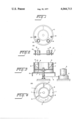
- FIG. 1 is a ground plan of the cover section of the film coating apparatus.
- FIG. 2 is a front view of the same.
- FIG. 3 is a sectional front view of a part of the main body of the film coating apparatus.
- FIG. 4 is an upper view of the FIG. 3 showing the interior.
- the film coating apparatus used for the film coating process of the present invention has such structure as is indicated by FIGS. 1 to 4. That is to say, 1 in the figure shows a rotary disk.
- a rotary disk made of stainless steel with a diameter of about 23 cm is used.
- the said disk 1 is positioned within the lower part of an outer cylinder 6 which is fixed on a mount 16.
- the said disk 1 is further fixed on a shaft which is rotated by a motor through a single stage transmission 4 and V belt 5.
- the flexible partition 10 has one portion thereof inclined in such manner that it may not stand in the way of solid particles moving on the rotary disk 1.
- the vertical position of the flexible partitions 10 is manually adjusted in advance through the quantity of fed solid particles the partition 10 being fixed to supporting plates 9 by bolts or the like.
- an annular space is formed between outer cylinder 6 and inner cylinder 8.
- a multistage transmission can be used.
- the said inner cylinder 8 may be suspended from the cover 11.
- the peripheral speed of rotation of the rotary disk 1 is selected by means of single stage transmission 4 according to diameter, shape, surface conditions, and fed quantity of particles, but 200 to 450 m/min. is suitable.
- Solid particles to be fed into the apparatus are given a movement toward the rolling direction by the rotation of the rotary disk 1.
- solid particles move toward the circumferences, since they directly touch the rotary disk 1.
- solid particles translocate upwards owing to a friction between the interior surface of the outer cylinder 6 and the particles. And the translocated particles roll down to the base on a slope of particles, that is, created from the upper surface of the rotary disk 1, to the interior of the outer cylinder 6 by gravity and centrifugal force.
- the inner cylinder 8 assists the formation of a doughnut-shaped high-speed air current caused by the flow of solid particles, prevents the solid particles and coating liquid dispersing into the inside, and plays the role of forming a rolling flow of solid particles.
- the flexible partition 10 prevents the heated gas for drying fed through a ventilating pipe 14 blowing out onto the coating section.
- the nozzles of the feeding pipe of film-coating liquid 12 and the feeding pipe of water 13 are located around the center of the flow of solid particles. In addition, if the tip of the nozzle is located near the particles, the coating liquid and water can be dispersed smoothly.
- the ventilating pipe 14 is connected to a blower and a heater.
- solid particles are fed into between the outer cylinder 6 and the inner cylinder 8.
- the rotating disk 1 is rolled by the motor 3 up to a rotating speed enough to form a stable rolling flow of solid particles.
- a gas at an appropriate temperature is let in through the ventilating pipe 14.
- Coating liquid and water are continuously fed through feeding pipes of coating liquid 12 and water 13.
- a protective film should be formed by using only a diluted (about 2.5 to 5.0%) coating solution in the present apparatus, and then the said coating should be carried out.
- the above-mentioned film coating apparatus has the following merits:
- the moving section consists of only a rotary disk. It provides a coating operation under the sealed condition and thus requires no preventive measure for the leakage of an organic solvent gas.
- Another merit is that with the present apparatus a coating can be carried out within a much shorter time than that of conventional coating process because the system can use a remarkably highly concentrated coating solution for tablets, pills, granules with a diameter of more than 2 mm. At the same time, the present apparatus provides a significant cut down in cost by reducing the quantity of solvent to use.
- Glossy globular granules were obtained by feeding 300 g of globular granules with an average diameter of 1 mm and water content of 24.0% in the said film coating apparatus and continuously adding 180 ml of a 5% solution of polyvinylacetal-diethylaminoacetate in acetone-methylchloroform mixture (7:3) while rotating the rotary disk 1 at the speed of 335 rpm and rapidly letting in an air of 55° C.
- the exhaust gas temperature was 41° C.
- the time required for the operation was 20 min.
- the water content of the granules at the end of coating was 14.6%.
- the following example is for the coating of an intestine-soluble film.
- Glossy globular granules were obtained by feeding 150 g. of globular granules with an average diameter of 1 mm and water content of 26.0% in the said film coating apparatus and continuously adding 100 ml of a 5% solution of cellulose acetate phtalate in ethanol-acetone mixture (3:7) while rotating the rotary disk 1 at the speed of 580 rpm and rapidly letting in an air of 55° C.
- the exhaust gas temperature was 43° C.
- the time required for the operation was 13 min.
- the water content of the granules at the end of coating was 8.0%.
Landscapes
- Chemical & Material Sciences (AREA)
- Health & Medical Sciences (AREA)
- General Health & Medical Sciences (AREA)
- Pharmacology & Pharmacy (AREA)
- Life Sciences & Earth Sciences (AREA)
- Animal Behavior & Ethology (AREA)
- Medicinal Chemistry (AREA)
- Public Health (AREA)
- Veterinary Medicine (AREA)
- Organic Chemistry (AREA)
- Chemical Kinetics & Catalysis (AREA)
- Medical Preparation Storing Or Oral Administration Devices (AREA)
- Medicinal Preparation (AREA)
Abstract
A coating apparatus for manufacturing of solid particles with digestive tracts-soluble film by rolling water-containing solid particles at high speed, adding a coating liquid and drying them simultaneously. Particles are disposed in a generally annular volume and supported on a generally rotary disk which is closely confined within a fixed cylinder and closely spaced from an inner fixed cylinder; said cylinder forming said annular volume. Partition means adjustably spaced from said plate, divide said volume into separate coating, water feed and drying chambers. The partitions form a sealing relationship with the particles.
Description
This is a division of application Ser. No. 444,056 filed Feb. 20, 1974, now U.S. Pat. No. 3,968,277.
The present invention relates to apparatus for coating solid particles such as granules, pills and tablets with digestive tracts-soluble film.
The conventional process for coating granules, pills and tablets with a digestive tracts-soluble film, that is, stomach-soluble film, intestine-soluble film, and gastrointestine-soluble film, is applied generally by a apparatus using a coating pan where there is repeated an operation of contacting solid particles with a solution of film coating material (hereinafter called "coating liquid") in a vessel rolling on low speed and of drying them. This process, however, has the following demerits:
1. It is impossible to add a large quantity of coating liquid at a time so as to prevent solid particles from sticking with each other. Therefore, a long time is required before finishing.
2. In this process skilled technics are required a uniform film coating at finishing.
3. This process is adverse for the commercial production because of the above-mentioned factors (1) and (2).
4. This process cannot be applied to solid particles of a small diameter.
5. Large expenses are required for warding off danger that may be incurred by the leakage of solvent gas resulted from the rolling of a coating pan itself.
6. This process makes product quality low by the loss of original gloss of a film due to a friction on the surface of solid particles, sticking of solid particles with each other, and ununiformity in the quantity of coating on the particles.
Moreover, there has recently been invented a process for spraying a coating liquid on fluidized bed of particles. This process, however, has such demerits as requiring very complicated operating conditions as well as a large quantity of organic solvent to dissolve the coating material. Under these circumstances, the present inventor attempted to develop a coating method with a digestive tracts-soluble film free from such defects as possessed by conventional methods and, after intensive research, discovered the followings:
A solution obtained from dissolving a substance selected from the under-mentioned Group B in a solvent that is a mixture of two substances selected from the undermentioned Group A, is found to possess a property to develop a film as soon as it contacts water, only in the case of a specific combination.
______________________________________
             Lower alcohol
Group A      Lower halogenated hydrocarbon
             Lower ketone
             Dialkylaminoethyl methacrylate-alkylmethacrylate
             Copolymer
             Alkylvinyl pyridine-methacrylic acid-alkylacrylate
Group B      Copolymer
             Alkyl methacrylate-methacrylic acid copolymer
             Polyvinylacetal dialkylaminoacetate
             Dicarboxylic acid halfester of cellulose acetate
______________________________________
As a result of extensive research on a process for utilizing the above-mentioned properties of the coating, the present inventor discovered the followings:
When the said solution of the coating material is poured onto solid particles containing or having an appropriate water on the surface while being rolled on high speed, a film rapidly develop on and surround the surface of the solid particles. A surplus solution is dispersed onto other non-film coated particles. In addition, the coating surrounded the surface of solid particles can be prevented from becoming viscous, if a heated gas necessary for the evaporation of the solvent is sent in simultaneously with the adding of the solution. By continuously repeating the film formation, it is possible to form a film that is soluble in digestive tract and smooth in the surface, within a short period of time. In case the surface of solid particles softens and deforms due to moisture or the solid particles contain components unstable to water, a perfect film can be formed by applying a protective coating using only an appropriate coating liquid as preliminary operation as in conventional methods and then pouring the coating liquid onto the particles while continuously dropping water necessary for film formation.
The present invention was accomplished on the basis of study results above-mentioned for the primary object of providing an apparatus for coating solid particles with digestive tracts-soluble film, which enables within a short period of time the formation of a perfect film by a very much simpler operation than those of conventional methods.
A further object of the present invention is to provide an apparatus for perfect gastric coating, a film soluble only in stomach, within a short time, by a very much simpler operation than those of conventional processes.
Another object of the present invention is to provide an apparatus for perfect enteric coating, a film soluble only in intestines, within a short time by a very much simpler operation than those of conventional processes.
A still further object of the present invention is to provide a process for perfect gastric and enteric coating, a film soluble in both stomach and intestines, within a short time by very much simpler operation than those of conventional processes.
A particular object of the present invention is to provide a apparatus for applying the said coating process, and to provide a coating apparatus where a perfect film coating is possible without being affected by the size distribution of solid particles.
One of the special feature of the coating process of solid particles with digestive tracts-soluble film is to add the coating solution onto the above-mentioned solid particles and dry them simultaneously, while rolling solid particles having an appropriate quantity of water on the surface, at high speed to such an extent that the particles will not be destroyed.
Other special feature of the coating process are as follows:
In case of coating solid particles with stomach-soluble film by the above-mentioned process, as the said coating there is used a solution obtained by dissolving dialkylaminoethyl methacrylate-alkyl methacrylate copolymer or polyvinylacetal dialkylaminoacetate in a mixed solvent of lower ketone and lower halogenated hydrocarbon or a mixed solvent of lower ketone and lower alcohol.
In case of coating solid particles with intestine-soluble film, there is used a solution obtained, as the said coating, by dissolving alkyl methacrylate-methacrylic acid copolymer or dicarboxylic acid halfester of cellulose acetate in a mixed solvent of lower ketone and lower alcohol.
In case of coating solid particles with gastrointestine-soluble film, there is used a solution obtained by dissolving alkyl-vinyl pyridine-methacrylic acid-alkyl acrylate copolymer in a mixed solvent of lower halogenated hydrocarbon and lower alcohol.
Further, special feature of the film coating apparatus of the present invention to be used for applying the said film coating process is as follows:
This apparatus is constructed by a rotary disk within a fixed outer cylinder, a motor for rotating the said rotary disk with a high speed device, a inner cylinder fixed and supported in such a manner that the lower end of the inner cylinder is slightly separated from the upper surface of the said rotary disk at the concentric position inside the outer cylinder, a cover mounted on the said outer cylinder, and feeding pipe of coating liquid, feeding pipe of water, a ventilating pipe and an exhaust pipe attached to the cover.
The following is given for further concrete explanation about the present invention:
In the film coating process of the present invention, the rolling of solid particles is given by, for instance, a high speed rotation of the rotary disk installed in such situation that it is within the outer cylinder fixed as mentioned above. The rolling condition is under the control of the nature of the surface of solid particles, the rotating speed of the rotary disk, and the friction inside the outer cylinder. Accordingly, in case that a water content is very low, diameter or form of solid particles is uneven, or solid particles slip on the above-mentioned surfaces of outer cylinder and disk because of the smoothness of particle surface, an appropriate motion can be given by increasing the rotating speed of the disk and attaching to the outer cylinder surface a block board.
The diameter of each solid particle can freely be set at within the range from 1 mm to a size applicable for oral administration. There is no restriction on the surface conditions of particles except that such particles as being concave on the surface may not be coated uniformly. Pills, global granules, tablets and others generally can be used as solid particles.
Solid particles to be film-coated are variable to a considerable extent depending on composition of solvent, its applied quantity and ventilating temperature. It is favourable, however, that the coating should be started in such condition that solid particles have an appropriate water content. When solid particles themselves contain water, they can be film-coated without drying them. This point is different from conventional processes. If solid particles contain no water, water should be added to them according to circumstances. Solid particles tend to stick together and change their moving conditions, when the translocation of water from the inside to the surface of particles delays. In such a case, an appropriate quantity of water may be supplied. As above-mentioned, in case solid particles cannot contain water before film coating, an appropriate quantity of water should be added to them after carrying on a protective coating.
As for water content of solid particles before coating, 15 to 30% by weight water to solid particles will be desirable for stomach-soluble film and intestine-soluble film while 15 to 25% by weight water to solid particles for gastrointestine-soluble film. As for a quantity of water to be added simultaneously with coating, it is 5 to 25% percentage of water by volume to volume of the used solvent for stomach-soluble film, 3 to 20% percentage of water volume to solvent volume for intestine-soluble film and 3 to 10% percentage of water volume to solvent volume for gastrointestine-soluble film.
These coating liquids may be used after a coating material such as titanium oxide, pigment or plasticizer is suspended or dissolved in them.
The lower ketone to be used as one of the mixed solvents means acetone, ethylmethylketone, etc. The lower halogenated hydrocarbon means carbon tetrachloride, chloroform, methylene dichloride, methylchloroform, etc. The lower alcohol means methanol, ethanol, iso-propanol, etc.
Ketone, halogenated hydrocarbon and alcohol other than the above-mentioned are not suitable for solvent, because they raise drying temperature owing to their high boiling points, thus badly affect both solid particles and film, and may make solvent remain in solid particles.
A mixing ratio of the said lower ketone and lower halogenated hydrocarbon or that of lower ketone and lower alcohol can be set at freely within the range of 9:1 to 3:7. However, as a ratio of lower ketone becomes higher, a required quantity of water tends to increase. At a mixing ratio other than the above-mentioned, coating material tends to be hard to dissolve as a ratio of lower halogenated hydrocarbon or lower alcohol becomes higher. And, the strength of a formed film appears to decline as a ratio of lower ketone becomes higher.
Similarly, a mixing ratio of lower alcohol and lower halogenated hydrocarbon can freely be set at within the range of 1:9 to 9:1. However, as a ratio of lower halogenated hydrocarbon becomes higher, a required quantity of water tends to increase. At a mixing ratio other than the above-mentioned, coating material tends to be hard to dissolve as a ratio of lower halogenated hydrocarbon becomes higher, and the formation of film tends to delay, as a ratio of lower alcohol becomes higher.
In order to dry simultaneous with the feed of a coating liquid, a heated gas needed for evaporation of a solvent in the coating liquid should be blown in. Air is the most common for this purpose. In case, however, solid particles may decompose or degenerate by air, an inert gas is recommended. The volume and temperature of a gas to blow in can be selected according to the quantity of solid particles to coat, the type, fed quantity, and feeding speed of coating liquid.
In short, the conditions under which solid particles can keep rolling ideally should be selected. A temperature of a gas about 45° - 65° C. is sufficient. Under the ideal coating conditions, not only the temperature of an exhaust gas becomes 10° - 20° C. lower than that of a gas to blow in, but also the temperature of the solid particles is kept at about 20° C. lower than that of the exhaust gas. The particles coated by the film coating process of the present invention will, if necessary, further be dried by an appropriate method and manufactured into a product. Since the water initially contained in solid particles undergoes azeotropy with an organic solvent during coating process and rapidly evaporates, the temperature of solid particles is kept low. Moreover, drying after film-coating is carried out without difficulty, since inside solid particles there are remained pores that have been made as a result of the rapid translocation of water to the surface, which also is one of the merits of the present invention.
The effects of the present invention are as follows:
1. By an adjustment of the rolling speed of solid particles, the feeding rate of coating liquid, the temperature and flow rate of the blowing air, a film with any desired thickness can be coated easily.
2. Since a film rapidly develops and coats solid particles, a film with an uniform thickness and yet no pinhole is obtainable without difficulty. As a result, the finished surface of particles is smooth and glossy.
3. Simultaneous operation of coating and drying shortens a time required for film coating.
4. For solid particles with a rather large diameter, a coating solution in a high concentration up to the limit can be used. This economizes an organic solvent required and significantly cuts both a required time and cost.
Next, the present invention is shown in the accompanying drawing in which:
FIG. 1 is a ground plan of the cover section of the film coating apparatus.
FIG. 2 is a front view of the same.
FIG. 3 is a sectional front view of a part of the main body of the film coating apparatus.
The FIG. 4 is an upper view of the FIG. 3 showing the interior.
The film coating apparatus used for the film coating process of the present invention has such structure as is indicated by FIGS. 1 to 4. That is to say, 1 in the figure shows a rotary disk. In the examples, a rotary disk made of stainless steel with a diameter of about 23 cm is used. The said disk 1 is positioned within the lower part of an outer cylinder 6 which is fixed on a mount 16. The said disk 1 is further fixed on a shaft which is rotated by a motor through a single stage transmission 4 and V belt 5.
In the interior surface of the said outer cylinder 6, several block boards 7 (four in the present examples) are mountable but these block boards are demountable according to circumstances. 8 in the figures shows an inner cylinder, which is supported on the said cylinder 6 by means of supporting plates 9. The said inner cylinder 8 is in the upper position slightly separated from the upper surface of the said disk 1 and concentric to the said outer cylinder 6. The said supporting plates 9 are prepared in plural number--three in the present examples. In the lower part of each supporting plate 9 there is installed a flexible partition 10 which is movable vertically according to the quantity of fed solid particles. 11 in the figures shows a cover, which is fixed close to both upper ends of the said outer cylinder 6 and the said inner cylinder 8. In the positions of the said cover 11 as are shown in the FIGS. 1 and 2, there are installed a feeding pipe of coating solution 12, a feeding pipe of water 13, a ventilating pipe 14, and an exhaust pipe 15. More particularly the flexible partition 10 has one portion thereof inclined in such manner that it may not stand in the way of solid particles moving on the rotary disk 1. During the coating operation, the vertical position of the flexible partitions 10 is manually adjusted in advance through the quantity of fed solid particles the partition 10 being fixed to supporting plates 9 by bolts or the like. And as shown, an annular space is formed between outer cylinder 6 and inner cylinder 8. By means of a plurality of the partitions 10, together with supporting plates 9 this annular space is divided into the coating section A, the water feeding section B, and the drying section C, the solid particles on the rotary disk 1 passing through all of these sections in sequence. The ventilating pipe 14 is attached to cover 11 in such manner that the outlet port at its tip can be positioned in said drying section.
In place of the said single stage transmission 4, a multistage transmission can be used. The said inner cylinder 8 may be suspended from the cover 11.
In the said apparatus of film coating, the peripheral speed of rotation of the rotary disk 1 is selected by means of single stage transmission 4 according to diameter, shape, surface conditions, and fed quantity of particles, but 200 to 450 m/min. is suitable.
Solid particles to be fed into the apparatus are given a movement toward the rolling direction by the rotation of the rotary disk 1. At the basic part of the flow of solid particles, accelerated and given a centrifugal force, solid particles move toward the circumferences, since they directly touch the rotary disk 1.
In the circumferential part of the flow of solid particles, solid particles translocate upwards owing to a friction between the interior surface of the outer cylinder 6 and the particles. And the translocated particles roll down to the base on a slope of particles, that is, created from the upper surface of the rotary disk 1, to the interior of the outer cylinder 6 by gravity and centrifugal force.
Therefore, the flow of solid particles rolls toward the advancing direction from the surface to the inside. In this case, an appropriate number of rolls will be two to four times per rotation. The said number of rolls can be adjusted by the rotating speed of the rotary disk 1 and the mounting or demounting of block boards 7. In the case of particles with smooth surface or small diameter, a desirable rolling motion is obtainable by mounting two to four block boards.
The inner cylinder 8 assists the formation of a doughnut-shaped high-speed air current caused by the flow of solid particles, prevents the solid particles and coating liquid dispersing into the inside, and plays the role of forming a rolling flow of solid particles.
The flexible partition 10 prevents the heated gas for drying fed through a ventilating pipe 14 blowing out onto the coating section.
The nozzles of the feeding pipe of film-coating liquid 12 and the feeding pipe of water 13 are located around the center of the flow of solid particles. In addition, if the tip of the nozzle is located near the particles, the coating liquid and water can be dispersed smoothly. The ventilating pipe 14 is connected to a blower and a heater.
For carrying out film coating, solid particles are fed into between the outer cylinder 6 and the inner cylinder 8. The rotating disk 1 is rolled by the motor 3 up to a rotating speed enough to form a stable rolling flow of solid particles. A gas at an appropriate temperature is let in through the ventilating pipe 14. Coating liquid and water are continuously fed through feeding pipes of coating liquid 12 and water 13. In case solid particles contain a component that rapidly degenerates with water or solid particles might transform due to the softening of the surface of particles with water, a protective film should be formed by using only a diluted (about 2.5 to 5.0%) coating solution in the present apparatus, and then the said coating should be carried out. In the course of the coating operation, when heated gas is blown out from the outlet port of ventilating pipe 14 into the drying section for desiccation, the solid particles passing through said drying section (said solid particles having been supplied with coating liquid in the coated section) are desiccated by means of the heated gas. Thus while the heated gas is being blown out, the heated gas is prevented from flowing out into the coating section by means of the partition 10.
The above-mentioned film coating apparatus has the following merits:
In the said apparatus, the moving section consists of only a rotary disk. It provides a coating operation under the sealed condition and thus requires no preventive measure for the leakage of an organic solvent gas.
Another merit is that with the present apparatus a coating can be carried out within a much shorter time than that of conventional coating process because the system can use a remarkably highly concentrated coating solution for tablets, pills, granules with a diameter of more than 2 mm. At the same time, the present apparatus provides a significant cut down in cost by reducing the quantity of solvent to use.
The following example is for the coating of a stomach-soluble-film:
Glossy, globular granules were obtained by feeding 300 g of globular granules with an average diameter of 1 mm and water content of 24.0% in the said film coating apparatus and continuously adding 180 ml of a 5% solution of polyvinylacetal-diethylaminoacetate in acetone-methylchloroform mixture (7:3) while rotating the rotary disk 1 at the speed of 335 rpm and rapidly letting in an air of 55° C. The exhaust gas temperature was 41° C. The time required for the operation was 20 min. The water content of the granules at the end of coating was 14.6%.
The following example is for the coating of an intestine-soluble film.
Glossy globular granules were obtained by feeding 150 g. of globular granules with an average diameter of 1 mm and water content of 26.0% in the said film coating apparatus and continuously adding 100 ml of a 5% solution of cellulose acetate phtalate in ethanol-acetone mixture (3:7) while rotating the rotary disk 1 at the speed of 580 rpm and rapidly letting in an air of 55° C. The exhaust gas temperature was 43° C. The time required for the operation was 13 min. The water content of the granules at the end of coating was 8.0%.
Claims (3)
1. Apparatus for coating solid particles with a digestive tracts-soluble film comprising a horizontally disposed rotary disk, an outer cylinder clearly surrounding said disk and supported upon a fixed support below said disk, a stationary inner cylinder concentrically arranged with respect to said outer cylinder and having a smaller diameter than the outer cylinder to form an annular space between the cylinders, the lower end of the inner cylinder being spaced a slight distance from the upper surface of the disk, a cover mounted on the upper cylinder and supporting a coating liquid pipe, a water feeding pipe, a ventilating pipe and an exhaust pipe, said pipes being spaced from each other and the outlets of all of said pipes opening into said annular space so that particles supported on said rotary disk are sequentially moved past the outlets of said pipes, a plurality of spaced-apart partitions are positioned in the annular space between the cylinders dividing said space into a coating section, a water feeding section and a drying section, said partitions being spaced from said rotary disk and in sealing relationship with said particles, the outlet of the coating liquid pipe being positioned in the coating section, the outlet of the water feeding pipe being positioned in the water feeding section and the outlets of the ventilating and exhaust pipes being positioned in the drying section, and means for rotating said disk.
2. Apparatus as set forth in claim 1 wherein a plurality of block boards carried by the outer cylinder project into said annular space within the path of travel of the particles.
3. Apparatus as set forth in claim 1 wherein the partitions are provided with lower outer portions which incline outwardly and downwardly.
Priority Applications (1)
| Application Number | Priority Date | Filing Date | Title |
|---|---|---|---|
| US05/608,988 US4044713A (en) | 1974-02-20 | 1975-08-29 | Tumbing apparatus |
Applications Claiming Priority (2)
| Application Number | Priority Date | Filing Date | Title |
|---|---|---|---|
| US05/444,056 US3968277A (en) | 1973-02-27 | 1974-02-20 | Process for coating solid particles with a digestive tract-soluble film |
| US05/608,988 US4044713A (en) | 1974-02-20 | 1975-08-29 | Tumbing apparatus |
Related Parent Applications (1)
| Application Number | Title | Priority Date | Filing Date |
|---|---|---|---|
| US05/444,056 Division US3968277A (en) | 1973-02-27 | 1974-02-20 | Process for coating solid particles with a digestive tract-soluble film |
Publications (1)
| Publication Number | Publication Date |
|---|---|
| US4044713A true US4044713A (en) | 1977-08-30 |
Family
ID=27033757
Family Applications (1)
| Application Number | Title | Priority Date | Filing Date |
|---|---|---|---|
| US05/608,988 Expired - Lifetime US4044713A (en) | 1974-02-20 | 1975-08-29 | Tumbing apparatus |
Country Status (1)
| Country | Link |
|---|---|
| US (1) | US4044713A (en) |
Cited By (2)
| Publication number | Priority date | Publication date | Assignee | Title |
|---|---|---|---|---|
| US5755880A (en) * | 1991-08-06 | 1998-05-26 | Borden Foods Corporation | Coating drum for cooked pasta |
| CN113995675A (en) * | 2021-10-28 | 2022-02-01 | 徐海艳 | Coating machine with high yield |
Citations (2)
| Publication number | Priority date | Publication date | Assignee | Title |
|---|---|---|---|---|
| US2799241A (en) * | 1949-01-21 | 1957-07-16 | Wisconsin Alumni Res Found | Means for applying coatings to tablets or the like |
| US3017854A (en) * | 1959-03-20 | 1962-01-23 | Edward D O'brien | Centrifugal coating apparatus |
-
1975
- 1975-08-29 US US05/608,988 patent/US4044713A/en not_active Expired - Lifetime
Patent Citations (2)
| Publication number | Priority date | Publication date | Assignee | Title |
|---|---|---|---|---|
| US2799241A (en) * | 1949-01-21 | 1957-07-16 | Wisconsin Alumni Res Found | Means for applying coatings to tablets or the like |
| US3017854A (en) * | 1959-03-20 | 1962-01-23 | Edward D O'brien | Centrifugal coating apparatus |
Cited By (3)
| Publication number | Priority date | Publication date | Assignee | Title |
|---|---|---|---|---|
| US5755880A (en) * | 1991-08-06 | 1998-05-26 | Borden Foods Corporation | Coating drum for cooked pasta |
| CN113995675A (en) * | 2021-10-28 | 2022-02-01 | 徐海艳 | Coating machine with high yield |
| CN113995675B (en) * | 2021-10-28 | 2023-11-03 | 广东先通药业有限公司 | Coating machine with high yield |
Similar Documents
| Publication | Publication Date | Title |
|---|---|---|
| US3383236A (en) | Continuous pharmaceutical film coating process | |
| US4935246A (en) | Process for the coating of granules | |
| Obara et al. | Dry coating: an innovative enteric coating method using a cellulose derivative | |
| US5047258A (en) | Aqueous spray-coating process | |
| US6627225B2 (en) | Gellan gum tablet coating | |
| US3968277A (en) | Process for coating solid particles with a digestive tract-soluble film | |
| KR100424931B1 (en) | Sustained release granules and preparation method | |
| Li et al. | Recent advances in microencapsulation technology and equipment | |
| US6569462B1 (en) | Layering process for multiparticulate dosage form | |
| EP0349644A1 (en) | A method for the preparation of coated solid medicament form. | |
| US4044713A (en) | Tumbing apparatus | |
| SE448061B (en) | PROCEDURE FOR THE PREPARATION OF PHARMACEUTICAL ACTIVE COMPOSITIONS WITH CONTROLLED RELEASE OF ACTIVE INGREDIENTS COVERED BY THE ACTIVE COMPONENT WITH A POLYMER SOLUTION IN WHICH A WATER PHASE IS DISPERSED | |
| US4690834A (en) | Process for coating solid particles | |
| US20090022800A1 (en) | Coating for small bodies | |
| JPS5820261A (en) | Drum nanufacturing sugar-coated tablet | |
| US3379554A (en) | Spray coating of pharmaceutical cores with a carboxylvinyl polymer and polyethylene glycol | |
| Chang et al. | Preparation and evaluation of shellac pseudolatex as an aqueous enteric coating system for pellets | |
| US4837033A (en) | Method for the preparation of a coated solid medicament | |
| Ramesh | Design and Evaluation of Single and Multi-unit Sustained Release Dosage Forms of Captopril | |
| US3843393A (en) | Process for coating tablets and making dragees | |
| DE2212985A1 (en) | Dragee coating machine - for chocolates,nuts or medicated cores etc, using double walled coating drum | |
| Kane et al. | Technological evaluation of three enteric coating polymers I. With an insoluble drug | |
| Caldwell et al. | New air suspension apparatus for coating discrete solids | |
| JPH0113447B2 (en) | ||
| Brophy et al. | Influence of coating and core modifications on the in vitro release of methylene blue from ethylcellulose microcapsules produced by pan coating procedure |