US398233A - clarke - Google Patents
clarke Download PDFInfo
- Publication number
- US398233A US398233A US398233DA US398233A US 398233 A US398233 A US 398233A US 398233D A US398233D A US 398233DA US 398233 A US398233 A US 398233A
- Authority
- US
- United States
- Prior art keywords
- states
- vote
- card
- ladder
- majority
- Prior art date
- Legal status (The legal status is an assumption and is not a legal conclusion. Google has not performed a legal analysis and makes no representation as to the accuracy of the status listed.)
- Expired - Lifetime
Links
- BSYNRYMUTXBXSQ-UHFFFAOYSA-N Aspirin Chemical compound CC(=O)OC1=CC=CC=C1C(O)=O BSYNRYMUTXBXSQ-UHFFFAOYSA-N 0.000 description 1
- 239000003086 colorant Substances 0.000 description 1
- VKYKSIONXSXAKP-UHFFFAOYSA-N hexamethylenetetramine Chemical group C1N(C2)CN3CN1CN2C3 VKYKSIONXSXAKP-UHFFFAOYSA-N 0.000 description 1
Images
Classifications
-
- A—HUMAN NECESSITIES
- A63—SPORTS; GAMES; AMUSEMENTS
- A63F—CARD, BOARD, OR ROULETTE GAMES; INDOOR GAMES USING SMALL MOVING PLAYING BODIES; VIDEO GAMES; GAMES NOT OTHERWISE PROVIDED FOR
- A63F3/00—Board games; Raffle games
- A63F3/00003—Types of board games
- A63F3/00138—Board games concerning voting, political or legal subjects; Patent games
Definitions
- My invention relates to games which may be played with cards especially designed for the purpose, being entitled The Gaine of Politics, or the Race for the Presidency, and based upon the electoral vote of the different States, the object being to furnish a more instructive and entertainingamusement of this character than has heretofore been produced.
- A represents the board
- B a set of the cards employed in .playing the game, six sets being required.
- the board maybe constructed in any form desired, but is preferably rectangular in shape, and is designed to be folded in the center to enable it to be more conveniently stored when not in use or transported from place to place.
- a parallelograin or space, C is marked off or formed, in which are printed the names of the different States ar-v ranged in ⁇ alphabetical order. Opposite the names ofthe States, and at either end thereof, are printed numerals which respectively represent the number of electoral votes to which the States are entitled, the sum. total (-101) of the columns of numerals thus formed being respectively shown at. the bottom of the columns, with the words Majority Needed to lVin the Gaine, 201, below them. Opposite the numerals of each State, and at each side of the space C, is formed a scoring-point,which may be in the form of a peg-hole, ai, for the reception of the pegs m..
- the spaces formed by the lower rnngs are denominated 4 Nomination, and the rive succeeding spaces formed bythe rungs are marked with numerals from 1,000 to 5,000, respectively.
- the seventh space is designated by the word Vithdrawm and the succeeding spaces in the ladders are numbered from 7,000 to 20,000, respectively.
- the board At the upper left-hand corner ot' the board is shown a chair, which is designated the Governors Chair, and extending transversely across the board from said chair, and at right angles to the ladders Gr H, is the representation of a similar ladder, K, the spaces between the rungs of which are marked in the saine manner as the ladders G H, excepting that the numerals extend to 40,000.
- the space between the top of the parallelegram C and the ladder K is designated by the words ⁇ Vhite House.
- the cards B (shown in Fie'. 2) constitute a set-six sets, or a pack consisting of fortyeight cards, being employed in playing the game. Eight cards in the pack are numbered IOO 1,000, eight 2,000, eight 3,000, eight 5,000, eight 7,000, and eight 10,000, as shown in Fig. 2.
- buttons or wads, r 5.', of different colors, ⁇ are used to designate the two predominating political parties, the pegs m being ent ployed to score the diiierent States won in the progress otI thc game.
- Equivalent scorers may be employed vFor indicating the progress of the game.
- the game must be contested by two, four, or six persons, and is played according to the following' RULES.
- NVhenevcr four or six persons play they must be seated so that a Republican sits next to a Democrat all the way round the board.
- the player next on the left of the dealer begins by throwing any card he pleases from his hand.
- the next player to him being a member ot the opposing party, must play on the iirst players card. This completes one play.
- the player who iirst throws a higher card than his opponent enters a candidate on the space marked Nomination.7
- A (a Democratic leads off with a 5,000 card; B (a Democrat plays a 7,000 card on it. That entitles B to put one of the round wads (either the red 01 the blue) on the space marked Nomination at the foot of the ladder leading to the Mayors chair; but if A plays 5,000 and B 1,000,
- the aim is to push him along up the ladder till he is elected-that is, until he reaches the chair at the top of the ladder.
- Each player throws his card in his turn, and his next neighbor to the left throws acard againstit.
- the majority card carries it, and the candidate of that side is pushed up the ladder by the amount .only of the majority.
- A, B, C, D, E, and F (six players) sit around the board in the order named. Then, under rule 3, A, C, and E are Republicans, and B, D, and F are Democrats.
- A is the leader; in that ca se (a Democrat) leads oft; B throws a card, and C (a Republican) throws a card against it.
- the highest card we will suppose, is Bs, which nominates a Democratic candidate.
- C (a Republican) throws a card
- the highest card of these two we will suppose, is thrown by C, and that nominates a Republican candidate.
- the board A may be illustrated in any manner desired, and pictures or symbols may be employed to designate the lVhite House, Senate, che., if desired.
- the arrangement ot' the different sections on the board may also be varied desired.
- a game-board provided with a number of divisions marked, respectively, U. S. Senate, Joint Vote, Vote et Senate, and Vote el' House.
- the gaine-board herein described provided with a presidential table containing the names of the several States of the United States disposed in a vertical column, iigures representing the electoral votes of the States disposed opposite the names of the States, and two columns of scoring-points also disposed opposite said names; a senatorial table having a number of divisions marked, respect ively, U. S. Senate,77 Joint Vote, Vote et' Senate, and Vote of House; a legislative ladder having' figures representing votes between each rung; a gubernatorial table having figures between each rung, and a mayors ladder, also having figures between each rung.
- the gameboard herein described provided with a presidential table containing the names of the several States ot' the United States disposed in a vertical column, two colf IOO IIO
Landscapes
- Engineering & Computer Science (AREA)
- Educational Technology (AREA)
- Multimedia (AREA)
- Management, Administration, Business Operations System, And Electronic Commerce (AREA)
Description
UNiTnn STATES PATENT rricn.
JEANIE P. CLARKE AND JAMES V. CLARKE, OF BOSTON, MASSACHUSETTS.
GAME.
SPECIFICATION forming part of Letters Patent No. 398,233, dated February 19, 18189. Application tiled Tune 26, 1888. Serial No. 278,227. No model.)
To @ZZ whom it may concern:
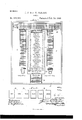
Be it known that we, JEANIE POLARKE and JAMES WV. CLARKE, both of Boston, in the county of Suffolk, State of lllassachusetts, have invent-ed a certain new and useful Improvement in Games, of which the following' is a description sufficiently full, clear, and exact to enable any person skilled in the art or science to which said invention appertains to make and use the same, reference being had to the accompanying` drawings, formin part of this specification, in which- Figure l is a top plan view of the board employed in my improved game, and Fig. i detail views of the implements used in pla ying the saine. y
Like letters and figures of reference indicate corresponding parts in the different tigures of the drawings.
My invention relates to games which may be played with cards especially designed for the purpose, being entitled The Gaine of Politics, or the Race for the Presidency, and based upon the electoral vote of the different States, the object being to furnish a more instructive and entertainingamusement of this character than has heretofore been produced.
The nature and operation of the invention will be readily understood by all conversant with such matters from the following explanation.
In the drawings, A represents the board, and B a set of the cards employed in .playing the game, six sets being required.
The board maybe constructed in any form desired, but is preferably rectangular in shape, and is designed to be folded in the center to enable it to be more conveniently stored when not in use or transported from place to place.
On the face of the board a parallelograin or space, C, is marked off or formed, in which are printed the names of the different States ar-v ranged in` alphabetical order. Opposite the names ofthe States, and at either end thereof, are printed numerals which respectively represent the number of electoral votes to which the States are entitled, the sum. total (-101) of the columns of numerals thus formed being respectively shown at. the bottom of the columns, with the words Majority Needed to lVin the Gaine, 201, below them. Opposite the numerals of each State, and at each side of the space C, is formed a scoring-point,which may be in the form of a peg-hole, ai, for the reception of the pegs m.. At thehead of the column of States are the words Electoral Votes by States, and at the foot of said column, beneath the words lllajority Needed,&c.,is the word Nomination.7 A figure, D, in imitation of a ladder, is printed on the board Abelow the space C,tl1e spaces between the rungs of said ladder being respectively marked U. S. Senate,7 Joint Vote, Vote of Senate, Vote of House, and Nomination.7 At the left of the lower end of said space is a cut or print representing a chair, which is designated Mayors Chair, and in a corresponding position at the right of said space a similar chair is disposed, which is designated Congressinans Chair. At each side of the space C, and arranged in parallelism there with, is printed the representation of aladder,
,I G H, the upper end of the ladder G being disposed at the Mayors chair and the upper end `of the ladder H at the Congressmans chair.
Beginning at the lower ends of the ladders G Il, respectively, the spaces formed by the lower rnngs are denominated 4 Nomination, and the rive succeeding spaces formed bythe rungs are marked with numerals from 1,000 to 5,000, respectively. The seventh space is designated by the word Vithdrawm and the succeeding spaces in the ladders are numbered from 7,000 to 20,000, respectively. At the upper left-hand corner ot' the board is shown a chair, which is designated the Governors Chair, and extending transversely across the board from said chair, and at right angles to the ladders Gr H, is the representation of a similar ladder, K, the spaces between the rungs of which are marked in the saine manner as the ladders G H, excepting that the numerals extend to 40,000. The space between the top of the parallelegram C and the ladder K is designated by the words \Vhite House.
The cards B (shown in Fie'. 2) constitute a set-six sets, or a pack consisting of fortyeight cards, being employed in playing the game. Eight cards in the pack are numbered IOO 1,000, eight 2,000, eight 3,000, eight 5,000, eight 7,000, and eight 10,000, as shown in Fig. 2.
Two buttons or wads, r 5.', of different colors,` are used to designate the two predominating political parties, the pegs m being ent ployed to score the diiierent States won in the progress otI thc game. Equivalent scorers may be employed vFor indicating the progress of the game.
The game must be contested by two, four, or six persons, and is played according to the following' RULES.
1. lt only two play, open the board and let one player sit opposite the other. It four or six persons play, they must play as partnerstwo or three Republicans against two or three Democrats.
2. NVhenevcr four or six persons play they must be seated so that a Republican sits next to a Democrat all the way round the board.
3. Shuttle the cards well, draw for first deal, and let the deal pass from the first dealer to the player next on his left and in rotation.
Li. Deal out the entire pack of forty-eight cards, giving each player an equal number of cards-twenty-tour apiece if two play, twelve apiece it tour play, and eight apiece vif six play.
5. Piek up and arrange your cards, putting the cards of each number together, so as to know what your hand is. Choose either the blue or red wad to represent the Democrat or Republican candidate, as you prefer. lf'the blue wad is the Democrat, then the red will of Acourse stand lfor the Republican, and Vice versa.
6. The player next on the left of the dealer begins by throwing any card he pleases from his hand. The next player to him, being a member ot the opposing party, must play on the iirst players card. This completes one play. The player who iirst throws a higher card than his opponent enters a candidate on the space marked Nomination.7
7. Thus, for example, A (a Republican leads off with a 5,000 card; B (a Democrat plays a 7,000 card on it. That entitles B to put one of the round wads (either the red 01 the blue) on the space marked Nomination at the foot of the ladder leading to the Mayors chair; but if A plays 5,000 and B 1,000,
-then A is entitled to enter his candidate. If A plays 5,000 and .B 5,000, it is a tie and neither can enter.
8. As soon as any player plays a card higher than the player of the other side against whom he plays, he can enter his sides candidate and not before.
9. Having entered the candidate, the aim is to push him along up the ladder till he is elected-that is, until he reaches the chair at the top of the ladder. Each player throws his card in his turn, and his next neighbor to the left throws acard againstit. The majority card carries it, and the candidate of that side is pushed up the ladder by the amount .only of the majority.
10. To illustrate: A, B, C, D, E, and F (six players) sit around the board in the order named. Then, under rule 3, A, C, and E are Republicans, and B, D, and F are Democrats. We will suppose that A is the leader; in that ca se (a Democrat) leads oft; B throws a card, and C (a Republican) throws a card against it. The highest card, we will suppose, is Bs, which nominates a Democratic candidate. Then C (a Republican) throws a card, and B (a Democrat) throws a card against it. The highest card of these two, we will suppose, is thrown by C, and that nominates a Republican candidate. Then it is the turn of E (a Republican) to throw a card, against which F (a Democrat) must throw a card. Suppose F throws a 5,000 card and E a 3,000 card. Then the Delnocratic candidate has 2,000 majority and is advanced 2,000 on the ladder.
11. The play goes on in this way, turn after turn-one player of one side against one of the other, the majority on each play being' scored for the side that makes it by advancing the blue or red wad up the ladder until the hand is played. Then shufle,deal again, and play as before. l
12. Having put a man into the Mayors chair, the next majority scored by that side carries the man on to the next space marked Nomination at the foot of the next ladder, and the scoring` goes on as before. No majority, however large, will carry a candidate beyond a chair on any one move. For example, if a candidate needs 2,000 to reach one of the chairs, and one of the players of that side scores 9,000 majority, it simply puts him into TOO IOS
the chair. It does not carry him any farther.v
13. As fast as a candidate reaches one ehair he can be nominated or entered for the next directly one of the players on that side throws a higher card than his opposing player, but always in this order: from the Hayors chair to the foot of the Governors ladder, form the Governors chair to the foot of the Congressmans ladder, from the Congressmans chair to the foot of the steps leading to the United States Senate, and from the United States Senate to the Nomination space at the foot of the list of States.
14. On each of the first three ladders (the Mayor, Governor, andY Congressman) the sixth round (6,000) is marked lVithdrawn. It one of the two candidates gets a majority which, being scored, brings him to this space marked Withdrawn, he is thereby put off that Tail der, and can onlybe entered again when some player on that side has scored a majority over a player opposed to him on the other side. A player will strive, therefore, to avoid throwing such a card as will en able his .opponent to IIO throw one against it that will leave him just majority enough to bring his candidate up to (5,000.
115. The United States Senate Chamber is not reached by the ladder. As in real politics so in this game a llnited States Senator is elected by the vote ot' the Legislature. First the vote of the ll'ouse of Representatives of his State is taken, then the vote of the Senate of his State, and then they go into what is called Joint Convention, and he must have a majority on the joint ballot--that is, a ma jority ot two bodies voting' together as one body. lVhen the turn ot` a player comes who has a candidate entered tor the United States Senate, he simply plays against his opponent, as usual, and it the majority is on his side he advances his man on to the first space marked Vote of the House. Ile has carried that one step. lit the majority is with his opponent, the latter advances his man instead or scores his majority en his candidate upon any other ladder. The Vote of the Senate is carried in the same way, and so is the Joint Vote 7--that is, a majority on one play between two opposing players carries each of these three steps that lead to the Senate (.fhamben and when the Joint Vote step is reached that is equal to election and the candidate of the blue or red wad is putinside the Senate Chamber. The next majority scored on his side nominates him t'or the Presidency.
The presiden/fnl Rove.
lll. The Presidency in real politics is carried bythe candidate who obtains a majority of the electoral votes of all the States. The total et' the electoral vote of all the States is 401. Therefore 201 is necessary to elect a President. This game exactly reproduces this feature of our governmental system. In the center of the board the States are named in alphabetical order. Opposite the name otl each State is the number of its electoral votes. The number of its electoral votes is given twice-'once on the right, once on the left hand. This is for convenience in scoring. Peg-holes are placed at the side of eachnumber. As one side or the other in the game gains a State its peg will be placed opposite the States vote. One side would peg its States on the lett and one on the right of the tables ol' States, so as to be able to add their respective scores up easily. The side that :t'oots up 201 electoral votes tirst elects its President and wins the game. The voting for President is to be carried on as follows: As soon as a candidate t'or lhesident is entered every player of the side to whom he belongs will in his turn vote on the States, one at a time in their alphabetical order-that is to say, it being his turn to play he will throw his card as usual against his opponent of the other party and the majority card settles it. As each State is won it must be pegged to show to which party it belongs.
counted lo advance their man at whatever stage of the game he happens to be. Call the States in their order on the list once and let cach be voted on once, and only once, until.
the whole thirty-eight have been called. Some will be carried by one side and some by the other side and pegged accordingly. Some et them will not be carried by either side, each player, perha-ps, having thrown a card ot equal value-5,000 against @OOO-which would be a tie, and so the State would be left unpegged. Having called and voted on each State once, go back and call over the States still leitto be carried, again callin g them in their order on the list. On this second call no State must be passed until it is carried by one party or the other. lf cards of equal value are thrown on the second call, that will be called a tie, and at once the State will be called again for the next two 'players to decide, and it" they tie it again it will be called again for the next two players to decide, and so on till one player secures its electoral vote by throwing a higher card than his opposing player.
The board A may be illustrated in any manner desired, and pictures or symbols may be employed to designate the lVhite House, Senate, che., if desired.
The arrangement ot' the different sections on the board may also be varied desired.
Having thus explained our invention, what we claim isi. A game-board provided with a number of divisions marked, respectively, U. S. Senate, Joint Vote, Vote et Senate, and Vote el' House.
2. The gaine-board herein described, provided with a presidential table containing the names of the several States of the United States disposed in a vertical column, iigures representing the electoral votes of the States disposed opposite the names of the States, and two columns of scoring-points also disposed opposite said names; a senatorial table having a number of divisions marked, respect ively, U. S. Senate,77 Joint Vote, Vote et' Senate, and Vote of House; a congressional ladder having' figures representing votes between each rung; a gubernatorial table having figures between each rung, and a mayors ladder, also having figures between each rung.
The gameboard herein described, provided with a presidential table containing the names of the several States ot' the United States disposed in a vertical column, two colf IOO IIO
umns of figures representing the electoral each rung; a gubernatorial table having g'- Io votes of the States disposed on opposite sides ures between each rung, and a mayors ladder,
of the names of the States, and two columns also having figures between each rung, in comof scoring-points disposed opposite said eoli bination with scorers and a set of game-cards. umns of iigures; a senatoral table having a l JEANIE P. CLARKE. number of divisions marked, respeetively,U. JAMES W. CLARKE.
S. Senate, Joint Vote, Vote of Senate, and Vote of House 3 a congressional ladder g having figures representing Votes between E l/Vitnesses:
AUGUSTUS ANDREWS, GEO. W. EsTABRooK.
Publications (1)
| Publication Number | Publication Date |
|---|---|
| US398233A true US398233A (en) | 1889-02-19 |
Family
ID=2467197
Family Applications (1)
| Application Number | Title | Priority Date | Filing Date |
|---|---|---|---|
| US398233D Expired - Lifetime US398233A (en) | clarke |
Country Status (1)
| Country | Link |
|---|---|
| US (1) | US398233A (en) |
Cited By (3)
| Publication number | Priority date | Publication date | Assignee | Title |
|---|---|---|---|---|
| US3889955A (en) * | 1974-07-05 | 1975-06-17 | Verlon Welch | Legislative board game apparatus |
| US4682778A (en) * | 1986-03-13 | 1987-07-28 | Willis Wayne H | Political game utilizing die with interchangeable faces |
| US4865327A (en) * | 1987-12-22 | 1989-09-12 | Wang Kuo Yi | Board game |
-
0
- US US398233D patent/US398233A/en not_active Expired - Lifetime
Cited By (3)
| Publication number | Priority date | Publication date | Assignee | Title |
|---|---|---|---|---|
| US3889955A (en) * | 1974-07-05 | 1975-06-17 | Verlon Welch | Legislative board game apparatus |
| US4682778A (en) * | 1986-03-13 | 1987-07-28 | Willis Wayne H | Political game utilizing die with interchangeable faces |
| US4865327A (en) * | 1987-12-22 | 1989-09-12 | Wang Kuo Yi | Board game |
Similar Documents
| Publication | Publication Date | Title |
|---|---|---|
| US793489A (en) | Card-receptacle for duplicate cribbage. | |
| US5242171A (en) | Game cards for playing a game and for learning arithmetic | |
| US4826175A (en) | Word card game | |
| US5224862A (en) | Initial and reinforcement learning unit | |
| US4223892A (en) | Stategy game | |
| US3318601A (en) | Apparatus for playing election game | |
| US4643429A (en) | Educational board game | |
| US715474A (en) | Game board. | |
| WO1997010881A2 (en) | Game set with tiles or pieces bearing indicia and a method of playing the same | |
| US6325374B1 (en) | Educational board game method and apparatus | |
| US1592252A (en) | Game | |
| US4709926A (en) | Electoral college game | |
| US4955619A (en) | Card game apparatus and method | |
| US1113504A (en) | Base-ball game. | |
| US1484564A (en) | Pack of game cards | |
| US458451A (en) | Game apparatus | |
| US2546347A (en) | Game board for simulated racing | |
| US4344627A (en) | Alphabet game | |
| US1200131A (en) | Playing-cards. | |
| US1048346A (en) | Playing-cards. | |
| US7568701B1 (en) | Card game | |
| US481859A (en) | Parlor game | |
| US1672478A (en) | Baseball game | |
| US690273A (en) | Game. | |
| US1570475A (en) | Playing cards |